Inconvenient truths on nuclear waste ignored or buried by UK Government (again).
Industrial Strategy (BEIS) department published two important new documents dealing with the UK radioactive waste strategy.
http://drdavidlowry.blogspot.com/2018/12/inconvenient-truths-on-nuclear-waste.html
Enormous costs of shutting down Japan’s nuclear facilities
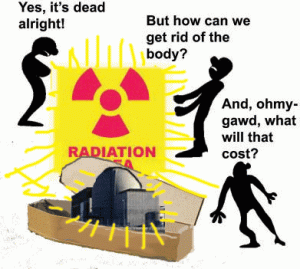 Costs for scrapping 79 nuclear facilities estimated at 1.9 tril. yen https://mainichi.jp/english/articles/20181227/p2g/00m/0na/001000c Costs for scrapping 79 nuclear facilities estimated at 1.9 tril. yen https://mainichi.jp/english/articles/20181227/p2g/00m/0na/001000c
December 27, 2018 (Mainichi Japan) TOKYO (Kyodo) — The state-backed Japan Atomic Energy Agency said Wednesday it would need to spend about 1.9 trillion yen ($17.1 billion) to close 79 facilities over 70 years, in its first such estimate. The total costs could increase further, as the agency said the estimated figure, which would be shouldered by taxpayers, excludes expenses for maintenance and replacing aging equipment. The JAEA plans to close more than half of the 79 facilities over the next 10 years due in part to the increased costs to operate them under stricter safety rules introduced after the 2011 Fukushima nuclear crisis. The agency, which has led nuclear energy research in Japan with its predecessors since the 1950s, owns a total of 89 facilities. Of the estimated costs, the expense for closing the nation’s first spent-fuel reprocessing plant in the village of Tokai, Ibaraki Prefecture, northeast of Tokyo, accounts for the largest chunk of 770 billion yen. It will cost 150 billion yen to decommission the trouble-plagued Monju prototype fast-breeder nuclear reactor. As for nuclear waste, the agency said about 100 kiloliters of high-level radioactive waste and up to 114,000 kl of low-level radioactive waste were estimated to have been produced but it has yet to decide on disposal locations. The Japanese government aims to restart nuclear power plants after a nationwide halt following the nuclear crisis, despite persistent concern over the safety of atomic power generation. |
|
|
USA desperate to make money from the nuclear industry – selling radioactive trash clean-up technology
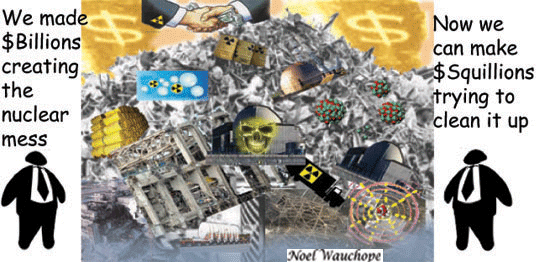
 US to offer ‘black box’ nuclear waste tech to other nations ChannelNews Asia 20 Dec 18
The U.S. Department of Energy’s nuclear security office is developing a project to help other countries handle nuclear waste, an effort to keep the United States competitive against global rivals in disposal technology, according to two sources familiar with the matter.
WASHINGTON: The U.S. Department of Energy’s nuclear security office is developing a project to help other countries handle nuclear waste, an effort to keep the United States competitive against global rivals in disposal technology, according to two sources familiar with the matter.
The push comes as the United States struggles to find a solution for its own mounting nuclear waste inventories amid political opposition to a permanent dump site in Nevada, proposed decades ago, and concerns about the cost and security of recycling the waste back into fuel.
The National Nuclear Security Administration is considering helping other countries by using technologies that could involve techniques such as crushing, heating and sending a current through the waste to reduce its volume, the sources said.
The machinery would be encased in a “black box” the size of a shipping container and sent to other countries with nuclear energy programs, but be owned and operated by the United States, according to the sources, who asked not to be named because of the sensitivity of the matter.
“That way you could address a country’s concerns about spent fuel without transferring ownership of the technology to them,” said one of the sources.
The NNSA confirmed a project to help other countries with nuclear waste is underway but declined to provide details.
We are in the conceptual phase of identifying approaches that could reduce the quantity of spent nuclear fuel without creating proliferation risks – a goal with significant economic and security benefits,” NNSA spokesman Dov Schwartz said.
The effort is being led by NNSA Deputy Administrator for Defense Nuclear Nonproliferation Brent Park, a nuclear physicist and former associate lab director at the Energy Department’s Oak Ridge National Laboratory, appointed by President Donald Trump in April.
The NNSA declined a Reuters request for an interview with Park.
The sources did not name countries to which the service would be marketed, or where the waste would be stored after it is run through the equipment. But they said they were concerned the processes under consideration could increase the risk of dangerous materials reaching militant groups or nations unfriendly to the United States.
Former President Jimmy Carter banned nuclear waste reprocessing in 1977 because it chemically unlocks purer streams of uranium and plutonium, both of which could be used to make nuclear bombs.
The NNSA’s Schwartz said the plans under consideration do not involve reprocessing, but declined to say what technologies could be used.
The sources familiar with the NNSA’s deliberations said there are three basic ways that the physical volume of nuclear waste can be reduced, all of which are costly. At least one of the techniques poses a security threat, they said.
The first, called consolidation, reduces the volume of nuclear waste by taking apart spent fuel assemblies and crunching the waste down to two times smaller than the original volume – an approach that is considered costly but which doesn’t add much security risk.
A second technique involves heating radioactive pellets in spent fuel assemblies. The process, which gives off gases that must be contained, results in a waste product that has more environmental and health risks.
A third approach called pyroprocessing – developed at the Department of Energy’s Argonne National Laboratory – puts spent fuel in liquid metal and runs an electric current through it. That reduces volume, but concentrates plutonium and uranium – making it a potential proliferation risk.
The nuclear community is divided on whether pyroprocessing fits the definition of reprocessing.
The Trump administration has made promoting nuclear technology abroad a high priority, as the United States seeks to retain its edge as a leader in the industry, amid advancements by other nations like Russia, and France – both of which already offer customers services to take care of waste.
U.S. reactor builder Westinghouse, which emerged from bankruptcy in August and is owned by Brookfield Asset Management, hopes to sell nuclear power technology to countries from Saudi Arabia to India, but faces stiff competition from Russia’s state-owned Rosatom.
U.S. Energy Secretary Rick Perry visited Saudi Arabia this month for talks on a nuclear energy deal with the kingdom, despite pushback from lawmakers concerned about the killing of journalist Jamal Khashoggi in the Saudi consulate in Istanbul………… https://www.channelnewsasia.com/news/technology/exclusive–us-to-offer–black-box–nuclear-waste-tech-to-other-nations-11046762
MOUNTING U.S. STOCKPILES of nuclear wastes – with nowhere to go
|
“…………MOUNTING U.S. STOCKPILES The United States is also struggling to support its own nuclear industry at home, with aging reactors shuttering, new projects elusive due to soaring costs, and an ongoing political stalemate over a permanent solution for mounting nuclear waste stockpiles. The United States produces some 2,000 metric tons of nuclear waste each year, which is currently stored in pools or in steel casks at the nation’s roughly 60 commercial nuclear power plants across 30 states. The federal government designated Nevada’s Yucca Mountain as the sole permanent U.S. nuclear waste repository decades ago to solve the problem, spending about US$13 billion on the project, but it has never opened due to local opposition. Thomas Countryman, the State Department’s top arms control officer during the Obama administration, said the government should make headway on the domestic problem before helping other countries. “The primary issue on this front … is not that the U.S. can’t offer a low-volume option to potential buyers; rather it’s that the U.S. still has no option for disposing of its own spent fuel,” he said. Edwin Lyman, a nuclear expert at the Union of Concerned Scientists, said NNSA should be less concerned about volume of waste and more concerned about the dangers that make it hard to store. “It’s not the volume of the nuclear waste that’s the issue, but the radioactivity and heat it gives off as well as the fact that it remains dangerous for hundreds of thousands of years,” he said. (Reporting by Timothy Gardner; Editing by Richard Valdmanis and Brian Thevenot) Source: Reuters https://www.channelnewsasia.com/news/technology/exclusive–us-to-offer–black-box–nuclear-waste-tech-to-other-nations-11046762
|
|
Britain’s nuclear nightmare -the Thermal Oxide Reprocessing Plant
 UK’s dream is now its nuclear nightmare https://climatenewsnetwork.net/uks-dream-is-now-its-nuclear-nightmare/?fbclid=IwAR3CEunSXXOxdK_-N8Ka9kwpCMzvHFXNkZf23VGjd6oFuDecember 14, 2018, by Paul Brown
Nobody knows what to do with a vast uranium and plutonium stockpile built up in the UK by reprocessing spent fuel. It is now a nuclear nightmare.
LONDON, 14 December, 2018 − Thirty years ago it seemed like a dream: now it is a nuclear nightmare. A project presented to the world in the 1990s by the UK government as a £2.85 billion triumph of British engineering, capable of recycling thousands of tons of spent nuclear fuel into reusable uranium and plutonium is shutting down – with its role still controversial.
Launched amid fears of future uranium shortages and plans to use the plutonium produced from the plant to feed a generation of fast breeder reactors, the Thermal Oxide Reprocessing Plant, known as THORP, was thought to herald a rapid expansion of the industry.
In the event there were no uranium shortages, fast breeder reactors could not be made to work, and nuclear new build of all kinds stalled. Despite this THORP continued as if nothing had happened, recycling thousands of tons of uranium and producing 56 tons of plutonium that no one wants. The plutonium, once the world’s most valuable commodity, is now classed in Britain as “an asset of zero value.” Continue reading
UK’s Sellafield nuclear reprocessing – a financial black hole for the Nuclear Decommissioning Authority
 Sellafield boss warns on nuclear clean-up, Guardian, Adam Vaughan@adamvaughan_uk, 16 Dec 2018
Falling revenues from waste reprocessing have led to a financial black hole for the Nuclear Decommissioning Authority The government body given the job of cleaning up Britain’s old nuclear power stations has warned that taxpayers will have to help plug a looming multimillion-pound gap in its finances left by shrinking revenues.
David Peattie, chief executive of the Nuclear Decommissioning Authority, said revenues would fall more than 10% annually in coming years due to the end of an era of nuclear waste reprocessing. One plant ceased operations in November and another will stop in two years.
The group has a £3bn annual budget to clean up 17 old nuclear sites around the UK, but earns £1bn a year from services including repurposing spent nuclear fuel. “I don’t think we can fill the hole completely,” Peattie said.
He hopes to offset some of the losses by making better use of the NDA’s fleet of four ships that operate out of Barrow-in-Furness, Cumbria. The ships were used to bring spent fuel from as far afield as Japan back to the UK for reprocessing.
Peattie also hopes to secure more non-nuclear work such as the non-food cargo it handles for Tesco using its rail business, which runs around 100 locomotives. The rail unit transports waste from nuclear power stations to be stored at the NDA’s biggest and most costly site, Sellafield in Cumbria.
The final bill could also be reduced, said Peattie if the public accepted that not all old nuclear facilities would be returned to a pristine field of “buttercups and daisies”.
The legacy of the industrial revolution means people already tolerate “industrial clutter” in parts of the countryside, he said……. https://www.theguardian.com/environment/2018/dec/16/taxpayers-face-extra-nuclear-cleanup-cost
The mad plan to store nuclear waste on the beach
 https://beyondnuclearinternational.org/2018/12/16/the-mad-plan-to-store-nuclear-waste-on-the-beach/, December 16, 2018
An accident at the California storage site would leave residents nowhere to run, By Diane RayOn August 9, 2018, standing tall and looking the part of the hero, David Fritch stepped up to the lectern at a Community Engagement Panel meeting between the owner of a now shuttered nuclear power plant and local residents concerned about the beachfront disposal of nuclear waste. “I may not have a job tomorrow,” he began, “But that’s fine. I made a promise to my daughter.”
Fritch introduced himself as an experienced nuclear power plant safety worker, sent around the country to oversee safety at various sites. He then reported what the Nuclear Regulatory Commission (NRC) called a “near miss” incident at the radioactive waste storage facility of the local nuclear power plant.
On August 3, 2018, a 100,000 pound thin-wall cask filled with deadly irradiated nuclear fuel got caught on a flange while being lowered into the steel-lined concrete vault of the waste storage site, known as an ISFSI (independent spent fuel storage installation). The cask got stuck on a ¼” guide ring for about an hour over an 18-foot drop.
“It was a bad day…. And you haven’t heard about it,” said Fritch. “And that’s not right.”
It was “a bad day” at a place where close to 3.6 million pounds of high level irradiated commercial nuclear fuel are being rushed into the sands of a fragile bluff, one and a half feet above the mean high tide, 108 feet from the sea, near an active earthquake fault, in a tsunami inundation zone, behind an inadequate sea wall.
It was another “bad day” at the long troubled and now closed San Onofre Nuclear Generating Station (SONGS) and its radioactive waste burial site on San Onofre State Beach, the iconic birthplace of California surf culture.
Coastal scientist and engineer, Rick Wilson of the Surfrider Foundation called it the worst waste site possible. Charles Langley, Director of Public Watchdogs and co-author of Radiological Regulatory Failure, called it insane: “Due to the danger from corrosion,” said Langley, “you never put nuclear waste next to salt and water.”
The ISFSI opened on January 31, 2018 to public opposition from Orange County citizens groups concerned about nuclear safety, including San Onofre Safety, Public Watchdogs, and Residents Organized for a Safe Environment (ROSE).
Fritch explained to a stunned audience that the two-man loading team handling the incident did not know that this was the second serious cask loading incident. “Public safety should be first and it is not,” Fritch said. “Behind the gate, it is not.”
Mandated by the NRC to report a nuclear incident in writing within an hour, Southern California Edison waited 42 days to issue their report, having informed the NRC three days after the incident via a “courtesy phone call.” Forced to issue a response, the NRC subsequently concurred with Fritch’s account, admitting to the possibility of: “a load drop event,…[in which the cask] could have fallen 18 feet into the storage vault if it had slipped off the inner ring assembly.”
How serious would the potential outcome have been had that nuclear waste cask fallen? Tom English, environmental engineer and former Presidential nuclear waste policy advisor, and local colleagues at UCSD and at the Samuel Lawrence Foundation, concluded that a cask could have “hit the concrete floor with the explosive energy larger than two sticks of dynamite.” They noted that based on the NRC’s own analysis of a similar dropped cask of slightly different dimensions, there was a 28 percent chance following a drop event that local residents would have needed to evacuate.
How can such a rate be acceptable in a highly populated area, they wondered? In a failure scenario caused by a steep drop of a cask, the air ducts could be damaged: “Water,” warned English, “would have to pour into the hole to cool the reaction and prevent or control a meltdown….As at Fukushima…the enveloping water would instantly become radioactive steam and require the evacuation of millions of people.”
Who would coordinate evacuation? Not the Marines standing guard across the freeway from SONGS nor any part of the federal government, which has opted out of any emergency or evacuation planning now that the nuclear plant is closed. Not by the state of California which has not come through with any comprehensive plan.
But even if there were government plans in place, nuclear emergency plans on paper are unlikely to be workable in real life. A serious accident could compromise the abutting rail line and freeway, the adjacent Marine Corps Base Camp Pendleton, the Pacific Ocean, vast treasures of land and wildlife, and a state that is ranked as the world’s fifth largest economy.
By the end of 2019, Edison plans to house 73 radioactive waste casks on the shoreline site. Along with an older ISFSI on site housing 51 thin-wall casks about 100 feet further up the beach, SONGS will become the largest commercial irradiated fuel burial site in the nation. Each thin-wall cask weighs about 100,000 pounds, bolted shut and loaded with pez like pellets of uranium. “The amount of radioactive isotope, cesium 137, contained within each cask is equivalent to one Chernobyl accident worth of escaped radiation in the event of a through leak into the atmosphere,” English told me.
Fritch’s allegation of an earlier cover-up of a loading event at the ISFSI was verified by Nina Babiarz of Public Watchdogs in a sworn affidavit, and confirmed by the NRC in a Webinar on November 8, 2018, according to Langley.
n the Ripley’s Believe It Or Not of the story, there was yet another near-miss at the ISFSI. Edison disclosed at a Community Engagement Meeting on March 21, 2018 that a four-inch bolt, used to secure a shim needed to circulate cooling helium within the nuclear waste cask, had fallen off, discovered right before the cask was to be filled and buried. Loading had been halted for 10 days but was once more underway.
Local nuclear safety advocates were horrified. What about the first four casks of the same model, already in the vault? Did they share the flaw, which could lead to overheating of the irradiated waste? The NRC declared it had made its inspection and found everything in order. However, no technology presently exists to inspect the interior of this model of thin-wall cask entombed in concrete.
Why would anyone rush to bury high-level radioactive waste on a state beach with high seismic and corrosion risks? In the opinion of Langley, there are two reasons: First, that Edison chose the old footprint of SONGS former Unit I to sidestep superfund cleanup costs and accelerate NRC approval (claiming the NRC suggested the beachfront site); Second, by dumping the waste onto public land, Edison sprints to the finish line, potentially also dumping liability for any future nuclear accident in a legal maneuver called “bona vacantia,” or legally ownerless. Public land equals public liability.
Fritch has since left the nuclear industry. SONGS’ Chief Nuclear Officer responsible for managing the ISFSI, Tom Palmisano, has stepped down. The NRC writes that it suspects that all thin-wall casks “in the storage vaults may have had metal to metal contact” between the cask being lowered and the storage vault. There is only ½” of clearance between the cask walls and the vault lining. The NRC acknowledged: The thin-wall casks “ tend to bump against the shelf while being loaded into the vault…”.
This raises the probability that all 29 thin-wall casks in the vault sustained damage to their exteriors, potentially accelerating cracking and leaking. At the time of the near drop incident last August, a 30th filled cask turned up locked in limbo, unable to be returned to the spent fuel pool or to be buried in the damaged vault. It remains stranded in a building, stored within a transfer cask. However, transfer casks are not intended to provide an indefinite radiation barrier for thin-wall casks but are only approved by the NRC for brief usage, protecting workers during transfer operations.
Neither Edison, the subcontractor, Holtec, nor the NRC will release information about how they can maintain a safe temperature for the stranded cask. The NRC states only that the cask is being kept sufficiently cool. Nuclear safety advocates are not reassured, particularly since the NRC is leaving it up to Edison as to whether they choose to resume loading operations into the clearly defective model of vault, the Holtec Hi-Storm UMAX.
Safety advocates consider this example, as well as the NRC’s pervasive pattern of lax oversight in all the near miss incidents cited in this article, as the very definition of a “captured agency,” a proverbial fox minding a hen house. Donna Gilmore, Director of San Onofre Safety and frequent intercessor with the NRC, concludes: “Congress and the President should mandate the NRC enforce safety standards…and force the NRC to stop misleading them about the safety of systems they approve.”
Public Watchdogs and San Onofre Safety advocate for immediate closure of the beachfront ISFSI. They propose loading the irradiated fuel into thick-wall casks that are 10 to 19.75 inches thick and stored in hardened buildings. This variant of cask, most commonly used around the world and which withstood the earthquake and tsunami at Fukushima, can be inspected and repaired to prevent leaks and explosions. These two groups then propose moving the sturdier casks across the freeway onto higher and drier ground at Camp Pendleton. Bonus: the marines stand guard.
Nuclear safety advocates recognize, however, that the plan suggested above is a “least worst” option, by no means 100% safe. At San Onofre, as elsewhere, the problem of safely, securely, and permanently storing high-level radioactive waste is yet to be solved. Without vigilant citizen oversight and advocacy, in the hands of the nuclear industry, the “least worst” option will never be achieved.
“For nuclear disaster at San Onofre,” concludes Langley, “you don’t even need an earthquake or a tsunami, you just need the nuclear industry.” And its lapdog regulator, too.
Diane Ray became an anti-nuclear activist in the late 1970s, working with Safe ‘n Sound against nuclear plant construction at Shoreham, Long Island, NY. Shoreham never opened. Ray is a member of Public Watchdogs.
Headline photo is a Google Earth shot of the SONGS ISFSI just steps from the shoreline.
Editor’s Note: Beyond Nuclear supports moving the SONGS radioactive waste off the shoreline and onto Camp Pendleton. We also support HOSS — Hardened On-Site Storage. HOSS mandates that: Irradiated fuel must be stored as safely as possible as close to the site of generation as possible; HOSS facilities must not be regarded as a permanent waste solution, and thus should not be constructed underground and the waste must be retrievable; The facility must have real-time radiation and heat monitoring for early detection of problems with containers; The overall objective of HOSS should be that the amount of releases projected in even severe attacks should be low enough that the storage system would be unattractive as a terrorist target; Placement of individual canisters that makes detection difficult from outside the site boundary. Read more about HOSS.
USA’s absolute dilemma over radioactive trash – used nuclear fuel
 What to do with used nuclear fuel, from Illinois to California https://thebulletin.org/2018/12/what-to-do-with-used-nuclear-fuel-from-illinois-to-california/ By Jeff Terry, December 14, 2018 The largest operator of nuclear power plants in the United States, Exelon, closed two nuclear reactors in the city of Zion, Illinois in 1998 because of low demand, which in turn led to poor operating economics. Ever since, these two pressurized water reactors have sat unused on the Lake Michigan shoreline just north of Chicago. Exelon contracted the company EnergySolutions to decontaminate and decommission the site, and this fall it announced it was nearly done, with demolition of the two structures almost complete.
These two closed reactors have been a thorn in Zion’s side since they shut down 20 years ago. The city lost $18 million in annual property tax revenue when the plants closed, and the shortfall had to be made up by local businesses and residents. Beyond the financial loss, the city can’t use the site for parkland, redevelopment, or anything else. But now that decontamination and decommissioning are nearly complete, Zion should be able to reclaim the land and convert it to beneficial use—right?
Not just yet. There is still spent nuclear fuel at the Zion site—bundles of rods of uranium dioxide pellets contained within Zircaloy metal claddings. These used fuel assemblies have been placed in large cylindrical concrete containers, which will be stored at the site on a 3,000 square-meter pad, an area just larger than half a football field. There they will remain in limbo due to the Nuclear Waste Policy Act of 1982. That year, in its infinite wisdom, the US Congress enacted a law saying that “the generators and owners of high-level radioactive waste and spent nuclear fuel have the primary responsibility to provide for, and the responsibility to pay the costs of, the interim storage of such waste and spent fuel until such waste and spent fuel is accepted by the Secretary of Energy in accordance with the provisions of this Act.” In other words, the power plant owner—in this case Exelon—has to hang on to the waste until the Energy Department agrees to accept it. The problem is that the Energy Department won’t accept it, because it has never arrived at an acceptable political solution for dealing with used nuclear fuel. Back in the late eighties, Congress designated Yucca Mountain in Nevada as the nation’s nuclear waste repository, but it has been the subject of political battles ever since, leaving the United States with no place for long-term disposal of nuclear waste.
Other countries have dealt with this problem. France reprocesses used nuclear fuel rods, extracting usable uranium and plutonium and immobilizing the leftover radioactive waste in hunks of glass. Finland has created the Onkalo repository for disposal in metal canisters deep underground. But since the US Energy Department doesn’t have a plan for nuclear waste, it is destined to sit at the Zion site for years, if not decades. A similar fate will likely befall the used fuel stored at other closed nuclear plants around the country, like the San Onofre Nuclear Generating Station in California. As in Zion, the San Onofre plant is located on prime waterfront real estate that local and state government would like to see available for public use as soon as possible.
n general, the US Nuclear Regulatory Commission and nuclear scientists would prefer to come up with a long-term solution to nuclear waste, meaning one that will last for thousands of years. The Yucca Mountain site was supposed to serve that purpose. But they also recognize that short-term or “interim” storage—good for up to 100 years—may be required. The Energy Department and private companies have floated proposals to use temporary sites around the country for short-term consolidated storage of waste from the current fleet of nuclear reactors. For example, Interim Storage Partners has proposed a consolidated storage site for Andrews County, Texas. Just over a decade ago, the American Physical Society released a comprehensive report, “Consolidated Interim Storage of Commercial Spent Nuclear Fuel,” saying that while it tends to prefer a long-term solution, it does recognize that “Consolidated storage could facilitate the decommissioning of sites with reactors that have been shut down.”
There are many closed nuclear plants in the United States that will undergo decontamination and decommissioning, but the Zion plant is an unusual situation, having nearly reached the point at which the land is entirely recoverable except for the lingering issue of used fuel. It is unreasonable to expect cities and towns to deal with land they can’t use, yet can’t collect tax on. Unfortunately, the problems Zion is about to face are just a harbinger of what is likely to happen around the country.
Proposed interim consolidated waste storage sites will probably face lawsuits from non-governmental organizations that don’t like the idea of nuclear waste being stored at temporary locations. Cities and citizens will also likely object to used nuclear fuel being moved along interstate shipping routes, and sue to stop that from happening. Governors will complain about radioactive materials being shipped into their states. This will all increase the amount of time Zion will have to act as a de facto interim waste storage site, without any of the benefits of being an official storage site, such as the potential to attract jobs in waste disposal and possibly enrichment or reprocessing.
There is, though, another potential option. The used fuel at Zion can be stored on only 3,000 square meters of land, an amount that could easily be found at either of the two Energy Department facilities in Illinois, the Argonne National Laboratory and the Fermi National Accelerator Laboratory, both located west of Chicago. It should be possible to move the waste from Zion to either of these sites. No interstate shipping would be required. Either site could store the waste in the same storage casks, on a similar pad. Neither Argonne nor Fermilab are expected to close, and even if they did unexpectedly, it would be decades before the land could be reclaimed for other purposes, which would give plenty of time for the waste to be moved again.
Both of these Energy Department facilities have experience handling radioactive materials. Both have strong research groups focused on radiation damage. They have the expertise to monitor and perform research on any potential degradation of the dry concrete storage containers. In terms of land use, security, and availability of expert staff, Illinoisans would be far better off with the waste stored at one of these sites than sitting in Zion on the shore of Lake Michigan.
Storing the waste in this way would even offer a research advantage. The Energy Department could fully study and document the process of taking ownership of the used fuel. It would end up with a model of safe transportation, storage, and monitoring that could be used to finally establish a process for the spent fuel sitting at other American commercial nuclear reactors. Even if the federal government fails to come up with a final disposition site, California could follow the Illinois model, transferring waste from closed nuclear plants like San Onofre to Energy Department sites within the state, or potentially even Defense Department facilities.
As EnergySolutions has now demonstrated in Zion, the private sector has the ability to decontaminate and decommission closed reactor sites. These places can be returned to public use, but only if the Energy Department finally takes title to the used nuclear fuel as it was obligated to do 20 years ago. We are about to have a restored site that cannot be fully used by the local community due to used fuel. It could easily take more than 10 years for interim storage to open elsewhere, and cities and towns should not have to serve as nuclear waste storage sites in the meantime. The Energy Department should consider moving used fuel to its own facilities within the same state.
Transport of nuclear wastes to USA’s Waste Isolation Pilot Plant is stalled while maintenace work is on
 US Nuclear Repository Turns Focus to Maintenance Projects https://www.usnews.com/news/best-states/new-mexico/articles/2018-12-14/us-nuclear-repository-turns-focus-to-maintenance-projects Work to dispose of tons of radioactive waste from defense sites around the United States will be put on hold next month so maintenance can be done at the federal government’s only underground nuclear waste repository. CARLSBAD, N.M. (AP) — Work to dispose of tons of radioactive waste from defense sites around the United States will be put on hold next month so maintenance can be done at the federal government’s only underground nuclear waste repository.
Officials at the Waste Isolation Pilot Plant announced during a meeting Thursday that the three-week work stoppage will begin Jan. 7.
The maintenance will include work on electrical substations and the refurbishing of areas where waste is stored until it’s taken below ground to be disposed of in rooms carved from an ancient salt formation.
The facility receives between five and 10 shipments weekly. That’s not expected to increase much until a new $135 million ventilation system is installed.
Repository managers say they’ve made progress this year but that air quality remains an issue.
Just the bare 60 years later, they will start to dismantle UK’s Dounreay nuclear reactor
 Scotland’s oldest nuclear reactor to go as demolition contract awarded, The decommissioning of Dounreay’s oldest nuclear reactor has taken a major step forward with the award of a multi-million pound contract Gov. UK 14 December 2018
How France multiplies hazardous nuclear waste.
 Reporterre 11th Dec 2018 Claiming to ” recycle ” used nuclear fuel, the reprocessing industry complicates the management of waste by increasing the amount of plutonium and hazardous materials.
According to the official communication, the reprocessing does not generate
contamination, only ” authorized discharges ” . They are spit by the
chimneys, dumped at the end of a pipe buried in the Channel.
authorized to reject 20,000 times more radioactive rare gases and more than
500 times the amount of liquid tritium that only one of the Flamanville
reactors located 15 km away. ” . It contributes ” almost half to the
radiological impact of all civilian nuclear installations in Europe ” .
https://reporterre.net/Comment-la-France-multiplie-les-dechets-nucleaires-dangereux
Environmentalists fear that reclassifying some nuclear wastes means abandoning clean-ups
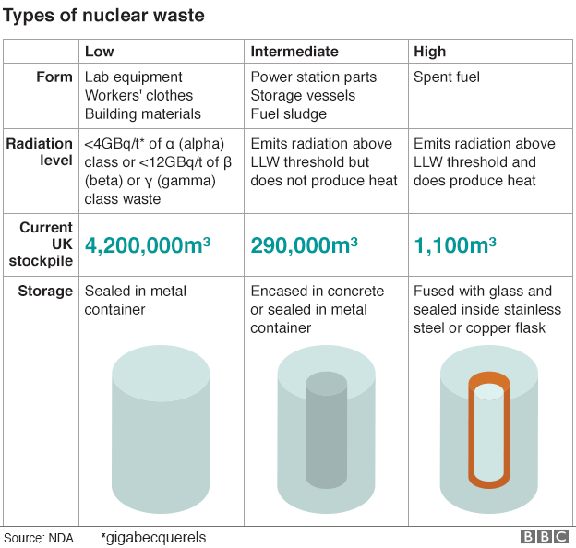
Energy Department Plan to Reclassify Nuclear Waste Worries Environmentalists https://weather.com/science/environment/news/2018-12-10-energy-department-reclassify-nuclear-waster
At a Glance
-
- The U.S. Department of Energy wants to reclassify some of the waste that meets highly technical conditions.
- The agency says the change could save the federal government $40 billion in cleanup costs at nuclear sites across the nation.
- About 56 million gallons of radioactive and hazardous chemical wastes are stored in tanks in Washington state.
- Environmentalists fear a U.S. Department of Energy proposal to reclassify some radioactive waste left from the production of nuclear weapons is simply a way to abandon the cleanup of places like the Hanford Nuclear Reservation in Washington state.The Trump administration proposal to lower the status of some high-level radioactive waste would make disposal cheaper and easier. Reclassifying the material to low-level could save the agency billions of dollars and decades of work by essentially leaving the material in the ground, critics say.
- The proposal joins a long list of Trump administration efforts to loosen environmental protections. Just last week, the Environmental Protection Agency acted to ease rules on the sagging U.S. coal industry.Tom Carpenter of Hanford Challenge, a nuclear watchdog group, said it wants a thorough cleanup of the Washington state nuclear site, which is half the size of Rhode Island. That includes building a national repository somewhere else to bury the waste once it has been stabilized.
- “The cleanup of the site is really at stake,” Carpenter said about the proposed change.
He noted that Hanford is located in an environmentally sensitive site adjacent to the Columbia River and susceptible to earthquakes, volcanoes and flooding.
- Hanford was established by the Manhattan Project in World War II to make plutonium, a key ingredient in the atomic bomb dropped on Nagasaki, Japan. The plant went on to produce most of the plutonium for the nation’s nuclear arsenal.As a result, the site also contains the nation’s largest collection of nuclear waste. The most dangerous is stored in 177 aging underground tanks, some of which have leaked. The tanks hold some 56 million gallons of radioactive and hazardous chemical wastes waiting to be treated for permanent disposal.Cleanup efforts at Hanford have been underway since the late 1980s and cost about $2 billion a year.
Current law defines high-level radioactive waste as resulting from processing irradiated nuclear fuel that is highly radioactive. The Energy Department wants to reclassify some of the waste that meets highly technical conditions.
The agency says the change could save the federal government $40 billion in cleanup costs across the nation’s entire nuclear weapons complex, which includes the Savannah River Plant in South Carolina and Idaho National Laboratory.
- Environmental groups and the state of Washington, which has a legal commitment with the Energy Department to oversee the Hanford cleanup, said the proposal is a concern.”They see it as a way to get cleanup done faster and less expensively,'” said Alex Smith of the Washington state Department of Ecology.Carpenter said there “is not much point in doing much else if they don’t clean up the high-level waste.”
At the request of U.S. Sen. Ron Wyden, an Oregon Democrat, the agency extended the public comment period on the proposal to Jan. 9. The agency can make the change without the approval of Congress.
“No one disputes the difficulty of retrieving and treating high-level waste from Hanford’s aging storage tanks,” Wyden wrote to the DOE. “However, lowering the bar for level of protection of future generations and the environment by changing the definition of what has always been considered high-level waste requiring permanent disposal is a significant change.”
Maine watchdogs keep close eye on Trump’s bid to change nuclear waste storage rules
|
https://bangordailynews.com/2018/12/12/news/midcoast/maine-watchdogs-keep-close-eye-on-trumps-bid-to-change-nuclear-waste-storage-rules/ • December 12 2018, A new proposal by President Donald Trump’s administration to reclassify some high-level nuclear waste to reduce cleanup costs will not affect the 550 metric tons of spent nuclear fuel stored in more than 60 airtight steel canisters near the former Maine Yankee nuclear reactor in Wiscasset. The new proposal focuses on waste generated by nuclear weapons, not power plants. But Mainers tasked with advocating for safe handling of atomic waste voiced concern that it could foretell changes that would affect the Maine Yankee waste.
“Safety costs money; environmental protection costs money,” said Edgecomb resident Ray Shadis, technical adviser to the New England Coalition on Nuclear Pollution in Brattleboro, Vermont, and founder of the group Maine’s Friends of the Coast that eventually got Maine Yankee shut down. “I think that’s the next shoe. This initiative at the weapons’ facilities is very likely the first step.” The U.S. Department of Energy has proposed reclassifying some high-level radioactive waste in various U.S. locations to low-level, allowing the department to leave the waste buried in the ground and save $40 billion in cleanup costs, the Associated Press reported Tuesday. Per the Atomic Energy Act of 1954 and the Nuclear Waste Policy of 1982, high-level radioactive waste is currently defined as waste resulting from processing irradiated nuclear fuel that is highly radioactive. Shadis said the proposal would not affect waste at the former Maine Yankee plant, which closed in 1996. Trump’s current proposal would only affect high-level radioactive waste generated by nuclear weapons production — currently stored in South Carolina, Idaho, Washington and New York — not waste generated by civilian nuclear production. “The terms ‘highly radioactive’ and ‘sufficient concentrations’ are not defined in the [Atomic Energy Act] or the [Nuclear Waste Policy Act],” the proposal states. It goes on to argue that “Congress left it to [Department of Energy] to determine when these standards are met. Given Congress’ intent that not all reprocessing waste is [high-level waste], it is appropriate for DOE to use its expertise to interpret the definition of [high-level waste], consistent with proper statutory construction, to distinguish waste that is non-HLW from waste that is HLW.” According to Shadis, industry officials and regulators have insisted since the beginning of the nuclear age that civilian nuclear production and weapons production for defense have nothing to do with each other. They are not integrated in any way and are handled separately. In fact, waste generated by civilian nuclear reactors is regulated by the U.S. Nuclear Regulatory Commission. Eric Howes, spokesman for Maine Yankee, said Tuesday he is not aware of any proposals to reclassify waste stored at Maine Yankee. Nevertheless, Shadis said, “I will say that we could simply wait for the other shoe to drop, because the Trump administration has rushed to the rescue of commercial power plants, which are shutting down all over the country because they are no longer competitive … it’s one way of fixing the game. One way of adjusting the cost of nuclear is to be more lenient when it comes to environmental regulations, including regulations regarding nuclear waste.” “That’s completely outrageous,” Don Hudson, chairman of the Maine Yankee Community Advisory Panel, said of the proposal. “They couldn’t have done that with a straight face. But it doesn’t affect Maine Yankee’s waste.” A federal judge has already awarded Maine Yankee $24.6 million in a decision based on the federal government’s failure to remove and dispose of the spent nuclear fuel. But Hudson said again on Tuesday there is no viable solution for the waste in Wiscasset, although “there are a couple of potential projects that might get built sometime in the next decade for above-ground storage near Carlsbad, New Mexico, and west Texas.” Previous administrations have said “stranded” nuclear waste — hazardous materials stored where there is no operating nuclear plant such as Maine Yankee, Yankee Rowe in Massachusetts and several others — would be the first to be removed, according to Hudson. But he said he isn’t holding his breath. “The impasse on the nuclear waste issue continues,” Howes said. “Congress to date has not provided any funding in the fiscal year 2019 budget for consolidated interim storage or the Yucca Mountain license application process. Maine Yankee and many others are urging Congress to provide fiscal year 2019 funding for nuclear waste management during this lame duck session of Congress.” “I hate to sound cynical, but I’m not going to believe it’s going to happen until I actually hear there’s a bulldozer on the ground,” Hudson said. “It’s really dangerous stuff, and it needs to be taken care of … depending on who you ask, it’s going to be multi tens of thousands of years before you could assign just casual care of this waste.” |
|
USA’s intractable nuclear waste problem: a new approach is needed
U.S. must start from scratch with a new nuclear waste strategy, a Stanford-led panel says
Thousands of tons of highly radioactive spent fuel are in temporary storage in 35 states, with no permanent solution being discussed. International experts led by Stanford show how to end this status quo. Stanford News, BY KATHLEEN GABEL CHUI AND MARK GOLDEN, 10 Dec 18, The U.S. government has worked for decades and spent tens of billions of dollars in search of a permanent resting place for the nation’s nuclear waste. Some 80,000 tons of highly radioactive spent fuel from commercial nuclear power plants and millions of gallons of high-level nuclear waste from defense programs are stored in pools, dry casks and large tanks at more than 75 sites throughout the country.
A Stanford University-led study recommends that the United States reset its nuclear waste program by moving responsibility for commercially generated, used nuclear fuel away from the federal government and into the hands of an independent, nonprofit, utility-owned and -funded nuclear waste management organization.
“No single group, institution or governmental organization is incentivized to find a solution,” said Rod Ewing, co-director of Stanford’s Center for International Security and Cooperation and a professor of geological sciences.
The three-year study, led by Ewing, makes a series of recommendations focused on the back-end of the nuclear fuel cycle. The report, Reset of America’s Nuclear Waste Management Strategy and Policy, was released today.
A tightening knot
Over the past four decades, the U.S. nuclear waste program has suffered from continuing changes to the original Nuclear Waste Policy Act, a slow-to-develop and changing regulatory framework. Erratic funding, significant changes in policy with changing administrations, conflicting policies from Congress and the executive branch and – most important – inadequate public engagement have also blocked any progress.
“The U.S. program is in an ever-tightening Gordian knot – the strands of which are technical, logistical, regulatory, legal, financial, social and political – all caught in a web of agreements with states and communities, regulations, court rulings and the congressional budgetary process,” the report says.
The project’s steering committee sought to untangle these technical, administrative and public barriers so that critical issues could be identified and overcome. They held five open meetings with some 75 internationally recognized experts, government officials, leaders of nongovernmental organizations, affected citizens and Stanford scholars as speakers.
After describing the Sisyphean history of the U.S. nuclear waste management and disposal program, the report makes recommendations all focused around a final goal: long-term disposal of highly radioactive waste in a mined, geologic repository.
“Most importantly, the United States has taken its eyes off the prize, that is, disposal of highly radioactive nuclear waste in a deep-mined geologic repository,” said Allison Macfarlane, a member of the steering committee and a professor of public policy and international affairs at George Washington University. “Spent nuclear fuel stored above ground – either in pools or dry casks – is not a solution. These facilities will eventually degrade. And, if not monitored and cared for, they will contaminate our environment.”
The new, independent, utility-owned organization would control spent fuel from the time it is removed from reactors until its final disposal in a geologic repository. ………https://news.stanford.edu/2018/12/10/square-one-u-s-nuclear-waste-management-program/
No answer to clean up Washington’s Hanford nuclear site
|
There’s no easy fix for our nuclear past At Washington’s Hanford nuclear site, failing infrastructure and make-do plans as the West prepares for a new round of radioactivity. High Country News, Heather Hansman, Dec. 10, 2018, Fhe Hanford nuclear complex in eastern Washington lies in a green-gold sagebrush steppe, so big you can’t see the edges of it and shimmery in the summer heat. The only landmarks are low-slung buildings on the horizon and ancient sand dunes scrubbed bare when the glaciers melted. There’s almost no trace that this is the biggest nuclear waste dump in the country. The scale of nuclear waste is like that: sprawling out into the metaphysical distance, too big for the human mind to hold. Over the ridge north of us, the Columbia River curves around the site, appearing motionless until you get close and see how much water is pushing past the banks. Over the past year, a series of accidents has put the spotlight on Hanford, its aging infrastructure and the lack of a long-term solution. In May 2017, part of the Plutonium Uranium Extraction Facility, which holds rail cars full of solid waste, collapsed. Later that year, workers tearing down the Plutonium Finishing Plant were contaminated with plutonium and americium particles when an open-air demolition went wrong. In December, others inhaled radioactive dust at the same site, halting work indefinitely. Then, in June of this year, the Department of Energy (DOE), which is responsible for the site, released a proposal to reclassify some of the high-level waste as less toxic, with what’s called a “Waste Incidental to Reprocessing” evaluation, so they could clean it up sooner and more cheaply. “There’s a lot more work to do than there is money to get it accomplished,” Price said. “We’ve really come to a fork in the road.” Across the country, big energy companies are considering a move from coal to nuclear-fueled plants even as sites like Hanford remain mired in many-decades-long cleanups of radioactive landscapes. As the possibility of more waste looms, Hanford has become a flashpoint for people who fear that there’s no safe way to deal with our nuclear legacy. In this era of climate change and large-scale environmental degradation, the site raises the question: Can we ever clean up the mistakes of our past? ………….The Government Accountability Office estimates cleaning up Hanford could total more than $100 billion. Since 1989, when Hanford was first designated as a Superfund site, 889 buildings have been demolished, 18.5 million tons of debris have been put in controlled landfills, and 20 billion gallons of groundwater have been treated. With three decades of work, the scope of the problem has been greatly reduced, but the really toxic stuff is still on site. The groundwater beneath Hanford is never going to be clean enough to drink, thanks to a cocktail of chemicals: strontium-90, which deteriorates marrow in the bones of humans and animals and takes 300 years to break down; hexavalent chromium, which mutates salmon eggs; and technetium-99, which dissolves like salt in water and has a half-life of 211,000 years.
The 586 square miles of sage still hold the 324 Building, home to highly radioactive nuclear containment chambers called hot cells, less than 1,000 feet from the Columbia and right across from the town of Richland, where many of the Hanford workers live. In the central plateau, where the ghostly vitrification plant stands, the Waste Encapsulation Storage Facility holds 1,936 radioactive cesium and strontium capsules currently kept in a glorified swimming pool. If an earthquake were to crack the pool, or the water supply were to run dry, those isotopes, physically hot and linked to bone cancer, would spread quickly.
The knotty heart of the cleanup is the tank farm, on the central plateau, where 56 million gallons of high-level waste — the official term for the long-lived radioactive material leftover from plutonium production — sit in 177 underground tanks. Each tank holds a unique mixture of sludge, solid, supernate liquid and crusty saltcake — a witch’s brew of 1,800 different chemicals that are buzzing, off-gassing and breaking down. Sixty-seven of the 149 carbon-steel single-shell tanks and one of the newer 28 double shells have leaked, but the Energy Department refuses to build new ones, and every year the timeframe for cleanup gets longer.
If you think it’s nearly intractable, that’s because it is,” said Randy Bradbury, the communications director from Washington’s Department of Ecology, one of the three parties that regulates the site. “The biggest mind-boggling thing about it is that we’re all going to be dead before this is cleaned up.” That timespan challenges our decision-making, which is much more suited to responding to accidents than to multigenerational cleanup projects. Philosopher Timothy Morton categorizes nuclear weapons, waste and explosions (not to mention climate change and the longevity of Styrofoam cups) as “hyperobjects” — real-life objects that are too large in time and space for humans to fully grasp. How, then, can we calculate all their costs? The Department of Energy spends billions of dollars on the cleanup each year; next year, it has a $2.4 billion budget. But those billions are barely enough to keep the wheels on, and the Government Accountability Office estimates that the last 15 percent of the cleanup could be as expensive as the first 85 percent, which has already taken 30 years. Maintaining the tanks alone costs $300 million a year, and the minimum amount needed to keep things safe increases as time goes on and infrastructure ages. There currently isn’t enough federal funding to meet cleanup benchmarks, and no money has been allocated for accidents like the tunnel collapse that contaminated workers. At the current rate of funding and cleanup, the DOE’s Richland Office, which manages most of the site, falls another year behind schedule every two years, and the Office of River Protection, which oversees the tank waste, slips back a year every three. This year, President Donald Trump proposed slashing the budget for Hanford cleanup by $230 million. ….….. Cleaning up the tank farm requires moving the waste out of the single-shell tanks, which are each as wide across as a tennis court and can hold up to a million gallons of waste, and into the sturdier double-shell tanks. From there, it will — theoretically — be vitrified, or turned into glass, at the as-yet-unbuilt vitrification plant and then sent to the stalled-out proposed federal nuclear repository at Yucca Mountain in Nevada, or to another long-term storage facility. Every step is excruciatingly complex. The massive tanks were designed to hold radioactive materials, not release them, so any material in these tanks has to come out through a pipe just 12 inches around. Challenges like this have forced Hanford managers to invent every step of the cleanup process, from how to sample the contents to how to keep video cameras from burning up in the radioactive heat inside. It’s a constant guessing game, where the questions of how to store the waste and neuter its effects change endlessly. That’s why in June, the Energy Department proposed reclassifying the remaining high-level waste in the C section of the tank farm as low-activity waste, and then filling the tanks with grout to stabilize the remaining 66,000 gallons of waste, so it could be kept onsite permanently. The department thinks that it would be safe enough to close the door on the tank cleanup once the grout is in, except for long-term monitoring. ……… Some people believe a fast response may be safer than a slower, more thorough response. “Until all the waste is out of those tanks, it’s almost inevitable that more of them will leak,” Bradbury says. The tanks, built starting in the 1940s, were designed to safely contain waste for up to 40 years on the assumption that we’d have figured out a long-term plan by then. But we haven’t, at Hanford or anywhere else. High-level waste was never supposed to stay on site permanently. The waste from the tanks is intended to be vitrified, turned into glass rods, then sent to a federal repository, where it would sit, isolated, forever. But that repository doesn’t exist yet, and it’s possible that it never will. The Nuclear Waste Policy Act of 1987 designated Yucca Mountain, Nevada, as the spot to store the waste. Despite $15 billion spent studying the site, and a growing cost to hold the waste at other sites, plans for Yucca have been in limbo for decades, in large part because of opposition from Nevadans, including former Senate Majority Leader Harry Reid, D-Nev., who don’t want the waste transported through or stored in their state. A bill to reopen Yucca passed the U.S. House of Representatives as recently as May, but failed in the Senate. “We’ve made stuff that will be dangerous for millennia and we deal with it in two-year congressional cycles,” said William Kinsella, a North Carolina State University professor whose research includes nuclear weapons cleanup. “We don’t want to make hasty decisions, but it’s a chokepoint for nuclear constipation.”That has created expensive and dangerous blockages throughout the nuclear waste management system. Without a place to send waste, the cleanup at Hanford has no real endgame. Because of the long-term impossibility, the Hanford Advisory Board — a coalition of tribal members, community volunteers and government workers who advise the agencies that manage the site — is constantly worried that the funds might dry up while the tanks are still full. The fear of slashed funding, and the cleanup’s long delay, is part of what drove the Department of Energy to consider grouting.
But the proposal worries watchdog groups, who are concerned about short-sighted cost-saving measures that could put surrounding communities at lasting risk by keeping 700,00 gallons of waste that’s currently classified as high-level, and that might ultimately leak to the river on site. “What the DOE is proposing is to make the Hanford site a high-level waste repository in all but name,” said Tom Carpenter, executive director of the Hanford Challenge, an environmental advocacy group. “That does not belong in an agriculture zone in a major river system in an earthquake zone.” ……… I ask Price what he thinks the worst-case scenario might be, and he says there are two things that keep him up at night. The first is a dramatic natural disaster, such as an earthquake or a fire, that would damage the fragile infrastructure and cause a massive spill. The site sits at the drought-prone edge of the Cascadia subduction zone, so both are likely. The week before our visit, a fire burned 2,500 acres here, and we can still smell the charred sage. But Price’s second fear is about the equally insidious threat people pose to themselves: A lack of long-term protection and the erosion of care. He says the paradox of Hanford is trying to convince people that the site is safe now, but that in 500 — or 1,000 — years, it might not be, and that we have to make decisions with those unknown risks in mind. “I’m not really worried about today, broad-scale, but I’m worried about the future,”………… Heather Hansman lives in Seattle, where she writes about water and the West. Downriver, her first book, will be out in April. https://www.hcn.org/issues/50.21/nuclear-energy-theres-no-easy-fix-for-our-nuclear-past |
|

1 This Month
23-25 October – on Zoom – World BEYOND War’s annual global conferenc


Shut down the radiation-damaged Heysham nuclear reactors now
To see nuclear-related stories in greater depth and intensity – go to https://nuclearinformation.wordpress.com

Say No to NASA’s Reckless Nuclear Reactor on the Moon
Say No to NASA’s Reckless Nuclear Reactor on the Moon
-
Archives
- October 2026 (190)
- September 2026 (339)
- August 2026 (330)
- July 2026 (355)
- June 2026 (287)
- May 2026 (306)
- April 2026 (356)
- March 2026 (251)
- February 2026 (267)
- January 2026 (308)
- December 2025 (358)
- November 2025 (359)
-
Categories
- 1
- 1 NUCLEAR ISSUES
- business and costs
- climate change
- culture and arts
- ENERGY
- environment
- health
- history
- indigenous issues
- Legal
- marketing of nuclear
- media
- opposition to nuclear
- PERSONAL STORIES
- politics
- politics international
- Religion and ethics
- safety
- secrets,lies and civil liberties
- spinbuster
- technology
- Uranium
- wastes
- weapons and war
- Women
- 2 WORLD
- ACTION
- AFRICA
- Atrocities
- AUSTRALIA
- Christina's notes
- Christina's themes
- culture and arts
- Events
- Fuk 2022
- Fuk 2023
- Fukushima 2017
- Fukushima 2018
- fukushima 2019
- Fukushima 2020
- Fukushima 2021
- general
- global warming
- Humour (God we need it)
- Nuclear
- RARE EARTHS
- Reference
- resources – print
- Resources -audiovicual
- Weekly Newsletter
- World
- World Nuclear
- YouTube
-
RSS
Entries RSS
Comments RSS

