Laundry in UK permitted to take radioactive materials from Sellafield!!
|
A Quick & Dirty Look At Energy Coast Laundry’s Radioactive Materials Permit (Starting With Caesium 137 Discharges to Air) https://mariannewildart.wordpress.com/2019/05/30/a-quick-dirty-look-at-energy-coast-laundrys-radioactive-materials-permit-starting-with-caesium-137-discharges-to-air/ |
|
Duke plans to decommission nuclear plant ahead of schedule
Duke Energy wants to tear down its Crystal River nuclear power plant about 50 years earlier than planned, the company announced Thursday.
In 2013, Duke decided to keep the facility idle until 2074 and then demolish the physical plant after removing all radioactive material. But a recent review of the cost to accelerate the timeline found the company had enough money in their decommissioning trust fund to cover the accelerated plan, said Heather Danenehower, Duke communications manager.
They need approval from the U.S. Nuclear Regulatory Commission to change plans and that process will take at least a year.
The accelerated process, which will take until 2027 to complete, would cost $540 million. The trust fund balance stood at $717 million on March 31. Whatever remains will go back to Duke’s customers. Customers, including the more than 66,000 in Marion County and the more than 4,000 in Alachua County, will not see their electricity bills increase because of the move, she said…… https://www.gainesville.com/news/20190530/duke-plans-to-decommission-nuclear-plant-ahead-of-schedule
France’s many nuclear waste locations revealed in an interactive map

Nuclear waste map of France published by Greenpeace, https://www.connexionfrance.com/French-news/Nuclear-waste-map-of-France-published-by-environmental-activists-Greenpeace-on-issue 29 May, 19, Nuclear waste is becoming a hot topic of discussion, as Greenpeace publishes a map of waste across France
A new interactive map showing the locations of nuclear waste across France has been published by environmental group Greenpeace, as part of its forthcoming campaign on the issue.
The map was published online this week, with the NGO aiming to “compile in a single place” all of the information it has on the location of radioactive material, to let people know how close they may be living to the waste.
The map categories include storage centres (at which the waste will be stored for 300 years minimum); nuclear centres that generate all forms of nuclear waste; more than 200 old uranium mines, operational up to 2001; factories and other plants; and radioactive waste from more than 70 military sites.
The data was collected from records of radioactive waste agency l’Agence Nationale pour la Gestion des Déchets Radioactifs (Andra).
The map does not include waste from medical use or research.
The map allows you to search by post code (Greenpeace.fr / Screenshot)Greenpeace is hoping to raise awareness and prompt debate over the extent of nuclear waste, and ask questions on the potential impact it may have. This also includes the impact of transporting nuclear waste by road or rail.
The group is also seeking to gather signatures and support for its national campaign on the issue, which it will later address to French ecology minister François de Rugy.
The map features a button saying “Agir! (Act!)”, allowing members of the public to add their support.
A public debate is set to be held on September 25 on this exact question – the issue of nuclear waste in France. It will be held on a platform via which the public will be able to ask for further information and have their say.
Nuclear waste disposal is also expected to be on the agenda at the G20 summit being held in Japan next month.
Radioactive shellfish – giant clams in Marshall Islands near USA nuclear dump
High radiation levels found in giant clams near U.S. nuclear dump in Marshall Islands, By SUSANNE RUST and CAROLYN COLE,
Researchers have found high levels of radiation in giant clams near the Central Pacific site where the United States entombed waste from nuclear testing almost four decades ago, raising concerns the contamination is spreading from the dump site’s tainted groundwater into the ocean and the food chain.

The findings from the Marshall Islands suggest that radiation is either leaking from the waste site — which U.S. officials reject — or that authorities did not adequately clean up radiation left behind from past weapons testing, as some in the Marshall Islands claim.
The radioactive shellfish were found near Runit Dome — a concrete-capped waste site known by locals as “The Tomb” — according to a presentation made by a U.S. Department of Energy scientist this month in Majuro, the island nation’s capital. The clams are a popular delicacy in the Marshall Islands and in other nations, including China, which has aggressively harvested them from vast swaths of the Pacific.
According to Terry Hamilton, a veteran nuclear physicist at the Energy Department’s Lawrence Livermore National Laboratory, Runit Dome is vulnerable to leakage by storm surge and sea level rise, and its groundwater, which is leaking into the lagoon and ocean, is severely contaminated.
But the radiation in the shellfish and surrounding lagoon is not coming from the 40-year-old dome, said Hamilton in a slide he presented May 15 to an audience assembled in a hotel conference room in Majuro.
He said isotopic analyses indicated the lagoon contamination was from residue from the initial nuclear weapons testing.
The Los Angeles Times was not at Hamilton’s presentation, and the Energy Department did not make him available to comment. But the following day, residents and officials informed The Times about the findings, which were later confirmed with others.
Between 1946 and 1958, the United States tested 67 nuclear devices in the Marshall Islands, including 44 in Enewetak Atoll, one of the nation’s 29 coral atolls. Although the Marshall Islands were home to only 6% of the total number of tests conducted by the United States, it bore the brunt of more than half the total energy yield of all U.S. nuclear weapons testing.
Much of the fallout from those events is now entombed within Runit Dome. According to a photograph taken of Hamilton’s presentation slides, the 377-foot-wide crater in Enewetak Atoll contains groundwater samples with radiation levels 1,000 to 6,000 times higher than those found in the open ocean.
Some Marshallese who attended the presentation are skeptical about the agency’s conclusion that the dome is not leaking into the lagoon.
“What they’re saying is, here is the dome. And here, in the lagoon area, there is radiation. … But as far as leaking from the dome, we don’t think that’s the case?” said James Matayoshi, mayor of Rongelap Atoll, one of the atolls contaminated by fallout from the nuclear testing program. “That doesn’t make any sense.”
Extending the incredulity further, Matayoshi and others noted that Hamilton presented a short animation of the dome, showing it rise and fall with the tide — suggesting seawater
is freely flowing in and out of the containment zone.
Between 1977 and 1980, the United States enlisted roughly 4,000 U.S. soldiers and subcontractors to clean the site. Many said they were inadequately protected. They excavated soils from Enewetak and elsewhere and turned the soil into a concrete slurry, which they poured into an unlined crater on Runit Island, left behind by the Cactus bomb. They sealed it with a clean concrete top 18 inches thick, creating what is now called the Tomb.
In 1980, the people of Enewetak were told by the U.S. government it was safe to return home.
But there have been lingering worries about the atoll’s safety. The U.S. government told the Marshallese the dome was a temporary fix. It’s now been nearly 40 years. This latest news didn’t alleviate any of those concerns, said Holly Barker, a professor of anthropology at the University of Washington in Seattle. Barker is a member of the Marshall Islands’ three-person National Nuclear Commission — a government-mandated committee charged with seeking justice for nuclear-related injuries and damage.
The basic takeaway from the presentation, said Barker, is the lagoon is so contaminated, any leakage from the dome is negligible.
Which raises the question, “in what way was Runit a cleanup?” Barker said………
Lucinda Anitok, 35, from Sedro-Woolley, Wash., is a descendant of Runit landowners. She said the U.S. testing program in Enewetak had devastated her family. Her grandmother, who was raised on Enewetak, had thyroid cancer. Her mother, who was born there, had cervical cancer. And her sister had leukemia.
“What happened there was wrong,” she said. “It ruined, and is still harming, many people’s lives.”…….https://www.latimes.com/science/environment/la-me-marshall-islands-dome-is-leaking-radiation-20190528-story.htm
Canada’s plans for nuclear waste disposal
Canada’s nuclear waste to be buried in deep underground repository, By Eric Sorensen, Global News, 29 May 19, “……..While the nuclear creating heat and electricity has been well contained in reactors, ceramic pellets and fuel bundles, we have been left with big a problem that everyone saw coming: the hazard posed by nuclear waste.
Ontario Power Generation has slowly made headway for a plan to bury this waste in a deep underground repository next to the Bruce plant. Much of it now sits in large tanks with row upon row of cement lids poking above the surface.of the ground.
Fred Kuntz, wearing an OPG hard hat, gazed over the containers: “This is all safe storage for now, but it’s not really the solution for thousands of years. The lasting solution is disposal in a deep geologic repository.”
He pointed to a stand of trees. “The DGR would be built here.”
“There isn’t a magic bullet. It’s not like we can put it out of sight and we’ve solved the problem.” said Theresa McClenaghan of the Canadian Environamental Law Association.
The nuclear plant was built on the traditional land of the Saugeen Ojibway. OPG says it has come to recognize the “historic wrongs of the past” and is negotiating compensation for those wrongs. And moving forward, OPG has given its assurance that the repository will only be built if the Saugeen Ojibway approve – from an afterthought to the power of veto over a multibillion-dollar enterprise……….
Remarkably, this is the relatively easy stuff to deal with: low- and intermediate-level nuclear waste. An even bigger problem is high-level radioactive used fuel. It too is piling up, primarily at the three big Ontario plants. It may be toxic for a million years. ……..
Ultimately they need to find one particular community to be a “willing host” for what amounts to 57,000 tonnes of used nuclear fuel……..
The plan is to pack the bundles into carbon steel tubes coated in copper – 48 bundles per container. They look like a big torpedoes. Each one will be packed snugly into what look like coffins made of a special clay called bentonite.

Thousands of bentonite boxes will be moved by robotic machines into hundreds of long placement rooms deep underground. Dried slightly, the clay will expand and plug every last space, ultimately sealing the repository. ……
Picking a host community, getting regulatory approval, building the repository, and transferring high-level waste will take the next 50 years.
It is separate from the OPG plan for low- and intermediate-level waste, which could have an answer from the Saugeen Ojibway Nation by the end of this year, and federal approval in 2020.
As it turns out, two of the NWMO sites for high-level waste – South Bruce and Huron-Kinloss – are also on Saugeen Ojibway land, so they may ultimately have to decide on separate nuclear waste projects on their land………https://globalnews.ca/news/5329835/canadas-nuclear-waste-to-be-buried-in-deep-underground-repository/
As Pilgrim nuclear plant closes, Holtec moves in to make a tidy profit
 Closure of Pilgrim nuclear plant is part of a shifting energy industry, Boston Globe, By David Abel Globe Staff,May 28, 2019, “…….. If all goes right, the last of 145 crucifix-shaped control rods will be inserted into the reactor, shutting down operations for good.
“For many of us, it’s the end of an era,” said Joe Frattasio, 56, a control room shift manager who has been working for Pilgrim for 19 years and expects to remain at the plant until March. “Unfortunately, this is the reality of the industry.”
When Pilgrim shuts down, there will be 97 nuclear reactors left in the United States, down from a peak of 112 in 1990. Another 10 reactors are slated to close by 2025.
Concerns about the safety of nuclear power — especially after the disasters at plants in the former Soviet Union and Japan — have contributed to the industry’s decline. The Nuclear Regulatory Commission in recent years had designated Pilgrim one of the nation’s three least-safe reactors, forcing the plant to spend tens of millions of dollars on upgrades and inspections.
……. But the changing nature of the larger energy industry, and the resulting economics, has played an even larger role.
…… By next April, when Entergy expects to complete the first phase of the decommissioning process, only about half as many workers will remain.
“It’s a sad time, but also a time of reflection,” said Patrick O’Brien, a spokesman for Pilgrim, before a simulation of the shutdown on Tuesday at a testing facility near the plant.
As part of the process, the company will reduce the evacuation zone to the perimeter around the plant.
….. The future of the property may be left to Holtec International, a New Jersey company that’s seeking to buy Pilgrim. Although it has never owned or decommissioned a nuclear plant, Holtec has promised to complete the process in just eight years, well ahead of the 60 years allowed by federal rules. https://www.bostonglobe.com/metro/2019/05/28/pilgrim/p00dL7Ju623l3VZDiUvMJO/story.html
San Onofre Task Force Questions Edison About Nuclear Waste Canisters
The Task Force was created to increase public involvement in the decommissioning of the plant, which shut down in 2012 after a small radioactive leak was discovered in the steam generators.
Levin said several Task Force members are concerned about burying spent nuclear fuel in stainless steel canisters encased in concrete, next to the beach.
“Our task force members had specific questions about those canisters,“ Levin said, “their safety, their design and the wear and tear that the coastal environment takes on them. Those questions were not answered sufficiently. Edison said, ‘We’ll have to have another meeting to discuss that,’ so we took them up on that, and we’re having another meeting.”
Levin said he has introduced legislation to put San Onofre’s nuclear waste at the top of the list to be moved if Congress decides on a location to store the nation’s spent fuel longer term.
His bill to earmark $25 million to identify and develop what’s called consolidated interim storage site recently passed the House Appropriations Committee.
Church should oppose nuclear waste in Utah
|
https://www.sltrib.com/opinion/letters/2019/05/29/letter-church-should/ By Leslie and Gail Ellison | The Public Forum, Dear Russell M. Nelson, Dallin H. Oaks and Henry B. Eyring,
On May 5, 1981, the First Presidency of The Church of Jesus Christ of Latter-day Saints issued a bold and important statement opposing the placing of the MX missile train system in Utah and Nevada. Our state is confronted with a similar situation today that simply cannot be ignored. Our legislators in the last session passedHB220 potentially allowing Class B and Class C nuclear wastes (including depleted uranium) to be transported to and stored at the Envirocare Skull Valley repository. These long-lived wastes increase in toxicity over hundreds of thousands of years. Every legislator that voted in favor of this legislation received donations from Envirocare. Imagine the thousands of trains and trucks transporting these nuclear poisons, sloshing in their holds … forever. Insane! There is so much wrong here, not only the dangers of transportation through population centers and the Envirocare site itself (open pit, shallow aquifer, etc.), but so many unknowns. This is a Utah state issue. Other states and the U.S. Department of Energy (DOE) cannot believe our state will actually welcome these toxic wastes. This should not be a political issue. It is an extremely serious health concern for our families, our children and our children’s children. We call upon the First Presidency and the Quorum of the Twelve Apostles to take a stand in reversing this bill, similar to the brave and righteous position they took against the MX missile system in 1981. |
|
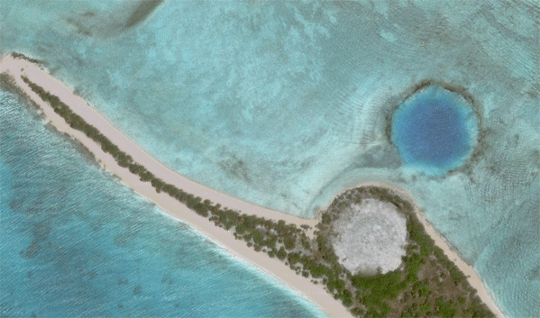
Temporary dome over radioactive trash on Runit Island – now leaking waste to the Pacific
|
Fears Grow That ‘Nuclear Coffin’ Is Leaking Waste Into The Pacific https://www.forbes.com/sites/trevornace/2019/05/27/fears-grow-that-nuclear-coffin-is-leaking-waste-into-the-pacific/#653322537073, Trevor Nace The tropical blue skies over the southern Pacific Ocean were enveloped by towering mushroom clouds lingering over the Marshall Islands in 1954 as the United States continued its testing of nuclear weapons. The United States conducted 67 nuclear weapon tests from 1946 to 1958 on the pristine Marshall Islands. The most powerful test was the “Bravo” hydrogen bomb in 1954, which was about 1,000 times more powerful than the bomb dropped on Hiroshima, Japan. The extensive nuclear bomb testing blanketed the islands in radioactive ash, covering it in the fine, white, powder-like substance. Children, unaware of what the radioactive ash was, played in the “snow” and ate it according to the Atomic Heritage Foundation. Today, there are growing concerns that the temporary containment of the nuclear waste resulting from those tests is leaking into the Pacific Ocean and could be cracked wide open from the next storm that rolls by. Specifically, the site is believed to be leaking one of the most toxic substances in the world, the radioactive isotope plutonium-239, a byproduct of nuclear bombs that decays with a half-life of 24,100 years. In 1977 the United States worked to clean up the radioactive waste left strewn across the Marshall Islands. In total, an estimated 73,000 cubic meters of radioactive soil was collected across the Marshall Islands. The US used a crater from an especially large nuclear bomb test on Runit Island to stash away the radioactive soil. The 328-foot crater from a May 1958 test was designated the dumping ground. As this was considered a temporary solution, the crater bottom was not lined with impervious material, which would have prevented radioactive waste from entering the below aquifers and Pacific Ocean. After the material was piled into the crater, an 18-inch thick concrete dome was positioned on top of it as a temporary containment. Plans for permanent radioactive waste storage were never finalized and thus the temporary solution has sat as-is for nearly 40 years. Shortly afterward, in 1983 the Marshall Islands agreed on their severity from the United States and with it, the islands released the United States of any responsibility for past nuclear testing. Rising sea level, soil shifting, and storms have all caused new concern over the integrity of the “nuclear coffin” and its ability to contain radioactive waste. The dome is reportedly cracking and the local government fears the next big storm may split the concrete dome apart. In addition, groundwater models suggest that seawater is almost certainly accessing the crater. However, it is unclear how much nuclear waste is seeping from the unlined crater bottom into the Pacific Ocean and groundwater aquifers. Despite recent awareness around the issue, the Marshallese government does not have the money or expertise to properly clean up and isolate the nuclear waste. Thus, the Marshallese are left helpless as their tropical islands continue to leak deadly radioactive waste across its coral reefs. Trevor Nace is a PhD geologist, founder of Science Trends, Forbes contributor, and explorer. Follow his journey @trevornace. |
|
Serious doubts about Holtec’s lucrative fast decommissioning of nuclear reactors
|
Nuclear waste: A hot business? https://thebulletin.org/2019/05/nuclear-waste-a-hot-business/, By Thomas Gaulkin, May 24, 2019 It usually takes decades for defunct nuclear plants in the United States to be taken apart and cleaned up so the land can be developed for other purposes. Long after the main facilities are dismantled and their sites remediated, spent fuel remains radioactive and takes years to cool off in pools before it can be safely placed in concrete cylinders—dry casks, in industry lingo—for interim storage that could last years or even decades. Utility companies stuck with these useless sites often delay the costly cleanups as long as they possibly can.
But Bob Salsberg reports for the Associated Press that a profit-hungry industry is emerging to rescue electric utilities that have little enthusiasm for dismantling their own aging nuclear power plants. Behind a promise of dramatically reduced decommissioning times, in some cases by as much as 50 years, a group of companies wants to buy the retired plants, take on the work of demolishing them, and manage storage of the spent fuel rods that will likely be stuck on the plants’ grounds for a very long time. Companies like Holtec International (which Salsberg reports has deals for several plants that are being retired up and down the east coast and in Michigan) will take on the nuclear facilities, their multibillion-dollar funds set aside for the decommissioning process, and the prospect of lucrative government compensation. (Since there’s no national long-term disposal site for high-level civilian nuclear waste, the concrete cylinders have to stay where they are until a long-term repository is created.) Holtec claims it can safely store spent fuel in its specialized cylinders after only two years of cooling, instead of the five to 10 years of cooling now required. But opponents and some officials worry that encouraging commercialization of nuclear waste storage will jeopardize safety, and that the speedier decommissioning projects will hit more snags than they already do. Salsberg notes that Holtec International has “never managed a decommissioning start to finish.” It’s also not clear that moving spent fuel from cooling pools into storage canisters a few years more quickly than it otherwise might be moved will make the former sites of nuclear power plants—still burdened with dry casks full of nuclear waste—all that attractive as developments sites. |
|
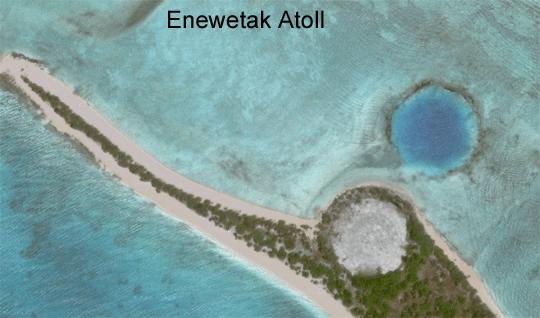
USA’s radioactive dump in the Marshall Islands is leaking
|
Under the dome: Fears Pacific nuclear ‘coffin’ is leaking, https://phys.org/news/2019-05-dome-pacific-nuclear-coffin-leaking.html As nuclear explosions go, the US “Cactus” bomb test in May 1958 was relatively small—but it has left a lasting legacy for the Marshall Islands in a dome-shaped radioactive dump.
The dome—described by a UN chief Antonio Guterres as “a kind of coffin”—was built two decades after the blast in the Pacific ocean region. The US military filled the bomb crater on Runit island with radioactive waste, capped it with concrete, and told displaced residents of the Pacific’s remote Enewetak atoll they could safely return home. But Runit’s 45-centimetre (18-inch) thick concrete dome has now developed cracks. And because the 115-metre wide crater was never lined, there are fears radioactive contaminants are leaching through the island’s porous coral rock into the ocean. The concerns have intensified amid climate change. Rising seas, encroaching on the low-lying nation, are threatening to undermine the dome’s structural integrity. Jack Ading, who represents the area in the Marshalls’ parliament, calls the dome a “monstrosity”. “It is stuffed with radioactive contaminants that include plutonium-239, one of the most toxic substances known to man,” he told AFP. “The coffin is leaking its poison into the surrounding environment. And to make matters even worse, we’re told not to worry about this leakage because the radioactivity outside of the dome is at least as bad as the radioactivity inside of it.” Staggering’ challenges The dome has become a symbol of the mess left by the US nuclear test programme in the Marshall islands when 67 bombs were detonated between 1947-58 at Enewetak and Bikini atolls. Numerous islanders were forcibly evacuated from ancestral lands and resettled, including Enewetak’s residents. Thousands more islanders were exposed to radioactive fallout and suffered health problems. The people of Enewetak were allowed home in 1980, and about 800 islanders now live in the southern part of the atoll, 20 kilometres (12 miles) from Runit. After the US military withdrew, the Marshall Islands government officially accepted a “full and final” settlement to cover the impact of the nuclear tests. But there have long been complaints that the compensation paid by Washington was inadequate, and the United Nations has described “a legacy of distrust” towards the United States. UN Secretary General Guterres raised the issue earlier this month after meeting Marshall Islands President Hilda Heine in Fiji, when they discussed the nuclear legacy and the prospect of radioactive leakage from Runit dome. “The Pacific was victimised in the past as we all know… the consequences of these have been quite dramatic, in relation to health, in relation to the poisoning of waters in some areas,” he said. Marshalls Foreign Minister John Silk said he appreciated Guterres bringing the Runit dome to world attention with this comments.. “We are pleased that the Secretary General made these statements, since so often it seems that these ongoing legacy issues that continue to impact our people are forgotten by the international community,” he said. Uncertain future Rhea Moss-Christian, who chairs the Marshall Islands National Nuclear Commission, said the country “needs the support of the international community to address the staggering health and environmental challenges across the Pacific.” The consequences of the dome failing are unclear. A 2013 inspection commissioned by the US government suggested radioactive fallout in the Enewetak lagoon sediment was already so high a catastrophic failure would not necessarily result in locals receiving increased dosages of radiation. Silk, noting that the US government had committed to ongoing monitoring of the dome, said an independent assessment of the structure’s status “would be helpful”. But Ading said the situation was “a constant source of anxiety for the people of Enewetak”. “We pray that the Runit dome does not eventually become our coffin,” he said. |
|
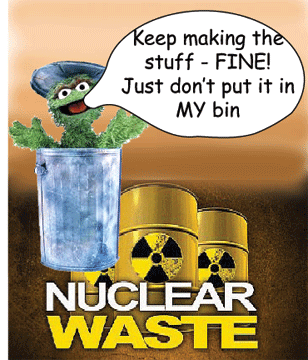
At June G20 meeting, Japan to push for international conference on nuclear waste disposal (but no talk on stopping making radioactive trash)
 Japan to push for int’l conference on nuclear waste disposal at June G-20 meet https://mainichi.jp/english/articles/20190525/p2a/00m/0in/006000c TOKYO — The Japanese government announced May 24 that it plans to arrange an international meeting to consider how to dispose of highly radioactive nuclear waste.
Tokyo is set to get approval for the plan at the Group of 20 Ministerial Meeting on Energy Transitions and Global Environment for Sustainable Growth scheduled for mid-June in Karuizawa, Nagano Prefecture, and aims to launch the first roundtable this autumn.
High-level nuclear refuse is usually “vitrified” — mixed with melted glass and solidified — before being deposited in an underground storage facility. Japan’s own disposal plans call for holding the waste for 30 to 50 years to cool it before burying it in stable rock formations at least 300 meters below ground. Finland is already building a major underground disposal site, while its neighbor Sweden is conducting a safety evaluation at the location of its own planned facility. However, there is no precedent for actually operating such an installation, and Japan has not yet even begun the survey process to choose a site.
The Japanese government will thus use the June 15-16 G-20 environment and energy summit meeting to urge member nations to cooperate on realistic solutions. Specifically, Japan will press nations with advanced nuclear disposal technology including those in Europe to share their know-how, and also promote international collaboration among research facilities and staff exchanges. The international roundtable will put together a collection of proposals on a basic nuclear waste disposal cooperation strategy and how to explain the issue to the citizens of member nations.
In UK Councillors to get briefing from nuclear panel – anyone can offer their land for nuclear waste dump!

Councillors to get briefing from nuclear panel https://www.newsandstar.co.uk/news/17663707.councillors-to-get-briefing-from-nuclear-panel/
By John Connell @JConnell35 Reporter 24 May 19, NEW councillors appointed to Copeland council’s nuclear panel will receive their first briefing early next month.The Strategic Nuclear Energy team is one of the authority’s most important committees, working with the Government and companies including Sellafield.
The first meeting since borough council elections will be held on Tuesday June 4 and will see members given an overview of the roles and responsibilities of the committee.
Members will be discussing some huge issues in the coming months including the Government’s search for a host community for a nuclear waste store.
Anyone with a reasonably-sized patch of land can volunteer it as a contender for the multi-million Geological Disposal Facility (GDF), effectively kick-starting the process.
West Cumbria has also been rocked in recent months by the collapse of the Moorside nuclear investment deal, while Sellafield is moving into the decommissioning phase.
Coun David Moore, Portfolio holder for Nuclear and Corporate Services, said the briefing would be an opportunity for councillors who have not worked on the panel before or were completely new to local politics to get to grip with the scope of the committee’s important work.
He added: “Some of the councillors who will be there are first-time councillors, just about to dip a toe in the water. This meeting them will give them an overview and it will be a learning curve for them.
“We are key players in nuclear consultations. Not many councils have an equivalent of our committee. I have no equivalent to my role as nuclear portfolio-holder.”
A ‘doomsday button’ for Native Americans if Yucca Mountain were to be poisoned by nuclear trash
 It will poison everything.’ Native Americans protest Yucca Mountain Nuclear Waste site It will poison everything.’ Native Americans protest Yucca Mountain Nuclear Waste site
TO THE WESTERN SHOSHONE NATION, THIS LAND IS SACRED. TO STORE NUCLEAR WASTE HERE IS TO PRESS A DOOMSDAY BUTTON. Ed Komenda, Reno Gazette Journal 24 May 19, “……….. “This is our church,” says Bobb, the 67-year-old chief of the Western Shoshone National Council. “All we have to do is pray.” Seven tents and travelers from as far as South Dakota and Washington dot this camp less than a mile from armed men in camouflage guarding the Nevada National Security Site – a 1,360-square-mile desert patch 65 miles north of Las Vegas where scientists decades ago detonated more than 900 nuclear bombs, assaulting the horizon with mushroom clouds. Off the Mercury exit of U.S. Highway 95 is a yellow road sign topped with flashing lights: “DEMONSTRATORS ON ROADWAY.” Another 35 miles northwest is the reason those demonstrators are here: The Yucca Mountain Nuclear Waste Repository. The Trump administration and a bipartisan collective of congressmen contend the Nye County mountain on federal land adjacent to the test site is the solution to the country’s nuclear waste problem – but the people who roamed the west long before there was a federal government see the peaks a different way. To the Western Shoshone Nation, this land is sacred. To store nuclear waste here is to press a doomsday button. “It will poison everything,” the elder says. “It’s people’s life, our Mother Earth’s life, all the living things here, all the creatures; whatever’s crawling around, it’s their life too.”…… The fight to prevent federal dollars from flowing into the Yucca Mountain project runs tandem to the push to license the land as a dumping ground. In January, Gov. Steve Sisolak promised “not one ounce” of nuclear waste would enter Yucca Mountain under his administration. Last week, it appeared another hurdle had been cleared to help him keep that promise. A Department of Energy funding bill released on May 14 showed no money set aside to bankroll nuclear waste storage at Yucca Mountain. The absent dollars marked a small victory for Nevada House Democrats – including Rep. Dina Titus, who met with Speaker Nancy Pelosi last week to talk about halting funding. “This has been a long, protracted battle,” Titus told the USA TODAY Network. “Some people say it’s a marathon and not a dash – but I’d say right now we’re in a pivotal moment.”….. The Trump administration now favors storing the nuclear waste in Yucca Mountain – and Trump has support from members of Congress looking to rid their own waste from nuclear facilities in their home districts. “It’s get it out of my backyard and into somebody else’s,” Titus said. In 2018, the House voted 340-72 to advance a bill directing the Department of Energy to resume the licensing process for a nuclear waste facility in Yucca Mountain. The bill died, never making it to the Senate floor – but it made its return to the House last week. Illinois Republican John Shimkus co-sponsored the reintroduction of the bill, pegging nuclear power as an essential component to addressing climate change….. n an interview with the USA Today Network, Shimkus characterized Yucca Mountain as a “pretty good” and “secure” location for nuclear waste. “If Yucca Mountain was where the capital is – yeah,” Shimkus said, “I could understand some concerns and some frustration.”…… “We’re trying to get money for that final scientific debate and argument. My friends, the Nevadans, continue to say it’s unsafe… but let’s have the science debated.” That effort to get that money died in Washington Tuesday, when the House Appropriations Committee voted 27-25 to kill an amendment from Rep. Mike Simpson, R-Idaho, to inject $74 million for Yucca Mountain into a bill funding the Energy Department. The outcome, Shimkus said in a statement, left him “disappointed.” https://www.rgj.com/story/news/2019/05/22/yucca-mountain-nuclear-waste-nevada-test-site/3694806002/ |
|
A high risk operation removing spent nuclear fuel from Russian ship “Lepse”
 Work on removing nuclear waste from 85-years old ship has started in Russia’s north https://thebarentsobserver.com/en/ecology/2019/05/work-removing-nuclear-waste-85-years-old-ship-has-started-russias-north
|
May 23, 2019
It is a milestone for nuclear safety clean-up on the Kola Peninsula. Though, the removal of the spent nuclear fuel elements from the storage compartment from «Lepse» will take time. The work is, to say it mildly, a high risk operation involving uranium fuel so radioactive it could cause lethal dose to workers if something goes wrong. «Preparatory work for this stage of the disposal of «Lepse» has been underway for the last two years,» Chief Engineer Georgy Neyman of the Nerpa shipyard told Komsomolskaya Pravda. «A protective shelter is built,» Neyman said. Phase one of the work, which started last week, is removing the 620 fuel elements believed not to be damaged. The elements will be loaded over to special casks for shipping to Atomflot service base in Murmansk. From there, a special train will take the casks to Mayak reprocessing plant in the Chelyabinsk region in the South-Urals. The work ahead is the most demanding. Cutting out the radioactive elements is done by using robotics. Inside the shelter, humans should spend as little times as possible. «The time intervals during which a person can be in the presence of ionizing radiation are strictly observed,» Oleg Khalimullin, deputy chief engineer at Nerpa shipyard said in an interview with the news portal of Bellona. The environmental group in Murmansk has for 25 years worked on promoting a safe disposal of «Lepse». In the early 1990s, the plan was simply to tow the aging storage ship to Novaya Zemlya in the Russian Arctic and dispose it in the permafrost near the shore. With radionuclides onboard estimated to be some 28,000 TBq (750,000 Curie), or nearly half the release of the Cesium-137 isotope that contaminated half of northern Europe following the 1986 Chernobyl disaster, the “Lepse” was a ticking threat to people and nature around Murmansk. «Lepse» was built in 1936, sunken during World War II, lifted afterwards and used as a radiological support vessel for the Soviet Union’s first nuclear powered icebreaker, «Lenin» from 1962. After a coolant accident with one of the three reactors on «Lenin» in 1966 some few hundreds of the spent fuel roads were lifted over to the storage compartment to «Lepse» . Radiation levels were high and “sarcophagus” was built over by filling cement. Both neighbouring Norway and the European Union have finacially and technically assisted Russia with securing the nuclear waste ship and preparing for the work now started. Expenses for the shelter and robotics are co-financed by the European Bank of Reconstruction and Development. If all go in accordance with schedule, removing the nuclear fuel from the compartment should be ended next year. |
|
1 This Month
23-25 October – on Zoom – World BEYOND War’s annual global conferenc


Shut down the radiation-damaged Heysham nuclear reactors now
To see nuclear-related stories in greater depth and intensity – go to https://nuclearinformation.wordpress.com

Say No to NASA’s Reckless Nuclear Reactor on the Moon
Say No to NASA’s Reckless Nuclear Reactor on the Moon
-
Archives
- October 2026 (170)
- September 2026 (339)
- August 2026 (330)
- July 2026 (355)
- June 2026 (287)
- May 2026 (306)
- April 2026 (356)
- March 2026 (251)
- February 2026 (267)
- January 2026 (308)
- December 2025 (358)
- November 2025 (359)
-
Categories
- 1
- 1 NUCLEAR ISSUES
- business and costs
- climate change
- culture and arts
- ENERGY
- environment
- health
- history
- indigenous issues
- Legal
- marketing of nuclear
- media
- opposition to nuclear
- PERSONAL STORIES
- politics
- politics international
- Religion and ethics
- safety
- secrets,lies and civil liberties
- spinbuster
- technology
- Uranium
- wastes
- weapons and war
- Women
- 2 WORLD
- ACTION
- AFRICA
- Atrocities
- AUSTRALIA
- Christina's notes
- Christina's themes
- culture and arts
- Events
- Fuk 2022
- Fuk 2023
- Fukushima 2017
- Fukushima 2018
- fukushima 2019
- Fukushima 2020
- Fukushima 2021
- general
- global warming
- Humour (God we need it)
- Nuclear
- RARE EARTHS
- Reference
- resources – print
- Resources -audiovicual
- Weekly Newsletter
- World
- World Nuclear
- YouTube
-
RSS
Entries RSS
Comments RSS

