nuclear-news

The News That Matters about the Nuclear Industry Fukushima Chernobyl Mayak Three Mile Island Atomic Testing Radiation Isotope

  • Home
  • 1 This Month
  • ACTION !
  • Disclaimer
  • Links
  • PAGES on NUCLEAR ISSUES

Cheaper and permanent, not temporary, disposal of nuclear waste.

We will provide an option for people not satisfied with existing options,” said Deep Isolation’s co-founder and CEO Elizabeth Muller. She pointed out the interim sites were not “deep geologic storage.”

They’re looking at being safe for decades,” Muller said. “They’re looking at temporary storage. We’re looking at disposal.”

David Lochbaum, former director of the Nuclear Safety Program for the Union of Concerned Scientists, has taken a seat on Deep Isolation’s advisory board.

“There are technical, legal and political challenges facing Deep Isolation, to be sure,” Lochbaum said via email. “I think their proposal could very well meet all these challenges.

“The spent fuel storage status quo is only worsening with time,” he said. “We need to find a solution before we run out of time to do so without harm.” 

Startup promotes permanent nuclear waste storage via miles-long drilling, South Coast Today, By Christine Legere / Cape Cod Times, 4 May 19, A small startup company in Berkeley, California, with connections to scientists, university professors, industry experts and Silicon Valley entrepreneurs is marketing a method to permanently store nuclear waste, tapping advanced drilling technology used for years by the gas and oil industries.

Storage of the highly radioactive waste would be permanent — unlike the options currently available around the world — and the method is being pitched as far less expensive than development of a deep geologic repository such as Yucca Mountain in Nevada. In New England, spent nuclear fuel is being stored on-site at the Maine Yankee, Seabrook, Vermont Yankee, Yankee Rowe, Pilgrim and Millstone nuclear plants.

Although the Department of Energy was required under the Waste Policy Act to remove spent fuel from sites nationwide for storage in a permanent repository by 1998, its plan for a Yucca Mountain repository in Nevada has languished for several years.

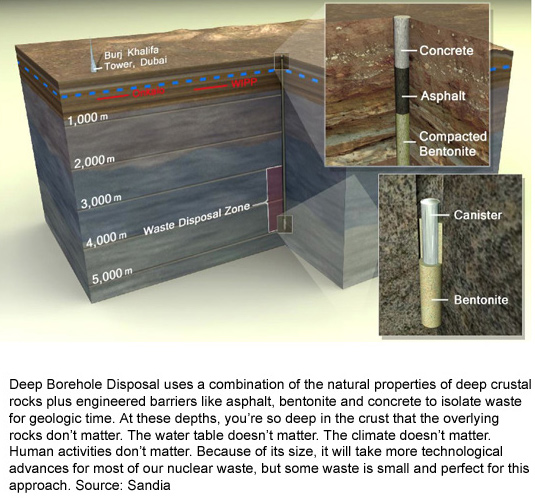
The proposal from Deep Isolation calls for drilling a 14-inch-wide vertical access channel up to a mile or more down, depending on geologic conditions, then gradually making the drill hole run horizontally along the line of the rock formation.

The horizontal bed, which could be as long as 2 miles, would serve as the nuclear waste storage area, deep in the subsurface where the rock has been stable and out of contact with the surface for millions of years and would remain out of contact for millions more, unaffected by surface impacts such as sea level rise.

Hundreds of corrosion-resistant canisters, each holding a spent fuel assembly, could be stored in a line inside a single drill hole, and since the technology already exists, the company could be placing fuel in the ground within two to three years, according to Sophie McCallum, Deep Isolation’s chief of staff.

And more than one drill hole can be made on a site.

We are in active discussions with potential customers in the U.S. and internationally to move forward disposal programs of stalled nuclear waste inventories,” McCallum said in an email .

Deep Isolation tested its system, installing a drill hole in Cameron, Texas, where it successfully placed a 5-foot-long canister — the kind used to store military waste such as cesium and strontium — in the horizontal storage area, deep underground. It then retrieved the canister, which Deep Isolation experts say could be done for up to about 50 years.

The company plans to begin with storage of defense waste in the U.S. and commercial waste in other countries, since the federal Waste Policy Act must be amended to allow for permanent storage of the nation’s commercial waste in places other than Yucca Mountain.

Currently about 80,000 metric tons of spent nuclear fuel produced by commercial reactors and another 14,000 metric tons from the nation’s weapons program is being temporarily stored at 80 sites in 35 states, in spent fuel pools or hulking dry casks.

Commercial reactor owners have sued the department for failing to provide promised permanent storage, and damages to date have cost the agency more than $6 billion.

In 2016, the department was investigating a method of storage that called for deep, vertical boreholes into crystalline basement rock, but the program was broken off in 2017 with Yucca Mountain once again taking over as the sole focus for permanent, high-level nuclear waste storage.

Holtec International and Waste Control Services have submitted applications to operate interim storage facilities in New Mexico and West Texas that are under review by the Nuclear Regulatory Commission. Spent fuel would be stored at those locations until a national repository is ready.

“We will provide an option for people not satisfied with existing options,” said Deep Isolation’s co-founder and CEO Elizabeth Muller. She pointed out the interim sites were not “deep geologic storage.”

They’re looking at being safe for decades,” Muller said. “They’re looking at temporary storage. We’re looking at disposal.”

……..Several nuclear watchdog groups have advocated for keeping waste at sites where it has been generated rather than transporting it across the country to other locations. Deep Isolation’s storage method can be done at or near the generation sites, depending on the geology.

…….Deep Isolation was established about three years ago and has operated to date without government or institutional funding but hopes that will change.

……The government estimates it will cost $100 billion to dispose of existing nuclear waste at Yucca. “We project that the cost of Deep Isolation disposal is about one-third of a mined repository,” McCallum said.

David Lochbaum, former director of the Nuclear Safety Program for the Union of Concerned Scientists, has taken a seat on Deep Isolation’s advisory board.

“There are technical, legal and political challenges facing Deep Isolation, to be sure,” Lochbaum said via email. “I think their proposal could very well meet all these challenges.

“The spent fuel storage status quo is only worsening with time,” he said. “We need to find a solution before we run out of time to do so without harm.” https://www.southcoasttoday.com/news/20190504/startup-promotes-permanent-nuclear-waste-storage-via-miles-long-drilling

May 6, 2019 Posted by Christina Macpherson | USA, wastes | Leave a comment

Renewed political turmoil over plan for Yucca Mountain as nuclear waste dump

Nevada braces for renewed fight over Yucca storing nuclear waste, By Gary Martin / Las Vegas Review-Journal, May 5, 2019, WASHINGTON — A concentrated effort in Congress to address the growing national stockpile of nuclear waste is underway and Nevada is bracing for a wave of new legislation and efforts to bury radioactive materials in the desert north of Las Vegas.

Two bills are moving through the Senate that would open Yucca Mountain as a permanent waste repository.

Similar legislation is expected in the House as early as this week as key committees weigh a Trump administration budget request of $116 million to process the Department of Energy license to open the Nevada site.

“Safely disposing of nuclear waste is a national problem. It requires a national solution,” said Sen. John Barrasso, R-Wyo., who dropped a Senate bill to expedite development of Yucca Mountain.

Another bill was filed by Sen. Lamar Alexander, R-Tenn., and Sen. Dianne Feinstein, D-Calif. It would push for interim storage facilities in other states while Yucca Mountain is developed.

Last week, Nevada officials in Carson City and Washington were united in delivering their message that federal and nuclear energy industry efforts to dispose of waste at Yucca Mountain are unfair to Nevada, which does not produce or use power generated by the plants……..

It will take a concentrated effort by the Nevada delegation, which huddled last Thursday, to stop the bipartisan push by lawmakers who represent states and cities where nuclear waste is currently stockpiled……..

Meanwhile, a new cast of political players from the state has emerged to oppose the concentrated push to transport the nation’s nuclear waste through Nevada and store it permanently below Yucca Mountain, located about 90 miles northwest of Las Vegas, which attracted 42 million visitors in 2018 alone.

In addition to Sisolak, a former Clark County commissioner who opposed Yucca Mountain from that elected position, Sen. Jacky Rosen, D-Nev., who fought development of the repository as a congresswoman, testified against a Senate bill to revive licensing procedures…….

Nevada officials noted that because of Yucca Mountain’s location, there are few routes available for the waste to travel without passing through Las Vegas and Reno, a major point in the state’s opposition……

“The history of the federal nuclear waste program has been dismal,” agreed Geoffrey Fettus with the Natural Resources Defense Council, but with an entirely different outlook.

Fettus warned that efforts to restart the Yucca Mountain licensing process over continued opposition by Nevada, tribal leaders, environmentalists and business groups, will “lead to years of litigation, and thus derail needed efforts to find disposal sites.”

The state of Nevada has pledged substantial funds to challenge Yucca Mountain on legal fronts………  “The history of the federal nuclear waste program has been dismal,” agreed Geoffrey Fettus with the Natural Resources Defense Council, but with an entirely different outlook.

Fettus warned that efforts to restart the Yucca Mountain licensing process over continued opposition by Nevada, tribal leaders, environmentalists and business groups, will “lead to years of litigation, and thus derail needed efforts to find disposal sites.”

The state of Nevada has pledged substantial funds to challenge Yucca Mountain on legal fronts. ….. Contact Gary Martin and gmartin@reviewjournal.com or 202-662-7390. Follow @garymartindc on Twitter.  https://www.reviewjournal.com/news/politics-and-government/nevada-braces-for-renewed-fight-over-yucca-storing-nuclear-waste-1656701/

May 6, 2019 Posted by Christina Macpherson | politics, wastes | Leave a comment

The Blue Pacific and the legacies of nuclear testing 

The Strategist 1 May 2019| Patrick Kaiku States in the Pacific islands are small in landmass and population. Their limited terrestrial resources and lack of comparative advantage are compounded by their remoteness from global centres of commerce. This obviously has impacts on the costs of doing business and integration into global trade relations. Their invisibility in international relations means that small states must creatively frame their presence in the global community.It’s against this backdrop that the ‘Blue Pacific’, which is touted as an empowering worldview, should be understood. The core principles of the Blue Pacific must be read together with recent developments in the region. In 2017, Pacific Islands Forum leaders endorsed the concept as a ‘driving force’ connecting Pacific peoples ‘with their natural resources, environment, culture and livelihoods’. The Boe Declaration of 2018 formally recognised Pacific islanders’ stewardship over the Pacific Ocean.

While big states such as the US and China are competing for influence in the region, the Boe Declaration makes a case for prioritising the concerns of Pacific island communities. The strategic confrontations of big powers do not feature in the daily lives of Pacific peoples. What’s important to the survival of island states is their environment and the capacity of their resources to meet present needs and the needs of future generations. This logic is seen with the proposed Pacific Resilience Facility, which is a regional pool of resources to manage or mitigate the adverse effects of environmental challenges in the region.

….. a  sticky issue in the region is the potential effects of nuclear contamination of the Pacific Ocean. The legacies of nuclear tests in the Pacific islands include highly radioactive waste materials stored on vulnerable atolls.

In the 1950s, the Pacific Ocean was considered an empty space by the Euro-American powers. With the onset of the arms race during the Cold War, some of the colonial powers used the Pacific as a testing ground for their nuclear weapons. More than 300 nuclear tests were conducted in the Pacific Ocean. Atolls in the Marshall Islands, Johnston Island, Christmas Island and French Polynesia were used as nuclear test sites, casting long shadows into the present.

On one low-lying Pacific island atoll, the toxic legacy of the nuclear tests remains. In 2017, Mark Willacy from the Australian Broadcasting Corporation investigated the nuclear-waste storage facility on the remote atoll of Enewetak in the Marshall Islands. It was there that the US conducted its series of tests of nuclear weapons, including the first full-scale hydrogen bomb. Before it abandoned its nuclear testing program in the 1970s, the US buried contaminated material on Runit Island.

An estimated 85,000 cubic metres of radioactive waste is buried on Runit Island, including some of the world’s most toxic materials. It will take more than 24,000 years for the waste to disintegrate. It’s buried in porous coral and sand and capped by a concrete dome. Marshallese and international non-government organisations are concerned that sea-level rise and major typhoons will destroy the dome, resulting in the contamination of not only the Marshall Islands but the wider Pacific Ocean. Since the sea is a free-flowing matrix of currents and borderless movements of water, a Pacific-wide disaster is a plausible scenario…….

The Pacific island states have an illustrious record in employing collective diplomacy to tackle difficult issues. Since the 1980s, the high-water marks of collective diplomacy have been the UN Convention on the Law of the Sea in 1982, the 1985 Rarotonga Treaty and the global moratorium on drift-net fishing. Currently, small states in the Pacific islands are actively engaged in framing the narrative on global cooperation to deal with climate change challenges.

The Blue Pacific is a timely framework, emphasising a Pacific islands worldview, and is an alternative to the zero-sum confrontations of big powers in the region. More importantly, it stresses the importance of cooperation on Pacific terms in dealing with transnational challenges. The various major powers embroiled in their great-power confrontations in the Pacific ought to be educated about the significance of the Blue Pacific and their participation in advancing the goals of that paradigm. After all, the Pacific Ocean connects all the large landmasses on the Pacific Rim. The state of affairs in the islands is a microcosm of the planet’s chances of surviving global environmental challenges.

Patrick Kaiku is a teaching fellow in the political science department at the University of Papua New Guinea.  https://www.aspistrategist.org.au/the-blue-pacific-and-the-legacies-of-nuclear-testing/

May 4, 2019 Posted by Christina Macpherson | OCEANIA, wastes, weapons and war | Leave a comment

Particles From Cold War Nuclear Bomb Tests Found in Deepest Parts of the Ocean

Particles From Cold War Nuclear Bomb Tests Found in Deepest Parts of the Ocean

Crustaceans in the Mariana Trench and other underwater canyons feed on food from the surface laced with carbon-14 from Cold War bomb tests, By Christopher Crockett, smithsonian.com , May 1, 2019 

Crustaceans in the Mariana Trench and other underwater canyons feed on food from the surface laced with carbon-14 from Cold War bomb tests
The first test of a thermonuclear weapon, or a hydrogen bomb, codenamed Ivy Mike and conducted by the United States in 1952 over the island of Elugelab in Enewetak Atoll in the Pacific Ocean. (Public Domain)……… Crustaceans in the Mariana Trench and other underwater canyons feed on food from the surface laced with carbon-14 from Cold War bomb tests

No place on Earth is free from human influence—not even the bottom of the deepest trenches in the ocean.

Shrimp-like critters from three West Pacific ocean trenches were found to munch on food that sinks down from the surface, leaving a unique chemical signature from decades-old nuclear bomb tests in the bodies of the deep-sea crustaceans. The findings, published recently in Geophysical Research Letters, not only help marine scientists figure out how these bottom dwellers survive, but also underscore the depths to which humanity’s influence can penetrate………

In those dark depths, one of the most common critters is the shrimp-like amphipod, a family of crustaceans that scavenge the ocean floor for food. Where that food comes from is a matter of debate. Potential sources include morsels that percolate up from Earth’s interior, nutrient-rich sediment that slides down steep trench walls, or tasty detritus that wafts down from the surface.

A recent haul of deep-sea amphipods offered Sun and colleagues a chance to solve this marine mystery. Using baited traps, two Chinese research vessels in 2017 harvested amphipods from three trenches in the West Pacific, including the famous Mariana Trench. Sun’s team chemically analyzed the amphipods’ muscle tissue and gut contents and found elevated levels of carbon-14, a heavy variant of carbon. The levels closely matched abundances found near the surface of the ocean, where the amount of carbon-14 is higher than usual thanks to nuclear bomb tests conducted more than half a century ago.

Carbon comes in a few different varieties based on how many neutrons are stuffed into its atomic nucleus. About one out of every trillion carbon atoms on Earth has two extra neutrons. This form, known as carbon-14, occurs naturally thanks to high-speed atomic particles from deep space whacking into nitrogen atoms. But in the middle of the 20th century, humans doubled the amount of carbon-14 in the atmosphere.

According to the International Atomic Energy Agency, from 1945 to 1963 the United States and the Soviet Union (with a little help from the United Kingdom and France) detonated nearly 500 nuclear bombs, 379 of which exploded in the atmosphere. These tests dramatically increased the amount of carbon-14 on our planet. The Test Ban Treaty of 1963 put a stop to most atmospheric and underwater tests, and carbon-14 levels in the atmosphere started a slow return to normal—though they are still higher than pre-nuclear levels—as ocean waters and land-based life absorbed carbon from the air.

………While the nuclear bomb signature has been recorded a couple miles down in the West Atlantic, no one has seen it as these depths before. “This is just interesting as all get out,” says Robert Key, a Princeton oceanographer who was not involved with this study. He points out that starting about a mile below the surface of the North Pacific, carbon-14 levels closely match what the atmosphere looked like before the bomb tests. “The high carbon-14 [in the amphipods] could only come from food that’s come down from the top,” he says.

The abundance of material created in nuclear bomb tests high in the sky found in the bodies of deep-dwelling amphipods underscores a very intimate connection between human activity and the most isolated reaches of the sea…………. https://www.smithsonianmag.com/science-nature/particles-cold-war-nuclear-bomb-testing-found-amphipods-mariana-trench-180972078/

May 2, 2019 Posted by Christina Macpherson | oceans, wastes, weapons and war | Leave a comment

Private Companies Pitch New Ways To Store USA’s piling up nuclear wastes

As Nuclear Waste Piles Up, Private Companies Pitch New Ways To Store It,  NPR, JEFF BRADY  1 May 19, Congress is once again debating how to dispose of the country’s growing inventory of nuclear waste. Sen. John Barrasso, R-Wyo., is proposing legislation that would jump-start licensing hearings for the Yucca Mountain nuclear waste storage site in Nevada. The Trump administration also is asking Congress for money to resume work on that decades old project.But that may not end local opposition or a longstanding political stalemate. And in the meantime, nuclear plants are running out of room to store spent fuel.

Running out of room

The Peach Bottom Atomic Power Station in south-central Pennsylvania illustrates the problem. It’s one of 80 sites, across dozens of states, where nearly 80,000 metric tons of waste from power plants is stored where it was generated, at taxpayer expense.

Spent fuel removed from the Peach Bottom reactor is first stored in racks in a big pool. It’s surrounded by a bright yellow plastic barrier and signs that read “Caution: Radiation Area.”

“They are under about 22 feet of water,” says reactor engineering manager Mark Parrish. “They are continuously being cooled, as they still have some amount of decay heat even after they’ve operated in the reactor.”

The spent fuel stays here for seven to 10 years while it cools.

Once it’s safe to remove the spent fuel from the pool, it’s stored outside in white metal casks that look like big hot water heaters. They are lined up on a concrete base behind razor wire and against a hillside near the power plant.

Currently there are 89 casks at Peach Bottom with room for three more, says Pat Navin, site vice president for Exelon, the company that partially owns and operates the power plant.

“That is 40 years worth of spent fuel stored over there currently and it’s less than the size of a football field,” says Navin. “Probably half a football field.”…….

without a permanent disposal site, Navin says they’re going to run out of room. So they’re expanding the temporary storage to hold all the waste generated through the 60 years the plant is licensed to operate…..

Private companies propose their own storage plans

As the waste piles up, private companies are stepping in with their own solutions for the nation’s radioactive spent fuel. One is proposing a temporary storage site in New Mexico, and another is seeking a license for a site in Texas.

But most experts agree that what’s needed is a permanent site, like Yucca Mountain, that doesn’t require humans to manage it.

“Institutions go away,” says Edwin Lyman, acting director of the Nuclear Safety Project at the Union of Concerned Scientists. “There’s no guarantee the owner will still be around for the duration of time when that waste remains dangerous, which is tens or hundreds of thousands of years.”

A California company says it has a viable plan for permanent storage. Deep Isolation wants to store spent fuel in holes drilled at least 1,000 feet underground in stable rock formations. The company says the waste would be separate from groundwater and in a place where it can’t hurt people.,,,,,,

Regulators require retrieval, because new technology could develop to better deal with the spent fuel. And the public is less likely to accept disposal programs that can’t be reversed, according to the International Atomic Energy Agency.

Proving the waste can be retrieved may be the easy part. The bigger challenge is federal law, which doesn’t allow private companies to permanently store nuclear waste from power plants.

Current law also says all the waste should end up at Yucca Mountain in Nevada. By contrast, Deep Isolation’s technology would store waste at sites around the country, likely near existing nuclear power plants.

“I just don’t see how there would be political support from every other state, other than Nevada, for changing the law, so that spent nuclear fuel could stay in your state forever,” says Lyman.

Despite the law, all that waste in dozens of states is staying put for now. https://www.npr.org/2019/04/30/716837443/as-nuclear-waste-piles-up-private-companies-pitch-new-ways-to-store-it

May 2, 2019 Posted by Christina Macpherson | USA, wastes | Leave a comment

Even USA’s conservative groups are objecting to subsidising Ohio’s nuclear power stations

Conservative Groups Voice Objections, Concerns With Nuclear Subsidies Bill  https://www.statenews.org/post/conservative-groups-voice-objections-concerns-nuclear-subsidies-bill, By ANDY CHOW 2 May 19 The energy bill that would bail out nuclear plants while repealing the state’s green energy standards on utilities is collecting a variety of opponents that don’t usually take the same side,

Conservative groups have joined environmental groups in voicing their objections to the energy bill, HB6, albeit for different reasons.

Micah Derry with Americans for Prosperity Ohio says the bill, which could dole out more than $150 million to Ohio’s two nuclear plants, is an unfair bailout.

Derry goes on to say this bills like this one gives capitalism a bad name.  Policies that have led to hundreds of thousands of students on university campuses across the United States to believe that capitalism is a fraud, a fake, and a failure. It is because they’ve been told, and observed that such cronyism and corporate welfare is actually capitalism,” Derry says.

The conservative Buckeye Institute and the Ohio Chamber of Commerce also have concerns with the nuclear subsidies but do support a repeal of the alternative energy standards.

May 2, 2019 Posted by Christina Macpherson | USA, wastes | Leave a comment

U.S. Dept of Energy pledges to remove plutonium from Nevada

Energy Department says it will remove plutonium from Nevada, abc,By SCOTT SONNER, ASSOCIATED PRESS,  Apr 30, 2019,U.S. Energy Secretary Rick Perry is pledging to expedite the removal of weapons-grade plutonium secretly hauled to Nevada last year as the state and Trump administration remain locked in a court battle about whether the shipment was legal.

The Energy Department intends to start removing the highly radioactive material in 2021 and finish by the end of 2026, Perry said in an April 24 letter to U.S. Sen. Catherine Cortez Masto, a Nevada Democrat.

He also assured her in the letter released Tuesday that his department won’t ship any more plutonium from South Carolina to the Nevada Nuclear Security Site north of Las Vegas.

As a result, Cortez Masto said she would drop all Senate holds she had placed on pending nominations to fill vacancies in the Energy Department.
The agency already said in court filings earlier this year that it wouldn’t ship any more plutonium from South Carolina to Nevada, but the senator said she wanted Perry’s assurances in writing.

Nevada still is seeking a formal court order preventing any shipments because it says the agency’s track record shows it cannot be trusted. It also has a related case before the 9th U.S. Circuit Court of Appeals.

A federal judge in South Carolina has ordered the U.S. government to remove a metric ton (2,204 pounds) of plutonium from the Savannah River site by Jan. 1, 2020, and haul out an additional 5 metric tons (11,020 pounds) in future years.

Nevada sued in November, accusing the Energy Department of failing to do the necessary environmental reviews before adopting a plan last August to ship the plutonium to the state.

The department disclosed in January that it already had shipped half a metric ton (1,102 pounds) of the material before Nevada sued but kept it secret for national security reasons…….

The Energy Department has said it plans to forward the plutonium to the Waste Isolation Pilot Plant in New Mexico by the “2026-2027 timeframe.” https://abcnews.go.com/Technology/wireStory/energy-department-remove-plutonium-nevada-62738713

May 2, 2019 Posted by Christina Macpherson | - plutonium, USA | Leave a comment

Nevada Gov. Steve Sisolak reiterates Nevada opposition to Yucca nuclear storage

Sisolak reiterates Nevada opposition to Yucca nuclear storage, By Gary Martin / Las Vegas Review-Journal, April 30, 2019 WASHINGTON — Nevada Gov. Steve Sisolak sent a letter Tuesday underscoring the state’s opposition to nuclear waste storage to the chairman and ranking member of a Senate panel in advance of a hearing on reviving the licensing process needed to open Yucca Mountain.

“My position, and that of the state of Nevada, remains identical to the position of Nevada’s past five governors,” Sisolak, a Democrat, wrote. “The state of Nevada opposes the project based on scientific, technical and legal merits.”

Sen. John Barrasso, R-Wyo., who chairs the Senate Committee on Environment and Public Works, has introduced a bill that would revive licensing for the Yucca Mountain site, designated by Congress in 1987 as the location for permanent storage of nuclear waste produced by power plants.

The project, though, has been delayed by political opposition…….https://www.reviewjournal.com/news/politics-and-government/nevada/sisolak-reiterates-nevada-opposition-to-yucca-nuclear-storage-1652992/

May 2, 2019 Posted by Christina Macpherson | opposition to nuclear, politics, wastes | Leave a comment

USA’s Nuclear Regulators look to New Mexico desert For Temporary Waste Storage Facility

Nuclear Regulators Search For Temporary Storage Facility In New Mexico, NPR, April 30, 2019  NATHAN ROTT

Private companies are proposing solutions to store the nation’s nuclear waste. The U.S. Nuclear Regulatory Commission is considering one storage site in New Mexico’s desert.

AILSA CHANG, HOST:

Nearly 100,000 tons of nuclear waste are piling up around the country. It wasn’t supposed to be this way. The federal government decided decades ago that it made sense to consolidate the waste at one permanent location, but no place seems to want it. So now nuclear regulators are considering proposals for temporary storage. NPR’s Nathan Rott checked out one such site in southeast New Mexico………

ROTT: The federal government’s inability to find a permanent repository for the nation’s nuclear waste has been a long-standing problem and an expensive one. Its preferred site, Yucca Mountain in Nevada, has long been blocked by local opposition. So instead, the government pays utility companies millions of dollars a day – taxpayer money – to continue to store the waste on-site at power plants around the country. A blue-ribbon panel tasked with looking at this problem under the Obama administration suggested temporary consolidated storage. But to avoid another Yucca-like impasse, it suggested taking a, quote, “consent-based approach” when finding a site.  And that May be hard to get…….. https://www.npr.org/2019/04/30/718735325/nuclear-regulators-search-for-temporary-storage-facility-in-new-mexico

May 2, 2019 Posted by Christina Macpherson | USA, wastes | Leave a comment

Exploitation of foreign workers in Japan’s Fukushima nuclear clean-up

Japan needs thousands of foreign workers to decommission Fukushima plant, prompting backlash from anti-nuke campaigners and rights activists, SCMP  Julian Ryall , 26 Apr, 2019

Activists are not convinced working at the site is safe for anyone and they fear foreign workers will feel ‘pressured’ to ignore risks if jobs are at risk
Towns and villages around the plant are still out of bounds because radiation levels are dangerously high

Anti-nuclear campaigners have teamed up with human rights activists in Japan to condemn plans by the operator of the crippled Fukushima Daiichi nuclear plant to hire foreign workers to help decommission the facility.

Tokyo Electric Power Co (TEPCO) has announced it will take advantage of the government’s new working visa scheme, which was introduced on April 1 and permits thousands of foreign workers to come to Japan to meet soaring demand for labourers. The company has informed subcontractors overseas nationals will be eligible to work cleaning up the site and providing food services.

About 4,000 people work at the plant each day as experts attempt to decommission three reactors that melted down in the aftermath of the March 2011 Great East Japan Earthquake and the huge tsunami it triggered. Towns and villages around the plant are still out of bounds because radiation levels are dangerously high.

TEPCO has stated foreign workers employed at the site must have Japanese language skills sufficient for them to understand instructions and the risks they face. Workers will also be required to carry dosimeters to monitor their exposure to radiation.

Activists are far from convinced working at the site is safe for anyone and they fear foreign workers will feel “pressured” to ignore the risks if their jobs are at risk.

“We are strongly opposed to the plan because we have already seen that workers at the plant are being exposed to high levels of radiation and there have been numerous breaches of labour standards regulations,” said Hajime Matsukubo, secretary general of the Tokyo-based Citizens’ Nuclear Information Centre. “Conditions for foreign workers at many companies across Japan are already bad but it will almost certainly be worse if they are required to work decontaminating a nuclear accident site.”

Companies are desperately short of labourers, in part because of the construction work connected to Tokyo hosting the 2020 Olympic Games, while TEPCO is further hampered because any worker who has been exposed to 50 millisieverts of radiation in a single year or 100 millisieverts over five years is not permitted to remain at the plant. Those limits mean the company must find labourers from a shrinking pool.

In February, the Tokyo branch of Human Rights Now submitted a statement to the UN Human Rights Council in Geneva demanding action be taken to help and protect people with homes near the plant and workers at the site.

“It has been reported that vulnerable people have been illegally deceived by decontamination contractors into conducting decontamination work without their informed consent, threatening their lives, including asylum seekers under false promises and homeless people working below minimum wage,” the statement said. “Much clean-up depends on inexperienced subcontractors with little scrutiny as the government rushes decontamination for the Olympic Games.”

Cade Moseley, an official of the organisation, said there are “very clear, very definite concerns”.

“There is evidence that foreign workers in Japan have already felt under pressure to do work that is unsafe and where they do not fully understand the risks involved simply because they are worried they will lose their working visas if they refuse,” he said……

https://www.scmp.com/news/asia/east-asia/article/3007772/japan-needs-thousands-foreign-workers-decommission-fukushima

April 30, 2019 Posted by Christina Macpherson | civil liberties, employment, Japan, politics, wastes | Leave a comment

Britain’s costly nuclear submarines – dead but not buried

The Royal Navy Can’t Seem to Figure Out How to Dispose of Old Nuclear Submarines,  National Interest  by Michael Peck 228 Apr 19,

Not an easy problem to solve.  “………Britain has retired twenty nuclear submarines since 1980. None have been disposed of, and nine still contain radioactive fuel in their reactors, according to an audit by Britain’s National Audit Office. These subs spent an average of twenty-six years on active service—and nineteen years out of service.  

“Because of this, the Department [Ministry of Defense] now stores twice as many submarines as it operates, with seven of them having been in storage for longer than they were in service,” the audit states.

Even worse is the price tag. Britain has spent 500 million pounds ($646.4 million) maintaining those decommissioned subs between 1980 and 2017. Full disposal of a nuclear sub would cost 96 million pounds ($112.1 million). As a result, the total cost for disposing of the Royal Navy’s ten active subs and twenty retired vessels would be 7.5 billion pounds ($9.7 billion), NAO calculated.

Dismantling and disposing of a nuclear sub is a complex process. The nuclear fuel must be carefully removed from the reactor using special facilities. Then the submarine itself must be dismantled, again with extra care paid to removing the radioactive parts of the vessel. Just one contractor—Babcock International Group PLC—is “currently the Department’s sole supplier capable of undertaking most of the Department’s defueling and dismantling requirements,” noted NAO. “It owns the nuclear-licensed dockyards and facilities in both Devonport and Rosyth, and also provides aspects of the related projects.”

Fuel removal ceased in 2004 after British nuclear regulators found the removal facilities didn’t meet standards. Yet the Ministry of Defense still lacks a fully-funded plan for defueling.

All of this is taking a toll on a Royal Navy already underfunded and struggling to fund new ships. “The Department pays an estimated £12 million [$15.5 million] a year to maintain and store the nine fueled submarines currently stored in Devonport,” NAO found. “Maintaining fueled, rather than unfueled, submarines also presents additional technical uncertainties and affects dock availability.  ….

Until submarines are prepared, the Department must keep them partially crewed, potentially affecting the Department’s ability to redeploy its personnel.”The plan is to begin defueling subs, beginning with HMS Swiftsure, in 2023. But even then, the Ministry of Defense will have to deal with different subs that have different disposal requirements. “At present, the Department does not have a fully developed plan to dispose of Vanguard, Astute and Dreadnought-class submarines, which have different types of nuclear reactor,” NAO pointed out. “For the Vanguard and Astute-class it has identified suitable dock space which, if used, will need to be maintained.”

Interestingly, the British military gets an exemption when it comes to nuclear waste. “Within the civil nuclear sector, organizations must consider nuclear waste disposal during the design stage of power stations and nuclear infrastructure. The Department does not have a similar obligation.”

Britain isn’t the only nation that has problems disposing of nuclear warships. The Soviet Union sank nineteen nuclear vessels, and fourteen shipborne nuclear reactors, at sea, sparking fears of an environmental catastrophe. Even the U.S. Navy is struggling with how to dispose of nuclear subs and aircraft carriers, such as the decommissioned carrier USS Enterprise.  https://nationalinterest.org/blog/buzz/royal-navy-cant-seem-figure-out-how-dispose-old-nuclear-submarines-54322

April 29, 2019 Posted by Christina Macpherson | UK, wastes, weapons and war | Leave a comment

USA’s Dept of Energy fails to provide adequate funding for Hanford nuclear clean-up

Hanford Cleanup Plans at Serious Risk, Advisory Board Says  https://www.exchangemonitor.com/hanford-cleanup-plans-serious-risk-advisory-board-says/

BY EXCHANGEMONITOR, 26 Apr 19, Cleanup plans for the Hanford Site in Washington state, along with remediation milestones established under the Tri-Party Agreement, are in “serious jeopardy,” the Hanford Advisory Board said Wednesday in its annual budget advice letter to the Department of Energy.

“The HAB views the combined lack of compliant budget appropriations, the unanticipated problems at Hanford, and the extreme increase in estimated funding levels identified in the lifecycle cost report with great concern,” the board told DOE. Those factors will result in cleanup taking longer and costing more, putting workers, the environment, and the public at increased risk, the letter says.

“They will also result in additional discussion about reducing standards or potentially conducting a lesser quality cleanup,” according to the board.

Unanticipated problems in work at the former plutonium production complex have included the spread of radioactive contamination at the Plutonium Finishing Plant demolition in 2017 and the May 2017 collapse of the older of two PUREX Plant radioactive waste storage tunnels.

The Energy Department has addressed the issues, but the costs and schedule impacts from these and other unanticipated setbacks could compound the challenge of meeting milestones set under the legally binding Tri-Party Agreement on Hanford cleanup, the budget letter said.

The latest Hanford Lifecycle Scope, Schedule and Cost Report, released in January, “is particularly concerning,” the board said. It put the remaining cost of Hanford cleanup and the initiation of long-term stewardship at $323 billion to $677 billion, and said work could continue beyond this century. The amount of funding needed annually would increase to $4 billion starting in fiscal 2020 and later could peak as high as $16 billion in 2088 under the worst-case scenario.

“Receiving appropriation for even the low-range annual funding estimates will be extremely challenging, thereby putting the cleanup mission in further jeopardy,” the letter said.

For fiscal 2020, which begins Oct. 1, DOE is seeking $2.1 billion for the two offices at Hanford. That would be a $400 million reduction from current funding levels.

April 27, 2019 Posted by Christina Macpherson | politics, USA, wastes | Leave a comment

Decommissioning contracts announced for Dounreay nuclear site in Scotland.

£400m decommissioning contract winners for Scotland nuclear site revealed, Infrastructure Intelligence  Ryan Tute, 24 Apr 19, Dozens of companies and their supply chains have been announced as winners for six decommissioning framework contracts, worth up to £400m, at the Dounreay nuclear site in Scotland.

Dounreay Site Restoration Limited (DSRL), was the site of Britain’s former centre of nuclear fast reactor research and development for 60 years and is set to be demolished and cleaned up.

Initially for up to four years with the possibility of extensions of up to an additional three years, winners will take work at the site, delivered on behalf of the Nuclear Decommissioning Authority (NDA). ……

Full list of winners:

  • AECOM E&C UK; MW Hargreaves; Kier Infrastructure and Overseas; Morson Projects; NIS; NSG Environmental; Squibb Group; Westinghouse Electrical Company UK
  • Dounreay Decommissioning Framework (DDF) Alliance; Cavendish Nuclear; BAM Nuttall; KDC Contractors; JGC Engineering and Technical Services
  • Dounreay Wood Alliance (DWA); Wood; Aquila Nuclear Engineering; GD Energy Services; Orano Projects
  • Jacobs UK; Atkins
  • Nuclear Decommissioning Ltd (NDL); James Fisher Nuclear; REACT Engineering; Shepley Engineers; WYG Engineering; JBV Demolition; RPS Consulting Services
  • Nuvia; Graham Construction; Oxford Technologies; Thompson of Prudhoe    http://www.infrastructure-intelligence.com/article/apr-2019/%C2%A3400m-decommissioning-contract-winners-scotland-nuclear-site-revealed

April 25, 2019 Posted by Christina Macpherson | UK, wastes | Leave a comment

Wastes from other nuclear stations could be dumped at Hinkley Point A

Somerset Live 23rd April 2019 Fears ‘skips of nuclear waste’ could be transported through Bridgwater to be stored at Hinkley Point A. Dozens of skips full of nuclear waste could
soon be transported through Bridgwater from other parts of the UK. Magnox
Ltd currently operates the Hinkley Point A site near Stogursey, which
includes a small area where nuclear waste is stored before being moved
elsewhere for processing. Currently, only waste which is generated on the
Hinkley site can legally be stored there. But the company is putting
forward plans to allow waste from other nuclear power stations to be
transported to Hinkley by road – via Bridgwater.

https://www.somersetlive.co.uk/news/somerset-news/fears-skips-nuclear-waste-could-2788091

April 25, 2019 Posted by Christina Macpherson | UK, wastes | Leave a comment

Germany launches public meetings, in search of nuclear waste repository solution

Public info event kicks off search for nuclear waste repository  https://www.cleanenergywire.org/news/public-info-event-kicks-search-nuclear-waste-repository

Nuclear phase-out, Clean Energy Wire , 24 Apr 19,   The next stage of the search for a final repository for Germany’s nuclear waste is launched today with a series of public information events in major German cities, the Federal Office for the Safety of Nuclear Waste Management (BfE) says. Following protests, exploration of a site in Gorleben was terminated, and a multi-stakeholder commission proposed a new search starting with a “blank map” and aiming to find a suitable site by 2031. The procedure was approved as law by parliament in 2017. The new rules prioritise citizens’ participation and transparent research processes. Researchers from the Federal Company for Radioactive Waste Disposal (BGE) are currently analysing geological data from all German states.
Germany will have to store around 28,100 cubic metres of high-level radioactive waste by 2080, for up to several million years. The search will focus on possible storage sites in rock salt, clay rock and crystalline granite, but experience at sites like Gorleben has shown that no community is particularly keen on living next to nuclear waste storage.

April 25, 2019 Posted by Christina Macpherson | Germany, wastes | Leave a comment

« Previous Entries     Next Entries »

1 This Month

9 September – online public forum THREE MILE ISLAND:

 7-8:30 PM ET, 

Legacy, resistance to reopening – https://us02web.zoom.us/webinar/register/WN_-LGJU4j6TD2Hgf0rpgAr1A#/registration


The nuclear industry and the U.S. Nuclear Regulatory Commission are threatening to restart Pennsylvania’s permanently closed and decommissioning Three Mile Island Unit 1 nuclear power station. Three expert speakers will present the resistance to this dangerous misadventure in a webinar hosted by the Clamshell Alliance, Beyond Nuclear and Massachusetts Peace Action.

No Nuclear in Cwm Llynfi! Stop the nuclear power station near Maesteg.

​To see nuclear-related stories in greater depth and intensity – go to https://nuclearinformation.wordpress.com

  • Categories

    • 1
      • Arclight's Vision
    • 1 NUCLEAR ISSUES
      • business and costs
        • employment
        • marketing
      • climate change
      • culture and arts
      • ENERGY
        • renewable
          • decentralised
          • energy storage
      • environment
        • oceans
        • water
      • health
        • children
        • psychology – mental health
        • radiation
        • social effects
        • women
      • history
      • indigenous issues
      • Legal
        • deaths by radiation
        • legal
      • marketing of nuclear
      • media
        • investigative journalism
        • Wikileaks
      • opposition to nuclear
      • PERSONAL STORIES
      • politics
        • psychology and culture
          • Trump – personality
        • public opinion
        • USA election 2024
        • USA elections 2016
      • politics international
      • Religion and ethics
      • safety
        • incidents
      • secrets,lies and civil liberties
        • civil liberties
      • spinbuster
        • Education
      • technology
        • reprocessing
        • Small Modular Nuclear Reactors
        • space travel
      • Uranium
      • wastes
        • – plutonium
        • decommission reactor
      • weapons and war
        • Atrocities
        • depleted uranium
      • Women
    • 2 WORLD
      • ANTARCTICA
      • ARCTIC
      • ASIA
        • Burma
        • China
        • India
        • Indonesia
        • Japan
          • – Fukushima 2011
          • Fukushima 2012
          • Fukushima 2013
          • Fukushima 2014
          • Fukushima 2015
          • Fukushima 2016
          • Fukushima continuing
        • Malaysia
        • Mongolia
        • North Korea
        • Pakistan
        • South Korea
        • Taiwan
        • Turkey
        • Vietnam
      • EUROPE
        • Belarus
        • Bulgaria
        • Denmark
        • Finland
        • France
        • Germany
        • Greece
        • Ireland
        • Italy
        • Kazakhstan
        • Kyrgyzstan
        • Russia
        • Spain
        • Sweden
        • Switzerland
        • UK
        • Ukraine
      • MIDDLE EAST
        • Afghanistan
        • Egypt
        • Gaza
        • Iran
        • Iraq
        • Israel
        • Jordan
        • Libya
        • Saudi Arabia
        • Syria
        • Turkey
        • United Arab Emirates
      • NORTH AMERICA
        • Canada
        • USA
          • election USA 2020
      • OCEANIA
        • New Zealand
        • Philippines
      • SOUTH AMERICA
        • Brazil
    • ACTION
    • AFRICA
      • Kenya
      • Malawi
      • Mali
      • Namibia
      • Niger
      • Nigeria
      • Somalia
      • South Africa
    • Atrocities
    • AUSTRALIA
    • Christina's notes
    • Christina's themes
    • culture and arts
    • Events
    • Fuk 2022
    • Fuk 2023
    • Fukushima 2017
    • Fukushima 2018
    • fukushima 2019
    • Fukushima 2020
    • Fukushima 2021
    • general
    • global warming
    • Humour (God we need it)
    • Nuclear
    • RARE EARTHS
      • thorium
    • Reference
      • Reference archives
    • resources – print
    • Resources -audiovicual
    • Weekly Newsletter
    • World
    • World Nuclear
    • YouTube
  • Pages

    • 1 This Month
    • ACTION !
    • Disclaimer
    • Links
    • PAGES on NUCLEAR ISSUES
      • audio-visual news
      • Anti Nuclear, Clean Energy Movement
        • Anti Nuclear movement – a success story
          • – 2013 – the struggle for a nuclear-free, liveable world
          • – 2013: the battle to expose nuclear lies about ionising radiation
            • Speakers at Fukushima Symposium March 2013
            • Symposium 2013 Ian Fairlie
      • Civil Liberties
        • – Civil liberties – China and USA
      • Climate change
      • Climate Change
      • Economics
        • – Employment
        • – Marketing nuclear power
        • – Marketing Nuclear Power Internationally
        • nuclear ‘renaissance’?
        • Nuclear energy – the sick man of the corporate world
      • Energy
        • – Solar energy
      • Environment
        • – Nuclear Power and the Tragedy of the Commons
        • – Water
      • Health
        • Birth Defects in the Chernobyl Radiation Affected Region.
      • History
        • Nuclear History – the forgotten disasters
      • Indigenous issues
      • Ionising radiation
        • – Ionising radiation – medical
        • Fukushima FACT SHEET
      • Media
        • Nuclear Power and Media 2012
      • Nuclear Power and the Consumer Society – theme for December 2012
      • Peace and nuclear disarmament
        • Peace on a Nuclear Free Earth
      • Politics
        • – Politics USA
      • Public opinion
      • Religion and ethics
        • -Ethics of nuclear power
      • Resources – print
      • Safety
      • Secrets and lies
        • – NUCLEAR LIES – theme for January 2012
        • – Nuclear Secrets and Lies
      • Spinbuster
        • 2013 nuclear spin – all about FEAR -theme for June
        • Spinbuster 1
      • Technology
        • TECHNOLOGY Challenges
      • Wastes
        • NUCLEAR WASTES – theme for October 2012
        • – Plutonium
      • Weapons and war
      • Women
  • Archives

    • September 2026 (77)
    • August 2026 (330)
    • July 2026 (355)
    • June 2026 (287)
    • May 2026 (306)
    • April 2026 (356)
    • March 2026 (251)
    • February 2026 (267)
    • January 2026 (308)
    • December 2025 (358)
    • November 2025 (359)
    • October 2025 (375)
  • Categories

    • 1
      • Arclight's Vision
    • 1 NUCLEAR ISSUES
      • business and costs
        • employment
        • marketing
      • climate change
      • culture and arts
      • ENERGY
        • renewable
          • decentralised
          • energy storage
      • environment
        • oceans
        • water
      • health
        • children
        • psychology – mental health
        • radiation
        • social effects
        • women
      • history
      • indigenous issues
      • Legal
        • deaths by radiation
        • legal
      • marketing of nuclear
      • media
        • investigative journalism
        • Wikileaks
      • opposition to nuclear
      • PERSONAL STORIES
      • politics
        • psychology and culture
          • Trump – personality
        • public opinion
        • USA election 2024
        • USA elections 2016
      • politics international
      • Religion and ethics
      • safety
        • incidents
      • secrets,lies and civil liberties
        • civil liberties
      • spinbuster
        • Education
      • technology
        • reprocessing
        • Small Modular Nuclear Reactors
        • space travel
      • Uranium
      • wastes
        • – plutonium
        • decommission reactor
      • weapons and war
        • Atrocities
        • depleted uranium
      • Women
    • 2 WORLD
      • ANTARCTICA
      • ARCTIC
      • ASIA
        • Burma
        • China
        • India
        • Indonesia
        • Japan
          • – Fukushima 2011
          • Fukushima 2012
          • Fukushima 2013
          • Fukushima 2014
          • Fukushima 2015
          • Fukushima 2016
          • Fukushima continuing
        • Malaysia
        • Mongolia
        • North Korea
        • Pakistan
        • South Korea
        • Taiwan
        • Turkey
        • Vietnam
      • EUROPE
        • Belarus
        • Bulgaria
        • Denmark
        • Finland
        • France
        • Germany
        • Greece
        • Ireland
        • Italy
        • Kazakhstan
        • Kyrgyzstan
        • Russia
        • Spain
        • Sweden
        • Switzerland
        • UK
        • Ukraine
      • MIDDLE EAST
        • Afghanistan
        • Egypt
        • Gaza
        • Iran
        • Iraq
        • Israel
        • Jordan
        • Libya
        • Saudi Arabia
        • Syria
        • Turkey
        • United Arab Emirates
      • NORTH AMERICA
        • Canada
        • USA
          • election USA 2020
      • OCEANIA
        • New Zealand
        • Philippines
      • SOUTH AMERICA
        • Brazil
    • ACTION
    • AFRICA
      • Kenya
      • Malawi
      • Mali
      • Namibia
      • Niger
      • Nigeria
      • Somalia
      • South Africa
    • Atrocities
    • AUSTRALIA
    • Christina's notes
    • Christina's themes
    • culture and arts
    • Events
    • Fuk 2022
    • Fuk 2023
    • Fukushima 2017
    • Fukushima 2018
    • fukushima 2019
    • Fukushima 2020
    • Fukushima 2021
    • general
    • global warming
    • Humour (God we need it)
    • Nuclear
    • RARE EARTHS
      • thorium
    • Reference
      • Reference archives
    • resources – print
    • Resources -audiovicual
    • Weekly Newsletter
    • World
    • World Nuclear
    • YouTube
  • RSS

    Entries RSS
    Comments RSS

Site info

nuclear-news
Create a free website or blog at WordPress.com.
Privacy & Cookies: This site uses cookies. By continuing to use this website, you agree to their use.
To find out more, including how to control cookies, see here: Cookie Policy
  • Subscribe Subscribed
    • nuclear-news
    • Join 2,100 other subscribers
    • Already have a WordPress.com account? Log in now.
    • nuclear-news
    • Subscribe Subscribed
    • Sign up
    • Log in
    • Report this content
    • View site in Reader
    • Manage subscriptions
    • Collapse this bar
Loading Comments...