Dispute over Ottawa River nuclear waste dump: more transparency needed

 Fight over Ottawa River nuclear waste dump getting political, but Liberals downriver standing behind the project—or staying quiet, The HillTimes, By PETER MAZEREEUW, BEATRICE PAEZ JUN. 10, 2019 Aplan to bury low-level nuclear waste at a site near the Ottawa River is raising opposition from municipalities and environmentalists. The company behind the project, Canadian Nuclear Laboratories, says it’s safe. The Near Surface Disposal Facility proposal is in year three of an environmental assessment handled by a regulator the Liberal government is on the verge of stripping of that responsibility.
A proposed dump for low-level nuclear waste near the Ottawa River has stirred up opposition from community groups, environmentalists, and municipalities worried the waste could leach into the river that flows past about 50 federal ridings, including Ottawa Centre, the home of Parliament Hill and Canada’s environment minister, Catherine McKenna.
Members of Parliament from riverside ridings closest to the site of the proposed dump at thesprawling nuclear laboratories at Chalk River, Ont., are largely staying out of the fray. That includes Ms. McKenna, who has the final say over an environmental assessment for the project that is being conducted through a Harper-era assessment process, which she and an independent review panel have discredited………
Several Liberal MPs from ridings just downstream of the site declined to comment on or be interviewed about the proposed project, as did Natural Resource Minister Amarjeet Sohi (Edmonton Mill Woods, Alta.), , while two others organized or held information sessions on the subject for their constituents.
Ms. McKenna told The Hill Times during a press conference that she “heard” concerns from her constituents about the project, but didn’t say whether she shared them. Her office did not respond to numerous interview requests on the subject.
The Ottawa Riverkeeper environmental group and the NDP candidate in Ottawa Centre, Emilie Taman, are among those who say they will raise the issue during the upcoming election campaign. Municipal politicians in Montreal and Gatineau have already expressed their opposition. CNL staff, meanwhile, are trying to spread the word about the safety and safeguards planned to keep the proposed dump, which is located less than one kilometre from the Ottawa River, from harming the environment, or people around and downstream from Chalk River.
No ‘public trust’ in assessment system
The Near Surface Disposal Facility to hold the low-level nuclear waste is being proposed by Canadian Nuclear Laboratories (CNL). It is part of a complicated arrangement of private and public organizations created under the previous Conservative federal government, which privatized the operation of the Chalk River nuclear facilities that had been run by Atomic Energy of Canada Ltd. (AECL), a Crown corporation, in 2013.
Under the new model, the part of AECL that ran the labs was shrunk down to a shell of its former self, with most of its employees transferred to CNL. The government pays CNL to run the Chalk River facilities, and AECL—and by extension, the federal government—keeps both the assets and liabilities tied to the site.
CNL is owned by a consortium of companies that mounted a bid for the right to run Chalk River. It includes Quebec’s SNC-Lavalin and U.S. engineering firms Fluor and Jacobs, which call themselves the Canadian National Energy Alliance.
The Near Surface Disposal Facility, commonly abbreviated as NSDF, is three years into an environmental impact assessment overseen by the Canadian Nuclear Safety Commission, a regulator for the nuclear industry.
It started the assessment in 2016, months after Ms. McKenna was given a mandate letter from Prime Minister Justin Trudeau (Papineau, Que.) that tasked her with reviewing the process immediately “to regain public trust and help get resources to market.”
Ms. McKenna struck an expert review panel that same year, which spent seven months surveying environmental groups, project proponents, academics, government officials, and other stakeholders about the environmental assessment process established by the previous Conservative government in 2012. Some said that CNSC should continue to be responsible for conducting assessments, given the technical expertise of its staff, but others said it was too close to industry, creating an “erosion of public trust” in the process and its outcomes. The panel recommended that CNSC be stripped of its role conducting assessments on nuclear projects.
Ms. McKenna tabled a bill in Parliament, C-69, which did just that. An omnibus bill that has been subject to criticism by Conservative politicians, industry, and some environmentalists, C-69 would put the power over assessments into the hands of the Canadian Environmental Assessment Agency, which it would rename to the Impact Assessment Agency of Canada. CNSC officials would still play a role, occupying some of the seats on review panels struck to guide assessments of nuclear projects. The Senate sent Bill C-69 back to the House last week with nearly 200 amendments, including those that would put more power over reviews back into the hands of CNSC officials.
In the meantime, however, the NSDF nuclear dump proposal is being evaluated under the old assessment system. Isabelle Roy, a spokesperson for CNSC, said in an email statement that the projects currently being examined “would not be subject to Bill C-69 if it passes,” and that the decision will ultimately be made by its independent commission. Ms. Roy said CNSC is awaiting CNL’s response to public comments regarding concerns about the project. ………
More transparency needed on what CNL considers low-level waste, experts say
In the face of public concerns that one per cent of the waste in the engineered mound would be intermediate-level waste, Ms. Vickerd said, CNL has since tweaked its proposal, limiting it to low-level waste.
According to the International Atomic Energy Agency (IAEA), a near-surface disposal facility doesn’t have the capacity to safely contain and isolate intermediate-level waste, which, by its definition, has long-lived radionuclides. Such waste, it says, has to be buried underground, by up to a few hundred metres.
Michael Stephens is a former AECL employee whose career in the nuclear industry spanned 25 years, including 16 years at the Chalk River labs, where he helped oversee the decommissioning of nuclear waste. He is one among several retired AECL employees who have decried the project as environmentally unsound.
Mr. Stephens said his main contention with NSDF is the criteria CNL is using to determine what the mound can hold. “What bothered me from the outset was originally the proposal [called] for intermediate-level waste [to be dumped],” he said. “That, by definition, is a non-starter.”
Gordon Edwards, president of the Canadian Coalition for Nuclear Responsibility, a non-profit organization that aims to educate the public on nuclear-energy issues, said the lab seems to be trying to push the limits of what it can reasonably get away with. “If you put forward an outrageous, totally unacceptable proposal, you can trim it and see how far you can go,” Mr. Edwards said. “CNL [was urged by the Harper government] to act quickly, to find a timely remediation to reduce Canada’s nuclear liability, in a … cost-effective manner. That’s code for relatively quickly, cheaply.”
Mr. Edwards has worked as a nuclear consultant; in 2017, he was hired by the federal auditor general’s office to consult for its performance audit of CNSC.
He said scrapping the idea of adding intermediate-level waste only goes “a little way” to addressing the larger issue. “What we’re talking about is a mound of literally hundreds of radioactive materials. All have different chemistries, and have different pathways to the environment, to the food chain,” he said………
Another concern for him is the plan to transport and dump the waste of other decommissioned plants, including from Whiteshell Laboratories in Pinawa, Man. “How do they know what’s in those containers? As far as we know, if they get the go-ahead to drive those containers right into where the mound will be, they’ll simply put them there, bury them … without having properly identified what’s in there,” he said.
Mr. Stephens echoed Mr. Edwards’ concerns about what, he said, could conceivably wind up in the dump. CNL, he argued, hasn’t been transparent about whether, for example, it would dump packaged solid waste, which could have varying degrees of toxicity, or building rubble that’s just been slightly contaminated…………
NO to high-level nuclear waste- governor of New Mexico
 New Mexico governor says no to high-level nuclear waste, June 8, 2019, ALBUQUERQUE, N.M. (AP) — New Mexico’s governor said Friday she’s opposed to plans by a New Jersey-based company to build a multibillion-dollar facility in her state to temporarily store spent nuclear fuel from commercial reactors around the U.S.
In a letter to U.S. Energy Secretary Rick Perry, Gov. Michelle Lujan Grisham said the interim storage of high-level radioactive waste poses significant and unacceptable risks to residents, the environment and the region’s economy.
She cited the ongoing oil boom in the Permian Basin, which spans parts of southeastern New Mexico and West Texas, as well as million-dollar agricultural interests that help drive the state’s economy.
Any disruption of agricultural or oil and gas activities as a result of a perceived or actual incident would be catastrophic, she said, adding that such a project could discourage future investment in the area.
“Establishing an interim storage facility in this region would be economic malpractice,” she wrote…………
Lujan Grisham’s stance marks a shift from the previous administration, which had indicated its support for such a project.
During her last year in Congress, Lujan Grisham, a Democrat, opposed changes to the Nuclear Waste Policy Act and the possible development of a temporary storage facility in New Mexico. She was concerned that loopholes could be created and result in the waste being permanently stranded in New Mexico.
The Permian Basin Petroleum Association, the New Mexico Farm and Livestock Bureau and the New Mexico Cattle Growers’ Association all have sent letters of concern to the governor.
Several environmental groups also have protested the idea of an interim storage site for spent nuclear fuel. The groups raised their concerns during a hearing before federal regulators earlier this year.
Opponents question the project’s legality, the safety of transporting high-level waste from sites scattered across the country and the potential for contamination if something were to go wrong.
The governor’s letter came as the Nuclear Regulatory Commission considers whether to issue a 40-year license for the facility proposed by Holtec. ……..
Municipalities elsewhere in New Mexico and Texas have passed resolutions expressing concerns about an interim storage proposal in the region.
Reams of documents have already been submitted to the regulatory commission, and the overall permitting process is expected to be lengthy.
A Texas-based company also has applied for a license to expand its existing hazardous waste facility in Andrews County, Texas, to include an area where spent fuel could be temporarily stored. https://www.apnews.com/25e295f2157343b7b644c82936aee01d
USA in a real mess over nuclear wastes: stalemate in storage options
|
House Panel Highlights Risks Over Nuclear-Storage Stalemate, https://www.usnews.com/news/us/articles/2019-06-07/house-panel-highlights-risks-over-nuclear-storage-stalemate
Members of Congress say America’s long stalemate over where to put its nuclear waste needs to end _ and as soon as possible. By Associated Press, Wire Service Content June 7, 2019 BY MICHAEL R. BLOOD, LAGUNA NIGEL, Calif. (AP) — Southern California‘s San Onofre nuclear power plant was permanently closed in 2013, but the site remains home to 3.5 million pounds (1.59 million kilograms) of nuclear waste that has nowhere else to go. Members of a House subcommittee held a hearing Friday not far from the defunct plant to highlight the urgency behind efforts to build a long-term national repository for used radioactive fuel, a proposal that has languished for decades in Washington. “The federal government has failed, and continues to fail, to find a solution to our country’s nuclear waste problem,” said Rep. Harley Rouda, a Democrat whose district is up the coast from the seaside San Onofre plant. Even if a bipartisan agreement is reached soon, development of a site would be at least a decade away, he said. In the meantime, 8.4 million residents live within 50 miles (about 80 kilometers) of the plant, which is within sight of a busy freeway and in a region crossed by earthquake faults. Nationally, one in three Americans lives within 50 miles of nuclear waste, Rouda said. The nation does “not have any more time to waste” to find a solution, he said, citing potential safety risks. Development of a proposed long-term storage site at Nevada‘s Yucca Mountain was halted during the Obama administration, although the Trump administration has moved to restart the licensing process while the plan continues to face stiff resistance in Nevada. Meanwhile, proposals in New Mexico and Texas for temporary storage sites are also facing criticism. On Friday, New Mexico Gov. Michelle Lujan Grisham said she’s opposed to plans to build the facility in her state. Building a long-term storage site would lead to another question: How would the radioactive waste get there from nuclear power plants? “There is not consensus about health and safety standards, including whether commercial spent fuel is safe where it is,” said Don Hancock of the Southwest Research and Information Center, a nonprofit watchdog group. “If it is safe where it is, why move it? If it’s not safe where it is, how can it be safe to transport through many other communities?” During the hearing, Democratic Rep. Mike Levin, whose 49th District includes the plant site, urged federal regulators to increase oversight at San Onofre, which received approval in 2015 to move tons of highly radioactive fuel from storage pools into steel canisters sheathed by concrete. Those transfers were halted about a year ago after a 50-ton canister of spent fuel was left hanging and at risk of being dropped rather than lowered 18 feet (5.5 meters) into a storage vault. Federal regulators later fined plant operator Southern California Edison $116,000. Levin has asked the Nuclear Regulatory Commission to appoint a full-time inspector at the plant, which is no longer producing power. NRC Administrator Scott Morris told the panel it would take a change in policy by the commission. The NRC has given Edison permission to resume transferring canisters filled with nuclear waste to the separate storage site. But the commission announced this month it will conduct surprise inspections at the plant to help make sure it’s running smoothly. Edison said in a statement that it strongly encourages action by Congress, but warned that “misrepresenting the science and potential consequences of spent nuclear fuel makes the challenge of finding a … location for storage more difficult.” “The federal government must honor its decades-long obligation to create a permanent repository and begin the process of relocating spent nuclear fuel from reactor sites throughout the country,” the company said. San Onofre was shut down in January 2012 after a small radiation leak led to the discovery of extensive damage to hundreds of tubes inside the virtually new generators. The plant never produced electricity again. Edison closed San Onofre for good in 2013 amid a fight with environmentalists over whether the plant was too damaged to restart safely. |
|
|
Holtec” nuclear waste canisters – a pot of gold for the company – a load of trouble for the future?
Last month, the Nuclear Regulatory Commission (NRC) fined Southern California Edison an unprecedented $116,000 for failing to report the near drop of an 54 ton canister of radioactive waste, and is delaying giving the go-ahead to further loading operations until serious questions raised by the incident have been resolved.
Critics have long been pointing out that locating a dump for tons of waste, lethal for millions of years, in a densely populated area, adjacent to I-5 and the LA-to-San Diego rail corridor, just above a popular surfing beach, in an earthquake and tsunami zone, inches above the water table, and yards from the rising sea doesn’t seem to make a lot of sense from a public safety standpoint.
 The near drop incident last August, revealed by a whistleblower, has drawn further attention to the many defects in the Holtec-designed and manufactured facility. It has been discovered that the stainless steel canisters, only five-eights inches thick, are being damaged as they are lowered into the site’s concrete silos. Experts have warned that the scratching or gouging that is occurring makes the thin-walled canisters even more susceptible to corrosion-induced cracking in the salty sea air, risking release of their deadly contents into the environment and even of hydrogen explosions.
Furthermore, critics point out, these thin-walled canisters are welded shut and cannot be inspected, maintained, monitored or repaired.
Systems analyst Donna Gilmore is the founder of SanOnofreSafety.org, and a leading critic of the Holtec system. She explains her concerns this way in a recent email:
The root cause of the canister wall damage is the lack of a precision downloading system for the canisters. Holtec’s NRC license requires no contact between the canister and the interior of the holes. The NRC admits Holtec is out of compliance with their license, but refuses to cite Holtec for this violation.
NRC staff said the scraping of the stainless steel thin canister walls against a protruding carbon steel canister guide ring also deposits carbon on the canisters, creating galvanic corrosion. The above ground Holtec system has long vertical carbon steel canister guide channels, creating similar problems.
Once canisters are scraped or corroded they start cracking. The NRC said once a crack starts it can grow through the wall in 16 years. In hotter canisters, crack growth rate can double for every 10 degree increase in temperature.
Each canister holds roughly the radioactivity of a Chernobyl nuclear disaster, so this is a critical issue people need to know about.
Unless these thin-wall canisters (only 1/2″ to 5/8″ thick) are replaced with thick-wall bolted lid metal casks – the standard in most of the world except the U.S. – none of us are safe. Thick-wall casks are 10″ to 19.75″ thick. Thick-wall casks survived the 2011 Fukushima 9.0 earthquake and tsunami.
U.S. companies choose thin canisters due to short-term cost savings. These thin-wall pressure vessels can explode, yet have no pressure monitoring or pressure relief valves. The NRC gives many exemptions to ASME N3 Nuclear Pressure Vessel standards (a scandal in and of itself).
The Nuclear Waste Technical Review Board December 2017 report to Congress raises concerns of hydrogen gas explosions in these canisters. The residual water in the canisters becomes radiated and results in buildup of hydrogen gas.
The gouged canister walls reduces the maximum pressure rating of these thin canisters, creating the perfect storm for a disaster. Ironically, Holtec calls their system “HI-STORM”.
How many “Chernobyl disaster can” explosions can we afford? There are almost 3000 thin-wall canisters in the U.S. Yet the NRC has no current plan in place to prevent or stop major radioactive releases or explosions.
Many are advocating that the San Onofre storage facility be moved to higher ground in thicker casks housed in more securely hardened structures. Others are advocating for the waste to be shipped across country to New Mexico to a facility being proposed there by Holtec and a local group of entrepreneurs calling itself the Eddy-Lea Alliance.
Holtec International, a family-owned company, based in Camden, New Jersey, with mixed reviews from employees. True to its name, the company has international ambitions for building small nuclear reactors (SMRs) and become dominant in the burgeoning global market of radioactive waste management. It is working hard to convince the NRC and members of the public that concerns about its San Onofre ISFSI are over-blown and unfounded.
Holtec canisters are reportedly installed at three-dozen other reactor sites around the country, including Humboldt Bay in California. Holtec is in the running, too, for a waste storage facility at the state’s Diablo Canyon nuclear site, scheduled for shutdown in 2025.
Holtec is also offering to buy four other US phased out nuclear power stations, – Oyster Creek in New Jersey, Pilgrim in Maine, Palisades in Michigan and Indian Point in New York. As of this writing three of those proposed deals have yet to be approved, but on April 18, 2019, Holtec announced that it has closed the deal with Entergy to acquire the leaking and controversial Indian Point energy center just outside New York City after the last of its three reactors shuts down.
The pot of gold in the radioactive waste business is that, thanks to fees charged to ratepayers over the years, each plant has accumulated hundreds of billions of dollars in a decommissioning trust fund, which would all go to Holtec once the sales have been completed.
With Three Mile Island now scheduled for shutdown by the end of September, will Holtec attempt to buy TMI, as well?………… https://www.counterpunch.org/2019/06/07/halting-holtec-a-challenge-for-nuclear-safety-advocates/
Nuclear Regulatory Commission ignores many objections, licenses Holtec’s New Mexico nuclear waste storage

Halting Holtec – A Challenge for Nuclear Safety Advocates, CounterPunch, 7 June 19″ ………Ruling Gives Go Ahead to Holtec New Mexico Project
On May 7, the Atomic Safety Licensing Board (ASLB) of the Nuclear Regulatory Commission (NRC) gave the go-ahead to the NRC’s consideration of a pending license application from Holtec International/Eddy-Lea [Counties] Energy Alliance to store 173,600 metric tons of highly radioactive irradiated nuclear fuel in southeastern New Mexico.
The 142-page ASLB decision denied all 50 contentions contained in petitions from nearly a dozen organizations opposing the project and requesting a full public evidentiary hearing on its potential impacts.
Petitioners included Beyond Nuclear, Sierra Club, Don’t Waste Michigan, Alliance for Environmental Strategies; Citizens for Alternatives to Chemical Contamination (MI), Citizens’ Environmental Coalition (NY), San Luis Obispo Mother’s for Peace (CA), Nuclear Energy Information Service (IL), Public Citizen (TX), Nuclear Issues Study Group (NM).
In an unusual alliance with environmental groups, extractive industry groups the Texas-based Fasken Land and Minerals Ltd. and Georgia-based NAC International Inc. also filed petitions for a hearing, contending that the nuclear waste storage project threatens lucrative fracking operations in the booming Permian Basin. The project is also widely opposed by Native American Tribes – already victimized by atom bomb testing and uranium mining – as well as ranchers and growers who fear water contamination and the boycotting of their products by suspicious consumers.
The region in which the proposed dump will be located is already known as Nuclear Alley, being home to the failed Waste Isolation Pilot Project(WIPP), the Urenco Nuclear Reprocessing Plant and the Waste Control Specialists (WCS) low-level waste site just across the border in Texas, which is also applying for a high-level waste storage license.
Opponents cite the likelihood that the Holtec/Eddy-Lea project – a below-grade ISFSI similar to the one at San Onofre – could and would be eventually expanded to accommodate spent fuel from aged reactors across the country as they are decommissioned in coming years, thus making the establishment of a permanent federal deep geological repository less urgent, and making New Mexico the de facto national dump.
 They point out that over 200 million U.S. Citizens living along transportation routes would be placed in peril by the thousands of resulting shipments of highly radioactive waste being shipped cross country on the nation’s rickety rails, roads and bridges through major population areas.
According to Michael J. Keegan, an Intervenor with Don’t Waste Michigan, “The license application to construct and operate a ‘consolidated interim storage facility’ for spent nuclear fuel in New Mexico is a blatant violation of the Nuclear Waste Policy Act (NWPA 1982, Amended 1987). The entire application is contingent on the Department of Energy taking title to the spent nuclear fuel, this is forbidden by current law, unless it is a Permanent Repository. Concealed from the Public is the true intent of Holtec International to store high level nuclear waste for 300 years. This proposal is [for a] permanent high level nuclear waste dump and is again, a blatant violation of NWPA,” Keegan points out.
Holtec counsel Jay Silberg reportedly said during a January hearing that the plan would still be viable if utilities retain title to the waste in the case that the Nuclear Waste Policy Act is not altered – as is now being attempted in Congress = or that a permanent repository at Yucca Mountain or elsewhere is not constructed.
“No less than Rick Perry, Secretary of the U.S. Department of Energy, admitted a few weeks ago to a congressional committee that there is a distinct possibility that ‘interim storage’ sites like Holtec could become permanent, de facto spent nuclear fuel repositories for hundreds of years or even forever,” says Don’t Waste Michigan attorney Terry J. Lodge. “Holtec would have none of the safeguards and protections that were considered during the Yucca Mountain proceeding. If Holtec is allowed to build, there is a grave possibility that New Mexico will become the loser for all ages,” Lodge adds.
Mindy Goldstein, a lawyer for Beyond Nuclear comments, “Holtec, Beyond Nuclear, and the NRC all agree that a fundamental provision in the Holtec application violates the Nuclear Waste Policy Act. Today, the Licensing Board decided that the violation did not matter. But, the Board cannot ignore the mandates of federal law.”
Goldstein adds that this is the second time the NRC has issued a decision overruling Beyond Nuclear’s objection to NRC consideration of the unlawful application, and that the group will continue to pursue a federal court appeal it filed on December 27, 2018.
Donna Gilmore comments, “This is another example of the NRC not protecting our safety. The proposed Holtec New Mexico system is the same Holtec system used at San Onofre. The NRC knows every canister downloaded into the Holtec storage holes is damaged the entire length of the canister due to the poorly engineered downloading system that lacks precision downloading. In spite of this gouging of thin canister walls (only 5/8″ thick), the NRC refuses to cite Holtec with a Notice of Violation.”
Gilmore concludes, “The NRC told the ASLB they have no problem with Holtec returning leaking canisters back to sender, yet neither the proposed New Mexico Holtec site nor the San Onofre site have a plan to deal with leaking canisters, let alone prevent radioactive leaks or hydrogen gas explosions. We cannot trust the NRC to protect our safety. It will be up to each state to stop this madness.”
The opposition groups have vowed to appeal. San Luis Obispo Mothers for Peace said in a statement, “These Mobile Chernobyls are fast tracked to take to the rail, roads, and waterways. Disregard for the current NWPA law by proceeding as if it does not exist is not acceptable. This railroad of a ruling by the Atomic Safety and Licensing Board Panel will be appealed to the NRC Commission as prescribed by the Administrative Procedures Act (APA). Once these remedies have been exhausted appeal to federal courts is then in order.”
San Luis Obispo Mothers for Peace Spokesperson Molly Johnson stateed, “The NRC again demonstrates that it has been fully captured by the industry it is charged to regulate. The NRC process is shamelessly designed to prevent the public from participating in decision-making.”
Kevin Kamps, radioactive waste specialist for Beyond Nuclear, speaks for many when he says, “On behalf of our members and supporters in New Mexico, and across the country along the road, rail, and waterway routes in most states, that would be used to haul the high risk, high-level radioactive waste out West, we will appeal today’s bad ruling.” https://www.counterpunch.org/2019/06/07/halting-holtec-a-challenge-for-nuclear-safety-advocates/
THE TRUMP ADMINISTRATION IS DOWNGRADING TOXIC NUCLEAR WEAPONS WASTE TO CUT DISPOSAL COSTS—SHOULD WE BE WORRIED?
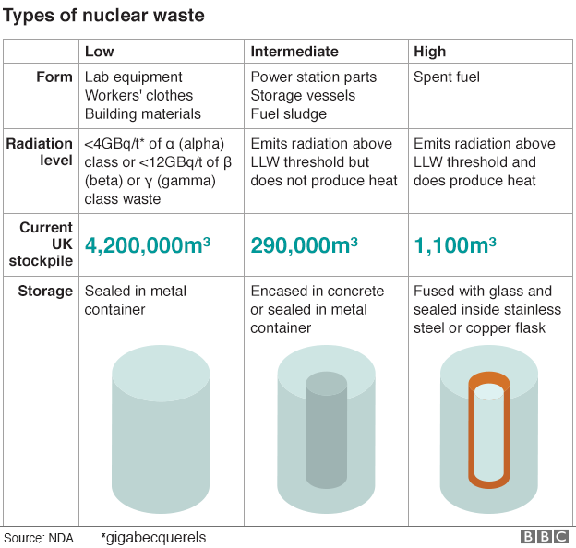
THE TRUMP ADMINISTRATION IS DOWNGRADING TOXIC NUCLEAR WEAPONS WASTE TO CUT DISPOSAL COSTS—SHOULD WE BE WORRIED? https://www.newsweek.com/trump-toxic-nuclear-weapons-waste-disposal-reclassify-1442573 BYON 6/6/19 The Trump administration announced on Wednesday that it is moving forward with plans to reclassify toxic nuclear waste from Cold War weapons research, downgrading some of it from the highest level, in order to cut costs and quicken the disposal process.
The waste under review is currently located at three DOE Defense Reprocessing Waste Inventories: the Hanford Site in Washington, the Savannah River Site in South Carolina, and the Idaho National Laboratory.
Environmental campaigners hit back, accusing the Department of Energy (DOE) of risking the health and safety of Americans through what it characterized as a reckless and dangerous departure from decades-long convention in the country’s handling of its nuclear waste.
But an expert in nuclear waste management said DOE’s shifting approach is both reasonable and desirable—provided it is transparent with the American public in order to build confidence that it is disposing of the toxic material responsibly and safely.
Currently, DOE treats most of its radioactive waste as “high-level” (HLW) because of how it was made rather than classifying it by its characteristics, such as radioactivity. HLW must be buried deep underground when it is disposed of.
DOE said in a release that this “one size fits all” approach to waste management has caused delays to permanent disposal, leaving toxic waste stored in DOE facilities, which causes health risks to workers and costs the taxpayers billions of unnecessary dollars.
Now, DOE will seek to lower the classification of waste of lesser radioactivity, meaning it can be disposed of with greater ease because it does not need to be stored deep below ground—and both sooner and at a lower cost.
Professor Neil Hyatt, an expert in nuclear materials chemistry and waste management at the U.K.’s University of Sheffield, told Newsweek this is potentially a positive change by the DOE.
“DOE is proposing to manage waste on the basis of risk rather than how it was produced, which is quite reasonable—and desirable. We would want resources to be focused on dealing with the waste of highest risk,” Hyatt said.
“That said, it is important that this is achieved with regard to the risk to health and the environment over the full lifecycle of waste management—including the period of waste disposal, which is some 250,000 years.”
Hyatt added: “The new interpretation has the potential to radically change the location, inventory, and nature of waste disposed of, which will be of concern to local communities.”
For the new interpretation of HLW to succeed, Hyatt said, those communities will need to be engaged by authorities in a transparent way.
“The problem is that the action will be seen as moving the goalposts, for unfair means, whilst the game is in progress,” Hyatt told Newsweek.
“If you have agreed that waste is to be classified and managed in a certain way for decades, how do you now build confidence in a new approach?
“This cannot be taken for granted. Transparency, effective public engagement and independent expert scrutiny, in evaluating the risk, will be key. But with a new approach comes a new opportunity to get that right.”
Another expert concurred. Pete Bryant is a consultant in nuclear waste management and president of The Society for Radiological Protection in the U.K. He also teaches in the field at the University of Liverpool.
“By characterizing the waste and classifying it according to its radioactivity and ultimately the risk it poses to human health and the environment, it is possible to dispose of some of the less hazardous waste, reducing the burden of managing them all of HLW,” Bryant told Newsweek.
“As long as this is done under appropriate arrangements and checks this will not present a risk to members of the public and the environment,” he said, adding that this is all in line with global standards of toxic waste management.
After DOE’s announcement, the Natural Resources Defense Council (NRD), an environmental campaign group, hit out at the imminent reclassification of some HLW.
“The Trump administration is moving to fundamentally alter more than 50 years of national consensus on how the most toxic and radioactive waste in the world is managed and ultimately disposed of,” Geoff Fettus, a senior attorney at NRDC, said in a statement.
“No matter what they call it, this waste needs a permanent, well-protected disposal option to guard it for generations to come. Pretending this waste is not dangerous is irresponsible and outrageous.”
DOE said the change will bring its practices in line with international standards on nuclear waste disposal.
USA aims to save money and time by classifying some “high level” radioactive wastes as “low level”
US to label nuclear waste as less dangerous to quicken cleanup, Guardian, 6 June 19,
Energy department says labeling some waste as low-level at sites in Washington state, Idaho and South Carolina will save $40bn, The US government plans to reclassify some of the nation’s most dangerous radioactive waste to lower its threat level, outraging critics who say the move would make it cheaper and easier to walk away from cleaning up nuclear weapons production sites in Washington state, Idaho and South Carolina.The Department of Energy said on Wednesday that labeling some high-level waste as low level will save $40bn in cleanup costs across the nation’s entire nuclear weapons complex. The material that has languished for decades in the three states would be taken to low-level disposal facilities in Utah or Texas, the agency said………
Critics said it was a way for federal officials to walk away from their obligation to properly clean up a massive quantity of radioactive waste left from nuclear weapons production dating to the second world war and the cold war.
The waste is housed at the Savannah River Plant in South Carolina, the Idaho National Laboratory and Hanford Nuclear Reservation in Washington state – the most contaminated nuclear site in the country.
Washington’s Governor Jay Inslee, a Democratic presidential candidate, and the state attorney general, Bob Ferguson, said the Trump administration was showing disdain and disregard for state authority.
“Washington will not be sidelined in our efforts to clean up Hanford and protect the Columbia River and the health and safety of our state and our people,” they said in a joint statement.
The new rules would allow the energy department to eventually abandon storage tanks containing more than 100m gallons (378m liters) of radioactive waste in the three states, according to the Natural Resources Defense Council.
The change means that some of the “most toxic and radioactive waste in the world” would not have to be buried deep underground, the environmental group said.
“Pretending this waste is not dangerous is irresponsible and outrageous,” the group’s attorney Geoff Fettus said.
Tom Clements of Savannah River Site Watch, a watchdog group for the South Carolina nuclear production site, called the reclassification of waste “a cost-cutting measure designed to get thousands of high-level waste containers dumped off site”. He said moving the waste to Utah or Texas is a bad idea involving “shallow burial”.
The old definition of high-level waste was based on how the materials were produced, while the new definition will be based on their radioactive characteristics – the standard used in most countries, the energy department said……..
The nuclear site 200 miles (322km) south-east of Seattle contains about 60% of the nation’s most dangerous radioactive waste that’s stored in 177 ageing underground tanks, some of which have leaked.
Cleanup at Hanford has been under way since the 1980s, at a cost of more than $2bn a year.
The energy department said it would immediately begin studying one waste stream at the Savannah River Plant to see if it should be reclassified as low-level waste. https://www.theguardian.com/world/2019/jun/05/us-to-label-nuclear-waste-as-less-dangerous-to-quicken-cleanup?fbclid=IwAR1NuNSVrKbw8rn_rLUwOZlx
The arguments for and against reclassifying nuclear wastes
THE TRUMP ADMINISTRATION IS DOWNGRADING TOXIC NUCLEAR WEAPONS WASTE TO CUT DISPOSAL COSTS—SHOULD WE BE WORRIED? https://www.newsweek.com/trump-toxic-nuclear-weapons-waste-disposal-reclassify-1442573 BYON 6/6/19 The Trump administration announced on Wednesday that it is moving forward with plans to reclassify toxic nuclear waste from Cold War weapons research, downgrading some of it from the highest level, in order to cut costs and quicken the disposal process.The waste under review is currently located at three DOE Defense Reprocessing Waste Inventories: the Hanford Site in Washington, the Savannah River Site in South Carolina, and the Idaho National Laboratory.
Environmental campaigners hit back, accusing the Department of Energy (DOE) of risking the health and safety of Americans through what it characterized as a reckless and dangerous departure from decades-long convention in the country’s handling of its nuclear waste.
But an expert in nuclear waste management said DOE’s shifting approach is both reasonable and desirable—provided it is transparent with the American public in order to build confidence that it is disposing of the toxic material responsibly and safely.
Currently, DOE treats most of its radioactive waste as “high-level” (HLW) because of how it was made rather than classifying it by its characteristics, such as radioactivity. HLW must be buried deep underground when it is disposed of.
DOE said in a release that this “one size fits all” approach to waste management has caused delays to permanent disposal, leaving toxic waste stored in DOE facilities, which causes health risks to workers and costs the taxpayers billions of unnecessary dollars.
Now, DOE will seek to lower the classification of waste of lesser radioactivity, meaning it can be disposed of with greater ease because it does not need to be stored deep below ground—and both sooner and at a lower cost.
Professor Neil Hyatt, an expert in nuclear materials chemistry and waste management at the U.K.’s University of Sheffield, told Newsweek this is potentially a positive change by the DOE.
“DOE is proposing to manage waste on the basis of risk rather than how it was produced, which is quite reasonable—and desirable. We would want resources to be focused on dealing with the waste of highest risk,” Hyatt said.
“That said, it is important that this is achieved with regard to the risk to health and the environment over the full lifecycle of waste management—including the period of waste disposal, which is some 250,000 years.”
Hyatt added: “The new interpretation has the potential to radically change the location, inventory, and nature of waste disposed of, which will be of concern to local communities.”
For the new interpretation of HLW to succeed, Hyatt said, those communities will need to be engaged by authorities in a transparent way.
“The problem is that the action will be seen as moving the goalposts, for unfair means, whilst the game is in progress,” Hyatt told Newsweek.
“If you have agreed that waste is to be classified and managed in a certain way for decades, how do you now build confidence in a new approach?
“This cannot be taken for granted. Transparency, effective public engagement and independent expert scrutiny, in evaluating the risk, will be key. But with a new approach comes a new opportunity to get that right.”
Another expert concurred. Pete Bryant is a consultant in nuclear waste management and president of The Society for Radiological Protection in the U.K. He also teaches in the field at the University of Liverpool.
“By characterizing the waste and classifying it according to its radioactivity and ultimately the risk it poses to human health and the environment, it is possible to dispose of some of the less hazardous waste, reducing the burden of managing them all of HLW,” Bryant told Newsweek.
“As long as this is done under appropriate arrangements and checks this will not present a risk to members of the public and the environment,” he said, adding that this is all in line with global standards of toxic waste management.
After DOE’s announcement, the Natural Resources Defense Council (NRD), an environmental campaign group, hit out at the imminent reclassification of some HLW.
“The Trump administration is moving to fundamentally alter more than 50 years of national consensus on how the most toxic and radioactive waste in the world is managed and ultimately disposed of,” Geoff Fettus, a senior attorney at NRDC, said in a statement.
“No matter what they call it, this waste needs a permanent, well-protected disposal option to guard it for generations to come. Pretending this waste is not dangerous is irresponsible and outrageous.”
DOE said the change will bring its practices in line with international standards on nuclear waste disposal.
Town of Pilgrim now faces long lasting problem of dangerous nuclear wastes
What to do with nuclear waste remains a national problem with no solution, despite a promise by the federal government to have a facility ready to permanently store it ready by 1998.
About 80,000 tons of spent fuel is currently sitting on nuclear plant properties across the country. To give the number perspective, if existing radioactive fuel assemblies were stacked end-to-end and side-by-side, they would stand over two stories high and cover a football field.
And like those other communities that have hosted nuclear plants during the last 50 years, residents and officials in Plymouth are crying foul. “The Department of Energy has absolutely dropped the ball on this for our communities and all the others, which are becoming de facto nuclear waste repositories,” said Kevin O’Reilly, former executive director of the Plymouth Area Chamber of Commerce and current vice chairman of the Nuclear Decommissioning Citizens Advisory Panel. “The federal government needs to step up to the plate and fulfill their promise.”
“Spent fuel” is nuclear fuel that has been used and removed from the reactor core. The Government Accountability Office calls the hot and highly radioactive stuff one of the most hazardous substances created by humans. Some components stay radioactive for tens of thousands of years.
“If not properly contained or shielded, the intense radioactivity of spent fuel can cause immediate deaths and environmental contamination, and in lower doses can cause long-term health hazards such as cancer,” according to a GAO study done at the request of Congress in 2012……….
Holtec International and Waste Control Services have submitted applications to operate interim storage facilities in New Mexico and West Texas that are under review by the Nuclear Regulatory Commission. But the review process hasn’t been smooth, as both proposed locations have drawn opposition.
Meanwhile, a small startup group in California is working on yet another alternative, which the company says would provide permanent storage right on current plant sites or close by.
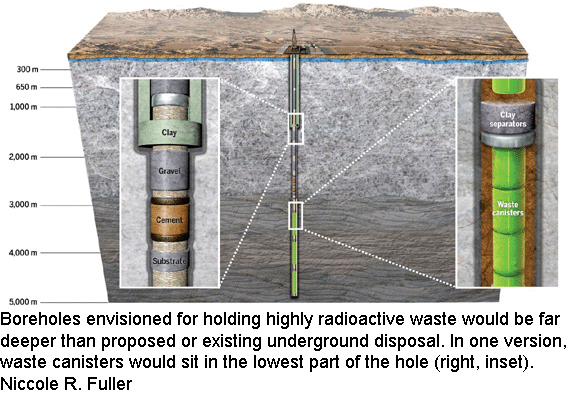
The proposal from Deep Isolation calls for drilling a vertical access channel up to a mile or more down, then gradually running the hole horizontally along the line of the rock formation, where company officials say the nuclear waste would remain unaffected by surface impacts such as sea level rise.
While the debate over where to put spent fuel continues, owners of commercial plants are suing the federal government to recoup money they’ve spent on storing fuel. To date, the Department of Energy has paid out $6.1 billion in damages.
All payouts so far have gone to nuclear power companies. Towns that store the spent fuel have lobbied to be paid for being de facto waste sites. While no such bill has been filed during the current session, legislators in states hosting spent fuel have filed legislation during the past three years called Nuclear Waste Accountability Act. Its provisions require the Department of Energy to provide payments to host communities equal to $15 per kilogram of spent fuel stored there.
FUEL DANGERS
Spent fuel stored in pools has historically caused worry. A zirconium fire could release radiation over hundreds of miles if the water in them is drained away through a seismic event, operator error or act of malice.
Much of the fuel will still be in the pool when Plymouth celebrates its 400th anniversary in 2020, with events throughout the year that will attract crowds of tourists and dignitaries from around the world.
“Spent fuel is a misnomer,” said Mary Lampert, president of the citizens group Pilgrim Watch. “It will be highly toxic as far into the future as dinosaurs were in the past.”
Fuel pool storage is particularly dangerous, she said. “The pool is vulnerable to water loss resulting in a fire that could contaminate an area larger than Massachusetts and force the evacuation of millions.”
The casks, once loaded, will ultimately be situated on a spent fuel pad about 75 feet above sea level………
Holtec International, the company looking to buy Pilgrim and decommission it, has long been involved in the manufacture of dry casks. Entergy has used Holtec’s Hi-Storm 100 casks and plans to continue with that model.
Watchdogs like Lampert worry over what will happen if those casks give out over time. They could crack or corrode from the coastal salt air. “We will only know after the fact that a cask has leaked radiation,” she said…… https://www.capecodtimes.com/news/20190601/radioactive-waste-big-concern-for-now-closed-pilgrim-plant
Holtec’s involvement in the Ukraine’s Chernobyl’s dry store facility
 Halting Holtec – A Challenge for Nuclear Safety Advocates, CounterPunch, 7 June 19 “……….The California – Chernobyl Connection
Holtec and its client Edison would have the public believe that the San Onofre ISFSI is top of the line, up to date and state-of-the-art spent fuel handling. But that image seems to be contradicted by a recent Holtec press release and accompanying animated video that may seem to describe something like the kind of waste storage system many are advocating for at San Onofre.
On May 6, 2019, Holtec was “pleased to announce the start of final system-wide trials for Chernobyl’s dry store facility….” In the next two months, Holtec expects to complete “stem-to stern functional demonstrations of the [SF-2] spent fuel handling and storage processes before handing over the facility to Ukraine’s State owned enterprise Chernobyl Nuclear Power Plant (ChNPP).”
The Holtec press release boasts, “Dismembering more than 21,000 RBMK spent fuel assemblies in a special purpose “hotcell,” packaging those fuel assemblies in double walled canisters(DWCs), and transferring them from (open) water-cooled pools into hermetically sealed rugged helium-filled storage systems inside ventilated modules will mark a huge safety milestone for Ukraine.” https://youtu.be/GYR3GmkRZV0
Holtec is also building a project called a Central Spent Fuel Storage Facility (CSFSF) for the Ukrainian company Energoatom. Holtec says the “CSFSF will employ double-confinement DWCs, the world’s first double-walled, double-lid multi-purpose canister system for dry storage of spent nuclear fuel.”
Many may now be asking, “Why isn’t what’s good for Ukraine, also good for California?” But, Donna Gilmore points out that, “It’s a thin-wall canister system. Exterior wall is 3/8″ thick. Interior wall is 1/2″ thick. Both welded shut. Still must be stored in Holtec concrete cask with air vents. Still cannot be inspected, maintained, monitored or repaired inside or out.” …………https://www.counterpunch.org/2019/06/07/halting-holtec-a-challenge-for-nuclear-safety-advocates/
Someday the U.S. Will Have to Actually Deal With Its Nuclear Waste Problem
Someday the U.S. Will Have to Actually Deal With Its Nuclear Waste Problem, The Department of Energy has made a move in that direction. Slate, By JANE C. HU 7 June 19, “………… the Department of Energy announced Wednesday that they are reclassifying the definition of “high-level,” or highly radioactive, waste stored in underground tanks at Hanford Nuclear Reservation in Washington state, the Savannah River Plant in South Carolina, and the Idaho National Laboratory in Idaho Falls. The DOE hopes that the redefinition will expedite cleanup of the waste. Currently, the high-level waste stored at these sites is waiting for the government to open a secure waste repository (like Yucca Mountain in Nevada, which has been in limbo for decades). But if some of the less radioactive waste qualifies under the new definition, it might instead be shipped off to other sites, like one in Texas, where it could be
mixed with “concrete-like grout.” The cleanup at Hanford has already cost the country billions of dollars and is projected to cost billions more as we continue the search for the waste’s final home. (Adding some urgency to developing a new plan is the risk that containers could leak and contaminate the environment, especially if there’s an earthquake in Washington.)JUNE 07,
The DOE’s new plan could be cost-effective, sure, but the question is whether it’s safe. When the agency first announced reclassification plans in October 2018 and solicited public comment, the proposal received thousands of responses. And Washington state officials are not happy; Gov. Jay Inslee and Department of Ecology Director Maia Bellon have both sent letters of concern to the DOE. “I am gravely concerned with DOE forging ahead with a new interpretation of HLW that does not comport with federal law, despite objections from Washington state,” wrote Bellon.
In addition to the waste we already have sitting around at Hanford and other old nuclear weapons facilities (charmingly called “legacy waste”), nearly 100 commercial nuclear reactors at 60 facilities around the U.S. are creating new waste every day. The type of waste produced by those two types of facility contains different radioactive materials with varying half-lives, but the same storage issues remain: What will we eventually do with all this radioactive stuff?
The lack of solution is not from lack of discussion. There have been all sorts of wacky ideas floated about where to store nuclear waste. Some have proposed we shoot it all into space, maybe have it orbit Venus. But given how spacecraft are prone to explosions, which would effectively mean showering the world with bits of radioactive waste, that idea stalled. In the ’90s, the idea of burying waste in deep ocean seabeds seemed promising, but it never really got off the ground. And some countries tried storing barrels of waste in ice sheets, which turns out to be less than ideal given that ice both moves and melts. As the earth thaws out, old waste becomes uncovered.
Here in the U.S., we’re running out of space, and experts are concerned about the lack of long-term solutions. “Instead of a planned, coherent system, we have the confusion of an unplanned, less than optimal system,” nuclear experts wrote in a 2018 report on nuclear waste management strategy and policy, calling the U.S. program “an ever-tightening Gordian Knot” subject to technical, scientific, logistical, regulatory, legal, financial, social, and political challenges. “This is not a situation that builds public confidence.”……..https://slate.com/technology/2019/06/department-of-energy-nuclear-waste-reclassification-yucca.html
America’s largest radioactive clean-up operation – at Hanford – has stalled
|
Nation’s most ambitious project to clean up nuclear weapons waste has stalled at Hanford, LA Times, By RALPH VARTABEDIANJUN 04, 2019
In a terse letter last week, state officials said the environmental project is at risk of violating key federal court orders that established deadlines after past ones were repeatedly missed.
Two multibillion-dollar industrial facilities intended to turn highly radioactive sludge into solid glass at the Hanford nuclear site have been essentially mothballed. Construction was halted in 2012 because of design flaws and Energy Department managers have foundered in finding alternatives, according to the letter that threatens new litigation. The department has stored 56 million gallons of radioactive sludge left over from the production of plutonium in 177 leaky underground tanks on a desert plateau a few miles from the Columbia River, raising concerns that the material has migrated into groundwater and eventually will reach the largest river in the West. The original idea was to chemically treat the sludge, mix it with sand and then melt the combination in furnaces to create glass that would be stable for centuries, but the plan was harder than expected because the sludge is so chemically and radioactively toxic. The process required the construction of a massive industrial complex.
Maia Bellon, Washington’s Department of Ecology director, said in the letter that federal officials have taken repeated unilateral actions that will make their cleanup unlikely to meet critical deadlines set up in a 2016 consent decree in federal court, which came after the department violated a 2010 legal agreement. The department has committed to removing and disposing all of the underground tank waste by 2047, though Bellon said the state doesn’t think that is possible at current funding levels. The six-page letter was addressed to Anne White, chief of environmental management at the Energy Department. The Times obtained the letter from Hanford Challenge, a watchdog group that has closely monitored the contaminated facility. “This is clearly setting the table for litigation,” said Tom Carpenter, executive director of the group. “The Energy Department is going to miss all of these deadlines.” Carpenter noted that in February, the Energy Department issued a new cost estimate to remediate the entire Hanford site, taking it from $110 billion to as much as $660 billion, a cost increase that has staggered Congress and has fueled sentiment to cut short the cleanup goals. “They are walking away from important elements of the cleanup,” he said. A spokeswoman at the Energy Department’s site office in nearby Richland said they had not seen the letter. A spokesman for White did not return calls seeking comment. White announced her resignation last week…… https://www.latimes.com/nation/la-na-hanford-nuclear-cleanup-20190604-story.html |
|
|


Cleaning up of South Carolina’s high level nuclear waste- the plan involves reclassifying some of as “low level”
|
Feds offer to speed cleanup of SC’s deadly nuclear waste. But plan isn’t that simple, The State, BY SAMMY FRETWELL
JUNE 06, 2019
According to plans, the energy department would classify some of the Savannah River Site’s high-level waste as low-level waste, a type of atomic refuse that is considered less toxic. That, in turn, would allow the material to be shipped to low-level nuclear waste disposal sites in the deserts of Utah and Texas. “We want to look at taking the waste stream in South Carolina and reclassifying it and moving it out of state,’’ said Paul Dabbar, the energy department’s undersecretary for science. The DOE’s plan for reclassifying and shipping waste from SRS is part of a larger proposal to change the definition of nuclear waste at weapons complexes in other parts of the country. The agency says it has historically considered much of the waste that resulted from Cold War weapons production to be high-level. Now, it will consider how radioactive the material is, the DOE said. In addition to the Savannah River Site, nuclear weapons sites in Washington and Idaho that also have high level waste could benefit from the department’s plan to change the definition of nuclear waste, the agency said. The SRS proposal and a companion plan for nuclear sites across the country, released Wednesday, drew immediate criticism from environmental groups, which said the plans are potentially dangerous. But the Department of Energy says reclassifying some of the high level waste would occur only after a thorough analysis and environmental studies. Federal records show the agency will look at whether 10,000 gallons of Savannah River Site wastewater should still should be classified as high level waste or downgraded to another category. For now, the DOE said it is only considering the 10,000 gallons for disposal at a licensed faciliity outside South Carolina, records show. The wastewater comes from the Defense Waste Processing Facility, an industrial plant that converts high-level waste into glass in an effort to neutralize its danger. Reclassifying waste would speed cleanup at the Savannah River Site, the agency said. The 310-square-mile weapons complex has tons of atomic refuse left over from Cold War weapons production. Much of that waste is held in about four-dozen aging tanks, some of which have cracked. A handful of tanks have been emptied, but most still contain waste…….. Geoff Fettus, who tracks nuclear waste issues for the Natural Resources Defense Council, said reclassifying waste might also allow officials at SRS to avoid cleaning up some material altogether. Fettus said that if some of the waste at SRS is no longer considered high level, the DOE could leave the material there and walk away. If that happens, it would not be the first time at SRS. In 2002, the energy department offered plans to reclassify waste so some residual material could remain in the tanks. “That is the big thing,’’ Fettus said. “I think this is just as much about what stays in the tanks, as to what comes out.’’ Fettus said the environmental group has serious reservations about the plan being advanced by President Donald Trump. “The Trump administration is moving to fundamentally alter more than 50 years of national consensus on how the most toxic, radioactive and dangerous waste in the world is managed and ultimately disposed of,’’ Fettus told The State newspaper. “No matter what they call it, this waste needs a permanent, well-protected disposal option to guard it for generations to come.’’ Tom Clements, who heads Savannah River Site Watch, also said the proposal is unwise and unsafe. “DOE’s questionable rewriting of the regulations is simply a cost-cutting measure designed to get thousands of HLW (high level waste) containers dumped off site,’’ he said in an email. Any waste that is reclassified would not be sent to South Carolina’s Barnwell County low-level nuclear waste site near SRS, but to commercial facilities near the Texas-New Mexico border and in Utah, energy officials said. The low-level Utah waste site is owned by the same company that runs the aging Barnwell County low-level waste dump, which has leaked. |
|
|
Doubts on Holtec’s clean-up of Pilgrim nuclear power station
|
Pilgrim Is Closing. So Then What Happens To The Radioactive Waste? wbur, Earthwhile, May 30, 2019, Barbara Moran This week, Pilgrim Nuclear Power Station will power down for the last time.Over the next few years, workers will move the radioactive fuel into storage, dismantle the plant, and clean up the site. The process is called decommissioning, and a lot of people are worried about safety, cost and where the nuclear waste will finally end up.
All together, there are 4,114 fuel assemblies at Pilgrim. They’ll stay radioactive for thousands of years. And with nowhere to put them — for now, at least — they’ll stay in Plymouth indefinitely. “With no repository in sight, Plymouth — America’s hometown — will be a nuclear waste dump,” says Diane Turco, executive director of the watchdog group Cape Downwinders. “No one knows what to do with this waste. … So I think we need to prepare that it’s going to be in Plymouth for a long time.”
After the plant powers down, workers will move the fuel from the reactor into the spent fuel pool. It will take a few years for the fuel to cool off enough for workers to move it from the pool into steel canisters. Then they’ll put the canisters into enormous steel-and-concrete containers called “dry casks” for storage. Everybody wants the job done right, because an accident could release radioactive material into the environment. The worst-case scenario — a major fire in the spent fuel pool — could put thousands of lives at risk. “Decommissioning is a very dangerous time at Pilgrim. The spent fuel will be moved from the pool to the dry casks; the dry casks will be moved on the property,” says Turco. “To do it quick and fast doesn’t necessarily mean safe — let’s do it right.” The fuel storage casks are made by New Jersey-based Holtec International. Holtec produces storage components for more than half of the nuclear power plants in the United States. And with nuclear plants shutting down across the country, business is booming.
It seems like a surprisingly low-tech way to hold highly radioactive spent nuclear fuel. That’s the beauty of it, says Allen Hickman, vice president of manufacturing for Holtec. ……… Not everyone shares Hickman’s confidence, including Plymouth resident Sean Mullin, chair of the state’s Nuclear Decommissioning Citizens Advisory Panel. “What happens if a crack emerges? There is a lot of salt in the air, and there’s a lot of other things that could deteriorate it,” says Mullin. At a public meeting in March, NRC Reactor Decommissioning Branch Chief Bruce Watson said the NRC is currently working with industry to develop surveillance and testing requirements, and that the storage facility at Pilgrim would be inspected “at least annually.” If workers detect a serious leak or crack in a cask — an event the Watson called “extremely unlikely” — it will be “encapsulated” in another cask. Mullin is skeptical of the encapsulation plan. “There should be something better,” he says. Holtec wants to do more than build nuclear storage casks. The company plans to buy Pilgrim and handle the whole decommissioning process: move the fuel to storage, tear down the plant, and clean up the site. But Holtec has never fully decommissioned a nuclear plant before. And unlike Entergy, which proposes decommissioning the site in 60 years, Holtec says it can be done in eight. ….. Holtec’s proposal worries critics like citizen’s group Pilgrim Watch and Massachusetts Attorney General Maura Healey. Both have filed petitions to intervene with the NRC. “Holtec has never actually cleaned up a nuclear power plant before, and it’s proposing to do so at what’s really a record pace,” says Healey. “What we want is for the closure to be done safely. We want the site cleaned up and we need to make sure that there’s enough money there to make that happen well.” Holtec also wants to buy Indian Point nuclear plant in New York, and build an interim storage site in New Mexico, where the company hopes to eventually ship spent fuel from Pilgrim and other sites. Critics say Holtec is stretched thin. We fear that they have bitten off far more than they can chew, negatively impacting the quality of oversight and attention to properly decommission Pilgrim Station,” wrote Pilgrim Watch director Mary Lampert in an email. In April the NRC issued two safety violations against the company for an incident involving dry casks at the San Onofre nuclear plant in California. Although no radioactive material was released and the NRC did not issue a fine, Holtec’s Russell says the company takes the violations “very seriously” and is scrutinizing technology, training and procedures…… Cost Concerns If Holtec purchases Pilgrim, the company will receive the plant, the surrounding land and a decommissioning trust fund currently valued around $1 billion. Holtec might also get additional money by suing the federal Department of Energy for failing to build a permanent nuclear waste repository. But an old plant like Pilgrim will likely have cleanup problems beyond nuclear waste, like asbestos and lead paint. And other nuclear plants, like Connecticut Yankee and Yankee Rowe, cost far more to clean up than expected. “We think that Holtec is seriously underestimating what it’s going to cost to get this done — underestimating to the tune of millions of dollars,” state AG Healey says. “And at the end of the day, if Holtec begins this project and doesn’t have the money to finish it, it’s going to be the state, our residents and taxpayers that are going to be on the hook, and we want to make sure that doesn’t happen.” Critics are also concerned about Holtec’s formation of a limited liability company with Canadian engineering and construction company SNC-Lavalin called Comprehensive Decommissioning International, which will handle Pilgrim’s decommissioning. Dan Wolf, a former state senator from the Cape and Islands — and the founder and CEO of Cape Air — says the move insulates the parent company and makes it unclear who is ultimately financially responsible for the cleanup. “My concern is, if there’s not enough money and the job doesn’t get completed, it’s going to fall both on our government and on the ratepayers to make up any deficiencies,” says Wolf. “It’s one of the more egregious cases of socializing risk and privatizing profit.”…….. The Pilgrim site is already storing spent nuclear fuel in 17 dry casks near the reactor building. Eventually, there will be 61 casks, stored on a new pad, 75 feet above sea level, partly to safeguard against sea level rise. It’s expected they’ll be moved there by 2021 and protected by armed guards. While Congress has recently started talking about a new national repository for nuclear waste, and Holtec says it hopes to remove the spent fuel from Pilgrim by 2062, there’s a chance that waste could remain at Pilgrim (or rather, the former Pilgrim) indefinitely, a silent monument to the nuclear age.https://www.wbur.org/earthwhile/2019/05/30/plymouth-nuclear-plant-decommissioning |
|
Map drawn of 80 USA nuclear waste sites
|
New Map Shows Expanse Of U.S. Nuclear Waste Sites https://www.forbes.com/sites/jeffmcmahon/2019/05/31/new-map-shows-expanse-of-u-s-nuclear-waste-sites/#5f0a293fc2cf
Jeff McMahon, The United States is home to 21 “stranded” nuclear-waste storage sites, according to a congressional researcher who was quick to add that “stranded does not imply that the waste has been abandoned or lacks regulatory oversight.”It means those 21 sites are no longer attached to reactors that are producing electricity or revenue, environmental policy analyst Lance N. Larson writes in a May report to members of Congress. The stranded sites are costly for the federal government, which has spent $7.4 billion to nuclear utilities and other reactor owners, according to CRS, to offset its responsibility to store the waste. The 21 are among 80 sites Larsen drew together in a map that shows where the country’s nuclear waste is distributed while it awaits construction of a permanent repository. The United States is home to 21 “stranded” nuclear-waste storage sites, according to a congressional researcher who was quick to add that “stranded does not imply that the waste has been abandoned or lacks regulatory oversight.” It means those 21 sites are no longer attached to reactors that are producing electricity or revenue, environmental policy analyst Lance N. Larson writes in a May report to members of Congress. The stranded sites are costly for the federal government, which has spent $7.4 billion to nuclear utilities and other reactor owners, according to CRS, to offset its responsibility to store the waste. The 21 are among 80 sites Larsen drew together in a map that shows where the country’s nuclear waste is distributed while it awaits construction of a permanent repository. |
|
1 This Month
23-25 October – on Zoom – World BEYOND War’s annual global conferenc


Shut down the radiation-damaged Heysham nuclear reactors now
To see nuclear-related stories in greater depth and intensity – go to https://nuclearinformation.wordpress.com

Say No to NASA’s Reckless Nuclear Reactor on the Moon
Say No to NASA’s Reckless Nuclear Reactor on the Moon
-
Archives
- October 2026 (170)
- September 2026 (339)
- August 2026 (330)
- July 2026 (355)
- June 2026 (287)
- May 2026 (306)
- April 2026 (356)
- March 2026 (251)
- February 2026 (267)
- January 2026 (308)
- December 2025 (358)
- November 2025 (359)
-
Categories
- 1
- 1 NUCLEAR ISSUES
- business and costs
- climate change
- culture and arts
- ENERGY
- environment
- health
- history
- indigenous issues
- Legal
- marketing of nuclear
- media
- opposition to nuclear
- PERSONAL STORIES
- politics
- politics international
- Religion and ethics
- safety
- secrets,lies and civil liberties
- spinbuster
- technology
- Uranium
- wastes
- weapons and war
- Women
- 2 WORLD
- ACTION
- AFRICA
- Atrocities
- AUSTRALIA
- Christina's notes
- Christina's themes
- culture and arts
- Events
- Fuk 2022
- Fuk 2023
- Fukushima 2017
- Fukushima 2018
- fukushima 2019
- Fukushima 2020
- Fukushima 2021
- general
- global warming
- Humour (God we need it)
- Nuclear
- RARE EARTHS
- Reference
- resources – print
- Resources -audiovicual
- Weekly Newsletter
- World
- World Nuclear
- YouTube
-
RSS
Entries RSS
Comments RSS

