Indigenous opposition grows against proposal for grand nuclear waste dump in New Mexico
 Some fear the “interim” storage facility could become a de facto permanent storage facility
transport of high-level radioactive waste across the state  could also lead to potentially dangerous nuclear releases, leaving impacted communities responsible for emergency responses.
 the proposal fits into a wider pattern of negligence and environmental racism on behalf of the federal government towards one of the United States’ poorest majority-minority states.
|
Nuclear Colonialism: Indigenous opposition grows against proposal for nation’s largest nuclear storage facility in NM Political Report By Kendra Chamberlain 14 Nov 19, A proposal for New Mexico to house one of the world’s largest nuclear waste storage facilities has drawn opposition from nearly every indigenous nation in the state. Nuclear Issues Study Group co-founder and Diné organizer Leona Morgan told state legislators last week the project, if approved, would perpetuate a legacy of nuclear colonialism against New Mexico’s indigenous communities and people of color.Holtec International, a private company specializing in spent nuclear fuel storage and management, applied for a license from the federal Nuclear Regulatory Commission to construct and operate the facility in southeastern New Mexico. The proposal, which has been in the works since 2011, would see high-level waste generated at nuclear power plants across the country transported to New Mexico for storage at the proposed facility along the Lea-Eddy county line between Hobbs and Carlsbad. Continue reading |
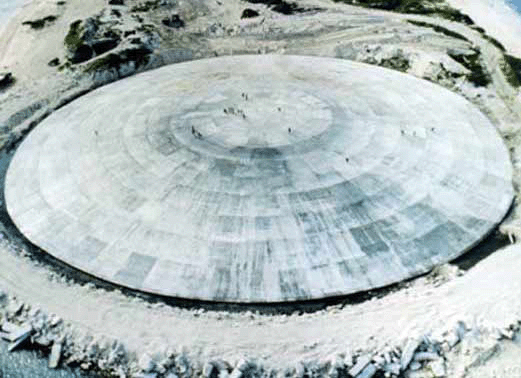
Nuclear tomb: The Runit Dome is chipping and cracking
|
Radioactive ‘Tomb’ in Pacific Filled With Nuclear Waste Is Starting to Crack, Science Alert ARIA BENDIX, BUSINESS INSIDER, 12 NOV 2019
In the Marshall Islands, locals have a nickname for the Runit Dome nuclear-waste site: They call it ‘The Tomb’. The sealed pit contains more than 3.1 million cubic feet (87,800 cubic meters) of radioactive waste, which workers buried there as part of efforts to clean hazardous debris left behind after the US military detonated nuclear bombs on the land. From 1977 to 1980, around 4,000 US servicemen were tasked with cleaning up the former nuclear testing site of Enewetak Atoll. They scooped up the contaminated soil, along with other radioactive waste materials such as military equipment, concrete, and scrap metal. It all went into the Runit Dome, which the servicemen then covered with concrete. In total, the crater holds enough radioactive waste to fill 35 Olympic-sized swimming pools. Most of that is irradiated soil carrying plutonium, an isotope that can cause lung cancer if inhaled. But as seas have gotten higher in the area – the water has risen about 7 millimetres per year since 1993 – water has begun to seep into the soil beneath the dome. Unlike the sealed dome on top, the bottom of the pit was never lined with concrete. So now, rising tides threaten to submerge the tomb – or crack it open. The Runit Dome is chipping and crackingPrior to the nuclear tests in the 1940s and 1950s, residents of Enewetak Atoll were exiled from their homes and relocated to nearby islands. Today, only three of the atoll’s 40 islands have been dubbed safe for human habitation. They are currently home to around 650 residents. The island that hosts Runit Dome remains unoccupied. In 2013, the US Department of Energy reported that radioactive materials could be leaking from the dome into the marine environment, but said such an occurrence would “not necessarily lead to any significant change in the radiation dose delivered to the local resident population.” But sea levels around the Marshall Islands are rising. By 2030, they could be between 1.2 and 6.3 inches (3 cm to 16 cm) higher than they are now, resulting in more storm surges and coastal flooding. By 2100, the dome could be submerged in water. Locals fear that mounting damage to the structure could present a new set of health risks. The dome recently began to crack and chip, increasing the odds that strong waves could force the structure open. A disaster like that would send even more radioactive waste into the nearby ocean or lagoon, which could even force locals to leave the island once again. “If it does [crack] open, most of the people here will be no more,” Christina Aningi, a teacher on Enewetak Atoll, told the Australian Broadcasting Corporation. “This is like a graveyard for us, waiting for it to happen.”…….https://www.sciencealert.com/a-tomb-in-the-marshall-islands-contains-a-huge-amount-of-radioactive-waste |
|
The push for nuclear power in Africa, but what happens to the wastes?

|
What happens to nuclear waste from power plants? DW, 14 Nov 19African countries looking to invest in nuclear energy as a source of clean electricity should consider Europe’s struggles with disposing of radioactive waste. Seventy years after the nuclear age began, no country has built a place to safely store its waste, a report published this week warns, raising concerns for governments mulling nuclear power as an alternative to fossil fuels.More than 60,000 tons of highly radioactive waste in the form of spent nuclear fuel rods are stored in interim sites across Europe, according to the World Nuclear Waste Report, some in old facilities that are running out of capacity and are expected to be used for decades longer than planned. Finland is the only country building a permanent repository underground for nuclear waste that emits large amounts of radiation for tens of thousands of years, according to the report published by the Heinrich Böll Foundation — which is affiliated with the German Green party.
“We are talking about time frames that are beyond the human scale of what we can think of,” said Arne Jungjohann, political scientist and lead editor of the report. “We still don’t know where to put the waste safely in a way that nobody will get harmed, that it is not vulnerable to terrorist attacks, that it is not being stolen to build nuclear bombs.” At the dawn of the nuclear age, radioactive material was diluted and dumped in the environment, before governments moved towards containing it securely underground. But projects from the 1960s onwards only met high safety expectations “to a very limited extent, if at all,” according to the report. That raises difficult questions for developing countries looking to get into nuclear. Nuclear Power in Africa Africa’s urban population is set to double in the next three decades, massively boosting demand for infrastructure and energy. Just half of Africans had access to electricity in 2017, compared to a global average of 88%, World Bank data shows. Eager to connect citizens with electricity grids, but anxious to avoid high-emissions of Western countries, some governments are exploring nuclear as a way to supply cheap and stable energy. South Africa is the only country on the continent that currently operates a nuclear plant, but about a dozen others are considering, planning or building them, according to the World Nuclear Association. Several countries — Algeria, Egypt, Ghana, Kenya, Namibia, Nigeria, Tanzania, Uganda and Zambia — have signed partnership agreements with Russian nuclear energy company Rosatom, a paper published in the journal Issues in Science and Technology found earlier this year, and others have contracts with China…….. attempts to deal with nuclear waste have so far faltered. Excluding Russia and Slovakia due to poor data, the report found that just four countries — France, the UK, Ukraine and Germany — are responsible for more than half of Europe’s nuclear waste, and none have yet found a deep underground store to hold it over centuries. The Heinrich Böll Foundation report found many governments underestimate the cost of storing waste and decommissioning reactors, with inconsistent rules shifting the financial burden from plant operators onto future generations of taxpayers. Unsolved nuclear waste is the “defeating argument against entering into the nuclear age,” said Rebecca Harms, a former Member of the European Parliament who was behind the report. “African countries should consider the nuclear legacies which have been created during the last 50, 60 years and for which we have no solutions.” Demand for energy in Sub-Saharan Africa is set to rise by 60% in the next two decades, but nuclear sources are projected to meet only a small fraction of this, according to the Africa Energy Outlook 2019, a report from the International Energy Agency (IEA) published on Thursday. “What we see in the future economic development of sub-Saharan Africa will be powered by a mix of renewables and natural gas,” said Kieran McNamara, senior energy analyst at the IEA and co-author of the report. “Nuclear just doesn’t feature.” https://www.dw.com/en/what-happens-to-nuclear-waste-from-power-plants/a-51216359 |
|
Lawmakers right to hold off on nuclear waste bill
Lawmakers right to hold off on nuclear waste bill https://www.powelltribune.com/stories/lawmakers-right-to-hold-off-on-nuclear-waste-bill,22189, November 7, 2019 , By CJ Baker
Offer people enough money and they’ll put up with quite a bit.
So if the State of Wyoming was offered, say, billions of dollars a year, you might find some folks willing to hold their nose and let the federal government store a bit of nuclear waste in an isolated corner of the state.
But with the feds apparently offering relative peanuts to stash their waste in Wyoming, we’re pleased that state lawmakers are backing off the idea.
On Tuesday, the Legislature’s Joint Minerals, Business & Economic Development Committee decided not to sponsor a bill that would have called on the governor’s office to try negotiating a nuclear waste deal with the feds.
Lawmakers started exploring the idea of temporarily storing spent nuclear fuel rods back in July. Things got off on the wrong foot right away, as the Joint Management Council opted to look into the concept using an unannounced vote held by email; the discussion only became public when WyoFile, a nonprofit news service, learned of and wrote about it.
We wrote in this space back in July that, while the lack of transparency was frustrating, the idea was worth exploring. However, the price has to be right. State Sen. Jim Anderson, a Republican from Casper, told WyoFile in July that Wyoming could receive as much as $1 billion a year for storing the country’s nuclear waste. That could go a long way toward relieving some of Wyoming’s budget woes.
But when the Spent Fuel Rods Subcommittee actually heard testimony on the subject in September, federal officials suggested the state might only receive $10 million a year — and a chunk of that would go to local governments, according to reporting by the Casper Star-Tribune.
Further, it was suggested that Wyoming might have a fight on its hands to even get that funding, possibly needing Congress to pass legislation and potentially facing multiple lawsuits.
On top of that, the idea drew nearly unanimous opposition from dozens of members of the public who weighed in at the meeting and via online comments.
“Keep that crap out of my state,” was one representative remark from a Casper resident.
While we believe that nuclear waste could be safely transported to and stored in Wyoming, it’s almost certain that, regardless of whatever precautions are taken and assurances given, many residents will remain wary and fearful of the idea. That means accepting spent fuel rods at a new facility here would require ramrodding legislation through the Wyoming Legislature and Congress over the top of some staunch opposition.
There’s also little question that the move would create some bad PR for Wyoming — the “toxic waste dump” jokes basically write themselves — which is a concern for a state that relies on tourism.
All of that is to say that we were a bit dumbfounded to hear that going to all that trouble would net a mere pittance in revenue.
In an interview with the Casper Star-Tribune last month, Sen. Anderson acknowledged the U.S. Department of Energy hasn’t offered enough cash.
“… if they stick to that $10 million figure, we’re not even going to pursue it,” he said.
However, Anderson suggested to the Star-Tribune that the state could negotiate a much better rate that would get closer to the $1 billion mark.
Under the legislation drafted by the Minerals, Business & Economic Development Committee, Gov. Mark Gordon would have been called upon to strike a deal with the Department of Energy. But the committee announced Tuesday that they wouldn’t sponsor the bill, the Star-Tribune reported, with Anderson saying that the governor could open negotiations on his own.
However, a spokesman for Gordon told the Star-Tribune that the governor “remains uncertain that this proposal is the best way to generate revenue for the state.” And the governor told the Wyoming Tribune Eagle last week that, while open to hearing more about nuclear waste storage, “I don’t think it’s the best industry for Wyoming.”
We share Gov. Gordon’s uncertainty and don’t see any reason to move forward at this time — particularly because it seems awfully unrealistic to think the Department of Energy will agree to pay 100 times its initial offer. And when it comes to stashing nuclear waste in the ground, we can’t afford to take a pie-in-the-sky approach.
Fukushima: Radioactive waste bags still missing after Typhoon Hagibis

In many municipalities in the prefecture, a lot of radioactive waste, including soil, was generated through decontamination work after the 2011 nuclear disaster at Tokyo Electric Power Company Holdings Inc.’s Fukushima No. 1 power plant. Numerous bags containing the waste are kept outdoors in temporary storage areas around the prefecture.
Heavy rains from the 19th typhoon of the year flooded storage space in many locations, sweeping away 44 bags in Kawauchi, 30 in Tamura, 15 in Nihonmatsu and one in Iitate.
By the end of October, 50 bags had been recovered. The contents had leaked from half of them. “We had far heavier rains than we expected. We did not cover bags of radioactive waste,” said an official of the Tamura Municipal Government.
The ministry and other organizations have mobilized 20 to 30 workers to look for the missing bags, wading into rivers when necessary and using drones to search areas that cannot physically be entered.
An aerial survey was conducted by helicopter on Oct. 23. On Friday, 29 workers searched the Furumichi River and areas along it in Tamura. Four bags were collected, but their contents had been lost.
“There has been no confirmation of any environmental impact due to the loss of the bags,” a ministry official said.
“We’ll continue searching in cooperation with local municipalities.”
Japan still has land space to store radioactive waste tanks, but tries to justify dumping into ocean
 Japan accused of trying to justify nuclear dump http://www.taipeitimes.com/News/taiwan/archives/2019/11/07/2003725403COVER? Tokyo Electric Power Co has said new storage tanks could be built to hold radioactive water at its stricken plant, a Greenpeace Germany member said Japan accused of trying to justify nuclear dump http://www.taipeitimes.com/News/taiwan/archives/2019/11/07/2003725403COVER? Tokyo Electric Power Co has said new storage tanks could be built to hold radioactive water at its stricken plant, a Greenpeace Germany member said
By Lin Chia-nan / Staff reporter The Japanese government’s claim that it will run out of room to store radiation-contaminated water at the Fukushima Dai-ichi nuclear power plant in two years is not true, and is simply an attempt to justify discharging polluted water into the Pacific Ocean, a Greenpeace International member said yesterday.
Shaun Burnie, senior nuclear specialist at Greenpeace Germany who has conducted long-term surveys in Japan, was invited by Greenpeace Taiwan to talk about the issue at a news conference in Taipei. An earthquake and a tsunami in March 2011 caused the plant’s reactor fuel rods to melt and large amounts of radioactive-contaminated water was released into the Pacific. As of Oct. 22, more than 1 million cubic meters of processed polluted water was stored at the treated water storage tank, while the current storage capacity is nearly 1.1 million cubic meters, Burnie said. Tokyo Electric Power Co in August said the tank would reach full capacity by the summer of 2022 and that there is no room for expansion at the site, he said. However, the company in a meeting in September said that land is available to build additional tanks, Burnie added. The claim of insufficient capacity is just an excuse to cover the Japanese government’s political agenda, Burnie said, adding that Tokyo has the option of storing contaminated water for a longer period. If Japan approves the discharge, radioactive tritium and other radionuclides in the water will likely enter the East China Sea, and eventually the waters surrounding Taiwan through the subtropical gyre, he said. However, even if the Japanese government decides to discharge polluted water into the ocean, it would not be able to carry out the plan immediately, as it might take years to build outflow pipelines, he said. In addition to protests from local fishers, especially those living along Japan’s Tohoku coast, the Japanese government would face strong pressure from the international community for discharging polluted water, he said, adding that it is a long-term problem that should be approached more cautiously. The Fukushima Dai-ichi disaster has led to catastrophic results, and the Taiwanese government should be lauded for making the “brave and correct” decision to phase out nuclear power plants, Burnie said. Taiwan should call on the Japanese government, via diplomatic or non-governmental channels, to shoulder its responsibility as a Pacific nation and not discharge radiation-contaminated water into the sea, National Nuclear Phase-out Action Platform spokesperson Tsuei Su-hsin (崔愫欣) said. As Taiwan generates less than 10 percent of its electricity from nuclear power — much lower than the ratio in Japan before the 2011 disaster, it should persist in its goal of phasing out all nuclear power plants by 2025, Tsuei said. |
|
Nuclear waste storage? There’s no real money in it for Wyoming.
 Kessler: Nuclear waste storage provides no benefit for Wyoming, https://trib.com/opinion/columns/kessler-nuclear-waste-storage-provides-no-benefit-for-wyoming/article_4267cc9f-a2f8-54e5-a2d6-7ebe2fe9f9eb.html, Nov 2, 2019
There’s no doubt that Wyoming needs to find new revenue sources to fund our schools and state budget, but storing nuclear waste is not the answer. It’s a far-fetched proposal riddled with legal roadblocks. And even if we ignore those roadblocks — along with the many safety and political risks of storing high-level radioactive waste — there’s no real money in it for Wyoming.
For starters, the Nuclear Waste Policy Act, which regulates the storage of spent fuel rods from commercial nuclear reactors, makes available just $5 million per year to states willing to host a “monitored retrievable storage” facility during the construction phase. Once such a facility starts accepting the waste, that amount increases to just $10 million per year. This is a far cry from the $1 billion per year proponents claim Wyoming would see.
That’s assuming such a facility can even legally be constructed. The act also prohibits building a temporary facility until a permanent disposal repository, such as the one proposed for Yucca Mountain in Nevada, starts construction. But licensing work on Yucca Mountain has stalled; Congress hasn’t authorized any funding for it in recent years.
To build a storage facility in Wyoming, we’d have to get Congress to change the law in our favor and give us 100 times the amount of cash authorized in the act. That’s not likely. In the last three years, more than a dozen bills have been introduced in Congress to amend the Nuclear Waste Policy Act and address this topic. They’ve all failed. Nuclear utilities are likely the biggest opponents: Fees collected for the act’s Nuclear Waste Fund are predominantly meant to fund a permanent disposal solution — not something temporary.
But assume we could actually convince Congress to change the law to allow a monitored retrievable storage site here. Then what? Chances are we’d be stuck with those spent fuel rods for good. That’s because there are no legal, political or financial mechanisms to ensure that, once accepted, high-level radioactive waste would ever be removed. Wyoming would likely become the new Yucca Mountain – not a place to hold nuclear waste temporarily, but a de facto permanent disposal site.
The proposal also ignores serious transportation safety concerns. At no time in our nation’s history would so much high-level radioactive waste be on our roads and rails — and traveling such great distances. So far, the federal government has failed to adopt the enhanced transportation safeguards suggested by the Western Governors’ Association, the bipartisan Blue Ribbon Commission on American’s Nuclear Future, the National Academy of Sciences and the Nevada Agency for Nuclear Projects. There is much work to be done ahead of any attempt to safely ship spent fuel rods across the country. As a recent government report concluded: “The transportation of large amounts of spent fuel to an interim storage or permanent disposal location is inherently complex and the planning and implementation may take decades to accomplish.”
“Can we trust the federal government or the assurance of negotiation to protect our citizens’ interests? To do so would disregard the geographical voting power in Congress and 100 years of history and experience… Are we willing to ignore the experience history would provide us for the siren song of promised economic benefits and a policy that is clearly a moving target? As Governor, I am not.”
In Wyoming, we need a vision for our future that embraces the assets that truly make us a place where people want to live, move to and do business: our strong public schools, workforce, wildlife, open spaces, livable communities, agricultural legacy and outdoor way of life. This is what makes Wyoming the envy of many other places. Instead of jeopardizing our heritage and tarnishing our state’s image, we need to protect and build upon these assets. Storing nuclear waste invites regulatory, political, safety and economic diversification risks — while providing Wyoming no real benefits. We urge the Legislature to reject spending any more time or resources on such a misguided idea.
Residents of Gillingham UK unaware of proximity of nuclear waste dump
Kent Live 30th Oct 2019, Gillingham Asda shoppers have no idea they’re parked metres away from a nuclear waste dump. Householders in Gillingham might be surprised to know that they live, work and sleep in the vicinity of vast tonnes of nuclear waste.wooded area where the Ministry of Defence deposited more than 3,000 cubic
metres of radioactive waste between 1968 and 1986. That’s enough to fill
an Olympic swimming pool. Householders in Gillingham might be surprised to
know that they live, work and sleep in the vicinity of vast tonnes of
nuclear waste. Just off Pier Approach Road lies a small, unmarked and
fenced-off wooded area where the Ministry of Defence deposited more than
3,000 cubic metres of radioactive waste between 1968 and 1986. That’s
enough to fill an Olympic swimming pool.
https://www.kentlive.news/news/kent-news/gillingham-asda-shoppers-no-idea-3484975
World Nuclear Waste Report (WNWR) to be launched 11th November
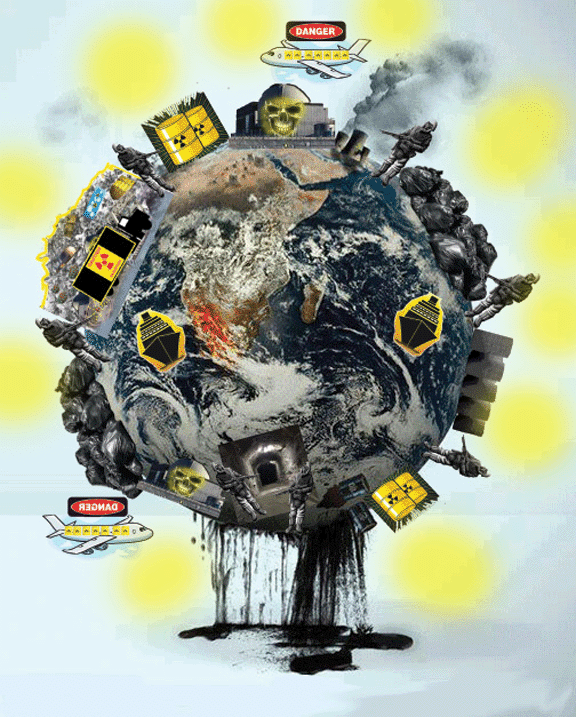 Heinrich-Böll-Stiftung (accessed) 28th Oct 2019, The first edition of the World Nuclear Waste Report (WNWR) – Focus Europe assesses how much waste countries have generated, how much is stored and disposed of. Heinrich-Böll-Stiftung (accessed) 28th Oct 2019, The first edition of the World Nuclear Waste Report (WNWR) – Focus Europe assesses how much waste countries have generated, how much is stored and disposed of.It provides an overview about the estimated costs for management, storage and disposal of nuclear waste and how governments try
to secure funding for these costs. Finally, the report presents a short history of how countries worldwide have been struggling up until today to advance in the search for repositories. The report offers a selection of country studies, including the Czech Republic, France, Germany, Hungary, Sweden, Switzerland, the United Kingdom, and the United States. To be launched in Berlin on 11th November.
https://calendar.boell.de/en/event/launch-world-nuclear-waste-report-wnwr-focus-europe |
|
National nuclear commission strategy for Marshall Islands
Marshalls endorses nuclear commission strategy, https://www.rnz.co.nz/international/pacific-news/401921/marshalls-endorses-nuclear-commission-strategy The Marshall Islands government has endorsed the adoption of a national nuclear commission strategy for the next three years.
The strategy honours the legacy of Marshallese nuclear heroes and heroines who fought and continue to demand accountability for their communities.
The strategy was mandated in the Marshall Islands parliament, or Nitijela, as part of the National Nuclear Commission Act of 2017.
It focuses on five broad themes for nuclear justice: compensation, health care, the environment, national capacity, and education and awareness.
From 1946 to 1958, the US used the Marshall Islands to test its nuclear weapons.
The commission also aims to establish an independent panel of scientists and specialists in fields related to radiation exposure, to provide the republic’s citizens access to trusted, independent science.
The commission’s chair, Rhea Moss-Christian, said the NNC strategy was a tool for all Marshallese, whether living in the islands or overseas, to use in their individual and collective efforts to respond to the devastation resulting from the US nuclear weapons testing program in the Marshall Islands.
“It is also a resource for our partners and friends outside the Marshall Islands to understand the nuclear testing impacts that persist today and how they can support the Marshallese people,” Ms Moss-Christian said.
340,000 to evacuate Fukushima, landslide fears(- and what about the nuclear waste bags?)

 Why doesn’t the news media explore the question of what is happening to Fukushima’s bags of radioactive nuclear debris?
|
Fukushima evacuation: 340,000 people told to leave over landslide fears after flooding, Mirror UK , By Bradley Jolly, Online journalist, 25 OCT 2019The 143,699 households in Fukushima, Japan, have been evacuated over flooding fears after Typhoon Hagibis lashed across the area. More than 340,000 people were today told to leave their homes over landslide fears due to flooding .
Many low-lying towns and cities east of Tokyo, Japan, were left inundated after Typhoon Hagibis swept across the region . Some 143,699 households in Fukushima, one of the worst affected cities, were evacuated today.
Fukushima Prefecture, the evacuation advisory, fears the danger of landslides remains very high. Alarming photos show muddy water spill from rivers and pedestrians wade through waist-deep floods. Almost 30,000 soldiers and rescue workers have been sent in to save stranded residents across the region. The recent typhoons have so far killed 24 people. More than 9,000 homes, including 6,000 in the Chiba prefecture and 2,500 in the nearby Ibaraki prefecture, were without electricity, according to Tokyo Electric Power Company. Local media reported two dams were expected to release built-up water and urged downstream residents to evacuate as a precaution. A motorway toll gate near Narita International Airport was temporarily closed for safety reasons. Heavy rain also washed out the second round of the PGA Tour’s first tournament held in Japan, the Zozo Championship in Inzai City, where Tiger Woods was tied with Gary Woodland at 64 after Thursday’s opening round. Fukushima is on Honshu, Japan’s largest island. It is about 40 miles away from Japan’s idyllic east coast. Soma, in particular, is a coastal city nearby popular with tourists.https://www.mirror.co.uk/news/world-news/fukushima-evacuation-340000-people-told-20721981 And the Meteorological Agency has predicted up to seven inches of rain over the next 24 hours. |
|
The failure of nuclear reprocessing and the “Plutonium Economy”
No one on the planet has been able to run unspent nuclear fuel through twice, and make it economically viable, let alone the countless times needed to make it ecologically viable.
It costs more to run unspent fuel through once more than to
• mine uranium,
• process for shipping
• process into yellowcake
• make into rods
• ship rods onsite to reactors
There is little to NO CHANCE of doing that again, and again.
Business history shows this wasn’t possible when;
• uranium was at its peak in price in 1980
2019, about to enter the third decade of the 21C, where commodities exchanges show nuclear fuel it is;
• LOWEST PRICE than in all of economic history,
and yet it still can’t compete with any other energy sources.
Nuclear apologists are a joke, delusional.
The nuclear sales executives of the nuclear estate have been busy rebranding, white and greenwashing their product is ever since Ronald Reagan announced The Plutonium Economy failed.
In point of fact, carbon fuel, gas spinning a turbine, has been producing cheaper energy fully levelized for three decades than any nuclear reactor.
Large scale
• solar PV and
• on-offshore wind turbines
• reached PARITY with
• carbon fuel NATURAL GAS
late last decade on an LCOE basis.
For this whole decade these;
• renewable systems
• fully lifecycle factored
• are cheaper than even carbon fuels
• NATURAL GAS
USA’s nuclear wastes can’t stay in above-ground canisters forever
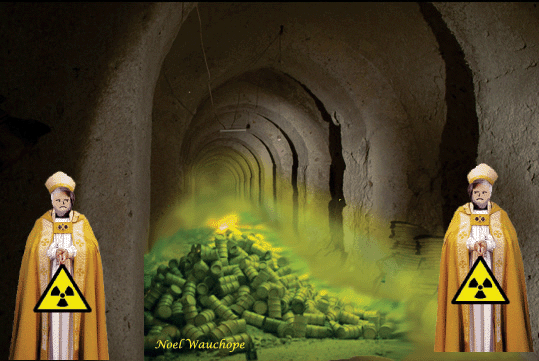
Who will be the ultimate bearer of the nation’s nuclear waste? Mashable
by Mark Kaufman, Editors Nandita Raghuram and Brittany Levine Beckman Illustrations Vicky Leta, 25 Oct 19, In Mashable’s series Wasted, we dig into the myriad ways we’re trashing our planet. Because it’s time to sober up.When future tourists journey through a desolate, sun-baked patch of the southeastern New Mexico desert, some 20 miles outside of the 21st-century oil boomtown of Carlsbad, they’ll spot dozens of giant pillars on the flat terrain, somewhat like the great stone heads looming on the treeless hills of Easter Island. If the intrigued desert visitors wander close enough to the 25-foot high granite monuments, erected by the United States Department of Energy, they’ll see inscriptions written in seven different, perhaps archaic, languages.
And if they dare wander past the perimeter of the grandiose columns, the travelers will find an open-air structure made of 15-foot high walls, emblazoned with frightening pictographs and symbols. Taken together, the U.S. agency hopes to convey a clear message to anyone who enters.Keep out. Leave. Don’t dig. Something bad lurks beneath the ground. “This ‘stay out’ sign warns future generations of the danger of intrusion,” the Department of Energy wrote in its blueprint of this imposing message.
In 1990, the agency convened a group of linguists, writers, anthropologists, and an assortment of other scientists to think about how, in centuries or thousands of years (perhaps long after the fall of the U.S. empire), they might discourage people from revealing what lay 2,000 feet below the rocky soil and dashing roadrunners: hundreds of thousands of containers filled with radioactive sludge, soil, mops, brooms, and gloves from the U.S. government’s nuclear weapons program. The sealed casks would be a danger for at least 10 millennia.
 [illustration by Vicky Leta, Mashable). Rather, much of the nuclear rummage is the spent radioactive fuel from power plants ……..the waste is scattered around the country at the very nuclear power plants where it was used, because the U.S. hasn’t decided on a place to permanently deposit the deadly dross. But the concrete and metal storage casks, often stockpiled directly on the surface in places like the idyllic California coast, age, crack, and decay over time. The waste can’t stay there forever.
It’s got to go somewhere,” said Allison Macfarlane, the former chairman of the United States Nuclear Regulatory Commission and professor of science and technology policy at George Washington University.
“The worst option is leaving it above ground indefinitely,” stressed Edwin Lyman, a senior scientist and expert in nuclear weapons policy at the Union of Concerned Scientists, a nonprofit science advocacy group….. there’s no good place to store the forever waste. “There’s no best option. There’s only the least bad option,”………
One day, WIPP might be joined by another nuclear waste site — but this one exposed on New Mexico’s desert surface.
Between the cities of Carlsbad and Hobbs, about 70 miles apart, lies 1,000 acres of rough desert scrub. Holtec International, a company that sells sturdy containers for storing nuclear waste, has a scheme for these 1,000 acres that would make them a lot of money. The company wants to transform this forsaken desert into a concrete field holding 10,000 containers of spent fuel from all the nation’s nuclear power plants, collectively called the HI-STORE Consolidated Interim Story Facility. “Interim” is a somewhat deceiving word here. Taxpayers would essentially rent these thick casks until our underperforming Congress finds a truly permanent place to store the spent fuel from nuclear plants. The waste could stay there for 40 years. Or, if the casks are continually restored, much longer……..
The waste must eventually go deep, deep underground, said Lyman, the nuclear expert. The irradiated can can’t be punted down the road all century. Nuclear plants are brimming with this stuff. “The Department of Energy is on the hook to produce some type of a solution as the reactor facilities are filling up,” emphasized Notre Dame’s Burns.
There’s only one way that can happen: not forcing, not dictating, but collaborating with a community, somewhere, to allow a geologic depository, stressed Macfarlane. The site would need to be heavily guarded in perpetuity. “The question is can they be compensated enough and their concerns be mitigated enough that they’re willing to accept it,” said Lyman.
while the waste can’t just sit exposed on the surface forever, it could be some 50 years before the casks become an imminent threat.
Indeed, nuclear waste is “out of sight out of mind,” noted Lyman. This is in stark contrast to an environmental threat like relentlessly rising global temperatures, wherein the well-predicted consequences of a warmer globe are conspicuously unfolding today: wildfires torching more land, the melting of the great ice sheets, unprecedented deluges, overheated infrastructure, an incessantly warming ocean, and beyond……..
If New Mexico’s nuclear heritage is somehow ever lost, perhaps by the passage of millennia and ravages of time, tall monuments will stand in the windswept desert for thousands of years, hopefully warding off any curious pilgrims, explorers, or future industrialists from the decaying consequences of war, weaponry, and defense. Whatever symbols the Department of Energy ultimately etches into the walls of the roofless, sunlit temple where WIPP once stood, they better be damn scary.https://mashable.com/feature/most-radioactive-state-in-us-nuclear-waste-new-mexico-nevada/?fbclid=IwAR3hb7-ZZjWxaF863zuHqueEHeA8VjhLwrWVm2sA849Kvcb5D6OAQ00SmdI
20 sovereign nations in New Mexico and Texas oppose nuclear facility near Carlsbad
Native American Pueblo leaders oppose nuclear facility near Carlsbad, Hobbs, https://www.oilandgas360.com/native-american-pueblo-leaders-oppose-nuclear-facility-near-carlsbad-hobbs-2/ in Press by— 360 Feed Wire
Oct. 24– Oct. 24–A group of Native American leaders opposed a plan to temporarily store nuclear waste at proposed facilities in southeast New Mexico and West Texas before a permanent repository is available.
The All Pueblo Council of Governors, which represents 20 sovereign nations in New Mexico and Texas held a meeting on Thursday where members affirmed their opposition to the projects, read a Monday news release from the group.
Concerns with the transportation of spent nuclear fuel rods drove the group’s opposition to two proposed consolidated interim storage (CIS) sites, one near the border of Eddy and Lea counties in New Mexico and another in Andrews, Texas. Continue reading
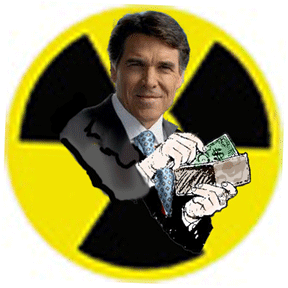
Rick Perry, as Energy Secretary, “solved” nuclear waste problem by reclassifying high level waste as low level
|
Perry’s Odd Definition of Progress on Nuclear Waste https://www.nrdc.org/experts/caroline-reiser/perrys-odd-definition-progress-nuclear-waste, October 22, 2019 Caroline Reiser
After months of suspense, Energy Secretary Rick Perry finally confirmed he will resign, boasting in a farewell tweet that under his leadership the Department of Energy “made environmental progress unseen for decades cleaning up the legacy of the Manhattan Project.” —What’s that now? Where exactly are the “numerous” legacy sites that Perry claims the Department tackled? All the Department of Energy has done under Perry is weaken standards and renege on promises by finding ways to abandon the world’s most toxic chemical and radioactive waste in place. To give a brief history of the legacy Perry is referring to, the Manhattan Project is the name of the World War II era research and development effort that led to the first several nuclear weapons, including those used to destroy Hiroshima and Nagasaki. In the atomic arms race of the Cold War, the Department of Energy and its predecessor agencies continued to design, test, and manufacture nuclear weapons but on a vaster scale—ultimately manufacturing over 30,000 nuclear weapons. Making nuclear weapons is not a clean business. Every country that has built a nuclear arsenal has harmed its own people and environment in the process. Nuclear production created a so-called “legacy” of profoundly contaminated radiological and chemical waste sites. There are dozens of these legacy waste sites across the United States; the largest three are the Idaho National Engineering and Environmental Laboratory, the South Carolina Savannah River Site, and the Washington Hanford site (which many consider one of the most contaminated sites in the Western Hemisphere). To give you a picture of the scale in terms of size and danger, the Hanford site hosts 177 tanks. The tanks range from 55,000 gallons to more than a million gallons of radioactive and chemical waste each. That’s from about 20 semi-trucks full to about two Olympic sized swimming pools. And even brief exposure to a small portion of that waste can be deadly. So what happened at these sites under Perry? Not much. The most far-reaching action the Department of Energy took under Secretary Perry was to give itself permission to “reclassify” highly toxic radioactive waste. The Department’s new stance is that it can magically decide that certain High-Level Waste is now Low-Level Waste without oversight from the Environmental Protection Agency, states, or tribes. With this authority, the Department of Energy no longer has to permanently isolate from the environment High-Level Waste, but instead can abandon hundreds of gallons of the most toxic waste at sites like Hanford. So really the only way Perry could be said to have cleaned up this toxic waste is by “recategorizing” it as something less dangerous than it is, and then (metaphorically) washing his hands of it. The Perry-led Department of Energy will also be remembered for breaking promises. In addition to the promises the Department is breaking by reclassifying High-Level Waste, the Department is also breaking promises to clean up smaller sites as well. For example, the Santa Susana Field Laboratory sits in the golden hills of California, right on the outskirts of Los Angeles’s urban sprawl. In 2010, the Energy Department agreed to clean up the site to what’s called “background levels,” meaning the normal levels of radiation one could expect to find at the site before industry intervened. But the Perry Energy Department decided this agreement didn’t matter – it now plans to leave in place the vast majority of the contamination and to act without consent from California. Both Washington and California are pushing back against the Department of Energy’s broken promises. And it’s clear that if the Department gets away with it at these sites, it will do the exact same thing at other sites across the country. So, for Secretary Perry’s tweet to be true, he must have a strange definition of “progress.” Maybe he means progress in abandoning the Department of Energy’s obligation to clean up the mess it made. Maybe he means progress in speeding up transferring the responsibility of managing highly toxic sites back to states, tribes, and local communities. Maybe he means progress in cutting corners to favor cost over health and safety. All I can say is that I hope the next Secretary and I have a more similar idea of what progress looks like. The Department of Energy can do better. President Trump has already nominated Dan Broulliette as a replacement for Perry. If Broulliette wants to make actual progress on America’s nuclear waste legacies, he needs to stop wasting time trying to get away with doing less – do the work and do it right. Given the track record of the last few years, there’s ample reason for skepticism. But I would love to be proven wrong. |
|
1 This Month
23-25 October – on Zoom – World BEYOND War’s annual global conferenc


Shut down the radiation-damaged Heysham nuclear reactors now
To see nuclear-related stories in greater depth and intensity – go to https://nuclearinformation.wordpress.com

Say No to NASA’s Reckless Nuclear Reactor on the Moon
Say No to NASA’s Reckless Nuclear Reactor on the Moon
-
Archives
- October 2026 (170)
- September 2026 (339)
- August 2026 (330)
- July 2026 (355)
- June 2026 (287)
- May 2026 (306)
- April 2026 (356)
- March 2026 (251)
- February 2026 (267)
- January 2026 (308)
- December 2025 (358)
- November 2025 (359)
-
Categories
- 1
- 1 NUCLEAR ISSUES
- business and costs
- climate change
- culture and arts
- ENERGY
- environment
- health
- history
- indigenous issues
- Legal
- marketing of nuclear
- media
- opposition to nuclear
- PERSONAL STORIES
- politics
- politics international
- Religion and ethics
- safety
- secrets,lies and civil liberties
- spinbuster
- technology
- Uranium
- wastes
- weapons and war
- Women
- 2 WORLD
- ACTION
- AFRICA
- Atrocities
- AUSTRALIA
- Christina's notes
- Christina's themes
- culture and arts
- Events
- Fuk 2022
- Fuk 2023
- Fukushima 2017
- Fukushima 2018
- fukushima 2019
- Fukushima 2020
- Fukushima 2021
- general
- global warming
- Humour (God we need it)
- Nuclear
- RARE EARTHS
- Reference
- resources – print
- Resources -audiovicual
- Weekly Newsletter
- World
- World Nuclear
- YouTube
-
RSS
Entries RSS
Comments RSS

