Hundreds of thousands of satellites brightening the night sky with negative effects on the ecosphere

441,449 LOW EARTH ORBIT SATELLITES
Operating, Approved and Proposed
While the attention of a terrified world has been riveted on a virus, and while concern about radiation has been focused on 5G on the ground, the assault on the heavens has reached astronomical proportions. During the past two years, the number of satellites circling the earth has increased from 2,000 to 4,800, and a flood of new projects has brought the number of operating, approved, and proposed satellites to at least 441,449. And that number only includes low-earth-orbit (LEO) satellites that will reside in the ionosphere.
The satellite projects include the ones listed below. The companies are based in the United States unless otherwise indicated.
17,270 satellites already approved by the U.S. Federal Communications Commission:
- Amazon (Kuiper) – 3,236 satellites
- Astro Digital – 30 satellites
- Black Sky Global – 36 satellites
- Boeing – 147 satellites
- Capella Space Corp. – 7 satellites
- Globalstar (operating since 2000) – 48 satellites
- Hawkeye 360 – 80 satellites
- ICEYE – 6 satellites (FINLAND)
- Iridium (operating since 1998) – 66 satellites
- Kepler Communications – 140 satellites (CANADA)
- Loft Orbital – 11 satellites
- OneWeb – 720 satellites (UNITED KINGDOM)
- Planet Labs (operating) – 200 satellites
- R2 Space, LLC – 8 satellites
- Spire Global – 175 satellites
- SpaceX – 11,943 satellites
- Swarm – 150 satellites
- Telesat – 117 satellites (CANADA)
- Theia Holdings – 120 satellites
- Umbra Lab – 6 satellites
- Viasat – 24 satellites
Applications for 65,912 satellites pending before the FCC:
- Amazon (Kuiper) – 4,538 additional satellites
- AST & Science – 243 satellites
- Astra Space – 13,620 satellites
- Boeing – 5,789 additional satellites
- Black Sky Global – 14 additional satellites
- Fleet Space Technologies – 40 satellites (AUSTRALIA)
- Hughes Network Systems – 1,440 satellites
- Inmarsat – 198 satellites (UNITED KINGDOM)
- Kepler Communications – two additional constellations of 360 satellites and 212 satellites (CANADA)
- Lynk Global – 10 satellites (HONG KONG)
- Maxar Technologies – 12 satellites
- New Spectrum – 30 satellites (CANADA)
- OneWeb – 6,368 additional satellites (UNITED KINGDOM)
- Orbital Sidekick – 6 satellites
- SN Space Systems – 1,190 satellites (UNITED KINGDOM)
- SpaceX – 30,000 additional satellites
- Telesat – 1,554 additional satellites (CANADA)
- Terra Bella – 24 satellites (15 already operating)
- Viasat – 264 additional satellites
Constellations totaling 14,872 satellites announced by governments:……………
Other LEO constellations planned by U.S. and foreign companies, totaling more than 16,055 satellites:…….
Rwanda, which wants to catapult Africa into world leadership in space, filed an application with the International Telecommunication Union (ITU) on September 21, 2021 for 327,320 satellites. Its proposal includes 937 orbital planes, distributed in 27 orbital shells (layers of satellites at different altitudes), with 360 satellites in each plane.
- Rwanda Space Agency – 327,320 satellites (RWANDA)
TOTAL: 441,449 SATELLITES OPERATING, APPROVED AND PROPOSED (+18 constellations whose numbers are not yet known) Most of the above list of satellites would orbit at altitudes between about 325 km (200 miles) and 1,100 km (680 miles), except that some of Rwanda’s proposed orbits go as low as 280 km (174 miles). The above list does not include applications for satellites in geostationary orbit (GEO), or for LEO constellations of fewer than 5 satellites, or constellations in medium earth orbit (MEO) such as:
- Intelsat (at 8600 km) – 216 satellites (LUXEMBOURG)
- Mangata Networks (at 6,400 km and 12,000 km) – 791 satellites
- O3b (at 8,062 km) – 112 satellites (LUXEMBOURG)
BRIGHTENING THE NIGHT SKY Scientists have already begun to publish papers analyzing the effect all these satellites will have, not only on astronomy, but on the appearance of the night sky and the visibility of the stars to everyone on earth. An article published online on March 29, 2021 in Monthly Notices of the Royal Astronomical Society by scientists in Slovakia, Spain and the United States is titled “The proliferation of space objects is a rapidly increasing source of artificial night sky brightness.” The scattering of sunlight from all of the objects in space, wrote the authors, is causing a “new skyglow” during the beginning and end of each night that has already brightened the natural night sky by about 10 percent. The authors are concerned that “the additional contribution of the new satellite mega-constellations” would ruin the night sky to a much greater extent.
A group of Canadian astronomers have an article in the January 2022 issue of The Astronomical Journal. “Megaconstellations of thousands to tens of thousands of artificial satellites (satcons) are rapidly being developed and launched,” they write. “These satcons will have negative consequences for observational astronomy research, and are poised to drastically interfere with naked-eye stargazing worldwide.” They analyzed what the effect on astronomy will be if 65,000 new low-orbit satellites are launched. At 40 degrees latitude (mid-United States; Mediterranean; mid-China; Japan; Buenos Aires; New Zealand), say these authors, more than 1,000 of these satellites will be sunlit and visible in the sky in the summer even at midnight. At higher latitudes (northern U.S.; Canada; most of Europe; Russia), thousands of these satellites will be visible all night long. Another paper, titled Report on Mega-Constellations to the Government of Canada and the Canadian Space Agency, was commissioned by the Canadian Astronomical Society and submitted to the Canadian government on March 31, 2021. It is a moving document. …………………………………… https://www.cellphonetaskforce.org/wp-content/uploads/2022/01/441449-Low-Earth-Orbit-Satellites.pdf
NASA seems to be struggling with the fact that ionising radiation is a greater risk to women, than to men

The committee also recommended NASA provide all its astronauts with individual radiation risk assessment (based on age and sex), communicate a comprehensive picture of an astronaut’s own cancer risk, and continue to discuss changes in radiation risk during routine health briefings.
New NASA radiation exposure limit would bring equality to female, male astronauts, Healio.com, Ryan Lawrence 20 Dec 21,
“Experts in oncology help advise NASA on space radiation health standard for astronauts”A committee of experts from science, medicine and academia, among other fields, has recommended NASA proceed with a proposal for a universal, career-long radiation dose limit for all astronauts
The Committee on Assessment of Strategies for Managing Cancer Risks Associated with Radiation Exposure During Crewed Space Missions, convened at the request of NASA, concluded that the career-long dose limit should apply to both men and women, a change from previous standards, and recommended improved communication methods for advising astronauts on cancer risks.
“The old radiation standards were very restrictive for women astronauts,” Amy Berrington de González, DPhil, senior investigator and chief of the radiation epidemiology branch at the NCI and a member of the committee, told Healio | HemOnc Today. “There has been a lot of progress in understanding of radiation risk in the last few decades, so bringing that in to see whether you could make the flying time more equitable for women astronauts, I think was really important.”
Berrington de González said the universal dose was established “for the most protective case” and applied to all astronauts.
As it currently stands, men and women have different allowable doses of radiation in space travel with NASA, which were based on reported relative susceptibilities to different radiation-induced cancers. The report recommends NASA move forward with its proposed single standard dose limit for all astronauts.
“I think NASA got worried because they saw some data from the Japanese atomic bomb survivors, who we use as our primary group for determining [radiation] risk, and it looked like there was an increased risk for lung cancer among women,” committee member Gayle E. Woloschak, PhD, associate dean for graduate student and postdoctoral affairs and professor of radiation oncology and radiology at Feinberg School of Medicine at Northwestern University, told Healio | HemOnc Today. “
“Then the question was, ‘Should we have a different risk level for women than for men, considering Mars missions might limit a woman from going into space at all?’ And, you can imagine, there are ethical issues with that, too. Basically, we said there should be the same risks across the board for everybody.”
Before these proposals, the current standard set career exposure to radiation to not exceed 3% risk for exposure-induced death (REID) for cancer mortality at a 95 percent confidence level, to limit the cumulative effective dose received throughout an astronaut’s career.
NASA called for an independent review of the validity of the 3% REID, which has been the standard since 1989, because it is for low-Earth orbit missions exclusively. An update was necessary as NASA plans for longer-duration missions farther in the solar system.
“The radiation in deep space is different,” committee member Carol Scott-Conner, MD, PhD, MBA, emeritus professor of surgery in surgical oncology and endocrine surgery at Carver College of Medicine at University of Iowa, told Healio | HemOnc Today. “Once you get beyond the Earth’s magnetosphere, you get highly energetic particles from the sun. And these are things like the nuclei of iron. You can think of them as like cannon balls going through cells, as opposed to protons, electrons or gamma rays that we think of here on Earth. … If you go to Mars, and let’s say it takes you about 6 months, you’re exposed that whole time to this radiation.”
The committee also recommended NASA provide all its astronauts with individual radiation risk assessment (based on age and sex), communicate a comprehensive picture of an astronaut’s own cancer risk, and continue to discuss changes in radiation risk during routine health briefings.
.
Nuclear Command and Control Satellites Should Be Off Limits – here’s why
 |

Nuclear Command-and-Control Satellites Should Be Off Limits https://www.defenseone.com/ideas/2021/12/nuclear-command-and-control-satellites-should-be-limits/187472/ Blowing up some satellites causes problems. Blowing up these could cause nuclear war. By JAMES ACTON and THOMAS MACDONALD, DECEMBER 10, 2021
When Russia blew up an old satellite with a new missile on November 15, it created an expanding cloud of debris that will menace the outer space environment for years to come.
Hypersonic fragments from the collision with Moscow’s ground-launched, anti-satellite weapon risk destroying other satellites used for communications, meteorology, and agriculture. They even pose a danger to China’s Tiangong Space Station and the International Space Station, where personnel—including Russia’s own cosmonauts—were forced to don spacesuits and flee into their escape capsules ahead of approaching debris.
But the greatest danger that this careless stunt highlighted is to a different potential target: high-altitude satellites used for nuclear command and control. Those critical satellites face the threat of being attacked by co-orbital anti-satellite weapons, that is, other spacecraft with offensive capabilities. Destroying a nuclear command-and-control satellite, even unintentionally, could lead a conventional conflict to escalate into a nuclear war. As such, the United States, China, and Russia have a shared interest in ensuring the security of each other’s high-altitude satellites.
Satellites are integral to the United States’ nuclear command-and-control system. They would be the preferred means to transmit a presidential order to use nuclear weapons and would provide the first warning of an incoming nuclear attack. Russia uses satellites for similar purposes, even if it appears not to rely on them quite as much as the United States. While little is publicly known about China’s nuclear command-and-control system, the U.S. Department of Defense has assessed that China is in the process of developing a space-based early-warning system.
The most important nuclear command-and-control satellites—those for communications and early warning—are located in high-altitude orbits. Fortunately, most are strung out about 22,500 miles above the equator—far above the debris from Russia’s ground-launched anti-satellite weapon test. These satellites, however, are growing more vulnerable, particularly to co-orbital anti-satellite weapons.
Nuclear command-and-control satellites might be attacked deliberately, as the prelude to a nuclear war. In a conventional conflict, if China, Russia, or the United States decided to use nuclear weapons first—or believed that its opponent was about to do so—it might try to degrade the adversary’s nuclear command-and-control system preemptively. China, for example, might attack U.S. early-warning satellites to weaken the United States’ homeland missile defenses. Conversely, the United States might target Chinese communication satellites to interfere with Beijing’s ability to wield its nuclear forces.
In a conventional war, however, nuclear command-and-control satellites might be attacked and threatened for altogether different reasons—creating the risk that nuclear war might be triggered inadvertently. The United States, in particular, is deeply reliant on satellites to enable conventional operations. Moreover, most, if not all, nuclear command-and-control satellites also support nonnuclear missions—making them tempting targets even in a purely conventional conflict. For example, some U.S. satellites transmit orders to both U.S. conventional and nuclear forces. Russia might attack these satellites to try to undermine the United States’ ability to prosecute a conventional war, but with the added and unintended effect of degrading the U.S. nuclear command-and-control system.
Washington would be hard pressed to determine the intent behind such attacks. It could easily misinterpret them as preparations for a nuclear war and respond accordingly. It might threaten to use nuclear weapons unless its adversary backed off. In fact, the Trump administration’s nuclear policy explicitly threatened the use of nuclear weapons in precisely this circumstance. The Biden administration can and should remove this threat as part of its ongoing Nuclear Posture Review.
To make matters worse, it might not take actual attacks against nuclear command-and-control satellites to spark this kind of escalation. Satellites in high-altitude orbits are periodically moved to different positions to optimize their performance. Especially in a conventional conflict, a repositioning operation that led one spacecraft to approach a nuclear command-and-control satellite might appear to the latter’s owner as the beginning of an attack against its nuclearcommand-and-control system. Once again, the potential consequences could be catastrophic.
“Keep-out zones” around high-altitude satellites would be a straightforward way to mitigate these risks. Specifically, the United States, China, and Russia should agree not to maneuver their spacecraft within a certain distance—we propose 430 miles—of one another’s high-altitude satellites. (Exceptions could be made to accommodate occasional repositioning under tightly controlled conditions. Most importantly, the state conducting the maneuver should warn the others at least 24 hours in advance.)
In a conflict, if the belligerents had no intention of attacking each other’s high-altitude satellites, they would have strong reasons of self-interest to respect keep-out zones. If a state did seek to launch such attacks, keep-out zones couldn’t stop it from doing so—but they would buy time that the targeted state could use to try to evade the attack.
Negotiating keep-out zones during a conflict, when they would be most useful, would be next-to impossible. So, Washington, Beijing, and Moscow shouldn’t wait—they should start negotiating right away.
James M. Acton is co-director of the Nuclear Policy Program and holds the Jessica T. Mathews Chair at the Carnegie Endowment for International Peace. Thomas D. MacDonald is a fellow in the Nuclear Policy Program.
”Billionaires who fly into space to produce nothing of scientific value” -on hearing that, Jeff Bezos hires lobbyist!
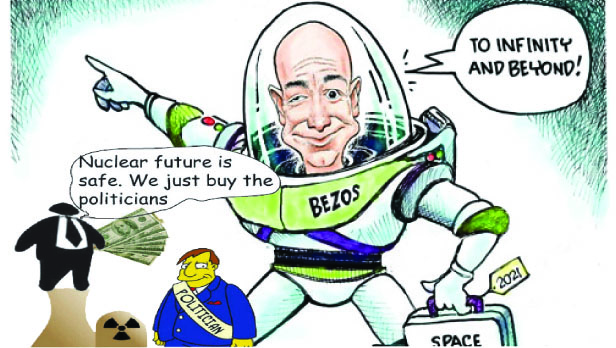
Bezos’ Blue Origin Hires Lobbyist Tied to Obama Admin After Space Tax Proposed, https://sputniknews.com/20211118/bezos-blue-origin-hires-lobbyist-tied-to-obama-admin-after-space-tax-proposed-1090824789.html
The company decided it needs the lobbyist’s services after US representative Earl Blumenauer, proposed a tax on space exploration firms. The Democratic lawmaker made his statement on 20 July – the day when Bezos himself went to space in Blue Origin’s first crewed flight.
“Space exploration isn’t a tax-free holiday for the wealthy. Just as normal Americans pay taxes when they buy airline tickets, billionaires who fly into space to produce nothing of scientific value should do the same, and then some”, he said in a statement at the time. “I’m not opposed to this type of space innovation. However, things that are done purely for tourism or entertainment, and that don’t have a scientific purpose, should, in turn, support the public good”.
NASA seeks ideas for a nuclear reactor on the moon – submissions due by February 19 2022

NASA seeks ideas for a nuclear reactor on the moon abc news, 20 Nov 21
If anyone has a good idea on how to put a nuclear fission power plant on the moon, the U.S. government wants to hear about itBy KEITH RIDLER Associated Press BOISE, Idaho — If anyone has a good idea on how to put a nuclear fission power plant on the moon, the U.S. government wants to hear about it.
NASA and the nation’s top federal nuclear research lab on Friday put out a request for proposals for a fission surface power system.
NASA is collaborating with the U.S. Department of Energy’s Idaho National Laboratory to establish a sun-independent power source for missions to the moon by the end of the decade…….
The reactor would be built on Earth and then sent to the moon…….
The proposal requests are for an initial system design and must be submitted by Feb. 19. https://abcnews.go.com/Technology/wireStory/nasa-seeks-ideas-nuclear-reactor-moon-81282960
UN ”Code of Conduct” towards preventing arms race in space, but no treaty banning weapons in space
Alice Slater, 7 Nov 21, The arms controllers have advanced their proposal for a Code of Conduct in space instead of a treaty to ban weapons in space. The country’s who have repeatedly been denied an opportunity to negotiate a space ban treaty in the consensus bound Disarmament Committee in Geneva, like Russia and China, have opposed this proposal, because it won’t create binding law and is an end run and distraction around negotiating a treaty to ban weapons in space. It will look like we’re doing something when we aren’t willing to be legally bound by it! The new American Empire way!!
Outer Space: UN Committee Advances Proposal on Rules Governing Behavior in Space
A United Nations panel overwhelmingly approved a resolution Nov. 1 to create a working group aimed at preventing an arms race in outer space, setting up the measure to pass in the General Assembly. The resolution, introduced by the United Kingdom with the support of more than 30 other nations, including the U.S., would establish an open-ended working group that would “ make recommendations on possible norms, rules and principles of responsible behaviors relating to threats by States to space systems.” The measure was approved by the U.N.’s First Committee, which deals with disarmament and international security threats, in a landslide 163-8 vote, with nine abstentions. Those opposed included Russia, China, North Korea, Iran, Cuba, Nicaragua, Venezuela, and Syria. (Air Force Magazine)
See also: UN Committee says yes to establishing space rules group (Space Watch)
See also: UN Committee Votes ‘Yes’ On UK-US-Backed Space Rules Group (Breaking Defense)
See also: The United Nations Could Finally Create New Rules for Space (Wired)
The push for nuclear power in space

“We know that over the years the U.S. Department of Energy has a terrible track record of worker and community contamination during these space nukes fabrication processes. One example is the 244 cases of worker contamination at Los Alamos National Laboratory in New Mexico while building the plutonium generators for the 1997 Cassini space probe,” said Gagnon.
“We’ve known for years that virtually every space mission that NASA flies is ‘dual use’—meaning that it serves two masters—civilian and military.

“The ultimate lesson here,” said Gagnon, “is that the nuclear industry views space as a new market for nuclear rockets, nuclear-powered rovers on Mars, and nuclear-powered mining colonies on the planetary bodies. Concern from Congress about impacts for life on planet Earth?
Not one word in that regard was expressed in the hearing”
The Push for Nukes in Space, CounterPunch, BY KARL GROSSMAN, 28 Oct 21,
The co-chairs of the Subcommittee on Space and Aeronautics of the U.S. House of Representatives Science, Space & Technology Committee were cheerleaders for the use of nuclear power in space at a hearing at which they presided over last week titled “Accelerating Deep Space Travel with Space Nuclear Propulsion.”
The advocacy of Representatives Don Beyer and Eddie Bernice Johnson for nukes in space was strongly criticized in a subsequent interview by Bruce Gagnon, coordinator of the Global Network Against Weapons and Nuclear Power in Space………
Witnesses testifying before the subcommittee included those from the aerospace industry including Michael French, vice president for space systems of the Aerospace Industries Association. ……….
There were no witnesses invited to the hearing who are critical of the use of nuclear power in space. Gagnon has been coordinator of the Global Network Against Weapons and Nuclear Power in Space since its formation in 1992. Based in Maine, it is the leading international organization opposing the use of nuclear power in space through protests, an annual “Space for Peace Week” and lawsuits through the years.
Said Gagnon: “The recent testimonies by aerospace industry operatives before the House Subcommittee on Space and Aeronautics were quite telling. But even more so were the opening statements by committee co-chairs, both Democrats, who hail from the heavily space-oriented states of Virginia and Texas. Both committee chairs Don Beyer (VA) and Bernice Johnson (TX) enthusiastically endorsed the proposal to continue spending hundreds of millions of dollars annually toward preparation of nuclear reactor flight tests in space.”
“The logic behind this dangerous ‘field test’ is to prepare to send nuclear-powered rockets to Mars,” said Gagnon. “Ostensibly these plans are to protect the ‘safety of our astronauts’ by reducing their exposure to in-space radiation with ‘shorter trips’ to the red planet because nuclear rockets would cut in half the travel time. This is very telling as concern over the safety of a couple of astronauts ‘trumps’ the safety of the Department of Energy workers who will be fabricating these space nuclear devices.”
“We know that over the years the U.S. Department of Energy has a terrible track record of worker and community contamination during these space nukes fabrication processes. One example is the 244 cases of worker contamination at Los Alamos National Laboratory in New Mexico while building the plutonium generators for the 1997 Cassini space probe,” said Gagnon.
“In addition, this concern over astronaut safety also ‘trumps’ the safety of all life on Earth as plans call for the testing of these nuclear rocket engines just over our heads in space,” he said.
“During the testimony of several aerospace industry executives at the hearing they admitted that current regulations that oversee ground testing of these reactors are ‘too restrictive’ because they require the capture and processing of ‘radiologic sources’ in order to ‘reduce contamination.’ Thus, with no regulation of testing in space the powerful alliance of aerospace and nuclear industry is asking Congress to give them a free pass,” Gagnon said.
“We’ve known for years that virtually every space mission that NASA flies is ‘dual use’—meaning that it serves two masters—civilian and military. During the committee hearing it was acknowledged that DARPA [the U.S. military’s Defense Advanced Research Projects Agency] has its own nuclear propulsion project for ‘national security interests’. This indicates that this proposed space nuke testing program will benefit the Pentagon’s goal to create space nuclear reactors for military operations in space.”
“The ultimate lesson here,” said Gagnon, “is that the nuclear industry views space as a new market for nuclear rockets, nuclear-powered rovers on Mars, and nuclear-powered mining colonies on the planetary bodies. Concern from Congress about impacts for life on planet Earth? Not one word in that regard was expressed in the hearing”
“If NASA wants to travel into space, then use solar power. There are ample examples of current successful solar missions into deep space,” he said.
“Let’s slow this run-away freight train down and let the public know about, and comment on, these dangerous plans to nuclearize space,” said Gagnon…………………………………………
There have been three accidents involving U.S. space nuclear missions,
the worst in 1964 involving a satellite powered by a plutonium-fueled RTG, the SNAP 9A. The satellite failed to achieve orbit, broke up in the atmosphere as it came crashing back down to Earth, its plutonium dispersing as dust extensively on Earth. Dr. John Gofman, an M.D. and Ph.D., professor at the University of California at Berkeley, formerly associate director of Lawrence Livermore National Laboratory, author of Poisoned Power and involved in early studies of plutonium, linked this accident to an increase in lung cancer on Earth.
Following the SNAP-9A accident, NASA pushed the development of solar power for satellites and now all U.S. satellites have energized by solar power—as is the International Space Station.
| Still, NASA for years insisted that nuclear power was necessary for power beyond the orbit of Mars—a claim that has been demonstrated to be false. In 2011, for example, NASA launched its Juno space probe to Jupiter—its electrical system energized by solar panels. It’s still up there studying Jupiter, despite sunlight being a hundredth of what it is on Earth.Still, the drive to utilize nuclear power in space continues being pushed hard…………………..Meanwhile, studies and articles have pointed to solar energy providing all the power needed for would-be settlements on Mars and the Moon. …………………… Karl Grossman, professor of journalism at State University of New York/College at Old Westbury, and is the author of the book, The Wrong Stuff: The Space’s Program’s Nuclear Threat to Our Planet, and the Beyond Nuclear handbook, The U.S. Space Force and the dangers of nuclear power and nuclear war in space. Grossman is an associate of the media watch group Fairness and Accuracy in Reporting (FAIR). He is a contributor to Hopeless: Barack Obama and the Politics of Illusion. https://www.counterpunch.org/2021/10/28/the-push-for-nukes-in-space/ |
Response to claims about China’s space aims
Response to claims about China’s space aims, by Michael Wong, 25 Oct 21
The claim – ”US must build space superhighway before China stakes claims-Senior Space Force Officer. From “Breaking Defense”: https://breakingdefense.com/2021/10/us-must-build-space-superhighway-before-china-stakes-claims-senior-space-force-officer/?utm_source=Sailthru&utm_medium=email&utm_campaign=EBB%2010.21.21&utm_term=Editorial%20-%20Military%20-%20Early%20Bird%20Brief
Some quotes with falsehoods:
- “China fully intends to extend its “territoriality” to the Moon, flouting international law in exactly the same way as it has with regard to the South China Sea, Brig. Gen. John Olson, chief advisor to Space Force head Gen. Jay Raymond on mobilization and space logistics, asserted today.” My comment: There is no evidence that China has any such intentions. China has not said anything like that, has not broken any international laws, nor taken any actions that are anywhere near as aggressive as US actions.
- “If you read their language, if you read their products — which I am a vigorous student of — if you look at what they do they telegraph everything that they’re going to do, they believe that the Moon is manifest destiny for them” and part of their “economic … and security equation,” Olson said.” My comment: In the San Francisco Chinese community of which I’m a part, I have many political friends including scholars, retired elected officials, and others who are from Hong Kong, China, or Taiwan, are native Chinese speakers, and follow the news from China and Asia closely. They have not reported any language, products, or anything else which implies that China believes the moon is “manifest destiny” for China. Remember American lies about WMD in Iraq, incubator babies thrown on the floor in Kuwait, or the Gulf of Tonkin “incident” in Vietnam? These are typical American lies to demonize a nation that the US decides to attack, and justify increased US defense money.
- “The officer drew a direct line between how Beijing has ignored a World Court ruling on a sovereignty dispute with the Philippines in the South China Sea to how Chinese leaders could act in space, without regard to the prohibitions of the 1967 Outer Space Treaty (OST.)” My comment: Check out this 11 minute video from a US Marine veteran living in Thailand, which breaks down this whole distorted narrative about China and the South China Sea: https://www.youtube.com/watch?v=if-fV9U_sWs
- “…US military space leaders more and more openly paint China as an aggressor in space, with goals of not just world but galactic domination.” My comment: “…galactic domination???” Come on, Washington, have you any idea how big the galaxy is? Do you really think China intends to dominate it? What is it with you guys? We hippies were the ones doing LSD in the ’60’s, why are you guys the ones hallucinating now?
Bottom line, it’s all about the money and American domination of the world. To get more and more of the US national budget, the military industrial complex needs an enemy to justify their existence. And they project their mindset onto the Chinese, who are a completely different nation and culture, and who simply don’t think like Washington (if you want to read a longer article on the mindset of the Chinese, here’s my take on it: https://peacepivot.org/america-china-life-death-the-long-game/ ).
More evidence that space radiation may be harmful to the male brain.
Deep Space Radiation Might Be Dangerous for the Male Brain
New research suggests that prolonged exposure to space is not so great for male mice. InterestingEngineering By Loukia Papadopoulos, 24 Oct 21,
Back in 2019, a study on mice was released that set out to investigate how deep space travel would impact the nervous system and found radiation exposure hurt cellular signaling in the hippocampus and prefrontal cortex of the brain leading to learning and memory difficulties. The researchers also saw the mice exhibit behaviors associated with anxiety, implying the radiation can harm the amygdala.
Now, a new study published in Science Advances is revealing that male mice exposed to radiation similar to that encountered by humans on long space missions experienced problems with spatial learning. The researchers conducted several tests to evaluate the mice’s spatial learning abilities after being exposed to galactic cosmic radiation……. https://interestingengineering.com/deep-space-radiation-might-be-dangerous-for-the-male-brain
War fears soar as NASA claims it needs nuclear rockets to rival China in space
| |||
War fears soar as NASA claims it needs nuclear rockets to rival China in space
NASA has prompted fears of a conflict after pleading with the US Government to invest in nuclear-powered spacecraft to speed ahead of rivals in the space race., Express UK, By JACOB PAUL, Oct 23, 2021
The agency’s officials were testifying at a House Science, Space, and Technology subcommittee hearing on Wednesday – and called for new weapons to help the US reach Mars before powers such as Russia and China. NASA called on US lawmakers to invest more resources into researching and developing nuclear-powered rockets. They said this would which help humans reach the planet in just three to four months……….
NASA are now scrambling for the US to boost their space defences as China appears to advancing its space technology at a rapid pace……….
while the NASA are hoping to ramp up their space defence systems as they prepare to fend off China in the space race, the move would also come at high risk.
A spokesperson for Campaign for Nuclear Disarmament told Express.co.uk: “The idea of using nuclear-power in space is not new and has long been suggested as a way of getting to Mars quickly.
“But the launch into space of a nuclear reactor also risks a catastrophic spread of radioactive material if, for example, the launch vehicle were to malfunction and explode – which would be quite possible if an over competitive rush to space were to occur.
“Nuclear power has also been suggested for other applications, such as powering space weapons and military bases on the Moon and Mars. So, there really needs to be international consideration of the possible applications of nuclear power in space and their desirability. Some of the risks may well outweigh any possible advantages.” https://www.express.co.uk/news/science/1510292/world-war-three-news-space-race-mars-nasa
Keep space for peace – opposition to New Zealand’s space industry and its military connections
NZ’s $1.7 billion space industry rockets away, but a law review sparks more debate about controversial military payloads, Stuff Amanda Cropp, Oct 17 2021 ”……………….. how far and how fast the New Zealand space industry has come since Rocket Lab’s first test launch blasted off in 2017 from its Māhia Peninsula launch site, with millions being invested by the Government and the private sector.A review of the Outer Space and High-Altitude Activities Act that regulates launches and payloads received only 17 responses last month, but consultation on the “peaceful, sustainable and responsible” use of space, delayed until next year because of Covid-19, is likely to get a much more heated reception.
Peace groups, the Green Party and members of the Māhia community have already been vocal about their opposition to Rocket Lab’s military work in the wake of the controversial Gunsmoke-J satellite it launched for the United States Army Space and Missile Defence Co………….
…… The Outer Space and High-Altitude Activities Act outlaws payloads that contribute to nuclear weapons programmes or capabilities, harm, interfere with or destroy other spacecraft or systems on earth; support or enable specific defence, security or intelligence operations that are contrary to government policy, or are likely to cause serious or irreversible harm to the environment…………….
Space for Peace
In March, 17 peace groups wrote an open letter to Prime Minister Jacinda Ardern saying the Gunsmoke-J launch appeared to breach both the New Zealand Nuclear Free Zone, Disarmament and Arms Control Act and the Cabinet-approved to payload assessments.
They argued that because US military strategy was increasingly using satellite systems to control and direct nuclear, as well as non-nuclear, weapons, it was extremely difficult to determine whether any given satellite was contributing to supporting this weapons system.
……… In mid-September the Anti-Bases Campaign had about 100 attendees at a Keep Space for Peace webinar, and organiser Murray Horton says they were primarily concerned Rocket Lab’s Auckland and Māhia operations effectively constituted a US base in New Zealand, albeit a privately owned one.
Sonya Smith of the Māhia’s Rocket Lab Monitoring Group says they want future regulations to include a clause outlawing payloads that will “assist in the operation of a weapon”.
Professor Kevin Clements is a member of the Peace Foundation International Affairs and Disarmament Committee, which was a signatory to the letter to the prime minister, and he does not believe MBIE is the appropriate agency to vet payloads.
“They have a vested interest in seeing [space] is a thriving industry bringing dollars into the New Zealand economy. This needs to be handled by the prime minister’s department.”…….. https://www.stuff.co.nz/business/126560061/nzs-17-billion-space-industry-rockets-away-but-a-law-review-sparks-more-debate-about-controversial-military-payloads
Prince William: Saving Earth should come before space tourism
William told Newscast’s Adam Fleming he had “absolutely no interest” in going as high as space, adding there was a “fundamental question” over the carbon cost of space flights.
Prince William: Saving Earth should come before space tourism https://www.bbc.com/news/uk-5890307816
By George Bowden, 15 Oct 21,
BBC News Prince William has suggested entrepreneurs should focus on saving Earth rather than engaging in space tourism.
The Duke of Cambridge said great brains and minds should be “trying to repair this planet, not trying to find the next place to go and live”.
He also warned about a rise in “climate anxiety” among younger generations.
William spoke to the BBC’s Newscast ahead of the first Earthshot Prize to reward those trying to save the planet.
The prize’s name is a reference to the “moonshot” ambition of 1960s America, which saw then-President John F Kennedy pledge to get a man on the moon within a decade.
Speaking about the current space race and the drive to promote space tourism, William said: “We need some of the world’s greatest brains and minds fixed on trying to repair this planet, not trying to find the next place to go and live.”I think that ultimately is what sold it for me – that really is quite crucial to be focusing on this [planet] rather than giving up and heading out into space to try and think of solutions for the future.”
On Wednesday, Hollywood actor William Shatner became the oldest person to go to space as he blasted off aboard the Blue Origin sub-orbital capsule developed by billionaire Amazon founder Jeff Bezos.
Sir Richard Branson and Elon Musk are also building up space businesses.
He warned there was “a rise in climate anxiety” among young people who whose “futures are basically threatened the whole time”.
“It’s very unnerving and it’s very, you know, anxiety making,” he said.
The father-of-three challenged adults to channel their inner child to “remember how much it meant to be outdoors and what we’re robbing those future generations of”.
William also said his father, Prince Charles, had a “rough ride” when warning about climate change, adding: “It’s been a hard road for him.”
He said Charles, inspired by his father, the late Duke of Edinburgh, “talked about climate change a lot more, very early on, before anyone else thought it was a topic”.
The duke added that “it would be an absolute disaster if [Prince] George is sat here talking” about saving the planet in 30 year’s time.
Five winners of the Earthshot Prize, each receiving £1m, will be announced in a ceremony later this month.
William told Newscast’s Adam Fleming he had “absolutely no interest” in going as high as space, adding there was a “fundamental question” over the carbon cost of space flights.
The “No Militarization of Space Act” has been introduced in the U.S. Congress.
No Militarization of Space Act, CounterPunch BY KARL GROSSMAN, 6 Oct 21,
Finally, there’s some good news about the U.S. push to turn space into a war zone. The “No Militarization of Space Act” has been introduced in the U.S. Congress. It would abolish the new U.S. Space Force.
It is being sponsored by five members of the House of Representatives led by Representative Jared Huffman. In a statement announcing the September 22nd introduction of the measure, Huffman called the U.S. Space Force “costly and unnecessary.”
The arms and aerospace industries, which have a central role in U.S. space military activities, will no doubt be super-active in coming weeks working to stop movement of the legislation.
Representative Huffman, with a background as a consumer attorney specializing in public interest cases, was elected in 2012 to represent the 2nd Congressional District in California which covers the state’s North Coast up to the Oregon border. He resides in San Rafael.
In his statement announcing the introduction of the bill, Huffman said the “long-standing neutrality of space has fostered a competitive, non-militarized age of exploration every nation and generation has valued since the first days of space travel. But since its creation under the former Trump administration, the Space Force has threatened longstanding peace and flagrantly wasted billions of taxpayer dollars.” And, he continued: “It’s time we turn our attention back to where it belongs: addressing urgent domestic and international priorities like battling COVID-19, climate change, and growing economic inequality. Our mission must be to support the American people, not spend billions on the militarization of space.”
Co-sponsors of the “No Militarization of Space Act” are Representatives Mark Pocan of Wisconsin, chair of the Congressional Progressive Caucus; Maxine Waters of California; Rashida Tlaib of Michigan; and Jesus Garcia of Illinois. All are Democrats.
Alice Slater, a board member of the organization World BEYOND War, commented that Trump, “in his besotted hunkering for hegemonic glory,” established the Space Force as “a brand new branch of the already gargantuan military juggernaut….Sadly, the new U.S. President Biden has done nothing to ratchet down the warmongering. Fortunately, help is on the way with a group of five sane members of Congress.”
But not only has Joe Biden stuck with the U.S. Space Force, but most Democrats in both the House of Representatives and Senate voted for its creation as championed by Trump. All Republicans in Congress voted for it…………….https://www.counterpunch.org/2021/10/06/no-militarization-of-space-act/
U.S. generals planning for a space war they see as all but inevitable
U.S. generals planning for a space war they see as all but inevitable, Space News, by Sandra Erwin — September 17, 2021 A ship in the Pacific Ocean carrying a high-power laser takes aim at a U.S. spy satellite, blinding its sensors and denying the United States critical eyes in the sky.
This is one scenario that military officials and civilian leaders fear could lead to escalation and wider conflict as rival nations like China and Russia step up development and deployments of anti-satellite weapons.
If a satellite came under attack, depending on the circumstances, “the appropriate measures can be taken,” said Lt. Gen. John Shaw, deputy commander of U.S. Space Command.
The space battlefield is not science fiction and anti-satellite weapons are going to be a reality in future armed conflicts, Shaw said at the recent 36th Space Symposium in Colorado Springs.
U.S. Space Command is responsible for military operations in the space domain, which starts at the Kármán line, some 100 kilometers (62 miles) above the Earth’s surface. This puts Space Command in charge of protecting U.S. satellites from attacks and figuring out how to respond if hostile acts do occur…………
A key reason why the space race is accelerating is that technology is advancing so rapidly, Smith said. A second reason is the absence of “binding commitments on what the operating norms are going to be in space,” she said. “And without that, we’re very likely to have a space war.”
The only foundation of international space law that currently exists, the 1967 Outer Space Treaty, is outdated and doesn’t address most space security issues that could set off a war, Smith noted.
The treaty bans the stationing of weapons of mass destruction in outer space, prohibits military activities on celestial bodies and contains legally binding rules governing the peaceful exploration and use of space. But a new set of rules is needed for the current space age, Smith said. “We really haven’t addressed some of the very difficult questions. Can a nation tailgate another nation’s satellite? Is preemptive self defense going to be permissible? Are we going to ban any form of weapons in space?”…….
USA developing space-based electromagnetic warfare

This is just the beginning.
How DOD is taking its Mission to Space https://www.thecipherbrief.com/column_article/how-dod-is-taking-its-mission-to-space?utm_source=Join+the+Community+Subscribers&utm_campaign=010f6454d2-EMAIL_CAMPAIGN_2021_09_14_12_18&utm_medium=email&utm_term=0_02cbee778d-010f6454d2-122765993&mc_cid=010f6454d2&mc_eid=b560fb1ddc. SEPTEMBER 14, 2021 | WALTER PINCUS Pulitzer Prize Winning Journalist Walter Pincus is a contributing senior national security columnist at The Cipher Brief. Pincus spent forty years at The Washington Post, writing on topics from nuclear weapons to politics. He is the author of Blown to Hell: America’s Deadly Betrayal of the Marshall Islanders (releasing November 2021)
While others this past weekend have been looking back to 9/11, U.S. Space Command is looking forward to the next domain of warfare — in the heavens — to be directed from a Space Electromagnetic Operating Base somewhere in the United States.
Space Command’s Systems Command, Enterprise Corps and Special Programs Directorate, located at Los Angeles Air Force Base, Calif., are looking for potential contractors to run an ambitious, five-year program that will, by 2027, design, develop, deliver and operate a Space Electromagnetic Warfare facility whose primary purpose would be to jam or destroy enemy satellite and land-based communications in time of war.
It all was described in a request for information published September 1, for possible contractors to provide their potential capabilities and interest in taking on the job.
The U.S. may not have done well here on earth against the Taliban in Afghanistan, but Space Command is moving to stay ahead of its big-power competitors in using the electromagnetic spectrum for use as a weapon against potential adversary satellites in space.
As the Congressional Research Service (CRS) recently described it, “The electromagnetic spectrum is the range of wavelengths or frequencies of electromagnetic radiation. It includes radio waves, microwaves, visible light, X-rays, and gamma rays.”
The majority of military communications capabilities use radio waves and microwaves. Infrared and ultraviolet spectrums can disseminate large volumes of data, including video, over long distances – for example, intelligence collection and distribution. The military can also use lasers offensively, to dazzle satellite sensors, destroy drones, and for other purposes, according to the CRS.
Electronic warfare is not new – it was extensively used in World War II and its uses have been growing ever since.
CRS described it this way: “Missiles in general, and anti-air munitions in particular, use either infrared or radar for terminal guidance (i.e., guiding a missile once it has been launched) to targets. Electronic jammers are used to deny an adversary access to the spectrum. These jammers are primarily used in the radio and microwave frequencies (and sometimes paired together), preventing communications (both terrestrially and space-based) as well as radar coverage. Militaries have also begun using lasers to disable intelligence collection sensors, destroy small unmanned aerial systems (aka ‘drones’), and communicate with satellites.”
Back in 1977, I covered a House hearing when Dr. George Ullrich, then-Deputy Director of Defense Special Weapons Agency, described resumption of atmospheric nuclear testing in 1962 following a three-year testing moratorium. One test, called Starfish Prime, was a 1.4 megaton, high-altitude detonation. It took place over Johnston Island in the South Pacific at an altitude of about 250 miles – the largest nuclear test ever conducted in outer space.
Ullrich testified that the EMP (electromagnetic pulse) effects of the Starfish explosion surprisingly knocked out the telephone service and street lights on Hawaiian Islands, which were 800 miles east of the detonation. Years later, Ullrich wrote that another surprise outcome had been that months after the 1962 detonation, an AT&T satellite transmitting television signals from space died prematurely followed by the early failure of other satellites.
Ullrich closed on a note more relevant to today. “High-altitude EMP does not distinguish between military and civilian systems. Unhardened infrastructure systems, such as commercial power grids, telecommunication networks, as we have discussed before, remain vulnerable to widespread outages and upsets due to high-altitude EMP. While DOD (Defense Department) hardens their assets it deems vital, no comparable civilian programs exist. Thus, the detonation of one or a few high-altitude nuclear weapons could result in serious problems for the entire U.S. civil and commercial infrastructure.”
There are also non-nuclear, EMP weapons that produce pulses of energy that create a powerful electromagnetic field capable of short-circuiting a wide range of electronic equipment, particularly computers, satellites, radios, radar receivers and even civilian traffic lights.
Key to the proposed Space Electromagnetic Operating Base is L3Harris’ next generation CCS (Counter Communications System) electronic warfare system known as Meadowlands, that can reversibly deny adversaries’ satellite communications. In March 2020, Space Force declared initial operational capability of Meadowlands as “the first offensive weapon system in the United States Space Force.” Currently a road-mobile system, an additional $30 million was added to the program in this fiscal year (2021) to “design forward garrison systems…Accelerate development of new mission techniques to meet advancing threat and integrate techniques into the CCS program of record.”
Defense Daily reported last month that in May, Space Force put out a bid for production of an additional 26 Meadowlands systems with production to go on through fiscal 2025.
The first task listed for the proposed, new Space Electromagnetic Operating Base is to provide a “Space EW (Electromagnetic Warfare) Common Operating Picture” that displays relevant space electromagnetic warfare information via the remote modular terminals (RMTs) of the Meadowland program. Another task will be mission planning to include providing “executable tactical instructions, planning weapon-target pairings, & enabling automated control of multiple SEW assets by a single operator.”
The proposal called for the Space EW common picture to depict the current adversary’s Space Order of Battle (SOB), the current state of space electromagnetic warfare tasking, and real-time status of operations. The information displayed will come from “real time intelligence, C2, and operational units. The information from intelligence will include SOB and Battle Damage Assessment (BDA). Command and control (C2) will provide its information to SEWOL [Space Electromagnetic Warfare Operating Location] via secure communications. Operational units will provide systems status, electromagnetic support (ES) reporting, Electromagnetic Attack (EA) strike assessment, and remote assets situational awareness (SA).”
The eventual contractor “will integrate the Meadowlands and RMT Remote Operations capability into the facility’s eventual architecture,” according to the proposal. The architecture of the proposed space warfare operating base “will be scalable and flexible to allow incorporation of future SEW [space electromagnetic warfare] systems. Future SEW systems could have substantially different interfaces from the RMT and Meadowlands systems without a baseline interface, and the development of the COI [common operating interface] will help streamline integration of future systems,” according to the proposal.
While Space Command is focused on an initial location in the continental U.S., the proposal said, “It will then expand to include multiple geographically dispersed operating locations…[which] will be able to control a scalable number of assets. In addition, they can be used interchangeably and/or collaboratively to provide high resiliency and operational flexibility.”
Three weeks ago, on August 24, Army Gen. James Dickinson, U.S. Space Command commander, declared the nation’s 11th combatant command achieved initial operational capability (IOC). “We are a very different command today at IOC then we were at stand-up in 2019 — having matured and grown into a war fighting force, prepared to address threats from competition to conflict in space, while also protecting and defending our interests in this vast and complex domain.”
to conflict in space, while also protecting and defending our interests in this vast and complex domain.”
This is just the beginning.
1 This Month



Shut down the radiation-damaged Heysham nuclear reactors now
To see nuclear-related stories in greater depth and intensity – go to https://nuclearinformation.wordpress.com

Say No to NASA’s Reckless Nuclear Reactor on the Moon
Say No to NASA’s Reckless Nuclear Reactor on the Moon
-
Archives
- October 2026 (247)
- September 2026 (339)
- August 2026 (330)
- July 2026 (355)
- June 2026 (287)
- May 2026 (306)
- April 2026 (356)
- March 2026 (251)
- February 2026 (267)
- January 2026 (308)
- December 2025 (358)
- November 2025 (359)
-
Categories
- 1
- 1 NUCLEAR ISSUES
- business and costs
- climate change
- culture and arts
- ENERGY
- environment
- health
- history
- indigenous issues
- Legal
- marketing of nuclear
- media
- opposition to nuclear
- PERSONAL STORIES
- politics
- politics international
- Religion and ethics
- safety
- secrets,lies and civil liberties
- spinbuster
- technology
- Uranium
- wastes
- weapons and war
- Women
- 2 WORLD
- ACTION
- AFRICA
- Atrocities
- AUSTRALIA
- Christina's notes
- Christina's themes
- culture and arts
- Events
- Fuk 2022
- Fuk 2023
- Fukushima 2017
- Fukushima 2018
- fukushima 2019
- Fukushima 2020
- Fukushima 2021
- general
- global warming
- Humour (God we need it)
- Nuclear
- RARE EARTHS
- Reference
- resources – print
- Resources -audiovicual
- Weekly Newsletter
- World
- World Nuclear
- YouTube
-
RSS
Entries RSS
Comments RSS

