NuScale’s Small Modular Nuclear power is too risky

NuScale nuclear power is too risky, [artist’s model above] https://www.sltrib.com/opinion/letters/2019/08/04/letter-nuscale-nuclear/ By Robert Goodman | The Public Forum, 4 Aug 19, NuScale’s nuclear power project is too much of a financial and environmental risk when there are cleaner energy alternatives.
Not only will NuScale’s virtually untested nuclear technology be an estimated 40% more costly than renewable energy portfolios, the project in Idaho Falls, Idaho, will also likely go exceedingly over budget.
Many recent nuclear projects nationwide have resulted in extreme cost overruns and project cancellations, the burden of which has often fallen on ratepayers. For instance, ratepayers in South Carolina will end up owing more than $6,000, to be paid in monthly installments for the next four decades for a failed nuclear power plant. And just this year, the Department of Energy gave $3.7 billion in taxpayer money to the ailing Southern Co.’s nuclear power project near Waynesboro, Ga.
Yes, UAMPS has promised a rate cap in order to protect ratepayers. But if the new, first-of-a-kind project goes over budget, will that rate cap stay? Will NuScale Power, an Oregon-based LLC, step up and pay the extra expense?
City officials in UAMPS districts should look beyond NuScale Power’s promotional presentations and consider economically competitive, safer and more sustainable energy portfolios through a more transparent, independent and robust procurement process.
A damning new report on the unlikely future for Small Modular Nuclear Reactors (SMRs)
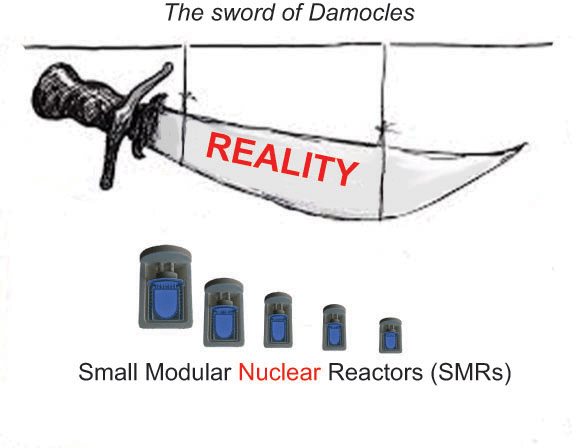 NFLA support joint report with the Nuclear Consulting Group which looks at the prospects of Small Modular Nuclear Reactors in the UK and globally and concludes they will not be built to any significant scale http://www.nuclearpolicy.info/news/nfla-joint-ncg-report-on-smrs/ 25 Jul 19
The Nuclear Free Local Authorities (NFLA) welcomes cooperating with the Nuclear Consulting Group (NCG) in its development of one of the most detailed analyses of the technologies being developed to create small modular nuclear reactors (SMRs) in the UK and around the world. This report concludes there remains fundamental barriers to any significant development of this new nuclear technology, and its prospects for creating some kind of ‘nuclear renaissance’ are unlikely to be realised.
The report has been developed by Professor Stephen Thomas of Greenwich University, Dr Paul Dorfman of University College London and NCG Founder, Professor M V Ramana of British Columbia University, and the NFLA Secretary. (1) The global nuclear industry has put forward SMRs as a panacea to the problems of high cost and the difficulty of financing large nuclear reactors; a ready-made alternative that can fill the gap.
However, as the NCG / NFLA report outlines in detail, there are huge obstacles to overcome. Some of these are technical issues, others are around building up an effective supply chain, while the financing of such schemes will only be possible with significant and large subsidy from the public purse.
The report starts with considering the failures in delivering larger nuclear reactors, and then takes in turn each type of SMR technology that has been put forward by companies involved in the nuclear industry.
The report outlines in some detail UK Government policy on SMRs. It notes that after some considerable early promotion of the technology, interest has markedly cooled, despite another fairly limited amount of money being offered to develop the technology, announced earlier this week. (2) The report notes the extraordinary set of conditions set out by Rolls Royce to be met by the UK Government if it is to invest significant amounts of money in its own SMR design, which the authors argue could and should not be committed to at a time when serious doubts remain about the economic viability of the technology.
At a global level, the report concludes that, as with the much-heralded ‘nuclear renaissance’ of recent times, SMRs will not be built in any significant scale. The authors note that the two main rationales for SMRs – promised lower overall project costs and lowering the risk of cost overruns by shifting to an assembly line approach – are more than offset by the loss of scale economies that the nuclear industry has pursued for the past five decades. Indeed, many of the features of the SMRs being developed are the same ones that underpinned the latest, failed generation of large reactors. Reactor cost estimates will remain with a large degree of uncertainty until a comprehensive review by national nuclear regulators is completed, the design features are finalised and demonstration plants are built. Whether the economies claimed from the use of production line techniques can be achieved will only be known if reactors are built in very large numbers, and at significant cost.
Spending so much time and effort pursuing such an uncertain technology, at a time when the ‘climate emergency’ has now reached the political and public lexicon in requiring urgent attention, does not appear to be an effective use of taxpayer resources. Abundant evidence shows that renewable energy supply, storage, distribution and management technologies are being developed ever cheaper and swifter at a time when real urgency is required across society and government to mitigate the worst effects of climate change. SMRs are no answer to creating low-carbon economies by 2030 or close to that date. Governments should consider this report carefully and not be diverted by an unproven technology inherent with many difficult issues still to overcome.
In the overall view of the report authors, the prospects for SMRs in the UK and Worldwide are limited and not worth the huge levels of effort or finance being proposed for them.
NFLA Steering Committee Chair Councillor David Blackburn said:
“This excellent independent analysis on the prospects for small modular nuclear reactors needs to be read by the new Business Secretary Andrea Leadsom and senior civil servants in the UK Government who have been providing support to the development of small modular nuclear reactors. It is clear from this joint report between the NCG and the NFLA that this technology is not the panacea to kick start new nuclear reactors, far from it. As Councils around the country declare ‘climate emergencies’ it is clear from this report that scarce available resource should not be spent developing this technology but rather diverted into renewable energy, smart energy, energy efficiency and energy storage projects instead. As large new nuclear like at Moorside and Wylfa has failed to be realised, it is time now to move away from small nuclear reactors as an expensive sideshow to the critical needs of mitigating carbon.”
Report co-author Professor Steve Thomas added:
“Nuclear proponents are saying that SMRs will be the next big thing – but the reality is they are as expensive as large reactors, produce the same waste, carry the same radiation risks, and are a long way from any real deployment.”
Ends – for more information please contact Sean Morris, NFLA Secretary, on 00 44 (0)161 234 3244.
Notes for editors:
(1) NCG / NFLA report – Prospects for Small Modular Reactors in the UK and Worldwide, July 2019
http://www.nuclearpolicy.info/wp/wp-content/uploads/2019/07/Prospects-for-SMRs-report-2.pdf
(2) Energy Live News, Government mulls investing £18 million to develop UK’s first mini nuclear reactor, 23rd July 2019 https://www.energylivenews.com/2019/07/23/government-mulls-investing-18m-to-develop-uks-first-mini-nuclear-reactor/
UK government commits to ordering mini nuclear reactors from Rolls Royce
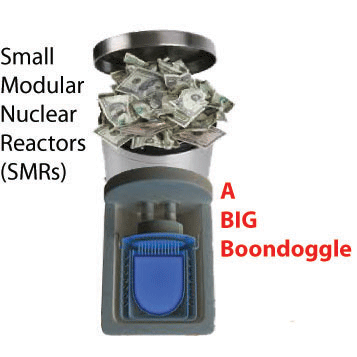 Rolls-Royce gets government commitment for mini nuclear reactors UK aero-engine maker seeks to spearhead development of export-led industry https://www.ft.com/content/32ee2100-ad43-11e9-8030-530adfa879c2 Sylvia Pfeifer in London, 24 July 19,
Although the initial commitment is just £18m, it will allow the consortium to mature the design of the reactors. The move, which is subject to a final sign-off, would still require significant levels of additional investment before the reactors can become a commercial reality. The UK aero-engine maker has long argued that its technology in this sphere should be regarded as a “national endeavour” to develop nuclear skills that can be used to create an export-led industry.
A consortium spokesperson said on Tuesday that the £18m investment would be used to “mature the design, address the considerable manufacturing technology requirements and to progress the regulatory licensing process”. He added: “We believe with early co-investment by the government, this power station design is a compelling commercial opportunity.”
Rolls-Royce and its team, which includes Laing O’Rourke and Arup, was one of several consortiums that bid in an initial government-sponsored competition launched in 2015 to find the most viable technology for a new generation of small nuclear modular reactors (SMRs). Most of these will not be commercial until the 2030s
Supporters argue that they can deliver nuclear power at lower cost and reduced risk. They will draw on modular manufacturing techniques that will reduce construction risk, which has plagued larger-scale projects. However, when a nuclear sector deal was finally unveiled last June, the government allocated funding only for more advanced modular reactors.
MRs, which typically use water-cooled reactors similar to existing nuclear power stations, were omitted from funding even though they were closer to becoming commercial. Rolls-Royce threatened last summer that it would shut down the project if there was no meaningful support from the government.
Ministers have in recent months scrambled to recast Britain’s energy policy after the collapse of plans to build several large reactors and on Monday evening published proposals to finance new nuclear plants by having taxpayers pay upfront through their energy bills. The government added that, as part of its plans to fund advanced nuclear technologies, it would make an “initial award” of up to £18m under the industrial strategy challenge fund to the Rolls-Royce-led consortium in the autumn. The consortium has said any government funding will be matched in part by contributions from the companies as well as by raising funds from third-party organisations.
Small Modular Nuclear Reactors – at least 10 years away – Canadian Nuclear Association
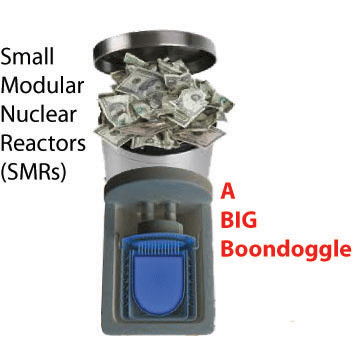 Mini-nuclear power plants at least 10 years out: Canadian Nuclear Association, The Post Millennial Jason Unrau, 21July 19, Mini-nuclear power plants at least 10 years out: Canadian Nuclear Association, The Post Millennial Jason Unrau, 21July 19,
|
|
|
Utah communities sign on, rather cautiously, to buy NuScale’s Small Modular Nuclear Reactors

 communities in Utah and elsewhere have agreed to purchase nuclear power from a small modular reactor planned at the Idaho National Laboratory, triggering a next phase in its development.
Bill Gates now glum about the prospects for his nuclear power company TerraPower

Bill Gates faces “daunting” nuclear energy future, Amy Harder AXIOX 15 July 19 ,The optimism usually radiating from billionaire Bill Gates when it comes to climate change is starting to fade on one of his biggest technology bets: nuclear power.
Driving the news: The Microsoft co-founder has focused much of his time lately on climate change and energy innovation. In an exclusive interview with Axios, Gates said that setbacks he is facing with TerraPower, a nuclear technology firm he co-founded in 2006, has got him questioning the future of that entire energy source.
……It’s declining in most places around the world, including the U.S., due to aging reactors, cheaper energy alternatives and public unease about radioactive risk ……
- The industry’s future is riding on largely unproven technologies like that of TerraPower because they’re smaller and deemed safer than today’s huge reactors.
“Without this next generation of nuclear, nuclear will go to zero,” Gates said during an interview in Washington last month. Germany is shutting 22 nuclear plants, France — a leader in clean-burning nuclear power — has plans to shut down some of its reactors and a similar trend is underway in the U.S. due to economic conditions, said Gates, before adding with a sigh: “So yes, it is daunting.”
Flashback: Gates announced in December that TerraPower was scrapping plans to build a demonstration reactor in China, largely due to the Trump administration deciding that fall to crack down on technological agreements between the two nations.
“There are times like when TerraPower gets told not to work in China, you’re thinking, ‘Boy, is this thing going to come together or not?’ ” Gates said in what are his first public comments on the matter since it happened. “That was a real blow.”
Where it stands: Gates is now trying to build TerraPower’s demonstration reactor in the U.S., calling on the Energy Department and Congress to more aggressively support advanced nuclear power through more funding and new legislation. Such a plant could cost anywhere between $3-$6 billion, say experts and Gates’ energy advisers.
- Bellevue, WA-based TerraPower is opening a new 65,000-square foot facility in the same region later this year to expand its research and testing, which is currently done in a lab 1/6th that size.
- Gates, whose net worth is roughly $100 billion, hasn’t disclosed how much money he has put toward the company, but experts think it’s at least $500 million.
“If at the end of the day we don’t find a country that wants to build an advanced nuclear power plant, then TerraPower will fail. I’m going to keep funding it for a period of years. And working with the U.S. is our strategy right now.”
— Bill Gates ………‘TerraPower’s traveling wave may prove to be an example of a very ambitious attempt to solve a very challenging problem that has turned out to be too expensive and too difficult,” said Chris Gadomski, head of nuclear research at Bloomberg New Energy Finance. ………
Expert opinion: small nuclear reactors a very bad deal for Scotland
“Even if a safe and affordable design were to emerge from the current research projects, the whole concept relies on there being a sufficient guaranteed pipeline of orders for the construction and ramping up to scale of a large and expensive production facility,” NCG said.
“Without such a pipeline – itself requiring an unlikely level of long-term policy consistency – it is difficult to see the private sector being willing to finance such a facility.”
“We need to rapidly scale up investments in clean, safe renewable power and improving energy efficiency rather than fall for the latest sales pitch of the failing nuclear industry.”
Small nuclear reactors for Scotland? No thanks, say experts, The Ferret, Jenny Tsilivakou on July 7, 2019
Scientifically ignorant, is Australia’s Morrison government being conned into buying Small Modular Nuclear Reactors?
 Fukushima, the ‘nuclear renaissance’ and the Morrison Government, Independent Australia, By Helen Caldicott | 25 June 2019 Now that the “nuclear renaissance” is dead following the Fukushima catastrophe, when one-sixth of the world’s nuclear reactors closed, the nuclear corporations – Toshiba, Nu-Scale, Babcock and Wilcox, GE Hitachi, Cameco, General Atomics and the Tennessee Valley Authority – will not accept defeat, nor will the ill-informed Morrison Government…..
To be quite frank, almost all of our politicians are scientifically and medically ignorant and in an age where scientific evolution has become extraordinarily sophisticated, it behoves us – as legitimate members of democracy – to both educate ourselves and our naive and ignorant politicians for they are not our leaders, they are our representatives.
Many of these so-called representatives are now being cajoled into believing that electricity production in Australia could benefit from a new form of atomic power in the form of small modular reactors (SMRs), allegedly free of the dangers inherent in large reactors — safety issues, high cost, proliferation risks and radioactive waste.

But these claims are fallacious, for the reasons outlined below.
Basically, there are three types of small modular reactors (SMRs), which generate less than 300 megawatts of electricity compared with current 1,000-megawatt reactors.
1. Light-water reactors
These will be smaller versions of present-day pressurised water reactors, using water as the moderator and coolant, but with the same attendant problems as Fukushima and Three Mile Island. Built underground, they will be difficult to access in the event of an accident or malfunction.
Because they’re mass-produced (turnkey production), large numbers must be sold yearly to make a profit. This is an unlikely prospect because major markets — China and India — will not buy our reactors when they can make their own.
If safety problems arise, they all must be shut down, which will interfere substantially with electricity supply.
SMRs are expensive because the cost per unit capacity increases with a decrease in reactor size. Billions of dollars of government subsidies will be required because investors are allergic to nuclear power. To alleviate costs, it is suggested that safety rules be relaxed.
2. Non-light-water designs
These include high-temperature gas-cooled reactors (HTGRs) or pebble-bed reactors. Five billion tiny fuel kernels consisting of high-enriched uranium or plutonium will be encased in tennis-ball-sized graphite spheres that must be made without cracks or imperfections — or they could lead to an accident. A total of 450,000 such spheres will slowly and continuously be released from a fuel silo, passing through the reactor core and then recirculated ten times. These reactors will be cooled by helium gas operating at high very temperatures (900 degrees Celcius).
A reactor complex consisting of four HTGR modules will be located underground, usually to be run by just two operators in a central control room. Claims are that HTGRs will be so “safe” that a containment building will be unnecessary and operators can even leave the site (“walk-away-safe” reactors).
However, should temperatures unexpectedly exceed 1,600 degrees Celcius, the carbon coating will release dangerous radioactive isotopes into the helium gas and at 2,000 degrees Celcius, the carbon would ignite, creating a fierce, Chernobyl-type graphite fire.
If a crack develops in the piping or building, radioactive helium would escape and air would rush in, also igniting the graphite.
Although HTGRs produce small amounts of low-level waste, they create larger volumes of high-level waste than conventional reactors.
Despite these obvious safety problems, and despite the fact that South Africa has abandoned plans for HTGRs, the U.S. Department of Energy has unwisely chosen the HTGR as the “next-generation nuclear plant.” There is a push for Australia to follow suit.
3. Liquid-metal fast reactors (PRISM)
It is claimed by proponents that fast reactors will be safe, economically competitive, proliferation-resistant and sustainable.
They are fueled by plutonium or highly enriched uranium and cooled by either liquid sodium or a lead-bismuth molten coolant. Liquid sodium burns or explodes when exposed to air or water, and lead-bismuth is extremely corrosive, producing very volatile radioactive elements when irradiated.
Should a crack occur in the reactor complex, liquid sodium would escape, burning or exploding. Without coolant, the plutonium fuel could reach critical mass, triggering a massive nuclear explosion, scattering plutonium to the four winds. One-millionth of a gram of plutonium induces cancer — and it lasts for 500,000 years. Extraordinarily, they claim that fast reactors will be so safe that they will require no emergency sirens and that emergency planning zones can be decreased.
There are two types of fast reactors: a simple, plutonium-fueled reactor and a “breeder,” in which the plutonium-reactor core is surrounded by a blanket of uranium 238, which captures neutrons and converts to plutonium.
The plutonium fuel, obtained from spent reactor fuel, will be fissioned and converted to shorter-lived isotopes, caesium and strontium, which last 600 years instead of 500,000. The industry claims that this process, called “transmutation,” is an excellent way to get rid of plutonium waste. But this is fallacious because only ten per cent is fissioned, leaving 90 per cent of the plutonium for bomb-making and so on.
Then there’s construction. Three small plutonium fast reactors are grouped together to form a module and three of these modules will be buried underground. All nine reactors will then be connected to a fully automated central control room operated by only three operators. Potentially, then, one operator could face a catastrophic situation triggered by the loss of off-site power to one unit at full power, another shut down for refuelling and one in startup mode. There are to be no emergency core cooling systems.
Fast reactors require massive infrastructure, including a reprocessing plant to dissolve radioactive waste fuel rods in nitric acid, chemically removing the plutonium and a fuel fabrication facility to create new fuel rods. A total of 14-23 tonnes of plutonium are required to operate a fuel cycle at a fast reactor, and just five pounds is fuel for a nuclear weapon.
Thus fast reactors and breeders will provide extraordinary long-term medical dangers and the perfect situation for nuclear-weapons proliferation. Despite this, the Coalition Government is considering their renaissance. https://independentaustralia.net/environment/environment-display/fukushima-the-nuclear-renaissance-and-the-morrison-government,12834
Salt Lake City-based Energy Strategies – study shows NuScale’s small nuclear reactors too costly for Utah
Environmental group says new nuclear power plant too pricey for Utah’s municipal utilities, KSL.com SALT LAKE CITY — A group opposed to a new type of nuclear plant being developed said Thursday the price of power produced there would be more than other carbon-free energy sources, making it a bad investment for Utah’s municipal utilities.
“We feel the numbers are independent and speak for themselves,” Michael Shea, a senior policy associate for the Healthy Environmental Alliance of Utah, told reporters at a news conference discussing the findings in a new study.
The study, by Salt Lake City-based Energy Strategies, found power produced by the small modular nuclear reactors to be built in Idaho would cost more than $66 per megawatt hour, compared to as low as just over $38 for wind and solar power.
“It does not make economic sense from a market perspective for a group like (the Utah Associated Municipal Power Systems) to be investing in what is essentially a subsidized science project that has not ever been proven,” Shea said…….
Longtime consumer protection watchdog Claire Geddes spoke at the news conference about her confidence in the study and her concerns about the impact of higher costs on the public.
Geddes, who said she has worked on utility issues since 1992, suggested the local governments supervising municipal utilities don’t have the resources to adequately vet the project.
“It’s really not fair to the public,” she said. “I would stress that these cities understand, before they go into it, what the risks are to their citizens and their businesses.”
Both the environmental alliance and Geddes called for further study by the municipal power system before local governments make a final decision next year on what would be a 40-year contract. ……
Besides the cost concerns, Williams said the new type of nuclear plant can’t be presumed to be safe and would still produce at least as much nuclear waste as a traditional plant.
The intent is for the municipal power system to purchase all 12 modular reactors at the plant being built by an Oregon-based company, NuScale Power, system spokesman LaVarr Webb said.
The power generated would be used by the 46 members, mostly municipalities, in Utah and other states, Webb said, and would sold to other users including the federal government for use by the Idaho National Laboratory and the Department of Energy……..https://www.ksl.com/article/46578424/environmental-group-says-new-nuclear-power-plant-too-pricey-for-utahs-municipal-utilities
Holtec and Ukraine developing Small Modular Nuclear Reactors (dodgy underground devices)
Consortium established for SMR-160 deployment in Ukraine, WNN 12 June 2019
The consortium document was signed by Holtec CEO Kris Singh, Energoatom President Yury Nedashkovsky and SSTC President Igor Shevchenko. The signing ceremony – held at Holtec’s headquarters in Camden, New Jersey – was attended by senior Holtec officials and delegations from Mitsubishi Electric, the US Department of Energy and Energoatom.
The consortium is a US company registered in Delaware with each of the three parties owning allotted shares. Its technology operation centre will be based in Kiev, Ukraine…….
The MoU includes the licensing and construction of SMR-160 reactors in Ukraine, as well as the partial localisation of SMR-160 components. The Ukrainian manufacturing hub is to mirror the capabilities of Holtec’s Advanced Manufacturing Plant in Camden, and will be one of four manufacturing plants Holtec plans to build at distributed sites around the world by the mid-2020s.
Holtec’s 160 MWe factory-built SMR uses low-enriched uranium fuel. The reactor’s core and all nuclear steam supply system components would be located underground, and the design incorporates a wealth of features including a passive cooling system that would be able to operate indefinitely after shutdown….
The SMR-160 is planned for operation by 2026.
The SMR-160 is currently undergoing the first phase of the Canadian Nuclear Safety Commission’s three-phase pre-licensing vendor design review process. State Nuclear Regulatory Inspectorate of Ukraine, the nuclear regulatory authority in Ukraine, is expected to coordinate its regulatory assessment of SMR-160 under a collaborative arrangement with its Canadian counterpart. http://www.world-nuclear-news.org/Articles/Consortium-established-for-SMR-160-deployment-in-U
Edwin lyman on the safety of these reactors “Holtec SMR-160. The Holtec SMR-160 will generate 160 MWe. Like the NuScale, it is designed for passive cooling of the primary system during both normal and accident conditions. However, the modules would be much taller than the NuScale modules and would not be submerged in a pool of water. Each reactor vessel would be located deep underground, with a large inventory of water above it that could be used to provide a passive heat sink for cooling the core in the event of an accident. Each containment building would be surrounded by an additional enclosure for safety, and the space between the two structures would be filled with water. Unlike the other iPWRs, the SMR-160 steam generators are not internal to the reactor vessel. The reactor system is tall and narrow to maximize the rate of natural convective flow, which is low in other passive designs. Holtec has not made precise dimensions available, but the reactor vessel is approximately 100 feet tall, and the aboveground portion of the containment is about 100 feet tall and 50 feet in diameter (Singh 2013)
For these and other SMRs, it is important to note that only limited information is available about the design, as well as about safety and security. A vast amount of information is considered commercially sensitive or security-related and is being withheld from the public. ….
in the event of a serious accident, emergency crews could have greater difficulty accessing underground reactors.
Underground siting of reactors is not a new idea. Decades ago, both Edward Teller and Andrei Sakharov proposed siting reactors deep underground to enhance safety. However, it was recognized early on that building reactors underground increases cost. Numerous studies conducted in the 1970s found construction cost penalties for underground reactor construction ranging from 11 to 60 percent (Myers and Elkins). As a result, the industry lost interest in underground siting. This issue will require considerable analysis to evaluate trade-offs…. ” https://nuclearinformation.wordpress.com/2017/11/29/edwin-lyman-on-small-modular-reactors/ erious accident, emergency crews could have greater difficulty accessing underground reactors.
Energy experts doubt the viability of Small Modular Nuclear Reactors (SMRs)

|
Caution urged over modular nuclear reactors, New Civil Engineer, 9 JUNE, 2019 Energy heavyweights have urged caution over the idea of rolling out small modular reactor (SMR) technology to replace cancelled and decommissioned nuclear power projects.
The warnings came during a discussion on the potential ‘clean energy gap’ left by cancelled nuclear projects like Wylfa and older plants being decommissioned early. One potential solution to the gap would be to accelerate the progress of SMR development, which are marketed by their supporters as a more affordable nuclear power option, and safer than larger projects, such as Hinkley Point C. However National Infrastructure Commission chief economist James Richardson warned that the industry had failed to deliver on technological promises in the past. “You have to have a degree of caution with new nuclear technology,” he said. “We have been promised things time and time again and typically the industry tends to be more expensive and take longer than planned. I would be cautious against SMRs, they are a question for the 2030s.” “SMRs are not going to help in the next decade because they are just not available. By the time they turn up we can see if they are still cost effective or if renewable’s have gone beyond.” UK Energy Research Centre director Jim Watson agreed, and added we need to decarbonised power before SMR’s can be deployed. “I would also be cautious; we need to remember that 2030 is when we need to have decarbonised our power system by and I think there is a limit to which nuclear can help deliver that. We don’t know what the real cost of these SMRs are. History does make us cautious.” ……. https://www.newcivilengineer.com/latest/caution-urged-over-modular-nuclear-reactors/10042995.article |
|
The false hope of “Small Modular Nuclear Reactors” being pushed in Wales
of Everlasting Nuclear Destruction. It is also the Welsh word for fox.
talked about as a possible location for a new, small modular reactor (SMR).
Trawsfynydd reactors are decommissioning now, but very slowly. On
Wikipedia, the page proclaims that the decommissioning is expected to take
“almost 100 years.”
beyond Trawsfynydd. Being described as “small” and “modular” tends
to mask the reality that it is expensive, of little use for climate change,
and likely still far in the future.
false hope, of course, because the likelihood of SMRs coming to fruition is
slim and would provide only a handful of jobs.
https://beyondnuclearinternational.org/2019/05/12/the-fox-we-need-to-guard-this-henhouse/
Pentagon’s strange and dangerous plan for small nuclear reactors at the battle scene

|
A New Kind of Nuclear War; The Pentagon pushes for fission for fighting, POGO,BY MARK THOMPSON 19 Apr19 “…… the Pentagon wants to build flyable and truckable nuclear-power plants to generate the power U.S. troops need to wage war deep in hostile territory.The concept of micro-nuclear power plants on the battlefield is both inspired and insane. The idea of landing portable nuclear reactors inside a war zone is as outlandish—economically and environmentally—as it sounds.
Yet the Pentagon’s nuclear push didn’t “go critical”—achieve a self-sustaining atomic reaction—on its own. “It is the culmination of a patient, decade-long effort by nuclear lobbyists to interest Defense and its congressional overseers in a costly product—small nuclear reactors—that few in the private sector seem to want,” Edwin Lyman, a senior scientist at the Union of Concerned Scientists, wrote in the Bulletin of the Atomic Scientists in February. “The Pentagon is precisely the savior small nuclear reactor vendors need: deep-pocketed and unbeholden to return-seeking investors.” Beyond that, the Pentagon’s nuclear advocates argue that battlefield nuclear reactors would improve the environment and help jump-start the nuclear-reactor business, creating thousands of well-paying jobs in the process. That meshes with the U.S. nuclear industry’s push to peddle more civilian reactors abroad, including a meeting with President Trump in February. “He really wanted to hear from us on what our views are on how we win the global nuclear energy technology race,” said J. Clay Sell, head of Maryland-based X-energy, an advanced nuclear-reactor company seeking business in Jordan. …. it should come as no surprise that the nuclear industry is pulling out all the stops as it sees climate-change concerns giving it a second lease on life, even as renewable energy (wind, solar, hydroelectric) is now producing more power in the United States. The NEI spends about $2 million annually seeking favors from the federal government. Conveniently, the Trump Administration is seeking to bail out the nuclear industry. The nuclear industry’s push isn’t only in Washington, DC. It’s gaining traction with state legislatures as well, most notably in Pennsylvania, home to Three Mile Island, the site of the most serious nuclear-power plant accident in U.S. history. In the last three years, Exelon, which operates Three Mile Island, has ramped up its lobbying efforts in Pennsylvania, in hopes of boosting taxpayer subsidies. The Pentagon has had a long-standing romance with nuclear power, dating back to Hiroshima and Nagasaki……. the Pentagon is trying to build support for the plan by noting that mini-nukes have heart-warming peaceful uses, too. “A small mobile nuclear reactor would enable a more rapid response during Humanitarian Assistance and Disaster Relief (HADR) operations,” it said earlier this year in a “request for information” seeking outside help to develop portable atomic reactors for war zones……. The Pentagon wants a reactor capable of generating between 1 and 10 megawatts (enough for a base housing at least 1,000 troops for three years without refueling. Weighing no more than 40 tons, it must be “sized for transportability by truck, ship, and C-17 aircraft.” And to avoid the problems posed by water-cooled reactors, it needs to be cooled by “ambient air,” just like the original VW Beetle and its distinctive putt-putt engine…….. The unit will be “semiautonomous—Not requiring manned control by operators to ensure safe operation,” the Pentagon says. Starting it up should take less than three days, and shutting it down should take no more than a week. Their basic design is as simple as nuclear power gets: as the reactor fuel decays, it generates heat that is then turned into electricity. The Pentagon plans on funding up to three designs before tapping a winner from among them. Other nations—Canada, China, and the United Kingdom—are also exploring such small reactors……. Lyman of the Union of Concerned Scientists says the “lobbying push” to build micro-nukes for the U.S. military comes from the U.S. Nuclear Industry Council. The Washington-based trade group says it is “composed of over 80 companies” and “represents the ‘Who’s Who’ of the nuclear energy supply chain community, including key utility movers, technology developers, fuel cycle companies, construction engineers, manufacturers and service providers.” But nuclear insiders also are playing a critical role. Among the authors of that key Defense Science Board report were some atomic heavyweights, including co-chairman Michael Anastasio, the only person to ever run two of the nation’s nuclear labs (he is the former head of Los Alamos in New Mexico, and Lawrence Livermore in California), and William Madia, who served as director of the Oak Ridge National Laboratory in Tennessee, and Pacific Northwest National Laboratory in Washington state. …… There are proliferation risks associated with deploying nuclear reactors amid wars. The 2016 Defense Science Board report suggested that portable nuclear reactors be fueled only with low-enriched uranium that couldn’t be turned into nuclear weapons, although it conceded they would represent “a lucrative target to become a dirty bomb if breached.” The Pentagon’s January 2019 solicitation said that “technology, engineering, and operations must demonstrate minimization of added proliferation risk.” Of course, the U.S. government has been through this before, dating back to President Eisenhower’s “Atoms for Peace” initiative. That led to the first nuclear reactors in Iran and Pakistan. Harnessing nuclear power on the battlefield would require changes in U.S. military training, nuclear regulation and licensing, as well as convincing foreign governments to let them on their soil. …….. Training soldiers to deploy and operate portable nuclear power plants would be challenging, although the Army said in the report, “this requirement is not anticipated to be as demanding as that of a nuclear weapon.” Any Army port-a-nuke “must prevent the reactor from going critical when it should not, such as during movement/transport.” While such a reactor “is not expected to survive a direct kinetic attack,” the Army said it would be designed “for the protection of personnel who may be adversely affected by the system or threats to the system.” Outsiders are dubious. “Even a reactor as small as 1 megawatt-electric would contain a large quantity of highly radioactive, long-lived isotopes such as cesium-137—a potential dirty bomb far bigger than the medical radiation sources that have caused much concern among security experts,” the Union of Concerned Scientists’ Lyman warned in the Bulletin of the Atomic Scientists. “At best a release of radioactivity would be a costly disruption, and at worst it would cause immediate harm to personnel, render the base unusable for years, and alienate the host country.” Any radiation leakage would be far more vexing than the cleanup after dumping about 20 million gallons of Agent Orange and other herbicides on Vietnam from 1961 to 1971. “While design simplification and damage-resistant fuel choices help, detailed planning for cleanup and removal of battle-damaged reactors or reactor components will be expensive and pose some technical challenges to resolve,” the Army report said, likely requiring changes to “existing treaties, international agreements, and policies.” At the end of the day, of course, the big bugaboo is what to do with all that spent, but still dangerous, nuclear fuel. But not to worry: the Army has figured that out, too. “Nuclear fuel is a DOE [Department of Energy] responsibility,” the Army notes. “Issues such as recycling of nuclear fuel or long-term disposal are not DOD’s business.” Perfect. Of course, the Energy Department hasn’t figured out what to do with the 80,000 metric tonsof spent nuclear-reactor fuel created by U.S. commercial reactors over the past half-century. Bottom line: thinking about sending portable nuclear reactors off to war is kind of like invading a country with no plan for how to get out. https://www.pogo.org/analysis/2019/04/a-new-kind-of-nuclear-war/ |
|
Nuclear Transparency Watch warns on the unwisdom of UK government subsidising Small Modular Nuclear Reactors (SMRs)
Small Modular Reactors – of SMRs and ANTs, by Jan Haverkamp http://www.nuclear-transparency-watch.eu/activities/small-modular-reactors-of-smrs-and-ants-by-jan-haverkamp.html
15 April 2019 The debate on Small Modular Reactors continues to warm up. The IAEA recently updated its webpages on the issue. SMRs are currently promoted by parts of the nuclear industry as an answer to the decrease of interest in normal gigawatt (GW)-scale reactors because of economic and technical realities.
Dr. David Lowry thinks it is time for a warning: “This article focuses on the UK, but similar arguments as I brought forward in Bratislava would apply to any other European government confronted with requests for support of this new sector.”
Many obstacles to small modular nuclear reactors, but U.S. Nuclear Regulatory Commission recommends them, anyway
NRC recommends issuing early site permit for Clinch River Nuclear Site, OAK RIDGE TODAY, APRIL 8, 2019BY The U.S. Nuclear Regulatory Commission has issued a final environmental impact statement, and the staff has recommended, based upon the environmental review, issuing an early site permit for the Clinch River Nuclear Site in west Oak Ridge, where two or more small modular nuclear reactors could be built.The final environmental impact statement, or EIS, was issued by the NRC on April 3. A notice of the EIS and the staff’s recommendation were published in the Federal Register on Monday, April 8.
The 935-acre Clinch River Nuclear Site is located in Roane County along the Clinch River……….
An early site permit is the NRC’s approval of a site for one or more nuclear power facilities. It does not authorize the actual construction and operation of a new nuclear power plant. That requires a construction permit and an operating license, or a combined license. ………
The Clinch River Nuclear Site could be used to demonstrate small modular reactors with a maximum total electrical output of 800 megawatts………
Now that the final EIS has been published, there will be a mandatory hearing with the NRC after a final safety evaluation report is issued. The NRC expects that report to be published in June. The five-member commission will make a decision after the hearing about whether to issue the early site permit.
A contested hearing could be held by the Atomic Safety and Licensing Board panel if a member of the public or an organization successfully files a petition that raises safety or environmental concerns about granting the site a permit, the NRC said.
The NRC said an authorization for the construction or operation of new nuclear units at the Clinch River site is not being sought at this time.
The potential timing of any reactors being built at the site is not clear. Among other things, TVA doesn’t control the reactor certification process.
“There are currently no certified small modular reactor designs available, but TVA will continue working to ensure we are ready to fully evaluate them when they are available,” Hopson said.
Financial considerations would have to be evaluated, and the TVA board of directors would have the final decision “based on what they believe will be in the best interest of the people of the Tennessee Valley,” Hopson said.
Since a design hasn’t been certified for a small modular reactor, TVA used what is known as a “plant parameter envelope” as a surrogate for a nuclear power plant and its facilities when applying for the early site permit. The “plant parameter envelope” estimated the potential environmental impacts of building and operating two or more small modular reactors at the site. TVA used information from four small modular reactor vendors to develop the “plant parameter envelope.”
A reader has asked why TVA might consider adding new generating capacity at the Clinch River site even as it plans to retire coal-fired units like the Bull Run Fossil Plant in Claxton, citing flat or declining demand………https://oakridgetoday.com/2019/04/08/nrc-recommends-issuing-early-site-permit-clinch-river-nuclear-site/
1 This Month



26 September – International Day for the Total Elimination of Nuclear Weapons


PLEASE OPPOSE HR 8255 AND S.3639 – bills would accelerate satellite deployment, with no environmental review or safeguards – https://ncstd5li.quorum.us/campaign/169331/
To see nuclear-related stories in greater depth and intensity – go to https://nuclearinformation.wordpress.com
-
Archives
- September 2026 (233)
- August 2026 (330)
- July 2026 (355)
- June 2026 (287)
- May 2026 (306)
- April 2026 (356)
- March 2026 (251)
- February 2026 (267)
- January 2026 (308)
- December 2025 (358)
- November 2025 (359)
- October 2025 (375)
-
Categories
- 1
- 1 NUCLEAR ISSUES
- business and costs
- climate change
- culture and arts
- ENERGY
- environment
- health
- history
- indigenous issues
- Legal
- marketing of nuclear
- media
- opposition to nuclear
- PERSONAL STORIES
- politics
- politics international
- Religion and ethics
- safety
- secrets,lies and civil liberties
- spinbuster
- technology
- Uranium
- wastes
- weapons and war
- Women
- 2 WORLD
- ACTION
- AFRICA
- Atrocities
- AUSTRALIA
- Christina's notes
- Christina's themes
- culture and arts
- Events
- Fuk 2022
- Fuk 2023
- Fukushima 2017
- Fukushima 2018
- fukushima 2019
- Fukushima 2020
- Fukushima 2021
- general
- global warming
- Humour (God we need it)
- Nuclear
- RARE EARTHS
- Reference
- resources – print
- Resources -audiovicual
- Weekly Newsletter
- World
- World Nuclear
- YouTube
-
RSS
Entries RSS
Comments RSS
 nuclear-news