15 USA senators re-introduce bill to promote new nuclear reactors
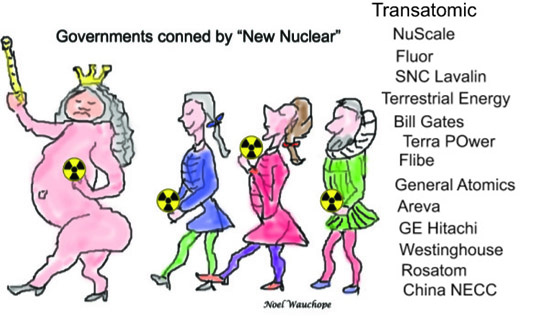
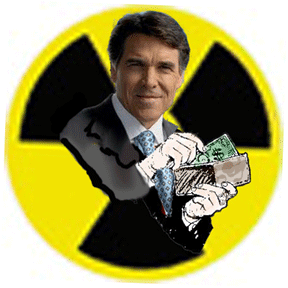
Senate re-introduces bill to help advanced nuclear technology, Legislation was praise by Bill Gates, who has  funded an advanced nuclear company. Ars Technica, MEGAN GEUSS – 4/1/2019,
Last week, a bipartisan group of 15 US senators re-introduced a bill to instate the Nuclear Energy Leadership Act (NELA), which would offer incentives and set federal goals for advanced nuclear energy. A smaller group of senators originally introduced the bill in September of last year, but the Congressional session ended before the Senate voted on it.
Specifically, the bill authorizes the federal government to enter into 40-year power purchase agreements (PPAs) with nuclear power companies, as opposed to the 10-year agreements that were previously authorized. Securing a 40-year PPA would essentially guarantee to an advanced nuclear startup that it could sell its power for 40 years, which reduces the uncertainty that might come with building a complex and complicated power source.
……. In addition to supporting a 40-year PPA to improve the economics of advanced nuclear reactor research from the private market, the bill directs the Department of Energy’s Office of Nuclear Energy to develop a 10-year strategic plan to support advanced nuclear reactor research. The DOE must also “construct a fast neutron-capable research facility” if the bill passes, which Senate materials say “is necessary to test important reactor components, demonstrate their safe and reliable operation, and ultimately license advanced reactor concepts.”
The bill also directs the federal government to make available some “high-assay low-enriched uranium” for research and testing in advanced reactors. Traditional light-water reactors use low-enriched uranium in which the active U-235 isotope constitutes 3 to 5 percent of the nuclear fuel, according to the World Nuclear Association. High-assay low-enriched uranium, on the other hand, pushes enrichment levels to about 7 percent of the fuel and, in some cases, can go as high as 20 percent.
Finally, the bill directs the DOE to create “a university nuclear leadership program” to train the next generation of nuclear engineers.
On Thursday, Microsoft mogul Bill Gates tweeted his support for the bill. Gates is currently the chairman for an advanced nuclear reactor company called Terrapower, which is developing a traveling wave reactor that uses depleted uranium as fuel (depleted uranium is a by-product of uranium enrichment). Terrapower suffered a political setback earlier this year, as US rules against sharing nuclear technology with China forced the company to abandon its plans for conducting preliminary trials of its technology in that country.
Gates praised this new bill, writing “I can’t overstate how important this is.”
…….. NuScale Power, a company that has made significant progress toward building a small modular reactor in Idaho, also praised the bill. In a statement to a market research company called The Morning Consult, chief strategy officer of NuScale Power Chris Colbert said that “the bill would ‘absolutely’ make it easier and more certain to reach deployment.” https://arstechnica.com/science/2019/03/senate-re-introduces-bill-to-help-advanced-nuclear-technology/
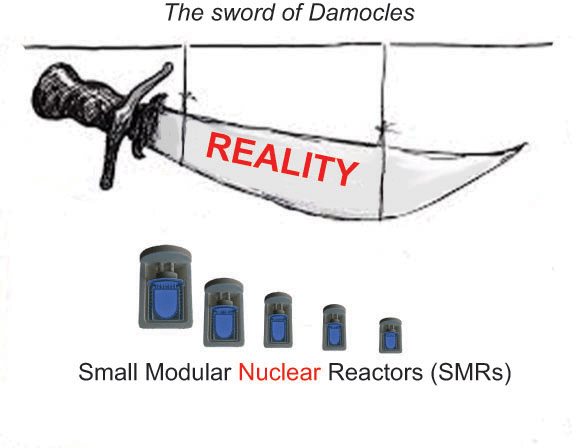
Small and Medium Nuclear Reactors (SMRs) – cost estimates, and what they cost to build
SMR cost estimates, and costs of SMRs under construction, Nuclear Monitor Issue: #872-873 4777 07/03/2019Jim Green ‒ Nuclear Monitor editor
 Costs of SMRs under construction https://wiseinternational.org/nuclear-monitor/872-873/smr-cost-estimates-and-costs-smrs-under-construction?fbclid=IwAR1TQA0xJ4bYxnVxJ0Aulcxvp0miMhEP4Vt8YqvLQKrhI3lTDhnrzZxQCE8Estimated construction costs for Russia’s floating nuclear power plant (with two 35-MW ice-breaker-type reactors) have increased more than four-fold and now equate to over US$10 billion / gigawatt (GW) (US$740 million / 70 MW).1 A 2016 OECD Nuclear Energy Agency report said that electricity produced by the plant is expected to cost about US$200/MWh, with the high cost due to large staffing requirements, high fuel costs, and resources required to maintain the barge and coastal infrastructure.2
Little credible information is available on the cost of China’s demonstration 2×250 MW high-temperature gas-cooled reactor (HTGR). If the demonstration reactor is completed and successfully operated, China reportedly plans to upscale the design to 655 MW (three modules feeding one turbine, total 655 MW) and to build these reactors in pairs with a total capacity of about 1,200 MW (so much for the small-is-beautiful SMR rhetoric). According to the World Nuclear Association, China’s Institute of Nuclear and New Energy Technology at Tsinghua University expects the cost of a 655 MWe HTGR to be 15-20% more than the cost of a conventional 600 MWe PWR.3
A 2016 report said that the estimated construction cost of China’s demonstration HTGR is about US$5,000/kW ‒ about twice the initial cost estimates.4 Cost increases have arisen from higher material and component costs, increases in labor costs, and increased costs associated with project delays.4 The World Nuclear Association states that the cost of the demonstration HTGR is US$6,000/kW.5
The CAREM (Central Argentina de Elementos Modulares) SMR under construction in Argentina illustrates the gap between SMR rhetoric and reality. Argentina’s Undersecretary of Nuclear Energy, Julián Gadano, said in 2016 that the world market for SMRs is in the tens of billions of dollars and that Argentina could capture 20% of the market with its CAREM technology.6 But cost estimates have ballooned: Continue reading
American nuclear lobby keen to market new nuclear reactors to overseas, to anyone!
 The US is losing the nuclear energy export race to China and Russia. Here’s the Trump
  team’s plan to turn the tide
- Russian and Chinese companies are aggressively pursuing nuclear energy export deals and building more reactors overseas than U.S. firms.
- The Trump administration aims to disrupt that progress by expanding early stage cooperation with countries interested in adopting nuclear energy.
- new initiative aims to make the U.S. the global leader in advanced nuclear reactors poised to hit the market in the coming years.The Trump administration is preparing a new push to help American companies compete in the race to build the next generation of nuclear power plants around the world — a competition the U.S. is currently losing.
In doing so, the administration also aims to push back on the growing dominance of Russia and China in the space, preventing them from expanding their international influence by forging long-lasting nuclear ties with foreign powers.
The State Department plans to expand cooperation with countries pursuing atomic energy long before those nations ever purchase a nuclear reactor. By facilitating early stage talks, the U.S. intends to put American companies first in line to build tomorrow’s fleet of nuclear power plants overseas
We still lead the world in nuclear technology innovation. Our big challenge is taking that incredible IP and those incredible technological innovative breakthroughs and bringing them to market.To be sure, the Energy and Commerce departments actively facilitate U.S. nuclear cooperation with their foreign counterparts. But the State Department now intends to push the issue in talks at the highest levels of government, making it clear that Washington believes cooperation in the nuclear realm is central to its strategic relationships…….
Rise of Russia and ChinaThe U.S. dominated nuclear energy exports decades ago, but faces stiff competition today, including from allies like France and South Korea. But it’s the growing dominance of adversaries in Beijing and Moscow that worries the Trump administration and nonproliferation experts……..
Russia is also changing the rules of the game by offering generous financing that makes nuclear energy affordable to more nations. Moscow is targeting non-nuclear states in the Middle East and Africa with a model to build, own and operate the plants.
The State Department intends to actively dissuade its partners from working with China and Russia, according to Christopher Ford, assistant secretary for international security and nonproliferation.
Ford previewed that message last month at the Hudson Institute in Washington DC: “Russia and China also use reactor sales by their heavily state-supported nuclear industries as a geopolitical tool to deepen political relationships with partner countries, to foster energy dependence by foreign partners, and sometimes even to use predatory financing to lure foreign political leaderships into ‘debt traps’ that give Beijing or Moscow leverage that it can exploit later for geopolitical advantage.”
New plan takes shapeDuring the address, Ford outlined State’s plan to help American companies compete with Chinese and Russian firms.
The department will more closely coordinate nuclear cooperation efforts across agencies and ramp up informal, non-binding talks with nations that might pursue nuclear energy technology. The goal is to expand the number of countries engaged in ongoing communication with U.S. government agencies, nuclear energy companies and researchers.
The State Department will do this by signing nuclear cooperation memorandums of understanding with the countries……..
State’s focus is on teeing up sales of a new generation of nuclear technology expected to come online in the next five to 10 years, the official said.Those include small modular reactors that can be bolted together to form larger units, Terrapower’s traveling wave reactor backed by Bill Gates and microreactors meant to provide enough power for a few thousand homes.
 Altogether, there are about two dozen serious designs for advanced nuclear reactors trying to break into the market, said McGinnis. Under McGinnis and Secretary Rick Perry, one of the Energy Department’s top priorities is facilitating the development of these new technologies…….
On Tuesday, NuScale Energy signed a memorandum to explore deploying its small modular reactors in Romania, after signing similar agreements with Canada and Jordan.
The U.S. will still have to reach so-called 123 Agreements with foreign countries before American firms can sell nuclear reactors overseas. These agreements place limits on the use of nuclear technology and must be approved by Congress.
These agreements have recently drawn scrutiny from Democratic and Republican lawmakers as Westinghouse bids for nuclear power contracts in Saudi Arabia. The Saudis have long insisted on their right to enrich uranium, something the U.S. usually opposes. The bidding also comes as tension between Riyadh and Capitol Hill has escalated after Saudi agents killed Washington Post columnist Jamal Khashoggi in October. …….. https://www.cnbc.com/2019/03/21/trump-aims-to-beat-china-and-russia-in-nuclear-energy-export-race.html
The sorry history of small nuclear power reactors
Many of the expenses associated with constructing and operating a reactor do not change in linear proportion to the power generated. For instance, a 400 MW reactor requires less than twice the quantity of concrete and steel to construct as a 200 MW reactor, and it can be operated with fewer than twice as many people.
In the face of this prevailing wisdom, proponents of small reactors pinned their hopes on yet another popular commercial principle: “economies of mass production.”
In 1968, the same year Elk River shut down, the last of the AEC’s small reactors was connected to the grid: the 50 MW La Crosse boiling water reactor.19 That plant operated for 18 years; by the end, its electricity cost three times as much as that from the coal plant next door, according to a 2012 news account about the disposal of the plant’s spent fuel. Dealing with the irradiated uranium-thorium fuel proved difficult too. Eventually, the spent fuel was shipped to a reprocessing plant in southern Italy.
Since then, not a single small reactor has been commissioned in the United States.
Without exception, small reactors cost too much for the little electricity they produced, the result of both their low output and their poor performance.
The forgotten history of small nuclear reactors Nuclear Monitor Issue: #872-873 4775 07/03/2019 M.V. Ramana ‒ Simons Chair in Disarmament, Global and Human Security at the School of Public Policy and Global Affairs at the University of British Columbia
the technology remains in stasis or decline throughout the Americas and Europe. …..
A fundamental reason for this decline is indeed economic. Compared with other types of electricity generation, nuclear power is expensive. Continue reading
NuScale includes Romania in its desperate search for taxpayer funding for Small Modular Nuclear Reactors

Romania to explore NuScale SMR deployment, WNN, 19 March 2019 An agreement between US small modular reactor (SMR) developer NuScale Power and Romanian energy company Societata Nationala Nuclearelectrica SA (SNN SA) to explore the use of SMRs in Romania has been welcomed by the US Department of Energy (DOE). The two companies have signed a memorandum of understanding covering the exchange of business and technical information on NuScale’s nuclear technology, with the goal of evaluating the development, licensing and construction of a NuScale SMR for a “potential similar long-term solution” in Romania……… NuScale has also signed MOUs to explore the deployment of its SMR technology in Canada and Jordan. http://world-nuclear-news.org/Articles/Romania-to-explore-NuScale-SMR-deployment
USA pushing mini-nuclear reactors for military reasons

US pursuing mini-nuclear reactors to support military expeditionary capabilities, Defence Connect, 20 Mar 19, The US military is conducting research into the development of rapidly deployable, container mounted nuclear reactors to support deployed American and allied forces, reducing threats to traditional supply and support convoys…….
The incessant statement that nuclear is “carbon free” is untrue, and the nuclear industry knows it
When “selling” a power plant to the public, the fact that it “provides” lots of jobs is seen as a positive. But in terms of carbon footprint and allocation of resources; the more humans needed to operate the plant; the bigger the carbon footprint, forever. This bit of resource accounting is always ignored, and is very far from trivial. Basically, in order to operate Three Mile Island, a small village of 700 people, + all the services they need, all the support- belongs to the carbon footprint of the nuclear plant. If those same people were elsewhere; their carbon costs would be attached to whatever enterprise they are involved in. T
ime to be serious about it; and honest. Only “Lifetime- total system” accounting – counts
Are these tiny, ‘inherently safe’ nuclear reactors the path to a carbon-free future?

Are these NuScale nuclear power stations REALLY tiny?
the industry sees the future not in building gargantuan plants, but in small modular reactors, or SMRs — factory-built units with fewer parts, designed to be installed underground with passive cooling systems that the industry says are “inherently safe.”
“SMRs seem to be a fad, as far as I can tell,” said Edwin Lyman, a senior scientist with the Union of Concerned Scientists, who wrote a widely cited paper questioning the economics of small reactors. “There’s very really little substance to its motivation, other than the private sector can’t afford ordinary sized reactors.”
…… Inside a Small Modular Reactor
Small modular reactors are factory-built, contain fewer mechanical parts, and are designed to be installed underground with passive cooling systems that are “inherently safe,” the industry says.
SMR designers say the plants will need fewer operators, and because the design is safer, they have also asked the NRC to reduce the 10-mile emergency planning zones now required for larger commercial reactors to an area confined to the plant site. Critics such as the Union of Concerned Scientists have opposed the request, saying the plants and their accumulated on-site spent fuel still pose a significant risk.
“They argue the reactors are so safe that terrorists won’t be able to effectively cause a massive radiological contamination event, and I beg to differ,” said Lyman.
The initial markets for SMRs are expected to be primarily overseas, where electricity costs are higher and nuclear energy can compete, NuScale says. Some water-starved Middle Eastern countries have expressed interest because some units can be configured to produce steam, rather than electricity, to power a nearby water desalinization plant.
Antidote to climate change
The industry is also positioning carbon-free nuclear plants as an antidote to climate change……
many environmental advocates fiercely oppose any expansion of nuclear energy’s role, including skeptics who cite safety issues exposed by the accident 40 years ago this month at Three Mile Island Unit 2 in Pennsylvania, which put the brakes on the industry’s growth in the 1980s. In the last 20 years, just one new commercial plant has begun operations in the United States, and only two are currently under construction.
Lyman said the industry would need to produce “hundreds or thousands” of units in order to cut costs and reduce the need for government assistance. ……
Nuclear power’s cost is at the heart of a debate that officially launched in Pennsylvania last week with the introduction of a proposal to give the nuclear industry $500 million in annual subsidies, paid by electric customers. Nuclear operators have threatened to shut down several Pennsylvania reactors because they are unable to compete in low-price electricity markets awash in cheap power from natural gas plants.
Exelon Generation says it will shut down Three Mile Island Unit 2, located next to the partly dismantled Unit 1, unless state lawmakers come to the rescue by June. …….
Dozens of companies are working to develop new nuclear reactors, including so-called Generation IV reactors that are cooled with such materials as molten salts, inert gases, or even liquid metals.
Several companies have focused on developing SMR designs. Holtec International, a private company in Camden whose core business is managing spent fuel at nuclear reactors and decommissioning old reactors, has developed a 160-megawatt reactor design it calls the SMR-160. The project’s status is unclear, and Holtec did not respond to written questions.
“I haven’t seen evidence of it really advancing,” said Lyman, of the Union of Concerned Scientists.
Westinghouse and BWX Technologies Inc., which both have long histories of building reactors, abandoned their SMR projects.
NuScale in September chose BWXT to build its SMR. BWXT, which built many of the small reactors used to power U.S. Navy ships and submarines, plans to subcontract component manufacturing to Precision Custom Components of York, Pa.
Mundy said by outsourcing the manufacturing to existing plants, NuScale can keep costs down compared with building a new factory. NuScale’s majority owner is the giant contractor Fluor Corp………
Lyman said that he is worried that multiple modular reactors would fail in NuScale plant, but that the NRC will accept more risk because it is under pressure to not impede the licensing process.
R.I.P. Small Modular Nuclear Reactors

An obituary for small modular reactors Jim Green, The Ecologist, 11 March 2019,https://theecologist.org/2019/mar/11/obituary-small-modular-reactors
The nuclear industry is heavily promoting the idea of building small modular reactors (SMRs), with near-zero prospects for new large power reactors in many countries. These reactors would have a capacity of under 300 megawatts (MW), whereas large reactors typically have a capacity of 1,000 MW.
Construction at reactor sites would be replaced with standardised factory production of reactor components then installation at the reactor site, thereby driving down costs and improving quality control.
The emphasis in this article is on the questionable economics of SMRs, but a couple of striking features of the SMR universe should be mentioned (for details see the latest issue of Nuclear Monitor).
First, the enthusiasm for SMRs has little to do with climate-friendly environmentalism. About half of the SMRs under construction (Russia’s floating power plant, Russia’s RITM-200 icebreaker ships, and China’s ACPR50S demonstration reactor) are designed to facilitate access to fossil fuel resources in the Arctic, the South China Sea and elsewhere. Another example comes from Canada, where one application of SMRs under consideration is providing power and heat for the extraction of hydrocarbons from oil sands.
A second striking feature of the SMR universe is that it is deeply interconnected with militarism:
- Argentina’s experience and expertise with small reactors derives from its historic weapons program, and its interest in SMRs is interconnected with its interest in small reactors for naval propulsion.
- China’s interest in SMRs extends beyond fossil fuel mining and includes powering the construction and operation of artificial islands in its attempt to secure claim to a vast area of the South China Sea.
- Saudi Arabia’s interest in SMRs is likely connected to its interest in developing nuclear weapons or a latent weapons capability.
- A subsidiary of Holtec International has actively sought a military role, inviting the US National Nuclear Security Administration to consider the feasibility of using a proposed SMR to produce tritium, used to boost the explosive yield of nuclear weapons.
- Proposals are under consideration in the US to build SMRs at military bases and perhaps even to use them to power forward operating bases.
- In the UK, Rolls-Royce is promoting SMRs on the grounds that “a civil nuclear UK SMR programme would relieve the Ministry of Defence of the burden of developing and retaining skills and capability”.
Independent economic assessments
SMRs will almost certainly be more expensive than large reactors (more precisely, construction costs will be lower but the electricity produced by SMRs will be more expensive).
They will inevitably suffer diseconomies of scale: a 250 MW SMR will generate 25 percent as much power as a 1,000 MW reactor, but it will require more than 25 percent of the material inputs and staffing, and a number of other costs including waste management and decommissioning will be proportionally higher.
It’s highly unlikely that potential savings arising from standardised factory production will make up for those diseconomies of scale.
William Von Hoene, senior vice president at Exelon, has expressed scepticism about SMRs: “Right now, the costs on the SMRs, in part because of the size and in part because of the security that’s associated with any nuclear plant, are prohibitive,” he said last year. “It’s possible that that would evolve over time, and we’re involved in looking at that technology. Right now they’re prohibitively expensive.”
Every independent economic assessment finds that electricity from SMRs will be more expensive than that from large reactors.
A study by WSP / Parsons Brinckerhoff, commissioned by the 2015/16 South Australian Nuclear Fuel Cycle Royal Commission, estimated costs of A$180‒184/MWh (US$127‒130) for large pressurised water reactors and boiling water reactors, compared to A$198‒225 (US$140‒159) for SMRs.
A 2015 report by the International Energy Agency and the OECD Nuclear Energy Agency predicts that electricity costs from SMRs will typically be 50−100 percent higher than for current large reactors, although it holds out some hope that large volume factory production of SMRs could help reduce costs.
A report by the consultancy firm Atkins for the UK Department for Business, Energy and Industrial Strategy found that electricity from the first SMR in the UK would be 30 percent more expensive than power from large reactors, because of diseconomies of scale and the costs of deploying first-of-a-kind technology.
An article by four current and former researchers from Carnegie Mellon University’s Department of Engineering and Public Policy, published in 2018 in the Proceedings of the National Academy of Science, considered options for the development of an SMR market in the US. They concluded that it would not be viable unless the industry received “several hundred billion dollars of direct and indirect subsidies” over the next several decades.
No market
SMR enthusiasts envisage a large SMR market emerging in the coming years. A frequently cited 2014 report by the UK National Nuclear Laboratory estimates 65‒85 gigawatts (GW) of installed SMR capacity by 2035, valued at £250‒400 billion.
But in truth there is no market for SMRs. Thomas Overton, associate editor of POWER magazine, wrote in 2014: “At the graveyard wherein resides the “nuclear renaissance” of the 2000s, a new occupant appears to be moving in: the small modular reactor (SMR) … Over the past year, the SMR industry has been bumping up against an uncomfortable and not-entirely-unpredictable problem: It appears that no one actually wants to buy one.”
Let’s briefly return to the National Nuclear Laboratory’s estimate of 65‒85 GW of installed SMR capacity by 2035. It is implausible and stands in contrast to the OECD Nuclear Energy Agency’s estimate of <1 GW to 21 GW of SMR capacity by 2035. But even if the 65‒85 GW figure proved to be accurate, it would pale in comparison to renewable energy sources.
As of the of end of 2017, global renewable energy capacity was 2,195 GW including 178 GW of new capacity added in 2017. On current trends, even in the wildest dreams of SMR enthusiasts, SMR capacity would be roughly 50 times less than renewable capacity by 2035.
SMRs under construction
SMR projects won’t be immune from the major cost overruns that have crippled large reactor projects (such as the AP1000 projects in the US that bankrupted Westinghouse). Indeed cost overruns have already become the norm for SMR projects.
Estimated construction costs for Russia’s floating nuclear power plant (with two 35-MW ice-breaker-type reactors) have increased more than four-fold and now equate to over US$10 billion / GW (US$740 million / 70 MW). A 2016 OECD Nuclear Energy Agency report said that electricity produced by the Russian floating plant is expected to cost about US$200 per megawatt-hour (MWh), with the high cost due to large staffing requirements, high fuel costs, and resources required to maintain the barge and coastal infrastructure.
The CAREM (Central Argentina de Elementos Modulares) SMR under construction in Argentina illustrates the gap between SMR rhetoric and reality. Cost estimates have ballooned. In 2004, when the CAREM reactor was in the planning stage, Argentina’s Bariloche Atomic Center estimated an overnight cost of US$1 billion / GW for an integrated 300 MW plant. When construction began in 2014, the estimated cost of the CAREM reactor was US$17.8 billion / GW (US$446 million for a 25-MW reactor). By April 2017, the cost estimate had increased to US$21.9 billion / GW (US$700 million with the capacity uprated from 25 MW to 32 MW). The CAREM project is years behind schedule and costs will likely increase further. In 2014, first fuel loading was expected in 2017 but completion is now anticipated in November 2021.
Little credible information is available on the cost of China’s demonstration high-temperature gas-cooled reactor (HTGR). If the 210 MW demonstration reactor is completed and successfully operated, China reportedly plans to upscale the design to 655 MW. According to the World Nuclear Association, China’s Institute of Nuclear and New Energy Technology at Tsinghua University expects the cost of a 655 MW HTGR to be 15-20 percent more than the cost of a conventional 600 MW PWR. A 2016 report said that the estimated construction cost of China’s demonstration HTGR is about twice the initial cost estimates, with increases due to higher material and component costs, increases in labour costs, and increased costs associated with project delays. The World Nuclear Association states that the cost of the demonstration HTGR is US$6,000/kW.
NuScale Power’s creative accounting
Cost estimates for planned SMRs are implausible. US company NuScale Power is targeting a cost of just US$65/MWh for its first plant. But a study by WSP / Parsons Brinckerhoff, commissioned by the South Australian Nuclear Fuel Cycle Royal Commission, estimated a cost of US$159/MWh based on the US NuScale SMR design. That’s 2.4 times higher than NuScale’s estimate.
A 2018 Lazard report estimates costs of US$112‒189/MWh for electricity from large nuclear plants. NuScale’s claim that its electricity will be 2‒3 times cheaper than large nuclear is implausible. And even if NuScale achieved costs of US$65/MWh, that would still be well above Lazard’s figures for wind power (US$29‒56) and utility-scale solar (US$36‒46).
Likewise, NuScale’s construction cost estimate of US$4.2 billion / GW is implausible. The latest estimate for the AP1000 reactors under construction in Georgia is US$17.4 billion / GW. NuScale wants us to believe that it will build SMRs at less than one-quarter of that cost, even though every independent assessment concludes that SMRs will be more expensive to build (per GW) than large reactors.
No-one wants to pay for SMRS
No company, utility, consortium or national government is seriously considering building the massive supply chain that is at the very essence of the concept of SMRs ‒ mass, modular factory construction. Yet without that supply chain, SMRs will be expensive curiosities.
In early 2019, Kevin Anderson, North American Project Director for Nuclear Energy Insider, said that there “is unprecedented growth in companies proposing design alternatives for the future of nuclear, but precious little progress in terms of market-ready solutions.”
Anderson argued that it is time to convince investors that the SMR sector is ready for scale-up financing but that it will not be easy: “Even for those sympathetic, the collapse of projects such as V.C Summer does little to convince financiers that this sector is mature and competent enough to deliver investable projects on time and at cost.”
A 2018 US Department of Energy report states that to make a “meaningful” impact, about US$10 billion of government subsidies would be needed to deploy 6 GW of SMR capacity by 2035. But there’s no indication or likelihood that the US government will subsidise the industry to that extent.
To date, the US government has offered US$452 million to support private-sector SMR projects, of which US$111 million was wasted on the mPower project that was abandoned in 2017.
The collapse of the mPower project was one of a growing number of setbacks for the industry in the US. Transatomic Power gave up on its molten salt reactor R&D last year. Westinghouse sharply reduced its investment in SMRs after failing to secure US government funding. MidAmerican Energy gave up on its plans for SMRs in Iowa after failing to secure legislation that would force rate-payers to part-pay construction costs. The MidAmerican story has a happy ending: the company has invested over US$10 billion in renewables in Iowa and is now working towards its vision “to generate renewable energy equal to 100 percent of its customers’ usage on an annual basis.”
Canadian Nuclear Laboratories has set the goal of siting a new demonstration SMR at its Chalk River site by 2026. But serious discussions about paying for a demonstration SMR ‒ let alone a fleet of SMRs ‒ have not yet begun. The Canadian SMR Roadmap website simply states: “Appropriate risk sharing among governments, power utilities and industry will be necessary for SMR demonstration and deployment in Canada.”
Companies seeking to pursue SMR projects in the UK are seeking several billion pounds from the government to build demonstration plants. But nothing like that amount of money has been made available. In 2018, the UK government agreed to provide £56 million towards the development and licensing of advanced modular reactor designs and £32 million towards advanced manufacturing research. An industry insider told the Guardian in 2017: “It’s a pretty half-hearted, incredibly British, not-quite-good-enough approach. Another industry source questioned the credibility of SMR developers: “Almost none of them have got more than a back of a fag packet design drawn with a felt tip.”
State-run SMR programs
State-run SMR programs ‒ such as those in Argentina, China, Russia, and South Korea ‒ might have a better chance of steady, significant funding, but to date the investments in SMRs have been minuscule compared to investments in other energy programs.
And again, wherever you look there’s nothing to justify the high hopes (and hype) of SMR enthusiasts. South Korea, for example, won’t build any of its domestically-designed SMART SMRs in South Korea (“this is not practical or economic” according to the World Nuclear Association). South Korea’s plan to export SMART technology to Saudi Arabia is problematic and may in any case be in trouble.
China and Argentina hope to develop a large export market for their high-temperature gas-cooled reactors and small pressurised water reactors, respectively, but so far all they can point to are partially-built demonstration reactors that have been subject to significant cost overruns and delays.
All of the above can be read as an obituary for SMRs. The likelihood that they will establish anything more than a small, niche market is vanishingly small.
Dr Jim Green is the lead author of a Nuclear Monitor report on small modular reactors, and national nuclear campaigner with Friends of the Earth Australia.
Mobile nuclear reactors for U.S. army -‘a COLOSSAL mistake’ – could bring about World War 3
 World War 3 news: US military’s mobile nuclear reactor ‘a COLOSSAL mistake’ https://www.express.co.uk/news/world/1097564/world-war-3-mobile-battlefield-nuclear-reactor-us-military-nuclear-war
US DEFENCE Department plans to build mobile nuclear reactors capable of powering their battlefield bases could trigger another world war, an eminent scientist has warned.
The US army is keen to end its dependance on fossil fuel deliveries to forward operating bases, situated close to conflict zones.
There would be a significant escalation if a nuclear plant was hit
But Dr Edwin Lyman, the senior global security scientist with the Union of Concerned Scientists, believes swapping to nuclear power is “simply trading one problem for another.”
Speaking exclusively to Express.co.uk, Dr Lyman said: “The military generally use diesel fuel that has to be trucked in, creating supply vulnerabilities.
“So they would love to have a constant supply of electricity which does not require these frequent shipments.
“And they think nuclear power can provide that.
“But nuclear reactors also require fuel – admittedly not as regularly – but not only would fresh fuel have to be delivered, but after its use it is highly radioactive spent fuel and there is no discussion over what would happen to that.”
The Defence Department has requested tenders for nuclear reactors capable of producing between one and 10 megawatts of electricity, weigh less than 40 tonnes, and can be transported by ship, truck or C-17 aircraft.
And it would have a so-called “inherently safe design”, ensuring a meltdown is physically impossible in various complete failure scenarios.
However, Dr Lyman, a scientist with several decades in the field, believes it is naive to expect a such nuclear reactor to be safe in the middle of a war zone.
He said: “It is foolish for the US Department of Defence to assume there are reactors that cannot meltdown and devastate their bases with radioactivity.
“And if that is what they are looking for, it is a fools errand.”
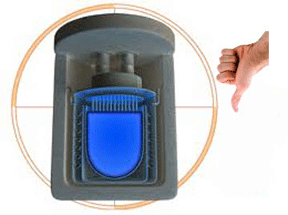 The nuclear scientist believes these nuclear reactors would be a target for terrorists, and a direct strike could disperse that hazardous radioactive enriched uranium that could damage the safety systems preventing the reactor from melting down.
Dr Lyman said: “I expect in a worst-case scenario you would have an area of many tens of kilometres that could be contaminated to the extent where the land would be unusable without being decontaminated.
“And anyone at the military base at that time would be exposed to potentially lethal doses of radiation.
“So at best it would be a costly mess and at worse it could imperil the mission and the military personnel, and contaminate the area of the base which would affect the inhabitants of the host country.“
The nuclear scientist believes the US military response to such a devastating nuclear attack on its armed forces could trigger a like-foxlike reaction.
“If you bomb a fossil fuel installation it would not be pretty, but there would be a significant escalation if a nuclear plant was hit.
“And so the military would have to respond in kind or with a more devastating response and it could escalate.”
He said: “There could be a number of disadvantages, both to military forces and also to the countries where the reactors would be located.
“The US military could end up leaving a radioactive mess for other countries to deal with.
There is precedent for this, when the US military dropped nuclear weapons off the coast of Spain and in Greenland.
“The US left a radioactive legacy in both countries for decades.
“So there are a lot of factors to consider, and I fear the military has an unrealistic view as to how successful this project is likely to be.”
The very dubious “market” for Small Modular Nuclear Reactors
What has not been tested is whether there would ever be enough orders for any one sort of small modular reactor to justify setting up a factory to produce dozens of them. This is the only way to get the unit cost down sufficiently to compete with renewables, which are continuing to get cheaper and already dominate the market.

|
Off-the-shelf nuclear reactors seek buyers, Climate NewsNetwork March 5th, 2019, by Paul Brown The nuclear industry’s fierce fight for survival is leading several countries to develop smaller, off-the-shelf nuclear reactors.
|
|
the nuclear lobby’s dream of small modular nuclear reactors is not likely to come true
The quest for boundless energy http://science.sciencemag.org/content/363/6429/809, Adrian Cho, See all authors and affiliations
Summary
For all their innovations, NuScale Power’s small modular reactors remain conventional in one way: They would use ordinary uranium-based reactor fuel that’s meant to be used once and safely disposed of. But for decades, nuclear engineers envisioned a world powered by “fast reactors” that can breed an essentially boundless supply of plutonium that can be reprocessed into fuel. Early in the atomic age, experts believed nuclear energy would one day supply most of the world’s power, raising the specter of a uranium shortage and boosting interest in fast breeder reactors.
However, the reactors are complex and must be cooled with substances such as liquid sodium or molten salt. The chemically intensive recycling process produces plenty of its own hazardous waste. And the closed fuel cycle also would establish a global market for plutonium, the stuff of atomic weapons, raising proliferation concerns. Perhaps most important, the world is in no danger of running out of uranium. So some experts doubt fast reactors will ever become mainstream.
Tax-payer funding for yet another nuclear folly? Rolls Royce’s Small Modular Reactors
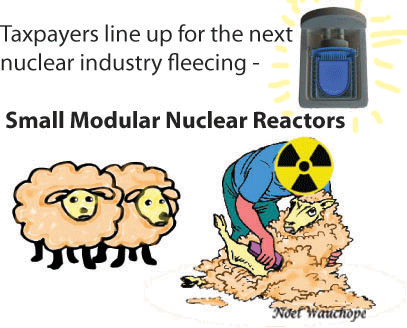 Rolls-Royce seeks government funds for nuclear power project https://www.ft.com/content/1bbfefb0-20bf-11e9-b2f7-97e4dbd3580d Group wants £200m to develop small-scale plants after failure of big schemes Sylvia Pfeifer and David Sheppard– 27 Jan 19
A consortium led by Rolls-Royce has asked for more than £200m in government funding to help develop its project for small nuclear reactors, as ministers scramble to recast Britain’s energy policy after the collapse of plans to build several large reactors. The engineering group and its partners, which include Laing O’Rourke and Arup, want to secure a sum “in the low hundreds of millions”, confirmed one person with knowledge of the request. Any amount would be match-funded by the consortium and be used to develop Rolls-Royce’s technology through to the later stages of the licensing process in order to be able to attract private investment.
The consortium has applied for funding from the government’s industrial strategy challenge fund under UK Research and Innovation. The money would enable the group to develop its design through to the later stages of the “generic design assessment” by the industry regulator. Industry sources with knowledge of the bid said the consortium “entered detailed negotiations” with UKRI before Christmas. Rolls-Royce has previously said it believes its reactor would cost about £2.5bn to build.
UK: Rolls Royce has mothballed its plans for Small Modular Nuclear Reactors
Evening Standard 22nd Jan 2019 The British nuclear industry is a mess. Successive governments spent 13 years devising a nuclear policy, and after years of debate, six nuclear power stations were eventually selected. The idea was that private contractors, not government, should take the risk and build the plants. But the contractors were wary, and with the collapse of renewable energy prices they have become warier still.and we won’t build any more giant plants, but Government is still wedded to its policy so it may take a few years, or a general election.
maintaining the power plants which drive the nuclear-powered submarines
carrying Britain’s nuclear deterrent since at least the Sixties.
run smoothly and remove the risk of the whole thing being endlessly delayed. It required further long-term thinking in the form of a promise to buy at least seven of the plants so that Rolls-Royce could capture the economies of scale in manufacturing which are essential to bringing the costs down. It required Government to be willing to provide matched funding in the development phase of the project. And finally it required Government support to assist the company in fully developing its export markets.
Molten salt nuclear reactors not commercially viable, but useful for military
 the decision to pursue Molten Salt Nuclear Reactors (MSRs )may not be based on market laws. For MSRs to succeed, they will likely be developed with appropriate political support and military funding.
If a nation wants an unlimited power supply for cutting-edge military technologies, then the MSR is indeed a very good candidate.
small modular reactors fitted with MSR technology could effectively supply electricity at remote military bases.
When a technology has some potential, the military sector can provide appropriate funding to quickly prototype products, which won’t necessarily have commercially viable features
Molten Salt Reactors: Military Applications Behind the Energy Promises, POWER,12/02/2018 | Jean-Baptiste Peu-Duvallon The commercial nuclear power sector has evolved with great help from the military-industrial complex. Research and development funded for the purpose of national defense has resulted in advances directly applicable to the power industry. For molten salt reactor designs to succeed, political support and military dollars may again be necessary.
Observers of the energy sector have likely noticed a growing interest worldwide in small modular molten salt reactor (MSR) concepts. North American companies such as Terrestrial Energy, Southern Company, and TerraPower are working to industrialize designs (Figure 1), while the Shanghai Institute of Applied Physics recently received $3.3 billion from the Chinese central government to build an MSR complex in the Gobi Desert.
……… under the leadership of its director Alvin M. Weinberg, the Oak Ridge Laboratory pursued the concept for civilian applications with the construction of a 7.4-MWth MSR, which operated for five years before being permanently shutdown in 1969. The reason testing was stopped was mainly political, as the MSR experiment in Oak Ridge wasn’t providing enough workload to other laboratories, while at the same time research on fast-breeding reactors was ramping up, requiring the engagement of more and more resources .
It was not only political, however. While the MSR concept is quite simple on paper, its industrialization is quite complex. Because the coolant is a mixture of chemicals rather than water, it provokes the release of significant quantities of tritium, which must be removed continuously. It generates other issues too, such as speedy corrosion of standard alloys, and also core lifetime issues when the coolant is moderated with graphite.
Because no MSRs have operated after the early 1970s, none of the technical solutions currently proposed to solve the outstanding issues have actually been tested. Still, new MSR projects are suddenly popping up for two main reasons: the Fukushima events and re-emerging military needs. …….
Nuclear Power in the New Weapons Race. MSRs have also gotten renewed interest following significant evolutions in military affairs. Indeed, since 2010, the U.S. military has started to deploy effective defense systems against ballistic missiles. In turn, it encourages rival powers to develop alternatives for their deterrence such as extreme-range hypersonic vehicles and low-altitude supersonic missiles.
During a speech to the nation on March 1, 2018, President Vladimir Putin revealed to the world the Russian ambition of extreme endurance. “We’ve started the development of new types of strategic weapons that do not use ballistic flight paths on the way to the target,” he said. “One of them is creation of a small-size highly powerful nuclear power plant that can be planted inside the hull of a cruise missile identical to our air-launched X-101 or the United States’ Tomahawk, but at the same time is capable of guaranteeing a flight range that is dozens of times greater, which is practically unlimited,” Putin added.
Beyond postures and statements, however, it seems there is still some work to be done. It has been reported that all flight tests of this new cruise missile resulted in short-term crashes.
Also, since the emergence of China as a military power, the probability of a high-intensity conflict in the Asia-Pacific region is growing. In such a case, the control over the vastness of the Pacific Ocean will be the aim of each party. Extreme ranges and endurance would be a key advantage for a potential winner.
If a nation wants an unlimited power supply for cutting-edge military technologies, then the MSR is indeed a very good candidate. As previously explained, the high temperature generated by an MSR makes it well-suited for airborne operations, while much more compact than a PWR for other applications. The advent of unmanned vehicles also makes the use of MSR technology easier, because radiation shielding requirements become far less stringent with no crew.
To counter the threat of new hypersonic vehicles currently under development, armies are again launching research for directed-energy weapons, such as high-energy lasers, which require huge power supplies to run efficiently. Finally, small modular reactors fitted with MSR technology could effectively supply electricity at remote military bases.
Although these military applications may sound like science fiction, one past example demonstrates the definitive military advantage procured by a high-temperature reactor over a PWR: the development of Alfa class submarines (Figure 4) in the Soviet Union in the 1960s. The Alfa-class submarine is still today considered the fastest, deepest, and most-agile nuclear submarine ever built. Its deployment resulted in the urgent design and manufacture of faster NATO torpedoes, like the U.S. Mark 48 Advanced Capability (ADCAP) or British Spearfish, to counter something that was virtually invulnerable when first put in service.
What made the Alfa possible? A lead-bismuth-cooled fast reactor, which shares the same main feature of the MSR: high temperature delivery, resulting in a high-power-density design, enabling a small, light, and powerful reactor for the submarine. However, as at ambient temperature the high-density lead-bismuth would freeze, the quayside maintenance operations aimed at preventing any irremediable core damage due to coolant freezing were very complicated and costly. While lead-bismuth and molten-salt reactors share many common points, MSRs are less costly and more easily maintainable.
Developing Viable MSR Designs
In France, the energy sector has not shown interest in MSR technology, as its current PWR fleet delivers competitive energy while achieving a very high level of safety. Furthermore, new PWR designs (EPRs) are intrinsically much safer than the Fukushima GE Mark I, which was designed in the 1960s.
MSRs are not just a different design, however; they are a different sector. MSR developers must essentially start from scratch with dedicated codes and regulations, dedicated licensing processes, dedicated fuel production facilities, dedicated reactors with dedicated highly trained operators, and dedicated waste reprocessing plants. Nonetheless, the decision to pursue MSRs may not be based on market laws. For MSRs to succeed, they will likely be developed with appropriate political support and military funding.
When a technology has some potential, the military sector can provide appropriate funding to quickly prototype products, which won’t necessarily have commercially viable features but will provide the groundwork for further refinement. Then, step by step, the remaining short-comings will be overcome to make a practical product for commercial operation. ■
—Jean-Baptiste Peu-Duvallon is a French nuclear energy professional with nearly 15 years of experience on several major construction projects. correct https://www.powermag.com/molten-salt-reactors-military-applications-behind-the-energy-promises/?pagenum=1
Small Modular Reactors not commercially viable, but nuclear companies want the government handouts
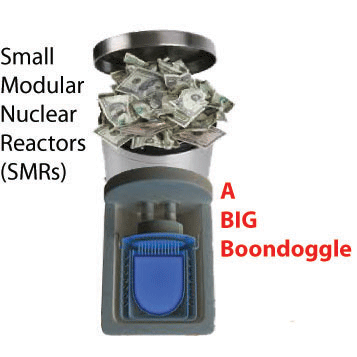 there is no market for the expensive electricity that SMRs will generate. Many companies presumably enter this business because of the promise of government funding. No company has invested large sums of its own money to commercialize SMRs.
Are Thousands of New Nuclear Generators in Canada’s Future? https://thetyee.ca/Opinion/2018/11/07/Nuclear-Generators-Canada-Future/Ottawa is pushing a new smaller, modular nuclear plant that could only pay off if mass produced. By M.V.  RamanaM. V. Ramana is the Simons Chair in Disarmament, Global and Human Security at the School of Public Policy and Global Affairs at UBC, and the author of The Power of Promise: Examining Nuclear Energy in India, Penguin Books, New Delhi (2012)
Canada’s government is about to embrace a new generation of small nuclear reactors that do not make economic sense.
Amidst real fears that climate change will wreak devastating effects if we don’t shift away from fossil fuels, the idea that Canada should get deeper into nuclear energy might seem freshly attractive to former skeptics.
For a number of reasons, however, skepticism is still very much warranted.
On Nov. 7, Natural Resources Canada will officially launch something called the Small Modular Reactor Roadmap. The roadmap was previewed in February of this year and is the next step in the process set off by the June 2017 “call for a discussion around Small Modular Reactors in Canada” issued by Canadian Nuclear Laboratories, which is interested in figuring out the role the organization “can play in bringing this technology to market.”
Environmental groups and some politicians have spoken out against this process. A petition signed by nearly two dozen civil society groups has opposed the “development and deployment of SMRs when renewable, safer and less financially, socially and environmentally costly alternatives exist.”
SMRs, as the name suggests, produce relatively small amounts of electricity in comparison with currently common nuclear power reactors. The last set of reactors commissioned in Canada is the four at Darlington. These started operating between 1990 and 1993 and can generate 878 megawatts of electricity (although, on average, they only generate around 75 to 85 per cent of that). In comparison, SMRs are defined as reactors that generate 300 MW or less — as low as 5 MW even. For further comparison, the Site C dam being built in northeastern B.C. is expected to provide 1,100 MW and BC Hydro’s full production capacity is about 11,000 MW.
Various nuclear institutions, such as Canadian Nuclear Laboratories, Canadian Nuclear Association and the CANDU Owners Group are strongly supportive of SMRs. Last October, Mark Lesinski, president and CEO of CNL announced: “Small modular reactors, or SMRs, represent a key area of interest to CNL. As part of our long-term strategy, announced earlier this year, CNL established the ambitious goal of siting a new SMR on a CNL site by 2026.”
Likewise, the CANDU Owners Group announced that it was going to use “their existing nuclear expertise to lead the next wave of nuclear generation — small modular reactors, that offer the potential for new uses of nuclear energy while at the same time offering the benefits of existing nuclear in combating climate change while providing reliable, low-cost electricity.”
A fix for climate change, says Ottawa
Such claims about the benefits of SMRs seems to have influenced the government too. Although NRCan claims to be just “engaging partners and stakeholders, as well as Indigenous representatives, to understand priorities and challenges related to the development and deployment of SMRs in Canada,” its personnel seem to have already decided that SMRs should be developed in Canada.
“The Government of Canada recognizes the potential of SMRs to help us deliver on a number of priorities, including innovation and climate change,” declared Parliamentary Secretary Kim Rudd. Diane Cameron, director of the Nuclear Energy Division at Natural Resources Canada, is confident: “I think we will see the deployment of SMRs in Canada for sure.” Such talk is premature, and unwise.
Canada is a late entrant to this game of talking up SMRs. For the most part it has only been talk, with nothing much to show for all that talk. Except, of course, for millions of dollars in government funding that has flown to private corporations. This has been especially on display in the United States, where the primary agency that has been pumping money into SMRs is the Department of Energy.
In 2001, based on an overview of around 10 SMR designs, DOE’s Office of Nuclear Energy concluded that “the most technically mature small modular reactor designs and concepts have the potential to be economical and could be made available for deployment before the end of the decade, provided that certain technical and licensing issues are addressed.” Nothing of that sort happened by the end of that decade, i.e., 2010. But in 2012 the U.S. government offered money: up to $452 million to cover “the engineering, design, certification and licensing costs for up to two U.S. SMR designs.” The two SMR designs that were selected by the DOE for funding were called mPower and NuScale.
The first pick was mPower and, a few months later, the DOE projected that a major electricity generation utility called the Tennessee Valley Authority “plans to deploy two 180 megawatt small modular reactor units for commercial operation in Roane County, Tennessee, by 2021, with as many as six mPower units at that site.”
The company developing mPower was described by the New York Times as being in the lead in the race to develop SMRs, in part because it had “the Energy Department and the T.V.A. in its camp.”
But by 2017, the project was essentially dead.
Few if any buyers
Why this collapse?
In a nutshell, because there is no market for the expensive electricity that SMRs will generate. Many companies presumably enter this business because of the promise of government funding. No company has invested large sums of its own money to commercialize SMRs.
An example is the Westinghouse Electric Co., which worked on two SMR designs and tried to get funding from the DOE. When it failed in that effort, Westinghouse stopped working on SMRs and shifted its focus to decommissioning reactors that are being shut down at an increasing rate, which is seen as a growing business opportunity. Explaining this decision in 2014, Danny Roderick, then president and CEO of Westinghouse, said: “The problem I have with SMRs is not the technology, it’s not the deployment — it’s that there’s no customers…. The worst thing to do is get ahead of the market.”
Many developing countries claim to be interested in SMRs but few seem to be willing to invest in the construction of one. Although many agreements and memoranda of understanding have been signed, there are still no plans for actual construction. Examples are the cases of Jordan, Ghana and Indonesia, all of which have been touted as promising markets for SMRs, but none of which are buying one because there are significant problems with deploying these.
A key problem is poor economics. Nuclear power is already known to be very expensive. But SMRs start with a disadvantage: they are too small. One of the few ways that nuclear power plant operators could reduce the cost of nuclear electricity was to utilize what are called economies of scale, i.e., taking advantage of the fact that many of the expenses associated with constructing and operating a reactor do not change in linear proportion to the power generated. This is lost in SMRs. Most of the early small reactors built in the U.S. shut down early because they couldn’t compete economically.
Reactors by the thousands?
SMR proponents argue that they can make up for the lost economies of scale in two ways: by savings through mass manufacture in factories, and by moving from a steep learning curve early on to gaining rich knowledge about how to achieve efficiencies as more and more reactors are designed and built. But, to achieve such savings, these reactors have to be manufactured by the thousands, even under very optimistic assumptions about rates of learning. Rates of learning in nuclear power plant manufacturing have been extremely low. Indeed, in both the United States and France, the two countries with the highest number of nuclear plants, costs went up, not down, with construction experience.
In the case of Canada, the potential markets that are most often proffered as a reason for developing SMRs are small and remote communities and mines that are not connected to the electric grid. That is not a viable business proposition. There are simply not enough remote communities, with adequate purchasing capacity, to be able to drive the manufacture of the thousands of SMRs needed to make them competitive with large reactors, let alone other sources of power.
There are thus good reasons to expect that small modular reactors, like large nuclear power plants, are just not commercially viable. They will also impose the other well-known problems associated with nuclear energy — the risk of severe accidents, the production of radioactive waste, and the linkage with nuclear weapons — on society. Rather than seeing the writing on the wall, unfortunately, NRCan and other such institutions are regurgitating industry propaganda and wasting money on technologies that will never be economical or contribute to any meaningful mitigation of climate change. There is no justification for such expensive distractions, especially as the climate problem becomes more urgent. ![[Tyee]](https://ci4.googleusercontent.com/proxy/-dbM2-hlkJWqmnDhMjXoXTKhgMN4lAbQ2wyqv_IW2Qs-IMWKHJAwJI-q0jLCPSZjrmKGcsJD2R_OTYg=s0-d-e1-ft#https://thetyee.ca/ui/img/ico_fishie.png)
1 This Month



26 September – International Day for the Total Elimination of Nuclear Weapons


PLEASE OPPOSE HR 8255 AND S.3639 – bills would accelerate satellite deployment, with no environmental review or safeguards – https://ncstd5li.quorum.us/campaign/169331/
To see nuclear-related stories in greater depth and intensity – go to https://nuclearinformation.wordpress.com
-
Archives
- September 2026 (233)
- August 2026 (330)
- July 2026 (355)
- June 2026 (287)
- May 2026 (306)
- April 2026 (356)
- March 2026 (251)
- February 2026 (267)
- January 2026 (308)
- December 2025 (358)
- November 2025 (359)
- October 2025 (375)
-
Categories
- 1
- 1 NUCLEAR ISSUES
- business and costs
- climate change
- culture and arts
- ENERGY
- environment
- health
- history
- indigenous issues
- Legal
- marketing of nuclear
- media
- opposition to nuclear
- PERSONAL STORIES
- politics
- politics international
- Religion and ethics
- safety
- secrets,lies and civil liberties
- spinbuster
- technology
- Uranium
- wastes
- weapons and war
- Women
- 2 WORLD
- ACTION
- AFRICA
- Atrocities
- AUSTRALIA
- Christina's notes
- Christina's themes
- culture and arts
- Events
- Fuk 2022
- Fuk 2023
- Fukushima 2017
- Fukushima 2018
- fukushima 2019
- Fukushima 2020
- Fukushima 2021
- general
- global warming
- Humour (God we need it)
- Nuclear
- RARE EARTHS
- Reference
- resources – print
- Resources -audiovicual
- Weekly Newsletter
- World
- World Nuclear
- YouTube
-
RSS
Entries RSS
Comments RSS
 nuclear-news