Renewable energy to fight climate change, – NOT Small Modular Nuclear Reactors
 Renewables – Not Small Modular Nuclear Reactors – Are the Solution to Climate Change, https://cela.ca/renewables-not-small-modular-nuclear-reactors-are-the-solution-to-climate-change/ December 4, 2019 By Theresa McClenaghan, Kerrie Blaise (CELA) and Guest Author Chris Rouse (New Clear Free Solutions) The idea of Small Modular Reactors (“SMRs”) was in the news this week with the federal government being urged to provide even more research money to develop this “new” nuclear power technology. The premise is that SMR’s are a needed, cost effective, safe and realistic solution to climate change. Renewables – Not Small Modular Nuclear Reactors – Are the Solution to Climate Change, https://cela.ca/renewables-not-small-modular-nuclear-reactors-are-the-solution-to-climate-change/ December 4, 2019 By Theresa McClenaghan, Kerrie Blaise (CELA) and Guest Author Chris Rouse (New Clear Free Solutions) The idea of Small Modular Reactors (“SMRs”) was in the news this week with the federal government being urged to provide even more research money to develop this “new” nuclear power technology. The premise is that SMR’s are a needed, cost effective, safe and realistic solution to climate change.However, SMRs are not the answer or even part of the answer to climate change given the problematic environmental, social and economic attributes of the proposed technology. Instead, in our view, investment is urgently needed in Canada’s vast and enviable renewable energy resources which are already scalable and provide safer, less costly, and more socially acceptable means of energy generation.
SMRs are not yet commercially available. Indeed, Canada’s SMR Roadmap, produced by the Canadian Nuclear Association, only sets out a path for having a commercial demonstration unit in the 2030s. To contend that SMR technology can aid in combatting climate change is potentially damaging to climate action, as it misses the 10-year window we have to reverse emissions and decarbonize. It also distracts from the urgent work needed to respond to the climate emergency. We already have many tools in our renewable energy toolbox. Canada’s electricity grid is 65% renewable, mainly from our vast hydro resources. These resources, used in combination with 30% to 35% wind and solar, makes a renewable grid achievable. Several jurisdictions have already achieved or surpassed this threshold, such as Prince Edward Island, where 43% of its power comes from wind alone. We also have access to other renewable energy resources such as biomass, geothermal, and tidal to assist in our transition to a low-carbon economy. Studies also continue to demonstrate viable pathways to a renewable grid, which are both technically and economically feasible. One report from Nova Scotia provides a pathway to reach a 90% renewable grid by 2030 and a study from New Brunswick plots a cost effective solution to achieve a 95% renewable grid. While work is needed to achieve the remaining 5% over time, the immediate need – and the focus of governmental efforts – should be on prioritizing the first 90% to 95% shift to renewables. Despite what appears as widespread interest in SMRs, very few countries have been willing to invest in their construction. Apart from technology’s risks, the problem is one of poor economics: nuclear energy is already known to be expensive and the cost-competitiveness of SMRs is contingent upon their mass fabrication. Hundreds if not thousands of SMRs would need to be deployed in order to be economically viable. Past experience also dictates this new reactor technology may never become commercially available. For instance, after two decades and hundreds of millions of taxpayer dollars, the two prototype MAPLE reactors were abandoned in 2008 because they could not be safely operated. The Gentilly 1 prototype reactor in Quebec which received similar investment, also failed and after 180 days of operation was mothballed. Despite public assurances of SMRs’ ‘passive’ and ‘inherent’ safety, SMR operators and suppliers would be protected from liability in the event of an accident under the current rules; the current nuclear liability rules are a concession by governments to the nuclear industry because of the inherent hazard that private nuclear investors do not want to underwrite. Furthermore, after 50 years of nuclear energy production, we still do not have an approved plan for Canada’s high, intermediate and low-level radioactive waste stockpiles. Because of the diverse range of fuels which can be used by SMRs, new radioactive waste streams will be created, thus increasing the complexity of the used nuclear fuel waste problem, with new types of nuclear waste hazards being introduced. The touted benefit of SMRs for use in remote and rural regions would also mean increased transport of radioactive substances on roads and railways across the country. This poses unique proliferation risks since the waste from enriched fuels can produce quantities of plutonium that could be attractive for diversion to malicious purposes. The greater the number of sites and communities with SMRs, the greater the proliferation risks because of challenges in monitoring, keeping track and measuring plutonium in spent fuel, which must be kept secure. Furthermore, Canada’s nuclear safety regulator advocated with the federal government to remove SMRs from public, more rigorous forms of decision-making under Canada’s new Impact Assessment Act (IAA). Despite requirements for wind and solar farms to undergo environmental assessments, either provincially or federally, SMRs would not trigger an environmental assessment under the current federal IAA Project List regulation. The coming into force of the Impact Assessment Act in June 2019 wholly exempts SMRs from environmental, or impact assessment review. Investment in nuclear power at the 11th hour is a distraction from real climate action when scalable, cost-effective renewable solutions could and need to be employed. Already climate-burdened future generations should not have new risks imposed on them, due to SMR’s radioactive waste and accompanying proliferation risk. We need to invest in known renewable energy solutions, and not the promise of a hypothetical and risky technology. |
|
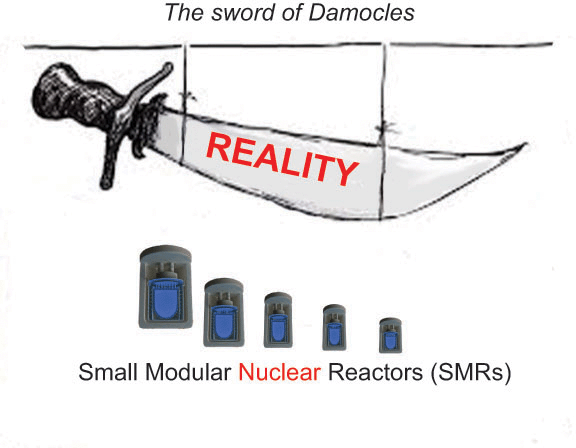
Significant obstacles to Rolls Royce’s fantasy of “clean” nuclear-supplied jet fuel
 Rolls-Royce Touts Nuclear Reactors as Key to Clean Jet Fuel, Bloomberg,
By Christopher Jasper,December 6, 2019,
Rolls-Royce Touts Nuclear Reactors as Key to Clean Jet Fuel, Bloomberg,
By Christopher Jasper,December 6, 2019,
- Synthetics, biofuels to be mainstay of aviation, CEO says
- Small reactors to be used to generate required electricityRolls-Royce Holdings Plc is pitching nuclear reactors as the most effective way of powering the production of carbon-neutral synthetic aviation fuel without draining global electricity grids.
Drawing on technology developed for nuclear-powered submarines, the small modular reactors or SMRs could be located at individual plants to generate the large amounts of electricity needed to secure the hydrogen used in the process, according to Chief Executive Officer Warren East…….
The proposals face significant obstacles, including widespread public concern about radiation leaks and the safe disposal of nuclear waste, as well as question marks over U.K. plans to revive the sector after Hitachi Ltd. and Toshiba Corp. withdrew from major projects.Rolls aims to minimize regulatory barriers by building an initial network of 16 SMRs on the sites of former U.K. nuclear power stations still approved for atomic use.
The plants, costing 1.8 billion pounds ($2.4 billion) apiece, would feed the national grid and come online from the 2030s, with all complete by 2050. https://www.bloomberg.com/news/articles/2019-12-06/rolls-royce-pitches-nuclear-reactors-as-key-to-clean-jet-fuel
Small Modular Nuclear Reactors – many pitfalls, including security risks
‘Many issues’ with modular nuclear reactors says environmental lawyer, https://www.cbc.ca/news/canada/new-brunswick/many-issues-modular-nuclear-1.5381804
Three premiers have agreed to work together to develop the technology, Jordan Gill · CBC News Dec 03, 2019 Modular nuclear reactors may not be a cure for the nation’s carbon woes, an environmental lawyer said in reaction to an idea floated by three premiers.
Theresa McClenaghan, executive director of the Canadian Environmental Law Association, said the technology surrounding small reactors has numerous pitfalls, especially when compared with other renewable energy technology.
This comes after New Brunswick Premier Blaine Higgs, Saskatchewan Premier Scott Moe and Ontario Premier Doug Ford agreed to work together to develop the technology.
The premiers say the smaller reactors would help Canada reach its carbon reduction targets but McClenaghan, legal counsel for the environmental group, disagrees.
“I don’t think it is the answer,” said McClenaghan. “I don’t think it’s a viable solution to climate change.”
McClenaghan said the technology behind modular reactors is still in the development stage and needs years of work before it can be used on a wide scale.
“There are many issues still with the technology,” said McClenaghan. “And for climate change, the risks are so pervasive and the time scale is so short that we need to deploy the solutions we already know about like renewables and conservation.”
Waste, security concerns: lawyer
While nuclear power is considered a low-carbon method of producing electricity, McClenaghan said the waste that it creates brings its own environmental concerns.
“You’re still creating radioactive waste,” said McClenaghan.
“We don’t even have a solution to nuclear fuel waste yet in Canada and the existing plans are not taking into account these possibilities.”
McClenanghan believes there are national security risks with the plan as well. She said having more reactors, especially if they’re in rural areas, means there’s a greater chance that waste or fuel from the reactors could be stolen for nefarious purposes.
“You’d be scattering radioactive materials, potentially attractive to diversion, much further across the country,” said the environmental lawyer.
Russia’s Rosatom planning to market Small Modular Nuclear Reactors to Europe
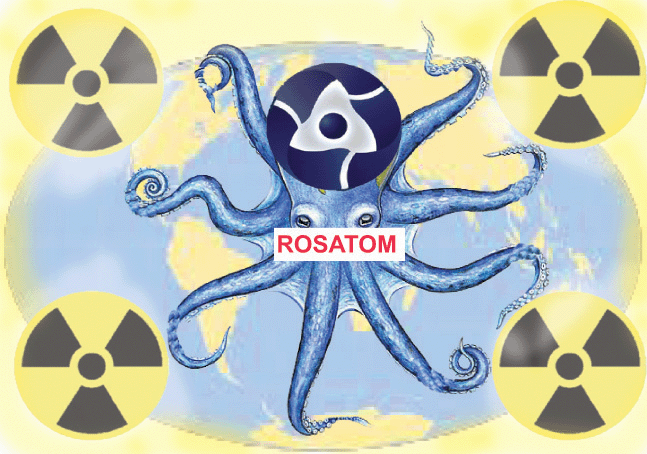
 Russian company’s plan for nuclear power expansion revealedVLADIMIR PUTIN has made nuclear energy one of Russia’s key priorities, and now the Russian nuclear power company Rosatom has revealed to Express.co.uk their plans to ramp up expansion into Europe with small modular reactors. Express UK By CHARLIE BRADLEY, Fri, Nov 29, 2019 Russian company’s plan for nuclear power expansion revealedVLADIMIR PUTIN has made nuclear energy one of Russia’s key priorities, and now the Russian nuclear power company Rosatom has revealed to Express.co.uk their plans to ramp up expansion into Europe with small modular reactors. Express UK By CHARLIE BRADLEY, Fri, Nov 29, 2019
Rosatom is completely under state control, and while its emphasis with some projects has been geared towards powering hard to reach Russian territories, it has also undertaken numerous international projects. This includes the development of nuclear power plants in China, Turkey and Iran, highlighting the growing presence of Russian energy throughout the world. And now, with some projects already under way in countries like Hungary and Finland, its Vice President of Marketing and Business Development Overseas, Anton Moskvin, has told Express.co.uk that Europe is a future target for the company.He said: “I must say Europe is very interesting for us with prospective small modular reactors market development, we know that several countries are interested. The UK has great interest in the small modular reactors.” …… However, some in the EU have expressed concern over any plans for the Russian nuclear giant, fearing that the country could use its business to wield political influence.
In 2014, President Putin agreed a deal worth £8.5billion with Hungary President Viktor Orban, a deal which has seen the two leaders meet regularly since. Hungary is both a NATO and EU member, and the latter has sought legislation to ensure countries embarking on nuclear deals with Moscow do not become dependent on the Kremlin. RFI (Radio France International) reported last month that Jan Haverkamp, vice-chairman of Nuclear Transparency Watch, has serious reservations about the projects. He said: “Our assessment is that the Kremlin tries to use nuclear power now to regain some of that lost influence. “We see Rosatom being very eager to buy up nuclear companies in Europe, where they try to get a participation in order to get a solid nuclear foothold inside the EU.” Mr Moskvin said he could not comment on political issues……… https://www.express.co.uk/news/world/1211103/putin-news-russia-europe-nuclear-power-eu-rosatom-spt |
|
Premiers of Ontario, Saskatchewan, New Brunswick to plan development of Small Modular Nuclear Reactors
 Ontario, Saskatchewan, N.B. premiers to announce nuclear reactor deal, Global News BY STAFF THE CANADIAN PRESS November 30, 2019 “….. The Ontario government said Premier Doug Ford will meet with Saskatchewan Premier Scott Moe and New Brunswick Premier Blaine Higgs for an announcement at a hotel near Pearson International Airport on Sunday afternoon.
A spokesman with Moe’s office confirmed the announcement is connected to an agreement on technology for small modular reactors, while a spokeswoman for Ford’s office said it’s an agreement to work together to determine the best technologies for the deployment of small modular reactors in Canada……
Moe has said that Saskatchewan will address climate change over the next decade by looking to carbon capture and storage technology and by increasing research efforts around small modular nuclear reactors.
However, the possibility of bringing nuclear power to Saskatchewan could still be years away https://globalnews.ca/news/6239231/premiers-nuclear-reactor-deal/
Small nuclear power station consortium targeting Cumbrian sites
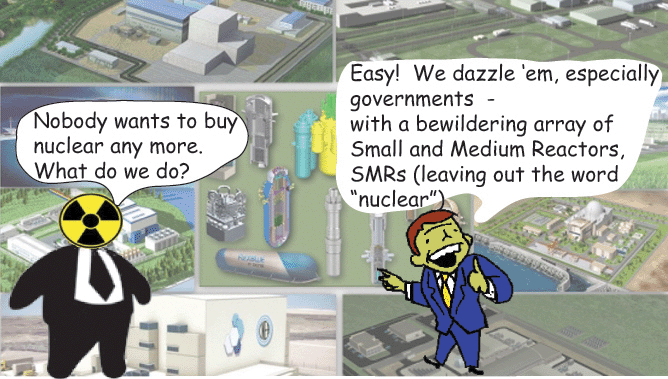 Small nuclear power station consortium targeting Cumbrian sites, The Mail 7th November, By Luke Dicicco @lukeadicicco Group business editor A consortium headed by engineering giant Rolls Royce has revealed it expects to develop its first-of-a-kind small nuclear reactors in Cumbria.
In July the Government said it will invest up to £18 million to support the design of the UK-made mini nuclear power stations. And this week UK Research and Innovation pledged to provide a further £18m, which will be matched by members of the consortium, to progress the project.
Both the Conservative Parliamentary Candidate for Copeland Trudy Harrison and Copeland Borough Council have vowed to up the ante on lobbying the Government to push for SMRs to be developed in Copeland, following the demise of plans for a large-scale nuclear power station at the Moorside site. ……
“We expect to build them on sites in Wales and particularly in Cumbria. That’s where we’re focusing, that’s where we’ll put our effort.”- Mr Woods …..
The SMRs are roughly the size of a one-and-a-half football pitches……..Construction is expected to take around four years per station, although the first unit would be longer, said Mr Woods.
The consortium says it is targeting a £1.8bn cost for each station…….
However, industry insiders still believe a large-scale plant is more suited to the vast Moorside site adjacent to Sellafield. And hopes remain high that a new development will come forward for the site once the Government unveils a new way of financially supporting new plants, with the most likely option a Regulated Asset Base Model. ……
“Unless you build a fleet, you will not do it. We want an industrial partnership between UK and China.” – Rob Davies, chief operating officer at CGN UK
CGN is already heavily involved in the UK’s nuclear new build plans.
It is a partner in the under-construction Hinkley Point C power station in Somerset, as well as planned developments for Bradwell B in Essex and Sizewell C in Somerset. https://www.nwemail.co.uk/news/18021450.small-nuclear-power-station-consortium-targeting-cumbrian-sites/
Bill Gates still hoping for tax-payer funding for his small nuclear reactor project
Bill Gates’ Nuclear Reactor Hits a Roadblock,
Engineering.com , October 21, 2019 Bill Gates is optimistic about the future—and the role of nuclear energy as an environmentally friendly energy source—but he faces significant obstacles along the way.
His company, TerraPower, is working on new technologies to revolutionize nuclear power. One of them is a traveling wave reactor (TWR). ………
One major problem with a TWR power plant is the price. It will cost about $3 billion to build a demonstration reactor. Even Bill Gates isn’t rich enough to fund it himself. TerraPower had signed a promising agreement with China to build a demonstration reactor, but the project has been shuttered due to China-U.S. trade tensions. The company is now lobbying Congress for a public-private partnership to fund the reactor. ……
Small nuclear reactors safe? Not so
 HELEN CALDICOTT: Small modular reactors — same nuclear
  disasters https://independentaustralia.net/politics/politics-display/helen-caldicott-small-modular-reactors–same-nuclear-disasters,13087
Now that the “nuclear renaissance” seems dead and buried following the Fukushima catastrophe (one-sixth of the world’s nuclear reactors were closed after the accident), the corporations invested in making nuclear plants and radioactive waste –including Toshiba, Nu-Scale, Babcock and Wilcox, GE Hitachi, General Atomics and the Tennessee Valley Authority – are not to be defeated.
Their new strategy is to develop small modular reactors (SMR), which can be sold around the world without, they say, the dangers inherent in large reactors — safety, cost, proliferation risks and radioactive waste.
There are basically three types of SMRs which generate less than 300 megawatts of electricity compared to the current 1,000-megawatt reactors.
Light water reactor designs
These will be smaller versions of present-day pressurised water reactors using water as the moderator and coolant but with the same attendant problems as Fukushima and Three Mile Island. They are to be built underground, which obviously makes them dangerous to access in the event of an accident or malfunction.
They will be mass-produced (turnkey production) and large numbers must be sold yearly to make a profit. This is an unlikely prospect because major markets – China and India – will be uninterested in buying U.S. reactors when they can make their own.
If a safety problem arises, such as with the Dreamliner plane, all of them will have to be shut down — interfering substantially with electricity supply.
SMRs will be expensive because the cost of unit capacity increases with decrease in the size of the reactor. Billions of dollars of government subsidies will be required because Wall Street will not touch nuclear power. To alleviate costs, it is suggested that safety rules be relaxed — including reducing security requirements and a reduction in the ten-mile emergency planning zone to 1,000 feet.
Non-light water designs
These are high-temperature gas-cooled reactors (HTGR) or pebble bed reactors. Five billion tiny fuel kernels of high-enriched uranium or plutonium will be encased in tennis-ball-sized graphite spheres which must be made without cracks or imperfections — or else they could lead to an accident. A total of 450,000 such spheres will slowly be released continuously from a fuel silo, passing through the reactor core, and then re-circulated ten times. These reactors will be cooled by helium gas operating at very high temperatures (900 C).
The plans are to construct a reactor complex consisting of four HTGR modules located underground to be run by only two operators in a central control room. It is claimed that HTGRs will be so safe that a containment building will be unnecessary and operators can even leave the site — “walk-away-safe” reactors.
However, should temperatures unexpectedly exceed 1600 degrees Celsius, the carbon coating will release dangerous radioactive isotopes into the helium gas and at 2000 C, the carbon would ignite creating a fierce graphite Chernobyl-type fire.
If a crack develops in the piping or building, radioactive helium would escape and air would rush in igniting the graphite.
Although HTGRs produce small amounts of low-level waste, they create larger volumes of high-level waste than conventional reactors.
Despite these obvious safety problems and despite the fact that South Africa has abandoned plans for HTGRs, the U.S. Department of Energy has unwisely chosen the HTGR as the “Next Generation Nuclear Plant”.
Liquid metal fast reactors (PRISM)
It is claimed by the proponents that fast reactors will be safe, economically competitive, proliferation-resistant and sustainable.
They are to be fueled by plutonium or highly enriched uranium, and cooled by either liquid sodium or a lead-bismuth molten coolant creating a potentially explosive situation. Liquid sodium burns or explodes when exposed to air or water and lead-bismuth is extremely corrosive producing very volatile radioactive elements when irradiated.
Should a crack occur in the reactor complex, liquid sodium would escape burning or exploding. Without coolant, the plutonium fuel would melt and reach critical mass, inciting a massive nuclear explosion. One-millionth of a gram of plutonium induces cancer and it lasts for 500,000 years. Yet it is claimed that fast reactors will be so safe that no emergency sirens will be required and emergency planning zones can be decreased from ten miles to 1,300 feet.
There are two types of fast reactors, a simple plutonium fueled reactor and a “breeder”. The plutonium reactor core can be surrounded by a blanket of uranium 238, the uranium captures neutrons and converts to plutonium creating ever more plutonium.
Some are keen about fast reactors because plutonium waste from other reactors can be fissioned converting it to shorter-lived isotopes like caesium and strontium which last “only” 600 years instead of 500,000. But this is fallacious thinking because only ten per cent is fissioned leaving 90 per cent of the plutonium for bomb-making and so on.
Construction
Three small plutonium fast reactors will be arranged together forming a module. Three of these modules will be buried underground and all nine reactors will connect to a fully automated central control room. Only three reactor operators situated in one control room will be in control of nine reactors. Potentially, one operator could simultaneously face a catastrophic situation triggered by the loss of off-site power to one unit at full power, in another shut down for refuelling and in one in start-up mode.
There are to be no emergency core cooling systems.
Fast reactors will require a massive infrastructure including a reprocessing plant to dissolve radioactive waste fuel rods in nitric acid, chemically removing the plutonium and a fuel fabrication facility to create new fuel rods. A total of 15,000 to 25,000 kilos of plutonium are required to operate a fuel cycle at a fast reactor and just 2.5 kilos is fuel for a nuclear weapon.
Thus, fast reactors and breeders will provide the perfect plan for nuclear weapons proliferation and despite this danger, the industry plans to sell them to many countries.
A small nuclear reactor was definitely the cause of the Russian missile engine explosion
It can therefore be stated with certainty that the “isotopic source of energy” referred to by Rosatom was a nuclear reactor.
The Mysterious Explosion of a Russian Nuclear Missile Engine The BESA CENTER. September 6, 2019 BESA Center Perspectives Paper No. 1,280, September 6, 2019
Refuting Australian Financial Review’s disinformation on Small Modular Nuclear Reactors (SMRs)
|
Aaron Patrick, senior correspondent with the Australian Financial Review (AFR), is the latest journalist to enter the nuclear culture wars with some propaganda that’s indistinguishable from that served up in the Murdoch tabloids. There’s lots of misinformation in Patrick’s articles. For example he uncritically promotes a dopey Industry Super Australia report, described by RenewEconomy editor Giles Parkinson as “one of the most inept analyses of the energy industry that has been produced in Australia”. (I’ve asked the authors of the Industry Super report if they intend to withdraw or amend it. No response.) The focus here ‒ and the focus of Patrick’s recent articles ‒ is on small modular reactors (SMRs), which he describes as new, small, safe, cheap and exciting (and he continues to make such claims even as I continue to feed him with evidence suggesting alternative SMR adjectives … non-existent, overhyped, obscenely expensive). Some history is useful in assessing Patrick’s claims. There’s a long history of small reactors being used for naval propulsion, but every effort to develop land-based SMRs has ended in tears. Academic M.V. Ramana concludes an analysis of the history of SMRs thus: “Sadly, the nuclear industry continues to practice selective remembrance and to push ideas that haven’t worked. Once again, we see history repeating itself in today’s claims for small reactors ‒ that the demand will be large, that they will be cheap and quick to construct. “But nothing in the history of small nuclear reactors suggests that they would be more economical than full-size ones. In fact, the record is pretty clear: Without exception, small reactors cost too much for the little electricity they produced, the result of both their low output and their poor performance. … “Worse, attempts to make them cheaper might end up exacerbating nuclear power’s other problems: production of long-lived radioactive waste, linkage with nuclear weapons, and the occasional catastrophic accident.” Patrick quotes an SMR company representative saying that SMRs have been “researched and developed for the best part of 50 years”. Fine … but surely AFR readers ought to be informed that every single attempt to commercialise SMRs over the past 50 years has failed. According to the Coalition’s energy spokesperson (p.34), “new-generation reactors with maximum safety features are now coming into use”. That was 30 years ago, and the spokesperson was Peter McGauran. A wave of enthusiasm for SMRs came and went without a single SMR being built anywhere in the world, and there’s no reason to believe the current wave of enthusiasm will be more fruitful. Diseconomies of scaleInterest in SMRs derives primarily from what they are not: large reactor projects which have been prone to catastrophic cost overruns and delays. Cost estimates for all reactors under construction in western Europe and north America range from A$17.5 billion to A$24 billion, and the twin-reactor V.C. Summer project in South Carolina was abandoned in 2017 after the expenditure of at least A$13 billion, forcing Westinghouse into bankruptcy and almost bankrupting its parent company Toshiba. But SMRs will cost more (per megawatt and megawatt-hour) because of diseconomies of scale: a 250MW SMR will generate 25 per cent as much power as a 1,000MW reactor, but it will require more than 25 per cent of the material inputs and staffing, and a number of other costs including waste management and decommissioning will be proportionally higher. So the nuclear industry’s solution to its wildly expensive and hopelessly uncompetitive large reactors is to offer up even-more-expensive reactors. Brilliant. Small wonder that nuclear lobbyists are lamenting the industry’s crisis and pondering what if anything might be salvaged from the “ashes of today’s dying industry“. Aaron Patrick claims in the AFR that SMRs are “likely” to be installed in North America and Europe. No, they aren’t. William Von Hoene, senior vice-president at Exelon ‒ the largest operator of nuclear power plants in the US ‒ said last year: “Right now, the costs on the SMRs, in part because of the size and in part because of the security that’s associated with any nuclear plant, are prohibitive.” The prevailing scepticism is evident in a 2017 Lloyd’s Register report based on the insights of almost 600 professionals and experts from utilities, distributors, operators and equipment manufacturers. They predict that SMRs have a “low likelihood of eventual take-up, and will have a minimal impact when they do arrive”. Likewise, American Nuclear Society consultant Will Davis said in 2014 that the SMR “universe [is] rife with press releases, but devoid of new concrete.” And a 2014 report produced by Nuclear Energy Insider, drawing on interviews with more than 50 “leading specialists and decision makers”, noted a “pervasive sense of pessimism” resulting from abandoned and scaled-back SMR programs. Independent economic assessmentsSMRs are “leading the way in cost” according to Tania Constable from the Minerals Council of Australia. NSW Deputy Premier John Barilaro claims that SMRs “are becoming very affordable”. But every independent economic assessment finds that electricity from SMRs will be more expensive than that from large reactors. A study by WSP / Parsons Brinckerhoff prepared for the 2015/16 South Australian Nuclear Fuel Cycle Royal Commission estimated costs of US$127‒130 per megawatt-hour (MWh) for large reactors, compared to US$140‒159 for SMRs. The Royal Commission’s final report identified numerous hurdles and uncertainties facing SMRs. A December 2018 report by CSIRO and the Australian Energy Market Operator concluded that “solar and wind generation technologies are currently the lowest-cost ways to generate electricity for Australia, compared to any other new-build technology.” It found that electricity from SMRs would be more than twice as expensive as that from wind or solar power with storage costs included (two hours of battery storage or six hours of pumped hydro storage). A report by the consultancy firm Atkins for the UK Department for Business, Energy and Industrial Strategy found that electricity from the first SMR in the UK would be 30 percent more expensive than that from large reactors, because of diseconomies of scale and the costs of deploying first-of-a-kind technology. A 2015 report by the International Energy Agency and the OECD Nuclear Energy Agency predicted that electricity from SMRs will be 50−100 percent more expensive than that from large reactors, although it holds out some hope that large-volume factory production could reduce costs. An article by four pro-nuclear researchers from Carnegie Mellon University’s Department of Engineering and Public Policy, published in 2018 in the Proceedings of the National Academy of Science, considered options for the development of an SMR industry in the US. They concluded that it would not be viable unless the industry received “several hundred billion dollars of direct and indirect subsidies” over the next several decades. That’s billion with a ‘b’: several hundred billion dollars.
|
|

A Small Nuclear Reactor exploded in Russian accident – fallout isotopes prove this

Isotopes’ Composition Proves Nuclear Reactor Was Involved in Russian Explosion, Expert Says
Analyses of the radionuclides in the fallout over Severodvinsk show several isotopes that would not have been present if was a simple RTG in the explosion.
Australia would be a mug to be conned into buying small modular nuclear reactors
 7 reasons why Small Modular Nuclear Reactrs are a bad idea for Australia, more https://independentaustralia.net/environment/environment-display/seven-reasons-why-small-modular-nuclear-reactors-are-a-bad-idea-for-australia,13010
International news reports that, in a failed missile test in Russia, a small nuclear reactor blew up, killing five nuclear scientists, and releasing a radiation spike.
In Australian news, with considerably less media coverage, Parliament announced an Inquiry into nuclear energy for Australia, with an emphasis on Small Modular Reactors (SMRs). Submissions are due by September 16.
A bit of background. The U.S. government and the U.S. nuclear industry are very keen to develop and export small modular nuclear reactors for two main reasons, both explained in the Proceedings of the National Academy of Sciences, 2018 Firstly, with the decline of large nuclear reactors, there is a need to maintain the technology and the expertise, trained staff, necessary to support the nuclear weapons industry. Secondly, the only hope for commercial viability of small nuclear reactors is in exporting them – the domestic market is too small. So – Australia is seen as a desirable market.
The USA motivation for exporting these so far non-existent prefabricated reactors is clear. The motivation of their Australian promoters is not so clear.
These are the main reasons why it would be a bad idea for Australia to import small modular nuclear reactors.
- COST.Researchers from Carnegie Mellon University’s Department of Engineering and Public Policy concluded that the SMR industry would not be viable unless the industry received “several hundred billion dollars of direct and indirect subsidies” over the next several decades. For a company to invest in a factory to manufacture reactors, they’d need to be sure of a real market for them – Australia would have to commit to a strong investment up front.
The diseconomics of scale make SMRs more expensive than large reactors. A 250 MW SMR will generate 25 percent as much power as a 1,000 MW reactor, but it will require more than 25 percent of the material inputs and staffing, and a number of other costs including waste management and decommissioning will be proportionally higher.
A study by WSP / Parsons Brinckerhoff, commissioned by the 2015/16 South Australian Nuclear Fuel Cycle Royal Commission, estimated costs of A$180‒184/MWh (US$127‒130) for large pressurised water reactors and boiling water reactors, compared to A$198‒225 (US$140‒159) for SMRs.
To have any hope of being economically viable, SMRs would have to be mass produced and deployed, and here is a “Catch-22″ problem The economics of mass production of SMRs cannot be proven until hundreds of units are in operation. But that can’t happen unless there are hundreds of orders, and there will be few takers unless the price can be brought down. Huge government subsidy is therefore required
- Safety problems. Small nuclear reactors still have the same kinds of safety needsas large ones have. The heat generated by the reactor core must be removed both under normal and accident conditions, to keep the fuel from overheating, becoming damaged, and releasing radioactivity. The passive natural circulation coolingcould be effective under many conditions, but not under all accident conditions. For instance, for the NuScale design a large earthquake could send concrete debris into the pool, obstructing circulation of water or air. Where there are a number of units, accidents affecting more than one small unit may cause complications that could overwhelm the capacity to cope with multiple failures.
Because SMRs have weaker containment systems than current reactors, there would be greater damage if a hydrogen explosion occurred. A secondary containment structure would prevent large-scale releases of radioactivity in case of a severe accident. But that would make individual SMR units unaffordable. The result? Companies like NuScale now move to projects called “Medium” nuclear reactors – with 12 units under a single containment structure. Not really small anymore.
Underground siting is touted as a safety solution, to avoid aircraft attacks and earthquakes. But that increases the risks from flooding. In the event of an accident emergency crews could have greater difficulty accessing underground reactors.
Security
Proponents of SMRs argue that they can be deployed safely both as a fleet of units close to cities, or as individual units in remote locations. In all cases, they’d have to operate under a global regulatory framework, which is going to mean expensive security arrangements and a level of security staffing. ‘Economies of scale’ don’t necessarily work, when it comes to staffing small reactors. SMRs will, anyway, need a larger number of workers to generate a kilowatt of electricity than large reactors need. In the case of security staffing, this becomes important both in a densely populated area, and in an isolated one.
- Weapons Proliferation.
The latest news on the Russian explosion is a dramatic illustration of the connection between SMRs and weapons development.
But not such a surprise. SMRs have always had this connection, beginning in the nuclear weapons industry, in powering U.S. nuclear submarines. They were used in UK to produce plutonium for nuclear weapons. Today, the U.S. Department of Energy plans to use SMRs as part of “dual use” facilities, civilian and military. SMRs contain radioactive materials, produce radioactive wastes – could be taken, used part of the production of a “dirty bomb” The Pentagon’s Project Dilithium’s small reactors may run on Highly Enriched Uranium (HEU) , nuclear weapons fuel – increasing these risks.
It is now openly recognised that the nuclear weapons industry needs the technology development and the skilled staff that are provided by the “peaceful” nuclear industry. The connection is real, but it’s blurred. The nuclear industry needs the “respectability” that is conferred by new nuclear, with its claims of “safe, clean, climate-solving” energy.
- Wastes.
SMRs are designed to produce less radioactive trash than current reactors. But they still produce long-lasting nuclear wastes, and in fact, for SMRs this is an even more complex problem. Australia already has the problem of spent nuclear fuel waste, accumulating in one place – from the nuclear reactor at Lucas Heights. With SMRs adopted, the waste would be located in many sites, with each location having the problem of transport to a disposal facility. Final decommissioning of all these reactors would compound this problem. In the case of underground reactors, there’d be further difficulties with waste retrieval, and site rehabilitation.
6. Location.
I have touched on this, in the paragraphs on safety, security, and waste problems. The nuclear enthusiasts are excited about the prospects for small reactors in remote places. After all, aren’t some isolated communities already having success with small, distributed solar and wind energy? It all sounds great. But it isn’t.
With Australia’s great distances, it would be difficult to monitor and ensure the security of such a potentially dangerous system, of many small reactors scattered about on this continent. Nuclear is an industry that is already struggling to attract qualified staff, with a large percentage of skilled workers nearing retirement. The logistics of operating these reactors, meeting regulatory and inspection requirements, maintaining security staff would make the whole thing not just prohibitively expensive, but completely impractical.
- Delay.
For Australia, this has to be the most salient point of all. Economist John Quiggin has pointed out that Australia’s nuclear fans are enthusing about small modular nuclear reactors, but with no clarity on which, of the many types now designed, would be right for Australia. NuScale’s model, funded by the U.S. government, is the only one at present with commercial prospects, so Quiggin has examined its history of delays. But Quiggin found that NuScale is not actually going to build the factory: it is going to assemble the reactor parts, these having been made by another firm, – and which firm is not clear. Quiggin concludes:
Australia’s proposed nuclear strategy rests on a non-existent plant to be manufactured by a company that apparently knows nothing about it.
As there’s no market for small nuclear reactors, companies have not invested much money to commercialise them. Westinghouse Electric Company tried for years to get government funding for its SMR plan, then gave up, and switched to other projects. Danny Roderick, then president and CEO of Westinghouse, announced:
The problem I have with SMRs is not the technology, it’s not the deployment ‒ it’s that there’s no customers. … The worst thing to do is get ahead of the market.
Russia’s programme has been delayed by more than a decade and the estimated costs have ballooned.
South Korea decided on SMRs, but then pulled out, presumably for economic reasons.
China is building one demonstration SMR, but has dropped plans to build 18 more, due to diseconomics of the scheme.
There’s a lot of chatter in the international media, about all the countries that are interested, or even have signed memoranda of understanding about buying SMRs, but still with no plans for actual purchase or construction.
Is Australia going to be the guinea pig for NuScale’s Small and Medium Reactor scheme? If so,when? The hurdles to overcome would be mind-boggling. The start would have to be the repeal of Australia’s laws – the Environment Protection and Biodiversity Conservation (EPBC) Act 1999 Section 140A and Australian Radiation Protection and Nuclear Safety Act 1998. Then comes the overcoming of States’ laws, much political argy-bargy, working out regulatory frameworks, import and transport of nuclear materials, – finding locations for siting reactors, – Aboriginal issues-community consent, waste locations. And what would it all cost?
And, in the meantime, energy efficiency developments, renewable energy progress, storage systems – will keep happening, getting cheaper, and making nuclear power obsolete.
USA abandoned the Nuclear-Powered Missile long ago due to its extreme danger. It seems that Russia just tried it again.
Why the U.S. Abandoned Nuclear-Powered Missiles More Than 50 Years Ago
President Donald Trump says the U.S. has a missile like the one that killed seven in the Russian arctic. That’s untrue, because the U.S. abandoned the idea decades ago.
Aug 13, 2019 Last week’s mysterious nuclear accident in Russia became even more mysterious as the government admitted that a small nuclear reactor had exploded, killing seven people.
Evidence is piling up that the incident is somehow related to Russia’s development of a nuclear-powered cruise missile, and President Donald Trump took to Twitter to state that the U.S. has a similar system. One problem: the U.S. looked into nuclear-powered cruise missiles more than half a century ago before rejecting them as impractical.
Last week’s mysterious nuclear accident in Russia became even more mysterious as the government admitted that a small nuclear reactor had exploded, killing seven people.
Evidence is piling up that the incident is somehow related to Russia’s development of a nuclear-powered cruise missile, and President Donald Trump took to Twitter to state that the U.S. has a similar system. One problem: the U.S. looked into nuclear-powered cruise missiles more than half a century ago before rejecting them as impractical.
Earlier reports of the August 8th incident stated that two individuals from Russia’s Defense Ministry were killed and six badly injured. Russia’s nuclear energy agency, has since admitted five of its employees were also killed in the explosion, with another three receiving injuries and burns. According to the Guardian, Rosatom said it was working on a number of experimental technologies, including “miniaturised sources of energy using [fissile] materials,” though a spokesperson did not explain how such research was related to the explosion.
After the incident, Greenpeace accused the Russian government of a coverup, using its own data to claim that radiation levels in the nearby city of Severodvinsk briefly spiked up to twenty times normal levels. The levels were not serious enough to warrant public health warnings.
A consensus is emerging that the nuclear accident is in some way related to Russia’s development of the Burevestnik (“Storm Petrel”) nuclear-powered cruise missile, known by NATO as the SSC-X-9 Skyfall. One advantage of a nuclear-powered missile would be a nearly unlimited range, allowing the missile to fly much longer than conventionally powered cruise missiles. This would allow the missile to fly around U.S. air defenses, skirting entire continents if necessary.
The United States tried to develop a nuclear-powered cruise missile in the 1950s and 1960s but abandoned the project as impractical. The weapon was known as Supersonic Low Altitude Missile, or SLAM, and it would have been the most dangerous nuclear weapon ever made.
SLAM, also known unofficially known as “The Big Stick,” was designed as a low-flying cruise missile. A rocket booster would launch SLAM into the air and boost it to speeds where its nuclear-powered ramjet engine would kick in. Once activated, the engine would give SLAM a top speed of Mach 3.5. The YouTube channel Curious Droid has a great mini-history on this doomsday weapon:
The missile would fly unusually low for a missile of its time, just 1,000 feet, to avoid enemy radars. The supersonic shockwave was projected to leave a trail of devastation, flattening forests, buildings, and killing anyone in the missile’s flight path.
SLAM, despite being advertised as a missile, was actually more like an unmanned bomber. Instead of a single warhead, it carried up to 26 hydrogen bombs, each hundreds of times more powerful than the bombs dropped on Hiroshima and Nagasaki. SLAM could fly a predetermined route over an enemy country or even continent, ejecting H-bombs on targets below. Once out of bombs SLAM would fly one last mission, running into a final target that would shower the target zone with lethal radioactivity.
SLAM was never built because it was too dangerous to even test. The dangerous levels of radioactivity unleashed by the nuclear engine was a big plus in some apocalyptic wartime scenario, but it couldn’t even be tested in the skies over the U.S. SLAM was also overtaken by intercontinental ballistic missile development, which could deliver a thermonuclear warhead against a target in Russia in half an hour.
Whatever Russia was really testing last week in the arctic, it’s likely something that should’ve remained an unused relic of the Cold War. https://www.popularmechanics.com/military/research/a28690053/russia-nuclear-powered-missile-skyfall/

Russia says small nuclear reactor blew up in deadly accident
|
August 13, 2019 The failed missile test that ended in an explosion killing five scientists last week on Russia’s White Sea involved a small nuclear reactor, according to a top official at the institute where they worked.
The institute is working on small-scale power sources that use “radioactive materials, including fissile and radioisotope materials” for the Defence Ministry and civilian uses, Vyacheslav Soloviev, scientific director of the institute, said in a video shown by local TV.
The men, who will be buried on Monday, were national heroes and the “elite of the Russian Federal Nuclear Centre,” institute Director Valentin Kostyukov said in the video, which was also posted on an official website in Sarov, a high-security city devoted to nuclear research less than 400 kilometers east of Moscow.
The blast occurred on August 8 during a test of a missile that used “isotope power sources” on an offshore platform in the Arkhangelsk region, close to the Arctic Circle, Russia’s state nuclear company Rosatom said over the weekend. The Defence Ministry initially reported two were killed in the accident, which it said involved testing of a liquid-fuelled missile engine. The ministry didn’t mention the nuclear element.
Rosatom declined to comment on the incident on Monday and a spokeswoman for the Sarov institute couldn’t immediately be reached.
Russian media have speculated that the weapon being tested was the SSC-X-9 Skyfall, known in Russia as the Burevestnik, a nuclear-powered cruise missile that President Vladimir Putin introduced to the world in a brief animated segment during his state-of-the-nation address last year.
The incident comes after a series of massive explosions earlier last week at a Siberian military depot killed one and injured 13, as well as forcing the evacuation of 16,500 people from their homes. Russia’s navy has suffered numerous high-profile accidents over the years. In July, 14 sailors died in a fire aboard a nuclear-powered submarine in the Barents Sea in an incident on which officials initially refused to comment. A top naval official later said the men gave their lives preventing a “planetary catastrophe.”
Russia’s worst post-Soviet naval disaster also occurred in the Barents Sea, when 118 crew died on the Kursk nuclear submarine that sank in after an explosion in August 2000. https://www.theage.com.au/world/asia/russia-says-small-nuclear-reactor-blew-up-in-deadly-accident-20190813-p52gfm.html
|
|

Even the IAEA is concerned about radioactive trash management from Small Modular Nuclear Reactors
|
Small Modular Reactors: A Challenge for Spent Fuel Management?, From the IAEA Bulletin, , Small modular reactors (SMRs) have been the talk of scientists and researchers in the nuclear industry for many years — but to what extent will their debut, expected next year, create challenges in spent fuel management? It depends, say experts, on the particular SMR design and a country’s existing spent fuel management practices……
|
|
1 This Month



26 September – International Day for the Total Elimination of Nuclear Weapons


PLEASE OPPOSE HR 8255 AND S.3639 – bills would accelerate satellite deployment, with no environmental review or safeguards – https://ncstd5li.quorum.us/campaign/169331/
To see nuclear-related stories in greater depth and intensity – go to https://nuclearinformation.wordpress.com
-
Archives
- September 2026 (233)
- August 2026 (330)
- July 2026 (355)
- June 2026 (287)
- May 2026 (306)
- April 2026 (356)
- March 2026 (251)
- February 2026 (267)
- January 2026 (308)
- December 2025 (358)
- November 2025 (359)
- October 2025 (375)
-
Categories
- 1
- 1 NUCLEAR ISSUES
- business and costs
- climate change
- culture and arts
- ENERGY
- environment
- health
- history
- indigenous issues
- Legal
- marketing of nuclear
- media
- opposition to nuclear
- PERSONAL STORIES
- politics
- politics international
- Religion and ethics
- safety
- secrets,lies and civil liberties
- spinbuster
- technology
- Uranium
- wastes
- weapons and war
- Women
- 2 WORLD
- ACTION
- AFRICA
- Atrocities
- AUSTRALIA
- Christina's notes
- Christina's themes
- culture and arts
- Events
- Fuk 2022
- Fuk 2023
- Fukushima 2017
- Fukushima 2018
- fukushima 2019
- Fukushima 2020
- Fukushima 2021
- general
- global warming
- Humour (God we need it)
- Nuclear
- RARE EARTHS
- Reference
- resources – print
- Resources -audiovicual
- Weekly Newsletter
- World
- World Nuclear
- YouTube
-
RSS
Entries RSS
Comments RSS
 nuclear-news