Canada’s government caught up in the Small Nuclear Reactor Ponzi Scheme
 Why is the federal government funding new nuclear power reactors? rabble.ca Susan O’Donnell, October 15, 2020
Today, the government made its first SMR funding announcement: $20 million from ISED’s Strategic Innovation Fund for the company Terrestrial Energy to develop its prototype SMR in Ontario.
Anyone interested in evidence-based policy is wondering: Why are they doing this? There is no evidence that nuclear power will achieve carbon reduction targets, while there is considerable research indicating the contrary.
In fact, in today’s funding announcement, federal Natural Resources Minister Seamus O’Regan confirmed that the new reactor will take more than a decade to develop and will contribute nothing to Canada’s 2030 target for reducing greenhouse gas (GHG) emissions.
The same week as the throne speech, the release of the 2020 World Nuclear Industry Status Report (WNISR) confirmed, as did its previous reports, that developing new nuclear energy is too slow and uneconomical to address the climate crisis compared to deploying renewable energy technologies.
Last week, research based on data from 123 countries over a 25-year period made a similar finding. December 2019 research from Stanford professor Mark Z. Jacobson refutes claims that nuclear energy is zero-carbon. A November 2019 article in the American business magazine Forbes argues that building new nuclear reactors instead of investing in more climate-effective energy resources actually makes climate change worse.
SMRs, the nuclear reactors promoted by the federal government, are in particular over-hyped as a climate crisis solution. SMRs have been proposed as a solution for remote communities and mining sites currently relying on diesel fuel but new research has found the potential market is too small to be viable.
SMRs exist only as computer models and nobody knows for sure if they will work. Last month, the Canadian energy watchdog The Energy Mix interviewed WNISR lead author Mycle Schneider, who called SMRs “PowerPoint reactors, not detailed engineering.”
Given all the research evidence pointing away from funding nuclear energy in a climate action plan, why is the federal government proposing to do it?
In a webinar presentation earlier this year, the president of the Canadian Coalition for Nuclear Responsibility Gordon Edwards put it bluntly: “The nuclear industry is desperate.”
Edwards believes the federal government’s push for new reactor development is coming from the nuclear industry. “If they can, the nuclear industry will convince governments to pour public money into this for whatever reason, by misrepresenting its advantages and minimizing or even ignoring its disadvantages.”……….
Nuclear reactor promoters are “barely keeping themselves alive,” said Edwards, and have realized for quite a while that “they are in trouble.”
The federal government created the nuclear industry in Canada and has funded it since the late 1940s. For more than 70 years Canada has been spending vast sums of public money to keep it going. Atomic Energy of Canada Limited (AECL), a Crown corporation with a mandate to promote and support nuclear science and technology and manage nuclear waste in Canada, received $826 million from the federal government in 2017-2018. Most of the public funds are turned over to a private-sector entity, Canadian Nuclear Laboratories, whose majority partner is SNC Lavalin.
One description of the nuclear industry in Canada is that it can be understood as a kind of Ponzi scheme. In its current corporate plan, AECL listed a cost liability of almost $6.4 billion for decommissioning and waste management provision and $988 million for contaminated sites in 2017-18.
The industry needs new nuclear reactors as a replacement revenue stream. New reactors require capital investment but no banks or private investors are willing to invest due to the poor return on investment. Public funding is the only option to keep the industry alive and pay off its liabilities, and more public money is always required or the entire scheme will collapse. ……..
a revolving door shuttles senior government personnel involved in nuclear energy files to the CNA lobby. In one recent example, the former parliamentary secretary to the minister of natural resources who was responsible for nuclear policy is now a consultant for the CNA.
Former senior AECL executives and government nuclear energy staff are now establishing and managing various start-up nuclear companies actively seeking public funding from the federal government. And according to the throne speech, the money is available…….
The Canadian government’s plans to invest in nuclear energy contrast with the European Union’s proposed Green New Deal released in June this year that specifically excludes investment in nuclear energy because of its harmful environmental impacts. The decision followed sustainable finance guidelines also adopted this year and developed in a process that included environmental and other civil society groups as well as energy industry representatives……….https://rabble.ca/blogs/bloggers/views-expressed/2020/10/why-federal-government-funding-new-nuclear-power-reactors#.X4t38dAXWFc.twitter
USA marketing NuScam small nuclear reactors to Africa
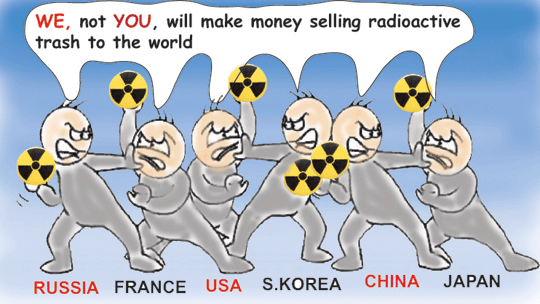
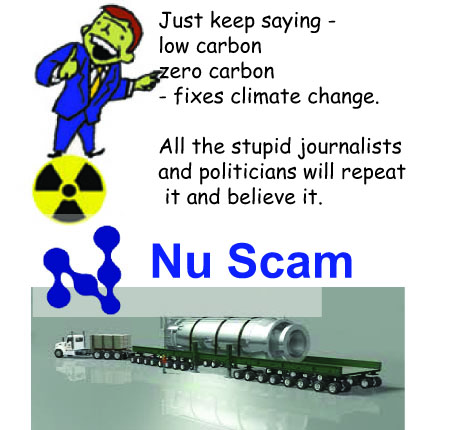 US to support new nuclear power project in South Africa https://businesstech.co.za/news/energy/441510/us-to-support-new-nuclear-power-project-in-south-africa/, Bloomberg17 October 2020 The United States International Development Finance Corp. pledged to support NuScale Power LLC, a US nuclear energy technology firm, to develop 2,500 megawatts of power in South Africa.
South Africa’s government drafted an economic recovery plan in conjunction with business and labour groups several months ago in a bargaining forum known as the National Economic Development and Labour Council, in the wake of the coronavirus pandemic.A version of the strategy that was discussed by the cabinet this week, and seen by Bloomberg, includes suggestions to secure reliable energy supply through the construction of new nuclear plants.
The draft envisages R23 billion ($1.4 billion) being allocated to galvanize private investment in infrastructure and R4.5 billion being spent on public transport over the next 12 months, but provides scant detail on where the money will come from.
The DFC, which ended its prohibition on supporting nuclear power in July, signed a letter of intent to support NuScale’s bid for South Africa’s independent power producer program, the development bank said in an emailed statement on Friday.
“If successful, NuScale would be the first US nuclear energy IPP on the continent and would help support energy resilience and security in one of Africa’s leading economies,” the DFC said.
USA starts off $3.2 billion subsidy program with $80 million each for “next generation” nuclear reactors
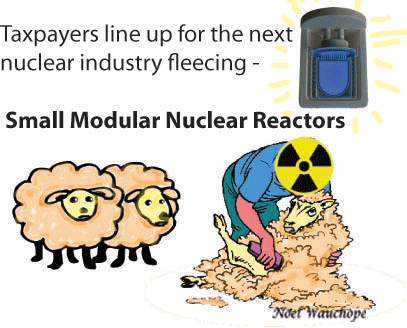
|
US DOE awards TerraPower, X-energy $80 million each for advanced nuclear reactors, S and P Global , Joniel Cha William Freebairn , EditorDerek Sands 14 Oct 20, Washington — The US Department of Energy has awarded two companies proposing next-generation nuclear reactors $80 million each in an initial award as part of a $3.2 billion program to build two advanced reactors that can be operational within seven years, Energy Secretary Dan Brouillette said Oct. 13.
One award went to a group including TerraPower, a company co-founded by billionaire Bill Gates, working with a General Electric and Hitachi joint venture, while the other is X-energy, a start-up that is advancing a reactor design originally developed in Germany. The awards are part of DOE’s Advanced Nuclear Reactor Demonstration Program, and future funding is dependent on appropriations, Brouillette said. Regarding advanced reactors, which generally use a different coolant than all operating commercial reactors in the US, “We want to make them more affordable to build, and we want to make them more affordable to operate,” Brouillette said. Brouillette said “it is likely” the advanced reactors will be built in Washington state, where he said a site is available. The key criteria to select applicants included that the reactor design represent a truly advanced technology dissimilar from existing reactors, Brouillette said. A second key factor was DOE’s assessment that the management team of the winning groups be able to supply the required 50-50 match in resources and deliver the projects within seven years, he said. TerraPower partnered with GE Hitachi, engineering and construction company Bechtel, and utilities Energy Northwest, Duke Energy and Pacificorp for its Natrium sodium fast reactor. The system will be supported by a new fuel fabrication facility to supply fuel for the unit, DOE said in a statement Oct. 13. That Natrium reactor and storage system is a 345-MW net reactor system coupled with a molten-salt-based energy storage system that will provide greater operating flexibility for owners, the companies have said. The Natrium system is designed to cost under $1 billion excluding financing costs. …… Congress appropriated $230 million to start a new demonstration program for advanced reactors in the fiscal 2020 budget. DOE said in May it would award $80 million each to two projects that could be operational in the next five to seven years. Additional funding was to be made available to up to five additional projects with anticipated deployment later than the near-term time frame. The other funding awards will be made in December, DOE said in the statement. https://www.spglobal.com/platts/en/market-insights/latest-news/electric-power/101320-us-doe-awards-terrapower-x-energy-80-million-each-for-advanced-nuclear-reactors X-energy is developing an 80-MW high temperature gas-cooled reactor, the Xe-100, which has begun a vendor design review with the Canadian Nuclear Safety Commission. It is working with Canadian engineering company Hatch on potential Canadian projects to deploy the Xe-100. The X-energy proposal includes four Xe-100 reactors and completion of a commercial-scale fuel fabrication facility. |
|
.S. govt funds small nuclear reactors, with $billions more tax-payer money to follow
DOE Awards $160M to TerraPower and X-Energy to Build Advanced Nuclear Plants by 2027, Greentech Media, 14 Oct 20 The U.S. Department of Energy has awarded $160 million to X-energy and TerraPower with the potential for billions more in federal funding, as the companies strive to build a working model of their smaller scale, more flexible advanced nuclear reactor designs by 2027. TerraPower is partnered with the GE Hitachi Nuclear Energy, a nuclear industry joint venture formed in 2007.
DOE’s Advanced Reactor Demonstration Program will provide $80 million to each award winner, DOE Secretary Dan Brouillette said Tuesday. DOE intends to invest about $3.2 billion over the next seven years into advanced nuclear, subject to future congressional appropriations, he said………
Smaller reactors are critical to rejuvenate an industry that’s struggling to finance and build the massive, gigawatt-plus power plants that make up the world’s existing nuclear fleet. In the U.S., several of these have been canceled, and Southern Company’s Plant Vogtle expansion is behind schedule and over budget.
Meanwhile, existing reactors in Pennsylvania and Illinois are facing the threat of closure due to challenging energy market economics, and California’s sole remaining nuclear reactor is set to close by mid-decade…………
TerraPower’s initial plans for what it calls a traveling wave reactor drew investment from Gates and Sun Microsystems billionaire Vinod Khosla with its promise of using depleted uranium rather than enriched uranium-235. But that project was abandoned last year after the Trump administration imposed limits on U.S.-China technology transfer forced it to cancel its partnership with China National Nuclear Corp. ……..
X-energy’s advanced pebble-bed reactor…… has yet to be proven in commercial form. A 15 MW demonstration reactor in Germany operated for two decades, but a second, larger-scale version was shut down after only four years of operation. China has built a 10 MW demonstration reactor, and a 250 MW unit began construction in 2012, but plans to start operations in 2019 have been pushed back, with no new completion date announced. ……
Small modular nuclear reactors create intensely radioactive wastes
 A bridge to nowhere New Brunswick must reject small modular reactors, Beyond Nuclear International, By Gordon Edwards and Susan O’Donnell, 12 Oct, 20 ”……… In New Brunswick, the proposed new reactors (so-called “small modular nuclear reactors” or SMNRs) will create irradiated fuel even more intensely radioactive per kilogram than waste currently stored at NB Power’s Point Lepreau Nuclear Generating Station. The non-fuel radioactive wastes will remain the responsibility of the government of New Brunswick, likely requiring the siting of a permanent radioactive waste repository somewhere in the province.
Interestingly, promoters of both new nuclear projects in New Brunswick – the ARC-100 reactor and the Moltex “Stable Salt Reactor” – claim their reactors will “burn up” these radioactive waste fuel bundles. They have even suggested that their prototype reactors offer a “solution” to Lepreau’s existing nuclear fuel waste problem. This is untrue. Radioactive left-over used fuel from the new reactors will still require safe storage for hundreds of thousands of years.
……… Until now, every effort to recycle and “burn up” used reactor fuel – in France, the UK, Russia and the US – has resulted in countless incidents of radioactive contamination of the local environment. In addition, none of these projects eliminated the need for permanent storage of the left-over long-lived radioactive byproducts, many of which cannot be “burned up.”…….
The nuclear waste problem is not going away. The recent letter from more than 100 groups across Canada, and the recent cancellation of the proposed nuclear waste dump in Ontario have shown that significant opposition to new nuclear energy generation exists. Because producing nuclear energy always means producing nuclear waste as well……. https://beyondnuclearinternational.org/2020/10/12/a-bridge-to-nowhere/,
Inadequate Emergency Planning Zones for small modular nuclear reactors
No emergency planning zones for SMRs? NRC commissioner warns against “flimsy” rule that could extend to current reactor fleet, Beyond Nuclear International By Jeff Baran, 12 Oct 20, In a 3-1 vote by NRC Commissioners on December 17, 2019, Proposed Rule: Emergency Preparedness for Small Modular Reactors and Other New Technologies (SECY-18-0103) was accepted. The Rule would eliminate the need for Emergency Planning Zones and dedicated offsite emergency planning for Small Modular Reactors. The lone dissenting vote came from NRC Commissioner Jeff Baran. These are his comments.
For the last 40 years, NRC has required emergency planning zones, or EPZs, (Emergency Planning Zones) around nuclear power plants “to assure that prompt and effective actions can be taken to protect the public in the event of an accident.” Every one of the 96* operating large light-water reactors in the country has a plume exposure pathway EPZ that extends about 10 miles around the site with dedicated offsite radiological emergency plans and protective actions in place to avoid or reduce radiation dose to the public during an accident. An ingestion exposure pathway EPZ with a radius of 50 miles around each of these sites is designed to avoid or reduce dose from consuming food and water contaminated by a radiological release.
The EPZs and dedicated radiological emergency plans are meant to provide multiple layers of protection – or defense-in-depth – against potential radiological exposure. Other NRC requirements are focused on preventing or mitigating a radioactive release. The emergency planning regulations are there to provide another layer of defense in case a release occurs despite those safety requirements.
In other words, EPZs and radiological emergency planning are designed to address low-probability, high-consequence events. The Federal Emergency Management Agency (FEMA) assesses the adequacy of the offsite emergency plans, and NRC regulations require licensees to hold offsite emergency preparedness drills at each plant at least once every 2 years to practice implementing the plan .
Under this proposed rule, emergency planning for small modular reactors (SMRs) and non-light-water reactors would be flimsy by comparison. Instead of a 10-mile plume exposure pathway EPZ, these reactors would have EPZs that encompass only areas where the projected dose from “credible” accidents could exceed 1 rem. An EPZ extending only to the site boundary is explicitly permitted under this methodology.
In the case of a site-boundary EPZ, NRC would not require dedicated offsite radiological emergency planning and FEMA would have no role in evaluating the adequacy of a site’s emergency plans. In addition, the proposed rule would eliminate the requirement for an ingestion exposure pathway EPZ and no longer require a specific drill frequency for emergency planning exercises. Overall, this proposed rule represents a radical departure from more than 40 years of radiological emergency planning…………
We need to take FEMA’s warnings seriously. FEMA has a key role in determining whether the emergency planning for a nuclear power plant site is adequate. Under NRC’s regulations, a nuclear power plant license cannot be issued unless NRC makes a finding that the major features of the emergency plan meet the regulatory requirements. And NRC is supposed to base its finding on FEMA’s determinations as to whether the offsite emergency plans are adequate and whether there is reasonable assurance that they can be implemented.
No new SMR or non-light-water reactor designs have yet been approved by NRC, and only one SMR design has been submitted for the staff’s review. These new designs could potentially be safer than current large light-water-reactor designs. But that does not eliminate the need for EPZs and dedicated offsite emergency planning to provide defense-in-depth in case something goes wrong…….
In addition to the issues identified by FEMA, there are several other significant problems with the proposed rule.
First, the logic of the proposed EPZ sizing methodology could be applied to the existing fleet of large light-water reactors to weaken the current level of protection. As the Advisory Committee on Reactor Safeguards noted:
No technical basis is stated in the rule or the guidance for restricting the use of the new rule to SMRs and [other new technologies] with a limit on thermal power. The rule could apply to any reactor technology regardless of size. During our meetings, the staff acknowledged this point.
In fact, the proposed rule explicitly seeks comment on whether to apply this kind of approach to large light-water reactors. This opens the door to smaller EPZs and reduced emergency planning for the existing fleet of power reactors. If the proposed rule’s formulaic approach is adopted, a precedent will be established for applying a purely risk-based methodology to EPZ sizing.
Second, the proposed rule does not account for the possibility of accidents affecting more than one SMR module. Even though some SMR designs contemplate several reactors at one site, the EPZ sizing methodology addresses each reactor in isolation. This ignores a key lesson of the Fukushima accident – that severe natural disasters can simultaneously threaten multiple reactors at a site. Under the draft proposed rule, a SMR is defined as a power reactor that produces less than 1,000 megawatts-thermal. The combined heat energy produced by just two SMRs of this size could be larger than that of some existing large light-water reactors in the U.S. But, under the proposed rule, each module could individually qualify for a site boundary EPZ without consideration of the other.
Third, unlike the existing regulations for large light-water reactors, the proposed rule “would not define the required frequency of drills and exercises” for emergency preparedness. As a result, SMR and non-light-water reactor licensees would not be required to conduct a full offsite emergency preparedness drill every 2 years. The NRC staff provides no basis for this weaker standard.
Finally, the proposed rule would eliminate the ingestion pathway EPZ for SMRs and non- light-water reactors . . . No FEMA evaluation of this change is provided. Nor is there any discussion of the effectiveness of ad hoc responses to previous radiological releases. Moreover, if the staff’s unbounded rationale were adopted, it could ultimately lead to ingestion pathway EPZs being dropped for the existing fleet of large light-water reactors.
For these reasons, I do not support finalizing the proposed rule in its current form. NRC needs a rule that provides regulatory certainty for potential applicants and recognizes that SMRs and non-light-water reactors will be different than traditional, large light-water reactors. It makes sense to have a graded approach that accounts for potential safety improvements in new designs. But the rule should not be purely risk-based, relying entirely on the results of a dose formula. Instead, NRC should issue a rule to establish the following emergency planning requirements for three categories of nuclear power plants………….https://beyondnuclearinternational.org/2020/10/12/no-emergency-planning-zones-for-smrs/
Big doubts about the economics of small nuclear reactors for the UK
 FT 11th Oct 2020, The big challenge facing small nuclear reactors. When Britain unveiled its
first commercial nuclear reactor back in 1956, Calder Hall in Cumbria had
the ability to generate 50 megawatts of electricity. Fast-forward four
decades to the last reactor the UK completed, at Sizewell in Suffolk. Still
functioning, it has a capacity of 1,200MW. Spot the theme? Yup, ever bigger
reactors.
Size has steadily increased because of simple nuclear economics.
Sizewell B may be able to generate 24 times as much power as a 50MW
reactor. But it doesn’t need 24 times the material inputs and staffing to
generate that extra power. Which all makes it seem faintly
counter-intuitive that Britain is considering downsizing and spending money
on a fleet of so-called small modular reactors.
The government is considering plans to put up to £2bn into developing the technology. A
number of companies, including Britain’s Rolls-Royce and GE Hitachi, are
pitching to sell their products. The aim is to fund prototypes with a view
to kick-starting a new SMR industry.
This would build perhaps dozens of
mini-reactors to [supposedly] help the UK meet its net zero emissions target while also
keeping the lights on, as well as exporting this technically advanced kit.
Large nuclear hasn’t exactly a spotless record when it comes to cost
containment. So why make it harder by forgoing those scale advantages?
Research by a team led by Tony Roulstone at Cambridge university looked at
the relative costs of building a “first of a series” SMR against a
comparable large reactor. It concluded that if you used the same project
techniques as for conventional plants, the SMR would cost (once the
interest costs incurred in construction were taken into account) roughly 70
per cent more per kilowatt (kW) to build than the larger one.
Squeezing that cost back down requires a wholly different approach to construction.
Instead of building everything in the open on a massive building site, as
with large reactors, it means making as much as possible in factories
before shipment to site. The same Cambridge team estimated that with ever
more prefabrication and standardisation of parts, you could ultimately
squeeze the cost down roughly to parity with the larger reactor.
A glance at the history of overruns and delays that plagued the Advanced Gas-cooled
Reactor project in the 1960s should suffice as a reminder. For SMRs to
avoid a similar miserable fate, the government must pick a single
commercial technology which can bring in sufficient private sector
investment and attract export orders. This cannot be some “made in
Britain” industrial exercise. If that’s what’s in prospect, then,
honestly, big is probably best.
https://www.ft.com/content/99307126-bb21-48e3-87aa-301749dec870
3 Canadian provinces sucked in by propaganda from 3 Small Nuclear Reactor companies

|
The two big-name companies that won’t be designing Ontario’s next nuclear reactor The province has passed over two major players on its shortlist for a small-modular-reactor design. Will that mean a more competitive process? TVO By John Michael McGrath – Oct 09, 2020 The Ontario government — along with the governments of New Brunswick, Saskatchewan, and (probably) Alberta — wants to develop a new generation of nuclear reactors in Canada. This week, the provincially owned Ontario Power Generation announced it was taking the latest step toward that goal and would be working with three different companies to refine their engineering and design work so that eventually one can be selected for completion.
The three lucky companies are Terrestrial Energy (covered previously on TVO.org), GE Hitachi (with generations of nuclear experience in the United States), and X-energy. At least as notable, however, are two major omissions: NuScale and SNC-Lavalin, which makes the CANDU reactors that Ontario has relied on for decades……….. The problem for NuScale is that its design is meant to be packaged in clusters of up to 12, which is fine if you need 12 — but, right now, Ontario is looking to find one reactor that it could build reasonably quickly, to prove the design works and can be built economically, and then to reproduce it in other provinces, such as Saskatchewan……… In June of this year, however, SNC-Lavalin announced it was submitting a reactor design to the Canadian regulator in the 300-megawatt range — putting it on the larger end of the spectrum for something that’s still supposed to be “small” but is still smaller than traditional CANDU designs. Terrestrial Energy, by comparison, is offering a 195-megawatt design. Canada’s nuclear industry tried to market a 300-megawatt CANDU reactor in the 1980s (the CANDU 3) but never found a buyer. ……… handing the prize to SNC-Lavalin out of nostalgia for the CANDU design would have been a poor guarantee of value for electricity customers. https://www.tvo.org/article/the-two-big-name-companies-that-wont-be-designing-ontarios-next-nuclear-reactor |
|
Design not even finished! But UK govt to subsidise Small Nuclear Reactors (SMRs)
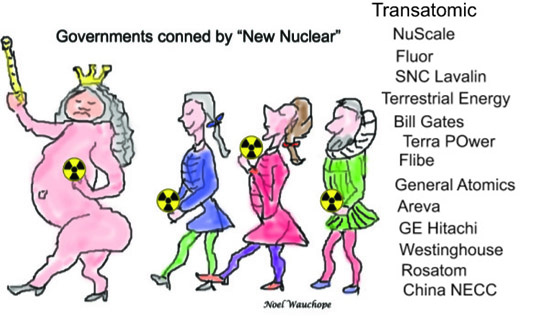
The plan is for 16 of them – at ? £2bn each?
FT 7th Oct 2020, Downing St considers £2bn support for mini nuclear reactors
Consortium wants to build up to 16 generators . Downing Street is supporting plans to spend up to £2bn of taxpayers’ money on a
new generation of mini nuclear reactors. Consortium wants to build up to 16 generators to help UK meet carbon emissions targets. The first SMR is expected to cost £2.2bn and be online by 2029.
Government and industry figures confirmed that a pledge of £1.5bn-£2bn is being discussed which could even see taxpayers acquire an equity stake in the programme.
However, discussions are still ongoing and any final decision will be subject to the Treasury’s current multiyear spending review, which is due later this year. The government could also commission the first mini power station, giving confidence to suppliers and investors. The consortium, which also includes the National Nuclear Laboratory, will seek additional funding of at least £2bn, including from private investors and the capital markets.
Support for SMR technology is expected to form part of Boris Johnson’s “10-point plan for a green industrial revolution” which he will set out later in the autumn. …….. Under the plans being considered by Number 10, the small
modular reactors would be manufactured on production lines in central plants and then transported to sites for assembly. Each mini power station would operate for up to 60 years, providing 440MW of electricity per year — enough to power a city the size of Leeds.
The government’s support “should deliver sufficient cash to get the consortium through building
factories and well on the way to construction of power stations prior to finding more money from other sources,” said one person with knowledge of the situation.
The consortium is expected to finalise the SMR design by April next year, when it hopes to launch the four-year licensing process.
During that time it hopes to begin recruiting employees for the business, and identifying the sites for powers stations and the factories to build the components and modules for the SMRs. The business department hasalready pledged £18m towards the consortium’s early-stage plans.
https://www.ft.com/content/d7016b80-e0c4-4444-a059-2daf32b9a4ab
One more Utah city withdraws from NuScam small nuclear reactor project
Kaysville withdraws from nuclear power project. Post Register, By NATHAN BROWN nbrown@postregister.com
- Sep 28, 2020 One more Utah city has withdrawn from a project to build 12 small nuclear reactors west of Idaho Falls.
The Kaysville City Council voted unanimously a week-and-a-half ago to withdraw from the Carbon Free Power Project, although the resolution left the door open for the city to hold a special meeting to rejoin the project if anything changes……….
Lehi and Logan have also withdrawn from the Carbon Free Power Project over the past month-and-a-half, citing potential risks to local taxpayers if costs go up. There are still more than 30 cities and power systems, including Idaho Falls, that are part of it, and the members have until Oct. 31 to recommit to the project’s next phase by approving the new budget. Utah Associated Municipal Power Systems is waiting for the U.S. Department of Energy to give final approval to a promised $1.4 billion to support the project. ……. https://www.postregister.com/news/government/kaysville-withdraws-from-nuclear-power-project/article_fbb6f15e-e8c6-5207-b6e9-bbf632538c85.html
Dr Helen Caldicott busts the media spin on ‘small nuclear reactors’
HELEN CALDICOTT: Small modular reactors — the next big thing?
https://independentaustralia.net/environment/environment-display/helen-caldicott-small-modular-reactors–the-next-big-thing,14342#disqus_thread By Helen Caldicott | 27 September 2020 Politicians debating nuclear power as an energy source, know little of the facts that make small modular reactors a bad idea, writes Dr Caldicott. AUSTRALIAN politicians are contemplating developing nuclear power for this country. In their ignorance, they are mooting “small modular reactors” (SMRs) about which they clearly know little.
The so-called “nuclear renaissance” died following the Fukushima catastrophe when one-sixth of the world’s nuclear reactors closed. However, global nuclear corporations – Toshiba, NuScale, Babcock & Wilcox, GE Hitachi, General Atomics and the Tennessee Valley Authority – did not accept defeat.
Their new strategy has been to develop small modular nuclear reactors without the dangers inherent in large reactors — safety, cost, proliferation risks and radioactive waste. But these claims are fallacious for the reasons outlined below.
Basically, there are three types of SMRs which generate less than 300 megawatts of electricity compared with current day 1000 megawatt reactors.
Light water reactors designs
These will be smaller versions of present-day pressurized water reactors using water as the moderator and coolant, but with the same attendant problems as Fukushima and Three Mile Island. Built underground, they will be difficult to access in the event of an accident or malfunction.
Mass-produced (turnkey production) large numbers must be sold yearly to make a profit. This is an unlikely prospect because major markets – China and India – will not buy U.S. reactors when they can make their own.
If safety problems arise – as in General Motors cars – they all must be shut down which will interfere substantially with electricity supply.
SMRs will be expensive because the cost per unit capacity increases with a decrease in reactor size. Billions of dollars of government subsidies will be required because Wall Street is allergic to nuclear power. To alleviate costs, it is suggested that safety rules be relaxed, including reducing security requirements and a reduction in the 10-mile emergency planning zone to 1,000 feet.
Non-light water designs
These are high-temperature gas-cooled reactors (HTGR) or pebble bed reactors. Five billion tiny fuel kernels consisting of high-enriched uranium or plutonium will be encased in tennis-ball-sized graphite spheres which must be made without cracks or imperfections — or they could lead to an accident. A total of 450,000 such spheres will slowly and continuously be released from a fuel silo – passing through the reactor core – and then be re-circulated ten times. These reactors will be cooled by helium gas operating at very high temperatures (900 degrees Celsius).
A reactor complex consisting of four HTGR modules will be located underground, to be run by just two operators in a central control room. Claims are that HTGRs will be so safe that a containment building will be unnecessary and operators can even leave the site – “walk away safe” reactors.
However, should temperatures unexpectedly exceed 1,600 degrees Celsius, the carbon coating will release dangerous radioactive isotopes into the helium gas and at 2,000 degrees Celsius the carbon would ignite creating a fierce graphite Chernobyl-type fire.
If a crack develops in the piping or building, radioactive helium would escape and air would rush in, also igniting the graphite.
Although HTGRs produce small amounts of low-level waste they create larger volumes of high-level waste than conventional reactors.
Despite these obvious safety problems and despite the fact that South Africa has abandoned plans for HTGRs, the U.S. Department of Energy has unwisely chosen the HTGR as the “Next Generation Nuclear Plant”.
 Liquid metal fast reactors (PRISM)
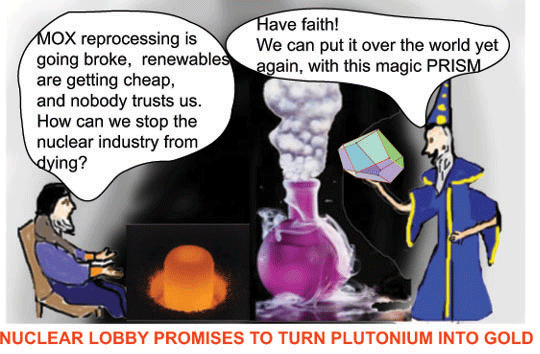
It is claimed by proponents that fast reactors will be safe, economically competitive, proliferation-resistant and sustainable.
They will be fueled by plutonium or highly enriched uranium and cooled by either liquid sodium or a lead-bismuth molten coolant. Liquid sodium burns or explodes when exposed to air or water and lead-bismuth is extremely corrosive producing very volatile radioactive elements when irradiated.
Should a crack occur in the reactor complex, liquid sodium would escape, burning or exploding. Without coolant, the plutonium fuel could reach critical mass, triggering a massive nuclear explosion scattering plutonium to the four winds. One-millionth of a gram of plutonium induces cancer and it lasts for 500,000 years. Extraordinarily, claims are made that fast reactors will be so safe they will require no emergency sirens and emergency planning zones can be decreased from ten miles to 1,300 feet.
There are two types of fast reactors: a simple plutonium fueled reactor and a “breeder” in which the plutonium reactor core is surrounded by a blanket of uranium 238 which captures neutrons and converts to plutonium.
The plutonium fuel, obtained from spent reactor fuel will be fissioned and converted to shorter-lived isotopes — caesium and strontium which last 600 years instead of 500,000. Called “transmutation”, the industry claims that this is an excellent way to get rid of plutonium waste. But this is fallacious because only ten per cent fissions, leaving 90 per cent of the plutonium for bomb-making etc.
Three small plutonium fast reactors will be grouped together to form a module and three of these modules will be buried underground. All nine reactors will then be connected to a fully automated central control room operated by only three operators. Potentially then, one operator could simultaneously face a catastrophic situation triggered by the loss of off-site power to one unit at full power, in another shut down for refuelling and in one in start-up mode. There are to be no emergency core cooling systems.
Fast reactors require a massive infrastructure including a reprocessing plant to dissolve radioactive waste fuel rods in nitric acid, chemically removing the plutonium and a fuel fabrication facility to create new fuel rods. A total of 10,160 kilos of plutonium is required to operate a fuel cycle at a fast reactor and just 2.5 kilos is fuel for a nuclear weapon.
Thus fast reactors and breeders will provide extraordinary long-term medical dangers and the perfect situation for nuclear weapons proliferation. Despite this, the industry is clearly trying to market them to many countries including, it seems, Australia.
You can follow Dr Caldicott on Twitter @DrHCaldicott. Click here for Dr Caldicott’s complete curriculum vitae.
Canada to splurge $billions on non-existent small nuclear reactors, ineffective and no use against climate change
GIBBONS: Nuclear power no solution to climate change https://torontosun.com/opinion/columnists/gibbons-nuclear-power-no-solution-to-climate-change, Author of the article:, Jack Gibbons, Sep 25, 2020 At a time when action on climate change has never been more urgent, the federal Liberals want to throw billions of dollars at non-existent technology that will not make a difference for decades, if ever.
But that’s pretty much the way things have always been when it comes to federal spending on nuclear power: As long as the word “nuclear” is attached, we put common sense aside and fund projects that lead to one dead end after another.
More than $400 million for Advanced CANDU reactors that never got built? You bet. Another $600 million on the infamous Maple medical isotope reactor design, which proved unsafe to operate? No problem.
Now the industry’s latest pitch is Small Modular Reactors (SMRs) and off we go on another wild goose chase with Minister of Natural Resources Seamus O’Regan once again promising billions for technology that is nowhere in sight, let alone use.
Meanwhile, costs for wind and solar have plunged to the point where these energy sources are now outcompeting even natural gas.
Nuclear, for its part, is fading fast. Due to its high costs and safety concerns, nuclear’s share of the world electricity market has cratered in the past two decades. More places are now retiring aging reactors than building them.
The nuclear industry loves to claim they are a critical climate change solution — except on a cost per tonne basis.
Nuclear is like buying a Mercedes to go to the corner store.
Ontario pays as little as two cents a kilowatt hour (kWh) for energy efficient improvements that could displace the need for nuclear while reducing greenhouse gas pollution.
Alberta is now paying around five cents per kWh for solar and four cents for wind.
Ontario Power Generation says it will need to be paid 16.5 cents per kWh for nuclear by 2025.
A whole lot has changed since the bad old days of Ontario’s Green Energy Act.
Yes, the sun doesn’t always shine or the wind blow. Which is why it is fortunate that in Ontario we live beside a giant battery.
Quebec has an enormous water-power reservoir system that Hydro Quebec is keen to integrate with renewable sources for its out-of-province customers.
When we have surplus solar and wind, Quebec stores water. When not, it produces hydro power for export.
We have the connections necessary to make this system work and can expand them at a cost that looks like spare change next to what it costs to rebuild a nuclear reactor or get an SMR prototype built.
The nuclear industry is grasping at straws. Its technology is obsolete, its promises unfulfilled and its costs ever rising.
Betting on nuclear as a climate solution is just sticking our heads in the sand because SMR technology is decades away, extremely expensive, and comes with a nasty pile of security and waste headaches. Yes. Virginia, SMRs still produce lots of highly radioactive waste and we still have no place to put the stuff.
That our government would be this gullible is distressing, especially given the havoc already being wreaked by a changing climate.
We have simple, affordable, reliable and truly clean answers to our climate problem at our fingertips.
Yet our government sits and waits for the nuclear industry to call with some good news. And the phone never rings.
— Jack Gibbons is chairman of the Ontario Clean Air Alliance
Small modular nuclear reactors for Canada? – useless, expensive, untested, and a wasteful distraction
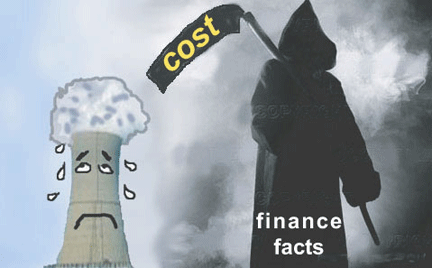 NB Media Co-op 22nd Sept 2020,Premier Blaine Higgs has endorsed so-called “small modular nuclear reactors” or SMRs. SMRs represent an untested technology but what we know on the basis of technical characteristics and historical precedent is that they will be expensive and any electricity they generate will not be economical. The nuclear industry is pushing small reactors because large reactors are simply not economical. Constructing nuclear plants is just too expensive—as Ontario’s government found out after its call in 2008 for bids to build two more reactors at the Darlington site.
https://nbmediacoop.org/2020/09/22/no-business-case-for-new-nuclear-reactors-in-new-brunswick/
Sierra Club Canada (accessed) 23rd Sept 2020, No plan that gets us to net zero in a reasonable time frame includes new nuclear reactors. Nuclear is far too slow and expensive to deal with the climate emergency. Just like fossil fuel energy, nuclear produces wastes that pose unacceptable health hazards and economic costs.Utah lawmakers seek details on planned nuclear plant in Idaho
Cities and districts invested in the plant have until Oct. 31 — one of several so-called off-ramps — to bow out of the project.
During the committee hearing, Sen. Ron Winterton, R-Roosevelt, shared his concerns over the cities’ financial commitments.
“I want to feel warm and fuzzy” he said, but questioned the technology and potential risks…….
Under both the Obama and the Trump administrations, the NuScale project has received strong financial support, Squires said. The federal energy agency gave NuScale a competitive award of $226 million in 2013 to develop the technology. Two years later, the federal agency gave NuScale $16.7 million for licensing preparation. …….
Critics like the Utah Taxpayers Association, however, say the investment by Utah cities is too risky and they should not be acting as seed investors.
“We are not opposed to nuclear power, we are opposed to the financial risk,” said the association’s vice president, Rusty Cannon. ……….. https://www.deseret.com/utah/2020/9/19/21438026/news-nuclear-plant-in-idaho-lawmakers-seek-details-on-planned-nuscale-uamps
NuScam’s ”small” nuclear reactor design approved – but cost, safety, public acceptance hurdles loom against them

First U.S. Small Nuclear Reactor Design Is Approved, Concerns about costs and safety remain, however, Scientific American  By Dave Levitan on September 9, 2020
- The U.S. Nuclear Regulatory Commission (NRC) has approved the design of a new kind of reactor, known as a small modular reactor (SMR). The design, from the Portland, Ore.–based company NuScale Power, is intended to speed construction, lower cost and improve safety over traditional nuclear reactors…………
- some experts have expressed concerns over the potential expense and remaining safety issues that the industry would have to address before any such reactors are actually built. ………
- The NRC’s design and related final safety evaluation report (FSER) do not mean that the firm can begin constructing reactors. But utility companies can now apply to the NRC to build and operate NuScale’s design. With almost no new nuclear construction completed in the U.S. over the past three decades, SMRs could help reinvigorate a flagging industry.
NuScale’s SMR, developed with the help of almost $300 million from the U.S. Department of Energy, has a generating capacity of 50 megawatts—substantially smaller than standard nuclear reactors, which can range to well more than 1,000 megawatts (MW). A utility could combine up to 12 SMRs at a single site, producing 600 MW of electricity—enough to power a midsize city. The NRC says it expects an application for a 60-MW version of NuScale’s SMR in 2022……….
In a July 2020 report, NRC nuclear engineer Shanlai Lu discussed a complicated issue known as boron dilution, which could possibly cause “fuel failure and prompt criticality condition”—meaning that even if a reactor is shut down, fission reactions could restart and begin a dangerous power increase. And in another report, the NRC’s Advisory Committee on Reactor Safeguards also noted that “several potentially risk-significant items” are not yet completed, though it did still recommend that the NRC issue the FSER. The agency’s response to the latter report stated that those items will be further assessed when site-specific licensing applications—the step needed to actually begin building and operating a reactor—are submitted. ……..
Lyman says that in general, the NRC’s design certification process should reduce uncertainty for utilities aiming to build nuclear plants because they can reference a completed safety review. But he thinks the NuScale approval undermines that advantage. Whether the gaps in safety will result in further delays to NuScale’s time line remains to be seen. The NRC will undertake another review when the company’s 60-MW design is submitted. https://www.scientificamerican.com/article/first-u-s-small-nuclear-reactor-design-is-approved/
1 This Month



26 September – International Day for the Total Elimination of Nuclear Weapons


PLEASE OPPOSE HR 8255 AND S.3639 – bills would accelerate satellite deployment, with no environmental review or safeguards – https://ncstd5li.quorum.us/campaign/169331/
To see nuclear-related stories in greater depth and intensity – go to https://nuclearinformation.wordpress.com
-
Archives
- September 2026 (233)
- August 2026 (330)
- July 2026 (355)
- June 2026 (287)
- May 2026 (306)
- April 2026 (356)
- March 2026 (251)
- February 2026 (267)
- January 2026 (308)
- December 2025 (358)
- November 2025 (359)
- October 2025 (375)
-
Categories
- 1
- 1 NUCLEAR ISSUES
- business and costs
- climate change
- culture and arts
- ENERGY
- environment
- health
- history
- indigenous issues
- Legal
- marketing of nuclear
- media
- opposition to nuclear
- PERSONAL STORIES
- politics
- politics international
- Religion and ethics
- safety
- secrets,lies and civil liberties
- spinbuster
- technology
- Uranium
- wastes
- weapons and war
- Women
- 2 WORLD
- ACTION
- AFRICA
- Atrocities
- AUSTRALIA
- Christina's notes
- Christina's themes
- culture and arts
- Events
- Fuk 2022
- Fuk 2023
- Fukushima 2017
- Fukushima 2018
- fukushima 2019
- Fukushima 2020
- Fukushima 2021
- general
- global warming
- Humour (God we need it)
- Nuclear
- RARE EARTHS
- Reference
- resources – print
- Resources -audiovicual
- Weekly Newsletter
- World
- World Nuclear
- YouTube
-
RSS
Entries RSS
Comments RSS
 nuclear-news