Several U.S. utilities back out of deal to build Small Nuclear Reactors

|
Several U.S. utilities back out of deal to build novel nuclear power plant, Science, By Adrian Cho, Nov. 4, 2020 Plans to build an innovative new nuclear power plant—and thus revitalize the struggling U.S. nuclear industry—have taken a hit as in recent weeks: Eight of the 36 public utilities that had signed on to help build the plant have backed out of the deal. The withdrawals come just months after the Utah Associated Municipal Power Systems (UAMPS), which intends to buy the plant containing 12 small modular reactors from NuScale Power, announced that completion of the project would be delayed by 3 years to 2030. It also estimates the cost would climb from $4.2 billion to $6.1 billion………. critics of the project say the developments underscore that the plant, which is designed by NuScale Power and would be built at the Department of Energy’s (DOE’s) Idaho National Laboratory, will be untenably expensive. M. V. Ramana, a physicist who works on public policy at the University of British Columbia, Vancouver, says he’s not surprised that so many utilities have opted out of the project. The question, he says, is why so many are sticking with it. “They ought to be seeing the writing on the wall and getting out by the dozens,” he says. ……… if the NuScale plant doesn’t run constantly at full output, it will be less efficient and even more expensive to operate, in terms of cost per megawatt hour (MWh) of energy, Ramana argues. Peter Bradford, a former member of the Nuclear Regulatory Commission (NRC) and former chair of the state utility commissions in Maine and New York, says renewables coupled with short-term storage in batteries would likely be a cheaper means to even out the supply……. in the 1980s, Washington Public Power Supply System agreed to build several nuclear reactors in Washington that ran far overbudget and were never completed, leading to the biggest default on municipal bonds in U.S. history. Public utilities are particularly vulnerable to such risks, Bradford says, as other than ratepayers they have few sources of revenue that could be used to cover cost overruns. “Not only are there no deep pockets, there are no pockets,” he says. On 28 October, Heber Light & Power in Utah withdrew from the project, just 1 day after utilities in the Utah communities of Bountiful and Beaver pulled out. Still, even critics doubt the UAMPS deal will fall apart immediately. In August, the NuScale design passed a key milestone in the NRC review process, receiving its safety evaluation report, and observers expect final “design certification” to come next year. In the meantime, UAMPS is moving to complete an application to construct and operate the plant, Webb says. That application should be submitted in 2023, construction of the plant should start in 2025, he says. Before construction can start, however, UAMPS still has to line up customers to buy the full 720-megawatt output of the plant, Webb says. So far, UAMPS members involved in the project have agreed to take only a relatively small fraction of that output. So UAMPS may have to convince plenty of other folks that it’s a good deal. https://www.sciencemag.org/news/2020/11/several-us-utilities-back-out-deal-build-novel-nuclear-power-plant |
|
Some problems that will handicap the development of Small Nuclear Reactors
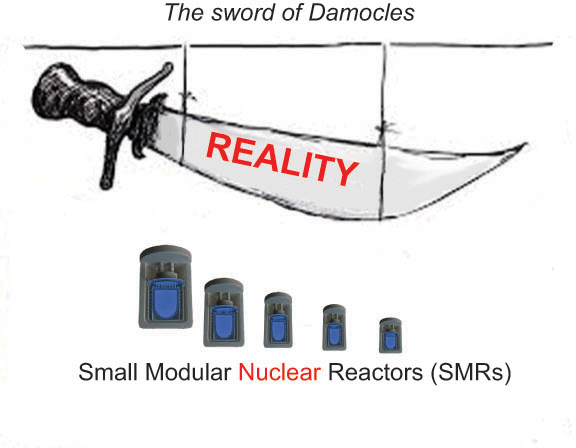 The I&C challenges for small modular reactors, Nuclear Engineering International 4 November 2020 Dr Li Li examines the instrumentation and control requirements and challenges for a new generation of small modular reactors.
REACTOR DEVELOPERS ARE DEVELOPING A wide variety of small modular reactor (SMRs)….. Many use Generation III+ pressurised water reactor (PWR) technology similar to that used in current gigawatt-scale reactors, while others are based on advanced Generation IV technologies ranging from high temperature gas-cooled reactors to molten-salt reactors.
Each design will have its own requirements for instrumentation and control (I&C) systems for the operation, monitoring and control of the reactor, turbine island and balance of plant. Even among PWRs, the design principles and I&C architectures are very different and cannot be easily replicated from one design to another.
To understand the challenges, let’s look at three competing designs: the UK SMR being developed by a consortium of companies including Rolls-Royce, Jacobs, Assystem and Atkins with support from research institutions including Nuclear AMRC; the NuScale Power Module backed by Fluor Corporation with funding from the US Department of Energy; and the Westinghouse SMR, which adapts technologies from the established AP1000 design………..
The issue of cyber security will be critical for the certification of digital I&C systems. According to the Industrial Control Systems Cyber Emergency Response Team, part of the US Department of Homeland Security, cyber-attacks and security infringement targeting control systems have increased significantly in recent years. With more digital smart devices used in nuclear power plant of any size, it must be a priority to protect the vulnerability of smart devices and digital I&C system from cyber attack and malicious sniffing from hostile individuals or organisations…….
in most cases, new codes and standards will need to be developed for advanced reactors.
The development of new codes and standards is a very lengthy process. It will take resources and time to publish a new standard for the nuclear industry, and we might not see one ready before new SMR developers file their design certification application……….
Many SMR designs, including the three considered above, have the potential to be used for co-generation of process heat, district heating or desalination. This will introduce additional complexity for regulators to approve the power plant I&C design, if the co-generation processes are located at same site for economic reasons. This brings new challenges because extra safety measures must be considered. For example, additional safety features of the control system and evacuation plan must be approved by an adequate jurisdictional authority for the orderly shutdown of both the nuclear plant and industrial processes in the event of an accident.
Author information: Dr Li Li, Head of the digital I&C group at the UK’s Nuclear Advanced Manufacturing Research Centre (Nuclear AMRC) https://www.neimagazine.com/features/featurethe-ic-challenges-for-small-modular-reactors-8345341/
Bill Gates has another go at getting taxpayer funding, for another nuclear venture (ships this time)
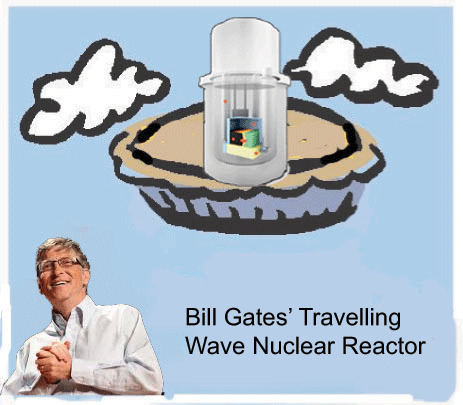 Bill Gates joins nuclear-powered shipping push, Splash Sam ChambersNovember 2, 2020 Bill Gates, one of the richest men in the world, has turned his attention to getting ships powered by nuclear energy.
The Microsoft co-founder, who turned 65 last week, is also chairman of TerraPower, a nuclear tech company that today announced a new venture with Mikal Bøe’s CORE POWER, French nuclear materials handling specialist Orano and American utilities firm Southern Company. The four companies plan to develop molten salt reactor (MSR) atomic technology in the United States………
The four companies have submitted an application to the US Department of Energy to take part in cost-share risk reduction awards under the Advanced Reactor Demonstration Programme to build a prototype MSR, as a proof-of-concept for a medium-scale commercial-grade reactor.
……. we seek to build scale-appropriate technology and broad acceptance of modern and durable liquid-fuelled atomic power to shape the future of how we deal with climate change,” Bøe commented today…….
Thorium is a weakly radioactive metallic chemical element found most commonly in India and is a substance that Gates’ TerraPower has been studying closely of late.
Admitting the technology would not be cheap to install on ships, Bøe has proposed a leasing model for his batteries, similar to those deployed for aircraft engines………. https://splash247.com/bill-gates-joins-nuclear-powered-shipping-push/
While Canadian authorities fall for “New Small Nuclear” spin, U.S. consortium rips off Canada’s nuclear waste disaster
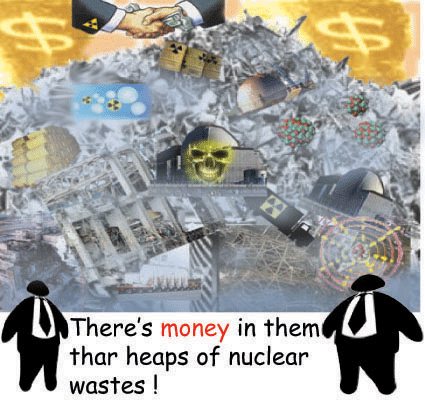
 U.S. corporations profiting from major Canadian nuclear liability, https://rabble.ca/blogs/bloggers/views-
 expressed/2020/10/us-corporations-profiting-major-canadian-nuclear-liability Ole Hendrickson, October 30, 2020
The nearly 70-year history of the federal crown corporation Atomic Energy of Canada Limited (AECL) has left a $16 billion toxic legacy of shuttered reactors, polluted lakes and groundwater, contaminated soils, and hundreds of thousands of cubic metres of radioactive waste.
AECL’s 2018 annual report estimates its undiscounted waste and decommissioning liability at $15.9 billion as of March 31, 2018. Table 5.7 in Canada’s 2019 public accounts estimates AECL’s environmental liabilities at $1.05 billion and “asset retirement obligations” at $6.6 billion.
This $7.7 billion estimate of AECL’s total nuclear liability is heavily discounted. The accounting firm Deloitte does not recommend discounting for environmental liabilities and asset retirement obligations unless the amount of the liability and the amount and timing of cash payments are “reliably determinable.” As explained in a detailed report, neither is true for AECL’s liability.
Prime Minister Stephen Harper thought that the private sector might do a better job of addressing this massive liability than AECL itself. Just before losing power to the Liberals in the 2015 election, his government contracted an American-controlled consortium (creatively called the “Canadian National Energy Alliance”) to manage federal nuclear facilities and reduce the waste liability quickly and cheaply.
According to the main estimates, AECL’s expenditures grew from $326 million in 2014-15 (before the consortium assumed control) to $491 million in 2015-16, $784 million in 2016-17, $827 million in 2017-18 and $829 million in 2018-19. The 2020-21 main estimates for AECL are $1.2 billion.
AECL hands most of this money over to the consortium, whose current members are Texas-based Fluor and Jacobs, and SNC-Lavalin. AECL retains ownership of the waste. A 2017 special examination report of the Auditor General of Canada to AECL’s board of directors says that “approximately $866 million for contractual expenses was paid or payable by the Corporation in the 2016-17 fiscal year.”
Is this “Government-owned, contractor-operated” (GoCo) arrangement providing value for money?
The GoCo contract was supposed to have been reviewed after an initial six-year period. However, AECL — whose president is an American with past ties to consortium members — extended it to a full 10-year period in April 2020, 18 months before its September 2021 renewal date.
The centrepiece of the consortium’s approach — a million-cubic–metre radioactive waste mound on a hillside draining into the Ottawa River – was revealed in May 2016, shortly after the ink dried on the contract. Neither the public, nor Algonquin peoples on whose unceded territory this facility would be built, were consulted.

Technical problems and public opposition have put the “near surface disposal facility” — to be built at AECL’s Chalk River laboratories — years behind schedule. AECL waste management experts who left when the consortium took over have been highly critical, pointing out that an above-ground mound would not contain and isolate the types of radioactive waste that the consortium planned to put in it.
Chalk River, the focal point of Canadian nuclear research since the late 1940s, is where most of AECL’s radioactive waste legacy is found. But AECL also built reactors at four other sites in Manitoba, Ontario and Quebec. All have been shut down for decades — radioactive hulks, yet to be fully decommissioned.
AECL and its American-led consortium have announced quick and cheap plans for Manitoba and Ontario reactors: fill them up with blast furnace slag and concrete, and abandon them in place. Critics say these proposals are seriously flawed, noting that the International Atomic Energy Agency (IAEA) says that “entombment” should only be considered in the event of a serious reactor accident.
Critics say that these sub-standard schemes would pollute major Canadian waterways and could expose workers and future generations to dangerous radiation levels.
The consortium is trying to salvage its Chalk River mound proposal with a promise to reduce the amount of radiation in the wastes it would house. Less radiation would leak into the Ottawa River.
However, management practices during Chalk River’s early years were poor, accidents were frequent and records were lost in a fire. Trying to separate out lower-activity from higher-activity wastes would involve considerable expense and high worker radiation exposures. And if strict limits on the mound’s radioactivity were adhered to, much of the federal waste liability would likely remain unaddressed.
Management of Canada’s radioactive waste by for-profit corporations, combined with a lack of government oversight, creates risks of delays, excessive radiation exposures to workers and the public, and squandering of tax dollars. Critics of AECL’s GoCo contract are asking the federal government to establish a publicly acceptable strategy for addressing its nuclear liability.
In a mission to Canada in late 2019, IAEA reviewers found virtually “no evidence … of a governmental policy or strategy related to radioactive waste management.” The government agreed to their recommendation that this gap be filled, assigning the task to Natural Resources Canada.
But Natural Resources Minister Seamus O’Regan seems preoccupied with promotion of a new generation of mass-produced, “modular” nuclear reactors. Two consortium members — Fluor and SNC-Lavalin — are heavily invested in their own reactor designs. There are plans to build three new demonstration reactors at Chalk River, and talk of building as many as eight. One proposal has already reached the environmental assessment stage.
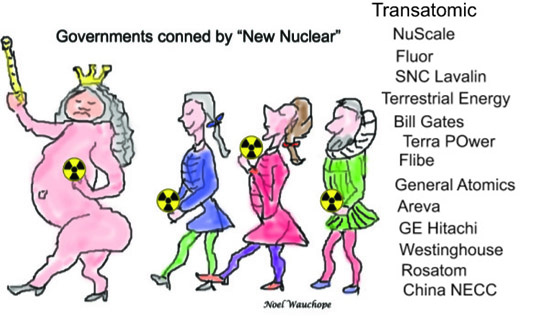
If the Liberal government caves into industry pressure to fund the building of these new reactors — instead of dealing responsibly with its existing waste liability — AECL’s $16 billion radioactive burden on Canadian taxpayers — and risks to workers and the public — will just keep growing.
Ole Hendrickson is a retired forest ecologist and a founding member of the Ottawa River Institute, a non-profit charitable organization based in the Ottawa Valley.
Financial red flags warn against Utah’s NuScale small nuclear reactor project
|
Is nuclear power Utah’s future? Red flags suggest holding off https://www-deseret-com.cdn.ampproject.org/c/s/www.deseret.com/platform/amp/opinion/2020/10/27/21535010/guest-opinion-nuclear-power-plant-idaho-utah-uamps-nuscale-red-flags?fbclid=IwAR13pzEW_7Bl0BQVlj8jN5UUIcoX9Mi_BZbgQq-22TBtjnJLSeSov8rZER, By M.V. Ramana, – on October 27, 2020 UAMPS has promised electricity at $55 per megawatt hour (MWh), down from the $65 it promised two years ago. One might imagine that the lower price is due to declining costs, but according to UAMPS, the project’s estimated costs have gone up, not down. In its 2018 Budget & Plan of Finance, UAMPS approved a construction cost of approximately $4.2 billion. This year, the UAMPS Amended Budget & Plan of Finance mentions a figure of approximately $6.1 billion. If the construction costs are going up, then why did the cost of electricity come down from $65/MWh to $55/MWh? The question arises because UAMPS and NuScale have not been transparent with the methodology used to develop figures like $55/MWh. The lack of transparency means the public does not know what assumptions are being made, let alone whether those assumptions are realistic. We do know that Pacificorp and Idaho Power have concluded that electricity from NuScale reactors would cost $94-$121/MWh. The UAMPS project also bears other red flags, and seems headed for failure. Less than 25% subscriptions. Based on public testimony, the UAMPS project has subscribers for less than 25% of the total power, leaving 75% of the output unclaimed. Communities continue to withdraw, citing the increasing costs, uncertain technology and the lack of subscribers. Several of the communities that withdrew were among the project’s largest subscribers. Project delays continue. NuScale initially claimed it could deliver the first working nuclear reactor in 2015. Now, the first UAMPS reactors aren’t scheduled to come online until 2029-2030, roughly 15 years later than originally expected — provided there are no further delays. NuScale’s experience is consistent with an independent study that showed that 175 of the 180 nuclear power projects examined took on average 64% longer than projected (and had final costs that exceeded the initial budget by an average of 117%). Unpredictable taxpayer subsidies. UAMPS and NuScale expect taxpayers to cover 25% of the project’s costs over the next nine years. Contrary to NuScale/UAMPS’ assurances about the recent U.S. Department of Energy $1.4 billion “funding vehicle,” there is no way to guarantee these funds. As the on-again, off-again Yucca Mountain project illustrates, federal funding for nuclear projects can be fickle and subject to withdrawal at any time. In the long history of failed U.S. nuclear projects, the public is almost never given an honest, transparent assessment of the likelihood of expensive overruns, lengthy scheduling delays and possible project collapse. The problems already apparent in the UAMPS project fit squarely into this history of failure. Some UAMPS members — Logan, Lehi, Kaysville and Murray, among them — seem to have realized that the risk of such failure is high enough and have pulled out of the project, cutting their losses. By the end of this week, roughly 30 Utah cities and towns will have a similar decision to make. They can either decide to continue the gamble and be tied to a contract that could leave them with millions of dollars of public debt. Or they could follow the lead of Logan, Lehi, Kaysville and Murray and vote to withdraw from this financially risky nuclear project. The sad irony is that even in the highly unlikely event of NuScale delivering on its promises, the $55/MWh figure is well above the current cost of procuring electricity for UAMPS itself, which has averaged around $29/MWh in the last two years. The $55/MWh would also far exceed the cost of renewables, which are continuing to decline in prices. Thus, a long term contract for $55/MWh is a recipe for excessive electricity costs for decades. I do think that UAMPS can achieve one of the stated goals of NuScale project promoters, namely invest in low-carbon sources of energy. But the way to do that is to pursue currently available solar, wind, energy storage (batteries) and energy efficiency. That is cheaper, safer, cleaner and more reliable than going deeper into the NuScale dead-end. Professor M.V. Ramana is the Simons Chair in Disarmament, Global and Human Security and Director of the Liu Institute for Global Issues at the School of Public Policy and Global Affairs at the University of British Columbia in Vancouver, Canada. Dr. Ramana is a member of the International Panel on Fissile Materials, the International Nuclear Risk Assessment Group and the team that produces the annual World Nuclear Industry Status Report. |
|
Another city bites the dust in regard to Utah’s NuScam small nuclear reactors plan
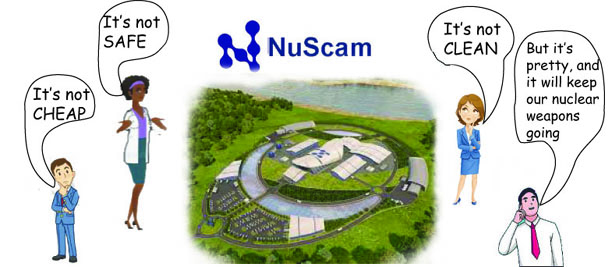
Seven Utah cities have now bailed out of an Idaho nuclear power project, Salt Lake Tribune, By Taylor Stevens-30 Oct 20,
Three more Utah cities voted this week not to move forward with a first-of-its kind nuclear power project that proponents have pitched as the future of clean energy but that opponents have lined up against over concerns about financial risk.
Beaver, Bountiful and Heber are the latest municipalities to exit the small modular nuclear reactor pursuit, following in the footsteps of Murray, Kaysville, Lehi and Logan, which also backed out in recent weeks. ………
The Heber Light and Power Board, which voted 5-1 to get out of the project, and the Bountiful City Council, which unanimously made the decision to back out, both did so this week largely over concerns about the subscription rate of the nuclear energy pursuit.
“There’s enough things wrong with this project that it made it really scary,” said Bart Miller, Heber Light and Power’s chief financial officer. “We’re just a bunch of little utilities in the state of Utah trying to do a $6 billion nuclear power plant.”………
Bountiful City Councilman Richard Higginson said the leaders there had similar concerns, and felt too many of the development and construction costs were falling to a small number of municipalities…….
Costs have been one of the main concerns for several of the cities that have backed out over the last few weeks, as the project’s projected price tag has ballooned significantly, from $4.5 billion a few years ago to around $6 billion now. Opponents have also raised concerns about time and cost overruns, safety considerations and an uncertain regulatory environment.
The Utah Taxpayers Association has been among the critics of the project, arguing that municipal power companies should not act as a “seed investor” for the new technology, a responsibility it’s argued should lie with the private sector.
Environmental groups, such as the Healthy Environment Alliance of Utah, have also raised concerns about the radioactive waste that would be generated by the project.
Cities participating in the Carbon Free Power Project through the Utah Associated Municipal Power Systems — a consortium of municipally owned power systems in Utah and several other Western states that has partnered with NuScale Power to study and create the nuclear technology — have until Saturday to decide whether to stay in the project or back out. https://www.sltrib.com/news/politics/2020/10/29/seven-utah-cities-have/
Big questions on the costs and safety of NuScale’s little nuclear reactors
NuScale Faces Questions on Nuclear Reactor Safety and Financing Its First Project
The first small modular reactor to receive federal approval must still grapple with design changes and safety concerns if it’s to be built by 2030. GreentechMedia
But its reactor design faces significant safety questions that were not resolved by a Nuclear Energy Commission (NRC) review completed in August. Those include potential problems with the system that automatically shuts down its reactors in case of emergency, casting doubt on key safety claims from the Portland, Oregon-based company, critics say.
The nature of NRC’s review will leave the resolution of these key safety issues to be completed later this decade.
This could prove problematic for NuScale’s first project, the 12-reactor Carbon Free Power Project (CFPP) in Idaho Falls, Idaho. Over the past two years, the project has seen expected costs double from $3 billion to $6.1 billion and its completion date moved from 2026 to 2030, putting pressure on parent company Fluor Corp. to keep further cost increases in check and secure financial backers for the project.
NuScale won’t complete key safety reviews for its reactor design until later this decade. These design changes and safety reviews will be the responsibility of the Utah Associated Municipal Power Systems (UAMPS), the first customer for 213 megawatts of the 720 MW the CFPP will produce, under a combined construction and operating license process. This could open up the CFPP to technical and legal challenges after significant investments in the project have already been made, critics warn.
UAMPS, a division of the Utah state government serving wholesale electric services to communities across the Intermountain West, has seen three cities vote to depart the 33-city consortium planning to agree to buy power from the CFPP in the past few months and is facing an October 31 deadline to commit to its role in the project.
And while the Department of Energy has issued a $1.36 billion, 10-year cost-share pledge to UAMPS, that funding will require future congressional appropriations in order to become reality. …..
Other U.S.-based SMR developers include Bill Gates-backed TerraPower and X-Energy, which have recently received financial support from DOE with the goal of building their first working units in the next seven years. Others include Hyperion Power Generation and Terrestrial Energy. ……
Safety questions on emergency shutdown
One of the most pressing unresolved safety issues deals with NuScale’s system to prevent overheating or meltdown during emergencies, according to the Advisory Committee on Reactor Safeguards (ACRS), which reviews reactor designs for the NRC.
NuScale’s reactor must submerge its fuel in water carrying boron, an element that absorbs neutrons and slows the fission chain reactions that generate heat and radioactivity. That water can be boiled away during emergencies, meaning that redundant safety systems are required that are capable of replacing it.
NuScale has said its system can reintroduce boronated water into the reactor without pumps that might lose power during an emergency, by venting steam into a surrounding containment vessel and condensing it back into water to inject into the core. But a March ACRS review noted that boron could be left behind as water turns into steam, yielding condensed water without enough boron to slow the chain reactions that could lead to overheating or core meltdown.
NuScale submitted design modifications to add boron to that reintroduced water supply. But in an April meeting, ACRS member Jose March-Leuba noted that the new design requires a series of 10 valves to operate without fail to solve the problem it’s geared to address, which he characterized as “10 single failure points.”
The ACRS told the NRC in a June letter that it “cannot reach a final conclusion on the safety of the NuScale design until the issue of the potential for a reactivity insertion accident” — a sudden increase in fission that cannot be halted — “is resolved to our satisfaction.” ………
Edwin Lyman, director of nuclear power safety at the Union of Concerned Scientists, said that the ACRS finding casts doubt on “one of the major selling points for this reactor, which is that it can passively shut down without any operator actions.”
NuScale has relied on its passive safety claims to argue that it should be exempt from other nuclear reactor safety requirements, such as maintaining emergency evacuation and planning zones within a 10-mile radius of the site and employing a security force to prevent sabotage attempts. Integrating these safety requirements into its projects may push NuScale’s power costs beyond the $55 per megawatt-hour it has targeted, he said.
“Nuclear safety is not just design. It’s the whole set of measures,” Lyman said.
Uncertain path to approval, unclear financing future
NuScale’s recent safety approval from the NRC is not as comprehensive a stamp of federal approval as the company had planned to obtain by now.
In March testimony before the U.S. House of Representatives, NuScale CEO John Hopkins said that parent company Fluor Corp. and investors have spent about $500 million to prepare a “design certification application,” which was submitted in 2016 and expected to be complete by September.
But NuScale’s recent approval from the NRC is not for a design certification application, Lyman said. Rather, it’s a “standard design approval,” which comes with less stringent rules for NRC review and allows future design changes. But it opens up NuScale’s design to future legal challenges that a design certification approval would not, he said.
NuScale also plans to increase the size of its reactor units from 50 MW to 60 MW units, which will require a separate design approval review, Lyman said. Meanwhile, NuScale’s original design certification, “when it’s approved, may never actually be used.” ……
these uncertainties have complicated the picture for UAMPS, which has pushed back its deadline for finalizing its licensing agreement with NuScale from September until October 31. UAMPS could be facing more than $100 million in commitments under its yet-to-be-finalized agreement. ….
Broader challenges for small modular reactors
In a September report, M.V. Ramana, a professor of disarmament and human security at the University of British Columbia, highlighted other risks facing NuScale. Those include further delays in licensing and certification, as well as the potential that design changes and increased safety requirements will raise the cost of power from NuScale’s reactors, which is already higher than the prices being set by new wind and solar energy today. Adding batteries or other forms of energy storage to renewables may prove a less costly solution to providing reliable zero-carbon electricity than NuScale can, he wrote.
Ramana also questioned the financial stability of NuScale’s parent company, engineering and construction giant Fluor, which has seen its share price drop about 80 percent over the past two years amid mounting financial losses and federal investigations into its accounting practices.
Fluor has invested $643 million into NuScale alongside $314 million in DOE funding, Hopkins told Congress in March. But it will need to bring more financial backers on board in the decade to come.
As for the DOE cost-share agreement, Lyman said it’s dependent on future congressional budget approvals that may not emerge. “The bottom line is, without a large subsidy, it would not be economical for them to buy this power.” ……… https://www.greentechmedia.com/articles/read/nuscale-faces-questions-over-nuclear-reactor-safety-path-to-financing-first-project
Two more cities opt out of Utah’s dubious small nuclear reactor project
|
The $6 billion project has built in “off-ramps” for members of the Utah Associated Municipal Power Systems to bow out of participation at this stage, with a deadline for this exit set for Saturday. The 720-megawatt NuScale Power project is planned for construction at the U.S. Department of Energy’s Idaho National Laboratory, about 180 miles north of Salt Lake City. Earlier this month, the federal agency announced it will provide nearly $1.4 billion for the project to pay for one-time costs for a plant that is being billed as a first-of-its-kind, next-generation nuclear power technology. The infusion of money would be subject to yearly appropriations by Congress, but project backers say it has had bipartisan support under both the Trump and Obama administrations. The power association is made up of 47 members in Utah and throughout the Intermountain West that are independent utilities. Bountiful and Beaver are the latest to leave the Carbon Free Power Project, citing concerns over rising costs,…. Concerns over costs and utilities acting as “seed investors” have been raised by the Utah Taxpayers Association, which warns project delays and mounting costs may make members vulnerable. The project passed one regulatory hurdle in a design certification process before the U.S. Nuclear Regulatory Commission and is moving onto the next phase of licensing…… If successful, the Carbon Free Power Project would be the first globally to deploy the modular technology. Construction of the 12-modular unit is expected to start in 2025, with the first unit coming online in 2029. https://www.deseret.com/utah/2020/10/28/21536595/news-nuclear-power-project-utah-cities-bountiful-bow-out-of-planned-nuscale-plant-idaho-uamps |
|
Finland, stuck with increasingly costly Olkiluouti nuclear nightmare, plans and even worse expense, with small nucler reactors!
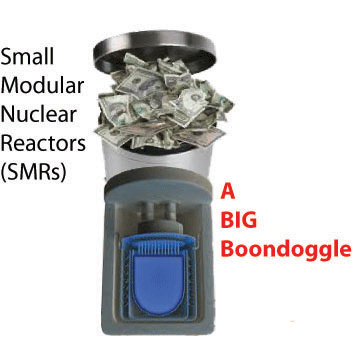 Taz 26th Oct 2020, The European pressurized water reactor Olkiluoto 3 has long since developed into a Finnish BER – at least twelve years too late, three times as expensive as planned. And it’s far from being online. The same goes for the
new Hanhikivi project: years behind before construction began .
But the Finnish nuclear lobby is already planning another nuclear energy adventure: the construction of so-called Small Modular Reactors (SMR). Paul Dorfman of the UK UCL Energy Institute and co-author of an SMR study by the Nuclear
Consulting Group estimates that small reactors would provide increasingly expensive energy due to the cost of materials and personnel : the massive investments that would be required to create a supply chain so that replacing the economies of scale of large reactors with the advantage of series production would make the investment risk for SMR even higher than for standard reactors.
Trump’s USA is pushing NuScale’s small nuclear reactors for South Africa.

The US nuclear company with an eye on South Africa just got a R23 billion boost, courtesy of Donald Trump, https://www.businessinsider.co.za/nuscale-nuclear-which-has-plans-for-sa-gets-a-big-us-subsidy-to-test-its-design-2020-10 Phillip de Wet , Business Insider SA Oct 22, 2020,
- American nuclear energy company NuScale has been citing Cape Town as an example of an ideal customer for its still-theoretical generators.
- It has now received in-principle financial support from the American government to build a nuclear power station in South Africa.
 NuScale’s pathfinder project for its new technology, in Idaho, just got a promise of an infusion of US government cash worth some R23 billion.
- While South Africa abandoned plans to create next-generation PBMR systems, the administration of Donald Trump has pushed small-scale nuclear development.
NuScale, a company with roots in US-funded research, this week received assurances that the American government will provide up to $1.4 billion (around R23 billion) in subsidies for a 12-module reactor it hopes to start building in Idaho by 2025.
The project is a commercial one, with municipal buyers lined up for the electricity, but the cash from the US department of energy is intended to bring the cost of that electricity down to $55 per MWh on a levelised cost of energy (LCOE) basis, making the project at least vaguely competitive with other forms of power generation.
Without the subsidies, the supposedly once-off cost of building a first-of-its kind power station would make the NuScale project commercially unviable, its planned customers say.
Just how once-off such costs are, and how much money the US government ends up actually spending on the project, will be closely watched in South Africa
Last week the US International Development Finance Corporation (DFC) announced it had signed a letter of intent to support NuScale “to develop 2,500 MW of nuclear energy in South Africa”.
NuScale has cited Cape Town as a purely theoretical customer for a 12-module version of its nuclear energy system, saying that such an installation could desalinate enough water to keep the entire city going.
But the 2,500MW number cited by the DFC suggests its South African ambitions are substantial. That is the full generating capability the South African government now envisages adding to the national grid from nuclear stations – but the government plan calls for a mixture of the conventional pressurised water reactors (PWRs) such as Russia’s Rosatom sells, and the type of small modular reactors (SMRs) NuScale is developing.
By seeking development finance for the full 2,500MW, NuScale appears to be signalling a plan to bid for the whole thing, rather than seeking to build only part of a new set of nuclear generators in SA alongside companies from China or elsewhere.
That matches the aggressive posture of the US government under the administration of Donald Trump. The DFC letter of intent is the first time the organisation has supported any nuclear project; a ban on its involvement in nuclear energy was lifted on the recommendation of a working group formed by the White House.
The state funding for the NuScale project in the US, meanwhile, comes after consistent and determined efforts under Trump’s presidency to “revitalise” nuclear energy in America, both in production and through research and development on next-generation systems.
South Africa, though determined to buy new nuclear power stations, has not had a similar political appetite to invest in research. In 2010 it mothballed work on the pebble bed modular reactor, a project launched in the late 1990s to create a safe, small, modular reactor system for both domestic use and sale abroad.
Russia once thought it had a done deal to build new nuclear reactors in South Africa. Half a decade later, thanks to its sheer political weight, China seems to be a serious contender for the job. Both France and South Korea have, at various points, been in the running too.
But as of this week, an American company with no track record of actually building commerical nuclear reactors yet is lining up the kind of money from the US government that could make its plans for South Africa viable – replacing a dream of home-grown next-generation nuclear with an imported version.
As of this year there are still vague plans to revive the project, in one form or another, but even if those were to succeed, the pace of development would have to be improbably fast for it to have any place in South Africa’s current round of explorations.
Another city leaves small nuclear reactor project – unanimous vote by Murray City Council, Utah
 Murray City votes to withdraw from nuclear power project, Salt Lake Tribune, By Taylor Stevens– 23 Oct 20, The Murray City Council voted unanimously this week to back out of a first-of-its-kind nuclear power project that has the support of a number of Utah municipalities.
It’s the fourth Utah city to exit the small modular nuclear reactor pursuit over the last few months amid pressure from opponents who have raised concerns about environmental and financial risks of the proposed 12-module plant, which would be located at Idaho National Laboratory in Idaho Falls and produce a total 720 megawatts of electricity.
During the city’s Tuesday council meeting, Murray Power Manager Blaine Haacke outlined several advantages of the project, including the potential that it could fill the energy gap that will be left when the Hunter Power Plant in Castle Dale goes offline in the coming years.
He told the council that he expects UAMPS will carry the project forward without Murray. But he said the association’s members will meet during the first week of November to make a final decision, after they find out how many cities have exited.
Very dubious claims made by proponents of NuScam’s small nuclear reactor plans
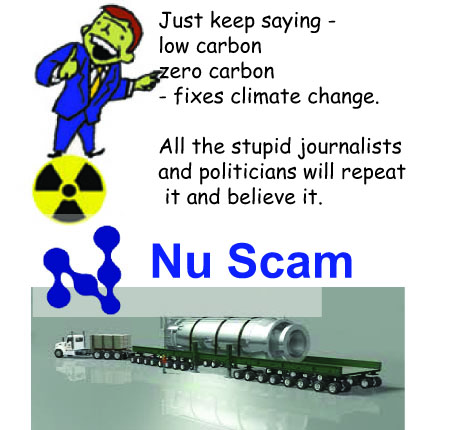 Small Nuclear Reactors Would Provide [a dubious claim] Carbon-Free Energy, but Would They Be Safe? Inside Climate News, Jonathan Moens, -21 Oct 20 Regulators have approved designs for 12 small reactors to be built in Idaho, but opponents say the project is dangerous and too late to fight climate change. “……… Last month, U.S. officials approved NuScale Power’s designs for 12 small nuclear reactors to be built in Boise, Idaho. The reactors could make use of the water, transmission lines and general infrastructure of former coal-powered plants in the West to produce clean energy, said Jose Reyes, co-founder of the company.
NuScale said the energy produced by its reactors would generate enough electricity to power about 50,000 homes across six Western states. The Utah Associated Municipal Power Systems, an energy cooperative, would be the first to build the reactors on a federal site at the Idaho National Laboratory.
The NuScale Power initiative has met with opposition from local environmental groups, who say that nuclear power is a dangerous and unsustainable energy source.
In addition, the highly radioactive waste from nuclear reactors must be securely stored indefinitely to prevent accidents, and contains plutonium and uranium that can be reprocessed into nuclear weapons. “We see this project as a way to create a whole new generation of high level radioactive waste,” said Scott Williams, executive director of Healthy Environment Alliance of Utah, a nuclear watchdog. ……
The designs underwent a public health and safety review by the Nuclear Regulatory Commission. But some scientists think they still aren’t safe enough. In a public statement, Edwin Lyman, director of nuclear power safety with the Union of Concerned Scientists, cited a report by a senior engineer at the Nuclear Regulatory Commission expressing concern that the cooling process might inadvertently cause “catastrophic” core damage to the reactors.
Other scientists worry that NuScale may be getting ahead of itself by not having a planning protocol for a radioactive emergency that affects areas around the site.
“In the event of an accident, the people around there will not have rehearsed how to do an evacuation,” said M.V. Ramana, a professor in the School of Public Policy and Global Affairs at the University of British Columbia. …….
Too Late in a Climate Crisis?
The municipal power systems cooperative still needs to obtain a license to build and begin operating the reactors. To do so, the project will undergo an additional site-specific review to consider the potential ecological, geographic and residential impact the technology may have on the area, said George Griffith, lead technician at the Idaho National Laboratory.
The delay means that while NuScale will be ready to manufacture modular reactors by around 2024, it will take an additional five to six years for them to be operational at the Idaho site, said Reyes.
Some experts, however, question whether 2029 is too late for the technology to be relevant in a time of climate crisis…….
Ramana, of the University of British Columbia, said, “While the overall capital cost [for small modular reactors] might be smaller, they also generate smaller amounts of electricity.” He outlined his concerns in a report released in September urging the Utah energy cooperative to “end their pursuit of small modular reactors.”
Ramana made clear that while devastating incidents associated with nuclear power plants might seem unlikely, we need to remain cautious.
“The lesson we should learn from all the many nuclear and other accidents that have happened with hazardous technologies, is a little bit of humility,” he said. https://insideclimatenews.org/news/20102020/small-nuclear-reactors-carbon-free-energy
Nuclear industry stagnates, renewables thrive- small nuclear reactors will be a terrible mistake for Canada
|
WORLD NUCLEAR INDUSTRY LOSES GROUND TO CHEAP RENEWABLES AS CANADA CONSIDERS SMALL MODULAR REACTORS, The Energy Mix SEPTEMBER 27, 2020 MITCHELL BEER @MITCHELLBEER
The world nuclear industry “continues to be in stasis,” with power plants shutting down at a faster rate in western Europe and the United States, the number of operating reactor units at a 30-year low, and the few new construction projects running into “catastrophic cost overruns and schedule slippages,” according to the latest edition of the annual World Nuclear Industry Status Report (WNISR), released last week. “Some 408 nuclear reactors were in operation in 31 countries as of July 2020, a decline of nine units from mid-2019 and 30 fewer than the 2002 peak of 438,” Reuters writes, citing the report. “The slow pace of new projects coming onstream also increased the overall age of the global fleet to around 31 years.” “Overall, in terms of the cost of power, new nuclear is clearly losing to wind and photovoltaics,” with the two renewable technologies now receiving about 10 times the investment, write Jungmin Kang, former chair of South Korea’s Nuclear Safety and Security Commission, South Korea, and Princeton University Professor Emeritus Frank von Hippel, in their foreword to the 361-page report. That meant new nuclear projects “were struggling to secure finance amid competition from renewables, with reported investment decisions for the construction of new nuclear plants at around US$31 billion in 2019,” Reuters says. One of the problems facing nuclear plants is that their high capital cost “requires that they operate almost continually to bring down the capital charge per kilowatt-hour,” Kang and von Hippel explain. “They must therefore compete directly with renewables most of the time or store their output to be used during cloudy, windless periods.” But “storage does not relieve the competition with wind and solar” since, “as renewables expand and storage costs come down, they too will have increasing incentives to store their excess output.” The report focuses in on COVID-19 as the first pandemic to have a significant, direct impact on the global nuclear industry, with large numbers of infections reported by the few operators that released precise figures. The WNISR says the pandemic has led to degraded safety and security and critical staffing issues at operating nuclear plants that also faced a tough economic hit when crashing electricity demand drove down power prices. In 2019, Russia had a hand in 15 of the 52 new nuclear construction projects around the world, and electricity generation from nuclear facilities grew 3.7%, with half of that total attributable to a 19% increase in China. But 33 of the 52 projects were behind schedule, and eight had been delayed by 10 years or more, “including two units that had construction starts 35 years ago and one unit that goes back 44 years,” WNISR notes. Of the 13 reactors scheduled for start-up last year, “only six made it,” including three in Russia, two in China, and one in South Korea—and no new nuclear facilities went online in the first half of 2020. Meanwhile, non-hydro renewables installed 184 gigawatts of new capacity in 2019, and “comparisons between nuclear and solar options show a large and widening gap,” the report states. “For example, a contract for 1.2 GW of solar power at US$24.20 per megawatt-hour, signed in 2017 and connected to the grid in 2019, is five to eight times cheaper than the international cost estimate for nuclear of US$118 to $192 per MWh.” [And that’s before the cost overruns that seems to be inevitable with most nuclear projects—Ed.] While “the biggest social argument for nuclear power plants is that their carbon emissions are low,” Kang and von Hippel write, that line of thought leads more toward refurbishing existing reactors—an area where the industry is also struggling. “In some major countries such as the United States, even 30-year-old plants whose capital costs have been paid off cannot compete economically with new renewable power plants, whose capital costs have been declining. The operating costs of nuclear plants are high in part because one to two hundred workers and guards are required onsite per reactor at all times in case of accident or terrorist attack.” And earlier this month, an incident in South Korea raised concerns about the reliability of nuclear generation in an era when climate change will make severe weather events more common and severe. The Kori nuclear plant was supplying 7% of the country’s electricity until it went into an automatic shutdown “because of typhoon impacts on their power transmission lines,” the two reviewers state. “Experts are concerned that, under different circumstances, the sudden shutdowns could destabilize South Korea’s grid and cause large-scale blackouts.” Paris-based consultant and lead WNISR author Mycle Schneider said the long-term headwinds facing nuclear development are even more daunting than the annual snapshot. Don’t just look at the photograph. Look at the movie,” he told The Energy Mix in an interview last week. “It takes an average of roughly 10 years to build a nuclear power plant from official construction start to grid connection,” even when a project isn’t delayed—which raises a particularly tough series of questions in the midst of a global climate emergency. “If I’m spending a dollar or a Euro or a yuan, I have to spend it in a way that allows me to reducogical renaissance through small modular reactors (SMRs). But “the industry is actually selling PowerPoint reactors, not detailed engineering, and it’s not the first time. They’ve been doing this for decades,” Schneider said. “Nobody, not even industry, pretends they can produce anything before 2030. That’s the earliest,” when 2050 is the latest possible deadline to decarbonize the entire global economy. Which means that, when it comes to SMRs, “it’s already very simple—it’s much too late, and we don’t know if it’ll work or what it’ll cost.”……….. “If I’m spending a dollar or a Euro or a yuan, I have to spend it in a way that allows me to reduce GHG emissions the most per dollar invested, the fastest.” Schneider said. But “if you look at nuclear power, it’s not only the most expensive, but it’s by far the slowest.” With even French nuclear giant EDF bidding against its own legacy technology to supply lower-cost solar projects, “do we really have to discuss what the future is or where this goes?” Schneider asked. “It’s obvious.” More recently, the nuclear industry has been promising a technological renaissance through small modular reactors (SMRs). But “the industry is actually selling PowerPoint reactors, not detailed engineering, and it’s not the first time. They’ve been doing this for decades,” Schneider said. “Nobody, not even industry, pretends they can produce anything before 2030. That’s the earliest,” when 2050 is the latest possible deadline to decarbonize the entire global economy. Which means that, when it comes to SMRs, “it’s already very simple—it’s much too late, and we don’t know if it’ll work or what it’ll cost.”……….. “Betting on nuclear as a climate solution is just sticking our heads in the sand because SMR technology is decades away, extremely expensive, and comes with a nasty pile of security and waste headaches,” Gibbons writes. “That our government would be this gullible is distressing, especially given the havoc already being wreaked by a changing climate.” Against concerns about intermittency of solar and wind, “it is fortunate that in Ontario we live beside a giant battery,” he adds. OCAA has long been an advocate for cross-border hydropower imports from Quebec to Ontario, and in the Sun, Gibbons notes that “Quebec has an enormous water power reservoir system that Hydro-Québec is keen to integrate with renewable sources for its out-of-province customers. When we have surplus solar and wind, Quebec stores water. When not, it produces hydropower for export.” The two provinces already “have the connections necessary to make this system work and can expand them, at a cost that looks like spare change next to what it costs to rebuild a nuclear reactor or get an SMR prototype built,” he adds. https://theenergymix.com/2020/09/27/world-nuclear-industry-loses-ground-to-cheap-renewables-as-canada-considers-small-modular-reactors/ |
|
Small Nuclear Reactors on the moon- desperate hope for the failing nuclear industry

While our species’ insatiable scientific curiosity has undoubtedly led to some beneficial inventions, it has also drawn us inexorably towards our own downfall. Our zeal to create the atomic bomb ignored logic, ethics, consequences and the fundamentals of human rights.
The bomb brought us so-called civil nuclear power reactors, the ugly and irresponsible spawn of a weapon that leaves us perched perpetually on the precipice of extinction. But there is nothing “civil” about nuclear power.
At the dawn of the nuclear energy age, not a thought was given to the legacy of deadly radioactive waste it would produce. That can was kicked summarily down the road. Now we are far down that road and no solution has been arrived at, while we ignore the one obvious one: stop making more of it!
So now comes the news that the US wants to put nuclear power reactors on the Moon.
In the news stories that followed the announcement, replete with the usual excitement about space exploration (never mind the cost and bellicose implications) there was not one single mention of the radioactive waste these reactors would produce.
The problem, like the waste itself, will simply be kicked into some invisible crater on the dark side of the Moon.
NASA, the US Department of Energy and assorted nuclear labs are pushing the small modular reactor for nuclear projects on the  Moon and Mars. Desperate to stay relevant and to continue gobbling up taxpayer dollars, this is music to the failing nuclear industry’s ears. Financially disastrous and technically unresolved on Earth, the SMR, say these “experts”, is ideally suited to the needs of humans living for extensive periods in space.
Since each of these mini-reactors will likely have an uninterrupted output of only 10 kilowatts, it will take multiple reactors on the Moon or Mars to fulfill the necessary functions for their human inhabitants.
Needless to say, so far there is no certified design, no test reactor, no actual reactor, and no fool-proof way to send such a reactor to the Moon. (Rockets have an unfortunate habit of sometimes blowing up on — or shortly after — launch.) Nevertheless, the year 2026 is the ambitious target date for all systems go. In keeping with the theme, “pie in the sky” springs to mind.
While no reactor design has been identified, it will most likely need to use highly enriched uranium (HEU) which puts the reactor firmly in violation of non-proliferation standards. As Dr. Edwin Lyman of the Union of Concerned Scientists told PBS Newshour, “This may drive or start an international space race to build and deploy new types of reactors requiring highly enriched uranium.”
Given the utility of HEU for nuclear weapons use, and the probes currently being sent to the Moon and Mars by “unfriendly” countries such as China and the United Arab Emirates, it does not take much of an imagination to envisage the temptation for theft by force. Will the US deploy guards around its lunar reactors.? Will we see terrorism on the Moon, even war?
What is this really all about? Profit? Prestige? Proliferation? The Idaho National Laboratory, which is eager to develop the lunar SMR prototype, sees this as an opportunity to emphasize “the United States’ global leadership in nuclear innovation,” the lab’s John Wagner told Newshour.
This echoes the mantra parroted by almost every federal institution and corporation seeking to justify some new and exorbitant nuclear expense: we cannot let China and Russia take over; the US must retain — or regain — pre-eminence in the nuclear sector and in space. And so on.
It’s not being cute to call this lunacy. With the ever-expanding crises on Earth, caused by the ravaging effects of climate change as well as the current pandemic, spending exorbitant sums to stick reactors on the Moon or Mars is more than madness; it is morally irresponsible. It abandons most of us on Earth to our fate, while, just maybe, possibly, someday, a handful of people will head off to the Red Planet. Never to return.
Yet undeterred by immorality and expense, and apparently without the slightest concern for the radioactive dirt pile these reactors will produce, NASA and the Department of Energy are eagerly soliciting proposals.
And what will these lunar reactors do? They will enable “capability for a sustained lunar presence, particularly for surviving a lunar night,” NASA’s Anthony Calomino told Space News. “The surface of the moon provides us an opportunity to fabricate, test and flight qualify a space fission system,” he said.
The Moon is seen as our launchpad to Mars. Now, it seems, it will also become our latest nuclear dustbin. If there is a meltdown, or a cascade of accidents among the cluster of small identical reactors there, all of which could suffer the same failure at the same time, it will become our next nuclear wasteland.
I am happy to say “goodnight moon.” But I don’t wan’t to say “goodbye.”
Hypocrisy prize to U.S. International Development Finance Corporation (DFC), for pretending that NuScam’s Small Nuclear Reactors are ”foreign aid”

|
DFC Convenes U.S., African Leaders for Investment Conference, U.S. International Development Finance Corporation (DFC), October 16, 2020 Announces new efforts aimed at bolstering agency’s reach across continent. WASHINGTON – Today, U.S. International Development Finance Corporation (DFC) and the Atlantic Council hosted the virtual Investing in Africa’s Future conference to bring together African heads of state, senior U.S. government officials, African development finance institutions and others to announce new efforts to promote and strengthen U.S. trade and investment in Africa, in support of the Administration’s Prosper Africa Initiative…….. DFC made the following announcements during the summit: …………
LOI for Nuclear in South Africa: In July 2020, DFC updated and modernized its nuclear energy policy—ending its prohibition on supporting nuclear power in order to help meet the energy needs in the developing world. DFC signed a Letter of Intent to support NuScale, a U.S. nuclear energy technology firm, to develop 2,500 MW of nuclear energy in South Africa. If successful, NuScale would be the first U.S. nuclear energy IPP on the continent and would help support energy resilience and security in one of Africa’s leading economies and a key partner on the continent for the United States Government……….. https://www.dfc.gov/media/press-releases/dfc-convenes-us-african-leaders-investment-conference
|
|
1 This Month



26 September – International Day for the Total Elimination of Nuclear Weapons


PLEASE OPPOSE HR 8255 AND S.3639 – bills would accelerate satellite deployment, with no environmental review or safeguards – https://ncstd5li.quorum.us/campaign/169331/
To see nuclear-related stories in greater depth and intensity – go to https://nuclearinformation.wordpress.com
-
Archives
- September 2026 (233)
- August 2026 (330)
- July 2026 (355)
- June 2026 (287)
- May 2026 (306)
- April 2026 (356)
- March 2026 (251)
- February 2026 (267)
- January 2026 (308)
- December 2025 (358)
- November 2025 (359)
- October 2025 (375)
-
Categories
- 1
- 1 NUCLEAR ISSUES
- business and costs
- climate change
- culture and arts
- ENERGY
- environment
- health
- history
- indigenous issues
- Legal
- marketing of nuclear
- media
- opposition to nuclear
- PERSONAL STORIES
- politics
- politics international
- Religion and ethics
- safety
- secrets,lies and civil liberties
- spinbuster
- technology
- Uranium
- wastes
- weapons and war
- Women
- 2 WORLD
- ACTION
- AFRICA
- Atrocities
- AUSTRALIA
- Christina's notes
- Christina's themes
- culture and arts
- Events
- Fuk 2022
- Fuk 2023
- Fukushima 2017
- Fukushima 2018
- fukushima 2019
- Fukushima 2020
- Fukushima 2021
- general
- global warming
- Humour (God we need it)
- Nuclear
- RARE EARTHS
- Reference
- resources – print
- Resources -audiovicual
- Weekly Newsletter
- World
- World Nuclear
- YouTube
-
RSS
Entries RSS
Comments RSS
 nuclear-news