Fluor could improve its finances by abandoning NuScam, as some cities pull out of ”small” nuclear reactor scheme
 Fluor could improve earnings by reducing underperforming assets, including NuScale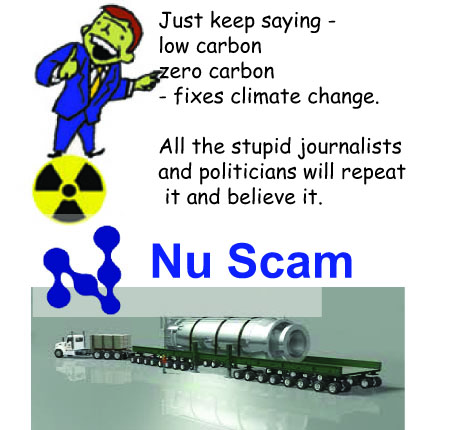
But two cities, Logan and Lehi, Utah have walked away from the project, and a third is now considering dropping its support because of risks and a lack of backers, according to officials.
Allen Johnson, the power department director for Bountiful, Utah, said chances are greater than 50-50 it will withdraw.
“You’ve got to have enough people to support it and some of the players I thought would be interested are not,” he said.
The defections are bad news for U.S. efforts to develop modular nuclear energy …
Combined, cities have so far committed to buying just under 200 megawatts of the plant’s planned 720 megawatts of power.
The U.S. Department of Energy has pumped more the $280 million into the project since 2013, and is expected to commit another $1.4 billion over the next nine years. The department did not respond to requests for comment…….
The consortium earlier this year pushed back the project’s commercial operation date to 2030 from 2026, Webb said, to provide more time for public input and opportunities for cities to reconsider their participation at various phases.
CITIES RETHINK COSTS
NuScale, based in Portland, Oregon, is majority owned by construction and engineering firm Fluor Corp.
The project would include 12 60-megawatt modules at the Energy Department’s Idaho National Laboratory.
The Nuclear Regulatory Commission last week approved NuScale’s design, the first such green light for a modular reactor.
Small modular reactors are meant to be cheaper and quicker to build than traditional reactors because they can be manufactured in factories. But critics say economies of scale are lost with the smaller plants.
The NuScale project’s projected cost of $6.1 billion has risen from $3.6 billion in 2017, Mark Montgomery, head of the municipal utility in Logan told officials there last month ahead of their vote to abandon the project.
Lehi withdrew from the project due to a lack of interest from other entities and increased costs, according to the Aug. 25 resolution approved by its city council.
“These cities should not be acting as venture capital investors,” said Rusty Cannon, vice president of the Utah Taxpayers Association, which has been pushing cities to leave.
Previous cost estimates did not account for financing and decommissioning, as well as higher labor, construction and materials costs over ten years, UAMPS spokesman Webb said, explaining the change.
NuScale said the project delay had been requested by UAMPS. It did not comment specifically on the city defections.
A Wednesday report written by M.V. Ramana a professor of disarmament and human security at the University of British Columbia said Fluor had cut its own investment in the project and excluded NuScale expenses from its financial forecasts because it was expecting additional funding from third party investors.
Financial analyst Jamie Cook of Credit Suisse said last year that Fluor could improve earnings by reducing underperforming assets, including NuScale. ………https://whtc.com/news/articles/2020/sep/02/some-us-cities-turn-against-first-planned-small-scale-nuclear-plant/1054578/
Small nuclear reactors – NuScam looking dodgy as parent company Fluor shares sink?
declined by -15.01% in the 3 months of the year. Over the past six months meanwhile, it has lost -19.89% and lost -47.51% year-on date. DBT News 25 August 20
Small nuclear reactor NuScam’s parent company Fluor sued over allegations of insider trading and deception
 Fluor Board Sued Over Insider Trading, Accounting Allegations, Mike Leonard, Legal Reporter, Aug. 14, 2020, COURT: Del. Ch., TRACK DOCKET: No. 2020-0655 (Bloomberg Law Subscription, JUDGE: J. Travis Laster (Bloomberg Law Subscription), COMPANY INFO: Fluor Corp. (Bloomberg Law Subscripti
The board of Fluor Corp., a leading engineering and construction conglomerate that does significant business with the federal government, has been hit with a Delaware lawsuit claiming several of its members sold stock at inflated prices while conspiring to mask the company’s deteriorating finances.
“At the same time,” Fluor’s board and top executives “engaged in a pattern” of having the company “repurchase its own shares at over-inflated prices,” the 98-page Chancery Court complaint says. “This repurchase of inflated stock cost the company over $1.6 billion.”
The heavily redacted derivative suit, made public Wednesday, comes about three months after Fluor……….(subscribers only) https://news.bloomberglaw.com/mergers-and-antitrust/fluor-board-sued-over-insider-trading-accounting-allegations
Small nuclear reactor NuScam’s parent company Fluor – shares tumble afterdisclosure of accounting probe
Fluor Shares Tumble After Disclosure of SEC Accounting Probe, Fluor shares are tumbling after the engineering company disclosed an SEC probe into its past accounting and financial reporting. ROB LENIHAN, FEB 18, 2020
Fluor (FLR) – Get Report shares were tumbling after the engineering and construction company said the Securities and Exchange Commission is looking into the company’s past accounting and financial reporting.
The Irving, Texas, company also said in a statement that the SEC has asked for documents and information related to projects for which the Company recorded charges in the second quarter of 2019……. https://www.thestreet.com/investing/stocks/fluor-shares-tumble-after-engineering-company-discloses-sec-probe
Lehi City Council backs out of NuScam ‘small’ nuclear reactor project
 Daily Herald 26 Aug 20,
The Lehi City Council voted unanimously Tuesday to withdraw the city from a multiagency nuclear power project that would provide nuclear power to cities across Utah, citing concerns over increasing costs.
The Carbon Free Power Project is an initiative by Oregon-based NuScale Power, the Utah Associated Municipal Power Systems and the United States Department of Energy to build a small modular reactor power plant at the Idaho National Laboratory………
Earlier this month, the Utah Taxpayer Association called on cities to withdraw from the project ahead of the Sept. 14 deadline after a closed-door virtual town hall meeting on July 21 where officials warned of project delays, increased costs to cities and towns involved, and “dependence on unpredictable federal subsidies.”
“The UAMPS project will lock in 27 municipalities in Utah and several in surrounding states for a share of billions of dollars in costs and unclear risk in the pursuit of a cluster of small modular reactors (SMRs) touted by Oregon-based NuScale Power, which repeatedly has delayed timelines and increased costs associated with its SMRs,” Utah Taxpayer Association Vice President Rusty Cannon said in an Aug. 4 news release. “The risky project with massive cost escalations is being conducted largely out of the public eye.”
Earlier this month, the Utah Taxpayer Association called on cities to withdraw from the project ahead of the Sept. 14 deadline after a closed-door virtual town hall meeting on July 21 where officials warned of project delays, increased costs to cities and towns involved, and “dependence on unpredictable federal subsidies.”
“The UAMPS project will lock in 27 municipalities in Utah and several in surrounding states for a share of billions of dollars in costs and unclear risk in the pursuit of a cluster of small modular reactors (SMRs) touted by Oregon-based NuScale Power, which repeatedly has delayed timelines and increased costs associated with its SMRs,” Utah Taxpayer Association Vice President Rusty Cannon said in an Aug. 4 news release. “The risky project with massive cost escalations is being conducted largely out of the public eye.”
In November 2017, the total cost of the project was estimated at $3.6 billion. By November 2019, that number had increased to $4.2 billion. By July, the estimated cost had gone up to $6.1 billion.
That would cost Lehi $466 million at the city’s current subscription levels, Eves said. UAMPS would be responsible for paying $4.8 billion, while the DOE would pay $1.3 billion and NuScale Power would pay $5 million. ………… https://www.heraldextra.com/news/local/govt-and-politics/lehi-city-council-votes-to-back-out-of-nuclear-power-project-contract/article_0af6e67c-24e5-5427-9029-e52b9f9d63ae.html
Two U.S.cities cut their losses, pullout of dodgy NuScam “small” nuclear reactor project
|
Lehi, Logan Back Out Of First-Of-Its-Kind Nuclear Power Plant Project Citing Financial Risk InKuer, By KATE GROETZINGER • 27 Aug 20, Two Utah cities have pulled out of a nuclear power plant investment — saying the financial risks are just too high. But 28 other towns and service districts in the state are still involved in the project, which is organized by a utility cooperative called Utah Associated Municipal Power Systems, or UAMPS. The Carbon Free Power Project involves a first-of-its-kind technology called “small modular nuclear reactors”, which would produce around 720 megawatts of nuclear energy. UAMPS and the U.S. Department of Energy have invested $3 million in the project since it began in 2017. But the reactors are still in development, and it’s unclear how much the project — and the power — will ultimately cost. That’s one reason the city of Logan cited in its decision to leave the project ahead of a Sept. 30 deadline to invest in its next phase, which is expected to cost $130 million. Logan was planning to use seven megawatts of power from the plant and has put around $250,000 into the project based on that amount so far. The city would have had to put in another $654,000 over the next three years to remain invested in the project. The cost could continue to grow, according to Mark Montgomery, director of light and power for Logan. He told the city council that Logan could end up having to pay millions into the project during the second phase of its licensing period, from 2023 to 2025……. Montgomery also cited concerns that it’s still up in the air whether the Department of Energy will invest in the project. The department pledged to fully fund the first reactor in 2018, but it went back on that deal. Now, it plans to invest $1.4 billion in the project — about a quarter of its total $6 billion price tag. That agreement is not yet final and the appropriation would need to be approved by Congress. The city of Lehi also voted to leave the project during a city council meeting this week. So far, Lehi has invested $455,000 in the project for a 21 megawatt subscription. Power Director Joel Eves said the project has struggled to find new investors, while its budget almost doubled to $6 billion from $3.4 billion since 2017. “A big piece of this is project subscription, and that does make us nervous,” Eves said. “It seems like we’re going at this alone as UAMPS members.” ……. https://www.kuer.org/post/lehi-logan-back-out-first-its-kind-nuclear-power-plant-project-citing-financial-risk#stream/0 |
|
City in Northern Utah pulls out of NuScam small nuclear reactors project
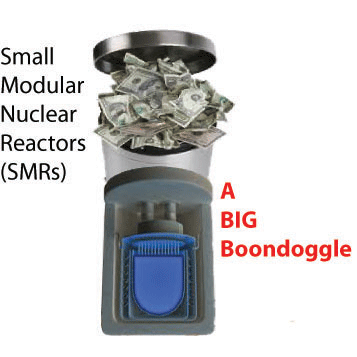
Northern Utah city opts out of planned nuclear power project over money concerns Deseret News, Amy Joi O’Donoghue @Amyjoi 16 Aug 24, 2020,
SALT LAKE CITY — Cost concerns over Logan’s participation in a next-generation nuclear power plant planned at Idaho National Laboratory led the city to withdraw from the project, and Lehi is considering a similar move in its council meeting Tuesday.
“My concerns were many and varied,” Logan Finance Director Richard Anderson said of last week’s decision
……. changes in funding by the U.S. Department of Energy for the Carbon Free Power Project caused Anderson concern, as it did for Mark Montgomery, the city’s light and power director, and prompted both of them to recommend Logan withdraw its participation.
Ultimately, the energy department committed to spend $1.4 billion on the project with an eye toward reducing carbon emissions, combating climate change and to position the country as a world leader in nuclear technology.
But critics say the proposed 720-megawatt plant is too risky and ratepayers — hence taxpayers — should not be footing the cost for technology they say is yet to be proven.
LaVarr Webb, spokesman for the municipal power association, said the investment schedule was specifically designed with these exit opportunities if cities or special districts become nervous.
The project, he added, will not proceed if costs prove too high.
The project has also come under criticism for what some say is a lack of transparency.
Earlier this month, the Utah Taxpayers Association urged cities to withdraw ahead of the deadline and complained about meetings in which groups were turned away unless they were project participants.
Rusty Cannon, vice president of Utah Taxpayers Association, said because the municipal power association is exempt from Utah’s open meeting laws, it can close its doors to others.
“We asked to observe a recent meeting and were denied access. That is the same response many others have also received,” Cannon said.
While association leaders have spent hours on video calls with the association and others, Cannon said that format does not provide the same answers.
Webb said meetings in which non-project participants were turned away, with perhaps the exception of one, are in line with why other governmental entities can close meetings under Utah law, such as contractual issues, litigation or personnel issues.
On Tuesday in Lehi, the City Council will consider a resolution outlining the city’s withdrawal from the project……. https://www.deseret.com/utah/2020/8/24/21399537/northern-utah-city-opts-out-of-planned-nuclear-power-project-over-money-concerns
Canada communities don’t want the so-called “clean” Small Modular Nuclear Reactors (SMRs)

even with SMRs under 300 megawatts, nuclear waste is a byproduct.
waste generated from SMRs would become a dangerous part of the transportation system “even if they do remove it.”
“It will be big, big transports of highly radioactive stuff, driving down the roads as an easy dirty bomb
the high cost of building infrastructure and then containing nuclear fallout and radiation are all concerns before they can go ahead.
Nuclear giants team up to develop reactors in Sask. and Ontario, Michael Bramadat-Willcock / Local Journalism Initiative Reporter, National Observer, AUGUST 23, 2020
Canada’s leading nuclear industry players announced an inter-provincial corporate partnership Thursday to support the launch of a research centre that will work on developing small modular reactors (SMRs) for use in Saskatchewan.
Saskatoon-based Cameco is the world’s biggest uranium producer and has long supplied fuel to Bruce Power, Ontario’s largest nuclear power company.SMRs are designed to produce smaller amounts of electricity, between 50 and 300 megawatts,……
The secretariat is mandated to develop and execute a strategic plan for the use of “clean-energy small modular reactors” in the province. ……
No timeframe or SMR sites were included in the announcement, but the government’s plans already have some northern residents raising alarms.
Committee for Future Generations outreach co-ordinator Candyce Paul of La Plonge at the English River First Nation told Canada’s National Observer that they haven’t been consulted on any aspects of the plan, but all signs point to the north as a site for the reactors.
Paul’s group fights nuclear waste storage in Saskatchewan and was instrumental in stopping a proposal that considered Beauval, Pinehouse and Creighton as storage locations in 2011.
“When we informed the communities that they were looking at planning to bury nuclear waste up here in 2011, once they learned what that entailed, everybody said no way. Eighty per cent of the people in the north said no way, absolutely not. It didn’t matter if they worked for Cameco or the other mines. They said if it comes here, we will not support it coming here,” she said.
Paul said she sees small modular nuclear reactors as another threat to the environment and to human safety in the region.
She noted that even with SMRs under 300 megawatts, nuclear waste is a byproduct.
“Even if they’re not burying nuclear waste here, they could be leaving it on site or hauling it through our northern regions and across our waterways,” Paul said.
She said that waste generated from SMRs would become a dangerous part of the transportation system “even if they do remove it.”
“It will be big, big transports of highly radioactive stuff, driving down the roads as an easy dirty bomb. You’d be driving down the road (behind a nuclear waste transport vehicle) and not know you’re following it,” Paul said.
Paul said the intent behind installing SMRs is anything but green and that the real goal is to prop up Saskatchewan’s ailing uranium industry and develop oilsands in the northwest.
Paul said that communities around Canada, and especially in the Far North, have long been pitched as sites for SMR development and have refused.
A 2018 brief from Pangnirtung Hamlet Council in Nunavut concluded “any Arctic-based nuclear power source should be an alternative energy choice of last resort.”
“None of our people are going to get trained for operating these. It supports people from other places. It doesn’t really support us,” Paul said.
SMRs have been pitched in the north as a way to move away from reliance on diesel fuel, which can be costly. Paul said any benefits of that remain to be seen.
She said companies would need to do environmental impact assessments for smaller reactors even though the exclusion zone around SMR sites is smaller.
“Even if the exclusion zone is only a few kilometres, a few kilometres affects a lot in an ecosystem and especially in an ecosystem that is wild,” Paul said.
“I’m not feeling confident in this at all, Canadian nuclear laboratories saying that it would only be a small radius exclusion zone. Well that’s our territory. That’s our land, our waters, our wildlife.
“It’s not their backyard, so they couldn’t care less.”
Brooke Dobni, professor of strategy at the University of Saskatchewan’s Edwards School of Business, told Canada’s National Observer that any development of small reactors would take a long time.
“It could be a good thing, but on the other hand, it might have some pitfalls. Those talks take years,” Dobni said.
He said nuclear reactors face bigger challenges because of public concerns about the environment and that the high cost of building infrastructure and then containing nuclear fallout and radiation are all concerns before they can go ahead.
“Anything nuclear is 25 years out if you’re talking about small reactors, those kinds of things to power up the city,” Dobni said.
“That technology is a long ways away and a lot of it’s going to depend on public opinion.
The court for that is the court of public opinion, whether or not people want that in their own backyard, and that’s the whole issue anywhere in the world.” https://www.humboldtjournal.ca/news/nuclear-giants-team-up-to-develop-reactors-in-sask-and-ontario-1.24191077
Small Modular Nuclear Reactors costs jump by $billions. Logan city abandons NuScam project

|
Logan withdraws from nuclear power project seen as cutting-edge but risky, KSL.com
By Graham Dudley, KSL.com – Aug. 20, 2020 LOGAN — A hesitant Logan City Council agreed to follow staff recommendations Tuesday and voted to leave a nuclear power project that has been characterized by ballooning costs and funding uncertainties.The Carbon Free Power Project aims to begin producing nuclear power from state-of-the-art small modular reactors But the projected cost of the power plant jumped from about $3.6 billion in 2017 to more than $6.1 billion in 2020. Logan has already committed more than $400,000 to the project and would have paid over $650,000 more in the next three years to see it through its next phase, at which point the city would again have had the option to modify or withdraw from the agreement. The project involves the Utah Associated Municipal Power Systems, or UAMPS, a political subdivision of the state of Utah which supplies energy to communities in six Western states and of which Logan is a member. The reactors are being built by Oregon-based NuScale, and the Texas-based Fluor Corporation is involved in project construction Logan council members reviewed the city’s involvement in the Carbon Free Power Project during their Aug. 4 and Aug. 18 meetings, ultimately voting 4-1 to leave the agreement…….. https://www.ksl.com/article/50008552/logan-withdraws-from-nuclear-power-project-seen-as-cutting-edge-but-risky |
|
City of Logan cuts its losses, withdraws from risky NuScam “small” nuclear reactor project
Logan withdraws from risky nuclear power project, Cache Valley Daily Charlie Schill August 19, 2020 LOGAN – Members of the Logan City Council voted Tuesday to end the city’s partnership in an increasingly expensive nuclear power project.
As a member of the Utah Associated Municipal Power Systems (UAMPS), Logan City owned a partial interest in a first-of-its-kind nuclear plant proposed to be constructed at the Idaho National Laboratory.
Faced with Sept. 15 deadline to ante up more funding for the risky project, both Mark Montgomery, the city’s light and power director, and Logan Finance Director Richard Anderson recommended that Logan withdraw from the Carbon Free Power Project…….
Montgomery told city council members that Logan had invested about $400,000 in the Small Modular Reactor (SMR) project since 2017. If the city had opted to continue its participation in the project into its initial licensing phase through 2023, the price tag would have been another $654,000.
In early August, the Utah Taxpayers Association urged all Utah cities to reconsider their participation in the SMR project due to its potential for out–of-control costs………
In the original CFPP proposal, the U.S. Department of Energy was to foot the bill for the development of the project’s first module. After pledging up to $1.4 billion for those expenses, federal officials have since backed out of that agreement, leaving UAMPS holding the bag for the project’s first-of-its-kind risks.
Montgomery added that estimated cost of the project have also escalated since 2017, jumping from $3.6 billion to $6.1 billion as of July of this year……… https://www.cachevalleydaily.com/news/archive/2020/08/19/logan-withdraws-from-risky-nuclear-power-project/#.X0BMOOgzbIU
Alberta premier’s small nukes pipe dream makes no economic sense.
Look Over There! Jason Kenney’s Phoney Nuclear Power  Distraction Why the Alberta premier’s small nukes pipe dream makes no economic sense., David Climenhaga 14 Aug 20, | TheTyee.ca
When Alberta Premier Jason Kenney says small nuclear reactors “could be a game changer in providing safe, zero-emitting, baseload power in many areas of the province,” as he did this week in a tweet, he’s pulling your leg…….
No electrical utility is ever going to buy one unless they are forced to by government policy or regulation — the kind of thing Alberta’s United Conservative Party purports to oppose……..
Small nuclear reactors are not as cheap to build as the premier’s fairy tale suggests.
Bringing an acceptable small nuclear reactor design all the way from the drawing board to approval by a national nuclear regulatory authority will cost hundreds of millions of dollars.
While dozens of speculative companies are printing colourful brochures with pretty pictures of little nukes being trucked to their destinations, very few are serious ventures with any possibility of building an actual reactor. The United Nations International Atomic Energy Agency says diplomatically there are about 50 concepts “at different stages of development.” Those that are serious, like NuScale Power in the United States, have huge amounts of government money behind them.
The only small nuclear reactor plant known to be operating in the world now is the Akademik Lomonosov, Russia’s floating power barge with two 35-megawatt reactors aboard. From an original estimate of US$140 million in 2006, its cost had ballooned to US$740 million when the vessel was launched last year.
The kind of small reactors Kenney is talking about won’t be cheap by any yardstick.
Small reactors are less economical to run than big reactors…….
This is why nobody wanted to buy the scaled-down CANDU-3 reactor, development of which was paid for by Canadian taxpayers in the 1980s. At 300 megawatts, they were just too small for commercial viability. A working CANDU-3 has never been built.
The cost of small reactors would have to come down significantly to change this. And remember, the research and development requirements of small reactors are just as high as for big ones. With nobody manufacturing modules, there are no existing economies of scale. In other words, dreamy brochures about the future of small reactors are just that — dreams.
By the way, in 2011 the Harper government privatized the best commercial assets of Crown-owned Atomic Energy of Canada Ltd. to… wait for it… SNC-Lavalin Group Inc. Think about that every time you hear Conservatives in Ottawa screeching about the goings on at SNC-Lavalin!
Small reactor designs mostly require enriched uranium, and Canada doesn’t produce any……
Small reactors might be safer than big ones, but we don’t really know.
Kenney and Savage talk about small reactors as if it were a fact they’re safer than big reactors. Maybe they are. But we don’t really know that because nobody but the Russians actually seems to have built one, and in most cases they haven’t even been designed.
Remember, the Russians’ small reactors are both on a barge. For what it’s worth, critics have called it “Floating Chernobyl.”
Small reactors won’t be safe without public regulation……..
Then there’s the matter of waste disposal.
Nuclear plants don’t produce a lot of waste by volume, but what there is sure has the potential to cause problems for a very long time. Thousands of years and more. So safe storage is an issue with small nukes, just like it is with big ones.
Where are we going to store the waste from all these wonderful small nuclear reactors Kenney is talking about?
How many jobs is it likely to create here in Western Canada? Well, Saskatchewan’s Ministry of Environment recently posted a job for a director of small modular reactors. That person will supervise four people. That’s probably about it for jobs for the foreseeable future.
If Alberta ever ends up with the same number of people working on this, we’ll be lucky https://thetyee.ca/Analysis/2020/08/13/Kenney-Nuclear-Power-Plant-Distraction/
Even with $1.4 billion government subsidy, NuScam’s nuclear station is still a dodgy prospect

The NuScale SMR plant is designed to be built with up to a dozen 60-MW reactor modules.
UAMPS is seeking other utilities throughout the West to purchase hundreds of megawatts of the $6 billion project’s output, but no utility has agreed to such a purchase.
Utah Taxpayer Association Vice President Rusty Cannon said UAMPS members currently committed to the project should withdraw from it because of the risks.
“The development of untried new designs is no place for small utilities with no nuclear construction experience to risk their customers’ money,” former NRC Commissioner Peter Bradford said during the briefing.
the first module is now expected to be operational in June 2029. Previously NuScale had targeted commercial operation of at least one reactor module in 2027.
|
Municipal power group awaits $1.4 billion from DOE for Idaho nuclear plant, https://www.spglobal.com/platts/en/market-insights/latest-news/electric-power/081320-municipal-power-group-awaits-14-billion-from-doe-for-idaho-nuclear-plant Author, Michael McAuliffe , Editor Keiron Greenhalgh 14 Aug 20, HIGHLIGHTS Utah Associated Municipal Power Systems (UAMPS) members face September decision on project Startup of first unit delayed to 2029 from 2027 Odds of members agreeing to go forward 50/50: muni Washington — A Utah municipal power association is expecting an influx of $1.4 billion in federal funds for the small modular reactor plant it is looking to build in Idaho, but association members are still deciding whether to go forward with the 720-MW project and the completion date has recently slipped, officials said. Continue reading |
NuScam’s (sort of) small nuclear reactors rejected by Utah Taxpayers Association
Critics of planned nuclear power project urge Utah cities to pull out before it’s too late, Utah Taxpayers Association warns it believes proposal is too costly, not transparent DeseretNews, By Amy Joi O’Donoghue@Amyjoi16 Aug 4, 2020 SALT LAKE CITY — The Utah Taxpayers Association and a former member of the U.S. Nuclear Regulatory Commission are urging cities that have signed on to a planned nuclear power plant in Idaho to get out while they can before costs become too great.
NuScale’s Small Modular Reactor is planned for construction at the Idaho National Laboratory near Idaho Falls and would provide 720 megawatts of power, or enough energy for 720,000 homes.
The Carbon Free Power Project is promoted as the next generation design for nuclear power, featuring 12 distinct modules, with the first scheduled to come online in 2029 with the 11 others following the next year.
The project is a collaborative effort involving the U.S. Department of Energy, NuScale and the Utah Associated Municipal Power Systems, a political subdivision of the state of Utah. ……
there are several off-ramps in those phases for cities to exit, one of which is coming up Sept. 14. That deadline prompted the taxpayers association to urge cities to get out now before they get trapped into paying millions for a technology it says is unproven.
“Small modular reactor power is just not cost competitive,” said Rusty Cannon, vice president of the taxpayer group, adding participating cities and districts should hold a public vote to withdraw from the project……..
Peter Bradford, a former member of the U.S. Nuclear Regulatory Commission, said enthusiasm over new developments in nuclear technology that turned out to be flawed have cost ratepayers and taxpayers in multiple states billions of dollars.
He said that of 31 projects pending before the commission in 2009, only two remain — with the rest canceled or indefinitely postponed.
“The stranded costs of nuclear plants paid off by customers in the 1990s exceeded $50 billion nationwide,” he said. “Each period of abject failure is followed by an array of new proposals.”…….
The project is backed heavily by the U.S. Department of Energy, which gave NuScale a competitive award of $226 million in 2013 to develop the technology. Two years later, the federal agency gave NuScale $16.7 million for licensing preparation……..
Cannon and Bradford also criticized the municipal power association for not being transparent enough because its briefing meetings are exempt from the Utah open meetings law and are closed……… https://www.deseret.com/utah/2020/8/4/21354171/critics-nuclear-power-project-urge-utah-cities-pull-out-nuscale-small-modular-reactor-idaho
Utah Taxpayers – NuScam nuclear power project costly and public kept in the dark
 New Information Disclosed in Meeting Closed to Public Points to Major Budget Commitments, Delay Risks in UAMPS Power Project https://utahtaxpayers.org/new-information-disclosed-in-meeting-closed-to-public-points-to-major-budget-commitments-delay-risks-in-uamps-nuclear-power-project/
by Tax Watchdog | Aug 4, 2020 “We Need Public Hearings and We Need Public Votes”: UTA Calls for Full Transparency and Accountability Ahead of September 14th Deadline; Parallels Seen to Ohio, Illinois and South Carolina Nuclear Controversies Where Public Was Kept in the Dark.
SALT LAKE CITY – August 4, 2020 – Utah Associated Municipal Power Systems (UAMPS) and NuScale Power held an “online town hall meeting” on July 21st, but there was just one problem: due to a quirk in Utah’s open meeting laws, the town was not invited. Not only did UAMPS/NuScale fail to be transparent in terms of the meeting about their controversial small modular nuclear reactor plans, but they also failed to disclose new and troubling information that emerged during the behind-closed-doors virtual session, according to the nonprofit Utah Taxpayers Association (UTA). UTA and Peter Bradford, a former U.S. Nuclear Regulatory Commission (NRC) member, warned that potentially higher costs, project delays, and other risks could be costly for UAMPS members and ratepayers.
A total of 34 municipalities in Utah, Idaho, New Mexico and California (see full list below) are participating in the UAMPS small modular nuclear project. Ratepayers will be locked into more than $100 million in commitments by a September 14th deadline and billions of dollars of risks later on if UAMPS members do not opt out of the project. The need for openness is particularly important while the nuclear industry is currently facing major credibility problems with scandals in Ohio, Illinois, and South Carolina.
On July 21st, UAMPS and NuScale held a so-called “online town hall meeting,” which was not made open to the media under a special Utah exemption for UAMPS for open meeting requirements. A video copy of the UAMPS/NuScale event was acquired after the fact. (The timecodes shown below refer to various points in the video.)
Rusty Cannon, Vice President, Utah Taxpayers Association, said: “The UAMPS project will lock in 27 municipalities in Utah and several in surrounding states for a share of billions of dollars in costs and unclear risk in the pursuit of a cluster of small modular reactors (SMRs) touted by Oregon-based NuScale Power, which repeatedly has delayed timelines and increased costs associated with its SMRs.”
Cannon added: “This risky project with massive cost escalations is being conducted largely out of the public eye. Most recently the public was barred from a late July online ‘town hall meeting,’ the content of which has since come to light and which raises serious concerns about what has not been disclosed to the general public. The Utah Taxpayers Association urges elected officials involved with UAMPS to disclose all relevant information to the public so decisions can be made in the open and city officials can be held accountable. We are urging city councils in Utah that are subscribed to the project to vote in a public meeting before the September deadline to withdraw from the project.”
Also speaking at today’s news event was Peter Bradford, a former member of the U.S. Nuclear Regulatory Commission who served as chair of both the New York Public Service Commission and the Maine Public Utilities Commission. He has been an expert witness in many cases involving nuclear power economics, and he has taught Nuclear Power and Public Policy at the Vermont Law School as well as Energy Policy and Environmental Protection at the Yale School of the Environment.
Peter Bradford said: “There is the very real possibility of large rate increases to the customers in these communities due to inadequate safeguards in this project. It is difficult to understand the case for taking on this risk given the certainty of cheaper clean energy alternatives as clearly shown by recent purchases of firm combinations of renewables, energy efficiency plus storage elsewhere in the West. The cost of lack of transparency plus unwise and secretive deals has resulted in the nuclear energy industry becomingembroiled in multiple debacles. UAMPS members and ratepayers should take heed and avoid making the same mistakes.”
Just what is UAMPS and NuScale failing to disclose to the public?
- RAPIDLY ESCALATING CONSTRUCTION COSTS. NuScale’s website currently explains to the public: “The estimated construction cost for the first NuScale 684 MWe (net) plant is about $3 billion.” However, during the July 2020 “town hall,” UAMPS contractor Bob Squires (MPR Associates) calls the project a “roughly $5 billion nuclear power plant development project with first of a kind technology.” (3:47:24) Even worse: NuScale’s 2020 Amended Budget & Plan of Finance projects a total cost of approximately $6.1 billion.
- MAJOR MISSED DEADLINES. In 2008, NuScale explained: “With timely application for a combined construction and operating license (COL), a NuScale plant could be producing electricity by 2015-16.” In 2019, UAMPS publicly announced that the NuScale nuclear power plant would begin construction in 2023, “with the first 60 MW module becoming operational in 2026 [and] [o]ther modules would come on-line soon thereafter.” However, during the non-public July “town hall,” Glenn Neises, nuclear director, Burns & McDonnell, announced for the first time that completion is now projected for June 2030, and the first module is not expected to become operational until June 2029. (3:22:25) And things could get even worse. Warning of possible new delays, Neises said: “I’d also like to stress that this is the current schedule and expect it to change as we see changes in funding, engineering moves forward, and as licensing advances.” (3:22:25)
-
- LOW-BALLED ENERGY PRICE. Doug Hunter, UAMPS CEO, said an undisclosed Economic Competitiveness Test (ECT) determined the UAMPS project power that could be generated would cost $55/MWh in 2018 dollars. (24:30) The UAMPS/NuScale estimate contrasts sharply with other independent utility projections (PacifiCorp’s estimate of $95/MWh and Idaho Power’s estimate of $125/MWh). Doug Hunter confirms this in answering a question as to why large investor-owned utilities are not pursuing this project: “Right now they’re still relying on existing capacity, most of them, to fill in energy with renewables because that happens to be the lowest IRP.” (2:28:20)
- DEPENDENCE ON UNPREDICTABLE FEDERAL SUBSIDIES. Mason Baker, UAMPS chief legal officer, admitted during the “town hall” that project organizers are now banking on a “massive increase” in the federal government’s contribution to UAMPS, a jump from $60 million to $1.4 billion. (48:30) UAMPS now acknowledges taxpayer subsidies are necessary to achieve the $55 per MW/h price point. (53:50) In effect, U.S. taxpayers are being asked to subsidize roughly 25 percent of the UAMPS SMR project to artificially hold down energy costs. However, taxpayer subsidies of this sort are both objectionable on their merits, entirely unpredictable as to passage, and subject to being withdrawn at any time.
- The Utah Taxpayers Association also noted that no town or city of more than 100,000 has opted into the UAMPS SMR project, which has not been successful in securing investments in it by investor-owned utilities. It is not apparent that any UAMPS member so far opting into the SMR project has been able to afford to do its own independent financial evaluation of the project, and, instead, may be over relying on assurances from the promoter, NuScale. Committing a municipal government to a long-term contract of this magnitude could result in massive sunk costs and higher rates and taxes on citizens.
- The following are the UAMPS members currently subscribed to the SMR project: Utah (Beaver City, Blanding, Bountiful, Brigham City, Enterprise, Ephraim City, Fairview City, Fillmore City, Heber City Light & Power, Holden Town, Hurricane City, Hyrum City, Kanosh Town, Kaysville City, Lehi, Logan City, Monroe City, Morgan City, Mt. Pleasant City, Murray City, Oak City, Paragonah Town, Parowan, Payson City, Santa Clara City, South Utah Valley Electric Service District, Spring City, Washington City, and Weber Basin Conservancy District); Idaho (Idaho Falls Power and Salmon River Electric Cooperative, Inc.); California (Lassen Municipal Utility District and Plumas-Sierra Rural Electric Cooperative); and New Mexico (Los Alamos County). The total size of the subscriptions is 160.4 megawatts, with 133.4 megawatts going to the state of Utah.
The Utah Taxpayers Association is a non-profit 501(c)(4) organization that works to limit state and local taxes, making Utah an attractive place to live and do business. www.utahtaxpayers.org
Important note: The Utah Taxpayers Association has no position on nuclear energy. The Association’s interest in this matter is limited to the extent to which public business of interest to ratepayers/taxpayers is conducted in an open and transparent manner in order to ensure maximum accountability to the public.
USA’s Nuclear Regulatory Commission plans to weaken safety standards for smaller nuclear reactors
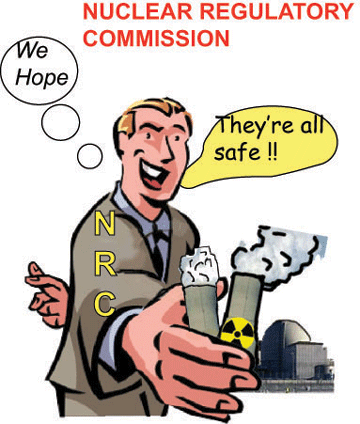 Smaller Nuclear Plants May Come With Less Stringent Safety Rules, npr, August 1, 2020
The NRC is considering whether to shrink emergency planning and evacuation zones around these newer reactors — from a 10-mile radius to, in some cases, the boundary of the plant site.
Nuclear energy critics say that would be a mistake.
“When you’re talking about a reactor that’s never been built or operated, you have to take with a big grain of salt the claims that it’s actually safer or more secure,” says Edwin Lyman at Union of Concerned Scientists.
He says the industry also wants to use weaker reactor containment shells, and in some cases they don’t want to have to keep an operator at the site.
Lyman thinks companies should build plants under current rules first. “You have to work out the kinks of these new plants,” he says. “And then over time you might be able to adjust your requirements accordingly. But you don’t do that at the get-go.”
A National Nuclear Security Administration (NNSA) official recently echoed some of Lyman’s concerns in comments sent to the NRC. The NNSA is a semi-autonomous agency within the Department of Energy.
Deputy Under Secretary Jay Tilden called the proposed rule a major departure from “the successful 42-year-old practice of using a 10-mile plume exposure emergency planning zone.” That existing regulation, he wrote, provides “the last layer of a defense-in-depth for low-probability, high-consequence accidents.” ………
1 This Month



26 September – International Day for the Total Elimination of Nuclear Weapons


PLEASE OPPOSE HR 8255 AND S.3639 – bills would accelerate satellite deployment, with no environmental review or safeguards – https://ncstd5li.quorum.us/campaign/169331/
To see nuclear-related stories in greater depth and intensity – go to https://nuclearinformation.wordpress.com
-
Archives
- September 2026 (233)
- August 2026 (330)
- July 2026 (355)
- June 2026 (287)
- May 2026 (306)
- April 2026 (356)
- March 2026 (251)
- February 2026 (267)
- January 2026 (308)
- December 2025 (358)
- November 2025 (359)
- October 2025 (375)
-
Categories
- 1
- 1 NUCLEAR ISSUES
- business and costs
- climate change
- culture and arts
- ENERGY
- environment
- health
- history
- indigenous issues
- Legal
- marketing of nuclear
- media
- opposition to nuclear
- PERSONAL STORIES
- politics
- politics international
- Religion and ethics
- safety
- secrets,lies and civil liberties
- spinbuster
- technology
- Uranium
- wastes
- weapons and war
- Women
- 2 WORLD
- ACTION
- AFRICA
- Atrocities
- AUSTRALIA
- Christina's notes
- Christina's themes
- culture and arts
- Events
- Fuk 2022
- Fuk 2023
- Fukushima 2017
- Fukushima 2018
- fukushima 2019
- Fukushima 2020
- Fukushima 2021
- general
- global warming
- Humour (God we need it)
- Nuclear
- RARE EARTHS
- Reference
- resources – print
- Resources -audiovicual
- Weekly Newsletter
- World
- World Nuclear
- YouTube
-
RSS
Entries RSS
Comments RSS
 nuclear-news