Arnie Gundersen writes to Bill Gates – about public funding for Gates’ false Natrium nuclear solution to climate change
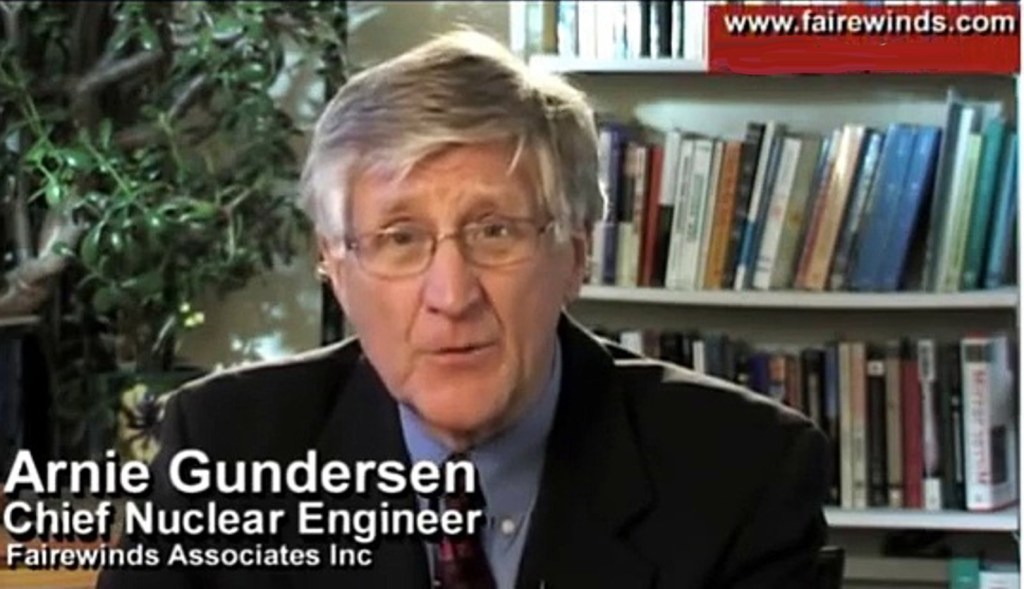
History shows a legacy of failures in the pursuit of the sodium reactor fantasy. As Admiral Rickover said almost 70 years ago, sodium reactors are “expensive to build, complex to operate, susceptible to prolonged shutdown as a result of even minor malfunctions, and difficult and time-consuming to repair.”
Mr. Gates, it’s time to face the music (and the facts) – your supposedly foolproof, sodium-cooled Natrium brainchild will encounter those same obstacles. In my fifty years of nuclear power expertise, I have learned that sooner or later, in any foolproof system, the fools are going to exceed the proofs. Now is the time to stop the Natrium marketing hype and instead use those precious public funds to pursue renewable energy options with a proven history of actually working inexpensively in a time frame that will prevent catastrophic climate change!
An Open Letter to Bill Gates About his Wyoming Atomic Reactor, https://www.counterpunch.org/2021/08/20/an-open-letter-to-bill-gates-about-his-wyoming-atomic-reactor/
BY ARNIE GUNDERSEN Dear Mr. Gates,
I am writing this open letter to you because I believe you have crossed the line by leveraging your fortune maneuvering State Governments and indeed the US Government to syphon precious taxpayer funds in support your latest atomic contrivance in Wyoming. How you spend your personal fortune is your decision and yours alone, but I question your zeal to leverage that fortune by securing additional public funds for an unproductive techno-solution[1] that claims to solve the climate crisis! Your latest technofix is the scheme to have taxpayers fund your new nuclear power concept in Wyoming, claiming that it will mitigate the climate crisis. It won’t!
Atomic power generation is not part of your skillset, but it is mine. The many facets of nuclear energy have been areas of my professional focus for the last 50 years. Beginning in 1971 with two nuclear engineering degrees, a Reactor Operator’s license, a corporate Senior Vice President position for an atomic licensee, a nuclear safety patent, two peer reviewed papers on radiation, and a best-selling book on Fukushima, nuclear power is in my wheelhouse, not yours.
Based on my experience, I am writing this public letter to express my fear that you have made a huge mistake by proposing to build a sodium-cooled small modular reactor (SMR) in Wyoming. Mr. Gates, your atomic power company Natrium (for the Latin word for sodium) is following in the footsteps of a seventy-year long record of sodium-cooled nuclear technological failures. Your plan to recycle those old failed attempts to resurrect liquid sodium yet again will siphon valuable public funds and research from much more inexpensive and proven renewable energy alternatives. Spending public funds on Natrium will make the global climate crisis worse, not better!
Let me explain why Natrium is doomed. As you probably have already been told, all present-day atomic reactors are cooled by water and are called Light Water Reactors (LWRs). Similarly, all US coal, oil, and gas-fired electric plants heat water, not exotic coolants. While some Small Modular Reactors concepts retain water cooling, Natrium’s proposed design deviates from this pattern by cooling the atomic chain reaction using an exotic coolant and specially designed steam generators to remove the atomic heat. Nuclear power concepts that do not use water for cooling are called Non-Light Water Reactors (or NLWRs), and Natrium claims that cooing with liquid sodium is safer and more reliable than traditional water-cooled reactors. What evidence exists to support that assertion?
World renowned energy economist Mycle Schneider calls Natrium and other proposed conceptual reactors “PowerPoint Reactors” as none are close to being fully designed yet all are being marketed as though their successful and safe operation were a fait accompli. According to Mycle Schneider, as reported in Politico EU:
All they have right now are basically PowerPoint reactors — it looks nice on the slide but they’re far from an operating pilot plant. We are more than a decade away from anything on the ground.”
The Union of Concerned Scientists (UCS) recently completed an exhaustive, 140-page study of the supposed safety improvements claimed by NLWR manufactures like Natrium. Entitled Advanced Isn’t Always Better, UCS concludes:
“But a fundamental question remains: Is different actually better? The short answer is no. Nearly all of the NLWRs currently on the drawing board fail to provide significant enough improvements over LWRs to justify their considerable risks.”
Recently, the media and governors in western states have become enthralled with one NLWR design hyped by you and your publicity team at Natrium. Using your successes at Microsoft, you are now asking state and national governments to bankroll a “fast reactor” concept that is cooled by liquid sodium.
“Wyoming To Lead The Coal-To-Nuclear Transition
Interest for new nuclear plants is growing beyond Wyoming as states in the western region like Montana, Nebraska, Utah, Idaho and North Dakota reevaluate the role of nuclear energy – particularly applications for advanced nuclear reactors … the brainchild of Bill Gates, … has developed a 345 MW sodium-cooled fast reactor with a molten salt-based energy storage system.”
The history of sodium as an atomic coolant does not support your grandiose claims for its success. Mr. Gates, the marketing hype associated with your latest “brainchild” ignores 70 years of failures using liquid sodium as an atomic reactor coolant. What follows are just a few examples of the monumental failures that have used liquid sodium that I am not so sure you have studied carefully before pressing for government funds in pursuit your idea.
According to Scientific American, liquid sodium “is no mere novelty; as dangerous as it is captivating… Sodium has significant disadvantages. On contact with air, it burns; plunged into water, it explodes.”
The Bulletin of Atomic Scientists goes even further stating:
“Unfortunately, this pitch glossed over stubborn facts… because plutonium fast-breeder reactors use liquid metal coolants, such as liquid sodium, operating them safely is far more challenging and expensive than conventional reactors. When private industry tried in the early 1960s to operate its own commercial-sized fast-breeder, Fermi I, the benefits were negative. Barely three years after Fermi 1 came online, a partial fuel meltdown in 1966 brought it down… These facts, however, are rarely emphasized….”
In addition to the meltdown at Fermi 1, whose failure is highlighted in the book We Almost Lost Detroit, other sodium cooled reactors have failed in the United States and worldwide. Beginning in 1950, the Navy attempted to develop a sodium-cooled reactor for the Seawolf submarine. According to the American Nuclear Society, Admiral Rickover, the founder of the nuclear Navy, testified to Congress in 1957 stating:
“We went to full power on the Seawolf alongside the dock on August 20 of last year. Shortly thereafter, she developed a small leak. It took us 3 months, working 24 hours a day, to locate and correct the leak. This is one of the serious difficulties in sodium plants.”
Rickover killed the Navy’s sodium powered reactor because of sodium leaks, sodium’s volatility and because sodium repairs take too long and radiation exposure to workers was too high. The problem of high radiation exposures to maintenance personnel while repairing inevitable sodium leaks was also highlighted by Rickover in that same 1957 testimony when he stated:
“Sodium becomes 30,000 times as radioactive as water. Furthermore, sodium has a half-life of 14.7 hours, while water has a half-life of about 8 seconds.”
Making rapid repairs in a sodium-cooled reactor is impossible because sodium becomes highly radioactive as it flows through the reactor core and it stays radioactive for weeks after shutdown. In contrast, water used to cool conventional reactors stays highly radioactive for about one minute.
After failed attempts to use liquid sodium on the Seawolf and on Fermi 1, nuclear zealots convinced the US Congress to subsidize yet another sodium-cooled reactor at Clinch River in Tennessee. The concept of a sodium reactor at Clinch River originated before the meltdown at Fermi 1, but was continued with huge government subsidies until 1984. Overcoming the safety issues presented by cooling atoms using liquid sodium led to delays and cost overruns that were certainly significant factors when the project was finally killed by Congress. However, serious, game-changing, safety concerns were also a factor in the cancelation of the project. According to The Rise and Demise of the Clinch River Breeder Reactor in Scientific American:
“In 1982 … the Energy Department videotaped safety tests it had conducted of how molten sodium might react once it came in contact with the reactor’s concrete containment structure. Concrete contains water crystals. Molten sodium reacts explosively when it comes in contact with oxygen, including oxygen contained in water. What the test demonstrated and the video showed was concrete exploding when it came in contact with liquid sodium.”
Even after the cancelation of the Clinch River fiasco, those same nuclear zealots continued to pursue the fantasy of a sodium-cooled reactor at the Monju site in Japan. Construction began in 1985 and about a decade later, the Monju sodium-cooled reactor was finally ready to operate. It did not operate long, however. After operating only 4 months, Monju had an emergency shutdown when the inevitable sodium leak caused an inevitable sodium fire.
According to a report issued by the Monju Construction Office entitled Sodium Leak at Monju-Causes and Consequences, the failure mode that caused the leak could not have been anticipated by Monju’s designers.
“On December 8, 1995, a sodium leak from the Secondary Heat Transport System (SHTS) occurred in a piping room of the reactor auxiliary building at Monju. The sodium leaked through a thermocouple temperature sensor due to the breakage of the well tube of the sensor installed near the outlet of the Intermediate Heat Exchanger (IHX) in SHTS Loop C… On the basis of the investigations, it was concluded that the breakage of the thermocouple well was caused by high cycle fatigue due to flow induced vibration in the direction of sodium flow.”
After ten years of construction, Monju’s four months of operation were followed by a fifteen year shutdown, Monju again restarted in 2010, but operated for less than a year when the equipment used for refueling fell into the reactor while a refueling was in progress. It never restarted. The simple fact is that the Monju sodium reactor took ten years to construct, ran intermittently for one year, and failed operate for twenty years. And then there is the matter of Japan’s government subsidized costs which exceeded $11 Billion USD.
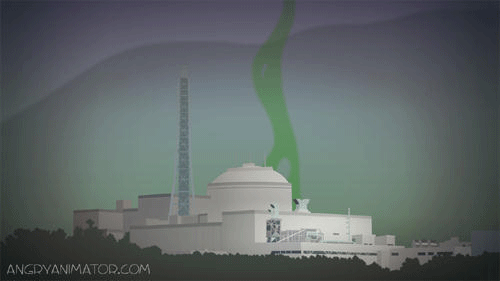
“The move to shut the Monju prototype fast breeder reactor in Fukui prefecture west of Tokyo adds to a list of failed attempts around the world to make the technology commercially viable and potentially cut stockpiles of dangerous nuclear waste…. With Monju’s shutdown, Japan’s taxpayers are now left with an estimated bill of at least 375 billion yen ($3.2 billion) to decommission its reactor, on top of the 1 trillion yen ($8.5 billion) spent on the project.”
A half a world away from Japan, France generates 75% of its electricity for light water cooled atomic reactors and has also considered sodium reactors. Given the repeated failures of sodium-cooled technology in Japan and the US, and with the falling price of renewable power, in 2019 France chose not to pursue the path chosen by you and Natrium. According to Reuters, France has decided to pull the plug on its sodium-cooled reactor designs for at least half a century!
PARIS (Reuters) – France’s CEA nuclear agency has dropped plans to build a prototype sodium-cooled nuclear reactor, it said on Friday, after decades of research and hundreds of millions of euros in development costs. Confirming a report in daily newspaper Le Monde, the state agency said it …is no longer planning to build a prototype in the short or medium term. “In the current energy market situation, the perspective of industrial development of fourth-generation reactors is not planned before the second half of this century,”
There are more reports I could outline but I think I have made my point! History shows a legacy of failures in the pursuit of the sodium reactor fantasy. As Admiral Rickover said almost 70 years ago, sodium reactors are “expensive to build, complex to operate, susceptible to prolonged shutdown as a result of even minor malfunctions, and difficult and time-consuming to repair.”
Mr. Gates, it’s time to face the music (and the facts) – your supposedly foolproof, sodium-cooled Natrium brainchild will encounter those same obstacles. In my fifty years of nuclear power expertise, I have learned that sooner or later, in any foolproof system, the fools are going to exceed the proofs. Now is the time to stop the Natrium marketing hype and instead use those precious public funds to pursue renewable energy options with a proven history of actually working inexpensively in a time frame that will prevent catastrophic climate change!
Signed,
Arnold “Arnie” Gundersen
Action on climate change is stalled by unwise spending on small nuclear reactors

So Who Is Advocating For SMRs & Why?
So why are they doing this?
Because it allows them to defer governmental climate action while giving the appearance of climate action. They can pander to their least intelligent and wise supporters by asserting that renewables aren’t fit for purpose, while also not doing anything about the real problem because SMRs don’t exist in a modern, deployable, operable form yet.
the people asserting that SMRs are the primary or only answer to energy generation either don’t know what they are talking about, are actively dissembling or are intentionally delaying climate action.
Small nuclear reactor advocates refuse to learn the lessons of the past, While history doesn’t repeat, merely rhymes, SMRs are rhyming hard, Medium.com Michael Barnard, 12 Aug 21, Like hydrogen, small modular nuclear reactors have been seeing a resurgence of interest lately. Much of that is driven by governmental policies and investments focusing on the technology. Much of it comes from the nuclear industry. And inevitably, some comes from entrepreneurs attempting to build a technology that they hope will take off in a major way, making them and their investors a lot of money.
Small modular reactors won’t achieve economies of manufacturing scale, won’t be faster to construct, forego efficiency of vertical scaling, won’t be cheaper, aren’t suitable for remote or brownfield coal sites, still face very large security costs, will still be costly and slow to decommission, and still require liability insurance caps. They don’t solve any of the problems that they purport to while intentionally choosing to be less efficient than they could be. They’ve existed since the 1950s and they aren’t any better now than they were then.
Most of the attention and funding is misguided at best, and actively hostile to climate action at worst.
There are a handful of differences between them and traditional nuclear generation reactors. The biggest one is that they are smaller, hence the ‘small’ and ‘medium’ in the names. They range from 0.068 MW to 500 MW in capacity, with the International Atomic Energy Association using small for up to 300 MW and medium for up to 700 MW.
Despite the buzz, this is not new technology. The first nuclear generation plant was a Russian 5 MW device that went live in 1954. Hundreds of small reactors have been built for nuclear powered vessels and as neutron sources. This is well trodden ground. Most of the innovations being touted were considered initially decades ago.
Continue readingHurdles and nagging doubts remain, facing Bill Gates’pet project – multi $billion Natrium nuclear
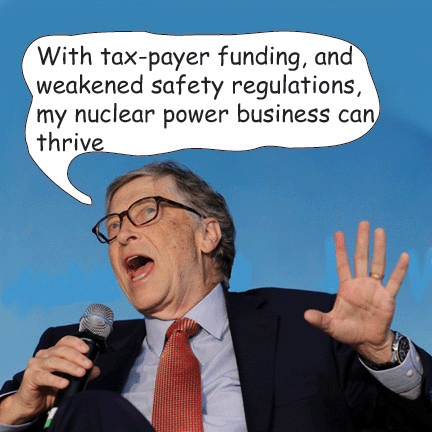
Multi-billion dollar Natrium nuclear project inches forward, County 17 , 18 Aug 21,
A progress report to members of the Joint Committee on Minerals, Business & Economic Development in Laramie Thursday offered mostly good news to proponents of building a first-of-its-kind nuclear reactor in Wyoming. Even with the backing of the Biden White House and the U.S. Department of Energy, however, the nascent plan still faces numerous administrative and legislative hurdles.
Officials with Rocky Mountain Power — who will facilitate construction of the project alongside billionaire tech entrepreneur Bill Gates’ company, TerraPower — told lawmakers they will select a project site by the end of 2021. They are eying four potential choices across Wyoming: Jim Bridger near Rock Springs, Naughton in Kemmerer, Dave Johnston near Glenrock or WyoDak near Gillette…….
Numerous legislative fixes would be required to keep Wyoming statutes up to date with changing technologies and accommodate such a facility……..
Skeptics
Some remained skeptical of the project’s broader implications.
State Rep. Chuck Gray (R-Casper) — a staunch advocate for coal — expressed concerns about a Wyoming-based utility courting federal funding to pioneer an alternative form of energy……
Others have raised environmental concerns outside of the meeting. …..
Natrium officials previously told WyoFile the waste produced by the facility would be stored on site.
Still up for debate, however, is how to tax the new style of reactor.
…. Senate Minority Leader Chris Rothfuss (D-Laramie), however, was reluctant to give nuclear a tax-free pass, urging lawmakers not to set an arbitrary tax rate that would hinder Wyoming’s future earning potential….
The committee ultimately defeated a motion to reduce the state’s production taxes on nuclear energy to zero.
Small nuclear reactors – questionable on safety, on toxic wastes, and on costs.
Nuclear Energy 101: What Exactly Are Small Modular Reactors? Bridget Reed Morawski EcoWatch Aug. 18, 2021 ”’……………………… While advanced reactor designs like small modular reactors are applauded by some for their potential to dramatically lower the costs and siting requirements for nuclear energy facilities, not everyone is throwing their support behind the technologies.
Edwin Lyman of the Union of Concerned Scientists counts himself among the SMR skeptics. As the non-profits’ nuclear power safety director, Lyman doesn’t believe that small modular reactor developers have “made the safety case that they don’t need a large structure,” even if the federal nuclear regulation agency “seems to be going along with their approach.”
………. Greg Rzentkowski, the IAEA’s nuclear installation safety division director, notes on the forum’s website that “SMRs are in general less dependent on safety systems, operational measures and human intervention than existing reactors,” adding that “the usual regulatory approach, which is based on overlapping safety provisions to compensate for potential mechanical and human failures, may not be appropriate and new ideas should be considered.”
Lyman doesn’t believe that the regulatory approach should be altered for new designs.
“I would say that any of these concepts aren’t necessarily safer and a big part of overall safety is not simply intrinsic aspects of the design, but also what is the set of safety requirements that you impose on that [design]?” said Lyman.
In Lyman’s opinion, “if the [U.S. Nuclear Regulatory Commission] grants exemptions and allows small modular reactors to take credit for these inherent safety features to reduce other aspects of operation that add layers of safety […] the overall outcome may be no better or even worse.” He explained that owners of conventional reactors are required by the NRC to draw up emergency evacuation plans that cover a 10-mile zone around the plant, for example, but that developers argue they don’t need such a plan for small reactors.
“But if they’re wrong, if there’s some unexamined accident sequence that can lead to a worse event than they contemplate, then you don’t have that extra layer of safety by being able to evacuate people,” he said.
The topic of nuclear waste disposal is among Lyman’s other concerns about small modular reactors. Although these smaller reactors may require fewer refuelings, he says that “it doesn’t matter what kind of reactor you have, there is no long-term strategy for nuclear waste disposal in this country, and most other countries in the world.” He added that more research needs to be done on storing certain small modular reactor fuel types in the long-term.
Some SMR developers also point to the added sustainability factor that comes from their recycling of nuclear waste. However, Lyman says “there’s no such thing as a reactor that consumes radioactive waste; what they’re really talking about is reprocessing spent fuel,” another term for nuclear waste.
As Lyman wrote in a March 2021 report, “any nuclear fuel cycle that utilizes reprocessing and recycling of spent fuel poses significantly greater nuclear proliferation and terrorism risks than” reactors that don’t reprocess such waste. Reprocessing “provides far greater opportunities for diversion or theft of plutonium and other nuclear-weapon usable materials.”
Lyman also questions the claims that small modular reactors are lower cost, saying that “it’s a situation where these reactors might be more affordable, but not more economical.” Procuring kilowatts of power from a small modular reactor might be cheaper in terms of how much money the overall facility costs but not in terms of how much it costs to produce a kilowatt of power compared to a much larger facility.
Think about it like your last trip to the grocery store: a single can of soda might have cost $1.50, but an entire 12-pack was priced at $10. That single soda might have a lower price than the entire pack, but you’re also getting a lot less soda per dollar spent. Similarly, Lyman believes the price per unit of electricity generated by a fleet of small modular reactors can’t actually be lower than the cost of a group of larger nuclear reactors generating the same amount of power.
Either way, small modular reactor development has attracted investment dollars from the federal government and private companies alike. Bill Gates, for example, is the main financier behind TerraPower, which plans to locate small modular reactors at the site of a former Wyoming coal plant in partnership with PacifiCorp, an investor-owned utility that operates in the intermountain west.
A competing company, the Oregon-based small modular nuclear reactor developer NuScale, has received roughly $192 million so far this year alone from private companies and investors. In 2020, the U.S. Department of Energy announced an up to $1.4 billion cost-share agreement with NuScale for a demonstration project in Idaho. At the time, Rita Baranwal, the DOE’s then-assistant secretary for nuclear energy, called the project “instrumental in the deployment of SMRs around the world.” https://www.ecowatch.com/nuclear-energy-101-2654710991.html
Canada’s Moltex small nuclear reactor project -its plutonium process brings danger of nuclear weapons proliferation.
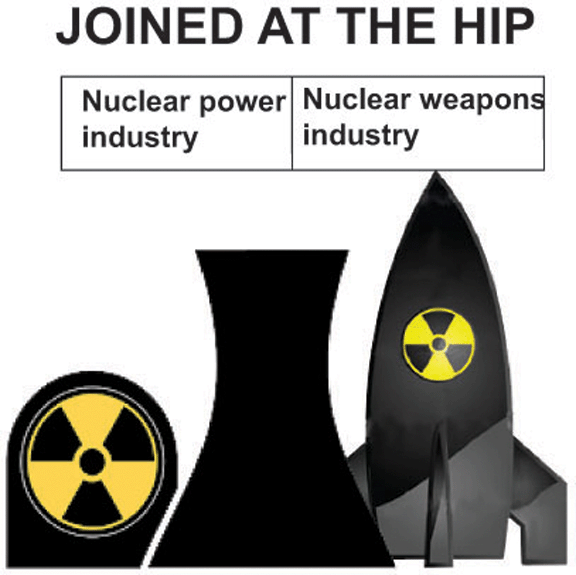
Diane Francis: Trudeau’s multi-million dollar nuclear deal called out by non-proliferation experts https://financialpost.com/diane-francis/diane-francis-trudeaus-multi-million-dollar-nuclear-deal-called-out-by-non-proliferation-experts ,
Scientists fear that the technology used to extract plutonium from spent fuel could be used to make nuclear bombs, Diane Francis Aug 12, 2021 In May, the Geneva-based International Campaign to Abolish Nuclear Weapons (ICAN) called out Prime Minister Justin Trudeau’s government over a deal he has approved and funded that critics say will undermine the goal of nuclear non-proliferation, according to an article published in the Hill Times and recently republished in the Bulletin of the Atomic Scientists.
Moltex Energy was selected by NB Power and the Government of New Brunswick to develop its new reactor technology and locate it at the Point Lepreau nuclear plant site by the early 2030s. Moltex is one of several companies that are promoting small, “next generation” nuclear reactors to replace fossil fuels in the production of electricity.
Moltex, a privately owned company that is based in the United Kingdom and has offices in Saint John, N.B., says it will “recycle nuclear waste” from New Brunswick’s closed Point Lepreau nuclear plant for use in its small-scale nuclear reactor. Federal funding and approval was announced on March 18 by Dominic LeBlanc, a New Brunswick MP who serves as minister of intergovernmental affairs.
The scientists dispute the claim that this is “recycling” and are concerned because the technology Moltex wants to use to extract plutonium, a key ingredient in nuclear weapons, from spent fuel could be used by other countries to make nuclear bombs. Decades ago, the U.S. and many of its allies, including Canada, took action to prevent this type of reprocessing from taking place.
“The idea is to use the plutonium as fuel for a new nuclear reactor, still in the design stage. If the project is successful, the entire package could be replicated and sold to other countries if the Government of Canada approves the sale,” reads the article.
On May 25, nine high-level American non-proliferation experts sent an open letter to Trudeau expressing concern that by “backing spent-fuel reprocessing and plutonium extraction, the Government of Canada will undermine the global nuclear weapons non-proliferation regime that Canada has done so much to strengthen.”
The signatories to the letter include senior White House appointees and other government advisers who worked under six U.S. presidents and who hold professorships at the Harvard Kennedy School, Princeton University and other eminent institutions.
The issue of nuclear proliferation dates back to 1974, when Canada got a black eye after India tested its first nuclear weapon using plutonium that was largely extracted using the CIRUS reactor, which was supplied by Canada for peaceful uses. Shortly after, other countries attempted to repurpose plutonium from reactors and were stopped — except for Pakistan, which, like India, succeeded in creating atomic weapons.
The Hill Times pointed out that, “To this day, South Korea is not allowed to extract plutonium from used nuclear fuel on its own territory — a long-lasting political legacy of the 1974 Indian explosion and its aftermath — due to proliferation concerns.”
The letter to Trudeau concluded: “Before Canada makes any further commitments in support of reprocessing, we urge you to convene high-level reviews of both the non-proliferation and environmental implications of Moltex’s reprocessing proposal including international experts. We believe such reviews will find reprocessing to be counterproductive on both fronts.”
The scientists’ letter has not yet been answered by the government. However, Canadians deserve to be fully briefed on all this and its implications. They deserve to know who owns Moltex, what the risks are to non-proliferation and why taxpayers are sinking millions of dollars into a project that’s morally questionable and potentially hazardous.Read and sign up for Diane Francis’ newsletter on America at dianefrancis.substack.com.
New ”Natrium” nuclear reactors – a very risky gamble.

A July 2021 Foreign Affairs article reports that in the past sixty years eight countries have spent $100 billion to produce sodium cooled fast reactors such as the one proposed for Wyoming. All have failed. The money’s spent and the lights are out.
While the Natrium design posits less risk of a meltdown, the sodium coolant is under high pressure and is explosive in the event of any breach in the containment area. And while Natrium plants produce less radioactive waste than traditional nuclear plants, there’s still the necessity to safely and permanently store this waste. How much will it cost? World Nuclear Industry Status Report’s editor Mycle Schneider says, “No one knows…because there is no functioning permanent storage facility.” Nowhere.
How much power are we talking about anyway? Writing for Canary Media, Eric Wesoff reported that in 2020, 2.4 gigawatts of new nuclear power plants were installed worldwide while there were 100 gigawatts of new solar and 60 gigawatts of new wind power generators. Meanwhile, old nuclear plants close—Indian Power in New York, Diablo Canyon in California, Exelon’s Byron and Dresden plants in Illinois. What do we do with decommissioned nuclear plants? A cooling tower in Germany has become a climbing wall.
Romtvedt: Proposal for nuclear power calls for caution https://trib.com/opinion/columns/romtvedt-proposal-for-nuclear-power-calls-for-caution/article_ecb135f0-1378-5728-9992-abd11b681ba4.html, David Romtvedt, Aug 10, 2021
In conjunction with PacifiCorp, Rocky Mountain Power’s parent company, owned by Berkshire Hathaway Energy, a subsidiary of Warren Buffett’s Berkshire Hathaway, Inc; and TerraPower, a nuclear reactor design company founded by Bill Gates, Wyoming Governor Mark Gordon has announced his support for the construction of a nuclear reactor demonstration plant in Wyoming. According to Berkshire Hathaway, the project is intended to “validate the design, construction and operational features” of TerraPower’s Natrium nuclear plant design which uses liquid sodium as a coolant rather than water.
Governor Gordon believes that Natrium offers a safe, reliable solution to Wyoming’s economic woes, saying, “I am thrilled to see Wyoming selected for this demonstration pilot project as our great state is the perfect place for this type of innovative utility facility and our experienced workforce is looking forward to the jobs this project will provide.”
So the benefits of the nuclear plant are said to be increased economic security and diminished environmental risk than with other forms of nuclear power plants. But it’s not so clear. Both in construction and operation, Natrium nuclear plants require uniquely skilled workers employing specialized materials and building techniques. Other economic issues include the temporary nature of construction work, long lead times for safety and licensing reviews (Natrium is not licensed by the Nuclear Regulatory Commission), and diminished severance tax revenues as a result of the shift from coal to nuclear.
There’s also the fuel—Natrium uses high-assay low-enriched uranium (HALEU). Power Magazine reports that there is no current supply of HALEU and that it will take at least seven years with sufficient demand to develop a fuel cycle infrastructure. Edwin Lyman of the Union of Concerned Scientist cautions that Russia is currently the only source of suitable fuel. In whatever quantity, the fuel is not likely to come from Wyoming uranium mines.
After construction there’s generation. World Nuclear Industry Status Report has recorded the changing costs of electric generation per kilowatt hour (in US cents) between 2009 and 2020. They are: solar—35.9 to 3.7, down 90%; wind—13.5 to 4.0, down 70%; gas—8.3 to 5.9, down 29%; coal—11.1 to 11.2, up 1%; and nuclear 12.3 to 16.3, up 33%. Nuclear is the most expensive way to generate electricity.
And time—the Wyoming proposal projects seven years to completion. Since no new nuclear power plant with a license application submitted since 1975 has yet begun operation, we may question the Wyoming timeline. More time equals more cost. Georgia Power’s Vogtle nuclear plants are years behind schedule with costs having risen from $14 billion to over $25 billion. But it may not matter as Georgia Power can charge cost overruns to its customers—the more the project is over budget, the more the company profits. In Florida, Duke Power, after seeing a cost increase from $5 billion to $22 billion, abandoned a Natrium nuclear project after passing $800 million dollars in excess costs to ratepayers.
A July 2021 Foreign Affairs article reports that in the past sixty years eight countries have spent $100 billion to produce sodium cooled fast reactors such as the one proposed for Wyoming. All have failed. The money’s spent and the lights are out.
While the Natrium design posits less risk of a meltdown, the sodium coolant is under high pressure and is explosive in the event of any breach in the containment area. And while Natrium plants produce less radioactive waste than traditional nuclear plants, there’s still the necessity to safely and permanently store this waste. How much will it cost? World Nuclear Industry Status Report’s editor Mycle Schneider says, “No one knows…because there is no functioning permanent storage facility.” Nowhere.
I’m guessing that Governor Gordon’s decision was driven in part by his hope to protect the lives and livelihoods of Wyoming workers. But generating radioactive waste without a procedure for safe permanent storage of that waste will protect no one—not unemployed coal miners, not me, not the governor.
How much power are we talking about anyway? Writing for Canary Media, Eric Wesoff reported that in 2020, 2.4 gigawatts of new nuclear power plants were installed worldwide while there were 100 gigawatts of new solar and 60 gigawatts of new wind power generators. Meanwhile, old nuclear plants close—Indian Power in New York, Diablo Canyon in California, Exelon’s Byron and Dresden plants in Illinois. What do we do with decommissioned nuclear plants? A cooling tower in Germany has become a climbing wall.
The questions loom. If I were a betting man, given initial costs, cost overruns, lost tax revenue, the increasing viability of renewables, the history of nuclear failure, and the health and safety hazards surrounding nuclear waste, I’d pause before I put my money on nuclear power. Not being a betting man, I wouldn’t consider it.
David Romtvedt is a writer and musician from Buffalo, Wyoming. A former activist with the Ground Zero Center for Nonviolent Action, he serves as a board member for the Powder River Basin Resource Council.
UK Taxpayer funding will pour in, to get Rols Royce’s small modular nuclear reactors happening
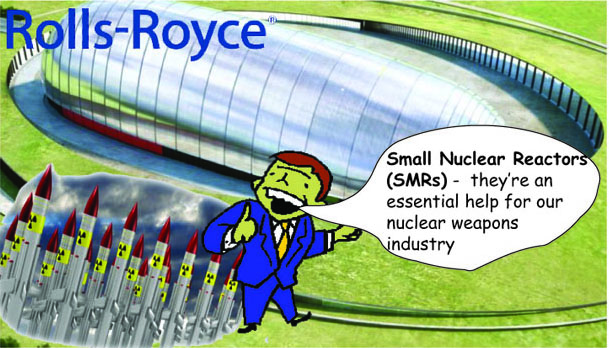
Rolls-Royce lines up funding for mini nuclear reactor revolution. Private
backing for Rolls-led consortium to build new generation of ‘mini nukes’
unlocks hundreds of millions of taxpayer support. Britain has taken a
crucial step towards creating a fleet of mini reactors that would reduce
reliance on Chinese money and nuclear technology after Rolls-Royce secured
investment to build the world’s first production line.
A consortium led by the FTSE 100 engineer has secured at least £210m needed to unlock a
matching amount of taxpayer funding, which will make it the first “small
modular reactors” (SMR) developer to submit its designs to regulators. It
is understood heavyweight financial investors specialising in energy are
now thrashing out the final details of their backing to drive work on the
so-called “mini nuke” power plants.
State support for SMRs – which
each generate about 450 megawatts, about a seventh of the output of
conventional nuclear power stations such as Hinkley Point – was revealed
in the Prime Minister’s ten-point plan for a green industrial revolution
released in the autumn. ………..
SMRs must play a
critical role in our clean energy transition and can open new export
markets worth billions of pounds. “To realise this potential, however,
the Government needs to establish a siting and policy framework by next
year to enable the deployment of a fleet of SMRs and capture the promise of
a net zero [that’s a lie] future.” Although officials are engaging with other businesses
on SMRs, one Whitehall source described the Rolls-led consortium as “by
far the most advanced”.
The UK SMR consortium also includes the National
Nuclear Laboratory and Laing O’Rourke, the construction firm. Ministers
are expected to push for the Office for Nuclear Regulation to prioritise
assessment of the consortium’s SMR design, while simultaneously driving the
planning process to get potential sites.
Telegraph 3rd Aug 2021
Small nuclear reactors, a dangerous experiment, and distraction from real climate action – David Suzuki

Renewables cost less than nuclear, come with fewer health, environmental and weapons-proliferation risks and have been successfully deployed worldwide.
Given rapid advances in energy, grid and storage technologies, along with the absolute urgency of the climate crisis, pursuing nuclear at the expense of renewables is costly, dangerous and unnecessary.
Is smaller better when it comes to nuclear? Pique, By: David Suzuki 1 Aug 21, Nuclear power hasn’t been in the news much since the 2011 Fukushima meltdown in Japan. Thanks to a push by industry and governments, you might soon hear more about how nuclear reactors are now safer and better.
Specifically, the conversation has shifted to “small modular nuclear reactors” or SMNRs, which generate less than 300 megawatts of electricity, compared to up to 1,600 MWe for large reactors.
Some of the 100 or so designs being considered include integral pressurized water reactors, molten salt reactors, high-temperature gas reactors, liquid metal cooled reactors and solid state or heat pipe reactors. To date, the industry is stuck at the prototype stage for all models and none is truly modular in the sense of being manufactured several at a time—an impediment considering the speed at which global heating is worsening.
The benefits touted by industry have convinced many countries, including Canada, to gamble huge sums on nuclear, despite the poor odds. The Small Modular Reactor Action Plan hypes it as the possible “future of Canada’s nuclear industry, with the potential to provide non-emitting energy for a wide range of applications, from grid-scale electricity generation to use in heavy industry and remote communities.” ………
given the seriousness of the climate emergency and the various options for transforming our energy systems to combat it, is nuclear—regardless of size or shape—the way to go? We must rapidly reduce emissions now, and we have readily available technologies to do so.
New nuclear doesn’t make practical or economic sense for now. Building reactors will remain expensive and time-consuming. Studies estimate electricity from small nuclear can cost from four to 10 times that of wind and solar, whose costs continue to drop. SMNRs will require substantial government subsidies.
Even when nuclear has to compete against renewables prepackaged with storage, the latter wins out.
One recent study of 123 countries over 25 years published in Nature Energy found that renewables are much better at reducing greenhouse gas emissions than nuclear—whose benefits in this area are negligible—and that combining nuclear and renewables creates a systemic tension that makes it harder to develop renewables to their potential.
Like all nuclear reactors, SMNRs produce radioactive waste and contribute to increased nuclear weapons proliferation risk—and Canada still has no effective strategy for waste. Nuclear power also requires enormous amounts of water.
Corporate interests often favour large, easily monopolized utilities, arguing that only major fossil fuel, nuclear or hydro power facilities can provide large-scale “baseload” power. But many experts argue the “baseload myth” is baseless—that a flexible system using renewables combined with investments in energy efficiency and a smart grid that helps smooth out demand peaks is far more efficient and cost-effective, especially as energy storage technologies improve.
Even for remote populations, energy systems that empower communities, households, businesses and organizations to generate and store their own energy with solar panels or wind installations and batteries, for example, and technologies like heat-exchange systems for buildings, would be better than nuclear.
Renewables cost less than nuclear, come with fewer health, environmental and weapons-proliferation risks and have been successfully deployed worldwide. Given rapid advances in energy, grid and storage technologies, along with the absolute urgency of the climate crisis, pursuing nuclear at the expense of renewables is costly, dangerous and unnecessary.
David Suzuki is a scientist, broadcaster, author and co-founder of the David Suzuki Foundation. Written with contributions from David Suzuki Foundation Senior Writer and Editor Ian Hanington. https://www.piquenewsmagazine.com/opinion/opinion-is-smaller-better-when-it-comes-to-nuclear-4175458
Environmental degradation, illness, international tensions – small nuclear reactors had bad results in the Arctic
The U.S. military’s first attempts at land-based portable nuclear reactors didn’t work out well in terms of environmental contamination, cost, human health and international relations. That history is worth remembering as the military considers new mobile reactors
the U.S. still has no coherent national strategy for nuclear waste disposal, and critics are asking what happens if Pele falls into enemy hands.
The US Army tried portable nuclear power at remote bases 60 years ago – it didn’t go well https://theconversation.com/the-us-army-tried-portable-nuclear-power-at-remote-bases-60-years-ago-it-didnt-go-well-164138
Paul Bierman Fellow of the Gund Institute for Environment, Professor of Natural Resources, University of Vermont, 21 July 21
In a tunnel 40 feet beneath the surface of the Greenland ice sheet, a Geiger counter screamed. It was 1964, the height of the Cold War. U.S. soldiers in the tunnel, 800 miles from the North Pole, were dismantling the Army’s first portable nuclear reactor.
Commanding Officer Joseph Franklin grabbed the radiation detector, ordered his men out and did a quick survey before retreating from the reactor.
He had spent about two minutes exposed to a radiation field he estimated at 2,000 rads per hour, enough to make a person ill. When he came home from Greenland, the Army sent Franklin to the Bethesda Naval Hospital. There, he set off a whole body radiation counter designed to assess victims of nuclear accidents. Franklin was radioactive.
The Army called the reactor portable, even at 330 tons, because it was built from pieces that each fit in a C-130 cargo plane. It was powering Camp Century, one of the military’s most unusual bases.
Camp Century was a series of tunnels built into the Greenland ice sheet and used for both military research and scientific projects. The military boasted that the nuclear reactor there, known as the PM-2A, needed just 44 pounds of uranium to replace a million or more gallons of diesel fuel. Heat from the reactor ran lights and equipment and allowed the 200 or so men at the camp as many hot showers as they wanted in that brutally cold environment.
The PM-2A was the third child in a family of eight Army reactors, several of them experiments in portable nuclear power.
A few were misfits. PM-3A, nicknamed Nukey Poo, was installed at the Navy base at Antarctica’s McMurdo Sound. It made a nuclear mess in the Antarctic, with 438 malfunctions in 10 years including a cracked and leaking containment vessel. SL-1, a stationary low-power nuclear reactor in Idaho, blew up during refueling, killing three men. SM-1 still sits 12 miles from the White House at Fort Belvoir, Virginia. It cost US$2 million to build and is expected to cost $68 million to clean up. The only truly mobile reactor, the ML-1, never really worked.
The U.S. military’s first attempts at land-based portable nuclear reactors didn’t work out well in terms of environmental contamination, cost, human health and international relations. That history is worth remembering as the military considers new mobile reactors.
Nearly 60 years after the PM-2A was installed and the ML-1 project abandoned, the U.S. military is exploring portable land-based nuclear reactors again.
In May 2021, the Pentagon requested $60 million for Project Pele. Its goal: Design and build, within five years, a small, truck-mounted portable nuclear reactor that could be flown to remote locations and war zones. It would be able to be powered up and down for transport within a few days.
The Navy has a long and mostly successful history of mobile nuclear power. The first two nuclear submarines, the Nautilus and the Skate, visited the North Pole in 1958, just before Camp Century was built. Two other nuclear submarines sank in the 1960s – their reactors sit quietly on the Atlantic Ocean floor along with two plutonium-containing nuclear torpedos. Portable reactors on land pose different challenges – any problems are not under thousands of feet of ocean water.
Those in favor of mobile nuclear power for the battlefield claim it will provide nearly unlimited, low-carbon energy without the need for vulnerable supply convoys. Others argue that the costs and risks outweigh the benefits. There are also concerns about nuclear proliferation if mobile reactors are able to avoid international inspection.
A leaking reactor on the Greenland ice sheet
The PM-2A was built in 18 months. It arrived at Thule Air Force Base in Greenland in July 1960 and was dragged 138 miles across the ice sheet in pieces and then assembled at Camp Century.
When the reactor went critical for the first time in October, the engineers turned it off immediately because the PM-2A leaked neutrons, which can harm people. The Army fashioned lead shields and built walls of 55-gallon drums filled with ice and sawdust trying to protect the operators from radiation.
The PM-2A ran for two years, making fossil fuel-free power and heat and far more neutrons than was safe.
Those stray neutrons caused trouble. Steel pipes and the reactor vessel grew increasingly radioactive over time, as did traces of sodium in the snow. Cooling water leaking from the reactor contained dozens of radioactive isotopes potentially exposing personnel to radiation and leaving a legacy in the ice.
When the reactor was dismantled for shipping, its metal pipes shed radioactive dust. Bulldozed snow that was once bathed in neutrons from the reactor released radioactive flakes of ice.
Franklin must have ingested some of the radioactive isotopes that the leaking neutrons made. In 2002, he had a cancerous prostate and kidney removed. By 2015, the cancer spread to his lungs and bones. He died of kidney cancer on March 8, 2017, as a retired, revered and decorated major general.
Camp Century’s radioactive legacy
Camp Century was shut down in 1967. During its eight-year life, scientists had used the base to drill down through the ice sheet and extract an ice core that my colleagues and I are still using today to reveal secrets of the ice sheet’s ancient past. Camp Century, its ice core and climate change are the focus of a book I am now writing.
The PM-2A was found to be highly radioactive and was buried in an Idaho nuclear waste dump. Army “hot waste” dumping records indicate it left radioactive cooling water buried in a sump in the Greenland ice sheet.
When scientists studying Camp Century in 2016 suggested that the warming climate now melting Greenland’s ice could expose the camp and its waste, including lead, fuel oil, PCBs and possibly radiation, by 2100, relations between the U.S, Denmark and Greenland grew tense. Who would be responsible for the cleanup and any environmental damage?
Portable nuclear reactors today
There are major differences between nuclear power production in the 1960s and today.
The Pele reactor’s fuel will be sealed in pellets the size of poppy seeds, and it will be air-cooled so there’s no radioactive coolant to dispose of.
Being able to produce energy with fewer greenhouse emissions is a positive in a warming world. The U.S. military’s liquid fuel use is close to all of Portugal’s or Peru’s. Not having to supply remote bases with as much fuel can also help protect lives in dangerous locations.
But, the U.S. still has no coherent national strategy for nuclear waste disposal, and critics are asking what happens if Pele falls into enemy hands. Researchers at the Nuclear Regulatory Commission and the National Academy of Sciences have previously questioned the risks of nuclear reactors being attacked by terrorists. As proposals for portable reactors undergo review over the coming months, these and other concerns will be drawing attention.
The U.S. military’s first attempts at land-based portable nuclear reactors didn’t work out well in terms of environmental contamination, cost, human health and international relations. That history is worth remembering as the military considers new mobile reactors.
Small Nuclear Power Plants No Use in Climate Crisis

Small Nuclear Power Plants No Use in Climate Crisis
https://goodmenproject.com/featured-content/small-nuclear-power-plants-no-use-in-climate-crisis/
Governments are investing in a new range of small nuclear power plants, with little chance they’ll ease the climate crisis.
July 20, 2021 by Climate News Network By Paul Brown
Claims that a new generation of so-called advanced, safe and easier-to-build nuclear reactors − small nuclear power plants − will be vital to combat climate change are an illusion, and the idea should be abandoned, says a group of scientists.
Their report, “Advanced” is not always better, published by the US Union of Concerned Scientists (UCS), examines all the proposed new types of reactor under development in the US and fails to find any that could be developed in time to help deal with the urgent need to cut carbon emissions. The US government is spending $600 million on supporting these prototypes.
While the report goes into details only about the many designs of small and medium-sized reactors being developed by US companies, it is a serious blow to the worldwide nuclear industry because the technologies are all similar to those also being underwritten by taxpayers in Canada, the UK, Russia and China. This is a market the World Economic Forum claimed in January could be worth $300 billion by 2040.
Edwin Lyman, who wrote the report, and is the director of nuclear power safety in the UCS Climate and Energy Program, thinks the WEF estimate is extremely unlikely. He comments on nuclear power in general: “The technology has fundamental safety and security disadvantages compared with other low-carbon sources.
“Nuclear reactors and their associated facilities for fuel production and waste handling are vulnerable to catastrophic accidents and sabotage, and they can be misused to produce materials for nuclear weapons. The nuclear industry, policymakers, and regulators must address these shortcomings fully if the global use of nuclear power is to increase without posing unacceptable risks to public health, the environment and international peace and security.”
Cheaper options
Lyman says none of the new reactors appears to solve any of these problems. Also, he says, the industry’s claims that their designs could cost less, be built quickly, reduce the production of nuclear waste, use uranium more efficiently and reduce the risk of nuclear proliferation have yet to be proved. The developers have also yet to demonstrate that the new generation of reactors has improved safety features enabling them to shut down quickly in the event of attack or accident.
Lyman examines the idea that reactors can be placed near cities or industry so that the waste heat from their electricity generation can be used in district heating or for industrial processes.
He says there is no evidence that the public would be keen on the idea of having nuclear power stations planted in their neighbourhoods.
Another of the industry’s ideas for using the power of the new nuclear stations to produce “green hydrogen” for use in transport or back-up energy production is technically feasible, but it seems likely that renewable energies like wind and solar could produce the hydrogen far more cheaply, the report says.
In reality the nuclear industry is shrinking in international importance and is likely to continue to do so, Lyman says. According to the International Energy Agency, at the end of 2010, there were 441 operating nuclear power reactors worldwide, with a total electrical power capacity of 375 gigawatts of electricity (GWe).
At the end of 2019, there were 443 operating reactors − only two more than in 2010 − with a total generating capacity of 392 GWe. This represented a decrease of over 20% in the share of global electricity demand met by nuclear energy compared with 2010.
Lyman says the US Department of Energy would be more sensible trying to address the outstanding safety, security and cost issues of existing light water reactors in the US, rather than attempting to commercialise new and unproven designs. If the idea is to tackle climate change, improving existing designs is a better bet.
The report notes that it is not just the US that is having trouble with nuclear technology: Europe is also suffering severe delays and cost overruns with new plants at Olkiluoto in Finland, Flamanville in France and Hinkley Point C in the UK.
Lyman’s comments might be of interest to the British government, which has just published its integrated review of defence and foreign policy.
Military link declared
In it the government linked the future of the civil and defence nuclear capabilities of the country, showing that a healthy civil sector was important for propping up the military. This is controversial because of the government’s decision announced in the same review to increase the number of nuclear warheads from 180 to 260, threatening an escalation of the international arms race.
Although Lyman does not mention it, there is a clear crossover between civil and nuclear industries in the US, the UK, China, Russia and France. This is made more obvious because of the few countries that have renounced nuclear weapons − for example only Germany, Italy and Spain have shown no interest in building any kind of nuclear station. This is simply because renewables are cheaper and produce low carbon power far more quickly.
But the link between civil and defence nuclear industries does explain why in the UK the government is spending £215m ($298m) on research and development into the civil use of the small medium reactors championed by a consortium headed by Rolls-Royce, which is also one of the country’s major defence contractors. Rolls-Royce wants to build 16 of these reactors in a factory and assemble them in various parts of the country. It is also looking to sell them into Europe to gain economies of scale.
Judging by the UCS analysis, this deployment of as yet unproven new nuclear technologies is unlikely to be in time to help the climate crisis – one of the claims that both the US and UK governments and Rolls-Royce itself are making. − Climate News Network
Small nuclear reactor project cut back to half size, due to financial worries

Eastern Idaho nuclear project goes from 12 to six reactors. IDAHO FALLS, Idaho (AP) 19 July 21— A Utah energy cooperative said it will reduce the number of small modular nuclear reactors it will build in Idaho from 12 to six for a first-of-a-kind project [ totally ineffective against global heating] that is part of a federal effort to reduce greenhouse gasses that cause climate change……
The reactors are being built by Portland, Oregon-based NuScale Power. The U.S. Nuclear Regulatory Commission last year approved NuScale’s application for the small modular reactors, the first time U.S. officials approved a design for a small commercial nuclear reactor.
………….. Idaho Falls has committed to buying 5 megawatts of power from the reactors through the Carbon Free Power Project. The city had been committed to 10 megawatts but cut that in half in October amid concerns about financial risks.
……….. Idaho Falls City Council member John Radford said at a July 8 meeting. “This project is something that can help keep this country on this trajectory to a carbon-free future and maybe a better existence for all of us.” – [a complete untruth!! this Councillor is either ignorant, or lying] https://madison.com/news/national/govt-and-politics/eastern-idaho-nuclear-project-goes-from-12-to-six-reactors/article_cb353af6-5659-5baa-8365-dc575aeeba8d.html
Canada’s small nuclear reactor project is looking like just a pipe-dream.

Globe Climate: Canada wants nuclear to power the future. But how? SIERRA BEIN Matthew McClearn is an investigative reporter and data journalist with The Globe. For this week’sdeeper dive, he talks about Canada’s nuclear ambitions. Globe and Mail, 19 July 21
Senior government officials, notably federal Natural Resources Minister Seamus O’Regan, say small modular reactors (SMRs) will help Canada achieve net-zero carbon emissions by mid-century. There’s just one problem: it’s not clear yet whether any will be built.
To be sure, many promises made by SMR vendors seem compelling. By taking advantage of factory-style mass production, they’re supposed to be far cheaper than previous generations of reactors, which tended to be massive and prone to cost overruns. They’d also be easier to deploy……..
A mad scramble to deliver on these promises is now underway. Ontario Power Generation—by far Canada’s most experienced nuclear station operator—plans to select a vendor to build a SMR at its Darlington Station by 2028. Further out, Saskatchewan is considering whether to order its own SMRs to replace coal-fired plants.
Accomplishing all that would silence numerous critics and naysayers. But as I explain in my most recent story, history is littered with reactors that failed to live up to their promises. . Many SMR vendors are very early-stage companies which face years of grueling, expensive R&D work to advance their designs to the point they could actually be built. And they’re competing against renewable technologies including wind and solar, which utilities can purchase and deploy today. It may be premature to count on SMRs to help meet Canada’s emissions targets. https://www.theglobeandmail.com/canada/article-globe-climate-canada-wants-nuclear-to-power-the-future-but-how/https://www.theglobeandmail.com/canada/article-globe-climate-canada-wants-nuclear-to-power-the-future-but-how/
Small Nuclear Reactors are all the hype. But here’s the reality

promoting a dizzying assortment of next-generation models that have collectively been dubbed “small modular reactors” (SMRs).……..
The real challenge “is answering all the safety questions that any good regulator would ask: ‘How will this behave if there’s an earthquake or fire? What happens if there’s a complete blackout? What happens if this component fails?’ ” Answering such questions requires an intensive research program and countless hours of laboratory work, which can take decades. There’s no guarantee the answers will be favourable.
Governments, utilities and the nuclear industry hope small modular reactors will power Canada’s future. Can they actually build one? The Globe and Mail MATTHEW MCCLEARN, JULY 17, 2021 Ontario Power Generation plans to make a decision this year that might determine the future of Canada’s nuclear industry.The utility, by far Canada’s largest nuclear power producer, promises to select a design for a 300-megawatt reactor it proposes to build at its Darlington Nuclear Generating Station by 2028. The estimated price tag: up to $3-billion. It would be the first new reactor built on Canadian soil in well over three decades. OPG won’t make that decision alone, because it’s intended to be the first of many reactors of the same design built across the country.Canada’s nuclear industry desperately needs a next act….. With a supply chain of more than 200 companies covering everything from uranium mining, to operating power plants, to decommissioning them, Canada is considered a Tier 1 nuclear country.
But lately, this machine has been devoted to squeezing more life out of old CANDU units, largely through Ontario’s $26-billion plan to refurbish its Darlington station, east of Toronto, and the Bruce Power complex, on Lake Huron. The industry has few, if any, exciting new products for sale……
but renewable forms of generation – hydro, wind, solar and biomass – have become preferred tools for decarbonizing electricity grids. And utilities can buy inexpensive wind turbines and solar panels today.
Seeking to catch up, dozens of nuclear vendors sprung up just in the past few years, promoting a dizzying assortment of next-generation models that have collectively been dubbed “small modular reactors” (SMRs)………
U.S. President Joe Biden and U.K. Prime Minister Boris Johnson have also indicated they will also support SMR development, as have some prominent investors, notably Bill Gates.

Here’s the reality: Most SMRs exist only as conceptual designs and are not yet licensed for construction anywhere.
The promised assembly lines that would churn them out like clockwork don’t exist
Here’s the reality: Most SMRs exist only as conceptual designs and are not yet licensed for construction anywhere. (The international law firm White & Case says the only contemporary SMR in existence is located on a vessel anchored off Russia’s Arctic coast. According to reports, construction of China’s first SMR recently commenced on the southern island of Hainan.) The promised assembly lines that would churn them out like clockwork don’t exist; many vendors are early-stage companies with hardly any revenues.
To change this, the federal government will probably have to open wide the taxpayer’s wallet. And the industry must move quickly from bold marketing claims to commercially viable products
OLD IDEAS, NEW PACKAGESMR is a marketing term, rather than a technical one, reflecting the industry’s aspirations rather than what it can deliver today.In Canada, SMR has come to describe reactors that generate 300 megawatts or less. That isn’t exactly small – it’s enough to power a small city – but for comparison’s sake, Ontario’s largest current reactors generate around 900 megawatts. Some proposed SMRs would produce just a few megawatts. The industry pitches them for remote Indigenous communities, industrial use (at mines, for instance) and tiny island nations.Small reactors aren’t new. They’ve been used in icebreakers, submarines and aircraft carriers. And many SMRs are based on concepts contemplated as long ago as the 1950s.
Oakville, Ont.-based Terrestrial Energy Inc., one of OPG’s potential partners, intends to use molten salt, rather than water, as a coolant. The company says its technology is a “game-changer”: The Integral Molten Salt Reactor (IMSR) would operate at much higher temperatures (about 700 C) than conventional reactors (about 300 C)….
As for the “modular” part, the notion is that SMRs would be mass-produced on assembly lines and shipped to where they’re needed, rather than custom-built onsite. This plug-and-play approach is intended to reduce purchase costs and accelerate deployment…………….
SMRs appeal to certain nationalist impulses as well: Canada is, after all, the world’s second-largest uranium producer.
…… The industry has made limited progress in addressing wastes from decades-old reactors; it’s unclear how novel detritus from SMRs might be handled. Perhaps most damagingly of all, reactors have earned a reputation for being overpriced relative to other forms of generation, and oftenbeleaguered by massive delays and cost overruns.
SMR GAME PLAN
The nuclear industry’s plan to reverse its flagging fortunes begins at Darlington. OPG announced late last year it was working with three SMR developers on preliminary design and engineering work: North Carolina-based GE Hitachi Nuclear Energy, Terrestrial Energy and X-energy. It promises to select a winner by year’s end….
Naturally, of course, no SMR developer aspires to be a one-hit wonder. So next up: Persuade Saskatchewan to build a fleet of the same reactors……….. Winning Saskatchewan would be a major coup: Jurisdictions that go nuclear tend to stay nuclear for decades. …… quandary remains: Prospective SMR buyers such as SaskPower can only look at conceptual designs. “There’s been some small demonstration units built, but nothing of the size that we would expect to see in operational terms,” Mr. Morgan said.
……... NUCLEAR GHOSTS Twenty years ago, Canada’s nuclear industry staked its future on updating the venerable CANDU design. Atomic Energy of Canada Ltd. (AECL), the
Crown corporation that pioneered it, talked up the Enhanced CANDU 6, CANDU 9 and Advanced CANDU Reactor (ACR) as safer, faster to construct, cheaper and better than previous models. The federal government pumped untold sums into their development.None were licensed. None were ordered. None were built.
In 2011, the federal government sold AECL’s reactor business to SNC-Lavalin for a paltry $15-million. After six decades of development, and dozens of bona fide reactors built and operated in seven countries, the CANDU had become nearly worthless.
The proposed site for OPG’s first SMR, next to the existing Darlington Station, is an artifact of that era. In 2006, OPG began preparing to build up to four reactors at the same location. AECL’s Enhanced CANDU 6 and the ACR 1000 were candidates.But the project was derailed in late 2013 when the Ontario government asked OPG to stand down, essentially because the province no longer needed the power. The viability of those “next-generation” CANDUs, however, was never clear.
It’s relatively easy to sketch a reactor design on the back of a napkin, or create promotional videos and brochures with snazzy renderings. Professor M.V. Ramana, of the University of British Columbia’s Liu Institute for Global Issues, says a few graduate students can develop a conceptual design for a few hundred thousand dollars.
But it’s quite another matter to advance a design to the point of actually building it. The real challenge, Prof. Ramana said, “is answering all the safety questions that any good regulator would ask: ‘How will this behave if there’s an earthquake or fire? What happens if there’s a complete blackout? What happens if this component fails?’ ” Answering such questions requires an intensive research program and countless hours of laboratory work, which can take decades. There’s no guarantee the answers will be favourable.
…………… Even a mature design isn’t enough. Just as Ford wouldn’t build an assembly line for the Mustang Mach-E if it thought it could sell only a handful, SMR vendors need assurances they’ll receive enough orders to justify mass production. It’s unclear how many orders would be sufficient, but published estimates have ranged from as low as 30 to well into the hundreds.
……… Prof. Ramana said many of the earliest power reactors met the modern definition of SMRs. But their diminutive size was rarely a virtue: It meant they couldn’t take advantage of economies of scale, resulting in high costs per unit of electricity generated, not to mention disproportionately greater volumes of radioactive waste. Many were shut down early.
“The lesson that we learned from some of these experiences is that designs that might seem captivating on paper might not actually work so well in real life,” Prof. Ramana said. “SMRs are not going to be economical. You can see that from the outset.”
………………. FEDERAL SUPPORT – THE CRUCIAL INGREDIENT. In contrast with the CANDU, the nuclear industry promises SMRs will be funded largely by the private sector. Many observers are skeptical. “Without government programs and financial support promoting SMRs, industry alone is unlikely to invest in the high up-front costs,” opined lawyers at Stikeman Elliott in a recent commentary.
Nor are non-nuclear provinces likely to make the leap alone. Mr. Morgan confirmed Saskatchewan seeks federal support to deploy SMRs, although the form of that support has yet to be determined.
For several years, federal and provincial government officials have signalled they want Canada to be one of the earliest adopters of SMRs. They’ve partnered with industry to produce road maps for making that happen. The governments of Ontario, New Brunswick, Saskatchewan and Alberta have agreed to collaborate on advancing SMRs. Mr. O’Regan, the federal Natural Resources Minister, has fully embraced the industry’s claim that Canada’s clean-energy transition cannot succeed without them,
So far, however, such pronouncements haven’t translated into generous subsidies. The federal government has channelled just meagre amounts of funding to SMRs, such as $20-million last October toward development of Terrestrial’s IMSR, and $50.5-million to New Brunswick-based Moltex Energy in March.
The latest federal budget didn’t mention SMRs. Nevertheless, studying its fine print, lawyers at McCarthy Tétrault LLP noticed what they described as “exciting policy levers.” They pointed, for example, to an income tax break of up to 50 per cent for manufacturers of zero-emission technologies. There was also $1-billion offered for clean tech projects “where there is a perceived lack of patient capital or ability to scale up because of the size of the Canadian market.” SMR vendors could capitalize on such programs, the lawyers concluded, depending on how they’re implemented.
Meanwhile, SMR vendors seek relaxed safety requirements that could make SMRs more cost-competitive.
……It’s unclear to what extent the Canadian Nuclear Safety Commission (CNSC) will acquiesce………….
Obtaining a licence typically takes a few years. “Experience has shown that it will be dramatically affected by the [proponent’s] capability of submitting adequate and complete information on day one,” Mr. Carrier said. Only one SMR has so far commenced a full licensing review: Ottawa-based Global First Power Ltd. submitted documentation for its Micro Modular Reactor in March.
The Union of Concerned Scientists, a long-time opponent of nuclear power, released a study in March which concluded that SMR designs, including molten salt reactors, are no safer than previous designs. It therefore urged regulators to maintain current requirements.
“The intense scrutiny, from policy makers and the public – given the safety and security angle combined with a nascent technology – will likely cause delays and conflicts” for SMR developers, lawyers from global law firm White & Case predicted in a recent commentary.
In short, SMRs’ future depends to a large extent on vendors delivering hard proof supporting their most ambitious promises about safety, efficiency, cost and other matters…….. a late arrival by SMRs could consign them to irrelevance. And right now, many observers regard them as too speculative to factor into forecasts. The federal government’s own Canada Energy Regulator projects the amount of power generated by nuclear reactors in Canada will continue on a declining trend.
Dennis Langren is a regulatory lawyer with Stikeman Elliott. He says the earliest deployments of SMRs in Canada are at least a decade off
Paris-based Mycle Schneider Consulting has reviewed the status of global SMR development three times since 2015. In the firm’s most recent review, published in September, 2020, it found little had changed over the period.
“Overall, there are few signs that would hint at a major breakthrough for SMRs, either with regard to the technology or with regard to the commercial side,” the firm observed. “Delays, poor economics, and the increased availability of low-carbon alternatives at rapidly decreasing cost plague these technologies as well, and there is no need to wait with bated breath for SMRs to be deployed.”
Ralph Torrie is a partner at Torrie Smith Associates, an energy and environmental consultancy. He says he’s focused on power generation options that can be built this decade to address a warming climate – a criterion that, in his view, disqualifies SMRs.“They’re a long way off.” theglobeandmail.com/business/article-governments-utilities-and-the-nuclear-industry-hope-small-modular/#:~:text=The%20utility%2C%20by%20far%20Canada’s,Nuclear%20Generating%20Station%20by%202028.–

Significant downsizing of NuScale’s small nuclear reactor project for Idaho – (cost of project unknown)

The company [NuScale] refused to disclose the modular reactor project’s exact costs.
Eastern Idaho nuclear reactor project downsized, Post Register, By KYLE PFANNENSTIEL kpfannenstiel@postregister.com, Jul 16, 2021
A project to build a first-of-its-kind nuclear reactor in eastern Idaho has been significantly downsized.
The initial plan for the Carbon-Free Power Project was to build 12 interconnected miniature nuclear reactor modules to produce a total of 600 megawatts. It would be the first small modular reactor in the United States. After the company tasked with manufacturing the plants said it could make the reactors more power-efficient, planners reduced the project down to six module reactors that could produce 462 MW total.
“After a lot of due diligence and discussions with members, it was decided a 6-module plant producing 462 MW would be just the right size for (Utah Associated Municipal Power Systems) members and outside utilities that want to join,” said LaVarr Webb, UAMPS spokesman.
The project between UAMPS and Portland-based reactor producer NuScale received $1.4 billion from the U.S. Department of Energy last year. The reactor is planned to be built on the DOE’s 890-square mile desert site west of Idaho Falls at Idaho National Laboratory.
…….. now that we have made significant progress, including a large cost-share award from the Department of Energy, and NuScale has received design approval from the (Nuclear Regulatory Commission), we’re seeing more and more utilities express interest in the plant.”
So far, Webb said 28 participants have committed to a total of 103 MW. But, he said, “all are currently evaluating whether to increase or decrease” their commitments.
…….. Others who support the project worry about its incomplete financial support. All but one council member that day voted to continue Idaho Fall’s 5 MW commitment. But two voiced direct concern over the project not having full subscriptions. Council member Jim Francis was the sole nay vote.
Last October, the Idaho Falls City Council halved its then-10 MW commitment. The move maintained the city’s involvement but reduced the risk to customers of the city-ran grid, by Idaho Falls Power, if the investment doesn’t pan out, the Post Register previously reported.
Downsizing the project reduces the project’s costs and the amount of power it can produce, overall.
…….. The company [NuScale] refused to disclose the modular reactor project’s exact costs.
Webb said the project is currently working toward submitting an application to the NRC in 2024 to build and operate the reactor. https://www.postregister.com/news/inl/eastern-idaho-nuclear-reactor-project-downsized/article_0c60abf6-d0ea-5d42-9f9e-3cdb1a49b381.html
USA’s Department of Energy brushes aside the community’s concerns about the so-called MARVELlous small nuclear reactor plan
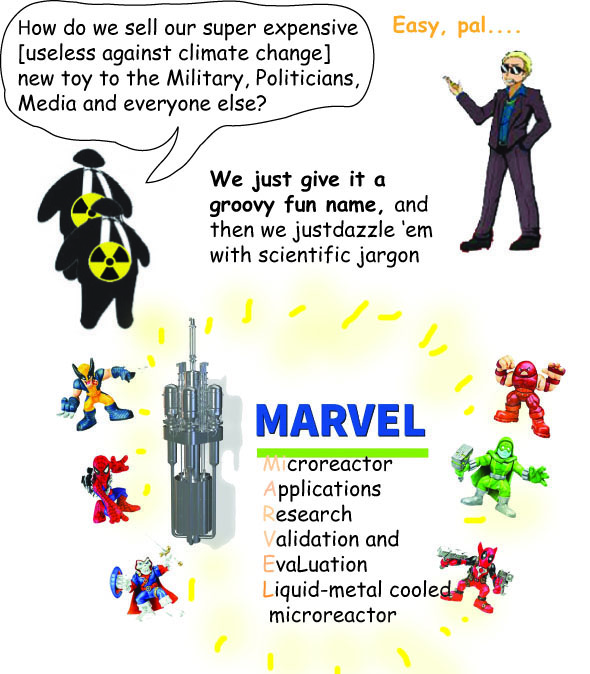
Concerns with nuclear energy must be taken seriously https://www.postregister.com/opinion/guest_column/opinion-concerns-with-nuclear-energy-must-be-taken-seriously/article_4e1e08d1-cad9-56dd-83cc-6ceadb828b24.html 16 July.By IAN COTTEN In June, the Department of Energy released a final environmental assessment for the MARVEL nuclear reactor project proposed to go in at Idaho National Laboratory. The result of the environmental assessment was a proposed finding of no significant impact.
It was incredibly discouraging to read through the DOE’s response to the public’s comments of concern in the final assessment. Many of the responses were copied and pasted responses and/or dismissively replied that the concerns around the proposal were out of scope for the assessment.
All nuclear energy produces highly dangerous, radioactive waste. The U.S. currently has no permanent radioactive waste repository. This means that every ounce of waste produced in this, and all other nuclear projects that take place at INL is destined to be stored in perpetuity at INL, which sits directly atop the Snake River Aquifer. This subsurface body of water is of critical importance to Idaho and provides drinking water to more than 300,000 people and irrigation water for our state’s richest agricultural regions. Continuing to add to the waste that is stored at INL is setting us up for catastrophe.
Littered throughout the assessment are mentions of how safely this reactor will operate and that there will be no impacts on groundwater during normal operations. Of course, project managers with the DOE intend for this reactor to operate as planned and for there to be no impact on the environment. But putting blind faith in a technology that exists only on paper and has no real-life operating experience is a reckless way to approach assessing potential environmental impacts.
It is also important to look at proposals like MARVEL within the larger energy landscape as we look ahead. When looking toward our energy future, the cost of research and development of new technologies must be considered. Every federal dollar that is spent on nuclear energy research, development and implementation is a dollar that cannot be spent on the development of actual renewable energy sources, such as wind and solar. Nuclear energy is considerably more expensive than renewables, often by orders of several magnitudes.
All of the safety concerns listed above should be considered in scope for this project, and the fact that the DOE refused to adequately acknowledge these concerns is disheartening. At the very least, our government should be willing to do their due diligence and prepare a more comprehensive environmental impact statement that assesses the potential health and safety impacts of this proposal in more depth.
While this proposed finding of no significant impact means that the DOE will likely avoid being required to prepare an environmental impact statement, MARVEL is not yet a sure thing. Idahoans who are concerned about this and other nuclear energy development in their state should voice their concerns to their Congress members and other elected officials. Idaho is too valuable to waste on untested, dangerous and dirty nuclear energy projects. Nuclear energy is out of scope for a safe, clean, equitable and renewable energy future.
1 This Month



26 September – International Day for the Total Elimination of Nuclear Weapons


PLEASE OPPOSE HR 8255 AND S.3639 – bills would accelerate satellite deployment, with no environmental review or safeguards – https://ncstd5li.quorum.us/campaign/169331/
To see nuclear-related stories in greater depth and intensity – go to https://nuclearinformation.wordpress.com
-
Archives
- September 2026 (233)
- August 2026 (330)
- July 2026 (355)
- June 2026 (287)
- May 2026 (306)
- April 2026 (356)
- March 2026 (251)
- February 2026 (267)
- January 2026 (308)
- December 2025 (358)
- November 2025 (359)
- October 2025 (375)
-
Categories
- 1
- 1 NUCLEAR ISSUES
- business and costs
- climate change
- culture and arts
- ENERGY
- environment
- health
- history
- indigenous issues
- Legal
- marketing of nuclear
- media
- opposition to nuclear
- PERSONAL STORIES
- politics
- politics international
- Religion and ethics
- safety
- secrets,lies and civil liberties
- spinbuster
- technology
- Uranium
- wastes
- weapons and war
- Women
- 2 WORLD
- ACTION
- AFRICA
- Atrocities
- AUSTRALIA
- Christina's notes
- Christina's themes
- culture and arts
- Events
- Fuk 2022
- Fuk 2023
- Fukushima 2017
- Fukushima 2018
- fukushima 2019
- Fukushima 2020
- Fukushima 2021
- general
- global warming
- Humour (God we need it)
- Nuclear
- RARE EARTHS
- Reference
- resources – print
- Resources -audiovicual
- Weekly Newsletter
- World
- World Nuclear
- YouTube
-
RSS
Entries RSS
Comments RSS
 nuclear-news