Serious questions about government funding Bill Gates’new confidence-trick, the NATRIUM nuclear reactor

Can we be sure that we will not end up with plutonium-fueled reactors coupled with reprocessing?
Dangerous Decisions about Advanced Nuclear Reactors Could Lead to New Threats https://portside.org/2021-06-27/dangerous-decisions-about-advanced-nuclear-reactors-could-lead-new-threats
Congress should have answers to tough questions before giving the Energy Department’s Advanced Reactor Development Program additional funding. June 27, 2021 Victor Gilinsky, Henry Sokolski
The Department of Energy’s recently launched Advanced Reactor Demonstration Program (ARDP) is slipping by without any close Congressional oversight, which is unfortunate as there are some serious questions that should be answered, including ones related to national security. The program was launched with an award of $160 million to TerraPower for its Natrium design and X-energy for its Xe-100. Each is to build a full-scale nuclear reactor within the next seven years, one that could be duplicated and sold commercially. While not a huge sum, it is intended to be the down payment on over $3 billion, a sum that is supposed to be cost-shared by the companies, with more for other projects.
At a March 25 Senate Energy Committee hearing on “advanced” reactors, executives of the two companies described a future with almost unlimited opportunities worldwide for their reactors, hundreds, maybe thousands. They got an enthusiastic reception from both sides of the aisle, summed up by Chairman Joe Manchin’s (D-WV) final observation that while wind and solar power were OK, “nuclear really does the job.” No one asked how the reactors will be fueled. Will they be fueled with nearly highly enriched uranium, or with plutonium? And what will be the security consequences of selling and encouraging reactors fueled with such fuels around the world?
Despite the enthusiasm for new technology, the “advanced” label is misplaced. These are re-engineered versions of old designs, some over fifty years old. “Advanced small modular reactors” trips off the tongues of people who think they are talking about the nuclear future, whereas in fact, they are talking about reviving the past.
“Small” is also an inaccurate label. Yes, there are lots of projects for small reactors, but they are a sideshow, for niche applications. The real action, the main ring, concerns larger units. TerraPower’s CEO, Chris Levesque, told the senators at the March 25 hearing that the company was pursuing a 300-megawatt (electric) unit because that was what today’s market would accept. But as it gained experience, TerraPower anticipated “growing Natrium output back up to gigawatt scale,” the size of current large light water reactors. The obvious conclusion is that TerraPower doesn’t think the smaller units would be economic, despite the current ballyhoo about the economic advantages of such units. Levesque thought there was a market for hundreds of the large units domestically and more abroad. As much of the talk was on competing with Russia and China, it is clear that the nuclear industry business plan centers on exporting the technology around the world.

Above – a different model – NuScale, but see the person indicated – this ”small” reactor is not small

The Natrium reactor TerraPower has promised to build with DOE funds is not, as many people think, the highly advertised “traveling wave” reactor design that TerraPower pursued when started by Bill Gates. That idea involved the active (fissioning) reactor region slowly “traveling” from the center of the reactor core over the life of the reactor, “breeding” plutonium from uranium and fissioning it in place, therefore with no need for reprocessing. That Bill Gates was assumed to be a shrewd investor boosted the company’s credibility. The traveling wave idea didn’t work, but TerraPower retained the label for a different design, apparently because it aids marketing.
The Natrium reactor is a scaled-up version of a General Electric design for a small sodium-cooled, plutonium-fueled fast breeder reactor (natrium is German for sodium, and “fast” means it relies on energetic neutrons). This is the reactor the nuclear enthusiasts have wanted to build since Congress canceled the Clinch River Fast Breeder Reactor in 1983. The Atomic Energy Commission, the DOE’s predecessor agency, pushed the liquid metal fast breeder (LMFBR) reactors in the 1970s as the energy solution in what was thought to be a uranium-poor world. But it turned out we live in a uranium-rich world so the expensive LMFBR made no economic sense.
It also made no sense to flood the world with untold tons of plutonium when a few kilograms is enough for a bomb. That’s why Presidents Gerald Ford and Jimmy Carter made it U.S. policy to discourage commercializing of plutonium-fueled reactors. Enthusiasts tried but failed to revive fast reactors as part of the second Bush administration’s Global Nuclear Energy Partnership program. It appears they are trying again.

TerraPower’s CEO told the senate hearing that the Natrium reactor would be fueled with uranium enriched to just short of 20 percent U-235 (a level that America is trying to prevent Iran from enriching to). It’s the borderline between low and highly enriched uranium. That choice seems to be related to DOE’s interest in developing a large enrichment market for the DOE-created Centrus Corporation, which is a story in itself.

Widespread use of reactors in this mode would dramatically increase demand for enriched uranium. Will 20 percent enriched uranium remain the preferred fuel for Natrium, or will it revert to plutonium with reprocessing to meet foreign customer interest? (The original GE design included an onsite reprocessing plant.) So configured, the reactor would make and reuse massive quantities of material that could be used to create a bomb. Recently, the Senate armed Services Committee raised this worry with regard to China’s fast reactor program. Congress should nail down the answer to this key question with regard to DoE’s programs.
There is a natural tendency to loosen the financial reins on projects that fall into the research and development category. But the two ARDP projects are prototypes for the commercial market. Congress should have answers to tough questions before giving the Energy Department’s ARDP additional funding. A good start would be to ask: Can we be sure that we will not end up with plutonium-fueled reactors coupled with reprocessing?
The Pentagon’s Project, Pele Military micro-reactors – creates more problems than it solves.

Military micro-reactors: Waging yesterday’s wars while losing the future’s https://www.defensenews.com/opinion/commentary/2021/06/15/military-micro-reactors-waging-yesterdays-wars-while-losing-the-futures/By: Bryan Clarkand Henry Sokolski With its withdrawal from Afghanistan and decision to end programs that typified America’s conflicts of past two decades, the Biden administration’s Pentagon is planning for long-term competitions against China and Russia. But for the Pentagon’s mobile micro-reactor effort, Project Pele, it’s still 2007.
Designed to supply energy to remote troops, Pele is geared for fighting the last war, which lacked high-end threats and during which vulnerable fuel convoys were a significant source of American casualties.
The Pentagon is asking Congress to spend $60 million next year on Pele. Congress should hit the brakes. Not only is Pele rooted in anachronistic military scenarios, but against Chinese, Russian, North Korean or Iranian militaries, it would be a prime target for precise missiles and drones as well as a source of friction with nuclear-skeptic U.S. allies expected to host the reactors.
With its withdrawal from Afghanistan and decision to end programs that typified America’s conflicts of past two decades, the Biden administration’s Pentagon is planning for long-term competitions against China and Russia. But for the Pentagon’s mobile micro-reactor effort, Project Pele, it’s still 2007.
Designed to supply energy to remote troops, Pele is geared for fighting the last war, which lacked high-end threats and during which vulnerable fuel convoys were a significant source of American casualties.
The Pentagon is asking Congress to spend $60 million next year on Pele. Congress should hit the brakes. Not only is Pele rooted in anachronistic military scenarios, but against Chinese, Russian, North Korean or Iranian militaries, it would be a prime target for precise missiles and drones as well as a source of friction with nuclear-skeptic U.S. allies expected to host the reactors.
To address the threat of attack, Pele’s fuel is intended to be inherently stable and resistant to meltdown.
Perhaps, but a large attack could bury the fuel in debris, preventing it from dissipating heat and causing it to exceed its design temperature. And even if the fuel remains intact, it is radioactive and would create a contamination risk once released from the reactor by an attack.
Count on our allies being unwilling to host Pele reactors that opponents are sure to strike. Unlike Iraq and Afghanistan, where the governments were beholden to the United States and guided-weapons threats were nonexistent, U.S. troops facing China would have to operate on Japanese, Australian or Philippine soil — nations that harbor strong anti-nuclear sentiments. U.S. governments in Guam or the Northern Mariana islands may have less choice in the matter, but residents there will hardly welcome new radioactive targets for Chinese missiles.
U.S. forces could reduce the threat to mobile reactors by taking them off the front lines. However, this reduces their value in solving logistical problems. More important, moving Pele away from the front will place it closer to civilian populations worried about Pele’s everyday radiological footprint. Consider instead of platoons of diesel mechanics and convoys of fuel, the Army needs squads of nuclear power plant operators and pallets of testing supplies and water treatment equipment. The return trip will also be full. Every glove, paper towel and sample bottle would likely be considered low-level waste and require specialized disposal, possibly back in the United States.
Bottom line: Pele creates more military challenges than it solves.
Mobile reactors might make sense for powering remote settlements and polar or moon stations, which is why NASA and the Energy Department are backing the project. But Pele is the wrong answer for tomorrow’s power-hungry military sensors, electric combat vehicles and directed-energy weapons. To supply these systems, the Pentagon should take a broader approach. Instead of advancing a comfortable solution from the past, the Defense Department should drive energy innovation through competition, such as the prize challenges that the Defense Advanced Research Projects Agency successfully used to advance new robotics and semiconductor designs.
New energy technologies are available. Solar and wind generation are being advanced and fielded today by commercial industry. Developments in batteries, capacitors and flywheels are already revolutionizing energy storage. A combination of these and other as-yet unidentified technologies could address the U.S. military’s expeditionary energy needs and be more feasible to deploy than Pele. Congress should reallocate Pele’s proposed budget to fund competitions to surface and exploit these new approaches rather than picking a winner today that is likely to lose tomorrow.
Bryan Clark, a retired U.S. Navy nuclear submarine officer, is currently a senior fellow at the Hudson Institute and the director of its Center for Defense Concepts and Technology. Henry Sokolski is the executive director at the Nonproliferation Policy Education Center. He served in the U.S. Defense Department’s Office of Net Assessment and as the department’s deputy for nonproliferation policy under then-Defense Secretary Dick Cheney
Why Utah really does not need Bill Gates’ small nuclear reactors

What Bill Gates and co. would like us to forget is that even the these geewhiz new small reactors are still based on that old carbon-releasing fuel chain –
Yes, there is a need to clean up our power generation to curb climate change — the sooner the better. But Williams points to a recent study that determined the lifecycle emissions with nuclear — mining, milling, transporting and storing the fuel and building and decommissioning the plants — far exceed other alternative energy sources.
Cox is eager for a nuclear future. Utahns should tell him why we’re not, says Robert Gehrke, https://www.sltrib.com/news/politics/2021/06/14/cox-is-eager-nuclear/ With safer, cleaner, cheaper alternatives, nuclear power may not make the most sense for Utah, By Robert Gehrke , June 15, 2021,
In Wyoming last week, an announcement was made that could mark a resurgence in the long-stymied nuclear energy industry.
Officials announced plans to build a new 345 megawatt nuclear power plant in the state that could, at its peak, generate enough electricity for all of the households in Wyoming with room to spare.
What makes this announcement different is the array of power players behind the project. It’s a partnership between Warren Buffett-owned Pacificorp and Bill Gates-owned Terrapower that has the backing of President Joe Biden’s Energy Department and Wyoming Gov. Mark Gordon.
It also has the support of Utah Gov. Spencer Cox, who praised the project as “a huge announcement” that “will have big implications for Utah in the future.”
“We look forward to similar partnerships in the years to come,” the governor said.
It’s not necessarily a new position. Cox’s predecessor, Gov. Gary Herbert, supported nuclear energy, as did his predecessor, Gov. Jon Huntsman.
But the Wyoming announcement ups the stakes dramatically, moving it from concept to something more concrete and forcing Utahns to confront critical questions nagging nuclear power: Is it safe? Is it cost-effective? And is it right for Utah?
Safety has always been the issue dogging nuclear power. Whether it’s Three Mile Island or Chernobyl or Fukushima, you surely have some nuclear disaster as a touchstone framing you perception of the energy.
The good news, according to Michael Simpson, chair of the Material Science and Engineering department at the University of Utah, is that the Natrium reactors that Terrapower hopes to build in Wyoming are generally safer than the old water-cooled reactors.
The Terrapower plant would be cooled with sodium, which transfers heat better than water, meaning it is less likely to melt down (like Chernobyl) or explode (like Fukushima).
Years ago, Simpson said, researchers at the Idaho National Laboratory did an experiment with a sodium-cooled reactor where they shut off the sodium coolant and instead of heating, the reactor slowly cooled and the reaction stopped.
Others dispute the safety claims, however. Earlier this year, the Union of Concerned Scientists issued a report that said the sodium reactors are unproven and raise other safety issues — for example, the sodium can burn if exposed to air.
“When it comes to safety and security, sodium-cooled fast reactors and molten salt-fueled reactors are significantly worse than conventional light-water reactors,” said Edwin Lyman, director of nuclear power safety for UCS.
Then there is the waste issue. The proponents of the sodium reactors contend that they would burn more of the fuel, producing less waste. Again, UCS disputes that and argues the waste that would be generated would pose nuclear proliferation and possible terrorism risks.
Then there’s the economics of nuclear power.
Recently, South Carolina completely scrapped a water-cooled nuclear plant that had been in the works for years. Some $9 billion was squandered sparking lawsuits by investors and ratepayers demanding their money back.
Rocky Mountain Power’s own figures released in 2019 put the cost of nuclear power at $95 per megawatt hour, compared to around $25 to $30 per hour for solar. Some cost projections are lower, some are higher, but none put nuclear in the same ballpark as solar, raising the obvious concern that we’ll be on the hook for the added expense one way or another — either as ratepayers or as taxpayers subsidizing the more costly power source.
There’s also a larger question, according to Scott Williams, executive director of HEAL Utah, an environmental group that has opposed nuclear power: Do we need it?
Yes, there is a need to clean up our power generation to curb climate change — the sooner the better. But Williams points to a recent study that determined the lifecycle emissions with nuclear — mining, milling, transporting and storing the fuel and building and decommissioning the plants — far exceed other alternative energy sources.
But the TerraPower reactor isn’t expected to come online until 2028 and, as we saw in South Carolina, when it comes to building nuclear power plants, the projections often are unrealistically optimistic.
With battery technology improving and rooftop solar expanding and getting cheaper, there’s no reason to gamble on nuclear, Williams said, other than centralized generation benefits Rocky Mountain’s shareholders.
“It just doesn’t make sense,” he said. “If you’re looking at it objectively, to say it’s better to put a bunch of money into a technology that not only isn’t proven, but has been proven to fail time and time again.”
And we have to take into account our state’s history with nuclear energy that is nothing short of radioactive itself, from the miners and uranium mill workers sickened by their exposure to radiation, to the thousands upon thousands of Utah Downwinders stricken with various cancers as a result of nuclear weapons testing in Nevada, to the decade-long battle to beat back a nuclear waste storage facility in Utah’s desert.
So do we scrap the whole nuclear idea? Not necessarily.
But if Utah wants to venture down the nuclear energy path, these questions and a host of others have to be thoroughly researched and addressed. We’re not there yet and until we are, the cheerleading from the Biden administration and Gov. Cox feels premature.
Bill Gates, Warren Buffett’s piddly little ”Natrium” nuclear reactor – greenwashing, while keeping fossil fuels going.

The key to understanding this story is found in Governor Gordon’s use of the words “all of the above.” That’s free market speak for “We’rehappy to have a piddly little 350 MW facility of over here, just so long as we can continue supporting coal- and gas-powered generating plants that churn out hundreds of gigawatts over there.”
In other words, it’s asmokescreen designed to allow fossil fuel interests to kick the can down the road a little further and add some greenwashing to their corporate portfolios at the same time. Being rich does not necessarily make a person all that smart. America needs more nuclear power like a fish needs a bicycle.
People in Wyoming may be fooled by this blather, but CleanTechnica readers aren’t taking the bait. Natrium was probably selected as the name of thus new nuclear technology because it sounds a little like “nature” or “natural.” That’s a great marketing ploy, but we’re not buying it. Frankly, the Bill and Warren show is more than a little disappointing.
Clean Technica 3rd June 2021
Bill Gates & Warren Buffett To Build A New Kind Of Nuclear Reactor — Is That Good News?
Billionaires’ advanced ”Natrium” nuclear reactors planned for Wyoming.
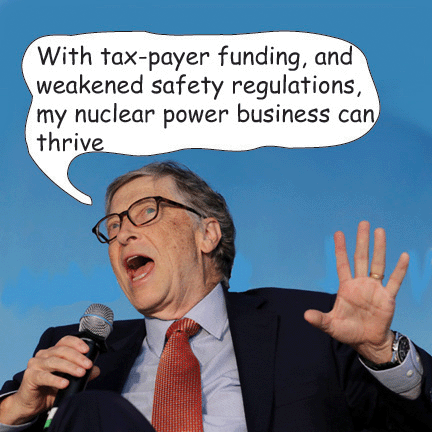
Power companies run by billionaire friends Bill Gates and Warren Buffett
have chosen Wyoming to launch the first Natrium nuclear reactor project on
the site of a retiring coal plant. TerraPower, founded by Gates about 15
years ago, and power company PacifiCorp, owned by Warren Buffett’s
Berkshire Hathaway, said on Wednesday that the exact site of the Natrium
reactor demonstration plant was expected to be announced by the end of the
year.
Nuclear power experts have warned that advanced reactors could have higher risks than
conventional ones. Fuel for many advanced reactors would have to be
enriched at a much higher rate than conventional fuel, meaning the fuel
supply chain could be an attractive target for militants looking to create
a crude nuclear weapon, a recent report said.
Guardian 3rd June 2021
Small nuclear reactors pushed for military use,despite their obvious dangers
There are concerns, of course, associated with deploying mobile nuclear reactors to bases or the battlefield. Meltdowns, waste products, and other malfunctions are always a concern with nuclear energy technologies, and if a reactor in a contested area is destroyed by adversary forces, for example, the risk of environmental contamination is high. That, in turn, could create a political disaster for the DOD and United States. Deploying any nuclear systems abroad also incurs the risk of proliferation if those technologies should fall into the wrong hands due to a forward-operating base or convoy being overrun by hostile forces.
Those concerns will no doubt be a major policy consideration when, or if, these mobile reactors ever reach a state of technological readiness to where they can be deployed. New nuclear technologies aren’t the only new energy production and storage systems the DOD is eyeing, however. Revolutionary concepts such as space-based solar power beaming, new forms of hydrogen fuel cells, or even more advanced applications of existing technologies like modular solar generators are all being developed which could revolutionize how the DOD powers its expeditionary forces without the risks associated with nuclear power.

The Military’s Mobile Nuclear Reactor Prototype Is Set To Begin Taking Shape, The Drive BY BRETT TINGLEY JUNE 3, 2021
Project Pele is one potentially revolutionary, albeit controversial, answer to the military’s growing battlefield energy requirements.
The Office of The Secretary of Defense (OSD) has requested $60 million dollars for Project Pele, which is aimed at developing a new, transportable nuclear microreactor to provide high-output, resilient power for a wide variety of Department of Defense (DOD) missions. The DOD hopes to begin working on a prototype reactor design, which will hopefully be able to eventually produce one to five megawatts of electricity and operate at peak power for at least three years, in the next fiscal year.
The request for funding for Project Pele is found in the Pentagon’s proposed budget for the 2022 Fiscal Year, which was released on May 28, 2021. This is the first year that the Office of the Secretary of Defense has asked for money for this program through the larger Advanced Innovative Technologies line item. Previous funding for Pele, also known as the Micro Nuclear Reactor Program, had come through a separate Operational Energy Capability Improvement account in OSD’s budget.
The budget documents say that the goals for Project Pele in the 2022 Fiscal Year are to “complete the design phase and prepare for construction of a 1-5 Megawatt electric transportable nuclear microreactor.” In addition, it notes that “due to the nature of this project, specific applications and detailed plans are available at a higher classification level.”
“The Pele project continues activities initiated under Congressional direction in FY 2020 and FY 2021,” according to the documents. “Congressional Adds [totaling $16 million in the 2021 Fiscal Year] directed for nuclear fuel core development to support the Pele reactor maturation and also funding to support power and thermal management maturation for directed energy weapons.”
………………the Fiscal Year 2022 budget requests says the desired design is as a 1-5 megawatt (MW) nuclear microreactor.
For comparison, the output of the smallest nuclear power plant in the United States, New York’s R.E. Ginna Nuclear Power Plant, is 581 MW. The desired power output is even smaller than most research reactors.
…… The funding for Pele also builds on several other developments, which show that the DOD, DOE, and the National Aeronautics and Space Administration (NASA) are investing heavily in new nuclear technologies to power a new American space age. “Production of a full-scale fourth-generation nuclear reactor will have significant geopolitical implications for the United States,” said Jay Dryer, director of the Strategic Capabilities Office.
……… Building on that document’s goals, a January 2021 Executive Order expanded on the National Space Council document by ordering NASA to deliver a report that defines requirements and foreseeable issues for developing a nuclear energy system to enable human and robotic space missions for the next two decades. The order also included plans for a “Common Technology Roadmap” made among NASA and the Departments of Energy, Defense, Commerce, and State for developing and deploying these new reactor technologies.
Energy security and dominance have become cornerstones of DOD strategy, given the unbelievable amounts of fuel and energy consumed by the power-hungry systems the modern military depends on. U.S. Army leadership has previously stated that it wants its brigades to be self-sufficient for a week without the need for resupply, and there have been previous calls for microreactors that could fit inside existing platforms such as the C-17 Globemaster. Meanwhile, Lockheed Martin and other laboratories continue work on the lofty goal of developing miniaturized fusion reactors…….
There are concerns, of course, associated with deploying mobile nuclear reactors to bases or the battlefield. Meltdowns, waste products, and other malfunctions are always a concern with nuclear energy technologies, and if a reactor in a contested area is destroyed by adversary forces, for example, the risk of environmental contamination is high. That, in turn, could create a political disaster for the DOD and United States. Deploying any nuclear systems abroad also incurs the risk of proliferation if those technologies should fall into the wrong hands due to a forward-operating base or convoy being overrun by hostile forces.
Those concerns will no doubt be a major policy consideration when, or if, these mobile reactors ever reach a state of technological readiness to where they can be deployed. New nuclear technologies aren’t the only new energy production and storage systems the DOD is eyeing, however. Revolutionary concepts such as space-based solar power beaming, new forms of hydrogen fuel cells, or even more advanced applications of existing technologies like modular solar generators are all being developed which could revolutionize how the DOD powers its expeditionary forces without the risks associated with nuclear power. https://www.thedrive.com/the-war-zone/40914/the-militarys-mobile-nuclear-reactor-prototype-is-set-to-begin-taking-shape
American experts warn Trudeau that Moltex small nuclear reactors are likely to prove a nightmare for Canada

The critics contend that SMRs are costly, unproven and creators of toxic waste of their own. From a practical point of view, it is hard to make the case that SMRs will be crucial in the battle against climate change, since they won’t come off the drawing board for years, if ever. Former Green Party leader Elizabeth May says that opting for experimental SMRs is just another way of delaying real action on global warming.
US Experts to Trudeau: Your Nuclear Dream May Turn Nightmare https://thetyee.ca/Analysis/2021/05/26/US-Experts-Trudeau-Your-Nuclear-Dream-May-Turn-Nightmare/?utm_source=daily&utm_medium=email&utm_campaign=260521
Rethink backing the Moltex reactor, urge nine non-proliferation heavyweights.
Michael Harris TheTyee.ca, 6 May 21, A blue-ribbon group of American nuclear non-proliferation experts warns that Canada’s investment in new nuclear technology could lead to the spread of nuclear weapons and new threats to the environment.
“We write as U.S. non-proliferation experts and former government officials and advisors with related responsibilities to express our concern about your government’s financial support of Moltex — a startup company that proposes to reprocess CANDU spent fuel to recover its contained plutonium for use in molten-salt-cooled reactors.”
The warning came in the form of an open letter to Prime Minister Justin Trudeau that was delivered on Tuesday and signed by the nine experts.
The group is spearheaded by Frank von Hippel, professor and senior research physicist at Princeton University; it includes Matthew Bunn, the Schlesinger professor of the practise of energy, national security, and foreign policy at the Harvard Kennedy School; and Thomas Countryman, former U.S. assistant secretary of state for non-proliferation.
“We understand your government’s motivation to support nuclear power and to reduce fossil fuel use but saving the world from climate disaster need not be in conflict with saving it from nuclear weapons. Also, like other reprocessing efforts, Moltex, even in the R&D stage, would create a costly legacy of contaminated facilities and radioactive waste streams, and require substantial additional government funding for cleanup and stabilization prior to disposal,” they wrote.
Rory O’Sullivan, CEO of Moltex North America painted a very different picture of his company’s experimental technology in an interview with World Nuclear News: “We are working to develop a technology that uses the fuel from the first generation of nuclear power to the next. This reduces the challenges associated with spent nuclear fuel, while expanding nuclear power to help Canada achieve its climate change objectives.”
The Trudeau government has invested $50.5 million in Moltex, and backs the company’s plan to build a 300 MW molten salt reactor in New Brunswick on the Bay of Fundy. Theoretically, it would then reprocess spent fuel from the Point Lepreau nuclear plant, which is set to be decommissioned in 2040.
The Moltex reactor belongs to a class of nuclear power plants termed small modular reactors or SMRs that generate small amounts of electricity in comparison with typical CANDU reactors.
Natural Resources Minister Seamus O’Regan has said that Canada can’t get to net-zero carbon emissions by 2050 without nuclear as part of the equation, along with renewables.
Despite marketing its roll of the dice on Moltex as part of its war on climate change, Ottawa isn’t getting much love from environmentalists, or many other people. Three federal political parties, the NDP, the Bloc and the Greens; the Green Budget Coalition; and the Canadian Environmental Law Association all oppose the federal investment in small modular reactors. University of British Columbia professor of public policy and global affairs M.V. Ramana has levelled criticisms in these pages as well.
The critics contend that SMRs are costly, unproven and creators of toxic waste of their own. From a practical point of view, it is hard to make the case that SMRs will be crucial in the battle against climate change, since they won’t come off the drawing board for years, if ever. Former Green Party leader Elizabeth May says that opting for experimental SMRs is just another way of delaying real action on global warming.
One who has closely followed and opposes the two experimental SMR reactors planned for New Brunswick, the ARC-100 and the Moltex SSR, is Dr. Susan O’Donnell, an adjunct professor of sociology at the University of New Brunswick. O’Donnell is also the primary investigator of Raven, a research team based at the university dedicated to highlighting rural environmental issues in the province.
O’Donnell points out that Moltex has never built a nuclear reactor before. In fact, only two molten salt reactors have ever been built — 50 years ago. Neither of them produced electricity. One of them lasted four years before shutting down, the other, just 100 hours.
On the environmental side, O’Donnell says that SMR pollution or a serious failure could lead to “disasters and no-go zones.”
On the non-proliferation front, she denounces the plan to broadly “export” the Moltex technology, assuming it ever gets up and running.
“What we have learned from Canada’s role in making India a nuclear power is that one of the dangers of the Moltex proposal is its plan to export the technology. We’re exporting bomb-making capacity,” she told The Tyee.
O’Donnell has pushed for public consultations to help develop a national radioactive waste policy. Last Aug. 13, she made an offer to the federal minister of natural resources to have the Raven project organize such a public consultation in New Brunswick. It would be online because of the pandemic, in both official languages, and would include Indigenous nations and rural communities. Minister O’Regan responded two months later, on Oct. 30, turning her down.
“Strangely, he cited the pandemic, even though our offer clearly stated the consultation would be virtual,” the professor said.
O’Donnell’s take on the Moltex project is backed up by Allison Macfarlane, former chair of the U.S. Nuclear Regulatory Commission. The specialist in the storage of nuclear waste told the CBC in January that the molten salt technology is totally unproven with respect to viability, costs and storage risks.
“Nobody knows what the numbers are, and anybody who gives you numbers is selling you a bridge to nowhere…. Nobody’s been able to answer my questions yet on what all those wastes are, and how much of them there are, and how heat-producing they are and what their compositions are,” Macfarlane said. She is now the director of the School of Public Policy and Global Affairs at UBC.
But the Trudeau government does have allies at the provincial level for its nuclear ambitions. The governments of New Brunswick, Ontario, Saskatchewan and Alberta have all signed a memorandum of understanding to develop SMRs, which means promoting them.
They are excited about the promises by Moltex that it will be able to produce clean energy at a low cost by recycling something that everyone wants to get rid of — the three million spent fuel bundles in Canada that the government still doesn’t know how to dispose of safely and permanently.
The U.S. experts made clear to the PM in their letter that they are not convinced by the company’s assertions. They want the Trudeau government to convene a high-level review of both the non-proliferation and environmental implications of Moltex’s reprocessing proposal. Key to that proposal is including “independent international experts,” before Ottawa makes any further investments in support of the Moltex proposal.
The earliest projects to reprocess nuclear waste extracted plutonium to make nuclear weapons. The letter signees worry Canada’s new generation of reactors will afford the same opportunity to anyone who buys them.
“Our main concern is that, by backing spent-fuel reprocessing and plutonium extraction, the government of Canada will undermine the global nuclear weapons non-proliferation regime that Canada has done so much to strengthen. Canada is a founding member of the Nuclear Suppliers Group, which was established in 1974 in response to India’s misuse of a Canada-supplied research reactor and U.S.-supplied reprocessing technology to acquire the plutonium needed for its first nuclear weapons.”
The reprocessing of nuclear waste was “indefinitely deferred” in the United States by president Jimmy Carter in 1977 after India tested its first nuclear weapon. At the time, the Americans discovered that several other countries including Brazil, Pakistan, South Korea and Taiwan were all surreptitiously headed down the same nuclear weapons path that India had taken. Of that group, only Pakistan managed to get the bomb.
The U.S. experts who signed the letter to Trudeau also rejected the claim by Moltex that by using spent fuel from older Canadian CANDU reactors, its reactor would reduce the long-term risk from a deep underground radioactive waste repository.
The Trudeau government promised it would base its major policies on science. It’s time for the public consultation, far from the greasy paws of lobbyists, and with the best minds that can be brought to the table.
This is a letter to take to heart.
Canadian government in the grip of the nuclear lobby’s NICE dishonest spin about small nuclear reactors.
”…………….To date, not a single SMR has been built in Canada, but no matter, the technology is the current darling of nuclear power circles, and not just at home, either; other countries, from China to the United States, are pursuing the development of SMRs. Currently, 12 proposals for SMR development are winding their way through the Canadian Nuclear Safety Commission’s (CNSC) pre-licensing vendor review process, which enables CNSC staff to provide feedback on proposed designs at a company’s request. But not a single project has yet been approved.
For the time being, any vision of SMRs is largely aspirational. A Conference Board of Canada report in March on SMRs outlined that from concept to commercialization, the technology will require about a billion dollars of development expenditure. The same report noted that as an emerging technology, costs are still uncertain, and the “risky pre-commercial phase needs capital investment, but governments will be reluctant without major private capital commitment.”
It’s early days for financing the technology. For instance, one infusion of federal funds, the $50 million granted to New Brunswick’s Moltex Energy in mid-April, only supports research and development, employee recruitment and the expansion of academic, research and supply chain partnerships, not the physical construction of that firm’s SMR.
Beyond financial considerations, the Liberal government will have a tough time convincing environmentalists to embrace the merits of SMRs, or any nuclear power, as a clean energy source. More than 100 groups have signed a letter issued by the Canadian Environmental Law Association condemning the government’s push to pursue nuclear power and SMRs. Among their concerns are that SMRs are more expensive to develop than renewable energy and that the reactors are “dirty and dangerous,” creating new forms of radioactive waste that are especially dangerous to manage.
For now, however, nothing is slowing the momentum. In mid-April, the Canadian Nuclear Association triumphantly announced Alberta was joining Ontario, New Brunswick and Saskatchewan in the development of SMRs.
Those aren’t the only recent developments in the burgeoning SMR industry. Ontario Power Generation is teaming up with SMR developer Ultra Safe Nuclear Corporation to develop a micro modular reactor at Chalk River. Ontario Power Generation is also carrying out engineering and design work on SMRs with GE Hitachi, Terrestrial Energy, and X-energy…….
Europe is now shifting away from nuclear power. In 2019, solar installed capacity exceeded nuclear for the first time in the EU, with 130 gigawatts versus 116 gigawatts, according to the World Nuclear Industry Status annual report, which provides independent assessments of global nuclear developments. And a technical expert group convened in the EU chose not to recommend nuclear energy when asked to advise on screening criteria that would substantially contribute to climate change mitigation or adaptation while “avoiding significant harm” to other environmental objectives.,…..
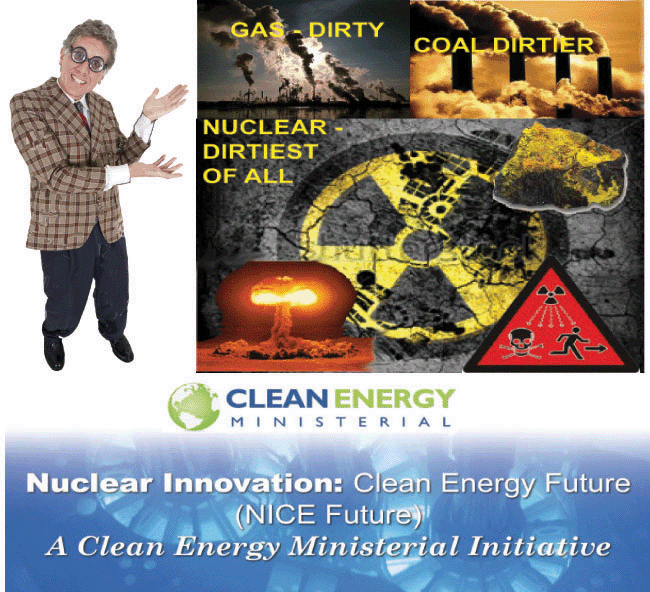
the federal government has been lobbying hard on behalf of the industry since at least 2019. The Department of Natural Resources, for instance, is a member of the international initiative Nuclear Innovation: Clean Energy Future, or as it’s better known, NICE, Besides Canada, members include Japan, the United States, and a number of nuclear associations. The goal “is to ensure that nuclear energy receives appropriate representation in high-level discussions about clean energy.”
Freelance researcher Ken Rubin turned up a number of documents using freedom-of-information requests that showed the federal government is collaborating with NICE and others to promote nuclear power and SMRs. The federal government, for example, offered $150,000 for the development of a “Top 20 book of short stories” on “exciting near-term nuclear innovations” designed to showcase nuclear power as an environmental force for good. The book includes stories on the safe storage of nuclear waste as well as on the emerging SMR market.
According to the book, uses for the latter technology include “energy parks” providing heat for industrial processes, steam for heating and electricity for cooling homes, offices and shops, all without emissions. The story breathlessly declares: “This isn’t science fiction.”
No matter how hard the government lobbies the public for a NICE future, though, it’s going to remain a tough sell to Canadian environmentalists. While the environmentalists have nothing specific to fight yet, given that a viable SMR has yet to be built, they’ll be ready when the technology reaches development. Already, a who’s who of groups has signed a letter protesting the next thing in nuclear.
Theresa McClenaghan, CELA’s executive director and counsel, told Canada’s National Observer: “It’s not a climate answer for many reasons, including the fact it’s not realistic and it’s way too far down the road for us to meet any serious climate targets. We’ve characterized it as a dirty, dangerous distraction.”
Susan O’Donnell, a researcher and adjunct professor in the Department of Sociology at the University of New Brunswick and a nuclear activist, says SMRs are too slow and costly as a climate crisis solution. “It’s important to remember that these technologies basically don’t exist yet,” she said. “They’re at a very early stage in development. They are speculative technologies. It will take at least a decade to get them off the drawing board and then it will take much longer than that to find out if they work.” – from the Bulletin of the Atomic Scientists , 20 May 21
Rolls Royce plans fleets of small nuclear reactors. At approx £2billion per reactor (that’s approx $2.8billion) how much will each fleet cost?

Rolls-Royce expects the first five reactors to cost £2.2bn each, falling to £1.8bn for subsequent units.
SMRs could not achieve economies of scale unless developers secured a large number of orders. “How are you going to get orders for 16 of an unproven reactor type and if you don’t have orders for 16 how are you going to build a factory?”

Rolls-Royce courts investors for mini nuclear plants, Consortium led by engine group seeks £300m in funding as it prepares application for small modular reactors, Nathalie Thomas in Edinburgh and Sylvia Pfeifer in London Ft.com, 17 May 21,
A consortium led by Rolls-Royce that is hoping to build a fleet of mini nuclear power stations across Britain is talking to investors to secure £300m in funding as it prepares to submit its design to regulators later this year. The consortium, which also includes Jacobs and Laing O’Rourke, hopes to be the first “small modular reactor” developer to put its design through the UK’s rigorous nuclear regulatory assessment. The process is expected to take up to four years but would keep the companies on track to complete their first 470MW plant by the early 2030s, which would be capable of generating enough low-carbon electricity for about 1m homes.
UK prime minister Boris Johnson backed SMRs as part of his 10-point plan for a “green industrial revolution” last year. The technology is viewed within the government as a good way to create manufacturing jobs as well as delivering on Johnson’s “levelling up” agenda. Rolls-Royce believes at least 16 SMRs could be installed at existing and former nuclear sites in Britain and more could potentially be built at locations such as former coal mines. It estimates the programme could create as many as 40,000 jobs in the UK regions by 2050.
Environmental groups say the technology is unproved and point out that nuclear energy leaves behind a legacy of waste, the most toxic of which takes at least 100,000 years to decay The prime minister has promised £215m in public funds, which the consortium hopes will help it secure the £300m in private match funding needed for the project to progress.
Rolls-Royce, which has been working on SMRs since 2015, expects the first five reactors to cost £2.2bn each, falling to £1.8bn for subsequent units.
It has argued that its design, which uses pressurised water reactors similar to existing nuclear power stations and boasts an increased generation capacity from 440MW previously, is more commercially viable and lower-risk than rival plans. The company has also claimed it could compete with renewable technologies such as offshore wind. Tom Samson, chief executive of the Rolls-Royce-led consortium, said “the way we manufacture and assemble our power station brings down its cost to be comparable with offshore wind at around £50/MWh”.
But Tom Burke, chair of climate change think-tank E3G, argued that SMRs could not achieve economies of scale unless developers secured a large number of orders. “How are you going to get orders for 16 of an unproven reactor type and if you don’t have orders for 16 how are you going to build a factory?” If sufficient private funding is secured, the consortium intends to set up a special purpose vehicle this summer in which Rolls-Royce is expected to retain a significant interest. The programme could give Rolls-Royce an important new revenue stream as it looks to reduce its exposure to the commercial aerospace sector, which has been severely dented by the coronavirus pandemic.https://www.ft.com/content/11ba5955-2f75-4eb5-b3e9-73f74684eb10
Small nuclear reactors – a way to get indigenous people to then accept nuclear waste?

Gordon Edwards is president of the Canadian Coalition for Nuclear Responsibility and notes the Moltex SMR design involves dissolving spent nuclear fuel in molten salt, and there lies an issue, he believes.
“What happens when you dissolve the solid fuel in a liquid, in this molten salt – then all of these radioactive materials are released into the liquid,” says Edwards, “and it becomes more dangerous to contain them because a solid material is much easier to contain than a liquid or gaseous material.”
Peskotomuhkati chief unhappy about nuclear reactor testing on his traditional territory https://www.aptnnews.ca/national-news/peskotomuhkati-nation-nuclear-reactor-testing-new-brunswick-small-modular-reactors/—
Christopher Read cread@aptn.caMay 16, 2021,
Feds say they won’t reach zero emissions by 2050 without small nuclear reactors.
It’s a new kind of nuclear reactor that the federal government is putting up $50.5 million in development money for, but some Indigenous leaders are already speaking out against it
.Moltex Energy Canada is getting the tax-dollar investment to develop what the nuclear industry calls a “small modular reactor” or SMR – which is generally considered to be a reactor with a power output of 300 megawatts or less.The Moltex SMR design is to be developed at New Brunswick Power’s Point LePreau Nuclear Generating Station, which is on the north shore of the Bay of Fundy and in Peskotomuhkati traditional territory.
ARC Clean Energy Canada is another operation also set to develop an SMR at the Point LePreau site. It was announced in February that ARC would get $20 million from the New Brunswick government if the company can raise $30 million of its own cash.
Hugh Akagi is Chief of Peskotomuhkati Nation and has concerns about more nuclear development in the aging facility.
“Well, I don’t feel very good about it, to be honest,” says Akagi. “You paid that money if you pay tax on anything in this country, you’ve just made a donation to Moltex. If you’re not concerned about $50 million being turned over to a corporation for a technology that does not exist – I hope you heard me correctly on that.”
The federal government has taken a shine to the idea of SMRs and Minister of Natural Resources Seamus O’Regan is on the record as saying “We have not seen a model where we can get to net-zero emissions by 2050 without nuclear.”
Under the Small Modular Reactor Action Plan, the federal government is pushing for SMRs to be developed and deployed to power remote industrial operations as well as northern communities.
Three streams of government-supported SMR developments are underway at two sites in Ontario as well as at Point LePreau.
As well, the governments of New Brunswick, Ontario, Saskatchewan and Alberta have all signed a memorandum of understanding pledging their support for SMR development.
Akagi says he hasn’t been formally consulted – but has been to a presentations put on by NB Power about the SMR project.
He says he is unlikely he’ll ever give it his support.
“Until I can have an assurance that the impact on the future is zero,” says Akagi, “I don’t want to 100 years, 200 years is still seven generations. I want zero impact.”
But Moltex Energy Canada CEO Rory O’Sullivan says his company’s technology will ultimately reduce environmental impact, by recycling spent nuclear fuel from full scale reactors.
“Instead of putting it in the ground where it’ll be radioactive for very long periods, we can reuse it as fuel to create more clean energy from what was waste,” says O’Sullivan. “We can’t get rid of the waste altogether. But the aim is to get rid, to get it down to about a thousandth of volume of the original long-lived radioactivity.
O’Sullivan admits to formerly seeing nuclear as too much of a problem to be a viable solution in the climate crisis.
“When I graduated as a mechanical engineer I saw that nuclear is potentially as too expensive, has the waste issue, has a potential safety issue,” says O’Sullivan. “Well, actually, with these innovative new designs, you can potentially have nuclear power that is lower cost, cheaper than fossil fuels – you can get much safer solution using innovation and you can potentially deal with the waste.”
Gordon Edwards, one of Canada’s most prominent nuclear critics, isn’t buying that argument.
Edwards is president of the Canadian Coalition for Nuclear Responsibility and notes the Moltex SMR design involves dissolving spent nuclear fuel in molten salt, and there lies an issue, he believes.
“What happens when you dissolve the solid fuel in a liquid, in this molten salt – then all of these radioactive materials are released into the liquid,” says Edwards, “and it becomes more dangerous to contain them because a solid material is much easier to contain than a liquid or gaseous material.”
Edwards also works on a radioactive task force with the Anishinabek Nation and the Iroquois Caucus.
And as he sees it, small modular reactors could make it harder for Indigenous communities to say no to the deep geological repositories [DGRs] being pitched to Indigenous communities as a supposedly safe way for Canada’s nuclear industry to entomb highly radioactive waste for hundreds of thousands of years.
“We don’t accept the small modular reactors because we know that it’s just a way of implicating us so that we can then have less of an argument against being radioactive waste dumps,” says Edwards. “If we accept small modular reactors into our communities, how can we then turn around and say we don’t want to keep the radioactive waste? It would just put us in an impossible position.”
Edwards and other nuclear critics such as Akagi recently participated in an online webinar focused on concerns around nuclear development at Point LePreau.
And those adding their voices to the critical side of the ledger on nuclear development at Point LePreau include Jenica Atwin – the Green Party’s MP for Fredricton, and Wolastoq Grand Council Chief Ron Tremblay – who issued a Resolution calling for nuclear development to be halted.
Atwin put out a release in April calling Canadian nuclear policies “profoundly misguided.”
“My basic premise is that the government needs to be more responsible in the information that they’re sharing just in general to talk about the risks that exist alongside whatever benefits they’re kind of toting,” says Atwin. “And right now, we’re only hearing that it’s the greatest option. This is how we fight climate change. It is clean, it’s cheap energy. And I have to disagree.”
If all goes to according to the Moltex plan, its SMR could be operable by about 2030.
Rolls Royce desperate for investors for its £2bn Small Nuclear Reactors

It’s not a good look, as Rolls Royce is in a financial crisis
Consortium led by Rolls-Royce on hunt for orders for its £2bn nuclear reactors after redesign that means each will power 100,000 more homes https://www.thisismoney.co.uk/money/markets/article-9581899/Rolls-Royce-starts-hunt-buyers-nuclear-reactor-boost.html By ALEX LAWSON, FINANCIAL MAIL ON SUNDAY 16 May 2021
A consortium led by Rolls-Royce is on the hunt for orders for its £2billion nuclear reactors after a redesign that means each will power 100,000 more homes.
The Mail on Sunday can reveal that the UK Small Modular Reactor (SMR) project has revamped the proposed mini reactors to increase their output. The factory-built reactors will now generate 470 megawatts, enough to provide electricity to a million homes.
The project, launched in 2015, aims to bring ten mini nuclear reactors into use by 2035, with the first due to enter service around 2030.
Tom Samson, chief executive of the UK SMR Consortium, said negotiations had begun with potential investors to fund the creation of the mini reactors – signalling that the project may move more rapidly than previously thought.
He said it was looking for customers, which could include energy, industrial or technology companies, to operate the sites. He added: ‘We’re ready to take this technology to market. We’re going to be pursuing orders. We’re hoping to get orders soon.’
The UK’s nuclear power industry has had a chequered recent past with the future of some huge plants thrown into doubt. Rolls-Royce hopes to create a nimbler solution to complement big power stations.
Rolls-Royce is the major share holder in the venture, which has been developed through a consortium that includes Atkins, Jacobs and Laing O’Rourke. The Government has so far invested £18million to support its design and £215million has been earmarked for the SMR programme as part of a ‘Green Industrial Revolution’.
Samson said a further £300million of private capital is now being sought to develop the reactors, which it hopes will be located both in the UK and overseas.
The initial ‘two to three’ units are likely to require Government support, but Samson hopes to move to ‘traditional debt and equity’ to fund following orders. Last week, the Government updated its nuclear policy to open its Generic Design Assessment to new nuclear technologies. UK SMR hopes to be the first to submit a proposal to Government and regulators.
Samson said 220 engineering decisions had been made in the latest designs. He said the switch from an ‘armadillo’-shaped building to one with a ‘faceted’ top allowing the roof to wrap around the inner workings made it more efficient.
The Prime Minister’s former chief adviser Dominic Cummings was a champion of the UK SMR programme, but Samson said No10 remained behind the project and it chimed with current policy.
He added: ‘We unashamedly wrap ourselves in the Union Jack. This is a really proud UK innovation that we’ve developed here at low cost. And that’s what consumers need.
We’re contributing to the Government’s levelling-up agenda. We’re also contributing to its post-Brexit global Britain agenda.’
Samson is running the rule over sites for factories to build the mini reactors, and said they were most likely to be in the North of England and the East Midlands, where Rolls-Royce is based. He is also studying potential locations for the reactors, which could include former nuclear sites in West Cumbria and Anglesey, where Japanese giant Hitachi pulled the plug on plans for a £20billion plant last year.
Samson described renewable energies such as solar and wind power as ‘weather dependent’, adding: ‘We’re not intermittent. These plants will run for 60 years. They will operate 24/7.’
Scepticism in Canada, about the government’s push for small nuclear reactors.
Canada pegs its energy future on nuclear power, but not everyone’s buying it, Canada’s National Observer, By Charles Mandel May 12th 2021 “…………. Gorman, along with the rest of the nuclear industry, pins the country’s future decarbonization efforts on a new breed of nuclear power known as small modular reactors (SMRs).
……… To date, not a single SMR has been built in Canada, but no matter, the technology is the current darling of nuclear power circles…. Currently, 12 proposals for SMR development are winding their way through the Canadian Nuclear Safety Commission’s (CNSC) pre-licensing vendor review process, which enables CNSC staff to provide feedback on proposed designs at a company’s request. But not a single project has yet been approved.
That hasn’t stopped the Canadian federal government from actively promoting a shift to SMRs………
For the time being, any vision of SMRs is largely aspirational. A Conference Board of Canada report in March on SMRs outlined that from concept to commercialization, the technology will require about a billion dollars of development expenditure. The same report noted that as an emerging technology, costs are still uncertain, and the “risky pre-commercial phase needs capital investment, but governments will be reluctant without major private capital commitment.”
It’s early days for financing the technology. For instance, one infusion of federal funds, the $50 million granted to New Brunswick’s Moltex Energy in mid-April, only supports research and development, employee recruitment and the expansion of academic, research and supply chain partnerships, not the physical construction of that firm’s SMR.
Beyond financial considerations, the Liberal government will have a tough time convincing environmentalists to embrace the merits of SMRs, or any nuclear power, as a clean energy source. More than 100 groups have signed a letter issued by the Canadian Environmental Law Association (CELA) condemning the government’s push to pursue nuclear power and SMRs. Among their concerns are that SMRs are more expensive to develop than renewable energy and that the reactors are “dirty and dangerous,” creating new forms of radioactive waste that are especially dangerous to manage.
As the SMR developments move forward, the environmental groups will have a chance to make their views heard during the public consultations that will have to take place as part of the environmental review phase of licensing each SMR.
For now, however, nothing is slowing the momentum. In mid-April, the Canadian Nuclear Association triumphantly announced Alberta was joining Ontario, New Brunswick and Saskatchewan in the development of SMRs.
…….. there are signs Europe is now shifting away from nuclear power. In 2019, solar installed capacity exceeded nuclear for the first time in the EU, with 130 gigawatts versus 116 gigawatts, according to the World Nuclear Industry Status annual report, which provides independent assessments of global nuclear developments. And a technical expert group convened in the EU chose not to recommend nuclear energy when asked to advise on screening criteria that would substantially contribute to climate change mitigation or adaptation while “avoiding significant harm” to other environmental objectives.
Small nuclear reactors- a very problematic ”solution” to climate change
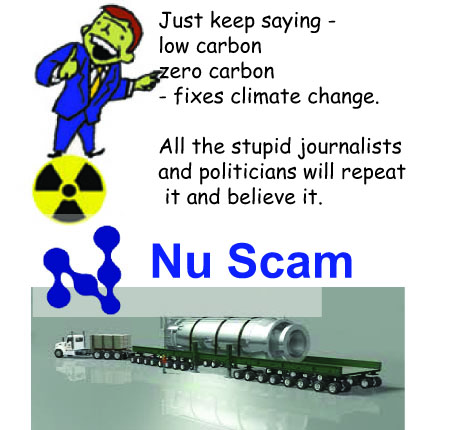
The controversial future of nuclear power in the U.S. National Geographic, 5 May 21, ”……………. In the U.S., a company called NuScale has recently received design certification approval from the Nuclear Regulatory Commission for its SMR, the first and only company to do so. Its reactor is a miniaturized version of a traditional reactor, in which pressurized water cools the core where nuclear fission is taking place. But in the NuScale design, the whole reactor is itself immersed in a pool of water designed to protect it from accidental meltdown.
NuScale hopes to build 12 of these reactors to produce 720 megawatts at the Idaho National Laboratory as a pilot project. It’s been supported by the U.S. Department of Energy, which has approved up to $1.4 billion to help demonstrate the technology. NuScale plans to sell the plant to an energy consortium called Utah Associated Municipal Power Systems.
Last year, eight of the 36 utilities in the consortium backed out of the project, citing the cost. The company recently announced the project would be delayed to 2030, and the cost would rise from $4.2 billion to $6.1 billion.
Nuclear opponents point to this latest disappointment as yet another example of why nuclear isn’t up to the task.
“If your first SMR isn’t built until the late 2020s, and then you have to turn it on, not to mention set up a whole new global supply chain, are you going to reach zero emissions by 2035?” asks IEER’s Makhijani. “You can’t make a significant contribution in time.” He adds that the industry’s long history of overruns and delays are especially problematic when considering climate commitments. “There’s no room for significant mistakes.”
……. The future of nuclear power will depend in part on how well it can balance a grid that increasingly relies on renewables….. Unlike gas turbines, which can be turned on and off in seconds to “follow the load,” reactors take an hour or more to cut their production in half.
It’s not that reactors can’t follow the load; they’re just slower. “They can and do, because they have to,” Buongiorno says. “It’s just never an attractive economic proposition.”
Last fall, the DOE awarded $80 million each to two companies working on advanced reactor designs intended in part to address this problem.
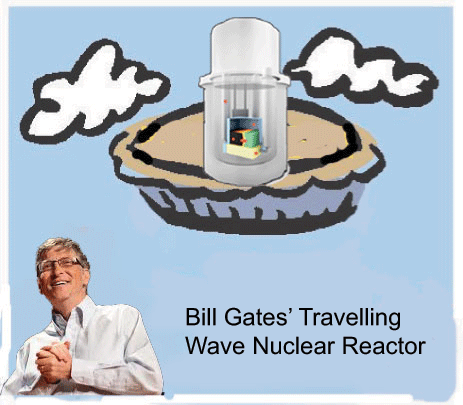
The first, TerraPower, a startup founded by Bill Gates, is working on a sodium-cooled reactor……… The second grant went to a company called X-energy for a gas-cooled reactor that operates at very high temperatures.
…… The high-level radioactive waste they produce, however, would need to be transported to a centralized location for management.
.. none of these new designs are moving quickly enough to meet Biden’s targets. DOE officials called their decision to support these two pilot projects, which aim to be fully operational by 2028, “their boldest move yet.”
Meanwhile, there’s a more direct way to balance the variability of renewables: store electricity in batteries. The market for utility-scale battery storage is exploding; it increased by 214 percent in 2020, and the EIA predicts that battery capacity will surge from its current 1,600 megawatts to 10,700 by 2023.
Makhijani thinks nuclear power isn’t going to be needed to balance the grid. A study he conducted in 2016 for the state of Maryland found that increased battery storage, combined with incentives to consumers to reduce their electricity use at peak times, would almost allow utilities to balance the variability of renewables.
They’d just need to store a little energy as hydrogen, which can be produced by running renewable electricity through water and then converted back to electricity in a fuel cell. That process is currently very expensive, Makhijani says, but “as long as it’s not giant amounts, it’s affordable.”……
Canada’s push for small nuclear reactors effectively stops real action on climate change.
Small Modular Nuclear Reactors Are Mostly Bad Policy, “………So Who Is Advocating For SMRs & Why? Clean Technica, ByMichael Barnard, 3 May 21,
At present we see SMR earmarked funds in both Canadian and US federal budgets, $150 million in Canada and 10 times as much in the US, mostly for research and development with the exception of over a billion to NuScale to, in theory, build something. In Canada, four provinces — Alberta, Ontario, New Brunswick and Saskatchewan — have joined forces in an SMR consortium. Bill Gates’ Terrapower has received another $80 million, as has X-Energy from the US DOE.
The failure conditions of small modular reactors are obvious. The lack of a significant market is obvious. The lack of ability to create a clear winner is obvious. The security costs are obvious. The lack of vertical scaling to thermal efficiency is obvious. The security risks and associated costs are obvious. The liability insurance cap implications are obvious. So why is all of this money and energy being thrown at SMRs? There are two major reasons, and only one of them is at all tenable.
Let’s start with the worst one. The Canadian provinces which are focused on SMRs are claiming that they are doing this as a major part of their climate change solutions. They are all conservative governments. Only one of those provinces has a nuclear fleet, although New Brunswick has one old, expensive, and due-to-retire reactor, as well as a track record of throwing money away on bad energy ideas, like Joi Scientific’s hydrogen perpetual motion machines. One of the provinces, Ontario, has been actively hostile to renewable energy, with the current administration cutting up 758 renewables contracts and legislating a lack of recourse as a very early act after election.
So why are they doing this? Because it allows them to defer governmental climate action while giving the appearance of climate action. They can pander to their least intelligent and wise supporters by asserting that renewables aren’t fit for purpose, while also not doing anything about the real problem because SMRs don’t exist in a modern, deployable, operable form yet.
The other major reason gets back to renewables as well. 15 years ago it was an arguable position to hold that renewables were too expensive, would cause grid reliability issues and that nuclear in large amounts was necessary. That’s been disproven by both 15 years of failures of nuclear deployments, but more importantly plummeting costs and proven grid reliability with renewable generation. Now almost every serious analyst agrees that renewables can economically deliver 80% of required grid energy, but there is still debate from credible analysts about the remaining 20%.
Mark Z. Jacobson and his Stanford team are at the center of this debate. Since the late 2000s, they’ve been publishing regular studies of increasing scope and sophistication on the thesis of 100% renewables by 2050. The 2015 publication saw a lot of pushback. At the time, my assessment of the fundamental disagreement was that the people who published a criticism of it thought the last 20% would be too expensive, and that both nuclear and carbon capture and sequestration would be necessary and scaled components.
Personally, I’ve done various aspects of the math, looked at grid reliability and transformation data from around the world, and looked at ancillary services requirements, and I think Jacobson and team are right. Further, that since we all agree that renewables are fit for purpose for 80% of the problem we should deploy them as rapidly as possible.
However, it’s very reasonable to make a side bet or two to ensure coverage of that last 20%. I don’t mind research dollars spent on SMRs, which is all most of the SMR expenditures amount to, outside of the Nu Scale bailout (which is added to the Ohio $1.3 billion bailout, which is added to the annual $1.7 billion overt federal subsidy, which is added to the annual hidden $4 billion security subsidy which is added to the $70 billion unfunded cleanup subsidy, which is added to the uncosted and unfunded taxpayer liability). Spending a few tens of millions of dollars in rich countries to ensure that we have that last 20% bridged is reasonable.
But the people asserting that SMRs are the primary or only answer to energy generation either don’t know what they are talking about, are actively dissembling or are intentionally delaying climate action. https://cleantechnica.com/2021/05/03/small-modular-nuclear-reactors-are-mostly-bad-policy/
Misguided funding for small nuclear reactors

Small Modular Nuclear Reactors Are Mostly Bad Policy, Clean Technica By Michael Barnard 3 May 21,
People asserting that SMRs are the primary or only answer to energy generation either don’t know what they are talking about, are actively dissembling or are intentionally delaying climate action.
Like hydrogen, small modular nuclear reactors have been seeing a resurgence of interest lately. Much of that is driven by governmental policies and investments focusing on the technology. Much of it comes from the nuclear industry. And inevitably, some comes from entrepreneurs attempting to build a technology that they hope will take off in a major way, making them and their investors a lot of money.
Most Of The Attention & Funding Is Misguided At Best, & Actively Hostile To Climate Action At Worst
First, let’s explore briefly the world of small modular nuclear reactors (SMNR) or small and medium reactors (SMR). The most common acronym is SMR, but you’ll see both.
As it says on the box, they are nuclear generation devices, specifically fission nuclear. That means they use radioactively decaying fissile materials, fuels, to heat a liquid which creates steam which drives steam turbines to generate electricity. Technically, they are like a coal generation plant, but with the heat provided by the decay of uranium instead of the burning of long-buried plant matter.
There are a handful of differences between them and traditional nuclear generation reactors. The biggest one is that they are smaller, hence the ‘small’ and ‘medium’ in the names. They range from 0.068 MW to 500 MW in capacity, with the International Atomic Energy Association using small for up to 300 MW and medium for up to 700 MW.
Despite the buzz, this is not new technology. The first nuclear generation plant was a Russian 5 MW device that went live in 1954. Hundreds of small reactors have been built for nuclear powered vessels and as neutron sources. This is well trodden ground. Most of the innovations being touted were considered initially decades ago.
In the seven decades since the first SMR was commissioned, 57 different designs and concepts have been designed, developed and, rarely, built. Most of the ones which are built are doing what nuclear reactors do, getting older without new ones being built to replace them.
The Russian models are far-north icebreaker power plants being considered for land-based deployment in remote northern towns, with the Siberian one at end of life. The Indian ones are 14 small CANDU variants in operation, most decades old now. The Chinese one is coming up to end of its 40-year life span as well.
The Argentinean model has been in construction on and off for over a decade with work stoppages, political grandstanding, and monetary problems. It may never see the light of day.
The Chinese HTR-PM, under construction for the past decade, is the only one with remotely new technology. If commissioned, it is expected to be the first Gen IV reactor in operation.
And to be clear, this isn’t a technology, it’s many technologies. Across the decades, 57 variants of 18 types have been put forward. None of the types can be considered to be dominant.
Claims About SMRs Don’t Withstand Advocates for SMRs typically make some subset of the following claims:
They are saferThey can be manufactured in scaled, centralized manufacturing facilities so they will be cheaperThey can provide clean power for remote facilities or communitiesThey can be deployed onto decommissioned coal generation brownfield sitesThey can be built faster.
Safety concerns aren’t why nuclear is failing in the marketplace, economics are why nuclear is failing in the marketplace…….. . https://cleantechnica.com/2021/05/03/small-modular-nuclear-reactors-are-mostly-bad-policy/
1 This Month



26 September – International Day for the Total Elimination of Nuclear Weapons


PLEASE OPPOSE HR 8255 AND S.3639 – bills would accelerate satellite deployment, with no environmental review or safeguards – https://ncstd5li.quorum.us/campaign/169331/
To see nuclear-related stories in greater depth and intensity – go to https://nuclearinformation.wordpress.com
-
Archives
- September 2026 (233)
- August 2026 (330)
- July 2026 (355)
- June 2026 (287)
- May 2026 (306)
- April 2026 (356)
- March 2026 (251)
- February 2026 (267)
- January 2026 (308)
- December 2025 (358)
- November 2025 (359)
- October 2025 (375)
-
Categories
- 1
- 1 NUCLEAR ISSUES
- business and costs
- climate change
- culture and arts
- ENERGY
- environment
- health
- history
- indigenous issues
- Legal
- marketing of nuclear
- media
- opposition to nuclear
- PERSONAL STORIES
- politics
- politics international
- Religion and ethics
- safety
- secrets,lies and civil liberties
- spinbuster
- technology
- Uranium
- wastes
- weapons and war
- Women
- 2 WORLD
- ACTION
- AFRICA
- Atrocities
- AUSTRALIA
- Christina's notes
- Christina's themes
- culture and arts
- Events
- Fuk 2022
- Fuk 2023
- Fukushima 2017
- Fukushima 2018
- fukushima 2019
- Fukushima 2020
- Fukushima 2021
- general
- global warming
- Humour (God we need it)
- Nuclear
- RARE EARTHS
- Reference
- resources – print
- Resources -audiovicual
- Weekly Newsletter
- World
- World Nuclear
- YouTube
-
RSS
Entries RSS
Comments RSS
 nuclear-news