Rolls Royce ”small” nuclear reactors – not really small, not useful against climate change, but useful for military purposes

Answers to the energy and climate crises are needed NOW. These answers are available based on a comprehensive programme of developing renewable energy and energy conservation technologies.
Every pound wasted on nuclear power will be a pound taken away from faster and more effectivesolutions offered by renewable energy and energy conservation.
It is reported that the Tory government will restate its support on Monday, 18 October to buiding a fleet of modular nuclear reactors. The favoured reactor is the Rolls Royce SMR, namely ‘Small ModularReactor’. This term is very misleading as the Rolls Royce reactor would produce 450MW of electricity, which is more than the output of the old Magnox station at Trawsfynydd, and the same size as one of old big Magnox reactors at Wylfa.

It is known that Rolls Royce are asking for huge public subsidies to realise their nuclear ambitions. This movement towardsbuilding reactors to produce electricity is closely related to their wish to safeguard skills in the reactors they provide for submarines carrying nuclear weapons. Civil and military nuclear are two sides of the same coin. Rolls Royce claim they would like to build 18 SMRs.
How far will the government be prepared to go to fund a far from new technology and like larger nuclear reactors, is open to accidents and radioactive leaks, and produces poisonous and lethal radioactive waste.
Also mentioned is the possibility of Bechtel/Westinghouse trying to push the Westinghouse AP1000 reactor on the Johnson government to be developed at the Wylfa site. This is the very reactor on the V.C.Summer site in South Carolina that
bankrupted Toshiba Westinghouse in 2017. That happened due to huge overspending and the project was abandoned 40% of the way into construction. It was therefore no surprise that the NUGen Consortium project to build three AP1000s at Moorside near Sellafield collapsed in 2018. Nobody was prepared to invest in it. Exactly the same fate as the Hitachi/Horizon plan at Wylfa. Johnson and his ministers in the Treasury and the Business,
Energy and Industrial Stratregy Department are missing the point entirely as they cling on to past imperial grandeur by blindly
promoting nuclear power. Nuclear power is dirty, dangerous, extortionately expensive, and a threat to environmental and human health. Nuclear power will do nothing to tackle the present energy crisis, nor will it effectively counteract the effects of climate change., and we certainly cannot afford to waste the fifteen years needed to build large new nuclear stations
Answers to the energy and climate crises are needed NOW. These answers are available based on a comprehensive programme of developing renewable energy and energy conservation technologies. Every pound wasted on nuclear power will be a pound taken away from faster and more effectivesolutions offered by renewable energy and energy conservation.
People Against Wylfa B 18th Oct 2021
British government’s enthusiasm for mini nuclear reactors, led by Rolls Royce and 8 other organisations

Brexit Britain strikes historic £210m deal with Rolls-Royce to create nuclear reactors
BREXIT Britain is set to see its emissions slashed as the Government is poised to make a landmark deal with Rolls-Royce to fund a fleet of nuclear mini-reactors.
Express UK, By JACOB PAUL, Mon, Oct 18, 2021 The move is set to help Prime Minister Boris Johnson race to his target of zero-carbon electricity by 2035 in a move set to impress ahead of the COP26 climate summit in Glasgow in less than two weeks time. Mr Johnson visited Rolls-Royce’s Bristol factory on Friday, where he was shown their state-of -the-art facility by their CEO, Warren East. A consortium led by Rolls-Royce had already secured £210million in backing from private investors for the small modular reactor (SMR) project, a sum that the Government is expected to match and even surpass.
Confirmation is expected before the spending review on October 27.
The consortium called UK SMR, is set to rebrand British engineering firm Rolls-Royce SMR under a request from the Government. Tom Greatrex, chief executive of the Nuclear Industry Association (NIA), said: “Match-funding for Rolls-Royce would be a huge signal to private investors that the government wants SMRs alongside new large-scale stations to hit net zero.
It would also show investors that the Government believes in nuclear as a green technology.”
Government support will help with the consortium’s multi-billion pound plans to build 16 SMRs up and down the country……………… Rolls-Royce is also being advised by HSBC, which has helped it secure £210million from private investors, which was a condition set by the government for them to hand out at least the same amount of funding.
This move could also signal a possible U-turn from the Government on their scheduled phasing out of nuclear power in the UK.
13 nuclear reactors capable of producing 7.8GW of power currently produce around 20 percent of the nation’s electricity.
But over half of that capacity comes from reactors that are scheduled to be replaced or halted by 2025. https://www.express.co.uk/news/science/1507881/brexit-britain-rolls-royce-nuclear-power-boris-johnson-cop26-climate-change
Terra Power’s Natrium nuclear reactor will be an economic lemon

This host of factors makes it reasonably certain that the Natrium will not be economically competitive.
In other words, even if has no technical problems, it will be an economic lemon.
Ramana, Makhijani: Look before you leap on nuclear https://trib.com/opinion/columns/ramana-makhijani-look-before-you-leap-on-nuclear/article_4508639b-d7e6-50df-b305-07c929de40ed.html, Oct 16, 2021
The Cowboy State is weighing plans to host a multi-billion dollar “demonstration” nuclear power plant — TerraPower’s Natrium reactor. The long history of similar nuclear reactors, dating back to 1951, indicates that Wyoming is likely to be left with a nuclear lemon on its hands.

The Natrium reactor design, which uses molten sodium as a coolant (water is used in most existing commercial nuclear reactors), is likely to be problematic. Sodium reacts violently with water and burns if exposed to air, a serious vulnerability. A sodium fire, within a few months of the reactor starting to generate power, led to Japan’s Monju [at left] demonstration reactor being shut down.

At 1,200 megawatts, the French Superphénix was the largest sodium-cooled reactor, designed to demonstrate commercial feasibility. Plagued by operational problems, including a major sodium leak, it was shut down in 1998 after 14 years, having operated at an average capacity of under 7 percent compared to the 80 to 90 percent required for commercial operation. Other sodium-cooled reactors have also experienced leaks, which are very difficult to prevent because of chemical interactions between sodium and the stainless steel used in various reactor components. Finally, sodium, being opaque, makes reactor maintenance and repairs notoriously difficult.
Sodium-cooled reactors can experience rapid and hard-to-control power surges. Under severe conditions, a runaway chain reaction can even result in an explosion. Such a runaway reaction was the central cause of the 1986 Chernobyl reactor explosion, though that was a reactor of a different design. Following Chernobyl, Germany’s Kalkar sodium-cooled reactor, about the same size as the proposed Natrium, was abandoned without ever being commissioned, though it was complete.
All these technical and safety challenges naturally drive up the costs of sodium-cooled reactors, making them significantly more expensive than conventional nuclear reactors. More than $100 billion, in today’s dollars, has been spent worldwide in the attempt to commercialize essentially this design and associated technologies, to no avail.
The Natrium design, being even more expensive than present-day reactors, will therefore be more expensive than practically every other form of electricity generation. The Wall Street firm, Lazard, estimates that electricity from new nuclear plants is several times more than the costs at utility-scale solar and wind power plants. Further, the difference has been increasing.
To this bleak picture, Terrapower has added another economically problematic feature: molten salt storage to allow its electric output to vary. Terrapower hopes this feature will help it integrate better into an electricity grid that has more variable electricity sources, notably wind and solar.
Molten salt storage would be novel in a nuclear reactor, but it is used in concentrating solar power projects, where it can cost an additional $2,000 per kilowatt of capacity. At that rate, it could add a billion dollars to the Natrium project.
This host of factors makes it reasonably certain that the Natrium will not be economically competitive. In other words, even if has no technical problems, it will be an economic lemon.
To top it all off, the proposed Wyoming TerraPower demonstration project depends on government funds. Last year, the Department of Energy awarded TerraPower $80 million in initial taxpayer funding; this may increase $1.6 billion over seven years, “subject to the availability of future appropriations” and Terrapower coming up with matching funds.
Despite government support, private capital has recently abandoned a more traditional project, the mPower small modular reactor, resulting in its termination in 2017. And it was Congress that refused to appropriate more money for the sodium-cooled reactor proposed for Clinch River, Tennessee when its costs skyrocketed, thereby ending the project in 1983.
A much harder look at the facts is in order, lest Wyoming add to the total of many cancelled nuclear projects and abandoned construction sites. Of course, the Natrium lemon might be made into lemonade by converting it to an amusement park if it is never switched on, like the Kalkar reactor, now refashioned into Wunderland Kalkar, an amusement park in Germany, near the border with the Netherlands. For energy, the state might look to its natural heritage – its wind power potential is greater than the combined generation of all 94 operating U.S. nuclear reactors put together, which are on average, about three times the size of Natrium.
M. V. Ramana is Professor and Simons Chair in Disarmament, Global and Human Security and the Director of the Liu Institute for Global Issues at the School of Public Policy and Global Affairs, University of British Columbia. Dr. Ramana holds a Ph.D. in Physics from Boston University.
Arjun Makhijani, President of the Institute for Energy and Environmental Research, holds a Ph.D. in engineering (nuclear fusion) from the University of California at Berkeley.
Japan’s new pro nuclear push – and for small nuclear reactors
Japan’s Carbon Goal Is Based on Restarting 30 Nuclear Reactors, Bloomberg, By Isabel Reynolds 17 October 2021, Japan’s goal of reducing carbon emissions by 46% by 2030 is based on the assumption it will restart 30 of its nuclear reactors, a top ruling party executive said.
Akira Amari, secretary general of the Liberal Democratic Party, made the remarks Sunday in a televised debate broadcast by NHK ahead of the Oct. 31 general election.
Much of Japan’s nuclear capacity has been offline since the 2011 Fukushima disaster and Amari said only nine reactors are currently in service. Surveys generally show the electorate is against restarting the plants.
The LDP has also been promoting the idea of building small modular reactors, saying they are safer than Japan’s existing atomic plants……..https://www.bloomberg.com/news/articles/2021-10-17/amari-says-japan-s-carbon-goal-based-on-restarting-30-reactors
Rebranded – ROLLS-ROYCE SMR , a new conglomerate of 9 groups (to spread the risks of uneconomic small nuclear reactors?)
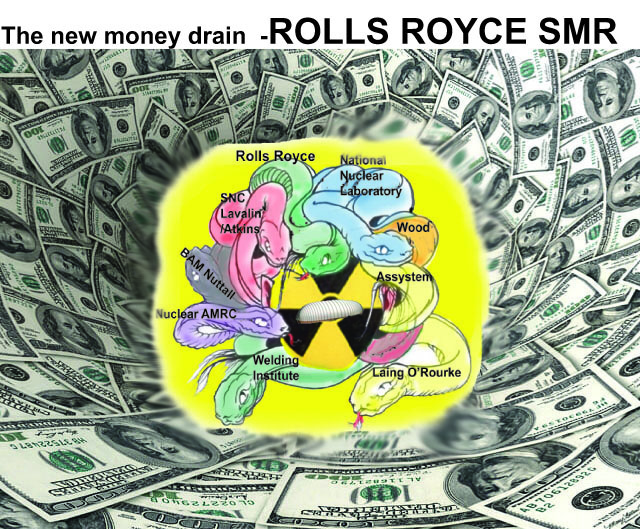
The nine-strong consortium also includes the National Nuclear Laboratory and Laing O’Rourke, the construction firm, alongside Assystem, SNC Lavalin/Atkins, Wood, BAM Nuttall, the Welding Institute and Nuclear AMRC.
UK poised to confirm funding for mini nuclear reactors for carbon-free energy Guardian,
Rolls-Royce-led consortium already has £210m in private backing for plans to build 16 reactors across the country, The government is poised to approve funding for a fleet of Rolls-Royce mini nuclear reactors that the prime minister hopes will help the UK reach his target of zero-carbon electricity by 2035.
A consortium led by the British engineering firm had already secured £210m in backing from private investors for the small modular reactor (SMR) project, a sum that the government is expected to match or better. Confirmation is expected before the spending review on 27 October, according to well-placed sources.
The consortium, known as UK SMR, will rebrand as Rolls-Royce SMR to coincide with Westminster’s blessing.
Tom Greatrex, the chief executive of the Nuclear Industry Association (NIA), said: “Match-funding for Rolls-Royce would be a huge signal to private investors that the government wants SMRs alongside new large-scale stations to hit net zero. It would also show investors that the government believes in nuclear as a green technology.”
Backing from the government will pave the way for the consortium’s multibillion-pound plan to build 16 SMRs around the country, the first of which could be plugged into the grid by 2031…………..
Confirmed support for SMRs could signal a concerted effort within government to reverse the scheduled decline in the UK’s nuclear power capacity. About 20% of the nation’s electricity comes from 13 nuclear reactors capable of producing 7.8GW of power. But more than half of that capacity comes from reactors due to retire by 2025, and plans to replace them have stalled.
Toshiba pulled out of a plant at Moorside in Cumbria in 2020, and Hitachi withdrew planning consent for a project at Wylfa Newydd, on Anglesey, this year. While Hinkley Point C is due to start generating electricity from 2026, only one new project, Sizewell C, is now in the works, with no final investment decision yet made.
Britain’s ability to build new nuclear reactors has been further complicated by the government’s unwillingness to allow any further involvement from the state-backed China General Nuclear. CGN has a 20% stake in Sizewell C but ministers have been looking into ways to remove it from the project before it moves to the construction phase. The Chinese company was due to take a lead role in the Bradwell reactor in Suffolk, which is now highly unlikely to go ahead.
Industry players are keen to see the government legislate to approve the regulated asset base (RAB) model, which allows private investors a more reliable stream of revenues from nuclear power plants – which typically require tens of billions of pounds to build – by piling costs on to household energy bills……..
The nine-strong consortium also includes the National Nuclear Laboratory and Laing O’Rourke, the construction firm, alongside Assystem, SNC Lavalin/Atkins, Wood, BAM Nuttall, the Welding Institute and Nuclear AMRC. https://www.theguardian.com/business/2021/oct/15/uk-poised-to-confirm-funding-for-mini-nuclear-reactors-for-green-energy
All nuclear reactors are very expensive, but small nuclear reactors are even more expensive
Australian Submarines May Go Nuclear But Our Power Stations Never Will, SOLARQUOTES, October 11, 2021 by Ronald Brakels
- ”…………………….Small Modular Reactors Are More Expensive An SMR is a Small Modular Reactor. There have been claims these will provide cheap energy in the future, but this seems unlikely given their designers have stated that…
- Before cost overruns are considered, SMRs will produce electricity at a higher cost than current nuclear reactor designs.Being more expensive than conventional nuclear power is a major obstacle for any plan to supply energy at a lower cost.
- The advantage of SMRs is they are supposed to be less likely to suffer from disastrous cost overruns. This means they are a more expensive version of a type of generation that is already too expensive for Australia before cost overruns. While any cost overruns that do occur may not be as bad as conventional nuclear, that’s not what I call a good deal.
There is nothing new about small nuclear reactors. India has over a dozen reactors of 220 megawatts or less in operation. But all Indian reactors now under construction are larger because they want to reduce costs. Technically their small reactors aren’t modular because major components weren’t constructed at one site and then moved to where they were used. This leads to another major problem with SMRs…- They don’t exist. Before Australia can deploy an SMR, a suitable prototype reactor will have to be successfully built and operated. Then a commercial version will need to be developed and multiple units constructed overseas without serious cost overruns and used long enough to show they can be operated safely and cheaply. Given nuclear’s prolonged development cycle, this could easily take over 20 years. The very best estimate for the cost of electricity from an SMR I have seen is around 6.2 cents per kilowatt-hour and it relies on everything going perfectly — a rare thing for nuclear power. It also leaves out several costs that have to be paid in the real world. :……….https://www.solarquotes.com.au/blog/submarines-nuclear-not-power-stations/
President Macron backs nuclear energy, but France’s Greens want speedier end to nuclear power
The president 9 Macron) used the speech to state his support for nuclear energy, which accounts for about 70% of French electricity and has become a point of fierce debate in the run-up to next year’s election.
Green politicians want France to move fast to end its dependence on nuclear, highlighting the large amounts of radioactive waste it produces as well as safety issues.
Politicians on the right and far-right want more reactors. Macron said France would invest €1bn by 2030 in “disruptive innovation” to produce atomic power, which he said would focus on designing small nuclear reactors with improved waste management. He added that France should be able to produce 2m electric and hybrid cars by 2030 and build a low-CO2 aeroplane during the same timeframe.
Guardian 12th Oct 2021
https://www.theguardian.com/world/2021/oct/12/macron-30bn-plan-to-reindustrialise-france
France is betting on small nuclear reactors, but obstacles remain.
| Nuclear, France still believes in it. Analysis The executive will encourage the creation of small reactors. The decision to launch the construction of 6 EPRs could come more quickly than expected, but the obstacles still remain numerous. La Criox 12th Oct 2021 https://www.la-croix.com/Economie/Nucleaire-France-croit-encore-2021-10-12-1201180081 *France – SMRs &EPRs** Nuclear: France is betting on SMR mini-reactors. As part of the France 2030 plan, the President of the Republic should announce this Tuesday a new envelope for the development of Small modular reactors (SMR). Mini-reactors with a power of 170 MW, ten times less than a conventional reactor. Les Echos 12th Oct 2021 https://www.lesechos.fr/industrie-services/energie-environnement/nucleaire-la-france-parie-sur-les-mini-reacteurs-1354051 |
We must question why small modular reactors and the rebirth of nuclear energy are all the rage

These considerations should lead us to make saner and more realistic choices for our children and our children’s children
Roland Ngam • 11 October 2021, We must question why small modular reactors and the rebirth of nuclear energy are all the rage, Daily Maverick,
Small modular nuclear reactors are being widely punted as the energy source of the future. But if we are looking only at costs, solar and wind are way cheaper than small modular reactors and battery technology is way better today than it was only three years ago.
Small modular reactors (SMRs) seem to be all the rage these days. Dismiss them at your peril. I am no conspiracy theorist, but everyone is talking about them just as energy prices are spiking in Europe, the UK is struggling to supply its filling stations with fuel, the green parties want to cancel Nord Stream 2 and China is rationing electricity after recent widespread outages in 22 states.
Could it be that some of these crises — and ergo, energy panic — are artificially made in order to give fossils one last hurrah in the limelight? Nuclear energy is renewable [Ed. this is not true] , but I mean, you need fossils and a lot of capital investment to make them! Also, are those who are betting on SMRs as the technology of the future right to place their hopes in this sector rather than in greener alternatives?………………
America has been subsidising research in SMRs for more than a decade now. They paid $226-million in research grants for the light-water SMR built by Nuscale Power for Energy Northwest. The US Congress has already passed a nuclear production tax credit (PTC) act to subsidise energy from the plant for the next 10 years and the Department of Energy further approved $1.355-billion to fund the Carbon Free Power Project (CFPP), which involves investing massively in SMRs.
China already has a bunch of floating SMR powerships and started construction on a 125 MWe land-based pressurised water reactor (PWR) in Hainan province in June 2021. The project was officially launched by the Ministry of Ecology and Environment (which is another point I will get back to in a moment, i.e. that countries are pushing nuclear hard as the green solution of the future).
In the United Kingdom, SMRs are a key part of the decarbonisation strategy. Last year, Prime Minister Boris Johnson announced a £525-million investment in SMR development and Business Secretary Kwasi Kwarteng is about to approve a contract for Rolls-Royce to build a fleet of them in order to assure energy self-sufficiency, which has become a hotly debated topic after Brexit and now amidst the fuel shortages that have hit the nation.
Not to be outdone, French President Emmanuel Macron wants to make SMRs a cornerstone of his 2022 re-election campaign. It is believed that France will spend €50-million from the Euro Recovery Plan on SMR research. Industry players in the nuclear space have already announced plans for the construction of a university of nuclear research. About 30 research centres have also received funds from the France Relance plan for nuclear research. Although France is a world leader in nuclear technology, they have been caught napping by Russia, the US and China which are already way ahead of them in SMR technology.
So the race is on to scale up production of affordable commercial land-based SMRs which could potentially fill up the manufacturing companies’ order books.
Now, back to why nuclear technology is enjoying a comeback — well, it never went away, but it is enjoying a renaissance of sorts among the ever-more confident G20 leaders — because, as Maud Bregeon puts it in Nucléaire: un patrimoine industriel et écologique, even the IPCC and the UN say that “all low-carbon technologies are needed to meet our climate goals, including nuclear.
…….. is the world right to focus on SMRs as the future? If we are looking only at costs, solar and wind are way cheaper than SMRs and battery technology is way better today than it was only three years ago.
According to the International Energy Agency and the OECD Nuclear Energy Agency, the kilowatt-hour price for SMR is almost certainly always going to be higher than what bigger power plants can offer. It is for this reason that many question why South Africa’s Energy Minister is still determined to commit to new nuclear capacity in line with the integrated resource plan (IRP). That allocation could be shifted to a cheaper energy source.
Three billion dollars is a massive drop from the $10-billion that is the going rate for a big nuclear plant. However, even at $3-billion in start-up for a small plant, the average African country simply cannot afford this type of technology. By comparison, they can get going on a modular solar plant with only a few thousand dollars.
Then there is the toll that continued investment in nuclear has on the environment. In an essay titled An Obituary for Small Modular Reactors, Friends of the Earth Australia argues that “about half of the SMRs under construction (Russia’s floating power plant, Russia’s RITM-200 icebreaker ships, and China’s ACPR50S demonstration reactor) are designed to facilitate access to fossil fuel resources in the Arctic, the South China Sea and elsewhere”.
Drought-hit Namibia, which has about 5% of the world’s uranium resources has seen an increase in investments in the uranium sector. Russia (
Helpless activists in Namibia have also been trying to draw the world’s attention to the unusually high numbers of former uranium mine workers who have been dying of cancer, without much success. As investments in uranium pick up, and as some environmental activists make the case for nuclear as green technology, it is important to remember the toll that it is taking on people and ecological systems in the Global South.
These considerations should lead us to make saner and more realistic choices for our children and our children’s children. https://www.dailymaverick.co.za/opinionista/2021-10-11-we-must-question-why-small-modular-reactors-and-the-rebirth-of-nuclear-energy-are-all-the-rage/
.
The facts contradict the pro nuclear spin of the Minerals Council of Australia’s report, written by Ben Heard.

“a smaller reactor, at least the water-cooled reactors that are most likely to be built earliest, will produce more, not less, nuclear waste per unit of electricity they generate because of lower efficiencies.”
”Due to the loss of economies of scale, the decommissioning and waste management unit costs of SMR will probably be higher than those of a large reactor (some analyses state that between two and three times higher).”
Small nuclear reactors, huge costs Dr. Jim Green 11 October 2021 Even by the standards of the Minerals Council of Australia (MCA), the new report published by the country’s most influential coal lobby on the subject of small modular nuclear reactors (SMRs) is jiggery-pokery of the highest order.
Why would a mining industry body promote SMRs? After mining for some years — or at most decades — no company would want to take on the responsibility of decommissioning a nuclear reactor and managing high-level nuclear waste for millennia. No companies are cited in the report expressing interest in SMRs to power their mining operations.
Perhaps the MCA – which infamously provided the lump of coal for Scott Morrison to wave around in parliament – thinks that promoting nuclear power will slow the transition from fossil fuels to renewables, and believes that it is in the interests of some of its member companies to slow the transition.
If so, the timing of the report isn’t great, coming in the same week as the Business Council of Australia’s report which argues for a rapid, renewables-led decarbonisation, and Fortescue’s announcement that it plans to build the world’s largest green energy hydrogen manufacturing facility in Queensland.
Perhaps the MCA is doing the bidding of the (mostly foreign-owned) uranium mining companies operating in Australia? The MCA’s CEO Tania Constable said: “Australia should take advantage of growing international interest in nuclear energy and look to expand its already significant uranium sector.”
Perhaps … but there’s no evidence that the two companies mining uranium in Australia — BHP (Olympic Dam) and Heathgate Resources (Beverley Four Mile) — are lobbying for nuclear power. And Australia’s “already significant” uranium industry could hardly be more insignificant — it accounts for about 0.2 percent of Australia’s export revenue and about 0.01 percent of all jobs in Australia.
Bob Carr’s atomic bombshell
The MCA report also came in the same week as Bob Carr’s striking about-face on nuclear power. Having previously supported nuclear power, Carr wrote in The Australian: “In 2010 one enthusiast predicted within 10 years fourth-generation reactors and small modular reactors would be commonplace, including in Australia. None exists, here or abroad.”
The MCA report says SMRs are an “ideal fit” for Australia, citing their enhanced safety, lower cost than large-scale nuclear reactors or equivalent energy production methods, and lower waste production than current reactors.
It’s all nonsense. The safety claims don’t stack up. Nor do the claims about waste. Academic M.V. Ramana notes that “a smaller reactor, at least the water-cooled reactors that are most likely to be built earliest, will produce more, not less, nuclear waste per unit of electricity they generate because of lower efficiencies.”
And a 2016 European Commission document states: “Due to the loss of economies of scale, the decommissioning and waste management unit costs of SMR will probably be higher than those of a large reactor (some analyses state that between two and three times higher).”
SMRs have a similar capacity to many existing coal and gas-fired power plants in Australia, the MCA report states, so would make an ideal replacement. Back to Bob Carr:
“Where is the shire council putting up its hand to host a nuclear power plant? Harder to find than a sponsor for a high-temperature toxic waste incinerator.
“Nobody in the Hunter Valley has urged nuclear for the Liddell site, even on the footprint of this coal-fired power plant scheduled to close. And not even invoking the prospect of a small modular reactor that 10 years back was the vanguard of the nuclear renaissance. About to be planted across the Indonesian archipelago and the rest of Asia, we were promised. Today they exist only on the Rolls-Royce drawing boards they have adorned since the 1970s.”
Economics
The MCA said in June 2020 that SMRs won’t find a market unless they can produce power at a cost of A$60-$80 per megawatt hour (MWh). That’s a big problem for enthusiasts because there’s no chance whatsoever that SMRs will produce power in that cost range.
An analysis by WSP / Parsons Brinckerhoff, prepared for the 2015/16 South Australian Nuclear Fuel Cycle Royal Commission, estimated a cost of A$225 / MWh for a reactor based on the NuScale design, about three times higher than the MCA’s target range.
CSIRO estimates SMR power costs at A$258-338 / MWh in 2020 and A$129-336 / MWh in 2030.
Russia’s floating nuclear plant is said to be the only operational SMR in the world, although it doesn’t fit the ‘modular’ definition of serial factory production.
A 2016 OECD Nuclear Energy Agency report said that electricity produced by the Russian floating plant is expected to cost about US$200 (A$273) / MWh, about four times higher than the target range cited by the MCA and more expensive than power from large reactors (US$129-198 / MWh).
Completion of Russia’s floating plant was nine years behind schedule and construction costs increased six-fold.
Yet, despite a mountain of evidence that SMRs won’t come close to producing power in the A$60-80 / MWh range, the new MCA report asserts that “robust estimates” using “conservative assumptions” suggest that SMRs will produce power at a cost of A$64-77 MWh by 2030.
One wonders who the MCA think they’re kidding.
The MCA report was written by Ben Heard, who recently closed his ‘Bright New World’ nuclear lobby website, just before taking up a full time role with consultancy Frazer-Nash. Heard promotes Canadian SMR-wannabe Terrestrial Energy in the MCA report but does not disclose his role on the company’s advisory board.
Heard also contributed two chapters on nuclear power to a 2020 book titled ‘An Australian nuclear industry: Starting with submarines’.
Dr Jim Green is lead author of a 2019 Nuclear Monitor report on SMRs and national nuclear campaigner with Friends of the Earth Australia.
Rolls Royce wants to supply data centres with their massive energy needs, by small nuclear reactors

Rolls-Royce said to be pitching small nuclear reactors to power data centers … while Boris Johnson proposes more big nuclear power stations for the UK, October 05, 2021 By Peter Judge
Rolls-Royce is planning to offer small nuclear reactors to US-based cloud operators so their hyperscale data centers can have net zero emissions and be independent of the electric grid, according to media reports.
Small modular reactors (SMRs) are under development by a consortium led by Rolls-Royce, and could potentially power data centers or other infrastructure that needs a steady supply of low-carbon energy, which may not be available from the local electricity grid. However, they will not be available until at least 2030…………. https://www.datacenterdynamics.com/en/news/rolls-royce-said-to-be-pitching-small-nuclear-reactors-to-power-data-centers/
Are small nuclear reactors really the answer to UK’s green energy crisis?

the falling cost of wind and solar power, coupled with new technology to store energy off the grid for times when it is needed, made nuclear largely redundant.
“It’s too expensive, takes too long to develop, and we can’t afford to wait for it”
| Are small nuclear reactors really the answer to our green energy crisis? Small nuclear reactors are hailed as an answer to our energy crisis, but Jon Yeomans finds problems remain with the untested technology. Trawsfynydd’s fortunes could be about to change. It has been proposed as a possible site for a new type of nuclear reactor to be built by a consortium led by Rolls-Royce. Small modular reactors (SMRs) offer the promise of a new fleet of power stations that could be produced in a factory, loaded on to lorries and then trucked around the country for installation on decommissioned nuclear sites. The government believes these so-called “mini-nukes” will form a key part of its “green recovery” and is close to approving £215 million in funding to speed their development. The hope is that they could reduce the cost of nuclear power dramatically and help the UK to hit its target of net-zero emissions by 2050. But nothing is ever simple with nuclear. Can this dream become reality? With large-scale nuclear projects under a cloud, the government has warmed to the idea of smaller, nimbler technology, such as the SMRs proposed by Rolls-Royce. The Derby-based company is better known for producing aircraft engines, but since the 1960s it has also been responsible for the reactors on Britain’s nuclear submarines. These pressurised water reactors (PWRs) will form the basis of the SMRs it proposes to build in the UK. The big selling point of SMRs is that they can be made on a production line, reducing the huge costs of a project such as Hinkley. Rolls claims they solve “the conundrum of how to create affordable energy, and more of it, with a lower carbon footprint”. It says the scheme could generate £52 billion of “economic benefit” by 2050. The company’s SMRs will have a price tag of about £2 billion each, once the initial costs of building the factory are out of the way. It is thought Rolls would need to make 16 before the programme could pay its way, with financial support from the government required for at least the first four units. The SMRs would have a capacity of 470MW — enough to power one million homes. Critics of SMRs note there are few, if any, operating anywhere in the world. The American company Westinghouse is developing a lead-cooled reactor with 450MW capacity which won £10 million in UK government funding last year. NuScale, based in Oregon, is working on SMRs with an output of 77MW. But its first plant will not be operational until 2027. If the government gives the green light, Rolls will spend the next four years seeking approval from regulators while simultaneously building the first of a projected three factories in the UK. Company sources suggested the factories themselves could be a “levelling up” opportunity, bringing high-skilled jobs to the regions. It would take another four years for the first reactor to roll off the production line, pushing their start date into the next decade. Stephen Thomas, professor of energy policy at Greenwich University, said the falling cost of wind and solar power, coupled with new technology to store energy off the grid for times when it is needed, made nuclear largely redundant. “It’s too expensive, takes too long to develop, and we can’t afford to wait for it,” he said. A report by National Grid ESO (Electricity System Operator) this year envisaged at least two pathways to net zero by 2050 that did not rely on a large increase in nuclear. Instead, the gap in output would be made up by more renewable energy; more energy storage, in the form of batteries; and changing consumer behaviour to lower energy demand. Times 3rd Oct 2021 https://www.thetimes.co.uk/article/are-small-nuclear-reactors-really-the-answer-to-our-green-energy-crisis-pm9mrmtqg |
An added small nuclear reactor would just increase the burden of radioactive trash at Columbia Generating Station

“A new nuclear reactor and its inevitable waste would further perpetuate the burden of cleanup,”
Oregon group claims new nuclear reactor plan poses threat to Tri-Cities, Columbia River https://www.union-bulletin.com/news/northwest/oregon-group-claims-new-nuclear-reactor-plan-poses-threat-to-tri-cities-columbia-river/article_66e8ffd6-23d7-11ec-be7c-fbf4fdf0cc75.html Annette Cary The Tri-City Herald, 3 Oct 21,
RICHLAND — An Oregon environmental group is objecting to Energy Northwest’s plan to place a small modular power reactor on its leased land on the Hanford nuclear reservation near the Columbia River just north of Richland.
Earlier this year Energy Northwest, which operates the Columbia Generating Station nuclear power plant near Richland, announced plans with X-energy and Grant County PUD to add a small modular reactor near its current, full-size commercial nuclear power reactor.
Columbia Riverkeeper says in a new report that it is concerned about the used radioactive fuel the proposed new reactor would generate.
The United States now lacks a deep geological repository for used commercial nuclear power plant fuel, after work stopped to develop the repository at Yucca Mountain, Nev.
The used fuel for the Columbia Generating Station, the Northwest’s only commercial nuclear power reactor, is stored in 19-feet-tall concrete and steel storage cylinders on a reinforced concrete pad near the reactor until the nation has a repository.
The small nuclear reactor planned by Energy Northwest is a high temperature gas-cooled Xe-100 reactor, which could be the nation’s first operating advanced nuclear reactor. The 80-megawatt reactor could be operating in 2028.
The project, with modular reactors added, could be scaled up to a 320-megawatt reactor.
Columbia Generating Station has the capability to produce 1,207 megawatts of electricity.
Columbia Riverkeeper says the Xe-100 reactor would generate more used fuel than the conventional large reactor per the power output of each.
It also is concerned about siting the plant on Energy Northwest’s leased land at the Department of Energy’s Hanford nuclear reservation in Eastern Washington, which was developed for wartime weapons production rather than commercial power production.
The 580-square-foot DOE nuclear reservation was used to produce two-thirds of the nation’s plutonium from World War II through the Cold War.
Now about $2.5 billion is being spent annually to clean up radioactive and chemical contamination left from the project.
DOE is focused now on 56 million gallons of radioactive and chemical waste in underground tanks after chemical processes were used to separate small quantities of plutonium from irradiated uranium fuel.
Used fuel from commercial nuclear power reactors remains in a solid form rather than being chemically processed.
“Adding more nuclear infrastructure — a small modular nuclear reactor — at Hanford without any long-term plan for the radioactive waste should be a nonstarter,” said Lauren Goldberg, legal director with Columbia Riverkeeper.
The waste from a small modular reactor would burden future generations, said Miya Burke, the lead author of Columbia Riverkeeper’s new report “Q&A: Nuclear Energy Development Threatens the Columbia River.”
“A new nuclear reactor and its inevitable waste would further perpetuate the burden of cleanup,” she said.
The report quotes the Confederated Tribes of the Umatilla Indian Reservation, which have treaty rights at Hanford, as opposing new nuclear missions on the Hanford site.
The Umatillas say no expansion of nuclear energy production should be developed without permission obtained through the tribes with government-to-government consultation.
Energy Northwest responded to Columbia Riverkeepers concerns, saying that it has always supported open discussions on advanced nuclear and small modular reactors.
But it has questions of the validity of some of the claims in the new report and the data supporting them.
Among issues raised in the report was the safety and cost of the proposed new small modular reactor, which remains under development.
X-energy says its proposed reactor design is based on “safe, secure, clean and affordable technology.” The Department of Energy awarded it $80 million to develop and demonstrate its first commercial small modular reactor.
“Over the past year we have engaged many groups and stakeholders — from environmental organizations and tribes to elected officials and local communities — to understand their concerns and receive their input,” Energy Northwest said in a statement. “Energy Northwest and our partners hope to have the same opportunity with the authors of this report.”
Fake ”green” investment fund – a front for the nuclear industry – pushes small nuclear reactors

IP3 has been sounding out pension funds and institutional investors about pouring cash into a multi-billion pound fund to invest in small nuclear infrastructure. It is also advising energy providers and governments on developing nuclear power projects.
Rolls-Royce to land ‘billions of pounds’ worth of orders for mini nuclear power stations from Eastern European nations. Rolls-Royce is poised to land ‘billions of pounds’ worth of orders for mini nuclear power stations from Eastern European nations, the boss of a major investor has said.
A consortium led by the engineering giant has secured £210million of funding from private investors for its small modular reactors (SMRs) programme in the UK. That is set to unlock the same amount of funding from the Government, allowing Rolls-Royce to kick-start the project.
An announcement is expected imminently and green (?) investment fund IP3 said an endorsement by
the Government should pave the way for the technology to be exported to other countries. IP3 has been sounding out pension funds and institutional investors about pouring cash into a multi-billion pound fund to invest in small nuclear infrastructure. It is also advising energy providers and governments on developing nuclear power projects.
IP3 chief executive Mike Hewitt, a retired US Navy rear admiral, told The Mail on Sunday that
eastern European nations – including Poland, the Czech Republic, Latvia,Hungary, Estonia and Bulgaria – are developing ‘aggressive plans’ for nuclear.
Mail on Sunday 2nd Oct 2021
Small nuclear reactors, uranium mining, nuclear fuel chain, reprocessing, dismantling reactors – extract from Expert Response to pro nuclear JRC Report
.

………… If SMRs are used, this not least raises questions about proliferation, i.e. the possible spread of nuclear weapons as well as the necessary nuclear technologies or fissionable materials for their production. ………..
By way of summary, it is important to state that many questions are still unresolved with regard to any widespread use of SMRs – and this would be necessary to make a significant contribution to climate protection – and they are not addressed in the JRC Report. These issues are not just technical matters that have not yet been clarified, but primarily questions of safety, proliferation and liability, which require international coordination and regulations.
The volume of waste arising from decommissioning a power plant would therefore be significantly higher than specified in the JRC Report in Part B 2.1, depending on the time required to dismantle it
Measures to reduce the environmental impact The JRC Report is contradictory when it comes to the environmental impact of uranium mining: it certainly mentions the environmental risks of uranium mining (particularly in JRC Report, Part A 3.3.1.2, p. 67ff), but finally states that they can be contained by suitable measures (particularly JRC Report, Part A 3.3.1.5, p. 77ff). However, suitable measures are not discussed in the depth required ……..…
Expert response to the report by the Joint Research Centre entitled “Technical assessment of nuclear energy with respect to the ‛Do No Significant Harm’ criteria in Regulation (EU) 2020/852, the ‛Taxonomy Regulation’” 2021
”…………………3.2 Analysing the contribution made by small modular reactors (SMRs) to climate change mitigation in the JRC Report
The statement about many countries’ growing interest in SMRs is mentioned in the JRC Report (Part A 3.2.1, p. 38) without any further classification. In particular, there is no information about the current state of development and the lack of marketability of SMRs.
Reactors with an electric power output of up to 300 MWe are normally classified as SMRs. Most of the extremely varied SMR concepts found around the world have not yet got past the conceptual level. Many unresolved questions still need to be clarified before SMRs can be technically constructed in a country within the EU and put into operation. They range from issues about safety, transportation and dismantling to matters related to interim storage and final disposal and even new problems for the responsible licensing and supervisory authorities
The many theories frequently postulated for SMRs – their contribution to combating the risks of climate change and their lower costs and shorter construction periods – must be attributed to particular economic interests, especially those of manufacturers, and therefore viewed in a very critical light.
Today`s new new nuclear power plants have electrical output in the range of 1000-1600 MWe. SMR concepts, in contrast, envisage planned electrical outputs of 1.5 – 300 MWe. In order to provide the same electrical power capacity, the number of units would need to be increased by a factor of 3-1000. Instead of having about 400 reactors with large capacity today, it would be necessary to construct many thousands or even tens of thousands of SMRs (BASE, 2021; BMK, 2020). A current production cost calculation, which consider scale, mass and learning effects from the nuclear industry, concludes that more than 1,000 SMRs would need to be produced before SMR production was cost-effective. It cannot therefore be expected that the structural cost disadvantages of reactors with low capacity can be compensated for by learning or mass effects in the foreseeable future (BASE, 2021).
There is no classification in the JRC Report (Part A 3.2.1, p. 38) regarding the frequently asserted statement that SMRs are safer than traditional nuclear power plants with a large capacity, as they have a lower radioactive inventory and make greater use of passive safety systems. In the light of this, various SMR concepts suggest the need for reduced safety requirements, e.g. regarding the degree of redundancy or diversity. Some SMR concepts even consider refraining from normal provisions for accident management both internal and external – for example, smaller planning zones for emergency protection and even the complete disappearance of any off-site emergency zones.
The theory that an SMR automatically has an increased safety level is not proven. The safety of a specific reactor unit depends on the safety related properties of the individual reactor and its functional effectiveness and must be carefully analysed – taking into account the possible range of events or incidents. This kind of analysis will raise additional questions, particularly about the external events if SMRs are located in remote regions if SMRs are used to supply industrial plants or if they are sea-based SMRs (BASE, 2021).
Continue reading1 This Month



26 September – International Day for the Total Elimination of Nuclear Weapons


PLEASE OPPOSE HR 8255 AND S.3639 – bills would accelerate satellite deployment, with no environmental review or safeguards – https://ncstd5li.quorum.us/campaign/169331/
To see nuclear-related stories in greater depth and intensity – go to https://nuclearinformation.wordpress.com
-
Archives
- September 2026 (233)
- August 2026 (330)
- July 2026 (355)
- June 2026 (287)
- May 2026 (306)
- April 2026 (356)
- March 2026 (251)
- February 2026 (267)
- January 2026 (308)
- December 2025 (358)
- November 2025 (359)
- October 2025 (375)
-
Categories
- 1
- 1 NUCLEAR ISSUES
- business and costs
- climate change
- culture and arts
- ENERGY
- environment
- health
- history
- indigenous issues
- Legal
- marketing of nuclear
- media
- opposition to nuclear
- PERSONAL STORIES
- politics
- politics international
- Religion and ethics
- safety
- secrets,lies and civil liberties
- spinbuster
- technology
- Uranium
- wastes
- weapons and war
- Women
- 2 WORLD
- ACTION
- AFRICA
- Atrocities
- AUSTRALIA
- Christina's notes
- Christina's themes
- culture and arts
- Events
- Fuk 2022
- Fuk 2023
- Fukushima 2017
- Fukushima 2018
- fukushima 2019
- Fukushima 2020
- Fukushima 2021
- general
- global warming
- Humour (God we need it)
- Nuclear
- RARE EARTHS
- Reference
- resources – print
- Resources -audiovicual
- Weekly Newsletter
- World
- World Nuclear
- YouTube
-
RSS
Entries RSS
Comments RSS
 nuclear-news