Another nuclear film advertisement – “The New Fire”

Film review: ‘The New Fire’ and the old Gen IV rhetoric Author: Jim Green ‒ Nuclear Monitor editor NM866.4751, October 2018 The New Fire is a pro-nuclear propaganda film directed and produced by musician and film-maker David Schumacher.It’s similar in some respects to the 2013 film Pandora’s Promise.1,2 The New Fire premiere was held in October 2017 and it can be streamed online from 18 October 2018.
Promotional material claims that the film lacked “a supportive grant” (and celebrity endorsements and the backing of a major NGO) but the end-credits list numerous financial contributors: Berk Foundation, Isdell Foundation, Steven & Michele Kirsch Foundation, Rachel Pritzker, Roland Pritzker, Ray Rothrock, and Eric Uhrhane.
The film includes interviews with around 30 people (an overwhelming majority of them male) interspersed with footage of interviewees walking into buildings, and interviewees smiling. The musical underlay is a tedious drone ‒ a disappointment given Schumacher’s musical background.
A highlight is hearing Eric Meyer ‒ an opera singer turned pro-nuclear activist ‒ bursting into song at various locations around the COP21 climate conference in Paris in December
2015, while he and his colleagues handed out free copies of the pro-nuclear book Climate Gamble Interviewees are mostly aging but the film’s main message is that young entrepreneurs may save the planet and its inhabitants with their Generation IV reactor projects. The film’s website states: “David Schumacher’s film focuses on how the generation facing the most severe impact of climate change is fighting back with ingenuity and hope. The New Fire tells a provocative and startlingly positive story about a planet in crisis and the young heroes who are trying to save it.”3
Schumacher writes (in the press kit): “These brilliant young people – some of the most gifted engineers of their  generation, who in all likelihood could have cashed in for a fortune by doing something else – believe deeply that nuclear power could play a key role in saving the planet. And they are acting on that conviction. They did the research. They raised the money. They used cutting edge computer technology to perfect their designs. They are the new face of nuclear power, and to me, the newest and most unlikely climate heroes.”
These climate heroes are contrasted with anti-nuclear environmentalists. One interviewee says that “people of our generation are the first ones that have the opportunity to look at nuclear power without all the emotional baggage that previous generations have felt.” Another argues that anti-nuclear environmentalists are “very good, decent, smart people” but the “organizational DNA … that they have inherited is strongly anti-nuclear.” Another argues that environmental organizations “have been using nuclear power as a whipping boy for decades to raise funds”. Another interviewee attributes opposition to nuclear power to an “irrational fear of the unknown” (which surely poses a problem for the exotic Generation IV concepts promoted in the film) and another says that “once people sort of understand what’s going on withnuclear, they are much more open to it”.
The film trots out the usual anti-renewables tropes and falsehoods: 100% renewables is “just a fantasy”, renewables can contribute up to 20% of power supply and the remainder must be baseload: fossil fuels or nuclear power.
In rural Senegal, solar power has brought many benefits but places like Senegalese capital Dakar, with a population of one million, need electricity whether the sun is shining or not. A Senegalese man interviewed in the film states: “Many places in Africa definitely need a low cost, reliable, carbon neutral power plant that provides electricity 24/7. Nuclear offers one of the best options we have to do that kind of baseload.” The film doesn’t explain how a 1,000 megawatt nuclear plant would fit into Senegal’s electricity grid, which has a total installed capacity of 633MW.4 The ‘microreactors’ featured in The New Fire might help … if they existed.
Accidents such as those at Fukushima and Chernobyl get in the news because they are “so unusual” according to interviewee Ken Caldeira. And they get in the news, he might have added, because of the estimated death tolls (in the thousands for Fukushima5, ranging to tens of thousands for Chernobyl6), the costs (around US$700 billion for Chernobyl7, and US$192 billion (and counting) for Fukushima8), the evacuation of 160,000 people after the Fukushima disaster and the permanent relocation of over 350,000 people after the Chernobyl disaster.9
“Most people understand that it’s impossible for a nuclear power plant to literally explode in the sense of an atomic explosion”, an interviewee states. And most people understand that chemical and steam explosions at Chernobyl and Fukushima spread radionuclides over vast distances. The interviewee wants to change the name of nuclear power plants to avoid any conflation between nuclear power and weapons. Evidently he didn’t get the memo that the potential to use nuclear power plants (and related facilities) to produce weapons is fast becoming one of the industry’s key marketing points.
Conspicuously absent from the film’s list of interviewees is pro-nuclear lobbyist Michael Shellenberger. We’ve taken Shellenberger to task for his litany of falsehoods on nuclear and energy issues10 and his bizarre conversion into an advocate of worldwide nuclear weapons proliferation.11 But a recent article by Shellenberger on Generation IV nuclear technology is informative and insightful ‒ and directly at odds with the propaganda in The New Fire.12
So, let’s compare the Generation IV commentary in The New Fire with that in Shellenberger’s recent article.
Transatomic Power’s molten salt reactor concept The film spends most of its time promoting Generation IV reactor projects including Transatomic Power’s molten salt reactor (MSR) concept. [Ed note. recently failed and abandoned] .
Scott Nolan from venture capital firm Founders Fund says that Transatomic satisfies his four concerns about nuclear power: safety, waste, cost, proliferation. And he’s right ‒ Transatomic’s MSRs are faultless on all four counts, because they don’t exist. It’s doubtful whether they would satisfy any of the four criteria if they did actually exist.
Shellenberger quotes Admiral Hyman Rickover, who played a leading role in the development of nuclear-powered and armed submarines and aircraft carriers in the US: “Any plant you haven’t built yet is always more efficient than the one you have built. This is obvious. They are all efficient when you haven’t done anything on them, in the talking stage. Then they are all efficient, they are all cheap. They are all easy to build, and none have any problems.”
Shellenberger goes on to say:12 “The radical innovation fantasy rests upon design essentialism and reactor reductionism. We conflate the 2-D design with a 3-D design which we conflate with actual building plans which we conflate with a test reactor which we conflate with a full-sized power plant.
“These unconscious conflations blind us to the many, inevitable, and sometimes catastrophic “unknowns” that only become apparent through the building and operating of a real world plant. They can be small, like the need for a midget welder, or massive, like the manufacturing failures of the AP1000.
“Some of the biggest unknowns have to do with radically altering the existing nuclear workforce, supply chain, and regulations. Such wholesale transformations of the actually existing nuclear industry are, literally and figuratively, outside the frame of alternative designs.
“Everyone has a plan until they get punched in the face,” a wise man once said. The debacles with the AP1000 and EPR are just the latest episodes of nuclear reactor designers getting punched in the face by reality.”
Shellenberger comments on MSR technology:12
New designs often solve one problem while creating new ones. For example, a test reactor at Oak Ridge National Laboratory used chemical salts with uranium fuel dissolved within, instead of water surrounding solid uranium fuel. “The distinctive advantage of such a reactor was that it avoided the expensive process of fabricating fuel elements, moderator, control rods, and other high precision core components,” noted Hewlett and Holl.
“In the eyes of many nuclear scientists and engineers these advantages made the homogeneous reactor potentially the most promising of all types under study, but once again the experiment did not reveal how the tricky problems of handling a highly radioactive and corrosive fluid were to be resolved.”
In The New Fire, Mark Massie from Transatomic promotes a “simpler approach that gives you safety through physics, and there’s no way to break physics”. True, you can’t break physics, but highly radioactive and corrosive fluids in MSRs could break and rust pipes and other machinery.
 Leslie Dewan from Transatomic trots out the silliest advantage attributed to MSRs: that they are meltdown-proof. Of course they are meltdown-proof ‒ and not just in the sense that they don’t exist. The fuel is liquid. You can’t melt liquids. SMR liquid fuel is susceptible to dispersion in the event of steam explosions or chemical explosions or fire, perhaps more so than solid fuels.
Michael Short from MIT says in the film that over the next 2‒3 years they should have preliminary answers as to whether the materials in Transatomic MSRs are going to survive the problems of corrosion and radiation resistance. In other words, they are working on the problems ‒ but there’s no guarantee of progress let alone success.
Dewan claims that Transatomic took an earlier MSR design from Oak Ridge and “we were able to make it 20 times as power dense, much more compact, orders of magnitude cheaper, and so we are commercializing our design for a new type of reactor that can consume existing stockpiles of nuclear waste.”
Likewise, Jessica Lovering from the Breakthrough Institute says: “Waste is a concern for a lot of people. For a lot of people it’s their first concern about nuclear power. But what’s really amazing about it is that most of what we call nuclear waste could actually be used again for fuel. And if you use it again for fuel, you don’t have to store it for tens of thousands of years. With these advanced reactors you can close the fuel cycle, you can start using up spent fuel, recycling it, turning it into new fuel over and over again.”
But in fact, prototype MSRs and fast neutron reactors produce troublesome waste streams (even more so than conventional light-water reactors) and they don’t obviate the need for deep geological repositories. A recent article in the Bulletin of the Atomic Scientists ‒ co-authored by a former chair of the US Nuclear Regulatory Commission ‒ states that “molten salt reactors and sodium-cooled fast reactors – due to the unusual chemical compositions of their fuels – will actually exacerbate spent fuel storage and disposal issues.”13 It also raises proliferation concerns about ‘integral fast reactor’ and MSR technology:
 “Pyroprocessing and fluoride volatility-reductive extraction systems optimized for spent fuel treatment can – through minor changes to the chemical conditions – also extract plutonium (or uranium 233 bred from thorium).”
Near the end of the film, it states: “Transatomic encountered challenges with its original design, and is now moving forward with an updated reactor that uses uranium fuel.” Transatomic’s claim that its ‘Waste-Annihilating Molten-Salt Reactor’ could “generate up to 75 times more electricity per ton of mined uranium than a light-water reactor” was severely downgraded to “more than twice” after calculation errors were discovered. And the company now says that a reactor based on the current design would not use waste as fuel and thus would “not reduce existing\ stockpiles of spent nuclear fuel”
So much for all the waste-to-fuel rhetoric scattered throughout The New Fire.
Michael Short from MIT claims MSRs will cost a “couple of billion dollars” and Dewan claims they will be “orders of magnitude cheaper” than the Oak Ridge experimental MSR. In their imaginations, perhaps. Shellenberger notes that “in the popular media and among policymakers, there has remained a widespread faith that what will make nuclear power cheaper is not greater experience but rather greater novelty. How else to explain the excitement for reactor designs invented by teenagers in their garages and famous software developers [Bill Gates / TerraPower] with zero experience whatsoever building or operating a nuclear plant?”12
Shellenberger continues:12
“Rather than address the public’s fears, nuclear industry leaders, scientists, and engineers have for decades repeatedly retreated to their comfort zone: reactor design innovation. Designers say the problem isn’t that innovation has been too radical, but that it hasn’t been radical enough. If only the coolant were different, the reactors smaller, and the building methods less conventional, they insist, nuclear plants would be easier and cheaper to build.
“Unfortunately, the historical record is clear: the more radical the design, the higher the cost. This is true not only with the dominant water-cooled designs but also with the more exotic designs ‒ and particularly sodium-cooled ones.”
Oklo’s sodium-cooled fast neutron microreactor The New Fire promotes Oklo’s sodium-cooled fast neutron microreactor concept, and TerraPower’s sodium cooled fast neutron ‘traveling wave’ reactor (TerraPower is also exploring a molten chloride fast reactor concept).
Oklo co-founder Jacob DeWitte says: “There’s this huge, awesome opportunity in off-grid markets, where they need power and they are relying on diesel generators … We were talking to some of these communities and we realized they use diesel because it’s the most energy dense fuel they know of. And I was like, man, nuclear power’s two million times as energy dense … And they were like, ‘Wait, are you serious, can you build a reactor that would be at that size?’ And I said, ‘Sure’.”
Which is all well and good apart from the claim that Oklo could build such a reactor: the company has a myriad of economic, technological and regulatory hurdles to overcome. The film claims that Oklo “has begun submission of its reactor’s license application to the [US] Nuclear Regulatory Commission” but according to the NRC, Oklo is a “pre-applicant” that has gone no further than to notify the NRC of its intention to “engage in regulatory interactions”.16
There’s lots of rhetoric in the film about small reactors that “you can roll … off the assembly line like Boeings”, factory-fabricated reactors that “can look a lot like Ikea furniture”, economies of scale once there is a mass market for small reactors, and mass-produced reactors leading to “a big transition to clean energy globally”. But first you would need to invest billions to set up the infrastructure to mass produce reactors ‒ and no-one has any intention of making that investment. And there’s no mass market for small reactors ‒ there is scarcely any market at all.17
TerraPower TerraPower is one step ahead of Transatomic and Oklo ‒ it has some serious funding. But it’s still a long way off ‒ Nick Touran from TerraPower says in the film that tests will “take years” and the company is investing in a project with “really long horizons … [it] may take a very long time”.
TerraPower’s sodium-cooled fast neutron reactor remains a paper reactor. Shellenberger writes:12
“In 2008, The New Yorker profiled Nathan Myhrvold, a former Microsoft executive, on his plans to re-invent nuclear power with Bill Gates. Nuclear scientist Edward “Teller had this idea way back when that you could make a very safe, passive nuclear reactor,” Myhrvold explained. “No moving parts. Proliferation-resistant. Dead simple.”
“Gates and Myhrvold started a company, Terrapower, that will break ground next year in China on a test reactor. “TerraPower’s engineers,” wrote a reporter recently, will “find out if their design really works.”
“And yet the history of nuclear power suggests we should have more modest expectations. While a nuclear reactor “experiment often produced valuable clues,” Hewlett and Holl wrote, “it almost never revealed a clear pathway to success.” …
“For example, in 1951, a reactor in Idaho used sodium rather than water to cool the uranium ‒ like Terrapower’s design proposes to do. “The facility verified scientific principles,” Hewlett and Holl noted, but “did not address the host of extraordinary difficult engineering problems.” …
“Why do so many entrepreneurs, journalists, and policy analysts get the basic economics of nuclear power so terribly wrong? In part, everybody’s confusing nuclear reactor designs with real world nuclear plants. Consider how frequently advocates of novel nuclear designs use the future or even present tense to describe qualities and behaviors of reactors when they should be using future conditional tense.
“Terrapower’s reactor, an IEEE Spectrum reporter noted “will be able to use depleted uranium … the heat will be absorbed by a looping stream of liquid sodium … Terrapower’s reactor stays cool”.
“Given that such “reactors” do not actually exist as real world machines, and only exist as computer-aided designs, it is misleading to claim that Terrapower’s reactor “will” be able to do anything. The appropriate verbs for\ that sentence are “might,” “may,” and “could.” …
“Myhrvold expressed great confidence that he had proven that Terrapower’s nuclear plant could run on nuclear waste at a low cost. How could he be so sure? He had modeled it. “Lowell and I had a month-long, no-holdsbarred nuclear-physics battle. He didn’t believe waste would work. It turns out it does.” Myhrvold grinned. “He concedes it now.”
“Rickover was unsparing in his judgement of this kind of thinking. “I believe this confusion stems from a failure to distinguish between the academic and the practical,” he wrote. “The academic-reactor designer is a dilettante. He has not had to assume any real responsibility in connection with his projects. He is free to luxuriate in elegant ideas, the practical shortcomings of which can be relegated to the category of ‘mere technical details.””
Small Modular Nuclear Reactors – their developers demand $billions from UK tax-payers
 Energy firms demand billions from UK taxpayer for mini reactors Ministers under pressure to fund new generation of small-scale nuclear power stations,Guardian, Adam Vaughan Energy correspondent @adamvaughan_uk, 1 Oct 2018 Backers of mini nuclear power stations have asked for billions of pounds of taxpayers’ money to build their first UK projects, according to an official document.
Advocates for small modular reactors (SMRs) argue they are more affordable and less risky than conventional large-scale nuclear plants, and therefore able to compete with the falling costs of windfarms and solar power.
But the nuclear industry’s claims that the mini plants would be a cheap  option for producing low-carbon power appear to be undermined by the significant sums it has been asking of ministers.
Some firms have been calling for as much as £3.6bn to fund construction costs, according to a government-commissioned report, released under freedom of information rules. Companies also wanted up to £480m of public money to help steer their reactor designs through the regulatory approval process, which is a cost usually paid by nuclear companies.
Ten companies hoping to build the plants requested direct government funding, according to the briefing paper by the Expert Finance Working Group on Small Reactors. While the report named the companies involved in the mini nuclear projects, it did not specify who was asking for
David Lowry, a nuclear policy consultant who obtained the document, said: “SMRs are either old, discredited designs repackaged when companies see governments prepared to throw taxpayers’ subsidies to support them, or are exotic new technologies, with decades of research needed before they reach commercial maturity.”
The working group that drafted the report, and was appointed by the Department for Business, Energy and Industrial Strategy (BEIS), urged the government in August to put in place a framework to help bring the smaller plants to market.
The government has already offered £44m of funding for research and development of one group of SMRs, which typically have a capacity of less than a tenth of the Hinkley Point C nuclear plant being built in Somerset, or enough power for 600,000 homes.
Mini nuclear power stations are unlikely to supply clean energy to Britain’s homes and businesses any time soon. Of more than 30 British, US and Chinese companies that have expressed an interest in building one in the UK, the majority told the working group that their power stations would be ready to deployed in the 2030s.
The companies include UK firms such as Rolls-Royce, Sheffield Forgemasters and Atkins, along with China’s CNNC, US companies NuScale and Westinghouse, and France’s EDF Energy.
The working group found the firms’ cost estimates “varied significantly”, to the degree that some of the companies clearly had a “lack of understanding” of how British nuclear regulation works.
It also noted that some of the companies proposed using “non-standard fuels” rather than the conventional uranium used by today’s nuclear plants, which “may add cost to business models” because of new facilities to produce and later manage the spent fuel.
The firms told the group that the four main barriers they faced were finding and confirming sites, the cost of regulatory approval for their designs, a lack of state funding and unclear policy.
The government is expected to make announcements soon regarding the siting regime and regulatory approvals for SMRs, sources told the Guardian…….. https://www.theguardian.com/environment/2018/sep/30/energy-firms-demand-billions-from-uk-taxpayer-for-mini-reactors
Court action over planned shutdown of Savannah River Site’s MOX project.
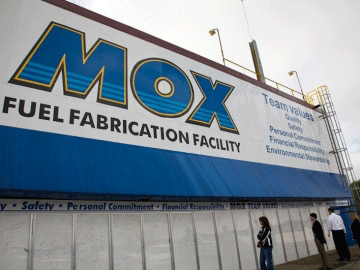
 WJBF 26th Sept 2018 , A Federal Appeals Court is set to discuss, Thursday, the future of Savannah
River Site’s MOX project. In a letter sent to a Texas congressman and
filed in court documents, the National Nuclear Security Agency says it
agrees with the decision made by Energy Secretary Rick Perry to stop the
project.
the matter was never considered when Secretary Perry issued the directive
to end MOX earlier this year.
last week that would effectively cut MOX down from over $300-billion to
$220 billon…which is the exact amount of funds it would take to close the
incomplete project safely and in a timely manner.
https://www.wjbf.com/news/south-carolina-news/future-of-savannah-river-site-s-mox-facility-to-be-discussed-in-court/1477008484
Debunking the claims about generation IV nuclear waste
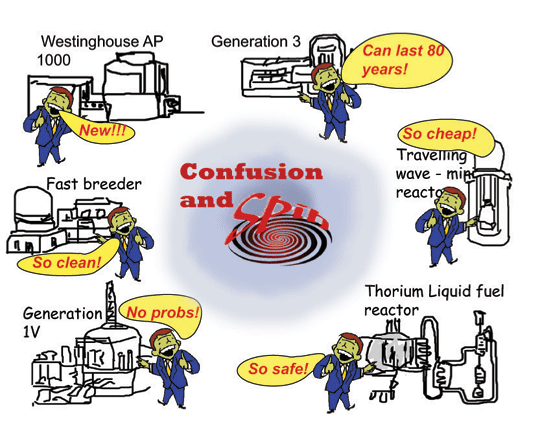
Generation IV nuclear waste claims debunked, Nuclear Monitor 24 Sept 18 Lindsay Krall and Allison Macfarlane have written an important article in the Bulletin of the Atomic Scientists debunking claims that certain Generation IV reactor concepts promise major advantages with respect to nuclear waste management. Krall is a post-doctoral fellow at the George Washington University. Macfarlane is a professor at the same university, a former chair of the US Nuclear Regulatory Commission from July 2012 to December 2014, and a member of the Blue Ribbon Commission on America’s Nuclear Future from 2010 to 2012.
Krall and Macfarlane focus on molten salt reactors and sodium-cooled fast reactors, and draw on the experiences of the US Experimental Breeder Reactor II and the US Molten Salt Reactor Experiment.
The article abstract notes that Generation IV developers and advocates “are receiving substantial funding on the pretense that extraordinary waste management benefits can be reaped through adoption of these technologies” yet “molten salt reactors and sodium-cooled fast reactors – due to the unusual chemical compositions of their fuels – will actually exacerbate spent fuel storage and disposal issues.”
Here is the concluding section of the article: Continue reading
Following Transatomic’s failure, small modular nuclear reactors face uncertain future

A good announcement and a bad announcement for two nuclear-energy startups,NuScale Power takes a step toward engineering; Transatomic power shuts down. Ars Technica, MEGAN GEUSS – 9/26/2018 “…………….The old light-water reactors that serve America’s grid today create nuclear waste that’s politically impossible to dispose of. Nuclear plants with traditional reactors are also extremely expensive to build and difficult to permit.
For these reasons, many nuclear hopefuls have looked to advanced nuclear technology. Several startups have popped up, promising to make either the waste problem or the expense problem go away.
This week, two advanced nuclear-technology startups have announced major news, both good and bad for the future of advanced nuclear technology………..
Transatomic is going to close down, according to MIT Technology Review. Several years ago, the startup raised millions on promises to use spent nuclear waste as reactor fuel, as well as to “generate electricity 75 times more efficiently than conventional light-water reactors,” according to MIT Technology Review. The company later retracted that “75 times” claim after a review from MIT’s Nuclear Engineering Department found issue with it.
Instead, Transatomic revised its estimates in 2016 to say that its reactor would be able to generate more than two times as much energy per ton of mined uranium than a standard reactor.
The company’s design to use spent nuclear-reactor fuel in a molten salt reactor was also called into question, causing Transatomic to state in its 2016 revision that its design “does not reduce existing stockpiles of spent nuclear fuel.”
The lost confidence made it harder for Transatomic to find funding to complete the $15 million it needed to build a prototype reactor, although it had raised about $4 million already……..
Onward to manufacturing
NuScale Power, based out of Portland, Oregon issued a press release today saying that, after 18 months of searching, it has selected manufacturing company BWX Technologies to begin engineering work that will lead to manufacturing the company’s Small Modular Reactor (SMR) design.
Phase 1 engineering and manufacturing begins today and will last until 2020, NuScale wrote, and then Phases 2 and 3—”preparing for fabrication” and “fabrication,” respectively—will continue from there……..
Small Modular Reactors don’t solve the nuclear-waste problem mentioned at the top of this article, but in theory, they might solve nuclear energy’s expense problem. Building smaller reactors that can be modularly expanded if necessary could not only keep siting, construction, and regulatory costs proportionally lower, but using the same manufacturing and construction crews to build more, smaller reactors would theoretically develop a workforce with expertise in building and installing reactors. https://arstechnica.com/science/2018/09/a-good-announcement-and-a-bad-announcement-for-two-nuclear-energy-startups/
After getting $millions in investment, Transatomic molten salt nuclear reactor project bites the dust
A nuclear startup will fold after failing to deliver reactors that run on spent fuel, MIT Technology Review, James Temple, 25 Sept 18 Transatomic Power, an MIT spinout that drew wide attention and millions in funding, is shutting down almost two years after the firm backtracked on bold claims for its design of a molten-salt reactor.
High hopes: The company, founded in 2011, plans to announce later today that it’s winding down.
Transatomic had claimed its technology could generate electricity 75 times more efficiently than conventional light-water reactors, and run on their spent nuclear fuel. But in a white paper published in late 2016, it backed off the latter claim entirely and revised the 75 times figure to “more than twice,” a development first reported by MIT Technology Review…….
The longer timeline and reduced performance advantage made it harder to raise the necessary additional funding, which was around $15 million. “We weren’t able to scale up the company rapidly enough to build a reactor in a reasonable time frame,” Dewan says.
Transatomic had raised more than $4 million from Founders Fund, Acadia Woods Partners, and others. ……https://www.technologyreview.com/the-download/612193/nuclear-startup-to-fold-after-failing-to-deliver-reactor-that-ran-on-spent-fuel/
The next big thing: unfeasible small modular nuclear reactors
A conversation with Dr. Gordon Edwards: contemporary issues in the Canadian nuclear industry, and a look back at the achievements of the Canadian Coalition for Nuclear Responsibility (CCNR), http://www.ccnr.org/ Montreal, August 25, 2018, Nuclear waste management: an exercise in cynical thinking. DiaNuke.org, 24 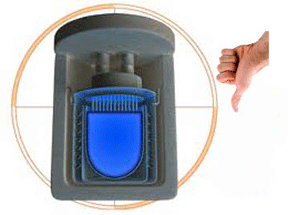 Sept 18, “…….. 8. The next big thing: unfeasible small modular reactors
They want to basically clear the decks by shoving this waste off to the side so that they can use this territory, which is crown land owned by the Government of Canada, in order to develop a whole new generation of small modular reactors which are also pie-in-the-sky. They don’t have any customers at the present time. They say there’s a great deal of interest in small modular reactors. However, the interest is almost totally confined to the nuclear establishment. It’s the nuclear people who are interested in these small modular reactors, nobody else.
In fact, we’ve had bad experience with small modular reactors Canada. We had two ten-megawatt nuclear reactors designed and built. They were built around the year 2000, and each one of these reactors was supposed to be able to replace the very old NRU reactor at Chalk River, which is the largest isotope production reactor in the world. And each one of these reactors—they’re called maples, the maple reactors—each one of them would be able to take over the workload of the already-existing NRU reactor which is now shut down. They couldn’t get either one of them to work properly. They were so unsafe, and so unstable in their operation that without operating them and after having spent hundreds of millions of dollars in building them, they now are dismantling them without ever having produced any useful results.
They also had here in Canada a design called a “slowpoke district heating reactor,” and this reactor was ranging from ten megawatts to a hundred megawatts, thermal power only, no electricity, and the idea of this was it could be a reactor which could supply district heating for buildings and so on. That was also a complete failure. That was back in the last century in the 80s and 90s in Canada. They tried to give these things away for free, and they couldn’t even give them away for free. Nobody wanted them.
So the whole business of nuclear waste has really been obfuscated by the industry who are perpetually trying to convince people that they have the solution, that they know what to do, and that when they do it, it’ll be perfectly safe. All of our experience points in the opposite direction…………https://www.dianuke.org/a-conversation-with-dr-gordon-edwards-contemporary-issues-in-the-canadian-nuclear-industry-and-a-look-back-at-the-achievements-of-the-canadian-coalition-for-nuclear-responsibility-ccnr-http-
Extremely high radiation doses threaten the plan to colonise Mars
Can humans survive on Mars? Scientists fear RADIATION threatens NASA Mars missions
NASA astronauts who could one day head to Mars will be exposed to incredibly high doses of radiation – a risk that could jeopardise the safety of future Mars missions.
Here on Earth, the planet’s magnetic field and atmosphere protect humans from absorbing deadly cosmic rays and atoms speeding through space.
Mars, however, has not had a magnetic field of its own since it collapsed for unknown reasons billion of years ago.
This could expose astronauts and Martian colonisers to radiation sickness, increased risk of developing cancer, degenerative diseases and central nervous system problems.
Jordanka Semkova of the Bulgarian Academy of Sciences, who leads a team of scientists manning an orbital Liulin-MO dosimeter over Mars, said the future of all Mars missions depends on how space agencies can combat this.
She said: “One of the basic factors in planning and designing a long-duration crewed mission to Mars is consideration of the radiation risk.
“Radiation doses accumulated by astronauts in interplanetary space would be several hundreds times larger than the doses accumulated by humans over the same time period on Earth, and several times larger than the doses of astronaut and cosmonauts working on the International Space Station.
“Our results show that the journey itself would provide very significant exposure for the astronauts to radiation.”
The findings were presented this week at the European Planetary Science Congress 2018 in partnership with the European Space Agency.
The journey itself would provide very significant exposure for the astronauts to radiation
According to the results, a 12-month-long round trip to Mars and back would expose astronauts to about 60 percent of the recommended radiation dosage for their entire career.
In space, millions of atoms and particles from the Sun and from outside of the solar system barrel through space at near the speed of light.
When exposed to unprotected human bodies, the particles violently tear through DNA, causing all sorts of genetic problems to arise.
Damaged DNA molecules can trigger cancers cells to grow, impair vision and cause the heart to fall ill.
During the course of just one week on the International Space Station (ISS), astronauts are exposed to roughly the equivalent of one year of radiation on Earth.
According to the ESA, astronauts who have been going into space since the 1960s have been reporting flashes of light even when they close their eyes.
These flashes are believed to be cosmic rays passing through the eye and triggering a response in the retina……….https://www.express.co.uk/news/science/1021623/NASA-Mars-mission-can-humans-survive-radiation-space
Heavy radiation effect on astronauts to Mars – now can be measured
Astronauts Going to Mars Will Absorb Crazy Amounts of Radiation. Now We Know How Much. https://www.space.com/41887-mars-radiation-too-much-for-astronauts.html By
The second nuclear industry stillbirth – Small Modular Nuclear Reactors (SMRs)
 SMR – The Second Make-Believe Renaissance – Gordon Edwards, 18 Sept 18 SMR stands for “Small Modular Reactor(s)”. It is the latest effort by an increasingly desperate nuclear industry to create a “Nuclear Renaissance”. Nuclear Renaissance I
NASA’s on again off again commitment to plutonium powered space travel, nuclear reactors on the moon etc
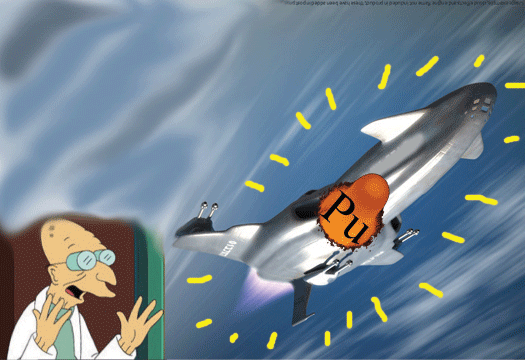 Why NASA wants to build a nuclear reactor on the Moon, techradar, By 16 Sept 18,”………“Safe, efficient and plentiful energy will be the key to future robotic and human exploration,” says Jim Reuter, NASA’s acting associate administrator for the Space Technology Mission Directorate (STMD) in Washington. “I expect the Kilopower project to be an essential part of lunar and Mars power architectures as they evolve.”
China Building a Nuclear-Powered Icebreaker
|
Why Is China Building a Nuclear-Powered Icebreaker? The melting ice of the Arctic does offer things that China wants: resources and shipping routes. And that means profits are to be had. National Interest
Wait a minute. China doesn’t have any Arctic territories. Its northern borders are Central Asia and Siberia, not the North Pole. Nonetheless, China has joined other nations, such as Russia, the United States, Norway and Canada, in positioning itself for the perceived riches of the North Pole. The nuclear icebreaker will join the recently launched Snow Dragon 2, China’s first domestically produced icebreaker, and the older Xuelong, built in Ukraine. “The ship’s nuclear power unit is huge and can be applied to a nuclear-powered aircraft carrier once updated, so it can be seen as a preparation for the aircraft carrier,” a Chinese analyst told another Chinese state-owned site. Significantly, the headline of the Chinamil.com article was “China one step closer to nuke-powered aircraft carrier with cutting-edge icebreaker,” which suggests that preparing to confront the U.S. Navy is more important than Arctic exploration……..https://nationalinterest.org/blog/buzz/why-china-building-nuclear-powered-icebreaker-31257 |
|
UK’s Department of Business, Energy and Industrial Strategy is NOT backing Small Modular Nuclear Reactors
 Global Warming Policy Foundation 10th Sept 2018 An important new briefing paper published by the Global Warming Policy Foundation reveals that the government has kicked a key nuclear programme into the long grass.
This follows an announcement last week by the Department of Business, Energy and Industrial Strategy on its small modular nuclear (SMR) competition, which outlined new funding for feasibility studies into a range of new nuclear technologies.
The report, by nuclear industry expert Andrew Dawson, shows that while this might appear to represent progress, in reality it is likely to be the end of the SMRs in the UK: “When George Osborne announced the SMR competition in 2015, it was about identifying SMR technologies that could be deployed in the near-term. But in its announcement last week, BEIS made it clear that it would only back “blue-skies” projects, some of which are not SMRs, and
none of which have any hope of breaking ground in the next few decades……
https://www.thegwpf.org/who-killed-the-small-modular-nuclear-programme/
Radiation the biggest of many hazards to space flight to Mars
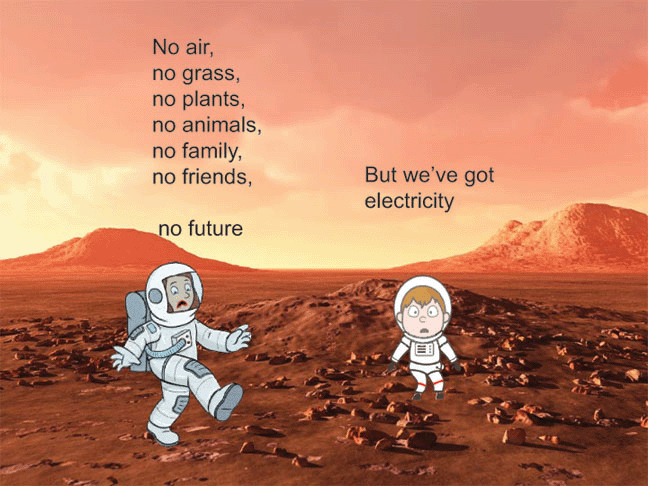
These hazards are being studied using ground-based analogues, laboratories, and the ISS, which serves as a test bed to evaluate human performance and counter-measures required for the exploration of space.
The National Aeronautics and Space Administration (NASA) has listed five hazards that astronauts can encounter on Mars.
In a statement, the US space agency said that “To bring a mission to the Red Planet from fiction to fact, NASA’s Human Research Program has organized hazards astronauts will encounter on a continual basis into five classifications.”
And they are – radiation; isolation and confinement; distance from Earth; gravity (or lack thereof); and hostile or closed environments………
The first hazard of a human mission to Mars, NASA says, is also the most difficult to visualise because, space radiation is invisible to the human eye.
Radiation is not only stealthy, but considered one of the most menacing of the five hazards.
Behavioral issues among groups of people crammed in a small space over a long period of time, no matter how well trained they are, are inevitable, according to NASA……..
The third and perhaps most apparent hazard is the distance. Mars is, on average, 140 million miles from Earth.
Rather than a three-day lunar trip, astronauts would be leaving our planet for roughly three years, the statement said.
NASA noted that the variance of gravity that astronauts will encounter is the fourth hazard of a human mission.
On Mars, astronauts would need to live and work in three-eighths of Earth’s gravitational pull for up to two years, it noted……… https://www.outlookindia.com/website/story/radition-to-isolation-nasa-lists-five-hazards-of-human-spaceflight-to-mars/316392
Irrational optimism about Small Modular Nuclear Reactors (SMRs)
 “Panglossian puffery”, says David Lowry. The report ignores the security and nuclear waste problems of small modular reactors.
The Nuclear Free Local Authorities (NFLA) says this is yet another attempt to promote the benefits of SMRs despite large and quite possibly insurmountable hurdles to cross. The Government suggests the report was produced by an ‘independent’ group, yet at least half of the group have strong links to the nuclear industry, including the Nuclear Industry Association. The UK appear to be one of the few governments pursuing a strategy of promoting SMRs. Even France and Finland, the only other countries in Europe currently developing large nuclear projects, have no plans to develop such technology. Indeed France has just commissioned a whole raft of new smaller-scale solar energy projects.
the finance sector is accurate in being sceptical of new nuclear developments given the rapidly decreasing costs of renewable energy.
Rolls-Royce warned last month that it was preparing to shut down the [Small Modular Nuclear Reactor] project if the government did not make a long-term commitment to its technology.
Panglossian SMRs , NuClear News Sept 18, The government should subsidise the deployment of small modular nuclear reactors in order to speed the transition to a low carbon energy system, according to an independent review into the technology commissioned by Ministers. The Expert Finance Working Group on Small Reactors (EFWG) said in a report that government should offer subsidies for small nuclear reactors to help de-risk the technology and kickstart cost reductions. (1)
Small modular reactors (SMRs) generally have a capacity less than 600MW, with the costs ranging from £100 million to £2.3 billion, which the experts suggest could be delivered by 2030. The EFWG has recommended the government to help de-risk the small nuclear market to enable the private sector to develop and finance projects – it believes SMRs could be commercially viable propositions both in the UK and for an export market.
The report says the “Government should establish an advanced manufacturing supply chain initiative, as it did with offshore wind, to bring forward existing and new manufacturing capability in the UK and to challenge the market on the requirement for nuclear specific items, particularly Balance of Plant (BOP), thereby reducing the costs of nuclear and the perceived risks associated with it.”
Nuclear Energy Minister Richard Harrington said: “Today’s independent expert report recognises the opportunity presented by small nuclear reactors and shows the potential for how investors, industry and government can work together to make small nuclear reactors a reality. Advanced nuclear technologies provide a major opportunity to drive clean growth and could create high-skilled, well-paid jobs around the country as part of our modern Industrial Strategy.” (2) Continue reading
1 This Month

22 June – Virtual Event –Climate Change: New Data, New Debate

Monday, June 22, 2026 2:30 p.m. – 3:15 p.m. CT
YouTube. Register here

Protect Sazan Island from the Trump family! https://secure.avaaz.org/campaign/en/protect_sazan_island_from_the_trump_family_loc/?bqFCVab&v=174511&cl=22707147157&_checksum=5e9dde668860e8231c33699735e16a1fbf22ab2cb01da50c999fe8732b9775ef&utm_source=email&utm_medium=blast_email&utm_campaign=174511
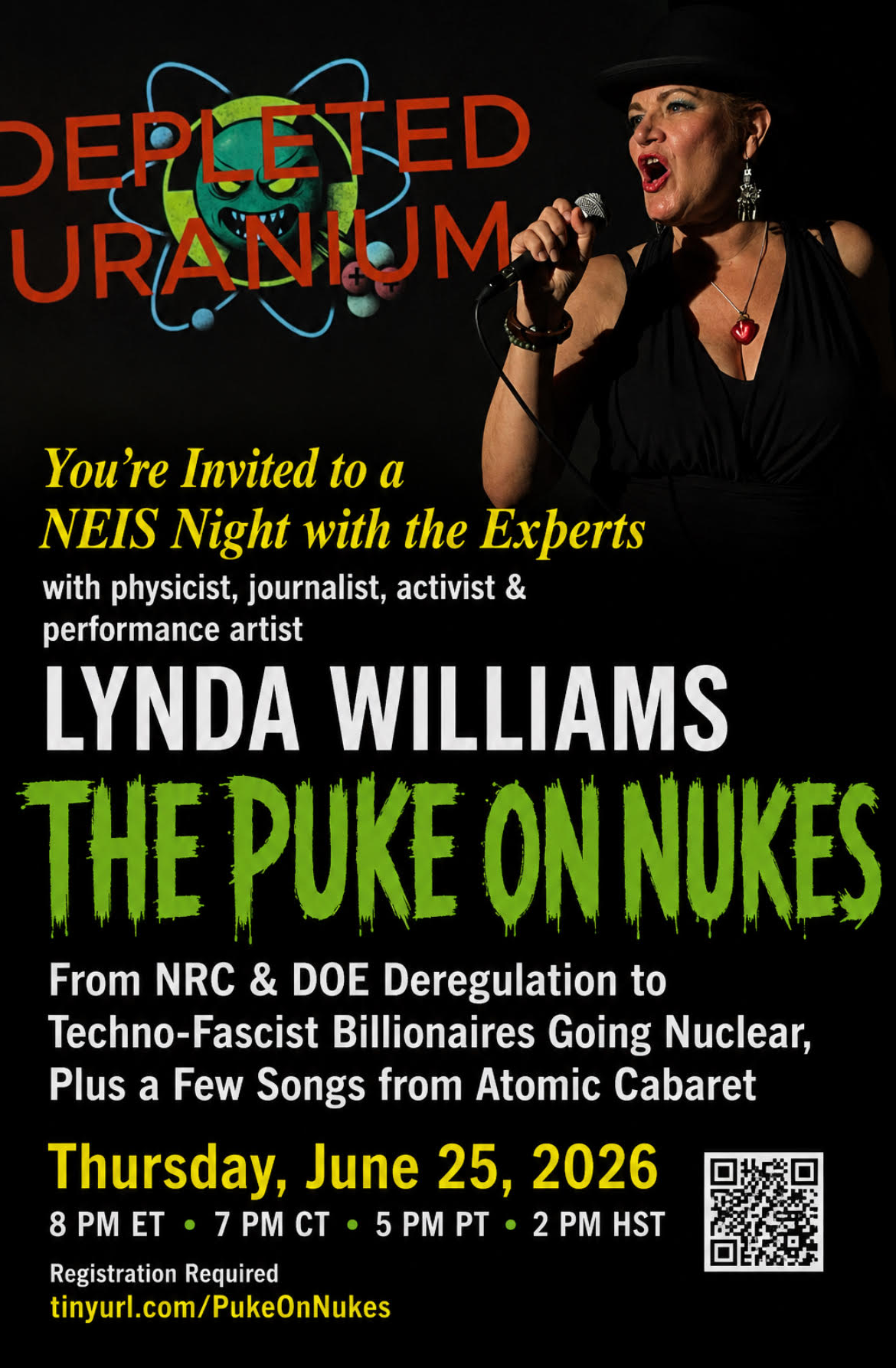
25 June- THE PUKE ON NUKES
Thursday, June 25, 2026
7pm Central Time (8pm ET, 6pm MT, 5pm PT) UTC – 5
From NRC & DOE Deregulation to Techno-Fascist Billionaires Going Nuclear, Plus a Few Songs from Atomic Cabaret REGISTER
26 June – Radiation Trainwreck at the NRC / Join the Protect Better Campaign – https://us02web.zoom.us/meeting/register/4ZlZ5_qLSHGiLSCg8FF6Bg#/registration


Cuba Is Not a Failed State – It Is a Besieged State
PETITION: “Global Appeal to Endorse Palestinian Right of Return of Refugees”
To see nuclear-related stories in greater depth and intensity – go to https://nuclearinformation.wordpress.com
-
Archives
- June 2026 (211)
- May 2026 (306)
- April 2026 (356)
- March 2026 (251)
- February 2026 (268)
- January 2026 (308)
- December 2025 (358)
- November 2025 (359)
- October 2025 (376)
- September 2025 (257)
- August 2025 (319)
- July 2025 (230)
-
Categories
- 1
- 1 NUCLEAR ISSUES
- business and costs
- climate change
- culture and arts
- ENERGY
- environment
- health
- history
- indigenous issues
- Legal
- marketing of nuclear
- media
- opposition to nuclear
- PERSONAL STORIES
- politics
- politics international
- Religion and ethics
- safety
- secrets,lies and civil liberties
- spinbuster
- technology
- Uranium
- wastes
- weapons and war
- Women
- 2 WORLD
- ACTION
- AFRICA
- Atrocities
- AUSTRALIA
- Christina's notes
- Christina's themes
- culture and arts
- Events
- Fuk 2022
- Fuk 2023
- Fukushima 2017
- Fukushima 2018
- fukushima 2019
- Fukushima 2020
- Fukushima 2021
- general
- global warming
- Humour (God we need it)
- Nuclear
- RARE EARTHS
- Reference
- resources – print
- Resources -audiovicual
- Weekly Newsletter
- World
- World Nuclear
- YouTube
-
RSS
Entries RSS
Comments RSS
 nuclear-news