Security dangers of nuclear energy in space
Nuclear Energy in Space: Nonproliferation Risks http://www.spaceref.com/news/viewpr.html?pid=54634, University of Texas-Austin, September 17, 2019
On October 17, experts from NASA, Congress, and reactor companies will gather in the nation’s capital to discuss ongoing development of nuclear reactors for space missions and the potential security risks.
The event is free, but pre-registration is required. For further details, and to register, please see: https://space-nuclear.eventbrite.com.
The program will feature Jeffrey A. Sheehy, NASA’s Chief Engineer in the Space Technology Mission Directorate. The keynote address will be delivered by Rep. Bill Foster (D-IL), the only physicist in Congress and a member of the House Science Committee.
Controversy centers on NASA’s choice of fuel for the reactor it tested in 2018 for use on a planetary surface: weapons-grade, highly enriched uranium. NASA scientists believe such uranium would enable smaller reactors, reducing launch costs. However, critics argue it could undermine decades of U.S. progress in reducing worldwide civilian commerce in this dangerous material, create a precedent that could help rogue countries obtain nuclear weapons, sharply increase security costs, impede NASA’s cost-saving collaboration with commercial partners who lack licenses for such uranium, and potentially disperse nuclear weapons material to adversaries in the event of a launch failure. They say that an alternative reactor fuel – low-enriched uranium, which is unsuitable for nuclear weapons – could reduce the security, economic, and political risks.
Last month, President Trump issued a Presidential Memorandum on the launch of space nuclear systems, which highlighted the security risk: “Due to potential national security considerations associated with nuclear nonproliferation . . . The President’s authorization shall be required for Federal Government launches . . . when such systems utilize any nuclear fuel other than low-enriched uranium.” In June 2019, the U.S. House of Representatives passed an appropriations bill that included an amendment by Rep. Foster, directing NASA to “work towards the development of a low enriched uranium (LEU) space power reactor.”
Ontario’s secretive role in helping Trump to nuclear weaponise Space
 The space race has a dirty nuclear secret and it’s right here in Ontario, https://nowtoronto.com/news/space-race-nuclear-power-ontario/ by Rosemary Frei, SEPTEMBER 16, 2019
 Unbeknownst to most Canadians, the Darlington nuclear power plant 70 kilometres east of Toronto has been playing a not-so-small role in the U.S. race to weaponize space
The 50th anniversary of the Apollo 11 mission added momentum to the new push to go farther into outer space than humans have ever gone before.
Ontario’s nuclear industry could receive both a reflected glow from the extraterrestrial travel hype and a new revenue stream. It could also potentially increase international nuclear-weapons proliferation.
Unbeknownst to most Canadians, the Darlington nuclear power plant 70 kilometres east of Toronto has already been playing a not-so-small role in the space race.
The plant has been producing radioactive plutonium-238 as fuel for spacecraft in NASA’s mushrooming space pipeline since 2017.
“We are proud to have Ontario play a part, however small, in this most noble of human endeavours,” OPG’s then-president and CEO Jeff Lyash said in a news release.
Canadian Nuclear Laboratories (CNL), which runs the Chalk River facility near Ottawa, another participant in the initiative, posted a “Success Stories” article on its website seven days later. It cautioned that “this opportunity is still subject to regulatory and licensing processes.” But it quotes a CNL official as saying “staff should take a lot of pride in the fact that we are key partners.”
CNL has continued communicating with other project stakeholders. But when NOW contacted CNL for a comment it responded on September 5 that it is no longer involved in the project. OPG has removed the news release from its website and did not respond to NOW’s request for information. Turns out a company called Technical Solutions Management (TSM) is steering the initiative now.
TSM is owned by former nuclear-industry executives Billy Shipp, Pierre Tremblay and Paul Spekkens. CEO Shipp told NOW in an August 29 phone interview that NASA has yet to give its formal thumbs-up.
“For us to get out ahead of our client [NASA], in terms of anticipated need [for plutonium-238], or making statements of their need, is not that professional on our part. So we really have been very low-key on this,” Shipp says when reached for an interview aboard a boat off Vancouver Island.
But he noted that U.S. President Donald Trump’s establishment of a Space Command makes the project more likely to proceed.
Plutonium-238 has long been used to fuel flight, via conversion into electricity of the intense heat the atom pumps out. The U.S. powered military satellites with it in the 1960s. NASA also harnessed it most recently to propel Curiosity Rover to Mars in 2011.
The steps involved for the manufacture of made-in-Canada plutonium-238 to supplement the U.S.’s production involves first synthesizing neptunium-237, plutonium-238’s precursor at the Pacific Northwest National Laboratory in Richland, Washington.
From there, the material is transported to Chalk River where it is put into bundles before it’s sent to Darlington and inserted into CANDU reactors. There, the neptunium-237 catches stray neutrons, transforming it into plutonium-238. The bundles are shipped back to Chalk River where the plutonium-238 is separated from by-products and packaged into pellets. The pellets are transported to Idaho National Lab where they are readied as ‘nuclear batteries’ for spacecraft engines. The current price of plutonium-238 isn’t public, but back in 2003 one kilogram was worth about $8 million U.S.
Gordon Edwards, co-founder and president of the Canadian Coalition for Nuclear Responsibility, says the form of radioactivity emitted by plutonium (namely, alpha particles) is highly toxic when inhaled but often isn’t picked up by radiation detectors.
For example, in November 2009, hundreds of workers at OPG’s Bruce nuclear plant breathed in plutonium dust (a by-product of nuclear-energy production) but the plutonium remained undetected for weeks. Many of the workers had not been given respirators. It was the largest preventable exposure of workers to internal radioactive contamination in the history of the civilian nuclear industry.
Even worse, says Edwards, is the fact the process used to create plutonium-238 can also be used to transform depleted uranium into plutonium-239, the key explosive in nuclear bombs.
“I grant that TSM’s plutonium-238 program does not fundamentally enhance this danger, but it does provide an opportunity to tell the public and politicians that if you can produce one kind of plutonium for the space program you can just as easily produce another kind of plutonium for a nuclear-weapons program, using essentially the same CANDU technology,” Edwards tells NOW.
However, no one inside the space or nuclear industries appears be seriously addressing these well-known problems. And there is plenty of money potentially available for a new plutonium-238 venture. NASA projects its research and development budget – including developing power and propulsion systems – will be $1.5 billion next year, rising to $3.4 billion by 2024.
TSM’s other co-owners, Tremblay and Spekkens, are well-placed to move such a project forward. Tremblay was OPG’s chief nuclear operating officer and president of OPG’s subsidiary Canadian Nuclear Partners. He became AECOM Canada Nuclear Operations’ president and CEO in August 2018. The American multinational is playing key roles in the multi-billion-dollar Darlington refurbishment. Tremblay started consulting for AECOM in June 2016; an industry article about this said the firm “has recruited key expertise that will undoubtedly position the company to play a key part in the massive nuclear power projects anticipated for Ontario over the next decade.”
Spekkens retired in 2016 as OPG’s vice president of science and technology and as chair of the CANDU Owners Group, a Toronto-based private organization that promotes CANDU use around the world. He then became a consultant and director of nuclear technology at Kinectrics.
He opined on the nuclear industry’s future at a June 2017 conference. In the abstract of his lecture, Spekkens says “this future will, of course, depend heavily on technology. But also (and perhaps equally) important will be non-technical considerations such as public acceptance, a pipeline full of qualified future employees, public policy in several levels of government, and of course, finances.”
The danger, the unwisdom, of highly enriched uranium in space
 provide a planetary base with electrical power. Currently it seems as though NASA is in favor of nuclear energy. Most recently, on August 20, 2019, President Trump issued a presidential memorandum authorizing the possible launch into space of nuclear reactors fueled by highly enriched uranium (HEU) for “orbital and planetary surface activities.” But sending HEU reactors into space is risky and unnecessary because there are viable options for using low-enriched uranium (LEU), or for avoiding nuclear power altogether by harnessing solar energy.
Since 2015, NASA has funded a group at Los Alamos National Laboratory to build what is called the Kilopower reactor, a nuclear fission reactor for space applications. The Kilopower reactor is a sodium-cooled fast-neutron reactor with a block core that produces electrical energy with Stirling engine heat converters. NASA plans to build four or five Kilopower reactors, each with a lifetime of 12 to 15 years and a continuous energy output of 10 kilowatts, which could meet the energy needs of a possible Mars base. This Kilopower fast reactor could be fueled with either LEU or HEU. While the LEU fuel for the Kilopower reactor would contain 19.75 percent uranium 235, the HEU fuel would contain 93 percent of this isotope, a degree of enrichment that is called “weapon-grade.” In the newest prototype, these two versions of the fast reactor have essentially the same design but differ by size and weight. Los Alamos published a white paper about the Kilopower reactor in August 2017 supporting the LEU designs, but half a year later the lab successfully tested the HEU design. In October 2018, Los Alamos published a second white paper that favored HEU on the grounds that it would have a lighter weight.
Indeed, the HEU version of the Kilopower reactor is lighter, but it comes with alarming risks: the block fuel element contains around 43 kilograms of HEU, enough material for a terrorist group to build a nuclear weapon. There is also a proliferation risk. Kilopower would establish a precedent that other states could use to justify their own production of weapon-grade uranium. That is why, over the last four decades, the United States has led an international effort to persuade research reactor operators to switch from using HEU to using LEU. Building an HEU-fueled space reactor would undermine those attempts and the nonproliferation policies that inform them.
There are other downsides beyond the security risks. For example, the use of HEU would exclude private industry from taking part in space-reactor research and development. Such a reactor would also be more expensive than the LEU version because of the high costs required to secure significant quantities of HEU during the development and the launch. Finally, an HEU reactor would be sure to stir controversy for the reasons mentioned above and would be subject to cancellation by Congress.
Beyond that, the main advantage of the HEU reactor may not actually be much of an advantage. In 2015 scientists from the Korea Atomic Energy Research Institute, and in 2018 scientists from the Colorado School of Mines, each published designs for different, lighter LEU reactor models with a similar power output to the Kilopower LEU version. Moreover, it seems realistic that we can expect further weight and launching cost reductions well before a Mars colonization mission could start.
Accident risks. Sending nuclear reactors into space is not a new idea. The Soviet Union launched over 30 into orbit during the Cold War to power radars that tracked the US Navy. The United States launched only one reactor, in 1965. Dubbed the SNAP-10A, it had to be shut down after only 43 days due to an electrical component failure.
Most of these reactors are still orbiting above us—but not all of them. For example, the Soviet Kosmos 954 reactor crashed to earth in 1978, spreading radioactive material over a large area of northern Canada. In total there is about one ton of nuclear material in orbit, and all of it is at risk of colliding with other space debris and coming back to earth.
Major accidents have occurred in over 20 percent of space reactor missions. That is probably one of the reasons why no country has launched a reactor into space since the Cold War. Given these issues, why not avoid radioactive material for space missions altogether? Perhaps solar energy should be the first choice for electrical energy in space. Most satellites launched into space get their energy from solar panels, as does the international space station, which has successfully operated for over 10 years with solar arrays that produce up to 120 kilowatts of electricity. The NASA Mars rover Opportunity ran for over 14 years powered by solar panels. In short, the difficulties of running a solar power system on Mars seem manageable.
If we really want to build a Mars base in the not-so-distant future, why should we go with weapon-grade uranium, with all its security and proliferation risks, when we have both the option of affordable alternative LEU designs and solar options that eliminate these risks? https://thebulletin.org/2019/09/do-we-need-highly-enriched-uranium-in-space-again/?utm_source=Newsletter&utm_medium=Email&utm_campaign=Newsletter09162019&utm_content=NuclearRisk_UraniumInSpace_09122019
Russia’s Floating Nuclear Power Plant Arrives At Far East Base Pevek
Russia’s Floating Nuclear Power Plant Arrives At Far East Base, https://www.rferl.org/a/russia-s-floating-nuclear-power-plant-arrives-at-far-east-base/30164346.html Russia’s first floating nuclear power plant has reached its final destination in the country’s remote Far East after a three-week, 5,000-kilometer journey.
Russia’s state nuclear energy company Rosatom announced on September 14 the arrival in the Arctic port town of Pevek of the nuclear power plant, which Greenpeace has dubbed a “floating Chernobyl.”
The massive plant — a 140-meter towed platform that carries two 35-megawatt nuclear reactors set sail from Murmansk, in northwestern Russia, on August 23 and traveled along the Northern Sea Route to its destination off the coast of Chukotka.
Rosatom said small surrounding communities, along with mining facilities and offshore oil and natural gas platforms, would make use of the electricity.
The nuclear plant has been named the Akademik Lomonosov after the 18th-century Russian scientist Mikhail Lomonosov.
Small nuclear reactors safe? Not so
 HELEN CALDICOTT: Small modular reactors — same nuclear
  disasters https://independentaustralia.net/politics/politics-display/helen-caldicott-small-modular-reactors–same-nuclear-disasters,13087
Now that the “nuclear renaissance” seems dead and buried following the Fukushima catastrophe (one-sixth of the world’s nuclear reactors were closed after the accident), the corporations invested in making nuclear plants and radioactive waste –including Toshiba, Nu-Scale, Babcock and Wilcox, GE Hitachi, General Atomics and the Tennessee Valley Authority – are not to be defeated.
Their new strategy is to develop small modular reactors (SMR), which can be sold around the world without, they say, the dangers inherent in large reactors — safety, cost, proliferation risks and radioactive waste.
There are basically three types of SMRs which generate less than 300 megawatts of electricity compared to the current 1,000-megawatt reactors.
Light water reactor designs
These will be smaller versions of present-day pressurised water reactors using water as the moderator and coolant but with the same attendant problems as Fukushima and Three Mile Island. They are to be built underground, which obviously makes them dangerous to access in the event of an accident or malfunction.
They will be mass-produced (turnkey production) and large numbers must be sold yearly to make a profit. This is an unlikely prospect because major markets – China and India – will be uninterested in buying U.S. reactors when they can make their own.
If a safety problem arises, such as with the Dreamliner plane, all of them will have to be shut down — interfering substantially with electricity supply.
SMRs will be expensive because the cost of unit capacity increases with decrease in the size of the reactor. Billions of dollars of government subsidies will be required because Wall Street will not touch nuclear power. To alleviate costs, it is suggested that safety rules be relaxed — including reducing security requirements and a reduction in the ten-mile emergency planning zone to 1,000 feet.
Non-light water designs
These are high-temperature gas-cooled reactors (HTGR) or pebble bed reactors. Five billion tiny fuel kernels of high-enriched uranium or plutonium will be encased in tennis-ball-sized graphite spheres which must be made without cracks or imperfections — or else they could lead to an accident. A total of 450,000 such spheres will slowly be released continuously from a fuel silo, passing through the reactor core, and then re-circulated ten times. These reactors will be cooled by helium gas operating at very high temperatures (900 C).
The plans are to construct a reactor complex consisting of four HTGR modules located underground to be run by only two operators in a central control room. It is claimed that HTGRs will be so safe that a containment building will be unnecessary and operators can even leave the site — “walk-away-safe” reactors.
However, should temperatures unexpectedly exceed 1600 degrees Celsius, the carbon coating will release dangerous radioactive isotopes into the helium gas and at 2000 C, the carbon would ignite creating a fierce graphite Chernobyl-type fire.
If a crack develops in the piping or building, radioactive helium would escape and air would rush in igniting the graphite.
Although HTGRs produce small amounts of low-level waste, they create larger volumes of high-level waste than conventional reactors.
Despite these obvious safety problems and despite the fact that South Africa has abandoned plans for HTGRs, the U.S. Department of Energy has unwisely chosen the HTGR as the “Next Generation Nuclear Plant”.
Liquid metal fast reactors (PRISM)
It is claimed by the proponents that fast reactors will be safe, economically competitive, proliferation-resistant and sustainable.
They are to be fueled by plutonium or highly enriched uranium, and cooled by either liquid sodium or a lead-bismuth molten coolant creating a potentially explosive situation. Liquid sodium burns or explodes when exposed to air or water and lead-bismuth is extremely corrosive producing very volatile radioactive elements when irradiated.
Should a crack occur in the reactor complex, liquid sodium would escape burning or exploding. Without coolant, the plutonium fuel would melt and reach critical mass, inciting a massive nuclear explosion. One-millionth of a gram of plutonium induces cancer and it lasts for 500,000 years. Yet it is claimed that fast reactors will be so safe that no emergency sirens will be required and emergency planning zones can be decreased from ten miles to 1,300 feet.
There are two types of fast reactors, a simple plutonium fueled reactor and a “breeder”. The plutonium reactor core can be surrounded by a blanket of uranium 238, the uranium captures neutrons and converts to plutonium creating ever more plutonium.
Some are keen about fast reactors because plutonium waste from other reactors can be fissioned converting it to shorter-lived isotopes like caesium and strontium which last “only” 600 years instead of 500,000. But this is fallacious thinking because only ten per cent is fissioned leaving 90 per cent of the plutonium for bomb-making and so on.
Construction
Three small plutonium fast reactors will be arranged together forming a module. Three of these modules will be buried underground and all nine reactors will connect to a fully automated central control room. Only three reactor operators situated in one control room will be in control of nine reactors. Potentially, one operator could simultaneously face a catastrophic situation triggered by the loss of off-site power to one unit at full power, in another shut down for refuelling and in one in start-up mode.
There are to be no emergency core cooling systems.
Fast reactors will require a massive infrastructure including a reprocessing plant to dissolve radioactive waste fuel rods in nitric acid, chemically removing the plutonium and a fuel fabrication facility to create new fuel rods. A total of 15,000 to 25,000 kilos of plutonium are required to operate a fuel cycle at a fast reactor and just 2.5 kilos is fuel for a nuclear weapon.
Thus, fast reactors and breeders will provide the perfect plan for nuclear weapons proliferation and despite this danger, the industry plans to sell them to many countries.
China’s plans for a nuclear-powered icebreaker ship
Checking in on China’s Nuclear Icebreaker, Speculation has trailed the news that China’s first nuclear-powered icebreaker ship was in the works. The Diplomat, By Trym Aleksander Eiterjord September 05, 2019 In June 2018, on the heels of China’s Arctic White Paper, The Diplomat reported on a tender issued by China National Nuclear Corporation (CNNC), the country’s largest nuclear operator, to build what would be China’s first nuclear-powered icebreaker.
A small nuclear reactor was definitely the cause of the Russian missile engine explosion
It can therefore be stated with certainty that the “isotopic source of energy” referred to by Rosatom was a nuclear reactor.
The Mysterious Explosion of a Russian Nuclear Missile Engine The BESA CENTER. September 6, 2019 BESA Center Perspectives Paper No. 1,280, September 6, 2019
Akademik Lomonosov — the first floating nuclear power stations – both a nuclear and a climate danger
‘It is not just a nuclear risk, but a climate risk’ https://www.downtoearth.org.in/interviews/climate-change/-it-is-not-just-a-nuclear-risk-but-a-climate-risk–66520
Jan Haverkamp, a nuclear expert of Greenpeace (Central and Eastern Europe), spoke to Down To Earth on about Akademik Lomonosov — the first floating nuclear power stations — in Russia
By Rajit Sengupta, 04 September 2019 Akademik Lomonosov is the first among a fleet of a dozen floating nuclear power stations to be used for fossil fuel exploration and exploitation in the Arctic. Jan Haverkamp, a nuclear expert of Greenpeace (Central and Eastern Europe), spoke to Down To Earth on how this project is not only about increasing nuclear risk, but also increasing climate change risks.
How safe is Akademik Lomonosov?
Unlike nuclear submarines, the Akademik Lomonosov is a barge without own propulsion, meaning it can only float (or sink) and not dive. It means that if the mooring is broken, the barge is steerless, adding considerable to the risk when compared to a submarine or an ice-breaker.
It can also not dive away from an iceberg or avoid sea-ice by going deep. For its operations, it will be partially dependent on a coastal electricity link, which will also be used for electricity intake in times of trouble. The cable is lot more vulnerable than that of an on-land reactor.
Accidents with naval reactors have happened in the past. In 1970, an uncontrolled start-up of the reactor of the nuclear submarine K-320, at the Krasnoye Sormovo wharf in Nizhny Novgorod, Russia, caused the release of larger amounts of radioactivity. It led to 12 casualties and hundreds of people getting exposed to above-limit radiation doses.
An accident during fuel loading of the reactor of a nuclear submarine in Chazma Bay, in 1985, irradiated 290 workers leading to 10 casualties and 49 injured.
The radioactive content of the two reactors on board of the Akademik Lomonosov is around 25 times smaller than that of the Chernobyl nuclear power station, but is still considerable. A severe accident with bypass of the containment could cause substantial contamination kilometres downwind.
Will Akademik Lomonosov lead to further nuclearisation in Northern Sea Route?
The Akademik Lomonosov is a new step in the nuclearisation of the Arctic. The first was the introduction of nuclear submarines, followed by nuclear weapons, nuclear marine vessels, a few nuclear merchant ships and nuclear ice-breakers and the Bilibino nuclear power station, which is to be closed down soon.
Akademik Lomonosov is the first of a fleet of a dozen floating nuclear power stations that are to power ports to enable transport through the Northern Sea Route, and substantially increase fossil fuel exploration and exploitation in the Arctic. So it is not only about increasing nuclear risk, but also increasing climate change risks.
Russia plans to sell the technology to other countries including Sudan. Why are countries so interested in this technology?
The interest is much lower than what Rosatom (Russia’s state nuclear corporation) wants us to believe. Indonesia and Cabo Verde have already denied interest. I think Sudan, which was a military dictatorship a few months ago, is an exception.
Rosatom is making tall promises to sell the technology, which is unlikely to be fulfilled. It has promised financing, cheap or competitive electricity and waste management with little historical experience to back it up.
What has Russia benefitted from the project?
The Akademik Lomonosov is a symbol of the power-struggle between the old nuclear dinosaurs gathered in Rosatom and the upcoming and already much larger global clean renewable industry.
The Akademik Lomonosov is extremely expensive, certainly in comparison with viable renewable alternatives for Chukotka. Now nuclear power is being used to exploit more gas, oil and coal. Rosatom is a bad energy advisor for Russia and for foreign partners.
France’s plan for a Generation IV nuclear reactor bites the dust

France drops plans to build sodium-cooled nuclear reactor. PARIS (Reuters) – France’s CEA nuclear agency has dropped plans to build a prototype sodium-cooled nuclear reactor, it said on Friday, after decades of research and hundreds of millions of euros in development costs.
Confirming a report in daily newspaper Le Monde, the state agency said it would finalize research in so-called “fourth generation” reactors in the ASTRID (Advanced Sodium Technological Reactor for Industrial Demonstration) project this year and is no longer planning to build a prototype in the short or medium term.
“In the current energy market situation, the perspective of industrial development of fourth-generation reactors is not planned before the second half of this century,” the CEA said.
In November last year the CEA had already said it was considering reducing ASTRID’s capacity to a 100-200 megawatt (MW) research model from the commercial-size 600 MW originally planned.
Le Monde quoted a CEA source as saying that the project is dead and that the agency is spending no more time or money on it.
Sodium-cooled fast-breeder reactors are one of several new designs that could succeed the pressurized water reactors (PWR) that drive most of the world’s nuclear plants. [tinyurl.com/y84d2hvc]
In theory, breeders could turn nuclear waste into fuel and make France self-sufficient in energy for decades, but uranium prices have been on a downward slope for a decade, undermining the economic rationale for fast-breeder technology.
There are also serious safety concerns about using sodium instead of water as a reactor coolant.
Since sodium remains liquid at high temperatures – instead of turning into steam – sodium reactors do not need the heavy pressurized hulls of PWRs. But sodium burns on contact with air and explodes when plunged into water.
An earlier French model was scrapped in the 1980s after encountering major technical problems.
The ASTRID project was granted a 652 million euro ($723 million) budget in 2010. By the end of 2017 investment in the project had reached 738 million euros, according to public auditor data quoted by Le Monde.
The CEA said a revised program would be proposed by the end of the year for research into fourth-generation reactors beyond 2020, in line with the government’s long-term energy strategy.
Reporting by Geert De Clercq; Editing by Leigh Thomas and David Goodman at top https://www.reuters.com/article/us-france-nuclearpower-astrid/france-drops-plans-to-build-sodium-cooled-nuclear-reactor-idUSKCN1VK0MC

France’s sodium-cooled fast Nuclear reactor turns out to be a dud. Cancelled
News1 29th Aug 2019 The Astrid Fast Reactor Project is shut down by the Atomic EnergyCommission. A blow to the future of the sector. This was to be the nextstep in the development of the French nuclear industry, one that wouldallow it to project into the future, but which is likely never to see the
light of day. According to our information, the Astrid Fast Neutron Reactor
(RNR) project is being abandoned by the Atomic Energy and Alternative
Energies Commission (CEA), which is nevertheless at the origin.
https://www.news1.news/2019/08/france-abandons-the-fourth-generation-of-reactors.html
Le Monde 29th Aug 2019 Astrid, the acronym for Advanced Sodium Technological Reactor for Industrial Demonstration, is a sodium-cooled fast reactor prototype project to be built at the Marcoule nuclear site in the Gard.
The objective of this new generation is to use depleted uranium and plutonium as fuel, in other words to reuse the radioactive materials from the electricity generation of the current nuclear fleet and largely stored at the La Hague site. (Channel), operated by Orano (formerly Areva).
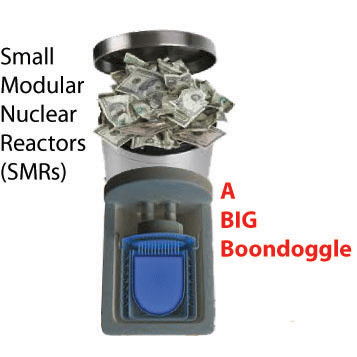
Refuting Australian Financial Review’s disinformation on Small Modular Nuclear Reactors (SMRs)
|
Aaron Patrick, senior correspondent with the Australian Financial Review (AFR), is the latest journalist to enter the nuclear culture wars with some propaganda that’s indistinguishable from that served up in the Murdoch tabloids. There’s lots of misinformation in Patrick’s articles. For example he uncritically promotes a dopey Industry Super Australia report, described by RenewEconomy editor Giles Parkinson as “one of the most inept analyses of the energy industry that has been produced in Australia”. (I’ve asked the authors of the Industry Super report if they intend to withdraw or amend it. No response.) The focus here ‒ and the focus of Patrick’s recent articles ‒ is on small modular reactors (SMRs), which he describes as new, small, safe, cheap and exciting (and he continues to make such claims even as I continue to feed him with evidence suggesting alternative SMR adjectives … non-existent, overhyped, obscenely expensive). Some history is useful in assessing Patrick’s claims. There’s a long history of small reactors being used for naval propulsion, but every effort to develop land-based SMRs has ended in tears. Academic M.V. Ramana concludes an analysis of the history of SMRs thus: “Sadly, the nuclear industry continues to practice selective remembrance and to push ideas that haven’t worked. Once again, we see history repeating itself in today’s claims for small reactors ‒ that the demand will be large, that they will be cheap and quick to construct. “But nothing in the history of small nuclear reactors suggests that they would be more economical than full-size ones. In fact, the record is pretty clear: Without exception, small reactors cost too much for the little electricity they produced, the result of both their low output and their poor performance. … “Worse, attempts to make them cheaper might end up exacerbating nuclear power’s other problems: production of long-lived radioactive waste, linkage with nuclear weapons, and the occasional catastrophic accident.” Patrick quotes an SMR company representative saying that SMRs have been “researched and developed for the best part of 50 years”. Fine … but surely AFR readers ought to be informed that every single attempt to commercialise SMRs over the past 50 years has failed. According to the Coalition’s energy spokesperson (p.34), “new-generation reactors with maximum safety features are now coming into use”. That was 30 years ago, and the spokesperson was Peter McGauran. A wave of enthusiasm for SMRs came and went without a single SMR being built anywhere in the world, and there’s no reason to believe the current wave of enthusiasm will be more fruitful. Diseconomies of scaleInterest in SMRs derives primarily from what they are not: large reactor projects which have been prone to catastrophic cost overruns and delays. Cost estimates for all reactors under construction in western Europe and north America range from A$17.5 billion to A$24 billion, and the twin-reactor V.C. Summer project in South Carolina was abandoned in 2017 after the expenditure of at least A$13 billion, forcing Westinghouse into bankruptcy and almost bankrupting its parent company Toshiba. But SMRs will cost more (per megawatt and megawatt-hour) because of diseconomies of scale: a 250MW SMR will generate 25 per cent as much power as a 1,000MW reactor, but it will require more than 25 per cent of the material inputs and staffing, and a number of other costs including waste management and decommissioning will be proportionally higher. So the nuclear industry’s solution to its wildly expensive and hopelessly uncompetitive large reactors is to offer up even-more-expensive reactors. Brilliant. Small wonder that nuclear lobbyists are lamenting the industry’s crisis and pondering what if anything might be salvaged from the “ashes of today’s dying industry“. Aaron Patrick claims in the AFR that SMRs are “likely” to be installed in North America and Europe. No, they aren’t. William Von Hoene, senior vice-president at Exelon ‒ the largest operator of nuclear power plants in the US ‒ said last year: “Right now, the costs on the SMRs, in part because of the size and in part because of the security that’s associated with any nuclear plant, are prohibitive.” The prevailing scepticism is evident in a 2017 Lloyd’s Register report based on the insights of almost 600 professionals and experts from utilities, distributors, operators and equipment manufacturers. They predict that SMRs have a “low likelihood of eventual take-up, and will have a minimal impact when they do arrive”. Likewise, American Nuclear Society consultant Will Davis said in 2014 that the SMR “universe [is] rife with press releases, but devoid of new concrete.” And a 2014 report produced by Nuclear Energy Insider, drawing on interviews with more than 50 “leading specialists and decision makers”, noted a “pervasive sense of pessimism” resulting from abandoned and scaled-back SMR programs. Independent economic assessmentsSMRs are “leading the way in cost” according to Tania Constable from the Minerals Council of Australia. NSW Deputy Premier John Barilaro claims that SMRs “are becoming very affordable”. But every independent economic assessment finds that electricity from SMRs will be more expensive than that from large reactors. A study by WSP / Parsons Brinckerhoff prepared for the 2015/16 South Australian Nuclear Fuel Cycle Royal Commission estimated costs of US$127‒130 per megawatt-hour (MWh) for large reactors, compared to US$140‒159 for SMRs. The Royal Commission’s final report identified numerous hurdles and uncertainties facing SMRs. A December 2018 report by CSIRO and the Australian Energy Market Operator concluded that “solar and wind generation technologies are currently the lowest-cost ways to generate electricity for Australia, compared to any other new-build technology.” It found that electricity from SMRs would be more than twice as expensive as that from wind or solar power with storage costs included (two hours of battery storage or six hours of pumped hydro storage). A report by the consultancy firm Atkins for the UK Department for Business, Energy and Industrial Strategy found that electricity from the first SMR in the UK would be 30 percent more expensive than that from large reactors, because of diseconomies of scale and the costs of deploying first-of-a-kind technology. A 2015 report by the International Energy Agency and the OECD Nuclear Energy Agency predicted that electricity from SMRs will be 50−100 percent more expensive than that from large reactors, although it holds out some hope that large-volume factory production could reduce costs. An article by four pro-nuclear researchers from Carnegie Mellon University’s Department of Engineering and Public Policy, published in 2018 in the Proceedings of the National Academy of Science, considered options for the development of an SMR industry in the US. They concluded that it would not be viable unless the industry received “several hundred billion dollars of direct and indirect subsidies” over the next several decades. That’s billion with a ‘b’: several hundred billion dollars.
|
|
A Small Nuclear Reactor exploded in Russian accident – fallout isotopes prove this

Isotopes’ Composition Proves Nuclear Reactor Was Involved in Russian Explosion, Expert Says
Analyses of the radionuclides in the fallout over Severodvinsk show several isotopes that would not have been present if was a simple RTG in the explosion.
Fish transport around Scandinavia in nuclear-powered Russian ship
 Russia starts nuclear-powered fish transport around Scandinavia Container carrier “Sevmorput” is now being loaded with 200 refrigerated containers with fish at port in Petropavlovsk-Kamchatskiy and will soon set sail for the Northern Sea Route and further south to St. Petersburg. Barents Observer Thomas Nilsen Russia starts nuclear-powered fish transport around Scandinavia Container carrier “Sevmorput” is now being loaded with 200 refrigerated containers with fish at port in Petropavlovsk-Kamchatskiy and will soon set sail for the Northern Sea Route and further south to St. Petersburg. Barents Observer Thomas Nilsen
“This test-voyage with the container carrier gives hope that one time such deliveries will become regular,” says Kamchatka Governor Vladmir Kuzmitsky in an interview with the region’s own portal.The 200 containers are filled with frozen fish, fillets, caviar and other seafood, a total of 5,000 tons. The voyage takes three weeks, of which the two first will be along the Northern Sea Route, north of Siberia. This is the first time a Russian civilian nuclear-powered ship sails with cargo outside the coast of Norway. From the North Sea, “Sevmorput” will continue in the narrow waters between Sweden and Denmark, sailing through the Great Belt and into the Baltic Sea before final port call to St. Petersburg. Rosatom confirmed the voyage in a tweet on Monday. “Sevmorput” is expected to cross the Barents Sea and sail outside Norway by the second week of September. Then, the ship will sail back the same route and a second voyage will come in late October……. https://thebarentsobserver.com/en/industry-and-energy/2019/08/russia-starts-nuclear-powered-fish-transport-around-scandinavia |
|
White House new system guidelines for nuclear power in space includes weapons grade materials
White House Overhauls Launch Approval Process for Nuclear Spacecraft, AIP, 23 Aug 19, The White House has announced a new launch authorization process for spacecraft that use nuclear-powered systems, instituting a tiered framework that delegates decision-making for less risky missions and provides explicit guidance on acceptable risk levels……
The least risky missions fall in Tier 1, where the director of the sponsoring agency can approve the launch. In Tier 2, an interagency review process is triggered, though the sponsoring agency director maintains authority over the launch decision. The memo directs NASA to establish a standing Interagency Nuclear Safety Review Board to perform this function, which formerly was handled by an ad hoc committee empaneled on a mission-by-mission basis.
Spacecraft that use fission reactors automatically fall in at least Tier 2, and the memo requires NASA to identify additional safety guidelines for “safe non-terrestrial operation of nuclear fission reactors, including orbital and planetary surface activities.”
Tier 3 missions require presidential authorization, which for non-defense missions is delegated to the OSTP director, who may opt to forward the decision to the president. Due to nuclear nonproliferation considerations, missions that use highly enriched uranium automatically fall in Tier 3.
The memo also establishes a set of safety guidelines that apply to spacecraft across all tiers. It specifies that the probability a launch accident would result in any individual receiving a total effective dose between 0.025 rem and five rem should be no greater than 1 in 100. The probability for exposures between five rem and 25 rem should not exceed 1 in 10,000, and above 25 rem the probability should not exceed 1 in 100,000. For comparison, the average effective doseindividuals receive from natural background radiation in the U.S. is about 0.3 rem per year, and the Nuclear Regulatory Commission’s dose limit for radiation workers is five rem per year…….
According to a 2015 study, the U.S. has launched 47 nuclear power systems and hundreds of heater units on 31 missions since 1961. The most recent scientific missions to employ an RPS were New Horizons, a Pluto fly-by mission launched in 2006, and the Mars Curiosity Rover, launched in 2011. The follow-on Mars 2020 Rover and the recently selected Dragonfly rotorcraft mission to Saturn’s moon Titan are currently the only two approved NASA spacecraft in development that will use an RPS.
The relatively infrequent use of nuclear systems on spacecraft is in part attributed to the complexity and cost of the safety review process, which generally has limited them to flagship-class missions. Low availability of plutonium for civilian uses has also constrained the mission cadence…….
NASA has recently emphasized the potential value of fission reactors for human deep space exploration missions. At the National Space Council meeting this week, NASA Administrator Jim Bridenstine said nuclear thermal propulsion technologies could significantly reduce transit time to Mars. He also pointed to other potential applications, such as using fission to power a space-based laser that could deflect asteroids and deorbit space debris.
NASA is also exploring how nuclear reactors could meet the power demands of planetary bases. One such concept, called Kilopower, could provide up to 10 kilowatts per reactor using highly enriched uranium. Bridenstine visited members of the Kilopower team this week at NASA’s Glenn Research Center.
The concept is not without critics. Rep. Bill Foster (D-IL), a former Fermilab physicist who advocates using alternatives to highly enriched uranium, pressedBridenstine on the subject at a hearing this year.
“A future where every space-faring nation has a big inventory of weapons-grade material to service the reactors that they are using all over the Moon and all over Mars is not a very safe space environment,” Foster said. “There will be some small performance compromises in going with low enriched non-weapons grade material, but I really urge you to look hard at keeping alive the prospect of having an international collaboration to develop workable non weapons grade-based materials that the whole world will use.” …….https://www.aip.org/fyi/2019/white-house-overhauls-launch-approval-process-nuclear-spacecraft
Safety concerns about floating nuclear reactors, and Rosatom admits that electricity from small floating nuclear reactors is more expensive.

|
Russia to launch floating nuclear reactor, Rosatom insists 2-reactor unit is safe as tests are planned in the Arctic, Ft.com, Nastassia Astrasheuskaya in Murmansk 21 Aug 19, On Friday, three tugs will tow the Akademik Lomonosov barge out of Murmansk to begin a 5,000km voyage to a remote port on the other side of Russia’s Arctic coast, and in the process send waves through the nuclear energy sector.
The vessel is a floating nuclear reactor, a portable power plant designed to supply electricity to areas disconnected from the grid, and envisaged by Russia’s state nuclear corporation Rosatom as the future of small-scale nuclear power with an eye on export opportunities in developing countries.
But the two-reactor Lomonosov, which took a decade to design and build, has sparked safety fears and concerns over the environmental impact of any mishap, amid concern over a botched nuclear missile test this month at a military site close to Murmansk that released a radiation spike in a nearby city.
Rosatom insists the unit is safe, and “virtually unsinkable” in case of natural disasters. The plant will also be guarded by the Russian guard, Moscow’s internal military force. “Our unit has other tasks, other requirements in terms of security. It has to correspond with double standards — for a nuclear plant and a vessel,” said Dmitry Alexeenko, deputy head of Rosatom’s department overseeing its construction.
The unit is the first in a programme designed to provide power to remote communities where building a conventional nuclear power plant would be excessive. The Akademik Lomonosov will sail to the Chukotka region, deep in Russia’s far east, where miners are seeking to exploit gold and copper reserves. …
However, environmental groups have raised concerns over the possible repeat of the 1986 Soviet nuclear power plant explosion in Chernobyl, modern-day Ukraine. In 2017, Greenpeace led a protest at St Petersburg’s Baltic shipyard, where the unit was being tested, demanding “No to floating Chernobyl”. The reactor tests were then moved to Murmansk. “A floating nuclear power plant is far more vulnerable to outside threats, such as those from pirates, should they be sold to equatorial countries, and natural disasters, which Fukushima proved even onshore plants are prone to,” said Konstantin Fomin of Greenpeace Russia. The launch comes as energy companies around the world, including in the US and South Korea, have been exploring building smaller scale reactors.
Rosatom says it has been in talks with potential buyers from Latin America, Africa and Asia. It has also held discussions with Sudan to use the plant for power generation and Argentina for water desalination. But the project’s total cost, and confirmation of any foreign contracts, will only be made after the technology is fully tested, the company added. Nuclear energy experts said given the construction timeframe, it is unlikely to be cheap.
Anton Khlopkov, head of Russia’s independent Center for Energy and Security Studies, expects the unit to be significantly cheaper than a conventional land-based nuclear power plant, which normally costs about $5bn-$6bn. But the cost per megawatt would be higher, he said.
“The project economics remain an open question, even taking into account that it is aimed at distant locations where the power costs can be higher for obvious reasons. Even then the project has to prove economic viability,” he said. Rosatom, however, sees the reactor as a strategic project where economic costs are secondary. …….https://www.ft.com/content/2edadf02-b538-11e9-8cb2-799a3a8cf37b
|
|
|
1 This Month



26 September – International Day for the Total Elimination of Nuclear Weapons


PLEASE OPPOSE HR 8255 AND S.3639 – bills would accelerate satellite deployment, with no environmental review or safeguards – https://ncstd5li.quorum.us/campaign/169331/
To see nuclear-related stories in greater depth and intensity – go to https://nuclearinformation.wordpress.com
-
Archives
- September 2026 (269)
- August 2026 (330)
- July 2026 (355)
- June 2026 (287)
- May 2026 (306)
- April 2026 (356)
- March 2026 (251)
- February 2026 (267)
- January 2026 (308)
- December 2025 (358)
- November 2025 (359)
- October 2025 (375)
-
Categories
- 1
- 1 NUCLEAR ISSUES
- business and costs
- climate change
- culture and arts
- ENERGY
- environment
- health
- history
- indigenous issues
- Legal
- marketing of nuclear
- media
- opposition to nuclear
- PERSONAL STORIES
- politics
- politics international
- Religion and ethics
- safety
- secrets,lies and civil liberties
- spinbuster
- technology
- Uranium
- wastes
- weapons and war
- Women
- 2 WORLD
- ACTION
- AFRICA
- Atrocities
- AUSTRALIA
- Christina's notes
- Christina's themes
- culture and arts
- Events
- Fuk 2022
- Fuk 2023
- Fukushima 2017
- Fukushima 2018
- fukushima 2019
- Fukushima 2020
- Fukushima 2021
- general
- global warming
- Humour (God we need it)
- Nuclear
- RARE EARTHS
- Reference
- resources – print
- Resources -audiovicual
- Weekly Newsletter
- World
- World Nuclear
- YouTube
-
RSS
Entries RSS
Comments RSS

