The aerospace industry – the goal is weaponry and global dominance
|
Keep Space for Peace! Save the Heavens fro!m Hegemony https://www.womenagainstmilitarymadness.org/articles/2020/12/22/keep-space-for-peace-save-the-heavens-from-hegemony Bruce K. Gagnon
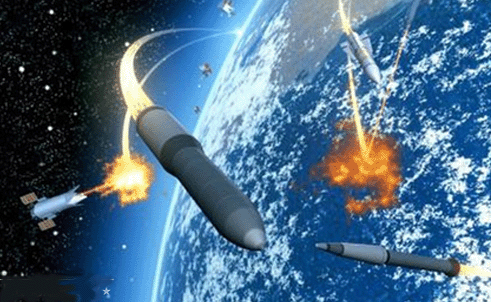
Recently we learned that the aerospace industry is pushing to turn a former naval air station in Brunswick, Maine, into a spaceport. Promising lots of “high tech” jobs, a bill is being pushed in Augusta, our capital, by some of the most “progressive” legislators in the state. Similarly, we are hearing from many other states where launch complexes are being promoted – from Hawaii to New Mexico to Alaska – that the industry wants some of the most pristine places on Earth to become spaceports. Why? A spaceport in Kodiak Island, Alaska (locals call it “Spacepork”), was built some years ago in spite of overwhelming opposition by local residents. They were promised that it would be used only for civilian launches. So far, all the launches at Kodiak have actually been for Pentagon (and Israeli) space-weapons technology tests. We’ve been hearing for several years now that new companies formed by tech-industry billionaires Elon Musk (whose projects include Tesla and SpaceX) and Jeff Bezos (Amazon, Blue Orbit) plan to launch as many as 35,000 mini-sats (satellites) into orbit. Imagine the enormous hole these polluting launches will punch into the ozone layer. The plan is to have a satellite orbiting over the head of every person on Earth 24 hours a day, making it possible for the new 5G wireless technology system to be profitable. Many questions are being raised about the military (dual-use) applications of these satellites as well. Space Force Earlier this year, Trump was able to “stand up” his new high-tech legacy branch of the military, called the Space Force. Congress was overwhelmingly in favor – that means both parties supported it; the only thing the Democrats (who could have stopped it cold in the House of Representatives) wanted to change was the name ¾ to “Space Corps.” They surrendered on that as well. When the new leaders of the Space Force speak about it, they keep using the word “lean” to describe the new service branch. They want to make it sound as though it won’t be a “fiscal burden” to the nation, especially at a time when we have more unemployment than during the Great Depression. But facts are facts, and I can testify that the aerospace-industry publications have been bragging about since the 1980s when Ronald Reagan first proposed Star Wars, that this would be the largest industrial project in the history of the planet. So $15 billion is just the foot in the door. Where will the funds come from to pay for this? Our entitlement programs ¾ Social Security, Medicare, Medicaid, and what little is left of the social safety net –– are on the chopping block to be sacrificed to the aerospace industry. During his presidency, Trump announced that the U.S. rejects the United Nations Outer Space and Moon Treaties that declare the planetary bodies are the “province of all humankind” – meaning that no nation, corporation, or individual can claim ownership of them. Thus the way is open for a new gold rush to grab the planets for resource extraction. And, if Biden were to continue Obama’s legacy, the way will be paved. The Real Missions of Space Force In 2015, Obama signed the U.S. Commercial Space Launch Competitiveness Act into law. The act grants companies the rights to whatever they manage to pluck out of these extraterrestrial bodies. Effectively an extension of capitalism into space, the bill is one of the few during Obama’s presidency that received widespread support from the GOP as well as from the Democrats, because apparently nothing screams bipartisanship louder than asteroid mining. (Asteroids are rocky and metallic objects that orbit the sun but are smaller than planets.)[1] “This is the single greatest recognition of property rights in history,” said Eric Anderson, a founder of Planetary Resources, Inc., a company whose mission it is to mine asteroids. “This legislation establishes the same supportive framework that created the great economies of history, and will encourage the sustained development of space.” I’ve long believed that the Space Force (and before that the Space Command) will have two primary missions: first, to give the U.S. and its Western capitalist allies “control and domination” of Earth; and secondly, the Space Force will be given the task to create the technologies to “control and dominate” the pathway on and off our sacred Mother Earth. In 1989, the U.S. Congress published an internal study called “Military Space Forces: The Next 50 Years.” In this study, the congressional staffer who wrote it explained the need to control the pathway between the Earth and the Moon. He suggested that armed space stations on either side of the Moon would allow the Pentagon to seize the “Earth-Moon gravity well.” He wrote: “Armed forces might lie in wait at that location to hijack rival shipments on return.” So this plan has been in the works for many years – in fact, since a former Nazis first briefed Congress back in 1958. From Nazi Rocket Science to the U.S. Militarizing Space Program Walter Dornberger was Hitler’s head man in charge of his World War II era V-1 and V-2 rocket program. He was the staff link between rocket scientist Wernher von Braun and Hitler. Dornberger, like von Braun and 1,600 other Germans, was smuggled into the U.S. after the war in the secret military program called Operation Paperclip. Speaking at a congressional hearing in 1958, Dornberger insisted that America’s first space priority ought to be to “conquer, occupy, keep and utilize space between the Earth and the Moon.” There has been unanimity in the halls of Congress since Dornberger’s testimony – both parties have faithfully kept the funding for the militarized space program alive and growing. Dornberger would be happy today to see that his Nazi prophecy has largely come to fruition. International Treaties and an Achilles Heel The U.S. has been leading the way to militarize and weaponize space since the beginning of WW II. For a while the former Soviet Union was in the game – until its collapse in 1991. Neither Russia nor China could keep up with the U.S. in the ensuing years, and they continually begged the U.S. to join them in negotiating a treaty to ban all weapons in space – in other words, close the door to the barn before the horse gets out. During Republican and Democrat administrations since Bill Clinton, the response to Moscow and Beijing was the same from Washington – NO. So Russia and China slowly but steadily have moved forward since the early 1990s and have begun to close the space gap – always continuing to urge the creation of a space-weapons ban treaty. But Washington still refuses to even consider it. In fact, the U.S. has gone in the opposite direction of international treaties under Trump – pulling out of the Anti-Ballistic Missile Treaty (ABM), Intermediate-Range Nuclear Forces Treaty (INF), and the Iran Nuclear Deal. Will the U.S. under Biden renew the Strategic Arms Reduction Talks (START), which run out in 2021? It’s all really quite simple – the U.S. has not wanted to be bound by any treaties that limit its goal for “control and domination.” One could say the U.S. has become a renegade or pirate nation controlled by the soulless corporate agenda, which is all about power and greed. This all makes the job of the Global Network[2] terribly difficult. Since our founding in 1992 we’ve been working hard to build an international constituency to keep space for peace. The corporate agenda is determined to block any progress toward that goal. But I’ve always maintained that like everything else, the aerospace industry and its Star Wars project has an Achilles heel. It’s money. The current global virus pandemic is only bringing this reality to bear as never before. We Must Stop an Arms Race in Space! If we hope to beat this insane and provocative plan, then we must starve the beast. We can do that by bringing our national priorities down to earth and fighting for social progress – for programs like Medicare for All and funding to deal with our real problem today: climate crisis. Please help us beat the expensive and dangerous Space Force by demanding our government provide programs that honor life on this lovely planet. Best wishes to all of you. Keep your spirit strong! ~ Bruce K. Gagnon is coordinator of the Global Network Against Weapons & Nuclear Power in Space (keepspace4peace.org) and lives in Bath, Maine. He began working on space issues in 1982. Endnotes [1] Definition from solarviews.com [2] Global Network Against Weapons & Nuclear Power in Space |
|
|
Dangers of plutonium fuelled, sodium cooled “Versatile Nuclear Reactor”

|
Experimental Nuclear Reactor Design Could Come to ID https://www.publicnewsservice.org/2021-01-25/nuclear-waste/experimental-nuclear-reactor-design-could-come-to-id/a72914-1January 25, 2021
BOISE, Idaho — The public can weigh in this week on an experimental nuclear reactor which could be coming to the Idaho National Laboratory. The U.S. Department of Energy (DOE) has released a draft Environmental Impact Statement (EIS) for a new design known as a “versatile nuclear reactor.” The DOE said it will be used to test nuclear-energy innovations, helping to push the sector forward. Edwin Lyman, director of nuclear power safety for the Union of Concerned Scientists, believes its construction would pose risks for eastern Idaho. “People should ask questions about whether the DOE has really done the accident analysis that it needs to, and is being honest with the people about the potential consequences of accidents at that reactor,” Lyman contended. The versatile nuclear reactor is cooled by liquid sodium, which Lyman noted is highly potent. Reactors currently in operation in the U.S. are cooled by water. The public hearings on the EIS will be held online Wednesday and Thursday. Lyman added there is another concern with the fuel the reactor would use. “Unlike the fuels that are used for light-water reactors, which is called low-enriched uranium fuel, that fuel is not directly usable in a nuclear weapon,” Lyman explained. “But plutonium is directly usable.” Lyman argued it raises questions about the potential for nuclear proliferation. The DOE estimated the project will cost between $2.6 and $5.8 billion dollars. Lyman cautioned that’s a lot of money for an experimental project. “The DOE needs to reconsider this whole project, and whether they can spend that money more wisely in helping to improve the safety of existing technologies,” Lyman concluded. |
|
First a comment on military smrs – then the enthusiastic article about them
 spikedpsycho169, 18 Jan 21, Small reactors on a battlefield where the enemy now has suicide drones, rpg’s and homemade rockets. What could possibly go wrong.? Other than electricity, reactors have little use on a field of combat. Some advocate the production of liquid fuels using in situ resources like ammonia, methanol, etc made using ambient materials like air/water. That requires temperatures above 600-800 degrees celsius, Which no reactor currently operates.
White House Accelerates Development Of Mini Nuclear Reactors For Space And The Battlefield
The order looks to accelerate and integrate the development of highly mobile nuclear reactors for space and the terrestrial battlefield. BY BRETT TINGLEY JANUARY 16, 2021
President Trump issued an Executive Order on January 12 that aims to promote small, modular nuclear reactors for defense and space exploration applications. According to a press statement issued by the White House, the order will “further revitalize the United States nuclear energy sector, reinvigorate America’s space exploration program, and produce diverse energy options for national defense needs.”
The order instructs NASA’s administrator to prepare a report within 180 days that will define NASA’s requirements and foreseeable issues for developing a nuclear energy system for human and robotic exploratory missions through 2040. The order also calls for a “Common Technology Roadmap” between NASA and the Departments of Energy, Defense, Commerce, and State for implementing new reactor technologies. The full text of the Executive Order can be read at WhiteHouse.gov ………
Section 4 of the Executive Order goes into further detail about the DoD’s energy needs, and outlines the role the Department of Defense will play in this new initiative to develop mobile nuclear reactors …….
The Executive Order also outlines a Common Technology Roadmap that “describes potential development programs and that coordinates, to the extent practicable, terrestrial-based advanced nuclear reactor and space-based nuclear power and propulsion efforts” between the Departments of Energy, Defense, Commerce, State, and NASA. This roadmap will also require “assessments of foreign nations’ space nuclear power and propulsion technological capabilities.” Naturally, one of the most pressing concerns with any nuclear technology is national security, and thus the order also instructs the DoD to work together with NASA and other agencies to identify security issues associated with any potential space-based nuclear systems.
With this new Executive Order, the White House seeks to propel the United States to the forefront of all of the work being conducted in compact reactor research. While the wording in the statement focuses more on space exploration, the Department of Defense’s involvement is highly important. Since space environments are similar in that resupply is a tricky, if not impossible, endeavor, NASA could help jump-start the DoD’s mobile nuclear program even further if both are really working on it collaboratively, although the requirements will be somewhat different. “There’s sometimes a risk of forcing too much commonality,” a White House official told SpaceNews.com. “What this executive order does is ensure that there is a deliberate look at what those opportunities may be.”
If realized, the Executive Order’s accompanying statement reads, this initiative could lead to a “transportable small modular reactor for a mission other than naval propulsion for the first time in half a century.”
Contact the author: Brett@TheDrive.com https://www.thedrive.com/the-war-zone/38687/white-house-accelerates-development-of-mini-nuclear-reactors-for-space-and-the-battlefield
”Small Modular Reactors”’- governments are being sucked in by the ”billionaires’ nuclear club”

SNC-Lavalin Scandal-ridden SNC-Lavalin is playing a major role in the push for SMRs.
Terrestrial Energy….. Terrestrial Energy’s advisory board includes Dr. Ernest Moniz, the former US Secretary of the Dept. of Energy (2013-2017) who provided more than $12 billion in loan guarantees to the nuclear industry. Moniz has been a key advisor to the Biden-Harris transition team, which has come out in favour of SMRs.
The “billionaires’ nuclear club” …“As long as Bill Gates is wasting his own money or that of other billionaires, it is not so much of an issue. The problem is that he is lobbying hard for government investment.”
Going after the public purse
Bill Gates was apparently very busy during the 2015 Paris climate talks. He also went on stage during the talks to announce a collaboration among 24 countries and the EU on something called Mission Innovation – an attempt to “accelerate global clean energy innovation” and “increase government support” for the technologies.
Gates’ PR tactic is effective: provide a bit of capital to create an SMR “bandwagon,” with governments fearing their economies would be left behind unless they massively fund such innovations.
governments “are being suckers. Because if Wall Street and the banks will not finance this, why should it be the role of the government to engage in venture capitalism of this kind?”
It will take a Herculean effort from the public to defeat this NICE Future, but along with the Assembly of First Nations, three political parties – the NDP, the Bloc Quebecois, and the Green Party – have now come out against SMRs.
|
Mini-Nukes, Big Bucks: The Interests Behind the SMR Push https://watershedsentinel.ca/articles/mini-nukes-big-bucks-the-money-behind-small-modular-reactors/
It’s remarkable that only five years ago, the National Energy Board predicted: “No new nuclear units are anticipated to be built in any province” by 2040.So what happened? The answer involves looking at some of the key influencers at work behind the scenes, lobbying for government funding for SMRs. |

Big doubts on small nuclear reactors – on economics, on waste problems
 Former U.S. regulator questions small nuclear reactor technology, Business case for small reactors ‘doesn’t fly,’ says expert on nuclear waste, Jacques Poitras · CBC News Jan 15, 2021 A former head of the United States’ nuclear regulator is raising questions about the molten-salt technology that would be used in one model of proposed New Brunswick-made nuclear reactors.
The technology pitched by Saint John’s Moltex Energy is key to its business case because, the company argues, it would reuse some of the nuclear waste from Point Lepreau and lower the long-term cost and radioactivity of storing the remainder.
But Allison Macfarlane, the former chairperson of the U.S. Nuclear Regulatory Commission and a specialist in the storage of nuclear waste, said no one has yet proven that it’s possible or viable to reprocess nuclear waste and lower the cost and risks of storage.
“Nobody knows what the numbers are, and anybody who gives you numbers is selling you a bridge to nowhere because they don’t know,” said Macfarlane, now the director of the School of Public Policy and Global Affairs at the University of British Columbia.
“Nobody’s really doing this right now. … Nobody has ever set up a molten salt reactor and used it to produce electricity.”
Macfarlane said she couldn’t comment specifically on Moltex, calling information about the company’s technology “very vague.”
But she said the general selling point for molten-salt technology is dubious.
“Nobody’s been able to answer my questions yet on what all these wastes are and how much of them there are, and how heat-producing they are and what their compositions are,” she said.
“My sense is that all of these reactor folks have not really paid a lot of attention to the back end of these fuel cycles,” she said, referring to the long-term risks and costs of securely storing nuclear waste.
Moltex is one of two Saint John-based companies pitching small nuclear reactors as the next step for nuclear power in the province and as a non-carbon-dioxide emitting alternative to fossil fuel electricity generation.
Moltex North America CEO Rory O’Sullivan said the company’s technology will allow it to affordably extract the most radioactive parts of the existing nuclear waste from the Point Lepreau Generating Station.
The waste is now stored in pellet form in silos near the plant and is inspected regularly.
The process would remove less than one per cent of the material to fuel the Moltex reactor and O’Sullivan said that would make the remainder less radioactive for a much shorter amount of time.
Existing plans for nuclear waste in Canada are to store it in an eventual permanent repository deep underground, where it would be secure for the hundreds of thousands of years it remained radioactive………..
Shorter-term radioactivity complicates storage
Macfarlane said a shorter-term radioactivity life for waste would actually complicate its storage underground because it might lead to a facility that has to be funded and secured rather than sealed up and abandoned.
“That means that you believe that the institutions that exist to keep monitoring that … will exist for hundreds of years, and I think that is a ridiculous assumption,” she said.
“I’m looking at the United States, I’m seeing institutions crumbling in a matter of a few years. I have no faith that institutions can last that long and that there will be streams of money to maintain the safety and security of these facilities. That’s why you will need a deep geologic repository for this material.”
And she said that’s assuming the technology will successfully extract all of the most radioactive material.
“They are assuming that they remove one hundred per cent of the difficult, radionuclides, the difficult isotopes, that complicate the waste,” she said.
“My response is: prove it. Because if you leave five per cent, you have high-level waste that you’re going to be dealing with. If you leave one per cent, you’re going to have high-level waste that you’re going to be dealing with. So sorry, that one doesn’t fly with me.”
Macfarlane, a geologist by training, raised doubts about molten-salt technology and waste issues in a 2018 paper she co-authored for the Bulletin of the Atomic Scientists………. https://www.cbc.ca/news/canada/new-brunswick/nuclear-waste-reactors-new-brunswick-allison-macfarlane-moltex-arc-1.5873542
Small modular reactor plan bolsters nuclear industry’s future, but renewables could address energy issues now,
Small modular reactor plan bolsters nuclear industry’s future, but renewables could address energy issues now, https://www.cbc.ca/news/opinion/opinion-small-modular-reactor-strategy-1.5869623
While SMRs are hailed as start of a nuclear renaissance, there are big questions about costs and timeframe, Eva Schacherl · CBC News Jan 15 In late December, as many Canadians were easing into a low-key holiday break, Minister of Natural Resources Seamus O’Regan pulled out a bag of goodies for the nuclear industry. It was the much-hyped Small Modular Reactor Action Plan for Canada.
Small modular reactors (SMRs) are experimental nuclear technologies that are still on the drawing board. They are the nuclear power industry’s hope for overcoming the problems that have plagued it: high costs, radioactive waste, and risks of accidents.
Public interest groups across the country, however, argue that SMRs won’t solve these issues.
The dozen SMR vendors backing the technology include GE-Hitachi, Westinghouse, and SNC-Lavalin (which, along with two U.S. corporations, already holds a multibillion-dollar contract with the federal government to run Canadian Nuclear Laboratories at Chalk River, Ont.). O’Regan’s plan did nothing to clarify the price tag of a nuclear renaissance, but it says the federal government expects to share the cost and risks of SMR projects with the private sector.
Proponents say that SMRs will cost less than conventional nuclear and be flexible enough to serve remote communities reliant on costly and polluting diesel. O’Regan has also said that SMRs are necessary to fight climate change: in short, a utopia of “clean, affordable, safe and reliable power,” as he told a nuclear conference last year.
But is this any more than a dream? The enthusiasm for SMRs sometimes sounds like a New Age cult — let’s examine the claims.
First, must we have a new generation of nuclear reactors to get to the promised land of net-zero emissions?
Many studies show a path to net-zero without nuclear energy. Energy scientists who modelled a 100 per cent renewable energy system for North America, for example, concluded that nuclear energy “cannot play an important role in the future” because of its high cost and safety issues. Closer to home, it has been shown how Ontario can meet its electricity demand without nuclear, using renewables, hydro and storage.
Meanwhile, a new study in Nature Energy uses data from 123 nations to show that countries focused on renewables do much better at reducing emissions.
Can SMRs one day be cost-competitive with renewable energy?
Right now, the cost difference between nuclear power and other low-carbon alternatives is growing because renewables and energy storage keep getting cheaper.
Meanwhile, the estimated cost of the most advanced SMR project, in Idaho, has increased from $4.2 billion to $6.1 billion before shovels are even in the ground. That’s nearly $12,000 per kilowatt of generation capacity.
an small reactors wean off-grid communities and mines from diesel fuel?
Finally, nuclear energy is neither green nor clean. All reactors produce radioactive waste that will need to be kept out of the biosphere for hundreds of thousands of years.
The proposal that some SMR models would reuse highly radioactive CANDU fuel and plutonium will only create worse problems in the form of radioactive wastes that are even more dangerous to manage.
For a livable future, Canada has pledged to get to net-zero emissions by 2050. Will we get a bigger bang for our buck from reactors that are still just design concepts? Or by retrofitting buildings, improving energy efficiency, and building solar, wind, geothermal and tidal power with existing technology?
Clearly, the latter. And it needs to be done now.
Nuclear Icebreakers Are Not An Option for U.S. Coast Guard
The call from the Trump administration to look at the potential for building nuclear-powered icebreakers coincided with the Pentagon’s ongoing shift to a National Defense Strategy that emphasizes high-end conflict with nations like Russia and China. ………… https://news.usni.org/2021/01/13/schultz-nuclear-icebreakers-are-not-an-option-for-coast-guard
As pandemic cripples America, Donald Trump orders funding for military Small Nuclear Reactors in space

|
Trump orders DoD to explore use of nuclear power for space, Defense News,
By: Aaron Mehta 14 Jan 21, WASHINGTON — In the waning days of his administration, U.S. President Donald Trump has signed an executive order aimed at pushing the Department of Defense toward quickly developing and producing small nuclear reactors for military use — and to see if they could be used by military space vehicles.
The order, signed Jan. 5 and posted publicly Jan. 12, is not the first time the value of nuclear power for military operations has been studied. There is a long history of the Pentagon considering the issue, which proponents believe could alleviate the department’s massive logistics challenge of keeping fuel moving around the world……… In terms of terrestrial efforts, the executive order requires the defense secretary to, within 180 days, “establish and implement a plan to demonstrate” a micro-reactor at a domestic military installation — in other words, setting up an actual test of a nuclear reactor at a U.S. military location. However, that doesn’t mean the first test will be on a military base. One location to keep an eye on is the Nevada National Security Site, a Department of Energy location roughly 65 miles from Las Vegas……. Noted Hans Kristensen of the Federation of American Scientists, “the signing of this at the very last minute of the Trump administration suggests someone is concerned [President-elect Joe Biden] might not support the program.” Specific to space, the order calls for the defense secretary, in consultation with the secretaries of state, commerce and energy as well as the NASA administrator, to “determine whether advanced nuclear reactors can be made to benefit Department of Defense future space power needs” and to “pilot a transportable micro-reactor prototype.” In addition, the order directs an analysis of alternatives for “personnel, regulatory, and technical requirements to inform future decisions with respect to nuclear power usage” as well as “an analysis of United States military uses for space nuclear power and propulsion technologies and an analysis of foreign adversaries’ space power and propulsion programs.” ……… While the order speeds up the timetable for a test of a nuclear reactor at a military installation, the idea of using nuclear power is hardly a new one for the DoD. In fact, the Pentagon currently has two different development tracts for small nuclear reactors. The first is “Project Pele,” an effort to create a small mobile nuclear reactor in the 1-5 MWe power range, being run out of the Strategic Capabilities Office. In March 2020, the department awarded three companies a combined $39.7 million to start design work for Project Pele, with plans to select one firm in 2022 to build and demonstrate a prototype. The second effort is run through the office of the undersecretary of acquisition and sustainment. That effort, ordered in the 2019 National Defense Authorization Act, involves a pilot program aiming to demonstrate the efficacy of a small nuclear reactor, in the 2-10 MWe range, with initial testing at a Department of Energy site around 2023. If all goes well, the goal is to have a permanent small nuclear reactor on a military base around 2027. Even if all those timelines are hit, it is unlikely microreactors could proliferate quickly throughout the military………. https://www.defensenews.com/smr/nuclear-arsenal/2021/01/13/trump-orders-dod-to-explore-use-of-nuclear-power-for-space-systems/ |
|
Most Maldon District Councillors oppose Bradwell big nuclear development: small reactors would carry the same dangers.
favour of a recommendation to send a letter in support of the development of small modular reactors at the site of Bradwell B power station. The letter was sent to MP John Whittingdale and to the head of nuclear development at the Department for Business, Energy and Industrial Strategy in support of the development.
position to back Bradwell B due to the environmental and ecological impacts it would have.
on the plans for Bradwell B that a strong majority of councillors agreed with BANNG that Bradwell is an unsuitable, unacceptable and unsustainable site for nuclear development.
environmental, heritage and ecological problems as those opposed by Maldon
District Council in relation to Bradwell B.”
Never mind health spending: USA aims to be Topp in Space Race

|
U.S. Goes All In On Nuclear Power In Space Race With China. Oil Price.com, By Tsvetana Paraskova – Jan 02, 2021, The United States is doubling down on nuclear power and propulsion systems in the new space race with China. The Trump Administration unveiled in the middle of December a National Strategy for Space Nuclear Power and Propulsion, the so-called Space Policy Directive-6, aiming to develop and use space nuclear power and propulsion (SNPP) systems to achieve scientific, national security, and commercial objectives.In the new space race between Western nations and China, the United States is betting on developing and demonstrating the use of new SNPP capabilities in space.
The strategy on nuclear power and propulsion sets a goal for the U.S. to develop uranium fuel processing capabilities that enable fuel production that is suitable to lunar and planetary surfaces and in-space power, nuclear electric propulsion (NEP), and nuclear thermal propulsion (NTP) applications. Another objective is to “demonstrate a fission power system on the surface of the Moon that is scalable to a power range of 40 kilowatt-electric (kWe) and higher to support a sustained lunar presence and exploration of Mars.” Collaboration with the private sector is also a pillar of the nuclear power and propulsion strategy…….. As part of the U.S. strategy, NASA’s near-term priority will be to mature and demonstrate a fission surface power system on the Moon in the late 2020s, in collaboration with the Department of Energy and industry. Such a system could provide power for sustainable lunar surface operations and test the potential for use on Mars. Earlier in 2020, the Department of Energy said that NASA plans to build a base and a nuclear power plant on the Moon by 2026 and is inviting proposals from companies ready to take on the challenge. The plan will involve the construction of a 10-kW class fission surface power system to be used for demonstrative purposes. The plant is to be manufactured and assembled on Earth and then shipped to the Moon on a launch vehicle. This vehicle will take the plant to Moon orbit, from where a lander will take it to the surface of the satellite. The demonstration will continue for one year, and if successful, it could open the door to other missions on both the Moon and Mars. “Space nuclear power and propulsion is a fundamentally enabling technology for American deep space missions to Mars and beyond. The United States intends to remain the leader among spacefaring Nations, applying nuclear power technology safely, securely, and sustainably in space,” Scott Pace, Deputy Assistant to the President and Executive Secretary of the National Space Council, said in a statement, carried by SpacePolicyOnline.com. The U.S. should continue to enable American entrepreneurs and innovators to further bolster its commercial space industry to continue leading the space race, U.S. Secretary of Commerce Wilbur Ross wrote in an op-ed in December. “Competition is increasing, especially between Western nations and China. Our advantage in this new space race is the U.S. commercial space industry. It is critical that we continue to enable American entrepreneurs and innovators, lest we miss the opportunity and potentially lose the race,” Secretary Ross said. https://oilprice.com/Energy/Energy-General/US-Goes-All-In-On-Nuclear-Power-In-Space-Race-With-China.html |
|
|
In Indonesia – small nuclear reactors as a prelude to nuclear weapons?
Small modular reactor plan – a dangerous distraction from climate change action

 Feds’ Small Modular Reactor Action Plan is a dangerous distraction from climate change mitigation, Corporate Knights BY RICK CHEESEMAN, December 29, 2020
Canada can be a world leader in this promising, innovative, zero-emissions energy technology, and this is our plan to position ourselves in an emerging global market,” Natural Resources Minister Seamus O’Regan said in a statement.
The governments of New Brunswick, Ontario, Saskatchewan and Alberta, together with the federal government, advocate that small modular reactors (SMRs) are essential if Canada is to achieve a net-zero economy by 2050. According to the feds’ 2018 Call to Action report on the mini nuclear reactors, “SMRs are a reliable, clean, non-emitting source of energy, with costs that are predictable and competitive with other alternatives.”
The first problem with these claims is that SMRs don’t yet exist and aren’t expected to exist for a decade, making these claims dubious. It’s not the only questionable claim made by proponents.
Are SMRs a clean, zero-emission source of power?
Nuclear reactors emit much lower concentrations of carbon than fossil fuels, so one could claim they are zero-emission. But they have their own, uniquely harmful, emissions. From thousands of tonnes of spent fuel to hundreds of thousands of tonnes of mine tailings, nuclear power leaves a radioactive trail that is an immediate threat to waterways and water tables and is lethal for hundreds of thousands of years. SMRs will only add to that.
In 2010, Ad Standards Canada ruled that an ad claiming CANDU reactors were emission-free was “inaccurate and unsupported.” The Power Workers’ Union was expected to remove all ads containing the “emission-free” statement and to qualify any future claims. ……
After 70 years, the nuclear industry still hasn’t found a way to keep habitable environments safe from spent fuel for anything close to the time frames required for it to be harmless. There have been many plans in the past and there are current plans but all have one thing in common: they are unfit for purpose.
Some SMR technologies promise to use CANDU spent fuel in the SMR, claiming this will reduce both the radioactivity and quantity of the spent fuel. This claim is theoretical, based on proprietary data, and a report published by the Bulletin of the Atomic Scientists said doing so would be “playing with fire,” noting that the process, called pyroprocessing, will exacerbate the spent fuel storage and disposal challenges, not mitigate them.
Will SMRs be safe?
A range of power-generation and storage technologies that are clean, emissions-free, safe and low cost, is imminent. Within 10 years, these technologies will be widespread, fully incorporated into all levels of society, and deployed to all regions – all before the first SMR comes online. In all likelihood, by the time an SMR comes to market, there will be a more economical and environmentally responsible alternative in place.
While the rhetoric is persuasive, the case for SMRs doesn’t stand up to objective scrutiny. Allocating climate-change funds to them is a travesty.
The insanity of nuclear power in space
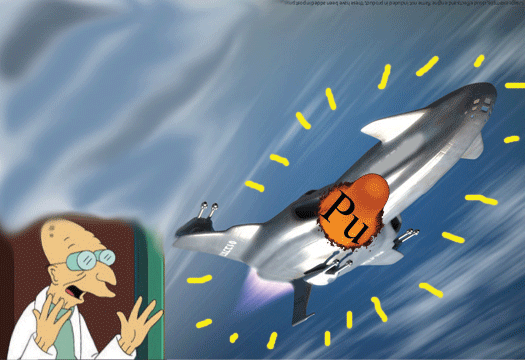
 The Big Push for Nukes in Space, https://www.counterpunch.org/2020/12/15/the-big-push-for-nukes-in-space/?fbclid=IwAR1rGf0qomJlTKuhqCOsTTl3EkKOQzxf2QxOJ-3n0MnxGWNLvybgxXPovTU BY KARL GROSSMAN.– 15 Dec 20, Last week a SpaceX rocket exploded in a fireball at the SpaceX site in Texas. “Fortunately,” reported Lester Holt on NBC TV’s Nightly News, “no one was aboard.”
But what if nuclear materials had been aboard?
The nuclear space issue is one I got into 35 years ago when I learned—from reading a U.S. Department of Energy newsletter—about two space shuttles, one the Challenger which was to be launched the following year with 24.2 pounds of plutonium aboard.
The plutonium the shuttles were to carry aloft in 1986 was to be used as fuel in radioisotope thermoelectric generators—RTGs—that were to provide a small amount of electric power for instruments on space probes to be released from the shuttles once the shuttles achieved orbit.
The plutonium-fueled RTGs had nothing to do with propulsion.
I used the U.S. Freedom of Information Act to ask what would be the consequences of an accident on launch, in the lower or upper atmosphere—and what about the dispersal of deadly plutonium. A few years earlier, I wrote Cover Up: What You Are Not Supposed to Know About Nuclear Power, so I was well familiar with plutonium, considered the most lethal radioactive substance.
For 10 months there was a stonewall of challenges to my FOIA request by DOE and NASA. Finally, I got the information, heavily redacted, with the claim that the likelihood of a shuttle accident releasing plutonium was “small.”
Said one document: “The risk would be small due to the high reliability inherent in the design of the Space Shuttle.” NASA put the odds of a catastrophic shuttle accident at one-in-100,000.
Then, on January 28, 1986 the Challenger blew up.
It was on its next mission—in May 1986—that it was slated to have a plutonium-fueled RTG aboard.
From a pay phone in an appliance store –amid scores of TV sets with that horrible video of the Challenger exploding—I called The Nation magazine and asked the folks there whether they knew that the next launch of the Challenger was to be a nuclear mission. They didn’t.
They had me write an editorial that appeared on The Nation’s front page titled “The Lethal Shuttle.” It began, “Far more than seven people could have died if the explosion that destroyed Challenger had occurred during the next launch…”
And I got deeper and deeper into the nukes-in-space issue—authoring two books, one The Wrong Stuff, presenting three TV documentaries, writing many hundreds of newspaper and magazine articles and speaking widely on the issue.
NASA, incidentally, later in 1986, drastically increased the odds of a catastrophic shuttle accident to one-in-76. It turned out the one-in-100,000 estimate was based on dubious guessing.
I found that accidents involving the use of nuclear power in space is not a sky-is-falling threat. In the then 26 U.S. space nuclear shots, there had been three accident, the worst in 1964 involving a satellite powered by a SNAP 9-A radioisotope thermoelectric generator fueled with plutonium.
The satellite failed to achieve orbit, broke up in the atmosphere as it came crashing back down to Earth, its plutonium dispersing as dust extensively on Earth. Dr. John Gofman, an M.D. and Ph.D., professor of medical physics at the University of California at Berkeley, formerly associate director of Lawrence Livermore National Laboratory, author of Poisoned Power and involved in early studies of plutonium, long pointed to the SNAP 9-A accident as causing an increase in lung cancer on Earth.
Today the use of nuclear in space is being pushed harder than ever.
“US Eyes Building Nuclear Power Plants for Moon and Mars,” declared the headline this July of an Associated Press dispatch. “US Eyes Building Nuclear Power Plants for Moon and Mars”.
As Linda Pentz Gunter, editor at Beyond Nuclear International, recently wrote here on CounterPunch, “Yet undeterred by immorality and expense, and apparently without the slightest concern for the radioactive dirt pile these reactors will produce, NASA and the Department of Energy are eagerly soliciting proposals.” https://www.counterpunch.org/2020/10/21/nukes-on-the-moon/
In July, too, the White House National Space Council issued a strategy for space exploration that includes “nuclear propulsion methods.” “US Ramps Up Planning for Space Nuclear Technology”
General Atomics Electromagnetic Systems has come out with a design for a nuclear propulsion reactor for trips to Mars.
Nuclear propulsion, its promoters are saying, would get astronauts to Mars quicker.
Shouted the headline in Popular Mechanics last month: “The Thermal Nuclear Engine That Could Get Us to Mars in Just 3 Months.”
And Elon Musk, founder and CEO of Space X, has been touting the detonation of nuclear bombs on Mars to, he says, “transform it into an Earth-like planet.” https://www.independent.co.uk/life-style/gadgets-and-tech/news/elon-musk-mars-nuke-humans-live-mirrors-spacex-a9072631.html
As Business Insider explains, Musk “has championed the idea of launching nuclear weapons just over Mars’ poles since 2015. He believes it will help warm the planet and make it more hospitable for human life.”
As space.com says: “The explosions would vaporize a fair chunk of Mars’ ice caps, liberating enough water vapor and carbon dioxide—both potent greenhouse gases—to warm up the planet substantially, the idea goes.” https://www.space.com/elon-musk-nuke-mars-terraforming.html
It’s been projected that it would take more than 10,000 nuclear bombs to carry out the Musk plan.
The nuclear bomb explosions would also would render Mars radioactive.
The nuclear bombs would be carried to Mars on the fleet of 1,000 Starships that Musk wants to build—like the one that blew up this week.
SpaceX is selling T-shirts emblazoned with the words “Nuke Mars.”
Beyond the this completely insane plan to ruin Mars, as on Earth, solar energy can provide all the power needed for would-be settlements on Mars and the Moon. Continue reading
Small Nuclear Reactors – the Big New Way – to get the public to fund the nuclear weapons industry
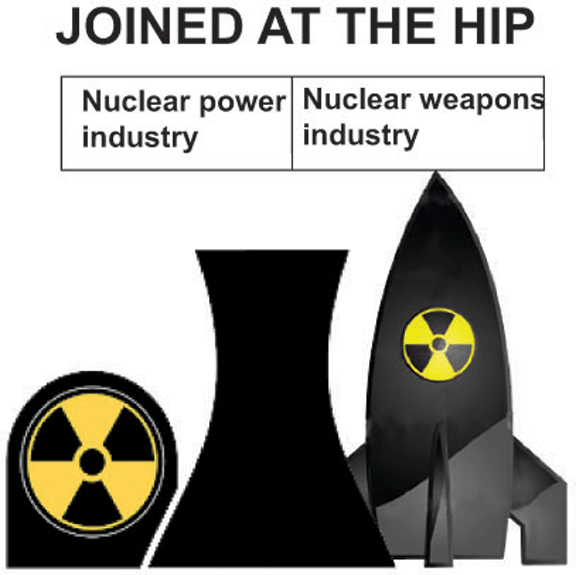
so-called “small nuclear reactors”
Downing Street told the Financial Times, which it faithfully reported, that it was “considering” £2 billion of taxpayers’ money to support “small nuclear reactors”
They are not small
The first thing to know about these beasts is that they are not small. 440MW? The plant at Wylfa (Anglesey, north Wales) was 460MW (it’s closed now). 440MW is bigger than all the Magnox type reactors except Wylfa and comparable to an Advanced Gas-cooled Reactor.
Only if military needs are driving this decision is it explicable.
”Clearly, the military need to maintain both reactor construction and operation skills and access to fissile materials will remain. I can well see the temptation for Defence Ministers to try to transfer this cost to civilian budgets,”
Any nation’s defence budget in this day and age cannot afford a new generation of nuclear weapons. So it needs to pass the costs onto the energy sector.
How the UK’s secret defence policy is driving energy policy – with the public kept in the dark. https://www.thefifthestate.com.au/energy-lead/how-the-uks-secret-defence-policy-is-driving-energy-policy-with-the-public-kept-in-the-dark/ BY DAVID THORPE / 13 OCTOBER 2020
The UK government has for 15 years persistently backed the need for new nuclear power. Given its many problems, most informed observers can’t understand why. The answer lies in its commitment to being a nuclear military force. Continue reading
The Mayak nuclear reprocessing plant: Rosatom’s dirty face- and the courageous opposition
 problems, protests, reprisals” Produced by RSEU’s program “Against nuclear and radioaсtive threats”
In the city of Krasnoyarsk, Rosatom plans to build a national repository for high–level radioactive waste. A site has been selected on the banks of Siberia’s largest river, the Yenisei, only 40 km from the city. Environmental activists consider this project, if implemented,to be a crime against future generations and violates numerous Russian laws. Activists are also concerned that waste from Ukraine,Hungary, Bulgaria (and in the future from Belarus, Turkey, Bangladesh, and other countries) could be transported there as well. (47)
1 This Month



26 September – International Day for the Total Elimination of Nuclear Weapons


PLEASE OPPOSE HR 8255 AND S.3639 – bills would accelerate satellite deployment, with no environmental review or safeguards – https://ncstd5li.quorum.us/campaign/169331/
To see nuclear-related stories in greater depth and intensity – go to https://nuclearinformation.wordpress.com
-
Archives
- September 2026 (257)
- August 2026 (330)
- July 2026 (355)
- June 2026 (287)
- May 2026 (306)
- April 2026 (356)
- March 2026 (251)
- February 2026 (267)
- January 2026 (308)
- December 2025 (358)
- November 2025 (359)
- October 2025 (375)
-
Categories
- 1
- 1 NUCLEAR ISSUES
- business and costs
- climate change
- culture and arts
- ENERGY
- environment
- health
- history
- indigenous issues
- Legal
- marketing of nuclear
- media
- opposition to nuclear
- PERSONAL STORIES
- politics
- politics international
- Religion and ethics
- safety
- secrets,lies and civil liberties
- spinbuster
- technology
- Uranium
- wastes
- weapons and war
- Women
- 2 WORLD
- ACTION
- AFRICA
- Atrocities
- AUSTRALIA
- Christina's notes
- Christina's themes
- culture and arts
- Events
- Fuk 2022
- Fuk 2023
- Fukushima 2017
- Fukushima 2018
- fukushima 2019
- Fukushima 2020
- Fukushima 2021
- general
- global warming
- Humour (God we need it)
- Nuclear
- RARE EARTHS
- Reference
- resources – print
- Resources -audiovicual
- Weekly Newsletter
- World
- World Nuclear
- YouTube
-
RSS
Entries RSS
Comments RSS

