NuScale’s nuclear reactor looks suspiciously like an old design, (that melted down)
 Why Does NuScale SMR Look Like a 1964 Drawing of Swiss Lucens Nuclear Reactor
  (which suffered a major meltdown in 1969)?
https://miningawareness.wordpress.com/2015/08/31/why-does-nuscale-smr-look-like-a-1964-drawing-of-swiss-lucens-nuclear-reactor-which-suffered-a-major-meltdown-in-1969/
Whatever NuScale is, or is not, it clearly isn’t “new”. The Bible must have foreseen the nuclear industry when it said that there was no new thing under the sun. While there might be something new about it, certainly its scale is not. And, it seems mostly a remake of old military reactors, perhaps with influence from swimming pool reactors.
The main ancestor seems to be the US Army’s SM-1, made by the American Locomotive Company, making its most distant ancestor the steam locomotive.
Government subsidizes for NuScale are a deadly taxpayer rip rip-off. Even without an accident, nuclear reactors legally leak deadly radionuclides into the environment during the entire nuclear fuel chain, as well as when they are operating. Then, the nuclear waste is also allowed to leak for perpetuity.
The 1964 Lucens Design certainly looks like the one unit NuScale. Did MSLWR, now NuScale, take from Lucens or from an earlier common design ancestor?
NuScale 12 years ago when it was called MASLWR and still an official government project, 2003, INEEL/EXT-04-01626.

This is for single reactors. They want to clump them together.
Is there a common ancestor in either the US nuclear power station in Greenland or Antarctica? Actually, the main “parent” for the underground concept, according to the Swiss documentation, is underground hydroelectric power stations, dating from the 1800s. These caverns have been known to collapse, which, along with the WIPP collapse, points to another risk associated with underground nuclear reactors, besides leakage and corrosion.
being mostly in an underground cavern proved to be a liability rather than an asset for Lucens. The cavern leaked water and contributed to corrosion issues that ultimately led to nuclear meltdown.
Despite its tiny size, tinier than NuScale, it still is classified as a major nuclear accident. Furthermore, the cavern did not keep the nuclear fallout from escaping into the environment. There was 1 Sv (1000 mSv) per hour of
radiation in the cavern. Radiation was measured in the nearby village, and the cavern still leaks radiation. Continue reading
Russia marketing small nuclear reactors to the Arctic , (who cares about the toxic wastes?)

Rosatom to build small-scale land-based Arctic nuclear plant by 2028
Rosatom said it has reached an agreement with the government of the Republic of Sakha (Yakutia) setting out parameters for pricing energy that will be produced by the nuclear plant, which is expected to be completed by 2028……….
“I am convinced that a small-scale nuclear power plant will give a qualitative impetus to the development of the Arctic regions of Yakutia, stimulate the development of industry in Ust-Yansky ulus and improve the living standards of local residents,” said in a statement Head of the Sakha Republic Aysen Nikolayev.
The nuclear plant is expected to operate for 60 years but the press release did not specify how Rosatom plans to deal with the nuclear waste produced by it.
Rosatom officials said the small-scale nuclear plant is based on a proven technology that has already been tested in Arctic conditions.
RITM-200 reactors are already being used on the recently commissioned Arktika nuclear-powered icebreaker and six other 22220 design heavy Russian icebreakers that are being built, Rosatom officials said…….
“The implementation of this project strengthens the leading position of Rosatom in the world market of small nuclear power plants.”…….
Rosatom is also actively marketing the technology for export overseas, Likhachev said. https://thebarentsobserver.com/en/nuclear-safety/2020/12/rosatom-build-small-scale-land-based-arctic-nuclear-plant-2028
U.S. Dept of Energy pouring $millions into new nuclear gimmicks
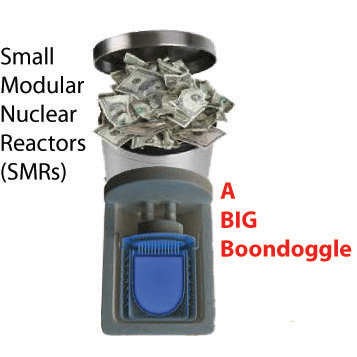 DOE selects advanced reactor concepts for funding https://www.world-nuclear-news.org/Articles/DOE-selects-advanced-reactor-concepts-for-funding, 23 December 2020
DOE expects to invest about USD600 million over the next seven years in ARDP, which aims to help domestic private industry demonstrate advanced nuclear reactors in the USA.
The department issued an ARDP funding opportunity announcement in May this year, which included the ARC-20 awards, the Advanced Reactor Demonstration awards, and the Risk Reduction for Future Demonstration awards. For the ARC-20 projects, DOE expects to invest a total of about USD56 million over four years with its industry partners providing at least 20% in matching funds. The goal of the ARC-20 programme is to assist the progression of advanced reactor designs in their earliest phases.
DOE yesterday announced the selection of three US-based teams to receive ARC-20 funding. These are:
- Inherently Safe Advanced SMR for American Nuclear Leadership. Advanced Reactor Concepts will deliver a conceptual design of a seismically isolated advanced sodium-cooled reactor facility that builds upon the initial pre-conceptual design of a 100 MWe reactor facility. The total award value over three-and-a-half years is USD34.4 million, with the DOE’s share being USD27.5 million.
- Fast Modular Reactor Conceptual Design. General Atomics will develop a fast modular reactor conceptual design with verifications of key metrics in fuel, safety and operational performance. The design will be for a 50 MWe fast modular reactor. Total award value over three years is USD31.1 million (DOE share is USD24.8 million).
- Horizontal Compact High Temperature Gas Reactor. Massachusetts Institute of Technology will mature the Modular Integrated Gas-Cooled High-Temperature Reactor (MIGHTR) concept from a pre-conceptual stage to a conceptual stage to support commercialisation. The total award value over three years is USD4.9 million (DOE cost share is USD3.9 million)………..
On 16 December, DOE selected five teams to receive USD30 million in initial funding for risk reduction projects under its ARDP programme. All five of the selected designs have the potential to compete globally once deployed, DOE said. The five projects are: the BWXT Advanced Nuclear Reactor; Westinghouse’s eVinci Microreactor; Kairos Power’s Hermes Reduced-Scale Test Reactor; the Holtec SMR-160 light-water small modular reactor; and the Molten Chloride Reactor Experiment, a project led by Southern Company Services Inc.
Two projects led by TerraPower and X-energy were selected in October to receive USD160 million in initial funding for under the DOE’s Demonstration projects pathway to develop and construct two advanced nuclear reactors that can be operational within seven years……https://www.world-nuclear-news.org/Articles/DOE-selects-advanced-reactor-concepts-for-funding
UK’s quest for nuclear fusion.
|
he science of nuclear fusion was proven in the early 1930s, after fusion of hydrogen isotopes was achieved in a laboratory. And we see fusion in action every day. The stars, including our Sun, are giant self-sustaining fusion reactors. ……..
Unlike nuclear fission, which breaks heavy atoms apart, nuclear fusion compresses light atoms together. This means there is far less harmful waste created by fusion. Neutron bombardment causes a fusion plant to become slightly radioactive, however these radioactive products are short-lived. Fusion therefore offers the tantalising potential for near-limitless, climate-friendly energy production that doesn’t come with a shadow of radioactive waste. Test reactors, such as the Joint European Torus (Jet) at Culham in England, have proved fusion is possible, albeit for short periods of time. The challenge is turning these experimental reactors into an ongoing process that is commercially viable. For this, it would need to generate more power than is needed to keep the fusion reaction going.
For decades, we have been promised that commercial fusion power plants will exist within 30 years. As far back as 1955, the physicist Homi J Bhabha claimed we would have fusion power within two decades. This claim, and many others since, have repeatedly failed to be achieved. The promise is eternal, but fusion always seems that same distance away………. https://www.bbc.com/future/article/20201214-the-uks-quest-for-affordable-fusion-by-2040
|
|

Biden flirts with the fantasy of small nuclear reactors as the cure for climate change
if the nuclear revolution doesn’t happen in the next four years, it’s probably not going to happen
The Green Fantasy and Messy Reality of Nuclear Power. TNR, 23 Dec 20, Biden is flirting with the idea of rejuvenating the industry to help decarbonize the economy—and there are skeptics in spades. Joe Biden will have to do more about climate change than any president before him. He has no choice. Already, close U.S. allies are openly expressing their relief about the end of the ecologically disastrous Trump era while a coalition of left-wing politicians and organizations are demanding sweeping emissions reductions.
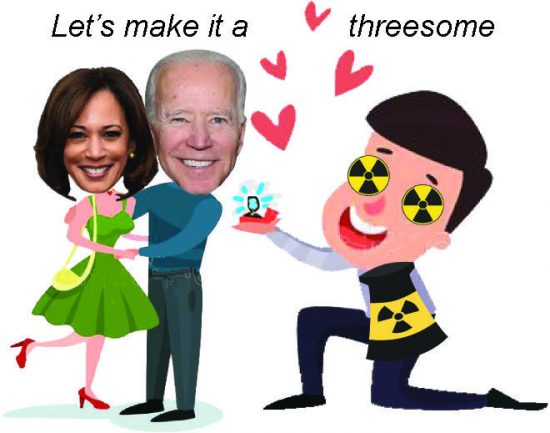 Biden’s campaign climate promises were extensive. But one of the more interesting promises in the plan—and one of the ones key to determining how he approaches emissions reduction—was his promise to “identify the future of nuclear energy.” That means reopening discussion of a technology many environmentalists once thought would be rotting in the dustbin of history by now.
Part of the reason nuclear energy construction remains difficult and expensive in the U.S. is that in polls Americans are split down the middle on their approval of nuclear energy, and opponents make a big stink when construction of a nuclear plant is being discussed. These are rational worries, according to Mark Delucchi, a research scientist affiliated with UC Berkeley and Lawrence Berkeley National Laboratory, which operates on behalf of the U.S. Department of Energy. In addition to the risk of meltdowns—which are, admittedly, rare—we have to also consider the disposal of caches of spent nuclear fuel, the risks of which “are potentially much more abroad in time and space,” Delucchi said. “They affect people. They affect other ecosystems. They affect different generations. And they’re unknown.”
“It kinda boggles my mind how anyone who has any clue about solving problems related to climate or energy still considers nuclear power,” said Mark Jacobson, professor of civil and environmental engineering at Stanford University and a frequent collaborator with Delucchi. As Jacobson pointed out, there’s next to no active construction of nuclear power plants currently going on in the U.S. All of the U.S. nuclear energy construction happening right now consists of two reactors in Georgia that Jacobson says “may never even be finished.”
A project in Utah set to break ground soon was set in motion by politicians accused of conflicts of interest, and construction of that plant has faced opposition from activists since its inception. In 2017, two U.S. nuclear reactor projects were canceled after construction had begun, leaving investors on the hook for billions of dollars. “So people are trying to say that we should build lots of these things that you can’t even build one of?” Jacobson said.
Despite the near impossibility of constructing one of these plants, greater federal investment in nuclear energy appears to be on the table. Biden’s transition team includes Rachel Slaybaugh, a Berkeley nuclear engineer. The Senate Committee on Energy and Public Works earlier this month approved a bipartisan bill aimed at protecting existing nuclear infrastructure, developing new nuclear technology, and supporting uranium mining.
 America’s pro-nuclear voices tend to hail from the aggressively moderate part of the political spectrum. The centrist think tank Third Way says on its website that “advanced nuclear is shaping up to be a key component in our race to zero emissions.” House Minority Leader Kevin McCarthy conceded in February that climate change is real—a step not all Republicans have taken—but claimed that the Democrats are going about trying to fix it all wrong. We should be, McCarthy wrote on his website, “investing in clean energy technology that will lead to less emissions, lower costs, and produce as much or more power. Chief among them is advanced nuclear technology.”
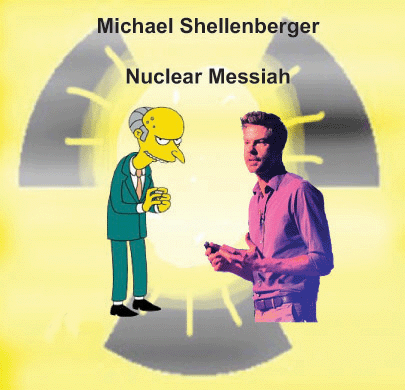
Rather predictably for anyone who follows this issue, McCarthy’s statement about clean energy (which doesn’t mention wind or solar) includes several citations of rockstar nuclear activist Michael Shellenberger, a guy who doesn’t think climate change is that bad and who has given not one, but two blockbuster TED talks attempting to bodyslam wind and solar, one of which is bluntly named “Why renewables can’t save the planet.” Over 2 million people have watched it on YouTube alone.
The notion that nuclear power is necessary and inevitable is far from a fringe viewpoint. Last year, The New York Times ran an op-ed called “Nuclear Power Can Save the World,” written by three Ph.D.-holders, including cognitive neuroscientist and radical optimist Steven Pinker.
According to this brand of eco-contrarianism, nuclear is not just viable, but the only pragmatic plan for decarbonizing the U.S. energy grid. Built into this message is invariably the idea that plans outlined by environmentalists, activists, and alternative energy proponents are actually doing more harm than good. It’s not that these folks want nuclear to have a seat at the table as humanity negotiates its energy future; they want to nuke-pill the whole climate movement.
But inevitably, this rhetoric has to address the chief problem of nuclear power, which is that it is extremely time-consuming and expensive to build new reactors. The solution, nuclear supporters argue, is to take a modular approach to our nuclear construction. Modularity means minimal  variation at each new site, a streamlined design process, and less of the sort of worksite entropy that slows things down. In other words, cookie-cutter them into the energy landscape as quickly as possible.
There’s reason to be skeptical of this approach. “Claims about the technical and economic attractiveness of modular or small scale nuclear reactors, I think, are potentially especially problematic on the political side of things,” Delucchi said. “A lot of the costs associated with nuclear power are based on technologies that are not commercialized, or even particularly close.”
Plans based on 100 percent renewable energy are routinely criticized for relying on technology not yet available or cost-effective. Clearly, though, that’s also true for nuclear power. Nuclear fans, then, are asking the country to bet on a successful nuclear expansion at a time when we have less than ten years—roughly the time it takes to carry out the relatively smooth construction of a single nuclear power plant—to cut our greenhouse gas emissions by 40–50 percent from 2010, or else we’ll blow past the ugly 1.5 degree warming threshold, according to the Intergovernmental Panel on Climate Change (IPCC), and plunge ourselves into climate chaos. That’s quite a bet.
In practical terms, all Biden has promised to do with regard to nuclear energy is form a research agency, dubbed ARPA-C, and churn out some government reports about it and other energy possibilities. And it won’t be at all surprising if, like Trump, Biden also gives a little boost to uranium mining companies that are desperate to expand their operations.
If ARPA-C’s research into modular reactors produces breakthroughs, more uranium gets mined, regulations fall away, public outcry dies down, and nuclear really turns out to be the answer to climate change, that should become clear by the end of Biden’s first term. If the U.S. is going to come anywhere close to meeting the IPCC’s recommendations for avoiding catastrophic warming through nuclear power, modular nuclear plants will be going up all over the place by January of 2025. We should see ribbons being cut, foundations being poured, and uranium ore well on its way to being enriched. “Small-scale modular” will have to become one of those eye-rollingly overused cliches, like “OK Boomer” or “social distancing.”
None of this seems particularly likely. And if the nuclear revolution doesn’t happen in the next four years, it’s probably not going to happen, given the slow pace of nuclear power construction. All those pragmatic arguments for nuclear energy will probably end up looking as fantastical as a three-eyed fish. https://newrepublic.com/article/160712/green-fantasy-messy-reality-nuclear-power
Trump Signs Directive to Bolster Nuclear Power in Space Exploration

|
Trump Signs Directive to Bolster Nuclear Power in Space Exploration, One goal laid out in the new policy is the testing of a fission power system on the moon by the mid- to late 2020s, Scientific American By Mike Wall, SPACE.com on December 21, 2020 Nuclear power will be a big part of the United States’ space exploration efforts going forward, a new policy document affirms. President Donald Trump on Wednesday (Dec. 16) issued Space Policy Directive-6 (SPD-6), which lays out a national strategy for the responsible and effective use of space nuclear power and propulsion (SNPP) systems. “Space nuclear power and propulsion is a fundamentally enabling technology for American deep-space missions to Mars and beyond,” Scott Pace, deputy assistant to the president and executive secretary of the National Space Council, said in an emailed statement Wednesday. “The United States intends to remain the leader among spacefaring nations, applying nuclear power technology safely, securely and sustainably in space.”…….. NASA and the U.S. Department of Energy are working together on a fission-reactor project called Kilopower, which could provide juice for crewed outposts on the moon and Mars. …….. SPD-6 is the sixth space policy directive signed by President Trump, as its name suggests. SPD-1 officially instructed NASA to return astronauts to the moon to help prepare for crewed Mars missions; SPD-2 eased regulations on the private spaceflight industry; SPD-3 aimed to help with space-traffic management; SPD-4 directed the Department of Defense to establish the U.S. Space Force; and SPD-5 laid out a cybersecurity policy for U.S. space systems. As that list indicates, President Trump has been quite active in the space-policy domain. He also resurrected the National Space Council, which had been dormant since the early 1990s. And just last week, he issued a new national space policy, which aims to bolster national security and American leadership in space, among other goals. https://www.scientificamerican.com/article/trump-signs-directive-to-bolster-nuclear-power-in-space-exploration/ |
|
USA’s Dept of Energy pouring $millions into gimmicky new untested nuclear projects
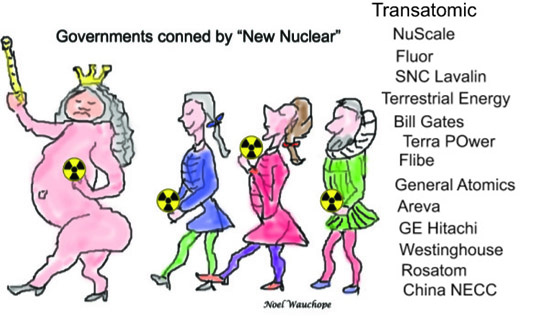
The US Department of Energy (DOE) has announced USD20 million in awards for the third of three programmes under its new Advanced Reactor Demonstration Program (ARDP). DOE’s Office of Nuclear Energy has selected three teams to receive FY2020 funding for the ARDP’s Advanced Reactor Concepts-20 (ARC-20) programme.
DOE expects to invest about USD600 million over the next seven years in ARDP, which aims to help domestic private industry demonstrate advanced nuclear reactors in the USA.
The department issued an ARDP funding opportunity announcement in May this year, which included the ARC-20 awards, the Advanced Reactor Demonstration awards, and the Risk Reduction for Future Demonstration awards. For the ARC-20 projects, DOE expects to invest a total of about USD56 million over four years with its industry partners providing at least 20% in matching funds. The goal of the ARC-20 programme is to assist the progression of advanced reactor designs in their earliest phases.
DOE yesterday announced the selection of three US-based teams to receive ARC-20 funding. These are:
- Inherently Safe Advanced SMR for American Nuclear Leadership. Advanced Reactor Concepts will deliver a conceptual design of a seismically isolated advanced sodium-cooled reactor facility that builds upon the initial pre-conceptual design of a 100 MWe reactor facility. The total award value over three-and-a-half years is USD34.4 million, with the DOE’s share being USD27.5 million.
- Fast Modular Reactor Conceptual Design. General Atomics will develop a fast modular reactor conceptual design with verifications of key metrics in fuel, safety and operational performance. The design will be for a 50 MWe fast modular reactor. Total award value over three years is USD31.1 million (DOE share is USD24.8 million).
- Horizontal Compact High Temperature Gas Reactor. Massachusetts Institute of Technology will mature the Modular Integrated Gas-Cooled High-Temperature Reactor (MIGHTR) concept from a pre-conceptual stage to a conceptual stage to support commercialisation. The total award value over three years is USD4.9 million (DOE cost share is USD3.9 million).
“ARDP is significant because it will enable a market for commercial reactors that are safe and affordable to both construct and operate in the near- and mid-term,” said Secretary of Energy Dan Brouillette. “All three programmes under ARDP pave the way for the United States to be highly competitive globally.”
On 16 December, DOE selected five teams to receive USD30 million in initial funding for risk reduction projects under its ARDP programme. All five of the selected designs have the potential to compete globally once deployed, DOE said. The five projects are: the BWXT Advanced Nuclear Reactor; Westinghouse’s eVinci Microreactor; Kairos Power’s Hermes Reduced-Scale Test Reactor; the Holtec SMR-160 light-water small modular reactor; and the Molten Chloride Reactor Experiment, a project led by Southern Company Services Inc.
Two projects led by TerraPower and X-energy were selected in October to receive USD160 million in initial funding for under the DOE’s Demonstration projects pathway to develop and construct two advanced nuclear reactors that can be operational within seven years.
“Funding for ARDP beyond the near term is contingent on additional future appropriations, evaluations of satisfactory progress, and DOE approval of continuation applications,” DOE noted.
Draft EIS on Versatile Test Reactor (VTR); Lacking Justification and Due to Proliferation Risks, VTR Project Must Not Go Forward.
SRS 21st Dec 2020, DOE Announces Release of Draft EIS on Versatile Test Reactor (VTR); Lacking
Justification and Due to Proliferation Risks, VTR Project Must Not Go
Forward. Option to Fabricate Plutonium Fuel in Old K-Reactor at Savannah
River Site would Bring Risks and Up to an Additional 30 Metric Tons of
Plutonium to South Carolina – Must be Rejected.
EIN Presswire 21st Dec 2020
Small Nuclear Reactor unicorns for Canada

Canada’s SMR ‘Action Plan’ banks on private sector nuclear pipe dreams, Burgess Langshaw-Power / December 21, 2020 For many kids who grew up in the 1980s and 1990s, Star Trek was a big part of our childhoods. The series is filled with strange new worlds, futurist politics, and advanced technology that is almost indistinguishable from magic. Yet even as a child I knew the show was a work of science fiction. Warp speed, transporters and phasers were all gadgets I could comprehend, but in my rational mind I knew they would never exist within my lifetime.
Unfortunately, recent announcements by Canada’s Natural Resources Minister Seamus O’Regan—a self-professed fan of science fiction—demonstrate that the government has yet to arrive at the same conclusion I did as a kid watching Star Trek.
On December 18, the Trudeau government launched Canada’s Small Modular Reactor (SMR) Action Plan, to great fanfare. This new action plan builds on the 2018 SMR Roadmap, which made the promise that, “SMRs are a re-scaling and repurposing of nuclear technology for wider markets. They represent a paradigm shift for nuclear reactor technology—analogous to the shift of steam engines from mineshafts into ships and vehicles, or the movement of computers from mainframe to desktop and then to laptop.”
This idea of a paradigm shift channels Star Trek-level aspirations, yet the new Action Plan is significantly more hesitant: “Small modular reactors (SMRs) could be a source of clean, safe and affordable energy, opening opportunities for a resilient, low-carbon future and capturing benefits for Canada and Canadians while supporting reconciliation with Indigenous peoples as essential enabling partners.”
In just two years, from the launch of the Roadmap to the announcement of the Action Plan, the government has gone from a paradigm shift to the possibility that SMRs could be a source of clean energy. It’s as though there is something else about SMRs that the government doesn’t want us to consider in more depth.
Before we go any further, what are SMRs, anyway? Well, it turns out that’s a very good question. In fact, the Globe and Mail notes that “SMR lacks a universally agreed definition, and the Canadian Nuclear Safety Commission regards it as a marketing rather than a technical term.” In other words, SMRs are a group of many different technologies, none of which have actually been proven or tested, with only one project proposed and no timeframe for its realization. None of the technologies currently under consideration have solved any major issues with nuclear energy, including the problem of high-level radioactive waste management, however some are less likely to have meltdown-like events and cannot produce isotopes for creating weapons.
The Statement of Principles section of the Action Plan notes that, “Markets around the globe are signalling a need for smaller, simpler, and cheaper nuclear energy.” However, there is simply no evidence to support this claim. In fact, the polar opposite is true, with many major governments and large corporations exiting the nuclear sector entirely. Meanwhile, German experts have stated that, “SMRs are always going to be more expensive than bigger reactors due to lower power output at constant fixed costs, as safety measures and staffing requirements do not vary greatly compared to conventional reactors.”
The British press is even more blunt about the prospects of a more ‘tactile’ nuclear future: “There is no commercial case for giant new reactors in any developed country. They cannot meet post-Chernobyl and post-Fukushima safety demands at viable cost and have been priced out of the global energy market. Precipitous falls in renewable costs over the last five years have rendered the technology effectively obsolete in the West.”
This doesn’t sound like a bold future to me………..
The theory is that SMRs will be cheaper and safer than conventional nuclear reactors. Again, German experts disagree on the cost front. In terms of levelized energy costs, says Nicolas Wendler of industry association Nuclear Technology Germany (KernD), SMRs will always be more expensive than big plants. Moreover, he says, “nuclear power plant owners have repeatedly rejected the idea that the nuclear exit be reversed, arguing the technology is no longer economically viable anyway.”
In the United States, some nuclear plants are being decommissioned early, while other projects are being cancelled at a huge financial loss. Why? They aren’t competitive. This does not even account for the fact that we have yet to successfully build even a single SMR. Yet, if we were to, how much would they cost? The record for delays and cost overruns in Canada is not positive, and nuclear facilities have an unusually poor record in this regard. After 1970, the average nuclear facility saw cost overruns exceed 241 percent (not including the added burden of construction delays).
This does not even begin to address the costs and hazards associated with cleaning up nuclear sites, such as expensive remediation projects now underway in the US and the UK. Perhaps unsurprisingly, these failures and cost overruns sound a lot like the last major federal investment in the energy sector—the Trans Mountain pipeline fiasco.
There is no doubt Canada will need new energy sources for our clean energy transition to address the climate crisis. The Government of Canada claims, “At the same time, international experts are telling us that new nuclear energy, together with the full range of low-carbon technologies, are needed to combat global climate change and meet federal, provincial and territorial emissions targets for 2030 and 2050.”
However, international examples do not inspire confidence that nuclear needs to be a part of this solution. Germany is close to achieving half its energy supply from renewables excluding nuclear. In the UK, some estimates show that not including nuclear energy in the mix will save hundreds of millions of pounds and that the only justification for pursuing nuclear energy in the UK or France is to support a nuclear military strategy (which Canada obviously does not have).
At least the UK is putting its money where its mouth is, with over half a billion pounds invested into nuclear, while Canada’s new SMR Action plan includes precisely $0 of investment, as opposed to our new federal hydrogen strategy, which received $1.5 billion.
Why would we choose nuclear over other cheaper and readily available renewable technologies? It is true that there are still major flaws with renewables, but given that most SMRs are a decade away (at least), and the cost of solar has already dropped 89 percent in the last decade, it seems unlikely that SMRs—whenever they are ready—will be competitive.
One of the theoretical selling points is the deployment of SMRs in rural and remote communities to replace diesel. Yet, many Indigenous and northern communities have expressed trepidation towards SMRs dotting their territory, and are building solar arrays instead. Another argument is that SMRs could be used for industrial facilities such as those in the mining sector, or the Alberta oil sands (this was a terrible idea in the past, and its terrible idea now). However, others suggest that SMRs are only capable of, “ticking off the Financial and Consumer Services Commission’s checklist on how to spot a scam.”
Canada’s SMR Action Plan is nothing more than science fiction: idle dreams of an indefinite group of technologies which may be ready in a decade, with no financial support or investment by the government. In the meantime, renewable energy continues to leap ahead, mostly without any federal support.
One can only imagine how government investment, if effectively pursued, could push our renewable energy potential by the time the first SMRs are ready for deployment. Given these considerations, perhaps the reason this “Action Plan” is so empty, is that the federal government is in fact aware of how little potential SMRs hold. Like nuclear fusion, maybe SMRs will always be just around the corner. In which case, why bother launching this plan at all? Let’s save our time and investment for renewable energy projects that have viability today, not somewhere down the road.
Burgess Langshaw-Power is a former policy analyst currently completing his PhD in Global Governance at the Balsillie School, University of Waterloo. His policy expertise includes energy technologies, regulatory approvals, climate change, and energy infrastructure. Views expressed here are his own and not necessarily those of his employer. https://canadiandimension.com/articles/view/canadas-smr-action-plan-banks-on-private-sector-nuclear-pipe-dreams
“Mutual admiration society” -between civilian and military nuclear experts
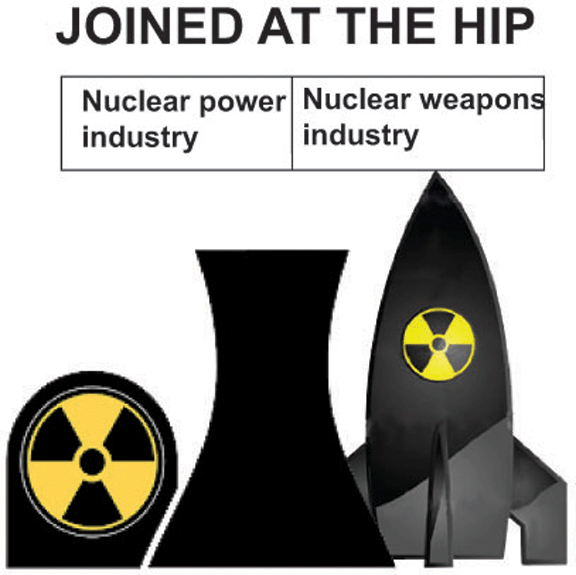 Civilian nuclear and military nuclear members of a “mutual admiration society” ~
  Dr. Gordon Edwards, https://concernedcitizens.net/2020/12/19/civilian-nuclear-and-military-nuclear-members-of-a-mutual-admiration-society/ Dr. Gordon Edwards, President of the Canadian Coalition for Nuclear Responsibility, December 19, 2020
Civilian nuclear and military nuclear have always been friendly room-mates, members of a “mutual admiration” society. In today’s announcement of an SMR Action Plan, Natural Resources Minister Seamus O’Regan said that nuclear power in Canada is a “home-grown” technology and referred to C. D. Howe’s role in this connection. In fact C.D. Howe arranged for all Canadian uranium extracted from Canadian mines to be sold to the US military for use in tens of thousands of nuclear weapons from 1945 to 1965. C D Howe was also on the Committee that met in Washington DC in 1944 to approve the first nuclear reactors to be built in Canada (at Chalk River) as part of the ongoing effort to produce plutonium for use as a nuclear explosive. Mr. Howe approved of the policy of selling plutonium produced at Chalk River to the US military for weapons use, a practice that continued until 1975 and beyond. Plutonium from Chalk River was sent to Britain (it was the first sample of plutonium that Britain had ever obtained) just a few months before Britain detonated its first A-Bomb in the Monte Bello Islands off Australia.
To the best of my knowledge, no civilian nuclear power agency – not the Canadian Nuclear Association, nor the Canadian Nuclear Society, nor the Canadian Nuclear Safety Commission, nor Atomic Energy of Canada Limited, nor Canadian Nuclear Laboratories, NOBODY – has ever issued a clear statement denouncing nuclear weapons or even calling for a nuclear weapons free world. Most nuclear scientists and engineers feel a strong kinship and camaraderie with those who are in the nuclear weapons business. The same goes for those in the nuclear division of Natural Resources Canada. I remember on one occasion (prior to the exchange of nuclear tests between India and Pakistan) I expressed alarm at the fact that both neighbours are developing a nuclear war-fighting capability and a couple of senior civil servants said “Would that be so bad? Maybe that’s just what the world needs. More deterrence. Creates stability”
Despite regular denials from our puppet masters that civilian nuclear has nothing to do with military nuclear, it is clear that civilian nuclear (including the frankly discriminatory provisions of the NPT) has adopted an appeasement policy that will never succeed in bringing about a nuclear weapons free world. Why does Canada continue to sell uranium to countries that are in the process of investing hundreds of billions to improve and modernize the nuclear arsenals in utter defiance of the NPT, knowing that the vast bulk of Canadian uranium that is rejected from enrichment plants as DU end up as the raw material for producing plutonium for Bombs, and that the lion’s share of the explosive power – and the overwhelming share of the radioactive fallout – of every H-bomb comes from the fissioning of DU atoms that are freely accessed by the military even if they are the leftovers of “peaceful” fuel production for nuclear power plants?
“See ‘The Nuclear Fudge’ at https://www.youtube.com/watch?v=0lK65S5eHRQ&feature=youtu.be“. This 16-minute W5 segment from the Regan era is very informative.
The real reason for “civil” Small Nuclear Reactors- to supply expertise and technology for the nuclear weapons industry
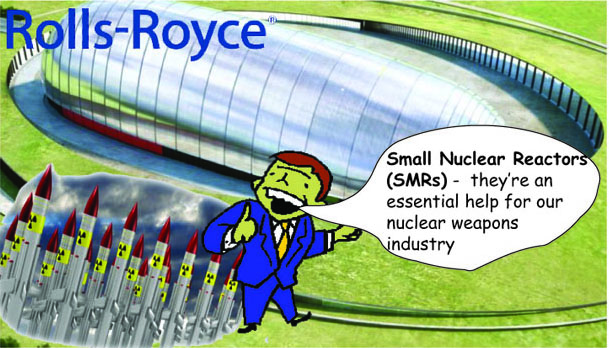
 How investment in SMRs supports “defense nuclear programs” https://concernedcitizens.net/2020/12/19/how-investment-in-smrs-supports-defense-nuclear-programs/comment-page-1/?unapproved=2198&moderation-hash=3219adce054494626a5ee71e323fef71#comment-2198 How investment in SMRs supports “defense nuclear programs” https://concernedcitizens.net/2020/12/19/how-investment-in-smrs-supports-defense-nuclear-programs/comment-page-1/?unapproved=2198&moderation-hash=3219adce054494626a5ee71e323fef71#comment-2198
1. Rolls-Royce, 2017, ‘UK SMR: A National Endeavour’, https://www.uknuclearsmr.org/wp-content/uploads/2017/09/V2088-Rolls-Royc… “The indigenous UK supply chain that supports defence nuclear programmes requires significant ongoing support to retain talent and develop and maintain capability between major programmes. Opportunities for the supply chain to invest in new capability are restricted by the limited size and scope of the defence nuclear programme. A UK SMR programme would increase the security, size and scope of opportunities for the UK supply chain significantly, enabling long-term sustainable investment in people, technology and capability. “Expanding the talent pool from which defence nuclear programmes can draw from would bring a double benefit. First, additional talent means more competition for senior technical and managerial positions, driving excellence and performance. Second, the expansion of a nuclear-capable skilled workforce through a civil nuclear UK SMR programme would relieve the Ministry of Defence of the burden of developing and retaining skills and capability. This would free up valuable resources for other investments.” |
|
USA to turn the moon into a nuclear weapons site
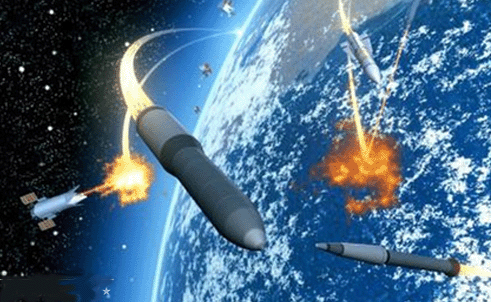 US to turn moon into ‘nuclear weapons site’ US to turn moon into ‘nuclear weapons site’
By Huang Lanlan Source: Global Times: 2020/12/18, The US ambition to build a nuclear power plant on the moon by 2027, which may contribute to future lunar military projects, shows it seeks space supremacy regardless of the damage and dangers it may cause to people, Chinese experts on military and international relations said.
Establishing a nuclear power plant on the moon by the end of 2027 was included in a number of specific goals in a memorandum signed by US President Donald Trump on Wednesday, which is known as Space Policy Directive 6 (SPD-6). The plant would “support a sustained lunar presence and exploration of Mars,” SPD-6 said. Military purposes are likely to be behind the establishment, Chinese military expert and commentator Song Zhongping said. By setting up a nuclear power plant, which includes exploiting nuclear materials and building equipment like nuclear reactors and uranium enrichment facilities, the US can theoretically turn the moon “into a production site of nuclear weapons,” Song told the Global Times Friday. The moon is rich in helium-3, a material that could be used as fuel to produce energy by nuclear fusion, Song said. In the name of building a nuclear power plant, the US may directly exploit this material on the moon and then construct nuclear fuel-processing plants there, he said. The plan once again shows American unilateralism in space, which runs counter to the will of the international community in terms of lunar issues, Li Haidong, a professor at the Institute of International Relations of the China Foreign Affairs University, said………. As Chang’e-5 successfully completed its lunar trip on Thursday, the signing of SPD-6 also shows the US’ intention of dragging China into a space race, trying to divert China’s attention to an endless consumption of national resources for the race from improving its economy and people’s livelihood, Li said. This is similar to what the US did to the Soviet Union in the 1980s under Ronald Reagan’s “Star Wars” program, he noted.
Its goal of building a lunar nuclear power plant, nonetheless, may hardly be achieved on time by 2027 as the US is stuck in domestic trouble and chaos, such as the ongoing COVID-19 pandemic, Li said. https://www.globaltimes.cn/content/1210357.shtml |
|
Many Canadian organisations dispute the government’s plan for small nuclear reactors
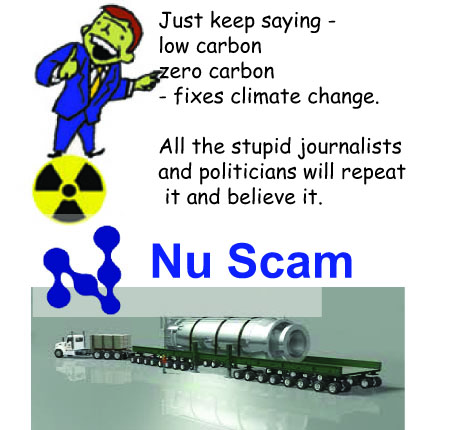 Feds throw support behind development of mini nuclear reactors; action plan released, Saskatoon / 650 CKOM Feds throw support behind development of mini nuclear reactors; action plan released, Saskatoon / 650 CKOMThe Canadian PressDec 18, 2020 “……. Among steps in the plan is developing prototypes and demonstration models.,,,,,
Dozens of groups, including opposition parties, some Indigenous organizations and environmentalists, want the government to fight climate change by investing more in renewable energy and energy efficiency rather than in the new reactors. They argue nuclear energy costs far too much money and is far from clean given the growing mound of radioactive waste it generates. O’Regan said the government is actively trying to figure out what do with the dangerous material….. The federal government estimates the global market for SMRs will be worth between $150 billion and $300 billion a year by 2040 but critics question the validity of the estimate. They also wonder who exactly might want one. …https://www.ckom.com/2020/12/18/feds-throw-support-behind-development-of-mini-nuclear-reactors/ |
|
In midst of pandemic crisis, more U.S. tax-payer money to go to nuclear power in space
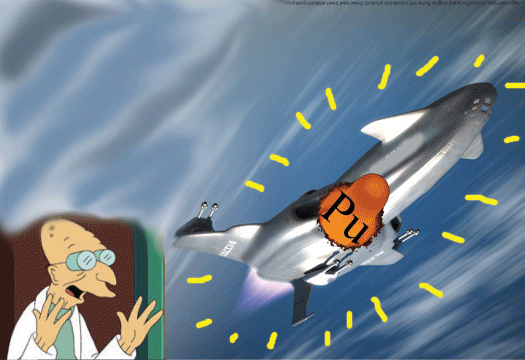 White House Issues Space Policy Directive on Space Nuclear Power and Propulsion. Via Satellite, By Rachel Jewett | December 17, 2020
SPD-6 establishes that the U.S. government will pursue a roadmap for federally-supported space nuclear power and propulsion activities.
Big boasts for small nuclear reactors on ships – but a recipe for disaster?
 Floating ‘mini-nukes’ could power countries by 2025, says startup, Danish company plans to fit ships with small nuclear reactors to send energy to developing countries, Guardian, Jillian Ambrose, 18 Dec 2020
 Floating barges fitted with advanced nuclear reactors could begin powering developing nations by the mid-2020s, according to a Danish startup company.Seaborg Technologies believes it can make cheap nuclear electricity a viable alternative to fossil fuels across the developing world as soon as 2025……..
Seaborg has raised about €20m (£18.3m) from private investors, including the Danish retail billionaire Anders Holch Povlsen, and received the first of the necessary regulatory approvals within a four-phase process from the American Bureau of Shipping this week. ….
Seaborg hopes to begin taking orders by the end of 2022 for the nuclear barges, which would be built in South Korean shipyards and towed to coastlines where they could be anchored for up to 24 years, he said. ……….
Seaborg’s design would be one of the first examples of a commercially available nuclear barge used to provide electricity to the mainland.
Chris Gadomski, a nuclear analyst at Bloomberg New Energy Finance, said: “The concept of a floating nuclear power plant has been around for a long time, and makes a lot of sense. But there are concerns.” There was inherent risk involved with nuclear reactor technologies and floating power plants, so combining to two could raise serious questions for investors and governments, he said.
“In places like the Philippines and Indonesia it makes a lot of sense. But it wasn’t so long ago that the Philippines was the site of a major tsunami, and I don’t know how you would hedge against a risk like that,” he added.
Jan Haverkamp, from Greenpeace, said floating reactors were “a recipe for disaster” including “all of the flaws and risks of larger land-based nuclear power stations”. “On top of that, they face extra risks from the unpredictability of operation in coastal areas and transport – particularly in a loaded state – over the high seas. Think storms, think tsunamis,” he said. ……..https://www.theguardian.com/environment/2020/dec/17/floating-mini-nukes-could-power-countries-by-2025-says-startup
1 This Month



26 September – International Day for the Total Elimination of Nuclear Weapons


PLEASE OPPOSE HR 8255 AND S.3639 – bills would accelerate satellite deployment, with no environmental review or safeguards – https://ncstd5li.quorum.us/campaign/169331/
To see nuclear-related stories in greater depth and intensity – go to https://nuclearinformation.wordpress.com
-
Archives
- September 2026 (257)
- August 2026 (330)
- July 2026 (355)
- June 2026 (287)
- May 2026 (306)
- April 2026 (356)
- March 2026 (251)
- February 2026 (267)
- January 2026 (308)
- December 2025 (358)
- November 2025 (359)
- October 2025 (375)
-
Categories
- 1
- 1 NUCLEAR ISSUES
- business and costs
- climate change
- culture and arts
- ENERGY
- environment
- health
- history
- indigenous issues
- Legal
- marketing of nuclear
- media
- opposition to nuclear
- PERSONAL STORIES
- politics
- politics international
- Religion and ethics
- safety
- secrets,lies and civil liberties
- spinbuster
- technology
- Uranium
- wastes
- weapons and war
- Women
- 2 WORLD
- ACTION
- AFRICA
- Atrocities
- AUSTRALIA
- Christina's notes
- Christina's themes
- culture and arts
- Events
- Fuk 2022
- Fuk 2023
- Fukushima 2017
- Fukushima 2018
- fukushima 2019
- Fukushima 2020
- Fukushima 2021
- general
- global warming
- Humour (God we need it)
- Nuclear
- RARE EARTHS
- Reference
- resources – print
- Resources -audiovicual
- Weekly Newsletter
- World
- World Nuclear
- YouTube
-
RSS
Entries RSS
Comments RSS

