Montana legislatures to review the law restricting nuclear developments
At the same time the House was reviewing a bill sponsored by Rep. Derek Skees, R-Kalispell, to remove restrictions on nuclear development, the Senate was at work on Senate Joint Resolution 3, which directs the state to study advanced nuclear reactors. The resolution appears well-positioned to pass — halfway through the session, SJ 3 has garnered unanimous support in the Senate.
Sponsor Terry Gauthier, R-Helena, becomes audibly excited discussing the measure. He said he sees modern nuclear technology as a way for Montana to send electrons to the energy-thirsty markets of the Pacific Northwest by tying into the high-voltage transmission lines leading out of Colstrip……..
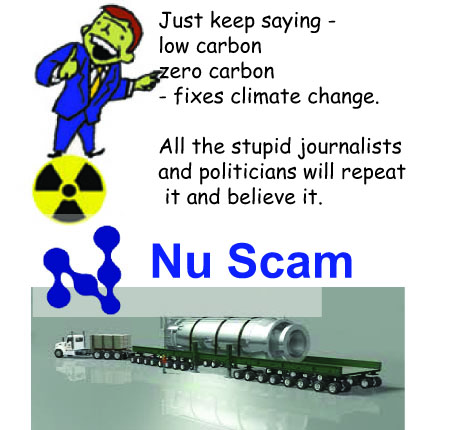 Gauthier is particularly interested in a company called NuScale, based in Portland, Ore., that’s garnered more than $1.3 billion from the federal government to advance its small modular reactor, or SMR, design. It’s the only company that’s received approval from the federal Nuclear Regulatory Commission for that type of design — a significant milestone on the journey to market……….
Much of the debate about the environmental impact associated with nuclear energy is focused on what to do with the spent fuel. Some kinds of nuclear fuel can remain radioactive for hundreds or thousands of years. The U.S. has yet to arrive at a long-term solution for re-using or storing spent fuel, creating a contentious political issue that’s spanned decades.
As is the case with larger-scale traditional nuclear plants, spent fuel from SMRs remains a “significant issue,” according to Darby.
NuScale’s plan is to store used fuel underwater in a stainless-steel lined concrete pool located onsite for at least five years. They say the pool is designed to withstand “a variety of severe natural and human made phenomena” like earthquakes and aircraft impacts. After the five-year period when the used fuel is both hottest and most radioactive has elapsed, it’s moved to a stainless-steel canister surrounded with concrete that’s designed to contain the radioactivity.
The United States doesn’t have a permanent underground repository for high-level nuclear waste, so those concrete containment vessels generally remain on-site or near the plant they came from. A 33-year-old effort to create such a long-term storage repository northwest of Las Vegas is still subject to heated debate. ……….
Another question hanging over nuclear energy development is the price of building a new plant. It’s not uncommon for new construction costs to exceed $1 billion. Concerns about cost increases led several cities that had committed to participate in NuScale’s demonstration plant in Idaho Falls to pull out of the multi-billion-dollar project last year.
NuScale told Montana Free Press that once production is rolling on their product, it anticipates the facility construction cost to be about $2,850 per kilowatt of producing capacity for its largest, 12-module iteration. For comparison, new construction of a natural gas plant averaged about $837 per kilowatt of capacity in 2018, and wind plants clocked in at $1,382, according to the U.S. Energy Information Administration.
Brad Molnar, a Republican senator from Laurel, told MTFP that cost will be an important consideration as the state plots its energy future. He said the study Gauthier is spearheading should involve the Public Service Commission, because it doesn’t make sense to conduct the study without landing on a cost-per-megawatt estimate.
Gauthier knows that nuclear is by no means the least expensive energy source, particularly if calculations are based on a strict dollars-and-cents equation…….
It’s not yet clear if Montana’s 1978 law requiring voter approval before a nuclear energy plant can be built in the state will still be on the books next year. The Legislature is still deciding the fate of HB 273, which would strike that law and remove nuclear projects from the purview of the Major Facility Siting Act.
Sen. Molnar has been asked if he’d carry HB 273 when it’s heard in the Senate, but he said he has reservations about the measure.
“By and large, I’m really hesitant to overturn a [voter] initiative,” he said, adding that the order of operations seems a little off to him.
“First you do the study, then you take action,” he said. “You don’t take action and then do the study.”
As of March 4, both HB 273 and SJ 3 have been transmitted to the Senate and House, respectively, for review. Hearing dates before those chambers’ energy committees have not been set. https://montanafreepress.org/2021/03/04/nuclear-on-the-radar-part-ii/
Is it wise for the Biden administration to fund Small Nuclear Reactors?

|
Climate change and ‘advanced nuclear’ solutions, The Hill, BY GREGORY JACZKO, — 02/23/21
Nuclear power is knocking on the government’s door offering solutions. The Biden platform answered by including so-called “advanced nuclear” in its list of climate options. The question now is will they wisely fund any such efforts?
While talk of advanced nuclear reactors is ubiquitous, a precise definition is elusive. Without a clear target in which to aim, government funds will not hit the mark. Advanced nuclear has become the catch-all for the knight-in-shining-armor reactors that promise to address issues that have kept nuclear a marginal electricity player since its inception. But we need more than this open-ended definition. The Biden administration should support projects only if they can compete with renewables and storage on deployment cost and speed, public safety, waste disposal, operational flexibility and global security. There are none today.
The only advanced nuclear technologies close to realization are called small modular reactors. These reactors are smaller than traditional reactors and are self-contained. These features allow companies to manufacture most of the reactor in a factory and ship it to a plant site. This concept evokes images of smart phones rolling out of factories by the billions — each design identical and mass produced. Their small size reduces the amount of radiation that can be released to the environment, greatly reducing — but not eliminating — safety to a plant’s community….
Yet the economic competitiveness of small modular reactors appears weak. Shrinking the size of a traditional reactor and splitting it among many modules increases the cost of the electricity it produces. It is the same reason airlines fly large capacity jets instead of private jets. You maximize the revenue per area of the aircraft hull. Proponents argue mass production will overcome this problem with fleet-wide economies of scale and construction efficiencies. Only wide scale adoption of the technology would deliver those benefits and there is no obvious market to support that today.
Moreover, the nuclear industry always promises better, faster and cheaper yet it fails to deliver. ……
Small modular designs are only promising to be cheaper than traditional reactors. Current estimates show they are more expensive than renewables, like wind and solar, even with storage and without subsidies. Small reactors have a long way to go to be competitive. Dramatic cost decreases for high-volume energy storage, which address the intermittency of some renewables, make the competitive case for any form of nuclear even tougher.
Even if everything else was lined up perfectly, nuclear has little time to catch up. After reentering the Paris Agreement, the U.S. will again strive to achieve drastic reductions in greenhouse gas emissions (GHG) within the next 10 years. Even in the most optimistic scenario, we won’t see even a handful of small modular nuclear reactors in the U.S. until 2029 or 2030, which means a large-scale impact would come far after the climate tipping point.
What about the other factors like proliferation resistance and waste disposal? For those criteria, small modular reactors offer no advantages over their traditional reactor cousins. Even if the cost factors are addressed, proliferation concerns and waste management will be hurdles.
Most importantly, no small modular reactors have been deployed yet in the United States, despite government efforts. In 2011, the Department of Energy (DOE) offered $400 million grants to support two small modular reactor designs. After providing tens of millions, only one design is still under development. That company originally planned to build a 12-module plant at the Idaho National Laboratory.
Predictably, this project is in trouble. Electricity customers have committed to purchase just a small fraction of the power produced annually by that plant, which now is likely to be scaled down, diminishing the economies of scale from mass production. It will not operate until at least 2030, years behind schedule and too late to help deal with the problem forecast in the best climate models. Despite these challenges, the federal government agreed in concept to a $1.4 billion direct subsidy over 10 years for the project. Without this cash infusion, the project will not meet its already disputed targets for price competitiveness. Such largesse is part of the billions Congress and the Trump administration committed to other advanced reactor concepts, none of which are close to deployment. To avoid wasting money on advanced nuclear reactors, the Biden administration must establish clear metrics for advanced nuclear reactors and apply them rigorously. Only ideas that can meet the pressing timetable of climate demands and electricity market realities deserve a serious look. My list is a good place to start. If advanced reactors cannot meet these metrics, they should not receive funding. Proponents of nuclear power will certainly say that living up to my list is an arduous task. Perhaps it is, but the future of our planet hangs in the balance. That is more important than the profits of an industry. Dr. Gregory Jaczko was the chairman of the U.S. Nuclear Regulatory Commission from 2009 to 2012 and currently develops clean energy projects and teaches at Princeton University. https://thehill.com/opinion/energy-environment/539991-climate-change-and-advanced-nuclear-solutions |
|
The media revels in rockets to Mars, ignores the horrible risk of plutonium pollution
 Plutonium, Perseverance and the Spellbound Press https://www.dailykos.com/stories/2021/2/24/2017916/-Plutonium-Perseverance-and-the-Spellbound-Press, Karl Grossman
With all the media hoopla last week about the Perseverance rover, frequently unreported was that its energy source is plutonium—considered the most lethal of all radioactive substances—and nowhere in media that NASA projected 1-in-960 odds of the plutonium being released in an accident on the mission.
“A ‘1-in-960 chance’ of a deadly plutonium release is a real concern—gamblers in Las Vegas would be happy with those odds,” says Bruce Gagnon, coordinator of the Global Network Against Weapons and Nuclear Power in Space.
Indeed, big-money lotteries have odds far higher than 1-in-960 and routinely people win those lotteries.
Further, NASA’s Supplementary Environmental Impact Statement (SEIS) for the $3.7 billion mission acknowledges that an “alternative” power source for Perseverance could have been solar energy. Solar energy using photovoltaic panels has been the power source for a succession of Mars rovers.
For an accident releasing plutonium on the Perseverance launch—and 1 in 100 rockets undergo major malfunctions on launch mostly by blowing up—NASA in its SEIS described these impacts for the area around the Cape Kennedy under a heading “Impacts of Radiological Releases on the Environment.” Continue reading
NuScale’s small nuclear reactor dream – dead on arrival?
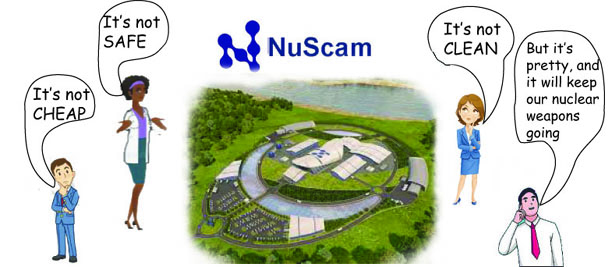
in order to make advanced reactors accessible within the next few decades—even relatively simple reactors, like NuScale’s—the government would need to provide hundreds of billions of dollars in subsidies …… the nuclear dream looks dead on arrival….
Biden’s Other Nuclear Option, Smaller nuclear reactors might be the bridge to a carbon-free economy. But are they worth it? Mother Jones, 22 Feb 21, BOYCE UPHOLT ”………..
But are these investments worth the money—and the risks? New designs or not, nuclear plants face daunting issues of waste disposal, public opposition, and, most of all, staggering costs. We must ramp up our fight against climate change. But whether nuclear is a real part of the solution—or just a long-shot bid to keep a troubled industry alive—is a debate that will come to the fore in the short window we have to overhaul the nation’s energy portfolio.
Few issues divide us as cleanly as nuclear power. According to a 2019 Pew Research Center poll, 49 percent of Americans support opening new plants, while 49 percent are opposed.
The popular argument against nuclear power can be summed up in a few names: Chernobyl. Fukushima. Three Mile Island. Nuclear dread is palpable. Some formerly pro-nuclear countries, like Germany, began phasing out plants in the wake of the 2011 disaster in Japan. The dangers begin well before nuclear fuel arrives at a plant, and persist long afterward; the rods that fuel today’s plants remain radioactive for millennia after their use. How to ethically store this waste remains a Gordian knot nobody has figured out how to cut.
The argument in favor of nuclear power boils down to the urgent need to combat climate change. [Ed, but nuclear does not really combat climate change.]
But if nuclear power is going to help us mitigate climate change, a lot more reactors need to come online, and soon. Eleven nuclear reactors in the United States have been retired since 2012, and eight more will be closed by 2025. (When nuclear plants are retired, utility companies tend to ramp up production at coal- or natural gas–fired plants, a step in the wrong direction for those concerned about lowering emissions.) Since 1970, the construction of the average US plant has wound up costing nearly three-and-a-half times more than the initial projections. Developers have broken ground on just four new reactor sites since Three Mile Island. Two were abandoned after $9 billion was.. sunk into construction; two others, in Georgia, are five years behind schedule. The public is focused on risks, but “nuclear power is not doing well around the world right now for one reason—economics,” says Allison Macfarlane, a former commissioner of the Nuclear Regulatory Commission.
Until Three Mile Island, public support was strong. Dozens of plants came online. In the 1970s, Reyes, seeing an industry full of promise, decided to pursue a degree in nuclear engineering.
……… Utah Associated Municipal Power Systems, a state-owned agency that sells electricity across six Western states aims to offer its members the choice of fully carbon-free power, sees NuScale as the best available option for undergirding its existing wind and solar plants. In 2015, UAMPS announced a plan to build 12 NuScale reactors at the federally run Idaho National Laboratory. NuScale projected total construction costs at $3 billion—nearly a third less than the most recently completed US reactor, which came online in 2016 at a cost of $4.7 billion (though it will supply more power). And the next plant should cost even less, since NuScale’s small reactors will be built on an assembly line, rather than on-site. But the price will drop only if more customers buy them. “Taxes are more popular than nuclear power,” jokes Doug Hunter, the CEO of UAMPS.
To change that perception, Hunter and his team have spent the last few years visiting towns and utility companies that buy power from UAMPS, explaining the potential role of nuclear power and the safety of NuScale’s design. His persistence paid off. By 2020, the majority had signed on to the NuScale project—though only as long as they had plenty of chances to back out if the project went south……….
Even with new technology, we will need to mine uranium—a process that has leached radioactive waste into waterways—and find somewhere to put the spent fuel. (The current practice, which persists at Trojan and will be employed at NuScale’s plants, is to hold waste on-site. This is intended to be a temporary measure, but every attempt to find a permanent disposal site has been stalled by geological constraints and local opposition.) Lloyd Marbet, Director of the non-profit Oregon Conservancy Foundation believes we need to transition away from coal and gas immediately. But he worries that nuclear is too expensive, and a new round of investment might pull money away from more effective, and cleaner, solutions. ……….
These days, he’s watching the industry creep back. A Republican state senator named Brian Boquist has proposed a bill three times that would permit city or county voters to exempt themselves from the 1980 law, allowing a nuclear facility to be built within their borders. (The bill has failed twice; the latest version is with the senate committee.) Boquist does not seem particularly committed to fighting climate change: He and other members of the Republican minority refused to show up to vote on a cap-and-trade bill in early 2020, causing the Senate to fall short of a quorum. (When Gov. Kate Brown threatened to retrieve legislators using state troopers, Boquist said to “send bachelors and come heavily armed.”)
In 2017, as the legislature debated Boquist’s first pro-nuclear bill, Marbet testified that NuScale was making “an end run around [voters] in their quest for corporate profit.” He also noted the company’s ties to the Fluor Corporation. The Texas-based multinational engineering firm that has been NuScale’s majority owner since 2011 has invested $9.9 million in campaign contributions over the past 30 years, with nearly two-thirds going toward Republican candidates. (Fluor is currently under investigation by the Securities and Exchange Commission due to allegedly sloppy accounting practices.)
Marbet admits his view of the industry is jaundiced, but his experiences make him skeptical of NuScale and its claims. He worries, too, that if small reactors take off, operators will revert to old habits, cutting corners to make a buck. He points to a draft rule approved last year by the Nuclear Regulatory Commission, over the objections of FEMA, that would reduce the size of the emergency planning zone around nuclear plants: Rather than a 10-mile-wide circle, a plant would only need an evacuation plan for the space within its fence lines. NRC commissioner Jeff Baran opposed the change, noting it is based on assumptions about small reactors, like NuScale’s, that remain on the drawing board, and might open the door to weakening safety standards for existing plants.
Old-line environmental groups like Greenpeace and the Sierra Club remain staunchly opposed to nuclear power, but politicians have been more open to it.
President Barack Obama was an outspoken proponent of nuclear’s potential. For 2020, the Senate Appropriations Committee unanimously agreed to spend more than President Trump requested on nuclear research, and the Senate is currently considering a bipartisan bill that will streamline the permitting process and establish a national uranium reserve.
Now, as part of his $2 trillion climate plan, Biden is calling for a federal research agency that would pursue carbon-free energy sources, including small reactors. Biden’s was the first Democratic Party platform in 48 years that explicitly supported an expansion of nuclear energy. His pick to lead the Department of Energy—which devotes the majority of its budget to nuclear projects—is former Michigan Gov. Jennifer Granholm, who has little experience in the field. Gina McCarthy, the former EPA administrator who is Biden’s chief domestic climate coordinator, has said that nuclear could play a key role in baseload power supply but indicated that waste disposal issues ought to be resolved before the technology is widely adopted.
A major hurdle for any advanced nuclear product is the regulatory process. NuScale spent more than $500 million developing its licensing application. The path to approval has consumed 12 years already, and it’s not over yet. In the months after my visit to NuScale, the Nuclear Regulatory Commission noted “several potentially risk-significant” questions that remain unanswered about the company’s reactor design, especially about its new version of a steam generator. Nonetheless, the NRC granted its initial approval of the design at the end of the summer; now NuScale awaits official, final certification by the commissioners, which is expected sometime this year. But further analysis of the generators will be required before a license is granted to actually build a plant.
A decade ago, NuScale suggested it might have a plant in operation by 2018. Now construction won’t begin until 2025 at the earliest. The plant at Idaho National Laboratory won’t be fully operational until 2030. Factoring in interest and other costs not included in NuScale’s $3 billion estimate, UAMPS expects a total 40-year lifetime cost of $6 billion for the plant. Some critics see this as the same old story: grand, early promises—a “dog and pony show,” as Marbet calls NuScale’s PR—followed by cost overruns and delays. Reyes intentionally used materials familiar to regulators, so as to speed along the process. But other advanced reactor designs, which use new kinds of fuel and coolant, may face an even slower and more expensive journey.
Recently, nine towns—more than a quarter of the subscribed members—pulled out of UAMPS’s project after changing their minds about their energy needs or worrying that it was becoming a financial sinkhole. (Meanwhile, one new town signed on.) The plant’s economics depend on running near full capacity, which will only happen if utilities outside of UAMPS also buy some of its power. The Department of Energy says it will chip in nearly $1.4 billion over the next nine years, which should help bring down the cost of the plant’s energy. But the projected price—$55 per megawatt-hour—is still above the current costs for solar and wind projects. And the federal money will require annual congressional approval. It’s possible that other new ideas might pop up, competing for limited dollars.
Biden’s climate plan hinges on a massive expenditure on research. What his administration will have to quickly decide, though, is how to divvy that pot. Allison Macfarlane, the former NRC commissioner, told me other industries deserve far more of our resources and attention than nuclear. Batteries, in particular, could steady out the uneven flow of renewables. They may even work better, since nuclear plants are difficult to power up or down in response to changing conditions. Once a pie-in-the-sky idea, battery storage now offers costs at least “in the ballpark” of nuclear, says Stan Kaplan, a former US Energy Information Administration analyst. Prices have dropped 70 percent in the past few years and are projected to drop another 45 percent before NuScale’s plant comes online. California—which also has a moratorium on nuclear builds—is rapidly expanding its storage capacity. Within 10 years, the niche that NuScale is aiming for might already be filled.
……. For nuclear to persist as a hedge, it all but requires government assistance, given the enormous upfront costs of R&D. Another challenge is vetting which projects have real promise. “You have all these reactor vendors pitching their wares, and making all sorts of outrageous and false claims,” says Edwin Lyman, the director of nuclear power safety with the Union of Concerned Scientists. These claims have also been the basis of lowering safety standards, which offers a large indirect subsidy for operators. There needs to be a stronger peer-review process, he says, to make sure the government is only sponsoring truly worthwhile projects.
A recent study from Princeton found that even without nuclear power, the relative cost of a decarbonized energy system in 2050 could be about the same as in 2015, which at the time was a historic low. The study found nuclear could reduce costs even further—if it becomes as cheap as its advocates hope. But Abdulla, the UC San Diego researcher, has calculated that in order to make advanced reactors accessible within the next few decades—even relatively simple reactors, like NuScale’s—the government would need to provide hundreds of billions of dollars in subsidies and substantially simplify the regulatory process. Abdulla believes nuclear energy should have been “an arrow in our quiver.” But given the economics, he says, “I fear the arrow has broken.”
 if money were no object—if we could snap our fingers and scatter reactors across the landscape—…… But if Abdulla’s numbers are right, the nuclear dream looks dead on arrival…. https://www.motherjones.com/environment/2021/02/nuclear-energy-climate-change-nuscale-green-power-uranium/
 A great article. Just one problem. The whole article runs with the assumption that nuclear power is effectively ”low carbon”. Yet this assumption is not challenged. There are several ways in which nuclear power is actually quite high carbon. Just for one comparison with reneewable energy: wind and solar power are delivered directlly to the turbines and panels – with no digging up of fuel required, no regular transport by road, rail etc. The entire nuclear fuel chain with all its steps – mining, milling, conversion, fuel fabrication, reactor, waste ponds, waste canisters , deep repositaory … all this is carbon emitting.
‘Medical Scientific’ committee, stacked with nuclear executives, promotes nuclear power in space
 “The nuclear industry views space as a new—and wide-open—market for their toxic product that has run its dirty course on Mother Earth.”
“Now it appears that the nuclear industry has also infiltrated the National Academies of Sciences, Engineering, and Medicine that has been studying missions to Mars. ”
It’s going to take enormous grassroots action—and efforts by those in public office who understand the error of the space direction being taken—to stop it.
Nuclear Rockets to Mars?, BY KARL GROSSMAN– CounterPunch, 16 Feb 21,
A report advocating rocket propulsion by nuclear power for U.S. missions to Mars, written by a committee packed with individuals deeply involved in nuclear power, was issued last week by the National Academies of Sciences, Engineering and Medicine.
The 104-page report also lays out “synergies” in space nuclear activities between the National Aeronautics and Space Administration and the U.S. military, something not advanced explicitly since the founding of NASA as a civilian agency supposedly in 1958.
The report states: “Space nuclear propulsion and power systems have the potential to provide the United States with military advantages…NASA could benefit programmatically by working with a DoD [Department of Defense] program having national security objectives.”’
The report was produced “by contract” with NASA, it states.
The National Academy of Sciences, Engineering and Medicine (NAS) describes itself as having been “created to advise the nation” with “independent, objective advice to inform policy.”
The 11 members of the committee that put together the report for the National Academy includes: Jonathan W. Cirtain, president of Advanced Technologies, “a subsidiary of BWX Technologies which is the sole manufacturer of nuclear reactors for the U.S. Navy,” the report states; Roger M. Myers, owner of R. Myers Consulting and who previously at Aerojet Rocketdyne “oversaw programs and strategic planning for next-generation in-space missions [that] included nuclear thermal propulsion and nuclear electric power systems; Shannon M. Bragg-Sitton, the “lead for integrated energy systems in the Nuclear Science and Technology Directorate at the Idaho National Laboratory:” Tabitha Dodson, who at the U.S. government’s Defense Advanced Research Project Agency is chief engineer of a program “that is developing a nuclear thermal propulsion system;” Joseph A. Sholtis, Jr., “owner and principal of Sholtis Engineering & Safety Consulting, providing expert nuclear, aerospace, and systems engineering services to government, national laboratories, industry, and academia since 1993.” And so on.
The NAS report is titled: “Space Nuclear Propulsion for Human Mars Exploration.” It is not classified and is available here.
Bruce Gagnon, coordinator of the Global Network Against Weapons and Nuclear Power in Space, from its offices in Maine in the U.S., declared: “The nuclear industry views space as a new—and wide-open—market for their toxic product that has run its dirty course on Mother Earth.”
“During our campaigns in 1989, 1990, and 1997 to stop NASA’s Galileo, Ulysses and Cassini plutonium-fueled space probe launches, we learned that the nuclear industry positioned its agents inside NASA committees that made the decisions on what kinds of power sources would be placed on those deep space missions,” said Gagnon. “Now it appears that the nuclear industry has also infiltrated the National Academies of Sciences, Engineering, and Medicine that has been studying missions to Mars. The recommendation, not any surprise, is that nuclear reactors are the best way to power a Mars mission.”
“It’s not the best for us Earthlings because the Department of Energy has a bad track record of human and environmental contamination as they fabricate nuclear devices. An accident at launch could have catastrophic consequences.”
Stated Gagnon: “We fought the DoE and NASA on those previous nuclear launches and are entering the battle again. The nuclear industry has its sights set on nuclear-powered mining colonies on an assortment of planetary bodies—all necessitating legions of nuclear devices being produced at DoE and then launched on rockets that blow up from time to time.”
“We urge the public to help us pressure NASA and DoE to say no to nukes in space. We’ve got to protect life here on this planet. We are in the middle of a pandemic and people have lost jobs, homes, health care and even food on their table.”
“Trips to Mars can wait,” said Gagnon.
There have been accidents in the history of the U.S.—and also the former Soviet Union and now Russia—using nuclear power in space……
(Article goes on to explain how solar power can be, and is being used for space travel and research)
The NAS committee, however, was mainly interested in a choice between a “nuclear thermal propulsion” (NTP) or “nuclear electric propulsion” (NEP) for rocket propulsion…….
“Advanced nuclear propulsion systems (along or in combination with chemical propulsion systems) have the potential to substantially reduce trip time” to Mars “compared to fully non-nuclear approaches,” says the report.
An issue: radioactivity from either of the systems affecting human beings on the rockets with nuclear reactors propelling them. Back after World War II with the Cold War beginning, the U.S. began working on bombers propelled by onboard nuclear reactors—even built one. The idea was that such bombers could stay aloft for days ready to drop nuclear weapons on the Soviet Union. No crews would need to be scrambled and bombers then sent aloft.
But, as The Atlantic magazine noted in a 2019 article titled, “Why There Are No Nuclear Airplanes”:
“The problem of shielding pilots from the reactor’s radiation proved even more difficult. What good would a plane be that killed its own pilots? To protect the crew from radioactivity, the reactor needed thick and heavy layers of shielding. But to take off, the plane needed to be as light as possible. Adequate shielding seemed incompatible with flight. Still, engineers theorized that the weight saved from needing no fuel might be enough to offset the reactor and its shielding. The United States spent 16 years tinkering with the idea, to no avail”
The Eisenhower administration concluded that the program was unnecessary, dangerous, and too expensive. On March 28, 1961, the newly inaugurated President John F. Kennedy canceled the program. Proposals for nuclear-powered airplanes have popped up since then, but the fear of radiation and the lack of funding have kept all such ideas down.”……
The “synergies” in space nuclear activities between NASA and the U.S. military advanced in the NAS report mark a change in public acknowledgement. The agency was supposed to have a distinctly civilian orientation, encouraging peaceful applications in space science.
However, throughout the decades there have been numerous reports on its close relationship with the U.S. military—notably during the period of NASA Space Shuttle flights. As a 2018 piece in Smithsonian Magazine noted, “During the heyday of the space shuttle, NASA would routinely ferry classified payloads into orbit for the Department of Deense among other projects the agencies have collaborated on.”
With the formation of a U.S. Space Force by the Trump administration in 2019, the NASA-Pentagon link would appear to be coming out of the shadows, as indicated by the NAS report. The Biden administration is not intending to eliminate the Space Force, despite the landmark Outer Space Treaty of 1967 put together by the U.S., the then Soviet Union and the U.K, setting aside space for peaceful purposes. It is giving the new sixth branch of U.S. armed forces “full support,” according to his spokesperson Jen Psaki.
The NAS report says, “Areas of common interest include (1) fundamental questions about the development and testing of materials (such as reactor fuels and moderators) that can survive NTP conditions and (2) advancing modeling and simulation capabilities that are relevant to NTP.” And, “Additionally, a NASA NTP system could potentially use a scaled-up version of a DoD reactor, depending on the design.”
It declares: “Threats to U.S. space assets are increasing. They include anti-satellite weapons and counter-space activities. Crossing vast distances of space rapidly with a reasonably sized vehicle in response to these threats requires a propulsion system with high Isp [Specific Impulse] and thrust. This could be especially important in a high-tempo military conflict.”
Moreover, on December 19, just before he was to leave office, Trump signed Space Policy Directive-6, titled “National Strategy for Space Nuclear Propulsion.” Its provisions include: “DoD [Department of Defense] and NASA, in cooperation with DOE [Department of Energy}, and with other agencies and private-sector partners, as appropriate, should evaluate technology options and associated key technical challenges for an NTP [Nuclear Thermal Propulsion] system, including reactor designs, power conversion, and thermal management. DoD and NASA should work with their partners to evaluate and use opportunities for commonality with other SNPP [Space Nuclear Power and Propulsion] needs, terrestrial power needs, and reactor demonstration projects planned by agencies and the private sector.”
It continues: “DoD, in coordination with DOE and other agencies, and with private sector partners, as appropriate, should develop reactor and propulsion system technologies that will resolve the key technical challenges in areas such as reactor design and production, propulsion system and spacecraft design, and SNPP system integration.”
It’s going to take enormous grassroots action—and efforts by those in public office who understand the error of the space direction being taken—to stop it.
Karl Grossman, professor of journalism at State University of New York/College at Old Westbury, and is the author of the book, The Wrong Stuff: The Space’s Program’s Nuclear Threat to Our Planet, and the Beyond Nuclear handbook, The U.S. Space Force and the dangers of nuclear power and nuclear war in space. Grossman is an associate of the media watch group Fairness and Accuracy in Reporting (FAIR). He is a contributor to Hopeless: Barack Obama and the Politics of Illusion. more https://www.counterpunch.org/2021/02/16/nuclear-rockets-to-mars/

Solar sails for space voyages
 Nuclear Rockets to Mars?, BY KARL GROSSMAN– CounterPunch, 16 Feb 21,”………. As for rocket propulsion in the vacuum of space, it doesn’t take much conventional chemical propulsion to move a spacecraft—and fast.
And there was a comprehensive story in New Scientist magazine this past October on “The new age of sail,” as it was headlined. The subhead: “We are on the cusp of a new type of space travel that can take us to places no rocket could ever visit.”
The article began by relating 17th Century astronomer Johanne Kepler observing comets and seeing “that their tails always pointed away from the sun, no matter which direction they were traveling. To Kepler, it meant only one thing: the comet tails were being blown from the sun.”
Indeed, “the sun produces a wind in space” and “it can be harnessed,” said the piece. “First, there are particles of light streaming from the sun constantly, each carrying a tiny bit of momentum. Second, there is a flow of charged particles, mostly protons and electrons, also moving outwards from the sun. We call the charged particles the solar wind, but both streams are blowing a gale”—that’s in the vacuum of space.
Japan launched its Ikaros spacecraft in 2010—sailing in space using the energy from the sun. The LightSail 2 mission of The Planetary Society was launched in 2019—and it’s still up in space, flying with the sun’s energy.
New systems using solar power are being developed – past the current use of thin-film such as Mylar for solar sails.
The New Scientist article spoke of scientists “who want to use these new techniques to set a course for worlds currently far beyond our reach—namely the planets orbiting our nearest star, Alpha Centauri.”……. more https://www.counterpunch.org/2021/02/16/nuclear-rockets-to-mars/
Accidents in both USA’s and Russia’s use of nuclear power in space
 Nuclear Rockets to Mars?, BY KARL GROSSMAN– CounterPunch, 16 Feb 21”…………There have been accidents in the history of the U.S.—and also the former Soviet Union and now Russia—using nuclear power in space.
And the NAS report, deep into it, does acknowledge how accidents can happen with its new scheme of using nuclear power on rockets for missions to Mars.
It says: “Safety assurance for nuclear systems is essential to protect operating personnel as well as the general public and Earth’s environment.” Thus under the report’s plan, the rockets with the nuclear reactors onboard would be launched “with fresh [uranium] fuel before they have operated at power to ensure that the amount of radioactivity on board remains as low as practicable.” The plans include “restricting reactor startup and operations in space until spacecraft are in nuclear safe orbits or trajectories that ensure safety of Earth’s population and environment” But, “Additional policies and practices need to be established to prevent unintended system reentry during return to Earth after reactors have been operated for extended periods of time.”
The worst U.S. accident involving the use of nuclear power in space came in 1964 when the U.S. satellite Transit 5BN-3, powered by a SNAP-9A plutonium-fueled radioisotope thermoelectric generator, failed to achieve orbit and fell from the sky, disintegrating as it burned up in the atmosphere, globally spreading plutonium—considering the deadliest of all radioactive substances. That accident was long linked to a spike in global lung cancer rates where the plutonium was spread, by Dr. John Gofman, an M.D. and Ph. D., a professor of medical physics at the University of California at Berkeley. He also had been involved in developing some of the first methods for isolating plutonium for the Manhattan Project.
NASA, after the SNAP-9A (SNAP for Systems Nuclear Auxiliary Power) accident became a pioneer in developing solar photovoltaic power. All U.S. satellites now are energized by solar power, as is the International Space Station.
The worst accident involving nuclear power in space in the Soviet/Russian space program occurred in 1978 when the Cosmos 954 satellite with a nuclear reactor aboard fell from orbit and spread radioactive debris over a 373-mile swath from Great Slave Lake to Baker Lake in Canada. There were 110 pounds of highly-enriched (nearly 90 percent) of uranium fuel on Cosmos 954.
Highly-enriched uranium—90 percent is atomic bomb-grade—would be used in one reactor design proposed in the NAS report. And thus there is a passage about it under “Proliferation and security.” It states that “HEU [highly enriched uranium] fuel, by virtue of the ease with which it could be diverted to the production of nuclear weapons, is a higher value target than HALEU [high assay low enriched uranium], especially during launch and reentry accidents away from the launch site. As a result, HEU is viewed by nonproliferation experts as requiring more security considerations. In addition, if the United States uses HEU for space reactors, it could become more difficult to convince other countries to reduce their use of HEU in civilian applications.”
As for rocket propulsion in the vacuum of space, it doesn’t take much conventional chemical propulsion to move a spacecraft—and fast……..more https://www.counterpunch.org/2021/02/16/nuclear-rockets-to-mars/
Big trouble ahead, on regulation issues, for countries desperately trying to export small nuclear reactors
 Regulatory Harmonization: An Upcoming Hurdle for SMRs?
Nuclear developers may have problems selling small modular reactors abroad. GreenTech Media JASON DEIGN FEBRUARY 15, 2021 The nuclear industry is betting on small modular reactors (SMRs) to regain its competitive edge in markets such as the U.S. and Canada. Proponents say the reactors can be built cheaply once multiple units start being ordered and can even lead to lucrative export opportunities.There’s just one problem. If you build an SMR in the U.S., for example, you can’t sell it in Canada until Canadian regulators have approved the design. And the same goes for every other nuclear market in the world. Even nuclear insiders recognize that this could be a big issue for SMRs.
Regulatory harmonization has a lot to do with whether or not SMRs are going to be able to achieve cost competitiveness,” stated John Gorman, president and CEO of the Canadian Nuclear Association, in an interview.
… national regulations cover everything from food safety to vehicle emissions.
But the hyper-safety-conscious nuclear industry takes regulation to a whole new level. The SMR manufacturer NuScale, for example, claims to have spent more than $500 million, plus 2 million labor hours, in the process of passing its U.S. Nuclear Regulatory Commission Design Certification Application…….
National regulations are not just highly detailed but also wildly divergent. The differences between the regulatory regimes in the U.S. and the U.K., for example, reflect not just different jurisdictions but entirely different safety philosophies.
……… even a regulatory approval from the Canadian Nuclear Safety Commission won’t pass muster in the U.S.,,,,, https://www.greentechmedia.com/articles/read/regulatory-harmonization-an-upcoming-hurdle-for-smrs
Even a pro nuclear enthusiast admits that Small Nuclear Reactors cause toxic radioactive wastes
 13 Feb 21 I was quite fascinated to note a paragraph in a long nuclear propaganda article, (by Stikeman Elliott, in Mondaq) yesterday, in which this, hitherto rather hidden problem, gets a mention.
Of course, this pro nuclear writer is not really worried all that much about the actual problem.
Oh no – his concern is about the public’s perception of it – that public perception might hamper the develoment of the nuclear lobby’s newest gimmick. Can’t have that!
”…….efforts need to be made to address the perceived risks so as to establish confidence in the ability of SMRs to operate safely while proving to be a viable source of low-carbon energy.
While SMRs produce less nuclear waste than traditional reactors, the issue of radioactive waste still exists. Nuclear waste needs to be safely stored and transported to secure facilities. SMRs have often been proposed as a solution for electricity generation in remote areas, but this proves problematic from a waste perspective as any nuclear waste would need to be transported over long distances. There is currently no permanent nuclear waste storage site in Canada……”
Not mentioned? Nuclear fusion is hugely expensive, and this quest has produced much toxic waste

|
Radiation Free Lakeland 11th Feb 2021, The local News and Star and other press have reported uncritically that ….“The Moorside Clean Energy Hub came out on top in the mini
competition. Cumbria LEP will now work with Copeland Borough Council in a bid to bring the cutting edge technology to Copeland. If successful, a prototype of the fusion reactor, which Professor Stephen Hawking has called “the key to the future” could be housed at Moorside; along with the Small Modular Reactors that are already in the works. This is right at the cutting edge of green energy” said deputy chairman of Copeland Borough Council David Moore.” What NuSpeak is this! Nuclear is not clean and
Fusion is Expensive as in off the richter scale ..it uses huge energy, needs tritium etc ..doesnt work (as in produce net energy) despite decades of funding and produces waste even tho they claim it doesnt. There was a telling article framed as a Brexit story in the Financial Times but the big reveal was that Fusion research reactors (RESEARCH reactors!) have produced enormous amounts of nuclear waste.https://mariannewildart.wordpress.com/2021/02/11/fusion-profligate-nuclear-waste-and-tritium-tainted-nightmare-for-cumbria-and-lancashire-no-thanks/ |
|
UK universities partnering with Chinese technology companies may be breaching national security rules
affairs committee, to alert Manchester University to the fact that a
Chinese company with which it was collaborating was implicated in
Beijing’s persecution of the Uighurs.
its partner’s role in providing surveillance technology used to spy on
China’s Muslim minority.
universities cut off links with CETC in 2019 after similar warnings. But
what is more troubling is that Manchester appears to be far from alone in
partnering with Chinese companies with defence links on cutting-edge
scientific research. Indeed the Foreign Office is investigating more than a
dozen universities for possible breaches of national security rules.
Deploying weapons in space crosses a threshold that cannot be walked back.

weaponizing space could become a classic case of trying to solve one problem while creating a much worse problem.
It’s time for arms control planning to address the issues raised by this drift toward militarization of space. Space is a place where billions of defense dollars can evaporate quickly and result in more threats about which to be concerned. China and Russia have been proposing mechanisms for space arms control at the United Nations for years; it’s time for the U.S. to cooperate in this effort.
Deploying weapons in space crosses a threshold that cannot be walked back.
The US should negotiate a ban on basing weapons in space, BY JOHN FAIRLAMB, — 02/04/21, https://thehill.com/opinion/national-security/536774-the-us-should-negotiate-a-ban-on-basing-weapons-in-space
The Biden administration is assembling a deep bench of personnel with experience negotiating arms control agreements and already has agreed with Russia to extend the New Start Treaty. It’s clear the administration intends to initiate another look at the 2018 Nuclear Posture Review and the massive buildup in nuclear weapons begun by the Trump administration. While it’s good that the Biden administration intends to resume negotiations to continue nuclear force reductions, the specter of placing weapons in space is another area that requires a serious arms control effort.
Now that separate space organizations have been established, major military commands are advocating to develop new capabilities. Pentagon buzzwords characterize space as a “contested domain” and some consider actual war-fighting in space to be inevitable. Some advocates argue that the U.S. should strive for technological superiority in space to ensure our dominance of that critical domain.
The history of technological advancement in weapons systems shows that any advantage gained usually lasts fewer than five years and guarantees a cycle of ever-increasing cost and new perceptions of threat. Already, there are weapons that can be targeted against space-based assets from non-space domains. Russia and China are believed to have deployed ground-based capabilities to attack satellites, and India joined this club last year by using a ground-based missile to bring down a satellite.
Although it isn’t clear how the Biden administration will shape space policy, during his confirmation hearing, Secretary of Defense Lloyd Austin seemed to signal a shift away from a more muscular approach and back to a focus on space resiliency and protecting U.S. space assets. As one analyst concluded, the language Austin used signals the Biden team wants to “start to lean away from … the pugilistic aspects of what’s been articulated [by the Trump administration].” Responding to a question about what his advice would be to the U.S. Space Command concerning military space operations, Austin stressed measures to protect U.S. assets that don’t include offensive options for taking the fight to adversaries. While not a fully articulated space policy, this is a welcome change of tone after the past few years of heavy breathing about waging war in space.
If the U.S. and other nations continue the current drift toward organizing and equipping to wage war in space, Russia, China and others will strive to improve capabilities to destroy U.S. space assets. Over time, this would greatly increase the threat to the full array of U.S. space-based capabilities. Intelligence, communications, surveillance, targeting and navigation assets already based in space, upon which the Department of Defense (DOD) depends for command and control of military operations, increasingly would be at significant risk. As a consequence, weaponizing space could become a classic case of trying to solve one problem while creating a much worse problem.
For example, buried in the DOD 2020 budget is $150 million for research into putting missile defense assets in space to attack enemy nuclear missiles in the boost phase. If the U.S. or another nation does deploy weapons in space, it would be the first country to do so and likely would be a disaster for strategic stability. To ensure the credibility of their nuclear deterrents, Russia, China and others could be expected to respond by deploying additional and new types of long-range ballistic missiles, as well as missiles employing non-ballistic trajectories that are harder to hit. Russia and China also would strive to improve their ability to destroy U.S. space-based interceptors, which would greatly increase the threat to the full array of U.S. space assets.
It’s time for arms control planning to address the issues raised by this drift toward militarization of space. Space is a place where billions of defense dollars can evaporate quickly and result in more threats about which to be concerned. China and Russia have been proposing mechanisms for space arms control at the United Nations for years; it’s time for the U.S. to cooperate in this effort.
In 2015, Frank Rose, assistant secretary for arms control, verification and compliance in the State Department, called for arms control in space at the Association of Southeast Asian Nations Regional Forum workshop on space security. But, he said the Obama administration opposed a 2008 Russian and Chinese proposal to ban all weapons in space because it was unverifiable, contained no prohibition on developing and stockpiling space arms, and did not address ground-based space weapons such as direct ascent anti-satellite missiles.
Instead of just criticizing others’ proposals, the U.S. should join in the effort and do the hard work of crafting a space arms control agreement that deals with the concerns we have and that can be verified. A legally binding international treaty banning the basing of weapons in space should be the objective.
Let’s be clear: Deploying weapons in space crosses a threshold that cannot be walked back. Given the implications for strategic stability, and the likelihood that such a decision by any nation would set off an expensive space arms race in which any advantage gained would likely be temporary, engaging now to prevent such a debacle seems warranted.
John Fairlamb, Ph.D., is a retired Army colonel with 45 years of government service, much of it in joint service positions formulating and implementing national security strategies and policies, including two four-year details in the Department of State and as the political-military affairs adviser for a major Army command. His doctorate is in comparative defense policy analysis.
America’s new strategy for space nuclear power pays little consideration to safety aspects
 America’s New Strategy for Space Nuclear Power, By Zhanna Malekos Smith. Wednesday, February 3, 2021
Among the flurry of executive orders and proclamations signed during his final weeks in office, President Trump issued two directives that have received little fanfare—about space. One directive concerns enhancing the cybersecurity of GPS satellites. The other is perhaps more exciting: It focuses on exploring Mars and the moon.
Unsafe plan for abandoning nuclear reactors onsite, and developing Small Nuclear Reactors
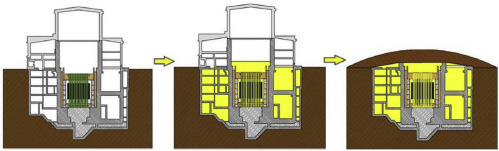
“IAEA guidance that entombment is not considered an acceptable strategy for planned decommissioning of existing [nuclear power plants] and future nuclear facilities.”
|
Groups oppose plans to abandon defunct nuclear reactors and radioactive waste, https://rabble.ca/columnists/2021/02/groups-oppose-plans-abandon-defunct-nuclear-reactors-and-radioactive-wasteThe Canadian Nuclear Safety Commission (CNSC) has just given a green light to the preferred industry solution for disposal of nuclear reactors — entomb and abandon them in place, also known as “in-situ decommissioning.” This paves the way for the introduction of a new generation of “small modular” nuclear reactors or SMRs. Over 100 Indigenous and civil society groups have signed a public statement opposing SMR funding, noting that the federal government currently has no detailed policy or strategy for what to do with radioactive waste. Many of these groups are also participating in a federal radioactive waste policy review launched in November 2020. The Assembly of First Nations passed resolution 62/2018 demanding that the nuclear industry abandon plans for SMRs and that the federal government cease funding them. It calls for free, prior and informed consent “to ensure that no storage or disposal of hazardous materials shall take place in First Nations lands and territories.”
An SMR emits no radiation before start-up (other than from uranium fuel) and could easily be transported at that stage. But during reactor operation, metal and concrete components absorb neutrons from the splitting of uranium atoms — and in the process, transform into radioactive waste. Removing an SMR after shut-down would be difficult and costly, and comes with the need to shield workers and the public from its radioactivity. Abandoning nuclear reactors on site has been in the works for some time. CNSC helped draft a 2014 nuclear industry standard with in-situ decommissioning as an option and then included it in a July 2019 draft regulatory document. However, when the International Atomic Energy Agency (IAEA) released a peer-reviewed report on Canada’s nuclear safety framework last February, it said in-situ decommissioning is “not consistent” with IAEA safety standards. The IAEA suggested that CNSC “consider revising its current and planned requirements in the area of decommissioning to align with the IAEA guidance that entombment is not considered an acceptable strategy for planned decommissioning of existing [nuclear power plants] and future nuclear facilities.” It also noted that CNSC is reviewing license applications for in-situ decommissioning of shut-down federal reactors in Ontario and Manitoba, and encouraged Canada “to request an international peer review of the proposed strategy” for legacy reactors. But CNSC continued to pursue this strategy. Clever language in a June 2020 document appeared to rule out on-site reactor disposal, but left the door open where removal is not “practicable”:
At public meeting last June, CNSC Commissioner Sandor Demeter asked: “why are future facilities in this sentence when in fact we should be designing them so that in-situ decommissioning is not the option?” Former CNSC staff member Karine Glenn replied that “leaving some small parts of a structure behind…especially if you are in a very, very remote area, may be something that could be considered.” Glenn is now with the industry-run Nuclear Waste Management Organization, tasked with leading the development of a radioactive waste management strategy for Canada. Commissioners decided to approve the regulatory document, but with added text to clarify where in-situ decommissioning would be acceptable. They asked for additional text on “legacy sites” and “research reactors,” stating that “[t]he Commission need not see this added text if it aligns with the oral submissions staff made in the public meeting.” But no new clarifying text was added to the final version of the document published on January 29, 2021. It enables abandonment of SMRs — by retaining the reference to future nuclear facilities — and of “research and demonstration facilities, locations or sites dating back to the birth of nuclear technologies in Canada for which decommissioning was not planned as part of the design.” The CNSC seems willing to ignore international safety standards — and a decision of its own commission — to accommodate nuclear industry proponents of SMRs and allow radioactive waste to be abandoned in place. Meanwhile, the federal government has assigned the nuclear industry itself — via the Nuclear Waste Management Organization — the task of developing a radioactive waste strategy for Canada. Barring public outcry, that strategy will be abandonment. Ole Hendrickson is a retired forest ecologist and a founding member of the Ottawa River Institute, a non-profit charitable organization based in the Ottawa Valley. |
|
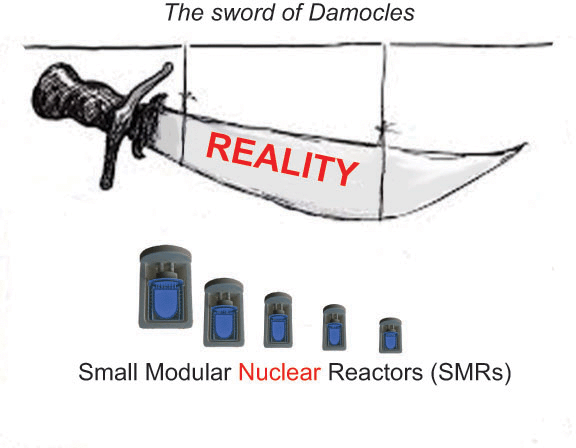
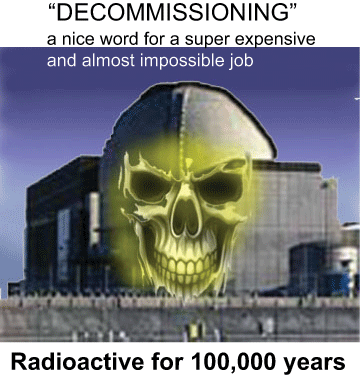
USA preparing for war in space

SPACECOM’s New Vision Targets ‘Space Superiority’
“We must have fully integrated offensive and defensive operations across all of our services, as well as our partners,” says Army Gen. James Dickinson, SPACECOM commander.
Breaking Defense, By THERESAHITCHENSon January 28, 2021 “……… “The intended audience is both internal and external,” Army Gen. James Dickinson told me in an interview yesterday. “Internally, the objective is to set the stage for SPACECOM personnel to develop and sustain a warfighting mindset necessary for our mission challenges in this new warfighting domain.”………
Dickinson’s eight-page manifesto, “Never A Day Without Space: Commander’s Vision” — provided to Breaking D — was briefed to SPACECOM today. It will be the “baseline” for future development of subordinate SPACECOM planning guidance, campaign plans, operational plans and other organizational documents required to running the 18-month-old Combatant Command, Dickinson explained.
The general’s stress on the need for both ‘offensive and defensive’ operations to achieve space superiority is not new, even if it makes some US security experts — including some Democrats in Congress — a bit queasy. It is one of the first things his predecessor, Air Force Gen. Jay Raymond who now heads the Space Force, made clear when SPACECOM was stood up in August 2019……..
Unified Command Plan and Missions
As Breaking D readers were first to learn, the revised UCP sent by Chairman of the Joint Chiefs of Staff Gen. Mark Milley to President Trump included a number of changes designed to delineate the role of SPACECOM — designated as a new geographic command with an area of responsibility (AOR) from 100 kilometers above the Earth to, well, infinity and beyond in theory — vice the 10 other Combatant Commands. These include giving SPACECOM the lead in deciding who gets priority use of communications satellites during combat, and what targets missile warning and space surveillance sensors are tasked to monitor. Trump signed the revised 2020 UCP Jan. 13, a spokesperson for the Joint Staff confirmed……..
Dickison elaborated during his conversation with Mitchell Institute Dean Dave Deptula that SPACECOM now has three primary missions: “One, our enduring, no-fail mission to enable warfighting operations in other domains. Two, our future mission as global SATCOM manager and global sensor manager. And three, our current new mission set compelling us to fight and win in the space domain in order to protect and defend our interests there.
“Additionally, this warfighting domain is growing, and this AOR is by far the biggest and is getting bigger, each day,” he added………
The ‘protect and defend’ mission, which would include any offensive action in a conflict, is carried out by the Joint Task Force Space Defense, commanded by Brig. Gen. Tom James. ………
Despite the new UCP, however, Dickinson was coy with me about how exactly the decisions about who supports whom when are actually made, and at what level of the US military hierarchy. “Command decisions reside with the Combatant Commander,” he said, although “many of those decisions may be made well above us depending on the situation.”
Some of this, he said, is because such details remain classified. However, a number of sources intimately familiar with these issues tell me that a big problem is that there simply hasn’t yet been any agreements codified on how those decisions will be made. The hope is that the impending Joint Warfighting Concept, in which space plays a central role, will go some ways toward clarifying those questions………… https://breakingdefense.com/2021/01/spacecoms-new-vision-targets-space-superiority/
1 This Month



26 September – International Day for the Total Elimination of Nuclear Weapons


PLEASE OPPOSE HR 8255 AND S.3639 – bills would accelerate satellite deployment, with no environmental review or safeguards – https://ncstd5li.quorum.us/campaign/169331/
To see nuclear-related stories in greater depth and intensity – go to https://nuclearinformation.wordpress.com
-
Archives
- September 2026 (257)
- August 2026 (330)
- July 2026 (355)
- June 2026 (287)
- May 2026 (306)
- April 2026 (356)
- March 2026 (251)
- February 2026 (267)
- January 2026 (308)
- December 2025 (358)
- November 2025 (359)
- October 2025 (375)
-
Categories
- 1
- 1 NUCLEAR ISSUES
- business and costs
- climate change
- culture and arts
- ENERGY
- environment
- health
- history
- indigenous issues
- Legal
- marketing of nuclear
- media
- opposition to nuclear
- PERSONAL STORIES
- politics
- politics international
- Religion and ethics
- safety
- secrets,lies and civil liberties
- spinbuster
- technology
- Uranium
- wastes
- weapons and war
- Women
- 2 WORLD
- ACTION
- AFRICA
- Atrocities
- AUSTRALIA
- Christina's notes
- Christina's themes
- culture and arts
- Events
- Fuk 2022
- Fuk 2023
- Fukushima 2017
- Fukushima 2018
- fukushima 2019
- Fukushima 2020
- Fukushima 2021
- general
- global warming
- Humour (God we need it)
- Nuclear
- RARE EARTHS
- Reference
- resources – print
- Resources -audiovicual
- Weekly Newsletter
- World
- World Nuclear
- YouTube
-
RSS
Entries RSS
Comments RSS

