The Chernobyl story continues
Chernobyl: The next phase https://www.ebrd.com/news/2021/chernobyl-the-next-phase.html By Axel Reiserer, 23 Apr 2021
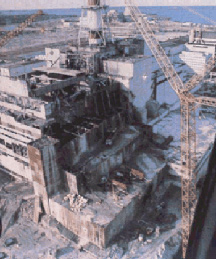
At 01:23:40 on 26 April 1986, the failure of a routine test at the Chernobyl Nuclear Power Plant in Ukraine, then part of the Soviet Union, caused reactor 4 to explode, releasing parts of its radioactive core. It was the worst nuclear accident the world had ever seen, with far-reaching political, economic and ecological consequences. Thirty-five years on, Chernobyl is still as well-known as it was a generation ago.
Fires broke out, causing the main release of radioactivity into the environment. Wind carried contaminated particles over Ukraine, Belarus and Russia, as well as parts of Scandinavia and wider Europe. The 50,000 inhabitants of the adjacent town of Pripyat were evacuated, never to return.
The accident destroyed reactor 4, killing 30 operators and firemen within three months and causing numerous other deaths in weeks and months that followed. To this day, it remains the only accident in the history of the civil use of nuclear power when radiation-related fatalities occurred. The precise number of short- and longer-term victims remains heavily disputed.
By 06:35 on 26 April, all fires at the power plant had been extinguished, apart from the fire inside reactor 4, which continued to burn for many days. Some 5,000 tonnes of boron, dolomite, sand, clay and lead were dropped from helicopters in a bid to extinguish the blaze. When the destroyed reactor was later enclosed in a provisional structure – the so-called sarcophagus – these fuel-containing materials were also walled in.
The sarcophagus was built under extremely hazardous conditions and unprecedented time pressure. By November 1986, a steel and concrete shelter was in place to lock away the radioactive substances inside the ruined reactor building and to act as a radiation shield. It was always intended as a temporary measure, with an estimated lifespan of 20-30 years
The search for a long-term solution started soon after, alongside the massive challenge of cleaning up the accident site. By the end of 1991, the Soviet Union had dissolved and newly independent Ukraine had been left with the Chernobyl legacy. Following a G7 Action Plan to improve nuclear safety in central and eastern Europe, the Nuclear Safety Account was set up at the European Bank for Reconstruction and Development (EBRD) in 1993. Two years later, the scope of the programme was extended to include Chernobyl.
A breakthrough came with the Shelter Implementation Plan in 1997, which provided a road map of how to the tackle the immediate and longer-term tasks. In the same year, the G7 officially invited the EBRD to set up and manage the Chernobyl Shelter Fund, which became the main vehicle for all efforts to ensure that the destroyed reactor 4 remained in an environmentally safe and secure state.
Emergency repairs in 1998 and 1999 prevented the imminent collapse of the sarcophagus, as well as a vent stack that was endangering the adjacent turbine hall over reactor 3, which was still in operation. It was only at the end of 2000 that all nuclear power generation in Chernobyl ceased. The following year saw a landmark decision to build an arch-shaped steel structure, called the New Safe Confinement (NSC), to seal off reactor 4.
In the subsequent years, several tasks were carried out simultaneously. Detailed technical work on the NSC started. The site had to be stabilised and prepared for the construction work. The first project the EBRD managed was the construction of a liquid radioactive waste treatment plant (LRTP) to handle some 35,000 cubic metres of low- and intermediate-level liquid waste at the site. Meanwhile, the safe storage of the spent fuel assemblies from reactors 1, 2 and 3 came into focus.
All this has been achieved. The LRTP has been operational since 2014. A new interim storage facility for the treatment and storage of spent fuel has been built and, after successful hot tests, is currently awaiting a permanent licence from the Ukrainian regulator. The NSC, the most visible Chernobyl project, was slid into position in late 2016 and then handed over to the Ukrainian authorities.
In total, the Bank has managed close to €2 billion in donor funds through the Chernobyl Shelter Fund and Nuclear Safety Account. Of this, the EBRD provided €715 million of its own resources to complete the Interim Storage Facility and New Safe Confinement.
Today, the New Safe Confinement dominates the skyline over Chernobyl, as the sarcophagus once did. The steel structure is 108 metres high and 162 metres long, with a span of 257 metres and a lifetime of at least 100 years. It was assembled in two stages in a cleaned area near the accident site and, despite its size and weight of 36,000 tonnes, was pushed 327 metres into position. It is the largest moveable structure ever built.

This is not where the story ends, however. The fact that the NSC has a lifespan of 100 years means that the next phase of work now has to be planned, agreed and implemented. The estimated 200 tonnes of radioactive nuclear fuel inside reactor 4 are now shielded by the New Safe Confinement. However, parts of the sarcophagus are becoming unstable and will have to be removed at some point. Once this is done, work will come closer to the reactor’s interior.
The EBRD remains a key partner in these efforts. Following a request by Ukraine, in November 2020, the Bank established the new International Chernobyl Co-Operation Account, aimed at creating an integrated plan for the site to serve as the basis for developing and implementing longer-term projects. The new fund will hold it first assembly meeting on Tuesday – fittingly one day after the 35th anniversary. The Chernobyl story continues.
USA: Small nuclear reactors cannot meet the critical climate need – now, or ever

The critical need for deep carbon pollution reductions this decade calls on us to focus on the low-carbon technologies we have now. And those are wind and solar. SMRs will be a dollar short and a day too late. They cannot meet critical climate deadlines, not by 2030 or 2035, and likely never.
Advanced Nuclear Dreaming in Washington State, CounterPunch, PATRICK MAZZA 19 Apr 21, It was once known by one of the most inadvertently appropriate acronyms ever, WPPSS, the Washington Public Power Supply System. “Whoops!,” as they called it, in the early 1980s brought on what was then the worst municipal bond default in U.S. history trying to build five nuclear reactors in Washington state at once, completing only one.
But faith in the nuclear future lives on at “Whoops!,” today rebranded as Energy Northwest. On April 1, the day perhaps also inadvertently fitting, the consortium of Washington state public utilities announced a move aimed at the first advanced nuclear reactor deployment in the U.S. Energy Northwest will partner with Grant County Public Utility District, a member utility serving a desert county in the center of the state, and X-energy, a leading developer of the nuclear industry’s bright shining hope, the small modular reactor (SMR)…………….
The WPPSS default was part of the first wave of nuclear failures in the U.S. In the wake of the 1979 Three Mile Island accident, approximately 100 proposed nuclear plants were cancelled. Recent years have seen a second round of failures. The Energy Policy Act of 2005 put $25 billion in nuclear subsidies on the table. That jumpstarted all of four nuclear reactors, two each in Georgia and South Carolina. The only way Wall Street would touch the projects was to make ratepayers carry the risk by paying for “work in progress” before the first watt is delivered. South Carolina ratepayers won’t even see that. Cost overruns killed the project there in 2017 after $9 billion was thrown away, setting up a political and court fight over whether ratepayers will continue to be soaked. The last two standing, Georgia’s Vogtle plants, were to have cost $14 billion and come on line in 2016-17. Now costs have doubled to $28 billion and scheduled completion this year and next is considered unlikely.
IS THE SMR A SOLUTION?
SMRs are the nuclear industry’s answer to avoid such failures in the future. Instead of being custom-built and individually licensed, SMRs are intended to cut costs by licensing a single design manufactured at a plant and sent for final assembly to their operating site. Smaller than the 1,000-megawatt-plus plants with which we’re familiar, SMRs are 100 MW or less, and designed with safety features to prevent meltdowns such as experienced at Japan’s Fukushima plant in 2011. Though there are questions about that, as covered below…………..
CAN THE SMR SAVE THE CLIMATE?

For now, the question is whether SMRs such as X-energy’s can really revive the nuclear industry, and most importantly, provide a climate solution with low-carbon electrical power in a meaningful timeframe. The answer, by simple logic, is no
…………Though deep carbon cuts must start quickly, the Washington state partnership gives a completion date for its SMR pilot project as 2027-28. Considering the nuclear industry’s track record, delays and cost overruns are likely. And that would only be the beginning of a long-process to create the entire manufacturing supply chain needed to make SMRs an economical alternative. If they can be. The key issue is economies of scale.
“Power generation scales on volume of the reactor vessels,” notes Arjun Makhijani, who has a Ph.D. in electrical engineering, with a specialization in nuclear fusion, from the University of California at Berkeley. “The materials and labor scale more slowly. That’s a basic reason that there are economies of scale and big reactors were built.”
The Union of Concerned Scientists (UCS) cites a study which shows that a reactor with 1,100 MW capacity would cost three times as much to build as a 180 MW plant, but produce six times the electricity, “so the capital cost per kilowatt would be twice as great for the smaller plant.”
SMRs lose those economies of scale, but proponents hope to make that up with mass manufacturing and licensing, avoiding costs of custom-built plants.
ROCKY ROAD TO MASS PRODUCTION
“The road to such mass manufacturing will be rocky,” Makhijani and M.V. Ramana write in a recent article, “Why Small Modular Reactors Won’t Help Counter the Climate Crisis.” “Even with optimistic assumptions about how quickly manufacturers could learn to improve production efficiency and lower cost, thousands of SMRs, which will all be higher priced in comparison to large reactors, would have to be manufactured for the price per kilowatt for an SMR to be comparable to that of a large reactor.”
That sets up “a chicken-and-egg economic problem,” they write. “Without the factories, SMRs can never hope to achieve the theoretical cost reductions that are at the heart of the strategy to compensate for the lack of economies of scale. But without the cost reductions, there will not be the large number of orders to stimulate the investments needed to set up the supply chain in the first place.”………….
WE DON’T NEED NUCLEAR
The world is running out of time to address all the concerns facing SMRs and advanced reactor designs in general.
“If you look at the cold facts from a climate point of view we have a shortage of time and money. New reactors cannot help materially,” Makhijani told The Raven. “How are we going to have a carbon-free electricity system by 2035 in which SMRs will play a significant role when the first one isn’t even supposed to come on line till the late 2020s? Those who are advocating new nuclear reactors should address the time constraint, and whether we can do it without nuclear. If we could not do it without, that would be another question. But we can. So there should be no question.”
Many studies document the capacity of wind and solar to replace fossil fuel electricity. The challenge of varying sunlight and wind speeds is met with a smart grid that can adjust energy demand to available supply and link diverse geographies. So when the wind is blowing on the Great Plains, it can supply juice while clouds block sunlight in Chicago. For times when none of that is sufficient, storage in many forms can be used, from batteries to pumped storage reservoirs. Even household water heaters. If all else fails, backup generators fueled with stored hydrogen can be brought into play. Hydrogen can be electrolyzed from water through solar and wind energy that would otherwise go unused because generation exceeds the demands of the grid.
Mark Jacobson of Stanford has done many studies documenting the capacity of wind, water and solar to meet all energy needs. A NOAA study showed carbon pollution from electricity could be cut up to 80% from 1990 levels by 2030, largely with wind and solar, needing no new nuclear and energy storage, while actually cutting electricity costs. That would require building a continental grid with efficient high-voltage DC lines to link diverse geographies. A study done by Makhijani for the Institute for Environmental and Energy Research, of which he is president, lays out a path to zero carbon electricity in Maryland.
ANOTHER WHOOPS?
Despite towering obstacles facing SMRs, from economic chicken-and-egg problems of ramping up production, to unsolved waste and proliferation issues, to remaining safety questions, the nuclear faithful at Energy Northwest soldier on. Yes, they now have operated a nuclear plant successfully since the 1980s, though questions have been raised about earthquake hazards in light of emerging seismic knowledge. Washington state has enacted a goal of 100% clean electricity by 2045, and nuclear advocates see it filling a role. In any event, new nuclear power from SMRs will be incapable of supplying a significant portion of low-carbon energy until well into the 2030s, even if economic and other issues are resolved.
All that time, any new nuclear reactors will be facing continuing cost declines in wind, solar and storage, as well as increasing deployment of smart grid technologies and advanced long-distance power transmission. If the Washington state partnership’s SMR installation actually is built and operated, with the 2027-8 timeline likely to be stretched out and the projected $2.4 billion cost figure likely to be exceeded, it could well be a costly white elephant, a relic of faith in a technology whose time has passed. The critical need for deep carbon pollution reductions this decade calls on us to focus on the low-carbon technologies we have now. And those are wind and solar. SMRs will be a dollar short and a day too late. They cannot meet critical climate deadlines, not by 2030 or 2035, and likely never. https://www.counterpunch.org/2021/04/19/advanced-nuclear-dreaming-in-washington-state/
Britain’s unlikely-to-succeed bet on Rolls Royce small nuclear reactors

…..Advanced Modular Reactors are unlikely to be available before 2045 if ever – much too late to be any help in tackling the climate emergency. .….
Small Modular Reactors s will only proceed if the risk to RR money is minimal. That means RR will only put serious effort into design development with government guarantees given now, before the design exists, and it has been reviewed by ONR, a demonstration plant has been completed, and costs are known.
SMRs will only proceed if the risk to RR money is minimal. That means RR will only put serious effort into design development with government guarantees given now, before the design exists, and it has been reviewed by ONR, a demonstration plant has been completed, and costs are known.
UK taxpayers would have to provide a large proportion of the cost of design development, navigating the regulators design assessment and assist in the setting up of component production lines. It would also have to guarantee orders for a minimum of 16 reactors, which, even on Rolls Royce’s unrealistic cost estimate, would be a commitment to spend nearly £30bn before it has progressed beyond a conceptual design.
Johnson Loves Pie in the Sky nuClear News N0. 131 April 2021, We saw in June 2020 (nuClear News No. 126) how the Nuclear Innovation and Research Advisory Board (NIRAB) has been advising the Department for Business, Energy and Industrial Strategy (BEIS) that we need three streams of nuclear product development and deployment:
• large-scale Light Water Reactors (LWRs), which are currently available and suitable for baseload electricity generation;
• small modular reactors (SMRs), which are based on the same proven technology and can offer additional flexibility to meet local energy needs;
• advanced modular reactors (AMRs), which typically have a higher temperature output, enabling them to contribute to decarbonisation through heat and hydrogen production, as well as generate electricity at competitive costs.
Small modular and advanced nuclear reactors are proposed, supposedly, as potential ways of dealing with some of the problems of large nuclear reactors —specifically economic competitiveness, risk of accidents, link to proliferation and production of waste. Yet Gregory Jaczko, Former Chair US Nuclear Regulatory Commission, says Advanced Nuclear Technologies should only be supported “if they can compete with renewables & storage on deployment cost & speed, public safety, waste disposal, operational flexibility & global security. There are none today.” (1)
The UK Government’s Policy Paper on ‘Advanced Nuclear Technologies’ (ANTs) specifies two broad categories of ANT. Firstly, Generation III water-cooled reactors similar to existing nuclear power station reactors but smaller, it calls Small Modular Reactors (SMRs). This is despite the fact that the Rolls Royce design which it is supporting is 470MW – much larger than the maximum 300MW defined by IAEA as small.
Secondly, Generation IV which use novel cooling systems or fuels to offer new functionality (such as industrial process heat) it calls Advanced Modular Reactors (AMRs). (2)
In July 2019 the UK Government gave an initial £18m to Rolls-Royce to help them develop the design for an SMR. This was to be matched with funding from the consortium led by Rolls-Royce (and including Assystem, SNC Lavalin/Atkins, Wood, Arup, Laing O’Rourke, BAM Nuttall, Siemens, National Nuclear Laboratory, and Nuclear AMRC). (3)
A year earlier, in June 2018, as part of the UK government’s £200 million Nuclear Sector Deal, £56 million was put towards the development and licensing of advanced modular reactor designs. Eight non-light water reactor (non-LWR) vendors each received £4 million to perform detailed technical and commercial feasibility studies. Those vendors were Advanced Reactor Concepts, DBD, LeadCold, Moltex Energy, Tokamak Energy, U-Battery Developments, Ultra Safe Nuclear Corporation (USNC), and Westinghouse Electric Company UK. (4) This was Phase One of the Advanced Modular Reactor (AMR) Feasibility and Development Project. Then in July 2020 Phase Two was announced with 3 AMRs receiving a share of £40m: U-Battery (4MW hig temperature reactor), Westinghouse (450MW lead-cooled fast reactor) & Tokamak (fusion). A possible further £5m was also made available to regulators to support this. (5) In November 2020, Boris Johnson’s 10 Point Plan confirmed the Government’s commitment to advancing large, small and advanced reactors, and announced an Advanced Nuclear Fund of up to £385 million which included:
• funding of up to £215 million for Small Modular Reactors (SMRs); • up to £170 million for Advanced Modular Reactors (AMRs); • up to £40 million to develop regulatory frameworks and support UK supply chains to help bring these technologies to market.
According to the Energy & Climate Change Intelligence Unit (ECIU) the investment in small modular reactors (SMRs) was less than expected. “If I was in the SMR game I’d be disappointed with this because £2bn support for a small initial fleet of reactors has been paired back to just over £500M.” (6)
Professor Steve Thomas says the 3 AMRs are unlikely to be available before 2045 if ever – much too late to be any help in tackling the climate emergency. (7)
The Rolls Royce (RR) SMR design is still at an early stage. It was only announced in 2016. It is slightly larger than the first unit at Fukushima (470MW vs 439MW) and much larger than the Trawsfynydd Magnox reactors, which were 250MW. Rolls Royce claims the first reactor could be operational by 2030, but it’s hard to see how this can be achieved. Even if achieved it is probably too late. By 2030 only Sizewell B and possibly Hinkley Point C will be operating and if the UK is to meet its targets of reducing greenhouse gas emissions by 68% by 2030 and 78% by 2035, we should by then be well on the road to a low carbon economy with a limited nuclear capacity
Thomas says SMRs will only proceed if the risk to RR money is minimal. That means RR will only put serious effort into design development with government guarantees given now, before the design exists, and it has been reviewed by ONR, a demonstration plant has been completed, and costs are known.
Rolls-Royce told the House of Lords Science and Technology Committee in 2016 that 7GW of power would “be of sufficient scale to provide a commercial return on investment from a UKdeveloped SMR, but it would not be sufficient to create a long-term, sustainable business for UK plc.” Therefore, any SMR manufacturer would have to look to export markets to make a return on their investment.
Rolls Royce is making extraordinary demands on the UK Government that it must commit to before further significant development work takes place. Thomas says RR would need:
- Exclusive access to UK market;
• Matched funding (minimum) up to end of Generic Design Assessment;
Sharing of costs for production line facilities (to produce 2 reactors per year);
• Guaranteed orders for 7GW (16 reactors).
UK taxpayers would have to provide a large proportion of the cost of design development, navigating the regulators design assessment and assist in the setting up of component production lines. It would also have to guarantee orders for a minimum of 16 reactors, which, even on Rolls Royce’s unrealistic cost estimate, would be a commitment to spend nearly £30bn before it has progressed beyond a conceptual design. The first plant must be made using production lines so all 16 reactors must be ordered now & by the time the first is completed, another 8 will be on their way. (8)
Rolls Royce claims a construction time of 4 years & costs (after 5 units) of £1.8bn (£3800/kW), which means electricity at £40-60/MWh. These claims are extraordinary but very similar to those made for Hinkley Point C. In 2000, it had been claimed the EPR would be built in four years or less and would cost $1000/kW (about £800/kW). In fact, all EPR’s that have been built have gone far over budget and all will take much more than 4 years to construct. The latest cost estimate for Hinkley Point C is about £27bn (2020 money) or about £8400/kW. Rolls Royce’s claims must therefore be taken with a very large pinch of salt.
Steve Thomas comments:
“The UK Government’s ‘Green Industrial Revolution’ 10-point plan of November 2020 seemed to include a major strengthening of the commitment to Small Modular Reactors (SMRs). However, closer examination shows much of the money is far from committed and the focus is on technologies that have little chance of contributing to meeting the UK’s target of zero-carbon by 2050. There remains no firm commitment to the Rolls Royce SMR and it must be hoped the government is unwilling to gamble the huge sums of money Rolls Royce is demanding to be promised if it is to progress the design from the early stage it is currently at.” ……… https://www.no2nuclearpower.org.uk/wp/wp-content/uploads/2021/04/nuClearNewsNo131.pdf
Artificial Intelligence is already a serious problem in military systems

Worried about the autonomous weapons of the future? Look at what’s already gone wrong, Bulletin of the Atomic Scientists, By Ingvild Bode, Tom Watts, April 21, 2021……..a close look at the history of one common type of weapons package, the air defense systems that militaries employ to defend against missiles and other airborne threats, illuminates how highly automated weaponry is actually a risk the world already faces…… while many policymakers say they want to ensure humans remain in control over lethal force, the example of air defense systems shows that they face large obstacles.
Weapons like the US Army’s Patriot missile system, designed to shoot down missiles or planes that threaten protected airspace, include autonomous features that support targeting. These systems now come in many different shapes and sizes and can be typically operated in manual or various automatic modes. In automatic modes, the air defense systems can on their own detect targets and fire on them, relegating human operators to the role of supervising the system’s workings and, if necessary, of aborting attacks. The Patriot air defense system, used by 13 countries, is “nearly autonomous, with only the final launch decision requiring human interaction,” according to research by the Center for Strategic and International Studies………..
Our research on the character of human-machine interaction in air defense systems suggests that over time, their use has incrementally reduced the quality of human oversight in specific targeting decisions. More cognitive functions have been “delegated” to machines, and human operators face incredible difficulties in understanding how the complex computer systems make targeting decisions……….
A study of air defense systems reveals three real-world challenges to human-machine interaction that automated and autonomous features have already created. These problems are likely to grow worse as militaries incorporate more AI into the high-tech weapons of tomorrow.
Targeting decisions are opaque.
The people who operate air defense systems already have trouble understanding how the automated and autonomous features on the weapons they control make decisions…………
The history of Patriot systems operated by the US Army, for instance, includes several near-miss so-called “friendly fire” engagements during the First Gulf War in the 1990s and in training exercises…….. . Rather than addressing the root-causes of these deficiencies or communicating them to human operators, the military appears to have framed the issues as software problems that could be fixed through technical solutions.
Another problem that operators of air defense systems encounter is that of automation bias and over-trust. Human operators can be overly confident of the reliability and accuracy of the information they see on their screens.
Operators can lose situational awareness……….. In real terms, the machines are now performing the bulk of the cognitive skills involved in operating an air defense system, not just the motor and sensory tasks……….
The tragic 1988 downing of an Iranian Air flight carrying 290 passengers and crew by a US Navy warship, the Vincennes, illustrates how human operators in the midst of combat can misinterpret computer outputs and make fatal mistakes. ………..
Improvements in the speed and maneuverability of modern weaponry continue to reduce the time human operators have to decide whether to authorize the use of force. Take what happened to an unfortunate Ukraine International Airlines jet as a recent example. The Iranian operators of a Tor-M1 system near Tehran’s airport shot down the civilian plane carrying 176 passengers and crew members in January 2020, only minutes after the plane took off…………
Regulating autonomous weapons. In our assessment, the decades long process of integrating automated and autonomous features into the critical functions of air defense systems has contributed toward an emerging norm governing the use of air defense systems. The norm is that humans have a reduced role in use of force decisions……..
Countries have been debating possible regulations on lethal autonomous weapons systems at the United Nations since 2014. Many states have agreed in principle that human responsibility for using weapons systems has to be retained to ensure that autonomous weapons systems are used in compliance with international humanitarian law. But this raises two questions. First, how can human control over the use of force be defined; and second, how can such control be measured to ensure that it is people, not machines, who retain ultimate control over the use of force?
Almost a decade after a nonprofit called Article 36 introduced the concept of meaningful human control, there is no agreement on what exactly makes human control meaningful. ………………..The current crop of more-or-less autonomous weapons has created norms for human control over lethal force, and policymakers need to understand how these may undermine any (potential) international efforts to regulate autonomous weapons systems. https://thebulletin.org/2021/04/worried-about-the-autonomous-weapons-of-the-future-look-at-whats-already-gone-wrong/?utm_source=Newsletter&utm_medium=Email&utm_campaign=MondayNewsletter04262021&utm_content=DisruptiveTechnology_AlreadyWrong_04212021
Washington’s nuclear industry a costly failure for ratepayers. Now they’re about to fail again, with small nuclear reactors
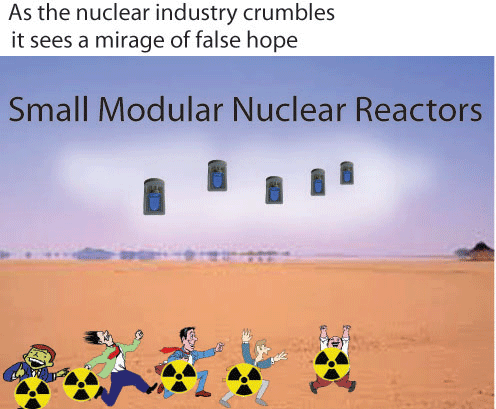
Advanced Nuclear Dreaming in Washington State, CounterPunch, PATRICK MAZZA 19 Apr 21……………..The WPPSS default was part of the first wave of nuclear failures in the U.S. In the wake of the 1979 Three Mile Island accident, approximately 100 proposed nuclear plants were cancelled. Recent years have seen a second round of failures. The Energy Policy Act of 2005 put $25 billion in nuclear subsidies on the table. That jumpstarted all of four nuclear reactors, two each in Georgia and South Carolina. The only way Wall Street would touch the projects was to make ratepayers carry the risk by paying for “work in progress” before the first watt is delivered. South Carolina ratepayers won’t even see that. Cost overruns killed the project there in 2017 after $9 billion was thrown away, setting up a political and court fight over whether ratepayers will continue to be soaked. The last two standing, Georgia’s Vogtle plants, were to have cost $14 billion and come on line in 2016-17. Now costs have doubled to $28 billion and scheduled completion this year and next is considered unlikely.
IS THE SMR A SOLUTION?
SMRs are the nuclear industry’s answer to avoid such failures in the future. Instead of being custom-built and individually licensed, SMRs are intended to cut costs by licensing a single design manufactured at a plant and sent for final assembly to their operating site. Smaller than the 1,000-megawatt-plus plants with which we’re familiar, SMRs are 100 MW or less, and designed with safety features to prevent meltdowns such as experienced at Japan’s Fukushima plant in 2011. Though there are questions about that, as covered below.
X-energy’s proposed plant is 80 MW. The Washington partnership envisions clustering four to make a 320-MW complex, with costs estimated at $2.4 billion. Half is to come from the U.S. Department of Energy’s Advanced Reactor Demonstration Program (ARDP), and half from private investors, apparently leaving ratepayers out of the picture this time.
ARDP in 2020 made two $80 million grants to advanced nuclear reactor developers, one to X-energy, and the other to TerraPower, a venture in which Bill Gates has invested. The latter, slated to be 345 MW, aims at eventual scales as large as today’s plants, so it is not an SMR. The TerraPower liquid-sodium cooled reactor concept has its own set of issues. Liquid-sodium reactors have suffered operating difficulties and fires, and pose potential weapons proliferation hazards. The Raven will look at TerraPower in a future post……..
ROCKY ROAD TO MASS PRODUCTION
“The road to such mass manufacturing will be rocky,” Makhijani and M.V. Ramana write in a recent article, “Why Small Modular Reactors Won’t Help Counter the Climate Crisis.” “Even with optimistic assumptions about how quickly manufacturers could learn to improve production efficiency and lower cost, thousands of SMRs, which will all be higher priced in comparison to large reactors, would have to be manufactured for the price per kilowatt for an SMR to be comparable to that of a large reactor.”
That sets up “a chicken-and-egg economic problem,” they write. “Without the factories, SMRs can never hope to achieve the theoretical cost reductions that are at the heart of the strategy to compensate for the lack of economies of scale. But without the cost reductions, there will not be the large number of orders to stimulate the investments needed to set up the supply chain in the first place.”
That is leaving aside the prospect of a design defect being discovered after many SMRs have been deployed. In the 1990s, multiple Westinghouse-built reactors suffered common steam generator problems, resulting in lawsuits. “If an error in a mass-manufactured reactor were to result in safety problems, the whole lot might have to be recalled, as was the case with the Boeing 737 Max and 787 Dreamliner jetliners,” Makhijani and Ramana write. “But how does one recall a radioactive reactor? What will happen to an electricity system that relies on factory-made identical reactors that need to be recalled?”
The economic hurdles of SMRs posed by its competitors are overwhelming.
“Lazard, a Wall Street financial advisory firm, estimates the cost of utility-scale solar and wind to be about $40 per megawatt-hour,” Makhijani and Ramana write. “The corresponding figure for nuclear is four times as high, about $160 per MWh – a difference that is more than enough to use complementary technologies, such as demand response and storage, to compensate for the intermittency of solar and wind.”
While costs for competitors declines, nuclear costs continue to escalate. Cost for a proposed Idaho project by NuScale, another SMR developer, has doubled from an estimated $3 billion in 2015 to $6.1 billion in 2020 “long before any concrete has been poured,” Makhijani and Ramana note………. https://www.counterpunch.org/2021/04/19/advanced-nuclear-dreaming-in-washington-state/
Bill Gates and 28 other billionaires pushing their small nuclear reactors, on the pretext that they’re ”clean”
Billionaires leading push for nuclear reactors in Canadian mining

By Joyce Nelson, Rabble, April 19 2021https://rabble.ca/news/2021/04/billionaires-leading-push-nuclear-reactors-canadian-miningThis is part two of a two-part series on small modular reactors.
In January 2019, Gordon Edwards, president of the Canadian Coalition for Nuclear Responsibility, warned that the Trudeau government has a “desire to build small modular nuclear reactors [SMRs] all over Canada, especially in the North, to support the accelerated exploitation of natural resources.” Edwards included an excerpt from Nuclear Energy Insider, published January 16, 2019, which stated: “Canada’s large mining sector is seen as a key early market for SMR plants as operators look to reduce carbon emissions and costs.”
That “early market” for small modular reactors has been cleverly targeted by a key lobby group. As I wrote for Watershed Sentinel, Bill Gates and 28 other billionaires and “high-net-worth” individuals launched the Breakthrough Energy Coalition at the 2015 Paris climate talks to lobby for small nuclear reactor development as “clean technology” in dozens of countries, including Canada.
This billionaires’ nuclear club has been working closely for years with Natural Resources Canada in the push for small modular reactors, especially for use in off-grid mining………………….
With Gates and his billionaires’ nuclear club backing KoBold, it’s likely that their off-grid mining projects would welcome government financing for small modular reactors.
When asked about the situation, Mining Watch Canada’s Jamie Kneen told me by email:
“On the one hand, the mining industry faces so much risk in the markets that it’s unlikely to add to that risk by jumping on an unproven technology [like SMRs]. On the other hand, the mining industry is used to leaving masses of toxic waste behind for others to deal with — and getting away with it — so it’d be a perfect fit.”
Three political parties are fully against small modular reactors: the NDP, the Bloc Québécois, and the Green Party — worth remembering if the federal budget causes an election.
This is part one of a two-part series on small modular reactors. Read part one here.
Freelance writer Joyce Nelson is the author of seven books. She can be reached via www.joycenelson.ca
https://rabble.ca/news/2021/04/billionaires-leading-push-nuclear-reactors-canadian-mining
Trudeau government’s extraordinary push for small nuclear reactors – tax breaks, no environmental assessment …
Budget may reveal extent of federal support for risky new nuclear reactors. Rabble.Ca Joyce Nelson 15 Apr 21, Across Canada, environmentalists and First Nations will be closely watching the April 19 release of the federal budget to see just how far the Trudeau Liberals will go in their push for small modular reactors (SMRs).
In September 2020, Canada’s Minister of Natural Resources Seamus O’Regan endorsed SMRs and stated that there is “no pathway to net zero [carbon emissions] without nuclear,” which prompted David Suzuki to famously tell the CBC: “I want to puke.”
Apparently, many share that feeling.
More than 100 Indigenous and civil society groups across Canada are now opposed to the new nuclear reactors, which are being pushed by the federal government and four provinces — Saskatchewan, Ontario, New Brunswick and Alberta — as so-called “clean energy” and a supposed solution to climate change.
These governments argue that the reactors would be the replacement for diesel in remote communities and for use in off-grid mining, tar-sands development, heavy industry, and as exportable expertise in a global market.
But opponents call SMRs “dirty, dangerous and distracting” from real climate solutions.
Even before the budget, the Trudeau Liberals have already taken several steps to advance development of the reactors, especially for use in off-grid mining.
Steps towards small reactors
The feds endorsed the March 2019 Canadian Minerals and Metals Plan, drawn up by federal, provincial and territorial governments. That plan urges governments to “accelerate efforts to develop and adopt clean energy sources, especially for northern, remote and isolated communities that rely on diesel” and “continue to study the feasibility of small modular reactors in mining operations, as well as the potential market for this technology.”
Then, in September 2020, Canada and the U.S. agreed to collaborate on the financing and production of rare-earth and other key metals, which are necessary for a wide range of products including batteries, solar panels, electric vehicles, AI, and weaponry.
After the December 2020 release of the “SMR Action Plan,” the federal government also decided that there would be no environmental impact assessments for small modular reactors, and that tax incentives should be given for this so-called “clean technology.”
The recent mandate letter to Finance Minister Chrystia Freeland directs her to “cut tax rates by 50 per cent for companies that develop and manufacture zero-emission technology” in order to “make Canada a world leader in clean technology.”
As rabble.ca noted, “[t]he Canadian Nuclear Safety Commission (CNSC) has just given a green light to the preferred industry solution for disposal of nuclear reactors — entomb and abandon them in place, also known as ‘in-situ decommissioning.’ This paves the way for the introduction of a new generation of ‘small modular’ nuclear reactors or SMRs.”
While this would be a disaster for the environment and nearby communities, it would be a boon for the nuclear industry and the off-grid mining sector, which would not have to deal with the fallout and repercussions of such nuclear waste once a mining project is finished.
Important policy change
On December 7, 2020 the Hill Times published an open letter to Treasury Board from more than 100 women leaders across Canada, stating:
“We urge you to say ‘no’ to the nuclear industry that is asking for billions of dollars in taxpayer funds to subsidize a dangerous, highly polluting and expensive technology that we don’t need. Instead, put money into renewable, energy efficiency and energy conservation.”………….. https://rabble.ca/news/2021/04/budget-may-reveal-extent-federal-support-risky-new-nuclear-reactors
Iran to enrich uranium to 60% after ‘wicked’ nuclear site attack,
Iran to enrich uranium to 60% after ‘wicked’ nuclear site attack, https://www.bbc.com/news/world-middle-east-56743560 14 Apr 21, Iran will produce 60%-enriched uranium in retaliation for a suspected Israeli attack on a nuclear site, President Hassan Rouhani says, bringing it closer to the purity required for a weapon.
A blast knocked out the power system at Natanz on Sunday, causing damage to thousands of uranium centrifuges.
Mr Rouhani warned the perpetrators that enrichment would now be ramped up as a response to “your wickedness”.
But he reiterated that Iran’s nuclear activities were “exclusively peaceful”.
France, Germany and the UK expressed “grave concern” at the move, saying Iran had “no credible civilian need for enrichment at this level”.
The three countries are parties to a 2015 nuclear deal with Iran, under which it is permitted to enrich uranium up to 3.67% purity to make reactor fuel. Weapons-grade uranium is 90%-enriched or more.
Iran began producing 20%-enriched uranium – a level that takes most of the overall effort required to get to weapons-grade – in January as part of its response to the US sanctions reinstated by former President Donald Trump when he abandoned the accord three years ago.
Israel, which sees Iran’s nuclear programme as a potential threat to its existence and is critical of Joe Biden’s efforts to revive the deal, has neither confirmed nor denied involvement in the Natanz incident. But public radio cited intelligence sources as saying it was a cyber operation by Mossad, Israel’s overseas intelligence agency.
US intelligence officials told the New York Times that a large explosion completely destroyed the power system that supplied an underground hall at Natanz where uranium hexafluoride gas was fed into centrifuges to separate out the most suitable isotope for nuclear fission, called U-235.
The head of the Iranian parliament’s research centre, Alireza Zakani, said on Tuesday that several thousand centrifuges were “damaged or destroyed in one instant” and that “the main part of our enrichment capacities” were eliminated.
On Tuesday night, Iran’s ambassador to the International Atomic Energy Agency (IAEA) announced it had just started enriching uranium up to 60% purity for the first time in response to the attack.
“We expect to accumulate the product next week,” Kazem Gharibabadi tweeted. “This will improve significantly both the quality and quantity of radiopharmaceutical products.”
Iran will also install 1,000 additional centrifuges at Natanz and replace damaged IR-1 centrifuges – the oldest and least efficient – with more advanced IR-6 models, significantly increasing its enrichment capacity.
President Rouhani told a cabinet meeting on Wednesday that, while Iranian security agencies had yet to provide their final reports on the attack, “apparently it is the crime of the Zionists”. Iran does not recognise Israel’s right to exist and often refers to it as the “Zionist state”.
“You cannot conspire against the Iranian nation and commit a crime in Natanz; we will cut off your arms when you commit a crime,” he said.
“What you did was nuclear terrorism; what we’ve done is legal,” he added.
Mr Rouhani said those responsible wanted to derail the indirect talks between US and Iranian officials in Vienna which are aimed at reviving the nuclear deal, formally known as the Joint Comprehensive Plan of Action (JCPOA).
“We know what you are trying to do; you want us to be empty-handed at the talks but we’re attending the negotiations with an even fuller hand.”
ran’s Supreme Leader, Ayatollah Ali Khamenei, later warned that US officials did not want to “accept the truth” and often made suggestions that were “not even worth looking at”.
“Sanctions must be removed first. Once we are certain that has been done, we will carry out our commitments,” he said.
The governments of France, Germany and the UK said enriching uranium up to 60% was “a serious development” since it constituted “an important step in the production of a nuclear weapon”.
“Iran’s announcements are particularly regrettable given they come at a time when all JCPOA participants and the United States have started substantive discussions, with the objective of finding a rapid diplomatic solution to revitalise and restore the JCPOA. Iran’s dangerous recent communication is contrary to the constructive spirit and good faith of these discussions.”
White House spokeswoman Jen Psaki said Iran’s decision was “provocative”.
In their annual threat assessment released on Tuesday, US intelligence agencies said they continued to “assess that Iran is not currently undertaking the key nuclear weapons-development activities that we judge would be necessary to produce a nuclear device”.
The fiasco of nuclear preprocessing: UK, Japan, USA.

Part one | The slow violence of SA’s nuclear waste,
Part one of this four-part story considers the imminent danger involved in storing used radioactive materials, a dilemma growing at a rate of more than 32 tonnes a year. New Frame , By: Neil Overy, 8 Mar 21
”……………..This is a process by which fission products are chemically separated out of used fuel rods to extract any unused uranium. This alleged solution to the problem of high-level waste has been one of the illusionary solutions Eskom has regularly mooted and just as regularly abandoned because of the colossal costs and serious dangers involved in reprocessing.
In the United Kingdom, the Thermal Oxide Reprocessing Plant, opened at huge cost in 1994, closed in 2018 having reached none of its intended reprocessing targets. Its decommissioning is now set to cost taxpayers at least $5.5 billion and take up to 100 years to complete. In Japan, construction of the Rokkasho Reprocessing Plant began in 1993 and was supposed to be completed by 1997. Incredibly, the plant is still not complete – its completion date has been postponed 25 times – and it is now expected to be operational in 2023, 26 years late and tens of billions of dollars over budget.
Even when operational, large quantities of dangerously radioactive waste, which needs to be stored for thousands of years, remains. Some of this waste is separated plutonium, a fissile material used in nuclear bombs, which presents a very serious security risk. This is precisely why reprocessing has never been authorised in the United States. As the Union of Concerned Scientists conclude, reprocessing is “dangerous, dirty and expensive”. Quite clearly, reprocessing is not an option South Africa should consider. …… , https://www.newframe.com/part-1-the-slow-violence-of-sas-nuclear-waste/?fbclid=IwAR0TEdv3xITKJISxqQs_UwdO9JB4m5LkPABzUl9b6R_nYVZKdL2S2ikp-MA
The US Energy Department’s renewed promotion of plutonium-fueled reactors.

Plutonium programs in East Asia and Idaho will challenge the Biden administration, Bulletin of the Atomic Scientists, By Frank N. von Hippel | April 12, 2021 ”’…………. The US Energy Department’s renewed promotion of plutonium-fueled reactors. The US plutonium breeder reactor development program was ended by Congress in 1983. A decade later, the Clinton Administration shut down the Idaho National Laboratory’s Experimental Breeder Reactor II for lack of mission. At the time, I was working in the White House and supported that decision.

The nuclear-energy divisions at the Energy Department’s Argonne and Idaho National Laboratories refused to give up, however. They continued to produce articles promoting sodium-cooled reactors and laboratory studies on “pyroprocessing,” a small-scale technology used to separate plutonium from the fuel of the Experimental Breeder Reactor II .
During the Trump administration, this low-level effort broke out. With the Energy Department’s Office of Nuclear Energy headed by a former Idaho National Lab staffer and help from Idaho’s two Senators, the Energy Department and Congress were persuaded to approve the first steps toward construction at the Idaho National Laboratory of a larger version of the decommissioned Experimental Breeder Reactor II.
The new reactor, misleadingly labeled the “Versatile Test Reactor,” would be built by Bechtel with design support by GE-Hitachi and Bill Gates’ Terrapower. The Energy Department awarded contracts to the Battelle Energy Alliance and to university nuclear-engineering departments in Indiana, Massachusetts, Michigan, and Oregon to develop proposals for how to use the Versatile Test Reactor.

The current estimated cost of the Versatile Test Reactor is $2.6-5.8 billion, and it is to be fueled with plutonium. The Idaho National Laboratory’s hope is to convince Congress to commit to funding its construction in 2021.
The Energy Department also committed $80 million to co-fund the construction of a 345-megawatt-electric (MWe) “Natrium” (Latin for sodium) demonstration liquid-sodium-cooled power reactor proposed by GE-Hitachi and Terrapower which it hopes Congress would increase to $1.6 billion. It also committed $25 million each to Advanced Reactor Concepts and General Atomics to design small sodium-cooled reactors. And it has subsidized Oklo, a $25-million startup company financed by the Koch family, to construct a 1.5 MWe “microreactor” on the Idaho National Laboratory’s site to demonstrate an extravagantly costly power source for remote regions.
In all these reactors, the chain reaction would be sustained by fast neutrons unlike the slow neutrons that sustain the chain reactions in water-cooled reactors. The Energy Department’s Office of Nuclear Energy has justified the need for the Versatile Test Reactor by the fast-neutron reactors whose construction it is supporting. In this way, it has “bootstraping” the Versatile Test Reactor by creating a need for it that would not otherwise exist.
This program also is undermining US nonproliferation policy..………..https://thebulletin.org/2021/04/plutonium-programs-in-east-asia-and-idaho-will-challenge-the-biden-administration/?utm_source=Newsletter&utm_medium=Email&utm_campaign=MondayNewsletter04122021&utm_content=NuclearRisk_EastAsia_04122021
Japan’s hugely costly nuclear reprocessing program.

Plutonium programs in East Asia and Idaho will challenge the Biden administration, Bulletin of the Atomic Scientists, By Frank N. von Hippel | April 12, 2021, ”………………Japan’s hugely costly reprocessing program. The United States has been trying to persuade Japan to abandon reprocessing ever since 1977. At the time, then prime minister Takeo Fukuda described plutonium breeder reactors as a matter of “life and death” for Japan’s energy future and steamrolled the Carter administration into accepting the startup of Japan’s pilot reprocessing plant. Today, Japan is the only non-nuclear-armed state that separates plutonium. Despite the absence of any economic or environmental justification, the policy grinds ahead due to a combination of bureaucratic commitments and the dependence of a rural region on the jobs and tax income associated with the hugely costly program. The dynamics are similar to those that have kept the three huge US nuclear-weapon laboratories flourishing despite the end of the Cold War.
For three decades, Japan has been building, fixing mistakes, and making safety upgrades on a large plutonium recycle complex in Rokkasho Village in the poor prefecture of Aomori on the northern tip of the main island, Honshu. The capital cost of the complex has climbed to $30 billion. Operation of the reprocessing plant is currently planned for 2023.
A facility for fabricating the recovered plutonium into mixed-oxide plutonium-uranium fuel for water-cooled power reactors is under construction on the same site (Figure 3 on original). The cost of operating the complex is projected to average about $3 billion per year. Over the 40-year design life of the plant, it is expected to process about 300 tons of plutonium—enough to make 40,000 Nagasaki bombs. What could possibly go wrong?
Japan’s Atomic Energy Commission reports that, because of the failures and delays of its plutonium useage programs, as of the end of 2019, Japan owned a stock of 45.5 tons of separated plutonium: 9.9 tons in Japan with the remainder in France and the United Kingdom where Japan sent thousands of tons of spent fuel during the 1990s to be reprocessed.
Both the Obama and Trump administrations pressed Tokyo to revise its reprocessing policy, especially after Japan’s decision to decommission its failed prototype breeder reactor in 2016.
Perhaps in response to this pressure, in 2018, Japan’s cabinet declared:
“The Japanese government remains committed to the policy of not possessing plutonium without specific purposes on the premise of peaceful use of plutonium and work[s] to reduce of the size of [its] plutonium stockpile.”
A step toward reductions that is being discussed would be for Japan to pay the United Kingdom to take title to and dispose of the 22 tons of Japanese plutonium stranded there after the UK mixed-oxide fuel fabrication plant was found to be inoperable. Japan’s separated plutonium in France is slowly being returned to Japan in mixed-oxide fuel for use in reactors licensed to use such fuel.
If, as currently planned, Japan operates the Rokkasho Reprocessing Plant at its design capacity of more than seven tons of plutonium separated per year, however, its rate of plutonium separation will greatly exceed Japan’s rate of plutonium use. Four of Japan’s currently operating reactors are licensed to use mixed-oxide fuel but loaded only 40 percent as much mixed-oxide fuel as planned in 2018-19 and none in 2020. Two more reactors that can use mixed-oxide are expected to receive permission to restart in the next few years. In 2010, Japan’s Federation of Electric Power Companies projected that the six reactors would use 2.6 tons of plutonium per year. If the much-delayed Ohma reactor, which is under construction and designed to be able to use a full core of mixed-oxide fuel, comes into operation in 2028 as currently planned, and all these reactors use as much mixed-oxide fuel as possible, Japan’s plutonium usage rate would still ramp up to only 4.3 tons per year in 2033. (At the end of 2020 the Federation of Electric Power Companies announced its hope to increase the number of mixed-oxide-using reactors to 12 by 2030 but did not list the five additional reactors, saying only, “we will release it as soon as it is ready.”)
As of June 2020, construction at Rokkasho on the mixed-oxide fuel fabrication facility that will process the plutonium separated by the Rokkasho Reprocessing Plant was only 12 percent complete. It was still just a hole in the ground containing some concrete work with its likely completion years behind the currently planned 2023 operation date of the reprocessing plant.
Thus, as happened in Russia and the United Kingdom, the Rokkasho Reprocessing Plant could operate indefinitely separating plutonium without the mixed-oxide plant operating. The reprocessing plant includes storage for “working stocks” containing up to 30 tons of unirradiated plutonium. If and when it begins operating, the mixed-oxide fuel fabrication plant will itself have additional working stocks of at least several tons of plutonium. Therefore, even if Japan transfers title to the plutonium it has stranded in the United Kingdom and manages to work down its stock in France, the growth of its stock in Japan could offset those reductions.
The Biden administration should urge Japan’s government to “bite the bullet” and begin the painful but necessary process of unwinding its costly and dangerous plutonium program. A first step would be to change Japan’s radioactive waste law to allow its nuclear utilities to use the planned national deep repository for direct disposal of their spent fuel.
In the meantime, most of Japan’s spent fuel will have to be stored on site in dry casks, as has become standard practice in the United States and most other countries with nuclear power reactors. Because of its safety advantages relative to storage in dense-packed pools, the communities that host Japan’s nuclear power plant are moving toward acceptance of dry-cask storage. During the 2011 Fukushima accident, the water in a dense-packed pool became dangerously low. Had the spent fuel been uncovered and caught on fire, the population requiring relocation could have been ten to hundreds of times larger ………….https://thebulletin.org/2021/04/plutonium-programs-in-east-asia-and-idaho-will-challenge-the-biden-administration/?utm_source=Newsletter&utm_medium=Email&utm_campaign=MondayNewsletter04122021&utm_content=NuclearRisk_EastAsia_04122021
USA’s nuclear rocket plan, and the Nazi history behind it.
The US plans to put a nuclear-powered rocket in orbit by 2025, David Hambling.. (subscribers only)
: https://www.newscientist.com/article/2274199-the-us-plans-to-put-a-nuclear-powered-rocket-in-orbit-by-2025/#ixzz6rrl4rEGB
Nuclear space craft very clearly is part of nuclear weapons programme
DARPA awards nuclear spacecraft contracts to Lockheed Martin, Bezos’ Blue Origin and General Atomics
PUBLISHED MON, APR 12 2021 HTTPS://WWW.CNBC.COM/2021/04/12/DARPA-NUCLEAR-SPACECRAFT-LOCKHEED-BEZOS-BLUE-ORIGIN-GENERAL-ATOMICS.HTML
The Pentagon’s DARPA awarded contracts to General Atomics, Lockheed Martin and Jeff Bezos’ space venture Blue Origin under the agency’s DRACO (Demonstration Rocket for Agile Cislunar Operations) program.
The Pentagon’s research and development arm on Monday awarded a trio of companies with contracts to build and demonstrate a nuclear-based propulsion system on a spacecraft in orbit by 2025.
General Atomics, Lockheed Martin and Jeff Bezos’ space venture Blue Origin won the Defense Advanced Research Projects Agency or DARPA awards, under the agency’s Demonstration Rocket for Agile Cislunar Operations program or DRACO.
The goal of the program is deceptively simple: Use a nuclear thermal propulsion system to power a spacecraft beyond low Earth orbit.
The problem of plutonium programs
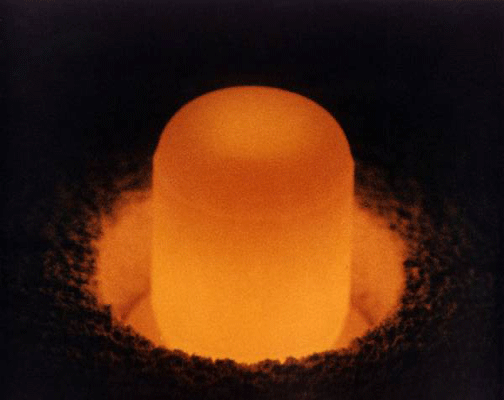
Plutonium programs in East Asia and Idaho will challenge the Biden administration, Bulletin of the Atomic Scientists, By Frank N. von Hippel | April 12, 2021 Among the Biden administration’s nuclear challenges are ongoing civilian plutonium programs in China and Japan. Also, South Korea’s nuclear-energy research and development establishment has been asserting that it should have the same “right” to have a plutonium program as Japan. These challenges have been compounded by a renewed push by the Energy Department’s Idaho National Laboratory to revive a plutonium program that was shut down in the 1980s. These foreign and domestic plutonium programs are all challenges because plutonium is a nuclear-weapon material.
Henry Kissinger’s State Department quickly discovered that the governments of Brazil, Pakistan, South Korea, and Taiwan—all under military control at the time—had contracted for French or German spent-fuel “reprocessing” plants. The United States intervened forcefully and none of these contracts were fully consummated…………………..
…………….A possible path forward. During the Trump administration, the Energy Department fell back into the never-never land of plutonium-fueled reactors from which the United States extracted itself in the 1980s. Fortunately, the big-dollar commitments to the Versatile Test Reactor and the Natrium Reactor have not yet been made, and the Biden administration could use the excuse of budget stringency not to make those commitments.
In South Korea, the Biden administration will have to deal with the completion of the Idaho National Lab–Korea Atomic Energy Research Institute Joint Fuel Cycle Study. Although there will no doubt be obfuscation in the report, the conclusions of the 10-year study should have been obvious from the beginning: reprocessing is hugely costly, creates proliferation risks, and complicates spent fuel disposal. Fortunately, the anti-nuclear-energy Moon administration is unlikely to push for reprocessing. It will be much more interested in the opportunities that the Biden administration can provide to advance the Korean Peninsula denuclearization agenda. It should therefore be politically relatively easy for the Biden Administration to terminate cooperation on pyroprocessing.
China’s reprocessing and fast-neutron reactor program may be driven in part by China’s interest in obtaining more weapon-grade plutonium to build up the size of its nuclear arsenal. If that is the case, China’s incentive to build up could be reduced through nuclear arms control. Specifically, if China is building up its nuclear arsenal out of concern about the adequacy of its nuclear deterrent in the face of an unconstrained US missile-defense buildup, then the United States could examine the possibility of an agreement to limit missile defenses as an alternative to an open-ended, offense-defense arms race. That was the path of wisdom that the United States and Soviet Union chose with their 1972 Anti-Ballistic Missile Treaty.
In Japan, the Biden administration will be faced with the continued unwillingness of the powerful Ministry of Economics, Trade, and Industry to wind down Japan’s dysfunctional plutonium program. But, if a linkage could be made between constraining China’s nuclear buildup and ending Japan’s hugely costly reprocessing program, that might help tip the balance in Japan’s internal debate over reprocessing. https://thebulletin.org/2021/04/plutonium-programs-in-east-asia-and-idaho-will-challenge-the-biden-administration/?utm_source=Newsletter&utm_medium=Email&utm_campaign=MondayNewsletter04122021&utm_content=NuclearRisk_EastAsia_04122021
The United States collaborates on nuclear pyroprocessing with South Korea.

Plutonium programs in East Asia and Idaho will challenge the Biden administration, Bulletin of the Atomic Scientists, By Frank N. von Hippel | April 12, 2021, ”…………………………………The United States collaborates on pyroprocessing with South Korea. The Idaho and Argonne National Laboratories also continue to promote the pyroprocessing of spent fuel. After the Clinton Administration shut down the Experimental Breeder Reactor II in 1994, the laboratory persuaded the Energy Department to continue to fund pyroprocessing as a way to process Experimental Breeder Reactor II spent fuel and blanket assemblies into stable waste forms for disposal in a deep underground repository. The proposal was to complete this effort in 2007. According to a review by Edwin Lyman of the Union of Concerned Scientists, however, as of the end of Fiscal Year 2016, only about 18 percent of the roughly 26 metric tons of assemblies had been processed at a cost of over $200 million into waste forms that are not stable. (Since then, an additional three percent has been processed.)
During the George W. Bush administration, Vice President Cheney accepted Argonne’s argument that pyroprocessing is “proliferation resistant” and the two US national laboratories were allowed to share the technology with the Korea Atomic Energy Research Institute.
At the beginning of the Obama administration, however, a group of safeguards experts from six Energy Department national laboratories, including Argonne and Idaho, concluded that pyroprocessing is not significantly more resistant to proliferation than PUREX, the standard reprocessing technology originally developed by the United States to extract plutonium for its weapons.

In 2014, the US-Republic of Korea Agreement for Cooperation on the Peaceful Uses of Atomic Energy was due to expire, but the negotiations on a successor agreement bogged down over Korea’s insistence that the new agreement include the same right to reprocess spent fuel as the 1988 US-Japan Agreement for Cooperation.
The compromise reached the following year was that the Korea Atomic Energy Research Institute and the Idaho National Laboratory would complete their Joint Fuel Cycle Study on “the technical, economic, and nonproliferation (including safeguards) aspects of spent fuel management and disposition technologies.” If the United States could be convinced that the proliferation risks of pyroprocessing were manageable, the secretary of energy would give consent for South Korea to use the technology on its territory. The final report from the joint study is due this year.
Meanwhile, in 2017, Moon Jae-in was elected president of the Republic of Korea on a platform that included not building any more nuclear power plants in South Korea. Fast-neutron reactors and pyroprocessing obviously do not fit with that policy. This gives the Biden administration an opportunity to end a cooperative nuclear-energy research and development program that is contrary to both US nuclear nonproliferation policy and South Korea’s energy policy. The United States could propose instead a joint collaborative program on safe spent fuel storage and deep underground disposal……………https://thebulletin.org/2021/04/plutonium-programs-in-east-asia-and-idaho-will-challenge-the-biden-administration/?utm_source=Newsletter&utm_medium=Email&utm_campaign=MondayNewsletter04122021&utm_content=NuclearRisk_EastAsia_04122021
1 This Month



26 September – International Day for the Total Elimination of Nuclear Weapons


PLEASE OPPOSE HR 8255 AND S.3639 – bills would accelerate satellite deployment, with no environmental review or safeguards – https://ncstd5li.quorum.us/campaign/169331/
To see nuclear-related stories in greater depth and intensity – go to https://nuclearinformation.wordpress.com
-
Archives
- September 2026 (257)
- August 2026 (330)
- July 2026 (355)
- June 2026 (287)
- May 2026 (306)
- April 2026 (356)
- March 2026 (251)
- February 2026 (267)
- January 2026 (308)
- December 2025 (358)
- November 2025 (359)
- October 2025 (375)
-
Categories
- 1
- 1 NUCLEAR ISSUES
- business and costs
- climate change
- culture and arts
- ENERGY
- environment
- health
- history
- indigenous issues
- Legal
- marketing of nuclear
- media
- opposition to nuclear
- PERSONAL STORIES
- politics
- politics international
- Religion and ethics
- safety
- secrets,lies and civil liberties
- spinbuster
- technology
- Uranium
- wastes
- weapons and war
- Women
- 2 WORLD
- ACTION
- AFRICA
- Atrocities
- AUSTRALIA
- Christina's notes
- Christina's themes
- culture and arts
- Events
- Fuk 2022
- Fuk 2023
- Fukushima 2017
- Fukushima 2018
- fukushima 2019
- Fukushima 2020
- Fukushima 2021
- general
- global warming
- Humour (God we need it)
- Nuclear
- RARE EARTHS
- Reference
- resources – print
- Resources -audiovicual
- Weekly Newsletter
- World
- World Nuclear
- YouTube
-
RSS
Entries RSS
Comments RSS
 nuclear-news