Many space rockets planned, thousands of satellites, thousands of space debris -what could possibly go wrong?

To read the news, you’d think that only China was the naughty nation that had accidents in space. Indeed, it’s all written up to convey the message that USA space stuff is utterly safe.
Reminds me of when the nuclear lobby tried to put across the idea that the Fukushima disaster was proof of the safety of U.S. nuclear technology.
Wikileaks lists spaceflight accidents and incidents.
Thousands of satellites in orbit (not all functioning) There are at least 6,900 satellites now in orbit around Earth, with 4000 still functioning.
Space debris
Number of debris objects regularly tracked by Space Surveillance Networks and maintained in their catalogue – About 28160 .
Estimated number of break-ups, explosions, collisions, or anomalous events resulting in fragmentation -More than 560
Total mass of all space objects in Earth orbitMore than 9300 tonnes.
NASA slams rocket risk, The Age, print version 10 May 2021, Remnants of China’s biggest rocket have landed in the Indian Ocean,with the bulk of its components destroyed on re-entry into the atmosphere according to Chinese state media., fencing days of speculation over where the debris would hit….
The coordinates given by the media yesterday, citing the China Manned Space Engineering Office, put the point of impact west of the Maldives archipelago.The Long March launched last week was the second deployment of the 5B variant since its maiden flight in May 2020 last year pieces from the first Long March 5B fell on Ivory Coast, damaging several buildings. No injuries were reported.
During the rocket’s flight, Harvard based astrophysicist Jonathon McDowellsaid the debris zone could have been as far north as New York, Madrid or Beijing, and as far south as southern Chile and New Zealand.
*************************************
large chunks of the NASA space station Skylab fell from orbit in July 1979 and landed in Australia
20 tonne space rocket out of control, but luckily landed in the Indian Ocean, rather than on land.
Out-of-control Chinese rocket finally lands in Indian Ocean near the Maldives, https://www.9news.com.au/world/chinese-rocket-expected-to-crash-into-earth-this-weekend/4b39859c-cfc4-4f3c-b9e2-f294e1bb65f4 By CNNJoe Attanasio May 9, 2021 A large Chinese rocket that was orbiting earth out of control has finally made impact, landing in the Indian Ocean close to the Maldives and drawing sharp criticism from NASA.
According to China Manned Space Engineering Office, the rocket made impact about 12.24pm AEST, roughly two hours earlier than predicted.Most of the remnants of the vessel burned up during re-entry to earth’s atmosphere, officials said, putting to bed week-long fears over the potential damage the rocket could have caused if it struck land.What was left of the spacecraft landed at open sea, at 72.47 degrees east longitude and 2.65 degrees north latitude.The Long March 5B rocket, which was around 30 metres tall and weighed 20 tonnes, entered earth’s low orbit earlier this morning.
It travelled at more than 30,000 kilometres an hour, was more than 10 stories tall, and weighed roughly the same as a full garbage truck, causing many to raise concerns about the impact its landing could have hadThe rocket launched a piece of the new Chinese space station into orbit on April 29 but then was left to hurtle through space uncontrolled until Earth’s gravity began pulling it back to the ground.
That approach is a break with what officials call “best practice” compared with what other space agencies do.
NASA Administrator Bill Nelson criticised China over the re-entry, saying spacefaring nations needed to minimise risk and maximise transparency in such situations.”It is clear that China is failing to meet responsible standards regarding their space debris,” he said, in a statement.”It is critical that China and all spacefaring nations and commercial entities act responsibly and transparently in space to ensure the safety, stability, security, and long-term sustainability of outer space activities.”Despite recent efforts to better regulate and mitigate space debris, Earth’s orbit is littered with hundreds of thousands of pieces of uncontrolled junk, most of which are smaller than 10 centimetres.Objects are constantly falling out of orbit, though most of them burn up in the Earth’s atmosphere before they have a chance to make an impact on the surface.
China sets out to control the world nuclear industry, – Pakistan, UK, and beyond
Nikkei Asian Review 9th May 2021, Nick Butler: On Mar. 11, Pakistan inaugurated its most recent and largest civil nuclear power project with the opening of the 1.1-gigawatt plant in Karachi, doubling the capacity of Pakistan’s four existing nuclear facilities. A second similar unit is due to come online in the coming months. The event marked a significant step for Pakistan which needs additional capacity from all sources to bolster its existing inadequate power supplies. But even more important was the fact that the plant was built and will be operated by the state-owned China National Nuclear Corp. (CNNC), one of the companies leading Beijing’s drive to join the very short list of countries with the capability to build and operate civil nuclear power projects around the world. The development of China’s nuclear industry over the last decade has been remarkable. With over 30 new reactors commissioned and another 16 under construction, China is now the main source of growth for nuclear power across the world. China’s objective is to create a closed cycle, self-reliant nuclear industry within China from the processing of uranium to produce fuel for the reactors through to construction and management of the operating plants. This is being achieved through the adaptation of international technology, in particular from Westinghouse into new Chinese designed reactors. In the process, the Chinese nuclear industry will reduce or eliminate the role of the foreign companies whose capabilities established the first wave of development. The other part of the Chinese strategy is to create an export industry, with the plan focused on a range of countries lacking resources of their own and, in most cases, also lacking the technical skills to develop their own indigenous nuclear skills. The leading Chinese nuclear company, the China General Nuclear Power Group (CGN), formerly the China Guangdong Nuclear Power Group, joined the French state company Electricite de France (EDF) in the U.K. in funding a third of the Hinkley Point project. Their aim was to secure the opportunity to go on to build, own and operate a Chinese reactor in Britain, beginning with a new plant at Bradwell in Essex. China, by pursuing its industrial aspirations, is creating a set of relationships and alliances, making full use of the fact that power supplies are crucial for the day-to-day operations of economic life. In the modern world, this is the way in which empires are built. https://asia.nikkei.com/Opinion/What-China-s-rapidly-expanding-nuclear-industry-means-for-the-West |
Small nuclear reactors- a very problematic ”solution” to climate change
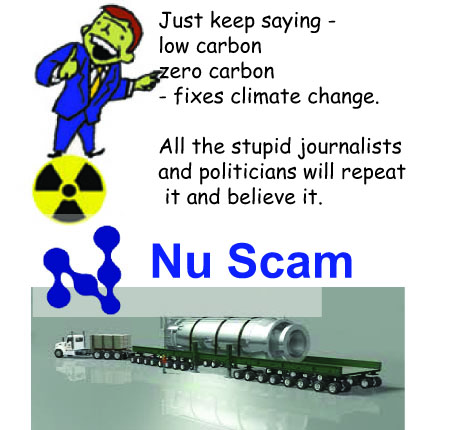
The controversial future of nuclear power in the U.S. National Geographic, 5 May 21, ”……………. In the U.S., a company called NuScale has recently received design certification approval from the Nuclear Regulatory Commission for its SMR, the first and only company to do so. Its reactor is a miniaturized version of a traditional reactor, in which pressurized water cools the core where nuclear fission is taking place. But in the NuScale design, the whole reactor is itself immersed in a pool of water designed to protect it from accidental meltdown.
NuScale hopes to build 12 of these reactors to produce 720 megawatts at the Idaho National Laboratory as a pilot project. It’s been supported by the U.S. Department of Energy, which has approved up to $1.4 billion to help demonstrate the technology. NuScale plans to sell the plant to an energy consortium called Utah Associated Municipal Power Systems.
Last year, eight of the 36 utilities in the consortium backed out of the project, citing the cost. The company recently announced the project would be delayed to 2030, and the cost would rise from $4.2 billion to $6.1 billion.
Nuclear opponents point to this latest disappointment as yet another example of why nuclear isn’t up to the task.
“If your first SMR isn’t built until the late 2020s, and then you have to turn it on, not to mention set up a whole new global supply chain, are you going to reach zero emissions by 2035?” asks IEER’s Makhijani. “You can’t make a significant contribution in time.” He adds that the industry’s long history of overruns and delays are especially problematic when considering climate commitments. “There’s no room for significant mistakes.”
……. The future of nuclear power will depend in part on how well it can balance a grid that increasingly relies on renewables….. Unlike gas turbines, which can be turned on and off in seconds to “follow the load,” reactors take an hour or more to cut their production in half.
It’s not that reactors can’t follow the load; they’re just slower. “They can and do, because they have to,” Buongiorno says. “It’s just never an attractive economic proposition.”
Last fall, the DOE awarded $80 million each to two companies working on advanced reactor designs intended in part to address this problem.
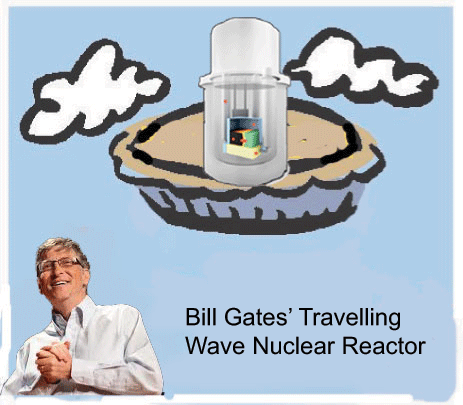
The first, TerraPower, a startup founded by Bill Gates, is working on a sodium-cooled reactor……… The second grant went to a company called X-energy for a gas-cooled reactor that operates at very high temperatures.
…… The high-level radioactive waste they produce, however, would need to be transported to a centralized location for management.
.. none of these new designs are moving quickly enough to meet Biden’s targets. DOE officials called their decision to support these two pilot projects, which aim to be fully operational by 2028, “their boldest move yet.”
Meanwhile, there’s a more direct way to balance the variability of renewables: store electricity in batteries. The market for utility-scale battery storage is exploding; it increased by 214 percent in 2020, and the EIA predicts that battery capacity will surge from its current 1,600 megawatts to 10,700 by 2023.
Makhijani thinks nuclear power isn’t going to be needed to balance the grid. A study he conducted in 2016 for the state of Maryland found that increased battery storage, combined with incentives to consumers to reduce their electricity use at peak times, would almost allow utilities to balance the variability of renewables.
They’d just need to store a little energy as hydrogen, which can be produced by running renewable electricity through water and then converted back to electricity in a fuel cell. That process is currently very expensive, Makhijani says, but “as long as it’s not giant amounts, it’s affordable.”……
Canada’s push for small nuclear reactors effectively stops real action on climate change.
Small Modular Nuclear Reactors Are Mostly Bad Policy, “………So Who Is Advocating For SMRs & Why? Clean Technica, ByMichael Barnard, 3 May 21,
At present we see SMR earmarked funds in both Canadian and US federal budgets, $150 million in Canada and 10 times as much in the US, mostly for research and development with the exception of over a billion to NuScale to, in theory, build something. In Canada, four provinces — Alberta, Ontario, New Brunswick and Saskatchewan — have joined forces in an SMR consortium. Bill Gates’ Terrapower has received another $80 million, as has X-Energy from the US DOE.
The failure conditions of small modular reactors are obvious. The lack of a significant market is obvious. The lack of ability to create a clear winner is obvious. The security costs are obvious. The lack of vertical scaling to thermal efficiency is obvious. The security risks and associated costs are obvious. The liability insurance cap implications are obvious. So why is all of this money and energy being thrown at SMRs? There are two major reasons, and only one of them is at all tenable.
Let’s start with the worst one. The Canadian provinces which are focused on SMRs are claiming that they are doing this as a major part of their climate change solutions. They are all conservative governments. Only one of those provinces has a nuclear fleet, although New Brunswick has one old, expensive, and due-to-retire reactor, as well as a track record of throwing money away on bad energy ideas, like Joi Scientific’s hydrogen perpetual motion machines. One of the provinces, Ontario, has been actively hostile to renewable energy, with the current administration cutting up 758 renewables contracts and legislating a lack of recourse as a very early act after election.
So why are they doing this? Because it allows them to defer governmental climate action while giving the appearance of climate action. They can pander to their least intelligent and wise supporters by asserting that renewables aren’t fit for purpose, while also not doing anything about the real problem because SMRs don’t exist in a modern, deployable, operable form yet.
The other major reason gets back to renewables as well. 15 years ago it was an arguable position to hold that renewables were too expensive, would cause grid reliability issues and that nuclear in large amounts was necessary. That’s been disproven by both 15 years of failures of nuclear deployments, but more importantly plummeting costs and proven grid reliability with renewable generation. Now almost every serious analyst agrees that renewables can economically deliver 80% of required grid energy, but there is still debate from credible analysts about the remaining 20%.
Mark Z. Jacobson and his Stanford team are at the center of this debate. Since the late 2000s, they’ve been publishing regular studies of increasing scope and sophistication on the thesis of 100% renewables by 2050. The 2015 publication saw a lot of pushback. At the time, my assessment of the fundamental disagreement was that the people who published a criticism of it thought the last 20% would be too expensive, and that both nuclear and carbon capture and sequestration would be necessary and scaled components.
Personally, I’ve done various aspects of the math, looked at grid reliability and transformation data from around the world, and looked at ancillary services requirements, and I think Jacobson and team are right. Further, that since we all agree that renewables are fit for purpose for 80% of the problem we should deploy them as rapidly as possible.
However, it’s very reasonable to make a side bet or two to ensure coverage of that last 20%. I don’t mind research dollars spent on SMRs, which is all most of the SMR expenditures amount to, outside of the Nu Scale bailout (which is added to the Ohio $1.3 billion bailout, which is added to the annual $1.7 billion overt federal subsidy, which is added to the annual hidden $4 billion security subsidy which is added to the $70 billion unfunded cleanup subsidy, which is added to the uncosted and unfunded taxpayer liability). Spending a few tens of millions of dollars in rich countries to ensure that we have that last 20% bridged is reasonable.
But the people asserting that SMRs are the primary or only answer to energy generation either don’t know what they are talking about, are actively dissembling or are intentionally delaying climate action. https://cleantechnica.com/2021/05/03/small-modular-nuclear-reactors-are-mostly-bad-policy/
Misguided funding for small nuclear reactors

Small Modular Nuclear Reactors Are Mostly Bad Policy, Clean Technica By Michael Barnard 3 May 21,
People asserting that SMRs are the primary or only answer to energy generation either don’t know what they are talking about, are actively dissembling or are intentionally delaying climate action.
Like hydrogen, small modular nuclear reactors have been seeing a resurgence of interest lately. Much of that is driven by governmental policies and investments focusing on the technology. Much of it comes from the nuclear industry. And inevitably, some comes from entrepreneurs attempting to build a technology that they hope will take off in a major way, making them and their investors a lot of money.
Most Of The Attention & Funding Is Misguided At Best, & Actively Hostile To Climate Action At Worst
First, let’s explore briefly the world of small modular nuclear reactors (SMNR) or small and medium reactors (SMR). The most common acronym is SMR, but you’ll see both.
As it says on the box, they are nuclear generation devices, specifically fission nuclear. That means they use radioactively decaying fissile materials, fuels, to heat a liquid which creates steam which drives steam turbines to generate electricity. Technically, they are like a coal generation plant, but with the heat provided by the decay of uranium instead of the burning of long-buried plant matter.
There are a handful of differences between them and traditional nuclear generation reactors. The biggest one is that they are smaller, hence the ‘small’ and ‘medium’ in the names. They range from 0.068 MW to 500 MW in capacity, with the International Atomic Energy Association using small for up to 300 MW and medium for up to 700 MW.
Despite the buzz, this is not new technology. The first nuclear generation plant was a Russian 5 MW device that went live in 1954. Hundreds of small reactors have been built for nuclear powered vessels and as neutron sources. This is well trodden ground. Most of the innovations being touted were considered initially decades ago.
In the seven decades since the first SMR was commissioned, 57 different designs and concepts have been designed, developed and, rarely, built. Most of the ones which are built are doing what nuclear reactors do, getting older without new ones being built to replace them.
The Russian models are far-north icebreaker power plants being considered for land-based deployment in remote northern towns, with the Siberian one at end of life. The Indian ones are 14 small CANDU variants in operation, most decades old now. The Chinese one is coming up to end of its 40-year life span as well.
The Argentinean model has been in construction on and off for over a decade with work stoppages, political grandstanding, and monetary problems. It may never see the light of day.
The Chinese HTR-PM, under construction for the past decade, is the only one with remotely new technology. If commissioned, it is expected to be the first Gen IV reactor in operation.
And to be clear, this isn’t a technology, it’s many technologies. Across the decades, 57 variants of 18 types have been put forward. None of the types can be considered to be dominant.
Claims About SMRs Don’t Withstand Advocates for SMRs typically make some subset of the following claims:
They are saferThey can be manufactured in scaled, centralized manufacturing facilities so they will be cheaperThey can provide clean power for remote facilities or communitiesThey can be deployed onto decommissioned coal generation brownfield sitesThey can be built faster.
Safety concerns aren’t why nuclear is failing in the marketplace, economics are why nuclear is failing in the marketplace…….. . https://cleantechnica.com/2021/05/03/small-modular-nuclear-reactors-are-mostly-bad-policy/
Sen. Angus King: Cybersecurity a major concern in U.S. nuclear command-and-control system
Sen. Angus King: Cybersecurity a major concern in U.S. nuclear command-and-control system https://spacenews.com/sen-angus-king-cybersecurity-a-major-concern-in-u-s-nuclear-command-and-control-system/, by Sandra Erwin — May 2, 2021 King: Without an adequate N3C system ‘none of the rest of it works’
WASHINGTON — The U.S. nuclear command, control and communications system that serves as the link between U.S. nuclear forces and presidential authority could be vulnerable to cyber attacks and needs upgrades, Sen. Angus King (I-Maine) told reporters May 1.
King, an independent who caucuses with the Senate’s Democratic majority, is the chairman of the Senate Armed Services Committee’s subcommittee on strategic forces, which oversees the Pentagon’s space, nuclear and strategic deterrence programs.
King and a bipartisan group of senators on Saturday were briefed on U.S. nuclear modernization efforts at Offutt Air Force, Nebraska, where U.S. Strategic Command is headquartered. The senators on Friday also toured U.S. nuclear operations at Minot Air Force Base, North Dakota.
During a call with reporters after the Saturday briefing, King said the nuclear command, control and communications system known as NC3 was a “major point of discussion” and a “significant part of the briefing” senators received at Offutt.
NC3 is a Cold War-era system of interconnected sensors, communications and early warning satellites, aircraft and ground control centers. The Trump administration in 2018 assigned U.S. Strategic Command the responsibility for upgrading the NC3 architecture so it’s compatible with modern technology.
King said nuclear command and control has become “much more complicated” and cybersecurity is a high priority. “All I can tell you is that it’s very much at the forefront” of the Strategic Command’s plan to upgrade the system, he said.
Ongoing discussions about the cost of modernizing the U.S. nuclear triad “tend to focus on missiles and airplanes and submarines, but command and control is essential,” King said. “It really ought to be referred to as the quad, not the triad.”
The U.S. nuclear triad consists of three “legs” — ground-based intercontinental ballistic missiles, aerial bombers and submarines that can deliver nuclear weapons anywhere in the world.
Without an adequate N3C system, “none of the rest of it works,” said King.
The increasing frequency and sophistication of cyber attacks against DoD and other government systems is a cause for concern in the modernization of the NC3, he added. “The next conflict will almost certainly start with a major cyber attack to disable communications networks, and communications between the command authority and the forces, whether it’s an aircraft carrier or a bomber or a missile site.”
“It’s a challenge of assurance of communication, to be sure that you’re not cut off,” King said. “The president has to able to communicate with the forces to be able to issue commands, to consult with advisors.”
Other senators who participated in the briefing included John Hoeven (R-N.D.), Deb Fischer (R-Neb.), Jeanne Shaheen (D-N.H.) and Joni Ernst (R-Iowa).
Poor prospects for small nuclear reactors (SMRs) as a cure for climate change

The nuclear industry and the U. S. Department of Energy are promoting the development of SMRs, supposedly to head off the most severe impacts of climate change. But are SMRs a practical and realistic technology for this purpose?
To answer, two factors are paramount to consider – time and cost. These factors can be used to divide SMRs into two broad categories:
Light water reactors based on the same general technical and design principles as present-day power reactors in the U.S., which in theory could be certified and licensed with less complexity and difficulty.
Designs that use a range of different fuel designs, such as solid balls moving through the reactor core like sand, or molten materials flowing through the core; moderators such as graphite; and coolants such as helium, liquid sodium or molten salts.
On both counts, the prospects for SMRs are poor.
EWG 25th March 2021
Mobile nuclear reactors? Scathing report slams ‘disturbing’ military program
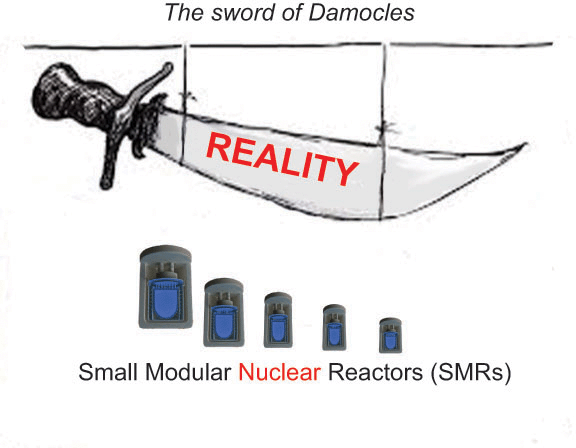
Mobile nuclear reactors? Scathing report slams ‘disturbing’ military program, Times, 1 May 21, Todd South The author of an academic report on Pentagon plans to build mobile nuclear reactors to power future combat bases called the effort “extremely disturbing” and “based on a lie.”
The report released Thursday slams the Pentagon and Army G-4, logistics — specifically the Army office’s 2018 report that lays out the potential uses and needs for such mobile nuclear reactors in future operations.
Alan J. Kuperman wrote the 21-page report titled, “Proposed U.S. Army Mobile Nuclear Reactors: Costs and Risks Outweigh Benefits,” in his role as coordinator of the University of Texas at Austin’s Nuclear Proliferation Prevention Project.
“They don’t reduce casualties, they increase costs and they increase threats to the lives of U.S. service members,” Kuperman said.
The program, known as “Project Pele,” is prototyping the mobile advanced microreactor concept under the Pentagon’s Strategic Capabilities Office……..
The DoD spokesman pointed out that the project is part of a collaboration involving the Department of Energy, Nuclear Regulatory Commission, U.S. Army Corps of Engineers and private industry. Project Pele is not being designed for a specific military service branch but does include experts across defense for a variety of requirements.
Army officials for G-4 deferred comment on the program to DoD……..
Congress approved funding for prototype reactors and the Army awarded $40 million in contracts to three nuclear reactor companies in March 2020 for Project Pele, according to the NPPP report.
Kuperman struck at the Army’s rationale, calling the project unnecessary and dangerous. He counters some of the main justifications that have been provided by DoD and Army reports:
High cost – Kuperman said the Army’s claims that nuclear power can provide cheaper electricity for powering future forward bases is “based on unrealistic assumptions.” Those include that such a reactor would have low construction costs and operate for 18 hours a day over 40 years. The more likely scenario is a mobile reactor would run for half that time over about 10 years, meaning nuclear electricity could cost 16 times more than estimates and still seven times more than diesel-generated power.- Vulnerability to missile attacks – The report points to the 2020 missile attack on forces at al-Asad air base in Iraq. Even with warnings hours ahead of time, more than 100 U.S. personnel suffered traumatic brain injury from the 11 strikes that hit the facility. And the missiles were 10 times more accurate than the Army has predicted in its report on the vulnerability of reactors to precision strikes. The service admits that a direct hit on a reactor would destroy the device. Kuperman notes that even the Army’s plans to protect the reactors, by burying them underground, could inadvertently cause meltdowns by impeding air cooling and causing overheating. A similar strike on an similar such future base with a reactor could cause far more devastating consequences.
Captured reactors – Should a U.S. base housing a mobile reactor be overrun or abandoned, the radioactive waste from the reactor could be used in “dirty bomb” terror attacks.- No mission for reactors – One of the chief purposes of pursing such reactor programs was to reduce casualties from diesel transport to remote bases. But Defense Department data shows a dramatic drop in casualties of five per 1 million gallons of fuel delivered in 2005 to nearly zero by 2013.
- High-energy weapons don’t need reactors – Kuperman states that the justification that future high-energy or laser weapons that the Army hopes to have protecting bases don’t require a reactor to power. “A high energy weapon would have to be fired millions of times to justify a reactor,” Kuperman said. “In reality such a weapon would be fired perhaps hundreds of times in its lifetime.”
- Transport problems – The Army wants to air deliver these reactors to combat posts. Kuperman questions the “regulatory nightmare” that would create. The program calls for initial tests flying the reactors domestically to run then returning them, and their radioactive waste, to another domestic location. Foreign transport would require approval of countries airspace traversed and the approval of a host nation where the reactor would be placed, he said. Other Army recommendations include truck or rail transport domestically and either ship or over-the-ocean flights to friendly ports to then move the reactors again via truck or rail.
Army Times reported on the proposed program in 2019, which had drawn backlash from the Union of Concerned Scientists and its then-director of the Nuclear Safety Project, Edwin Lyman, who called the proposal, “naïve.”The original proposal, approved by the Pentagon’s Strategic Capabilities Office asked for industry solutions in January 2019 on providing a less than 40-ton small, mobile nuclear reactor design that could operate for three years or more and provide 1 to 10 megawatts of power.Planners want the reactor to fit inside a C-17 cargo plane for air transport to theater. More recent moves have reduced the power output to 5 megawatts……..
Lyman notes a major failure with one of the original eight designs in 1961 when a core meltdown and explosion of the ML-1 reactor in Idaho killed three operators.
The three deployed to Antarctica, Greenland and Alaska proved “unreliable and expensive to operate,” Lyman wrote in his response to the Army’s 2018 report on the mobile reactor program.Lyman told Army Times on Thursday that a number of those old reactors required decades of decommissioning and one used at Fort Belvoir, Va., near Washington D.C. is finally scheduled for decommissioning in late 2021……….. https://www.armytimes.com/news/your-army/2021/04/30/mobile-nuclear-reactors-scathing-report-slams-disturbing-military-program/
Following Biden climate summit, USA govt keen to promote and export Small Nuclear Reactors

A Spotlight on Advanced Nuclear after the White House Climate Summit– JD Supra, 30 Apr 21. -”…….. With the nuclear ban lifted by the Development Finance Corporation for investment in innovation projects, the U.S. government acknowledged the importance of nuclear in the transition to [?] clean energy in developing economies.
……….. the Department of State announced the launch of its Foundational Infrastructure for the Responsible Use of Small Modular Reactor Technology (FIRST) Program. Through an initial $5.3 million investment, this program will strengthen international collaboration between the U.S. and partner countries seeking to deploy nuclear energy in their clear energy initiatives. This cooperation includes supporting the deployment of advanced nuclear technologies, including small modular reactors (SMRs),…….
The nuclear menace from under the seas and from high in the sky- theme for May 21
Why would anyone persist in pushing Small Nuclear Reactors (SMRs) and pretending that they can solve climate change, when they clearly cannot?
Well, the answer is – if you’re a toxic macho nuclear zealot or a nuclear weapons corporation – ( Lockheed Martin, Raytheon Technologies, Northrop Grumman, Boeing, and General Dynamics etc)- this myth about SMRs is manna from heaven.
It means that the tax-payer, not private enterprise investors, will take over the SMR push – and the military-industrial-complex will race away with nuclear sites and weapons in space, and with powerful killer nuclear submarines.

Meanwhile those billionaire nuclear gurus – Elon Musk, Bill Gates, Jeff Bezos, , Richard Branson, Jack Ma and othes , will be laughing all the way to the bank, as they promote ”peaceful, nuclear-powered” space travel.
The global media promotes the joy and delight of space travel, rarely acknowledging its intimate connection with militarism. And there’s a crazy sort of national pride – hubris in being in the space race.
The space race to what? Apart from the obvious – nuclear war and annihilation, there’s the danger of ecosystem plutonium pollution from accidents and leaks, drastic accidents, and the gobbling up of public funds that might otherwise go to the public good – health, education, welfare, climate ation – heck – even good international relations!
The USA and Russia have long been in a toxic competition to militarily control the world especially by nuclear submarines. There’s a strange and unwarranted confidence that nuclerar submarines are ”clean” and somehow ”safe”. That’s because they release their radioactive trash unseen, into the world’s ocean waters. When they have an accident, well they just sink, and their poisonous mess is invisible. Dead nuclear submarines seem to be no trouble, hidden on the sea floor. Now that the world has become (a bit) aware of the radioactive danger of nuclear submarines, the dead ones lie in port, as nobody really knows what to do with them, how to clean up the nuclear mess.
In this time of pandemic, it is urgently necessary to put the brakes on NATO, and Russia – in regard to the increasing danger to the world, of nuclear submarines. Even more than cruise ships, they can be a hot-bed of coronavirus – making them even more unsafe in a number of ways.
The purpose of USA space research is clearly military – they don’t even pretend any more.
US Nuclear Marks Beginning of Age of Space Mining as It Signs Historic Trade Agreement, US Nuclear Corp, April 28, 2021,
Source: US Nuclear Corp. Los Angeles, CA, April 28, 2021 (GLOBE NEWSWIRE) — via NewMediaWire — On April 15, 2021, US Nuclear Corp. (OTCQB: UCLE) signed a historic trade agreement with Solar System Resources Corporation that marked the beginning of the age of space trade and mining. The new agreement sets preliminary prices for the high value materials to be extracted. It also establishes and expands our cislunar and solar system value chain and adds SatRevolution as a new partner. The agreement is a continuation of the Letter of Intent signed on February 5, 2021, and outlines how US Nuclear and Solar Systems Resources Corp. plan to cooperate building a value chain starting with mining and selling valuable helium-3 and lanthanide metals and other materials from space deposits.
Solar Systems Resources Corporation Sp. z o. o. is a space mining company that conducts localization, in-situ verification, and mining of space resources. A third strategic partner, SatRevolution S.A., a leading provider of nanosatellites, is also participating in construction of the value chain mentioned in the agreement. The deal, if completed in full, could be worth many hundreds of billions of dollars and will pave the way to a new frontier mining resources in space.
The agreement is in the form of a Memorandum of Understanding, and highlights include:
……….. The parties will endeavor to support the US (and allies), NATO military, and the development of the operational capabilities of the US Space Force…… https://www.globenewswire.com/news-release/2021/04/28/2218641/0/en/US-Nuclear-Marks-Beginning-of-Age-of-Space-Mining-as-It-Signs-Historic-Trade-Agreement.html
Call for debate and scrutiny of proposed nuclear fusion power plant
Call for debate and scrutiny of proposed nuclear fusion power plant, 28 Apr 2021 Nation CYMRU, Alex Seabrook, local democracy reporter
A call has been made for a proper debate and scrutiny over a proposed nuclear fusion power plant near Barry.
Vale of Glamorgan council put forward Aberthaw, a recently closed coal-fired power plant, as a potential site for a fusion prototype.
The UK government last year called for suggestions for possible sites to pioneer the technology which could generate electricity with low carbon emissions.
But opposition councillors on the Vale council have claimed the cabinet has “rushed through” its decision to suggest Aberthaw as a site.
Plaid Councillor Ian Johnson said: “It was strange that the council leadership did not consult with other parties or ask a cross-party scrutiny committee to consider issues before making the expression of interest about a possible future use of the Aberthaw plant.
“Even though it is an early point, many people will have questions about the technology, the impact of the development and the process, and discussing this in scrutiny would open up the debate and ensure transparency.”
Fusion technology is still in its infancy and no fusion reactor has ever created more power than it consumes. But scientists say it could be cleaner and safer than fission, the nuclear technology currently used to generate electricity.
If Aberthaw is chosen, the council is hoping the power plant could bring lots of high-tech high-paid jobs to the region. Westminster should decide on a site by the end of next year, and the power plant would be built by 2040, costing about £2 billion.
Controversial’
But the Vale’s cabinet used controversial emergency powers last month to put forward Aberthaw as a site, without consulting the full council or any scrutiny committees. Council leader Neil Moore said this was due to the deadline for suggestions at the end of last month.
However, Westminster made the initial call for suggestions in December last year, meaning the council had four months in total to debate and scrutinise the decision to put forward Aberthaw. The council debated the issue in a meeting this week, after the deadline passed.
Conservative Cllr Gordon Kemp said: “This is being dealt effectively without allowing any proper consideration or scrutiny. It’s an extremely significant matter, even if we ignore the issue of public concern over such a proposal.
“We’re looking at potentially a colossal, massive investment in the Vale. It could create many jobs, so I think it’s something that should have been discussed.
“I appreciate there are always deadlines on this. But I’m very concerned and surprised this wasn’t put before cabinet and scrutiny committees [earlier].”… https://nation.cymru/news/call-for-debate-and-scrutiny-of-proposed-nuclear-fusion-power-plant/
No future for new nuclear

‘the claim that any nuclear reactor system can “burn” or “consume” nuclear waste is a misleading oversimplification. Reactors can actually use only a fraction of spent nuclear fuel as new fuel, and separating that fraction increases the risks of nuclear proliferation and terrorism.’
mini-PWR designs, like NuScale’s Small Modular Reactor. – the UCS is none too keen on SMRs, as witness its earlier report on them –it says ‘small isn’t always beautiful’. A more recent review of SMRs by Prof. M.V. Ravana, from the University of British Columbia, looking more at the economics, came to similar conclusions: ‘Pursuing SMRs will only worsen the problem of poor economics that has plagued nuclear power and make it harder for nuclear power to compete with renewable sources of electricity.’

No future for new nuclear— https://renewextraweekly.blogspot.com/2021/04/no-future-for-new-nuclear.htmlAn arguably definitive study 25 Apr 21, of new advanced non-water cooled nuclear options, including molten salt reactors and liquid sodium cooled fast reactors, from the US Union of Concerned Scientists, concludes that none can be ready for at least a decade, more like two, and there are none that meet safety, security, sustainability criteria, apart possibly from once-through breed and burn reactors. If we want nuclear it says it would more sensible just to upgrade the standard, more familiar, water cooled reactors.
It sets the scene by noting that, in the United States, so-called Light Water Reactors (PWRs and BWRs) have dominated, these using ordinary water to cool their hot, highly radioactive cores, as opposed to reactors like the Canadian CANDU that use ‘heavy water’, with a double neutron hydrogen isotope, as a moderator. Support for LWRs has continued, despite some economic problems, which have bedevilled expansion in the US and elsewhere: ‘new nuclear plants have proven prohibitively expensive and slow to build, discouraging private investment and contributing to public skepticism’.
Continue readingBe aware – Nuclear Thermal Propulsion (NTP) for space rockets has everything to do with the mkilitary, and funding for weapons makers

US Military Seeks Nuclear Space Flight Test by 2025, VOA 26 Apr 21,
The U.S. military has chosen three companies to develop nuclear thermal propulsion, or NTP systems to be tested in space by 2025. The goal is to test the space travel technology in cislunar space – the area between Earth and the moon.
What is NTP? What is NTP?
The U.S. Department of Energy describes on its website how an NTP system works. It needs a radioactive material such as uranium and another element, such as hydrogen, in liquid form. The liquid propellant is pumped through a reactor core. This causes uranium atoms to break apart inside the core and release heat. The heat turns the propellant into gas, which expands through an opening to produce thrust.
The contracts to produce a flight demonstration of NTP technology were awarded by the military’s Defense Advanced Research Projects Agency, or DARPA. The winning contractors were General Atomics, Blue Origin and Lockheed Martin. DARPA did not announce how much the contracts were worth.
In a recent announcement about the project, DARPA said the area of space, or “space domain,” will be very important to business, scientific discovery and national defense. Establishing “space domain awareness in cislunar space…will require a leap-ahead in propulsion technology,” the agency said……..
NTP and NASA
The U.S. space agency NASA has long been interested in nuclear propulsion systems to power its spacecraft of the future. But the technology has not yet been demonstrated…….. https://learningenglish.voanews.com/a/us-military-seeks-nuclear-space-flight-test-by-2025/5864011.html
1 This Month



26 September – International Day for the Total Elimination of Nuclear Weapons


PLEASE OPPOSE HR 8255 AND S.3639 – bills would accelerate satellite deployment, with no environmental review or safeguards – https://ncstd5li.quorum.us/campaign/169331/
To see nuclear-related stories in greater depth and intensity – go to https://nuclearinformation.wordpress.com
-
Archives
- September 2026 (257)
- August 2026 (330)
- July 2026 (355)
- June 2026 (287)
- May 2026 (306)
- April 2026 (356)
- March 2026 (251)
- February 2026 (267)
- January 2026 (308)
- December 2025 (358)
- November 2025 (359)
- October 2025 (375)
-
Categories
- 1
- 1 NUCLEAR ISSUES
- business and costs
- climate change
- culture and arts
- ENERGY
- environment
- health
- history
- indigenous issues
- Legal
- marketing of nuclear
- media
- opposition to nuclear
- PERSONAL STORIES
- politics
- politics international
- Religion and ethics
- safety
- secrets,lies and civil liberties
- spinbuster
- technology
- Uranium
- wastes
- weapons and war
- Women
- 2 WORLD
- ACTION
- AFRICA
- Atrocities
- AUSTRALIA
- Christina's notes
- Christina's themes
- culture and arts
- Events
- Fuk 2022
- Fuk 2023
- Fukushima 2017
- Fukushima 2018
- fukushima 2019
- Fukushima 2020
- Fukushima 2021
- general
- global warming
- Humour (God we need it)
- Nuclear
- RARE EARTHS
- Reference
- resources – print
- Resources -audiovicual
- Weekly Newsletter
- World
- World Nuclear
- YouTube
-
RSS
Entries RSS
Comments RSS
 nuclear-news