Small Nuclear Power Plants No Use in Climate Crisis

Small Nuclear Power Plants No Use in Climate Crisis
https://goodmenproject.com/featured-content/small-nuclear-power-plants-no-use-in-climate-crisis/
Governments are investing in a new range of small nuclear power plants, with little chance they’ll ease the climate crisis.
July 20, 2021 by Climate News Network By Paul Brown
Claims that a new generation of so-called advanced, safe and easier-to-build nuclear reactors − small nuclear power plants − will be vital to combat climate change are an illusion, and the idea should be abandoned, says a group of scientists.
Their report, “Advanced” is not always better, published by the US Union of Concerned Scientists (UCS), examines all the proposed new types of reactor under development in the US and fails to find any that could be developed in time to help deal with the urgent need to cut carbon emissions. The US government is spending $600 million on supporting these prototypes.
While the report goes into details only about the many designs of small and medium-sized reactors being developed by US companies, it is a serious blow to the worldwide nuclear industry because the technologies are all similar to those also being underwritten by taxpayers in Canada, the UK, Russia and China. This is a market the World Economic Forum claimed in January could be worth $300 billion by 2040.
Edwin Lyman, who wrote the report, and is the director of nuclear power safety in the UCS Climate and Energy Program, thinks the WEF estimate is extremely unlikely. He comments on nuclear power in general: “The technology has fundamental safety and security disadvantages compared with other low-carbon sources.
“Nuclear reactors and their associated facilities for fuel production and waste handling are vulnerable to catastrophic accidents and sabotage, and they can be misused to produce materials for nuclear weapons. The nuclear industry, policymakers, and regulators must address these shortcomings fully if the global use of nuclear power is to increase without posing unacceptable risks to public health, the environment and international peace and security.”
Cheaper options
Lyman says none of the new reactors appears to solve any of these problems. Also, he says, the industry’s claims that their designs could cost less, be built quickly, reduce the production of nuclear waste, use uranium more efficiently and reduce the risk of nuclear proliferation have yet to be proved. The developers have also yet to demonstrate that the new generation of reactors has improved safety features enabling them to shut down quickly in the event of attack or accident.
Lyman examines the idea that reactors can be placed near cities or industry so that the waste heat from their electricity generation can be used in district heating or for industrial processes.
He says there is no evidence that the public would be keen on the idea of having nuclear power stations planted in their neighbourhoods.
Another of the industry’s ideas for using the power of the new nuclear stations to produce “green hydrogen” for use in transport or back-up energy production is technically feasible, but it seems likely that renewable energies like wind and solar could produce the hydrogen far more cheaply, the report says.
In reality the nuclear industry is shrinking in international importance and is likely to continue to do so, Lyman says. According to the International Energy Agency, at the end of 2010, there were 441 operating nuclear power reactors worldwide, with a total electrical power capacity of 375 gigawatts of electricity (GWe).
At the end of 2019, there were 443 operating reactors − only two more than in 2010 − with a total generating capacity of 392 GWe. This represented a decrease of over 20% in the share of global electricity demand met by nuclear energy compared with 2010.
Lyman says the US Department of Energy would be more sensible trying to address the outstanding safety, security and cost issues of existing light water reactors in the US, rather than attempting to commercialise new and unproven designs. If the idea is to tackle climate change, improving existing designs is a better bet.
The report notes that it is not just the US that is having trouble with nuclear technology: Europe is also suffering severe delays and cost overruns with new plants at Olkiluoto in Finland, Flamanville in France and Hinkley Point C in the UK.
Lyman’s comments might be of interest to the British government, which has just published its integrated review of defence and foreign policy.
Military link declared
In it the government linked the future of the civil and defence nuclear capabilities of the country, showing that a healthy civil sector was important for propping up the military. This is controversial because of the government’s decision announced in the same review to increase the number of nuclear warheads from 180 to 260, threatening an escalation of the international arms race.
Although Lyman does not mention it, there is a clear crossover between civil and nuclear industries in the US, the UK, China, Russia and France. This is made more obvious because of the few countries that have renounced nuclear weapons − for example only Germany, Italy and Spain have shown no interest in building any kind of nuclear station. This is simply because renewables are cheaper and produce low carbon power far more quickly.
But the link between civil and defence nuclear industries does explain why in the UK the government is spending £215m ($298m) on research and development into the civil use of the small medium reactors championed by a consortium headed by Rolls-Royce, which is also one of the country’s major defence contractors. Rolls-Royce wants to build 16 of these reactors in a factory and assemble them in various parts of the country. It is also looking to sell them into Europe to gain economies of scale.
Judging by the UCS analysis, this deployment of as yet unproven new nuclear technologies is unlikely to be in time to help the climate crisis – one of the claims that both the US and UK governments and Rolls-Royce itself are making. − Climate News Network
Energy-guzzling Bitcoin must be allied to dangerous costly nuclear power

Bitcoin Miners Embrace Nuclear Power , Yahoo Finance, Editor OilPrice.com, 21 July 21,
”…..The worldwide cryptocurrency production sector is eating up an almost unfathomable amount of energy — as much as entire nations. As of now, Bitcoin mining ranks between Colombia (a country of 50 million people) and Bangladesh (population 163 million) in terms of energy consumption. All told, Bitcoin networks account for an incredible 0.32% of the world’s energy consumption…
The process of “mining” Bitcoin, while virtual, requires an enormous amount of resources because of the considerable computing power necessary to carry out the extremely complex calculations to solve the “proof-of-work” problems that make up the blockchain, the digital ledger that Bitcoin is built upon. Bitcoin is currently being singled out for its massive energy consumption over other cryptocurrencies, not only because it is more than twice the size of the next-most traded cryptocurrency, but because Bitcoin’s especially complex SHA-256 algorithm, which makes Bitcoin one of the most secure cryptocurrencies out there, also makes it one of the most energy-hungry.
Small nuclear reactor project cut back to half size, due to financial worries

Eastern Idaho nuclear project goes from 12 to six reactors. IDAHO FALLS, Idaho (AP) 19 July 21— A Utah energy cooperative said it will reduce the number of small modular nuclear reactors it will build in Idaho from 12 to six for a first-of-a-kind project [ totally ineffective against global heating] that is part of a federal effort to reduce greenhouse gasses that cause climate change……
The reactors are being built by Portland, Oregon-based NuScale Power. The U.S. Nuclear Regulatory Commission last year approved NuScale’s application for the small modular reactors, the first time U.S. officials approved a design for a small commercial nuclear reactor.
………….. Idaho Falls has committed to buying 5 megawatts of power from the reactors through the Carbon Free Power Project. The city had been committed to 10 megawatts but cut that in half in October amid concerns about financial risks.
……….. Idaho Falls City Council member John Radford said at a July 8 meeting. “This project is something that can help keep this country on this trajectory to a carbon-free future and maybe a better existence for all of us.” – [a complete untruth!! this Councillor is either ignorant, or lying] https://madison.com/news/national/govt-and-politics/eastern-idaho-nuclear-project-goes-from-12-to-six-reactors/article_cb353af6-5659-5baa-8365-dc575aeeba8d.html
Canada’s small nuclear reactor project is looking like just a pipe-dream.

Globe Climate: Canada wants nuclear to power the future. But how? SIERRA BEIN Matthew McClearn is an investigative reporter and data journalist with The Globe. For this week’sdeeper dive, he talks about Canada’s nuclear ambitions. Globe and Mail, 19 July 21
Senior government officials, notably federal Natural Resources Minister Seamus O’Regan, say small modular reactors (SMRs) will help Canada achieve net-zero carbon emissions by mid-century. There’s just one problem: it’s not clear yet whether any will be built.
To be sure, many promises made by SMR vendors seem compelling. By taking advantage of factory-style mass production, they’re supposed to be far cheaper than previous generations of reactors, which tended to be massive and prone to cost overruns. They’d also be easier to deploy……..
A mad scramble to deliver on these promises is now underway. Ontario Power Generation—by far Canada’s most experienced nuclear station operator—plans to select a vendor to build a SMR at its Darlington Station by 2028. Further out, Saskatchewan is considering whether to order its own SMRs to replace coal-fired plants.
Accomplishing all that would silence numerous critics and naysayers. But as I explain in my most recent story, history is littered with reactors that failed to live up to their promises. . Many SMR vendors are very early-stage companies which face years of grueling, expensive R&D work to advance their designs to the point they could actually be built. And they’re competing against renewable technologies including wind and solar, which utilities can purchase and deploy today. It may be premature to count on SMRs to help meet Canada’s emissions targets. https://www.theglobeandmail.com/canada/article-globe-climate-canada-wants-nuclear-to-power-the-future-but-how/https://www.theglobeandmail.com/canada/article-globe-climate-canada-wants-nuclear-to-power-the-future-but-how/
Problems of nuclear power in space
Houston, are we going to have a problem with space nuclear power? Bulletin of the Atomic Scientists, By Beau Rideout | July 19, 2021 ” ………….. space nuclear power isn’t just about propulsion. The dynamic commercial space and national security sectors can also benefit from nuclear capabilities and have an important role to play in developing dual-use technologies that have both military and civilian applications, though with some caveats to ensure human safety.
While the National Academies report published in February advocates for the use of nuclear power in propulsion, nuclear power for non-propulsion applications is becoming increasingly attractive as the commercial space sector seeks to expand its activities. It would be prudent to discuss and establish policy on the use of space nuclear power now, so that policy and safety concerns can be fully addressed during the development proposed by NASA and the National Academies. The United States, and the world, has important decisions to make about whether, when, and how to use nuclear power in space.
Nuclear propulsion in space. The fiscal year 2021 spending approved by Congress provides $110 million for space nuclear propulsion development. This reflects growing NASA interest in more ambitious deep-space missions and a burgeoning commercial interest in exploiting extraterrestrial resources on the Moon, Mars, and the asteroid belt, for which nuclear power would be a key enabling technology……………….
With both a high-power output and high mass efficiency, nuclear propulsion would strike a mighty blow against the tyranny of the rocket equation, which dictates that spacecraft need exponentially more fuel to travel farther. Space nuclear propulsion would enable entirely novel types of space missions, such as capturing small asteroids or, as NASA plans, sending humans to Mars.
Non-propulsion activities in space. In addition to providing advanced propulsion capabilities, nuclear power would enable other space activities and allow the commercial space industry to reduce its reliance on solar panels. For example, space-based radar systems can image the ground day or night, regardless of cloud cover, but require large amounts of electrical power. Communication systems relay data across the world but are constrained by the size of their solar panels. With nuclear power, they could send more data down to Earth, or serve more customers by operating from higher orbits.
The space industry is offering new in-space services and aiming for new destinations beyond geostationary orbit but within the moon’s orbit. Lockheed Martin has announced that future GPS satellites will be designed to receive hardware upgrades of processors and sensors while in orbit. A DARPA program is investigating future in-space manufacturing of large, lightweight structures using raw materials harvested from the Moon. And the NASA Commercial Lunar Payload Services program is scheduled to begin sending commercial lunar landers to the Moon in the fourth quarter of this year. This uptick of activity requiring frequent trips beyond low Earth orbit indicates that requirements for propulsion and power generation will continue to expand, making nuclear power an increasingly attractive solution. In anticipation of this demand, conversations about the proper, safe use of nuclear power in space must begin now.
………… The United States should lead the way in identifying the types of applications that should be encouraged, those where caution may be indicated, and perhaps some applications that should be discouraged because the risks outweigh potential benefits.
…………. Interagency review should also identify measures to protect human safety. For example, the National Academies report has recommended that nuclear applications in space minimize the amount of radioactive material required, undergo sufficient testing to ensure reliable operations prior to any orbital flight, restrict reactor use until a spacecraft has achieved a safe orbit, and design all space-going reactors to automatically go into a “safe state,” in which the reactor is highly unlikely to achieve criticality and sustain a fission chain reaction, if a launch failure occurs. Nuclear power applications in low Earth orbits should be required to include back-up safety mechanisms such as redundant communications or a secondary propulsion system, as objects in these orbits are most at risk of uncontrolled reentry events like the Soviet Kosmos 954 reactor accident
In that 1978 accident, the Kosmos 954 satellite broke apart over Canada, spreading radioactive debris over the Northwest Territories and requiring a multimillion-dollar cleanup operation. Kosmos 954 was not the first fission reactor in space. The United States flew an experimental satellite called SNAPSHOT in 1965 to test a small nuclear reactor powering an early form of electric propulsion. SNAPSHOT failed 43 days after launch, but the reactor safely shut down and was left in a high orbit. The Soviet Union launched 33 RORSAT radar satellites powered by reactors between 1967 and 1988. Unlike SNAPSHOT, these RORSAT satellites orbited at low altitude and would fall back to Earth unless boosted up to a higher disposal orbit from which they would not return for several centuries. However, this boosting maneuver was not always successful and on two occasions resulted in the reactor cores crashing back to Earth. ………………. https://thebulletin.org/2021/07/houston-are-we-going-to-have-a-problem-with-space-nuclear-power/?utm_source=Newsletter&utm_medium=Email&utm_campaign=MondayNewsletter07192021&utm_content=NuclearRisk_NuclearPowerInSpace_07192021
Small Nuclear Reactors are all the hype. But here’s the reality

promoting a dizzying assortment of next-generation models that have collectively been dubbed “small modular reactors” (SMRs).……..
The real challenge “is answering all the safety questions that any good regulator would ask: ‘How will this behave if there’s an earthquake or fire? What happens if there’s a complete blackout? What happens if this component fails?’ ” Answering such questions requires an intensive research program and countless hours of laboratory work, which can take decades. There’s no guarantee the answers will be favourable.
Governments, utilities and the nuclear industry hope small modular reactors will power Canada’s future. Can they actually build one? The Globe and Mail MATTHEW MCCLEARN, JULY 17, 2021 Ontario Power Generation plans to make a decision this year that might determine the future of Canada’s nuclear industry.The utility, by far Canada’s largest nuclear power producer, promises to select a design for a 300-megawatt reactor it proposes to build at its Darlington Nuclear Generating Station by 2028. The estimated price tag: up to $3-billion. It would be the first new reactor built on Canadian soil in well over three decades. OPG won’t make that decision alone, because it’s intended to be the first of many reactors of the same design built across the country.Canada’s nuclear industry desperately needs a next act….. With a supply chain of more than 200 companies covering everything from uranium mining, to operating power plants, to decommissioning them, Canada is considered a Tier 1 nuclear country.
But lately, this machine has been devoted to squeezing more life out of old CANDU units, largely through Ontario’s $26-billion plan to refurbish its Darlington station, east of Toronto, and the Bruce Power complex, on Lake Huron. The industry has few, if any, exciting new products for sale……
but renewable forms of generation – hydro, wind, solar and biomass – have become preferred tools for decarbonizing electricity grids. And utilities can buy inexpensive wind turbines and solar panels today.
Seeking to catch up, dozens of nuclear vendors sprung up just in the past few years, promoting a dizzying assortment of next-generation models that have collectively been dubbed “small modular reactors” (SMRs)………
U.S. President Joe Biden and U.K. Prime Minister Boris Johnson have also indicated they will also support SMR development, as have some prominent investors, notably Bill Gates.

Here’s the reality: Most SMRs exist only as conceptual designs and are not yet licensed for construction anywhere.
The promised assembly lines that would churn them out like clockwork don’t exist
Here’s the reality: Most SMRs exist only as conceptual designs and are not yet licensed for construction anywhere. (The international law firm White & Case says the only contemporary SMR in existence is located on a vessel anchored off Russia’s Arctic coast. According to reports, construction of China’s first SMR recently commenced on the southern island of Hainan.) The promised assembly lines that would churn them out like clockwork don’t exist; many vendors are early-stage companies with hardly any revenues.
To change this, the federal government will probably have to open wide the taxpayer’s wallet. And the industry must move quickly from bold marketing claims to commercially viable products
OLD IDEAS, NEW PACKAGESMR is a marketing term, rather than a technical one, reflecting the industry’s aspirations rather than what it can deliver today.In Canada, SMR has come to describe reactors that generate 300 megawatts or less. That isn’t exactly small – it’s enough to power a small city – but for comparison’s sake, Ontario’s largest current reactors generate around 900 megawatts. Some proposed SMRs would produce just a few megawatts. The industry pitches them for remote Indigenous communities, industrial use (at mines, for instance) and tiny island nations.Small reactors aren’t new. They’ve been used in icebreakers, submarines and aircraft carriers. And many SMRs are based on concepts contemplated as long ago as the 1950s.
Oakville, Ont.-based Terrestrial Energy Inc., one of OPG’s potential partners, intends to use molten salt, rather than water, as a coolant. The company says its technology is a “game-changer”: The Integral Molten Salt Reactor (IMSR) would operate at much higher temperatures (about 700 C) than conventional reactors (about 300 C)….
As for the “modular” part, the notion is that SMRs would be mass-produced on assembly lines and shipped to where they’re needed, rather than custom-built onsite. This plug-and-play approach is intended to reduce purchase costs and accelerate deployment…………….
SMRs appeal to certain nationalist impulses as well: Canada is, after all, the world’s second-largest uranium producer.
…… The industry has made limited progress in addressing wastes from decades-old reactors; it’s unclear how novel detritus from SMRs might be handled. Perhaps most damagingly of all, reactors have earned a reputation for being overpriced relative to other forms of generation, and oftenbeleaguered by massive delays and cost overruns.
SMR GAME PLAN
The nuclear industry’s plan to reverse its flagging fortunes begins at Darlington. OPG announced late last year it was working with three SMR developers on preliminary design and engineering work: North Carolina-based GE Hitachi Nuclear Energy, Terrestrial Energy and X-energy. It promises to select a winner by year’s end….
Naturally, of course, no SMR developer aspires to be a one-hit wonder. So next up: Persuade Saskatchewan to build a fleet of the same reactors……….. Winning Saskatchewan would be a major coup: Jurisdictions that go nuclear tend to stay nuclear for decades. …… quandary remains: Prospective SMR buyers such as SaskPower can only look at conceptual designs. “There’s been some small demonstration units built, but nothing of the size that we would expect to see in operational terms,” Mr. Morgan said.
……... NUCLEAR GHOSTS Twenty years ago, Canada’s nuclear industry staked its future on updating the venerable CANDU design. Atomic Energy of Canada Ltd. (AECL), the
Crown corporation that pioneered it, talked up the Enhanced CANDU 6, CANDU 9 and Advanced CANDU Reactor (ACR) as safer, faster to construct, cheaper and better than previous models. The federal government pumped untold sums into their development.None were licensed. None were ordered. None were built.
In 2011, the federal government sold AECL’s reactor business to SNC-Lavalin for a paltry $15-million. After six decades of development, and dozens of bona fide reactors built and operated in seven countries, the CANDU had become nearly worthless.
The proposed site for OPG’s first SMR, next to the existing Darlington Station, is an artifact of that era. In 2006, OPG began preparing to build up to four reactors at the same location. AECL’s Enhanced CANDU 6 and the ACR 1000 were candidates.But the project was derailed in late 2013 when the Ontario government asked OPG to stand down, essentially because the province no longer needed the power. The viability of those “next-generation” CANDUs, however, was never clear.
It’s relatively easy to sketch a reactor design on the back of a napkin, or create promotional videos and brochures with snazzy renderings. Professor M.V. Ramana, of the University of British Columbia’s Liu Institute for Global Issues, says a few graduate students can develop a conceptual design for a few hundred thousand dollars.
But it’s quite another matter to advance a design to the point of actually building it. The real challenge, Prof. Ramana said, “is answering all the safety questions that any good regulator would ask: ‘How will this behave if there’s an earthquake or fire? What happens if there’s a complete blackout? What happens if this component fails?’ ” Answering such questions requires an intensive research program and countless hours of laboratory work, which can take decades. There’s no guarantee the answers will be favourable.
…………… Even a mature design isn’t enough. Just as Ford wouldn’t build an assembly line for the Mustang Mach-E if it thought it could sell only a handful, SMR vendors need assurances they’ll receive enough orders to justify mass production. It’s unclear how many orders would be sufficient, but published estimates have ranged from as low as 30 to well into the hundreds.
……… Prof. Ramana said many of the earliest power reactors met the modern definition of SMRs. But their diminutive size was rarely a virtue: It meant they couldn’t take advantage of economies of scale, resulting in high costs per unit of electricity generated, not to mention disproportionately greater volumes of radioactive waste. Many were shut down early.
“The lesson that we learned from some of these experiences is that designs that might seem captivating on paper might not actually work so well in real life,” Prof. Ramana said. “SMRs are not going to be economical. You can see that from the outset.”
………………. FEDERAL SUPPORT – THE CRUCIAL INGREDIENT. In contrast with the CANDU, the nuclear industry promises SMRs will be funded largely by the private sector. Many observers are skeptical. “Without government programs and financial support promoting SMRs, industry alone is unlikely to invest in the high up-front costs,” opined lawyers at Stikeman Elliott in a recent commentary.
Nor are non-nuclear provinces likely to make the leap alone. Mr. Morgan confirmed Saskatchewan seeks federal support to deploy SMRs, although the form of that support has yet to be determined.
For several years, federal and provincial government officials have signalled they want Canada to be one of the earliest adopters of SMRs. They’ve partnered with industry to produce road maps for making that happen. The governments of Ontario, New Brunswick, Saskatchewan and Alberta have agreed to collaborate on advancing SMRs. Mr. O’Regan, the federal Natural Resources Minister, has fully embraced the industry’s claim that Canada’s clean-energy transition cannot succeed without them,
So far, however, such pronouncements haven’t translated into generous subsidies. The federal government has channelled just meagre amounts of funding to SMRs, such as $20-million last October toward development of Terrestrial’s IMSR, and $50.5-million to New Brunswick-based Moltex Energy in March.
The latest federal budget didn’t mention SMRs. Nevertheless, studying its fine print, lawyers at McCarthy Tétrault LLP noticed what they described as “exciting policy levers.” They pointed, for example, to an income tax break of up to 50 per cent for manufacturers of zero-emission technologies. There was also $1-billion offered for clean tech projects “where there is a perceived lack of patient capital or ability to scale up because of the size of the Canadian market.” SMR vendors could capitalize on such programs, the lawyers concluded, depending on how they’re implemented.
Meanwhile, SMR vendors seek relaxed safety requirements that could make SMRs more cost-competitive.
……It’s unclear to what extent the Canadian Nuclear Safety Commission (CNSC) will acquiesce………….
Obtaining a licence typically takes a few years. “Experience has shown that it will be dramatically affected by the [proponent’s] capability of submitting adequate and complete information on day one,” Mr. Carrier said. Only one SMR has so far commenced a full licensing review: Ottawa-based Global First Power Ltd. submitted documentation for its Micro Modular Reactor in March.
The Union of Concerned Scientists, a long-time opponent of nuclear power, released a study in March which concluded that SMR designs, including molten salt reactors, are no safer than previous designs. It therefore urged regulators to maintain current requirements.
“The intense scrutiny, from policy makers and the public – given the safety and security angle combined with a nascent technology – will likely cause delays and conflicts” for SMR developers, lawyers from global law firm White & Case predicted in a recent commentary.
In short, SMRs’ future depends to a large extent on vendors delivering hard proof supporting their most ambitious promises about safety, efficiency, cost and other matters…….. a late arrival by SMRs could consign them to irrelevance. And right now, many observers regard them as too speculative to factor into forecasts. The federal government’s own Canada Energy Regulator projects the amount of power generated by nuclear reactors in Canada will continue on a declining trend.
Dennis Langren is a regulatory lawyer with Stikeman Elliott. He says the earliest deployments of SMRs in Canada are at least a decade off
Paris-based Mycle Schneider Consulting has reviewed the status of global SMR development three times since 2015. In the firm’s most recent review, published in September, 2020, it found little had changed over the period.
“Overall, there are few signs that would hint at a major breakthrough for SMRs, either with regard to the technology or with regard to the commercial side,” the firm observed. “Delays, poor economics, and the increased availability of low-carbon alternatives at rapidly decreasing cost plague these technologies as well, and there is no need to wait with bated breath for SMRs to be deployed.”
Ralph Torrie is a partner at Torrie Smith Associates, an energy and environmental consultancy. He says he’s focused on power generation options that can be built this decade to address a warming climate – a criterion that, in his view, disqualifies SMRs.“They’re a long way off.” theglobeandmail.com/business/article-governments-utilities-and-the-nuclear-industry-hope-small-modular/#:~:text=The%20utility%2C%20by%20far%20Canada’s,Nuclear%20Generating%20Station%20by%202028.–

Significant downsizing of NuScale’s small nuclear reactor project for Idaho – (cost of project unknown)

The company [NuScale] refused to disclose the modular reactor project’s exact costs.
Eastern Idaho nuclear reactor project downsized, Post Register, By KYLE PFANNENSTIEL kpfannenstiel@postregister.com, Jul 16, 2021
A project to build a first-of-its-kind nuclear reactor in eastern Idaho has been significantly downsized.
The initial plan for the Carbon-Free Power Project was to build 12 interconnected miniature nuclear reactor modules to produce a total of 600 megawatts. It would be the first small modular reactor in the United States. After the company tasked with manufacturing the plants said it could make the reactors more power-efficient, planners reduced the project down to six module reactors that could produce 462 MW total.
“After a lot of due diligence and discussions with members, it was decided a 6-module plant producing 462 MW would be just the right size for (Utah Associated Municipal Power Systems) members and outside utilities that want to join,” said LaVarr Webb, UAMPS spokesman.
The project between UAMPS and Portland-based reactor producer NuScale received $1.4 billion from the U.S. Department of Energy last year. The reactor is planned to be built on the DOE’s 890-square mile desert site west of Idaho Falls at Idaho National Laboratory.
…….. now that we have made significant progress, including a large cost-share award from the Department of Energy, and NuScale has received design approval from the (Nuclear Regulatory Commission), we’re seeing more and more utilities express interest in the plant.”
So far, Webb said 28 participants have committed to a total of 103 MW. But, he said, “all are currently evaluating whether to increase or decrease” their commitments.
…….. Others who support the project worry about its incomplete financial support. All but one council member that day voted to continue Idaho Fall’s 5 MW commitment. But two voiced direct concern over the project not having full subscriptions. Council member Jim Francis was the sole nay vote.
Last October, the Idaho Falls City Council halved its then-10 MW commitment. The move maintained the city’s involvement but reduced the risk to customers of the city-ran grid, by Idaho Falls Power, if the investment doesn’t pan out, the Post Register previously reported.
Downsizing the project reduces the project’s costs and the amount of power it can produce, overall.
…….. The company [NuScale] refused to disclose the modular reactor project’s exact costs.
Webb said the project is currently working toward submitting an application to the NRC in 2024 to build and operate the reactor. https://www.postregister.com/news/inl/eastern-idaho-nuclear-reactor-project-downsized/article_0c60abf6-d0ea-5d42-9f9e-3cdb1a49b381.html
USA’s Department of Energy brushes aside the community’s concerns about the so-called MARVELlous small nuclear reactor plan
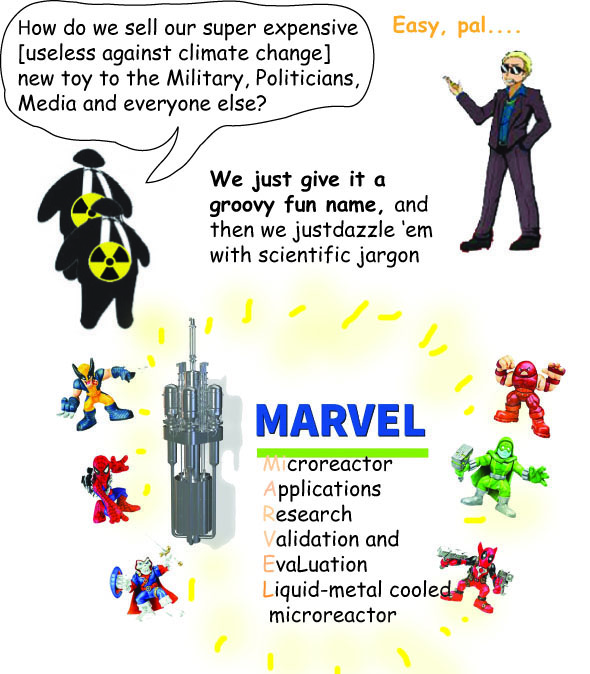
Concerns with nuclear energy must be taken seriously https://www.postregister.com/opinion/guest_column/opinion-concerns-with-nuclear-energy-must-be-taken-seriously/article_4e1e08d1-cad9-56dd-83cc-6ceadb828b24.html 16 July.By IAN COTTEN In June, the Department of Energy released a final environmental assessment for the MARVEL nuclear reactor project proposed to go in at Idaho National Laboratory. The result of the environmental assessment was a proposed finding of no significant impact.
It was incredibly discouraging to read through the DOE’s response to the public’s comments of concern in the final assessment. Many of the responses were copied and pasted responses and/or dismissively replied that the concerns around the proposal were out of scope for the assessment.
All nuclear energy produces highly dangerous, radioactive waste. The U.S. currently has no permanent radioactive waste repository. This means that every ounce of waste produced in this, and all other nuclear projects that take place at INL is destined to be stored in perpetuity at INL, which sits directly atop the Snake River Aquifer. This subsurface body of water is of critical importance to Idaho and provides drinking water to more than 300,000 people and irrigation water for our state’s richest agricultural regions. Continuing to add to the waste that is stored at INL is setting us up for catastrophe.
Littered throughout the assessment are mentions of how safely this reactor will operate and that there will be no impacts on groundwater during normal operations. Of course, project managers with the DOE intend for this reactor to operate as planned and for there to be no impact on the environment. But putting blind faith in a technology that exists only on paper and has no real-life operating experience is a reckless way to approach assessing potential environmental impacts.
It is also important to look at proposals like MARVEL within the larger energy landscape as we look ahead. When looking toward our energy future, the cost of research and development of new technologies must be considered. Every federal dollar that is spent on nuclear energy research, development and implementation is a dollar that cannot be spent on the development of actual renewable energy sources, such as wind and solar. Nuclear energy is considerably more expensive than renewables, often by orders of several magnitudes.
All of the safety concerns listed above should be considered in scope for this project, and the fact that the DOE refused to adequately acknowledge these concerns is disheartening. At the very least, our government should be willing to do their due diligence and prepare a more comprehensive environmental impact statement that assesses the potential health and safety impacts of this proposal in more depth.
While this proposed finding of no significant impact means that the DOE will likely avoid being required to prepare an environmental impact statement, MARVEL is not yet a sure thing. Idahoans who are concerned about this and other nuclear energy development in their state should voice their concerns to their Congress members and other elected officials. Idaho is too valuable to waste on untested, dangerous and dirty nuclear energy projects. Nuclear energy is out of scope for a safe, clean, equitable and renewable energy future.
Astronauts to Mars – a game of cancer-russian-roulette, especially dangerous to women


women were more likely to develop lung cancer than men, suggesting a greater sex-based vulnerability to harmful radiation.
the risk to an astronaut exposed to space radiation is long-term rather than immediate. Without proper shielding (which tends to be rather heavy and thus prohibitively expensive to launch) their chances of developing cancer, as well as cardiovascular disease, cataracts and central nervous system damage, slightly increase each day they are in space. In a person’s cells, space radiation can sever both strands of a DNA molecule’s double helix. And while a few such instances might come with very limited risks, each additional severance raises the odds of developing a harmful mutation that could cause cancer………
New Space Radiation Limits Needed for NASA Astronauts, Report Says, Scientific American, By Ramin Skibba on July 14, 2021 https://www.scientificamerican.com/article/new-space-radiation-limits-needed-for-nasa-astronauts-report-says/ Although meant to minimize risks to human health, the proposed new limits would still be exceeded by any conceivable near-future crewed voyage to MarsAstronaut Scott Kelly famously spent an entire year residing onboard the International Space Station (ISS), about 400 kilometers above Earth, and his NASA colleague Christina Koch spent nearly that long “on station.” Each returned to Earth with slightly atrophied muscles and other deleterious physiological effects from their extended stay in near-zero gravity.
But another, more insidious danger lurks for spacefarers, especially those who venture beyond low-Earth orbit.
Space is filled with invisible yet harmful radiation, most of it sourced from energetic particles ejected by the sun or from cosmic rays created in extreme astrophysical events across the universe. Such radiation can damage an organism’s DNA and other delicate cellular machinery. And the damage increases in proportion to exposure, which is drastically higher beyond the protective cocoon of Earth’s atmosphere and magnetic field (such as on notional voyages to the moon or Mars). Over time, the accrued cellular damage significantly raises the risk of developing cancer.
To address the situation, at NASA’s request, a team of top scientists organized by the National Academies of Sciences, Engineering, and Medicine published a report in June recommending that the space agency adopt a maximum career-long limit of 600 millisieverts for the space radiation astronauts can receive. The sievert is a unit that measures the amount of radiation absorbed by a person—while accounting for the type of radiation and its impact on particular organs and tissues in the body—and is equivalent to one joule of energy per kilogram of mass. Scientists typically use the smaller (but still quite significant) quantity of the millisievert, or 0.001 sievert. Bananas, for instance, host minute quantities of naturally occurring radioactive isotopes, but to ingest a millisievert’s worth, one would have to eat 10,000 bananas within a couple of hours.
Every current member of NASA’s astronaut corps has received less than 600 millisieverts during their orbital sojourns, and most, including Koch, have received much less and can thus safely return to space. But a year on the ISS still exposes them to more radiation than experienced by residents of Japan who lived near the Fukushima Daiichi nuclear accidents of 2011.
“Everybody is planning trips to the moon and Mars,” and these missions could have high radiation exposures, says Hedvig Hricak, lead author of the report and a radiologist at Memorial Sloan Kettering Cancer Center in New York City. Using current spaceflight-proved technologies, long-distance voyages—especially to the Red Planet—would exceed the proposed threshold, she says.
That could be a big problem for NASA’s Artemis program, which seeks to send astronauts to the moon in preparation for future trips to Mars. Another problem for the space agency is that the epidemiological data it uses mostly come from a longevity study of Japanese survivors of atomic bomb blasts, as well as from the handful of astronauts and cosmonauts who have endured many months or even years in low-Earth orbit. NASA’s current space radiation limit, which was developed in 2014, involves a complicated risk assessment for cancer mortality that depends on age and sex, yet more relevant data are necessary, Hricak argues. In the atomic bomb survivor study, for instance, women were more likely to develop lung cancer than men, suggesting a greater sex-based vulnerability to harmful radiation. “But with the knowledge we presently have, we know we cannot make a comparison between high exposure versus chronic exposure,” Hricak says. “The environment is different. There are so many factors that are different.”
NASA wants to update its standards now because the agency is on the cusp of sending so many astronauts well beyond low-Earth orbit, where greater amounts of space radiation seem destined to exceed previously mandated exposure limits. Furthermore, Hricak says, having a single, universal radiation limit for all space travelers is operationally advantageous because of its simplicity. A universal limit could also be seen as a boon for female astronauts, [ Ed. a boon?when they still are more susceptible to cancer than men are?] who had a lower limit than men in the old system and therefore were barred from spending as many days in space as their male counterparts.
The new radiation limit proposed by Hricak and her team is linked to the risks to all organs of a 35-year-old woman—a demographic deemed most vulnerable in light of gender differences in the atomic bomb survivor data and the fact that younger people have higher radiation risks, partly because they have more time for cancers to develop. The goal of the radiation maximum is to keep an individual below a 3 percent risk of cancer mortality: in other words, with this radiation limit, at most three out of 100 astronauts would be expected to die of radiation-induced cancer in their lifetime.
“NASA uses standards to set spaceflight exposure limits to protect NASA astronauts’ health and performance, both in mission and after mission,” says Dave Francisco of NASA’s Office of the Chief Health and Medical Officer. He acknowledges that, while astronauts on Mars missions would benefit from the thin Martian atmosphere that provides some limited protection, “transit in deep space has the highest exposure levels.”
That means long-haul space trips come with the biggest risks. A stay on the lunar surface for six months or more—presuming, of course, that astronauts eventually have a presence there and do not spend most of their time in subsurface habitats—would involve nearly 200 millisieverts of exposure, a higher amount than an extended visit to the ISS. And an astronaut traveling to Mars would be exposed to even more radiation. Whether they reached the Red Planet through a lunar stopover or on a direct spaceflight, they could have experienced significant radiation exposure en route. Even before they embarked on the trip back home, they could have already exceeded the 600 millisievert limit. The entire voyage, which would likely last a couple of years, could involve well more than 1,000 millisieverts. So if astronauts—and not just robots—will be sent to Mars, NASA likely will need to request waivers for them,
Hricak says, although the exact process for obtaining a waiver has not yet been laid out.
The report’s proposal for a new radiation maximum is not without its critics. “For a mission to Mars, a 35-year-old woman right at that limit could have an over 10 percent chance of dying in 15 to 20 years. To me, this is like playing Russian roulette with the crew,” says Francis Cucinotta, a physicist at the University of Nevada, Las Vegas, and former radiation health officer at NASA. Despite the supposed benefits the new limits would have for female astronauts, he is concerned that the risks are particularly pronounced for younger women in space.
On the contrary, Hricak says, in its request for new limits, NASA has sought to be conservative. The European, Canadian, and Russian space agencies all currently have a higher maximum allowed dose of 1,000 millisieverts, while Japan’s limit is age- and sex-dependent like NASA’s current one, mainly because of a shared dependence on the atomic bomb survivor data.
But unlike someone in the vicinity of a nuclear explosion, the risk to an astronaut exposed to space radiation is long-term rather than immediate. Without proper shielding (which tends to be rather heavy and thus prohibitively expensive to launch) their chances of developing cancer, as well as cardiovascular disease, cataracts and central nervous system damage, slightly increase each day they are in space. In a person’s cells, space radiation can sever both strands of a DNA molecule’s double helix. And while a few such instances might come with very limited risks, each additional severance raises the odds of developing a harmful mutation that could cause cancer………
considering how little is known about various health risks from different kinds of space radiation, compared with radiation we are familiar with on Earth, researchers will surely continue with more studies like these to protect astronauts as much as possible. “I can tell you exactly how much exposure you’re going to get from a CT scan,” Hricak says, “but there are many uncertainties with space radiation.”….. https://www.scientificamerican.com/article/new-space-radiation-limits-needed-for-nasa-astronauts-report-says/
Nuclear fusion – a very unlikely development for Bradwell, UK
Bradwell is no soft touch for Nuclear Fusion’s fantasy. Bradwell looks
an unlikely bet for fusion whoever is behind the scheme. And it will not
happen anytime soon – the 2040s at the very earliest – far too late to
save the planet. Even if the experiment goes ahead it is far more likely to
go to a more welcoming site.
Maylands Mayl July Edition 7th July 2021
EDF launches the “EPR2” After the Flamanville and Finland fiascoes, what could go wrong?

After the Flamanville and Finland fiascoes, what could go wrong?
EDF launches the “EPR2” — Beyond Nuclear International The politics of “fait accompli” will ensure a new industrial and financial disaster
Editor’s note: Despite the latest safety failures at the Taishan EPR in China; the endless delays and cost over-runs at the EPR projects in France and Finland; the technical fiascos and do-overs at the EPR construction sites in France, Finland and the UK; and the ongoing reckless plans for 6 EPRs in India, the French nuclear sector has far from abandoned its hubris. Instead, incredibly, and as Stéphane Lhomme tells us in a recent new blog on the topic, here translated into English, EDF has announced plans to begin construction of the “EPR2”. What could possibly go wrong?
By Stéphane Lhomme. 4 July 21,
Despite the fact that it has proven incapable of properly carrying out the construction of the EPR reactor at the never-ending Flamanville site underway since 2008, EDF leadership has nevertheless decided — according to the media outlet, Contexte — to allocate hundreds of millions of Euros to launch a construction program for new reactors, called “EPR2”.
Despite being fiercely pro-nuclear, President Macron has declared on several occasions that the EPR at Flamanville would need to be operational before any decision to build other reactors could be made.
However, it’s very likely that Mr. Macron is perfectly well aware of — and complicit in — this decision by EDF management to move forward with a new project.
Just as it has often done in the past, in its contempt for democracy and the interests of the French public, the leadership of EDF intends to use the politics of fait accompli: it proposes to spend hundreds of billions to start one or several “EPR2” reactor construction projects in order to then proclaim that the ship has sailed so the program cannot be stopped…. under threat of wasting hundreds of billions.
But it’s precisely by building nuclear reactors that EDF is already wasting astronomic sums, just as Areva did before that, going bankrupt due to the disastrous EPR construction project in Finland (which began in 2005, was supposed to come on line in 2009….but is still not complete)!
EDF claimed to have EPR construction under control despite Areva’s setbacks in Finland, but the construction at Flamanville is also a total catastrophe. So how can we possibly believe that, miraculously, EDF would be capable of building new EPR reactors, and moreover modified ones (hence the concept “EPR2”)?
For sure, from the anti-nuclear point of view, it is reassuring to be able to count on the incompetence and manifest inability of EDF to build nuclear reactors. But there is no justification for wasting incredible sums of money that are so needed for energy efficiency and renewable energy development.
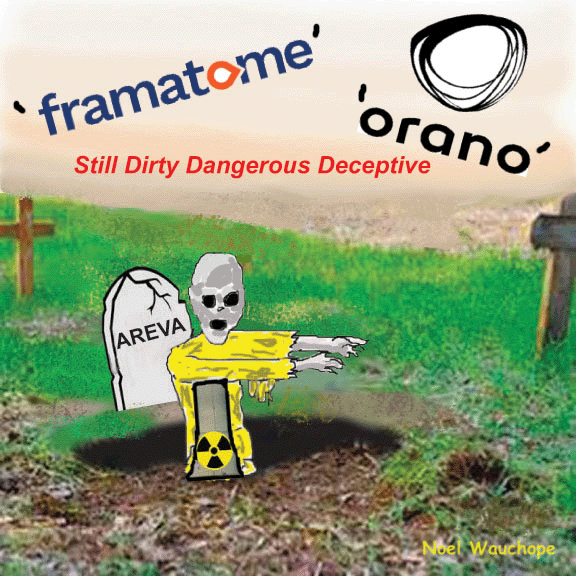
On the contrary, EDF is guaranteeing failure with these delusional nuclear projects, and, as is the case for Areva (renamed Orano), it is the public who will pay for the steep losses. If this “EPR2” program is not stopped as quickly as possible, it will end in a new industrial and financial disaster.
The least that the President of the Republic can do, assuming that he has a good grasp on democracy, is to prohibit EDF (which is 85% state-owned) from launching this new nuclear program before the startup of the Flamanville EPR.
But obviously the best decision would be to cancel all the new reactor projects and immediately to begin a rapid closure of the 56 reactors that pose a daily threat to the lives of French citizens and a majority of Europeans; reactors that produce radioactive waste for which there is no existing solution and that serve as a pretext for the totalitarian repression of citizens who oppose waste burial at the Cigéo at Bure in the Meuse.
Stéphane Lhomme is a longtime French anti-nuclear campaigner and runs the anti-nuclear network, Nuclear Observatory (Observatoire Du Nucléaire).
Headline photo of EPR protest in Colmar, France, by Linda Pentz Gunter.
The space tourism plans of Bezos, Musk and Branson are morally reprehensible,

Ben Bramble sets out a problem that ought to be so obvious – that this space travel push is a wasteful, and even childish example of the rich boys club doing its thing – Bezos, Musk, Gates, Branson etc trying to outdo each other
But there is a more sinister side to space travel and space research – the national rivalries, started with Donald Trump’s plan for a Space Force – nuclear reactors, nuclear-powered rockets, and nuclear weapons in space. Those billionaires are all too well connected with NASA and this space military push. The thought of a nuclear war in space is horrendous. But what else could possibly go wrong?
The space tourism plans of Bezos, Musk and Branson are morally reprehensible, The Age, Ben Bramble, 5 July 21.
With billionaires Jeff Bezos, Elon Musk, and Richard Branson soon to send paying customers into space, members of US Congress are askingwhether and how to regulate commercial spaceflight. But there is a more basic question: Should there be such an industry in the first place?
Supporters of such an industry, such as Republican Kevin McCarthy, cast these billionaires as modern-day Wright brothers, innovating commercialspaceflight in a way governments either can’t or won’t. While billionaires will be the first in space, they say, soon everyone will get their chance.
But this is clearly not feasible any time soon, given Earth’s environmental crises. It is unsustainable for humans to keep consuming resources at the rate we currently are, let alone if space tourism were to become commonplace. The fact that a product can be made cheap enough for many people to afford it does not show that it is environmentally sustainable for many people to actually consume it.
Still, you might say, what could be wrong with commercial spaceflight reserved for the ultra-wealthy? This wouldn’t significantly worsen our environmental crises.–
But there is something morally distasteful in the extreme about space tourism exclusively for the ultra-wealthy when so many people on Earth are in such great need. Going into space, in full view of the many billions of humans who are struggling on a daily basis, is a little like enjoying a pop-up Michelin star meal in front of a homeless shelter.
This is not to decry all luxury goods. But there is something particularly objectionable about spending so much money on a fleeting experience for oneself and others, who are already among the best off on the planet, when so many cannot even make ends meet (through no fault of their own).
At present, there seems a clear tendency to reserve moral criticism for people who cause bad things or who set out to harm others. Such behaviour is certainly bad and merits criticism. But we should feel grumpy also at people for failing to help others when they easily can. Those who display an indifference to the plight of others or who are too wrapped up in themselves and their own self-serving projects are morally criticisable even if they are not the cause of others’ suffering. While it is true that Bezos has recently become a major sponsor of the environment, much more is needed. Every dollar spent on sending billionaires into space is money that could have been used instead to help save the planet or bring others out of poverty.
It is worth adding that many billionaires have contributed to Earth’s problems. Our environmental crises are largely due to excessive consumption, something that companies such as Amazon have played a major role in making possible, affordable and accepted……….
Bezos has said that one of his reasons for founding his company Blue Origin is that “we’re now big compared to the size of the planet”. Like Musk, he thinks we need to look beyond Earth to survive our present crises. But this is far too premature. We can still save the Earth. But to save it, we’re going to have to re-engineer our consumer cultures and economies. This, and not space tourism, is the great engineering challenge of the 21st century. I’d like to see these billionaires use their brilliant minds to help save the Earth, rather than flee it. If this means smaller growth for their own companies, so be it. ….. https://www.theage.com.au/national/the-space-tourism-plans-of-bezos-musk-and-branson-are-morally-reprehensible-20210704-p586o1.html
NASA pretending that space radiation is sort of OK for women, but it’s not
New NASA radiation standards for astronauts seen as leveling field for women, Science, By Anil OzaJun. 29, 2021
A blue-ribbon panel has endorsed NASA’s plans to revise its standard for exposing astronauts to radiation in a way that would allow women to spend more time in space.
A report by the U.S. National Academies of Sciences, Engineering, and Medicine released on 24 June encourages NASA to proceed with its plans to adopt a new standard that limits all astronauts to 600 millisieverts of radiation over their career. The current limit is the amount of radiation that correlates with a 3% increase in the risk of dying from a cancer caused by radiation exposure—a standard that favored men and older astronauts whose cancer risk from radiation was lower. The proposed standard would limit all astronauts to the allowable dosage for a 35-year-old woman.
The changes are in line with current data and puts women on an equal footing, says Hedvig Hricak, a radiologist at Memorial Sloan Kettering Cancer Center and chair of the committee that wrote the report. “There’s no evidence for significant gender difference in the radiation exposure, and associated risk of cancer,” she says.
The new standard comes as NASA gears up for renewed exploration of the Moon and, eventually, a mission to Mars. The change should remove gender from the list of factors used to decide who gets chosen for those missions, says Paul Locke, an environmental health expert at Johns Hopkins University who was not on the committee. “Women will not be penalized because they are, under the old model, at higher risk,” he says.
Whereas some experts lauded NASA’s intentions, others worry the proposal ignores the complexities and uncertainties of deep space travel. “I think they’ve pulled together the best data they have. But again, I think, more research is going to be needed,” says Albert Fornace, a radiobiologist at Georgetown University. With so few people having traveled beyond low-Earth orbit, most of the data for setting radiation exposure limits in space come from survivors of the atomic bombs in Japan and studies of people, like uranium miners, who work in conditions with high exposure to radiation. The long lead time for voyages to Mars also gives scientists time to develop ways to shield astronauts from higher levels of radiation, Fornace adds.
Francis Cucinotta, a biophysicist at the University of Nevada, Las Vegas, doesn’t agree with the report’s backing of a single dosage level. Instead, the former chief scientist for NASA’s radiation program thinks equity should come in the form of equal risk rather than equal dosages of radiation.
“[It] sounds like they’re just going to ignore the science and try to make it comfortable for everybody,” Cucinotta says, arguing that age, sex, and race affect an individual’s risk of developing cancer and should be factors when determining the amount of time astronauts can spend in space. “When they’re selected to be astronauts, there’s a lot of things where it’s not equal—it’s based on performance capability. But they’re not applying that model here.”
Cucinotta would stick with the 3% increase in the risk of dying of cancer. For a Mars mission, which is expected to expose astronauts to 1000 millisieverts, he proposes raising that maximum risk to 5% after conducting research on countermeasures and weighing genetic markers that lower an astronaut’s risk of developing cancer……….. https://www.sciencemag.org/news/2021/06/new-nasa-radiation-standards-astronauts-seen-leveling-field-women
Bradwell anti-nuclear campaigners may face fight against nuclear fusion plan
CAMPAIGNERS battling proposals for a new nuclear power station at Bradwell
could have to fight on a second front. The UK Atomic Energy Authority has
put Bradwell on a ‘long-list’ of 15 possible sites for the UK’s prototype
fusion energy plant – STEP. Others include Sellafield, north Wales and
Dounreay, together with other nuclear and former coal-fired power station
sites. The UKAEA says the successful site will become a “global hub” for
fusion energy and associated, industries and create thousands of highly
skilled jobs during the construction and operation of the plant, while
attracting investment that will enable the development of a new UK science
and technology centre of excellence”.
Essex Gazette 28th June 2021
https://www.gazette-news.co.uk/news/19399659.bradwell-earmarked-fusion-power-plant/
Serious questions about government funding Bill Gates’new confidence-trick, the NATRIUM nuclear reactor

Can we be sure that we will not end up with plutonium-fueled reactors coupled with reprocessing?
Dangerous Decisions about Advanced Nuclear Reactors Could Lead to New Threats https://portside.org/2021-06-27/dangerous-decisions-about-advanced-nuclear-reactors-could-lead-new-threats
Congress should have answers to tough questions before giving the Energy Department’s Advanced Reactor Development Program additional funding. June 27, 2021 Victor Gilinsky, Henry Sokolski
The Department of Energy’s recently launched Advanced Reactor Demonstration Program (ARDP) is slipping by without any close Congressional oversight, which is unfortunate as there are some serious questions that should be answered, including ones related to national security. The program was launched with an award of $160 million to TerraPower for its Natrium design and X-energy for its Xe-100. Each is to build a full-scale nuclear reactor within the next seven years, one that could be duplicated and sold commercially. While not a huge sum, it is intended to be the down payment on over $3 billion, a sum that is supposed to be cost-shared by the companies, with more for other projects.
At a March 25 Senate Energy Committee hearing on “advanced” reactors, executives of the two companies described a future with almost unlimited opportunities worldwide for their reactors, hundreds, maybe thousands. They got an enthusiastic reception from both sides of the aisle, summed up by Chairman Joe Manchin’s (D-WV) final observation that while wind and solar power were OK, “nuclear really does the job.” No one asked how the reactors will be fueled. Will they be fueled with nearly highly enriched uranium, or with plutonium? And what will be the security consequences of selling and encouraging reactors fueled with such fuels around the world?
Despite the enthusiasm for new technology, the “advanced” label is misplaced. These are re-engineered versions of old designs, some over fifty years old. “Advanced small modular reactors” trips off the tongues of people who think they are talking about the nuclear future, whereas in fact, they are talking about reviving the past.
“Small” is also an inaccurate label. Yes, there are lots of projects for small reactors, but they are a sideshow, for niche applications. The real action, the main ring, concerns larger units. TerraPower’s CEO, Chris Levesque, told the senators at the March 25 hearing that the company was pursuing a 300-megawatt (electric) unit because that was what today’s market would accept. But as it gained experience, TerraPower anticipated “growing Natrium output back up to gigawatt scale,” the size of current large light water reactors. The obvious conclusion is that TerraPower doesn’t think the smaller units would be economic, despite the current ballyhoo about the economic advantages of such units. Levesque thought there was a market for hundreds of the large units domestically and more abroad. As much of the talk was on competing with Russia and China, it is clear that the nuclear industry business plan centers on exporting the technology around the world.

Above – a different model – NuScale, but see the person indicated – this ”small” reactor is not small

The Natrium reactor TerraPower has promised to build with DOE funds is not, as many people think, the highly advertised “traveling wave” reactor design that TerraPower pursued when started by Bill Gates. That idea involved the active (fissioning) reactor region slowly “traveling” from the center of the reactor core over the life of the reactor, “breeding” plutonium from uranium and fissioning it in place, therefore with no need for reprocessing. That Bill Gates was assumed to be a shrewd investor boosted the company’s credibility. The traveling wave idea didn’t work, but TerraPower retained the label for a different design, apparently because it aids marketing.
The Natrium reactor is a scaled-up version of a General Electric design for a small sodium-cooled, plutonium-fueled fast breeder reactor (natrium is German for sodium, and “fast” means it relies on energetic neutrons). This is the reactor the nuclear enthusiasts have wanted to build since Congress canceled the Clinch River Fast Breeder Reactor in 1983. The Atomic Energy Commission, the DOE’s predecessor agency, pushed the liquid metal fast breeder (LMFBR) reactors in the 1970s as the energy solution in what was thought to be a uranium-poor world. But it turned out we live in a uranium-rich world so the expensive LMFBR made no economic sense.
It also made no sense to flood the world with untold tons of plutonium when a few kilograms is enough for a bomb. That’s why Presidents Gerald Ford and Jimmy Carter made it U.S. policy to discourage commercializing of plutonium-fueled reactors. Enthusiasts tried but failed to revive fast reactors as part of the second Bush administration’s Global Nuclear Energy Partnership program. It appears they are trying again.

TerraPower’s CEO told the senate hearing that the Natrium reactor would be fueled with uranium enriched to just short of 20 percent U-235 (a level that America is trying to prevent Iran from enriching to). It’s the borderline between low and highly enriched uranium. That choice seems to be related to DOE’s interest in developing a large enrichment market for the DOE-created Centrus Corporation, which is a story in itself.

Widespread use of reactors in this mode would dramatically increase demand for enriched uranium. Will 20 percent enriched uranium remain the preferred fuel for Natrium, or will it revert to plutonium with reprocessing to meet foreign customer interest? (The original GE design included an onsite reprocessing plant.) So configured, the reactor would make and reuse massive quantities of material that could be used to create a bomb. Recently, the Senate armed Services Committee raised this worry with regard to China’s fast reactor program. Congress should nail down the answer to this key question with regard to DoE’s programs.
There is a natural tendency to loosen the financial reins on projects that fall into the research and development category. But the two ARDP projects are prototypes for the commercial market. Congress should have answers to tough questions before giving the Energy Department’s ARDP additional funding. A good start would be to ask: Can we be sure that we will not end up with plutonium-fueled reactors coupled with reprocessing?
1 This Month



26 September – International Day for the Total Elimination of Nuclear Weapons


PLEASE OPPOSE HR 8255 AND S.3639 – bills would accelerate satellite deployment, with no environmental review or safeguards – https://ncstd5li.quorum.us/campaign/169331/
To see nuclear-related stories in greater depth and intensity – go to https://nuclearinformation.wordpress.com
-
Archives
- September 2026 (257)
- August 2026 (330)
- July 2026 (355)
- June 2026 (287)
- May 2026 (306)
- April 2026 (356)
- March 2026 (251)
- February 2026 (267)
- January 2026 (308)
- December 2025 (358)
- November 2025 (359)
- October 2025 (375)
-
Categories
- 1
- 1 NUCLEAR ISSUES
- business and costs
- climate change
- culture and arts
- ENERGY
- environment
- health
- history
- indigenous issues
- Legal
- marketing of nuclear
- media
- opposition to nuclear
- PERSONAL STORIES
- politics
- politics international
- Religion and ethics
- safety
- secrets,lies and civil liberties
- spinbuster
- technology
- Uranium
- wastes
- weapons and war
- Women
- 2 WORLD
- ACTION
- AFRICA
- Atrocities
- AUSTRALIA
- Christina's notes
- Christina's themes
- culture and arts
- Events
- Fuk 2022
- Fuk 2023
- Fukushima 2017
- Fukushima 2018
- fukushima 2019
- Fukushima 2020
- Fukushima 2021
- general
- global warming
- Humour (God we need it)
- Nuclear
- RARE EARTHS
- Reference
- resources – print
- Resources -audiovicual
- Weekly Newsletter
- World
- World Nuclear
- YouTube
-
RSS
Entries RSS
Comments RSS
 nuclear-news