Nuclear fusion’s unlikely future, – too late for climate action
Fusion- next steps for the UK, 26 June 21, Nuclear fusion is being talked up as the next big energy thing- although it remains some way off and there are many technical and economic question marks. But Boris Johnson is evidently a fan. The UK government, keen to maintain headway in this field after the UK’s exit from Euratom, has set aside £222m for the development of new fusion technology.
It has also asked local authorities to nominate potential sites for a prototype fusion plant, based on the MAST Tokamak developed at Culham in Oxfordshire. The Atomic Energy Authority will assess the sites before making recommendation to the Secretary of State for Business, Energy and Industrial Strategy. Candidate sites for the ‘Spherical Tokamak for Energy Production’ (STEP) project include Ratcliffe-on-Soar power station, Nottinghamshire and Aberthaw Power Station, near Barry, in Wales. With there being concerns about local job as coal plants close, new projects like this are obviously attractive, but the STEP programme is fairly leisurely, with a commercial-scale plant not being expected until 2040.
The basic requirement for a viable fusion plant is to be able to sustain fusion reactions between relatively easily obtained hydrogen isotopes in a plasma of superhot gas for long enough to get more energy out than is needed to run the system. ITER, a very big 500MW rated conventional helical tokamak prototype, is being built with international support in France, but the STEP programme offers a possibly faster route using a much smaller spherical device. To make that viable you need higher power superconducting magnets to sustain/contain the plasma. The STEPs team have come up with a way to put thin layers of superconducting rare-earth barium copper oxide (ReBCO) on metal tape. The team says that the technology should be deployable in a test fusion pilot plant ‘in the early 2030s’.
However, they are not alone. First Light, an Oxford University spin off company based in an industrial park in Oxford, are developing a novel inertia confinement system. And Canadian company General Fusion is to build and operate a demonstation Magnetised Target fusion plant plant at UKAEA’s Culham Campus near Oxford. It involves injecting hydrogen plasma into a liquid metal sphere, where it is compressed and heated so that fusion occurs. The company, which is backed by Amazon’s Jeff Bezos, says its goal is to bring fusion energy to the world by the early 2030s. There are also pioneering projects underway in the USA and elsewhere – some with 2030 targets. Though there is some debate over target criteria and what counts as operational success- presumably a real total energy gain. And also debates over safety, security, environmental impacts and of course costs.
It is very early days for these novel technologies, but there have been assessments made of health and safety risk factors in relation to ITER-type reactors, a key one being the creation of X and gamma ray activated containment materials from the powerful internal radiation fluxes. So, as a Nature paper explained, even though they will be shorter lived than the waste produced by fission reactors, ITER-type plants will produce wastes that have to be dealt with, and will need shielding and careful access control to protect workers and the public. All of which will add to the cost.
It is rare to see much in the way of convincing analysis of costs – with so many different still developing technologies and little work done yet on exactly how the neutron energy released by fusion reactors would be converted to electricity, it’s too early to say. ITER’s web site says that the average cost per kilowatt of electricity is expected to be similar to that from a nuclear fission plant ‘slightly more expensive at the beginning, when the technology is new, and less expensive as economies of scale bring the costs down’.
However, there are other views: one study in 2018 put the estimated mid-range capital cost of an ITER-type commercial plant at roughly twice that from on shore wind, although it claimed that the average cost of energy would be similar, while it would be cheaper than wind when external (impact) costs were added. That is very surprising and seems to be based on the assumption that fusion plants’ external impacts would be tiny, whereas it has been argued that there could be significant issues e.g. from the release of radioactive tritium.
The smaller inertia confinement systems may of course turn out to be cheaper since they do not need large complex energy-hungry magnetic containment systems. First Light has claimed that it could deliver a Levelised Cost Of Energy (LCOE) as low as $25/MWh compared with $100/MWh for conventional nuclear energy and up to $50/MWh for onshore wind. However, that is all very speculative, whereas one thing has been clear, year by year renewables like wind and especially solar PV are getting cheaper.
Despite all these uncertainties and concerns over technical and operational viability, there is a lot of optimism about fusion, for both ITER and for the national programmes going on in parallel. However, it sometime involves over-egged media attention alluding to imminent breakthroughs. In reality, ITERs development programme stretches out decades ahead, with the first test run maybe in 2035, but, even if all goes well, it seems from project planning reports that a commercial-scale ITER follow up is not likely to be available to feed power to the grid until well after 2050!
However, some of smaller rival projects may beat it to the market. In that regard, the UK and USA are reputedly in something of a race and China and South Korea are also in the game. It will be interesting to see how it plays out. There have been some perhaps rather optimistic claims by developers. For example, in 2014 Lockheed claimed that for their ‘compact fusion’ programme they were aiming for a ‘prototype in 5 years, defence products in 10, clean power for the world in 20 years’. That raised some eyebrows. It will probably take longer that that for any of the schemes. Possibly much longer. In which case there is no way that fusion can help deal with the urgent problem of climate change, which raises the question – why is so much being spent on it? Perhaps $20 billion globally so far and at least that again now likely to be invested in new research programmes.
It may be reasonable to mount smallish long-term programmes, since, at some point in the future, we may need a power source for deep space travel, not least to get access to the helium 3 from the asteroids in order to run fusion reactors: given its use for electric vehicles, we may run out of lithium for tritium production. But why bother with the huge effort to get fusion plants running on earth? We have the sun, a free fusion reactor in the sky, that delivers all the energy we could ever need, without charge. And the technology needed to use it is available now, not, at the very best for fusion, in a decade or two, and more likely not until 40 years on…
Renew Extra Weekly 26th June 2021
https://renewextraweekly.blogspot.com/2021/06/fusion-next-steps-for-uk.html
NASA wants to increase allowable radiation exposure for astronauts – women affected most.
“As missions go deeper into space, we need to communicate why astronauts are being asked to take on that risk and offer explicit ethical justifications. This report offers a framework for accomplishing that,”

Report backs NASA proposal to change astronaut radiation exposure limits, Space News, by Jeff Foust — June 25, 2021 WASHINGTON — A National Academies committee has endorsed a NASA proposal to change the radiation exposure limits the agency sets for its astronauts but cautioned that the revised limit is still insufficient for human Mars missions.
The June 24 report by a committee established by the National Academies and sponsored by NASA backs the agency’s proposal to set a single lifetime radiation exposure limit for astronauts, rather than different limits based on age and gender.
Currently, lifetime exposure limits range from 180 millisieverts for a 30-year-old woman to 700 millisieverts for a 60-year-old man. Those limits are based on models intended to set a limit of no more than a 3% risk of radiation exposure-induced death (REID) at the 95% confidence level.
NASA proposed changing that to a limit of about 600 millisieverts, regardless of age or gender. That limit is based on the mean 3% risk of REID for a 35-year-old woman, the most conservative case but measured to a different standard than the earlier calculation.
The change, the committee noted, will allow more opportunities for female astronauts given the higher radiation limits. “Taken together, the proposed standard creates equality of opportunity for spaceflight with the trade-offs of somewhat higher allowable exposure to radiation for a subset of astronauts (primarily women) and limiting exposures below otherwise acceptable doses for others (primarily older men),” the committee’s report stated………
While the revised levels will increase flight opportunities for many NASA astronauts, the levels are still more conservative than many other space agencies. Roscosmos, the European Space Agency and the Canadian Space Agency all set lifetime exposure limits of 1,000 millisieverts for their astronauts and cosmonauts, without any age or gender differences. The Japanese space agency JAXA does have age and gender differences, varying between 500 and 1,000 millisieverts.
Even those higher levels fall short of projected radiation exposures for round-trip Mars missions, which the report noted would exceed 1,000 millisieverts. Any astronauts who fly on a Mars mission would need a waiver to NASA’s radiation exposure limits, which raises ethical questions. “NASA should develop a protocol for waiver of the proposed space radiation standard that is judicious, transparent, and informed by ethics,” the committee recommended.
“As missions go deeper into space, we need to communicate why astronauts are being asked to take on that risk and offer explicit ethical justifications. This report offers a framework for accomplishing that,” said Julian Preston of the U.S. Environmental Protection Agency, vice-chair of the committee, in a statement.https://spacenews.com/report-backs-nasa-proposal-to-change-astronaut-radiation-exposure-limits/
Scientists say New Brunswick’s plutonium plan is undermining the global nuclear weapons non-proliferation regime
Scientists say New Brunswick’s plutonium plan is undermining the global nuclear weapons non-proliferation regime, https://nbmediacoop.org/2021/06/14/scientists-say-nbs-plutonium-plan-is-undermining-the-global-nuclear-weapons-non-proliferation-regime/ by Susan O’Donnell and Gordon EdwardsJune 14, 2021 The company Moltex Energy wants to extract plutonium from the thousands of used nuclear fuel bundles stored at Point Lepreau on the Bay of Fundy. They plan to use the plutonium as fuel for a new nuclear reactor, still in the design stage. If the project is successful, the entire package could be replicated and sold to other countries.
However, American scientists and non-proliferation experts say that Canadian government support for the Moltex plutonium-extraction project is undermining the global nuclear weapons non-proliferation regime. Plutonium is the primary nuclear explosive material in the world’s arsenals of nuclear weapons.
On March 18 this year, federal Intergovernmental Affairs Minister Dominic LeBlanc announced a $50.5 million grant for the Moltex project, adding to the $5 million the New Brunswick government gave the company in 2018. During the announcement, LeBlanc and Premier Blaine Higgs described the Moltex project as “recycling” nuclear waste, although less than one percent of the used nuclear fuel is potentially available for use as new reactor fuel, leaving a lot of radioactive waste leftovers.
On May 25, nine US non-proliferation experts sent an open letter to Prime Minister Trudeau expressing concern that by “backing spent-fuel reprocessing and plutonium extraction, the government of Canada will undermine the global nuclear weapons non-proliferation regime that Canada has done so much to strengthen.”
The nine signatories to the letter include senior White House scientist appointees and other US government advisors who worked under six US presidents: Kennedy, Johnson, Nixon, George H.W. Bush, Clinton, and Obama; and who hold professorships at the Harvard Kennedy School, University of Maryland, Georgetown University, University of Texas at Austin, George Washington University and Princeton University.

Plutonium is a human-made element created as a byproduct in every nuclear reactor. India exploded its first nuclear weapon in 1974 using plutonium extracted from a “peaceful” Canadian nuclear reactor given as a gift many years earlier. In the months afterwards, it was discovered that South Korea, Pakistan, Taiwan and Argentina – all customers of Canadian nuclear technology – were well on the way to replicating India’s achievement.
The US and its allies acted swiftly to prevent these countries from acquiring the necessary plutonium extraction facilities. To this day South Korea is not allowed to extract plutonium from used nuclear fuel on its own territory due to proliferation concerns.
Several years after the Indian explosion, the US Carter administration ended federal support for civil reprocessing of spent nuclear fuel in the US out of concern that making plutonium more available would contribute to the proliferation of nuclear weapons. At that time, Canada’s policy on reprocessing also changed to accord with the US policy.
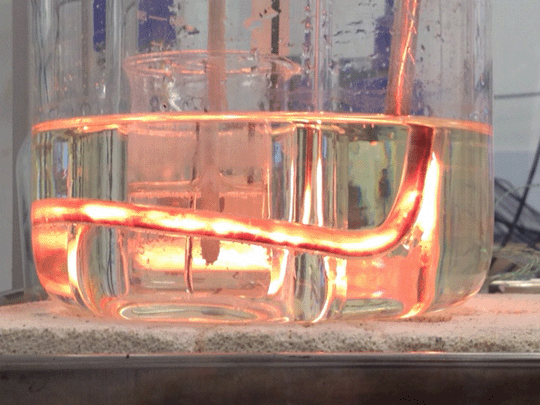
Moltex is proposing extract plutonium at Point Lepreau using “pyroprocessing,” in which the solid used reactor fuel is converted to a liquid form, dissolved in a very hot bath of molten salt. What happens next was described by Moltex Chairman and Chief Scientist Ian Scott in a recent article in Energy Intelligence. “We then — in a very, very simple process — extract the plutonium selectively from that molten metal. It’s literally a pot. You put the metal in, put salt in the top, mix them up, and the plutonium moves into the salt, and the salt’s our fuel. That’s it … You tip the crucible and out pours the fuel for our reactor.”
From an international perspective, the federal support of the Moltex project can be seen as Canada sending a signal – giving a green light to plutonium extraction and the reprocessing of used nuclear fuel.
The US experts are concerned other countries could point to Canada’s support of the Moltex project to help justify their own plutonium acquisition programs. That could undo years of efforts to keep nuclear weapons out of the hands of countries that might want to join the ranks of unofficial nuclear weapons states. The Moltex project is especially irksome since its proposed pyroprocessing technology is very similar to the one South Korea has been trying to deploy for almost 10 years.
Despite the alarm raised by the nine experts in their letter to Trudeau, the government has not yet responded. The only response has come from the industry, Moltex CEO Rory O’Sullivan. His reply to a Globe and Mail reporter: the plutonium extracted in the Moltex facility would be “completely unsuitable for use in weapons.”
But the International Atomic Energy Agency (IAEA) has stated that “Nuclear weapons can be fabricated using plutonium containing virtually any combination of plutonium isotopes.” All plutonium is of equal “sensitivity” for purposes of IAEA safeguards in non-nuclear weapon States.
Similarly, a 2009 report by non-proliferation experts from six US national laboratories concluded that pyroprocessing is about as susceptible to misuse for nuclear weapons as the original reprocessing technology used by the military.
In 2011, a US State Department official responsible stated that pyroprocessing is just as dangerous from a proliferation point of view as any other kind of plutonium extraction technology, saying “frankly and positively that pyroprocessing is reprocessing. Period. Full stop.”
And, despite years of effort, the IAEA has not yet developed an approach to effectively safeguard pyroprocessing to prevent diversion of plutonium for illicit uses.
Given that history has shown the dangers of promoting the greater availability of plutonium, why is the federal government supporting pyroprocessing?
The answer: the Canadian nuclear lobby wants it. In the nuclear industry’s report released in March, “Feasibility of Small Modular Reactor Development and Deployment in Canada,” reprocessing (which they call “recycling”) spent nuclear fuel is presented as key to the industry’s future plans.
To date however, there has been no democratic open debate or public consultation over the path Canada is charting with nuclear energy. Important national and international issues are at stake, and conscientious New Brunswickers and all Canadians should sit up and take notice. Political representatives in the Canadian Parliament and the New Brunswick Legislature owe it to their constituents to demand more accountability and ask why our governments are supporting a plutonium-extraction project that raises such serious international concerns.
Susan O’Donnell, a Fredericton-based researcher specializing in technology adoption and environmental issues, is the lead researcher for the RAVEN project at the University of New Brunswick. Gordon Edwards is a Montreal-based mathematician, physicist, nuclear consultant, and President of the Canadian Coalition for Nuclear Responsibility.
UK government’s fantasy of a nuclear fusion energy plant at Bradwell
**Fusion** The announcement by the Government that Bradwell is on the long list of
fifteen possible sites for the UK’s prototype fusion energy plant has
come out of the blue. Chair of the Blackwater Against New Nuclear Group
(BANNG) Professor Andy Blowers, described the idea to develop fusion
(essentially the process that goes on inside the sun and in hydrogen bombs)
to produce electricity as ‘yet another nuclear fantasy, like the
philosopher’s stone full of golden promise but impossible to realise.
Bradwell is not a soft touch for such speculative and dangerous
experimentation’.The Government has committed £400M to the fusion
programme and the UK Atomic Energy Authority (UKAEA) put out a call for
sites to host STEP (the Spherical Tokamak for Energy Production), the
prototype fusion plant. The fifteen sites include the usual suspects –
Sellafield, North Wales, Dounreay – together with other nuclear sites,
former coal-fired power station sites and, at the end of the list, Bradwell
nominated by Belport Ltd., an entrepreneurial property and asset management
company.
BANNG 22nd June 2021
U.S. Space Force wants to use directed-energy weapons for space superiority,
 |
The Space Force wants to use directed-energy weapons for space superiority,
|
Nathan Strout, 17 June 21, WASHINGTON — The head of the Space Force acknowledged that the U.S. is developing the “appropriate” directed-energy systems to maintain American space superiority, although he declined to provide details in the unclassified setting of a June 16 congressional hearing.
Noting that directed-energy systems could be a possible defensive tool for American satellites, Rep. Jim Langevin, D-R.I., asked Chief of Space Operations Gen. Jay Raymond whether the United States was adequately developing a directed energy portfolio “to be an effective capability for space dominance.”
“Yes sir, we are,” Raymond responded, suggesting that they discuss the issue in more detail in a classified setting. “We have to be able to protect these capabilities that we rely so heavily on.”
n a statement to C4ISRNET, a Space Force spokesperson said, “General Raymond has stated many times that China and Russia have directed energy capabilities that are designed to damage or destroy our satellites. His response to Congressman James Langevin’s question was confirming that our architecture developments in the face of these threats are appropriate.”
The Missile Defense Agency has explored using space-based lasers to intercept ballistic missiles in the past, and other nations have fielded ground-based laser dazzling weapons that can blind on orbit sensors. However, the Space Force has been effectively mum on what weapon systems — conventional or directed energy — it is developing to protect its satellites or defeat enemy satellites. Raymond’s acknowledgement at the hearing might be the first time he’s publicly confirmed the directed energy systems are under development.
The government cited the development of anti-satellite (ASAT) weapons by China and Russia as a justification for the creation of Space Command and the Space Force, and since their establishment military space leaders have been quick to criticize ASAT development and testing. U.S. Space Command’s Gen. James Dickinson has heavily criticized direct-ascent missile tests by Russia, which demonstrated the ability to take out satellites in low Earth orbit and the potential to cause dangerous space debris. Perhaps more concerning is a mysterious Russian satellite that has shown the ability to fire a projectile in space. Raymond refers to the spacecraft as an on-orbit weapon system.
Russia has made space a war-fighting domain by testing space-based and ground-based weapons intended to target and destroy satellites. This fact is inconsistent with Moscow’s public claims that Russia seeks to prevent conflict in space,” said Dickinson after a Russian ASAT test in December. “Space is critical to all nations. It is a shared interest to create the conditions for a safe, stable and operationally sustainable space environment.”
However, the Space Force — and the Air Force before it — have always been secretive about what ASAT weapons the U.S. military has or is developing. The one with the most public details is the Counter Communications System, a transportable system that can jam enemy satellites. And while the Air Force is developing laser weapons, it’s not clear what plans — if any — there are to attach them to space systems or direct them at enemy satellites. The U.S. also has missiles that can reach satellites in low Earth orbit.
Reports from the intelligence community and observers have highlighted the development of kinetic weapons — such as those mentioned above — as well as non-kinetic weapons — such as ground-based jammers or laser systems that can effectively blind satellite sensors — by nations deemed American adversaries.
In a report earlier this year, the Center for Strategic and International Studies suggested that the Space Force develop orbital laser weapons to defend American satellites. Titled “Defense Against the Dark Arts in Space,” the report lays out the various types of ASAT weapons and describes several ways the Space Force could defend against them. That includes passive defenses, like building a redundant space architecture that could survive the loss of one or even multiple satellites, and active defenses, such as satellite-mounted lasers that could blind incoming threats.
The U.S. has invested heavily in building passive defenses, such as a distributed architecture like the one described in the report, but it’s less forthcoming on its active defenses. Other nations are less secretive. Most notably, France has stated that it could equip its satellites with weapons — possibly lasers — to defend themselves from adversaries.
While Raymond’s brief comments didn’t give any insight into what the U.S. is developing in regards to directed energy systems for space, they didn’t rule out the types of weapons laid out in the CSIS report.
“It was a limited exchange, but the context of the statements and the statements themselves certainly leave the door open to nonkinetic defensive space capabilities of some kind,” said Todd Harrison, director of the CSIS Aerospace Security Project. “As we noted in our report, on-board electronic countermeasures, such as laser dazzlers and radar jammers, can be an effective way to defend satellites against certain types of kinetic attacks. And it has the advantage of protecting satellites without producing space debris, which is important to the long-term viability of the space domain for all users, not just the U.S. military.”
”Advanced” nuclear reactor designs – the latest version of nuclear wishful thinking

Clean Technica 16th June 2021, Some nuclear energy developers are now promoting what they call “advanced” reactor designs as a solution. Unlike light-water reactors, these non-light-water designs rely on materials other than water for cooling, including liquid sodium, helium and molten salt. Some developerscontend these reactors, which are still in the concept stage, will solve all the problems that plague light-water reactors and be ready for prime time by the end of the decade. The siren song of a cheap, safe and secure nuclear reactor in the offing has attracted the attention of Biden administration officials and some key members of Congress, who are looking for any and all ways to curb carbon emissions. But are so-called advanced reactors merely the latest version of nuclear wishful thinking? A comprehensive Union of Concerned Scientists (UCS) analysis of non-light-water reactor concepts in development suggests they are. Published in mid-March, the 140-page report found that these designs are no better — and in some respects significantly worse — than the light-water reactors in operation today. The report, “Advanced” Isn’t Always Better, assesses the pros and cons of three main types of non-light-water reactors: sodium-cooled fast reactors, high-temperature gas-cooled reactors and molten salt–fueled reactors. It rates each type on three broad criteria: safety; nuclear proliferation and terrorism risks; and sustainability, which refers to how efficiently they use uranium and how much long-lived nuclear waste they generate. https://cleantechnica.com/2021/06/16/when-it-comes-to-nuclear-power-advanced-isnt-always-better/ |
The Pentagon’s Project, Pele Military micro-reactors – creates more problems than it solves.

Military micro-reactors: Waging yesterday’s wars while losing the future’s https://www.defensenews.com/opinion/commentary/2021/06/15/military-micro-reactors-waging-yesterdays-wars-while-losing-the-futures/By: Bryan Clarkand Henry Sokolski With its withdrawal from Afghanistan and decision to end programs that typified America’s conflicts of past two decades, the Biden administration’s Pentagon is planning for long-term competitions against China and Russia. But for the Pentagon’s mobile micro-reactor effort, Project Pele, it’s still 2007.
Designed to supply energy to remote troops, Pele is geared for fighting the last war, which lacked high-end threats and during which vulnerable fuel convoys were a significant source of American casualties.
The Pentagon is asking Congress to spend $60 million next year on Pele. Congress should hit the brakes. Not only is Pele rooted in anachronistic military scenarios, but against Chinese, Russian, North Korean or Iranian militaries, it would be a prime target for precise missiles and drones as well as a source of friction with nuclear-skeptic U.S. allies expected to host the reactors.
With its withdrawal from Afghanistan and decision to end programs that typified America’s conflicts of past two decades, the Biden administration’s Pentagon is planning for long-term competitions against China and Russia. But for the Pentagon’s mobile micro-reactor effort, Project Pele, it’s still 2007.
Designed to supply energy to remote troops, Pele is geared for fighting the last war, which lacked high-end threats and during which vulnerable fuel convoys were a significant source of American casualties.
The Pentagon is asking Congress to spend $60 million next year on Pele. Congress should hit the brakes. Not only is Pele rooted in anachronistic military scenarios, but against Chinese, Russian, North Korean or Iranian militaries, it would be a prime target for precise missiles and drones as well as a source of friction with nuclear-skeptic U.S. allies expected to host the reactors.
To address the threat of attack, Pele’s fuel is intended to be inherently stable and resistant to meltdown.
Perhaps, but a large attack could bury the fuel in debris, preventing it from dissipating heat and causing it to exceed its design temperature. And even if the fuel remains intact, it is radioactive and would create a contamination risk once released from the reactor by an attack.
Count on our allies being unwilling to host Pele reactors that opponents are sure to strike. Unlike Iraq and Afghanistan, where the governments were beholden to the United States and guided-weapons threats were nonexistent, U.S. troops facing China would have to operate on Japanese, Australian or Philippine soil — nations that harbor strong anti-nuclear sentiments. U.S. governments in Guam or the Northern Mariana islands may have less choice in the matter, but residents there will hardly welcome new radioactive targets for Chinese missiles.
U.S. forces could reduce the threat to mobile reactors by taking them off the front lines. However, this reduces their value in solving logistical problems. More important, moving Pele away from the front will place it closer to civilian populations worried about Pele’s everyday radiological footprint. Consider instead of platoons of diesel mechanics and convoys of fuel, the Army needs squads of nuclear power plant operators and pallets of testing supplies and water treatment equipment. The return trip will also be full. Every glove, paper towel and sample bottle would likely be considered low-level waste and require specialized disposal, possibly back in the United States.
Bottom line: Pele creates more military challenges than it solves.
Mobile reactors might make sense for powering remote settlements and polar or moon stations, which is why NASA and the Energy Department are backing the project. But Pele is the wrong answer for tomorrow’s power-hungry military sensors, electric combat vehicles and directed-energy weapons. To supply these systems, the Pentagon should take a broader approach. Instead of advancing a comfortable solution from the past, the Defense Department should drive energy innovation through competition, such as the prize challenges that the Defense Advanced Research Projects Agency successfully used to advance new robotics and semiconductor designs.
New energy technologies are available. Solar and wind generation are being advanced and fielded today by commercial industry. Developments in batteries, capacitors and flywheels are already revolutionizing energy storage. A combination of these and other as-yet unidentified technologies could address the U.S. military’s expeditionary energy needs and be more feasible to deploy than Pele. Congress should reallocate Pele’s proposed budget to fund competitions to surface and exploit these new approaches rather than picking a winner today that is likely to lose tomorrow.
Bryan Clark, a retired U.S. Navy nuclear submarine officer, is currently a senior fellow at the Hudson Institute and the director of its Center for Defense Concepts and Technology. Henry Sokolski is the executive director at the Nonproliferation Policy Education Center. He served in the U.S. Defense Department’s Office of Net Assessment and as the department’s deputy for nonproliferation policy under then-Defense Secretary Dick Cheney
Why Utah really does not need Bill Gates’ small nuclear reactors

What Bill Gates and co. would like us to forget is that even the these geewhiz new small reactors are still based on that old carbon-releasing fuel chain –
Yes, there is a need to clean up our power generation to curb climate change — the sooner the better. But Williams points to a recent study that determined the lifecycle emissions with nuclear — mining, milling, transporting and storing the fuel and building and decommissioning the plants — far exceed other alternative energy sources.
Cox is eager for a nuclear future. Utahns should tell him why we’re not, says Robert Gehrke, https://www.sltrib.com/news/politics/2021/06/14/cox-is-eager-nuclear/ With safer, cleaner, cheaper alternatives, nuclear power may not make the most sense for Utah, By Robert Gehrke , June 15, 2021,
In Wyoming last week, an announcement was made that could mark a resurgence in the long-stymied nuclear energy industry.
Officials announced plans to build a new 345 megawatt nuclear power plant in the state that could, at its peak, generate enough electricity for all of the households in Wyoming with room to spare.
What makes this announcement different is the array of power players behind the project. It’s a partnership between Warren Buffett-owned Pacificorp and Bill Gates-owned Terrapower that has the backing of President Joe Biden’s Energy Department and Wyoming Gov. Mark Gordon.
It also has the support of Utah Gov. Spencer Cox, who praised the project as “a huge announcement” that “will have big implications for Utah in the future.”
“We look forward to similar partnerships in the years to come,” the governor said.
It’s not necessarily a new position. Cox’s predecessor, Gov. Gary Herbert, supported nuclear energy, as did his predecessor, Gov. Jon Huntsman.
But the Wyoming announcement ups the stakes dramatically, moving it from concept to something more concrete and forcing Utahns to confront critical questions nagging nuclear power: Is it safe? Is it cost-effective? And is it right for Utah?
Safety has always been the issue dogging nuclear power. Whether it’s Three Mile Island or Chernobyl or Fukushima, you surely have some nuclear disaster as a touchstone framing you perception of the energy.
The good news, according to Michael Simpson, chair of the Material Science and Engineering department at the University of Utah, is that the Natrium reactors that Terrapower hopes to build in Wyoming are generally safer than the old water-cooled reactors.
The Terrapower plant would be cooled with sodium, which transfers heat better than water, meaning it is less likely to melt down (like Chernobyl) or explode (like Fukushima).
Years ago, Simpson said, researchers at the Idaho National Laboratory did an experiment with a sodium-cooled reactor where they shut off the sodium coolant and instead of heating, the reactor slowly cooled and the reaction stopped.
Others dispute the safety claims, however. Earlier this year, the Union of Concerned Scientists issued a report that said the sodium reactors are unproven and raise other safety issues — for example, the sodium can burn if exposed to air.
“When it comes to safety and security, sodium-cooled fast reactors and molten salt-fueled reactors are significantly worse than conventional light-water reactors,” said Edwin Lyman, director of nuclear power safety for UCS.
Then there is the waste issue. The proponents of the sodium reactors contend that they would burn more of the fuel, producing less waste. Again, UCS disputes that and argues the waste that would be generated would pose nuclear proliferation and possible terrorism risks.
Then there’s the economics of nuclear power.
Recently, South Carolina completely scrapped a water-cooled nuclear plant that had been in the works for years. Some $9 billion was squandered sparking lawsuits by investors and ratepayers demanding their money back.
Rocky Mountain Power’s own figures released in 2019 put the cost of nuclear power at $95 per megawatt hour, compared to around $25 to $30 per hour for solar. Some cost projections are lower, some are higher, but none put nuclear in the same ballpark as solar, raising the obvious concern that we’ll be on the hook for the added expense one way or another — either as ratepayers or as taxpayers subsidizing the more costly power source.
There’s also a larger question, according to Scott Williams, executive director of HEAL Utah, an environmental group that has opposed nuclear power: Do we need it?
Yes, there is a need to clean up our power generation to curb climate change — the sooner the better. But Williams points to a recent study that determined the lifecycle emissions with nuclear — mining, milling, transporting and storing the fuel and building and decommissioning the plants — far exceed other alternative energy sources.
But the TerraPower reactor isn’t expected to come online until 2028 and, as we saw in South Carolina, when it comes to building nuclear power plants, the projections often are unrealistically optimistic.
With battery technology improving and rooftop solar expanding and getting cheaper, there’s no reason to gamble on nuclear, Williams said, other than centralized generation benefits Rocky Mountain’s shareholders.
“It just doesn’t make sense,” he said. “If you’re looking at it objectively, to say it’s better to put a bunch of money into a technology that not only isn’t proven, but has been proven to fail time and time again.”
And we have to take into account our state’s history with nuclear energy that is nothing short of radioactive itself, from the miners and uranium mill workers sickened by their exposure to radiation, to the thousands upon thousands of Utah Downwinders stricken with various cancers as a result of nuclear weapons testing in Nevada, to the decade-long battle to beat back a nuclear waste storage facility in Utah’s desert.
So do we scrap the whole nuclear idea? Not necessarily.
But if Utah wants to venture down the nuclear energy path, these questions and a host of others have to be thoroughly researched and addressed. We’re not there yet and until we are, the cheerleading from the Biden administration and Gov. Cox feels premature.
NFLA report on UK plutonium policy amid new concerns over plutonium dumped in the Irish Sea
| |||
| |||
NFLA publishes report on UK plutonium policy amid new concerns over plutonium remobilisation in the Irish Sea https://www.nuclearpolicy.info/news/nfla-report-uk-plutonium-policy-concerns-plutonium-remobilisation-irish-sea/
The UK & Ireland Nuclear Free Local Authorities (NFLA) publishes today on its website an expert overview of national plutonium policy and recent concerns over the potential for plutonium remobilisation in the Irish Sea. (1)
The report was developed by the NFLA Policy Advisor, Pete Roche, and was first published on the website ‘No2nuclearpower.org.uk’. (2) Recent research on this area was also presented by Pete to the most recent meetings of the NFLA English Forum and NFLA All Ireland Sustainable Energy Forum. (3)
The report notes that the Nuclear Decommissioning Authority (NDA) expects the Magnox Reprocessing Plant at Sellafield to close this year (2021) – one year later than previously planned. This follows on from the closure of the Thermal Oxide Reprocessing Plant (THORP) in November 2018. Reprocessing, which NFLA has always argued has been completely unnecessary, is the chemical separation of plutonium and unused uranium from spent nuclear waste fuel.
When reprocessing ends there will be around 140 tonnes of separated civil plutonium stored at Sellafield – the world’s largest stockpile. Since 2008, the NDA has been discussing how to deal with this embarrassment, given that it is highly toxic, poses a permanent risk of proliferation, and will cost taxpayers around £73 million a year to store for the next century. (3) 13 years later, after much dithering, the UK Government has failed to make any decisions, but still appears to favour the re-use option, which would probably involve transporting weapons-useable plutonium or Mixed Oxide Fuel (MoX) fuel to reactor sites, such as Hinkley Point C and Sizewell B (and C if it is ever built) with an armed escort.
The report looks at this sorry saga and the options for dealing with this stockpile. NFLA believe that the plutonium should be immobilised and stored safely. NDA is continuing to investigate how immobilisation and reuse might be implemented, arguing that using the material as MOX fuel in light water reactors is the most mature option from a technical and licensing perspective. The UK government says it can only make a decision when it can be underpinned with sufficient evidence.
When reprocessing ends there will be around 140 tonnes of separated civil plutonium stored at Sellafield – the world’s largest stockpile. Since 2008, the NDA has been discussing how to deal with this embarrassment, given that it is highly toxic, poses a permanent risk of proliferation, and will cost taxpayers around £73 million a year to store for the next century. (3) 13 years later, after much dithering, the UK Government has failed to make any decisions, but still appears to favour the re-use option, which would probably involve transporting weapons-useable plutonium or Mixed Oxide Fuel (MoX) fuel to reactor sites, such as Hinkley Point C and Sizewell B (and C if it is ever built) with an armed escort.
The report looks at this sorry saga and the options for dealing with this stockpile. NFLA believe that the plutonium should be immobilised and stored safely. NDA is continuing to investigate how immobilisation and reuse might be implemented, arguing that using the material as MOX fuel in light water reactors is the most mature option from a technical and licensing perspective. The UK government says it can only make a decision when it can be underpinned with sufficient evidence.
The NFLA report also highlights its concerns that plutonium particles dumped in the Irish Sea from Sellafield could remobilise. Low-level aqueous radioactive waste has been discharged from the Sellafield site into the Irish Sea for more than 50 years.
Unfortunately, it has since emerged that a proportion of such sediment associated radioactivity has remobilised, and is being actively transported around the Irish Sea, while the remainder is temporarily “sequestered” in the seabed but subject to any future disturbance mechanisms such as storm, wave and seismic activity. In addition, a proportion of dissolved nuclides did not necessarily remain dissolved in liquid form in the water column, but it could become incorporated into organic particles and deposited into sedimentary environments where they could be temporarily sequestered, but subsequently recycled back into the environment by dredging, trawling storm and seismic activity.
For NFLA, there remains real concern that this ‘Sellafield Mudpatch’ in the Irish Sea could be disturbed if either a deep-underground coal mine is developed off the coast of Cumbria, or similarly if a deep-underground radioactive waste repository is built under the Irish Sea again off the Cumbrian coast. It calls for the NDA and Radioactive Waste Management (RWM) to study these issues urgently before any such development is ever considered to be developed.
FLA Steering Committee Chair Councillor David Blackburn said:
“This report on the NFLA policy outlines one of the most embarrassing and perplexing elements of UK nuclear policy – what to do with its world record plutonium stockpile. The NFLA report highlights there are no easy answers, but delays on pursuing sensible immobilisation options have cost money and lead to further storage challenge. This report also highlights ongoing scientific and environmental alarm about building deep-underground facilities off the Cumbria coast that could remobilise plutonium and other dangerous particles that lie on the Irish Sea. Real caution and detailed research are required before any decisions are made. I urge councillors and council waste management officers to reads this important report.”
Ends – for more information please contact Sean Morris, NFLA Secretary, on 07771 930196.
A nuclear start-up company could undermine Canada’s global non-proliferation policy: experts
A nuclear start-up company could undermine Canada’s global non-proliferation policy: experts
the International Atomic Energy Agency (IAEA) has stated that “Nuclear weapons can be fabricated using plutonium containing virtually any combination of plutonium isotopes.” All plutonium is of equal “sensitivity” for purposes of IAEA safeguards in non-nuclear weapon states.
Similarly, a 2009 report by non-proliferation experts from six U.S. national laboratories concluded that pyroprocessing is about as susceptible to misuse for nuclear weapons as the original reprocessing technology used by the military, called PUREX.
By SUSAN O’DONNELL AND GORDON EDWARDS , THE HILL TIMES, JUNE 11, 2021www.ccnr.org/undermining_non-proliferation_2021.pdf
Important national and international issues are at stake, and conscientious Canadians should sit up and take notice. Parliamentarians of all parties owe it to their constituents to demand more accountability. To date however, there has been no democratic open debate or public consultation over the path Canada is charting with nuclear energy.
The recent effort to persuade Canada to sign the Treaty on the Prohibition of Nuclear Weapons has stimulated a lively debate in the public sphere. At the same time, out of the spotlight, the start-up company Moltex Energy received a federal grant to develop a nuclear project in New Brunswick that experts say will undermine Canada’s credibility as a non-proliferation partner.
Moltex wants to extract plutonium from the thousands of used nuclear fuel bundles currently stored as “high-level radioactive waste” at the Point Lepreau reactor site on the Bay of Fundy. The idea is to use the plutonium as fuel for a new nuclear reactor, still in the design stage. If the project is successful, the entire package could be replicated and sold to other countries if the Government of Canada approves the sale.On May 25, nine U.S. non-proliferation experts sent an open letter to Prime Minister Justin Trudeau expressing concern that by “backing spent-fuel reprocessing and plutonium extraction, the Government of Canada will undermine the global nuclear weapons non-proliferation regime that Canada has done so much to strengthen.”
The nine signatories to the letter include senior White House appointees and other U.S. government advisers who worked under six U.S. presidents: John F. Kennedy, Lyndon B. Johnson, Richard Nixon, George H.W. Bush, Bill Clinton, and Barack Obama; and who hold professorships at the Harvard Kennedy School, University of Maryland, Georgetown University, University of Texas at Austin, George Washington University, and Princeton University.
Plutonium is a human-made element created as a byproduct in every nuclear reactor. It’s a “Jekyll and Hyde” kind of material: on the one hand, it is the stuff that nuclear weapons are made from. On the other hand, it can be used as a nuclear fuel. The crucial question is, can you have one without the other?
India exploded its first nuclear weapon in 1974 using plutonium extracted from a “peaceful” Canadian nuclear reactor given as a gift many years earlier. In the months afterwards, it was discovered that South Korea, Pakistan, Taiwan and Argentina—all of them customers of Canadian nuclear technology—were well on the way to replicating India’s achievement. Swift action by the U.S. and its allies prevented these countries from acquiring the necessary plutonium extraction facilities (called “reprocessing plants”). To this day, South Korea is not allowed to extract plutonium from used nuclear fuel on its own territory—a long-lasting political legacy of the 1974 Indian explosion and its aftermath—due to proliferation concerns.
Several years after the Indian explosion, the U.S. Carter administration ended federal support for civil reprocessing of spent nuclear fuel in the U.S. out of concern that it would contribute to the proliferation of nuclear weapons by making plutonium more available. At that time, Canada’s policy on reprocessing also changed to accord with the U.S. policy—although no similar high-level announcement was made by the Canadian government.
Moltex is proposing to use a type of plutonium extraction technology called “pyroprocessing,” in which the solid used reactor fuel is converted to a liquid form, dissolved in a very hot bath of molten salt. What happens next is described by Moltex chairman and chief scientist Ian Scott in a recent article in Energy Intelligence. “We then—in a very, very simple process—extract the plutonium selectively from that molten metal. It’s literally a pot. You put the metal in, put salt in the top, mix them up, and the plutonium moves into the salt, and the salt’s our fuel. That’s it. … You tip the crucible and out pours the fuel for our reactor.”
The federal government recently supported the Moltex project with a $50.5-million grant, announced on March 18 by Intergovernmental Affairs Minister Dominic LeBlanc in Saint John. At the event, LeBlanc and New Brunswick Premier Blaine Higgs described the Moltex project as “recycling” nuclear waste, although in fact barely one-half of one per cent of the used nuclear fuel is potentially available for use as new reactor fuel. That leaves a lot of radioactive waste left over.
From an international perspective, the government grant to Moltex can be seen as Canada sending a signal—giving a green light to plutonium extraction and the reprocessing of used nuclear fuel.
The U.S. experts’ primary concern is that other countries could point to Canada’s support of the Moltex program to help justify its own plutonium acquisition programs. That could undo years of efforts to keep nuclear weapons out of the hands of countries that might want to join the ranks of unofficial nuclear weapons states such as Israel, India, Pakistan, and North Korea. The Moltex project is especially irksome since its proposed pyroprocessing technology is very similar to the one that South Korea has been trying to deploy for almost 10 years.
In their letter, the American experts point out that Japan is currently the only non-nuclear-armed state that reprocesses spent nuclear fuel, a fact that is provoking both domestic and international controversy.
In a follow-up exchange, signatory Prof. Frank von Hippel of Princeton University explained that the international controversy is threefold: (1) The United States sees both a nuclear weapons proliferation danger from Japan’s plutonium stockpile and also a nuclear terrorism threat from the possible theft of separated plutonium; (2) China and South Korea see Japan’s plutonium stocks as a basis for a rapid nuclear weaponization; and (3) South Korea’s nuclear-energy R&D community is demanding that the U.S. grant them the same right to separate plutonium as Japan enjoys.
Despite the alarm raised by the nine authors in their letter to Trudeau, they have received no reply from the government. The only response has come from the Moltex CEO Rory O’Sullivan. His reply to a Globe and Mail reporter is similar to his earlier rebuttal in The Hill Times published in his letter to the editor on April 5: the plutonium extracted in the Moltex facility would be “completely unsuitable for use in weapons.”
But the International Atomic Energy Agency (IAEA) has stated that “Nuclear weapons can be fabricated using plutonium containing virtually any combination of plutonium isotopes.” All plutonium is of equal “sensitivity” for purposes of IAEA safeguards in non-nuclear weapon states.
Similarly, a 2009 report by non-proliferation experts from six U.S. national laboratories concluded that pyroprocessing is about as susceptible to misuse for nuclear weapons as the original reprocessing technology used by the military, called PUREX.
In 2011, a U.S. State Department official responsible for U.S. nuclear cooperation agreements with other countries went further by stating that pyro-processing is just as dangerous from a proliferation point of view as any other kind of plutonium extraction technology, saying: “frankly and positively that pyro-processing is reprocessing. Period. Full stop.”
And, despite years of effort, the IAEA has not yet developed an approach to effectively safeguard pyroprocessing to prevent diversion of plutonium for illicit uses.
Given that history has shown the dangers of promoting the greater availability of plutonium, why is the federal government supporting pyroprocessing?
It is clear the nuclear lobby wants it. In the industry’s report, “Feasibility of Small Modular Reactor Development and Deployment in Canada,” released in March, the reprocessing (which they call “recycling”) of spent nuclear fuel is presented as a key element of the industry’s future plans.
Important national and international issues are at stake, and conscientious Canadians should sit up and take notice. Parliamentarians of all parties owe it to their constituents to demand more accountability. To date however, there has been no democratic open debate or public consultation over the path Canada is charting with nuclear energy.
Countless Canadians have urged Canada to sign the UN Treaty on the Prohibition of Nuclear Weapons that came into force at the end of January this year. Ironically, the government has rebuffed these efforts, claiming that it does not want to “undermine” Canada’s long-standing effort to achieve a Fissile Materials Cut-off Treaty. Such a treaty would, if it ever saw the light of day (which seems increasingly unlikely), stop the production of weapons usable materials such as Highly Enriched Uranium and (you guessed it) Plutonium.
So, the Emperor not only has no clothes, but his right hand doesn’t know what his left hand is doing.
Susan O’Donnell is a researcher specializing in technology adoption and environmental issues at the University of New Brunswick and is based in Fredericton.Gordon Edwards is a mathematician, physicist, nuclear consultant, and president of the Canadian Coalition for Nuclear Responsibility, and is based in Montreal.
Russia’s Approach to Nuclear Power in Outer Space
Russia’s Approach to Nuclear Power in Outer Space
Jamestown Foundation, Eurasia Daily Monitor Volume: 18 Issue: 92 By: Pavel Luzinune 9, 2021
Russia has been conducting research and development (R&D) on using nuclear power in outer space for years. On May 22, Alexander Bloshenko, executive director for advanced programs and science of Roscosmos, announced that the first mission of the nuclear-powered spacecraft, also known as the transport and energy module (TEM), is scheduled for 2030 (TASS, May 22). A week before this announcement, there was a deliberate leak from the Keldysh Center, a Roscosmos subsidiary entity, that this nuclear-powered spacecraft might be used for military purposes along with civil ones (RIA Novosti, May 13). These verbal interventions almost coincided with the hearings in the US Congress on the NASA budget request that proposes $585 million for nuclear thermal propulsion technology in FY2022 and ongoing American efforts in this field (SpaceNews, May 19; Physics Today, May 28). That means the Russian program on space nuclear power systems has not only technological but also geopolitical goals.
The current Russian program has a Soviet background. The USSR launched 33 military reconnaissance and targeting spacecraft with nuclear reactors into low-Earth orbit from 1969 to 1988. Most of them used thermoelectric nuclear power plants “Buk,” and the last two spacecraft used more advanced thermal electron emission NPPs “Topaz” with 4.5–5.5 kW of electric power. The Soviet Union also developed the prototypes of nuclear rocket engines, but the project was closed in 1986. In the early 1990s, a Russian-American project aimed to develop the “Topaz” reactors further, but was canceled by 1995. In 2000–2007, Russia tried to cooperate with China in this field (Kukharkin, 2012).
Despite long-term economic decline, Moscow has also tried to continue its independent efforts in space nuclear power systems since 1998, and during the presidency of Dmitry Medvedev, these efforts were proclaimed among the Kremlin’s key priorities (Pravo.gov.ru, February 2, 1998; RG.ru, November 13, 2009).
The program’s budget of 17 billion rubles for the period 2010–2018 was divided between Roscosmos (9.8 billion rubles) and Rosatom (7.2 billion rubles), totaling $560 million according to the exchange rates of 2010 (RG.ru, October 3, 2012). However, the actual spending was smaller. In 2010, only 500 million rubles ($16.5 million) were assigned for the purpose (Roscosmos, February 10, 2010). During the following decade, the total spending has reached almost 10 billion rubles or $213 million according to open data on federal budget funds and procurements released by Roscosmos and Rosatom (Vesti.ru, January 19, 2011; Interfax, October 12, 2020; Zakupki.gov.ru, 2013–2021). The current results of these efforts are less than initially planned………..
In comparison with NASA that tries to design a 10 kW space nuclear reactor with a Stirling engine intended to increase efficiency, the thermal electron emission remains the central paradigm of Russia’s R&Ds and the idea of using engines or turbines together with space nuclear reactors still remains theoretical (NASA, May 2, 2018; Issledovaniya Naukograda, July–September 2017). It is doubtful that Russia will develop the space nuclear power system with 1 MW of electric power and ion thrusters with more power in the foreseeable future. Still, Moscow definitely will try to convert existing results into some advance in outer space and foreign policy.
Along with a significant deficiency in other dimensions of Russia’s space activity and the country’s overall economic weakness, these problems prompt the Kremlin to look for an ace up its sleeve. While there is still a long way to go to develop nuclear reactors for space exploration missions, Russian industry and authorities are seeking to apply nuclear power for military satellites (KB Arsenal, September 1, 2020). Such spacecraft may be used for radar reconnaissance and electronic warfare (jamming) and be deployed to low, medium or geosynchronous orbits. However, there have not been any flight tests or technological demonstrations of such a satellite yet. This means Moscow will not be ready to deploy these satellites any time soon……… https://jamestown.org/program/russias-approach-to-nuclear-power-in-outer-space/
Bill Gates, Warren Buffett’s piddly little ”Natrium” nuclear reactor – greenwashing, while keeping fossil fuels going.

The key to understanding this story is found in Governor Gordon’s use of the words “all of the above.” That’s free market speak for “We’rehappy to have a piddly little 350 MW facility of over here, just so long as we can continue supporting coal- and gas-powered generating plants that churn out hundreds of gigawatts over there.”
In other words, it’s asmokescreen designed to allow fossil fuel interests to kick the can down the road a little further and add some greenwashing to their corporate portfolios at the same time. Being rich does not necessarily make a person all that smart. America needs more nuclear power like a fish needs a bicycle.
People in Wyoming may be fooled by this blather, but CleanTechnica readers aren’t taking the bait. Natrium was probably selected as the name of thus new nuclear technology because it sounds a little like “nature” or “natural.” That’s a great marketing ploy, but we’re not buying it. Frankly, the Bill and Warren show is more than a little disappointing.
Clean Technica 3rd June 2021
Bill Gates & Warren Buffett To Build A New Kind Of Nuclear Reactor — Is That Good News?
Billionaires’ advanced ”Natrium” nuclear reactors planned for Wyoming.

Power companies run by billionaire friends Bill Gates and Warren Buffett
have chosen Wyoming to launch the first Natrium nuclear reactor project on
the site of a retiring coal plant. TerraPower, founded by Gates about 15
years ago, and power company PacifiCorp, owned by Warren Buffett’s
Berkshire Hathaway, said on Wednesday that the exact site of the Natrium
reactor demonstration plant was expected to be announced by the end of the
year.
Nuclear power experts have warned that advanced reactors could have higher risks than
conventional ones. Fuel for many advanced reactors would have to be
enriched at a much higher rate than conventional fuel, meaning the fuel
supply chain could be an attractive target for militants looking to create
a crude nuclear weapon, a recent report said.
Guardian 3rd June 2021
Small nuclear reactors pushed for military use,despite their obvious dangers
There are concerns, of course, associated with deploying mobile nuclear reactors to bases or the battlefield. Meltdowns, waste products, and other malfunctions are always a concern with nuclear energy technologies, and if a reactor in a contested area is destroyed by adversary forces, for example, the risk of environmental contamination is high. That, in turn, could create a political disaster for the DOD and United States. Deploying any nuclear systems abroad also incurs the risk of proliferation if those technologies should fall into the wrong hands due to a forward-operating base or convoy being overrun by hostile forces.
Those concerns will no doubt be a major policy consideration when, or if, these mobile reactors ever reach a state of technological readiness to where they can be deployed. New nuclear technologies aren’t the only new energy production and storage systems the DOD is eyeing, however. Revolutionary concepts such as space-based solar power beaming, new forms of hydrogen fuel cells, or even more advanced applications of existing technologies like modular solar generators are all being developed which could revolutionize how the DOD powers its expeditionary forces without the risks associated with nuclear power.

The Military’s Mobile Nuclear Reactor Prototype Is Set To Begin Taking Shape, The Drive BY BRETT TINGLEY JUNE 3, 2021
Project Pele is one potentially revolutionary, albeit controversial, answer to the military’s growing battlefield energy requirements.
The Office of The Secretary of Defense (OSD) has requested $60 million dollars for Project Pele, which is aimed at developing a new, transportable nuclear microreactor to provide high-output, resilient power for a wide variety of Department of Defense (DOD) missions. The DOD hopes to begin working on a prototype reactor design, which will hopefully be able to eventually produce one to five megawatts of electricity and operate at peak power for at least three years, in the next fiscal year.
The request for funding for Project Pele is found in the Pentagon’s proposed budget for the 2022 Fiscal Year, which was released on May 28, 2021. This is the first year that the Office of the Secretary of Defense has asked for money for this program through the larger Advanced Innovative Technologies line item. Previous funding for Pele, also known as the Micro Nuclear Reactor Program, had come through a separate Operational Energy Capability Improvement account in OSD’s budget.
The budget documents say that the goals for Project Pele in the 2022 Fiscal Year are to “complete the design phase and prepare for construction of a 1-5 Megawatt electric transportable nuclear microreactor.” In addition, it notes that “due to the nature of this project, specific applications and detailed plans are available at a higher classification level.”
“The Pele project continues activities initiated under Congressional direction in FY 2020 and FY 2021,” according to the documents. “Congressional Adds [totaling $16 million in the 2021 Fiscal Year] directed for nuclear fuel core development to support the Pele reactor maturation and also funding to support power and thermal management maturation for directed energy weapons.”
………………the Fiscal Year 2022 budget requests says the desired design is as a 1-5 megawatt (MW) nuclear microreactor.
For comparison, the output of the smallest nuclear power plant in the United States, New York’s R.E. Ginna Nuclear Power Plant, is 581 MW. The desired power output is even smaller than most research reactors.
…… The funding for Pele also builds on several other developments, which show that the DOD, DOE, and the National Aeronautics and Space Administration (NASA) are investing heavily in new nuclear technologies to power a new American space age. “Production of a full-scale fourth-generation nuclear reactor will have significant geopolitical implications for the United States,” said Jay Dryer, director of the Strategic Capabilities Office.
……… Building on that document’s goals, a January 2021 Executive Order expanded on the National Space Council document by ordering NASA to deliver a report that defines requirements and foreseeable issues for developing a nuclear energy system to enable human and robotic space missions for the next two decades. The order also included plans for a “Common Technology Roadmap” made among NASA and the Departments of Energy, Defense, Commerce, and State for developing and deploying these new reactor technologies.
Energy security and dominance have become cornerstones of DOD strategy, given the unbelievable amounts of fuel and energy consumed by the power-hungry systems the modern military depends on. U.S. Army leadership has previously stated that it wants its brigades to be self-sufficient for a week without the need for resupply, and there have been previous calls for microreactors that could fit inside existing platforms such as the C-17 Globemaster. Meanwhile, Lockheed Martin and other laboratories continue work on the lofty goal of developing miniaturized fusion reactors…….
There are concerns, of course, associated with deploying mobile nuclear reactors to bases or the battlefield. Meltdowns, waste products, and other malfunctions are always a concern with nuclear energy technologies, and if a reactor in a contested area is destroyed by adversary forces, for example, the risk of environmental contamination is high. That, in turn, could create a political disaster for the DOD and United States. Deploying any nuclear systems abroad also incurs the risk of proliferation if those technologies should fall into the wrong hands due to a forward-operating base or convoy being overrun by hostile forces.
Those concerns will no doubt be a major policy consideration when, or if, these mobile reactors ever reach a state of technological readiness to where they can be deployed. New nuclear technologies aren’t the only new energy production and storage systems the DOD is eyeing, however. Revolutionary concepts such as space-based solar power beaming, new forms of hydrogen fuel cells, or even more advanced applications of existing technologies like modular solar generators are all being developed which could revolutionize how the DOD powers its expeditionary forces without the risks associated with nuclear power. https://www.thedrive.com/the-war-zone/40914/the-militarys-mobile-nuclear-reactor-prototype-is-set-to-begin-taking-shape
Ionising radiation the big danger to astronauts

NASA says that not only does space radiation potentially put astronauts at greater risk of radiation sickness, but an “increased lifetime risk for cancer, central nervous system effects, and degenerative diseases.”
Astronauts in space are exposed to the radiation equivalent of 150 to 6,000 chest x-rays https://www.revelstokereview.com/news/morning-start-astronauts-in-space-are-exposed-to-the-radiation-equivalent-of-150-to-6000-chest-x-rays/ May 28, 2021
As noted by NASA, radiation is a type of energy that is emitted in the form of rays, electromagnetic waves and/or particles. Radiation can be seen as visible light or felt as infrared radiation. However, some forms of radiation, like x-rays and gamma rays, are not visible.
Space radiation differs from the type of radiation experienced on Earth because intergalactic radiation “is comprised of atoms in which electrons have been stripped away as the atom accelerated in interstellar space to speeds approaching the speed of light – eventually, only the nucleus of the atom remains.”
So how much space radiation are astronauts exposed to? They’re exposed to “ionizing radiation with effective doses in the range from 50 to 2,000 mSv. 1 mSv of ionizing radiation is equivalent to about three chest x-rays. So that’s like if you were to have 150 to 6,000 chest x-rays.”
With that being said, NASA says that not only does space radiation potentially put astronauts at greater risk of radiation sickness, but an “increased lifetime risk for cancer, central nervous system effects, and degenerative diseases.”
1 This Month



26 September – International Day for the Total Elimination of Nuclear Weapons


PLEASE OPPOSE HR 8255 AND S.3639 – bills would accelerate satellite deployment, with no environmental review or safeguards – https://ncstd5li.quorum.us/campaign/169331/
To see nuclear-related stories in greater depth and intensity – go to https://nuclearinformation.wordpress.com
-
Archives
- September 2026 (257)
- August 2026 (330)
- July 2026 (355)
- June 2026 (287)
- May 2026 (306)
- April 2026 (356)
- March 2026 (251)
- February 2026 (267)
- January 2026 (308)
- December 2025 (358)
- November 2025 (359)
- October 2025 (375)
-
Categories
- 1
- 1 NUCLEAR ISSUES
- business and costs
- climate change
- culture and arts
- ENERGY
- environment
- health
- history
- indigenous issues
- Legal
- marketing of nuclear
- media
- opposition to nuclear
- PERSONAL STORIES
- politics
- politics international
- Religion and ethics
- safety
- secrets,lies and civil liberties
- spinbuster
- technology
- Uranium
- wastes
- weapons and war
- Women
- 2 WORLD
- ACTION
- AFRICA
- Atrocities
- AUSTRALIA
- Christina's notes
- Christina's themes
- culture and arts
- Events
- Fuk 2022
- Fuk 2023
- Fukushima 2017
- Fukushima 2018
- fukushima 2019
- Fukushima 2020
- Fukushima 2021
- general
- global warming
- Humour (God we need it)
- Nuclear
- RARE EARTHS
- Reference
- resources – print
- Resources -audiovicual
- Weekly Newsletter
- World
- World Nuclear
- YouTube
-
RSS
Entries RSS
Comments RSS
 nuclear-news