Small nuclear reactors for military use would be too dangerous – excellent targets for the enemy

In normal operation, they release potentially hazardous quantities of fission products that would be widely distributed by any penetration of the reactor vessel. More worryingly, the resiliency of tri-structural isotropic particles to kinetic impact is questionable: The silicon carbide coating around the fuel material is brittle and may fracture if impacted by munitions.
Further, graphite moderator material, which is used extensively in most mobile power plant cores, is vulnerable to oxidation when exposed to air or water at high temperatures, creating the possibility of a catastrophic graphite fire distributing radioactive ash. Even in the case of intact (non-leaking) fuel fragments being distributed by a strike, the radiological consequences for readiness and effectiveness are dire.
Given these vulnerabilities, sophisticated adversaries seeking to hinder U.S. forces are likely to realize the utility of the reactor as an area-denial target…….. , a reactor strike offers months of exclusion at the cost of only a few well-placed high-explosive warheads, a capability well within reach of even regional adversaries
Even an unsuccessful or minimally damaging attack on a reactor could offer an adversary significant benefits…………..placing these reactors in combat zones introduces nuclear reactors as valid military targets,
MOBILE NUCLEAR POWER REACTORS WON’T SOLVE THE ARMY’S ENERGY PROBLEMS, War on the Rocks, 14 Dec 21, JAKE HECLA ”………… As China and Russia develop microreactors for propulsion, the U.S. Army is pursuing the ultimate in self-sufficient energy solutions: the capability to field mobile nuclear power plants. In this vision of a nuclearized future, the Army will replace diesel generator banks with microreactors the size of shipping containers for electricity production by the mid-2020s.
……. the question is whether or not reactors can truly be made suitable for military use. Are they an energy panacea, or will they prove to be high-value targets capable of crippling entire bases with a single strike?
nuclear power program is confidently sprinting into uncharted territory in pursuit of a solution to its growing energy needs and has promised to put power on the grid within three years. However, the Army has not fielded a reactor since the 1960s and has made claims of safety and accident tolerance that contradict a half-century of nuclear industry experience.
The Army appears set to credulously accept industry claims of complete safety that are founded in wishful thinking and characterized by willful circumvention of basic design safety principles………..
Buyer beware: NuScale tries a new way to get funding for its small nuclear reactor plan
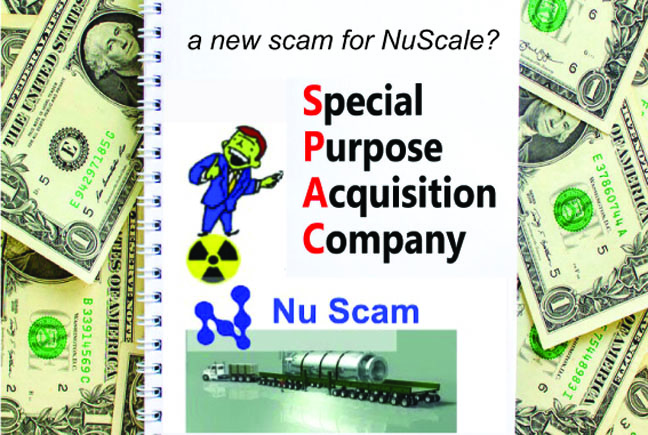
An Oregon company is going public to raise money for nuclear power ambitions, OPD, 15 Dec 21,
……………NuScale, headquartered in the Portland suburb of Tigard, will go public by merging with what’s known as a special purpose acquisition company, or SPAC. The company, Spring Valley Acquisition Corporation, is already publicly traded. Such mergers have recently gained popularity on Wall Street by allowing private companies the option to go public without the costs or risks associated with the more conventional initial public offering, or IPO.
Other Oregon businesses like the vacation rental company Vacasa and battery manufacturer ESS Tech have also gone public by merging with so-called “blank check” companies. In each of those cases, some investors pulled out when news of the mergers dropped, leaving each company with less money than they’d initially hoped……………
Dr Jim Green dissects the hype surrounding Small ”Modular” Nuclear Reactors

Nuclear power’s economic failure, Ecologist, Dr Jim Green, 13th December 2021 Small modular reactors
Small modular reactors (SMRs) are heavily promoted but construction projects are few and far between and have exhibited disastrous cost overruns and multi-year delays.
It should be noted that none of the projects discussed below meet the ‘modular’ definition of serial factory production of reactor components, which could potentially drive down costs.
Using that definition, no SMRs have ever been built and no country, company or utility is building the infrastructure for SMR construction.
In 2004, when the CAREM SMR in Argentina was in the planning stage, Argentina’s Bariloche Atomic Center estimated a cost of US$1 billion / GW for an integrated 300 MW plant (while acknowledging that to achieve such a cost would be a “very difficult task”).

Now, the cost estimate for the CAREM reactor is a mind-boggling US$23.4 billion / GW (US$750 million / 32 MW). That’s a truckload of money for a reactor with the capacity of two large wind turbines. The project is seven years behind schedule and costs will likely increase further.
Russia’s floating plant
Russia’s floating nuclear power plant (with two 35 MW reactors) is said to be the only operating SMR anywhere in the world (although it doesn’t fit the ‘modular’ definition of serial factory production).
The construction cost increased six-fold from 6 billion rubles to 37 billion rubles (US$502 million).
According to the OECD’s Nuclear Energy Agency, electricity produced by the Russian floating plant costs an estimated US$200 / MWh, with the high cost due to large staffing requirements, high fuel costs, and resources required to maintain the barge and coastal infrastructure.

The cost of electricity produced by the Russian plant exceeds costs from large reactors (US$131-204) even though SMRs are being promoted as the solution to the exorbitant costs of large nuclear plants.
Climate solution?
SMRs are being promoted as important potential contributors to climate change abatement but the primary purpose of the Russian plant is to power fossil fuel mining operations in the Arctic.
A 2016 report said that the estimated construction cost of China’s demonstration 210 MW high-temperature gas-cooled reactor (HTGR) is about US$5 billion / GW, about twice the initial cost estimates, and that cost increases have arisen from higher material and component costs, increases in labour costs, and project delays.
The World Nuclear Association states that the cost is US$6 billion / GW.
Those figures are 2-3 times higher than the US$2 billion / GW estimate in a 2009 paper by Tsinghua University researchers.
China reportedly plans to upscale the HTGR design to 655 MW but the Institute of Nuclear and New Energy Technology at Tsinghua University expects the cost of a 655 MW HTGR will be 15-20 percent higher than the cost of a conventional 600 MW pressurised water reactor.
HTGR plans dropped
NucNet reported in 2020 that China’s State Nuclear Power Technology Corp dropped plans to manufacture 20 HTGR units after levelised cost of electricity estimates rose to levels higher than a conventional pressurised water reactor such as China’s indigenous Hualong One.
Likewise, the World Nuclear Association states that plans for 18 additional HTGRs at the same site as the demonstration plant have been “dropped”.
In addition to the CAREM reactor in Argentina and the HTGR in China, the World Nuclear Association lists just two other SMR construction projects.
In July 2021, China National Nuclear Corporation (CNNC) New Energy Corporation began construction of the 125 MW pressurised water reactor ACP100.
According to CNNC, construction costs per kilowatt will be twice the cost of large reactors, and the levelised cost of electricity will be 50 percent higher than large reactors.
Fast reactor
In June 2021, construction of the 300 MW demonstration lead-cooled BREST fast reactor began in Russia.
In 2012, the estimated cost for the reactor and associated facilities was 42 billion rubles; now, the estimate is 100 billion rubles (US$1.36 billion).
Much more could be said about the proliferation of SMRs in the ‘planning’ stage, and the accompanying hype.
For example a recent review asserts that more than 30 demonstrations of different ‘advanced’ reactor designs are in progress across the globe.

In fact, few have progressed beyond the planning stage, and few will. Private-sector funding has been scant and taxpayer funding has generally been well short of that required for SMR construction projects to proceed.
Subsidies

Large taxpayer subsidies might get some projects, such as the NuScale project in the US or the Rolls-Royce mid-sized reactor project in the UK, to the construction stage.

Or they may join the growing list of abandoned SMR projects:
* The French government abandoned the planned 100-200 MW ASTRID demonstration fast reactor in 2019.
* Babcock & Wilcox abandoned its Generation mPower SMR project in the US despite receiving government funding of US$111 million.
* Transatomic Power gave up on its molten salt reactor R&D in 2018.
* MidAmerican Energy gave up on its plans for SMRs in Iowa in 2013 after failing to secure legislation that would require rate-payers to partially fund construction costs.
* TerraPower abandoned its plan for a prototype fast neutron reactor in China due to restrictions placed on nuclear trade with China by the Trump administration.
* The UK government abandoned consideration of ‘integral fast reactors’ for plutonium disposition in 2019 and the US government did the same in 2015.
Hype
So we have a history of failed small reactor projects.
And a handful of recent construction projects, most subject to major cost overruns and multi-year delays.
And the possibility of a small number of SMR construction projects over the next decade.
Clearly the hype surrounding SMRs lacks justification.
Moreover, there are disturbing, multifaceted connections between SMR projects and nuclear weapons proliferation, and between SMRs and fossil fuel mining.
Hype cycle
Dr Mark Cooper connects the current SMR hype to the hype surrounding the ‘nuclear renaissance’ in the late 2000s:
“The vendors and academic institutions that were among the most avid enthusiasts in propagating the early, extremely optimistic cost estimates of the “nuclear renaissance” are the same entities now producing extremely optimistic cost estimates for the next nuclear technology. We are now in the midst of the SMR hype cycle.
* Vendors produce low-cost estimates.
* Advocates offer theoretical explanations as to why the new nuclear technology will be cost competitive.
* Government authorities then bless the estimates by funding studies from friendly academics.” ………………. https://theecologist.org/2021/dec/13/nuclear-powers-economic-failure
Nuclear power’s economic failure – a ”renaissance in reverse”

China is said to be the industry’s shining light but nuclear growth is modest ‒ an average of 2.1 reactor construction starts per year over the past decade.
Moreover, nuclear growth in China is negligible compared to renewables ‒ 2 gigawatts (GW) of nuclear power capacity were added in 2020 compared to 135 GW of renewables.
Nuclear power’s economic failure, Ecologist, Dr Jim Green, 13th December 2021
A new report from Friends of the Earth Australia details the catastrophic cost overruns with nuclear power projects.
Despite the abundance of evidence that nuclear power is economically uncompetitive compared to renewables, the nuclear industry and some of its supporters continue to claim otherwise.
Those claims are typically based on implausible cost projections for non-existent reactor concepts. Moreover, the nuclear lobby’s claims about the cost of renewables are just as ridiculous.
Claims about ‘cheap’ nuclear power certainly don’t consider the real-world nuclear construction projects detailed in a new report by Friends of the Earth Australia.
Every power reactor construction project in Western Europe and the US over the past decade has been a disaster.
The V.C. Summer project in South Carolina (two AP1000 reactors) was abandoned after the expenditure of at least US$9 billion leading Westinghouse to file for bankruptcy in 2017.
Criminal investigations
Criminal investigations and prosecutions related to the V.C. Summer project are ongoing ‒ and bailout programs to prolong operation of ageing reactors in the US are also mired in corruption.
The only remaining reactor construction project in the US is the Vogtle project in Georgia (two AP1000 reactors). The current cost estimate of US$27-30+ billion is twice the estimate when construction began (US$14-15.5 billion).
Costs continue to increase and the Vogtle project only survives because of multi-billion-dollar taxpayer bailouts. The project is six years behind schedule…..
In 2006, Westinghouse said it could build an AP1000 reactor for as little as US$1.4 billion, 10 times lower than the current estimate for Vogtle.
The Watts Bar 2 reactor in Tennessee began operation in 2016, 43 years after construction began. When construction resumed in 2008 after a long hiatus, the cost estimate to complete the reactor was US$2.5 billion but the final completion cost was US$4.7 billion.
US nuclear renaissance in reverse
The previous reactor start-up in the US was Watts Bar 1, completed 20 years earlier (1996) after a 23-year construction period. Thus Watts Bar 1 and 2 are the only power reactor start-ups in the US over the past quarter-century.
In 2021, TVA abandoned the unfinished Bellefonte nuclear plant in Alabama, 47 years after construction began and following the expenditure of an estimated US$5.8 billion.
There have been no other power reactor construction projects in the US over the past 25 years other than those listed above.
Numerous other reactor projects were abandoned before construction began, some following the expenditure of hundreds of millions of dollars. Twelve reactors have been permanently shut down over the past decade with many more closures in the pipeline.
Western Europe
The only current reactor construction project in France is one EPR reactor under construction at Flamanville. The current cost estimate of €19.1 billion is 5.8 times greater than the original estimate.
The Flamanville reactor is 10 years behind schedule.
The only current reactor construction project in the UK comprises two EPR reactors under construction at Hinkley Point. In the late 2000s, the estimated construction cost for one EPR reactor in the UK was £2 billion.
The current cost estimate for two EPR reactors at Hinkley Point is £22-23 billion, over five times greater than the initial estimate.
In 2007, EDF boasted that Britons would be using electricity from an EPR reactor at Hinkley Point to cook their Christmas turkeys in 2017, but construction didn’t even begin until 2018.
Is China a shining light for nuclear power?
One EPR reactor (Olkiluoto-3) is under construction in Finland. The current cost estimate of about €11 billion is 3.7 times greater than the original estimate. Olkiluoto-3 is 13 years behind schedule.
Nuclear power is growing in a few countries, but only barely. China is said to be the industry’s shining light but nuclear growth is modest ‒ an average of 2.1 reactor construction starts per year over the past decade.
Moreover, nuclear growth in China is negligible compared to renewables ‒ 2 gigawatts (GW) of nuclear power capacity were added in 2020 compared to 135 GW of renewables.
There were only three power reactor construction starts in Russia in the decade from 2011 to 2020, and only four in India.
Nuclear vs renewables costs
Continue readingTaxpayer funding might not be enough to save USA’s failing new nuclear, specifically the ”Versatile Test Reactor”

Advanced Nuclear Energy Projects Stumble Despite White House Support, Forbes, 12 Dec 21, During the COP26 climate conference, U.S. Energy Secretary Jennifer Granholm said that the United States is “all-in” on nuclear energy ………The White House supports an expansion for all next-generation nuclear reactors………..
All this is in the context of the U.S. House and Senate actions, where lawmakers “zeroed-out” [reduce something to zero; eliminate or remove entirely] funding for the so-called Versatile Test Reactor (VTR) at the Idaho National Laboratories.
…. For now, Russia is the only country with a test reactor similar to VTR…… Russia’s state-owned nuclear energy industry gives it a guaranteed source of funding. In contrast, the United States’ private model requires investors to buy-in — not to mention the elected policymakers in a democratic system. ……. The Natrium facility, which Microsoft’s Bill Gates founded, is an electricity-generating reactor that is getting Energy Department support: $80 million, a small part of the overall cost. The goal is to have it up and running by 2030.
VTR will not produce power for consumers. It is a test facility that can, for example, predict the long-term wear-and-tear on reactors through modeling.
But some experts say that VTR is too costly and that advanced nuclear reactors are unproven. The Union of Concerned Scientists says that the jury is still out as to whether those units can reduce costs, limit nuclear waste, burn uranium more efficiently, and strengthen safety.
“Despite the hype surrounding them, none of the non-light-water reactors on the drawing board that we reviewed meet all of those requirements, says Dr. Edwin Lyman, a physicist and the director of nuclear power safety, in a report. “High-temperature, gas-cooled reactors may have the potential to be safer, but that remains unproven, and problems have come up during recent fuel safety tests.” ……
UK government will ”prove the potential”of advanced nuclear reactors with its Advanced Modular Reactor Research, Development and Demonstration Programme.
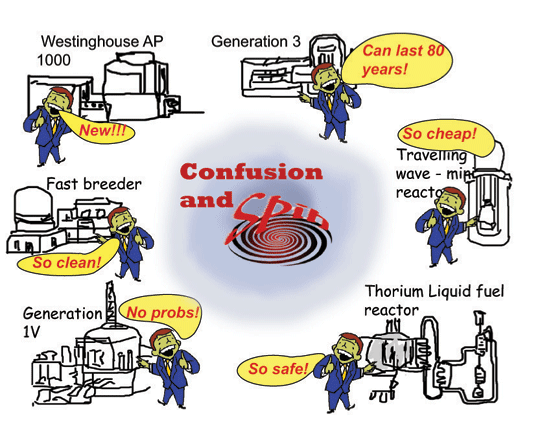
nuClear NewsNo 136 Dec 21, Advanced Reactors , Energy minister Greg Hands told the Nuclear2021 conference organised by the Nuclear Industry Association that the UK will build a high-temperature gas reactor (HTGR) as the centrepiece of its Advanced Modular Reactor Research, Development & Demonstration Programme.
The goal of the research programme is to “prove the potential” of advanced reactors and have a demonstration unit in operation “by the early 2030s, at the latest”. The key focus would be to produce high temperature heat which could be used for hydrogen production, to supply industrial processes and potentially district heating as well as electricity generation.
Several other reactor concepts could have been selected. The emerging category of ‘advanced’ reactors includes the lead-cooled fast reactor, molten salt reactor, supercritical water-cooled reactor, sodium-cooled fast reactor and very-high-temperature gas reactor in addition to hightemperature gas reactors.
Paul Howarth, CEO of the National Nuclear Laboratory (NNL), called it “a further signal of the resurgence of nuclear.” He added, “With the opportunity HTGRs bring to deliver high temperature heat, hydrogen and synthetic fuels, the potential of this technology to help decarbonise our industries and energy grid is significant.” He noted that NNL is “actively working on the fuel, graphite and high temperature materials required for HTGRs.”
The Advanced Modular Reactor Research, Development & Demonstration Programme counts on £170 million of government funding from a £385 million package intended to accelerate development of highly flexible nuclear technologies. (1)
In July the Government sought views on its preference to explore the potential of High Temperature Gas Reactors (HTGRs) for the Advanced Modular Reactor Research Development & Demonstration (AMR RD&D) Programme. It says the call found no significant, additional evidence to materially change the outcome of the Government’s underpinning analysis. As a result, the Programme will focus on High Temperature Gas Reactors with the ambition for this to lead to a HTGR demonstration by the early 2030s at the latest. In parallel, government continues to support the development of all AMRs as part of wider policy on advanced nuclear activities. This includes: opening the Generic Design Assessment (GDA) process to advanced nuclear technologies and developing a siting approach for further nuclear developments. (2) https://www.no2nuclearpower.org.uk/wp/wp-content/uploads/2021/12/nuClearNewsNo136.pdf
Inside information from China could sink the French nuclear flagship EPR.
 | |||

Image – by Eva Stegen
Maxron says –
''we are building nuclear power plants 6 new epr klima blablabla''
Inside information from China could sink the French nuclear flagship EPR https://www.ausgestrahlt.de/blog/2021/12/09/insider-infos-aus-china-k%C3%B6nnen-franz%C3%B6sisches-atomflaggschiff-epr-versenken/ 09.12.2021 | Eva Stegen In 1989, in response to Chernobyl, development of a third generation reactor began. The European pressurized water reactor EPR has not yet generated a kilowatt hour in Europe. Despite multiple disasters, no one pulled the rip cord. Now a whistleblower reveals a system error that should be the end of the EPR.
Some people either have nerves of wire, no self-esteem or the deep certainty that any nonsense they utter will be whipped into all media via the international press agencies, just as if one did not have to check a completely absurd announcement at least once. But it is so, the French emperor is naked. He just yelled out to the press that he wanted to have six more reactor construction sites for the fiasco flagship EPR (European pressurized water reactor) when a whistleblower tore the last scrap of material off his body. It was a French nuclear engineer who had an in-depth look at the EPR reactors in Taishan, China. They are the only two – out of 200 announced – that ever went online.
There it was just ………
However, one of the two is offline again after just 2.5 years of operation. With an unknown outcome. Evidence is growing that a design flaw affecting the entire EPR series has led to Taishan 1 being switched off. The whistleblower gave the radiation research institute ‘CRIIRAD’ important detailed technical information from Taishan. CRIIRAD, in turn, put a series of questions to the French nuclear regulator, ‘Autorité de Sûreté Nucléaire’, ASN.
The silence of those who knew it
A copy was sent to the news agency ‘AFP’, but miraculously the horror news did not spread as rapidly as Macron’s ludicrous announcement to sink further billions in further ‘EPR’ flop construction sites. With every additional day on which neither the operator nor the nuclear regulatory authority deny ‘ASN’, this hypothesis of the design flaw, which affects all ‘EPR’, becomes more important.
In June 2021, a CNN report from Taishan, China caused a stir. There was talk of an “imminent radiological threat” in a letter from the French consortium partner “Framatome” to the US Department of Energy, which “CNN” has received. The Chinese security authorities were accused of having raised the radiation limit values for the outside area around the nuclear power plant in order to circumvent the shutdown of the defective reactor block.
Where do the radioactive gases come from?
As early as October 2020, defects were found on the cladding tubes of some fuel elements, which led to the escape of radioactive gases in the reactor pressure vessel. Despite the radiological risks for workers and residents, the nuclear power plant continued to operate. First of all, according to Bruno Chareyron from ‘CRIIRAD’. This duct damage is quite normal, something like that happens. In fact, however, the degree of damage to the cladding tubes and the gas leaks in the reactor have steadily worsened since it was loaded with fuel in autumn 2020.
The operators have asked the authorities to increase the limit value, above which the reactor must be shut down. The authorities would have doubled the value , but as the contamination continued to rise, the new warning threshold was exceeded at the end of May 2021. This continued until the shutdown on July 30, 2021. In August, the fuel rods began unloading. Nobody knows when or whether the reactor can ever start again.
Thanks to the whistleblower’s insider knowledge, ‘CRIIRAD’ is now able to track down the causes of the defective ducts, which the investigative satirical magazine ‘le Canard enchaîné’ described as “knots in the pipelines”. The cameras that the Chinese had brought into the heart of the EPR, in the reactor pressure vessel, were supposed to check the thesis that the zirconium cladding tubes that protect the uranium fuel rods are unusually corroded.
The operators have asked the authorities to increase the limit value, above which the reactor must be shut down. The authorities would have doubled the value , but as the contamination continued to rise, the new warning threshold was exceeded at the end of May 2021. This continued until the shutdown on July 30, 2021. In August, the fuel rods began unloading. Nobody knows when or whether the reactor can ever start again.
Thanks to the whistleblower’s insider knowledge, ‘CRIIRAD’ is now able to track down the causes of the defective ducts, which the investigative satirical magazine ‘le Canard enchaîné’ described as “knots in the pipelines”. The cameras that the Chinese had brought into the heart of the EPR, in the reactor pressure vessel, were supposed to check the thesis that the zirconium cladding tubes that protect the uranium fuel rods are unusually corroded.
In addition to the risk of pipe rupture in the primary circuit, there is also the risk that the grids, which are intended to hold the fuel elements in position in the reactor pressure vessel, are damaged by the vibrations. If this structure is weakened , Chareyron explained , it is conceivable that in the event of an earthquake the clusters of fuel and control rods would swing against the inner walls of the container. A deformation induced in this way could mean that the control rods, which are actually supposed to brake the nuclear chain reaction, cannot retract.
Bad Vibrations from Olkiluoto and the scandal forge Le Creusot
As early as 2018, the Finnish electricity supplier ‘TVO’ and the Finnish safety authority ‘STUK’ reported that during tests on the Olkiluoto EPR permanent construction site, vibrations had occurred in the primary circuit on the reactor pressure vessel .
But as early as 2007/08 hydraulic model tests at the scandal-shrouded nuclear component manufacturer in Le Creusot brought the vibration problem to light. That is why ‘CRIIRAD’ asks the nuclear supervisory authority about the failed attempt to reduce the flow of water with the help of a baffle that was attached under the reactor core in order to influence the hydraulics and thus the vibrations. The vibration problem is obviously inherent in the system and affects not only the Taishan blocks but also Olkiluoto, Flamanville and Hinkley Point C. In short, all Generation 3 reactors that were once touted as “inherently safe”.
Corecatcher not catchy
In addition to carbon-brittle forging errors, messed up welds and inferior concrete, there are also vibrations of the artfully knotted pipeline design. The once-praised core catcher, which was supposed to catch a melted reactor core, apparently also gives the engineers a headache. If a large fragment of the container were to block the slide to the catcher, the corium would not flow into the catcher, according to the confidential account. But the naked Emperor Macron never tires of loudly proclaiming his atomic illusions. If the idea of the third generation of EPR reactors, which incidentally dates back to 1989, doesn’t work, you can tell the same nonsense again. Simply use the same “climate saver” texts again, just replace generation 3 and EPR with generation 4 and SMR. Apparently, the president is sure that the news agencies and the associated copy-paste editorial offices are already creating the appropriate mental cinema for EU citizens. Because he wants taxonomy money from them, for even more atomic illusions.
Nuclear Command and Control Satellites Should Be Off Limits – here’s why
|

Nuclear Command-and-Control Satellites Should Be Off Limits https://www.defenseone.com/ideas/2021/12/nuclear-command-and-control-satellites-should-be-limits/187472/ Blowing up some satellites causes problems. Blowing up these could cause nuclear war. By JAMES ACTON and THOMAS MACDONALD, DECEMBER 10, 2021
When Russia blew up an old satellite with a new missile on November 15, it created an expanding cloud of debris that will menace the outer space environment for years to come.
Hypersonic fragments from the collision with Moscow’s ground-launched, anti-satellite weapon risk destroying other satellites used for communications, meteorology, and agriculture. They even pose a danger to China’s Tiangong Space Station and the International Space Station, where personnel—including Russia’s own cosmonauts—were forced to don spacesuits and flee into their escape capsules ahead of approaching debris.
But the greatest danger that this careless stunt highlighted is to a different potential target: high-altitude satellites used for nuclear command and control. Those critical satellites face the threat of being attacked by co-orbital anti-satellite weapons, that is, other spacecraft with offensive capabilities. Destroying a nuclear command-and-control satellite, even unintentionally, could lead a conventional conflict to escalate into a nuclear war. As such, the United States, China, and Russia have a shared interest in ensuring the security of each other’s high-altitude satellites.
Satellites are integral to the United States’ nuclear command-and-control system. They would be the preferred means to transmit a presidential order to use nuclear weapons and would provide the first warning of an incoming nuclear attack. Russia uses satellites for similar purposes, even if it appears not to rely on them quite as much as the United States. While little is publicly known about China’s nuclear command-and-control system, the U.S. Department of Defense has assessed that China is in the process of developing a space-based early-warning system.
The most important nuclear command-and-control satellites—those for communications and early warning—are located in high-altitude orbits. Fortunately, most are strung out about 22,500 miles above the equator—far above the debris from Russia’s ground-launched anti-satellite weapon test. These satellites, however, are growing more vulnerable, particularly to co-orbital anti-satellite weapons.
Nuclear command-and-control satellites might be attacked deliberately, as the prelude to a nuclear war. In a conventional conflict, if China, Russia, or the United States decided to use nuclear weapons first—or believed that its opponent was about to do so—it might try to degrade the adversary’s nuclear command-and-control system preemptively. China, for example, might attack U.S. early-warning satellites to weaken the United States’ homeland missile defenses. Conversely, the United States might target Chinese communication satellites to interfere with Beijing’s ability to wield its nuclear forces.
In a conventional war, however, nuclear command-and-control satellites might be attacked and threatened for altogether different reasons—creating the risk that nuclear war might be triggered inadvertently. The United States, in particular, is deeply reliant on satellites to enable conventional operations. Moreover, most, if not all, nuclear command-and-control satellites also support nonnuclear missions—making them tempting targets even in a purely conventional conflict. For example, some U.S. satellites transmit orders to both U.S. conventional and nuclear forces. Russia might attack these satellites to try to undermine the United States’ ability to prosecute a conventional war, but with the added and unintended effect of degrading the U.S. nuclear command-and-control system.
Washington would be hard pressed to determine the intent behind such attacks. It could easily misinterpret them as preparations for a nuclear war and respond accordingly. It might threaten to use nuclear weapons unless its adversary backed off. In fact, the Trump administration’s nuclear policy explicitly threatened the use of nuclear weapons in precisely this circumstance. The Biden administration can and should remove this threat as part of its ongoing Nuclear Posture Review.
To make matters worse, it might not take actual attacks against nuclear command-and-control satellites to spark this kind of escalation. Satellites in high-altitude orbits are periodically moved to different positions to optimize their performance. Especially in a conventional conflict, a repositioning operation that led one spacecraft to approach a nuclear command-and-control satellite might appear to the latter’s owner as the beginning of an attack against its nuclearcommand-and-control system. Once again, the potential consequences could be catastrophic.
“Keep-out zones” around high-altitude satellites would be a straightforward way to mitigate these risks. Specifically, the United States, China, and Russia should agree not to maneuver their spacecraft within a certain distance—we propose 430 miles—of one another’s high-altitude satellites. (Exceptions could be made to accommodate occasional repositioning under tightly controlled conditions. Most importantly, the state conducting the maneuver should warn the others at least 24 hours in advance.)
In a conflict, if the belligerents had no intention of attacking each other’s high-altitude satellites, they would have strong reasons of self-interest to respect keep-out zones. If a state did seek to launch such attacks, keep-out zones couldn’t stop it from doing so—but they would buy time that the targeted state could use to try to evade the attack.
Negotiating keep-out zones during a conflict, when they would be most useful, would be next-to impossible. So, Washington, Beijing, and Moscow shouldn’t wait—they should start negotiating right away.
James M. Acton is co-director of the Nuclear Policy Program and holds the Jessica T. Mathews Chair at the Carnegie Endowment for International Peace. Thomas D. MacDonald is a fellow in the Nuclear Policy Program.
Nuclear fusion – not as clean as they say: it produces considerable amounts of radioactive trash
NuClear News No 136 Dec 21, Fusion Waste The Committee on Radioactive Waste Management (CoRWM) has published a preliminary position on the implications for decommissioning, radioactive waste management, and radioactive waste disposal associated with fusion energy. (1) CoRWM member Claire Corkhill says: “Although nuclear fusion does not produce long lived fission products and actinides, neutron capture by the fusion reactor structural materials and components forms short, moderate and some long-lived activation products. In addition to tritium emissions and contaminated materials, it is clear that there will be a need to manage radioactive materials and wastes produced by neutron activation, within regulatory controls, over the whole life cycle of a fusion reactor.” (2)
The paper itself says: “The activation of components in a fusion reactor is low enough for the materials to be recycled or reused within 100 years.”
It continues:
“Minimising the generation of long lived activation products, and tritium inventory at source, is therefore of fundamental importance in achieving the primary objective in the waste hierarchy of waste prevention. However, it is to be recognised that future generations will be committed to managing wastes arising from decommissioning and waste management plans that are predicated on extended decay storage, such as those discussed herein.”
However, the paper goes on to says that “The primary components of the fusion reactor system are likely to require disposal, including the activated front wall, blanket, divertor and vacuum vessel materials … From a radiological perspective, it is reasonable to consider that, conceptually, wastes from a nuclear fusion power programme should be compatible with geological disposal, however, they may prove challenging for disposal in a near surface facility, given the long half-life and potential mobility of 14C and 94Nb.”
“…some key activation products of concern, such as 14C and 94Nb, which are long lived, should be limited in near surface disposal facilities, given the reliance on engineered barriers to assure containment.14C poses a particular challenge given its potential mobility in the near subsurface.
“Nuclear fusion technology is advocated as not being compromised by the burden of generating long lived nuclear wastes. It is evident that this claim is challenged by the expected generation of some significant volumes of LLW and likely ILW arisings. It may be noted that the recent call for expressions of interest to accommodate siting the STEP facility makes no mention of management of the arising radioactive waste. Future dialogue with local communities needs to ensure it is as open and transparent as possible on such matters.”
The Government is consulting on proposals for a regulatory framework for fusion. The consultation closes on 24th h December. See: https://assets.publishing.service.gov.uk/government/uploads/system/uploads/attachment_da ta/file/1032848/towards-fusion-energy-uk-government-proposals-regulatory-frameworkhttps://www.no2nuclearpower.org.uk/wp/wp-content/uploads/2021/12/nuClearNewsNo136.pdf
Nuclear weapons proliferation: the great danger in the USA exporting advanced fast nuclear reactors
Letter to the Secretary of Energy Regarding Advanced Reactors, Fast Reactors, Nuclear Proliferation https://npolicy.org/letter-to-the-secretary-of-energy-regarding-advanced-reactors-fast-reactors-nuclear-proliferation/ November 29, 2021
Earlier last month, Secretary of Energy Jennifer Granholm touted the Department’s commercialization of advanced fast reactors at the COPO26 Glasgow Climate Conference as a demonstration of America’s commitment to decarbonizing the planet. The State Department announced it’s organizing itself to support the export of such reactors. Yet, a day after Secretary Granholm’s COPO talk, the Pentagon determined that Beijing would acquire at least 1,000 nuclear weapons by 2030, in part, because of the super weapons-grade plutonium China could produce in its advanced fast reactors.
If the United States is serious about preventing the further spread of nuclear weapons, something has got to give. In June, I, Victor Gilinsky (NPEC’s Program Advisor), and 11 other of the nation’s leading nuclear nonproliferation experts wrote the Biden Administration and Secretary Granholm noting the nuclear weapons proliferation dangers posed by the Energy Department’s fast reactor commercialization efforts. The administration has yet to reply to that note, which called for a policy review.
Last week, I sent yet another note (below) to Secretary Granholm recalling the June 20th letter, the Pentagon’s latest China warhead findings, and fast reactor concerns.
It would be best if the United States dropped its plans to export fast reactors as these machines can be used to produce copious amounts of weapons plutonium. At a minimum, such reactors should not be exported unless and until our government can certify that it can technically assure timely warning of possible nuclear military diversions from such plants. This was the requirement that Presidents Ford and Carter demanded be met before the United States ever commercialized plutonium-based fuels. If we are still serious about preventing nuclear proliferation, our government should demand no less today.
It would be useful for the Secretary and the letter’s other addresses to clarify their position as the Department of State has already announced a $25 million-program to promote the export of U.S. advanced reactors and is presently in this business.
Letter to the Secretary of Energy Regarding Advanced Reactors, Fast Reactors, Nuclear Proliferation
November 29, 2021
The Honorable Jennifer M. Granholm
Secretary of Energy
US Department of Energy
1000 Independence Avenue, S.W.
Washington, DC 20585-1000
Re: Advanced reactors, fast reactors, nuclear proliferation
Madam Secretary:
Among the Energy Department’s “advanced reactors” that are being supported for commercialization and export are some — sodium-cooled fast reactors — that shouldn’t be for international security reasons. The natural fuel of such reactors is plutonium. In this mode they are called “breeder” reactors. If they are successful in becoming an export product—which the Department of Energy and the companies designing them advertise as a desirable goal—they will provide easy access around the world to nuclear weapons-grade plutonium. As far back as 1976, President Gerald Ford said we should not rely on plutonium fuel until the world can cope with the proliferation consequences. This determination was subsequently backed by President Jimmy Carter. Does anyone think we are anywhere near meeting this test and that we should now reverse that policy? The short answer is no.
Certainly, the Energy Department’s current enthusiasm to develop and export fast reactors is in direct conflict with the Pentagon’s trepidation about these reactors’ utility as nuclear weapons material production plants. In specific, Pentagon’s latest China military power report, released earlier this month, spotlighted two Chinese fast reactors and their associated reprocessing plants under construction and their role in helping to supply China with the weapons plutonium Beijing needs to acquire more than 1,000 nuclear weapons by 2030.
The head of the Strategic Command, Admiral Charles Richard, amplified this point earlier this year before the Senate Armed Services Committee. “With a fast breeder reactor,” he noted, “you now have a very large source of weapons grade plutonium available to you, that will change the upper bounds of what China could choose to do if they wanted to, in terms of further expansion of their nuclear capabilities.” In speaking of “a large source of weapons-grade plutonium,” Admiral Richard is referring not only to copious plutonium production, but to the “super weapons-grade” quality of about half of plutonium produced in fast reactors, a circumstance that simplifies weapon design and production. Imagine if such facilities spread globally, including to dangerous regions in Asia and the Middle East. We certainly cannot exclude the possibility that some future owners of such reactors may be interested in using these plants to make bombs.
With light water reactors, there is no need to extract plutonium. Also, as noted previously in letter to you with multiple signatures sent June 20th, there’s a major economic penalty for recycling plutonium in light water reactors versus using fresh uranium. As a result, international inspections to afford timely warning of military diversions are feasible. In contrast, with the copious quantities of “super-grade” plutonium that fast reactors produce, no such warning is yet practicable. Nor is there some technical modification of reprocessing technology that promises to make it substantially harder to access the plutonium to make bombs. Exporting “smaller” advanced nuclear plants also won’t help: Nuclear facilities, which are small in commercial terms, can, nonetheless pose very large military threats. A “small” 300 megawatt (electrical) fast reactor, for example, can produce upwards of 300 kilograms of plutonium annually, about half of which is “super-grade.” Contrast that with the requirement for a warhead, which can be as little three kilograms.
Unfortunately, nuclear enthusiasts intrigued with the breeding potential of fast reactors, especially the sodium-cooled category, have largely ignored these international security issues. Instead, they’ve lobbied for “advanced” fast reactors and reprocessing for decades. Yet, their “advanced” design dates back to the mid 1940s and so predates the light water reactor. In the 1970s, a fast reactor demonstration plant, the Clinch River Breeder Reactor, then the largest US energy project ever, was the Atomic Energy Commission’s main focus. Congress canceled it in the early 1980s because it made no economic sense. The Department of Energy, then, tried to revive the fast reactor concept during the George W. Bush administration on grounds that it would help in nuclear waste management, but that got nowhere.
The current Department of Energy flagship fast reactor commercialization demonstration project, TerraPower’s Natrium reactor, is based on an earlier General Electric-Hitachi design for a Prism reactor which is classified as a plutonium-fueled fast breeder reactor. TerraPower executives say they intend to fuel Natrium not with plutonium, but with uranium enriched to below 20 percent and that it would not require reprocessing of spent fuel. They also plan on exporting the reactor.
But fast reactors are very flexible regarding fuel use, and its customers, especially its foreign customers, will view the reactor as a potential “breeder” reactor, indeed it is the main attraction of such machines, and we expect the exporters will accommodate the customers. Consider that while TerraPower is taking advantage of the “small modular reactor” label’s cachet, TerraPower’s CEO expects customers to want the larger 1000 megawatt (electrical) size and expects to accommodate them. It is apparently still true—despite the enthusiasm over small modular reactors—that the larger sizes are more economic. I believe that once the design is established the fuel choice will revert the same way.
The Biden administration and Congress have decided to support nuclear energy as part of the effort to combat climate change. You have said that you are “very bullish on advanced nuclear reactors.” But our government’s support for advanced reactors should not be extended to fast reactors, much less their export, which would make it much easier for those so inclined to manufacture nuclear weapons. At a minimum, our government should not push their export unless and until it can certify that it can technically assure timely warning of possible nuclear military diversions. This was the requirement that Presidents Ford and Carter demanded be met before the United States ever commercialized plutonium-based fuels. If we are still serious about preventing nuclear proliferation, our government should demand no less today.
Sincerely, Henry Sokolski
Executive Director
The Nonproliferation Policy Education Center
CC: Secretary of State Antony Blinken
Administrator of the National Nuclear Security Administration Jill Hruby
Chairman, Nuclear Regulatory Commission Christopher Hansen
Analysis: Small Modular Reactors Are Decades Away. That Suits the Fossil Lobby Just Fine.

Perhaps it is no coincidence that the fossil fuel lobby in all three countries is keen to support nuclear power as “one of the answers to climate change.” Unlike renewables that can be deployed quickly, new nuclear power is decades away, providing breathing space for a dying industry to go on exploiting fossil fuels while nuclear power plants are built.
Analysis: Small Modular Reactors Are Decades Away. That Suits the Fossil Lobby Just Fine. https://www.theenergymix.com/2021/12/01/analysis-small-modular-reactors-are-decades-away-that-suits-the-fossil-lobby-just-fine/December 1, 2021
Primary Author: Paul Brown @pbrown4348 Media outlets and the energy journalists employed by them seem to have lost their critical faculties when it comes to writing about small modular nuclear reactors (SMRs), according to critics who think the industry has no hope of delivering on its promises to build a new generation of power stations.
In the build-up to the climate talks at COP 26 in Glasgow, through the negotiations and afterwards, small modular reactors were repeatedly discussed enthusiastically in newspaper articles, government announcements, and by the nuclear industry.
In every article or press release these reactors, which in the UK have yet to leave the drawing board, were touted as a vital part of Britain’s efforts to reach zero emissions by 2050. The same treatment has been given to similar plans in Canada, France, and the United States.
Oil Price reported Rolls Royce, the British engineering giant, was “breathing life back into the nuclear industry” by promising the first reactor in operation by the early 2030s and 10 by 2035.
After months of hype, having been given £210 million of British government money and raised £250 million from private investors, Rolls Royce has finally applied to the UK licencing authority to have its design approved so construction can begin.
Rolls-Royce SMR has been established to deliver a low-cost, deployable, scalable, and investable program of new nuclear power plants,” said CEO Tom Samson. “Our transformative approach to delivering nuclear power, based on predictable factory-built components, is unique, and the nuclear technology is proven. Investors see a tremendous opportunity to decarbonize the U.K. through stable baseload nuclear power, in addition to fulfilling a vital export need as countries identify nuclear as an opportunity to decarbonize.”
Meanwhile, campaigners and climate policy specialists at the Glasgow talks were looking for fast, deep cuts in carbon emissions before 2030, to enable the planet to have a chance of staying below 1.5°C. They cast Rolls-Royce’s plans, which have been re-announced repeatedly over several months, as another prime example of “greenwash” or “kicking the can down the road.”
Nor did campaigners at Glasgow miss the fact that Britain, Canada, and the United States, the three countries with most enthusiasm for small modular reactors, have something else in common: Their wish to go on extracting oil and gas that scientists say needs to be kept in the ground if the 1.5°C limit is not to be breached.
Perhaps it is no coincidence that the fossil fuel lobby in all three countries is keen to support nuclear power as “one of the answers to climate change.” Unlike renewables that can be deployed quickly, new nuclear power is decades away, providing breathing space for a dying industry to go on exploiting fossil fuels while nuclear power plants are built.
Jonathon Porritt, chair of the U.K.’s Sustainable Development Commission between 2000 and 2009 and founder member of Forum for the Future, is scathing about the plans of the U.K. government and Rolls Royce.
He says taking the SMR through the Generic Design Assessment process takes at least four years, more likely five, and even if it passes it will take years to build, given the need to find sites and seek planning permission amid likely public opposition.
To be generous, Porritt said, it would be 2035 before the first was commissioned, let alone the five to 16 reactors Rolls Royce wants to build.
“It is therefore of zero benefit in terms of meeting the (British) government’s own target of a 78% reduction in greenhouse gas emissions by 2035,” he said. “It doesn’t matter how many times ministers bang this particular drum, or how many times deplorably gullible journalists in the BBC, Financial Times, Times, and the Daily Telegraph suck it all up. Moonshine is still moonshine.”
“It’s all such a pathetic waste of time—and of taxpayers’ money,” he added. “Whatever the time scale, SMRs will never compete with renewables plus storage.”
Porritt went on to discuss tidal stream energy using undersea turbines rather like wind turbines, which two British companies are developing with some success, and the even greater potential of using the tidal range—the height difference between low and high tide—to generate electricity to generate electricity through traditional turbines. Since Britain has the second-highest tides in the world after Canada and is surrounded by the sea, it has huge potential—but is ignored by the U.K. government.
“If our government was genuinely serious about energy security (instead of finding ways of propping up Rolls-Royce to support our nuclear weapons program), tidal power would be top of its list,” Porritt concluded.
Not all publications, however, agree with the mainstream British press about nuclear power. Under the headline “Nuclear Power Won’t Save the World—It Won’t Even Help”, published in the Green Energy Times, climate writer and retired computer engineer George Harvey said the cost estimates and timetables for nuclear power were never realistic.
“All told, we might say that putting money into nuclear power goes beyond being a monumental waste,” he wrote. “It detracts from the overarching issue of dealing with climate change by making that money unavailable for dealing with the problem using less expensive, more reliable energy that can be built far more quickly.”
New Name- Same Scam. NuScale small nuclear reactors become ‘VOYGR”, universities co-opted.

NuScale SMR plants become VOYGR 03 December 2021,
NuScale Power’s small modular reactor (SMR) power plants are to be named VOYGR, the company has announced. The company is working towards commercialising the technology and aims to be ready to deliver the first VOYGR plant to public power consortium Utah Associated Municipal Power Systems’ Carbon Free Power Project by the end of the decade………
UAMPS earlier this year said it expects to submit a combined licence application for the Carbon Free Power Project – currently envisaged as a six-module plant – to the NRC in 2024. The plant is to be located on a site at the US Department of Energy’s (DOE’s) Idaho National Laboratory…….
Training centre

NuScale has now opened a third university-based centre to provide training and outreach opportunities through simulated, real-world nuclear power plant operation scenarios. The NuScale Energy Exploration (E2) Center, opened in collaboration with the Texas A&M Engineering Experiment Station, is at the Center for Advanced Small Modular and Micro Reactors located in College Station, Texas, and uses state-of-the-art computer modelling within a simulation of the control room of a 12-unit NuScale power plant control.
Previous E2 Centers were opened at Oregon State University, in November 2020, and at the University of Idaho, in August 2021. The centres are supported by a 2019 DOE grant to broaden the understanding of advanced nuclear technology in a control room setting. https://www.world-nuclear-news.org/Articles/NuScale-SMR-plants-become-VOYGR
France joins the Small Nuclear Reactor frenzy, bringing out its odd version ”NAAREA”

French engineering group Assystem has signed a cooperation agreement with
newly-created French micro-reactor developer Naarea to build its
ultra-compact eXtra Small Modular Reactor (XSMR). Dassault Systèmes is to
supply Naarea with a cloud-based platform on which to virtually design the
1 to 40 MW molten salt reactor. Naarea expects the first units of XSMR to
be produced by 2030.
The company says its ultra-compact molten salt reactor uses “the untapped potential of used radioactive materials, and thorium, unused mining waste.” Naarea noted, “The current stocks of these two wastes will supply the energy needs of humanity for thousands of years, and reconcile humanity with its future.”
World Nuclear News 3rd Dec 2021
https://www.world-nuclear-news.org/Articles/Assystem-to-cooperate-with-Naarea-on-micro-reactor
Canada to get its version of the mythical beast – the Small Nuclear Reactor – GE Hitachi Nuclear Energy (GEH) BWRX-300

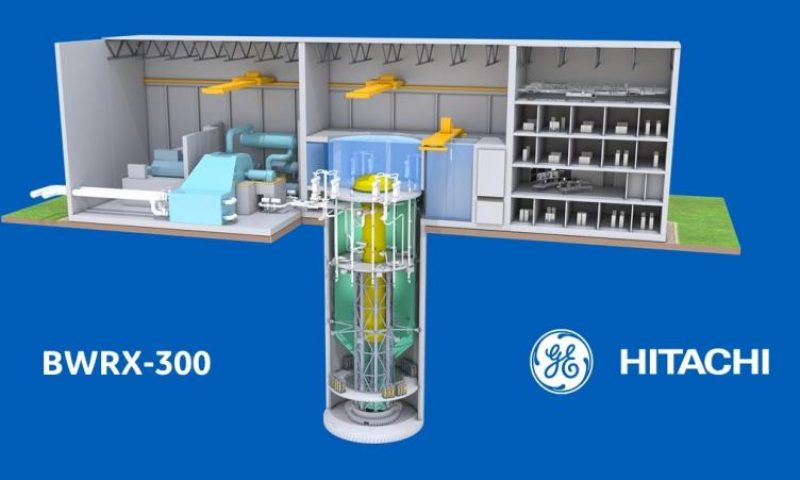
Ontario Power Generation (OPG) will build a GE Hitachi Nuclear Energy (GEH) BWRX-300 small modular reactor (SMR) at its Darlington Nuclear Station in Clarington, Ontario, marking a major triumph for the nuclear vendor in a stiff competition for the much-watched utility-scale project.
OPG announced the selection of the GE Hitachi BWRX-300 SMR over competitors X-energy and Terrestrial Energy in a live stream on Dec. 2. The utility said it will now work with GE Hitachi on the SMR engineering, design, planning, preparing the licensing and permitting materials, and performing site preparation activities. The companies are targeting a “mutual goal of constructing Canada’s first commercial, grid-scale SMR, projected to be completed as early as 2028.” Site preparation, which will include
“installation of the necessary construction services,” is slated to begin in the spring of 2022, pending appropriate approvals. OPG additionally said it will apply to the Canadian Nuclear Safety Commission
(CNSC) for a License to Construct the SMR by the end of 2022.
Power Mag 2nd Dec 2021
Gordon Edwards discusses a Canadian documentary on the ”Nuclear Revival” and small nuclear reactors.

Gordon Edwards, 1 December 21, On November 24, 2021, APTN broadcast a half-hour TV documentary about High Level Nuclear Waste in Canada, with some extra attention paid to the new, unorthodox irradiated fuels that would result from the proposed new reactors called SMRs. Here is a link to the program, entitled Nuclear Revival: https://youtu.be/uLhPwAWejzc
A couple of observations that crossed my mind while watching the report by Journalist Christopher Read –
(1) The fuel bundles should be thought of as CONTAINERS of the actual radioactive wastes, which are locked up inside those solid bundles. There are many different radioactive elements (all of them human-made, most of them not found in unspoiled nature) that can escape from the fuel bundles as gases, liquids or solids. They all have different chemical and biological properties but they are all cancer-causing elements and can damage genetic materials like DNA molecules.
Even though the fuel bundles may not move an inch from where they have been emplaced, these other materials can leak out or leach out and find their way to the environment of living things. Time is on their side!! Damaged fuel bundles are analogous to a broken bottle – the container is still there, but the contents (some at least) have escaped.
(2) Concerning SMRs, even if these new nuclear reactors all worked very well, which is doubtful, they will be terribly expensive and very slow to reach a level of commercial deployment (and profitability) – at least 10 to 20 years – so they are too costly and too slow to respond to the climate crisis TODAY.
Solar and wind are much cheaper than nuclear, they are proven and can be quickly deployed, while energy efficiency measures are even cheaper and even faster to implement. We do not yet know how much progress can be made using these alternatives but clearly they should have the first priority – with nuclear as a wait-and-see backup possibility which very likely will not be needed at all (as in the case of Germany, which has phased out nuclear – nearly finished – and now is focussed on phasing out coal, using renewables and efficiency.)
1 This Month



26 September – International Day for the Total Elimination of Nuclear Weapons


PLEASE OPPOSE HR 8255 AND S.3639 – bills would accelerate satellite deployment, with no environmental review or safeguards – https://ncstd5li.quorum.us/campaign/169331/
To see nuclear-related stories in greater depth and intensity – go to https://nuclearinformation.wordpress.com
-
Archives
- September 2026 (245)
- August 2026 (330)
- July 2026 (355)
- June 2026 (287)
- May 2026 (306)
- April 2026 (356)
- March 2026 (251)
- February 2026 (267)
- January 2026 (308)
- December 2025 (358)
- November 2025 (359)
- October 2025 (375)
-
Categories
- 1
- 1 NUCLEAR ISSUES
- business and costs
- climate change
- culture and arts
- ENERGY
- environment
- health
- history
- indigenous issues
- Legal
- marketing of nuclear
- media
- opposition to nuclear
- PERSONAL STORIES
- politics
- politics international
- Religion and ethics
- safety
- secrets,lies and civil liberties
- spinbuster
- technology
- Uranium
- wastes
- weapons and war
- Women
- 2 WORLD
- ACTION
- AFRICA
- Atrocities
- AUSTRALIA
- Christina's notes
- Christina's themes
- culture and arts
- Events
- Fuk 2022
- Fuk 2023
- Fukushima 2017
- Fukushima 2018
- fukushima 2019
- Fukushima 2020
- Fukushima 2021
- general
- global warming
- Humour (God we need it)
- Nuclear
- RARE EARTHS
- Reference
- resources – print
- Resources -audiovicual
- Weekly Newsletter
- World
- World Nuclear
- YouTube
-
RSS
Entries RSS
Comments RSS
 nuclear-news