Safety concerns: NRC was right to deny OKLO’s plan for small nuclear reactors

“The company asserted that its reactor was so small and so safe that it didn’t need to play by the same rules as those used to license larger reactors,” Lyman said. “But the fact remains that even a very small reactor contains enough highly radioactive material to cause significant radiological contamination in the event of an accident or a terrorist attack.”..
NRC denies Oklo Power’s plan to construct 1.5 MW advanced nuclear reactor in Idaho
Utility Dive Jan. 7, 2022 Robert Walton, Reporter
Dive Brief:
- The Nuclear Regulatory Commission on Thursday announced it denied without prejudice an application by Oklo Power to construct the United States’ first advanced nuclear reactor, in Idaho. The small design, dubbed “Aurora,” would be capable of producing 1.5 MW of electric power.
- The NRC cited “significant information gaps” in the company’s application, including details on potential accidents and its classification of safety systems and components. However, the company can resubmit its application and regulators said they are “prepared to re-engage” the company.
- Oklo is reviewing the decision, but in a statement said it was “eager to continue moving forward” on the Idaho reactor as well as others. Opponents of the project say a failure to provide safety information could put the public at significant risk in the event of an accident or attack.
………………………. according to the Union of Concerned Scientists, NRC was right to reject the application.
“Oklo simply refused to give the NRC the basic information that the agency needs to assess compliance with its regulations and its legal mandate to protect public health, safety, and the environment,” UCS Director of Nuclear Power Safety Edwin Lyman said in an email………
“The company asserted that its reactor was so small and so safe that it didn’t need to play by the same rules as those used to license larger reactors,” Lyman said. “But the fact remains that even a very small reactor contains enough highly radioactive material to cause significant radiological contamination in the event of an accident or a terrorist attack.”………. https://www.utilitydive.com/news/nrc-denies-oklo-powers-plan-to-construct-15-mw-advanced-nuclear-reactor-i/616807/
The world’s greatest garbage dump – space !

441,449 LOW EARTH ORBIT SATELLITES. Operating, Approved and Proposed …………………..
THE WORLD’S LARGEST GARBAGE PIT
And not only do thousands of whole satellites threaten the heavens, but a phenomenal amount of debris orbits the earth as a result of satellites colliding, or exploding, or otherwise being destroyed while in space. During the 64 years that humans have been launching rockets, the protective blankets of the ionosphere and magnetosphere have become the Earth’s largest garbage pit.
According to the European Space Agency there are, in orbit around the Earth today, 7,790 intact satellites, of which 4,800 are functioning. Since 1957, there have been more than 630 breakups, explosions, collisions, and other satellite-destroying events. This has resulted in the creation of more than 9,700 tons of space debris. There are, in orbit today:
- 30,430 debris objects presently being tracked
- 36,500 objects larger than 10 cm in size
- 1,000,000 objects from 1 cm to 10 cm in size
- 330,000,000 objects from 1 mm to 1 cm in size
EFFECTS ON OZONE, EARTHQUAKES, AND THUNDERSTORMSOzone In a 2020 paper titled “The environmental impact of emissions from space launches: A comprehensive review,” Jessica Dallas and her colleagues at the University of New South Wales wrote that “ozone depletion is one of the largest environmental concerns surrounding rocket launches from Earth.”
In 2021, there were 146 orbital rocket launches to put 1,800 satellites into space. At that rate, to maintain and continually replace 100,000 low-earth-orbit satellites, which have an average lifespan of five years, would require more than 1,600 rocket launches per year, or more than four every day, forever into the future.
2020 and 2021 witnessed two of the largest Antarctic ozone holes since measurements began in 1979. The 2020 hole was also the longest-lasting on record, and the 2021 hole was only a few days shorter; larger than the continent of Antarctica, it began in late July 2021 and ended on December 28, 2021. Everyone is still blaming chlorofluorocarbons (CFCs), which were banned by the Montreal Protocol in 1978. Nobody is looking at rocket launches, of which there were more in 2020 and 2021 than in any previous year. In addition to the 146 orbital launches in 2021, there were 143 sub-orbital launches of rockets to over 80 kilometers in altitude, for a total of 289 high-altitude launches for the year, or almost one every day.
Earthquakes and Thunderstorms
Earthquakes and Thunderstorms
In 2012, Anatoly Guglielmi and Oleg Zotov reviewed evidence that the global use of electricity has an effect on both seismic activity and thunderstorms…………………………………………… Everyone is so focused on a virus, and on antennas on the ground, that no one is paying attention to the holocaust descending from space. https://www.cellphonetaskforce.org/wp-content/uploads/2022/01/441449-Low-Earth-Orbit-Satellites.pdf
Hundreds of thousands of satellites brightening the night sky with negative effects on the ecosphere

441,449 LOW EARTH ORBIT SATELLITES
Operating, Approved and Proposed
While the attention of a terrified world has been riveted on a virus, and while concern about radiation has been focused on 5G on the ground, the assault on the heavens has reached astronomical proportions. During the past two years, the number of satellites circling the earth has increased from 2,000 to 4,800, and a flood of new projects has brought the number of operating, approved, and proposed satellites to at least 441,449. And that number only includes low-earth-orbit (LEO) satellites that will reside in the ionosphere.
The satellite projects include the ones listed below. The companies are based in the United States unless otherwise indicated.
17,270 satellites already approved by the U.S. Federal Communications Commission:
- Amazon (Kuiper) – 3,236 satellites
- Astro Digital – 30 satellites
- Black Sky Global – 36 satellites
- Boeing – 147 satellites
- Capella Space Corp. – 7 satellites
- Globalstar (operating since 2000) – 48 satellites
- Hawkeye 360 – 80 satellites
- ICEYE – 6 satellites (FINLAND)
- Iridium (operating since 1998) – 66 satellites
- Kepler Communications – 140 satellites (CANADA)
- Loft Orbital – 11 satellites
- OneWeb – 720 satellites (UNITED KINGDOM)
- Planet Labs (operating) – 200 satellites
- R2 Space, LLC – 8 satellites
- Spire Global – 175 satellites
- SpaceX – 11,943 satellites
- Swarm – 150 satellites
- Telesat – 117 satellites (CANADA)
- Theia Holdings – 120 satellites
- Umbra Lab – 6 satellites
- Viasat – 24 satellites
Applications for 65,912 satellites pending before the FCC:
- Amazon (Kuiper) – 4,538 additional satellites
- AST & Science – 243 satellites
- Astra Space – 13,620 satellites
- Boeing – 5,789 additional satellites
- Black Sky Global – 14 additional satellites
- Fleet Space Technologies – 40 satellites (AUSTRALIA)
- Hughes Network Systems – 1,440 satellites
- Inmarsat – 198 satellites (UNITED KINGDOM)
- Kepler Communications – two additional constellations of 360 satellites and 212 satellites (CANADA)
- Lynk Global – 10 satellites (HONG KONG)
- Maxar Technologies – 12 satellites
- New Spectrum – 30 satellites (CANADA)
- OneWeb – 6,368 additional satellites (UNITED KINGDOM)
- Orbital Sidekick – 6 satellites
- SN Space Systems – 1,190 satellites (UNITED KINGDOM)
- SpaceX – 30,000 additional satellites
- Telesat – 1,554 additional satellites (CANADA)
- Terra Bella – 24 satellites (15 already operating)
- Viasat – 264 additional satellites
Constellations totaling 14,872 satellites announced by governments:……………
Other LEO constellations planned by U.S. and foreign companies, totaling more than 16,055 satellites:…….
Rwanda, which wants to catapult Africa into world leadership in space, filed an application with the International Telecommunication Union (ITU) on September 21, 2021 for 327,320 satellites. Its proposal includes 937 orbital planes, distributed in 27 orbital shells (layers of satellites at different altitudes), with 360 satellites in each plane.
- Rwanda Space Agency – 327,320 satellites (RWANDA)
TOTAL: 441,449 SATELLITES OPERATING, APPROVED AND PROPOSED (+18 constellations whose numbers are not yet known) Most of the above list of satellites would orbit at altitudes between about 325 km (200 miles) and 1,100 km (680 miles), except that some of Rwanda’s proposed orbits go as low as 280 km (174 miles). The above list does not include applications for satellites in geostationary orbit (GEO), or for LEO constellations of fewer than 5 satellites, or constellations in medium earth orbit (MEO) such as:
- Intelsat (at 8600 km) – 216 satellites (LUXEMBOURG)
- Mangata Networks (at 6,400 km and 12,000 km) – 791 satellites
- O3b (at 8,062 km) – 112 satellites (LUXEMBOURG)
BRIGHTENING THE NIGHT SKY Scientists have already begun to publish papers analyzing the effect all these satellites will have, not only on astronomy, but on the appearance of the night sky and the visibility of the stars to everyone on earth. An article published online on March 29, 2021 in Monthly Notices of the Royal Astronomical Society by scientists in Slovakia, Spain and the United States is titled “The proliferation of space objects is a rapidly increasing source of artificial night sky brightness.” The scattering of sunlight from all of the objects in space, wrote the authors, is causing a “new skyglow” during the beginning and end of each night that has already brightened the natural night sky by about 10 percent. The authors are concerned that “the additional contribution of the new satellite mega-constellations” would ruin the night sky to a much greater extent.
A group of Canadian astronomers have an article in the January 2022 issue of The Astronomical Journal. “Megaconstellations of thousands to tens of thousands of artificial satellites (satcons) are rapidly being developed and launched,” they write. “These satcons will have negative consequences for observational astronomy research, and are poised to drastically interfere with naked-eye stargazing worldwide.” They analyzed what the effect on astronomy will be if 65,000 new low-orbit satellites are launched. At 40 degrees latitude (mid-United States; Mediterranean; mid-China; Japan; Buenos Aires; New Zealand), say these authors, more than 1,000 of these satellites will be sunlit and visible in the sky in the summer even at midnight. At higher latitudes (northern U.S.; Canada; most of Europe; Russia), thousands of these satellites will be visible all night long. Another paper, titled Report on Mega-Constellations to the Government of Canada and the Canadian Space Agency, was commissioned by the Canadian Astronomical Society and submitted to the Canadian government on March 31, 2021. It is a moving document. …………………………………… https://www.cellphonetaskforce.org/wp-content/uploads/2022/01/441449-Low-Earth-Orbit-Satellites.pdf
More fusion folly — Beyond Nuclear International

Fusion reactors present unsolved risks and still produce nuclear waste
More fusion folly — Beyond Nuclear International Nuclear fusion has been a long-held ambition of the nuclear industry and
governments who support nuclear power for decades. Since the end of the
Second World War, governments around the world, backed by elements of their
scientific communities, have always lauded fusion power as the ‘next
step’ above and beyond fission that is almost within reach, yet many
billions has so far been spent over the past seven decades on what has
often been called by its critics an ‘energy pipedream’.
Nuclear Free Local Authorities (NFLA) has rarely commented on nuclear fusion, given such
energy projects have yet to be commercially realised. All have foundered
around the complex challenges in developing such technology, many of which
in the third decade of the 21st century remain unsolved. In summary, to
date, none of the experimental reactors in operation have produced more
energy than was put into them.
Beyond Nuclear 2nd Jan 2022
https://beyondnuclearinternational.org/2022/01/02/more-fusion-folly/
Japan to help build Bill Gates’ high-tech Natrium nuclear reactor in Wyoming
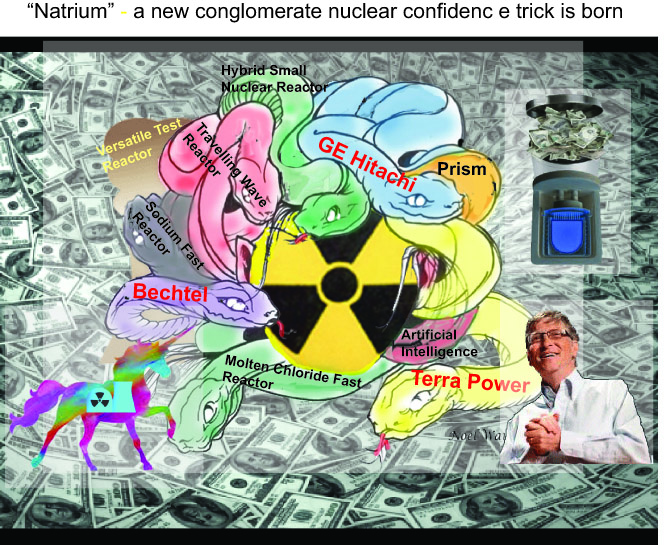
Japan to help build Bill Gates’ high-tech nuclear reactor in Wyoming -Yomiuri https://www.reuters.com/markets/commodities/japan-help-build-bill-gates-high-tech-nuclear-reactor-wyoming-yomiuri-2022-01-01/Reuters TOKYO. Reporting by Sakura Murakami; Editing by Kim Coghill- The Japan Atomic Energy Agency (JAEA) and Mitsubishi Heavy Industries Ltd (7011.T) are set to cooperate with the United States and Bill Gates’ venture company to build a high-tech nuclear reactor in Wyoming, the daily Yomiuri reported on Saturday.
The parties will sign an agreement as early as January for JAEA and Mitsubishi Heavy Industries to provide technical support and data from Japan’s own advanced reactors, the report said citing multiple unidentified sources.
TerraPower, an advanced nuclear power venture founded by Gates, is set to open its Natrium plant in Wyoming in 2028. The U.S. government will provide funding to cover half of the $4 billion project. read more
Terrapower had initially explored the prospect of building an experimental nuclear plant with state-owned China National Nuclear Corp, until it was forced to seek new partners after the administration of Donald Trump restricted nuclear deals with China.
The United States has been competing with China and Russia which also hope to build and export advanced reactors.
Japan, on the other hand, has a bitter history of decommissioning its Monju prototype advanced reactor in 2016, a project which cost $8.5 billion but provided little results and years of controversy.
The Monju facility saw accidents, regulatory breaches, and cover-ups since its conception, and was closed following public distrust of nuclear energy after the 2011 Fukushima nuclear disaster.
Both JAEA and Mitsubishi Heavy Industries could not be reached for comment, as their offices were closed for the New Year holidays.
Iran launches rocket into space as nuclear talks continue
Iran launches rocket into space as nuclear talks continue, Aljazeera, 31 Dec 21,
Iran uses satellite carrier rocket to send three research devices into space, state media reports, as talks to revive nuclear deal continue in Vienna.
Iran has launched a satellite carrier rocket bearing three research devices into space, according to state media, as difficult negotiations over its tattered nuclear deal with world powers continue in Vienna.The reports on Thursday did not say when the launch was conducted, nor what devices the carrier brought with it. It was unclear whether any of the objects entered orbit around the Earth…………………….. https://www.aljazeera.com/news/2021/12/30/iran-announces-new-space-launch-amid-nuclear-talks-in-vienna
The murky world of financing Small Nuclear Reactors (SMRs)

IKEA it ain’t: don’t go looking for friendly nuclear option, no matter the spin
MICHAEL WEST MEDIA, By Noel Wauchope|December 30, 2021
”……………..[Everyone] should be aware of the financial gymnastics going on in the USA, with NuScale, and in the UK, with Rolls-Royce. That’s just to single out the two most advanced of the many dubious SMR projects still at the starting gate.
The Murdoch media is enthusiastic about SMRs. Missing from the hype are a lot of unanswered questions. For a start — the ”M” stands for ”modular” — meaning that these reactors will be built in pieces, sort of, and transferred to a site, where they will be assembled, like a piece of IKEA furniture. But in fact there are at least 50 designs being promoted, and not all are modular.
The critical question comes down to – the money
The enthusiasm of the SMR lobby for the economic viability of SMRs is not matched by the facts.
For one thing to consider – there’s the price of the electricity to be eventually delivered by these small nuclear reactors. The Minerals Council of Australia estimates that by 2030 and beyond, SMRs could offer power to grids from $64-$77MWh, depending on size and type.
An analysis by WSP / Parsons Brinckerhoff, prepared for the 2015-16 South Australian Nuclear Fuel Cycle Royal Commission, estimated a cost of A$225 / MWh for a reactor based on the NuScale design, about three times higher than the MCA’s target range. CSIRO estimates SMR power costs at A$258-338 / MWh in 2020 and A$129-336 / MWh in 2030.
Then there are the costs of actually getting SMRs in the first place.
In Russia, China, France, and Argentina, the construction is done entirely or largely at taxpayers’ expense, and there is little or no transparency about the costs. But generally in the Western world, electricity production is supposed to be a commercially viable operation. In the context of promoting low -carbon technologies, SMRs are promoted as being cheaper than large ones. It is generally acceptable for the government to kick-start the process, with some funding, but with the understanding that the industry will become successful, profitable.
NuScale financing contortions
In the US, NuScale leads the pack. After its efforts to partner with Romania, UK, Canada and Jordan, NuScale has joined with a Utah-based utility consortium to develop what initially was proposed to be a power plant with 12 small reactors. The project, which is now forecast to cost $5.1 billion, has since been scaled back to six reactors, expected to start coming online in 2029. The Department of Energy (DOE) is to provide an annual supplement of about $130 million a year for a decade. However, that would be dependent upon annual renewals of the funding by Congress during that decade, which is a risk.
NuScale promises to deliver electricity at $55/MWh. UAMPS and NuScale have not explained the methodology used to develop this figure. Meanwhile PacifiCorp and Idaho Power have concluded that electricity from NuScale reactors would cost $94-$121/MWh.
Now NuScale is to go public by merging with what’s known as a special purpose acquisition company, or SPAC. The company, Spring Valley Acquisition Corporation, is already publicly traded. The new company named NuScale Power Corporation will list on the Nasdaq under the ticker symbol SMR. Their new SMR power plants will be called VOYGR, and NuScale will open centres at universities to promote technical training for them. The Department of Energy (DOE) will support these centres with funding, and NuScale will open centres at universities to promote technical training for them. DOE will support these centres with funding.
A SPAC is a type of shell company (shell companies being those not having actual business operations, just specific objectives, in this case, raising capital) The SPAC raises money from the public through initial public offerings, the sponsor getting 20% of the funds invested. Later private investments through public equity, or PIPES, can be added, often bought at a discount price by big institutions. The whole process is done relatively speedily, and with much less scrutiny than in usual mergers. US Securities and Exchange Commission Chair Gary Gensler wants to tighten regulations on SPACs:
Glitzy corporate presentation decks, hyped press releases and celebrity endorsements can balloon a SPAC’s equity well beyond a reasonable value long before proper disclosures are filed, Gensler said.
SPACs have had a chequered history — they enable the sponsors to avoid financial loss, even if the business fails, as many did, in the 1990s. Sixty-five per cent of deals completed in 2021 at a valuation above $1bn are trading below $10 — the price at which they were floated. All of the companies are trading below their stock market highs with some of them down by as much as 70%. Senator Elizabeth Warren and three other Democrats are investigating the imbalance between the financial results for the sponsors and banks versus the early investors.
Rolls-Royce still looking for money
The process of getting funding for the UK’s SMRs is equally tortuous. The government invested £18 million in November 2019, which delivered significant development of the initial design as part of Phase One of the project. At the beginning of November 2021, Rolls-Royce Holdings Plc raised 455 million pounds ($608 million) to fund the development of SMRs, with almost half of the financing coming from the U.K government Rolls-Royce Small Modular Reactor (SMR) business is a consortium, backed by BNF Resources and Exelon Generation. BNF Resources UK Limited is a subsidiary of BNF Capital Limited. Other members of the consortium are Assystem, Atkins, BAM Nuttall, Laing O’Rourke, National Nuclear Laboratory (NNL), Jacobs, The Welding Institute (TWI) and Nuclear AMRC, as well as Rolls-Royce. It’s not at all clear how much each group has put into the venture.
For the plan to have the planned £30 billion fleet of mini-nuclear power stations, the business will have to rely on UK taxpayers to help fund the construction of the first of the new designs. New government funding of £210 million announced on November 9 will take forward phase 2, over the next three years, of the so-called Low-Cost Nuclear project to further develop SMR design and take it through the regulatory processes to assess suitability of potential deployment in the UK. Exelon is contributing under an agreement from a year ago to find international markets. Rolls-Royce expects the first five SMR reactors to cost £2.2bn each, falling to £1.8bn for subsequent units.
Rolls-Royce will be seeking more investment for the project to help fund the building of actual SMRs.
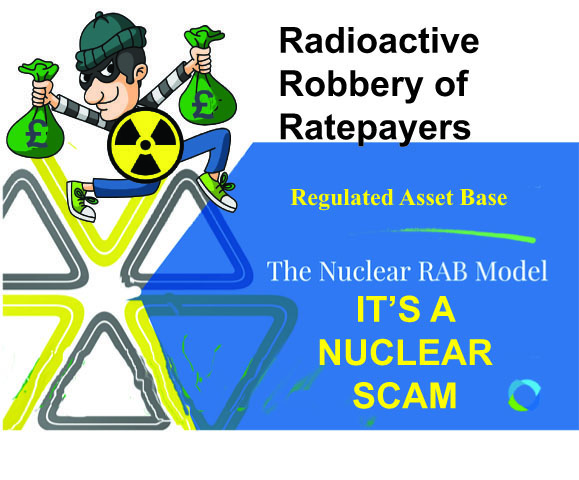
The government is currently passing legislation that will allow investors to back projects like SMRs using a regulated asset base (RAB) model, which allows them to recoup upfront costs from the consumers, over the construction period, long before those consumers actually get any electricity from the project.
Mythical beasts
So — what it all boils down to is an agreement to spend about £400 million over the next three years — to perhaps produce a design for a reactor, which might get approved by the regulators, and might find investors who might be willing to pay what will be at least £2 billion to build each one.
It’s not at all clear who is going to end up paying the most for small nuclear reactors, or indeed, if that fleet of SMRs will ever become a reality. It will probably be the taxpayers. I haven’t mentioned all those ancillary costs — of winning community approval, of security, waste disposal.
In the meantime, it’s worth being wary about the financial aspects, given the obscure manipulations going on in the US and UK, and remembering that not yet does one of these mythical beasts, Small Modular Nuclear Reactors actually exist.
Renewables remain the cheapest “new-build” source of energy generation. They exist. They work. https://www.michaelwest.com.au/ikea-it-aint-small-modular-nuclear-reactors/
.
NuScale’s Small Nuclear Reactors (SMRs) to go public with the dodgy Special Purpose Acquisition Company System
US nuclear reactor company NuScale to go public via SPAC, Capital.com, 30 Dec 21,
NuScale Power announced plans to go public in a merger with blank cheque company Spring Valley Acquisition earlier this month, highlighting the growing area of small nuclear power reactors……. So far, NuScale is the first and only company to design a SMR that received approval from the US Nuclear Regulatory Commission, according to the company’s presentation to investors…….
Going public
The deal values NuScale at $1.9bn, which implies a four-times multiple over its 2026 estimated EBITDA, CEO of Spring Valley Acquisition Chris Sorrells said in a call with investors.
The merger is expected to close in 2022 and will make NuScale a public company that trades on the Nasdaq under the ticker “SVIIU.”
The company has yet to produce revenue but estimates that once it’s incorporated, the company can begin producing around $16m in revenue next year and boost that to $13.1bn by 2030, according to the presentation.
NuScale was formed in 2007 when Oregon State University (OSU) granted exclusive rights to the core SMR technology patents. OSU maintains an interest in the company due to the technology transfer agreement.
Other companies that have invested in NuScale include Samsung’s construction subsidiary, Japanese engineering company JGC Holdings and Doosan Heavy Industries and Construction……
One of the first customers of NuScale’s technology will be Utah Associated Municipal Power Systems, which is expected to deploy a new plant in Idaho by 2029 for its Carbon Free Power Project.
Just last month, Romania’s state-owned electric utility service SN Nuclearelectrica signed an agreement to advance the deployment of NuScale’s technology in the country as early as 2027–2028.
Canada to be the guinea pig for America’s probably unviable small nuclear reactor.

“There’s lots of enthusiasm among nuclear reactor designers, developers and national laboratories, and academic nuclear engineering departments” about SMRs, said Edwin Lyman, director of nuclear power safety at the Union of Concerned Scientists, who published a report on SMR reactor designs in early 2021. “
There’s a lot of supply but there’s not much demand, because utilities don’t want to be guinea pigs.”
cost escalation is practically inevitable.
Canada’s first new nuclear reactor in decades is an American design. Will it prompt a rethink of government support? The Globe and Mail, MATTHEW MCCLEARN, 26 Dec 21, Ontario Power Generation’s selection of GE Hitachi Nuclear Energy to help build a small modular reactor (SMR) at its Darlington station in Clarington, Ont., set in motion events that could shape Canada’s nuclear industry for decades to come.
OPG’s choice, announced in December, is the BWRX-300. It’s a light water reactor, the variety most popular in developed countries, and quite unlike Canada’s existing fleet of CANDU heavy water reactors. Though not exactly small – the BWRX’s 300-megawatt nameplate capacity is roughly equivalent to a large wind farm – it would produce only one-third as much electricity as traditional reactors. It would use different fuel, produce different wastes and possibly have different safety implications.
The Darlington SMR would be the first BWRX-300 ever constructed. By moving first, OPG hopes Ontario will become embedded in a global supply chain for these reactors.
“OPG ourselves, we don’t really get anything out of it – it’s a lot of work,” said Robin Manley, OPG’s vice-president of nuclear development. “Our goal is to have as many contracts signed with Canadian suppliers as we possibly can.” But that might not satisfy some critics, who’ve protested OPG’s selection of a U.S. design by GE Hitachi, which is based in North Carolina.
Ontario Power Generation chose GE Hitachi Nuclear Energy to build a light water reactor .
It does seem to confirm the end of Canada’s tradition of homegrown reactors. The BWRX-300 would be Canada’s first new reactor since Darlington Unit 4 in Ontario, completed in 1993. According to Mycle Schneider Consulting, the average age of the country’s 19 operational reactors is 38 years. Attempts to update the CANDU design proved largely fruitless; OPG and Bruce Power opted to refurbish reactors at Darlington and Bruce stations to operate another few decades, while sizing up SMRs as a possible next act.
Time is running short. This decade is widely regarded as crucial for building emissions-free generation capacity. SMRs will be late to that party even if this BWRX-300 is built on time. Delays and cost overruns, ever-present risks with any reactor, could kill its prospects.
The partnership with OPG represents a major coup for GE Hitachi, a U.S.-Japanese alliance that set up its SMR subsidiary in Canada less than a year ago. There are at least 50 SMR designs worldwide, but most exist only on paper; vendors compete vigorously to sell to experienced nuclear operators such as OPG because they represent an opportunity to build a bona fide reactor that might entice other clients. For the same reason, OPG’s decision is a blow to the losing candidates, Oakville, Ont.-based Terrestrial Energy Inc. and X-energy, an American vendor
“There’s lots of enthusiasm among nuclear reactor designers, developers and national laboratories, and academic nuclear engineering departments” about SMRs, said Edwin Lyman, director of nuclear power safety at the Union of Concerned Scientists, who published a report on SMR reactor designs in early 2021. “There’s a lot of supply but there’s not much demand, because utilities don’t want to be guinea pigs.”
Nuclear industry executives and government officials hope the Darlington SMR will be the first of many deployed in Ontario and beyond. SaskPower is also shopping; it has collaborated with OPG since 2017, and said the BWRX-300 is among its candidates. Canada has a small population, so observers doubt the country could support supply chains for multiple reactor designs.
But OPG’s selection of an American SMR has drawn some sharp criticism. Some observers assumed Terrestrial enjoyed a home turf advantage, particularly in light of the federal government’s decision to invest $20-million toward its Integral Molten Salt Reactor (IMSR). The Society of Professional Engineers and Associates, a union representing engineers and others working on CANDU reactors, complained that “priority should have been given to Canadian design.”
“It is a slap in the face for Terrestrial,” said M.V. Ramana, professor at the University of British Columbia’s Liu Institute for Global Issues. “It is not a good sign for Canada’s nuclear industry.”
Prof. Ramana added that OPG’s decision may prompt a rethinking of government support to SMR developers. In addition to Terrestrial’s funding, Moltex Energy received $50.5-million from the federal Strategic Innovation Fund and the Atlantic Canada Opportunities Agency to advance the Stable Salt Reactor-Wasteburner it is working on in New Brunswick. ARC Clean Energy received $20-million from New Brunswick’s government toward its ARC-100 reactor.
“If these companies are not able to persuade OPG, then maybe we should stop funding them,” he said…………………..
Unlike CANDUs, which consume unenriched uranium, light water reactors require fuel enriched to increase Uranium-235 content. Mr. Lyman said that by adopting any non-CANDU design, Canada will become dependent on enriched fuel imported from the U.S., Europe or elsewhere.
The industry would also need to learn how to dispose of unfamiliar wastes. The Nuclear Waste Management Organization (NWMO), which is in the final stages of selecting an underground storage site for Canada’s radioactive spent fuel, said spent BWRX-300 fuel would generate more heat and radioactivity than CANDU fuel, but could be stored in fewer containers, placed further apart.
“We will learn from our international partners who already have plans to permanently store this type of waste in a deep geological repository,” the NWMO said in a statement.
All this assumes OPG’s reactor gets built. To begin with, the BWRX-300 actually isn’t licensed to be built anywhere. GE Hitachi is participating in the Canadian Nuclear Safety Commission’s Vendor Design Review, through which it receives early feedback from the regulator on its reactor. ………
critics say completing the reactor by 2028 is a tall order. According to Mycle Schneider Consulting, one in eight reactors that have begun construction since 1951 were never connected to the grid. Many survivors, meanwhile, arrived years later than promised.
Mr. Manley said 2028 is “an aspirational goal” rather than a hard deadline. The project schedule will firm up over the next two years.
OPG has yet to publish a cost estimate, but according to a report published by PwC, the SMR project “is expected to spend $2-billion over seven years.” That’s already higher than the US$1-billion price tag GE Hitachi promised for a BWRX-300 in 2019. (In public presentations, GE executives declared that keeping the price below US$1-billion was crucial to its plans to exponentially grow its customer base.)……
Prof. Ramana said cost escalation is practically inevitable……….https://www.theglobeandmail.com/business/article-canadas-first-new-nuclear-reactor-in-decades-is-an-american-design/
A second great nuclear ice breaker for Russia to keep the Northern Sea Route open
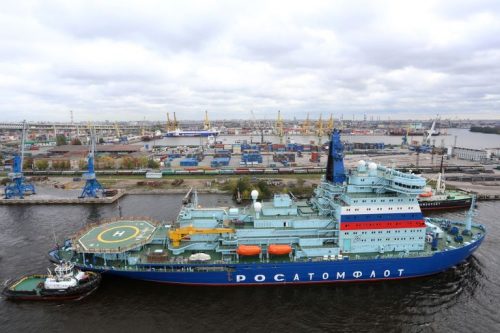
Second giant nuclear icebreaker handed over to Rosatomflot, The “Sibir”
will add to the rapidly growing fleet of powerful icebreakers tasked to
keep the Northern Sea Route open for year-round shipping. The acceptance
certificate was signed at a ceremony onboard the icebreaker at the Baltic
Shipyard in St. Petersburg on December 24, Rosatomflot informs.
Barents Observer 25th Dec 2021
ROLLS ROYCE FALLS 3% ON QATARI INVESTMENT IN SMALL NUCLEAR BUSINESS
- Rolls Royce Holding PLC (LON: RR) has fallen 3% on news of the Qatari investment into the small nuclear reactor business
- It may well not be the investment itself that is the catalyst for the price change but Omicron
- The £85 million Qatar investment isn’t really a material number for Rolls Royce, even as it’s a vote of confidence in the programme.
Rolls Royce shares have continued their recent decline even as the news comes through of a Qatari investment in the small nuclear reactor programme. This could be seen as a surprise – investment in such a programme is likely to be a good deal for Rolls Royce after all. On the other hand, £85 million, the size of the investment, isn’t a large number compared to Rolls Royce – it’s not, as they say, a material number.
The likelihood is therefore that it is wider events driving the Rolls Royce share price, Omicron continues to rage around the world, air travel becomes increasingly restricted and so on. It’s worth pointing out that the RR incomes do not depend, particularly, on actually selling engines to people. There are fees involved in that, most certainly, but there’s an element of selling razors in how the business work. Once you’ve sold someone a razor then you’ve a capitve market for razor blades. Once you’ve got an engine in an aircraft then there’s a decades-long maintenance and repair income flow. That Rolls Royce income stream though depends upon hours in the air – exactly the thing being depressed by Omicron.
Rolls Royce shares have continued their recent decline even as the news comes through of a Qatari investment in the small nuclear reactor programme. This could be seen as a surprise – investment in such a programme is likely to be a good deal for Rolls Royce after all. On the other hand, £85 million, the size of the investment, isn’t a large number compared to Rolls Royce – it’s not, as they say, a material number.
The likelihood is therefore that it is wider events driving the Rolls Royce share price, Omicron continues to rage around the world, air travel becomes increasingly restricted and so on. It’s worth pointing out that the RR incomes do not depend, particularly, on actually selling engines to people. There are fees involved in that, most certainly, but there’s an element of selling razors in how the business work. Once you’ve sold someone a razor then you’ve a capitve market for razor blades. Once you’ve got an engine in an aircraft then there’s a decades-long maintenance and repair income flow. That Rolls Royce income stream though depends upon hours in the air – exactly the thing being depressed by Omicron. https://www.asktraders.com/analysis/rolls-royce-falls-3-on-qatari-investment-in-small-nuclear-business/
NASA seems to be struggling with the fact that ionising radiation is a greater risk to women, than to men

The committee also recommended NASA provide all its astronauts with individual radiation risk assessment (based on age and sex), communicate a comprehensive picture of an astronaut’s own cancer risk, and continue to discuss changes in radiation risk during routine health briefings.
New NASA radiation exposure limit would bring equality to female, male astronauts, Healio.com, Ryan Lawrence 20 Dec 21,
“Experts in oncology help advise NASA on space radiation health standard for astronauts”A committee of experts from science, medicine and academia, among other fields, has recommended NASA proceed with a proposal for a universal, career-long radiation dose limit for all astronauts
The Committee on Assessment of Strategies for Managing Cancer Risks Associated with Radiation Exposure During Crewed Space Missions, convened at the request of NASA, concluded that the career-long dose limit should apply to both men and women, a change from previous standards, and recommended improved communication methods for advising astronauts on cancer risks.
“The old radiation standards were very restrictive for women astronauts,” Amy Berrington de González, DPhil, senior investigator and chief of the radiation epidemiology branch at the NCI and a member of the committee, told Healio | HemOnc Today. “There has been a lot of progress in understanding of radiation risk in the last few decades, so bringing that in to see whether you could make the flying time more equitable for women astronauts, I think was really important.”
Berrington de González said the universal dose was established “for the most protective case” and applied to all astronauts.
As it currently stands, men and women have different allowable doses of radiation in space travel with NASA, which were based on reported relative susceptibilities to different radiation-induced cancers. The report recommends NASA move forward with its proposed single standard dose limit for all astronauts.
“I think NASA got worried because they saw some data from the Japanese atomic bomb survivors, who we use as our primary group for determining [radiation] risk, and it looked like there was an increased risk for lung cancer among women,” committee member Gayle E. Woloschak, PhD, associate dean for graduate student and postdoctoral affairs and professor of radiation oncology and radiology at Feinberg School of Medicine at Northwestern University, told Healio | HemOnc Today. “
“Then the question was, ‘Should we have a different risk level for women than for men, considering Mars missions might limit a woman from going into space at all?’ And, you can imagine, there are ethical issues with that, too. Basically, we said there should be the same risks across the board for everybody.”
Before these proposals, the current standard set career exposure to radiation to not exceed 3% risk for exposure-induced death (REID) for cancer mortality at a 95 percent confidence level, to limit the cumulative effective dose received throughout an astronaut’s career.
NASA called for an independent review of the validity of the 3% REID, which has been the standard since 1989, because it is for low-Earth orbit missions exclusively. An update was necessary as NASA plans for longer-duration missions farther in the solar system.
“The radiation in deep space is different,” committee member Carol Scott-Conner, MD, PhD, MBA, emeritus professor of surgery in surgical oncology and endocrine surgery at Carver College of Medicine at University of Iowa, told Healio | HemOnc Today. “Once you get beyond the Earth’s magnetosphere, you get highly energetic particles from the sun. And these are things like the nuclei of iron. You can think of them as like cannon balls going through cells, as opposed to protons, electrons or gamma rays that we think of here on Earth. … If you go to Mars, and let’s say it takes you about 6 months, you’re exposed that whole time to this radiation.”
The committee also recommended NASA provide all its astronauts with individual radiation risk assessment (based on age and sex), communicate a comprehensive picture of an astronaut’s own cancer risk, and continue to discuss changes in radiation risk during routine health briefings.
.
Bill Gates’ sodium-cooled ‘Natrium’ nuclear reactor design – strikingly like the disastrous reactors at Santa Susana Field Lab.
Most striking of all is the success of official campaigns asserting that even the most serious accidents have caused little or no harm

Spent Fuel, Harpers, by Andrew Cockburn, 20 Dec 21, The risky resurgence of nuclear power ” …………………………. Gates and other backers extoll the promise of TerraPower’s Natrium reactors, which are cooled not by water, as commercial U.S. nuclear reactors are, but by liquid sodium. This material has a high boiling point, some 1,600 degrees Fahrenheit, which in theory enables the reactor to run at extreme temperatures without the extraordinary pressures that, in turn, require huge, expensive structures……………….

Prosperous and 70 percent white, West Hills, California, is one of the communities that have sprouted near the Santa Susana Field Laboratory in the decades since the 1959 meltdown. Unlike the poor, sick, and embittered residents of Shell Bluff, people living in West Hills had until recently only the barest inkling that nuclear power in the neighborhood might have had unwelcome consequences. “Almost no one knew about the Santa Susanna Field Lab, or they thought it was an urban legend,” Melissa Bumstead, who grew up in nearby Thousand Oaks, told me recently. In 2014, Bumstead’s four-year-old daughter, Grace, was diagnosed with an aggressive form of leukemia. “This has no environmental link,” her pediatric oncologist told her firmly. Childhood cancers were rare, and this was just cruel luck.
Then, while taking Grace to Children’s Hospital Los Angeles, Bumstead ran into a woman who recognized her from the local park where their young daughters played. The woman’s child had neuroblastoma, another rare cancer, as did another from nearby Simi Valley, whom they encountered while the children were getting chemo. Back at home, someone on her street noticed the childhood cancer awareness sticker on Bumstead’s car and mentioned that another neighbor had died of cancer as a teenager.
Bumstead began to draw a map detailing the cluster of cancer deaths in small children just in the previous six years, but stopped working on it in 2017. “I had such severe PTSD when I added children onto it, my therapist told me to stop.” But it is still happening, she said, mentioning the unusual number of bald children she had noticed in local elementary schools in recent years, as well as the far-above-average rate of breast cancer cases recorded in the area. A cleanup of the field lab was due to be completed in 2017, but it has yet to begin.

I called Bumstead because I had been struck by the fact thatTerraPower’s Natrium reactor resembles in its basic features the long-ago Sodium Reactor Experiment at Santa Susana. (Natrium is Latin for sodium.) “That’s exactly what we had!” Bumstead exclaimed when I mentioned that liquid sodium is integral to TerraPower’s project. “The meltdown was in the sodium reactor.” As her comment made clear, such liquid sodium technology is by no means innovative.
Nor, in an extensive history of experiments, has it ever proved popular—not least because liquid sodium explodes when it comes into contact with water, and burns when exposed to air. In addition, it is highly corrosive to metal, which is one reason the technology was rapidly abandoned by the U.S. Navy after a tryout in the Seawolf submarine in 1957.
That system “was leaking before it even left the dock on its first voyage,” recalls Foster Blair, a longtime senior engineer with the Navy’s reactor program. The Navy eventually encased the reactor in steel and dropped it into the sea 130 miles off the coast of Maryland, with the assurance that the container would not corrode while the contents were still radioactive. The main novelty of the Natrium reactor is a tank that stores molten salt, which can drive steam generators to produce extra power when demand surges. “Interesting idea,” Blair commented. “But from an engineering standpoint one that has some real potential problems, namely the corrosion of the high-temperature salt in just about any metal container over any period of time.”
TerraPower’s Jeff Navin assured me in response that Natrium “is designed to be a safe, cost-effective commercial reactor.” He added that Natrium’s use of uranium-based metal fuel would increase the reactor’s safety and performance. Blair told me that such a system had been tried and abandoned in the Fifties because the solid fuel swelled and grew after fissioning.
As the sodium saga indicates, the true history of nuclear energy is largely unknown to all but specialists, which is ironic given that it keeps repeating itself. The story of Santa Susana follows the same path as more famous disasters, most strikingly in the studious indifference of those in charge to signs of impending catastrophe.The operators at Santa Susana shrugged off evidence of problems with the cooling system for weeks prior to the meltdown, and even restarted the reactor after initial trouble. Soviet nuclear authorities covered up at least one accident at Chernobyl before the disaster and ignored warnings that the reactor was dangerously unsafe. The Fukushima plant’s designers didn’t account for the known risk of massive tsunamis, a vulnerability augmented by inadequate safety precautions that were overlooked by regulators. Automatic safety features at Santa Susana did not work. This was also the case at Fukushima, where vital backup generators were destroyed by the tidal wave.
No one knows exactly how much radiation was released by Santa Susana—it exceeded the scale of the monitors. Nor was there any precise accounting of the radioactivity released at Chernobyl. Fukushima emitted far less, yet the prime minister of Japan prepared plans to evacuate fifty million people, which would have meant, as he later recounted, the end of Japan as a functioning state. Another common thread is the attempt by overseers, both corporate and governmental, to conceal information from the public for as long as possible. Santa Susana holds the prize in this regard: its coverup was sustained for twenty years, until students at UCLA found the truth in Atomic Energy Commission documents.
Most striking of all is the success of official campaigns asserting that even the most serious accidents have caused little or no harm……………………
“The right not to know” about the effects of nuclear power is currently embraced far beyond Fukushima. In the face of escalating alarm about climate change, the siren song of “clean and affordable and reliable” power finds an audience eager to overlook a business model that is dependent on state support and often greased with corruption; failed experiments now hailed as “innovative”; a pattern of artful disinformation; and a trail of poison from accidents and leaks (not to mention the 95,000 tons of radioactive waste currently stored at reactor sites with nowhere to go) that will affect generations yet unborn. Arguments by proponents of renewables that wind, solar, and geothermal power can fill the gap on their own have found little traction with policymakers. Ignoring history, we may be condemned to repeat it. Bill Gates has bet a billion dollars on that. https://harpers.org/archive/2022/01/spent-fuel-the-risky-resurgence-of-nuclear-power/
USA has 85,000 metric tons of spent fuel from nuclear power plants, 90 million gallons of weapons wastes – robots to the rescue.
There’s over 85,000 metric tons of spent nuclear fuel from commercial
nuclear power plants, and 90 million gallons of waste from government
weapons programs in the U.S. today, according to the Government
Accountability Office.
That number is rapidly growing. Every year, we add
2,000 metric tons of spent nuclear fuel. Disposing and handling nuclear
waste is a dangerous task that requires precision and accuracy. Researchers
from the National Centre for Nuclear Robotics led by the Extreme Robotics
Lab at the University of Birmingham in the UK are finding ways to help
humans and robots work together to get the job done.
The researchers have
developed a system using a standard industrial robot that uses a parallel
jaw gripper to handle objects and an Ensenso N35 3D cameras to see the
world around it. The team’s system involves allowing humans to make more
complex decisions that AI isn’t equipped to do, while the robot
determines how to best perform the tasks. The team uses three kinds of
shared control.
The Robot Report 18th Dec 2021
Nuclear Free Local Authorities call for ”no watering down” of safety regulations regarding future nuclear fusion reactors
The Nuclear Free Local Authorities Network has called for ‘no watering
down’ of the safety regulations that will be applied to future fusion
reactors in its response to a public consultation by the Department of
Business, Energy, and Industrial Strategy.
In his letter to the BEIS, Councillor David Blackburn, Chair of the NFLA Steering Committee, outlines
the many challenges and risks that would be posed by operating nuclear
fusion, including the risk posed by the large quantities of radioactive
wastes that would result and the danger of radioactive tritium entering the
water supply.
Most frightening is the requirement to constantly and safely
contain the immense temperatures needed to spark and sustain a fusion
reaction and the long-term damage that the whole structure will suffer from
prolonged exposure to neutron radiation, a situation which if not carefully
monitored could result in the very integrity of the reactor vessel being
placed in jeopardy.
NFLA 15th Dec 2021
1 This Month



26 September – International Day for the Total Elimination of Nuclear Weapons


PLEASE OPPOSE HR 8255 AND S.3639 – bills would accelerate satellite deployment, with no environmental review or safeguards – https://ncstd5li.quorum.us/campaign/169331/
To see nuclear-related stories in greater depth and intensity – go to https://nuclearinformation.wordpress.com
-
Archives
- September 2026 (245)
- August 2026 (330)
- July 2026 (355)
- June 2026 (287)
- May 2026 (306)
- April 2026 (356)
- March 2026 (251)
- February 2026 (267)
- January 2026 (308)
- December 2025 (358)
- November 2025 (359)
- October 2025 (375)
-
Categories
- 1
- 1 NUCLEAR ISSUES
- business and costs
- climate change
- culture and arts
- ENERGY
- environment
- health
- history
- indigenous issues
- Legal
- marketing of nuclear
- media
- opposition to nuclear
- PERSONAL STORIES
- politics
- politics international
- Religion and ethics
- safety
- secrets,lies and civil liberties
- spinbuster
- technology
- Uranium
- wastes
- weapons and war
- Women
- 2 WORLD
- ACTION
- AFRICA
- Atrocities
- AUSTRALIA
- Christina's notes
- Christina's themes
- culture and arts
- Events
- Fuk 2022
- Fuk 2023
- Fukushima 2017
- Fukushima 2018
- fukushima 2019
- Fukushima 2020
- Fukushima 2021
- general
- global warming
- Humour (God we need it)
- Nuclear
- RARE EARTHS
- Reference
- resources – print
- Resources -audiovicual
- Weekly Newsletter
- World
- World Nuclear
- YouTube
-
RSS
Entries RSS
Comments RSS
 nuclear-news