Bill Gates’ nuclear startup wins $750M, loses sole fuel source
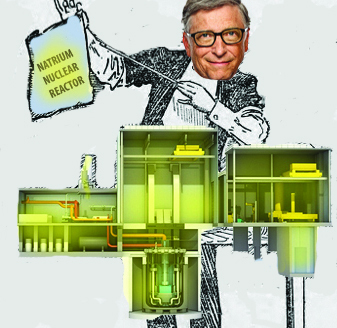
TerraPower notches a record-setting investment round led by South Korea’s SK. But it has no supplier of the enriched fuel it needs, now that sourcing from Russia is off the table.
Canary Media Eric Wesoff, 18 August 2022, Nuclear fission startup TerraPower, founded and chaired by Microsoft co-founder Bill Gates, has raised $750 million to develop advanced nuclear reactors to serve as alternatives to the light-water reactors that make up the vast majority of the world’s civilian nuclear fleet. But cash alone won’t be enough to get the startup over the many hurdles that stand in its way.
TerraPower’s Natrium fast reactor design is radically different from the design of traditional nuclear reactors. For starters, it’s smaller. A typical reactor in the U.S. produces 1,000 megawatts of power. TerraPower’s first demonstration reactor, now being planned for a site in Wyoming, will have a capacity of 345 megawatts. The smaller size could enable the reactor to be built cheaply in a factory and not expensively on-site.
The Natrium reactor will also use a different fuel and a different coolant than standard nuclear reactors. It will be fueled by high-assay low-enriched uranium (HALEU), which is enriched with more uranium than the fuel used in traditional nuclear plants. And the coolant will be high-temperature liquid sodium instead of water.
TerraPower’s new funding includes $250 million from South Korean chaebol SK Group. Previous funding for the firm has come from Gates and Warren Buffett of Berkshire Hathaway. The company was also awarded $80 million from the U.S. Department of Energy to work on its Natrium reactor design.
Canary covered TerraPower’s technology in detail last year when the firm announced that Bechtel will build its first reactor in Kemmerer, Wyoming, near the site of a coal-fired power plant that is scheduled to be shut down. The U.S. Department of Energy and private investors will split the cost of the demonstration project.

The startup claims that this first reactor will be in operation by 2028 and will cost $4 billion, including engineering, procurement and construction. If TerraPower comes anywhere close to meeting those wildly ambitious goals, it will strongly differentiate itself from the traditional nuclear industry, which is notorious for missed deadlines and shocking cost overruns. The only two conventional nuclear reactors currently under construction in the U.S., at the Vogtle plant in Georgia, are already six years overdue and will cost utility customers over $30 billion, more than double the original price tag.
Fuel folly?
One big new problem for TerraPower emerged earlier this year: its fuel source. The only facility currently able to supply commercial quantities of HALEU is in Russia. That wasn’t a great situation even before Russia invaded Ukraine. Now that the war in Ukraine has been grinding on for six months and shows no signs of resolution, relying on fuel sourced from Russia is untenable.
In March, TerraPower said it had cut ties with Tenex, the Russian state-owned company from which it had planned to source HALEU, Wyoming-based nonprofit news outlet WyoFile reported. “When Russia invaded Ukraine it became very clear, for a whole set of reasons — moral reasons as well as commercial reasons — that using Russian fuel is no longer an option for us,” said Jeff Navin, TerraPower’s director of external affairs.
TerraPower did just get good news this week when President Biden signed the Inflation Reduction Act into law. The legislation includes $700 million to help build up a domestic supply chain for HALEU. The funding could give a boost to the U.S. Department of Energy’s plans to launch a congressionally authorized HALEU Availability Program. But developing HALEU production capacity in the U.S. will take years.
TerraPower does not have wiggle room to delay. If it doesn’t complete its demonstration project by 2028, it stands to lose out on up to $2 billion in federal funding from the U.S. Department of Energy’s Advanced Reactor Demonstration Program and the opportunity for expedited federal regulatory reviews.
Some experts are skeptical that TerraPower will make the deadline, especially now that it has no source of fuel. “I didn’t think it was doable before this monkey wrench was thrown in,” Edwin Lyman, director of nuclear power safety for the Union of Concerned Scientists, told WyoFile in March.
A nuclear renaissance?
Despite these headwinds, TerraPower did just raise $750 million, so it’s not alone in anticipating a revival of the nuclear power industry.
The Inflation Reduction Act will help not just HALEU-fueled TerraPower but the rest of the nuclear energy sector too: It includes a production tax credit for nuclear power, an incentive that will benefit struggling nuclear plants that already exist across the country as well as developers of new types of nuclear reactors. In addition to TerraPower, that latter category includes U.S. startups NuScale and Oklo.
….. The bipartisan infrastructure law Biden signed late last year contains $6 billion to support existing nuclear plants and $3.2 billion for development of advanced nuclear power technology. The Department of Energy’s Loan Programs Office has $11 billion in funding for nuclear plants and nuclear supply chains, according to Jigar Shah, director of the office. …………….. https://www.canarymedia.com/articles/nuclear/bill-gates-nuclear-startup-wins-750m-loses-sole-fuel-source
Twelve months, one meeting – the complete lack of accountability on nuclear in Copeland

In fact, the Rolls-Royce fronted consortium developing a 470-MW so-called ‘Small’ Modular Nuclear Reactor still faces considerable challenges in bringing a design to market. The design still needs to be approved by the Office of Nuclear Regulation after a comprehensive Generic Design Assessment. If approved, the consortium would need to build and test an actual working prototype; establish facilities to fabricate the parts; master the fabrication and on-site assembly process; secure funding; navigate the siting, planning and Development Consent process; and actually build the first plant. So hardly a rose in fragrant bloom!
https://www.nuclearpolicy.info/news/twelve-months-one-meeting-the-complete-lack-of-accountability-on-nuclear-in-copeland/ 19 Aug 22, Despite Copeland Council being at the heart of plans to develop a new nuclear plant and a nuclear waste dump in the borough, the Nuclear Free Local Authorities were surprised to see that the Council’s Strategic Nuclear and Energy Board has only met once in the last twelve months.[1]
Only last month, Copeland Borough Council’s Portfolio Holder for Nuclear and Commercial Services Councillor David Moore described how “the future looks rosy” for new nuclear in Copeland as talks progress on Small Modular Nuclear Reactors.[2]
Unfortunately, for the members of the Board, there was no opportunity to explore how ‘rosy’ the future was as the scheduled 9 August meeting was subsequently cancelled. Since the last meeting of the Board on 6 October 2021, meetings have been cancelled on 9 December; 10 February; 28 April; 7 June; and latterly on 9 August 2022.
In fact, the Rolls-Royce fronted consortium developing a 470-MW so-called ‘Small’ Modular Nuclear Reactor still faces considerable challenges in bringing a design to market. The design still needs to be approved by the Office of Nuclear Regulation after a comprehensive Generic Design Assessment. If approved, the consortium would need to build and test an actual working prototype; establish facilities to fabricate the parts; master the fabrication and on-site assembly process; secure funding; navigate the siting, planning and Development Consent process; and actually build the first plant. So hardly a rose in fragrant bloom!
Perhaps the infrequency of the meetings of the Board can be related to the disquiet expressed by some members over the lack of accountability over plans for Copeland Borough Council to partner with Nuclear Waste Services to bring a nuclear waste dump (a so-called Geological Disposal Facility or GDF) to Copeland. The Board minutes for 9 October 2021 record that three Councillors wanted the final decision taken by a meeting of the Full Council rather than reserved to the Executive; with a tied vote, this proposal was defeated only on the Chair’s casting vote. To placate the objectors, Councillor Moore promised that ‘this committee and full Council would be updated on a regular basis’.[3] The Board has since never met.
Commenting, Councillor David Blackburn said: “At a cost of up to £53 billion, the GDF would be the biggest engineering undertaking to take place in Copeland, since the creation of the Sellafield complex. It would be a repository for Britain’s high-level nuclear waste from seven decades of civil nuclear operations, and also take waste from future generation. Taking up to 150 years to build, fill and seal, it would have massive implications for, and be completely disruptive to, any host community in Copeland for generations.
“The GDF process is fast moving on apace. Since October 2021, first a Working Group and then a Community Partnership have been formed with Copeland’s involvement. In the last month, seismic testing has been taking place off the coast of West Cumbria, an activity which has rightly been hugely controversial for its adverse impact on marine life. Yet during this whole time, this Board, the very body charged by Copeland Council to provide oversight on the GDF and nuclear projects, has not met; no reports on these and other important issues have been brought before this Board for debate; and there has been no opportunity for members of the public to sit in on deliberations. Hardly democracy at its finest.”
For more information, please contact NFLA Secretary Richard Outram by email on richard.outram@manchester.gov.uk or telephone 07583 097793
Commenting, Councillor David Blackburn said: “At a cost of up to £53 billion, the GDF would be the biggest engineering undertaking to take place in Copeland, since the creation of the Sellafield complex. It would be a repository for Britain’s high-level nuclear waste from seven decades of civil nuclear operations, and also take waste from future generation. Taking up to 150 years to build, fill and seal, it would have massive implications for, and be completely disruptive to, any host community in Copeland for generations.
“The GDF process is fast moving on apace. Since October 2021, first a Working Group and then a Community Partnership have been formed with Copeland’s involvement. In the last month, seismic testing has been taking place off the coast of West Cumbria, an activity which has rightly been hugely controversial for its adverse impact on marine life. Yet during this whole time, this Board, the very body charged by Copeland Council to provide oversight on the GDF and nuclear projects, has not met; no reports on these and other important issues have been brought before this Board for debate; and there has been no opportunity for members of the public to sit in on deliberations. Hardly democracy at its finest.”
For more information, please contact NFLA Secretary Richard Outram by email on richard.outram@manchester.gov.uk or telephone 07583 097793
“The New Space Race is Going Nuclear”
“The space nuclear industry is flying blind—blinded by its devotion to profit and power,” Gagnon declared. “Their hard hearts have no concern about the negative impacts they might create on Earth, to the people and environment, nor any long-term impacts their high-tech nuclear power ‘visions’ might have in space. Their vision is so myopic, so limited, so tunnel like, because their minds are closed to the idea that space is alive and is an environment that we humans who are on this tiny spinning orb called Earth live in. They are colonizers, much like the long-history of earth-bound colonizers, who have raped and pillaged our lovely planet home.“
https://www.thesentinel.com/communities/the-new-space-race-is-going-nuclear/article_3fc861da-1da5-11ed-b190-4ffd12c4bafa.html By Karl Grossman, Aug 16, 2022
“The New Space Race is Going Nuclear” was the title of a recent hour webinar presented by the American Nuclear Society. The U.S. government is pouring money into the development of space nuclear power—for commercial, exploratory and military purposes—as described in the panel discussion featuring five very enthusiastic advocates of using atomic energy in space.
“So, it’s really an exciting time,” said the moderator for the American Nuclear Society, Jeffrey King, a professor of nuclear engineering and director of the Nuclear Science and Engineering Center at the Colorado School of Mines, and also past chair of the society’s Aerospace Nuclear Science and Technology Division.
“It’s actually a time I didn’t expect that we’d end up seeing in my lifetime,” King said. “But we have now multiple companies—everything from government to the large contractors, small companies to start-up companies all interested in space nuclear power and different aspects of space nuclear power. It’s truly an exciting renaissance time for the field.”
As to the impacts of using nuclear power in space, comments made 44 minutes into the webinar were telling. King said “several people asked about,” in questions they sent in, “if anyone could comment on decommissioning plan or briefly what the plan is when we are done with these.”
Brad Rearden, director of the Government R&D Division of x-Energy, a company based in Rockville, Maryland and, previously, for 20 years, with the Reactor and Nuclear Systems
Division at Oak Ridge National Laboratory, said: “So, at this point, I mean, you’re going to have a reactor that’s potentially stationed on the moon and operating for a decade. You know there’s no [nuclear waste] repository in America. There’s also no repository on the moon. And, so, it’s certainly a policy that needs to be examined. There’s always the possibility of removing it from the Moon at some point for disposal and disposing of it or doing some sort of disposal in place. So, I think it’s a really relevant question and something that certainly needs to be decided on the policy level. We can provide technical answers for that.”
Moderator King followed declaring: “Certainly in lunar you don’t have water, you don’t have wind. You don’t have anything that drives the motion of material and you don’t have an ecosystem that we have to worry about protecting but it is going to be a long-term concern.”
Asked by me in a question about that statement, King wrote back: “Specifically, the moon does not have an ecosystem. While there are what we might consider concerns is terms of leaving things pristine and or long-term human habitat, the moon is sterile and the worry about damaging in ecosystem is largely non-existent.”
And, Sebastian Corbisiero, senior technical advisor in the Nuclear Science and Technology Directorate at Idaho National Laboratory and the leader of the laboratory’s “Fission Surface Power” program, added in the webinar: “I don’t think anything has been officially decided on that. However, I will say that having a reactor on the Moon is less risky than having spent fuel in the vicinity of large population.”
About the webinar, Bruce Gagnon, coordinator of the Global Network Against Weapons & Nuclear Power in Space, said: “I am reminded by the agents of nuclear power in space how the aerospace industry has viewed outer space during the 40 years I have been organizing on these issues. They’ve maintained that space is vast and limitless and has no real ecosystem or environment that we should be concerned about. So, their philosophy has essentially been ‘full speed ahead’.”
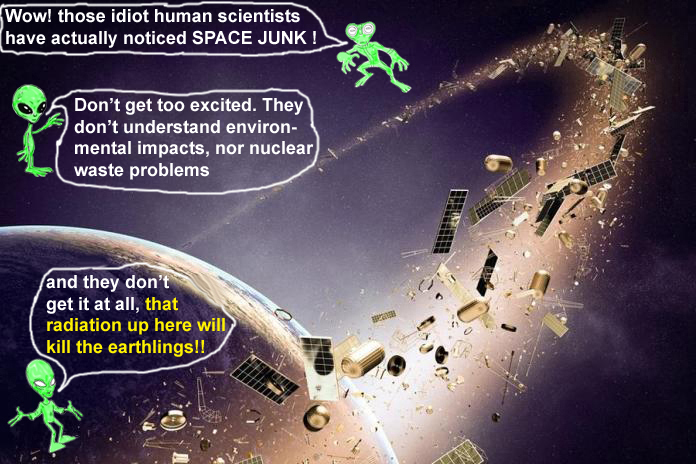
Now today,” Gagnon said, “NASA, the military, and some in the aerospace industry, are worriedly tracking the growing amount of space debris orbiting the Earth. They are beginning to talk about the ‘Kessler syndrome’ that predicts cascading collisions due to increasingly crowded orbits which could at some point make getting a rocket through the debris field encircling our planet nearly impossible.”
“So as the nuclear industry cavalierly undertakes their plan for nuclear-powered mining colonies on the Moon, Mars and other planetary bodies they easily brush off any concerns about impacts,” said Gagnon. “As they make plans to test nuclear reactor rocket engines just over our heads in Lower Earth Orbits (LEO) they discount any concerns of environmental impacts if the tests go wrong. They never talk about the Department of Energy laboratories where these nuclear devices are fabricated with a long history of radioactive contamination of workers, local water tables and air contamination.”
“The space nuclear industry is flying blind—blinded by its devotion to profit and power,” Gagnon declared. “Their hard hearts have no concern about the negative impacts they might create on Earth, to the people and environment, nor any long-term impacts their high-tech nuclear power ‘visions’ might have in space. Their vision is so myopic, so limited, so tunnel like, because their minds are closed to the idea that space is alive and is an environment that we humans who are on this tiny spinning orb called Earth live in. They are colonizers, much like the long-history of earth-bound colonizers, who have raped and pillaged our lovely planet home.”
The Global Network Against Weapons & Nuclear Power in Space (www.space4peace.org) founded 30 years ago, in 1992, at a conference in Washington, D.C. is the leading organization internationally challenging the weaponization and use of nuclear power in space. In its description of the August 4th webinar, the American Nuclear Society asserts: “For decades, nuclear energy has played a role, sometimes minor and sometimes major, in humanity’s exploration and research of outer space. Many space experts, scientists, astronauts, and researchers believe that nuclear energy can fundamentally change how we live and work in extraterrestrial environments and that some missions, projects, and endeavors are nearly impossible without the involvement of nuclear technologies. As federal funding is being applied to nuclear projects for various space-based applications and opportunities, an expert panel will discuss how nuclear companies and researchers are poised to capitalize.”
A video recording of the webinar can also be viewed at https://www.ans.org/webinars/view-space2022/
Among the panelists was Michael Anness who, as biographies on the webinar website described, “leads the development new nuclear fuel products and services at Westinghouse Electric Company.” He has been a licensed nuclear reactor operator, it says. Anness spoke of space nuclear projects of Westinghouse Electric, based in Pittsburgh, Pennsylvania, including “microreactors” that would provide “fission surface power.” Anness said: “I’m kind of a fuel guy so I believe fuel is an enabling platform for space nuclear.”
Also on the panel was Kate Kelly, director for Space and Emerging programs at Lynchburg, Virginia-based BWXT Advanced Technologies and, previously, at BWX was “the Advanced Nuclear Systems Program Manager focused on the development of nuclear project to promote the company’s R&D interests in advanced manufacturing and nuclear thermal propulsion technologies.” She spoke about an “inflection point” on the use of nuclear power in
space having arrived. Said Kelly: “Over the last several years there’s been this re-emerging interest and investment by the government in fission systems for in-space power and propulsion.”
The sixth participant in the webinar was Alex Gilbert who has “expertise in space mining, nuclear innovation, energy markets and climate policy,” says his biography on the webinar website. “As Director of Space & Planetary Regulation at Zeno Power [based in Washington, D.C.], Alex oversees regulatory approvals for space launch, maritime, and terrestrial applications of radioisotope power systems…He was lead author of the U.S. Advanced Nuclear Energy Strategy, which outlined how government and industry can establish U.S. leadership in next generation nuclear reactor markets.”
Gilbert said “we are at a unique moment. I call it a space opportunity.” “He said “we could actually see exponential growth. Right now the space economy is around $400 billion globally. By the middle of the century it could be $4 trillion.” This expansion is a result of factors including a “resurgence in science and exploration and defense activities…and commerce. That is what is driving the interest in space nuclear technologies.” The American Nuclear Society describes itself as comprised of 10,000 members dedicated to “exploring possibilities within the realm of nuclear science and technology.”
King recounted that “I’ve been in and around the space nuclear community for quite a while, ever since 1997, for about 25 years. I remember it was space nuclear that got me into nuclear,” and being told by a nuclear engineer advisor that “space nuclear is going to be the future.”
As Threat of Militarisation Rises, International Community Races to Set Standards for Responsible Behaviour in Outer Space
Cornelis van Haperen | U. Nottingham School of Law, GB, AUGUST 11, 2022
The past decades have seen a growing interest in, and utilisation of, outer space. Ease of access to space has increased alongside the rise of more affordable and small-scale technologies, and as a consequence space has become a congested and competitive environment. This has resulted in an increase in the number of nations with space ambitions, while the proliferation of commercial space platforms and space exploration has also grown, even leading to Elon Musk’s capabilities to support Ukraine in its defense against Russia’s invasion, and the new phenomenon of space tourism.
No longer is the space domain reserved for the original space-faring nations — the United States, Russia and the emerging global power China. It is also causing the increased militarisation of space (‘arms race’) with a number nations having formed new military commands and armed forces (e.g. Space Command and Space Force: USA, UK, France) and NATO having declared space a war-fighting domain in 2019.
The proliferation of space objects and debris is resulting in a growing risk of collision and damage, while the activities of certain nations (Russia, China) [ed note – h ha – why not include USA?]pose increased threats and risks of conflict. Western Allies have realized that they rely more and more on space for all military activities, including collective defence, crisis response, disaster relief, and counterterrorism, and depend on information delivered from and through space. Militarily tensions seem to have been on the rise too. There are real concerns among the international rule-based nations about the challenging behaviours of Russia and China [ ha ha why not include USA?] wreaking real havoc in space which even resulted in serious endangerment of the lives of American and Russian astronauts at the International Space Station.
This article will shed some legal light on the recent announcement by US Vice-President Kamala Harris that the US would refrain from conducting destructive direct-ascent anti-satellite missile testing (i.e. destroying satellites in space). Whilst this seems to firmly place destructive actions at the centre of recent debates, the growing conduct of non-lethal operations such as jamming and spoofing should not be discarded. This article will therefore concentrate more widely on the international legal framework and military use of space. The main issue that will be addressed is whether the increased militarisation of space requires better norms and rules to ensure the responsible and peaceful use of outer space. There will be a brief reflection on the United Nations organisations that are leading efforts to bring nations together in the development of such norms and rules and where the international community is going next.
Military Use of Space – the Relevant Law?
It seems inherently contradictory to talk about military and weapons in the same breath as outer space. In December 1963, the UN General Assembly unanimously adopted a resolution recognising the common interest of all mankind in the progress, exploration, and use of outer space for peaceful purposes. These words resembled similar aspirations as defined in the Antarctic Treaty a few years earlier. The main difference was that this Treaty also spelled out the prohibition of military activities whereas resolution 1962 did not. It has therefore been unavoidable that two interpretations of the term peaceful have emerged: one arguing a complete ban of all weapons in space, while the prevailing view does not represent such a prohibition.
Let’s place the increased militarisation of space in the appropriate context by defining the international legal framework for outer space and reflect on the legal underpinning of military activities within outer space. The Treaty on Principles Governing the Activities of States in the Exploration and Use of Outer Space, including the Moon and Other Celestial Bodies, 1967, better known as the Outer Space Treaty (OST), and four other key treaties, commonly referred to as the outer space legal regime, together provide a legal foundation for ‘the expanding and increasingly complex tasks aimed at the exploration and use of outer space for peaceful purposes.’
In addition, the UN General Assembly has defined several principles as well as adopted various resolutions. Article I of the OST states that exploration and use of outer space, including the moon and other celestial bodies, is to be for the benefit of all mankind. Importantly, Article II clarifies that they shall not be subject to national appropriation and thus there can be no claims of sovereignty. The OST further states that the use of outer space, including the moon and other celestial bodies, shall be undertaken consistent with international law. This includes the UN Charter and is to conform with the UN’s purposes to maintain peace and security and the promotion of international co-operation. ………………………………………..
Preventing Bad Behaviour: Mitigating Risks of Damage and Threats of Escalation
It is often reported that debris in space is growing exponentially. The logical consequence of the increase in space activities is a growing risk of collisions with space objects, i.e. other satellites, and the creation and proliferation of new debris due to ever more launches. However, whilst some of this risk could arguably be mitigated through more cautious behaviour, there has also been a noticeable growth of capabilities to interfere with systems in outer space or even destroy them, and we have seen an upturn in deliberate malicious acts by actors seeking to affect the space activities of other nations. The most destructive forms are those of kinetic or physical counter-space weapons that directly hit satellites. ……………………………………………………
United Nations and National Leadership
The framework for state action in outer space is now far behind the technological possibilities, developments, and commercialisation of space. Nevertheless, the Proposed Prevention of an Arms Race in Space (PAROS) has been on the United Nations’ disarmament agenda for over four decades. Numerous nations have expressed their concerns about the harmful and damaging effects of this competition for space. While the discussions in the international community have intensified over the past decades these have not yet resulted in binding treaties or measures……………………………………………….. more https://www.jurist.org/features/2022/08/11/explainer-as-threat-of-militarisation-rises-international-community-races-to-set-standards-for-responsible-behaviour-in-outer-space/
MARS ASTRONAUTS WOULD GET HORRIFYING DOSE OF RADIATION, STUDY FINDS

SO… WHAT WAS THAT ABOUT COLONIZING MARS?
MAGGIE HARRISON https://futurism.com/the-byte/mars-astronauts-radiation-study 15 Aug 22
Sorry, Elon
So, uh, there might be a serious wrench in Elon Musk’s plans to colonize Mars.
According to an alarming — though yet-to-be-peer-reviewed — new study, astronauts who underwent a crewed mission to the Red Planet would likely face devastating levels of radiation — even when wearing protective metal shields.
Bad Trip
In order to realistically examine how much cumulative radiation the astronauts would face, the scientists based their research on a 1,000-day crewed mission — 600 days of travel time, 400 days on the Martian surface — to our neighboring planet.
As New Scientist reports, the work was partially inspired by the gender gap in space radiation research. Most studies in the field have focused on male bodies — NASA, in fact, is only sending test dummies with female anatomies into space for the first time this year.
With that in mind, the scientists were sure to include comprehensive virtual models of both male and female anatomies in their study. These models were then mercilessly pelted with simulated cosmic radiation, including that caused by solar flares, and studied using particle-tracking software usually used in particle accelerator research. (It’s also worth noting that the model accounted for exposures with aluminum shielding and without.)
Radiation Station
And regarding whether such missions would be safe or not, the results were unfortunately in favor of “not.”
After surveying the impact of the 1,000-day simulated mission on over 40 of the digitally-modeled body parts and organs, the researchers determined that most of the individual organs examined contained radiation levels over one sievert — as New Scientist reports, most space agencies worldwide stipulate that no astronaut should be exposed to over one sievert of radiation throughout their entire career, while NASA maintains that 0.6 sieverts should be the max.
As the study has yet to be peer reviewed, none of this data is entirely certain. But if it ultimately checks out, humanity definitely has some protective measures to figure out before any astronauts — let alone a whole chunk of humanity — could safely make their way to Earth’s dusty red neighbor.
READ MORE:Mars astronauts would get unsafe radiation doses even with shielding [New Scientist]
Elon Musk’s SpaceX now leaving junk in Australia’s backyard
Independent Australia, By Darren Crawford | 10 August 2022 After a SpaceX capsule crashed onto an Australian farm, we’re left wondering if Elon Musk will clean up his own mess, writes Darren Crawford.
ACCORDING TO the ABC, the Australian Space Agency (ASA) has confirmed that debris found in a sheep paddock in the Snowy Mountains region of New South Wales, Australia, belongs to Elon Musk’s SpaceX Dragon capsule, which was launched in November 2020.
Local authorities were alerted after nearby residents heard a loud bang earlier this year on 9 July. It is now thought the bang was the noise of the capsule re-entering the Earth’s atmosphere. New South Wales Police and the ASA visited one of the sites on Saturday 31 July and confirmed that two of the pieces are from a SpaceX mission.
According to the ABC, the ASA is continuing to engage with its counterparts in the U.S. as well as other parts of the Commonwealth and local authorities.
An ASA spokesperson said:
“The agency is operating under the Australian Government Space Re-entry Debris Plan which outlines roles and responsibilities for key Australian government agencies and committees in supporting the response to space re-entry debris.”
So who is responsible for the clean-up?
According to the ABC report, the space debris will remain in place for now. However, the pieces could eventually be returned to U.S. soil.
Australian National University’s Institute of Space deputy director Dr Cassandra Steer said there was an obligation under international space law to repatriate any debris to the country from where it originated.
Dr Steer went on to confirm that “Any space object, or part thereof, has to be repatriated” and should be sent back to the U.S. However, SpaceX has only confirmed that the debris is theirs and is yet to commit to the costs associated with returning it to the U.S.
Dr Steer added:
“We have clarity in terms of lines of responsibilities. The U.S. is liable for any damage that is caused by this space debris… and Australia could go to the U.S. and seek some form of compensation if there are any costs involved in cleaning it up.”
Elon Musk and SpaceX have a poor environmental record
As reported earlier this year, Elon Musk and fellow billionaires Richard Branson and Jeff Bezos are currently participating in a dick-swinging rocket contest to see who can get to Mars first. Suffering from massive rocket envy, these three men are speeding up the climate change process by increasing the amount of carbon dioxide and other gases in the Earth’s atmosphere with every launch.
The Guardian reports that one rocket launch alone can release up to 300 tons of carbon dioxide into the Earth’s upper atmosphere and it can stay there for years. This is in comparison to a standard long-haul flight which produces three tons of carbon dioxide per passenger/per flight, into the lower atmosphere.
These impacts do not include what happens on the ground during a launch, including the heat and noise pollution in the immediate area, or the impacts on local wildlife.
There appear to be few controls put in place to protect the planet and its inhabitants from falling space junk by Elon Musk and SpaceX. In March 2021, a SpaceX rocket blew up on launch and debris was scattered throughout the protected area. According to a local non-profit environmental group, it took three months to clean up the mess.
According to the report, launch site ditches on SpaceX land and public property in the U.S. have dumped runoff water directly into the tidal flats threatening local fish breeding grounds, and public beaches and roads have been closed for longer than the agreed times.
Finally, at an earlier launch in 2018, a jettisoned SpaceX booster rocket missed its target drone ship a few hundred kilometres out to sea and destroyed itself on impact slamming into the ocean at 500 km/hour.
So, will Elon Musk and SpaceX clean up their mess down under?
This is the great unknown, as Elon Musk’s environmental record in relation to his SpaceX program is extremely poor.
It is also clear, as can be seen by his recently abandoned Twitter purchase, that Elon Musk doesn’t care who he burns, or how hard he burns them, to get his own way.
It is apparent that Elon Musk sees the increasing amount of pollution produced by his SpaceX endeavours as little more than collateral damage and less of a threat to our civilisation. Similarly, he doesn’t care whose backyard he trashes (as long as it’s not his, obviously).
Instead of turning his immense intelligence (and wealth) to solving our current problems, Elon Musk (and his billionaire space mates) seek to exacerbate these problems by polluting the planet further.
It will be interesting to see whether he does the right thing by the Australian Government and its people and pays for the clean-up of his mess.
Update, 10 August 2022:
The ABC is reporting that SpaceX has confirmed that the space debris spread throughout an Australian sheep paddock is indeed remnants of their Dragon Capsule and is sending a team down under to investigate………………………….
What was not stated was whether any ASA or government agencies were aware of or engaged in any of SpaceX’s planning. Space Law Lecturer at UNSW Canberra, Duncan Blake, wondered if they had coordinated with Australian agencies prior to their risk assessment — “If they didn’t, then that seems somewhat arrogant to make a decision that affects Australia without consulting Australians,” he said.
There has been no mention of the cost of removal or the debris, or as to whether Elon Musk and SpaceX will be more honest and open in the future and advise all Australians about the potential damage falling SpaceX junk may cause in their country.
https://independentaustralia.net/environment/environment-display/elon-musks-spacex-now-leaving-junk-in-our-own-backyard,16650
New leader of Canada’s New Brunswick Liberals breaks ranks with the party’s previous support for Small Nuclear Reactors
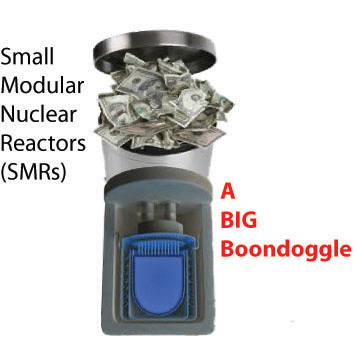
New Liberal leader questions small nuclear reactors. Susan Holt says it’s not clear the technology is a responsible energy solution
Jacques Poitras · CBC News · Aug 10, 2022
The new leader of the New Brunswick Liberals is questioning whether small modular nuclear reactors are the answer to the province’s energy needs, a more cautious stance than her party’s previous full-throated support for the technology.
Susan Holt said after winning the leadership Saturday that while the potential jobs created by SMRs would be good for the province, she was looking for more evidence they were the right bet for clean energy.
“It’s an interesting project on the economic development level … but I’m not sure it’s the solution for electricity generation for our province,” Holt told reporters.
“I think it’s not clear yet if it will really give us energy in a way that’s responsible and efficient with our investments, so there’s still more to determine there.”
Two companies based in Saint John, ARC Clean Energy and Moltex Energy, have received tens of millions of dollars in taxpayer funding to develop reactors………..
Last year the province handed ARC $20 million, while Moltex received more than $50 million from the federal government.
The previous provincial Liberal government gave each of them $5 million.
Holt held the title of chief of business relationships at the Jobs Board secretariat under then-Liberal Premier Brian Gallant at the time ARC and Moltex got that initial funding.
Both the Liberals and the Progressive Conservatives have been enthusiastic supporters of SMRs until now, ………………..
at legislative committee hearings in January, former N.B. Power CEO Gaëtan Thomas and officials from Saint John Energy warned that SMRs may not be ready in time to replace electricity from the Belledune generating station, which must stop using coal by 2030.
Louise Comeau, the director of climate change and energy solutions for the Conservation Council of New Brunswick, welcomed Holt’s comments.
“It sounds to me like the new leader is open to more information and analysis, which is what we desperately needed on the question of small modular nuclear reactors,” she said.
“We’ve been more in a phase of hype and boosterism. … I think what she’s said is we need to have more information, we need to look at all options, and we would really agree with that. Wind and solar and efficiency and other options all have to be part of the portfolio.”
Susan O’Donnell, a member of the Coalition for Responsible Energy Development in New Brunswick, said she was happy Holt was “reading the independent research about SMRs instead of the nuclear industry sales and promotional materials.”…………………..
In January, the Pembina Institute, a clean energy think tank, released a report that said small nuclear reactors would be more expensive and generate less electricity than a combination of renewable energy and energy efficiency measures. https://www.cbc.ca/news/canada/new-brunswick/susan-holt-questions-small-nuclear-reactors-1.6545007
CND (Campaign for Nuclear Disarmament) oppose plans for a nuclear fusion plant in North Ayshire, on environmental and other grounds
Anti-nuclear campaigners have accused organisations supporting plans for a
nuclear fusion plant in North Ayrshire of having promoted the project with
“half truths” and warned it would be “dangerous” for the
environment.
A consortium, which includes Glasgow University and North
Ayrshire Council, is backing a prototype fusion energy plant at Ardeer,
capable of providing what they claim would be an environmentally-friendly
source of electricity. The plant would create an estimated 3,500 jobs
during construction and 1,000 jobs when the site begins operating,
according to the project’s backers.
However, Ayrshire CND argued that
fusion is a nuclear technology with radioactive risks since it requires
tritium – a radioactive isotope of hydrogen – during the process. The group
also claimed the plant would “create a considerable carbon footprint”.
Environmental groups are calling for the Ardeer peninsula to be given
special status to protect its diverse wildlife. Ayrshire CND has accused
North Ayrshire Council of committing to supporting the £222m project
without having a full council discussion. The campaign group’s Richard Leat
also questioned what the public has been told. “We are told that this is
not really a nuclear plant,” he claimed. “We are being sold this plant
with half truths.” Leat pointed to a poll by the Ardrossan Herald which
found the majority of 502 responses – 69 per cent – were against the plant.
“Furthermore, outwith the general risks from nuclear energy, the site
would require monitoring and tight security for many, many decades, which
will restrict public access to the peninsula and beach,” Leat continued.
The Ferret 7th Aug 2022 https://theferret.scot/public-half-truths-nuclear-fusion-anti-nuclear/
Why investors should be wary of small nuclear reactors

NuScale has some big challenges.
NuScale announced that completion of the project would be delayed by three years to 2030 and estimated the cost had climbed from $4.2 billion to $6.1 billion. This is a familiar old song in the nuclear energy sector: Big schedule delays and big cost-overruns.
M. V. Ramana, a physicist at the University of British Columbia who works on public policy was not surprised that so many utilities backed-out of the project. “They (utility companies) ought to be seeing the writing on the wall and getting out by the dozens.”
at least one study says that small nuclear power plants will generate more waste than conventional reactors.
NuScale: Finally Time For Small Module Nuclear Reactors?
Summary
- Small module nuclear reactors have been discussed and researched for decades – going back to at least my college engineering days in the 1970s.
- Yet for a variety of reasons, small module reactors (“SMR”) have never become a reality.
- NuScale Power wants to change that and at the present time, the company appears to be the planet’s best chance to do so.
- Today I’ll discuss my sense of NuScale’s chances of success and whether or not the stock is a good fit for an investor’s “speculative growth” bucket.
…………………………………………. My sense is that many of NuScale’s potential utility customers are waiting for – what I consider to be the “proof-of-concept” plant – to be built in Idaho.
Valuation
After a big jump in the stock price in July, NuScale currently has a $3.3 billion market cap (and a 13.7% short position):
……………… In June, NuScale gave a financial update re-affirming guidance for (only) $16 million in FY22 revenue. For the three-month period ending March 31, 2022, the company reported:
- Total available capital was $383.7 million.
- Revenue of $2.4 million and a net loss of $(23.4) million compared to revenue of $0.7 million and a net loss of $(22.7) million for the same period in 2021.
- Research and development expenses of $24.4 million compared to $18.8 million for the same period in 2021.
Clearly the company is burning cash. However, even if the cash burn grew to, say, $30 million per quarter, the available capital would last more than three years.
Risks
However, NuScale has some big challenges. Back in 2020, several utility companies within the UAMPS group backed-out of the deal to build the first NuScale SMR power plant. Even with the infusion of U.S. federal dollars, NuScale announced that completion of the project would be delayed by three years to 2030 and estimated the cost had climbed from $4.2 billion to $6.1 billion. This is a familiar old song in the nuclear energy sector: Big schedule delays and big cost-overruns. It was a big-blow: After all, the whole idea behind a small scale modular nuclear plant was to reduce the risk of both schedule and expense.
According to the previously reference source, critics of the project said it will be “untenably expensive.” M. V. Ramana, a physicist at the University of British Columbia who works on public policy was not surprised that so many utilities backed-out of the project. “They (utility companies) ought to be seeing the writing on the wall and getting out by the dozens.”
The Department of Energy (“DOE”) previously agreed to $1.4 billion in funding for the project. However, as I reported above, the cost estimate for the project now is $6.1 billion. That’s a big gap in funding. Further, at that price, investors need to question whether or not renewable solar and wind capacity would be better back-stopped by battery backup, and more wind and solar capacity additions, as opposed to an SMR.
Meantime, I personally would be much more supportive of the effort if NuScale had a partnership of some sort, or at least a well publicized plan, to re-process or store spent radioactive fuel. That’s especially the case given that at least one study says that small nuclear power plants will generate more waste than conventional reactors. The report said SMRs would create up to 30x more radioactive waste per unit of electricity generated as compared to conventional reactors. According to Reuters, Lindsay Krall – the study’s lead author – said:
Even if (the U.S.) had a robust waste management program, we think there would be a lot of challenges to deal with some of the SMR waste.
The study said NuScale’s reactor would produce ~1.7x more waste per energy equivalent than traditional reactors. NuScale countered that the study used “outdated design information and incorrect assumptions about the plants.”
Summary and Conclusions
In theory, small module nuclear reactors sound like a great idea. And they have been sounding like a great idea for decades. Yet despite all the technology available to man, and the pressing threat of global warming, no small module nuclear reactor has yet to be built in the United States. And that should tell the investor something. https://seekingalpha.com/article/4530416-nuscale-time-for-small-module-nuclear-reacto
US regulators approve small nuclear reactors – BUT – costs, delays, too late for climate help
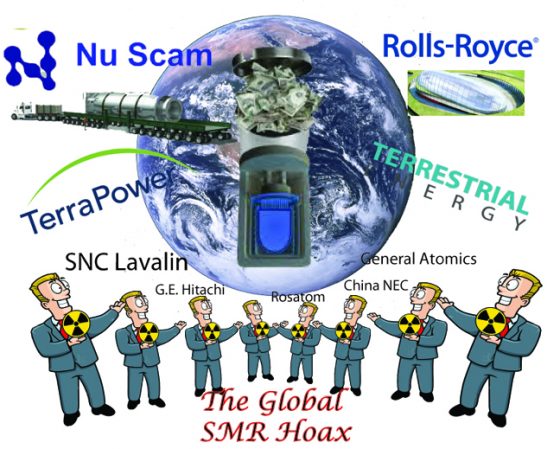
The First Small Modular Nuclear Reactor Was Just Approved by US Regulators, Singularity Hub, By Edd Gent-August 5, 2022
…………………………………… questions have been raised about whether SMRs will really live up to their billing as a cheaper, safer alternative to traditional nuclear power plants. A study published in Proceedings of the National Academy of Sciences in May found that contrary to the claims of SMR makers, these smaller reactors are actually likely to produce more radioactive waste than conventional plants.
In an article in Counterpunch, nuclear power expert M.V. Ramana also points out that the cost of renewable energy like wind and solar is already lower than that of nuclear, and continuing to fall rapidly. In contrast, nuclear power has actually become more expensive over the years.
SMRs could cost more than bigger nuclear plants, he adds, because they don’t have the same economy of scale. In theory this could be offset through mass manufacture, but only if companies receive orders in the hundreds. Tellingly, some utilities have already backed out of NuScale’s first project over cost concerns.
Perhaps even more importantly, notes Ramana, SMRs are unlikely to be ready in time to contribute to the climate fight. Projects aren’t expected to come online until the end of the decade, by which time the IPCC says we already need to have made drastic emissions reductions.
The technology has some powerful boosters though, not least President Joe Biden, who recently touted NuScale’s “groundbreaking American technology” while announcing a grant for an SMR plant the company will build in Romania. Engineering giant Rolls-Royce also recently announced a shortlist for the location of its future SMR factory, which will be used to build 16 SMRs for the UK government by 2050.
Whether SMRs can deliver on their promise remains to be seen, but given the scope of the climate challenge facing us, exploring all available options seems wise. https://singularityhub.com/2022/08/05/the-first-small-modular-nuclear-reactor-design-was-just-approved-by-us-regulators/
Small nuclear reactors produce more radioactive trash than large ones do- American Academy of Sciences

Despite being hailed as the future of electricity generation in the UK,
small nuclear reactors may actually produce more waste than their larger
counterparts, as our Gossage Gossip columnist explains.
A planned new generation of small nuclear reactors will create more waste than
conventional reactors, according to an authoritative new study.
The projects, called small modular reactors (SMR), are designed to be simpler
and safer than conventional plants in the case of an accident. They are
also expected to be built in factories and shipped to locations across the
world, as opposed to today’s massive reactors, which are built on-site
and typically run billions of pounds over budget. SMR backers maintain they
are a safe way to boost generation of virtually emissions-free electricity.
But the reactors would create far more radioactive waste per unit of
electricity they generate than conventional reactors by a factor of up to
30, according to a study published in the Proceedings of the American
National Academy of Sciences.
Some of these smaller reactors, with molten
salt and sodium-cooled designs, are expected to create waste that needs to
go through additional conditioning to make it safe to store in a
repository.
Allison Macfarlane, a co-author of the study and former head of
the US Nuclear Regulatory Commission, said SMR designers ‘don’t pay
that much attention in general to the waste, because the thing that makes
money for them is the reactor. But it is important to know about the waste
products, and whether they’re going to pose such difficulties in managing
and then disposing of them. Which they are.’
Electrical Review 2nd Aug 2022
Small nuclear reactors will bleed us dry and won’t solve climate change – unfounded promises

there is every reason to believe that if and when a NuScale SMR is built, its final cost too will vastly exceed current official estimates.
Unfounded promises — Beyond Nuclear International Small Modular Reactors epitomize culture that embraces exaggeration
By M.V. Ramana
In 2006, Elizabeth Holmes, founder of a Silicon Valley startup company called Theranos, was featured in Inc magazine’s annual list of 30 under 30 entrepreneurs. Her entrepreneurship involved blood, or more precisely, testing blood. Instead of the usual vials of blood, Holmes claimed to be able to obtain precise results about the health of patients using a very small sample of blood drawn from just a pinprick.
The promise was enticing and Holmes had a great run for a decade. She was supported by a bevy of celebrities and powerful individuals, including former U.S. secretaries of state Henry Kissinger and George Shultz, James Mattis, who later served as U.S. secretary of defense, and media mogul Rupert Murdoch. Not that any of them would be expected to know much about medical science or blood testing. But all that public endorsement helped. As did savvy marketing by Holmes. Theranos raised over $700 million from investors, and receive a market valuation of nearly $9 billion by 2014.
The downfall started the following year, when the Wall Street Journal exposed that Theranos was actually using standard blood tests behind the scenes because its technology did not really work. In January 2022, Holmes was found guilty of defrauding investors.
The second part of the Theranos story is an exception. In a culture which praises a strategy of routine exaggeration, encapsulated by the slogan “fake it till you make it”, it is rare for a tech CEO being found guilty of making false promises. But the first part of Theranos story—hype, advertisement, and belief in impossible promises—is very much the norm, and not just in the case of companies involved in the health care industry.
Small Modular Nuclear Reactors
Nuclear power offers a great example. In 2003, an important study produced by nuclear advocates at the Massachusetts Institute of Technology identified costs, safety, proliferation and waste as the four “unresolved problems” with nuclear power. Not surprisingly, then, companies trying to sell new reactor designs claim that their product will be cheaper, will produce less—or no—radioactive waste, be immune to accidents, and not contribute to nuclear proliferation. These tantalizing promises are the equivalent of testing blood with a pin prick.
And, as was the case with Theranos, many such companies have been backed up by wealthy investors and influential spokespeople, who have typically had as much to do with nuclear power as Kissinger had to with testing blood. Examples include Peter Thiel, the Silicon Valley investor; Stephen Harper, the former Prime Minister of Canada; and Richard Branson, the founder of the Virgin group. But just as the Theranos product did not do what Elizabeth Holmes and her backers were claiming, new nuclear reactor designs will not solve the multiple challenges faced by nuclear power.
One class of nuclear reactors that have been extensively promoted in this vein during the last decade are Small Modular Reactors (SMRs). The promotion has been productive for these companies, especially in Canada. Some of these companies have received large amounts of funding from the national and provincial governments. This includes Terrestrial Energy that received CAD 20 million and Moltex that received CAD 50.5 million, both from the Federal Government. The province of New Brunswick added to these by awarding CAD 5 million to Moltex and CAD 25 million in all to ARC-100.
All these companies have made various claims about the above mentioned problems. Moltex, for example, claims that its reactor design “reduces waste”, a claim also made by ARC-100. ARC-100 also claims to be inherently safe, while Terrestrial claims to be cost-competive. Both Terrestrial and ARC-100 claim to do well on proliferation resistance. In general, no design will admit to failing on any of these challenges.
Dealing with any of these challenges—safety enhancement, proliferation resistance, decreased generation of waste, and cost reduction—will have to be reflected in the technical design of the nuclear reactor. The problem is that each of these goals will drive the requirements on the reactor design in different, sometimes opposing, directions.
Economics
The hardest challenge is economics. Nuclear energy is an expensive way to generate electricity. In the 2021 edition of its annual cost report, Lazard, the Wall Street firm, estimated that the levelized cost of electricity from new nuclear plants will be between $131 and $204 per megawatt hour; in contrast, newly constructed utility-scale solar and wind plants produce electricity at somewhere between $26 and $50 per megawatt hour according to Lazard. The gap between nuclear power and renewables is large, and is growing larger. While nuclear costs have increased with time, the levelized cost of electricity for solar and wind have declined rapidly, and this is expected to continue over the coming decades.
Even operating costs for nuclear power plants are high and many reactors have been shut down because they are unprofitable. In 2018, NextEra, a large electric utility company in the United States, decided to shut down the Duane Arnold nuclear reactor, because it estimated that replacing nuclear with wind power will “save customers nearly $300 million in energy costs, on a net present value basis.”
The high cost of constructing and operating nuclear plants is a key driver of the decline of nuclear power around the world. In 1996, nuclear energy’s share of global commercial gross electricity generation peaked at 17.5 percent. By 2020, that had fallen to 10.1 percent, a 40 percent decline.
The high costs described above are for large nuclear power plants. SMRs, as the name suggests, produce relatively small amounts of electricity in comparison. Economically, this is a disadvantage. When the power output of the reactor decreases, it generates less revenue for the owning utility, but the cost of constructing the reactor is not proportionately smaller. SMRs will, therefore, cost more than large reactors for each unit (megawatt) of generation capacity. This makes electricity from small reactors more expensive. This is why most of the early small reactors built in the United States shut down early: they just couldn’t compete economically.
SMR proponents argue that the lost economies of scale will be compensated by savings through mass manufacture in factories and as these plants are built in large numbers costs will go down. But this claim is not very tenable. Historically, in the United States and France, the countries with the highest number of nuclear plants, costs went up, not down, with experience. Further, to achieve such savings, these reactors have to be manufactured by the hundreds, if not the thousands, even under very optimistic assumptions about rates of learning. Finally, even if SMRs were to become comparable in cost per unit capacity of large nuclear reactors, that would not be sufficient to make them economically competitive, because their electricity production cost would still be far higher than solar and wind energy.
…………………………………………. Cost escalations are already apparent in the case of the NuScale SMR, arguably the design that is most developed in the West. The estimated cost of the Utah Association of Municipal Power Systems project went from approximately $3 billion in 2014 to $6.1 billion in 2020—this is to build twelve units of the NuScale SMR that were to generate 600 megawatts of power. The cost was so high that NuScale had to change its offering to a smaller number of units that produce only 462 megawatts, but at a cost of $5.32 billion. In other words, the cost per kilowatt of generation capacity is around $11,500 (US dollars). That figure is around 80 percent more than the per kilowatt cost of the infamous Vogtle project at the time its construction started. Since that initial estimate of $14 billion for the two AP1000 reactors, the estimated cost of the much delayed project has escalated beyond $30 billion. As with the AP1000 reactors, there is every reason to believe that if and when a NuScale SMR is built, its final cost too will vastly exceed current official estimates. ……………
Timelines
The other promise made by SMR developers is how fast they can be deployed. GE-Hitachi, for example, claims that an SMR could be “complete as early as 2028” at the Darlington site. ARC-100 described an operational date of 2029 as an “aggressive but achievable target”.
Again, the historical record suggests otherwise. Consider NuScale. In 2008, the company projected that “a NuScale plant could be producing electricity by 2015-16”. As of 2022, the company projects 2029-30 as the date for start of generation. Russia’s KLT-40S, a reactor deployed on a barge, offers another example. When construction started in 2007, the reactor was projected to start operations in October 2010. It was actually commissioned a whole decade later, in May 2020.
The SMR designs being considered in Canada are even further off. In December 2021, Ontario Power Generation chose the BWRX-300 for the Darlington site. That design is based on GE-Hitachi’s Economical Simplified Boiling Water Reactor (ESBWR) design, which was submitted for licensing to the U.S. Nuclear Regulatory Commission in 2005. That ESBWR design was changed nine times; the NRC finally approved revision 10 from 2014. If the Canadian Nuclear Safety Commission does its due diligence, it might be 2030 or later before the BWRX-300 is even licensed for construction. That assumes that the BWRX-300 design remains unchanged. And, then, of course, there will be the inevitable delays (and cost escalations) during construction. ………….
Waste, Proliferation and Safety
Small reactors also cause all of the usual problems: the risk of severe accidents, the production of radioactive waste, and the potential for nuclear weapons proliferation. …………
…………… small modular reactor proposals often envision building multiple reactors at a site. The aim is to lower costs by taking advantage of common infrastructure elements. The configuration offered by NuScale, for example, has twelve reactor modules at each site, although it also offers four- and six-unit versions. With multiple reactors, the combined radioactive inventories might be comparable to that of a large reactor. Multiple reactors at a site increase the risk that an accident at one unit might either induce accidents at other reactors or make it harder to take preventive actions at others. This is especially the case if the underlying reason for the accident is a common one that affects all of the reactors, such as an earthquake. In the case of the accidents at Japan’s Fukushima Daiichi plant, explosions at one reactor damaged the spent fuel pool in a co-located reactor. Radiation leaks from one unit made it difficult for emergency workers to approach the other units. ……………………………
Claims by SMR proponents about not producing waste are not credible, especially if waste is understood not as one kind of material but a number of different streams. A recent paper in the Proceedings of the National Academy of Sciences examined three specific SMR designs and calculates that “relative to a gigawatt-scale PWR” these three will produce up to 5.5 times more spent fuel, 30 times more long-lived low and intermediate level waste, and 35 times more short-lived low and intermediate level waste. In other words, in comparison with large light water reactors, SMRs produce more, not less, waste per unit of electricity generated. As Paul Dorfman from the University of Sussex commented, “compared with existing conventional reactors, SMRs would increase the volume and complexity of the nuclear waste problem”.
Further, some of the SMR designs involve the use of materials that are corrosive and/or pyrophoric. Dealing with these forms is more complicated. For example, the ARC-100 design will use sodium that cannot be disposed of in geological repositories without extensive processing. Such processing has never been carried out at scale. The difference in chemical properties mean that the methods developed for dealing with waste from CANDU reactors will not work as such for these wastes.
Many SMR designs also make the problem of proliferation worse. Unlike the CANDU reactor design that uses natural uranium, many SMR designs use fuel forms that require either enriched uranium or plutonium. Either plutonium or uranium that is highly enriched in the uranium-235 isotope can be used to make nuclear weapons. Because uranium enrichment facilities can be reconfigured to alter enrichment levels, it is possible for a uranium enrichment facility designed to produce fuel for a reactor to be reconfigured to produce fuel for a bomb. All else being equal, nuclear reactor designs that require fuel with higher levels of uranium enrichment pose a greater proliferation risk—this is the reason for the international effort to convert highly enriched uranium fueled research reactors to low enriched uranium fuel or shutting them down.
Plutonium is created in all nuclear power plants that use uranium fuel, but it is produced alongside intensely radioactive fission products. Practically any mixture of plutonium isotopes could be used for making weapons. Using the plutonium either to fabricate nuclear fuel or to make nuclear weapons, require the “reprocessing” of the spent fuel. Canada has not reprocessed its power reactor spent fuel, but some SMR designs, such as the Moltex design, propose to “recycle” CANDU spent fuel. Last year, nine US nonproliferation experts wrote to Prime Minister Justin Trudeau expressing serious concerns “about the technology Moltex proposes to use.”
The proliferation problem is made worse by SMRs in many ways. ……………………..
Conclusion
The saga of Theranos should remind us to be skeptical of unfounded promises. Such promises are the fuel that drive the current interest in small modular nuclear reactors………
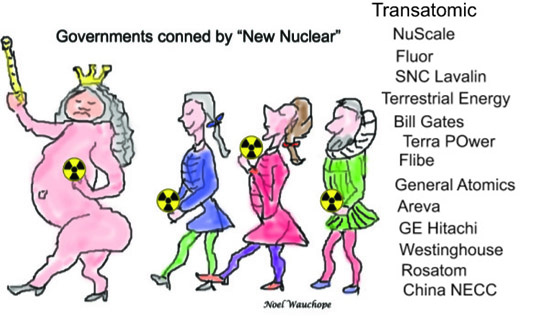
Rather than seeing the writing on the wall, unfortunately, government agencies are wasting money on funding small modular reactor proposals. Worse, they seek to justify such funding by repeating the tall claims made by promoters of these technologies…… https://beyondnuclearinternational.org/2022/07/31/unfounded-promises00
MidAmerican shouldn’t waste money studying small nuclear reactors
Small modular reactors and nuclear power represent a dangerous distraction from the changes needed to deal with global warming. https://www.desmoinesregister.com/story/opinion/columnists/iowa-view/2022/07/24/midamerican-energy-small-nuclear-reactors-uneconomical/10104142002/ Dr. Maureen McCue and Dr. M.V. Ramana, Yet again, MidAmerican Energy has expressed an interest in studying nuclear reactors for Iowa. Earlier, between 2010 and 2013, MidAmerican studied the feasibility of nuclear power for Iowa and concluded that it didn’t make sense. This time around, MidAmerican does not even have to embark on the study. We know already that the newest offerings from the nuclear industry, Small Modular Reactors, or SMRs, carry the same economic and environmental risks as their larger predecessors and make no sense for Iowa, or anywhere else for that matter.
In 2013, the Wall Street firm Lazard estimated that the cost of generating electricity at a new nuclear plant in the United States will be between $86 and $122 per megawatt-hour. Last November, Lazard estimated that the corresponding cost will be between $131 and $204 per megawatt-hour. During the same eight years, renewables have plummeted in cost, and the 2021 estimates of electricity from newly constructed utility-scale solar and wind plants range between $26 and $50 per megawatt-hour. Nuclear power is simply not economically competitive.
SMRs will be even less competitive. Building and operating SMRs will cost more than large reactors for each unit (megawatt) of generation capacity. A reactor that generates five times as much power will not require five times as much concrete or five times as many workers. This makes electricity from small reactors more expensive; many small reactors built in the United States were financially uncompetitive and shut down early.
The estimated cost of constructing a plant with 600 megawatts of electricity from NuScale SMRs, arguably the design closest to deployment in the United States, increased from about $3 billion in 2014 to $6.1 billion in 2020. The cost was so high that at least ten members of Utah Associated Municipal Power Systems canceled their contracts. NuScale then changed its proposed plant configuration to fewer reactors that produce only 462 megawatts at a cost of $5.32 billion. For each kilowatt of electrical generation capacity, that estimate is around 80% more than the per-kilowatt cost of the Vogtle project in Georgia — before its cost exploded from $14 billion to over $30 billion. Based on the historical experience with nuclear reactor construction, SMRs are very likely to cost much more than initially expected.
And they will be delayed. In 2008, officials announced that “a NuScale plant could be producing electricity by 2015-16.” Currently, the Utah project is projected to start operating in 2029-30. All this before the inevitable setbacks that will occur once construction starts.
Time is critical to dealing with global warming. According to the Intergovernmental Panel on Climate Change, emissions have to be reduced drastically by 2030 to stop irreversible damage from climate change.
Small reactors also are associated with all of the usual problems with nuclear power: severe accidents, the production of radioactive waste, and the potential for nuclear weapons proliferation. Indeed, some of these problems could be worse. For each unit of electricity generated, SMRs will actually produce more nuclear waste than large reactors. Whether generated by a large or small plant, nuclear waste remains radioactive and dangerous for hundreds of thousands of years. There is no demonstrated solution to permanently isolate this lethal waste, for both technical and social reasons.

Most new nuclear reactor designs will rely on water sources for cooling. Nuclear plants have some of the highest water withdrawal requirements; in the United States, the median value for water withdrawal was calculated as 44,350 gallons per megawatt-hour of electricity generated, roughly four times the corresponding figure for a combined cycle natural gas plant. Renewables require little or no water because there is no heat production. Iowa’s lakes and rivers are already challenged by the warming climate, existing power plants, and polluting industries.
In medicine, a basic principle used to guide our decisions is “first, do no harm.” That principle will be violated if Iowa embarks on building SMRs. Small modular reactors and nuclear power represent a dangerous distraction from the changes needed to deal with global warming. Investing in these technologies will divert money away from more sustainable and rapidly constructed solutions, including wind and solar energy, microgrids, batteries and other forms of energy storage, and energy-efficient devices.
NASA, Russian space agency sign deal to share space station flights – Roscosmos
Yahoo News, Joey Roulette July 15, 2022 (Reuters) -NASA and Russia’s space agency Roscosmos have signed a long-sought agreement to integrate flights to the International Space Station, allowing Russian cosmonauts to fly on U.S.-made spacecraft in exchange for American astronauts being able to ride on Russia’s Soyuz, the agencies said Friday.
NASA and Russia’s space agency Roscosmos have signed a long-sought agreement to integrate flights to the International Space Station, allowing Russian cosmonauts to fly on U.S.-made spacecraft in exchange for American astronauts being able to ride on Russia’s Soyuz, the agencies said Friday.
“The agreement is in the interests of Russia and the United States and will promote the development of cooperation within the framework of the ISS program,” Roscosmos said in a statement, adding it will facilitate the “exploration of outer space for peaceful purposes.”
NASA and Roscosmos, the two-decade-old space station’s core partners, have sought for years to renew routine integrated crewed flights as part of the agencies’ long-standing civil alliance, now one of the last links of cooperation between the United States and Russia as tensions flare over the war in Ukraine.
The first integrated flights under the new agreement will come in September, NASA said, with U.S. astronaut Frank Rubio launching to the space station from the Moscow-leased Baikonur Cosmodrome in Kazakhstan alongside two cosmonauts, Sergey Prokopyev and Dmitry Petelin.
In exchange, cosmonaut Anna Kikina will join two U.S. astronauts and a Japanese astronaut on a SpaceX Crew Dragon flight to the orbital laboratory, launching from NASA’s Kennedy Space Center in Florida.
The two agencies had previously shared astronaut seats on the U.S. shuttle and the Russian Soyuz spacecraft.
After the shuttle’s retirement in 2011, the U.S. relied on Russia’s Soyuz for sending American astronauts to the space station until 2020, when SpaceX’s Crew Dragon capsule revived NASA’s human spaceflight capability and began routine ISS flights from Florida……………………….. more https://www.yahoo.com/news/nasa-russian-space-agency-sign-132725285.html
YES! Experimental nuclear reactors (SMRs) DO need an impact assessment: Speak Out!

https://www.cleanairalliance.org/yes-smrs-need-assessment/ 15 July 22 The nuclear industry plans to build experimental nuclear reactors (SMRs) in New Brunswick, aiming that one day they can be used in different towns and remote communities across Canada.
Pressure from the nuclear industry lobby changed our federal environmental assessment law in 2019, exempting many nuclear projects like SMRs from undergoing a full environmental impact assessment (IA)
The exemption not only erodes public involvement and oversight of the project but also means there will be no full reckoning of the alternatives to the energy project and its impacts to social, economic, Indigenous and environmental values.
The Coalition for Responsible Energy Development in New Brunswick (CRED-NB) is challenging the exemption for the “SMR Demonstration Project” planned for Point Lepreau on the Bay of Fundy.
CRED-NB is asking the federal government to order an impact assessment for this project which could have profound and lasting impacts on the Bay of Fundy and the coastal communities and marine life it supports.
For more information about why an impact assessment is required, please read the full request by CRED-NB to federal Environment Minister Steven Guilbeault,HERE
Please join us in this effort. Use our action tool to write Minister Guilbeault to support the CRED-NB request for a full impact assessment for the SMR Demonstration Project.
Your message will be sent to Minister Guilbeault, other relevant members of the federal Cabinet, your MP, leaders of the federal opposition parties, and provincial representatives in New Brunswick.
1 This Month



26 September – International Day for the Total Elimination of Nuclear Weapons


PLEASE OPPOSE HR 8255 AND S.3639 – bills would accelerate satellite deployment, with no environmental review or safeguards – https://ncstd5li.quorum.us/campaign/169331/
To see nuclear-related stories in greater depth and intensity – go to https://nuclearinformation.wordpress.com
-
Archives
- September 2026 (245)
- August 2026 (330)
- July 2026 (355)
- June 2026 (287)
- May 2026 (306)
- April 2026 (356)
- March 2026 (251)
- February 2026 (267)
- January 2026 (308)
- December 2025 (358)
- November 2025 (359)
- October 2025 (375)
-
Categories
- 1
- 1 NUCLEAR ISSUES
- business and costs
- climate change
- culture and arts
- ENERGY
- environment
- health
- history
- indigenous issues
- Legal
- marketing of nuclear
- media
- opposition to nuclear
- PERSONAL STORIES
- politics
- politics international
- Religion and ethics
- safety
- secrets,lies and civil liberties
- spinbuster
- technology
- Uranium
- wastes
- weapons and war
- Women
- 2 WORLD
- ACTION
- AFRICA
- Atrocities
- AUSTRALIA
- Christina's notes
- Christina's themes
- culture and arts
- Events
- Fuk 2022
- Fuk 2023
- Fukushima 2017
- Fukushima 2018
- fukushima 2019
- Fukushima 2020
- Fukushima 2021
- general
- global warming
- Humour (God we need it)
- Nuclear
- RARE EARTHS
- Reference
- resources – print
- Resources -audiovicual
- Weekly Newsletter
- World
- World Nuclear
- YouTube
-
RSS
Entries RSS
Comments RSS
 nuclear-news