Report: small nuclear reactors an ‘uncertain and unproven’ technology that could delay Australia’s transition to renewables

Australian Conservation Foundation report finds modular reactors are expensive and introduce unnecessary challenges in managing radioactive waste
Bulletin of the Atomic Scientists, Graham Readfearn 5 Oct 22,
The next generation of small nuclear reactors being advocated by the Coalition would raise electricity prices, slow the uptake of renewables and introduce new risks from nuclear waste, according to a report from the Australian Conservation Foundation.
But the report from the conservation group has found only two small modular reactors (SMRs) are known to be operating around the world, in Russia and China, and both have seen large cost blowouts.
Promoters of nuclear energy, the report claims, were pinning their hopes on technology that was “uncertain and unproven”.
“The good news about the renewed nuclear discussion is that it highlights that business as usual with fossil fuels is not an option,” the report found.
“The bad news is the very real risk of delay, distraction and a failure to advance a just energy transition”.
Last week during question time, the energy minister, Chris Bowen, mocked the Coalition for supporting nuclear and asked which MP would be willing to have a reactor in their electorate.
Nuclear energy has been effectively banned in Australia since the late 1990s, but some Coalition senators are pushing for those restrictions to be lifted.
The opposition leader, Peter Dutton, has tasked the shadow climate minister, Ted O’Brien, to review the status of nuclear energy.
In the report Dave Sweeney, ACF’s Nuclear Free campaigner, wrote SMRs would push up electricity costs and introduce unnecessary challenges in managing nuclear waste.
“In short, Australia’s energy future is renewable, not radioactive,” he wrote.
According to the report, Russia’s floating nuclear plant, the Akademik Lomonosov, has two small SMR units on board. Construction costs had ballooned sixfold.

Work started in 2012 on a demonstration plant in China with two gas-cooled reactors that was completed nine years later, costing $8.8bn.
“The global SMR reality simply does not come close to matching the Australian SMR rhetoric,” the report says.
Three further SMR plants were under construction in Argentina, China and Russia but had been plagued by cost rises and delays, the report said.
In June, a study in the Proceedings of the National Academy of Sciences suggested future deployment of SMRs could increase the amount of nuclear waste by factors of two to 30, depending on the design.
……………………………………….. In June the International Energy Agency said SMRs were not yet commercially viable, but “lower cost, smaller size and reduced project risks” could improve social acceptance.
There was increased support and interest in Canada, France, UK and the US for the technology, the report said, adding: “But the successful long-term deployment of SMRs hinges on strong support from policymakers starting now, not just to mobilise investment but also to streamline and harmonise regulatory frameworks.” https://thebulletin.org/2022/10/report-small-nuclear-reactors-an-uncertain-and-unproven-technology-that-could-delay-australias-transition-to-renewables/
Britain’s new Energy Secretary suffering from the ‘nuclear fusion delusion’

In his speech to the 2022 Conservative Party Conference, the Britain’s
newly-appointed Energy Secretary has shown that, like those in office
before him, he too is suffering from the ‘fusion delusion’.
To the Nuclear Free Local Authorities (NFLA), the condition represents a mistaken
belief in someone in high political office that fusion can address the
nation’s future energy needs by providing access to cheap, green power in
defiance of the reality that the technology is far from being
scientifically certain, far from being economically viable, potentially
unsafe, too costly, and still comes with a legacy of nuclear waste – and
that it will in any case come decades too late to address Britain’s
immediate energy / cost-of-living crisis or the urgent need to curb carbon
emissions to arrest the worsening climate emergency.
In his first conference speech as Energy Secretary, Jacob Rees-Mogg lauded the merits of
fusion energy and announced that a new pilot plant will be established on
the site of the former West Burton A coal-fired power plant in
Nottinghamshire describing it as a ‘beacon of bountiful green
energy…proving the commercial viability of fusion energy to the world’.
NFLA 6th Oct 2022
TODAY. Small Nuclear Reactors have only one use – to lead and help the global nuclear weapons juggernaut
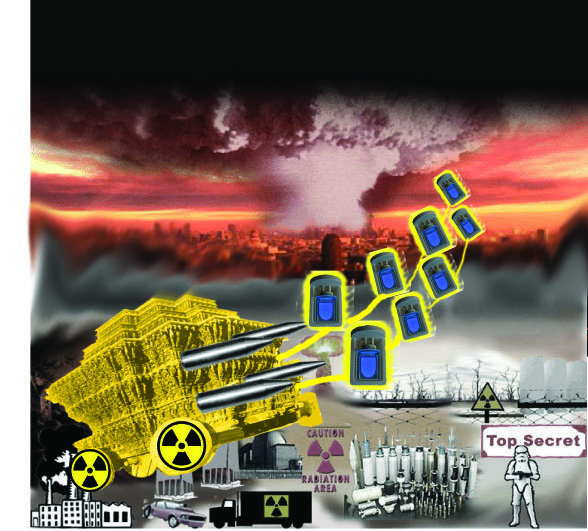
Once again, credible sources reiterate that ‘advanced nuclear’ technology – especially Small Nuclear Reactors (SMRs) are:
- non-existent as a functioning electricity source
- the most expensive of all energy sources
- not really small anyway 300MWe (and cunningly designated “medium” – up to 700MWe)
- serious producers of toxic, virtually eternal, wastes
- Thorium ones need plutonium or enriched uranium to start the reaction
- require huge security – safety and proliferation risks
- Millions of them needed to be effective against climate change, but none available till long after urgent action is needed.
- Distract and divert attention, energy and money away from real climate solutions.
So – why on Earth are all the powerful governments and media constantly trumpeting the virtues of Small Nuclear Reactors?
There is only one real reason:
Small Nuclear Reactors are essential for the nuclear weapons industry.
As the Big Nuclear power industry is failing, and cyclotrons now produce medical radioisotopes, there is really no need for the so-called “peaceful” nuclear industry (except for the massive clean-up jobs)
The Small Nuclear Reactor fantasy keeps the whole show, the whole hypocrisy, alive.
Starting with the (dubiously useful) nuclear submarines – the small nuclear reactor dream is already taking shape. But the industry needs a nice, clean-sounding ‘cover’ for its real killer purpose. Hence the foolish frenzy for “Nice Clean, Climate-helping, Waste-eating, Jobs-providing” Small Nuclear Reactors. (go to Google – you will find nothing but a procession of these lies.
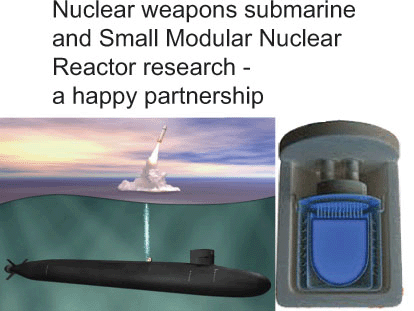
Ukraine War Exposes Risks to Deploying Small Nuclear Reactors
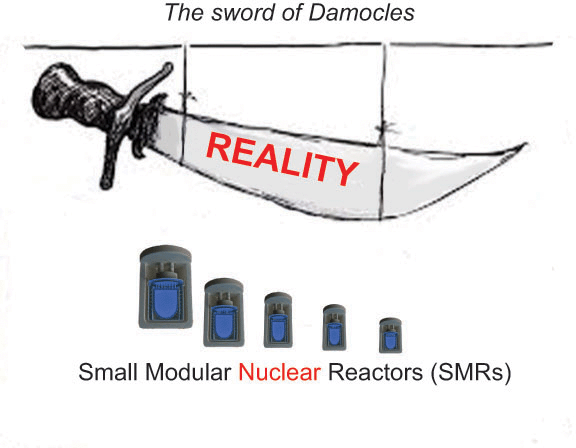
- Small modular reactors are seen as the future of atomic energy
- Russian seizure of atomic plant exposes safety vulnerabilities
By Jonathan Tirone, October 6, 2022, The Russian army’s seizure of the biggest nuclear power plant in Europe isn’t just exposing Ukrainians to the risk of an atomic accident but may also undermine plans to install new miniature reactors in far-flung places. ……… (subscribers only) more https://www.bloomberg.com/news/articles/2022-10-05/ukraine-war-shows-new-risk-to-nuclear-power-s-next-small-thing#xj4y7vzkg
NextEra Energy finds that small nuclear reactors (SMRs) really are the biggest boondoggle of all
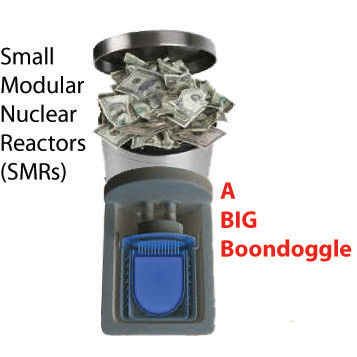
There were a couple of interesting developments in June in regards to electric power. One was that NextEra Energy issued its Investor Conference Report 2022 to its stockholders. Another was a paper from Stanford University, “Low-cost solutions to global warming, air pollution, and energy insecurity for 145 countries,” (LCS study) by Mark Z. Jacobson, et al. Looking into them is rather interesting.
The first of these makes very clear that in the opinions of the people running NextEra Energy, combustion
generating sources and nuclear power are getting too expensive. Furthermore, their opinion is that the most expensive of these, at least in the late 2020s, will be small modular nuclear reactors (SMRs).

We should make clear, just in case anyone doesn’t know, that NextEra is hardly anti-nuclear. While it is already the biggest investor in renewable energy in the US, it does own seven nuclear reactors, including the one at Seabrook. Electricity from new, near-firm solar and wind plants is a good deal less expensive than electricity from existing nuclear plants.
Let’s state this clearly: We are paying extra for electricity from nuclear plants, even after they have been paid down, and even though the sun can shine and the wind can blow almost all the time, because of really cheap battery storage. Put another way, it would be cheaper to close the nuclear plants and replace them with new renewable facilities.
Clean Technica 4th Oct 2022 https://cleantechnica.com/2022/10/04/why-should-we-pay-extra-for-nuclear-power/
Nuclear fusion – public money wasted on this unproven technology
UK ministers have been criticised for “pouring billions of pounds of
public money into unproven technology” by pressed ahead with nuclear
fusion investment. The warning comes after North Ayrshire lost out on
becoming the site of the UK’s first fusion energy plant having been
shortlisted.
Herald 4th Oct 2022
Small modular reactors: What is taking so long?
Next-generation nuclear has long been just around the corner, but debate still rages over the silver-bullet credentials of small modular reactors.
By Oliver Gordon The growing urgency of the climate crisis and, more recently, the energy crisis has reawakened global interest in nuclear energy. Even the likes of Bill Gates and Elon Musk have waded into the debate to petition for a more prominent role for nuclear power in the transition to net-zero greenhouse gas emissions. To that end, there is much expectation surrounding the development of small modular reactors (SMRs), a new generation of nuclear reactors that are being marketed as the solution to all of nuclear power’s previous shortcomings.
To that end, there is much expectation surrounding the development of small
modular reactors (SMRs), a new generation of nuclear reactors that are
being marketed as the solution to all of nuclear power’s previous
shortcomings.
In fact, SMRs are not forecast to hit the commercial market
before 2030, and although SMRs are expected to have lower up-front capital
costs per reactor, their economic competitiveness is still to be proven in
practice once they are deployed at scale.
Nuclear reactors are extremely
complex systems that must comply with stringent safety requirements, taking
into account a wide variety of accident scenarios. The licensing process is
extensive and country-dependent, implying some standardisation will be
required for SMRs to properly take off.
However – beyond the perennial
oscillation of public acceptance of nuclear energy – there are still a
variety of challenges SMR technology needs to overcome before it can reach
commercial deployment. “The hardest is economics,” says M V Ramana, the
Simons Chair in Disarmament, Global and Human Security at the School of
Public Policy and Global Affairs at the University of British Columbia,
Canada, and author of The Power of Promise: Examining Nuclear Energy in
India. “Nuclear energy is an expensive way to generate electricity.”
Energy Monitor (accessed) 21st Sept 2022
https://www.energymonitor.ai/sectors/power/small-modular-reactors-smrs-what-is-taking-so-long
Small nuclear reactors emerge as energy option, but risks loom

The search for alternative sources to Russian energy during the war in Ukraine has refocused attention on smaller, easier-to-build nuclear power stations.
The Indian Express, By: AP Nicosia (cyprus) September 11, 2022. A global search for alternative sources to Russian energy during the war in Ukraine has refocused attention on smaller, easier-to-build nuclear power stations, which proponents say could provide a cheaper, more efficient alternative to older model mega-plants…………
While Rolls-Royce SMR and its competitors have signed deals with countries from Britain to Poland to start building the stations, they are many years away from operating and cannot solve the energy crisis now hitting Europe.
Nuclear power also poses risks, including disposing of highly radioactive waste and keeping that technology out of the hands of rogue countries or nefarious groups that may pursue a nuclear weapons program.Those risks have been accentuated following the shelling around Europe’s largest nuclear power plant in Zaporizhzhia, Ukraine, which has raised fears of potential nuclear disaster in the wake of the war
………………………………. Similarly, Oregon-based NuScale Power signed agreements last year with two Polish companies — copper and silver producer KGHM and energy producer UNIMOT — to explore the possibility of building SMRs to power heavy industry. ……….. Rolls-Royce SMR said last month that it signed a deal with Dutch development company ULC-Energy to look into setting up SMRs in the Netherlands. Another partner is Turkey, where Russia is building the Akkuyu nuclear power plant on the southern coast. Environmentalists say the region is seismically active and could be a target for terrorists.
The introduction of unproven nuclear power technology in the form of SMRs doesn’t sit well with environmentalists, who argue that proliferation of small reactors will exacerbate the problem of how to dispose of highly radioactive nuclear waste.“Unfortunately, Turkey is governed by an incompetent administration that has turned it into a ‘test bed’ for corporations,” said Koray Dogan Urbarli, a spokesman for Turkey’s Green Party.“It is giving up the sovereignty of a certain region for at least 100 years for Russia to build a nuclear power plant. This incompetence and lobbying power make Turkey an easy target for SMRs,” said Koray, adding that his party eschews technology with an “uncertain future.”
……………….. M.V. Ramana, professor of public policy and global affairs at the University of British Columbia, cites research suggesting there’s “no demonstrated way” to ensure nuclear waste stored in what authorities consider to be secure sites won’t escape in the future. The constant heat generated by the waste could alter rock formations where it’s stored and allow water seepage, while future mining activities could compromise a nuclear waste site’s integrity, said Ramana, who specializes in international security and nuclear energy.
Skeptics also raise the risks of possibly exporting such technology in politically tumultuous regions……………
Ramana said that there’s no guarantee nations will follow the rules. “Any country acquiring nuclear reactors automatically enhances its capacity to make nuclear weapons,” he said, adding that every SMR could produce “around 10 bombs worth of plutonium each year.”…………………………… more https://indianexpress.com/article/technology/science/small-nuclear-reactors-emerge-as-energy-option-but-risks-loom-8143584/
Space race – the old macho aim – USA and China to beat each other

A new space race? China adds urgency to US return to moon
By ELLEN KNICKMEYER September 15, 2022 WASHINGTON (AP) — It’s not just rocket fuel propelling America’s first moonshot after a half-century lull. Strategic rivalry with China’s ambitious space program is helping drive NASA’s effort to get back into space in a bigger way, as both nations push to put people back on the moon and establish the first lunar bases.
American intelligence, military and political leaders make clear they see a host of strategic challenges to the U.S. in China’s space program, in an echo of the U.S.-Soviet rivalry that prompted the 1960s’ race to the moon. That’s as China is quickly matching U.S. civil and military space accomplishments and notching new ones of its own.
On the military side, the U.S. and China trade accusations of weaponizing space. Senior U.S. defense officials warn that China and Russia are building capabilities to take out the satellite systems that underpin U.S. intelligence, military communications and early warning networks………………………..
NASA, the U.S. civilian space agency, is awaiting a new launch date this month or in October for its Artemis 1 uncrewed test moonshot. Technical problems scrubbed the first two launch attempts in recent weeks.
China likewise aims to send astronauts to the moon this decade, as well as establish a robotic research station there. Both the U.S. and China intend to establish bases for intermittent crews on the moon’s south pole after that…………………………………….
And for space more broadly, Americans alone have tens of thousands of satellites overhead ………………………
The moon programs signal that “space is going to be an arena of competition on the prestige front, demonstrating advanced technical expertise and know-how, and then also on the military front as well,” said Aaron Bateman, a professor of history and international affairs at George Washington University and a member of the Space Policy Institute……………………………….
A 1967 U.N. space treaty meant to start shaping the guardrails for space exploration bans anyone from claiming sovereignty over a celestial body, putting a military base on it, or putting weapons of mass destruction into space.
“I don’t think it’s at all by coincidence or happenstance that it is now in this period of what people are claiming is renewed great-power competition that the United States is actually investing the resources to go back,” said Bateman, the scholar on space and national security. “Time will tell if this turns into a sustained program.”………………………………… https://apnews.com/article/astronomy-russia-ukraine-space-exploration-science-technology-f98448825e588e8902bb74519b55ba9f
France sends reprocessed nuclear fuel to Japan, despite environmental and safety dangers

https://japantoday.com/category/national/france-sends-latest-nuclear-shipment-to-japan CHERBOURG, France 18 Sept 22
Two ships carrying reprocessed nuclear fuel destined for Japan set sail Saturday morning from northern France, an AFP photographer said, despite criticism from environmental campaigners.
The fuel was due to leave the northern French port city of Cherbourg earlier this month but was delayed by the breakdown of loading equipment.
Environmental activists have denounced the practice of transporting such highly radioactive materials, calling it irresponsible.
The previous transport of MOX fuel to Japan in September 2021 drew protests from environmental group Greenpeace.
MOX fuel is a mixture of reprocessed plutonium and uranium.
“The Pacific Heron and Pacific Egret, the specialised ships belonging to British company PNTL, left Cherbourg harbor on September 17. They will ensure the shipment of MOX nuclear fuel to Japan,” French nuclear technology group Orano said in a statement Saturday.
They are bound for Japan for use in a power plant and Orano said it expected the shipment to arrive in November.
Japan lacks facilities to process waste from its own nuclear reactors and sends most of it overseas, particularly to France.
The operation was carried out “successfully”, Orano said, and it is the second shipment that arrived in Cherbourg from a plant in La Hague, located 20 kilometers away, after the first came on September 7.
Yannick Rousselet of Greenpeace France previously denounced the shipment.
“Transporting such dangerous materials from a nuclear proliferation point of view is completely irresponsible,” he said last month.
MOX is composed of 92 percent uranium oxide and eight percent plutonium oxide, according to Orano.
The plutonium “is not the same as that used by the military,” it said.
Can the testing on anti-satellite weapons be banned?

U.S. looking to encourage more countries to join ASAT testing ban, Space News, by Jeff Foust — August 31, 2022
WASHINGTON — As a second session of a United Nations working group on reducing space threats approaches, U.S. government officials say they’re looking for ways to encourage more countries to back a ban on anti-satellite weapon tests.
Vice President Kamala Harris announced April 18 that the United States would refrain from conducting direct-ascent anti-satellite (ASAT) tests, calling such debris-generating activities “reckless and irresponsible.” She called on other nations to also halt such tests.
Her speech, officials later said, was timed to influence discussions at the first meeting of a U.N. Open-Ended Working Group (OEWG) on norms of behavior for reducing space threats held in May in Geneva. During that meeting Canada announced that it would join the United States in the ASAT testing ban. In July, the New Zealand government announced that it, too, would commit not to test direct-ascent ASATs. Neither country had developed or were planning to develop such weapons………………………………………………………………………
In 1963, the U.N. General Assembly passed a resolution that called on countries not to place nuclear weapons or other weapons of mass destruction in outer space, which eventually became part of the 1967 Outer Space Treaty……… https://spacenews.com/u-s-looking-to-encourage-more-countries-to-join-asat-testing-ban/
Rethink Research throws cold water on the Nuclear Energy Institute’s enthusiasm for Small Modular Reactors (SMRs).
For SMRs to remain competitive there will need to be heavy state-side subsidizes for consumers, as the initial cost of energy produced from them is considerably above wholesale auction prices.
https://rethinkresearch.biz/articles/smr-boon-forecast-by-nei-rethink-doubts-it/—SMR boon forecast by NEI, Rethink doubts it, By Connor Watts, 24 Aug 22, Some 19 utilities surveyed by the US Nuclear Energy Institute (NEI) says they see potential for up to 90GW of small modular reactors (SMR) within the United States by 2050. This would work out to around 300 reactors producing 731.3 TWh of energy, most of which would come online before 2050. Those numbers look pretty good until you look at current generation figures
During 2021 the US consumed around 790 TWh of electricity from nuclear power plants and 899 TWh from coal plants. The EIA projects that 16GW of nuclear plants will be decommissioned, alongside 69GW of coal plants up to 2050. This means that as much as 95% of potential SMR energy production could be going directly to the replacement of existing facilities.
This leaves only 5GW of remaining demand potential for SMR energy production up to 2050 outside of decommissioning existing facilities, we think even this may be optimistic.
Traditional nuclear plants take upwards of a decade to build and often run massively overbudget, making the energy it does produce once built more expensive as costs are attempted to be recouped.
SMR producers promise to do away with these drawbacks through standardizing their designs to enable factory production. Minimizing cost while shortening production times, theoretically addressing the main weaknesses of traditional reactors.
In practice it’s a little more complicated.
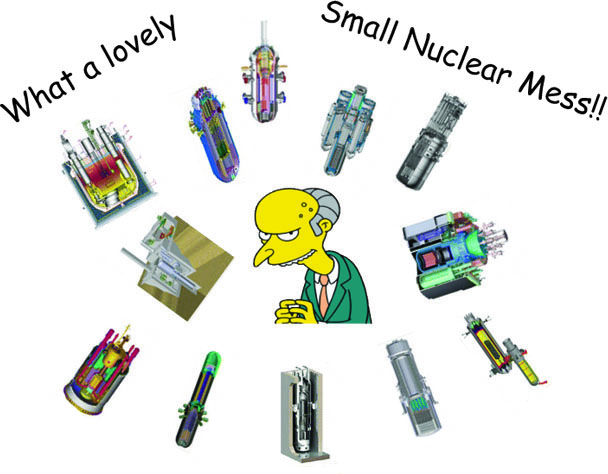
Considering the complexity and risks involved with nuclear power generation, commercial production and design of SMRs remains a slow and meticulous process. This has left many SMR sites still in the planning or design phase years after their announcements, almost competing in deployment time with traditional nuclear plants.
Once a new SMR gets deployed after its design and development period, it will need to be monitored for a few years to inspect for defects and inefficiencies within the design to prevent any mishaps. This is likely to add yet more time to an already long production horizon, adding costs as new units cannot go into production.
The cost savings achieved through modularity and standardization are borne through mass-production and deployment. In a way this is the “gigafactory” approach for nuclear. Considering long initial production times, this will contribute significantly to a short-term increase in the price of nuclear electricity, minimizing its applications where it remains competitive.
SMRs are supposed to come to market at $60 per MWh LCOE – but already wind and solar are considerably below that, and what level will they be at after SMRs arrived on the scene in volume, by say 2030?
For SMRs to remain competitive there will need to be heavy state-side subsidizes for consumers, as the initial cost of energy produced from them is considerably above wholesale auction prices.

Another issue with nuclear power generation is water usage. Earlier this month nuclear plants in France had a rule concerning water discharging waived as heatwaves boiled most of Europe.
Typically, the reactors would reduce their output to minimize damage from discharging hot water into the nearby ecosystems, but this rule has been waived until the 11th of September to ensure energy supplies in the short term. SMRs will also need to use local water supplies as a coolant, which makes them ineffective in a drought.
This can be mitigated through the use of alternative coolants such as liquid metal, gas and molten salt, but many SMR designs currently work similarly to traditional nuclear.
To use the time horizon for SMRs makes them look economically unfavorable, and while these 19 utilities may genuinely feel they like the idea of more nuclear, their controlling state utilities commission may well have something to say about whether they ever actually get installed.
Astronauts Going to Mars Will Receive Many Lifetimes Worth of Radiation

Universe Today, In a recent study published in Space Physics, an international team of researchers discuss an in-depth study examining the long-term physiological effects of solar radiation on astronauts with emphasis on future astronauts traveling to Mars, to include steps we can take to help mitigate the risk of such solar radiation exposure. The researchers hailed from the United Arab Emirates, New Zealand, India, United States, Italy, Greece, and Germany, and their study helps us better understand the in-depth, long-term health impacts of astronauts during long-term space missions, specifically to Mars and beyond.
Exposure to ionizing radiation is one of the main health risks to astronauts in crewed missions to Mars,” said Dr. Dimitra Atri, a Research Scientist at New York University Abu Dhabi, and lead author of the study. “Going to Mars is going to be humanity’s ultimate adventure in the 21st century — it would be unfortunate if the mission is successful, but astronauts suffer major health issues or even die because of radiation exposure. So, we need to estimate radiation exposure in a very careful way and study its overall impact on human health. It will also help us develop mitigation strategies to keep our astronauts safe.”
To conduct their study, the researchers utilized a computer simulation known as Geant4 with a model human phantom to calculate how each organ of the human body is affected by radiation doses from exposure to energetic charged particles for prolonged periods. These include impacts on an astronaut’s health such as Acute Radiation Syndrome, nervous system damage, and a higher risk of cancer. The CDC defines Acute Radiation Syndrome, also known as radiation sickness or radiation toxicity, as “an acute illness caused by irradiation of the entire human body (or most of the body) by a high dose of penetrating radiation in a very short period of time (usually a matter of minutes).”
Combining their data from the model human phantom with dozens of past medical studies, the researchers discuss the underlying impacts of ionizing radiation on physiological systems, to include the nervous, immune, and skeletal systems, and behavioral effects, along with impacts on genetic material and risk of cancer. They considered a crewed mission to Mars comprising of 600 days in cruise phase to and from the Red Planet and spending 400 days on the Martian surface. While they noted a knowledge gap regarding past medical studies and their own study, they stated radiation limits set by the European Space Agency, Roscosmos, Japanese Aerospace Exploration Agency, and NASA would be surpassed during a crewed mission to Mars.
“It is a comprehensive study modeling the impact of charged particles — protons, alpha particles, heavier species on a human phantom by using CERN’s charged particle interaction code, said Dr. Atri. “We were able to calculate radiation dose deposited in various organs of the human body. …………. https://www.universetoday.com/157285/astronauts-going-to-mars-will-receive-many-lifetimes-worth-of-radiation/
Digital damage: Is your online life polluting planet?

https://www.miragenews.com/digital-damage-is-your-online-life-polluting-840709/ Macquarie University/The Lighthouse Dr Jessica McLean is a Senior Lecturer in Human Geography in the Macquarie School of Social Sciences. 22 Aug 22
Shorter emails, camera-off Zoom calls and deleting old photos could reduce our digital carbon footprints – but sustainability expert Dr Jessica McLean says this is too big for individuals, and governments and organisations need to take responsibility.
Swapping digital meetings, shopping and even exercise classes for their in-person alternatives can substantially reduce greenhouse gas emissions by avoiding transport-related pollution, but the environmental impact of our digital lives is also surprisingly high, says Human Geographer Dr Jessica McLean.
We don’t often think about the various infrastructures required to do simple things like send an email or hold our photos – these digital things are stored in data centres that are often out of sight, out of mind,” says McLean, who is a Senior Lecturer in Human Geography at Macquarie University’s School of Social Sciences.
“If we think about it at all, we usually expect these services to be continual and think that there isn’t really a limit on those digital practices,” she says.
However, digital activity has a surprisingly high environmental impact, says McLean, who has recently published a book on the topic.
Along with the greenhouse gas emissions from substantial energy use by our personal computers, data centres and communication equipment, this impact also includes the water use and land impact from mining, building and distributing the metals and other materials that make up our vast global digital infrastructure.
High-impact digital activities
Many researchers have attempted to calculate the individual carbon footprints of various technologies, and these often focus on the energy used by servers, home wi-fi and computers and even a tiny share of the carbon emitted to construct data centre buildings.
Some of our greenhouse-gassiest digital activities include:
Emails: Professor Mike Berners-Lee calculated that a short email sent phone-to-phone over wifi equates to 0.3 grams of CO2, a short email sent laptop-to-laptop emits 17g of CO2 and a long email with attachment sent from laptop could produce 50g of CO2.- Digital hoarding: Data transfer and storage of thousands of photo, audio and video files, messages, emails and documents in an average US data centre emits around 0.2 tons of CO2 each year, for every 100 gigabyte of storage.
- Binge-watching in High Definition: Just one hour of HD streaming a day emits 160kg of CO2 each year – but swap to Standard Definition video quality and that drops to around 8kg of CO2 annually.
Using super-computers: Australian astronomers each produce 15 kilotonnes of CO2 a year from super-computer work – more than their combined emissions from operating observatories, taking international flights and powering office buildings. However Dutch astronomers produce about 4 per cent of these emissions, as Netherlands national supercomputer uses 100 per cent renewable energy.- Artificial Intelligence: Training a large AI model emits 315 times more carbon than a round-the-world flight.
Beyond the individual
Deconstructing the many and varied impacts of our increasingly digital lives can be overwhelming.
Talking heads: Just one hour of videoconferencing can emit up to 1kg of CO2.
“There’s a lot to take in, and many of these figures will change depending on things like the use of renewable energy that is being taken up by some digital corporations and many individuals,” says McLean.
“This highlights the complexity of this challenge, showing that understanding and addressing digital sustainability goes beyond individual responsibilities, and is more fittingly held by governments and corporations.”
She says that the onus should be on governments to regulate a greater transparency on how digital corporations use energy, and to require regular reporting on sustainability targets.
Big tech continues to produce smartphones that are not designed to last.
“Most device manufacturers subscribe to a ‘planned obsolescence’ paradigm, rather than circular economy – for example, big tech continues to produce smartphones that are not designed to last.”
McLean’s recent research with Dr Sophia Maalsen (University of Sydney) and Dr Lisa Lake (UTS) found that while university students, staff and affiliates were concerned about the sustainability of digital technologies, there was a big gap between their intentions and actual practices of sustainability in their everyday digital lives.
“People expressed concern for the sustainability of their digital technologies, but they had limited opportunities to do anything substantive about this issue,” she says.
Digital ‘solutionism’ the wrong approach
Concepts like the paperless office, remote work and virtual conferences often come with a promise of lower environmental impacts – but McLean says these can be examples of ‘digital solutionism’.
E-harm: Digital activity has a surprisingly high environmental impact, says Dr Jessica McLean, who has recently published a book on the topic.
“It’s time to question whether being digital is always the most sustainable solution,” she says.
McLean says that our society is becoming increasingly entangled in the digital via the exponential growth of intensely data driven activities and devices, from the Internet of Things to Big Data and AI.
However, she points out that this digital immersion isn’t universal.
“There are uneven patterns and gaps in these digital affordances, both within Australia and across the Global South,” she says.
Her book, Changing Digital Geographies, explores alternatives to our current exponential digital growth, and its impact on our natural world.
“There are many alternatives for how we live digitally, from making decisions about what’s ‘good enough’ to changing the whole digital lifecycle and the way it is regulated,” she says.
“Individuals cannot be expected to resolve these issues, governments need to regulate and corporations need to act, to improve our digital future and make it sustainable.”
1 This Month



26 September – International Day for the Total Elimination of Nuclear Weapons


PLEASE OPPOSE HR 8255 AND S.3639 – bills would accelerate satellite deployment, with no environmental review or safeguards – https://ncstd5li.quorum.us/campaign/169331/
To see nuclear-related stories in greater depth and intensity – go to https://nuclearinformation.wordpress.com
-
Archives
- September 2026 (245)
- August 2026 (330)
- July 2026 (355)
- June 2026 (287)
- May 2026 (306)
- April 2026 (356)
- March 2026 (251)
- February 2026 (267)
- January 2026 (308)
- December 2025 (358)
- November 2025 (359)
- October 2025 (375)
-
Categories
- 1
- 1 NUCLEAR ISSUES
- business and costs
- climate change
- culture and arts
- ENERGY
- environment
- health
- history
- indigenous issues
- Legal
- marketing of nuclear
- media
- opposition to nuclear
- PERSONAL STORIES
- politics
- politics international
- Religion and ethics
- safety
- secrets,lies and civil liberties
- spinbuster
- technology
- Uranium
- wastes
- weapons and war
- Women
- 2 WORLD
- ACTION
- AFRICA
- Atrocities
- AUSTRALIA
- Christina's notes
- Christina's themes
- culture and arts
- Events
- Fuk 2022
- Fuk 2023
- Fukushima 2017
- Fukushima 2018
- fukushima 2019
- Fukushima 2020
- Fukushima 2021
- general
- global warming
- Humour (God we need it)
- Nuclear
- RARE EARTHS
- Reference
- resources – print
- Resources -audiovicual
- Weekly Newsletter
- World
- World Nuclear
- YouTube
-
RSS
Entries RSS
Comments RSS
 nuclear-news