USA using COP27 to co-opt Europe , especially Ukraine, into the small nuclear reactor gamble

U.S. announces new European SMR initiatives at COP27 in Egypt
“……………………………….. On November 12, the U.S. announced two global Small Modular Reactor (SMR) initiatives: (1) a Ukraine clean fuels from SMRs pilot project and (2) a new initiative to accelerate the European transition of coal-fired plants to SMRs.
………. additional information on these two initiatives is still underway (the White House mentioned both initiatives in its Overview of COP27)
The U.S. Special Presidential Envoy for Climate, John Kerry, and Ukraine Minister of Energy German Galushchenko introduced a “Ukraine Clean Fuels from SMRs Pilot” project…………………………
- The pilot project, which will run for 2-3 years, also relies on the work of a public-private consortium on scientific and practical developments for SMRs.
- Participating partners from the U.S. include Argonne National Laboratory, Clark Seed, FuelCell Energy, NuScale and Starfire Energy. On the Ukraine side, participants include nuclear operator Energoatom, the National Security and Defense Council, and the State Scientific and Technical Center for Nuclear and Radiation Safety.
Special Envoy Kerry introduced another a new initiative, called Project Phoenix, to accelerate the European transition of coal-fired plants to SMRs,……………
According to the White House Fact Sheet Project Phoenix will provide direct U.S. support for the coal-to-SMR feasibility studies and related activities that support energy security goals for countries in Central and Eastern Europe.
Japan’s new nuclear energy policy- is it really feasible?
On August 24, 2022, at the newly established GX (Green Transformation)
Implementation Council chaired by Prime Minister Kishida Fumio, the
Japanese government announced a new nuclear energy policy.
The framework
for this new policy consists of three key points: maximize the use of
existing nuclear power plants through an accelerated restart and extension
of their operation period; develop and build advanced next-generation
reactors; and develop conditions suitable for the use of nuclear energy,
including back-end support.
The most contentious of these is the second
point: the development and construction of advanced next-generation
reactors. Since the Fukushima nuclear disaster, previous Japanese
government policy has made no mention of building new power plants, so it
is being seen as a major policy change. What explains this policy change,
and is it really feasible?
The Diplomat 14th Nov 2022
https://thediplomat.com/2022/11/japans-changing-nuclear-energy-policy/
Nuclear fusion discovery uncovers strange behaviour of limitless energy source
Despite promises of imminent breakthroughs in nuclear fusion power going
back decades, the ultimate clean energy source remains out of scientists’
reach. Nuclear fusion discovery uncovers strange behaviour of limitless
energy source. Even as scientists achieve new milestones in developing
fusion power, new questions arise as to how the basic physics of fusion
reactions may work.
Independent 15th Nov 2022
So-Called Next-Generation Nuclear Power Plants Are Being Oversold

One contender, for example, TerraPower’s 345-megawatt Natrium reactor, received considerable media attention earlier this year when company founder Bill Gates touted it during interviews about his new book, How to Avoid a Climate Disaster. According to the UCS report, however, sodium-cooled fast reactors such as Natrium would likely be less uranium-efficient and would not reduce the amount of waste that requires long-term isolation. They could also experience safety problems that are not an issue for light-water reactors. Sodium coolant, for instance, can burn when exposed to air or water, and the Natrium’s design could experience uncontrollable power increases that result in rapid core melting.

There’s little evidence that they’d be cheaper or safer than existing designs
https://www.scientificamerican.com/article/lsquo-advanced-rsquo-nuclear-reactors-don-rsquo-t-hold-your-breath/— By Elliott Negin, Elliott Negin is a senior writer at the Union of Concerned Scientists. July 21
The U.S. nuclear power industry is at an impasse. Since 2012, 11 of the 104 light-water reactors in operation at the time have closed, mainly as a result of aging infrastructure and the inability to compete with natural gas, wind and solar, which are now the cheapest sources of electricity in the U.S. and most other countries worldwide.
One way the industry is trying to reverse the trend is by looking to what it likes to call “advanced” reactors. Despite the name, these designs are largely based on unproven concepts from more than 50 years ago. Unlike conventional light-water reactors, these rely on sodium or molten salt or gas for cooling, and their proponents claim they will be less expensive, safer and more secure than their predecessors. Some claim that these innovative devices will be ready for prime time by the end of this decade.
The U.S. nuclear power industry is at an impasse. Since 2012, 11 of the 104 light-water reactors in operation at the time have closed, mainly as a result of aging infrastructure and the inability to compete with natural gas, wind and solar, which are now the cheapest sources of electricity in the U.S. and most other countries worldwide.
One way the industry is trying to reverse the trend is by looking to what it likes to call “advanced” reactors. Despite the name, these designs are largely based on unproven concepts from more than 50 years ago. Unlike conventional light-water reactors, these rely on sodium or molten salt or gas for cooling, and their proponents claim they will be less expensive, safer and more secure than their predecessors. Some claim that these innovative devices will be ready for prime time by the end of this decade.
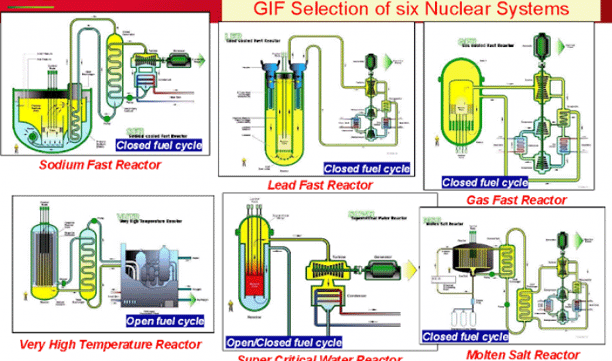
This has naturally attracted the attention of Biden administration officials and some key members of Congress, who are looking for ways to curb carbon emissions. But an analysis of non-light-water reactor concepts in development by the Union of Concerned Scientists (UCS) has found that these designs are no better—and in some respects significantly worse—than the light-water reactors in operation today. The report’s author, UCS physicist Edwin Lyman, took a close look at the claims developers have been making: that these new devices will burn uranium fuel more efficiently and produce less radioactive waste than existing plants; will reduce the risk of nuclear proliferation; and will be commercialized relatively soon. Those claims, however, do not hold up to scrutiny.
One contender, for example, TerraPower’s 345-megawatt Natrium reactor, received considerable media attention earlier this year when company founder Bill Gates touted it during interviews about his new book, How to Avoid a Climate Disaster. According to the UCS report, however, sodium-cooled fast reactors such as Natrium would likely be less uranium-efficient and would not reduce the amount of waste that requires long-term isolation. They could also experience safety problems that are not an issue for light-water reactors. Sodium coolant, for instance, can burn when exposed to air or water, and the Natrium’s design could experience uncontrollable power increases that result in rapid core melting.
In June, TerraPower announced that it would build the first Natrium reactor in Wyoming as part of a 50–50 cost-share program with the Department of Energy. The DOE program originally required the company to have the reactor, still in its early design stage, up and running by 2027. That was recently pushed back a year, but it is still a completely unrealistic timetable. According to the UCS report, if federal regulators require the necessary safety demonstrations, it could take at least 20 years—and billions of dollars in additional costs—to commercialize such reactors, their associated fuel-cycle facilities, and other related infrastructure.
The Nuclear Regulatory Commission (NRC) may have to adapt some regulations when licensing reactor technologies that differ significantly in design from the current fleet. Lyman says that should not mean weakening public health and safety standards, finding no justification for the claim that “advanced” reactors will be so much safer and more secure that the NRC can exempt them from fundamental safeguards. On the contrary, because there are so many open questions about these reactors, he says they may need to meet even more stringent requirements.
Lyman’s report recommends that the DOE suspend its advanced reactor demonstration program until the NRC determines whether it will require full-scale prototype tests before any designs are licensed for commercial deployment, which the report argues are essential. It also calls on Congress to require the NRC to convene an independent commission to review the technical merits of non-light-water reactors and approve only those projects that have a high likelihood of commercialization and are clearly safer and more secure than the current fleet.
Finally, it recommends that the NRC and Congress consider spending more research and development dollars on improving the safety and security of light-water reactors rather than on commercializing immature, overhyped non-light-water reactor designs. Any federal appropriations for R&D and deployment of these reactor designs, Lyman says, should be guided by a realistic assessment of the likely benefits and not based on wishful thinking.
Why molten salt nuclear reactors really can’t succeed
Beyond Nuclear By M.V. Ramana and Cassandra Jeffery 14 Nov 22

………………………………………………………….Technical Problems
Let us start with the problems with the molten chloride fast reactor. As its name suggests, the reactor uses nuclear materials dissolved in molten chemical salts.
Salt is corrosive — just ask anyone who lives on the coast. So the inside of the reactor will be a chemically corrosive and highly radioactive environment.
No material can perform satisfactorily in such an environment. After reviewing the available studies, all that the U.S. Idaho National Laboratory — a nuclear power booster — could recommend was that “a systematic development program be initiated.”
TerraPower has three different nuclear reactor designs on the books: the Natrium reactor; the molten chloride fast reactor; and the traveling wave reactor.
Given his emphasis on novelty and innovation, one would expect Gates to put his money on reactor designs that are new and likely to succeed. None of these designs have that merit. All of these reactors are based on two old reactor designs vexed with major problems.
Other leading research laboratories like France’s Institut de radioprotection et de sûreté nucléaire (IRSN) and the U.K.’s Nuclear Innovation and Research Office, have concluded that molten salt reactors are problematic. As IRSN put it, “numerous technological challenges remain to be overcome before the construction of an MSR can be considered.”
The historical experience with molten salt reactors has been pretty bleak, to put it mildly. The last one to be built was the Molten Salt Reactor Experiment in Oakridge, Tennessee. It operated intermittently from 1965 to 1969, and operations were interrupted 225 times in those four years; of these interruptions, only 58 were planned.
But it’s not just a matter of molten salt reactors being unreliable or technologically challenged. As Edwin Lyman from the Union of Concerned Scientists has documented at length, the “use of liquid fuel instead of a solid fuel” in molten salt reactors “has significant safety implications for both normal operation and accidents.”
Specifically, the molten nature of the fuel makes it easier for radioactive materials to escape into the atmosphere and be dispersed.
Terrapower’s other two reactor designs are not much better. Both the Travelling Wave Reactor and the Natrium use molten sodium. Another problematic material, molten sodium is used to transport the intense heat produced by the nuclear fission reactions. Again, such reactors have been constructed since the dawn of the nuclear age and with similarly dismal results.
To start with, such reactors have had numerous accidents. The record starts on November 29, 1955 when the Experimental Breeder Reactor (EBR-1) in Idaho had a partial core meltdown.
A decade later, in October 1966, the Fermi-1 demonstration fast reactor in Michigan suffered a partial core meltdown. The shock made its way into the cultural mainstream in the form of a book called We Almost Lost Detroit and a song with the same name by Gil Scott Heron.
In Japan, the Monju reactor suffered a series of accidents and produced almost no electricity, after an expenditure of at least $8.5 billion
The use of molten sodium makes such reactors susceptible to serious fires, because the material burns if exposed to air. Almost all sodium-cooled reactors constructed around the world have experienced sodium leaks, likely because of chemical interactions between sodium and the stainless steel used in various components of the reactor.
Finally, the use of sodium also makes it difficult to maintain and carry out repairs on fast reactors, which then become susceptible to long shutdowns. Having to deal with all these volatile properties and safety concerns naturally drives up the construction costs of fast reactors, rendering them substantially more expensive than common thermal reactors.
Sodium-cooled reactors are also unreliable, operating at dismally low rates compared to standard reactors. The load factor (the ratio of the amount of electrical energy a power plant has produced to the amount of energy it would have produced had it operated at full capacity) for the Prototype Fast Reactor in the United Kingdom was 27%; France’s Superphenix reactor managed a mere 7.9%.
The typical U.S. reactor operates with a load factor of more than 90%. Sodium- cooled reactors would have to sell their power at higher prices to compensate for the fewer units of electrical energy generated.
“Without innovation, we will not solve climate change,” chanted Gates. But no amount of innovation will change the laws of chemistry or physics. How sodium behaves when it interacts with air or water won’t be affected, even if the sodium is inside a nuclear reactor backed by one of America’s oligarchs.
Innovation will not change the fact that the radioactive wastes produced by the Natrium reactor will remain hazardous for tens of thousands of years……………………………………………….. more https://beyondnuclearinternational.org/2022/11/13/bill-gates-and-techno-fix-delusions/
Surprise surprise. USA co-opts Ukraine to try out small nuclear reactors

US, Ukraine announce project on construction of small modular nuclear reactor,
New initiative aims to accelerate conversion of coal-fired power plants in central, eastern Europe: US State Department AA, Burc Eruygur |13.11.2022
The US and Ukraine have announced the launch of a project on the construction of a small modular nuclear reactor (SMR) in Ukraine during the 27th UN Climate Change Conference (COP27) in Egypt, according to the US State Department.
“Special Presidential Envoy for Climate John Kerry and Ukraine Minister of Energy Herman Halushchenko announced a Ukraine Clean Fuels from SMRs pilot project that will demonstrate the production of clean hydrogen and ammonia using secure and safe SMRs and cutting-edge electrolysis technologies in Ukraine,” read a statement by the US State Department on Saturday………………………
In addition to Argonne National Laboratory and Ukraine’s Energoatom, National Security and Defense Council, and State Scientific and Technical Center for Nuclear and Radiation Safety, the statement expresses that multiple private companies will also take part in the project’s multinational consortium.
Kerry separately announced the launch of a new initiative, called Project Phoenix, “to accelerate the transition in Europe of coal-fired plants to SMRs while retaining local jobs through workforce retraining,” it also said.
“Project Phoenix will provide direct US support for coal-to-SMR feasibility studies and related activities in support of energy security goals for countries in central and eastern Europe,” according to the statement.
On Sunday, Ukraine’s Ambassador to the US Oksana Markarova also confirmed the project, reiterating the information released by the US State Department.
“Ukraine is not only working to protect and quickly repair/replace what was destroyed but is already planning to build an innovative energy system,” Markarova said on Facebook. https://www.aa.com.tr/en/russia-ukraine-war/us-ukraine-announce-project-on-construction-of-small-modular-nuclear-reactor/27
Ever the optimists… Rolls-Royce chooses four sites for reactor that’s yet to be built

https://www.nuclearpolicy.info/news/ever-the-optimistsrolls-royce-chooses-four-sites-for-reactor-thats-yet-to-be-built/ 9 Nov 22, Rolls Royce SMR, the company behind the development of so-called Small Modular Reactors, has today announced its ambitious plans to deploy new reactors at four sites in England and North Wales by the early 2030’s, but there is a fly in the ointment – it is a reactor that has yet to be built.
Rolls-Royce has been visiting sites in recent months and number-crunching existing data to identify their preferred locations for any future SMRs, and Wylfa and Trawsfynydd in North Wales; Sellafield in West Cumbria; and Oldbury in Gloucestershire have been selected based on ‘existing geotechnical data, adequate grid connection and because each site is large enough to deploy multiple SMRs’.
But the announcement leapfrogs several crucial challenges Roll-Royce will first need to overcome before their SMR vision becomes reality.
Councillor David Blackburn, Chair of the UK/Ireland Nuclear Free Local Authorities, explained: “Rolls-Royce may sound optimistic, but the history of British civil nuclear power is littered with projects delivered late, over budget, whilst compromising safety, or with sub-standard power output. And the SMR concept has its own set of problems.
“For one the design has not even received regulatory approval from the Office of Nuclear Regulation, and it may not, and this is a process expected to take until at least mid-2024.
“It is also conceived to be prefabricated and assembled on site, but factories still have to be built to fabricate the parts; the process of fabrication has to be mastered; all the necessary approvals and permits will have to secured to build on each site, possibly in the teeth of significant public opposition; and the assembly of pre-fabricated reactors on site is still not a perfected art – just think of the challenge of building an IKEA furniture set and multiply that a million fold.”

The NFLA also has real concerns about the radioactive waste future SMRs will bring, with a recent study by the University of Stanford and British Columbia identifying that fission in these smaller reactor types could produce between two and thirty times as much radioactive waste as that produced by a ‘conventional’ larger reactor per unit of electricity generated.[1]
Added Councillor Blackburn: “That is an awful lot of radioactive waste to add to the stockpile Britain has already accumulated from almost seventy years of civil nuclear power generation; toxic waste that must be managed safely at vast public expense and for which a long-term totally safe storage solution has yet to be found. Do we really want to produce more when we can generate our electricity safely and more cheaply using renewables?”
America’s Abandoned Nuclear Power Projects (includes Interactive Map)
THE BIG PICTURE: Abandoned Nuclear Power Projects (Interactive Map), Power, by Sonal Patel Increasing uncertainties concerning low forecasted load; construction financing constraints and reversals; state certification hurdles; and challenges to nuclear profitability posed by the growing share of coal plants beset the nuclear industry in the early 1970s. The nuclear suffered a renewed economic meltdown and fierce public pushback in the aftermath of the Three Mile Island accident in 1979. By 1983, these factors prompted the delay or cancellation of 100 nuclear units—nearly 45% of total commercial capacity previously ordered. An estimated $10 billion (in mid-1982 dollars) had been spent on the scrapped projects. Mounting public opposition from Chernobyl and new safety rules required after Fukushima also affected a number of later projects.
POWER in April 2020 published an infographic showing construction timeframes of completed nuclear reactors: THE BIG PICTURE (Infographic): U.S. Nuclear Lifetimes
A supplement to POWER‘s February 2018 THE BIG PICTURE print infographic, this interactive map offers a sampling of nuclear plant projects that have been abandoned. Double click on the map to activate the zoom function. Click on “Map Overview” to zoom out. Scroll down for an overview. Note: All dollar figures are from the corresponding year. Source: NRC
—Copy, artwork, and interactive feature by Sonal Patel, a POWER senior associate editor (@sonalcpatel, @POWERmagazine)
………………………… A Brief History of Abandoned U.S. Nuclear Projects
1974: Tyrone 2 (1.2 GW)—Wisconsin regulators denied certification of the project being built by Northern States Power (now Xcel Energy) owing to insufficient demand growth and public opposition. Abandonment cost the company $103 million. The Wisconsin Public Utility Commission ordered the company to study a substitute coal-fired plant.
1974: Vogtle 3 and 4 (each 1,113 MW)— While Georgia Power gave this project new life 2013 as AP1000s—and they remain the only two reactors under construction in the U.S.—the company canceled two reactors under construction at the Vogtle site in 1974, citing citizen opposition and regulatory changes, which contributed to rising costs and construction delays. Critics, however, pointed to management issues for the project’s failure.
1977: Surry 3 and 4 (each 882 MW)—Power demand fell dramatically from 1972, when Surry 3 and 4 were planned by Virginia Electric & Power Co. (VEPCO) northwest of Newport News, Virginia, through March 1977, when the units were canceled. VEPCO, which also cited construction delays caused by labor problems, intervention of environmentalists, and tighter NRC controls, said the company had invested $53 million in the projects and had contracts for another $93 million (1977 dollars).
1980: North Anna 4 (907 MW)—In the wake of Three Mile Island, VEPCO abandoned the project when it was only 4% complete. Abandonment of Unit 4 cost it $155 million (1980 dollars). The company had reportedly spent $485 million to build Unit 3 (abandoned two years later) and 4 at North Anna at the time. In 1982, when it scrapped Unit 3 because of a sharp increase in construction costs, VEPCO sought rate increases to cover an estimated $540 million write-off.
1980: Sterling (1.2 GW)—The New York Public Service Commission unequivocally allowed Rochester Gas & Electric Corp. full recovery of costs of the Sterling plant, which had just kicked off construction, estimated at about $129 million.
1980: Jamesport 1 and 2 (1.2 GW)—Long Island Lighting, which had also just entered construction, also recovered abandonment costs of about $120 million.
1980: Forked River 1 (1.1 GW)—Jersey Central Power & Light halted construction at this project in 1974 owing to financial cutbacks and protests, but it resumed construction only to abandon the project which was 5.6% complete owing to “financial difficulties” stemming from the Three Mile Island accidents, and also, uncertainty about whether the NRC would grant a license or put in place costly regulations.
1981: Callaway 2 (1.2 GW)—Construction had barely begun when Union Electric Co. halted the project, citing financial risks to investors posed by uncertainties afflicting the sector.
1981: Hope Creek 2 (1.1 GW)— Public Service Electric & Gas scrapped the unit when it was about 19% complete, but pressed on with Hope Creek 1. The $3.79 billion Hope Creek 1 was already plagued with soaring cost overruns, up from $600 million initially estimated for both units.
1981: Bailly 1 (645 MW)—The U.S. Supreme Court halted Northern Indiana Public Service’s $1.8 billion boiling water reactor (BWR) project owing to questions regarding pilings for the plant. Faced with longer delays for the project already seven years into construction, the company abandoned it.
1981: Shearon Harris 3 and 4 (900 MW each)—Costly safety upgrades and weakening power demand prompted Carolina Power & Light to abandon two of four planned Westinghouse 3 loop reactors under construction. The third 900-MW reactor, Shearon Harris 2, was abandoned in 1983.
1982: Washington Nuclear 4 and 5 (1.2 GW each)—Unit 4 was 25% complete and Unit 5 17% complete when Energy Northwest’s predecessor Washington Public Power Supply System halted construction at the two units after it failed to sell enough bonds to complete five reactors needed to meet projected power in the Pacific Northwest. Abandonment of the two units alone led to the company’s
defaulting on $2.2 billion in municipal bonds. Total costs for all five units planned at the site was estimated to exceed $24 billion.
1982: Phipps Bend 1 and 2 (1.2 GW each)—The Tennessee Valley Authority’s (TVA’s) board voted to stall construction of Unit 1, which was 29% complete, and Unit 2, 5% complete owing to slacker power demand as aluminum plants in the South closed down. Abandoning the project cost the TVA about $1.2 billion. The site in 2017 became home to a 1-MW solar farm.
1982: Hartsville B1 and B2 (1.2 GW each)—TVA also slowed work at Hartsville, B1 and B2, which were 17% and 7% complete, finally moving to scrap them. The decision cost $718 million.
1982: Cherokee 2 and 3 (1.3 GW)—Economic troubles also prompted Duke Power to abandon two of three reactors it was building in South Carolina. In 1983, Duke Power also scrapped the 1.3-GW Unit 1.
1984: Yellow Creek 1 and 2 (1.3 GW each)—About 30% of the two System 80 pressurized water reactors (PWRs) near Iuka, Mississippi, were complete when TVA moved to abandon them, citing lower power demand and dramatically higher construction costs. TVA estimated Yellow Creek would have cost $10 billion to build.
1984: Hartsville A1 and A2 (1.2 GW each)—On the same day it abandoned Yellow Creek, TVA also scrapped the two remaining Hartsville reactors near Nashville, Tennessee. Completing the Hartsville reactors would have cost $6.5 billion, it said.
1984: Zimmer 1 (810 MW)—When Cincinnati Gas & Electric Co. announced cancellation of the project to convert it to a coal plant, it was 97% complete and had so far cost $1.6 billion—up from a the $240 million originally estimated. The decision to scrap the project was rooted in estimates that completing the project would cost an additional $1.5 billion and two more years of construction to satisfy new requirements from the NRC. Just months before, the federal regulatory body repudiated its own probe into a pipe-weld problem at Zimmer, alleging “incompetence” after a whistleblower—29-year-old Thomas Applegate, a private investigator hired by the utility to check possible time-card padding at the plant—brought to light that the NRC’s regional office of inspection and enforcement had never inspected the defective welds in safety-related systems. While Applegate alleged a cover up by the NRC, the NRC rejected its own overall finding, deeming the investigation “unsatisfactory.” Ultimately, it halted construction on several parts of the plant after finding fault with project management and for safety violations. Fallout from the Zimmer project struck the nuclear industry widely—specifically for utilities looking to sell bonds to finance new nuclear—as no company had walked away from a costly nuclear project so close to completion.
1986: Midland 1 (818 MW) and 2 (492 MW)—After 17 years of sporadic construction, hearing and protests, and after project partner Dow Chemical pulled out of the project, Consumers Powers Co.’s board of directors voted to abandon the two reactors in Michigan—even though the project was 85% complete. At the time, the board cited changing safety rules, which it blamed for costly delays, and a refusal by some of Michigan’s major industrial consumers to agree to rate increases. Some critics also alleged project mismanagement. Consumers had spent $4 billion on the two reactors when it abandoned the project. In 1987, it began converting the plant to a natural gas–fired cogeneration facility, and in 2009, after years of high natural gas prices, the company sold its stake in the Midland Cogeneration Venture to New York–based Fortistar.
1988: Bellefonte 1 and 2 (1.2 GW each)—TVA’s board suspended the project when Unit 1 was 88% complete and Unit 2, 58% complete, after a combined $6 billion investment. TVA considered completing the project in 2010, but it ultimately sold the site in November 2016 to Nuclear Development LLC, a firm that has sought federal loan guarantees to complete the project.
1988: Seabrook 2 (1.2 GW)— Public Service Co. of New Hampshire canceled plans for the second of two reactors planned at Seabrook. Unit 2 was 25% complete and the utility had spent $800 million on the project. Unit 1 was completed in 1986.
1989: Shoreham (820 MW)—The Shoreham Long Island Lighting Co. (LILCO) fully completed this GE BWR in 1984, but considerable public opposition after Three Mile Island prompted Suffolk County officials in New York to determine that the county could not be safely evacuated in the event of a serious nuclear accident at the plant. Even though the company received federal permission for low power tests in 1985, the states declined a company-sponsored evacuation plan, effectively barring it from ever opening. In 1992, the Long Island Power Authority bough the plant from LILCO (for $1), and it was fully decommissioned in 1994. In 1965 when LILCO first announced plans for the plant, it said it could be completed by 1973 at a cost of $75 million; by the late 1970s, after LILCO decided to increase the size of Shoreham from 540 MW to 820 MW, costs soared to $2 billion; and by the 1990s, ratepayers were saddled with an enormous price tag of $6 billion for the project, which never produced commercial power.
1990: Grand Gulf 2 (1.3 GW)—Though planned in the 1970s when regional demand for power was rising sharply every year, in 1986, Middle South Utilities—Entergy’s predecessor— suspended construction of the project where work had begun in 1975 after state regulators denied the company’s request for rate increases to pay for the project. Citing a massive debt load and political imbroglio, and though the project was 66% complete and one unit at the plant had been placed in commercial operation in 1985, the company scrapped the project in 1990.
1995: Washington Nuclear 1 (1.3 GW) and Washington Nuclear 3 (1.2 GW)—Only one of five reactors planned by the Washington Public Power Supply System was completed (Columbia Generating Station, in 1984) but the remaining unfinished plants were mothballed against the possibility that construction would be resumed. In 1995, the projects were formally terminated. The company, renamed as Energy Northwest, asked the NRC to extend the construction permit for Unit 1 to 2001, but in 2005, it determined again that the construction permit was no longer needed.
2017: V.C. Summer 3 and 4 (each 1.1 GW)—SCANA Corp. and its partner Santee Cooper scrapped two AP1000 reactors that were 64% complete, claiming completion would cost $9.8 billion. The project, whose construction began in 2013, was dogged by costly delays stemming in part due to new safety rules implemented in the wake of the 2011 Fukushima disaster. In early 2017, delays at the project and two other AP1000s under construction in Georgia forced contractor Westinghouse to declare bankruptcy. The partners spent $9 billion on the project they estimated could cost up to $24 billion to complete. https://www.powermag.com/interactive-map-abandoned-nuclear-power-projects/#.Y2Sprx1KxHA.twitter
Rocket Lab: Helping the US wage endless wars from space

https://thedailyblog.co.nz/2022/10/25/rocket-lab-helping-the-us-wage-endless-wars-from-space/By John Minto, October 25, 2022
It’s clear local mana whenua were misled by Rocket Lab founder Peter Beck when iwi land at Mahia Peninsula was leased to launch satellites into space.
At the time Peter Beck was clear Rocket Lab would be used for civilian purposes only and would not take up military contracts, despite this being a particularly lucrative path to take.
Fast forward a few years and we find Beck has abandoned any principles he may have had and his company is now majority owned by the US military and is launching satellites for US military purposes.
The government has to sign off on each launch to make sure it is in line with what’s acceptable to this country but it’s clearly a rubber stamp process conducted by Stuart Nash.
Any assurances from Peter Beck or Economic and Regional Development Minister Stuart Nash, who signs off on the launches for the government, that Rocket Lab’s work is for the betterment of mankind are not credible.
Peter Beck sets up straw man arguments saying claims of Rocket Lab weaponizing space are “misinformation” and the company would “not deal in weapons”. “We’re certainly not going to launch weapons or anything that damages the environment or goes and hurts people,” he told Newshub last year.
What nonsense. These are “straw-man” arguments. No-one has claimed the rockets contain weapons but what is absolutely clear is that the US military launches rockets for military purposes and this is what is happening at Mahia.
The NZ Herald reported last year on the capabilities of “Gunsmoke-J satellites”, which have been launched from Mahia for the US military, saying:
The other is the “Gunsmoke-J” satellite being launched for the US Army’s Space and Missile Defence Command (SMDC).
Gunsmoke-J is a prototype for a possible series of nano-satellites that will collect targeting data “in direct support of Army combat operations” according to a US Army fact sheet and a US Department of Defence budget document.
Green MP and party spokesperson for security and intelligence, Teanau Tuiono, is right to speak out:
“Weaponising space is not in our national interest and goes against our international commitments to ensuring peace in space,”
“The government should put in place clear rules that stop our whenua being used to launch rockets on behalf of foreign militaries”
“We should not be a launching pad for satellites for America’s military and intelligence agencies,” Green Party security and intelligence spokesman Teanau Tuiono said.
Rocket Lab is donkey deep with US strategies for “full spectrum dominance of the planet – including space. In doing so Beck and the government have made Mahia a target for conventional or even tactical nuclear weapons if hostilities break out between the US and another world power.
It’s ironic that the government provided start-up funds for Beck to get Rocket Lab off the ground only for Aotearoa New Zealand to find the company has put us to bed with a foreign military and made us target for conventional or nuclear attack.
Mana whenua in Mahia are right to be concerned – and so should the rest of us.
The government is “consulting” at the moment on these issues in their Space Policy Review.
Make a submission for the peaceful use of space here (Deadline 31 October)
Russian delegation at UN calls on USA to join initiative to renounce weapons in space

Foreign Ministry Spokeswoman Maria Zakharova’s comment on the US initiative in the UN General Assembly First Committee
The other day, the US delegation submitted to the UN General Assembly First Committee an aide-memoire on proposed UN General Assembly resolution on destructive direct-ascent anti-satellite missile testing. We analysed the text to discover that our apprehensions concerning this US initiative were valid.
As before, we regard the moratorium on testing the above type of anti-satellite weapon (ASW) announced by the White House in April as a purely declarative move. The UN General Assembly statements and draft resolutions are clearly not enough to prevent an arms race in space (PARIS), all the more so for a country that has had experience – at least since 2008 – destroying space objects with ASW.
The United States remains bashfully silent about the most important thing: are they willing to permanently rule out the combat use of this type of weapon? The resolution says nothing about it. There are no commitments regarding the development and production of such systems, or the prospect of ever destroying the Pentagon’s existing anti-satellite capabilities.
Moreover, the possibility of deploying ASW means on the US reusable unmanned space shuttle X-37B, which is capable of staying in orbit for a long time, performing manoeuvres and carrying a payload, cannot be ruled out. By the way, our multiple requests to the United States to clarify the X-37B platform’s goals and objectives have so far remained unanswered.
Military dominance and superiority in outer space being set as clear goals in US doctrinal documents, their view of space as an arena of confrontation and their plans for achieving these goals are quite telling if one wants to understand Washington’s genuine motives. It is no coincidence that the US delegation at the Geneva Conference on Disarmament is doing its utmost to hinder the start of talks on a multilateral instrument which contains reliable international legal guarantees against deploying weapons of any kind in outer space and the renunciation of the use of force or the threat of force against space objects. The Americans are using every pretext to avoid working on the Russian-Chinese draft treaty designed to fulfill PARIS goals………………….
Washington can prove it has serious intentions if it revises its destructive stance and the US delegation that is participating in the Conference on Disarmament joins the efforts to start talks as soon as possible on a legally binding instrument with guarantees of non-deployment of weapons in space, non-use of force or threat of force against space objects.
Specifically, the approach promoted by Russia involves the following commitments:
– not to use space objects as a means of destroying any targets on Earth, in the air or outer space;
– not to create, test or deploy weapons in space to perform any tasks, including for anti-missile defence, anti-satellite activity, or use against targets on Earth or in the air, and to eliminate such systems that the states already possess;
– not to create, test, deploy or use space weapons for anti-missile defence, anti-satellite activity, or use against targets on Earth or in the air;
– not to destroy, damage, or disrupt the normal functioning and not to change the flight paths of space objects owned by other states;
– not to assist or encourage other states, groups of states, international, intergovernmental, or any non-governmental organisations, including non-governmental legal entities that were established, registered or located on the territory under their jurisdiction and/or control, to participate in the above activities.
In addition, the accession of the United States and its allies to the international initiative/political commitment not to be the first to place weapons of any kind in outer space would be a really important confidence-building measure. We are once again calling on Washington to follow the example of more than 30 UN member states and join this initiative, as well as to support the UNGA draft resolution on that matter.
We are ready to substantively and professionally discuss the US initiative in this context of multilateral efforts to arrive at a comprehensive solution to PARIS issues. https://mid.ru/en/foreign_policy/news/1835061/
American companies might make fuel for small nuclear reactors, except that there seems to be no market for them.
Russia’s Uranium Dominance Threatens America’s Next-Gen Nuclear Plans, By Tsvetana Paraskova – Oct 23, 2022, 10:00 AM CDT
- The United States has ambitious plans for its nuclear power industry.
- Russia’s stranglehold on the uranium market threatens to delay progress in nextgen nuclear power projects.
- U.S. companies are scrambling to develop the domestic uranium supply chain needed to fuel nuclear power ambitions.
……………………..
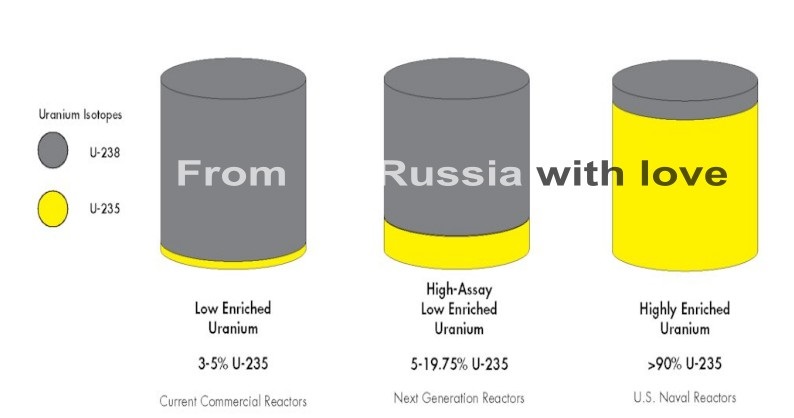
there is one major hurdle to the construction of most advanced reactors under development in the United States—the uranium type of fuel on which those reactors are designed to run is currently sold commercially by only one company in the world. And that company is a subsidiary of Russia’s ROSATOM, the Russian State Atomic Energy Corporation.
The federal government and U.S. companies developing advanced nuclear reactors—including Bill Gates’ TerraPower—recognize the urgent need to eliminate reliance on a Russian state corporation for nuclear fuel for America’s next-generation nuclear reactors.
The association Uranium Producers of America noted during a Senate committee hearing after the Russian invasion of Ukraine that “almost none of the fuel needed to power America’s nuclear fleet today comes from domestic producers, while U.S. nuclear utilities purchase nearly half of the of the uranium they consume from state-owned entities (SEO) in Russia, Kazakhstan, and Uzbekistan.”
“We estimate that there is more than $1 billion in annual U.S. dollar purchases of nuclear fuel flowing to ROSATOM,” said Scott Melbye, president of the association and Executive Vice President at Uranium Energy Corp.
ROSATOM is not under Western sanctions after the Russian invasion of Ukraine because of the Russian state firm’s importance in the supply chain of the global nuclear power industry. But the U.S. firms developing the next generation of more efficient, cheaper, and more environmentally friendly nuclear reactors don’t want to do business with Russia anymore.
Hence, the need for a commercially viable and stable domestic supply chain of the fuel for those advanced reactors—HALEU, or high assay low enriched uranium. ……………………………………….
the U.S. government faces the “chicken and egg” dilemma in HALEU supply, Matt Bowen, Research Scholar at the Center on Global Energy Policy at Columbia University SIPA, and Paul M. Dabbar, Distinguished Visiting Fellow at the same center, wrote in a paper in May this year/
“Existing enrichment companies, such as Urenco, Orano, GLE, and Centrus, could make HALEU, but these companies would likely be hesitant to invest too much in building HALEU infrastructure and completing NRC licensing without being confident there will in fact be a profitable market for the product,” they say.
New Zealand MP says Rocket Lab launches could betray country’s anti-nuclear stance
The commercial space company rejects criticism of satellite launches for the US military,
Guardian, Eva Corlett in Wellington, @evacorlett 17 Oct 22,
A New Zealand commercial space company, Rocket Lab, has faced new opposition to its activities on behalf of foreign militaries, with one New Zealand Green MP saying its actions could fly in the face of the country’s anti-nuclear stance.
The American-New Zealand company, founded by Peter Beck in 2006, provides rockets to deliver payloads into orbit from its launch site on the Māhia Peninsula, in New Zealand’s north. A third of Rocket Lab’s activities have been on behalf of defence and national security agencies. These include launching US and Australian spy satellites, the controversial “Gunsmoke J” satellite, and most recently Nasa’s capstone spacecraft.
The company’s contracts with the US have been flagged as concerning by the Māhia community, the Green party, and Rocket Lab Monitor – a watchdog group.
In 2019, the New Zealand government banned launch activities that were not in the country’s national interest, or were a breach of both domestic and international laws. The minister for economic and regional development, Stuart Nash, who is also the MP for the area that covers the Māhia Peninsula, has the ability to veto space launches that are not considered to be in the national interest, including payloads that contribute to nuclear weapons programmes or support or enable specific defence, security or intelligence operations contrary to government policy.
But the Green party’s security and intelligence spokesperson, Teanau Tuiono warned last week that it is “unclear when the national interest test should be invoked” and that there is no guarantee the satellites will not be used to assist nuclear programmes.
“Weaponising space is not in our national interest and goes against our international commitments to ensuring peace in space,” he said.
“Launching space satellites from Aotearoa could improve the ability of foreign actors to control a nuclear explosive device,” Tuiono said. “But right now, the government is allowing operators like Rocket Lab to put payloads into space for the US Army Space and Missile Defense Command and the US Space Force.”
Tuiono said that this poses a risk to New Zealand’s nuclear-free stance, which was enshrined in law more than 35 years ago and is considered a defining moment in the country’s history.
“We risk betraying the anti-nuclear generation and handing our kids a less safe world,” Tuiono said………………………………………………………
Watchdog group, Rocket Lab Monitor, has said it’s skeptical that this is a fail-proof system and worries the country’s space agency lacks in-house expertise to assess if satellites are contributing to nuclear weapon programmes.
“It all relies on the ‘intent’ of a payload rather than monitoring what it actually ends up being used for,” its spokesperson Sonya Smith said.
Smith pointed to Rocket Lab’s 2021 launch of the “Gunsmoke-J” satellite – an experimental satellite that, according to the US army, can “provide tactically actionable targeting data” to “warfighters”, and to which Minister Nash admitted he was “unaware of [its] specific military capabilities”.
Last month, the government announced a new aerospace strategy, that includes further financial support for the emerging sector. At the same time, it opened a review to allow the public to give feedback on the future of New Zealand’s space policy. https://www.theguardian.com/world/2022/oct/17/new-zealand-mp-says-rocket-lab-launches-could-betray-countrys-anti-nuclear-stance
Anti-nuclear campaigners have raised fears about a plan to turn Trawsfynydd into a test-bed for a new generation of mini nuclear power plants.
The Nuclear Decommissioning Authority which owns the Trawsfynydd
nuclear power plant site has signed an agreement with the Welsh
government’s development company, Cwmni Egino, to share information on
how best to redevelop the site. Cwmni Egino chief executive Alan Raymant
has said that they are focused on installing one of a new generation of
mini nuclear reactors developed by Rolls-Royce, with an aim to start on the
work by 2027.
But anti-nuclear campaigners CND Cymru, Cymdeithas y Cymod,
CADNO, and PAWB have released a statement opposing the plans and backing
renewables instead. “Wales is already a net exporter of electricity, and
the investment into true renewables like wave, wind, tidal, and sun will be
much more effective than the billions washed down the nuclear drain,”
they said. “We jointly call on the NDA to reconsider its support of
nuclear development in Wales, and Trawsfynydd and Wylfa in particular, and
further call on the UK and Welsh Government to invest in the green, clean,
and renewable future of wave, wind, and sun that we all deserve.”
Last month anti-nuclear campaigners have protested against plans for new nuclear
power stations to be built in Wales with a 70-mile march across Gwynedd and
Anglesey. Plaid Cymru Gwynedd Council leader Dyfrig Siencyn is among those
to have backed the plans for a new reactor at the nuclear power plant,
which employed 500 people when in operation between 1967 and 1993.
“There’s quite a strong anti-nuclear lobby, and they have been
demonstrating recently; we received a petition from them as a council,”
he told the Telegraph newspaper. “But I think we need nuclear energy if
we are serious about addressing the climate change emergency.”
Nation Cymru 14th Oct 2022 https://nation.cymru/news/anti-nuclear-campaigners-raise-fears-about-trawsfynydd-mini-nuke-test-bed-plans/
Small modular nuclear reactors risky venture for Saskatchewan
https://thestarphoenix.com/opinion/letters/letters-small-modular-nuclear-reactors-risky-venture-for-saskatchewan 16 Oct 22, Small modular reactors do not exist yet
Referring to nuclear as a possible part of our future energy mix in “SaskPower working to find right mix for the future,” (Oct. 5) CEO Rupen Pandya said “small modular reactors are smaller, easier to build, more affordable and safer”. This statement is both misleading and inappropriate.
Pandya’s use of the word “are” is a red flag: SMRs do not yet exist. The type of SMR SaskPower has selected to build — if it ever gets beyond the conceptual stage — would use enriched uranium fuel imported from the
USA, thus cannot be considered “safe”.
Are SMRs easier to build? We don’t know, since none have ever been built.
The exact cost of building the GE-Hitachi BWRX-300 is unknown, but would be in the billions of dollars, and is certainly less affordable than renewable energy options that are already available.
Nuclear power projects are prone to cost over-runs and delays — but this is an advantage for the companies involved in their design and construction, as it means more money will be be transferred to them from
the taxpayer.
An energy mix based on expensive, uncertain and risky SMRs would foreclose on building a truly sustainable energy future based on energy conservation and renewable sources like solar, wind, hydro, geothermal
and energy storage systems.
SaskPower should be listening — not trying to sell us on a particular option.
Cathy Holtslander, Saskatoon
SMRs are hardly emissions free
Re. Cameco engineer Brahm Neufeld’s letter on small modular reactors.
The marketing of SMRs has been entirely fraudulent. No emissions? Of course there will be emissions. All nuclear power plants must release radioactive gases, tritium and krypton intermittently and sometime inadvertently.
If carbon dioxide is included it would likely be radioactive carbon-14. Green? The carbon cost of building, mining, refining, enriching and decommissioning is many times that of solar and wind.
Dale Dewar, Wynyard
1 This Month



26 September – International Day for the Total Elimination of Nuclear Weapons


PLEASE OPPOSE HR 8255 AND S.3639 – bills would accelerate satellite deployment, with no environmental review or safeguards – https://ncstd5li.quorum.us/campaign/169331/
To see nuclear-related stories in greater depth and intensity – go to https://nuclearinformation.wordpress.com
-
Archives
- September 2026 (245)
- August 2026 (330)
- July 2026 (355)
- June 2026 (287)
- May 2026 (306)
- April 2026 (356)
- March 2026 (251)
- February 2026 (267)
- January 2026 (308)
- December 2025 (358)
- November 2025 (359)
- October 2025 (375)
-
Categories
- 1
- 1 NUCLEAR ISSUES
- business and costs
- climate change
- culture and arts
- ENERGY
- environment
- health
- history
- indigenous issues
- Legal
- marketing of nuclear
- media
- opposition to nuclear
- PERSONAL STORIES
- politics
- politics international
- Religion and ethics
- safety
- secrets,lies and civil liberties
- spinbuster
- technology
- Uranium
- wastes
- weapons and war
- Women
- 2 WORLD
- ACTION
- AFRICA
- Atrocities
- AUSTRALIA
- Christina's notes
- Christina's themes
- culture and arts
- Events
- Fuk 2022
- Fuk 2023
- Fukushima 2017
- Fukushima 2018
- fukushima 2019
- Fukushima 2020
- Fukushima 2021
- general
- global warming
- Humour (God we need it)
- Nuclear
- RARE EARTHS
- Reference
- resources – print
- Resources -audiovicual
- Weekly Newsletter
- World
- World Nuclear
- YouTube
-
RSS
Entries RSS
Comments RSS
 nuclear-news