The ugly truth behind ChatGPT: AI is guzzling resources at planet-eating rates
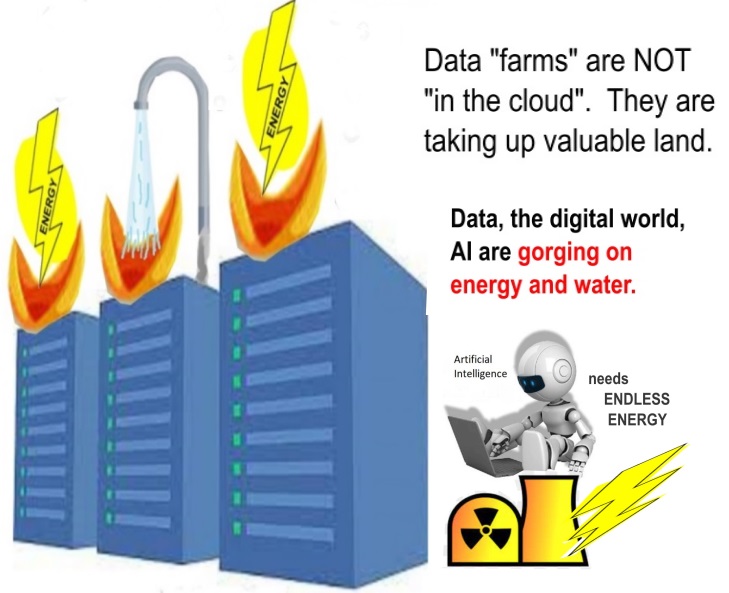
Mariana Mazzucato, Mariana Mazzucato is professor of economics at UCL, and director of the Institute for Innovation and Public Purpose, https://www.theguardian.com/commentisfree/article/2024/may/30/ugly-truth-ai-chatgpt-guzzling-resources-environment
Big tech is playing its part in reaching net zero targets, but its vast new datacentres are run at huge cost to the environment.
hen you picture the tech industry, you probably think of things that don’t exist in physical space, such as the apps and internet browser on your phone. But the infrastructure required to store all this information – the physical datacentres housed in business parks and city outskirts – consume massive amounts of energy. Despite its name, the infrastructure used by the “cloud” accounts for more global greenhouse emissions than commercial flights. In 2018, for instance, the 5bn YouTube hits for the viral song Despacito used the same amount of energy it would take to heat 40,000 US homes annually.
This is a hugely environmentally destructive side to the tech industry. While it has played a big role in reaching net zero, giving us smart meters and efficient solar, it’s critical that we turn the spotlight on its environmental footprint. Large language models such as ChatGPT are some of the most energy-guzzling technologies of all. Research suggests, for instance, that about 700,000 litres of water could have been used to cool the machines that trained ChatGPT-3 at Microsoft’s data facilities. It is hardly news that the tech bubble’s self-glorification has obscured the uglier sides of this industry, from its proclivity for tax avoidance to its invasion of privacy and exploitation of our attention span. The industry’s environmental impact is a key issue, yet the companies that produce such models have stayed remarkably quiet about the amount of energy they consume – probably because they don’t want to spark our concern.
Google’s global datacentre and Meta’s ambitious plans for a new AI Research SuperCluster (RSC) further underscore the industry’s energy-intensive nature, raising concerns that these facilities could significantly increase energy consumption. Additionally, as these companies aim to reduce their reliance on fossil fuels, they may opt to base their datacentres in regions with cheaper electricity, such as the southern US, potentially exacerbating water consumption issues in drier parts of the world. Before making big announcements, tech companies should be transparent about the resource use required for their expansion plans.
Furthermore, while minerals such as lithium and cobalt are most commonly associated with batteries in the motor sector, they are also crucial for the batteries used in datacentres. The extraction process often involves significant water usage and can lead to pollution, undermining water security. The extraction of these minerals are also often linked to human rights violations and poor labour standards. Trying to achieve one climate goal of limiting our dependence on fossil fuels can compromise another goal, of ensuring everyone has a safe and accessible water supply.
Moreover, when significant energy resources are allocated to tech-related endeavours, it can lead to energy shortages for essential needs such as residential power supply. Recent data from the UK shows that the country’s outdated electricity network is holding back affordable housing projects. This will only get worse as households move away from using fossil fuels and rely more on electricity, putting even more pressure on the National Grid. In Bicester, for instance, plans to build 7,000 new homes were paused because the electricity network didn’t have enough capacity.
In an era where we expect businesses to do more than just make profits for their shareholders, governments need to evaluate the organisations they fund and partner with, based on whether their actions will result in concrete successes for people and the planet. In other words, policy needs to be designed not to pick sectors or technologies as “winners”, but to pick the willing by providing support that is conditional on companies moving in the right direction. Making disclosure of environmental practices and impacts a condition for government support could ensure greater transparency and accountability. Similar measures could promote corporate accountability in global mineral supply chains, enforcing greater human rights compliance.
In navigating the intersection of technological advancement and environmental sustainability, policymakers are facing the challenge of cultivating less extractive business models. This is not just about adopting a piecemeal approach; it’s about taking a comprehensive systematic view, empowering governments to build the needed planning and implementation capacity. Such an approach should eschew outdated top-down methods in favour of flexible strategies that integrate knowledge at all levels, from local to global. Only by adopting a holistic perspective can we effectively mitigate the significant environmental impacts of the tech industry.
Ultimately, despite the unprecedented wave of innovation since the 1990s, we have consistently overlooked the repercussions of these advances on the climate crisis. As climate scientists anticipate that global heating will exceed the 1.5C target, it’s time we approach today’s grand challenges systemically, so that the solution to one problem does not exacerbate another.
Small modular nuclear reactors get a reality check in new report

New Atlas By Michael Franco, May 31, 2024
A new report has assessed the feasibility of deploying small modular nuclear reactors to meet increasing energy demands around the world. The findings don’t look so good for this particular form of energy production.
Small modular nuclear reactors (SMR) are generally defined as nuclear plants that have capacity that tops out at about 300 megawatts, enough to run about 30,000 US homes. According to the Institute for Energy Economics and Financial Analysis (IEEFA), which prepared the report, there are about 80 SMR concepts currently in various stages of development around the world.
While such reactors were once thought to be a solution to the complexity, security risks, and costs of large-scale reactors, the report asks if continuing to pursue these smaller nuclear power plants is a worthwhile endeavor in terms of meeting the demand for more and more energy around the globe.
The answer to this question is pretty much found in the report’s title: “Small Modular Reactors: Still Too Expensive, Too Slow, and Too Risky.”
If that’s not clear enough though, the report’s executive summary certainly gets to the heart of their findings.
“The rhetoric from small modular reactor (SMR) advocates is loud and persistent: This time will be different because the cost overruns and schedule delays that have plagued large reactor construction projects will not be repeated with the new designs,” says the report. “But the few SMRs that have been built (or have been started) paint a different picture – one that looks startlingly similar to the past. Significant construction delays are still the norm and costs have continued to climb.”
Too Expensive
The cost of SMRs is at the forefront of the report’s argument against the deployment of the reactors. According to some of the data it provides, all three SMRs currently operating (plus one now being completed in Argentina) went way over budget, as this graph shows.

The report authors also point out that a project in Idaho called NuScale had to be scrapped because during its development between 2015 and 2023, costs soared from $9,964 per kilowatt to $21,561 per kilowatt. Additionally, the costs for three other small plants in the US have all skyrocketed dramatically from their initial cost assessments.

Not only are the excessive costs of building SMRs problematic in and of themselves, says the IEEFA, but the money being poured into the projects is money that is not being spent on developing other sources of energy that are cleaner, quicker to deploy, and safer.
“It is vital that this debate consider the opportunity costs associated with the SMR push,” write the authors. “The dollars invested in SMRs will not be available for use in building out a wind, solar and battery storage resource base. These carbon-free and lower-cost technologies are available today and can push the transition from fossil fuels forward significantly in the coming 10 years – years when SMRs will still be looking for licensing approval and construction funding.”
Too Slow
That last bit gets to another of the report’s findings: that building SMRs simply takes too much time. The Shidao Bay project in China, for example, was supposed to take four years to build, but actually took 12; the Russian Ship Borne project had an estimated completion time of three years, but took 13; and the ongoing CAREM project in Argentina was supposed to be done in four years, but it’s now in its 13th year of development. (another excellent graph on original)………………………………………………………………………
Too Risky
Both the unpredictable costs and the extraordinary building delays makes SMR development just too big of a risk, says the IEEFA. But that’s not the only potential peril. Because the technology for this small-scale nuclear facility is fairly new and untested, risks could exist in terms of functionality and safety as well. For example, the authors question if the new SMRs will actually be able to output the kind of power they claim. Based on cost and development estimates going so widely afield, the sense in the report is that power output claims could also be off.
In terms of safety, the report quotes a 2023 study for the US Air Force that said: “Since SMR technology is still developing and is not deployed in the US, information is scarce concerning the various costs for [operations & maintenance], decommissioning and end-of-life dissolution, property restoration and site clean-up and waste management.”
The authors also point out that because many SMRs are being built using identical technologies, if a component of that tech fails, it could easily affect reactors around the world……………………………
Conclusion
So: too expensive, too slow, and too risky. And not at all where we should be focussing our, um – energy – these days, as the study authors make clear in their conclusion.
“At least 375,000 MW of new renewable energy generating capacity is likely to be added to the US grid in the next seven years,” they say. “By contrast, IEEFA believes it is highly unlikely any SMRs will be brought online in that same time frame. The comparison couldn’t be clearer. Regulators, utilities, investors and government officials should acknowledge this and embrace the available reality: Renewables are the near-term solution.”https://newatlas.com/energy/modular-nuclear-reactors/—
Small Modular Reactors: Still too expensive, too slow and too risky.

Institute for Energy Economics and Financial Analysis.
1 Report SMRs (Small Modular Reactors) Nuclear Transition United States
Institute for Energy Economics and Financial Analysis. May 29, 2024, David Schlissel and Dennis Wamsted more https://ieefa.org/resources/small-modular-reactors-still-too-expensive-too-slow-and-too-risky?fbclid=IwZXh0bgNhZW0CMTEAAR1jnn-FMHaMbUkjLSR0kbe-ku3uRRLcwq5jFcZfx62d4vHIZilLTK73YOg_aem_Abj940YmQyHY2fHN3alfZYFxXGCjmhy7qqSR1SLZ7HipqrGxyOaplVTSCuk7GjV3z8ZxriI0DSoGaIg4KFv_B5L1
Key Findings
Small modular reactors still look to be too expensive, too slow to build, and too risky to play a significant role in transitioning from fossil fuels in the coming 10-15 years.
Investment in SMRs will take resources away from carbon-free and lower-cost renewable technologies that are available today and can push the transition from fossil fuels forward significantly in the coming 10 years.
Experience with operating and proposed SMRs shows that the reactors will continue to cost far more and take much longer to build than promised by proponents.
Regulators, utilities, investors and government officials should embrace the reality that renewables, not SMRs, are the near-term solution to the energy transition.
The rhetoric from small modular reactor (SMR) advocates is loud and persistent: This time will be different because the cost overruns and schedule delays that have plagued large reactor construction projects will not be repeated with the new designs. But the few SMRs that have been built (or have been started) paint a different picture—one that looks startingly similar to the past. Significant construction delays are still the norm and costs have continued to climb.
IEEFA has taken a close look at the data available from the four SMRs currently in operation or under construction, as well as new information about projected costs from some of the leading SMR developers in the U.S. The results of the analysis show little has changed from our previous work. SMRs still are too expensive, too slow to build, and too risky to play a significant role in transitioning from fossil fuels in the coming 10 to 15 years.
We believe these findings should serve as a cautionary flag for all energy industry participants. In particular, we recommend that:
- Regulators who will be asked to approve utility or developer-backed SMR proposals should craft restrictions to prevent delays and cost increases from being pushed onto ratepayers.
- Utilities that are considering SMRs should be required to compare the technology’s uncertain costs and completion dates with the known costs and construction timetables of renewable alternatives. Utilities that still opt for the SMR option should be required to put shareholder funds at risk if costs and construction times exceed utility estimates.
Investors and bankers weighing any SMR proposal should carefully conduct their due diligence. Things will go wrong, imperiling the chances for full recovery of any invested funds.
State and federal governments should require that estimated SMR construction costs and schedules be publicly available so that utility ratepayers, taxpayers and investors are better able to assess the magnitude of the SMR-related financial risks that they may be forced to bear.
Finally, it is vital that this debate consider the opportunity costs associated with the SMR push. The dollars invested in SMRs will not be available for use in building out a wind, solar and battery storage resource base. These carbon-free and lower-cost technologies are available today and can push the transition from fossil fuels forward significantly in the coming 10 years—years when SMRs will still be looking for licensing approval and construction funding.
Space junk is raining from the sky. Who’s responsible when it hits the Earth?

With more rockets launching each year, there’s more risk of falling debris causing damage — or hitting someone
Nicole Mortillaro · CBC News ·May 28, 2024 , https://www.cbc.ca/news/science/space-debris-responsibility-1.7211473#:~:text=It%20says%20that%20countries%20are,absolute%20liability%2C%22%20she%20said.
In March 2022, a couple living in the rural town of São Mateus do Sul, Brazil, were shocked to find a 600-kilogram piece of smashed metal lying just 50 metres from their home.
Four months later, two Australian sheep farmers found a strange, black object that appeared to have embedded itself in a field.
Then last week, a farmer in Ituna, Sask., found a similar object in his wheat field.
Alien invasion? Nope. All pieces of SpaceX debris that had fallen from the sky.
In the past, these events were rare. Instead, it was often said that because our planet is more than 70 per cent ocean, the chances of space debris reaching the ground in a populated area were slim.
While that is still largely true, the chances may be on the rise, said Cassandra Steer, the deputy director of mission specialists at Australian National University’s Institute for Space.
“The odds are increasing just because of the amount of space traffic that we are creating,” she said. “I mean, in the first 50 years of [spaceflight] since 1957, when Sputnik was launched, … there were something like 2,000 launches in total.
“These days, we’re seeing 1,000 launches per year.”
This leads to a big question: Who is responsible for this space debris?
The answer is complicated. There are a few United Nations agreements in place, but for the most part, it’s rare for any one country to take another country to international court over space junk.
Space law
Yes, space law is a thing.
The Outer Space Treaty, of which Canada is a signatory, was adopted in 1967 to govern the peaceful use of space. It says that countries are liable for any damage caused by space objects they’ve launched. Commercial activities are covered by the treaty’s Liability Convention, Steer said.
“The Liability Convention says if there’s damage caused on Earth, or in the air, then it’s absolute liability,” she said. “In other words, you don’t have to prove faults, you just have to figure out where this debris came from.”
That convention was put to the test in 1978, when a Soviet nuclear satellite called Cosmos 954 re-entered Earth’s atmosphere and exploded over Northern Canada, scattering radioactive debris from present-day Nunavut to northern Alberta. The Canadian government spent more than $14 million CAD in cleanup efforts.
Canada used the Liability Convention to request $4.4 million in compensation from the Soviet Union. In the end, it received $3 million.
In addition to physical damage, countries could potentially seek compensation for economic costs that come from planes or ships being forced to divert due to debris re-entry, said Ewan Wright, a PhD candidate at the University of British Columbia studying the sustainability of the outer space environment.
Geopolitical tensions can also influence how countries respond to such incidents, he said.
“The states are wary of setting a precedent because, you know, last month it was U.S. debris hitting Canada. But what if it was Canadian debris hitting China?”
In response to last week’s incident, the Canadian Space Agency said, “We are working with our partners at Global Affairs Canada and Department of National Defence on the management of space debris.”
There might not be any liability issues to sort out in this particular case. That’s because liability hangs on one word: damage.
And since no damage was done, the U.S. — the country where the debris originated — has no real obligation.
A growing problem
What fell in Barry Sawchuk’s Saskatchewan field was part of a private SpaceX mission called Axiom-3.
Many people are aware that SpaceX returns the first stage of their rockets to be reused again and again. But there is also a second stage to those rockets, and in some cases — such as with the Axiom missions and resupply missions to the International Space Station (ISS) — a trunk that holds pressurized cargo. Both of those are expected to fall out of orbit on their own and burn up completely as they re-enter the Earth’s atmosphere.
But tell that to Sawchuk.
Samantha Lawler, an associate professor of astronomy at the University of Regina who keeps a close eye on satellites and their orbits, said it’s concerning that the Saskatchewan debris made it to Earth.
“The farmer found a one-hundred-pound piece of junk, four feet by six feet,” she said. “It’s huge. So yeah, clearly it is not burning up, and others in the area have found other pieces, too.”
Part of that may be explained by the materials used in the rockets — like carbon fibre, which was used in that SpaceX trunk. While aluminum will burn up fairly well, carbon fibre doesn’t.
This isn’t just a SpaceX problem. In 2023, a massive cylindrical object washed up on shore in Western Australia. The Australian Space Agency reported that it was part of a launch vehicle from India’s space agency.
There have also been incidents involving space junk from China. In 2007, a plane narrowly avoided being hit by Russian space debris. And last month, a piece of space junk from the ISS that was expected to burn up ended up slamming through the roof and two floors of a Florida home.
Chances of being hit
And that’s what’s most concerning: that one day debris will hit a plane or someone on the ground.
Aaron Boley is an associate professor at UBC’s physics and astronomy department and co-director at the Outer Space Institute, a group of experts dedicated to space exploration. He’s been crunching the numbers on orbital debris re-entering Earth’s atmosphere.
“There’s a lot of work that’s been done on this. And people have been kind of screaming and pounding things and saying, ‘Look, you can’t just keep dropping things thinking it’s not going to matter,'” he said.
He’s deeply concerned that people are looking the other way.
“[NASA] said it was going to entirely demise and ablate in the atmosphere and instead somebody had something that went through their roof, went through the first floor, went through the next floor,” he said. “And so there are all these assumptions that I think we are seeing being challenged just because there’s so much activity taking place right now.”
For the most part, space companies and agencies are responsible for the end of life of their satellites and rockets. For some, that means putting them in a high orbit that is a sort of graveyard around Earth. Others use their craft’s remaining fuel to do a controlled de-orbit.
But then there are those spent rocket stages that are left to orbit Earth. The planet is always pulling them down, so eventually their orbits “decay” and they fall back down, and they don’t always burn up in the atmosphere when they do.
So what are the chances of space debris crashing into a person?
“We estimate the chance of somebody getting hit by one of the rocket bodies over the next 10 years to be about 20 to 30 per cent,” PhD candidate Wright said. “So that worked out to about a three or four per cent chance each year that someone, somewhere will get hit by a piece of space debris.”
Part of that also has to do with how much our population has increased since the start of the space program.
With a record number of launches every year, the risk is only going to grow, Wright said.
“We’re putting thousands of satellites up and nothing is really being done about this re-entry issue. And even if we stop launching today, there would still be space debris that comes down over the next century.”
Altman-Backed Oklo Sees Data Centers Boosting Nuclear Demand, (though OKLO design not yet approved)

Will Wade, Bloomberg News
Bloomberg) — A day after announcing a deal to provide nuclear energy to a data center, Oklo Inc. says it expects to sign additional contracts from the power-hungry industry.
About 80% of Oklo’s inbound inquiries are coming from data center operators, according to Jacob DeWitte, chief executive officer of the company that is backed by Sam Altman, CEO of the AI firm OpenAI Inc. It went public this month through a merger with Altman’s AltC Acquisition Corp.
Oklo agreed Thursday to deliver 100 megawatts of power to Wyoming Hyperscalar to run a data center campus. “This is just a scratch on the tip of an iceberg,” DeWitte said in an interview Friday at Bloomberg’s headquarters in New York. “There’s going to be a lot more.”
While utilities are racing to meet demand that’s forecast by some analysts to soar thanks to artificial intelligence and data centers, it will be years before Oklo can help meet that need. The Santa Clara, California-based company has yet to receive regulatory approval to build its reactor and DeWitte said it’s unlikely one will be in service before 2027.
Why US Opposes Efforts to Keep Space Weapons-Free
https://sputnikglobe.com/20240521/why-us-opposes-efforts-to-keep-space-weapons-free-1118569943.html
The United Nations Security Council failed to adopt a resolution drafted by Russia on prevention of weapon deployment in space this week, with seven countries – including the United States and Britain – voting against it.
The United States and Britain’s move to block a Russian draft resolution in the UN Security Council aimed at preventing an arms race in space stem from the US’ unwillingness to let Russian and Chinese initiatives to ban space weapons succeed, Dmitry Stefanovich from the Moscow-based Institute of World Economy and International Relations at the Russian Academy of Sciences says.
While Russia and China, as well as a number of other countries, insist on adopting a legally binding document that would ban the very concept of stationing weapon systems in space, Western powers such as the US want the situation where anyone can deploy anything they want in space as long as their behavior is deemed correct, he explains.
Therefore, the West is promoting the concept of restricting what spacecraft can do in space whereas the Russo-Chinese approach is to prohibit sending weapons into space, Stefanovich surmises.
Regarding speculation about the possible deployment of nuclear weapons in Earth’s orbit, Stefanovich points out that the United States currently enjoys a distinct advantage in the “dual-use space infrastructure,” i.e. spacecraft and satellites that can be used for both commercial/scientific and military purposes.
Since destroying large satellite constellations through conventional means, one by one, would seem a daunting task, it begets concerns that nuclear weapons might be used to accomplish such tasks, he explains.
Stefanovich also lamentas that any progress in resolving concerns about weapon deployment in space that was made in the past few years was essentially undone amid the ongoing conflict between the West and Russia, as well as the confrontation between the United States and China.
“Currently, everyone is looking for a way to weaken their adversary rather than for some kind of mutually acceptable solution,” he says.
Tech firms claim nuclear will solve AI’s power needs – they’re wrong

Some AI firms think nuclear power can help meet the electricity demand from Silicon Valley’s data centres, but building new nuclear power stations takes too long to plug the gap in the short term
New Scientist, By Jeremy Hsu, 16 May 2024
Silicon Valley wants to use nuclear power to support the energy-hungry data centres that help train and deploy its artificial intelligence models. But realistic timelines show that any US nuclear renaissance will have at best a limited impact during a period of fast-rising electricity demand.
Global electricity usage from data centres is already on track to double by 2026. In the US, data centres represent the fastest-growing source of energy demand at a time when the country’s……………………… (Subscribers only) https://www.newscientist.com/article/2431828-tech-firms-claim-nuclear-will-solve-ais-power-needs-theyre-wrong/
—
Mini-Nukes, Big Bucks: The Interests Behind the Small Modular Reactor Push

Scandal-ridden SNC-Lavalin is playing a major role in the push for SMRs.
Then there’s Terrestrial Energy
the Breakthrough Energy Coalition (BEC) no longer makes its membership public, the original coalition included such familiar names as Jeff Bezos (Amazon), Marc Benioff (Salesforce), Michael Bloomberg, Richard Branson, Jack Ma (Alibaba), David Rubenstein (Carlyle Group), Tom Steyer, George Soros, and Mark Zuckerberg. Many of those names (and others) can now be found on the “Board and Investors” page of Breakthrough Energy’s website.
Why Canada is now poised to pour billions of tax dollars into developing Small Modular Reactors as a “clean energy” climate solution
by Joyce Nelson, January 14, 2021
https://watershedsentinel.ca/articles/mini-nukes-big-bucks-the-money-behind-small-modular-reactors/—
Back in 2018, the Watershed Sentinel ran an article warning that “unless Canadians speak out,” a huge amount of taxpayer dollars would be spent on small modular nuclear reactors (SMRs), which author D. S. Geary called “risky, retro, uncompetitive, expensive, and completely unnecessary.” Now here we are in 2021 with the Trudeau government and four provinces (Saskatchewan, Ontario, New Brunswick, and Alberta) poised to pour billions of dollars into SMRs as a supposed “clean energy” solution to climate change.
It’s remarkable that only five years ago, the National Energy Board predicted: “No new nuclear units are anticipated to be built in any province” by 2040.
So what happened?
The answer involves looking at some of the key influencers at work behind the scenes, lobbying for government funding for SMRs.
The Carney factor
When the first three provinces jumped on the SMR bandwagon in 2019 at an estimated price tag of $27 billion, the Green Party called the plan “absurd” – especially noting that SMRs don’t even exist yet as viable technologies but only as designs on paper.
According to the BBC (March 9, 2020), some of the biggest names in the nuclear industry gave up on SMRs for various reasons: Babcock & Wilcox in 2017, Transatomic Power in 2018, and Westinghouse (after a decade of work on its project) in 2014.
But in 2018, the private equity arm of Canada’s Brookfield Asset Management Inc. announced that it was buying Westinghouse’s global nuclear business (Westinghouse Electric Co.) for $4.6 billion.
Two years later, in August 2020, Brookfield announced that Mark Carney, former Bank of England and Bank of Canada governor, would be joining the company as its vice-chair and head of ESG (environmental, social, and governance) and impact fund investing, while remaining as UN Special Envoy for Climate Action and Finance.
“We are not going to solve climate change without the private sector,” Carney told the press, calling the climate crisis “one of the greatest commercial opportunities of our time.” He considers Canada “an energy superpower,” with nuclear a key asset.
Carney is an informal advisor to PM Trudeau and to British PM Boris Johnson. In November, Johnson announced £525 million (CAD$909.6 million) for “large and small-scale nuclear plants.”
SNC-Lavalin
Scandal-ridden SNC-Lavalin is playing a major role in the push for SMRs. In her mid-December 2020 newsletter, Elizabeth May, the Parliamentary Leader of the Green Party, focused on SNC-Lavalin, reminding readers that in 2015, then-PM Stephen Harper sold the commercial reactor division of Atomic Energy of Canada Ltd. (AECL) “to SNC-Lavalin for the sweetheart deal price of $15 million
May explained, “SNC-Lavalin formed a consortium called the Canadian National Energy Alliance (CNEA) to run some of the broken-apart bits of AECL. CNEA has been the big booster of what sounds like some sort of warm and cuddly version of nuclear energy – Small Modular Reactors. Do not be fooled. Not only do we not need new nuclear, not only does it have the same risks as previous nuclear reactors and creates long-lived nuclear wastes, it is more tied to the U.S. military-industrial complex than ever before. That’s because SNC-Lavalin’s partners in the CNEA are US companies Fluor and Jacobs,” who both have contracts with US Department of Energy nuclear-weapons facilities.”
But, states May, “Natural Resources Minister Seamus O’Regan has been sucked into the latest nuclear propaganda – that ‘there is no pathway to Net Zero [carbon emissions] without nuclear’.”
Terrestrial Energy
Then there’s Terrestrial Energy, which in mid-October 2020 received a $20 million grant for SMR development from NRCan’s O’Regan and Navdeep Bains (Minister of Innovation, Science and Industry). The announcement prompted more than 30 Canadian NGOs to call SMRs “dirty, dangerous, and distracting” from real, available solutions to climate change.
The Connecticut-based company has a subsidiary in Oakville, Ontario. Its advisory board includes Stephen Harper; Michael Binder, the former president and CEO of the Canadian Nuclear Safety Commission; and (as of October) Dr. Ian Duncan, the former UK Minister of Climate Change in the Dept. of Business Energy and Industrial Strategy (BEIS).
Perhaps more important, Terrestrial Energy’s advisory board includes Dr. Ernest Moniz, the former US Secretary of the Dept. of Energy (2013-2017) who provided more than $12 billion in loan guarantees to the nuclear industry. Moniz has been a key advisor to the Biden-Harris transition team, which has come out in favour of SMRs, calling them “game-changing technologies” at “half the construction cost of today’s reactors.”

In 2015, while the COP 21 Paris Climate Agreement was being finalized, Moniz told reporters that SMRs could lead to “better financing terms” than traditional nuclear plants because they would change the scale of capital at risk. For years, banks and financial institutions have been reluctant to invest in money-losing nuclear projects, so now the goal is to get governments to invest, especially in SMRs.
That has been the agenda of a powerful lobby group that has been working closely with NRCan for several years.
The “billionaires’ nuclear club”
The 2015 Paris climate talks featured what cleantechnica.com called a “splashy press conference” by Bill Gates to announce the launch of the Breakthrough Energy Coalition (BEC) – a group of (originally) 28 high net-worth investors, aiming “to provide early-stage capital for technologies that offer promise in bringing affordable clean energy to billions.”
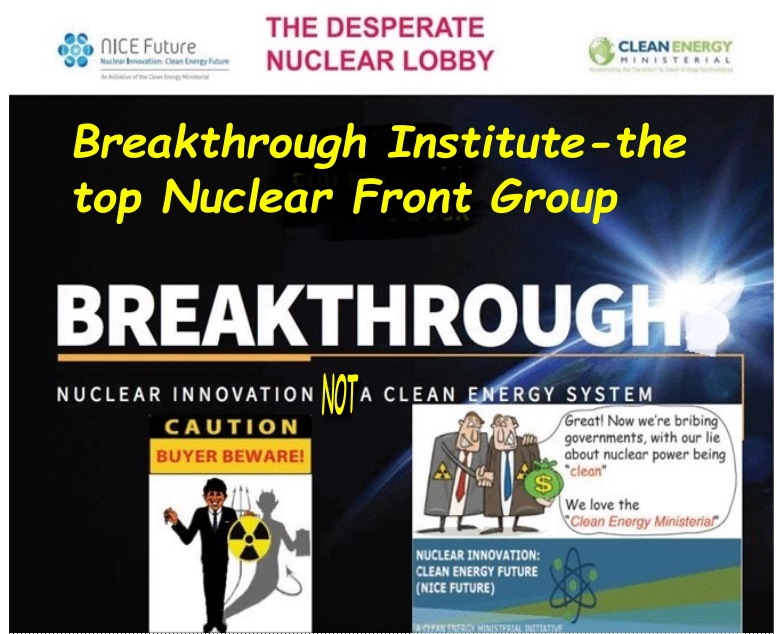
Though BEC no longer makes its membership public, the original coalition included such familiar names as Jeff Bezos (Amazon), Marc Benioff (Salesforce), Michael Bloomberg, Richard Branson, Jack Ma (Alibaba), David Rubenstein (Carlyle Group), Tom Steyer, George Soros, and Mark Zuckerberg. Many of those names (and others) can now be found on the “Board and Investors” page of Breakthrough Energy’s website.
Writing in Counterpunch (Dec. 4, 2015) shortly after BEC’s launch, Linda Pentz Gunter noted that many of those 28 BEC billionaires (collectively worth some $350 billion at the time) are pro-nuclear and Gates himself “is already squandering part of his wealth on Terra Power LLC, a nuclear design and engineering company seeking an elusive, expensive and futile so-called Generation IV traveling wave reactor” for SMRs. (In 2016, Terra Power, based in Bellevue, Washington, received a $40 million grant from Ernest Moniz’s Department of Energy.)
According to cleantechnica.com, the Breakthrough Energy Coalition “does have a particular focus on nuclear energy.” Think of BEC as the billionaires’ nuclear club.
By 2017, BEC was launching Breakthrough Energy Ventures (BEV), a $1 billion fund to provide start-up capital to clean-tech companies in several countries.
Going after the public purse
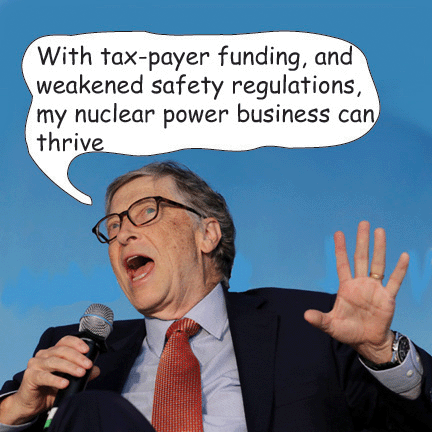
Bill Gates was apparently very busy during the 2015 Paris climate talks. He also went on stage during the talks to announce a collaboration among 24 countries and the EU on something called Mission Innovation – an attempt to “accelerate global clean energy innovation” and “increase government support” for the technologies. Mission Innovation’s key private sector partners include the Breakthrough Energy Coalition, the World Economic Forum, the International Energy Agency, and the World Bank.
An employee at Natural Resources Canada, Amanda Wilson, was appointed as one of the 12 international members of the Mission Innovation Steering Committee.
In December 2017, Bill Gates announced that the Breakthrough Energy Coalition was partnering with Mission Innovation members Canada, UK, France, Mexico, and the European Commission in a “public-private collaboration” to “double public investment in clean energy innovation.”
Canada’s Minister of Natural Resources at the time, Jim Carr, said the partnership with BEC “will greatly benefit the environment and the economy. Working side by side with innovators like Bill Gates can only serve to enhance our purpose and inspire others.”
Dr. M.V. Ramana, an expert on nuclear energy and a professor at the School of Public Policy and Global Affairs at UBC, told me by email: “As long as Bill Gates is wasting his own money or that of other billionaires, it is not so much of an issue. The problem is that he is lobbying hard for government investment.”
Dr. Ramana explained that because SMRs only exist on paper, “the scale of investment needed to move these paper designs to a level of detail that would satisfy any reasonable nuclear safety regulator that the design is safe” would be in the billions of dollars. “I don’t see Gates and others being willing to invest anything of that scale. Instead, they invest a relatively small amount of money (compared to what they are worth financially) and then ask for government handouts for the vast majority of the investment that is needed.”
Kevin Kamps, Radioactive Waste Specialist at Beyond Nuclear, told me by email that the companies involved in SMRs “don’t care” if the technology is actually workable, “so long as they get paid more subsidies from the unsuspecting public. It’s not a question of it working, necessarily,” he noted.
Gordon Edwards, President of the Canadian Coalition for Nuclear Responsibility, says governments “are being suckers. Because if Wall Street and the banks will not finance this, why should it be the role of the government to engage in venture capitalism of this kind?”
“Roadmap” to a NICE future
By 2018, NRCan was pouring money into a 10-month, pan-Canadian “conversation” about SMRs that brought together some 180 individuals from First Nations and northern communities, provincial and territorial governments, industry, utilities, and “stakeholders.” The resulting November 2018 report, A Call to Action: A Canadian Roadmap for Small Modular Reactors, enthusiastically noted that “Canada’s nuclear industry is poised to be a leader in an emerging global market estimated at $150 billion a year by 2040.”
At the same time, Bill Gates announced the launch of Breakthrough Energy Europe, a collaboration with the European Commission (one of BEC’s five Mission Innovation partners) in the amount of 100 million euros for clean-tech innovation.
Gates’ PR tactic is effective: provide a bit of capital to create an SMR “bandwagon,” with governments fearing their economies would be left behind unless they massively fund such innovations.
NRCan’s SMR Roadmap was just in time for Canada’s hosting of the Clean Energy Ministerial/Mission Innovation summit in Vancouver in May 2019 to “accelerate progress toward a clean energy future.” Canada invested $30 million in Breakthrough Energy Solutions Canada to fund start-up companies.
A particular focus of the CEM/MI summit was a CEM initiative called “Nuclear Innovation: Clean Energy (NICE) Future,” with all participants receiving a book highlighting SMRs. As Tanya Glafanheim and M.V. Ramana warned in thetyee.ca (May 27, 2019) in advance of the summit, “Note to Ministers from 25 countries: Prepare to be dangerously greenwashed.”
Greenwash vs public backlash
While releasing the federal SMR Action Plan on December 18, O’Regan called it “the next great opportunity for Canada.”
Bizarrely, the Action Plan states that by developing SMRs, our governments would be “supporting reconciliation with Indigenous peoples” – but a Special Chiefs Assembly of the Assembly of First Nations passed a unanimous 2018 resolution demanding that “the Government of Canada cease funding and support” of SMRs. And in June 2019, the Anishinabek Chiefs-in-Assembly (representing 40 First Nations across Ontario) unanimously opposed “any effort to situate SMRs within our territory.”
Some 70 NGOs across Canada are opposed to SMRs, which are being pushed as a replacement for diesel in remote communities, for use in off-grid mining, tar-sands development, and heavy industry, and as exportable expertise in a global market.
On December 7, the Hill Times published an open letter to the Treasury Board of Canada from more than 100 women leaders across Canada, stating: “We urge you to say ‘no’ to the nuclear industry that is asking for billions of dollars in taxpayer funds to subsidize a dangerous, highly-polluting and expensive technology that we don’t need. Instead, put more money into renewables, energy efficiency and energy conservation.”
No new money for SMRs was announced in the Action Plan, but in her Fall Economic Statement, Finance Minister Chrystia Freeland touted SMRs and noted that “targeted action by the government to mobilize private capital will better position Canadian firms to bring their technologies to market.” That suggests the Canada Infrastructure Bank will use its $35 billion for such projects.
It will take a Herculean effort from the public to defeat this NICE Future, but along with the Assembly of First Nations, three political parties – the NDP, the Bloc Quebecois, and the Green Party – have now come out against SMRs.
Award-winning author Joyce Nelson’s latest book, Bypassing Dystopia, is published by Watershed Sentinel Books. She can be reached via www.joycenelson.ca.
Canada’s plutonium mishap in India was 50 years ago this week – is history repeating itself now?

the International Panel on Fissile Materials states: ‘the most important reason to be concerned about the practice of reprocessing is that plutonium can be used to make weapons.’
Canada’s support for the Moltex technology could be used by other countries to justify their own plutonium acquisition programs
by Susan O’Donnell and Gordon Edwards, May 16, 2024, https://nbmediacoop.org/2024/05/16/canadas-plutonium-mishap-in-india-was-50-years-ago-this-week-is-history-repeating-itself-now/
In the public imagination, nuclear power for electricity and nuclear weapons are entirely separate issues. Because Canada is not a nuclear weapons state, Canada’s nuclear power reactors are thought to be unrelated to weapons of mass destruction, and its nuclear technology exports are considered ‘peaceful.’
Yet this week marks the 50-year anniversary of one day in May when Canada’s ‘peaceful’ nuclear image was shattered. On May 18, 1974, India shocked the world by conducting a test A-Bomb explosion it called ‘Smiling Buddha.’ The nuclear explosive was plutonium, obtained from a ‘peaceful’ research reactor – a gift from the Canadian government in 1954.
Plutonium is not found in nature but nuclear reactors create it as a by-product. Plutonium was the explosive used in the A-Bomb that the U.S. military dropped on the Japanese city of Nagasaki in 1945, killing 70,000 civilians, half of them on the first day.
The story of India’s first A-Bomb shows that ‘intent’ is all that separates military from civilian use of nuclear technology. On that fateful day in 1974, it suddenly became clear that any country with a nuclear reactor can choose to extract plutonium from the fiercely radioactive used fuel and secretly make a nuclear bomb.
Plutonium extraction is a sensitive procedure called ‘reprocessing.’ Plutonium can also be used as a nuclear fuel. But this can only be done by first reprocessing used nuclear fuel, and this increases the risk of nuclear weapons proliferation. As the International Panel on Fissile Materials states: ‘the most important reason to be concerned about the practice of reprocessing is that plutonium can be used to make weapons.’
India’s nuclear explosion deeply traumatized Ottawa and shocked the world. U.S. Secretary of State Henry Kissinger publicly shamed Canada when he told the media that: ‘The Indian nuclear explosion occurred with material that was diverted not from an American reactor under American safeguards, but from a Canadian reactor that did not have appropriate safeguards.’ His statement conveniently ignored the fact that the U.S. encouraged India in its reprocessing technology.
India’s nuclear explosion led to a de-facto ban on commercial reprocessing in Canada by Prime Minister Pierre Elliot Trudeau following an explicit ban on reprocessing by U.S. President Jimmy Carter. The de-facto ban in Canada remains today, despite industry efforts to overturn it.
In 2022, Jonathan Wilkinson, Minister of Energy and Natural Resources, delivered ‘Canada’s National Statement on Nuclear Energy’ in Washington, emphasizing just one word, ‘peaceful’: ‘Canada began a legacy of nuclear excellence as the second country ever to produce nuclear power. Since that time, we have been actively involved in promoting the peaceful use of nuclear energy around the world.’
In 2023, Canada signed the G7 Leaders’ Hiroshima Vision on Nuclear Disarmament, committing the country to ‘prioritizing efforts to reduce the production and accumulation of weapons-usable nuclear material for civil purposes around the world.’
India’s nuclear explosion led to a de-facto ban on commercial reprocessing in Canada by Prime Minister Pierre Elliot Trudeau following an explicit ban on reprocessing by U.S. President Jimmy Carter. The de-facto ban in Canada remains today, despite industry efforts to overturn it.
In 2022, Jonathan Wilkinson, Minister of Energy and Natural Resources, delivered ‘Canada’s National Statement on Nuclear Energy’ in Washington, emphasizing just one word, ‘peaceful’: ‘Canada began a legacy of nuclear excellence as the second country ever to produce nuclear power. Since that time, we have been actively involved in promoting the peaceful use of nuclear energy around the world.’
In 2023, Canada signed the G7 Leaders’ Hiroshima Vision on Nuclear Disarmament, committing the country to ‘prioritizing efforts to reduce the production and accumulation of weapons-usable nuclear material for civil purposes around the world.’
The U.S. experts stated that Canada’s support for the Moltex technology could be used by other countries to justify their own plutonium acquisition programs and undo decades of efforts to keep nuclear weapons out of the hands of countries that might want to join the ranks of unofficial nuclear weapons states: India, Pakistan, North Korea and Israel.
In subsequent letters, the experts expressed concern that the Canadian government has forgotten the lessons learned 50 years ago with the launch of India’s nuclear-weapon program. They reminded the Prime Minister that the experience led Prime Minister P.E. Trudeau and U.S. President Jimmy Carter to oppose the separation of plutonium from spent fuel.
After India’s nuclear explosion in 1974, Canada and the United States became founding members of the Nuclear Suppliers Group that helped to ensure there has been no export of reprocessing technology to non-nuclear weapons states since. The U.S. experts stated: “It is imperative to uphold this decades-long norm of not reprocessing, lest we find ourselves in a world of many states with latent nuclear-weapon capabilities.”
Canada’s support for reprocessing now is sending the wrong signal to the world and threatening the already fragile global non-proliferation regime. Will history repeat itself?
An earlier version of this story was published by The Hill Times.
Susan O’Donnell, PhD, is the lead investigator of the CEDAR project in the Environment & Society program at St. Thomas University. Gordon Edwards, PhD, is president of the Canadian Coalition for Nuclear Responsibility in Montreal.
Small Modular Nuclear Five Times The Price (letter)
by News Of The Area – Modern Media –
DEAR News Of The Area,
IN response to Derek Musgrove opinion regarding small modular nuclear generation.
Derek, the reason nuclear sub reactors are not used for domestic generation is because they use a more enriched fuel unsuitable for domestic SMRs.
If you research your topic for five minutes you will find only five SMRs operating in the world.
There are quite a number in development but they are either abandoned or going to produce power at five times the cost of other types of generation.
Nuclear power also needs huge amounts of water for cooling so it limits their location options.
Feel free to check these facts.
Not scaremongering but why would we want to pay five times the cost for power.
The reactor in Canada is heavily subsidised by their government.
While you fact check, search how many SMRs would Australia need.
Did you know in 2023 in South Australia 80 percent of their power generation was from renewables.
Regards,
Ian HALL,
Hawks Nest.
New report to Congress shows US determined to militarize space

Drago Bosnic, independent geopolitical and military analyst, 8 May 24, https://infobrics.org/post/39611
Back in mid-February, the mainstream propaganda machine bombarded us with a slew of reports about “big bad Russian space nukes“, claiming that Moscow is using its technological prowess to build strategic space-based weapons. And while it’s true the Eurasian giant is a cosmic superpower and that it certainly has the know-how to accomplish such a feat, the mainstream propaganda machine conveniently “forgot” to explain why the Kremlin would make the decision to expand its space capabilities. Namely, Russia is indeed planning to deploy a nuclear-powered anti-satellite weapon (ASAT), but there’s a massive difference between having thermonuclear warheads pointed at Earth from space and having a nuclear-powered spacecraft. The Russian military is already in possession of the former, as it was the world’s first operator of the FOBS back in the early 1960s.
FOBS, an acronym for the Fractional Orbital Bombardment System (СЧОБ in Russian), is a thermonuclear weapon system found on intercontinental ballistic missiles (ICBMs), designed to make their range effectively limitless. China tested its own version of the technology only in 2021, while the United States has been unable to create anything similar. Thus, Moscow has had this capability for well over half a century, so why is there such hype over a supposed nuclear-powered ASAT all of a sudden? It’s exceedingly difficult to ignore the fact that this is being used as yet another excuse to push several warmongering agendas at once. First, it furthers the idea that there “cannot be peace” with the Kremlin, and second, it gives Washington DC the perfect excuse to continue militarizing space, started years (or, in reality, even decades) before the special military operation (SMO).
Apart from making sure that its economic issues spill over to the rest of the world, where impoverished and heavily exploited countries pay the price of US imperialism, the belligerent thalassocracy keeps militarizing and creating enemies in order to feed the monstrosity called the American Military Industrial Complex (MIC). Back in late March, as the debt ceiling crisis was unfolding, General Mark Milley, Chairman of the Joint Chiefs of Staff, stated that the Pentagon would be doubling its military budget. At the time, Milley kept parroting about “a looming global conflict”, but clearly “forgot” to explain that if there were to ever be one, its sole cause would be the US itself, as it’s the only country on the planet with an openly stated strategy of “full spectrum dominance”. However, the only way to accomplish this is to keep spending funds that Washington DC simply doesn’t have.
Global military spending for 2022 was around $2.1 trillion, meaning that the US is already at over 40% of the world’s total with its current budget. Doubling it, even over the next several years (also taking into account that other superpowers would certainly respond to it), could push that figure close to 60%. In terms of the US federal budget, it would also require further cuts to investment in healthcare, infrastructure, education, etc. As the military currently spends approximately 15% of the entire US federal budget, obviously, doubling it would mean the percentage would go up to (or even over) 30%. Such figures are quite close to what the former Soviet Union was spending, which was one of the major factors that contributed to its unfortunate dismantlement and the later crisis in all post-Soviet countries that needed approximately a decade to recover.
As previously mentioned, such a move would also force others to drastically increase their own military spending in response to US belligerence. If China were to follow suit, its military budget would then rise to approximately $500 billion, while Russia’s military budget would be close to $200 billion. In fact, Moscow is already in the process of doing this, as it recently increased its defense spending by 70% in 2024 alone in order to tackle NATO aggression in Europe. As we can see, this is causing a military spending “death spiral” that’s extremely difficult to control and is leading the world into an unprecedented arms race. However, it seems that’s exactly what Washington DC wants. On October 12, the US Congress Strategic Posture Commission issued its final report and called for further expansion of America’s already massive arsenal of thermonuclear weapons.
It should be noted that the reasoning (although there’s hardly anything reasonable in it) behind such a decision is a simultaneous confrontation with both Russia and China. This includes massive investment into new weapons systems such as the B-21 “Raider” strategic bomber/missile carrier and Columbia-class SSBN (nuclear-powered ballistic missile submarine), as well as the replacement of the heavily outdated “Minuteman 3” ICBMs (intercontinental ballistic missiles) with new LGM-35 “Sentinel” missiles. All three types are in different stages of development and are expected to be fully operational by the early 2030s. However, with the US debt projected to reach over $50 trillion in less than ten years (the best-case scenario), the viability of such a massive expansion in American military spending is highly questionable (if possible at all).
By 2027, interest payments alone are expected to surpass the Pentagon’s entire budget. What’s more, America’s ability to keep up with the technological advances of its geopolitical adversaries is also falling short, particularly in the development of hypersonic weapons, a field in which Russia has an absolute advantage, despite spending approximately 20-25 times less on its armed forces. The only way for the US to avoid bankrupting itself is to finally leave the world alone and focus on the mountain of domestic issues that keep piling up.
Source: InfoBrics
EU rebuffs UK attempt to continue collaborating on nuclear fusion experiment.
EU rebuffs UK attempt to continue collaborating on nuclear fusion
experiment. Bloc tells London it will be locked out of Iter project in
France within months unless it rejoins civil atomic programme. Brussels has
told London it will be locked out of the Iter project, based in France,
within months unless it affiliates to Euratom, which it quit when it left
the bloc, according to people familiar with the matter.
The UK has asked to continue with Iter as an outside partner, an arrangement granted to
Australia. But the EU has said it must also join a Euratom research scheme,
the people said. Australia has a co-operation agreement with Euratom.
London left Euratom because it did not believe the programme provided value
for money, and stayed out when it rejoined other EU research schemes last
year. Iter is an international project to build the world’s biggest
tokamak — the reaction vessel for nuclear fusion.
After four decades of experiments the technology is still years away from proving it can generate commercially viable power, but supporters hope it will prove a viable
source of plentiful low-carbon energy.
FT 15th May 2024
https://www.ft.com/content/12cf843a-184d-4e50-8818-a57e12464276
Constellation Energy looks to small nuclear reactors for the gross, ever-increasing energy needs of great steel data containers.
Constellation Energy eyes new nuclear for unprecedented data center power
demand.
Constellation Energy (CEG.O), opens new tab is considering building
next-generation nuclear plants on its existing sites to meet soaring demand
from data centers, executives with the Baltimore-based power company said
on Thursday. The largest operator of U.S. nuclear energy said it is looking
at adding new small modular reactors and other energy technologies to
deliver electricity to large load customers like data centers.
Reuters 9th May 2024
Sam Altman-backed nuclear start-up crashes after Wall Street debut
NEW YORK, https://www.malaymail.com/news/money/2024/05/11/sam-altman-backed-nuclear-start-up-crashes-after-wall-street-debut/133694 ― The share price of nuclear energy start-up Oklo, chaired by OpenAI boss Sam Altman, fell sharply yesterday on its first day of trading on Wall Street.
At around 3.40pm (1940GMT), the stock was down 53.9 per cent to US$8.40 (RM39.80).
Founded in 2013 by graduates of the Massachusetts Institute of Technology (MIT), Oklo went public by merging with AltC Acquisition Corp, a listed company.
The latter is a SPAC (special purpose acquisition company), a company whose sole purpose is to enable another firm to enter Wall Street through a merger.
Since the deal with Oklo was announced in July last year, AltC’s share price has soared, gaining over 72 per cent.
But transactions involving a SPAC are often highly volatile, partly because they are more exposed to speculation than traditional IPOs.
Altman is involved in several cutting-edge sectors and invested in Oklo in 2015, also becoming its chairman.
According to company documents, Altman directly controls around three per cent of the capital.
Oklo plans to build small modular reactors (SMRs), which are theoretically quicker to build than conventional power plants and less complicated to construct in remote areas. Oklo also wants to offer nuclear fuel recycling.
Conventional nuclear reactors are hugely expensive and take a long time to construct, with major projects having become notorious for their budget and schedule overruns.
The startup does not yet have a site of its own, and in January 2022 was refused a licence to build an SMR in Idaho by the Nuclear Regulatory Agency (NRC).
The NRC rejected the application on the grounds that there was a lack of information on the risks of accidents and the responses planned in such cases.
With the merger with AltC, Oklo raised US$306 million, which will be used to build the company’s first fission reactor, Aurora, in Ohio. ― AFP
Telegraph: Microsoft reportedly planning “Stargate”, a $100billion supercomputer to be powered by several nuclear plants

Microsoft, OpenAI Reportedly Plans $100-Billion Supercomputer Fueled by Nuclear Power
Mark Nelson @energybants 13 May 24
The era of the great uranium brains approaches.
Microsoft (NASDAQ: MSFT) is reportedly gearing up to construct a colossal $100 billion data center, aptly named “Stargate.” Analysts speculate that this ambitious endeavor will be powered by multiple nuclear plants, marking a significant shift in the tech industry’s approach to energy sourcing.
The almost limitless piles of cash AI companies have to spend helps. Open AI and its major investor Microsoft developing plans for the world’s biggest $100billion project code-named Stargate. Analysts at Morgan Stanley speculated last week that this would be powered by several nuclear plants
1 This Month


PLEASE OPPOSE HR 8255 AND S.3639 – bills would accelerate satellite deployment, with no environmental review or safeguards – https://ncstd5li.quorum.us/campaign/169331/
To see nuclear-related stories in greater depth and intensity – go to https://nuclearinformation.wordpress.com
-
Archives
- September 2026 (194)
- August 2026 (330)
- July 2026 (355)
- June 2026 (287)
- May 2026 (306)
- April 2026 (356)
- March 2026 (251)
- February 2026 (267)
- January 2026 (308)
- December 2025 (358)
- November 2025 (359)
- October 2025 (375)
-
Categories
- 1
- 1 NUCLEAR ISSUES
- business and costs
- climate change
- culture and arts
- ENERGY
- environment
- health
- history
- indigenous issues
- Legal
- marketing of nuclear
- media
- opposition to nuclear
- PERSONAL STORIES
- politics
- politics international
- Religion and ethics
- safety
- secrets,lies and civil liberties
- spinbuster
- technology
- Uranium
- wastes
- weapons and war
- Women
- 2 WORLD
- ACTION
- AFRICA
- Atrocities
- AUSTRALIA
- Christina's notes
- Christina's themes
- culture and arts
- Events
- Fuk 2022
- Fuk 2023
- Fukushima 2017
- Fukushima 2018
- fukushima 2019
- Fukushima 2020
- Fukushima 2021
- general
- global warming
- Humour (God we need it)
- Nuclear
- RARE EARTHS
- Reference
- resources – print
- Resources -audiovicual
- Weekly Newsletter
- World
- World Nuclear
- YouTube
-
RSS
Entries RSS
Comments RSS
 nuclear-news