Huge ITER fusion nuclear reactor is finally completed. But it won’t run for another 15 years.
By Ben Turner , Live Science 3 July 24
ITER, a $28 billion fusion reactor in France, has finally had its last magnetic coil installed. But the reactor itself won’t fire up fully until 2039 at the earliest.
The world’s largest fusion reactor has finally been completed, but it won’t run for another 15 years, project scientists have announced.
The International Fusion Energy Project (ITER) fusion reactor, consisting of 19 massive coils looped into multiple toroidal magnets, was originally slated to begin its first full test in 2020. Now scientists say it will fire in 2039 at the earliest.
This means that fusion power, of which ITER’s tokamak is at the forefront, is very unlikely to arrive in time to be a solution for the climate crisis.
“Certainly, the delay of ITER is not going in the right direction,” Pietro Barabaschi, ITER’s director general, said at a news conference on Wednesday (July 3). “In terms of the impact of nuclear fusion on the problems humanity faces now, we should not wait for nuclear fusion to resolve them. This is not prudent.”
The world’s largest nuclear reactor and the product of collaboration between 35 countries — including every state in the European Union, the U.K., China, India and the U.S. — ITER contains the world’s most powerful magnet, making it capable of producing a magnetic field 280,000 times as strong as the one shielding Earth.
The reactor’s impressive design comes with an equally hefty price-tag. Originally slated to cost around $5 billion and fire up in 2020, it has now suffered multiple delays and its budget swelled beyond $22 billion, with an additional $5 billionproposed to cover additional costs. These unforeseen expenses and delays are behind the most recent, 15-year delay……………………………………………………………… https://www.livescience.com/physics-mathematics/worlds-largest-nuclear-reactor-is-finally-completed-but-it-wont-run-for-another-15-years
French nuclear giant scraps SMR plans due to soaring costs, will start over.
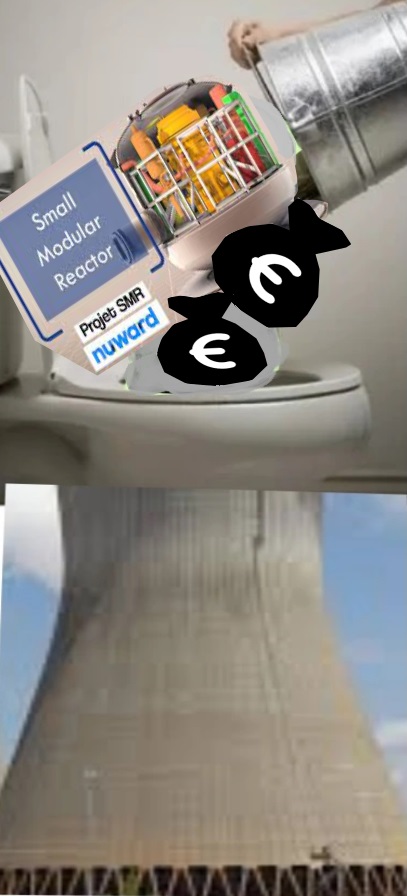
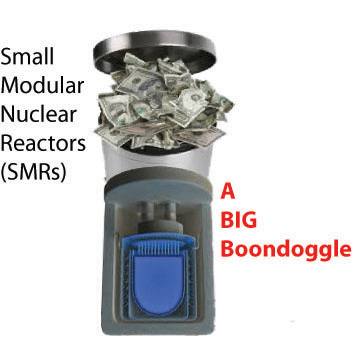
Another Small Modular Nuclear Reactor project goes down the toilet
This time it’s that great nuclear poster boy France that is facing the humiliation and embarrassment of wasting billions on “New Nuclear”
Last time it was the USA with the NuScale fiasco
Giles Parkinson Jul 2, 2024, https://reneweconomy.com.au/french-nuclear-giant-scraps-smr-plans-due-to-soaring-costs-will-start-over/
The French nuclear giant EdF, the government owned company that manages the country’s vast fleet of nuclear power stations, has reportedly scrapped its plans to develop a new design for small nuclear reactors because of fears of soaring costs.
EdF, which is now fully government owned after facing potential bankruptcy due to delays and massive cost over-runs at its latest generation large scale nuclear plants, had reportedly been working on a new design for SMRs for the last four years.
The French investigative outlet L’Informé reported on Monday that EdF had scrapped its new internal SMR design – dubbed Nuward – because of engineering problems and cost overruns. It cited company sources as saying EdF would now partner with other companies to use “simpler” technologies in an attempt to avoid delays and budget overruns.
Reuters confirmed the development, citing an email from a company spokesman that confirmed the program had been abandoned after the basic design had been completed.
“The reorientation consists of developing a design built exclusively from proven technological bricks. It will offer better conditions for success by facilitating technical feasibility,” an EDF spokesperson told Reuters via email.
Continue readingUnable to effectively operate its lone existing nuclear reactor, New Brunswick is betting on advanced options.
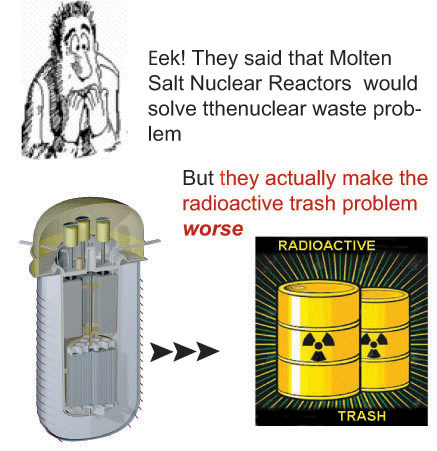
The International Panel found that sodium-cooled reactors proved expensive to build, complex to operate, prone to malfunctions, and difficult and expensive to repair. Sodium reacts violently with water and burns if exposed to air. Major sodium fires have occurred in previous reactors, often leading to lengthy shutdowns.
If NB Power needs outside assistance with a conventional reactor it has owned and operated for more than 40 years, one might question the wisdom of building two more featuring untested designs. Mr. Holland’s replacement as energy minister, Hugh Flemming, must now decide how comfortable he is with the province’s SMR ambitions.
Perhaps the most fundamental risk to New Brunswick’s SMR push is that the province can’t afford it.
MATTHEW MCCLEARN, JULY 2, 2024 https://www.theglobeandmail.com/business/article-new-brunswick-nuclear-reactor-technology-arc-clean-moltex-energy/
Mike Holland was among Canada’s leading evangelists for small modular nuclear reactors. During his tenure as New Brunswick’s energy minister, from 2018 to when he stepped down on June 20, he vigorously supported plans by the province’s Crown utility, NB Power, to construct two different small reactor designs from startup companies: U.S.-based ARC Clean Technology and Britain’s Moltex Energy. This represents Canada’s most ambitious – and perhaps riskiest – foray into bleeding-edge nuclear technology.
In an interview shortly before he resigned to pursue an opportunity in the private sector, Mr. Holland recalled how SMRs arrived on his agenda soon after he assumed office. He began exploring what advanced reactors could mean for decarbonizing the province’s electricity sector and growing its economy, and concluded New Brunswick could become a hub for nuclear design and manufacturing, and export reactors around the world.
“I saw the opportunity for New Brunswick to not just participate, but be a leader in this,” he said. “I am someone that loves to be on the cutting edge.”
His enthusiasm and risk tolerance proved a boon for ARC and Moltex, two tiny startups that have neither licensed nor constructed a commercial reactor. Under Mr. Holland’s leadership, New Brunswick became an incubator and helped the companies attract government funds to continue their work.
But NB Power is already struggling with persistent problems at its lone existing reactor at Point Lepreau Nuclear Generating Station. It has been negotiating a partnership with Ontario Power Generation that could see the latter assume partial ownership and help fix the ailing plant.
If NB Power needs outside assistance with a conventional reactor it has owned and operated for more than 40 years, one might question the wisdom of building two more featuring untested designs. Mr. Holland’s replacement as energy minister, Hugh Flemming, must now decide how comfortable he is with the province’s SMR ambitions.
Unconventional thinking
Nearly all of the more than 400 nuclear reactors operating today use water to cool their highly radioactive cores. Water also acts as a “moderator,” slowing down the high-energy neutrons produced by nuclear fission. Though water-cooled reactors have dominated for decades, they cost huge sums to build and produce waste that remains hazardous for countless human lifetimes. They’re vulnerable to severe (albeit rare) accidents that can render surrounding areas uninhabitable.
Virtually every SMR is marketed as addressing these and other shortcomings – and most have ditched water as coolant and moderator.
According to documents released by New Brunswick’s energy ministry through the province’s freedom of information legislation to researcher Susan O’Donnell, and provided to The Globe and Mail, in 2017 NB Power reviewed dozens of SMRs it read about in nuclear industry publications. It came up with a short list of five, which it later narrowed to ARC and Moltex, and enticed both companies to set up headquarters in Saint John.
ARC and Moltex are pursuing what the industry calls “fast” neutron reactors, so named because they lack a moderator. The ARC-100 reactor would be cooled using liquid sodium metal and consume enriched uranium metal fuel. Moltex’s Stable Salt Reactor-Wasteburner (SSR-W), meanwhile, would use molten salt fuel placed in fuel assemblies similar to those in conventional reactors.
The SSR-W would require its own fuel reprocessing plant called WATSS (short for Waste to Stable Salt), which would convert Point Lepreau’s spent fuel into new fuel. For NB Power, that’s a major attraction: As of last summer, Point Lepreau had more than 170,000 Candu spent fuel bundles. Moltex says that’s enough to power its reactor for 60 years.
In May, 2019, NB Power sent a letter to Mr. Holland and Premier Blaine Higgs urging them to support fast reactors. The utility told its government masters that there was enough room at Point Lepreau for both reactors and that they could be up and running by 2030.
“These two technologies have different market applications and there is no downside to letting both of them work through the process,” the letter stated.
New Brunswick’s latest energy plan suggests electricity consumption will nearly double in the next few decades. NB Power’s challenge is to satisfy that demand while simultaneously reducing greenhouse gas emissions; Lori Clark, its chief executive, has cast SMRs as playing an important role in the utility’s efforts to reach net zero by 2035.
What New Brunswick covets most, however, is a shot of economic adrenalin.
Even optimists expect that SMR demonstration units will be too expensive to be economically attractive. Multiple units must be built to exploit economies of scale and reduce costs.
NB Power is counting on that. According to documents released under the federal Access to Information Act, the utility expects the first ARC-100 would be followed by 11 more units by mid-century. By then, up to 24 would be built in Canada, and the same number in other countries. And the first SSR-W would lead to 11 more built across Canada and two dozen more in the United States, Britain and Eastern Europe. If that happened, they’d be among the most successful models in history.
NB Power thought more than half of the components would be manufactured in New Brunswick. It also enthused about royalty payments on reactor sales, “potentially worth billions of dollars.”
Technical risks
But to realize any of that, New Brunswick’s SMR program must overcome technical challenges that have plagued the nuclear industry from its earliest days.
Edwin Lyman, a physicist at the Union of Concerned Scientists, has warned policy makers about the pitfalls of betting on “advanced” reactor designs, which he has studied over many years. “Developing new designs that are clearly superior to light water reactors overall is a formidable challenge, as improvements in one respect can create or exacerbate problems in another,” he wrote in a 2021 report.
Fast reactors, which originated in the earliest years of the nuclear age, bear this out. The U.S., Britain, the Soviet Union, France, Germany, Japan and India all pursued so-called “fast breeder” reactors that could produce more plutonium fuel than they consumed. A report that examined the history of those reactors, produced in 2010 by the International Panel on Fissile Materials, a group of arms control and non-proliferation experts, found member countries of the Organization for Economic Co-operation and Development collectively invested about US$50-billion researching breeder reactors. Outside the OECD, Russia and India also spent heavily.
They didn’t have much to show for it. According to the International Atomic Energy Agency, there are only two fast reactors currently generating electricity – both in Russia. The International Panel found that sodium-cooled reactors proved expensive to build, complex to operate, prone to malfunctions, and difficult and expensive to repair. Sodium reacts violently with water and burns if exposed to air. Major sodium fires have occurred in previous reactors, often leading to lengthy shutdowns.
As for molten salt reactors, there have only been two experimental exemplars, the most recent of which operated in the 1960s. Mr. Lyman’s 2021 report said molten salts were highly corrosive to many materials typically used in reactor construction. Moreover, “liquid nuclear fuels introduce numerous additional safety, environmental and proliferation risks.” Molten salt reactors likely couldn’t be built before the 2040s at the earliest, he concluded.
In addition to confronting such technical challenges, New Brunswick’s strategy also presupposes that reprocessing of spent fuel will be permitted and affordable. But a report published last year by the Nuclear Waste Management Organization, the industry-controlled organization tasked with disposing of Canada’s reactor waste, was skeptical on both counts.
NB Power is also counting on circumstances that are beyond its control. According to a letter signed by former CEO Keith Cronkhite in 2020 and released under the Access to Information Act, New Brunswick’s plan hinges on Ontario and other provinces building multiple BWRX-300s. (The letter was sent to Prime Minister Justin Trudeau.) If they do not, “SMR companies based in New Brunswick will not be able to attract private investment necessary to ever deploy a new reactor,” Mr. Cronkhite’s letter predicted.
The SMR plan is already falling behind schedule. At a rate hearing in June before the New Brunswick Energy and Utilities Board, Brad Coady, vice-president of strategic partnerships and business development, said NB Power believes it is no longer possible to have SMRs operating by 2030; the earliest date for the first unit has been pushed back to 2032 or 2033.
Delays will have consequences, because NB Power needs options to replace its coal-fired generation while at the same time satisfying growing demand for electricity. The utility, he said, has been studying alternative scenarios “if we don’t have them in time.”
Paying for it
Perhaps the most fundamental risk to New Brunswick’s SMR push is that the province can’t afford it.
Last year, ARC and Moltex each estimated that developing their reactors would cost around $500-million per company. NB Power is Canada’s most heavily indebted utility, and its budgets must be approved by the province’s Energy and Utilities Board. It has limited ability to pay for crucial early steps such as studies necessary to establish what the environmental consequences of the SMRs might be. In published reports, NB Power has acknowledged that its research and development efforts might have to be sacrificed to meet debt-reduction targets.
David Coon, leader of New Brunswick’s Green Party, said NB Power faces huge capital spending to retire its Belledune coal-fired generating plant and refurbish its Mactaquac hydroelectric dam and transmission lines.
“That is why they’re really not putting much into this,” he said. “Their approach has been, well, if we get a new nuclear plant out of this that that doesn’t really cost us much of anything, then bonus!”
ARC and Moltex also don’t have the money. In late June, ARC parted ways with CEO William Labbe and laid off an undisclosed number of staff – a move some observers said was likely due to a shortage of funds. Mr. Chronkite’s 2020 letter warned that the two SMR developers were small startups that couldn’t afford to do work using their own resources, and were at immediate risk of insolvency.
“Without federal support this year to the SMR developers in New Brunswick, one or both companies are expected to close their offices in the next year,” Mr. Cronkhite’s letter stated.
Indeed, New Brunswick officials have counted on continuing and generous support from Canadian taxpayers. In his letter, Mr. Cronkhite called on the federal government to provide $70.5-million that year to ARC and Moltex – and more than $100-million the following year – to “keep the SMR development option in New Brunswick viable.” In 2022, the two companies would need another $91-million.
Ottawa obliged, but only partly. It gave Moltex $50.5-million in 2021. The federal government also provided ARC $7-million last year. The lobbying efforts continue: When NB Power board vice-chair Andrew MacGillivray received his mandate letter in May, 2023, it instructed him to “support efforts to acquire federal funding” for the SMRs.
New Brunswick’s own history suggests the risks inherent in counting on boundless federal support.
Andrew Secord, an economics professor at St. Thomas University in Fredericton, has studied decision-making in the 1970s that led to the construction of the original Point Lepreau reactor. In a 2020 paper, he detailed how Point Lepreau arose in part from an export-led strategy under which multiple large reactors would be built and their electricity exported to New England. NB Power (then known as the New Brunswick Electric Power Commission, or NBEPC) first focused on building interconnections with New England and then pivoted to building reactors.
This strategy failed by 1972, but by that point NBEPC was unwilling to change course. Over the next three years, it assumed ever greater risks as potential partners failed to materialize.
“NBEPC managers continued along the nuclear path, exhibiting higher risk behaviour in the process,” Mr. Secord wrote. “As NBEPC executives spent more time and resources on the nuclear option, their personal attachment and the associated institutional commitment increased.”
Mr. Coon said New Brunswick’s SMR plan so far has cost the provincial and federal governments only around $100-million. But it could start costing taxpayers and ratepayers “much more money” if things progress further.
“It seems like we haven’t learned our lesson in New Brunswick,” he said.
Small Modular Nuclear Reactors cost concerns challenge industry optimism
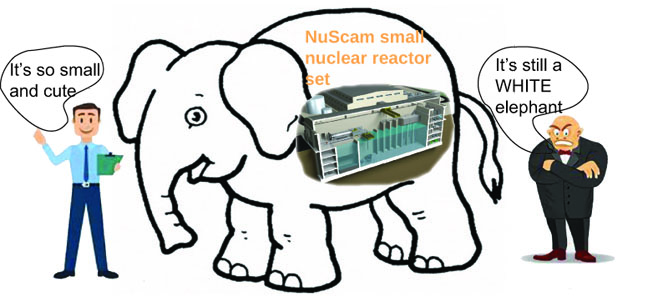
Reuters, Paul Day, Jun 27, 2024
Concerns over the potential cost of small modular reactors (SMRs) and the electricity they produce continue to cast a shadow over growing optimism for new nuclear.
Proponents say that the recent faltering history of large nuclear projects missing schedules and running over budget are just teething problems for a new industry in the midst of a difficult economic climate.
However, critics claim it as proof that nuclear is not economically viable at all, and it will take too long faced with pressing climate issues.
There is little doubt that new nuclear will, at least initially, be more expensive to develop, build, and run than many are hoping.
New Generation IV reactors, such as SMRs, are likely to produce hidden costs inherent in the development of first-of-a-kind technology, while high commodity and building material prices, stubbornly high inflation, and interest rates at levels not seen for decades are adding to mounting expenses for the new developers.
NuScale’s cancelled deal to supply its SMRs to a consortium of electricity cooperatives due to rising power price estimates prompted The Breakthrough Institute’s Director for Nuclear Energy Innovation Adam Stein to write that advanced nuclear energy was in trouble.

Speaking during an event at the American Nuclear Society (ANS) 2024 Annual Conference in June, Stein said nothing had changed to fix the fundamental challenges nuclear faces since he wrote that in November, but there was a greater sense of urgency.
“Commodity prices have come down slightly, though interest rates are largely still the same and those are risks, or uncertainties, that are outside of the developer’s control,” Stein said during an event at the American Nuclear Society (ANS) 2024 Annual Conference.
“Until those can be considered a project risk, instead of unknown uncertainties, they are not going to be controlled at all and can drastically swing the price of any single project.”
Enthusiastic hype
These criticisms clash with growing enthusiasm (critics say ‘hype’) surrounding the new technology.
Twenty two countries and 120 companies at the COP28 conference in November vowed to triple global nuclear capacity by 2050, and developers are making sweeping promises about the capabilities and affordability of their latest creations, many of which will not be commercially available in North America or Europe until the early 2030s.
SMRs, defined as reactors that generate 300 MW or less, cost too much, and deployment is too far out for them to be a useful tool to transition from fossil fuels in the coming 10-15 years, according to a recent study by the Institute for Energy Economics and Financial Analysis (IEEFA).
“SMRs are not going to be helpful in the transition. They’re not going to be here quick enough. They’re not going to be economic enough. And we really don’t have time to wait,” says co-author of the study Dennis Wamsted.
Existing SMRs in China (Shidao Bay), Russia (floating SMR such as the Akademik Lomonosov), and in Argentina (the still under-construction CAREM) have all cost significantly more than originally planned, the IEEFA says in the study ‘Small Modular Reactors: Still too expensive, too slow, and too risky.’
Construction work on the cutting-edge CAREM project has been stalled since May due to cost-cutting measures by Argentina’s President Javier Milei, the head of National Atomic Energy Commission (CNEA) told Reuters.
The billions of dollars the U.S. and Canadian governments are pouring into nuclear power through subsidies, tax credits, and federally funded research, would be better spent on extra renewables, Wamsted says.
Some 260,000 MW of renewable energy generation, mostly solar, is expected to be added to the U.S. grid just through to 2028, the study says citing the American Clean Power Association, way before any new nuclear is expected to be plugged in.
“Federal funds to nuclear is, in our opinion, a waste of time and money,” says Wamsted.
High uncertainty…………………………………………….
https://www.reutersevents.com/nuclear/smr-cost-concerns-challenge-industry-optimism
Over budget and plagued with delays: UK nuclear lessons for Australia
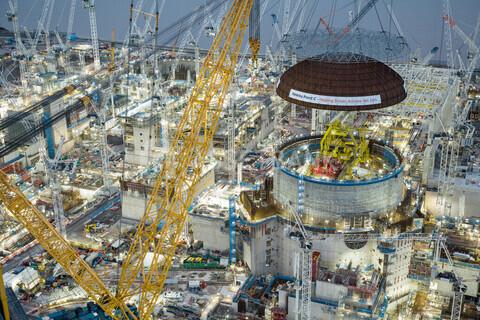
The big challenges facing nuclear power in Britain, both for large reactors and SMRs, are not technological or economic, but largely administrative and logistical.
AFR, Hans van Leeuwen, Europe correspondent, Jun 21, 2024 –
Behind the shore of England’s south-western county of Somerset lie the Quantock Hills – as perfect a landscape of lush rolling pasture and rugged heathland, laced with woodland groves and nestled hedgerows, as you could possibly imagine. It’s also home, incongruously, to a very, very large crane.
Big Carl, as it is known, is, in fact, the world’s largest. It is six kilometres long, 250 metres high and has 96 wheels. It has spent the past few years at Hinkley Point, on the Bristol Channel. Big Carl hit a mini-climax of hydraulic achievement just before Christmas last year, as it hauled a 14-metre tall, 245-tonne steel dome onto the top of a 44-metre nuclear reactor.
Progress at last. The reactor’s name is Hinkley Point C – which sadly doesn’t quite have the same folksy ring as “Big Carl”. Fifteen years have elapsed since French giant EDF and its Chinese partner began trying to build it, and rouse Britain from decades of nuclear slumber.
Lining up the regulators and the finance took seven years. Construction is in its seventh year, and might be only just past the halfway mark. There are 10,000 workers and 3500 British companies involved in pulling this off, at a cost that may end up topping £46 billion ($88 billion) – almost thrice the original estimate of £16 billion.
This is the kind of monumental scale of project that Opposition Leader Peter Dutton wants to bring to Australia. Alongside it, he also envisages small modular reactors (SMRs): more petite, but equally dully monikered, nukes that are thrown together in a factory and then operate from what is really little more than an industrial shed.
Britain wants to build those too, and is in the last throes of a competition to put taxpayer money behind at least one contender. But even the most advanced would-be manufacturer, Rolls-Royce, doesn’t appear to expect an SMR to actually be up and running until the start of the 2030s………………………………………………………………………………………………….
Why so long, and so costly?
Greatrex offers a warning to Australia: the big challenge facing nuclear power in Britain, both for large reactors and SMRs, but most clearly in evidence at Hinkley Point C, is not technological or economic, but largely administrative and logistical.
“Issues around bottlenecks in the planning system, the time it takes for permitting on various things, the issues around access to grid and grid connections, they’re all real factors,” he says.
“There are a whole number of issues around planning and permitting that seem to be taking more time to deal with than the actual construction period.”
This has left Greatrex and his organisation fighting a rearguard action against public and media perceptions that the industry is foundering – particularly as the flagship Hinkley Point C reactor project suffers repeated cost and deadline blowouts.
Although the government has this year doubled down on building large reactors to keep nuclear’s share of British electricity generation at about 25 per cent, the negative stories keep coming……………………………………………………………………………
For 35 years after the plant starts operating, taxpayers will fill any gap between that price and the going market rate, likely resulting in a subsidy far higher than that for offshore wind or solar. The government is also guaranteeing the debt funding of almost half the capital costs of building it.
The original estimated cost of Hinkley Point C was £16 billion, and the anticipated date to get it open and running was 2023. Now, it’s £35 billion in today’s prices, which could be £46 billion by the time the work is completed between 2029 and 2031.
EDF this year took a €12.9 billion ($20.8 billion) impairment charge on the project. The Chinese partner, having been frozen out of future nuclear projects in Britain for geopolitical reasons, has reportedly been withholding its own contributions this year.
The company has blamed the blowout on design changes enforced by the regulator, along with labour shortages and supply chain issues.
Going first to restart the nuclear construction industry in Britain after a 20-year pause has been hard,” Hinkley Point C boss Stuart Crooks said in a letter to staff earlier this year.
But the British government is still pushing on with a second reactor, the 3.2-gigawatt Sizewell C on the country’s east coast, which EDF will also build. This has taxpayer backing of £2.5 billion, and the government is on the hunt for £20 billion of private capital, supposedly by the end of the year………………………………………………………………………………
Rolls-Royce rollout starts at home
But even if the Coalition has to look elsewhere than Britain and Europe for its mega-reactors, energy spokesman Ted O’Brien has explicitly name-checked Rolls-Royce as a potential partner on SMRs………………………………………..
At any rate, Rolls-Royce has to crack its home market first. The government will next month decide which of six horses to back with taxpayer largesse. https://www.afr.com/companies/energy/over-budget-and-plagued-with-delays-uk-nuclear-lessons-for-australia-20240621-p5jnkq
Researchers have doubts, but Bill Gates is hyping his new liquid-sodium nuclear reactor
Research has poured cold water on some of the hype surrounding these proposed next-generation reactors, including liquid-sodium reactors. According to a report produced by the Union of Concerned Scientists in 2021, Natrium reactors may be less “uranium-efficient”, may not reduce the amount of nuclear waste produced, and may face safety risks that are unique to them and absent from their predecessors.
The new Natrium reactors promise to be more efficient and safer than traditional nuclear reactors, but is this the case?
Bill Gates Has Made Progress Towards Next-Generation Nuclear Reactors
IFLScience, DR. RUSSELL MOUL, Edited by Laura Simmons, 15 June 24
Bill Gates has helped “break ground” on the development of a new next-generation nuclear reactor. The project, which is run between TerraPower and the Department of Energy, plans to build a new sodium test reactor at a site in Kemmerer, Wyoming by 2030.
The nuclear industry has been in decline in the USA for decades. Despite the country being one of the first nations to generate nuclear energy for commercial civilian purposes, there have been few developments since the late 1970s. For instance, since 1978, only two nuclear power plants have started construction, and that only occurred in 2013.
This industry has stalled because of various broad challenges related to economics, regulatory frameworks, and technological problems, as well as declining respect within the public sphere.
All of the USA’s existing nuclear power plants are traditional pressurized water reactors, which rely on technologies developed over 40 years ago. They are expensive to build and even more so to maintain across their lifecycle. Costs do not just concern the initial construction, but also the ongoing price of fuels, operational costs, and engineering fees. And then there’s the problem of the nuclear waste, which in the US is mostly stored in tanks at sites owned by the Department of Energy.
The industry was also fatally wounded by the Three Mile Island partial meltdown in 1979, which caused new regulatory delays to the 51 new reactors that were under construction at the time. With the introduction of new safety procedures and back-fit requirements, the speed of construction was slowed down, and the costs skyrocketed for many reactors. After that, many contracts were canceled and the industry ground to a halt.
Today, nuclear power provides around one-fifth of the country’s electricity.
But in 2008, Bill Gates founded TerraPower with the aim of building a new generation of nuclear reactors in the US. The reactors, called Natrium, are 345-megawatt modular, pool type, liquid sodium reactors that run off low-enriched uranium (this is fuel that contains 5 to 20 percent fissile uranium). The reactors are also hooked up to a 1-gigawatt hour molten salt storage system…………………………………………………………..
Research has poured cold water on some of the hype surrounding these proposed next-generation reactors, including liquid-sodium reactors. According to a report produced by the Union of Concerned Scientists in 2021, Natrium reactors may be less “uranium-efficient”, may not reduce the amount of nuclear waste produced, and may face safety risks that are unique to them and absent from their predecessors. ……..https://www.iflscience.com/bill-gates-has-made-progress-towards-next-generation-nuclear-reactors-74667
Science Writer
The United Nations Security Council takes up Space Security – it might have been best if it had not
As the international community’s dependence on space-enabled services grows exponentially, the disconnect between space powers on rules for responsible behaviour in outer space can only be a matter of great concern.
Open Canada, BY: PAUL MEYER , Adjunct Professor of International Studies and Fellow in International Security, Simon Fraser University, Senior Advisor, ICT4Peace, Director, Canadian Pugwash Group, Fellow, Outer Space Institute 17 JUNE, 2024
It may come as a surprise that until this April the United Nations (UN) Security Council had never taken up the issue of outer space security despite the Council’s primary responsibility for the maintenance of international peace and security. Outer space has become an increasingly important environment for global well-being with a wide array of space-based services underpinning many critical civilian activities from telecommunications to navigation to remote sensing of the Earth. The world is also experiencing an exponential growth in the numbers of satellites in orbit driven primarily by the private sector and the launch by companies such as “Starlink” and “One Web” of “mega-constellations” to ensure global Internet connectivity. Many stakeholders in the use of outer space also recognize that preserving this environment for peaceful purposes, in line with the 1967 Outer Space Treaty, means ensuring that it is kept free of man-made threats.
Regrettably, just as global society is discovering ever more benefits from outer space activity, leading space powers are characterizing it as a “war-fighting domain” while accusing one another of having been the first to “weaponize” this vital if vulnerable environment. The ethos of cooperation imbued in the Outer Space Treaty with its stress on space activity being “in the interests and for the benefit of all countries”; its insistence on each party paying “due regard” to the rights of others and its prohibition on the stationing of nuclear weapons or other WMD in orbit, is currently under severe strain. Hostile rhetoric, accusations of nefarious intent, development of anti-satellite weapons and other so-called “counter-space capabilities” plus the abuse of consensus-based diplomatic processes have generated an atmosphere that is not conducive for states agreeing on cooperative security measures even when these are urgently needed.
To the degree that space security has been addressed by the UN in the past it has been a preserve of the General Assembly and the 65-member Conference on Disarmament in Geneva, both of which have had the “Prevention of an Arms Race in Outer Space” (PAROS) item on their agenda since the early 1980s…………………………………………
Part of the problem has been that since it last negotiated an agreement in 1996 the Conference on Disarmament has been a largely moribund body, unable to agree and implement a basic programme of work let alone negotiate anything. This dysfunctionality is sustained by its consensus-based decision making that essentially gives each of its members a de facto veto over any decision. As security perspectives and threat perceptions differ amongst the member states no common ground has emerged for any new agreement. Specifically, on the PAROS item an East-West divide has existed for decades over how best to proceed.
In 2008, Russia and China put forward a draft treaty on “The Prevention of Placement of Weapons in Outer Space and the Threat or use of Force against Space Objects” (better known by its acronym PPWT). In the view of its sponsors it is essential that a legally binding agreement is concluded that will ban all weapons in space. The United States (US) and its allies have raised objections to the Sino-Russian treaty ………………………………
This gap in positions could be bridged with a modicum of good will and a willingness to compromise on preferred positions, but neither quality is much in evidence these days. Instead, a decision was made to transfer the unresolved debate over PAROS to the Security Council which had never addressed the issue before……………………………………………….
The US and Japan, along with numerous co-sponsors, introduced this April a draft resolution on Outer Space and WMD with a principal call for all states to adhere to the ban on placing WMD into space. At the April 24 Security Council meeting slated to consider this issue, Russia offered up an amendment to the US/Japan resolution. The amendment stipulated that states “take urgent measures to prevent for all time the placement of weapons in outer space and the threat or use of force in outer space, from space against Earth and from Earth against objects in outer space”; and called for “the early elaboration of appropriate reliably verifiable legally binding multilateral agreements” (i.e. like the PPWT). The amendment failed having received only 7 positive votes whereas 9 are required in the Security Council.
This set the stage for a vote on the US/Japan resolution which garnered 13 positive votes, one abstention (China) and fatally a veto from Russia. In an effort to turn the tables on the US, Russia introduced a new resolution of its own which incorporated much of the text from the US/Japan resolution, but reinserted the language of its amendment. When this resolution went to a vote at a May 20th Security Council session it failed (like the amendment) to garner sufficient support with a repetition of the earlier split 7-7 vote. …………………………………………………………………………………………………………………………………………………….
More promising than the combative machinations in the Security Council has been the creative approach shown in the recent UN Open Ended Working Group (OEWG) on “Reducing Space Threats through norms, rules and principles of responsible behaviours”. This group convened for a few weeks in 2022 and 2023 with a final session in the week of August 28 to September 1. Due to disruptive and frankly spiteful behaviour by the Russian delegation no concluding report could be achieved (the group operating by consensus) and even the usual anodyne procedural report was blocked by the Russian representative who openly delighted in the group’s failure.
Despite this egregious conduct the OEWG benefited from the active participation of those present and the rich menu of proposals that were presented, any one of which, if adopted, would make a positive contribution to the security situation in outer space…………………………………….
Notable among these proposals were restraint measures on any destructive action against satellites and refraining from “any other non-consensual act that destroys or damages the space objects of other States”; refraining from “any deliberate act that interferes with the normal and safe operation of the space objects under the jurisdiction or control of other States”; refraining from “any acts that would impair the provision of critical space-based services to civilians” and ensuring “that satellites under their jurisdiction and control or operating on their behalf do not rendezvous, physically connect or physically damage with satellites under the jurisdiction and control of another State, or operate in proximity to, without prior consultations and consent”. Agreement on such conflict prevention measures is the type of action which would really benefit the international community.
In lieu of further polemics between Russia, China and the US it would be helpful if concerned middle powers, such as Canada, and non-governmental stakeholders spoke out on the need to take up some of these specific proposals and seek agreement on them. Let’s put aside the tired and sterile debates over the desired scope and status for space arms control and embark on a purposeful effort to develop cooperative security measures for outer space. The international community deserves no less. https://opencanada.org/the-united-nations-security-council-takes-up-space-security-it-might-have-been-best-if-it-had-not/—
SPACEX’S STARLINK MAY BE KEEPING THE OZONE FROM HEALING, RESEARCH FINDS
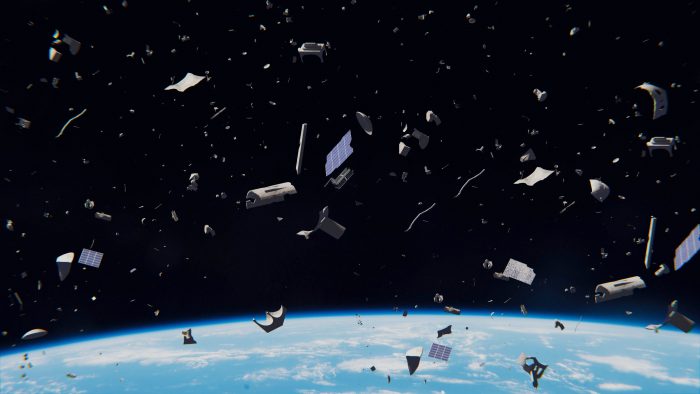
MEGACONSTELLATIONS COULD BE A DISASTER FOR THE ENVIRONMENT.
JUN 15, 24 by VICTOR TANGERMANN https://futurism.com/the-byte/spacex-starlink-ozone-healing
Burning Up
In a new study, researchers from the University of Southern California estimated the harmful effects from satellites injecting harmful pollutants such as aluminum oxides into the upper atmosphere as they burn up during reentry.
These dying satellites may even be contributing to “significant ozone depletion,” according to the researchers. The ozone layer is the Earth’s “sunscreen” that shields us from too much UV radiation from the Sun
While researchers have largely focused on the pollutants being released by rockets as they launch, we’ve only begun to understand the implications of having thousands of retired and malfunctioning satellites burn up in the atmosphere.
And that’s only becoming more relevant, as SpaceX has already launched almost 6,000 Starlink satellites to date, and is planning to add tens of thousands more — orbital ambitions that are now inspiring competing satellite constellations.
“Only in recent years have people started to think this might become a problem,” said coauthor and University of Southern California astronautics researcher Joseph Wang in a statement. “We were one of the first teams to look at what the implication of these facts might be.”
Poking Holes
Since it’s practically impossible to get accurate readings from the kind of pollutants satellites release as they scream back through the atmosphere, scientists can only estimate their effects on the surrounding environment.
By studying how common metals used in the construction of satellites interact with each other, the team estimated that the presence of aluminum increased in the atmosphere by almost 30 percent in 2022 alone.
They found that a 550-pound satellite generates roughly 66 pounds of aluminum oxide nanoparticles during reentry, which would take up to 30 years to drift down into the stratosphere.
In total, if constellations from the likes of SpaceX continue to grow as planned, the levels of aluminum oxides in the atmosphere could increase by a staggering 646 percent over natural levels every year.
And that doesn’t bode well, considering we’ve only begun to study the phenomenon.
“The environmental impacts from the reentry of satellites are currently poorly understood,” the researchers note in their paper. “As reentry rates increase, it is crucial to further explore the concerns highlighted in this study.”
Unveiling Cosmic Secrets: Black Budget Tech and UFOs with Aerospace Expert Michael Schratt
The U.S. military and intelligence agencies have billions of dollars’ worth of secret projects they don’t want you to know about. These billions have funded a secret world of advanced science, technology, weapons, and various covert activities, which have always been shielded from congressional oversight and public scrutiny. Back in the 90s, Members of the House Armed Services Committee once said that 70 percent of the black budget could be declassified at no risk to national security. Our taxpayer dollars are funding these black budget programs, and we have a right to know what we’re paying for. So why the secrecy? What is being kept hidden from the public?
To investigate this further, we recently interviewed private pilot and military aerospace historian Michael Schratt, who’s studied top secret advanced technologies buried deep within the military-intelligence complex for over 25 years. He alleges to have first-hand experience with classified government black budget programs, with access to former US Air Force pilots, retired Naval personnel and former aerospace engineers with top-secret clearance. He’s one of the leading authority voices in investigating government programs involving the recovery and study of off-world technology, also known as UAP/UFO crash retrieval programs. He’s author of DARK FILES, which brings to life historically significant and credible UFO cases obtained from university archives, research centers, and private collections using carefully re-constructed illustrations of the events. Whether it’s advanced military aircraft or serious signs of extraterrestrial life, the implications are too profound to ignore. Michael is suggesting that publicly known technology and weapons programs might be fronts for black budget operations dealing with technologies way more advanced than the public is aware of.
Join us in this fascinating 38-min video interview, with many images and videos throughout to verify and illustrate the points being discussed.
- 00:00:00 Introduction to the military-industrial complex and the black budget world 00:03:54 Interview begins
- 00:06:00 What drew Michael Schratt to studying advanced black budget technologies and UFO phenomena
- 00:07:22 If you could declassify one technology developed under a black budget program, what would it be and why?
- 00:10:20 Out of all the advanced technologies in use on Earth, how much has ET influence?
- 00:11:39 UFO/UAP crash retrieval programs
- 00:18:05 Top secret technologies 101 00:22:32 The infamous Tic Tac video: a UFO, reverse-engineered craft, experimental military tech, or all of the above
- 00:26:32 The military bases that are purported to study ET tech and house advanced technologies
- 00:29:25 How can the most powerful technologies help humanity instead of harm?
- 00:30:37 How to balance disclosure with national security obligations
- 00:33:01 Michael’s thoughts on the UAP Disclosure Act
- 00:36:32 What keeps Michael inspired and hopeful
Radiation could pose challenge to putting people on Mars
- A solar storm that hit Earth also impacted Mars
- Data showed how much radiation hit the planet’s surface
- High levels of radiation could be risky for astronauts
Steph Whiteside JUN 14, 2024
(NewsNation) — A massive solar storm that impacted Earth also affected Mars, and data suggests radiation levels on the red planet could pose a challenge to human exploration there.
A record-setting solar storm made the aurora borealis visible as far south as North Carolina, stunning people with a view of the dancing lights not usually seen in most of the U.S.
That same storm also hit Mars and also caused an aurora there. Data from NASA’s Odyssey and MAVEN (it stands for “Mars Atmosphere and Volatile Evolution”) orbiters and the Curiosity rover showed what happened when solar flares hit the planet……………………………………………………
Data showed that radiation near Curiosity was around 8,100 micrograys, which is the equivalent of 30 chest X-rays. While that isn’t a deadly amount for a person, it’s also a lot more than someone would want to be exposed to, especially since astronauts on Mars would likely face multiple exposures like that.
Astronauts could also face visual distortions similar to Curiosity’s cameras, with many on the International Space Station describing seeing “fireworks” behind their eyes when they close them during a radiation storm.
So, what does this mean for future exploration?
Scientists say the data shows that shielding on Mars will have to be a serious concern for any crewed missions, raising the possibility that cliffside or lava tubes could play a role in such efforts. That could also impact agriculture on the planet. That would be a necessity because it takes nine months to travel to Mars, and astronauts would have to wait a minimum of three months on the planet before a suitable window to make a return trip.
There is likely to be more data for research as the sunspot that caused the previous storms has continued to show activity. https://www.newsnationnow.com/space/radiation-challenge-people-mars/
Nuclear Power Is Hard. Billionaire Bill Gates Wants to Make It Easier
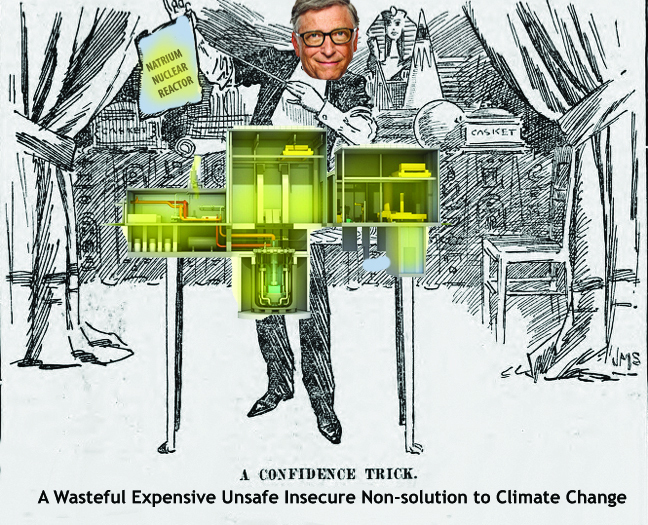
COMMENT. Sodium cooled nuclear reactors are not necessarily safer. Nuclear power: molten salt reactors and sodium-cooled fast reactors make the radioactive waste problem WORSE
Work is starting in Wyoming coal country on a new type of reactor.
Its main backer, Bill Gates, says he’s in it for the emissions-free
electricity. Outside a small coal town in southwest Wyoming, a
multibillion-dollar effort to build the first in a new generation of
American nuclear power plants is underway. Workers began construction on
Tuesday on a novel type of nuclear reactor meant to be smaller and cheaper
than the hulking reactors of old and designed to produce electricity
without the carbon dioxide that is rapidly heating the planet.
The reactor being built by TerraPower, a start-up, won’t be finished until 2030 at the
earliest and faces daunting obstacles. The Nuclear Regulatory Commission
hasn’t yet approved the design, and the company will have to overcome the
inevitable delays and cost overruns that have doomed countless nuclear
projects before.
What TerraPower does have, however, is an influential and
deep-pocketed founder. Bill Gates, currently ranked as the seventh-richest
person in the world, has poured more than $1 billion of his fortune into
TerraPower, an amount that he expects to increase.
At a recent conference in New York, David Crane, the Energy Department under secretary for
infrastructure, said that two years ago he “didn’t really see” a case
for next-generation reactors. But as demand for electricity surges because
of new data centers, factories and electric vehicles, Mr. Crane said he had
become “very bullish” on nuclear to provide carbon-free power around
the clock without needing much land. One problem with nuclear power,
though, is that it has become prohibitively expensive.
Traditional reactors are huge, complex, strictly regulated projects that are difficult to build
and finance. The only two American reactors built in the last 30 years,
Vogtle Units 3 and 4 in Georgia, cost $35 billion, more than double initial
estimates, and arrived seven years behind schedule. TerraPower’s reactor,
by contrast, uses liquid sodium instead of water, allowing it to operate at
lower pressures. In theory, that reduces the need for thick shielding. In
an emergency, the plant can be cooled with air vents rather than
complicated pump systems. The reactor is just 345 megawatts, one-third the
size of Vogtle’s reactors, making for a smaller investment.
New York Times 11th June 2024 https://www.nytimes.com/2024/06/11/climate/bill-gates-nuclear-wyoming.html
Great British Nuclear Small Reactors competition timeline delayed for General Election, amid doubts on their viability
There have been some doubts cast, with the Environmental Audit Committee claiming that SMRs will not be able to help the UK decarbonise by 2035. Additionally, US think tank Institute for Energy Economics and Financial Analysis (IEEFA) has said that SMRs are “too expensive, too slow, and too risky”.
10 JUN, 2024 BY TOM PASHBY
The six small modular reactor (SMR) developers shortlisted in Great British Nuclear’s (GBN’s) competition now have an extra two weeks to submit documentation due to the General Election.
The competition winner will receive government backing to deploy a fleet of SMRs in the UK. At the time of the competition announcement, GBN chief executive Gwyn Parry-Jones
said parties would be “aiming for a final contract agreement in the
summer”. Even if not successful in GBN’s competition, many of the
shortlisted firms have signalled intent to deliver SMRs in the UK.
Rolls-Royce SMR recently announced a prototype module testing facility at
the University of Sheffield and Holtec has shortlisted four UK sites for
its SMR module factory. Westinghouse has plans to deploy the first
privately funded SMRs in North Teesside by the 2030s.
There have been some doubts cast, with the Environmental Audit Committee claiming that SMRs will not be able to help the UK decarbonise by 2035. Additionally, US think tank
Institute for Energy Economics and Financial Analysis (IEEFA) has said that
SMRs are “too expensive, too slow, and too risky”.
New Civil Engineer 10th June 2024
Are the prospects for Small Modular Reactors being exaggerated? Five key characteristics examined
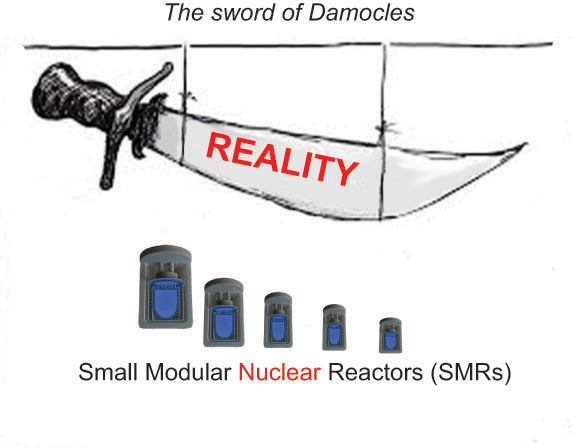
June 11, 2024 by Ed Lyman, Ed Lyman is Director, Nuclear Power Safety, at the Union of Concerned Scientists
Small Modular Reactors (SMRs) are being presented as the next generation of nuclear technology. While traditional plants face cost overruns and safety issues, SMRs are seen by their champions as cheaper, safer, and faster to deploy. But Ed Lyman at UCS cites evidence that cast these claims into doubt.
In five sections of this article, he lists the reasons why. SMRs are not more economical than large reactors. SMRs are not generally safer or more secure than traditional large light-water reactors. SMRs will not reduce the problem of disposal of radioactive waste. SMRs cannot be counted on to provide reliable and resilient off-the-grid power (for facilities like data centres, bitcoin mining, hydrogen or petrochemical production). SMRs do not use fuel more efficiently than large reactors.
And where problems might be ironed out over time, the learning cycle of such technology is measured in decades during which costs will remain very high. SMRs may have a role to play in our energy future, says Lyman, but only if they are sufficiently safe and secure, along with a realistic understanding of their costs and risks.
Even casual followers of energy and climate issues have probably heard about the alleged wonders of small modular nuclear reactors (SMRs). This is due in no small part to the “nuclear bros”: an active and seemingly tireless group of nuclear power advocates who dominate social media discussions on energy by promoting SMRs and other “advanced” nuclear technologies as the only real solution for the climate crisis. But as I showed in my 2013 and 2021 reports, the hype surrounding SMRs is way overblown, and my conclusions remain valid today.
Unfortunately, much of this SMR happy talk is rooted in misinformation, which always brings me back to the same question: if the nuclear bros have such a great SMR story to tell, why do they have to exaggerate so much?
What are SMRs?
SMRs are nuclear reactors that are “small” (defined as 300 megawatts of electrical power or less), can be largely assembled in a centralised facility, and would be installed in a modular fashion at power generation sites. Some proposed SMRs are so tiny (20 megawatts or less) that they are called “micro” reactors. SMRs are distinct from today’s conventional nuclear plants, which are typically around 1,000 megawatts and were largely custom-built. Some SMR designs, such as NuScale, are modified versions of operating water-cooled reactors, while others are radically different designs that use coolants other than water, such as liquid sodium, helium gas, or even molten salts.
To date, however, theoretical interest in SMRs has not translated into many actual reactor orders. The only SMR currently under construction is in China. And in the United States, only one company — TerraPower, founded by Microsoft’s Bill Gates — has applied to the Nuclear Regulatory Commission (NRC) for a permit to build a power reactor (but at 345 megawatts, it technically isn’t even an SMR).
The nuclear industry has pinned its hopes on SMRs primarily because some recent large reactor projects, including Vogtle units 3 and 4 in the state of Georgia, have taken far longer to build and cost far more than originally projected. The failure of these projects to come in on time and under budget undermines arguments that modern nuclear power plants can overcome the problems that have plagued the nuclear industry in the past.
Developers in the industry and the US Department of Energy say that SMRs can be less costly and quicker to build than large reactors and that their modular nature makes it easier to balance power supply and demand. They also argue that reactors in a variety of sizes would be useful for a range of applications beyond grid-scale electrical power, including providing process heat to industrial plants and power to data centres, cryptocurrency mining operations, petrochemical production, and even electrical vehicle charging station
Here are five facts about SMRs that the nuclear industry and the “nuclear bros” who push its message don’t want you, the public, to know.
1. SMRs are not more economical than large reactors. 2. SMRs are not generally safer or more secure than large light-water reactors. 3. SMRs will not reduce the problem of what to do with radioactive waste. 4. SMRs cannot be counted on to provide reliable and resilient off-the-grid power for facilities, such as data centers, bitcoin mining, hydrogen or petrochemical production. 5. SMRs do not use fuel more efficiently than large reactors
Continue readingU.S. Micro Nuclear Reactors happy to join with NATO military
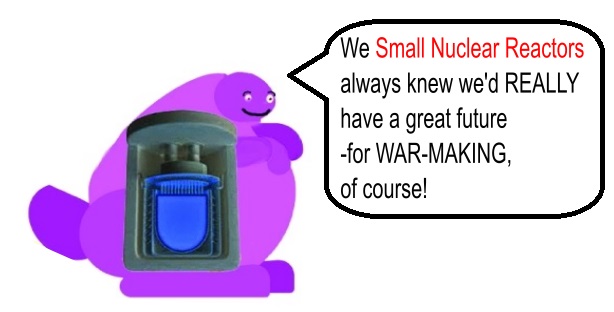
Last Energy and NATO enter micro-nuclear energy partnership
The Engineer, Jason Ford, 04 Jun 2024
The NATO Energy Security Centre of Excellence (ENSEC COE) and Washington, DC-based Last Energy are jointly investigating military applications for micro-nuclear power technologies
The partnership also intends to explore opportunities for future deployment on NATO military installations.
The research and development partnership, signed by Last Energy CEO Bret Kugelmass and NATO Energy Security Centre of Excellence director Colonel Darius Uzkuraitis, marks the first agreement between the NATO Energy Security Centre of Excellence and a nuclear energy company………………. https://www.theengineer.co.uk/content/news/last-energy-and-nato-enter-micro-nuclear-energy-partnership
Energy buffs give small modular reactors a gigantic reality check
John Ketchum, CEO of nuclear power firm NextEra, has even said SMRs were nothing but “an opportunity to lose money in smaller batches”
Before signing any contract for an SMR, just get a fixed price in writing. If a developer won’t agree to it, they probably don’t have faith in their own estimates.
Too expensive, slow, and risky for investors, and they’re taking focus off renewables, say IEEFA experts
Brandon Vigliarolo, Mon 3 Jun 2024 , https://www.theregister.com/2024/06/03/small_modular_reactor_criticism/
Miniature nuclear reactors promise a future filled with local, clean, safe zero-carbon energy, but those promises quickly melt when confronted with reality, say a pair of researchers.
Known as small modular reactors, or SMRs, miniaturized atomic power plants have been touted as a way to ensure the world meets climate change mitigation goals as fossil fuels are phased out in favor of renewables and nuclear sources.
With a few SMR projects built and operational at this point, and more plants under development, the Institute for Energy Economics and Financial Analysis (IEEFA) concludes in a report that SMRs are “still too expensive, too slow to build, and too risky to play a significant role in transitioning away from fossil fuels.”
IEEFA doesn’t have many data points to pull from, with only three SMRs actually online around the world – one in China and two in Russia. A fourth, in Argentina, is still under construction and perfectly illustrates the point IEEFA researchers try to make: It’s running far over cost and is facing budget constraints that could affect its future.
The other three SMRs have run into similar issues. They’ve all been way more expensive than initially agreed upon, and proposals for SMRs in the US face related issues, the report finds.
Per-kilowatt hour costs for SMRs proposed in the US by NuScale, the first company to receive US regulatory approval for SMRs, have more than doubled since 2015. Costs projected by X-Energy and GE-Hitachi for their SMRs have similarly risen since initial proposals.
In most cases, these costs are rising before the US Nuclear Regulatory Commission has even given its approval, IEEFA notes.
Pick none: Fast, good, low risk
If the cost of an SMR were high but the risk low, or if construction were quick, it might be worth considering further development. The report finds that SMRs are neither cheap, quick, nor reliable.
Along with those costs, IEEFA research points out that none of the SMRs built so far have come anywhere close to meeting proposed construction timelines. The two Russian units were supposed to be built in three years, but both took 13. The Shidao Bay SMR in China was estimated as a four-year project but took 12, while the ongoing CAREM 25 in Argentina was also proposed as a four-year development but has so far taken 13.
Similarly optimistic construction estimates have consistently shown up in US SMR project development presentations,” the report notes. Without speed or value to rely on, one would hope that an SMR project was at least low risk, but that doesn’t appear to be the case either.
Leaders at two nuclear power companies whose quotes are carried in the report “endorsed nuclear power in the abstract” as a way to transition away from fossil fuels, but both expressed concern over the investment risk.
John Ketchum, CEO of nuclear power firm NextEra, has even said SMRs were nothing but “an opportunity to lose money in smaller batches” at this point in time, which was cited in the report. Chris Womack, CEO at Southern Company, which recently finished building the first new US nuclear reactor this century, similarly expressed concerns about expanding his company’s nuclear portfolio.
Quit hogging the energy transition spotlight
The report’s data makes it seem like there’s not a lot going for SMRs, but “loud and persistent” advocates for the technology have managed to capture the spotlight anyway, say report authors David Schlissel, IEEFA director of resource planning analysis, and Dennis Wamsted, IEEFA energy analyst.
“A key argument from SMR proponents is that the new reactors will be economically competitive,” said Schlissel. “But the on-the-ground experience with the initial SMRs that have been built or that are currently under construction shows that this simply is not true.”
Meanwhile, all the time, energy, and money spent constructing SMRs is taking resources away from renewables that work, and would work now, the duo said. It’s also likely that, even though SMR operators intend their reactors to be complementary to other power sources on the grid, they’re far more likely to do the opposite, the report concludes – especially given the rise in construction costs and the need to break even.
“Developers bringing multibillion-dollar SMRs onto the electric grid would have every incentive to run them as much as possible,” the report surmises. “The less they run, the more their per megawatt-hour costs rise and the harder it will be for them to compete in the market.”
“Having invested billions, it is unlikely developers will willingly cycle their plants to accommodate renewables,” the report adds.
While some have predicted it might take a decade to get SMR technology to the point where it’s reliable, Schlissel and Wamsted believe the mini-reactors will continue to be too expensive, slow, and risky to play a reliable role in fossil fuel transition in the next 15 years. That said, developers are still going to push for the projects, so the pair reckon there’s a few things prospective buyers and investors should ensure – like crafting restrictions into contracts that prevent delays and risking costs from being pushed onto ratepayers.
Schlissel and Wamsted make several more recommendations for how to keep SMR projects from becoming too costly or blocking renewables, but the best one is the simplest: Before signing any contract for an SMR, just get a fixed price in writing. If a developer won’t agree to it, they probably don’t have faith in their own estimates.
Wamsted appears to have little faith SMR developers would agree to those terms.
“The comparison between building new SMRs and building renewable energy couldn’t be clearer,” Wamsted said of the pair’s recommendations. “Regulators, utilities, investors, and government officials should acknowledge this and embrace the available reality: Renewables are the near-term solution.”
1 This Month


PLEASE OPPOSE HR 8255 AND S.3639 – bills would accelerate satellite deployment, with no environmental review or safeguards – https://ncstd5li.quorum.us/campaign/169331/
To see nuclear-related stories in greater depth and intensity – go to https://nuclearinformation.wordpress.com
-
Archives
- September 2026 (194)
- August 2026 (330)
- July 2026 (355)
- June 2026 (287)
- May 2026 (306)
- April 2026 (356)
- March 2026 (251)
- February 2026 (267)
- January 2026 (308)
- December 2025 (358)
- November 2025 (359)
- October 2025 (375)
-
Categories
- 1
- 1 NUCLEAR ISSUES
- business and costs
- climate change
- culture and arts
- ENERGY
- environment
- health
- history
- indigenous issues
- Legal
- marketing of nuclear
- media
- opposition to nuclear
- PERSONAL STORIES
- politics
- politics international
- Religion and ethics
- safety
- secrets,lies and civil liberties
- spinbuster
- technology
- Uranium
- wastes
- weapons and war
- Women
- 2 WORLD
- ACTION
- AFRICA
- Atrocities
- AUSTRALIA
- Christina's notes
- Christina's themes
- culture and arts
- Events
- Fuk 2022
- Fuk 2023
- Fukushima 2017
- Fukushima 2018
- fukushima 2019
- Fukushima 2020
- Fukushima 2021
- general
- global warming
- Humour (God we need it)
- Nuclear
- RARE EARTHS
- Reference
- resources – print
- Resources -audiovicual
- Weekly Newsletter
- World
- World Nuclear
- YouTube
-
RSS
Entries RSS
Comments RSS
 nuclear-news