Critics Slam Cost of Ontario SMR Plan, Question Dependence on U.S. Uranium
May 12, 2025, Mitchell Beer, https://www.theenergymix.com/critics-slam-cost-of-ontario-smr-plan-question-dependence-on-u-s-uranium/
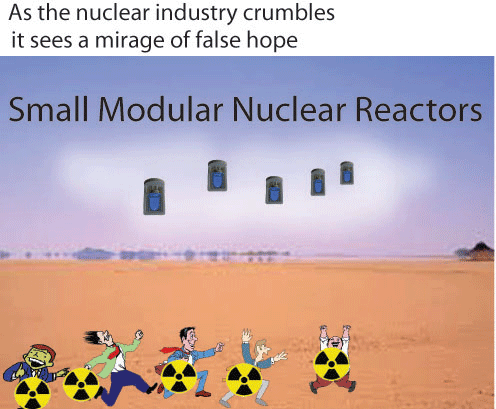
Critics are taking a hard line on Ontario’s announcement that it will build four 300-megawatt small modular nuclear reactors (SMRs) at the existing Darlington nuclear plant near Bowmanville, with most concerns focused on the cost of the project and the geopolitical risk in sourcing enriched uranium from a U.S. supplier.
Ontario Power Generation announced provincial approval for the first of the four units May 8, describing it as “the first new nuclear build in Ontario in more than three decades.”
“This is truly a historic moment,” said OPG President and CEO Nicolle Butcher. “This made-in-Ontario project will support provincial companies, create jobs for Ontarians, and spur growth for our economy.”
Energy and Mines Minister Stephen Lecce declared the 1,200-megawatt installation, the first of its kind in the G7, a “nation-building project being built right here in Ontario.” Durham MPP Todd McCarthy called it “the next step to strengthening Ontario and Canada’s energy security.”
The published cost of the project is $7.7 billion for the first reactor, including $1.6 billion for infrastructure and administrative buildings, and $20.9 billion to complete the series of four. Citing Conference Board of Canada figures, OPG said the four SMRs will contribute $38.5 billion to Canada’s GDP over 65 years and sustain an average of about 3,700 jobs per year, including 18,000 per year during construction.
First Mover Advantage or Boutique Pricing?
In the OPG announcement, Butcher suggested an advantage in being the first G7 jurisdiction to bring an SMR to market. “As a first mover on SMRs, Ontario will also be able to market our capabilities and nuclear expertise to the world to further grow our domestic industry,” she said.
The Globe and Mail says the Darlington New Nuclear Project “is being watched closely by utilities around the world,,”, and OPG’s BWRX-300 design “is a candidate for construction in the United States, Britain, Poland, Estonia, and elsewhere.” But “the costs published Thursday are higher than what independent observers argue are necessary to attract many more orders. For comparison, a recently completed 377-megawatt natural gas-fired power station in Saskatchewan cost $825-million.”
Ed Lyman, director of nuclear power safety at the Cambridge, MA-based Union of Concerned Scientists, called the Ontario estimate “an eye-popping figure, but not unexpected given what we know about the poor economics of small nuclear reactors.” That would make the Darlington SMR facility “a boutique unit that’s going to produce electricity for a very expensive price.”
An independent study released last week by the Ontario Clean Air Alliance found that the Darlington SMRs will cost up to eight times as much as onshore wind, almost six times as much as utility-scale solar, and 2.7 times as much offshore wind in the Great Lakes after factoring in the federal tax credit. The analysis by Hinesburg, Vermont-based Energy Futures Group “used data from Ontario’s Independent Electricity System Operator (IESO) but used realistic real-world capital costs and performance measures to develop a more accurate comparison of the cost of nuclear and renewable power options,” OCAA writes.
The report calculates the levelized cost of electricity (LCOE) from different sources in 2030 and 2040, with and without the federal government’s 30% clean energy investment tax credit (ITC). It places the unsubsidized costs per megawatt-hour in 2030 at:
• $33 to $51 for onshore wind;
• $54 for utility-scale solar;
• $105 to $113 for offshore wind;
• $214 to $319 for different SMR designs;
• $279 to $307 for conventional nuclear plants.
By 2040, the prices range from $30 for onshore wind and $41 for utility-scale solar to up to $269 for SMRs and $307 for conventional nuclear. SMR pricing falls as low as $137 per MWh with a 30% ITC.
“It remains unclear how this, and the province’s larger nuclear expansion program, will actually be paid for,” Mark Winfield, co-chair of York University’s Sustainable Energy Initiative, told The Energy Mix in an email. “Putting this on the rate base means higher rates for Ontario electricity consumers, even if the costs are as claimed.”
He added that “the potential role of the federal ITC and [Canada] Infrastructure Bank Investment raises serious questions about what should be defined as ‘clean’ energy given the risks involved in this case, in terms of economic and technological viability, safety risks, and unanswered questions regarding waste streams.”
Critics were already questioning whether field experience with four individual SMRs will be enough to drive down production costs from $6.1 billion plus surrounding infrastructure for the first unit to a range of $4.1 to $4.9 billion for the next three, after the estimated price of the project has already ballooned. Now, with New Brunswick scaling back its SMR development plans, “Ontario is taking something of a technological and economic flyer on this, on behalf of everyone else, underwritten by the electricity ratepayers and, ultimately, taxpayers of Ontario,” Winfield wrote. “This is a project that demands serious economic, technological, and environmental scrutiny, and has been subject to virtually none.”
Uranium Sourced from the United States
OPG is also running into concerns with its plan to power the BWRX-300 with enriched uranium supplied by a firm in the U.S. state of New Mexico. When Donald Trump launched his tariff war earlier this year and began muttering about making Canada a 51st state, Premier Doug Ford applied a short-lived tariff to Ontario power sales and referred publicly to cutting exports as a retaliatory measure. Now, the province is proposing to make 1,200 MW of electricity supply dependent on a vendor that could see its price driven up by tariffs, or be compelled to cut off the supply entirely.
“Developing a dependence on another country for our nuclear fuel has always been a concern, and recent events have proven those concerns are justified,” Bob Walker, national director of the Canadian Nuclear Workers’ Council, told the Globe and Mail in February. “The arrangements are probably as robust as they could be under normal circumstances, but the circumstances are no longer normal.”
In an email to the Globe at the time, OPG spokesperson Neal Kelly described the situation as “very fluid”, adding that “we are proactively evaluating potential impacts and will act as the situation arises.”
Kelly did not respond to an email Monday morning asking whether OPG has any concerns about sourcing enriched uranium from the U.S., and whether it has or needs a Plan B.
US loosens some rules for offensive counterspace ops, wargaming
Some decision-making authorities, previously closely held by the president or secretary of defense, have been delegated to US SPACECOM, according to sources, but military space leaders want more freedom to act.
Breaking DEfense, By Theresa Hitchens, on May 12, 2025
WASHINGTON — When the Space Force recently put out a forward-leaning “warfighting” framework, it included an unusually blunt warning for military commanders: ensure the rules of engagement for space operations aren’t too restrictive, or the US will be at a severe disadvantage in the heavens.
That warning was public, but Breaking Defense has learned it comes amid a parallel push by the Space Force and US Space Command (SPACECOM) over the last several years to gain more military decision-making control over the use of anti-satellite (ASAT) weapons — decision-making authority that has historically been closely held by the president and/or the secretary of defense.
While delegation of presidential authority with regard to space weapons is obscured by deep secrecy and classification, discussions by Breaking Defense with more than a dozen sources — including former Pentagon and US government civilian officials, retired and current military officials and outside space experts — have revealed that gradual but ground-breaking shifts in military freedom to prosecute war in the heavens have begun to take place in response to growing threats from Russia and, in particular China.
“We have made some changes that delegated some authorities down to Space Command commander under certain circumstances,” a former senior Space Force official said. “But in my view, not enough.”
For example, over the last decade there has been a gradual loosening of the reins on case-by-case determinations about the use of some types of temporary or reversible counterspace actions, such as jamming or lazing, according to a handful of sources. However, these sources did not indicate that there has been any relaxation of the requirement for approval by the president and/or the secretary of defense for a kinetic attack to destroy an enemy satellite……………………….
Changes in delegation of authority sped up following the standup of SPACECOM in 2019, the former senior Space Force official said. And according to three sources close to the debate, there were intense discussions as late as last summer within the Biden administration about delegating authority for the use of offensive satellite attack weapons to SPACECOM.
“OSD [Office of the Secretary of Defense] Space Policy was engaged in the strongest push I’m aware of to get authorization to use offensive counterspace capabilities delegated down from the [White House] to the [Secretary of Defense] and eventually to” the head of SPACECOM, said another former Pentagon official.
John Plumb, the head of OSD Space Policy under President Joe Biden, did reveal to Breaking Defense one significant move by that administration: allowing joint force planners to include space warfighting in their routine contingency plans and wargames for future conflict. (He would not, however, address the key question of whether destructive, kinetic strikes can be included in those plans.)………………………………………………………………………………………………………………………………. https://breakingdefense.com/2025/05/exclusive-us-loosens-some-rules-for-offensive-counterspace-ops-wargaming/
Resuscitation at Zaporizhzhia?
by beyondnuclearinternational, https://beyondnuclearinternational.org/2025/05/11/resuscitation-at-zaporizhzhia/
Why would the US, Ukraine and Russia contemplate this when renewables could answer energy needs faster and more safely, writes Linda Pentz Gunter
The Trump administration has been dangling all sorts of offers before the embattled (literally) Ukrainian government lately. These include a US grab for Ukraine’s minerals in exchange for continued support of its war with Russia, and asking Ukraine to serve as an overseas prison for those residents of the US deemed “illegals” and “criminals” by Trump’s (in)justice department.
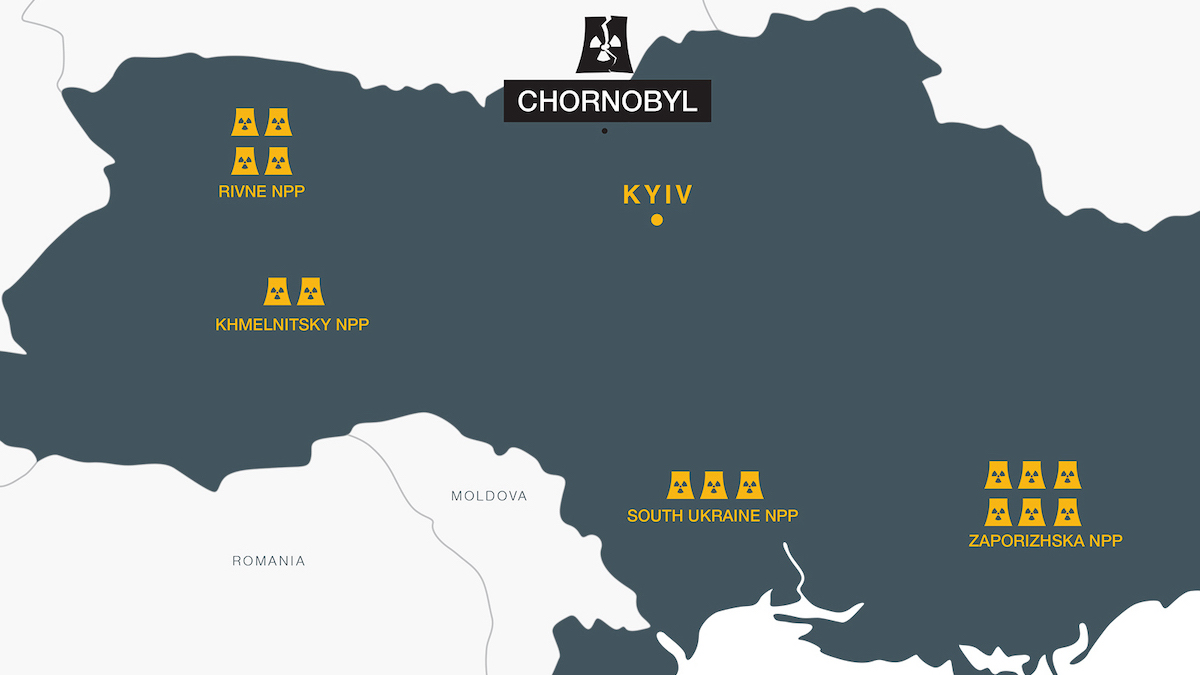
Now, the White House is apparently suggesting that the US should first rebuild and then operate the damaged six-reactor Zaporizhzhia nuclear plant in the southeast of Ukraine, the area of some of the most intense fighting between Ukrainian and Russian forces.
This bizarre proposal is detailed in a new column by the director of the Nonproliferation Policy Education Center, Henry Sokolski, in the May 6, 2025 edition of The Bulletin of the Atomic Scientists. Along with the question of whose nuclear plant Zaporizhzhia actually is, or who damaged it, Sokolski also asks just how complex and expensive restoring the plant would be and whether it is even needed?
In reading through the list of challenges to a restart that Sokolski outlines, the answer to that last question becomes increasingly more obvious: No. It is glaringly evident that nuclear power is the wrong choice for Ukraine at this point (and, we would argue, always has been).
Renewable energy can take a couple of years — and in some cases just a few months — to build and bring into operation. Given Ukraine’s previous reliance on nuclear energy for around 55% of the country’s electricity (before the war interrupted the flow), developing an energy supplier that can come on fast and doesn’t present a safety risk (under war conditions or at any other time) is, as they say here, a “no brainer”.
And yet all three countries are vying to be the one responsible for a Zaporizhzhia restart. All three are also married to the idea of a nuclear-powered future and therefore cannot be relied upon to take the more sensible renewable energy route. Even in the midst of a war, Ukraine has signaled its intention to build as many as nine new Westinghouse AP1000 reactors at all four of its existing nuclear sites —yes, even at Zaporizhzhia! Both Russia and the US are expanding their nuclear power capacity, at home as well as abroad, including through the export of reactor technology.
Why then are any of these countries even contemplating an attempt to surmount the likely insurmountable challenges of resurrecting the existing Russian built VVER Zaporizhzhia reactors, which comprise the largest nuclear power plant in Europe at 5,700 MW?
As Sokolski asks in a preamble to his Bulletin article:
“Russia destroyed the Kakhovka Dam upstream of the plant. What would be required to assure a steady clean supply of cooling water for the reactors? The Russians laid mines around the plant; the area is also laced with unexploded ordnance. How will these be neutralized? Who will do this? The Russians looted and damaged much of the plant’s control equipment. How will it be repaired and replaced? Who will certify that the work has been done properly? The U.S. Nuclear Regulatory Commission? The Ukrainian State Nuclear Regulatory Inspectorate? Rosatom?”
Then there’s the issue of cost.
“Will seized Russian assets foot the bill?” Sokolski asks. “Or will it be European Reconstruction Bank funds? What of US investment, taxpayer funds, and any private entity potentially interested in chipping in? Once funds are allocated, who would receive the profits, if any, or be responsible for the losses? Who would assume responsibility for possible accidents and damage to property beyond the plant’s site? And, finally, who will bear the costs of ensuring the plant’s security so that its reactors do not become again the targets of future attacks?”
It’s not just a question of repairing the reactors of course. It’s also an issue of repairing the damaged — and in parts destroyed — electrical grid. Even assuming Zaporizhzhia gets restared, how will the electricity it generates even reach its customers? And do they even have homes left where the lights can be switched on? Let’s remind ourselves one more time that there is a war going on in Ukraine, a bloody and protracted one that began on February 24, 2022 when Russia invaded its neighbor. (The arguments about why and what the precursors were have raged on, especially on the left, but are not the subject of this present discussion.)
There seem to be altogether too many questions surrounding a Zaporizhzhia restart to make any such prospect an even vaguely rational proposition. And there would be no need to ask any of these questions, if the obvious alternative — renewable energy — was mooted instead. These days you can ask AI — a not entirely unbiased source to be sure — which responds that Ukraine hasn’t turned to renewable energy because it “requires significant investment and infrastructure development.” Yes, but not nearly as much as trying to re-establish broken nuclear power plants and reconnect them to a destroyed electricity grid.
None of this will cross the radar at peace talks between the warring parties and the US in its self-appointed role as peacemaker. That’s because solar panels and wind turbines don’t come with the radioactive inventory that has somehow earned nuclear power a position of international — and aspirational — prestige. What it should trigger instead is an array of red warning flags, and not the kind any of us would want to “keep flying here”.
Linda Pentz Gunter is the international specialist at Beyond Nuclear and writes for and edits Beyond Nuclear International. Opinions are her own.
.
Westinghouse drops out of UK SMR competition
Nuclear Engineering International 30th April 2025, https://www.neimagazine.com/news/westinghouse-drops-out-of-uk-smr-competition/
S Westinghouse has pulled out of the UK’s small modular reactor (SMR) design competition, according to the UK The Telegraph.
Earlier in April, three of the four competition finalists in Great British Nuclear’s (GBN’s) small modular reactor (SMR) competition submitted their final tenders. The four finalists received an Invitation to Submit Final Tender (ISFT) in February – GE-Hitachi Nuclear Energy International, Holtec Britain, Rolls-Royce SMR, and Westinghouse Electric Company.
GEH (part of GE Vernova) proposed its BWRX-300 boiling water reactor; Holtec proposed its SMR-300 – a 300 MWe pressurised water reactor (PWR); the Rolls-Royce SMR is a 470 MWe PWR; and the Westinghouse AP300 is a 300 MWe/900 MWt PWR. Westinghouse, however, failed to submit its final tender.
GBN was expected to announce two winners this summer with bidders told to prepare to build three to four mini reactors each. The winners will be awarded contracts to co-fund further design development as well as the necessary regulatory, environmental and site-approvals before a final investment decision is taken in 2029. The contracts are expected to total £20bn ($26.7bn) – £10bn each if two companies are selected.
However, The Telegraph reported in February that the Government was considering awarding only one contract as Rachel Reeves, the Chancellor “is struggling to balance the books as weak economic growth makes it harder to meet her self-imposed ‘fiscal rules’ for borrowing.
According to The Telegraph, Westinghouse did not deny it had withdrawn but declined to give its reasons. “One industry source suggested the company had baulked at the commercial offer made by the Government.”
A spokesman from the UK Energy Department said: “Great British Nuclear is driving forward its SMR competition for UK deployment. It has now received final tenders, which it will evaluate ahead of taking final decisions this spring.”
There is growing concern that the economics of SMRs could prove even hard to justify at the high costs for the initial four units. None of the bidders has built their designs which are still in development. All SMRs in the GBN competition will be first-of-a-kind units (FOAK), which will push up costs.
Commenting on the issue, Neutron Bytes noted: “Most estimates are that economies of scale based on factory production of SMRs, promised by all four vendors, only kick in when order books come in “fleet mode,” e.g. by the dozen or more. It follows that even £10bn could be insufficient to cover the costs of four units any of the three 300 MWe offerings based on their status as FOAK projects.”
It added: “Splitting the difference for the GBN competition, e.g. awarding one winner £10bn, keeps the SMR initiative alive, but does nothing to promote long-term “fleet mode” production of SMRs which the UK nuclear industry points out is the only way to achieve economies of scale with factory production of SMRs.”
US nuclear giant Westinghouse pulls out of race to build Britain’s first mini-nukes

There are growing fears that the economics of SMRs could prove even harder to justify – because they have many of the same problems as large reactors – meaning security and waste disposal – but produce far less electricity and so make less money.
There are growing fears that the economics of SMRs could prove even harder to justify – because they have many of the same problems as large reactors – meaning security and waste disposal – but produce far less electricity and so make less money.
Westinghouse has not submitted its final bid for the UK’s SMR design competition
Matt Oliver, Industry Editor, https://www.telegraph.co.uk/business/2025/04/26/us-company-pulls-out-race-build-britains-first-mini-nuke/
US nuclear giant Westinghouse has pulled out of the UK’s small modular reactor (SMR) design competition.
The four companies remaining in the contest were given a deadline of mid-April to make their final bids, but The Telegraph understands that Westinghouse did not submit one following a negotiation process.
It means only three finalists – Rolls-Royce, GE-Hitachi and Holtec – remain in the running.
Great British Nuclear (GBN), the quango responsible for the SMR programme, was expected to announce two winners this summer with bidders told to prepare to build three to four mini reactors each.
Westinghouse did not deny it had withdrawn on Friday but declined to give its reasons.
One industry source suggested the company had baulked at the commercial offer made by the Government.
GBN previously advertised contracts worth £20bn in total for SMR “technology partners”, a figure that is understood to be based on the assumption two winners would be chosen.
However, The Telegraph revealed in February that the Government was considering awarding a contract to only one company as Rachel Reeves, the Chancellor, looks to make savings in her cross-departmental spending review.
The Chancellor is struggling to balance the books as weak economic growth makes it harder to meet her self-imposed “fiscal rules” for borrowing.
SMR supporters claim they could be a breakthrough in nuclear power because they would be made predominantly in factories and then assembled on site, cutting building times from around a decade to a few years. In theory this could cut costs – as would-be builders of SMRS have repeatedly promised..
Many politicians have snapped up that bait. When he opened the latest stage of the SMR competition, Mr Miliband said: “Small modular reactors will support our mission to become a clean energy superpower.”
However, the nuclear industry has a mixed record on bringing in key projects on time and on budget.
The biggest current example is the UK’s Hinkley Point C power station in Somerset which EDF originally said would cost under £20bn and be operating by now. Current costs estimates are for a final price approaching £50bn and a start-up after 2030.
There are growing fears that the economics of SMRs could prove even harder to justify – because they have many of the same problems as large reactors – meaning security and waste disposal – but produce far less electricity and so make less money.
A spokesman from the UK Energy Department said: “Great British Nuclear is driving forward its SMR competition for UK deployment. It has now received final tenders, which it will evaluate ahead of taking final decisions this spring.”
On Friday, a GBN spokesman declined to comment on Westinghouse’s position as did Westinghouse itself.
China, Russia may build nuclear plant on moon to power lunar station, official says

By Eduardo Baptista, April 24, 2025,
https://www.reuters.com/business/energy/china-led-lunar-base-include-nuclear-power-plant-moons-surface-space-official-2025-04-23/
- Summary
- China and Russia plan nuclear reactor for lunar base by 2035
- China and Russia-led ILRS aims to rival NASA’s Artemis program
- China-Russia cooperation strengthened by tensions with West
SHANGHAI, April 23 (Reuters) – China is considering building a nuclear plant on the moon to power the International Lunar Research Station (ILRS) it is planning with Russia, a presentation by a senior official showed on Wednesday.
China aims to become a major space power and land astronauts on the moon by 2030, and its planned Chang’e-8 mission for 2028 would lay the groundwork for constructing a permanent, manned lunar base.
In a presentation in Shanghai, the 2028 mission’s Chief Engineer Pei Zhaoyu showed that the lunar base’s energy supply could also depend on large-scale solar arrays, and pipelines and cables for heating and electricity built on the moon’s surface.
Russia’s space agency Roscosmos said last year it planned to build a nuclear reactor on the moon’s surface with the China National Space Administration (CNSA) by 2035 to power the ILRS.
The inclusion of the nuclear power unit in a Chinese space official’s presentation at a conference for officials from the 17 countries and international organisations that make up the ILRS suggests Beijing supports the idea, although it has never formally announced it.
“An important question for the ILRS is power supply, and in this Russia has a natural advantage, when it comes to nuclear power plants, especially sending them into space, it leads the world, it is ahead of the United States,” Wu Weiren, chief designer of China’s lunar exploration program, told Reuters on the sidelines of the conference.
After little progress on talks over a space-based reactor in the past, “I hope this time both countries can send a nuclear reactor to the moon,” Wu said.
China’s timeline to build an outpost on the moon’s south pole coincides with NASA’s more ambitious and advanced Artemis programme, which aims to put U.S. astronauts back on the lunar surface in December 2025.
Wu said last year that a “basic model” of the ILRS, with the Moon’s south pole as its core, would be built by 2035.
In the future, China will create the “555 Project,” inviting 50 countries, 500 international scientific research institutions, and 5,000 overseas researchers to join the ILRS.
Researchers from Roscosmos also presented at the conference in Shanghai, sharing details about plans to look for mineral and water resources, including possibly using lunar material as fuel.
‘I guarded Britain’s nuclear sites – our security can’t cope with new mini reactors’

mini reactors do not pose miniature hazards. “On security, size doesn’t matter. When it comes to the fuel and the byproducts, they are equally dangerous.”
“You get less energy, but you’re still going to have exactly the same security concerns,” says Okuhara. “How enthusiastic is a site operator going to be paying for security when that’s eating into their bottom line?”
INTERVIEW . Matthew Okuhara, a former armed officer with the Civil Nuclear Constabulary, fears that current security plans will be inadequate to protect the UK’s next generation of nuclear power plants..
Rob Hastings, Special Projects Editor , April 22, 2025
Sometimes he would patrol rural lanes on foot, carrying his assault rifle, looking out for any terrorists hiding in the countryside. On other assignments he would man machine guns mounted on armoured ships, watching for any sign of hostile vessels coming his way. Or he would drive in weapons-laden road convoys, monitoring potential threats from vehicles.
While serving as an armed officer with the Civil Nuclear Constabulary (CNC), Matt Okuhara saw every aspect of how the UK’s nuclear power stations and their radioactive fuel are protected from terrorists.
He spent years escorting the transport of uranium fuel to and from plants, which would be planned for months in advance. “Nuclear material is at its most vulnerable when it’s in transit,” he explains. “You’ve got to move it as secretly as possible.”
Working for the specialist force, Okuhara always felt confident the country’s civil nuclear programme was in safe hands. “Any threat has been detected long before it’s been able to cause any problems,” he says.
However, he believes the situation is “definitely more dangerous now” than when he was serving. Terrorism has become more advanced and there are new fears about so-called hybrid warfare from geopolitical adversaries including Russia.
“You don’t have to be a James Bond super-villain to realise where the vulnerable parts of a site are. You can just look on Google Maps and say, ‘We’ll attack that bit,’ especially now we’ve got drones. The threat has really shot up.”
With new technology also on the horizon, he believes the nuclear industry must face up to big security questions.
The CNC currently guards just a handful of sites, all in relatively remote locations. But experts believe the Government’s planned array of cutting-edge mini nuclear power stations could lead to a “proliferation” of reactors around the country, potentially much closer to towns and cities. This may also lead to their fuel being transported more often.
Small modular reactors (SMRs) are seen as an essential source of green energy for the UK in decades to come. Proponents say they will be quicker and cheaper to build than conventional plants, because they will be largely prefabricated.
But security experts are worried about the complex implications for how SMRs will be policed and protected, as The i Paper revealed this week. Analysts say that thousands more armed officers would have to be recruited, co-ordination with local police would have to be strengthened, and a new national infrastructure force may even have to be created.
Okuhara shares these concerns. “I don’t think the CNC’s current policing model would be able to cope with any more sites,” he says. “The generating sites, they’re kept well away from the public for good reasons.
“One, they’re easier to protect. And two, if something goes wrong, the contingency engineers have got some space to work with.”
What is the Civil Nuclear Constabulary?
- The CNC is a specialist armed force with about 1,600 officers and staff. It was created in 2005 to guard civil nuclear sites and material.
- “The CNC will deter any attacker whose intent is the theft, sabotage or destruction of nuclear material, whether static or in transit, or the sabotage of high consequence facilities,” its web page explains.
- It adds: “If an attack occurs, CNC will defend that material and those facilities and deny access to them. If material is seized or high consequence facilities are compromised, the CNC will recover control of those facilities and regain custody of the material.”
New small reactors, same big risks
After fighting in the Iraq War with British infantry, Okuhara joined the CNC in 2006 and served for six years. He describes how he helped to protect Gloucestershire’s Oldbury Power Station – which is now undergoing decommissioning – in his new book, Nuclear Copper. “Based within the high metal fences and fortress-like security measures of the power station, there was a heavily armed police presence on duty at any given time,” he writes.
To deter and prevent terrorism, the team patrolled surrounding roads and villages, wearing body armour and carrying G36C assault rifles. They benefited from the rural location by building relationships with local farmers and villagers, who “could recognise an unfamiliar car or person instantly” and knew to inform officers.
Rules currently state that nuclear power stations can only be placed in “semi-urban” settings. A spokesperson for the Department for Energy Security & Net Zero insists: “All new nuclear projects, including SMRs, are prevented from being built in densely populated areas.” The Government is loosening restrictions on them being built in the countryside.
But a majority of industry figures believe that “new nuclear technologies could be safely located closer to densely populated areas,” according to an official consultation paper.
The Whitehall document says that the semi-urban restriction will be reviewed every five years “to ensure it remains relevant and effective,” and the Government is “open to revising” this rule in future……………………….
The nuclear industry argues that SMRs will be small enough to build in urban settings, but Okuhara argues this would rob officers of a key advantage. “An intervention zone around a site gives you plenty of space where you can detect things,” he explains.
And he underlines that mini reactors do not pose miniature hazards. “On security, size doesn’t matter. When it comes to the fuel and the byproducts, they are equally dangerous.”
At the moment, energy companies cover much of the CNC’s costs. But having many smaller sites is likely to make security operations proportionately more expensive.
He continues: “If you think about the largest sites in the UK, places like Sellafield or Dounreay, they’ve got hundreds of officers. There are plenty of people out on patrol. Are these SMRs going to be given sufficient resources? Or are the companies going to be saying: ‘It’s a small reactor, we don’t need as many bodies on the ground’?”
The Government offers reassurance that any SMR will “need to have the highest levels of security in place.” A spokesperson said: “All operators are answerable to a robust and independent regulator – the Office for Nuclear Regulation – which must approve their security plan covering physical, personnel and cyber security.” The CNC declined to comment.
Vetting failures
If potentially thousands more armed officers must be recruited to guard SMRs, the CNC must improve its vetting procedures. That much is clear because of one man: Wayne Couzens.
Couzens’ name became infamous after he raped and murdered Sarah Everard in Surrey in 2021, having used his Metropolitan Police ID to falsely arrest her.
Couzens had previously been an authorised firearms officer with the CNC, serving at Sellafield and Dungeness. He had passed the CNC’s vetting procedures in 2011 despite previously being accused of numerous sexual offences, including harassment, assault and indecent exposure. He transferred to the Met in 2018.
The CNC’s Chief Constable, Simon Chesterman, apologised “unreservedly” on behalf of the force in 2024, “for the part CNC played in his entry as a full-time police officer.”………………………………………………
No matter whether they’re protecting groundbreaking SMRs, or conventional nuclear sites, or convoys of radioactive fuel, “every officer in the CNC should have the top level of vetting,” he says. “They’ve got access to firearms. They can access some of the most toxic material that has ever existed.”
It’s a reminder that when it comes to nuclear security, sometimes the biggest threats can come from insiders.
‘Nuclear Copper: The Secret World of Nuclear Policing’ by Matt Okuhara is out now (£22.99, Amberley Publishing) @robhastings.bsky.social https://inews.co.uk/news/crime/i-guarded-britains-nuclear-sites-security-mini-reactors-3649782
China, Russia may build nuclear plant on moon to power lunar station, official says
China is considering building a nuclear plant on the moon to power the
International Lunar Research Station (ILRS) it is planning with Russia, a
presentation by a senior official showed on Wednesday. China aims to become
a major space power and land astronauts on the moon by 2030, and its
planned Chang’e-8 mission for 2028 would lay the groundwork for
constructing a permanent, manned lunar base.
Reuters 23rd April 2025, https://www.reuters.com/business/energy/china-led-lunar-base-include-nuclear-power-plant-moons-surface-space-official-2025-04-23/
As more countries enter space, the boundary between civilian and military enterprise is blurring. Dangerously.

By Zohaib Altaf | April 9, 2025, https://thebulletin.org/2025/04/as-more-countries-enter-space-the-boundary-between-civilian-and-military-enterprise-is-blurring-dangerously/#post-heading
Outer space is no longer just for global superpowers and large multinational corporations. Developing countries, start-ups, universities, and even high schools can now gain access to space. The democratization of space has led to significant technological advancements, economic growth, and international collaboration.
In 2024, a record 2,849 objects were launched into space. The commercial satellite industry saw global revenue rise to $285 billion in 2023, driven largely by the growth of SpaceX’s Starlink constellation. Private space companies such as SpaceX have played crucial roles in making space more accessible globally.
Developing countries have also made strides. Since 2018, nations like Bangladesh, Ghana, Nepal, Rwanda, and Sri Lanka have launched their first satellites. The African space scene has grown, with 43 satellites launched since 2016, totaling 63 in 2025. Ethiopia, despite being one of the world’s poorest countries, has made significant progress in space activities. Similarly, Rwanda, with a substantial portion of its population living in poverty, has embarked on its space journey. These advances show that barriers to space entry are declining.
While the democratization of space is a positive development, it has introduced complex challenges, particularly an ethical quandary that I call the “double dual-use dilemma.” The double dual-use dilemma refers to how private space companies themselves—not just their technologies—can become militarized and integrated into national security while operating commercially
Unlike the traditional military-industrial complex, space companies fluidly shift between civilian and military roles. Their expertise in launch systems, satellites, and surveillance infrastructure allows them to serve both markets, often without clear regulatory oversight. Companies like Walchandnagar Industries in India, SpaceX in the United States, and the private Chinese firms that operate under a national strategy of the Chinese Communist Party called Military-Civil Fusion exemplify this trend, maintaining commercial identities while actively supporting defense programs. This blurring of roles, including the possibility that private space companies may develop their own weapons, raises concerns over unchecked militarization and calls for stronger oversight to preserve space as a neutral domain.
Dual use of space companies. Countries like the United States and China have already shown a willingness to use commercial space entities for military purposes. China encourages private entities to participate in space activities as part of its Military-Civilian Integration Strategy. Similarly, the 2021 United States Space Priorities Framework outlines how new commercial space capabilities and services can be leveraged to meet national security needs. In a 2021 interview, the then-head of the US Space Force discussed the importance of using the space industry for national security.
Researchers and security analysts are increasingly concerned that the dual use of private space companies is not limited to their space technologies, such as the satellites they launch. In some cases, a company may appear to be a civilian space entity while actually maintaining close links with defense sectors.
For instance, take the example of India, which has seen phenomenal growth in its space sector in recent years. The leading companies of the Indian Space Association have worked closely with the Indian Ministry of Defence on various contracts.
Furthermore, the association’s leadership maintains a close connection with the Indian army and defense organizations. For example, the first chairman, Jayant Patil, was also the senior vice president for defense business at Larsen and Toubro, an Indian company involved in the space industry. The company has collaborated with India’s Defence Research and Development Organisation since the mid-1980s.
The usefulness of space companies goes beyond their existing technologies. Military organizations can use expertise gained through civilian cooperation programs to develop other critical technologies. India’s intercontinental ballistic missile program, based on the SLV-3 vehicle, was initially developed under civilian space cooperation with NASA. India’s Agni-V ICBM, which is capable of carrying multiple warheads and has a range exceeding 5,000 kilometers, has also benefited from technological cooperation with NASA.
Indian private space companies such as Walchandnagar Industries are also defense contractors producing aerospace, defense, missile, and nuclear power technologies. These companies collaborate with India’s Defence Ministry and the Defence Research and Development Organisation to produce strategic articles, tactical missiles, and critical platform-based equipment. The expertise gained from private space launches and technological developments can be leveraged to improve missile technology.
There is a serious risk that civilian companies in India and elsewhere, having gained expertise through cooperation with the military, might start developing their own weapons. The table below shows how specific types of space expertise can be used to develop missiles, drones, precision missiles, hypersonic missiles, and other loitering munitions.
Dual use of space technology. India’s rapidly growing space sector and expanding military-commercial partnerships make it a key case study of the double dual-use dilemma. Unlike the United States and China, which have structured policies—the US Space Force and National Space Policy formally integrate private firms into defense, while China’s Military-Civil Fusion strategy mandates commercial space support for China’s army—India’s private space sector is expanding, but its dual-use regulatory framework is still developing. India’s Space Policy 2023, while not explicitly mentioning the military, hints at defense applications by emphasizing space capabilities for “national security.”
This lack of clear regulatory boundaries allows technologies initially developed for civilian use to be repurposed for defense applications, as seen in the case of Synthetic Aperture Radar. Originally acquired through civilian cooperation with NASA, this radar imaging technique is now being adapted for military reconnaissance and targeting. Although not a weapon, the technique’s dual-use nature enables high-resolution surveillance, missile guidance, and intelligence operations.
The commercialization of space by private companies poses significant security challenges. For instance, ostensibly civilian satellites can be repurposed for military uses such as surveillance and espionage. Commercial satellites with high-resolution imaging capabilities, like those from companies such as Planet Labs, can be used for intelligence gathering, providing detailed information on adversaries’ activities and installations. The dual-use dilemma affects governments as well as private companies, but poses greater risks with private entities due to weaker oversight and profit-driven priorities. Governments operate under strict security frameworks and treaties like the Outer Space Treaty, ensuring accountability in the use of dual-use technologies. In contrast, private companies may prioritize commercial interests, potentially selling technologies to less accountable actors, increasing proliferation risks. While satellite launches are regulated, post-launch activities—like selling high-resolution imagery or repurposing technology—are harder to monitor.
Furthermore, companies like the American company Capella Space have developed synthetic aperture radar satellites for civilian purposes such as disaster management and environmental monitoring. However, the high-resolution images provided by these satellites can also be used for military applications, including counterforce strikes and espionage. These satellites can monitor adversaries and plan strategic military operations.
Moreover, American companies like SpaceX and Blue Origin, which focus on developing rockets and spacecraft for civilian space missions, also have the potential to contribute to military logistics and defense operations. For instance, SpaceX’s Starlink constellation, designed for global internet coverage, could be used in military scenarios to support drone operations by enabling real-time communication and coordination, as seen during the Russia-Ukraine conflict.
Repurposing commercial technologies for military use introduces potential risks. Civilian systems could become high-value targets, vulnerable to cyberattacks and physical strikes, potentially disrupting operations and escalating conflicts into space. The reliance on privately owned infrastructure also poses challenges, as it reduces government oversight and increases the risk of misuse or proliferation. For example, reusable rockets developed for commercial launches could be adapted for missile programs, enabling military advancements to be concealed within civilian initiatives. These dual-use capabilities have the potential to blur the boundaries between civilian and military applications, increasing the risks of conflict escalation and complicating efforts to maintain global stability in a democratized space domain.
Need for robust regulatory framework. The challenges posed by the double dual-use dilemma necessitate robust regulatory frameworks and international cooperation to ensure that the commercialization of space does not compromise global security. For example, commercial satellite launch services could be used to deploy space-based weapons or reconnaissance systems under the guise of civilian activities, making it harder to enforce arms control agreements. Effective space governance must address the potential for commercial space entities to be co-opted for military purposes. One practical step is the establishment of international agreements that mandate transparency in satellite launches and operations.
The Outer Space Treaty, which forms the basis of international space law, should be expanded to include specific provisions for the dual use of space technologies. For example, countries could be required to declare the intended uses of their satellites, with periodic inspections to ensure compliance. International space governance must ensure that expertise gained through civil cooperation does not translate into new weapons programs.
Furthermore, partnerships between governments and private corporations should be regulated to prevent the misuse of commercial space capabilities. The European Union’s Space Surveillance and Tracking network is an example of regional cooperation to monitor space activities and ensure that space assets are used for their declared purposes. This type of cooperation should be extended globally to include major space-faring nations and emerging space players.
In the United States, the Space Force has already begun leveraging commercial space capabilities for national security purposes. For instance, the National Reconnaissance Office has contracted with commercial satellite companies to provide imagery for intelligence purposes. Such partnerships highlight the need for clear guidelines to differentiate civilian and military applications and to ensure that commercial space activities do not escalate geopolitical tensions.
The international community must develop comprehensive strategies to manage the complexities introduced by the double dual-use dilemma. It is no longer a distant challenge—it is actively reshaping the balance of power in space. As private space firms blur the lines between commercial innovation and military assets, the risk of an unregulated arms race beyond Earth’s atmosphere grows.
Without clear governance, space could follow the path of cyberspace—a once-neutral domain now deeply entrenched in geopolitical rivalry. The question is no longer if commercial space activities will fuel strategic competition, but how soon nations will act to prevent the militarization of the final frontier.
INSIDER THREAT SECURITY CONSIDERATIONSFOR ADVANCED AND SMALL MODULAR REACTORS.
The wide range of nuclear power plant technologies currently in design
globally have an assortment of unique characteristics that create novel
security considerations compared to large conventional nuclear power
plants.
Some of these characteristics create “insider threat”
considerations for nuclear security, where insiders are defined as
individuals with legitimate access to nuclear facilities and materials who
use this access to carry out sabotage or theft of nuclear material.
These include a lack of mature security culture in developer organisations,
serial plant manufacturing in a production line environment, plant siting
in remote and isolated areas, minimised staff numbers, teleoperation of
plants by offsite staff, the increased reliance on digital instrumentation
and control systems, and the potential for greater involvement of foreign
experts and third-party suppliers, especially on short-term bases for, e.g,
refuelling and maintenance.
The paper takes a technology agnostic approach
to examine what these factors may mean for insider threat risks and
suggests that plant designers should be identifying and minimising the
opportunities of insiders to act throughout the engineering design process.
Doing so is anticipated to strengthen effective insider threat mitigation
in deployed small and advanced reactors.
Kings College 21st April 2025 – https://kclpure.kcl.ac.uk/ws/portalfiles/portal/311074601/Paper_381_Insider_Threat_for_SMR.pdf
Small nuclear reactors are no fix for California’s energy needs

I know all too well that the hype is built on quicksand …….. many of those “building support for small modular reactors” are putting forward “rhetorical visions imbued with elements of fantasy.”
SMRs are just one of several wildly overhyped false promises on which the world is poised to spend hundreds of billions of dollars by 2040
Joseph Romm, April 18, 2025 , https://www.latimes.com/opinion/story/2025-04-18/small-modular-reactors-cost-california
It might seem like everyone from venture capitalists to the news media to the U.S. secretary of Energy has been hyping small modular reactors as the key to unlocking a nuclear renaissance and solving both climate change and modern data centers’ ravenous need for power.
On Monday, the Natural Resources Committee of the California Assembly will consider a bill to repeal a longstanding moratorium on nuclear plants in the state, which was meant to be in place until there is a sustainable plan for what to do with radioactive waste. Defeated multiple times in the past, this bill would carve out an exception for small modular reactors, or SMRs, the current pipe dream of nuclear advocates.
SMRs are typically under 300 megawatts, compared with the combined 2.2 gigawatts from Diablo Canyon’s two operating reactors near San Luis Obispo. These smaller nukes have received so much attention in recent years mainly because modern reactors are so costly that the U.S. and Europe have all but stopped building any.
The sad truth is that small reactors make even less sense than big ones. And Trump’s tariffs only make the math more discouraging.
I’ve been analyzing nuclear power since 1993, when I started a five-year stint at the Department of Energy as a special assistant to the deputy secretary. I helped him oversee both the nuclear energy program and the energy efficiency and renewable energy program, which I ran in 1997.
So I know all too well that the hype is built on quicksand — specifically, a seven-decade history of failure. As a 2015 analysis put it, “Economics killed small nuclear power plants in the past — and probably will keep doing so.” A 2014 journal article concluded many of those “building support for small modular reactors” are putting forward “rhetorical visions imbued with elements of fantasy.”
But isn’t there a nuclear renaissance going on? Nope. Georgia’s Vogtle plant is the only new nuclear plant the U.S. has successfully built and started in recent decades. The total cost was $35 billion, or about $16 million per megawatt of generating capacity — far more than methane (natural gas) or solar and wind with battery storage.
As such, Vogtle is “the most expensive power plant ever built on Earth,” with an “astoundingly high” estimated electricity cost, noted Power magazine. Georgia ratepayers each paid $1,000 to support this plant before they even got any power, and now their bills are rising more than $200 annually.
The high cost of construction and the resulting high energy bills explain why nuclear’s share of global power peaked at 17% in the mid-1990s but was down to 9.1% in 2024.
For decades, economies of scale drove reactors to grow beyond 1,000 megawatts. The idea that abandoning this logic would lead to a lower cost per megawatt is magical thinking, defying technical plausibility, historical reality and common sense.
Even a September report from the federal Department of Energy — which funds SMR development — modeled a cost per megawatt more than 50% higher than for large reactors. That’s why there are only three operating SMRs: one in China, with a 300% cost overrun, and two in Russia, with a 400% overrun. In March, a Financial Times analysis labeled such small reactors “the most expensive energy source.”

Indeed, the first SMR the U.S. tried to build — by NuScale — was canceled in 2023 after its cost soared past $20 million per megawatt, higher than Vogtle. In 2024, Bill Gates told CBS the full cost of his 375-megawatt Natrium reactor would be “close to $10 billion,” making its cost nearly $30 million per megawatt — almost twice Vogtle’s.
All of this has played out against a backdrop of historically cheap natural gas and a rapid expansion of renewable energy sources for electricity generation. All that competition against nuclear power matters: A 2023 Columbia University report concluded that “if the costs of new nuclear end up being much higher” than $6.2 million per megawatt, “new nuclear appears unlikely to play much of a role, if any, in the U.S. power sector.” R.I.P.
SMRs are just one of several wildly overhyped false promises on which the world is poised to spend hundreds of billions of dollars by 2040, including hydrogen energy and direct air carbon capture.
But nuclear power is the original overhyped energy technology. When he was chairman of the Atomic Energy Commission, Lewis Strauss — the Robert Downey Jr. character in “Oppenheimer” — predicted in 1954 that our children would enjoy nuclear power “too cheap to meter.”
Yet by the time I joined the Department of Energy in 1993, nuclear power costs had grown steadily for decades. Since then, prices for new reactors have kept rising, and they are now the most expensive power source. But solar, wind and battery prices have kept dropping, becoming the cheapest. Indeed, those three technologies constitute a remarkable 93% of planned U.S. utility-scale electric-generating capacity additions in 2025. The rest is natural gas.
China is the only country building many new nuclear plants over the next five years — about 35 gigawatts. Less than 1% of this projected capacity would be from small reactors — while more than 95% will be from reactors over 1,100 megawatts. Now compare all that to the 350 gigawatts of solar and wind China built — just in 2024.
For the U.S., President Trump’s erratic tariffs make small modular reactors an even riskier bet. If the U.S. economy shrinks, so does demand for new electric power plants. And the twin threats of inflation and higher interest rates increase the risk of even worse construction cost overruns.
Also, China, Canada and other trading partners provide critical supply chain elements needed to mass-produce SMRs — and mass production is key to the sales pitch claiming this technology could become affordable. That logic would apply only if virtually all of the current SMR ventures fail and only one or two end up pursuing mass production.
So, can we please stop talking about small modular reactors as a solution to our power needs and get back to building the real solutions — wind, solar and batteries? They’re cheaper and cleaner — and actually modular.
Joseph Romm is a former acting assistant secretary of Energy and the author of “The Hype About Hydrogen: False Promises and Real Solutions in the Race to Save the Climate.”
I’ve got a rocket for these space cadets and their pantomime of feminism

They do not operate the spaceship. They dress sexy for the spaceship flight.
pseudo-feminism.. which wrinkles its nose if you look grey, ugly or old
The Age, Jacqueline Maley, April 20, 2025
“……………………………………………………………….. We didn’t want to look but we found we couldn’t look away when, on Wednesday, Jeff Bezos’ Blue Origin – a space technology company – launched an all-female, B- and C-list celebrity crew of six into space, wearing skintight designer spacesuits and heavy make-up. It was the first fully-lady-mission since Russian astronaut Valentina Tereshkova’s solo space flight in 1963.
The team consisted of the billionaire Bezos’ fiancée, the television journalist and children’s book author Lauren Sanchez; pop star Katy Perry; television host and Oprah-bestie Gayle King; former NASA rocket scientist Aisha Bowe; activist, sexual assault survivor and scientist Amanda Nguyen; and film producer Kerianne Flynn.
“I was like, ‘What am I going to wear?’” Perry told Elle of her initial reaction to the invitation. “But seriously, I have wanted to go to space for almost 20 years.”
In terms of publicity for space tourism for the rich and (dubiously) famous, it was a bonanza. But the heavily girlified nature of the rhetoric around the mission (if we can call it that – the trip lasted for 11 minutes), and its explicit branding as an exercise in empowering girls to aspire to careers in space exploration, well, that made it a very dark day for feminism.
The whole exercise was emblazoned with such drippy femininity and lame girlboss-ery that all womankind was implicated. It was a test of the implicit feminist pact to Support Women. I suspect I failed it.
It’s not something that Virginia Woolf or Betty Friedan ever prepared us for – an all-woman space crew which served quotes like: “I think it’s so important for people to see … this dichotomy of engineer and scientist, and then beauty and fashion. We contain multitudes. Women are multitudes. I’m going to be wearing lipstick.”
Despite not having any direct link to the Trump administration, it all felt so very Trumpy – a symbol of the dark end-days of American democracy; the great American project of aspiration and exploration reduced to a commercialised stunt, obscenely wasteful and vulgar beyond words. …………..
… the moral emptiness of the mission was underscored by leaked documents showing the Trump administration plans to gut key science programs funded by the federal government.
Under the leaked plans, NASA’s science budget for the fiscal year 2026 would be nearly halved. As Nature reported: “At risk is research that would develop next-generation climate models, track the planet’s changing oceans and explore the Solar System.”
Separately, NASA’s Diversity, Equity and Inclusion chief Neela Rajendra was sacked, in compliance with Trump’s executive order to “terminate” all people employed under “DEI” programs.
Business Standard reported Rajendra “played a key role in national initiatives like the Space Workforce 2030 pledge, aimed at increasing representation of women and minorities in STEM fields”.
Sure, but did she put the glam into space? The girlstronauts represent a pantomime of feminism found everywhere across Trump-land.
It’s in the robotically doll-like women who sit behind the men of the administration, nodding and smiling as they announce powerful new assaults on the rule of law.
It’s in the milquetoast “Be Best” initiatives of first lady Melania Trump.
It’s in the administration’s persecution of trans people in the name of “women’s rights”, and in its rollback of abortion rights…………
But at least the women are on stage, right? Women can be treated as a special category as long as they uplift and adorn – that seems to be the message the girl crew have absorbed and then promoted. But there is little point in them being on view if they are not looking “glam”.
Such women equate a certain kind of physical presentation with self-respect, and they defend it as their “right”. They fail to realise, or are too rich to care, that the companies which sell them their version of beauty are exploiting them. They do not operate the spaceship. They dress sexy for the spaceship flight.
It is a nihilistic form of pseudo-feminism that insists on women’s right to “take up space” (as the astronaut women chanted when they reached the zero-gravity part of their adventure), but which wrinkles its nose if you look grey, ugly or old while doing so.
It is a way of reducing women to the status of a pretty distraction, while insisting, straight-faced, that at least that means we are being “seen”. https://www.theage.com.au/politics/federal/i-ve-got-a-rocket-for-these-space-cadets-and-their-pantomime-of-feminism-20250417-p5lslv.html
Aerial photos show state of Sizewell C preparatory works

Aerial photos of the proposed Sizewell C nuclear power station in Suffolk
have revealed the state of preparatory works ahead of its final investment
decision (FID). Despite the nuclear power plant having received development
consent in 2022, its FID is still yet to be achieved and the mood of
potential investors has been the subject of intense speculation.
Centrica chief executive Chris O’Shea said his company’s stake in Sizewell C
could be “between 1% or 2% and 50%”, meanwhile, the French spending
regulator Cour des comptes said EDF should scale back its involvement in
the project.
Nevertheless, preparatory work is underway such on road
upgrades and ground freezing, with over £2.5bn worth of contracts having
been awarded already. Four photos taken from an aerial platform, which
could be a drone, aircraft or hot air balloon, were published by Stop
Sizewell C on 8 April. The images were republished by Nuclear Free Local
Authorities (NFLA), which said the photos had been taken by an “anonymous
source” who “kindly made them free of license for open use”.
New Civil Engineer 16th April 2025, https://www.newcivilengineer.com/latest/aerial-photos-show-state-of-sizewell-c-preparatory-works-16-04-2025/
Bill Gates enters race to build mini-nuclear reactors in Britain
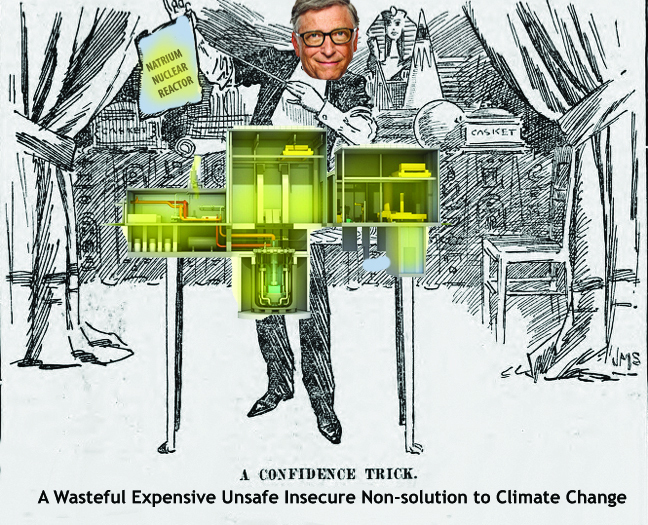
Competition from billionaire’s company TerraPower threatens blow for Rolls-Royce
A company founded by Bill Gates has submitted a bid to build
mini-nuclear reactors in Britain, dealing a potential blow to
Rolls-Royce’s hopes of dominating the domestic market.
Seattle-based TerraPower has written to the Government outlining its intention to submit
its reactor design for regulatory approval. The move kickstarts efforts by
the US company to enter an increasingly competitive market to build small
modular reactors (SMR), which are expected to play a key role in the UK’s
shift to cleaner energy.
The Microsoft billionaire’s company has
developed a reactor, called Natrium, that uses a molten sodium heat storage
system that allows it to rapidly ramp up its power output at peak times.
Natrium is the Latin word for sodium which has the chemical symbol Na.
Chris Levesque, TerraPower chief executive, said: “I am incredibly
excited to begin the process of licensing the Natrium technology in the UK.
Rolls-Royce had hoped to corner UK market with its small modular reactors.
While TerraPower is not involved in the competition for the UK’s SMR
contract, the potential entrant of a new deep-pocketed rival into the
market will pose a fresh challenge to Rolls-Royce’s plans.
Telegraph 16th April 2025, https://www.telegraph.co.uk/business/2025/04/16/bill-gates-bids-to-build-mini-nuclear-reactors-in-britain/
UPENN REPORT: TARIFFS LIKELY NAIL IN COFFIN OF U.S. SMALL NUCLEAR REACTORS.
Small Modular Reactors (SMRs) are a “false promise” for powering
proposed artificial intelligence (AI) data centers nationwide, according to
a new report published today by the University of Pennsylvania’s (UPenn), Dr. Joseph Romm, a former Acting Assistant Secretary of Energy.
The research report, “Smaller nuclear reactors (SMRs) are a costly dead end,
especially for AI, and Trump’s tariffs and other policies make them even
more of a losing bet,” is an expanded version of a chapter in Dr.
Romm’s new book, “The Hype About Hydrogen: False Promises and Real
Solutions in the Race to Save the Climate” (Island Press, April 22).
The report examines recent economic developments, including the over-budget $35
billion completion of Georgia’s Vogtle plant, current and canceled SMR
proposals, and how Trump’s tariffs (and other policies) threaten the
nuclear industry. The study concludes that these factors will ultimately
doom the likelihood of new American commercial nuclear reactors playing
much of a role in meeting U.S. electricity demand needs for the foreseeable
future.
“It would be unprecedented in the history of energy for smaller
nuclear reactors to overcome not only the high cost per megawatt of large
nuclear plants but also the diseconomies of shrinking them down—and then
to somehow keep dropping in price so sharply that SMRs become such clear
marketplace winners as to make a major contribution to cutting greenhouse
gas emissions by 2050. This is especially true since SMRs show every sign
of the kind of cost escalation that has plagued larger nuclear reactors for
decades,” according to the report.
Hastings Group 15th April 2025,
https://hastingsgroupmedia.com/SMF/041525-Romm-SMR-Dead-End-Report-news-release.pdf
1 This Month

To see nuclear-related stories in greater depth and intensity – go to https://nuclearinformation.wordpress.com
-
Archives
- September 2026 (194)
- August 2026 (330)
- July 2026 (355)
- June 2026 (287)
- May 2026 (306)
- April 2026 (356)
- March 2026 (251)
- February 2026 (267)
- January 2026 (308)
- December 2025 (358)
- November 2025 (359)
- October 2025 (375)
-
Categories
- 1
- 1 NUCLEAR ISSUES
- business and costs
- climate change
- culture and arts
- ENERGY
- environment
- health
- history
- indigenous issues
- Legal
- marketing of nuclear
- media
- opposition to nuclear
- PERSONAL STORIES
- politics
- politics international
- Religion and ethics
- safety
- secrets,lies and civil liberties
- spinbuster
- technology
- Uranium
- wastes
- weapons and war
- Women
- 2 WORLD
- ACTION
- AFRICA
- Atrocities
- AUSTRALIA
- Christina's notes
- Christina's themes
- culture and arts
- Events
- Fuk 2022
- Fuk 2023
- Fukushima 2017
- Fukushima 2018
- fukushima 2019
- Fukushima 2020
- Fukushima 2021
- general
- global warming
- Humour (God we need it)
- Nuclear
- RARE EARTHS
- Reference
- resources – print
- Resources -audiovicual
- Weekly Newsletter
- World
- World Nuclear
- YouTube
-
RSS
Entries RSS
Comments RSS
 nuclear-news