The very dodgy plans for Small Modular Nuclear Reactors (SMRs)
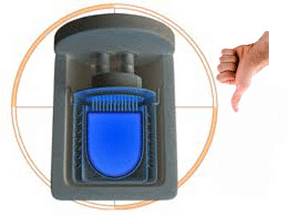 As SMRs are being promoted for overseas markets, SRS officials will not say what plans are for used reactor vessels or highly radioactive spent fuel which would be taken back to the production site.
“If SRS would become a nuclear waste dumping site due to involvement in SMR programs, this is something that the public in the Aiken area and in South Carolina will soundly reject,”
Documents Reveal Time-line and Plans for “Small Modular Reactors” (SMRs) at the Savannah River Site (SRS) Unrealistic and Promise no Funding http://aikenleader.villagesoup.com/blog/blog/documents-reveal-time-line-and-plans-for-small-modular-reactors-smrs-at-the-savannah-river-site-sr/840884 By Thomas Clements | Jun 19, 2012 One SMR Design being Eyed at SRS for Use of Plutonium Fuel (MOX) and Production of Tritium Gas Used in Nuclear Weapons
Documents obtained under the Freedom of Information Act (FOIA) by the Alliance for Nuclear Accountability (ANA) in Columbia, South Carolina reveal unrealistic plans for pursuit of “small modular reactors” (SMR) at the Department of Energy’s Savannah River Site, located near Aiken, South Carolina. Continue reading
Murky history of Japan’s fast breeder nuclear reactor program
 United States Circumvented Laws To Help Japan Accumulate Tons of Plutonium, DC Bureau By Joseph Trento, on April 9th, 2012“…….From the very start, the Japanese breeder program was predicated on the belief that Japanese industry could do what the Americans and Europeans had failed to do – run the extremely complicated breeder cycle safely and profitably. That belief was rooted in Japan’s national self-confidence, nurtured by two generations of success in manufacturing. Japan’s dedicated and educated workforce and its special brand of quality management made it the world leader in a host of industries. Nuclear power generation would, it was believed, merely be one more success, made possible by Japan’s superior workers and management.
Thirty years ago even Japan’s harshest critics might have agreed that perhaps it could succeed where Western efforts had failed. But that optimism soon faded as a string of nuclear catastrophes demonstrated that nuclear industries are far different than any other. Both the Monju fast-breeder reactor in 1995 and the Tokai reprocessing plant in April 1997 suffered serious, accidental radiation leaks; both accidents were the subjects of attempted cover-ups. Most egregious was the fire and leak of radioactive sodium at the Monju FBR. Japan’s Power Reactor and Nuclear Fuel Development Corporation (PNC), the government corporation that operated Monju, lied repeatedly to the public about the accident. PNC attempted to suppress video footage that showed the cause of the accident: a ruptured pipe in a secondary cooling system that had spilled an estimated two to three tons of radioactive sodium – the largest such leak in the history of fast-breeder technology. One of the reasons PNC gave for releasing the misinformation was that Monju was too important to Japan’s energy program to jeopardize the reactor’s operation. In other words, the public’s safety was secondary to the breeder program.
Had it not been for a courageous act by a group of Fukui prefecture officials in the early morning of December 11, PNC’s attempted cover-up probably would have succeeded. Suspecting a cover-up, the officials entered the plant and secured the videotape. The action came as a direct result of a previous accident at Fukui’s Tsuruga Unit I reactor in the early 1980s. Fukui prefecture officials were not permitted to investigate that mishap. When the Monju accident took place, the officials were determined not to be turned away a second time. Following revelations that the agency itself had been involved in trying to withhold the video, a PNC executive committed suicide……. http://www.dcbureau.org/201204097128/national-se
How fast breeder nuclear reactors were tried in USA, and failed
Despite the efforts of the country’s best minds and nearly limitless budgets, the breeder program did not work. And it was not only the Clinch River team who failed. Breeder programs in Germany, France and the United Kingdom also could not make the leap from lab experiment to commercially viable practice.
United States Circumvented Laws To Help Japan Accumulate Tons of Plutonium, DC Bureau By Joseph Trento, April 9th, 2012.….Reversing Course – Reagan Undermines Carter’s Policies Richard Kennedy One of the most passionate nuclear believers was a career bureaucrat named Richard Kennedy. A former Army officer, he labored in obscurity at the Nuclear Regulatory Commission, his career held hostage by his vehement opposition to President Carter’s nuclear policies. All of that changed after Ronald Reagan’s election in 1980. One of Reagan’s first acts as president was to effectively reverse Carter’s nuclear doctrine, which had barred the United States from using plutonium in civilian power projects with America’s friends or adversaries.
Reagan made Kennedy his right-hand man for nuclear affairs. From his new post as Ambassador at Large for Nuclear Energy, Kennedy oversaw the dismantling of the Carter policies he despised. The new administration rejuvenated American and international reliance on plutonium. Continue reading
Space Travel – ionising radiation would kill you
 How a long mission to Mars could kill you NBC News, By Eric Niiler 7/18/2011 We’ve already “done” the moon, but Mars still beckons like some interplanetary Brigadoon ; visible through the eyes of clever little rovers and orbiters, but just beyond the reach of human footsteps…..
Radiation The combined effects of background cosmic rays from extragalactic sources and extreme radiation events from the sun make space travel too hazardous for an estimated six months there and six months return. ”The estimate now is you would exceed acceptable levels of fatal cancer,” said Francis Cucinotta, chief scientist for NASA’s space radiation program at the Johnson Space Center in Houston. “That’s just cancer. We also worry about effects of radiation on the heart and the central nervous system.”
Cucinotta says these estimates do take into account protective shielding around a crew vehicle, probably some form of polyethylene plastic. Lead shields actually create secondary radiation when struck by cosmic rays, while water, perhaps the best form of protection, would have to be several meters thick to get enough protection. (“Houston calling Water Balloon 1, do you copy?”)
Lead and water, in any case, are very heavy for the quantities that would be required, making them an expensive shielding to launch….. studies show that radiation can damage the vitamins in food supplies, and the loss of even one vitamin in the food chain could cause serious health effects over a long trip. Little is known about the long-term effects of radiation on food supplies, since International Space Station (ISS) crews have been partially sheltered by Earth’s magnetosphere.
It’s expected that the crew will have to grow its own food in some kind of greenhouse,… http://www.msnbc.msn.com/id/43796117/ns/technology_and_science-science/t/how-long-mission-mars-could-kill-you/?__utma=14933801.1192036095.1344035709.1344126652.1344387760.3&__utmb=14933801.1.10.1344387760&__utmc=14933801&__utmx=-&__utmz=14933801.1344387760.3.3.utmcsr=google|utmccn=(organic)|utmcmd=organic|utmctr=(not%20provided)&__utmv=14933801.|8=Earned%20By=msnbc%7Ctechnology%20%26%20science%7Cscience%7Ccosmic%20log=1^12=Landing%20Content=Original=1^1
Mars probe records radiation blasts that could affect future
astronauts, NBC News, By Alan Boyle, 3 Aug 12 Even before its landing, NASA’s Mars Science Laboratory has sent back its first scientific results — shedding light on the radiation exposure that astronauts would face during a future mission to the Red Planet. Continue reading
Radiation more destructive to electronics than thought, Electronics News, 3 August, 2012 RESEARCH published in the Journal of Applied Physics indicate that radiation causes at least ten times more structural damage to electronic materials than previously thought.
The study used a new characterisation method which uses a combination of lasers and acoustic waves, allowing scientists to look through solid materials and pinpoint the size and location of defect buried at the atomic level.
The method is important due to the ever-shrinking sizes of microelectronic devices. Transistors which are millions of atoms in size have a greater margin of error before they fail, but transistors which only have a few thousand atoms could fail as the result of a
single atomic defect….. The physicists found that a sample of gallium arsenide semiconductor which had been irradiated had structural damage spread over 1000 atoms due to an embedded neon atom – damage which is more extensive than previously found by other means.
PRISM nuclear reactor won’t solve UK’s plutonium problem
Adrian Simper, the strategy director of the UK’s Nuclear Decommissioning Authority, warned last November in an internal memorandum that fast reactors were “not credible” as a solution to Britain’s plutonium problem because they had “still to be demonstrated commercially” and could not be deployed within 25 years.
the plutonium metal, once prepared for the reactor, would be even more vulnerable to theft for making bombs than the powdered oxide.
Are fast-breeder reactors the answer to our nuclear waste nightmare? The Guardian 30 July 12 The battle is intensifying on a decision over a major fast-breeder reactor to deal with the plutonium waste at Sellafield. Fred Pearce “…….Britain has a history of embarrassing failures with MOX, including the closure last year of a $2 billion blending plant that spent 10 years producing a scant amount of fuel. And critics say that, even if it works properly, MOX fuel is an expensive way of generating not much energy, while leaving most of the plutonium intact, albeit in a less dangerous form.
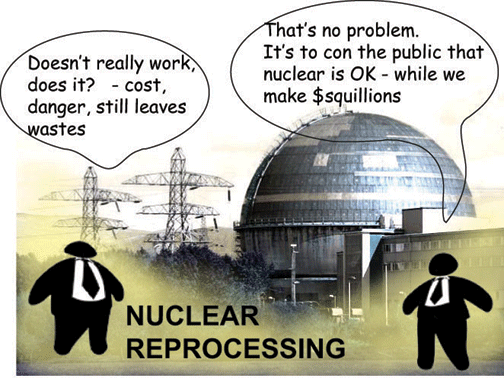
Only fast reactors can consume the plutonium. Many think that will ultimately be the UK choice. If so, the PRISM plant would take five years to license, five years to build, and could destroy probably the world’s most dangerous stockpile of plutonium by the end of the 2020s. GEH has not publicly put a cost on building the plant, but it says it will foot the bill, with the British government only paying by results, as the plutonium is destroyed.
The idea of fast breeders as the ultimate goal of nuclear power engineering goes back to the 1950s, when experts predicted that fast-breeders would generate all Britain’s electricity by the 1970s. But the Clinton administration eventually shut down the U.S.’s research program in 1994. Britain followed soon after, shutting its Dounreay fast-breeder reactor on the north coast of Scotland in 1995. Continue reading
Kyodo: Alarm sounds at MOX reactor in Japan, no “actual leakage” detected — Nuclear fuel loaded inside July 30th, 2012 By ENENews (Subscription Only) Title: Monju alarm on sodium leakage malfunctions Source: Kyodo
Japan Atomic Energy Agency said an alarm was activated early Monday morning indicating a sodium coolant leakage at its Monju prototype fast breeder reactor in Tsuruga, Fukui Prefecture. Continue reading
a SILEX facility could make it much easier for a rogue state to clandestinely enrich weapons grade uranium to create nuclear bombs
SILEX could become America’s proliferation Fukushima,
Controversial nuclear technology alarms watchdogs http://www.smartplanet.com/blog/intelligent-energy/controversial-nuclear-technology-alarms-watchdogs/18138 By David Worthington | July 30, 2012 A controversial nuclear technology is raising alarms bells among critics who claim it may be better suited for making nuclear weapons than lowering the cost of nuclear power and could lead to a nonproliferation “Fukushima” for the United States. Continue reading
Hacking into Iran’s nukes with heavy metal music
The latest cyber weapon to rock Iran’s nuclear program? Australia’s AC/DC The Star, July 25, 2012, Bloomberg, DUBAI, UNITED ARAB EMIRATES — Iran’s nuclear facilities have suffered a cyber attack that shut down computers and played music from the rock band AC/DC, the F-Secure Security Labs website says.
A new worm targeted Iran’s nuclear program, closing down the “automation network” at the Natanz and Fordo facilities, the Internet security site reported, citing an email it said was sent by a scientist inside Iran’s Atomic Energy Organization.
The virus also prompted several of the computers on site to play the song “Thunderstruck” by AC/DC at full volume in the middle of the night, according to the e-mail, part of which is published in English on the website……
AC/DC has played “high voltage rock ‘n’ roll” since the band was formed in 1973 in Australia, according to the band’s website. The group’s songs were among the loud music played to detainees at the Guantanamo Bay prison facility in preparation for interrogations, the Associated Press reported in October 2009, citing the National
Security Archive in Washington….. http://www.thestar.com/news/world/article/1231457–the-latest-cyber-weapon-to-rock-iran-s-nuclear-program-australia-s-ac-dc
MOX nuclear reprocessing plant at Savannah River Site
NRC holding public meeting over MOX plant http://www.sacbee.com/2012/07/24/4654152/nrc-holding-public-meeting-over.html The Associated Press, Jul. 24, 2012 COLUMBIA, S.C. — Federal regulators are holding a public meeting to discuss a project to create mixed-oxide fuel at a former nuclear weapons site in South Carolina.
The U.S. Nuclear Regulatory Commission is having the open session on Tuesday at the Savannah River Research Campus in New Ellenton.
Construction on the MOX facility began at the Savannah River Site in 2007. Officials say the plant will be used to convert weapons grade plutonium into fuel that will be sold to run commercial power reactors.
The SRS complex once produced plutonium and tritium for atomic bombs. Officials say the nearly $5 billion MOX facility is on schedule and should be running in 2016.
MOX plutonium nuclear reprocessing plants for Tennessee and Alabama?
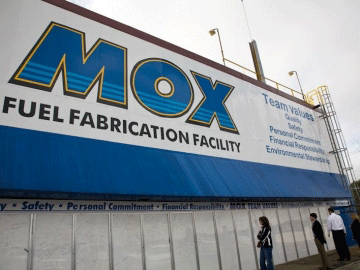 TVA considering fuel made from nuclear weapons http://www.kfoxtv.com/news/ap/energy/tva-considering-fuel-made-from-nuclear-weapons/nP3m5/ CHATTANOOGA, Tenn. — The Department of Energy is preparing an environmental impact statement on the use of fuel made from surplus nuclear weapons to power Tennessee Valley Authority nuclear plants. TVA released a set of talking points on Tuesday about the environmental impact statement, which will appear as a draft this week in the Federal Register, TVA spokesman Ray Golden told The Chattanooga Times Free Press (http://bit.ly/MGUFrO ).
The mixed oxide fuel, also called MOX fuel, is a blend of plutonium and uranium, but the variety under consideration is made from retired nuclear weapons, according to the TVA.
The utility has tentatively agreed to consider using the fuel in its Sequoyah and Browns Ferry nuclear plants in Tennessee and Alabama, with a timetable set for 2018. Continue reading
Pitfalls in building nuclear reactors underground
 Just build them underground! http://daryanenergyblog.wordpress.com/ca/part-10-smallreactors-mass-prod/10-2-2-just-build-them-underground/ There is a common misconception, that we could solve a lot of the problems with reactor construction, both large and small (though in particular the small ones) by building them in subsurface pits. I’m assuming the person who thought up this one has never dug a hole in his back garden! If you have, you’d know that digging a hole is not as easy as it seems. Firstly, the soil type has a big bearing on things. Depending on where you live you could be looking at thick sticky soil that difficult to shift, loose gravely soil that collapses easily or rocky earth, that rapidly turns into bedrock (so after a while you’re not digging any more but blasting!). As we need to put foundations down under out reactor to suit the soil type, and probably piling too (due to its weight), this means we essentially need to design each reactor’s containment vessel individually to suit local soil conditions, which increases costs.
Another problem is water intrusion, as anyone who’s ever dug a pit, then gone in for lunch, come back out and found it full of water will know all about! Our reactor “pit” needs to be designed like the hull of a boat to stop water leaking in and flooding it. Doing that with concrete, particularly thick section of it, is always difficult. The fact that the reactor will be generating heat complicates things as it raises the risk of subsidence or settlement cracking. While this can happen if the reactor is on the surface too, putting it under ground level “complicates things”.
In general with any construction project significant efforts are made to reduce the amount of earth movement required to start construction, not increase it, as lots of earth moving nearly always results in delays, hold-ups and ultimately higher costs (not the least of those being the cost of hiring out of earth moving equipment, those guys charge an arm and a leg!).
Overall, except in a small number of narrow cases building reactors this way will often work out as more expensive and slower than just putting the containment dome above ground.
Building nuclear reactors underground
FirstEnergy looking into building small nuclear reactor By John Funk, The Plain Dealer , July 25, 2012 FirstEnergy said today it had signed an agreement with a subsidiary of Babcock & Wilcox Co. to study the “potential deployment of the B&W mPower small modular reactor in FirstEnergy’s service territory.” The reactor would generate just 180 megawatts and be built in an underground containment structure, …..
A critical analysis of future nuclear reactors designs
By D A. Ryan, Once upon a time I used to be a fan of nuclear energy. As far as I saw it, nuclear energy was the silver bullet solution to all of our energy problems and more. However, the more I’ve learned about the industry the more critical I’ve become.
Notably the fact that most of the economic figures in support of nuclear power (a couple of typical delusions you’ll find here and here) come straight out of Hogwarts school of magic, wizardry….and economics (more realistic appraisals of nuclear economics can be found here and here).
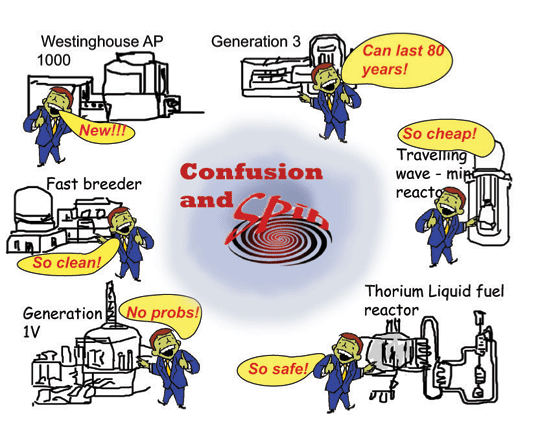
All in all my conclusion is that the case for future Generation IV nuclear reactors is much narrower than the supporters of nuclear energy would have you believe. While they do offer some advantages over LWR’s, notably in the area of safety, this comes with strings attached, notably higher capital costs. This is largely a result of the fact that many of these would need to be built from much more exotic materials, such as high temperature stainless steel alloys Nickel alloys or Refractory materials, while the predominant material of choice in current reactors is steel (stainless and forged ferritic) and concrete. This materials requirement is itself an issue related to the high temperatures these alternative reactors would be required to operate at, not to mention the more aggressive and corrosive environment in some of them, notably the MSR proposals. Of course one to question whether these higher construction costs (and in some cases higher decommissioning costs) are justified……..
Small to medium sized modular reactors do offer a good deal more flexibility in terms of how nuclear power could be used and yet a further improvement in safety. However, they also comes with lower economies of scale and thus higher construction costs and worse a slower rate of reactor roll out (at least in the early days). We could claw back on these two issues by mass producing said reactors in large volumes but as I point out (again see the full article), it is far from proven whether that would be economically viable and whether there is in fact a market for large numbers of small reactors…….
by and large mass production means “dumbing down” our design, and that means accepting a reactor that’s much cheaper and easier to build but has a lower thermal efficiency, a higher rate of fuel consumption and ultimately produces larger volumes of nuclear waste compared to our “mega” reactors. With the exception of a small number of narrow cases, it’s difficult to envisage how this would offer an improvement on the current status quo…..
Fusion?
Finally, I also had a look at Fusion power . his is the great white hope of nuclear energy and it has to be said we are making progress, but it’s a case of slow and steady progress. Indeed I would question whether we are in a position yet to even estimate how long it will take for fusion power to become commercial available…if indeed ever! Recent news from ITER is not positive, its now not due to go online till 2026, which would imply a completion of experiments in 2046. And it will take sometime beyond that before we wind up with a viable working commercial fusion reactor. As I speculate (here), it would likely be the latter half of this century (or the beginning of the next one) before we start to see Fusion play any sort of major role in mass global power generation…… nuclear energy supporters need to overcome their pathological hatred of renewables http://www.green-blog.org/2011/08/11/a-critical-analysis-of-future-nuclear-reactors-designs/
1 This Month



19 November – Webinar – The Reality of Reprocessing
Time: 11:00 AM Pacific Time (US & Canada) / 2:00 PM Eastern / 7:00 PM UK / 8:00 PM CET
Register for the Zoom Event Here



Shut down the radiation-damaged Heysham nuclear reactors now
To see nuclear-related stories in greater depth and intensity – go to https://nuclearinformation.wordpress.com

Say No to NASA’s Reckless Nuclear Reactor on the Moon
Say No to NASA’s Reckless Nuclear Reactor on the Moon
-
Archives
- November 2026 (44)
- October 2026 (302)
- September 2026 (339)
- August 2026 (330)
- July 2026 (355)
- June 2026 (287)
- May 2026 (306)
- April 2026 (356)
- March 2026 (251)
- February 2026 (267)
- January 2026 (308)
- December 2025 (358)
-
Categories
- 1
- 1 NUCLEAR ISSUES
- business and costs
- climate change
- culture and arts
- ENERGY
- environment
- health
- history
- indigenous issues
- Legal
- marketing of nuclear
- media
- opposition to nuclear
- PERSONAL STORIES
- politics
- politics international
- Religion and ethics
- safety
- secrets,lies and civil liberties
- spinbuster
- technology
- Uranium
- wastes
- weapons and war
- Women
- 2 WORLD
- ACTION
- AFRICA
- Atrocities
- AUSTRALIA
- Christina's notes
- Christina's themes
- culture and arts
- Events
- Fuk 2022
- Fuk 2023
- Fukushima 2017
- Fukushima 2018
- fukushima 2019
- Fukushima 2020
- Fukushima 2021
- general
- global warming
- Humour (God we need it)
- Nuclear
- RARE EARTHS
- Reference
- resources – print
- Resources -audiovicual
- Weekly Newsletter
- World
- World Nuclear
- YouTube
-
RSS
Entries RSS
Comments RSS

