What is wrong with thorium nuclear reactors? Well, a lot, really
Thorium: Why We Don’t Want It http://nowarnow.wordpress.com/2012/08/03/thorium-why-we-dont-want-it/ By No War Now / 3 August, 2012
“….. Thorium is just another nuclear industry way of persevering their jobs in an energy production method that does not make sense for our planet. Thorium requires mining rare earth elements. Thorium requires the changing of laws to process monazite, currently categorized as “‘prescribed substance’ and the sole domain of the government” per the Atomic Energy Act (Canada and China work in thorium, http://nextbigfuture.com/2012/08/canada-and-china-work-on-thorium-candu.html).
Thorium continues the predatory practice of extracting public money to support its development and operations. Of course, you won’t learn this from the schills and trolls who want to convince you that thorium is the answer to our energy needs and ought be part of our “clean energy” package. Mining is not, and has never been, a clean energy production practice. Especially when it involves uranium. Continue reading
Don’t be sucked in by ‘spin’ promoting thorium nuclear reactors
 thorium is merely a way of deflecting attention and criticism from the dangers of the uranium fuel cycle and excusing the pumping of more money into the industry….. the nuclear industry itself is also sceptical
‘ these arereally U-233 reactors,’ This isotope is more hazardous than the U-235 used in conventional reactors, he adds, because it produces U-232 as a side effect (half life: 160,000 years), on top of familiar fission by-products
Don’t believe the spin on thorium being a ‘greener’ nuclear option Ecologist, Eifion Rees 23rd June, 2011 It produces less radioactive waste and more power than uranium but the UK would be making a mistake in looking to it as a ’greener’ fuel. The Ecologist reports….. nuclear radiologist Peter Karamoskos, of the International Campaign to Abolish Nuclear Weapons (ICAN), says the world shouldn’t hold its breath.
‘Without exception, [thorium reactors] have never been commercially viable, nor do any of the intended new designs even remotely seem to be viable. Like all nuclear power production they rely on extensive taxpayer subsidies; the only difference is that with thorium and other breeder reactors these are of an order of magnitude greater, which is why no government has ever continued their funding.’ Continue reading
Extracting uranium from oceans: very worrying questions arise
Extracting Uranium from oceans offers a mixed bag of possibilities Examiner, AUGUST 22, 2012 BY: DAVID HERRON Oak Ridge National Labs (ORNL) yesterday announced a new technique for efficiently harvesting uranium from the ocean. This raises the possibility that Uranium supplies will be much deeper and longer lasting than previously thought.
For the environmentally minded it raises a quandary…. there are radiation risks galore…. there is the huge spectre of more nuclear accidents and radiation exposure…..
It would appear this material could be used to target other materials. For example there are concerns over supplies of lithium, or of rare earth metals, or various other minerals, some of which are present in ocean water. Could this material be tailored to target extraction of
those materials from the ocean, providing a source of raw materials that is independent of digging rocks out of the ground? If so it could reduce the amount of hard rock mining operations around the world.
Maybe the material could be used in environmental mitigation, in that there are sites poisoned by releases of toxic metals into the ocean.
But what if corporations so efficiently mine the oceans certain metals that it actually affects the chemical balance of the ocean? The existing chemical balance in the ocean is vital to the food chain, and changing that balance would clearly have some effect on the living things in the ocean. Do “we” even have a clue about the potential impact?…
Thorium reactors (LFTRs) not really supported by the Nuclear Establishment
D. A,. RyanNovember 6th, 2011 at 13:39 The NNL lead scientist Prof. Howarth deals specifically with the LFTR here and pours cold water on it:
A pro-nuclear engineer let slip to me a while ago the real attiude of the nuke industry to Thorium. They see it as hedging their bets in case fusion proves to be harder than they thought and they don’t get commercial grade fusion plants up and running by the 2050′s. If that occurs, then that’s when Thorium (or LFTR’s) will figure. In other words, to them its a blue sky idea to sort out a future energy crisis, not the one facing us right now. This is why you see a vast gulf of a difference between pro-Thorium bloggers and the nuclear industry establishment.
Opposition to USA plan to commercialise plutonium wastes at Savannah
 The preferred plan under consideration calls for the shipment of 7.1 metric tons of so-called pits — or cores — of an undisclosed number of nuclear warheads now stored at the Pantex plant in West Texas to Los Alamos National Laboratory in New Mexico and the Savannah River Site for disarmament and processing into fuel for commercial nuclear reactors.
Anti-nuclear activists question plan for shipping plutonium from warheads to New Mexico By Associated Press, August 22 LOS ALAMOS, N.M. — Nuclear watchdogs are fighting a proposal to ship tons of plutonium to New Mexico, including the cores of nuclear warheads that would be dismantled at an aging and structurally questionable lab atop an earthquake fault zone.
Opponents voiced their opposition at a series of public hearings that opened this week on the best way to dispose of the radioactive material as the federal government works to reduce the nation’s nuclear arsenal.
The Department of Energy is studying alternatives for disposing of plutonium in light of federal budget cuts that have derailed plans for new multi-billion-dollar facilities at the Savannah River Site in South Carolina. Continue reading
UK’s dangerous plan to make its piles of nuclear waste a commercial asset
Britain’s previous attempts to convert plutonium into Mox fuel which could then be burned in conventional reactors have proved disastrous, culminating in the premature closure last year of the £1.34bn Sellafield Mox Plant, which was a commercial and technical failure.
 ‘Untested’ nuclear reactors may be used to burn up plutonium waste Feasibility study looks at building revolutionary new facility at Sellafield to dispose of stockpile The Independent, STEVE CONNOR 20 AUGUST 2012 An ambitious plan to rid Britain of its civil plutonium stockpile – the biggest in the world – has come a step closer with the submission of a feasibility study for building revolutionary nuclear reactors to “burn” the waste at Sellafield in Cumbria.
The plan envisages the construction of twin nuclear “fast reactors” at Sellafield that can dispose of the plutonium directly as fuel to generate electricity while ridding the country of a nuclear-waste headache that has dogged governments for half a century. Continue reading
Why molten salt nuclear reactors and thorium nuclear reactors are duds
Thorium: Not ‘green’, not ‘viable’, and not likely Oliver Tickell, April / May 2012. 1. Introduction ”With uranium-based nuclear power continuing its decades-long economicThorium nuclear reactors not all they’re cracked up to be
Thorium: Not ‘green’, not ‘viable’, and not likely
http://www.no2nuclearpower.org.uk/nuclearnews/NuClearNewsNo43.pdf
Journalist, Oliver Tickell, author of the Kyoto2 climate initiative, (1) editor of the Nuclear Pledge website (2) and Green Party candidate for Oxford City Council in three elections, has published a new briefing on Thorium reactors.
A number of commentators have argued that most of the problems associated with nuclear power could be avoided by both, using thorium fuel in place of uranium or plutonium fuels and using ‘molten salt reactors’ (MSRs) in place of conventional solid fuel reactor designs. The combination of these two technologies is known as the Liquid Fluoride Thori um Reactor or LFTR, because the fuel is in form of a molten fluoride salt of thorium and other elements.
The briefing examines the validity of the optimistic claims made for thorium fuel, MSRs and the LFTR in particular, and finds that they do not stand up to critical scrutiny – these technologies have significant drawbacks including: very high costs; marginal benefits for a thorium fuel cycle over uranium; serious nuclear weapons proliferation hazards; the danger of both routine and accidental releases of radiation, mainly from continuous ‘live’ fuel reprocessing in MSRs and the very long lead time for significant deployment of LFTRs of perhaps 50 years – rendering it irrelevant in terms of addressing current or medium term energy supply needs.
The thorium-uranium fuel cycle has some advantages over the dominant uranium-plutonium cycle, in terms for example, of the reduced production of long-lived actinides and somewhat diminished radio -toxicity overall. However, it also creates new hazards of its own. As far as radioactive fission products are concerned, there is little to choose between the two.
Thorium reactors do not produce plutonium. But an LFTR could (by including 238U in the fuel) be adapted to produce plutonium of a high purity well above normal weapons-grade, presenting a major proliferation hazard. Beyond that, the main proliferation hazards arise from the need for fissile material (plutonium or uranium) to initiate the thorium fuel cycle, which could be diverted, and the production of fissile uranium 233U.
LFTRs are theoretically capable of a high fuel burn-up rate, but while this may indeed reduce the volume of waste, the waste is more radioactive due to the higher volume of radioactive fission products. The continuous fuel reprocessing that is characteristic of LFTRs will also produce hazardous chemical and radioactive waste streams, and releases to the environment will be unavoidable. Spent fuel from any LFTR will be intensely radioactive and constitute high level waste. The reactor itself, at the end of its lifetime, will constitute high level waste.
The UK’s National Nuclear Laboratory (NNL) believes that considerable research, development and testing lies ahead before thorium fuels will be ready for operational use. As the NNL states, “Thorium reprocessing and waste management are poorly understood. The thorium fuel cycle cannot be considered to be mature in any area.” It estimates that 10-15 years work is required before thorium fuels will be ready for use in current reactor designs, and that their use in new types of reactor is at least 40 years away. (3)
(1) http://www.kyoto2.org/
(2) http://www.nuclearpledge.com/
(3) Thorium: Not Green, Not Viable and Not Likely, Oliver Tickell, June 2012
http://www.nuclearpledge.com/reports/thorium_briefing_2012.pdf
The very dodgy plans for Small Modular Nuclear Reactors (SMRs)
As SMRs are being promoted for overseas markets, SRS officials will not say what plans are for used reactor vessels or highly radioactive spent fuel which would be taken back to the production site.
“If SRS would become a nuclear waste dumping site due to involvement in SMR programs, this is something that the public in the Aiken area and in South Carolina will soundly reject,”
Documents Reveal Time-line and Plans for “Small Modular Reactors” (SMRs) at the Savannah River Site (SRS) Unrealistic and Promise no Funding http://aikenleader.villagesoup.com/blog/blog/documents-reveal-time-line-and-plans-for-small-modular-reactors-smrs-at-the-savannah-river-site-sr/840884 By Thomas Clements | Jun 19, 2012 One SMR Design being Eyed at SRS for Use of Plutonium Fuel (MOX) and Production of Tritium Gas Used in Nuclear Weapons
Documents obtained under the Freedom of Information Act (FOIA) by the Alliance for Nuclear Accountability (ANA) in Columbia, South Carolina reveal unrealistic plans for pursuit of “small modular reactors” (SMR) at the Department of Energy’s Savannah River Site, located near Aiken, South Carolina. Continue reading
Murky history of Japan’s fast breeder nuclear reactor program
 United States Circumvented Laws To Help Japan Accumulate Tons of Plutonium, DC Bureau By Joseph Trento, on April 9th, 2012“…….From the very start, the Japanese breeder program was predicated on the belief that Japanese industry could do what the Americans and Europeans had failed to do – run the extremely complicated breeder cycle safely and profitably. That belief was rooted in Japan’s national self-confidence, nurtured by two generations of success in manufacturing. Japan’s dedicated and educated workforce and its special brand of quality management made it the world leader in a host of industries. Nuclear power generation would, it was believed, merely be one more success, made possible by Japan’s superior workers and management.
Thirty years ago even Japan’s harshest critics might have agreed that perhaps it could succeed where Western efforts had failed. But that optimism soon faded as a string of nuclear catastrophes demonstrated that nuclear industries are far different than any other. Both the Monju fast-breeder reactor in 1995 and the Tokai reprocessing plant in April 1997 suffered serious, accidental radiation leaks; both accidents were the subjects of attempted cover-ups. Most egregious was the fire and leak of radioactive sodium at the Monju FBR. Japan’s Power Reactor and Nuclear Fuel Development Corporation (PNC), the government corporation that operated Monju, lied repeatedly to the public about the accident. PNC attempted to suppress video footage that showed the cause of the accident: a ruptured pipe in a secondary cooling system that had spilled an estimated two to three tons of radioactive sodium – the largest such leak in the history of fast-breeder technology. One of the reasons PNC gave for releasing the misinformation was that Monju was too important to Japan’s energy program to jeopardize the reactor’s operation. In other words, the public’s safety was secondary to the breeder program.
Had it not been for a courageous act by a group of Fukui prefecture officials in the early morning of December 11, PNC’s attempted cover-up probably would have succeeded. Suspecting a cover-up, the officials entered the plant and secured the videotape. The action came as a direct result of a previous accident at Fukui’s Tsuruga Unit I reactor in the early 1980s. Fukui prefecture officials were not permitted to investigate that mishap. When the Monju accident took place, the officials were determined not to be turned away a second time. Following revelations that the agency itself had been involved in trying to withhold the video, a PNC executive committed suicide……. http://www.dcbureau.org/201204097128/national-se
How fast breeder nuclear reactors were tried in USA, and failed
Despite the efforts of the country’s best minds and nearly limitless budgets, the breeder program did not work. And it was not only the Clinch River team who failed. Breeder programs in Germany, France and the United Kingdom also could not make the leap from lab experiment to commercially viable practice.
United States Circumvented Laws To Help Japan Accumulate Tons of Plutonium, DC Bureau By Joseph Trento, April 9th, 2012.….Reversing Course – Reagan Undermines Carter’s Policies Richard Kennedy One of the most passionate nuclear believers was a career bureaucrat named Richard Kennedy. A former Army officer, he labored in obscurity at the Nuclear Regulatory Commission, his career held hostage by his vehement opposition to President Carter’s nuclear policies. All of that changed after Ronald Reagan’s election in 1980. One of Reagan’s first acts as president was to effectively reverse Carter’s nuclear doctrine, which had barred the United States from using plutonium in civilian power projects with America’s friends or adversaries.
Reagan made Kennedy his right-hand man for nuclear affairs. From his new post as Ambassador at Large for Nuclear Energy, Kennedy oversaw the dismantling of the Carter policies he despised. The new administration rejuvenated American and international reliance on plutonium. Continue reading
Space Travel – ionising radiation would kill you
 How a long mission to Mars could kill you NBC News, By Eric Niiler 7/18/2011 We’ve already “done” the moon, but Mars still beckons like some interplanetary Brigadoon ; visible through the eyes of clever little rovers and orbiters, but just beyond the reach of human footsteps…..
Radiation The combined effects of background cosmic rays from extragalactic sources and extreme radiation events from the sun make space travel too hazardous for an estimated six months there and six months return. ”The estimate now is you would exceed acceptable levels of fatal cancer,” said Francis Cucinotta, chief scientist for NASA’s space radiation program at the Johnson Space Center in Houston. “That’s just cancer. We also worry about effects of radiation on the heart and the central nervous system.”
Cucinotta says these estimates do take into account protective shielding around a crew vehicle, probably some form of polyethylene plastic. Lead shields actually create secondary radiation when struck by cosmic rays, while water, perhaps the best form of protection, would have to be several meters thick to get enough protection. (“Houston calling Water Balloon 1, do you copy?”)
Lead and water, in any case, are very heavy for the quantities that would be required, making them an expensive shielding to launch….. studies show that radiation can damage the vitamins in food supplies, and the loss of even one vitamin in the food chain could cause serious health effects over a long trip. Little is known about the long-term effects of radiation on food supplies, since International Space Station (ISS) crews have been partially sheltered by Earth’s magnetosphere.
It’s expected that the crew will have to grow its own food in some kind of greenhouse,… http://www.msnbc.msn.com/id/43796117/ns/technology_and_science-science/t/how-long-mission-mars-could-kill-you/?__utma=14933801.1192036095.1344035709.1344126652.1344387760.3&__utmb=14933801.1.10.1344387760&__utmc=14933801&__utmx=-&__utmz=14933801.1344387760.3.3.utmcsr=google|utmccn=(organic)|utmcmd=organic|utmctr=(not%20provided)&__utmv=14933801.|8=Earned%20By=msnbc%7Ctechnology%20%26%20science%7Cscience%7Ccosmic%20log=1^12=Landing%20Content=Original=1^1
Mars probe records radiation blasts that could affect future
astronauts, NBC News, By Alan Boyle, 3 Aug 12 Even before its landing, NASA’s Mars Science Laboratory has sent back its first scientific results — shedding light on the radiation exposure that astronauts would face during a future mission to the Red Planet. Continue reading
Radiation more destructive to electronics than thought, Electronics News, 3 August, 2012 RESEARCH published in the Journal of Applied Physics indicate that radiation causes at least ten times more structural damage to electronic materials than previously thought.
The study used a new characterisation method which uses a combination of lasers and acoustic waves, allowing scientists to look through solid materials and pinpoint the size and location of defect buried at the atomic level.
The method is important due to the ever-shrinking sizes of microelectronic devices. Transistors which are millions of atoms in size have a greater margin of error before they fail, but transistors which only have a few thousand atoms could fail as the result of a
single atomic defect….. The physicists found that a sample of gallium arsenide semiconductor which had been irradiated had structural damage spread over 1000 atoms due to an embedded neon atom – damage which is more extensive than previously found by other means.
PRISM nuclear reactor won’t solve UK’s plutonium problem
Adrian Simper, the strategy director of the UK’s Nuclear Decommissioning Authority, warned last November in an internal memorandum that fast reactors were “not credible” as a solution to Britain’s plutonium problem because they had “still to be demonstrated commercially” and could not be deployed within 25 years.
the plutonium metal, once prepared for the reactor, would be even more vulnerable to theft for making bombs than the powdered oxide.
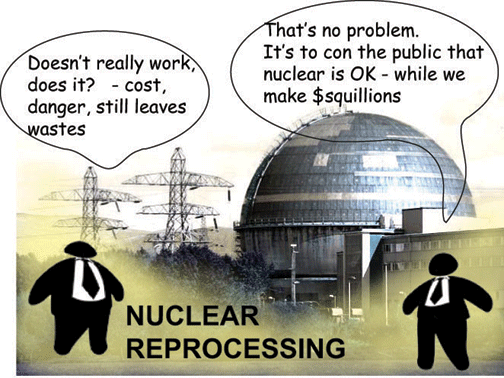
Are fast-breeder reactors the answer to our nuclear waste nightmare? The Guardian 30 July 12 The battle is intensifying on a decision over a major fast-breeder reactor to deal with the plutonium waste at Sellafield. Fred Pearce “…….Britain has a history of embarrassing failures with MOX, including the closure last year of a $2 billion blending plant that spent 10 years producing a scant amount of fuel. And critics say that, even if it works properly, MOX fuel is an expensive way of generating not much energy, while leaving most of the plutonium intact, albeit in a less dangerous form.
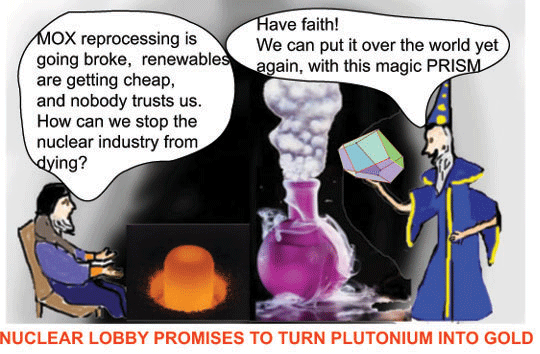
Only fast reactors can consume the plutonium. Many think that will ultimately be the UK choice. If so, the PRISM plant would take five years to license, five years to build, and could destroy probably the world’s most dangerous stockpile of plutonium by the end of the 2020s. GEH has not publicly put a cost on building the plant, but it says it will foot the bill, with the British government only paying by results, as the plutonium is destroyed.
The idea of fast breeders as the ultimate goal of nuclear power engineering goes back to the 1950s, when experts predicted that fast-breeders would generate all Britain’s electricity by the 1970s. But the Clinton administration eventually shut down the U.S.’s research program in 1994. Britain followed soon after, shutting its Dounreay fast-breeder reactor on the north coast of Scotland in 1995. Continue reading
1 This Month
26 September – International Day for the Total Elimination of Nuclear Weapons





PLEASE OPPOSE HR 8255 AND S.3639 – bills would accelerate satellite deployment, with no environmental review or safeguards – https://ncstd5li.quorum.us/campaign/169331/
To see nuclear-related stories in greater depth and intensity – go to https://nuclearinformation.wordpress.com
-
Archives
- September 2026 (305)
- August 2026 (330)
- July 2026 (355)
- June 2026 (287)
- May 2026 (306)
- April 2026 (356)
- March 2026 (251)
- February 2026 (267)
- January 2026 (308)
- December 2025 (358)
- November 2025 (359)
- October 2025 (375)
-
Categories
- 1
- 1 NUCLEAR ISSUES
- business and costs
- climate change
- culture and arts
- ENERGY
- environment
- health
- history
- indigenous issues
- Legal
- marketing of nuclear
- media
- opposition to nuclear
- PERSONAL STORIES
- politics
- politics international
- Religion and ethics
- safety
- secrets,lies and civil liberties
- spinbuster
- technology
- Uranium
- wastes
- weapons and war
- Women
- 2 WORLD
- ACTION
- AFRICA
- Atrocities
- AUSTRALIA
- Christina's notes
- Christina's themes
- culture and arts
- Events
- Fuk 2022
- Fuk 2023
- Fukushima 2017
- Fukushima 2018
- fukushima 2019
- Fukushima 2020
- Fukushima 2021
- general
- global warming
- Humour (God we need it)
- Nuclear
- RARE EARTHS
- Reference
- resources – print
- Resources -audiovicual
- Weekly Newsletter
- World
- World Nuclear
- YouTube
-
RSS
Entries RSS
Comments RSS


