The nuclear fusion dream – ever elusive
Fusion: Maybe Less Than 30 Years, But This Year Unlikely Bill Chameides Dean, Duke University’s Nicholas School of the Environment, August 2012 No ignition at the U.S. National Ignition Facility , home to the world’s largest laser….. Scientists have been thinking about how to bring this game changer into the energy game for decades. (See fusion/fission timeline .) As far back as 1946, two British scientists — Sir George Paget Thomson and Moses Blackman — filed the first patent for a fusion power plant .
But there have been a couple of hold-ups . To get a fusion reaction started, you need to slam the hydrogen atoms together really, really hard and that requires a lot of energy. (In a hydrogen bomb, the fusion reaction gets ignited by an atomic bomb, using fission. Not exactly the preferred method for your local fusion power plant.)
Even trickier is controlling the fusion reaction. It’s one thing to make a fusion bomb, it’s a lot harder to get the reaction going and keep it under control in a way that the amount of energy extracted is larger than that expended to initiate and manage the reaction.
Over the almost 70-year pursuit of the fusionary holy grail, it’s been fairly common for scientists working on the problem to say that they’re about 30 years away from achieving a power plant based on fusion. (See here and here .) The problem has been that while time has marched on, the 30-year horizon has remained fixed. Suffice to say it has proven to be a very tough problem…. http://www.huffingtonpost.com/bill-chameides/fusion-maybe-less-than-30_b_1949573.html
Radioactive wastes in space – oh what a lovely idea!
Nuclear waste to fuel Neptune mission THE AUSTRALIAN BY: JONATHAN LEAKE The Times September 30, 2012 BRITAIN’S burgeoning stockpile of nuclear waste may finally be put to good use – as fuel for Europe’s future missions to the solar system’s most distant and exotic planets such as Uranus and Neptune.
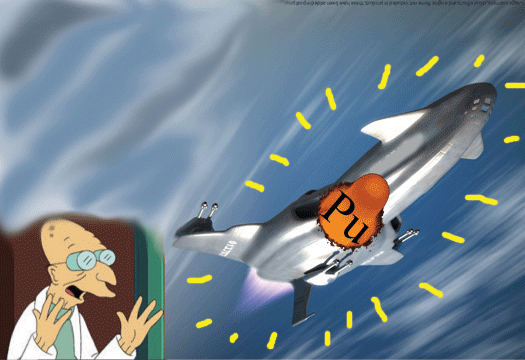
The European Space Agency (ESA) and Britain’s National Nuclear Laboratory (NNL) want to use radioactive isotopes harvested from the waste to make the nuclear batteries essential to power such space probes. Continue reading
Nuclear lobbying might succeed in resuscitating the dangerous Monju dream
The [nuclear industry] lobbying has also forestalled scrapping a controversial, 25-year-old fast breeder reactor on the country’s western coast in Fukui prefecture.
25 years and $13 billion after construction began, the Monju fast breeder reactor has managed to produce electricity for only one hour.
“What’s frightening is that it has the property that once it starts running out of control it can’t be stopped,…. What no one can ignore is that Monju is located adjacent to an earthquake fault.
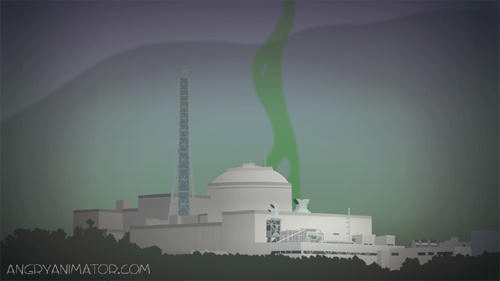
Japan Plans Restart of Controversial Reactor VOA Correspondent Steve Herman was given unprecedented access inside Japan’s Fast Breeder Reactor Research and Development Center at a time when the country is debating its future energy policy in wake of last year’s Fukushima nuclear disaster.
kui Pref., Japan. Steve Herman September 25, 2012 TSURUGA, JAPAN — There has been an ongoing debate in Japan on the best way to obtain a safe and affordable energy supply for the island nation. The nuclear option suffered a setback in March, 2011, when a massive earthquake and devastating tsunami caused a meltdown in reactors at Japan’s main Fukushima-1 nuclear power plant. Continue reading
Design for recycling rare earths is urgently needed
 “The situation clearly calls for international policy initiatives to minimize the seemingly bizarre situation of spending large amounts of technology, time, energy and money to acquire scarce metals from the mines and then throwing them away after a single use.”
Yale Researchers Call for Specialty Metals Recycling http://environment.yale.edu/news/article/yale-researchers-call-for- specialty-metals-recycling/ 25 Sept 12 An international policy is needed for recycling scarce specialty metals that are critical in the production of consumer goods,
according to Yale researchers in Science.
“A recycling rate of zero for specialty metals is alarming when we consider that their use is growing quickly,” said co-author Barbara Reck, a research scientist at the Yale School of Forestry & Environmental Studies.
Specialty metals, which include rare earth elements such as indium, gallium and germanium, account for more than 30 of the 60 metals in the periodic table. Because they are used in small amounts for very precise technological purposes, such as red phosphors, high-strength magnets, thin-film solar cells and computer chips, recovery can be so technologically and economically challenging that the attempt is seldom made. Continue reading
Facts: Thorium fuel not clean, not safe, not commercially viable
One reason reprocessing thorium fuel cycles haven’t been successful is that uranium-232 (U-232) is created along with uranium-233. U-232, which has a half-life of about 70 years, is extremely radioactive and is therefore very dangerous in small quantities:
 Thorium Fuel: No Panacea for Nuclear Power, http://ieer.org/wp/wp-content/uploads/2012/04/thorium2009factsheet.pdf By Arjun Makhijani and Michele Boyd A Fact Sheet Produced by the Institute for Energy and Environmental Research and Physicians for Social Responsibility
Thorium “fuel” has been proposed as an alternative to uranium fuel in nuclear reactors. There are not “thorium reactors,” but rather proposals to use thorium as a “fuel” in different types of reactors, including existing light-water reactors and various fast breeder
reactor designs. Continue reading
Don’t believe the lies that Thorium reactors are clean, safe, and cheap
Thinking About Thorium by Gordon Edwards, Ph.D., President of CCNR, September 16 2012 On CBC’s “Quirks and Quarks” radio program aired on Saturday, September 15, 2012, there was an enthusiastic endorsement of “thorium reactors” as a nearly miraculous form of nuclear energy that will avoid all of the major problems now associated with uranium-based nuclear power.
I have been asked by several people to give my own personal opinion of this prospect, and accordingly have written the following:
Background:
When nuclear power was first presented to a credulous public, fully conditioned to respect science and admire scientists, people were quick to believe that nuclear power was safe, clean, cheap and inexhaustible — just because scientists said so. It was also said that “peaceful” nuclear power had nothing whatsoever to do with atomic bombs and the proliferation of nuclear weapons. It took decades for people to realize that these are all lies.
I can’t believe that people are now so eager to swallow the hype about thorium with all its over-the-top claims of being safe, clean, cheap, inexhaustible, unrelated to nuclear weapons, and even a miraculous way of solving the nuclear waste problems created by the previous generation of — what? — safe, clean, cheap, inexhaustible, unrelated to nuclear weapons, nuclear reactors. Continue reading
Thorium reactors – the latest dishonest spin from the nuclear propagandists
S. Korea urges U.S. to allow ‘peaceful’ nuclear enrichment SEOUL, Sept. 17 (Yonhap) –– South Korea called for the United States to approve it undertaking “peaceful” enrichment of uranium and reprocessing of spent nuclear fuel, a government think tank said Monday, as little progress has been made in bilateral negotiations to revise the countries’ nuclear accord.
Under a 1974 accord with the U.S., South Korea is banned from enriching uranium or reprocessing spent nuclear fuel. The allies have held five rounds of formal negotiations since 2010 to rewrite the bilateral nuclear cooperation treaty, which expires in 2014…..
Some nonproliferation experts say pyroprocessing is not significantly different from reprocessing, and pyroprocessed plutonium could be quickly turned into weapons-grade material….. http://english.yonhapnews.co.kr/national/2012/09/17/38/0301000000AEN20120917002600315F.HTML
USA public waking up to the dangers of MOX nuclear fuel reprocessing
MOX or not? Gov’t likes weapons fuel, public doesn’t Equities.com, By Eric Fleischauer, The Decatur Daily, Ala. 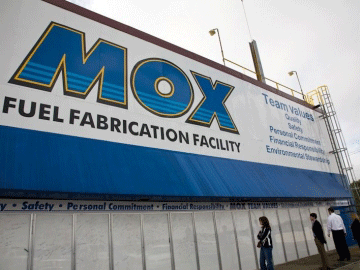 McClatchy-Tribune Information Services Sept. 14--The Energy Department believes it is safe to use weapons-grade fuel at Browns Ferry Nuclear Plant, but not many residents attending a public hearing Thursday agreed.
“They don’t need to have it here,” said Sara Crossfield of Athens, who has a farm near the Limestone County plant. “TVA’s charter requires them to protect us.”
U.S. treaties with Russia require the disposal of 50 tons of surplus plutonium. The treaties authorize disposal by recycling the weapons-grade plutonium into mixed-oxide fuel, or MOX, for use in nuclear reactors. MOX is a mixture of plutonium and low-enriched
uranium.
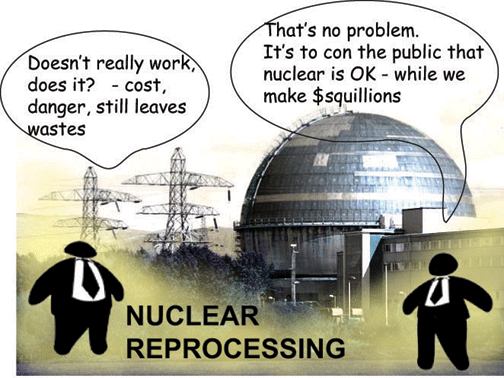
The purpose of Thursday’s public hearing was to receive comments on a draft document describing the environmental impact of using MOX. About 60 people attended.
While MOX is the Energy Department’s preferred alternative for most of the surplus plutonium, the Tennessee Valley Authority said it has no preference. Sachiko McAlhany, document manager for the U.S. Department of Energy, presented a summary of the environmental impact statement. She said the department concluded using MOX “does not appreciably change” the risk posed by conventional uranium fuel.
Neither McAlhany nor a TVA representative, Mick Mastilovic, answered questions at the hearing. The comments from the public will be incorporated into the final environmental impact statement, scheduled for a spring 2013 release.
The plutonium would be reprocessed into MOX at a $6 billion plant in South Carolina, operated by France-based AREVA. It would then have to be transported to Browns Ferry.
Many of the concerns expressed by those attending the hearing involved the cost of creating MOX and the risks involved in transport.
Concerns specific to Browns Ferry focused on the impact of the fuel — which burns at slightly higher temperatures than conventional fuel — on the reactors and the possibility that Browns Ferry would become a terrorist target. Continue reading
UK National Nuclear Laboratory says Thorium nuclear reactors risky
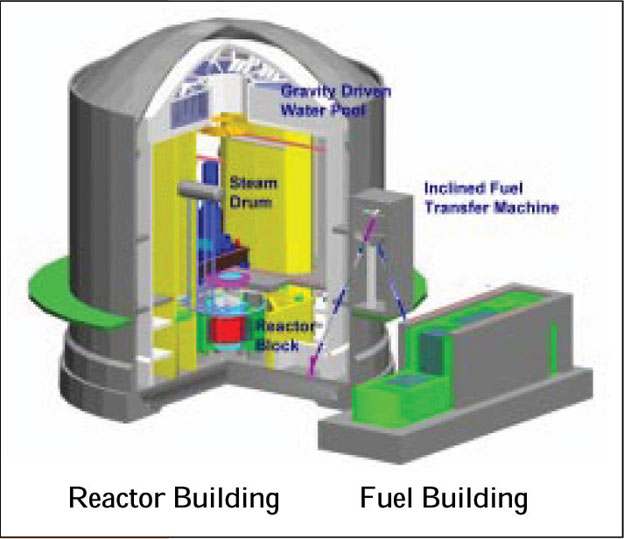 The Thorium Fuel Cycle – Summary An independent assessment by the UK National Nuclear Laboratory Summary NNL believes that the thorium fuel cycle does not currently have a role to play in the UK context, other than its potential application for plutonium management in the medium to long term and depending on the indigenous thorium reserves, is likely to have only a limited role internationally for some years ahead.
The technology is innovative, although technically immature and currently not of interest to the utilities, representing significant financial investment and risk without notable benefits. In many cases, the benefits of the thorium fuel cycle have been over-stated.
http://www.nnl.co.uk/media/27860/nnl__1314092891_thorium_cycle_position_paper.pdf
Danger of MOX nuclear reprocessing: it’s the plutonium, stupid
 From Plutonium to Power, Spiegal Online 09/07/2012 Russia To Produce Electricity with Former Nukes By Kerstin Brandt “…….What makes the new reactor a particularly delicate case, though, is its fuel.
Of all the bequests of the atomic age, the heavy metal that takes its name from Pluto, god of the underworld, is considered the most dangerous. A nuclear chain reaction initiated with six kilograms (13 pounds) of the material over Nagasaki, Japan, on Aug. 9, 1945, immediately killed 80,000 people. Breathing in just a few milligrams of plutonium dust is fatal to humans.
Vast amounts of this element, which almost never occurs naturally, now exist on Earth. Well more than 1,000 tons of the plutonium, which is one component of spent fuel from nuclear reactors, now sits in spent fuel pools and interim storage facilities, awaiting an indeterminate fate.
Then there are a further estimated 250 tons of weapons-grade plutonium, which consists of the fissile isotope Pu-239 at its highest possible concentration. This is a material produced for a single, military purpose: to trigger the most devastating detonations possible, as reliably as possible.
But what meant power during the arms race has since become a curse. Plutonium is enormously expensive to secure — and completely useless for civilian purposes.
For many years, permanent storage facilities for nuclear waste were the solution of choice among experts in the field. Melted down in a glass matrix and mixed with other highly radioactive nuclear waste, plutonium could be made to disappear deep into the Earth, protected from the elements and from the reach of untrustworthy militaries.
These days, though, that method is essentially off the table, because tough disarmament negotiations reach their goals more quickly when the end result is profit rather than unpredictable storage facility costs. The world’s military superpowers have done this once before: In 1993, as part of the “Megatons to Megawatts” nonproliferation program, the US pledged to buy 500 tons of weapons-grade uranium from Russia. Diluted down to a level suitable for use in a nuclear plant, fuel obtained from Soviet nuclear bombs currently generates one tenth of the United States’ electricity……http://www.spiegel.de/international/world/energy-from-the-bomb-russia-to-produce-electricity-with-former-nukes-a-854318.html
MOX nuclear reprocessing: a Russian project leader’s safety fears
He [ Yevgeny (name changed)] then explains that colleagues and superiors of many years have been leaving the BN-800 project in recent weeks. Their vacated positions, he says, are being given to new employees just starting their careers.
“People who have no experience with the difficulties sodium coolant can cause now head our departments,”… “And you know what? I’m going to leave, too. Or, no, I’m going to run.”
From Plutonium to Power, Spiegal Online 09/07/2012 Russia To Produce Electricity with Former Nukes By Kerstin Brandt “…….. plutonium is not uranium. It’s more toxic and more radioactive, and it’s not easy to dilute.
Yevgeny doesn’t speak English, so he doesn’t understand the disarmament slogan “Global Zero.” Until recently, he was convinced that Russia, alone among world’s countries, had mastered fast reactor technology. He himself worked at Beloyarsk’s fast reactor for many years, after all. But since the plant’s managers assigned him to the construction of the successor model BN-800, Yevgeny has grown doubtful. Continue reading
Dangerous MOX nuclear plant planned, close to highly populated area
About 35,000 people live within 10 miles of the plant. That’s no place for TVA and DOE to be running an experiment with radioactive material in an aging nuclear plant under increased supervision because of major safety problems.
Alabama.com OUR VIEW: Next door, nuclear research, September 09, 2012, By Mike Hollis, The Huntsville Times The Tennessee Valley Authority says it’s willing to consider using a blend of uranium and weapons-grade plutonium as reactor fuel at its Browns Ferry Nuclear Plant near Athens. That’s surprising, given the plant’s safety record.
Part of the problem, critics say, is that this mix of uranium and plutonium oxide fuel, called MOX, makes reactors harder to control, may increase the risk of some types of accidents and raises the threat to public health if an accident results in a major radioactive release. Continue reading
Confusion in Aomori Prefecture about importing radioactive waste
 Aomori Pref. mulling rejecting nuclear waste The Yomiuri Shimbun , 6 Sept 12, AOMORI—The Aomori prefectural government is considering refusing to accept highly radioactive
  waste scheduled to be returned from reprocessing overseas if the central government abolishes its nuclear fuel cycle policy.
The prefectural government was likely prompted to act by recent moves by the central government toward abandoning nuclear power generation.
The village of Rokkasho in the prefecture is home to a spent nuclear fuel reprocessing plant that is considered to be the foundation of the nuclear fuel cycle, in which plutonium and uranium are extracted from spent fuel to be reused.
The plant has yet to begin operating, and spent nuclear fuel from the nation’s nuclear reactors are currently stored at nuclear power plants or at the Rokkasho facility. Some spent nuclear fuel is reprocessed in France and Britain. Vitrified radioactive waste, the highly radioactive waste that is produced in the reprocessing process, has been shipped from Europe to the Vitrified Waste Storage Center at the Rokkasho facility. So far, the plant has received 1,414 containers of vitrified waste, and 28 more are scheduled to be shipped from Britain in October at the earliest. Continue reading
MOX nuclear fuel poses a grave safety threat
DUKE POWERS PLAN TO USE BOMB-PLUTONIUM FUEL CONCEALS HIDDEN DANGERS AND COSTS Steven Dolley Nuclear Control Institute October 18, 2000
“….MOX fuel poses a grave safety threat. Dr. Edwin Lyman, NCI Scientific Director, conducted a MOX fuel safety study using the same computer codes employed by DOE and the Nuclear Regulatory Commission. Dr. Lymans study concluded that, in the event of a severe accident resulting in a large radioactive release, an average of 25% more people would die of cancer if the reactor were using a partial core of plutonium-MOX fuel, as opposed to a full core of conventional uranium fuel. DOE itself has concurred with many of Dr. Lymans findings.
Dr. Lyman also found that the impact of MOX fuel on certain reactor characteristics might also increase the chance that such a severe accident would occur. DOE and Duke dismiss such accidents as extremely improbable—but it must be remembered that the accidents that took place at Three Mile Island, Chernobyl, and the Tokai nuclear-fuel plant in Japan last September all had been similarly dismissed as highly unlikely or even impossible events. Continue reading
1 This Month
26 September – International Day for the Total Elimination of Nuclear Weapons





PLEASE OPPOSE HR 8255 AND S.3639 – bills would accelerate satellite deployment, with no environmental review or safeguards – https://ncstd5li.quorum.us/campaign/169331/
To see nuclear-related stories in greater depth and intensity – go to https://nuclearinformation.wordpress.com
-
Archives
- September 2026 (305)
- August 2026 (330)
- July 2026 (355)
- June 2026 (287)
- May 2026 (306)
- April 2026 (356)
- March 2026 (251)
- February 2026 (267)
- January 2026 (308)
- December 2025 (358)
- November 2025 (359)
- October 2025 (375)
-
Categories
- 1
- 1 NUCLEAR ISSUES
- business and costs
- climate change
- culture and arts
- ENERGY
- environment
- health
- history
- indigenous issues
- Legal
- marketing of nuclear
- media
- opposition to nuclear
- PERSONAL STORIES
- politics
- politics international
- Religion and ethics
- safety
- secrets,lies and civil liberties
- spinbuster
- technology
- Uranium
- wastes
- weapons and war
- Women
- 2 WORLD
- ACTION
- AFRICA
- Atrocities
- AUSTRALIA
- Christina's notes
- Christina's themes
- culture and arts
- Events
- Fuk 2022
- Fuk 2023
- Fukushima 2017
- Fukushima 2018
- fukushima 2019
- Fukushima 2020
- Fukushima 2021
- general
- global warming
- Humour (God we need it)
- Nuclear
- RARE EARTHS
- Reference
- resources – print
- Resources -audiovicual
- Weekly Newsletter
- World
- World Nuclear
- YouTube
-
RSS
Entries RSS
Comments RSS

