Small Modular Nuclear Reactors (SMRs) fail on safety and economic grounds
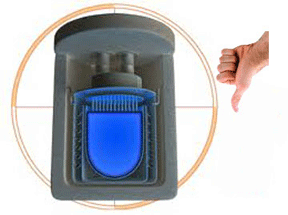 More backup systems, he pointed out, would drive up the cost of small reactors, which already have a sizable economic disadvantage compared with large reactors. Because of economies of scale, the capital cost per kilowatt for a small reactor would be approximately 250 percent more than that for a large conventional reactor.
Lyman warned about allowing the industry to site small modular reactors in remote areas or developing countries that have no nuclear experience or emergency planning infrastructure. “UCS believes that [small modular reactors] are only suitable for deployment where there is an established infrastructure to cope with emergencies, and if sufficient numbers of trained operator and security staff can be provided
Nuclear Expert Dispels Myths about Small Modular Nuclear Reactors in Senate Testimony http://www.ucsusa.org/news/press_release/nuclear-expert-dispels-myths.html WASHINGTON (July 14, 2011) –– A physicist from the Union of Concerned Scientists (UCS) today testified before a Senate subcommittee that small modular nuclear reactors are not necessarily any safer or more secure than conventional size reactors and could be more dangerous. Companies vying to sell small reactors, he said, are overstating their benefits and downplaying their potential pitfalls. Continue reading
A warning on Mixed-Oxide Fuel (MOX) nuclear fuel plan
 MOX stands for “Mixed-Oxide Fuel.” It is a nuclear power reactor fuel made from plutonium mixed with uranium. The U.S. Department of Energy (DOE) wants to make experimental MOX fuel using plutonium from dismantled nuclear weapons.
Use of MOX fuel fails as a means of getting rid of plutonium. Instead, the plutonium just becomes part of the lethal soup of ingredients termed “high-level nuclear waste”
What is MOX? http://www.nirs.org/factsheets/basicmoxinfo.htm The giant French nuclear firm Cogema, Duke Power and Virginia Power have formed a consortium to create and use plutonium MOX fuel in civilian atomic reactors in North and South Carolina and Virginia.
If their effort is successful, plutonium would be trucked from nuclear weapons depots in the west to the Savannah River Plant on the South Carolina/Georgia border, where new plutonium processing plants would be built. This new MOX fuel would then be trucked to commercial reactors in the Southeast, in order to turn this plutonium into high-level radioactive waste.
The MOX program is dangerous and unnecessary. More than 200 environmental and other organizations across the world have signed an International NIX MOX statement and have pledged to work to stop this program in the U.S. and similar programs in Russia, France and England.
What is MOX? Continue reading
Nuclear spacecraft in the sky – (hope they don’t crash)
Proposed nuclear reactor could power future space flights By Mark Morgenstein, CNN, 27 Nov 12 For potential power sources on space flights beyond the horizon, scientists are looking back to the future.
A team of NASA and Department of Energy researchers has shown that a reliable nuclear reactor based on technology that’s been around for decades could be used in spaceships, according to a news release from the Los Alamos National Laboratory, where some of the researchers are
based…..
“A small, simple, lightweight fission power system could lead to a new and enhanced capability for space science and exploration,” said Los Alamos project lead Patrick McClure. “We hope that this proof of concept will soon move us from the old frontier of Nevada to the new frontier of outer space.” http://lightyears.blogs.cnn.com/2012/11/26/proposed-nuclear-reactor-could-power-future-space-flights/
USA taxpayers to pay up for Small Modular Nuclear Reactors
 “The Obama Administration continues to believe that low-carbon nuclear energy has an important role to play in America’s energy future,” DOE Secretary Steven Chu stated
Small nuclear reactors eyed for Oak Ridge site, Oakridger.com By Donna Smith/Staff Nov. 25, 2012 The former Clinch River Breeder Reactor site in Oak Ridge may become the home for four small modular nuclear reactors that could be operational by 2022. Continue reading
Nuclear Fusion a clean alternative to Fission – not really!
Chernobyl Children Fukushima Children http://www.facebook.com/chernobylchildren.fukushimachildren 26 Nov 12 We were told the exact SAME LIES about Nuclear Fission. The exact same lies. Now it’s Fusion. A nuclear fusion power plant emits in normal operation 1000 times more radioactivity than a nuclear power plant and produces five times as much nuclear waste as a present-day nuclear fission power plant – Including the radioactive tritium beta emitter (heavy hydrogen). It mimics Hydrogen and becomes build in the DNA hydrogen bridges and causes childood leukemia. The nuclear fusion is not a “clean alternative” but a capital-intensive, centralized destructive force, based on the principle of the HYDROGEN BOMB, so the fusion is based on the fusion of radioactive Isotopes of hydrogen (deuterium and tritium) to helium, with large amounts of energy. http://www.greenpeace-aachen.de/archiv/energie/bilder/atom-kernfusion.jpg
Failure of Japan’s new Fukushima clean-up robot
 Japan’s new nuclear-proof robot gets stage fright
  http://ajw.asahi.com/article/economy/technology/AJ201211220024 November 22, 2012 REUTERS YOKOHAMA--A Japanese robot designed to withstand high levels of radiation and extreme heat at damaged nuclear plants such as Fukushima froze on its first public demonstration.
Despite being home to the largest number of industrial robots in the world, Japan did not have a device capable of entering the damaged Fukushima nuclear facility after last year’s devastating earthquake and tsunami.
Instead, Japan brought in U.S. robots to survey the extent of the damage inside the reactor buildings.
Toshiba Corp. unveiled Japan’s own nuclear-proof robot on Oct. 21, a four-legged device able to carry up to 20 kg of equipment and capable of lifting itself up if it falls over on uneven surfaces and amid debris.
During the demonstration, the robot experienced a case of stage fright. The shuffling Tetrapod locked up and suddenly froze after it tried to balance itself, forcing technicians to carry it away. It is the second time such Japanese robotic technology has experienced problems. Last October, a crawling robot developed by the Chiba Institute of Technology lost connection with operators and was abandoned inside Fukushima’s No. 2 reactor building.
Another blow to the Small Modular nuclear reactor (SMR) pipe-dream
“I think they were trying to use cleanup funds, which weren’t intended to be used for nuclear energy projects,” said Tom Clements, the non-proliferation policy director for the Alliance for Nuclear Accountability.
“The whole SMR thing has always appeared very premature and rather half-baked; since these reactors don’t even exist the companies don’t have money to pursue them,” “So it’s all very highly speculative.”
SRS suspends portable reactor development, The Augusta Chronicle, By Rob Pavey, Nov. 10, 2012 Savannah River Site can no longer use its increasingly limited environmental management resources to pursue the development of small, portable nuclear power reactors.
 The ambition to create a “small, modular reactor” farm, where a new generation of SMRs
could be perfected for the commercial market, is a key facet of Enterprise SRS, a futuristic strategy designed to create jobs and future missions for the 310-square-mile site.
Although the U.S. Department of Energy announced agreements in March with three firms that are hoping to use SRS as a home base to study and develop mini reactor technology, site contractor Savannah River Nuclear Solutions received a directive from headquarters to “stand down” and devote no further funds or resources to the effort. Continue reading
US Dept of Energy losing enthusiasm for Small Modular Nuclear reactors (SMRs)
ultimately, the decision may have come down to the commercial prospects for the technologies. The fact remains that the economics of all of these designs remains murky.
Based on economies of scale, small reactors will produce more expensive electricity than large reactors, all other factors being equal.
Does DOE’s Funding Announcement Mark the End of its Irrational Exuberance for SMRs? http://allthingsnuclear.org/does-does-funding-announcement-mark-the-end-of-its-irrational-exuberance-for-smrs/?utm_source=twitterfeed&utm_medium=twitter&utm_campaign=Feed%3A+AllThingsNuclear+%28All+Things+Nuclear%29 Ed Lyman, senior scientist
November 21, 2012
On November 20 DOE finally announced that the Babcock and Wilcox Company (B&W) and its “mPower” reactor were the lucky winners of its Funding Opportunity Announcement (FOA) for a cost-sharing program with industry for the design and licensing of “small modular reactors,” or SMRs. Although DOE had originally said the announcement would come in July or August, it decided instead to bury it on Thanksgiving week – not usually a time the agency releases news of which it is particularly proud.
And in fact, the real news is not that a grant was awarded to B&W – this was a near-certainty – but that there was only one winner instead of two. Continue reading
Weapons proliferation concern about laser uranium enrichment technology
U.S. approval for laser enrichment – could spur new clandestine research and construction in other nations that might make bomb-building efforts by nuclear-arms aspirants easier to conceal.
Decision on Proliferation Assessments Pending at Nuclear Agency, Nov. 20, 2012 By Elaine M. Grossman Global Security Newswire
A roadway marker points to nuclear fuel operations at a GE-Hitachi campus in North Carolina. The Nuclear Regulatory Commission might soon decide whether to demand proliferation threat assessments from firms seeking licenses for new fuel-making activities, such as a commercial laser uranium-enrichment approach proposed by the energy conglomerate
Continue reading
Radiation harms space technology, as well as people
Pioneering planet hunter suffers radiation overdose, New Scientist, 20 November 2012 by Lisa Grossman The first space telescope to hunt for transiting exoplanets may be on its deathbed.
On 2 November, the COROT satellite, which launched in 2006, lost the use of its only remaining onboard computer. The spacecraft can no longer receive data from its 30-centimetre telescope, which searches for the telltale dimming of stars as planets cross in front of them.
The culprit was too much radiation, says project scientist Malcolm Fridlund of the European Space Agency. The orbiting spacecraft had spent a long time in a harsh particle environment called the South Atlantic Anomaly.
Earth’s magnetic field is especially weak at this region about 200 to 800 kilometres above the surface, leading to high levels of damaging radiation. Because of its passages through the anomaly, COROT had survived more than twice the amount of radiation it was designed to
withstand….. http://www.newscientist.com/article/dn22517-pioneering-planet-hunter-suffers-radiation-overdose.html
Aging nuclear reactors, like Pilgrim, Plymouth, become more dangerous
Nuclear facilities are licensed to operate for forty years and all have experienced age-related degradation before the termination of their original license. Despite this, the NRC continues to extend licenses to facilities throughout the U.S.
from 1952-2009 there have been 99 major nuclear power station incidents worldwide.
NUKE MATTERS: Three Mile Island, Chernobyl, Fukushima…Plymouth?
http://www.wickedlocal.com/plymouth/news/opinions/x35738056/NUKE-MATTERS-Three-Mile-Island-Chernobyl-Fukushima-Plymouth#axzz2CQF4Vofv By Karen Vale, Campaign Coordinator, Cape Cod Bay Watch Wicked Local Plymouth, 18 Nov 12, Three Mile Island in 1979, Chernobyl in 1986, and most recently Fukushima – these catastrophic nuclear accidents thrust the debate about the safety of nuclear power into the public
spotlight.
Fukushima also triggered a critical examination of nuclear stations with the same type and operational design as the reactors that failed in March 2011. In the U.S., there are 23 reactors with the same design as Fukushima – including Pilgrim Nuclear Power Station
(Pilgrim) on Cape Cod Bay in Plymouth. Continue reading
Rokkasho: Japan’s nuclear reprocessing plant – to keep nuclear industry alive
Rokkasho has grown dependent on the reprocessing complex for nearly all its jobs and income.
“Without Rokkasho, we would not get approval to restart the other reactors—not ever,” says a member of the ruling Democratic Party of Japan (DPJ).
 Japan’s Nuclear Future, Rokkasho and a hard place The government’s fudge on its nuclear future remains unconvincing http://www.economist.com/news/asia/21566018-governments-fudge-its-nuclear-future-remains-unconvincing-rokkasho-and-hard-place Nov 10th 2012 | ROKKASHO THIS remote north-eastern coastal village in Aomori prefecture would delight a North Korean or Iranian spy. Not because of the rolling countryside, but the
  uranium-enrichment facility, the plant undergoing testing to make nuclear fuel by reprocessing spent uranium and plutonium, and the stash of a good part of Japan’s stockpiles of more than nine tonnes of separated plutonium—enough, experts say, to make more than 1,000 nuclear warheads.
The Rokkasho plant seems an anomaly in a country that forswearsnuclear weapons and that has shut down all but two of its 54 nuclear reactors. Yet the same government that says it wants to phase out atomic energy by the end of the 2030s also insists that it is committed soon to start reprocessing enough nuclear waste at Rokkasho to provide fuel for Japan’s nuclear-power plants to go flat out into the 2050s.
It does not take much prodding for officials to concede a potential contradiction, big enough to render Japan’s nuclear policy almost meaningless. Continue reading
Ionising radiation – the killer for super fast space travel
 Super-Fast Space Travel Would Kill You In Minutes http://www.gizmodo.com.au/2012/11/super-fast-space-travel-would-kill-you-in-minutes/ JAMIE CONDLIFFE, 6 Nov 12, Everyone thinks it would be cool to travel at the speed of light, which is why scientists devote their lives to working out if it would be possible and NASA is trying to develop its own warp drive. But easy, tiger: turns out super-fast space travel would be fatal. A paper published in Natural Science brings some boring common sense to the speed-of-light-travel table. In order to travel huge distances in next to no time, people need to travel close to the speed of light. In so doing, travellers cover extremely large distances very quickly, and thanks to the quirks of relativity, it would feel like it took mere minutes because of an effect known as time dilation , which squashes perceived time.
The trouble is that travelling close to the speed of light brings about other effects too. In Natural Science , Edelstein and Edelstein point out that hydrogen in any craft cable of travelling at the speed of light would also prevent it from travelling at the speed of light. They explain :
Unfortunately, as spaceship velocities approach the speed of light, interstellar hydrogen H, although only present at a density of approximately 1.8 atoms/cm3, turns into intense radiation that would quickly kill passengers and destroy electronic instrumentation. In addition, the energy loss of ionizing radiation passing through the ship’s hull represents an increasing heat load that necessitates large expenditures of energy to cool the ship.
In other words, travel close to the speed of light and you’ll be bombarded with so much radiation that you kick the bucket. The knock-on effect is that even if it’s possible to create a craft capable of travelling close the speed of light, it wouldn’t be able to transport people.
Instead, there’s a natural speed limit imposed by safe levels of radiation due to hydrogen, which means humans couldn’t travel faster than half the speed of light unless they were willing to die almost immediately. Dammit. [Natural Science ]
Nuclear fusion – pie in the sky – years away from even feasibility study
 Nuclear Fusion Project Struggles to Put the Pieces Together Scientific America, 27 Oct 12, Contracting woes may cause further delays for $19.4-billion ITER, a project designed to show the feasibility of nuclear fusion as a power source
By Geoff Brumfiel and Nature magazine The world’s largest scientific project is threatened with further delays, as agencies struggle to complete the design and sign contracts worth hundred of millions of euros with industrial partners, Nature has learned.
ITER is a massive project designed to show the feasibility of nuclear fusion as a power source. Continue reading
In a grid connected solar power system, a solar inverter converts the DC electricity generated by solar panels into AC electricity suitable for use by home appliances and for exporting to the mains grid. Continue reading
1 This Month
26 September – International Day for the Total Elimination of Nuclear Weapons





PLEASE OPPOSE HR 8255 AND S.3639 – bills would accelerate satellite deployment, with no environmental review or safeguards – https://ncstd5li.quorum.us/campaign/169331/
To see nuclear-related stories in greater depth and intensity – go to https://nuclearinformation.wordpress.com
-
Archives
- September 2026 (305)
- August 2026 (330)
- July 2026 (355)
- June 2026 (287)
- May 2026 (306)
- April 2026 (356)
- March 2026 (251)
- February 2026 (267)
- January 2026 (308)
- December 2025 (358)
- November 2025 (359)
- October 2025 (375)
-
Categories
- 1
- 1 NUCLEAR ISSUES
- business and costs
- climate change
- culture and arts
- ENERGY
- environment
- health
- history
- indigenous issues
- Legal
- marketing of nuclear
- media
- opposition to nuclear
- PERSONAL STORIES
- politics
- politics international
- Religion and ethics
- safety
- secrets,lies and civil liberties
- spinbuster
- technology
- Uranium
- wastes
- weapons and war
- Women
- 2 WORLD
- ACTION
- AFRICA
- Atrocities
- AUSTRALIA
- Christina's notes
- Christina's themes
- culture and arts
- Events
- Fuk 2022
- Fuk 2023
- Fukushima 2017
- Fukushima 2018
- fukushima 2019
- Fukushima 2020
- Fukushima 2021
- general
- global warming
- Humour (God we need it)
- Nuclear
- RARE EARTHS
- Reference
- resources – print
- Resources -audiovicual
- Weekly Newsletter
- World
- World Nuclear
- YouTube
-
RSS
Entries RSS
Comments RSS

