Rokkasho a big-box store for nuclear terrorists.

After spending tens of billions of dollars and decades on breeder-related programs, Tom Cochran said, countries find it hard to pull the plug.
“You have an entrenched bureaucracy and an entrenched research and development community and commercial interests invested in breeder technology, and these guys don’t go away,” Cochran said. “They’re believers … and they’re not going to give up. The really true believers don’t give up.”……..
“Stealing a weapon is too hard,” Cochran said. “But there is no big risk in fuel assemblies, or in taking things from a bulk handling facility that can be used to make weapons.” In this view, Rokkasho is a kind of big-box store for would-be nuclear terrorists.
A Washington-based physicist and nuclear contrarian, Cochran helped kill a vast plutonium-based nuclear industrial complex back in the 1970s, and now he’s at it again — lecturing at symposia, standing up at official meetings, and confronting nuclear industry representatives with warnings about how commercializing plutonium will put the public at enormous risk.
Where the story ends isn’t clear. But the stakes are large. Continue reading
Decades to solve problems of Thorium nuclear reactors
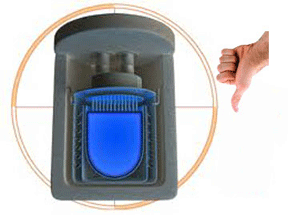 South China Morning Post, 19 March 14 ……….Researchers working on the project said they were under unprecedented “war-like” pressure to succeed and some of the technical challenges they faced were difficult, if not impossible to solve in such a short period.
They would also probably face opposition from sections of the Chinese public after the nuclear disaster at Fukushima in Japan….One of the technical difficulties is that the molten salt produces highly corrosive chemicals such as fluoride that could damage the reactor.
The power plant would also have to operate at extremely high temperatures, raising concerns about safety. In addition, researchers have limited knowledge of how to use thorium.
“We are still in the dark about the physical and chemical nature of thorium in many ways,” said Li. “There are so many problems to deal with but so little time.”
Western countries such as the United States have experimented with thorium reactors but gave up on the technology because of the engineering difficulties………
One of the technical difficulties is that the molten salt produces highly corrosive chemicals such as fluoride that could damage the reactor.
The power plant would also have to operate at extremely high temperatures, raising concerns about safety. In addition, researchers have limited knowledge of how to use thorium.
“We are still in the dark about the physical and chemical nature of thorium in many ways,” said Li. “There are so many problems to deal with but so little time.”
Western countries such as the United States have experimented with thorium reactors but gave up on the technology because of the engineering difficulties……The thorium reactors would need years, if not decades, to overcome the corrosion issue and the stability of accelerator-driven plants was also in doubt, he said.
“These projects are beautiful to scientists, but nightmarish to engineers,” he said…….After the Fukushima nuclear disaster three years ago, the central government withheld approval for new nuclear plants.
Part of the resistance came from the public, as many people were worried that nuclear plants would cause more serious contamination than the pollution created by coal-fired stations, Gu said.
Government agencies such as the Ministry of Water Resources also opposed the construction of nuclear plants in land-locked areas over concerns that radioactive waste would worsen river pollution.
Dirty bomb could be made from uranium-233 recovered from thorium reactor
Thorium nuclear reactors (LFTRs) produce intensely radioactive wastes
 “……LFTRs are theoretically capable of a high fuel burn-up rate, but while this may indeed reduce the volume of waste, the waste is more radioactive due to the higher volume of radioactive fission products. The continuous fuel reprocessing that is characteristic of LFTRs will also produce hazardous chemical and radioactive waste streams, and releases to the environment will be unavoidable. Spent fuel from any LFTR will be intensely radioactive and constitute high level waste.
The reactor itself, at the end of its lifetime, will constitute high level waste.
The UK’s National Nuclear Laboratory (NNL) believes that considerable research, development and testing lies ahead before thorium fuels will be ready for operational use. As the NNL states, “Thorium reprocessing and waste management are poorly understood. The thorium fuel cycle cannot be considered to be mature in any area.” It estimates that 10-15 years work is required before thorium fuels will be ready for use in current reactor designs, and that their use in new types of reactor is at least 40 years away….”http://www.no2nuclearpower.org.uk/nuclearnews/NuClearNewsNo43.pdf
Small Modular Nuclear Reactors – the $90 billion gamble
Going nuclear-and small-with new type of reactor, 27 Jan 14 “……….recent report by the Institute for Energy and Environmental Research cast doubt on the idea that SMRs could help revive the nuclear industry.
The think tank said small reactors “still present enormous financial risks,” citing the sector’s tendency to overrun on costs. It said the four reactors under construction were in part subsidized by taxpayers. The report said the mass production of SMRs could require $90 billion, and migrating from reactors to smaller modules “is a financial risk shell game, not a reduction in risk.
Small Modular Reactors – forlorn hope of beleaguered nuclear industry
IEER REPORT: Small Modular Reactors a “Poor Bet” to Revive Failed Nuclear Renaissance in U.S. AUDIO: Light Water Designs of Small Modular Reactors: Facts and Analysis http://ieer.org/resource/nuclear-power/light-water-designs-of-small-modular-reactors-facts-and-analysis/By Dr. Arjun Makhijani
Download the report, updated September 2013
$90 Billion in Initial Manufacturing Order Book Needed, Requiring Massive Involvement by the Chinese or Taxpayer-Backed Federal Subsidies;
Major Implications Seen for Companies and SMR Test Sites in FL, MO, NC, OR, PA, SC, and TN.
WASHINGTON, D.C.///August 8, 2013///A shift to “small modular reactors” (SMRs) is unlikely to breathe new life into the increasingly moribund U.S. nuclear power industry, since SMRs will likely require tens of billions of dollars in federal subsidies or government purchase orders, create new reliability vulnerabilities, as well as serious concerns in relation to both safety and proliferation, according a report issued today by the nonprofit Institute for Energy and Environmental Research (IEER) think tank .
The IEER report has implications for SMR companies headquartered or with planned test sites in Florida, Missouri, North Carolina, Oregon, Pennsylvania, South Carolina, and Tennessee.
Titled “Light Water Designs of Small Modular Reactors: Facts and Analysis the IEER report focuses on light water reactor (LWR) SMR designs, the development and certification of which the U.S. Department of Energy (DOE) is already subsidizing at taxpayer expense. Continue reading
Small Modular Nuclear Reactors (JSMRs) irrelevant last ditch ploy of the failing nuclear industry
Small reactors just compound the waste problem because you generate more radioactive components (aside from all the nuclear fuel that turns into nuclear waste too) than a large nuclear reactor does per unit of energy generated. And placing them underground, while making them less tempting targets for terrorists, brings up issues of groundwater contamination and greater earthquake vulnerability in affected areas. The fact that you could use ground-source cooling to condense your cooling water a lot easier with these reactors is a benefit, so they aren’t completely a bad idea.
However, it should be made abundantly clear why some in the nuclear industry see these reactors as a way forward. As the article mentions, building large 1GW+ reactors has become an immensely risky undertaking from a financial perspective. Forget all the crap people harp on about Fukushima, the price tags on these reactors are the real killer. The new reactor under construction in Finland (Olkiluoto Unit 3) is coming in at 8.5B euros ($11.55B), or almost 3 TIMES it’s initial cost estimate. In dollar terms, that amounts to over $7.21 per watt!
http://en.wikipedia.org/wiki/Olkiluoto_Nuclear_Power_Plant
New reactors going up in the US are posting similar figures, although the massive web of government supports and insulation from market forces that the nuclear industry benefits from makes true cost figures for these reactors hard to pin down.
This is in the face of wind power getting INSTALLED for $1 – $2 per watt:
In short, the nuclear industry is scrambling for solutions before it becomes clear to everybody how irrelevant they are. Much like typewriters got really fancy and sophisticated in the 1990′s before going the way of the buggy whip and the rotary phone.
Japan Nuclear Fuel trying to get Rokkasho nuclear reprocessing plant into production
Safety screening sought for nuclear fuel plant The Japan News, 7 Jan 14, Nuclear Fuel Ltd. on Tuesday filed for regulatory safety screening of its spent nuclear fuel reprocessing plant.
The company aims to complete the plant in the village of Rokkasho, Aomori Prefecture, in October, expecting that tests by the Nuclear Regulation Authority will be concluded in about six months. The company is determined to do whatever it can to ensure the screening goes smoothly, Senior Executive Vice President Kazuhiro Matsumura said.
The NRA last month drew up new safety standards for key facilities used in the country’s nuclear fuel cycle, such as fuel reprocessing plants.
Under the new rules, operators of these facilities must take steps to ensure they can deal with severe accidents caused by earthquakes, tsunami and terrorist attacks.
The operators are also required to take a stricter approach in research to determine whether faults running near or directly under their facilities are active or not.
Japan Nuclear Fuel previously planned to finish construction of the plant in October 2013. But the firm put off the planned completion by about one year to meet the new standards………
The ¥2.2 trillion plant has seen its scheduled completion date moved back as many as 20 times due to a series of problems. Initially, the plant was slated to be completed in 1997, four years after the start of construction.
It is uncertain whether the NRA can complete its safety screening of the plant in six months as expected……
Japan Nuclear Fuel also filed for safety screening tests of other facilities, such as a low-level radioactive waste management center and a plant to make mixed oxide, or MOX, fuel from extracted uranium and plutonium.http://the-japan-news.com/news/article/0000921892
Spread of nuclear weapons – a danger posed by SILEX laser uranium enrichment technology
US uranium laser enrichment technology threatens Nuclear Non-Proliferation TreatyVoice of Russia, 26 Dec 13, The uranium laser enrichment technology that has been given a new impetus in the US is capable of knocking the bottom out of the Treaty on the Non-Proliferation of Nuclear Weapons (NPT). The technology consists in uranium isotope separation with laser stimulation (SILEX). Optimists put a great deal of trust in this and pessimists warn about negative consequences……..
Thorium nuclear reactors for military use, too, funded by USA and Chinese tax-payers
 SPECIAL REPORT-The U.S. government lab behind China’s nuclear power push Dec 20, 2013 Dec 20 (Reuters) – Scientists in Shanghai are attempting a breakthrough in nuclear energy: reactors powered by thorium, an alternative to uranium.
 The project is run by the Chinese Academy of Sciences, a government body with close military ties that coordinates the country’s science-and-technology strategy. The academy has designated thorium as a priority for China’s top laboratories. The program has a budget of $350 million. And it’s being spearheaded by the influential son of a former Chinese president.
But even as China bulks up its military muscle through means ranging from espionage to heavy spending, it is pursuing this aspect of its technology game plan with the blessing – and the help – of the United States. Read more »
Small Modular Nuclear Reactors (SMRs) raise saafety and security concerns
Potential fire and explosion hazards……
Potential flooding hazards:……
Limited access for conducting inspections of pressure vessels…
Safety and Security Concerns about Small Modular Reactors: NuScale’s Design http://allthingsnuclear.org/safety-and-security-concerns-about-small-modular-reactors-nuscales-design/ Ed Lyman, senior scientist December 17, 2013 Late last week the Department of Energy finally announced its decision to provide the small modular reactor (SMR) design NuScale with a matching grant of up to $226 million under its Licensing Technical Support program intended to speed the development of SMRs.
But the real news is not that DOE awarded a second grant under the program, but that it took so long to do so. NuScale, along with three other reactor vendors, originally applied for the funds in early 2012 with the expectation that two designs would receive grants. However, later that year DOE surprised many observers by only awarding a grant to one design, the Generation mPower.
Safety and Security Concerns
As discussed in detail in my September 2013 report “Small Isn’t Always Beautiful,” UCS has safety and security concerns about small modular reactors in general and about the NuScale design in particular
SMR vendors are pushing the Nuclear Regulatory Commission (NRC) to weaken its regulations regarding operator staffing, security staffing, and emergency planning, based on highly optimistic assertions that their reactors will be significantly safer than larger reactors. Continue reading
Big push for Small Modular Nuclear Reactors grinds to a halt
Ameren/Westinghouse passed over again for small modular reactor funding By JACOB BARKER December 13, 2013 Ameren Missouri and Westinghouse Electric again were passed over by the U.S. Department of Energy, which announced Thursday that its final funding award under a small modular nuclear reactor program would go to NuScale Power of Portland, Ore.
The announcement was the second disappointment for a coalition built around Westinghouse’s nuclear reactor design and St. Louis-based Ameren, which had indicated it would build a new reactor near its existing nuclear power plant in Callaway County if it could secure a federal investment….. the department said it would enter into a five-year cost-share agreement with NuScale and invest as much as half of the total project cost. The department did not release the final amount it would put up for the project, saying that sum would be negotiated with NuScale and come from a $452 million fund established for the SMR program.
…….[In 2012] DOE said then it would open future funding opportunities, but this time, it isn’t planning any more…..
“As a result of the DOE’s decision, we are stepping back and considering our alternatives as we continue to focus on maintaining all generation options for a cleaner energy portfolio to meet Missouri’s energy needs in the future,” Ameren said in its statement. ……
The Missouri Coalition for the Environment responded to the decision with a news release saying Missouri should focus on “clean renewable energy,” excluding nuclear power, in line with a 2008 statewide vote requiring utilities to generate more power from renewable sources. http://www.columbiatribune.com/news/local/ameren-westinghouse-passed-over-again-for-small-modular-reactor-funding/article_8141670c-637c-11e3-8c67-001a4bcf6878.html?comments=focus
USA government has lost enthusiasm for Small Modular Nuclear Reactors
DOE Drops the Ball on Nuclear Design Funding The Motley Fool, By John Licata December 13, 2013 …The Department of Energy (DOE) was expected to announce two winners of the first round of small modular nuclear reactor (SMR) design funding which was delayed several times in 2012. However, only one award was announced last November and that award went to Babcox & Wllcox (NYSE: BWC ) . Now over one year later and past the most recent deadline of September 2013 for two more design award announcements, the DOE continues to delay further commitment to SMR designs….
Approval for Tokai nuclear reprocessing plant BEFORE safety screening!
NRA to approve restart of reprocessing facility http://www3.nhk.or.jp/nhkworld/english/news/20131211_29.html Japan’s nuclear regulator plans to approve a partial restart of a facility for reprocessing spent nuclear fuel before it clears safety screening under new regulations.
The Nuclear Regulation Authority says it’s allowing the restart to make plutonium and other highly radioactive waste in the facility solid and more stable.
The authority said on Wednesday that it plans to allow the government-backed Japan Atomic Energy Agency to operate part of the plant in Tokai Village, about 100 kilometers north of Tokyo.
The decision comes after the agency sought permission to restart the facility soon, saying that keeping the waste in liquid form involves high risks.
NRA commissioners said the facility’s stockpiles of plutonium solutions and other liquid waste will be made safer when reprocessed into solids.
They came up with a plan to allow part of the facility to run for 5 years before checking is done under the enhanced regulations.
The facility stores 3.5 cubic meters of solutions containing plutonium and more than 400 cubic meters of highly radioactive liquid waste. NRA secretariat officials say reprocessing the plutonium solutions into powder will take about 2 years, and turning other liquid waste into glass 21 years.
The new regulations are to take effect on December 18th. The NRA is to give formal approval after confirming that the agency can ensure stable reprocessing at the plant.
US govt chooses small Oregan company for grant for small nuclear reactors
Small Oregon Nuclear Power Plant Company Gets Massive Federal Backing OPB | Dec. 12, 2013 Portland, Oregon NuScale Power, a spin-off business out of Oregon State University, will receive up to $226 million from the U.S. Department of Energy.
NuScale Power is designing a small nuclear reactor — about the size of a semi-trailer standing on its head.
Chief commercial officer Mike McGough says the money will be spent getting the Nuclear Regulatory Commission to certify the design — a task that’s expected to cost about $1 billion……
If NuScale secures certification, a reactor isn’t expected to be up and running until at least 2023.It would be built in Idaho.
Oregon has tight restrictions on the construction of nuclear power facilities. For example, it would have to be approved by voters and builders would need to be able to demonstrate the safe disposal of high level waste….http://www.opb.org/news/article/small-oregon-nuclear-power-plant-company-gets-massive-federal-backing/
1 This Month
26 September – International Day for the Total Elimination of Nuclear Weapons





PLEASE OPPOSE HR 8255 AND S.3639 – bills would accelerate satellite deployment, with no environmental review or safeguards – https://ncstd5li.quorum.us/campaign/169331/
To see nuclear-related stories in greater depth and intensity – go to https://nuclearinformation.wordpress.com
-
Archives
- September 2026 (305)
- August 2026 (330)
- July 2026 (355)
- June 2026 (287)
- May 2026 (306)
- April 2026 (356)
- March 2026 (251)
- February 2026 (267)
- January 2026 (308)
- December 2025 (358)
- November 2025 (359)
- October 2025 (375)
-
Categories
- 1
- 1 NUCLEAR ISSUES
- business and costs
- climate change
- culture and arts
- ENERGY
- environment
- health
- history
- indigenous issues
- Legal
- marketing of nuclear
- media
- opposition to nuclear
- PERSONAL STORIES
- politics
- politics international
- Religion and ethics
- safety
- secrets,lies and civil liberties
- spinbuster
- technology
- Uranium
- wastes
- weapons and war
- Women
- 2 WORLD
- ACTION
- AFRICA
- Atrocities
- AUSTRALIA
- Christina's notes
- Christina's themes
- culture and arts
- Events
- Fuk 2022
- Fuk 2023
- Fukushima 2017
- Fukushima 2018
- fukushima 2019
- Fukushima 2020
- Fukushima 2021
- general
- global warming
- Humour (God we need it)
- Nuclear
- RARE EARTHS
- Reference
- resources – print
- Resources -audiovicual
- Weekly Newsletter
- World
- World Nuclear
- YouTube
-
RSS
Entries RSS
Comments RSS

