Latest Nuclear PR Gimmick – reactors floating on the ocean

Christina Macpherson’s websites & blogs
What really fascinates me about this proposal is this bit -“the ocean serves as an “infinite heat sink,” which allows for the core to be cooled passively.”Now one current big argument FOR nuclear power, is that it would fight global warming. . Yet anyone who knows anything about global warming would know that heating up of the ocean is one of the major factors in global warming. This floating nuclear proposal is the clearest example yet, of how the nuclear industry CONTRIBUTES to global warming.
 MIT Wants to Mass Produce These Floating Nuclear Reactors JORDAN PEARSON 18 April 14, MIT RESEARCHERS WANT TO GO SURFING WITH NUCLEAR POWER. THEY’VE DESIGNED A FLOATING REACTOR THAT PROMISES INCREASED SAFETY—AND THE COST-EFFECTIVENESS AND MASS REPRODUCIBILITY OF FORD’S MODEL-T.
The reactor is essentially built like a floating oil rig, and its designers, MIT professors Jacopo Buongiorno, Michael Golay, and Neil Todreas, promise that it will be able ride out tsunamis, earthquakes, and that meltdowns will be essentially impossible. According to Buongiorno, the ocean serves as an “infinite heat sink,” which allows for the core to be cooled passively……….
If this scheme catches hold, in the future we could see mass-produced nuclear power plants, ranging in size, powering many of America’s coastal cities. For now, however, the design team has their eyes set on Asia, specifically Japan, as an area which has a growing need for power sources that can withstand tsunamis.
Yet floating reactors have an unmistakably ominous quality to them, not unlike the Titanic. Although meltdowns may be “virtually impossible,” they are certainly not impossible, and the big question is what happens if one of these cores goes, well, nuclear.,….The 1970s plan for nuclear energy at sea got about this far, as well, before it was shot down by a slew of environmental, economic, and social concerns. At the time, there was an outcry over the potential environmental impact of a core meltdown at sea. John O’Leary, a Department of Energy secretary, delivered what a staffer called a “grim—even alarming report.” After the Three Mile Island disaster, the curtains had closed on the plan to build reactors at sea. Until now, that is……http://motherboard.vice.com/read/mit-wants-to-mass-produce-these-floating-nuclear-reactors
What really fascinates me about this proposal is this bit -“the ocean serves as an “infinite heat sink,” which allows for the core to be cooled passively.”Now one current big argument FOR nuclear power, is that it would fight global warming. . Yet anyone who knows anything about global warming would know that heating up of the ocean is one of the major factors in global warming. This floating nuclear proposal is the clearest example yet, of how the nuclear industry CONTRIBUTES to global warming.
Small Modular Nuclear Reactors (SMRs) uneconomic: Babcock and Wilcox pulling out?
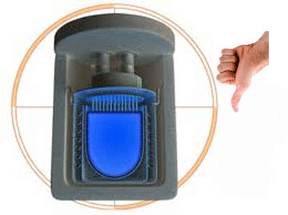 B&W scales back its small nuclear reactor project, Charlotte Observer, By Bruce Hendersony, Apr. 14, 2014 Charlotte-based Babcock & Wilcox said Monday it will scale back its mPower small modular nuclear reactor program after being unable to attract needed investors or contracts. The president of its mPower subsidiary, Christofer Mowry, left the company as of Sunday, B&W said in a securities filing. Mowry was terminated “without cause,” the filing said. William Fox III will replace him.
Announced in 2009, small modular reactor technology had been the company’s largest research and development project……Babcock & Wilcox announced an “accelerated” search for additional investors in the program last November.
But the project struggled to find additional investors or construction contracts that would bring in enough revenue to continue its development, B&W said Monday……..mPower recorded an $87 million operating loss in 2013, B&W said in a March proxy statement. http://www.charlotteobserver.com/2014/04/14/4841485/bw-scales-back-its-small-nuclear.html
PRISM an ugly magic trick from the nuclear lobby
http://www.no2nuclearpower.org.uk/nuclearnews/NuClearNewsNo61.pdf
 The U.S. corporation GE Hitachi (GEH) is promoting a reactor design called the PRISM (Power Reactor Innovative Small Modular) that its chief consulting engineer and fast-breeder guru, Eric Loewen, says is a safe and secure way to power the world using yesterday’s nuclear waste – he means plutonium which hasn’t officially been classified as waste in the UK. The Nuclear Decommissioning Authority has declared PRISM to be a “credible option” for managing the UK’s plutonium stockpile.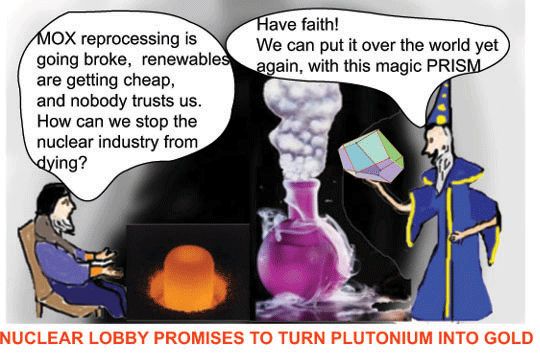
Small Modular Nuclear Reactors a dodgy dream
But the safety of the proposed compact designs is unproven—for instance, most of the designs call for weaker containment structures. And the arguments in favour of lower overall costs for SMRs depend on convincing Nuclear Regulators to relax existing safety regulations.Nuclear lobby’s new gimmick -thorium reactors, does not impress
 NuClear News No.61 April 2014 There’s a modern mythology that suggests that thorium might be able to replace uranium and deliver a safer and cheaper nuclear reactor with more abundant fuel. In March press reports suggested that Chinese scientists have been told to accelerate plans to build the first fully-functioning thorium reactor within ten years, instead of 25 years as originally planned. The Telegraph said they “may do the world a big favour. They may even help to close the era of fossil fuel hegemony.” (1)
Jan Beránek, leader of Greenpeace International’s Energy Campaign says we’ve heard all this before. Thorium technology is in principal based on nuclear fission and therefore keeps fission’s inherent problems. While it partially addresses some of the downsides of current commercial reactors based on uranium (plutonium) fuel, such as limited reserves of uranium and unwanted production of plutonium and transuranic isotopes, it still has significant issues related to fuel mining and fabrication, reactor safety, production of dangerous waste, and the hazards of the proliferation of nuclear weapons. (2)
The Union of Concerned Scientists point out that thorium cannot be used by itself to sustain a nuclear chain reaction: it must be used together with a fissile material such as enriched uranium, uranium-233, or plutonium. The U.S. Department of Energy has concluded after a review that “the choice between uranium-based fuel and thorium-based fuel is seen basically as one of preference, with no fundamental difference in addressing the nuclear power issues [of waste management, proliferation risk, safety, security, economics, and sustainability].” (3)
UCS continues some people believe that liquid fluoride thorium reactors, which would use a high-temperature liquid fuel made of molten salt, would be significantly safer than current-generation reactors. However, such reactors have major flaws. There are serious safety issues associated with the retention of fission products in the fuel, and it is not clear these problems can be effectively resolved. Such reactors also present proliferation and nuclear terrorism risks because they involve the continuous separation, or “reprocessing,” of the fuel to remove fission products and to efficiently produce U-233, which is a nuclear weapon-usable material. Moreover, disposal of the used fuel has turned out to be a major challenge.
Even the UK Department of Energy and Climate Change commissioned a report which concluded in 2012 that the claims by thorium proponents who say that the radioactive chemical element makes it impossible to build a bomb from nuclear waste, leaves less hazardous waste than uranium reactors, and that it runs more efficiently, are “overstated“.http://www.no2nuclearpower.org.uk/nuclearnews/NuClearNewsNo61.pdf
Westinghouse to go IN to lucrative nuclear decommissioning, OUT of Small Modular reactors (SMRs)
Westinghouse backs out of Small Modular Reactor market Enformable Nuclear News Lucas W Hixson http://enformable.com/2014/02/westinghouse-backs-small-modular-reactor-market/Danny Roderick, President and CEO of Westinghouse announced that the nuclear firm is backing off of research and development of their Small Modular Reactor design. The Westinghouse design is a scaled down version of the AP1000 reactor, designed to produce 225 MWe, which could power 45,000 residential houses.
In December, the firm was passed over for a second time by the United States Department of Energy’s SMR commercialization program. Roderick clarified the issue and noted that it was not the deployment of the technology that posed the biggest problem – it was that there were no customers. “The worst thing to do is get ahead of the market,” he added

According to Roderick, unless Westinghouse was capable of producing 30 to 50 small modular reactors, there was no way that the firm would return its investment in the development project. In the end, given the lack of market, and the similar lack of federal funding, Westinghouse was unable to justify the economics of small modular reactors at this point.
Westinghouse was working with St. Louis-based Ameren, which had indicated its desire to build a new reactor near the State’s only existing nuclear reactor – the Calloway nuclear power plant, if a federal investment could be secured.
Westinghouse will focus its attentions on its decommissioning business, which is a $1 billion dollar per year business for the firm – which is equivalent to Westinghouse’s new reactor construction business, and rededicate its staff to the AP1000 reactor design.

Analysts are monitoring how the companies who did receive funding from the Department of Energy perform as they evolve. Source: The Pittsburgh Post-Gazett
MOX nuclear plant consumed $billions – now to be closed
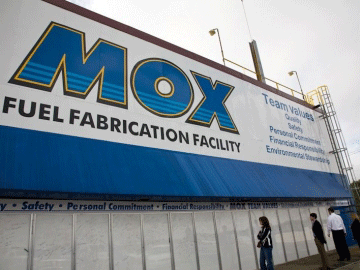 DOE shuts $4 billion ‘plutonium-eater’ reactor Ecologist, Douglas Birch 12th March 2014 A nuclear reactor designed to burn up surplus Cold War plutonium has been closed by the US Department of Energy. Initially it was meant to cost $1bn. So far it has cost $4bn. To complete and operate would cost $25-34bn.
After a year of study meant to examine the viability of the two-decade old program, the department’s leadership made clear in budget documents for fiscal year 2015 that the plant is no longer affordable within budget limits set by Congress.
The mad world of nuclear economics
Initially advertised as a $1 billion program, the plant has already consumed more than $4 billion and was projected to cost up to $10 billion to complete over the next five years. Its total costs – including operation over 15 years – were estimated at nearly $34 billion by a special study conducted for Energy Secretary Ernest Moniz.
The plant, which lay at the center of a diplomatic deal with Russia that was blessed by three U.S. presidents, was supposed to transform at least 34 tons of plutonium withdrawn from retired U.S. nuclear weapons into so-called Mixed Oxide (MOX) fuel to be burned in civilian nuclear power plants. Russia agreed to undertake a similar effort, but the cancellation of the U.S. plan may affect that decision.
The department’s review “has determined that the MOX fuel approach is significantly more expensive than planned and it is not viable within the FY 2015 funding levels”, the White House’s Energy Department budget proposal states……..http://www.theecologist.org/News/news_round_up/2317472/doe_shuts_4_billion_plutoniumeater_reactor.htm
the perils of trying out a new nuclear reactor design
City’s nuclear age lasted only a year Argus Leader. South Dakota Eric Renshaw11:23 p.m. CDT March 29, 2014 In 1959, Northern States Power Co. began construction on what would become the Pathfinder Nuclear Generating Station just south of Interstate 90 between Sioux Falls and Brandon…….. After spending much time and money assembling the plant and trying to get the superheater working the way it should, they finally pushed the plant to run at full output, which lasted about 30 minutes. During that 30 minutes, it was decided that they should never do that again. The flaws in the superheater became evident, and it was deemed too expensive to repair. They’d put enough into it and had learned a lot. It did run at less than peak output from August 1966 to September 1967, though it was never put on the grid.
Pathfinder ceased operation in October 1967 and was converted to a gas- and coal-powered station. The fuel was shipped away in 1970, and the reactor vessel was removed from the plant in 1990 after it had had time to cool down a bit. Its cooling tower collapsed in July 2000, and production stopped in that building………http://www.argusleader.com/story/life/2014/03/30/citys-nuclear-age-lasted-year/7043837/
Thorium – the nuclear power fuel of the perpetual future
Clamping down on tweets Mar 26th 2014, by Economist.com Thorium the wonder fuel of Tomorrowland by Oliver Morton HOW the Doppler effect helped locate the likely remains of MH370, why thorium will not be the fuel of tomorrow and how Turkey (tried to) shut Twitter down

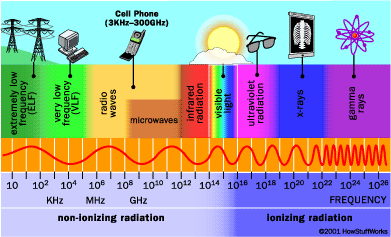
Be cautious with devices that give off electromagnetic radiation
Waves of uncertainty over wi-fi Stuff.co.nz 29 March 14“……..CUT BACK ON YOUR EXPOSURE
MOBILES AND DEVICES
Before buying a cellphone or internet-capable device, check out its SAR (specific absorption rate) rating – though in New Zealand you’ll likely have to go online for this information. The SAR measures how much the device’s emissions are absorbed by the body. Lower ratings indicate lower absorption.
Ensure your mobile has flight mode and use this as often as you can, including overnight, and when carrying it close to your body.
For long computing tasks, select a wired desktop or plugged-in laptop, rather than a wireless tablet.
Avoid holding a laptop or device on your lap or stomach – use a table instead, unless it’s in flight mode.
When you can, choose a text over a call. Keep phone calls to a minimum or use a hands-free kit.
Keep calls to a minimum where reception is bad – when a mobile is far from a cell tower, it has to boost its signal to connect.
Choose a wired mouse and keyboard.
CORDLESS PHONES
If possible, choose corded devices, or purchase one with speaker-phone capabilities.
Keep the main transmitting base of the cordless phone away from bedrooms and desks.
Keep calls short.
WI-FI
When installing a transmitting unit, ask for it to be put up high, such as on the wall or a shelf, away from bedrooms or where people sit.
Only turn the system on when you’re using it. Make sure the router is turned off overnight, especially.
Choose software on a laptop rather than cloud-computing technology such as Google Docs, if you’re using wi-fi. Typing in a Google Docs word processing means a wi-fi signal is sent with every single keystroke.http://www.stuff.co.nz/dominion-post/news/9882716/Waves-of-uncertainty-over-wi-fi
Rokkasho a big-box store for nuclear terrorists.

After spending tens of billions of dollars and decades on breeder-related programs, Tom Cochran said, countries find it hard to pull the plug.
“You have an entrenched bureaucracy and an entrenched research and development community and commercial interests invested in breeder technology, and these guys don’t go away,” Cochran said. “They’re believers … and they’re not going to give up. The really true believers don’t give up.”……..
“Stealing a weapon is too hard,” Cochran said. “But there is no big risk in fuel assemblies, or in taking things from a bulk handling facility that can be used to make weapons.” In this view, Rokkasho is a kind of big-box store for would-be nuclear terrorists.
A Washington-based physicist and nuclear contrarian, Cochran helped kill a vast plutonium-based nuclear industrial complex back in the 1970s, and now he’s at it again — lecturing at symposia, standing up at official meetings, and confronting nuclear industry representatives with warnings about how commercializing plutonium will put the public at enormous risk.
Where the story ends isn’t clear. But the stakes are large. Continue reading
Decades to solve problems of Thorium nuclear reactors
South China Morning Post, 19 March 14 ……….Researchers working on the project said they were under unprecedented “war-like” pressure to succeed and some of the technical challenges they faced were difficult, if not impossible to solve in such a short period.
They would also probably face opposition from sections of the Chinese public after the nuclear disaster at Fukushima in Japan….One of the technical difficulties is that the molten salt produces highly corrosive chemicals such as fluoride that could damage the reactor.
The power plant would also have to operate at extremely high temperatures, raising concerns about safety. In addition, researchers have limited knowledge of how to use thorium.
“We are still in the dark about the physical and chemical nature of thorium in many ways,” said Li. “There are so many problems to deal with but so little time.”
Western countries such as the United States have experimented with thorium reactors but gave up on the technology because of the engineering difficulties………
One of the technical difficulties is that the molten salt produces highly corrosive chemicals such as fluoride that could damage the reactor.
The power plant would also have to operate at extremely high temperatures, raising concerns about safety. In addition, researchers have limited knowledge of how to use thorium.
“We are still in the dark about the physical and chemical nature of thorium in many ways,” said Li. “There are so many problems to deal with but so little time.”
Western countries such as the United States have experimented with thorium reactors but gave up on the technology because of the engineering difficulties……The thorium reactors would need years, if not decades, to overcome the corrosion issue and the stability of accelerator-driven plants was also in doubt, he said.
“These projects are beautiful to scientists, but nightmarish to engineers,” he said…….After the Fukushima nuclear disaster three years ago, the central government withheld approval for new nuclear plants.
Part of the resistance came from the public, as many people were worried that nuclear plants would cause more serious contamination than the pollution created by coal-fired stations, Gu said.
Government agencies such as the Ministry of Water Resources also opposed the construction of nuclear plants in land-locked areas over concerns that radioactive waste would worsen river pollution.
Dirty bomb could be made from uranium-233 recovered from thorium reactor
Thorium nuclear reactors (LFTRs) produce intensely radioactive wastes
 “……LFTRs are theoretically capable of a high fuel burn-up rate, but while this may indeed reduce the volume of waste, the waste is more radioactive due to the higher volume of radioactive fission products. The continuous fuel reprocessing that is characteristic of LFTRs will also produce hazardous chemical and radioactive waste streams, and releases to the environment will be unavoidable. Spent fuel from any LFTR will be intensely radioactive and constitute high level waste.
The reactor itself, at the end of its lifetime, will constitute high level waste.
The UK’s National Nuclear Laboratory (NNL) believes that considerable research, development and testing lies ahead before thorium fuels will be ready for operational use. As the NNL states, “Thorium reprocessing and waste management are poorly understood. The thorium fuel cycle cannot be considered to be mature in any area.” It estimates that 10-15 years work is required before thorium fuels will be ready for use in current reactor designs, and that their use in new types of reactor is at least 40 years away….”http://www.no2nuclearpower.org.uk/nuclearnews/NuClearNewsNo43.pdf
Small Modular Nuclear Reactors – the $90 billion gamble
Going nuclear-and small-with new type of reactor, 27 Jan 14 “……….recent report by the Institute for Energy and Environmental Research cast doubt on the idea that SMRs could help revive the nuclear industry.
The think tank said small reactors “still present enormous financial risks,” citing the sector’s tendency to overrun on costs. It said the four reactors under construction were in part subsidized by taxpayers. The report said the mass production of SMRs could require $90 billion, and migrating from reactors to smaller modules “is a financial risk shell game, not a reduction in risk.
1 This Month
26 September – International Day for the Total Elimination of Nuclear Weapons





PLEASE OPPOSE HR 8255 AND S.3639 – bills would accelerate satellite deployment, with no environmental review or safeguards – https://ncstd5li.quorum.us/campaign/169331/
To see nuclear-related stories in greater depth and intensity – go to https://nuclearinformation.wordpress.com
-
Archives
- September 2026 (292)
- August 2026 (330)
- July 2026 (355)
- June 2026 (287)
- May 2026 (306)
- April 2026 (356)
- March 2026 (251)
- February 2026 (267)
- January 2026 (308)
- December 2025 (358)
- November 2025 (359)
- October 2025 (375)
-
Categories
- 1
- 1 NUCLEAR ISSUES
- business and costs
- climate change
- culture and arts
- ENERGY
- environment
- health
- history
- indigenous issues
- Legal
- marketing of nuclear
- media
- opposition to nuclear
- PERSONAL STORIES
- politics
- politics international
- Religion and ethics
- safety
- secrets,lies and civil liberties
- spinbuster
- technology
- Uranium
- wastes
- weapons and war
- Women
- 2 WORLD
- ACTION
- AFRICA
- Atrocities
- AUSTRALIA
- Christina's notes
- Christina's themes
- culture and arts
- Events
- Fuk 2022
- Fuk 2023
- Fukushima 2017
- Fukushima 2018
- fukushima 2019
- Fukushima 2020
- Fukushima 2021
- general
- global warming
- Humour (God we need it)
- Nuclear
- RARE EARTHS
- Reference
- resources – print
- Resources -audiovicual
- Weekly Newsletter
- World
- World Nuclear
- YouTube
-
RSS
Entries RSS
Comments RSS

