NASA report against program for nuclear power in space missions
NASA Releases Space Nuclear Power Study, Federation of American Scientists, (FAS) Jun.04, 2015 NASA has released a long-awaited Nuclear Power Assessment Study that examines the prospects for the use of nuclear power in civilian space missions over the next 20 years.
The Study concludes that there is a continuing demand for radioisotope power systems, which have been used in deep space exploration for decades, but that there is no imminent requirement for a new fission reactor program.
The 177-page Study, prepared for NASA by Johns Hopkins University Applied Physics Laboratory, had been completed several months ago but was withheld from public release due to unspecified “security concerns,” according to Space News. Those concerns may have involved the discussion of the proposed use of highly enriched uranium as fuel for a space reactor, or the handling of plutonium-238 for radioisotope power sources……
development of nuclear reactor technology for use in space has been dogged by a repeated series of false starts in which anticipated mission requirements failed to materialize.
“The United States has spent billions of dollars on space reactor programs, which have resulted in only one flight of an FPS [fission power source],” the new NASA report noted. That was the 1965 launch of the SNAP 10-A reactor on the SNAPSHOT mission. It had an electrical failure after a month’s operation and “it remains in a 1300-km altitude, ‘nuclear-safe’ orbit, although debris-shedding events of some level may have occurred,” the report said.
The development and use of space nuclear power raises potential environmental safety and public health issues. As a result, the NASA report said, “it may be prudent to build in more time in the development schedule for the first launch of a new space reactor. Public interest would likely be large, and it is possible that opposition could be substantial.”
In any case, specific presidential approval is required for the launch of a nuclear power source into space, pursuant to Presidential Directive 25 of 1977.
“For any U.S. space mission involving the use of RPS [radioisotope power sources], radioisotope heating units, nuclear reactors, or a major nuclear source, launch approval must be obtained from the Office of the President,” the report noted. http://fas.org/blogs/secrecy/2015/06/nasa-npas/
Nuclear Lobby’s convenient amnesia about the sorry history of Small Modular Reaactors (SMRs)
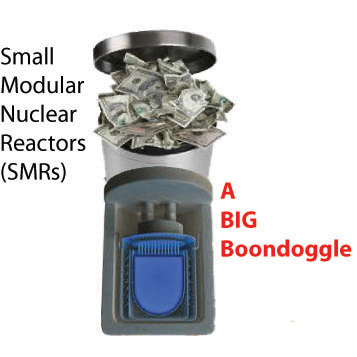 Small reactors, in fact, date back to the earliest days of atomic power, and this long history shouldn’t
be overlooked as vendors tout new generations of the technology. As the history makes clear, small nuclear reactors would be neither as cheap nor as easy to build and operate as their modern proponents are claiming they would be.
nothing in the history of small nuclear reactors suggests that they would be more economical than full-size ones. In fact, the record is pretty clear: Without exception, small reactors cost too much for the little electricity they produced, the result of both their low output and their poor performance.
In the end, as an analyst for General Electric pronounced in 1966, “Nuclear power is a big-plant business: it is most competitive in the large plant sizes.” And if large nuclear reactors are not competitive, it is unlikely that small reactors will do any better. Worse, attempts to make them cheaper might end up exacerbating nuclear power’s other problems: production of long-lived radioactive waste, linkage with nuclear weapons, and the occasional catastrophic accident
The Forgotten History of Small Nuclear Reactors Economics killed small nuclear power plants in the past—and probably will keep doing so, The Spectrum, By M.V. Ramana 27 Apr 2015 A tantalizing proposition has taken hold again in the nuclear industry: that small nuclear reactors have economic and other advantages over the standard-size ones being built today. The idea is that by reducing the substantial financial risk of a full-scale nuclear project, small reactors are the best option for kick-starting a much-discussed revival of nuclear power. Continue reading
Nuclear fusion – expensive boondoogle – as far away as ever
 Star power: Troubled ITER nuclear fusion project seeks new path, Phys Org 23 May by Pascale Mollard “……Launched in 2006 after years of wrangling, the International Thermonuclear Experimental Reactor (ITER) project is saddled with a reputation as a money pit.
It has been bedevilled by technical delays, labyrinthine decision-making and cost estimates that have soared from five billion euros ($5.56 billion) to around 15 billion. It may be another four years before it carries out its first experiment………
ITER’s job is to build a testbed to see if fusion, so far achieved in a handful of labs at great cost, is a realistic power source for the energy-hungry 21st Century.
Fusion entails forcing together the nuclei of light atomic elements in a super-heated plasma, held by powerful magnetic forces in a doughnut-shaped chamber called a tokamak, so that they make heavier elements and in so doing release energy.
The principle behind it is the opposite of nuclear fission—the atom-splitting process behind nuclear bombs and power stations, which carries the risk of costly accidents, theft of radioactive material and dealing with dangerous long-term waste…….
The tokamak—a word derived from Russian—by itself is an extraordinary undertaking: a 23,000-tonne lab, three times heavier than the Eiffel Tower.
“This is a project of unprecedented complexity… a real challenge,” said Mario Merola, in charge of ITER’s internal components division.
Management tangle
Part of ITER’s problems lie in a diffuse managerial structure and decision-making among its partners: the 28-nation European Union, which has a 45-percent stake, the United States, Russia, Japan, China, India, South Korea and Switzerland. he partners are providing their contributions mostly in kind, which has been a cause of messy, protracted debate about who should provide what, when and how. It has been further complicated by the role of national agencies, which in turn deal with their own suppliers.
In some cases, said Bigot, discussions have dragged on for six whole years without resolution……..By November, there will be a new progress report, with the likelihood of a further increase in the price tag. The project has no reserve fund to deal with the unexpected…..So far around seven billion euros have been contractually committed to the thousand or so companies working on the scheme. Every year of delay adds 200 million euros to the bill……”clearly if we can’t manage this project correctly, if undertakings are not kept… (the project) could be in danger.” http://phys.org/news/2015-05-star-power-iter-nuclear-fusion.html
The deceptive hype about nuclear reprocessing
Nuclear Reprocessing Pay more, risk more, get little,
Bulletin of the Atomic Scientists 21 May 15 Hui Zhang“…… Lately, advocates for fast neutron reactors have been arguing that breeders and reprocessing can reduce the long-term hazards associated with burial of high-level waste. But these long-term benefits are offset by short-term risks and costs.
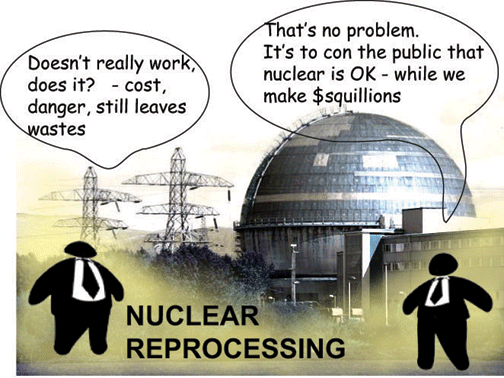
For example, breeder advocates argue that the risks surrounding leakage in geological repositories could be reduced if all the long-lived isotopes of plutonium and other transuranics contained in spent fuel were transmuted (or fissioned), thus significantly reducing the doses of radioactivity that could escape due to any leakage. But studies show that long-lived fission and activation products in spent fuel—not isotopes that could be fissioned through breeders and reprocessing—dominate the radioactivity doses that leakage could release.
Plutonium, in fact, is quite insoluble in deep underground water. So, reprocessing delivers no obvious long-term benefits in reducing leaked doses of radioactivity—but it does involve routine releases of long-lived radioactive gases from spent fuel. Reprocessing also increases the risk that tanks for high-level liquid waste might explode.
(In a similar vein, advocates for fast neutron reactors argue that reprocessing, by reducing the need to mine uranium, can reduce human radiation exposure. But any such benefit is canceled out because plutonium reprocessing and recycling themselves expose workers and the public to radiation. In short, the net effects may well be negative.)
Meanwhile, all reprocessing and fast neutron reactor programs currently under consideration significantly increase the economic costs of nuclear energy. This means that nuclear decision makers must choose between achieving rather insignificant reductions in the long-term hazards associated with nuclear waste—and achieving short-term gains in the areas of safety, security, human health, and the environment.
The choice seems rather clear-cut. The US National Academy of Sciences concluded in 1996, based on a review of the costs and benefits of reprocessing and fast neutron reactor programs, that “none of the dose reductions seem large enough to warrant the expense and additional operational risk of transmutation.” That assessment remains valid today…….http://thebulletin.org/reprocessing-poised-growth-or-deaths-door/pay-more-risk-more-get-little
Australians the suckers as AREVA tries to sell its failed nuclear technology down under
A negative learning curve on steroids What to make of the EPR saga? Areva is backing the wrong horse − the outcome of current political debates will result in a declining role for nuclear power in France, coupled to the growth of renewables.
A new report by ADEME, a French government agency under the Ministries of Ecology and Research, concludes that a 100% renewable electricity supply scenario is feasible in France. The report estimates that the electricity production cost would be €119 per megawatt-hour in 2050 in the 100% renewables scenario, compared with a near-identical figure of €117/MWh with a mix of 50% nuclear, 40% renewables, and 10% fossil fuels.
 Areva has also backed the wrong-sized wrong horse: a giant reactor with a giant price-tag. That said, the backers of ‘small modular reactors‘ are having no more success than Areva. And Areva isn’t having much luck with its mid-sized ATMEA pressurised water reactor………
The EPR saga shows that developing modified versions of conventional reactors (in this case pressurised water reactors) can be complicated and protracted and can end in failure. How much more difficult will it be to develop radically new types of reactors? The French government’s Institute for Radiological Protection and Nuclear Safety has recently produced an important critique of Generation IV nuclear power concepts. It states that there “is still much R&D to be done to develop the Generation IV nuclear reactors” and it is sceptical about the safety claims made for Generation IV concepts.
Feeling the pressure: Bumbling nuclear’s negative learning curve Jim Green, 21 May 2015, Climate Spectator http://www.businessspectator.com.au/article/2015/5/21/energy-markets/feeling-pressure-bumbling-nuclears-negative-learning-curve
French state-owned nuclear giant Areva is offering to sell its ‘world leading’ nuclear technology to South Australia. The offer is being reported in the South Australian media without a hint of irony. A reality check is in order.
Areva has posted losses in each of the past four years including a €4.83 billion loss in 2014. Continue reading
No new Generation IV Nuclear design will be ready for build before 2050
 NuClear News May 15 The Generation IV International Forum (GIF) is a co-operative international endeavour which was set up to carry out the research and development needed to establish the feasibility and performance capabilities of the next generation nuclear reactors.
Six reactor types have been selected for further development. These include: the Gas-cooled Fast Reactor (GFR), the Leadcooled Fast Reactor (LFR), the Molten Salt Reactor (MSR), the Supercritical Water-cooled Reactor (SCWR), the Sodium-cooled Fast Reactor (SFR) and the Very High Temperature Reactor (VHTR). (1)
The French Radiological Protection Agency (IRSN) has carried out a review of these systems from the point of view of safety and radiation protection. On the basis of its examination, IRSN considers the SFR system to be the only one of the six to have reached a degree of maturity compatible with the construction of a Generation IV reactor prototype during the first half of the 21st century.
Even then this will depend on further studies. (2) This is hardly a ringing endorsement, let alone anything like a quickly deployable climate solution – ie the SFR is the best possibility depending on further studies leading to a prototype before 2050!
DECC estimate in their 2013 Nuclear Energy Research and Development Roadmap (3) that the first commercial Generation IV reactors should be operating by 2040. That is still years away considering the timescale for dealing with the climate change threat.
Yet pro-nuclear environmentalists still promote these new fast reactors as if they are just around the corner. (“It may take ten years for these reactors to prove their potential” according to Kirsty Gogan writing in Nuclear Engineering International.)(4) http://www.no2nuclearpower.org.uk/nuclearnews/NuClearNewsNo74.pdf
Areva’s nuclear fuel reprocessing plant in La Hague in crisis- shunned by clients
Crisis for Areva’s La Hague plant as clients shun nuclear, News Daily May 6, 2015 EMMANUEL JARRY FOR REUTERS BEAUMONT-HAGUE, France – Areva’s nuclear fuel reprocessing plant in La Hague needs to cut costs as its international customers disappear following the Fukushima disaster, and its sole remaining big customer, fellow state-owned French utility EDF, pressures it to cut prices.
Located at the westernmost tip of Normandy, La Hague reprocesses spent nuclear fuel for reuse in nuclear reactors and is a key part in Areva’s production chain, which spans uranium mining to fuel recycling.
Its valuation and outlook are crucial for the troubled French nuclear group, which is racing to find an equity parter after four years of losses have virtually wiped out its capital……….
One of the world’s biggest nuclear waste storage facilities, La Hague’s four pools hold the equivalent of about 50 reactor cores under four meters of water.
Protected by 1.5 meter thick anti-radiation concrete walls, employees in space suits cut up spent nuclear fuel rods, extract uranium and about one percent of plutonium, and melt the remaining waste into glass for eventual deep storage.
Areva says reprocessing reduces natural uranium needs by 25 percent but opponents say that separating plutonium from spent nuclear fuel increases the risk of nuclear proliferation.
The United States does not reprocess its nuclear fuel, but Britain has a large reprocessing plant in Sellafield. A planned recycling plant in Rokkasho, Japan – modeled on La Hague – has been plagued by problems and is years behind schedule.
Since the 2011 nuclear disaster in Fukushima, Areva’s reprocessing unit has lost nearly all of its international customers.
The company’s “back-end” sales – which include reprocessing, logistics and decommissioning – have fallen to 1.53 billion euros in 2014, 18 percent of Areva’s turnover, from 2 billion euros, 30 percent of nuclear revenue, in 2004.
EDF SQUEEZE
In the past decades, more than 32,000 tonnes of spent nuclear fuel has been reprocessed at La Hague, of which nearly 70 percent for EDF, 17 percent for German utilities, nine percent for Japanese utilities and the rest for Swiss, Belgian, Dutch and Italian clients.
This year, La Hague expects to treat 1,205 tonnes of spent fuel, of which just 25 tonnes will come from abroad. That leaves Areva with EDF virtually as its sole customer, and although both firms are state-owned – Areva 87 percent, EDF 85 percent – EDF has played hardball in contract negotiations.
La Hague extracts plutonium from used nuclear fuel, which it then sends to Areva’s Melox plant in southeast France, which produces MOX fuel – a mixture of plutonium and spent uranium – for 22 (soon 24) of EDF’s 58 reactors.
The arrival of new management at both companies since the start of the year has ended years of hostility between France’s two nuclear champions, but a 6.5 billion euro contract to treat and recycle 1,100 tonnes per year of EDF’s spent fuel for the 2013-2020 period has still not been signed…………http://newsdaily.com/2015/05/crisis-for-arevas-la-hague-plant-as-clients-shun-nuclear/
Cheap, efficient deep bore waste disposal would abort nuclear reprocessing
successfully developing deep-hole disposal techniques would be a great development for society
it could be devastating for next-generation nuclear developers attempting to utilize existing used nuclear fuel stockpiles
 Why Sending Nuclear Waste to the Center of the Earth is Bad News for General Electric,Motley Fool By Maxx Chatsko April 30, 2015 “………the U.S. Department of Energy is set to experiment with a technique to dispose of nuclear wastes by drilling 3-mile boreholes into the Earth’s crust and then, well, dropping radioactive materials into their geological tombs. For good
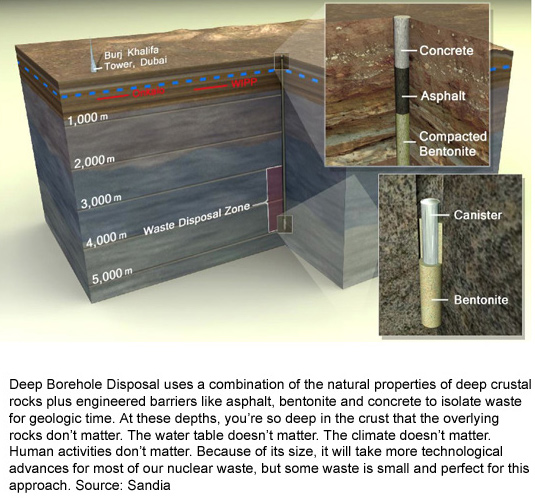
………Fergus Gibb, the technique’s pioneer, told The Engineer that each bore hole, measuring roughly 3 miles deep and 2 feet wide, would cost just a few tens of millions of dollars to drill. …
Generation IV Nuclear Reactors no better than the current ones
Future Of Nuclear Industry Takes Yet Another Hit http://oilprice.com/Alternative-Energy/Nuclear-Power/Future-Of-Nuclear-Industry-Takes-Yet-Another-Hit.html By Charles Kennedy, 28 April 2015
Despite the rough patch that the nuclear industry has experienced in recent years, its future remains bright, the industry insists. That is because the next generation of nuclear reactors will provide significant safety and economic benefits over current reactors.
But what if the new designs are actually not all that much better than the current fleet?
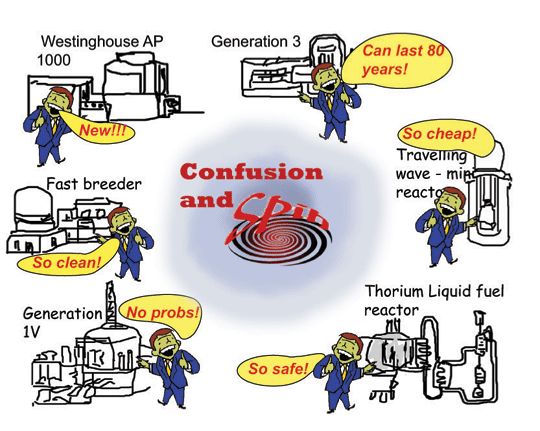
That is the provocative conclusion that France’s nuclear watchdog came to in a new report. Published on April 27, the IRSN said that the so-called “generation IV” reactors of the future may not be able to offer major upgrades in safety (most of the reactors running today are generation II – built in the 1960’s and 1970’s – and the newer designs that are currently under construction today are considered to be generation III).
The IRSN report reviewed six of the most promising generation IV reactor designs: sodium-cooled fast reactors (SFR); very high-temperature reactors (VHTR); gas-cooled fast reactors (GFR); lead-cooled fast reactors (LFR); molten salt reactors (MSR); and SuperCritical water reactors (SCWR).
Out of all of those, ISRN found that only the sodium-cooled fast reactor is close enough to maturity. SFRs have been trumpeted as an exciting concept – they can burn nuclear waste, reducing the need to build long-term spent fuel storage.
But after looking into the technology ISRN says it’s hard to say whether or not SFRs would be better. “While it seems possible for SFR technology to guarantee a safety level at least equivalent” to generation III reactors, “IRSN is unable to determine whether it could significantly exceed this level,” the report concluded. That is because liquid sodium can explode if exposed to water. IRSN also questioned the extent to which SFRs could actually burn through dangerous nuclear waste.
The report amounts to a big rebuke for generation IV reactors, the first significant criticism of a nuclear dream that has been hailed as the key to solving energy and climate change challenges.
However, ISRN also ultimately said that the devil will be in the details. The reactor designs could solve some of their drawbacks as the specifics are fleshed out. But unless generation IV designs can prove to be much safer than generation III designs, the nuclear renaissance may not be as bright as many had hoped.
Maine’s Governor wants to remove voters’ rights on decisions on small nuclear reactors
 LePage’s plan to negate rule on nuclear power plants could be radioactive. Observers wonder why his attention to the issue begins with an attempt to disempower Maine voters. 26 Apr. BY BILL NEMITZ COLUMNIST bnemitz@pressherald.com | @BillNemitz Consider yourselves warned, fellow citizens. Gov. Paul LePage is fiddling around with Maine’s nuclear hot button.
“We anticipated this might provoke a conversation,” noted Patrick Woodcock, director of the Governor’s Energy Office, in an interview on Friday.
Under LePage’s new plan, scheduled for a hearing Wednesday at 1 p.m. before the Legislature’s Energy, Utilities and Technology Committee, voters would no longer have a say on the creation of nuclear power plants with generating capacities of 500 megawatts or less.
(Just so you know, the Fukushima Daiichi Nuclear Power Plant’s Unit 1 reactor – one of three destroyed by Japan’s apocalyptic tsunami in 2011 – had a generating capacity of 460 megawatts.)
Let’s back up a little.
Considering the complexity and controversy bound to greet any talk of dusting off nuclear generation in Maine, why start with a bill that effectively tells voters they’re being cut out of the process?
Or, as longtime anti-nuclear activist Ray Shadis of Edgecomb put it on Friday, “You don’t start a conversation by throwing a hand grenade in the room.”
Shadis, who currently represents the lone remaining intervenor in the proposed relicensing of New Hampshire’s Seabrook nuclear plant, sees this week’s hearing as “the kind of rudeness we’ve come to expect from Gov. LePage.”
He also thinks the governor is dreaming if he thinks small modular reactors – the brainchildren of a new generation of nuclear engineers working mostly out of the Massachusetts Institute of Technology – can attract the investment capital needed to put them on the energy radar here in Maine or anywhere else, for that matter.
“The most rabid anti-nuclear crowd are the investors in the market,” Shadis noted. “It takes a long time to realize any return at all. And the entirety of what you invest can turn from an asset to a liability overnight. Why bother risking your money? So they don’t.”
Thus, he said, LePage’s bill at best “is impractical, it’s silly. Out there in the energy world, where people are really trading on this stuff, it will make Maine the laughingstock. It will make us look like patsies.”
Finland’s nuclear regulator demands safety check for Olkiluoto 3 nuclear reactor’s pressure vessel
Nuclear watchdog seeks re-check of Olkiluoto 3 reactor yle 18 Apr 15 The Finnish Radiation and Nuclear Safety Authority (STUK) is demanding that energy utility TVO carry out new tests of the durability of the pressure vessel planned for the Olkiluoto 3 nuclear reactor. This follows a recent discovery by French officials of inconsistencies in the mechanical toughness of a vessel made for a similar reactor, also being built by the French company Areva.

The third unit for the Flamanville, France reactor was built by Areva in France, while the one to be used in the Finnish reactor has been assembled in Japan. Both units are of the European Pressurised Reactor (EPR) type.
“There are inconsistencies in the material that the reactor vessel is made of,” Tapani Virolainen, Deputy Director of STUK’s Nuclear Reactor Regulation Department, confirmed to Yle…….Virolainen explains that anomalies were found in both the reactor vessel head and reactor vessel bottom head. He says STUK will ask TVO to re-check the reactor vessel’s manufacturing process…….http://yle.fi/uutiset/nuclear_watchdog_seeks_re-check_of_olkiluoto_3_reactor/7937448
Tritium is a major radioactive pollutant from Canada’s CANDU nuclear power reactors.
 Tritium Traffic: Deadly Dividends for Nuclear Industry, Peace Magazine By David H MartinIn February, 1934, the British journal, New Scientist, published an article by Tom Wilkie, “Old Age Can Kill the Bomb.” It was an ingenious solution to the arms control nightmare of verification; controlling not only the number of weapons, but the strategic materials that fuel them — mainly plutonium, enriched uranium and tritium. Wilkie focused on tritium, because it turns into non-radioactive helium at a rate of 5.5 per cent per year. A halt of tritium production would rapidly cripple all nuclear arsenals. Thus, attention was rivetted on Ontario Hydro’s plan to produce about 57 kilograms of tritium by 2006. A one megaton thermonuclear warhead (equivalent to one million tons of TN”) may contain as little as one gram of tritium.
Tritium (H3) (a form of hydrogen that emits beta radiation), is a major radioactive pollutant from Canada’s CANDU nuclear power reactors. Unlike American reactor systems, the CANDU uses heavy water as a moderator and coolant. The moderator and the heavy water coolant slows down the neutron release from the uranium fuel in the reactor so that a chain reaction can take place. The active ingredient in heavy water is deuterium, another form of hydrogen. When the deuterium picks up a neutron, some of it is transformed into tritium. The concentration of tritium in the heavy water increases with the age of the reactor.
The CANDU reactor system produces 2400 times as much tritium as the American light water reactor. Continue reading
Why China should avoid the doubtful dream of commercial nuclear reprocessing
 Reprocessing in China: A long, risky journey, Bulletin of the Atomic Scientists, April 15 Hui Zhang“………Should China continue pursuing its plans for fast breeder reactors and commercialized reprocessing? Good reasons exist for avoiding this course of action. First, because most of China’s power reactors are newly built, Beijing will face little pressure over the next two decades to reduce its spent fuel burden. And spent fuel can be stored safely, at low cost, in dry casks—or disposed of safely in a deep geological repository.
Second, China faces no shortage of uranium resources for the foreseeable future. The nation’s identified resources more than tripled between 2003 and 2012, to 265,500 metric tons from 77,000 metric tons. China’s potential uranium reserves amount to more than 2 million tons. Beijing in recent times has also secured huge overseas uranium resources—about three times as large as its own identified uranium reserves. More such reserves could easily be added.
In any event, the cost of uranium accounts for only a small percentage of the cost of power that reactors generate. Simply put, the cost of uranium will not increase in the foreseeable future to levels that would justify the cost of reprocessing and breeder reactors. To the extent that China is concerned about potential disruptions in its uranium supply, it could easily and inexpensively establish a “strategic” uranium stockpile.
China should carefully examine the experiences of nations that have launched large reprocessing programs and built demonstration breeder reactors in the expectation that the commercialization of these reactors would follow. Commercialization did not follow in those countries—but huge expenses were incurred for cleaning up reprocessing sites and disposing of separated plutonium. For China, there is no urgent need to go down this risky road.
Plutonium recycling is much more expensive, and much less safe and secure, than operating light water reactors with a once-through fuel cycle. As for nuclear waste, dry cask storage is a safe, flexible, and low-cost option that can postpone for decades the need either to reprocess spent fuel or to dispose of it directly—allowing time for technology to develop. China has no convincing rationale for rushing to build commercial-scale reprocessing facilities or plutonium breeder reactors. http://thebulletin.org/reprocessing-poised-growth-or-deaths-door8185
Nuclear reprocessing has NOT gone according to plan, in China
Reprocessing in China: A long, risky journey, Bulletin of the Atomic Scientists, Hui Zhang , April 15 Since 1983, a closed fuel cycle has been an official element of China’s nuclear energy policy. According to proponents, plutonium reprocessing and breeder reactors will allow full utilization of China’s uranium resources, drastically reduce the volume of radioactive waste that must be stored in an underground repository, and establish a way to dispense with the spent fuel accumulating in China’s reactor pools.
But Beijing’s attempts to develop commercially viable reprocessing facilities and breeder reactors have been afflicted with technological difficulties, serious delays, and cost overruns. At this point—especially taking into account China’s ample uranium resources and its easy access to additional resources abroad—it appears very doubtful that reprocessing and fast reactors are the proper way forward for China’s nuclear energy sector.
Not according to plan………..
Parallel with development of the pilot reprocessing plant, China has been working to establish commercially viable plutonium breeder reactors. According to a plan in place until 2013, development of breeder reactors was to be a three-stage process. The first stage was to complete a project known as the China Experimental Fast Reactor. The second stage would involve building, by about 2020, a few demonstration fast reactors. Finally, commercialized fast reactors would be deployed around 2030. Progress always ran far behind schedule.
The China Experimental Fast Reactor is a sodium-cooled experimental fast reactor using technology developed for Russia’s BN-600 reactor. The project, with a planned capacity of 20 megawatts, was approved in 1995. Construction began in 2000. As with the pilot reprocessing plant, the experimental fast reactor encountered many difficulties during construction. Capital cost estimates had to adjusted twice, with each estimate double the previous one. The reactor went critical in July 2010 and, by July 2011, 40 percent of its full power was incorporated into the grid. The reactor, however, was online for only 26 hours during the remainder of 2011, and it produced the equivalent of just one full power-hour. Not until December 2014 did the reactor manage to operate at full capacity for 72 hours. So 19 years passed between project approval and operation at full capacity.
As for the second stage of the pre-2013 plan, CNNC in 2009 signed an agreement with Russia’s Rosatom to jointly construct two copies of Russia’s BN-800 fast neutron reactor in China. But Beijing has not officially approved the project. As with the French reprocessing plant, Chinese experts complain that Russia is demanding too high a price. It is not clear when or if the project will go forward. Instead, CNNC in 2013 began focusing on the development of the indigenous 600-megawatt China Fast Reactor (CFR-600). The start of construction is envisioned for 2017, with operations to commence in 2023—but the government has not approved the project yet.
Experts from CNNC have also, since 2013, urged the development of China’s first commercial fast reactor—a 1,000-megawatt reactor based on experience gained from the CFR-600. But CNNC expert Gu Zhongmao—an advocate of the closed fuel cycle—said at a recent workshop on nuclear energy in East Asia that “China needs at least another 20 to 30 years of effort before commercialization of fast reactor energy systems, and there are so many uncertainties ahead. It is beyond our ability to draw a clear picture 20 years ahead.”…………. http://thebulletin.org/reprocessing-poised-growth-or-deaths-door8185
Will Energy Secretary Moniz benefit France in MOX nuclear boondoggle deal? Or make AREVA accountable?
$30+billion Plutonium (Pu) Fuel Project, Good for France; Bad for America: AREVA-MOX Ça Pue! Pe-yoo! Minimg Awareness, 5 Apr 15 [Recall that Areva is 89.9% French State owned and would be long gone if it weren’t for French taxpayers keeping it afloat. Furthermore, Areva has been under police investigation for years in France due to what is known as the Uramin scandal. After the French State the largest shareholder is Kuwait (Kuwait Investment Authority at 4.8%.]
From Savannah River Site Watch:
“Now, we’re being told the real reason for continuing construction of the $12.7 MOX plant at SRS – “it’s good for France!” Part of DOE’s foreign aid program fostered by Senator MOX….
“French ambassador impressed with MOX”
Aiken Standard, March 17, 2015,
We all know that with the gracious assistance of big-spender Senator Lindsey Graham that the bankrupt company AREVA has thrived on the transfer of US tax payer money into their coffers and are getting desperate as their plans for reprocessing of commercial spent fuel in the US have gone down the drain.
“We want to save the jobs in South Carolina because it’s good for the state, he (Wilson) believes it’s good for the U.S. and to me, it’s good for France,” Araud said. (Gerard Araud, France’s Ambassador to the United States)
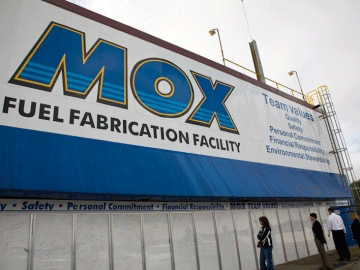 “The MOX facility is being designed by AREVA, a French company that is also the parent company to the MOX contractor, CB&I-AREVA MOX Services. Gilles Rousseau, the chief operating officer for the contractor, expressed his gratitude for having Araud on site.”
[…]
“Business at its Ugly Usual at DOE: As of April 4, 2015, there is No Accountability to the Tax-Paying Public for the U.S. DOE’s Grossly Mismanaged $30+-billion Plutonium Fuel (MOX) Project, a Textbook Case of Big Government’s Inability to Manage a Costly, Complex Project. When will Secretary of Energy Moniz and Congress act to hold those responsible accountable?
As DOE spins out of control in its management of large projects, the MOX coverup drags on and on and on. When will there be any accountability for the failed MOX project?
 SRS Watch requested in a letter hand delivered to US Secretary of Energy Ernest Moniz on July 29, 2014 that he “Take immediate steps to hold managers in DOE, NNSA and Shaw AREVA MOX Services accountable for the massive cost overruns and schedule delays associated with MOX project.”.http://www.srswatch.org/uploads/2/7/5/8/27584045/letter_to_moniz_from_srs_watch_july_28_2014.pdf
Will Secretary Moniz act responsibly and fulfill his obligations as a public servant? Will he hold specific individuals accountable and make sure that their glaringly inadequate abilities in managing the MOX boondoggle are not used elsewhere in DOE? Let us know who you think must be held accountable: srswatch@gmail.com https:// ……….miningawareness.wordpress.com/2015/04/05/30billion-plutonium-pu-fuel-project-good-for-france-bad-for-america-areva-mox-ca-pue-pe-yoo/
1 This Month
26 September – International Day for the Total Elimination of Nuclear Weapons





PLEASE OPPOSE HR 8255 AND S.3639 – bills would accelerate satellite deployment, with no environmental review or safeguards – https://ncstd5li.quorum.us/campaign/169331/
To see nuclear-related stories in greater depth and intensity – go to https://nuclearinformation.wordpress.com
-
Archives
- September 2026 (291)
- August 2026 (330)
- July 2026 (355)
- June 2026 (287)
- May 2026 (306)
- April 2026 (356)
- March 2026 (251)
- February 2026 (267)
- January 2026 (308)
- December 2025 (358)
- November 2025 (359)
- October 2025 (375)
-
Categories
- 1
- 1 NUCLEAR ISSUES
- business and costs
- climate change
- culture and arts
- ENERGY
- environment
- health
- history
- indigenous issues
- Legal
- marketing of nuclear
- media
- opposition to nuclear
- PERSONAL STORIES
- politics
- politics international
- Religion and ethics
- safety
- secrets,lies and civil liberties
- spinbuster
- technology
- Uranium
- wastes
- weapons and war
- Women
- 2 WORLD
- ACTION
- AFRICA
- Atrocities
- AUSTRALIA
- Christina's notes
- Christina's themes
- culture and arts
- Events
- Fuk 2022
- Fuk 2023
- Fukushima 2017
- Fukushima 2018
- fukushima 2019
- Fukushima 2020
- Fukushima 2021
- general
- global warming
- Humour (God we need it)
- Nuclear
- RARE EARTHS
- Reference
- resources – print
- Resources -audiovicual
- Weekly Newsletter
- World
- World Nuclear
- YouTube
-
RSS
Entries RSS
Comments RSS

