Savannah River Site’s MOX project needs $800 million a year
Review: MOX needs $800M a year http://www.aikenstandard.com/article/20150820/AIK0101/150829974/1121
Earlier this year, the Department of Energy commissioned the Red Team, a group led by Thom Mason, the director of the Oak Ridge National Laboratory, to evaluate cost projections and alternatives to the MOX method of plutonium disposition. The method includes the Mixed Oxide Fuel Fabrication Facility under construction at SRS.
The project is part of a nonproliferation agreement with Russia to dispose of 34 metric tons of weapons grade plutonium.
“The Red Team concluded that if the MOX pathway is to be successful, then annual funding for the whole program would have to increase from the current $400 million per year to $700 to 800 million per year over the next 2-3 years, and then remain at $700 to $800 million until all 34 metric tons are dispositioned,” officials wrote.
The Aiken Standard will have more on the MOX review in Friday’s paper.
UK government just quietly funding Small Modular Nuclear Reactors
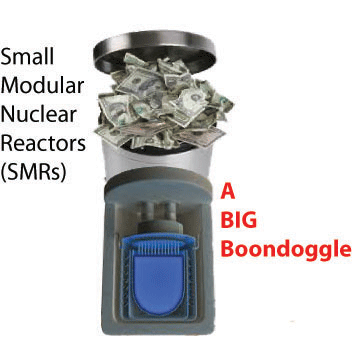 UK invests in advanced nuclear fuel research, World Nuclear News, 7 Aug 15 “……The Department of Energy and Climate Change (DECC) has awarded £1.5 million ($2.3 million) to the NNL and £1.0 million ($1.6 million) to the University of Manchester to fund new capital equipment for nuclear fuel and manufacturing research……..
Hartlepool, Trawsfynydd & Small Modular Reactors,
Meanwhile the Wall Street Journal reports that using modular construction techniques for the AP1000 reactor hasn’t worked. Building nuclear reactors out of factory-produced modules was supposed to make construction swifter and cheaper, but costly delays have shaken faith in the new construction method at the two US sites. “Modular construction has not worked out to be the solution that the utilities promised”
NuClearNews August 2015 New energy minister Andrea Leadsom has given the strongest signal  yet that the Government is looking to support a new era of factory-built, nuclear power stations – with a Newcastle company leading the way on their development in the UK. Speaking at the Nuclear Industry Association conference Ms Leadsom said: “Small Modular Reactors are an option we are investigating further. These have the potential to drive down the cost of nuclear energy and make financing easier through shorter construction times and lower initial capital investment requirements, in addition to high value commercial opportunities.” (1)
Amidst a growing sense of frustration and hand-wringing over the delays in the current nuclear programme, new hope has emerged that support is on the way for a home-grown generation of Small Modular Reactors (SMR). Continue reading
Failure of USA’s small scale reactor in Antarctica – costly and cancer-causing

Christina Macpherson’s websites & blogs
This is quite an old article, but I find it remarkable because, for once, it mentions the enormous cost of security measures needed for small nuclear reactors in remote areas.
That is what is being proposed for Australia – by both the thorium enthusiasts, and the overseas companies desperate to keep the nuclear industry alive by selling small reactors to Australa (or, even more insidiously, by providing them to Australia “for free”, in exchange for South Australia importing radioactive trash, as outlined by nuclear proponent Oscar Archer )
the PM-2A’s purpose was to test whether reactors could be built in remote locations using prefabricated parts.
After the reactor was closed down, the US shipped 7700 cubic metres of radioactive contaminated rock and dirt to California, but passed through Dunedin, with a population of 124,000, the second largest city on New Zealand’s South Island, where it stayed for four days, raising local concerns, the New Zealand news site stuff.co.nz.
Russia has found that the logistics of even finding customers for its ANPP’s outweigh even the logistics of operating the plants. Russia has staked a financial bonanza on prospective orders for the plants, but there are, simply, no takers. And if there were, the logistics of securing such a plant against terrorists or accidents in remote areas would require at least the staff of a stationary plant.

Small-scale US nuclear reactor blamed for spiking cancer rates, casting pall over Russia’s FNPP fetish AMSTERDAM – A small nuclear power plant operated the United States at Antarctica’s McMurdo Sound has been implicated in dozens of cases of an unusual cancer in personnel who worked at or near the station between the years 1964 and 1973, US and New Zealand media have indicated. March 7, 2011 by Bellona Continue reading
Even USA’s nuclear lobby has doubts about “next generation” nuclear reactors
Could Next-Gen Reactors Spark Revival In Nuclear Power?, National Geographic By Wendy Koch, JULY 24, 2015 Tech titans like Bill Gates are helping fund a new generation of commercial nuclear reactors,………..These are complex systems…They look good on paper but could be difficult to realize in practice.
Matthew McKinzie “These are complex systems,” says Matthew McKinzie, director of the nuclear program at the Natural Resources Defense Council, an environmental group that prefers solar, wind and energy efficiency—rather than nuclear—as climate solutions.
“They look great on paper but could be difficult to realize in practice,” he says of the advanced reactors. “A lot of projects in the past have led to disappointment.” He says reactors that don’t use the light-water design common in today’s nuclear power plants will need prototypes for testing and their private funds aren’t enough to cover the cost.
In addition, “molten salt is corrosive and messy to work with,” says McKinzie, who holds a doctorate in experimental nuclear physics..
Russ Bell, senior director of new plant licensing for the Nuclear Energy Institute says many new reactor designs are safe and “extremely innovative,” but since they need to be prototyped, it will take 20 to 25 years to bring them to market……
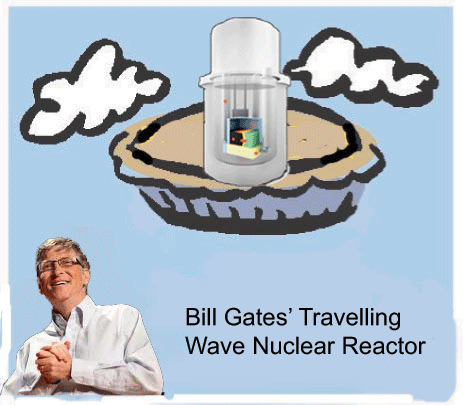
Bill Gates has visited China several times to seek its cooperation in developing a next-gen reactor. He chairs TerraPower, which has designed a traveling wave reactor that runs on depleted uranium and produces very little nuclear waste……
“It’s American technology. I personally want the United States to get it first,” says Leslie Dewan. Her company, Transatomic, plans five more years of experimental and design work before aiming to build a 20-megawatt prototype.
“We’ve been talking with the national labs about it,” she says, noting the Department of Energy has a new loan guarantee program for advanced nuclear reactors. “There’s really good buy-in from DOE for developing a wide range of technologies.”
Even if all goes well, Dewan says, it will take at least a decade to develop a commercial molten salt reactor.
Bleak outlook for Generation IV nuclear reactors, as Generation III look like failing
Construction starts and delays. Deconstructing the nuclear industry
Myle Schneider,Antony Froggatt, 27 July 15 “…………WNISR 2015 goes further and deeper than previous reports in analyzing the pace of nuclear power plant construction: the length of the process, the reasons for delays, the number of projects that have been cancelled or suspended, and how construction trends vary from country to country. These are limiting factors in any plan for a global scale-up of nuclear power.
The average construction time of the 40 units that started up in nine countries since 2005—all but one (in Argentina) in Asia or Eastern Europe—was 9.4 years, with a large range from 4 to 36 years. Construction starts plunged from 15 in 2010 to three in 2014. There are currently 62 reactors under construction, five fewer than a year ago, and at least three-quarters of these projects are facing delays. In 10 of 14 countries that are building new reactors, all projects are delayed, many by years. Five reactors that are “under construction” are projects that began more than 30 years ago.
For the first time, this year’s report devotes a full chapter to Generation III+ reactors such as the Westinghouse AP1000, Rosatom AES-2006, and Areva EPR—advanced reactors designed to improve the safety and economics of nuclear power. These reactors are not proving easy to build: By May 2015, 18 next-generation reactors were under construction, but only two projects were still on schedule; the rest were running behind by two to nine years. This includes the AP1000s being built at the Summer and Vogtle nuclear plants in the United States, which after only two years of construction are late by at least two years.
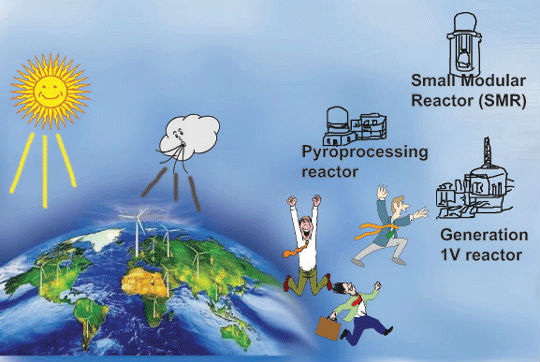
Generation III+ reactors were originally seen as a transition to even more advanced Generation IV reactors, but if Generation III+ reactors fail, the future for the nuclear industry looks bleak. Small Modular Reactors (SMRs) or radically new reactor designs, known as Generation IV and optimistically touted by some nuclear lobbyists as the key to de-carbonizing the global economy, are still decades away from commercial deployment. Meantime, existing nuclear plants around the world are edging toward retirement, with an average age that has been increasing steadily and now stands at 28.8 years……. http://thebulletin.org/deconstructing-nuclear-industry8565
Small Modular Nuclear Reactors unlikely to be commercially developed
Around the World, Nuclear Can’t Compete With Growing Renewables “What is spectacular is the extent to which the nuclear industry is appearing to ignore reality.” Katherine Tweed Greentech Media, July 16, 2015 “……..For the reactors that are in operation, many are aging rapidly. The mean age for reactors worldwide is about 29 years, and most were designed for life spans of 40 years, but many will operate beyond that. The cost of going beyond 40 years isn’t cheap — about $1 billion to $5 billion per reactor. By 2050, nuclear’s share of global electricity generation is expected to be similar to its role today, which amounts to about 10 percent.
Given the cost and time necessary to build large reactors, many in the industry have argued for a move to small modular reactors. Yet SMRs have also suffered from higher-than-expected costs and long development timelines, the report states.

The U.S. Department of Energy has been one of the proponents of this technology, yet none of the designs it said in 2001 could be available by the end of the decade were deployed. Of the two companies the DOE chose years later for SMR development funding, one slashed its spending on SMRs in 2014. NuScale, the other SMR manufacturer, is still continuing with development. Even so, “there is no evidence that SMRs will be constructed in the United States anytime soon,” the report states.
The picture is not rosier in other countries that have lent support to SMRs. South Korea, for example, has been developing an SMR since the 1990s, and while it was approved in 2012, no orders have yet been received. Saudi Arabia did say earlier this year it would test the technology in a three-year pilot.
“The static, top-heavy, monstrously expensive world of nuclear power has less and less to deploy against today’s increasingly agile, dynamic, cost-effective alternatives,” wrote Porritt. “The sole remaining issue is that not everyone sees it that way — as yet.”http://www.greentechmedia.com/articles/read/renewables-outpace-nuclear-in-major-economies
21 years after shutdown, USA’s Experimental Breeder Nuclear Reactor-II (EBR-II) is entombed
USA’s Experimental Breeder Reactor-II now permanently entombed, World Nuclear News
01 July 2015 The main clean-up contractor at the US Department of Energy’s (DOE’s) Idaho Site, has entombed an historic nuclear reactor in place and treated the reactor’s remaining sodium coolant….CH2M-WG, Idaho, LLC (CWI) said yesterday that crews with the Decontamination and Decommissioning (D&D) Program recently completed pouring more than 3400 cubic yards of concrete grout into the basement of the Experimental Breeder Reactor-II (EBR-II) building to fill in any remaining void spaces and effectively entomb the reactor.
Workers also removed and treated the last of the sodium coolant from the reactor’s nine heat exchangers. The exchangers were used to cool the liquid metal and direct the steam to a generating turbine to produce electricity when the reactor was operating.
The EBR-II was the basis of the US Integral Fast Reactor (IFR) program…….. The reactor was shut down in 1994 and its fuel was removed and transported to another site facility for safe storage.
The DOE grouted the reactor in place instead of removing it to protect workers from industrial hazards and radiological risks, CWI said. Crews filled the reactor vessel with grout over two years ago and recently completed the remainder of grouting at the facility under CWI’s contract.
A losing bet – Bill Gates’ gamble on nuclear power?
Arjun Makhijani, president of the Institute for Energy and Environmental Research, told VICE News that companies have spent $100 billion worldwide trying to commercialize breeder reactors without success.
“So now you’re telling me that this combination of reactors has $1.3 billion scattered over more than a dozen technologies?” he said. “Bill Gates’ investment … is hopeless.”
Tech Titans Like Bill Gates Are Gambling on Nuclear Power — But It Looks to Be a Losing Bet, VICE News, By Laura Dattaro July 4, 2015 Nearly 50 American and Canadian tech companies, including heavy hitters like Bill Gates, have invested over a billion dollars in next-generation nuclear technologies in the last 10 years, according to the think tank Third Way.
Despite declining public trust in nukes, especially since the Fukushima Daiichi meltdown in Japan in March 2011, proponents argue that nuclear is key — some say the key — to providing reliable energy while at the same time helping to rid the world of fossil fuels.
“We were compelled by a mission to get involved in a very pressing energy challenge …. Marcia Burkey, chief financial officer of TerraPower, told VICE News. Bellingham, Washington-based TerraPower was founded by Bill Gates and is developing new nuclear reactor technologies.
But critics of nuclear power say this rosy picture does not match the realities of the industry, and that the technologies are too far from being scaled up commercially to meet the urgency of lowering emissions. What’s more, they say, the money behind the current push for more advanced reactors is paltry compared to the costs associated with developing, licensing, and constructing even a single nuclear plant.
“You can’t really in good faith put forward a technology that we don’t know how to do, and have no real prospect of knowing how to do in the next couple of decades. The solution needs to be underway already or to be capable of beginning tomorrow,” Peter Bradford, a professor at Vermont Law School and former member of the US Nuclear Regulatory Commission (NRC), told VICE News. “That’s really not true of any of those designs mentioned in the [Third Way] report.” Continue reading
Washington State Senate passes Bill on Small Modular Nuclear Reactors – calls them “clean”
Small modular reactor bill passes state Senate BY ANNETTE CARY Tri-City HeraldJune 30, 2015 A bill to support the manufacturing of small modular reactors in Washington state passed the state Senate 31-12 on Tuesday as the Legislature wrapped up its work.
As of 8 p.m. Tuesday, however, the House had yet to consider it…………….
There is interest in the Tri-Cities for positioning the community as a center for assembling or manufacturing the small nuclear plants to be shipped around the world, including to Asia. The reactors are proposed to be manufactured in modules and then shipped to where they will be used, with additional modules added as demand for electricity production increases…….
Added to the bill is a requirement that the state Department of Commerce and the Office of the Superintendent of Public Instruction prepare a joint report to the Legislature by Dec. 1 with recommendations for a clean-energy education program.
The program would be required to include grants both for clean-energy ambassadors and for professional development for teachers.
The clean-energy ambassadors would visit classrooms to introduce students to clean energy science and technology. They could cover solar and wind power, small modular reactors and opportunities for nuclear waste cleanup technology careers…….
Certified science teachers could receive grants to help them pursue professional development opportunities in clean-energy science and broaden their exposure to the field.
“One way to ensure that young people understand nuclear energy is to introduce them to our many great scientists, engineers and others who work in the nuclear field,” Brown said. “It’s also one of the best ways to guarantee that the next-generation of Washington job-seekers is prepared for opportunities in emerging nuclear and other clean-energy fields.”…….http://www.tri-cityherald.com/2015/06/30/3632808_small-modular-reactor-bill-passes.html?rh=1
NASA cancelling solar space missions, favouring plutonium fuelled space flights
Debate over future of nuclear power systems in space, Enformable, Karl Grossman 29 Jun 2015NASA has released a study claiming there is a need for continued use of plutonium-energized power systems for future space flights. It also says the use of actual nuclear reactors in space “has promise” but “currently” there is no need for them.
The space plutonium systems—called radioisotope thermoelectric generators (RTGS)—use the heat from the decay of plutonium to generate electricity in contrast to nuclear reactors, usually using uranium, in which fission or atom-splitting takes place.
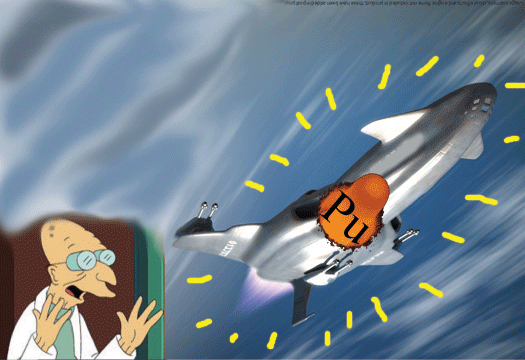
The “Nuclear Power Assessment Study” describes itself as being done as a “collaboration” involving “NASA centers,” among them Johnson Space Center, Kennedy Space Center and the Jet Propulsion Laboratory, “the Department of Energy and its laboratories including Los Alamos National Laboratory, Idaho National Laboratory, Sandia National Laboratories,” and the Johns Hopkins University Applied Physics Laboratory.
The study, released this month, comes as major breakthroughs have been happening in the use of solar and other benign sources of power in space. The situation parallels that on Earth as solar and wind power and other clean, safe technologies compete with nuclear, oil, coal and other problematic energy sources and the interests behind them. Examples of the use of benign power in space include the successful flight in May of a solar-powered spacecraft named LightSail in a mission funded by members of the Planetary Society. Astronomer Carl Sagan, a founder of the society, was among those who have postulating having a spacecraft with a sail propelled through the vacuum of space by the pressure of photons emitted by the sun. LightSail demonstrates his vision.
Yet, meanwhile, NASA cancelled its own solar sail mission scheduled for this year. Continue reading
‘Scorpion’ robot to help develop new robots that could go deeper into Fukushima nuclear reactor unit 2
Officials hope the robot can see the fuel in the pressure vessel in the middle of the reactor. The fuel hasn’t been located exactly and studied because of the high radiation levels.
The difficult work of decommissioning the Fukushima plant damaged by the 2011 earthquake and tsunami will take decades. The scorpion robot is the second to enter a primary containment vessel, after “snake” robots were sent in April inside the worst-hit Unit 1. One of the two robots used in that reactor became stuck and had to be left behind, and neither was able to spot the melted fuel debris.
This time, the scorpion crawler, which is 54 centimeters (21 inches) long when it is extended, will enter through a duct designed as a passageway for fuel rods. Toshiba has no back up machine……….
Toshiba officials said they hope the robot can capture images of deeper areas of the vessel, though the primary focus is the platform area, so they can design suitable robots that can go deeper into the vessel……
The robot’s entry is just the beginning of the reactor investigation required before the most challenging task of removing the melted fuel.: http://phys.org/news/2015-06-small-robot-interior-fukushima-daiichi.html#jCp
Japan will now allow India to reprocess spent nuclear fuel from Japanese-made reactors
Japan eases fuel rules for India nuclear deal, Japan Times KYODO, JUN 19, 2015 Japan has given in to India’s demand that it be allowed to reprocess spent nuclear fuel from Japanese-made reactors, negotiation sources said, marking a major shift in Japan’s stance against proliferation.
India, a nuclear power that conducted its first weapons test in 1974 using reprocessed plutonium, has not joined the Nuclear Non-Proliferation Treaty.
Japan has been seeking measures to guarantee India will not divert extracted plutonium — which could be used to build nuclear weapons — for military use, but no agreement has been reached on the issue, the sources said Thursday…..http://www.japantimes.co.jp/news/2015/06/19/national/japan-eases-fuel-rules-for-india-nuclear-deal/#.VYSSFfmqpHw
Pentagon’s arms provider, and billionaires Bill Gates and Paul Allen in propaganda push for Small Nuclear Reactors
Planet Ark 16-Jun-15 USA Timothy Gardner The Pentagon’s top arms provider and firms partly funded by Silicon Valley billionaires Bill Gates and Paul Allen are among dozens of companies collectively betting more than $1.3 billion that a new wave of nuclear power can be a force to fight climate change.
Advanced nuclear power plants, which will employ techniques such as using fuels other than uranium and coolants other than water, have attracted private investments from more than 40 companies from Florida to Washington state, the Third Way think tank says in the first report specifying the number of firms and total money invested in the technologies……..
Companies expressing faith in advanced nuclear power range from Lockheed Martin, the Pentagon’s largest supplier, to Holtec International, which is building a $260 million technology campus in economically depressed Camden, New Jersey.
Gates has partially funded TerraPower, a company that aims to build reactors cooled by liquid metal, and Allen has partially funded TriAlpha, a company that plans to make nuclear fusion plants……
Critics of advanced nuclear say companies have yet to make small reactors economically viable despite decades of development by energy companies and the U.S. military. Advanced reactors using new fuels, such as thorium, and new cooling systems, such as molten salt, are also difficult to make economically viable, they say.
The nuclear industry has also been weakened by a political backlash following radioactive leaks at Japan’s Fukushima power plant in 2011. And the U.S. natural gas boom has slashed the cost of that fuel, making it harder for nuclear power to compete.
The Third Way report was not funded by the nuclear industry. But the think tank has received financial support from The Nuclear Energy Institute, the industry’s lobby group, and Babcock & Wilcox, a company hoping to build small nuclear reactors…….http://planetark.org/enviro-news/item/73313
Nuclear fusion: US Congress ponders on this as wasteful boondoggle
 Nuclear war on the Hill Fusion research splits the House and Senate. Why? Because, er… science. Politico.com , 12 June 15 By BOER DENG On a patch of land in Saint-Paul-les-Durance, in the South of France, cranes recently installed two massive electrical fixtures, industrial gray and 87 tons each — the first components of a plant that will house the world’s biggest scientific project.
If it succeeds, the International Thermonuclear Experimental Reactor, or ITER, will turn hydrogen, the most abundant element in the universe, into virtually limitless clean energy. But success is far from assured, getting results will take years, and construction is behind schedule.
Now Congress has split on whether to continue supporting the enterprise at all. ……..Ambitious science projects frequently crash into funding rocks, and nuclear fusion is a particularly vexing problem for politicians. More than four decades have been spent trying to turn the reaction that fuels stars and H-bombs into a viable source of energy. Is it worth shelling out ever more on a very risky bet with a big potentialpayoff — a step towards securing the world’s, not to mention the country’s, energy future? Or is it yet another boondoggle science project recklessly spending taxpayer money?….
like many “big science” projects, it has a record of overrunning its cost estimates. ……
Plenty of physicists are skeptical of ITER, … “I was on the site and it’s appalling how little work has been done,” says Michael Lubell of the American Physical Society. Some researchers have derided the Department of Energy’s most recent fusion strategy, which includes ITER, or have written to Congress to plead for pulling out of the experiment. The technology the reactor will use is too costly to be viable, they say, and the money would be better put toward research on alternative designs…..http://www.politico.com/agenda/story/2015/06/nuclear-war-on-the-hill-000083
1 This Month
26 September – International Day for the Total Elimination of Nuclear Weapons





PLEASE OPPOSE HR 8255 AND S.3639 – bills would accelerate satellite deployment, with no environmental review or safeguards – https://ncstd5li.quorum.us/campaign/169331/
To see nuclear-related stories in greater depth and intensity – go to https://nuclearinformation.wordpress.com
-
Archives
- September 2026 (291)
- August 2026 (330)
- July 2026 (355)
- June 2026 (287)
- May 2026 (306)
- April 2026 (356)
- March 2026 (251)
- February 2026 (267)
- January 2026 (308)
- December 2025 (358)
- November 2025 (359)
- October 2025 (375)
-
Categories
- 1
- 1 NUCLEAR ISSUES
- business and costs
- climate change
- culture and arts
- ENERGY
- environment
- health
- history
- indigenous issues
- Legal
- marketing of nuclear
- media
- opposition to nuclear
- PERSONAL STORIES
- politics
- politics international
- Religion and ethics
- safety
- secrets,lies and civil liberties
- spinbuster
- technology
- Uranium
- wastes
- weapons and war
- Women
- 2 WORLD
- ACTION
- AFRICA
- Atrocities
- AUSTRALIA
- Christina's notes
- Christina's themes
- culture and arts
- Events
- Fuk 2022
- Fuk 2023
- Fukushima 2017
- Fukushima 2018
- fukushima 2019
- Fukushima 2020
- Fukushima 2021
- general
- global warming
- Humour (God we need it)
- Nuclear
- RARE EARTHS
- Reference
- resources – print
- Resources -audiovicual
- Weekly Newsletter
- World
- World Nuclear
- YouTube
-
RSS
Entries RSS
Comments RSS

