Recycling of nuclear fuel is more expensive than dry cask storage of nuclear wastes
 The High and Hidden Costs of Nuclear Power POLICY August & September 2010, No. 162 Review By Henry Sokolski…….Discouraging the use of government financial incentives to promote commercial nuclear power. This recommendation was made by the Congressional Commission on the Prevention of Weapons of Mass Destruction Proliferation and Terrorism. It would clearly include discouraging new, additional federal loan guarantees for nuclear fuel or power plant construction of the type now being proposed by President Obama and the nuclear industry. ………
St George city decides against getting electricity from NuScale’s Small Modular Nuclear Reactors
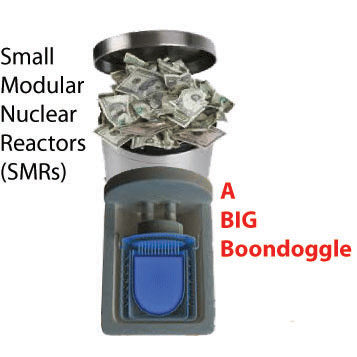 City opts to withdraw from nuclear power project, keep options open, St George News by Mori Kessler March 27, 2015 ST. GEORGE – City officials discussed the city’s future power generations needs during a City Council meeting Thursday. The city wants to keep its options open as far as those needs are concerned, and for the time being, is backing away from an experimental nuclear power option.
City staff recommended that the City Council hold off on committing to a project by NuScale Power. Based out of Oregon, NuScale proposes to build compact nuclear reactors that would be housed in a power plant built near Idaho Falls, Idaho. The compact reactors are designed to produce 40-50 megawatts of power.
A permit application for the proposed project is slated to be sent into the U.S. Nuclear Regulatory Commission for review, and could take until 2018 or longer to be approved. If approved, the power plant could be built and operational by 2024…….
Though St. George is one of UAMPS biggest utilities, city staff have recommended against committing to any binding agreements, saying they want the city to maintain flexibility over where it gets its power. The cost of being involved could run into the millions of dollars, said Laurie Mangum, the city’s energy services director……
Other sources of potential energy the city could tap into in the future include solar power or hydroelectric power generated along the Lake Powell Pipeline. Also, through its existing contracts and city-owned power-generation facilities, the city has 70 percent of its base load power needs covered up to around 2024-25, Esplin said.
“We’re in pretty good shape for the next eight-nine years,” Esplin said…….https://www.stgeorgeutah.com/news/archive/2015/03/27/mgk-city-opts-withdraw-nuclear-power-project-keep-options-open/#.VRXGyvyUcnk
Dubious USA Bills – Small Nuclear Reactors, “education on nuclear”, nuclear as “renewable”
 Nuclear power measures face questions CrossCut WEDNESDAY 25, MARCH 2015 by John Stang The big topic at the House Technology & Economic Development Committee hearing was whether Washington should find a place to build small modular reactors, which would be produced for utility customers. Sen. Sharon Brown, R-Kennewick, is sponsoring this proposal and the two other nuclear-related bills that the committee examined. The Senate passed the
  small modular reactor bill 27-21, mostly along party lines.Tri-Cities leaders envision a Boeing-style assembly plant to build small modular reactors. This is a long-range plan and is predicted to take several years to develop……
The concept is still on the drawing board. No one has built a commercial small modular reactor yet……
At the hearing, critics cited the lack of any track record on cost or safety for small modular reactors, plus concerns over the nation’s lack of a permanent place to store used nuclear fuel.
“Small nuclear reactors are still in the prototype stage. … The prototype has never been tested in power production yet,” said Thomas Buchanan of Physicians for Social Responsibility.
“I don’t think that the Department of Commerce should work on this until it has a design that passes the NRC,” said Chuck Johnson of the same organization.
Johnson argued that a single small-modular reactor would not generate enough electricity to efficiently recover its construction and operating costs…..
Deborah Wolpoff of Olympia pointed to the cancelation of the nation’s proposed nuclear fuel repository inside Yucca Mountain, with no replacement lined up. “I think it is irresponsible to promote this technology that produces this waste that we have no solution for,” Wolpoff said.
Committee member Rep. Gael Tarleton, D-Seattle, wondered why the Legislature should support a new nuclear industry while Hanford’s Cold War nuclear wastes are decades from being cleaned up….
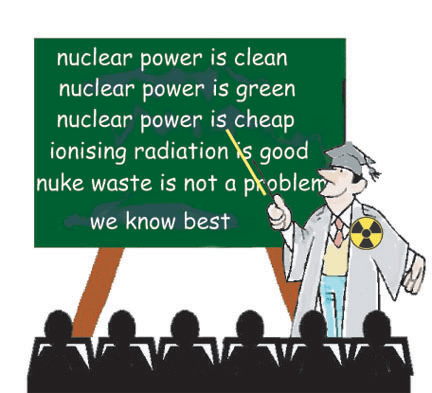 Another Brown bill, which the Senate passed 44-5, would create an education program aimed at providing nuclear science lessons to students in the eighth through 12th grades. Qualified American Nuclear Society members would be brought in for classroom sessions. Also, science teachers would receive instruction on nuclear science in order to teach the subject in the classrooms…….
Mary Hanson of Physicians Social Responsibility argued that the bill would give the nuclear industry influence over students, while other energy industries would not have the same access. She said American Nuclear Society members might be less versed in nuclear power’s health issues than its technical ones.
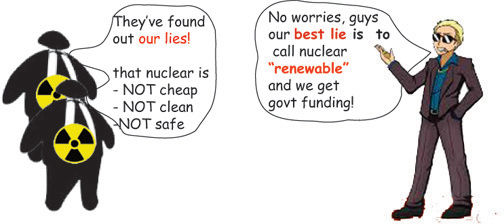
The third Brown bill, which the Senate passed 29-20, would add nuclear power to the list of alternative power sources that certain utilities can use to meet a state requirement to offer their customers voluntary participation in alternative energy purchases. The current list of green sources includes wind, solar, geothermal and biomass energy….
Physicians for Social Responsibility opposed it, contending nuclear energy is not a renewable power source….
http://crosscut.com/2015/03/nuclear-power-measures-face-questions/
President Obama quietly “greenwashes” Small Modular Nuclear Reactors
SMR developers have already looked to the federal government as one of their most important potential customers.
SMRs face major challenges before they can ever be deployed, including an apparent lack of private sector interest and the potential for unforeseen problems and cost overruns when building a factory to mass produce the technology
The failure to find investors caused two NuScale competitors, Generation mPower and Westinghouse Electric Co. LLC, to cut back on their SMR programs.
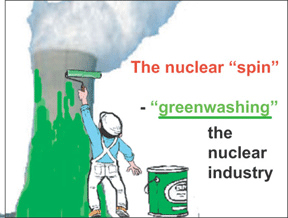 Obama executive order tags small modular reactors as clean energy https://www.snl.com/Interactivex/article.aspx?CdId=A-31794585-10540 By Matthew Bandyk 26 Mar 15 A new executive order issued by President Barack Obama to cut greenhouse gas emissions from federal government agencies could benefit what has become a pet project of the administration: small modular reactors. The in-development technology is the only form of nuclear energy to qualify as clean energy under the order.
The order, announced March 19, requires federal agencies to ensure that increasing amounts of the electric and thermal energy they consume come from low-carbon dioxide-emitting “alternative energy” sources. At least 10% of their energy must come from these sources starting in 2016, all the way up to 25% by 2025.
The definition of alternative energy in the order does not include “nuclear power” in general but specifically “small modular nuclear reactor technologies,” a term used to refer to a number of proposed designs for portable reactors typically under 300 MW, which are much smaller and potentially cheaper and easier to build than conventional nuclear reactors.
With the order, the Obama administration is pushing policies in support of small modular reactors, or SMRs, which are similar to proposals being contemplated at the state level. The Washington state senate, for example, recently passed a bill that would count SMRs among wind and solar as “qualified alternative energy resources” in the state’s voluntary alternative energy purchase program for utilities. Continue reading
Japan’s Monju fast breeder reactor still closed: over 10,000 cases of maintenance errors in 2013
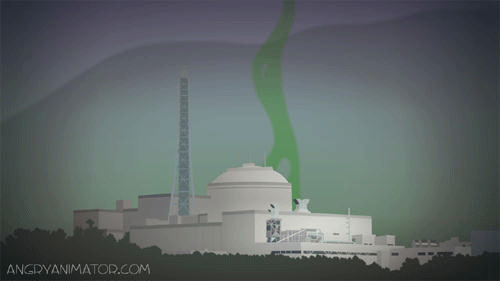 More errors with Monju nuclear reactor maintenance found, Mainichi, 27 Mar 15 Several more maintenance problems have been discovered at the Monju fast-breeder reactor facility in Tsuruga, Fukui Prefecture, which has been banned from operation following the discovery of over 10,000 cases of maintenance errors in 2013, it has been learned.
The Nuclear Regulation Authority (NRA) secretariat revealed on March 25 that the newly discovered maintenance errors — which involve the facility’s piping system — mean that Monju operator Japan Atomic Energy Agency (JAEA) may have violated safety regulations……..http://mainichi.jp/english/english/newsselect/news/20150326p2a00m0na007000c.html
NusCale company pushing for NRC approval to commercialise Small Modular Nuclear Recators
Oregon’s nuclear startup adds execs to prepare for regulatory push Portland Business Journal
NuScale, which is looking to make a small-scale nuclear power plant, wants the NRC to allow for full commercialization of its nuclear power technology…….
NuScale is backed by Fluor Corp. (NYSE: FLR) and U.S. Department of Energy grants. It has more than 600 employees and is working to develop its factory-built nuclear power system, which will be submitted to government regulators for approval in 2016. Its system consists of modules each producing 50 megawatts of electricity.
It expects to deploy the first working model to a coalition of Western states that will station a power plant in Idaho, possibly near the Idaho National Energy Laboratory.http://www.bizjournals.com/portland/blog/sbo/2015/03/oregons-nuclear-startup-adds-execs-to-prepare-for.html
Push for small nuclear reactors – portrayed as “renewable energy”
NuScale targets 2016 to apply for NRC approval for its nuclear power system Portland Business Journal
It will submit the document in late 2016 and expects the NRC to take 39 months to review, putting it on track for a 2020 commercial launch……. The 570MWe complex of 12 units will be sited in Idaho, potentially near the U.S. Department of Energy’s Idaho national Laboratory Site near Idaho Falls. The deal makes UAMPS NuScale’s first official customer, subject to NRC certification of the system……. NuScale also benefits from Congress’s recent move to extend renewable energy tax incentives through the end of 2014, putting nuclear on equal footing with its carbon-free rivals…….
Nuclear terrorism danger would be magnified, if Japan reactivated nuclear reprocessing
Nuclear terrorism risks in Northeast Asia: Japan’s reactor restart and spent fuel Nautilus Peace and Security NAPS Net Special Report by Peter Hayes 23 March 2015 “…..Japan’s Post-Fukushima Choice
Due to Fukushima, Japan now must choose to go in one of two directions that are largely exclusive: either towards a reactor restart choice that leads to a minimalist phase-out of separated plutonium over time; or towards a maximalist reliance on separated plutonium over time in a closed fuel cycle………
Should Japan opt to start enough reactors to justify reactivating the plutonium fuel cycle, then the implications for nuclear terrorism would be substantial. The train of logic for maximum spent fuel arising from a closed nuclear fuel cycle is radically different to that for the once-through fuel cycle. In this trajectory, the following would occur:
- Japan starts many more light water reactors, sooner rather than later, and extends reactor lifetimes beyond forty years, and constructs new reactors
- This choice enables far more MOx fuel fabrication and recycling of MOx fuel to these reactors than in the once-through fuel cycle usage; this choice would either slowly reduce or rapidly increase the stockpile of separated plutonium that would be supplemented (if the central state is willing to subsidize heavily the utilities for using MOx fuel) by reprocessing the spent fuel from the operation of the light water reactors
- Thereby generating a new stream of separated and un-separated plutonium in Japan to store and secure, and available for diversion or attack.
Although it does not follow automatically, this vision of the revived closed fuel cycle also implies that:
- The fast reactor is developed in order to burn actinides to reduce the waste disposal problem (whether it would do so is debatable)
- The fast reactor would be developed to breed plutonium based on the argument that doing so makes Japan more independent from external nuclear fuel supply.
All the steps in this second path which maximizes separated fuel involves more transport, more bulk processing and storage, and creates more opportunity for non-state actors to divert fissile material or to attack directly the spent fuel stocks in pools or other nuclear materials process sites in the envisioned “closed” fuel cycle. In short, this trajectory maximizes the nuclear terrorist threat, directly and indirectly, over the next thirty years, especially when the demonstration effect on other states to follow suit are taken into account. For exactly this reason, the United States has reaffirmed recently that it does not favor MOx use and breeder activity in Japan or elsewhere……..[19]http://nautilus.org/napsnet/napsnet-special-reports/nuclear-terrorism-risks-in-northeast-asia-japans-reactor-restart-and-spent-fuel/
Fukushima company to build 400 unmanned surveillance aircraft
 DRONES TO BE MASS-PRODUCED IN FUKUSHIMA http://fukushimaupdate.com/drones-to-be-mass-produced-in-fukushima/
Kikuchi Seisakusho plans to produce 400 unmanned surveillance aircraft at its plant in Minamisoma in Fukushima Prefecture. “Fukushima is a suitable production site given its need to measure radiation,” said Nonami, a professor at Chiba University. “We also hope that production will help the region’s recovery.”
The drone, 50 centimeters in height and 90 centimeters in diameter, can fly for up to 30 minutes at a time at speeds of up to 36 kph. With six propellers, it weighs only about three kilograms but can carry loads of up to six kilograms. It will be priced at around ¥2 million to ¥3 million.
The drone made a demonstration flight Friday, taking photos from 20 meters above the ground. A larger drone currently under development, with the capacity to carry loads of up to 30 kilograms, was also shown.
The use of drones is expected to spread for tasks such as measuring radiation, shooting movies and monitoring social infrastructure such as bridges, as well as for work related to the decommissioning of reactors at the Fukushima No. 1 plant.
The United States is considering regulating the use of drones to protect privacy and ensure safety. A similar debate may also take place in Japan ahead of their full implementation.
Washington State Senator Sharon Brown enthusiastically pushing for Small Modular Nuclear Reactors
Nuclear Advocate Pushes For Modular Reactor Presence In Washington State http://www.icontact-archive.com/uY4CWN-9Ks3su6iHyVeY7nHzrprAq8_d?w=1 Feb 25 2015 A state senator in Washington, Sharon Brown, R-Kennewick, is promoting nuclear energy with a focus on technology that has yet to be put into operation.
Bills that Brown have sponsored nudge the state towards acceptance of modular, factory-built nuclear reactors, The Olympian reported Tuesday.
Brown has called for a relatively modest $176,000 study to identify sites for nuclear power reactors that are in frequent discussions, but have yet to be built – reactors with a generation capacity of 300 MW or less.
In neighboring Oregon, NuScale Power is developing reactors that will built in one location and shipped by truck or rail to their final destination
“We need to make sure we’re not left behind,” said Brown at a hearing Tuesday. She also said, “It’s really important that as a state we get our arms around small nuclear reactors.”
Brown, who is pushing the state to nudge the federal government on construction of a federal waste repository, has sponsored other nuclear power-friendly bills that cleared a critical deadline last week. These include a bill to provide sales tax relief for small reactor production and one that mandates the Commerce Department support small reactors development for commercial use.
She has also sponsored measures that would allow energy from modular reactors to count as part of the state’s renewable energy targets, although these initiatives have strong opposition from environment groups.
The initiatives follow up on a previous state study, completed in September, that said a modular reactor facility was feasible for the Hanford Site nuclear facility.
Exploring molten cores of Fukushima nuclear reactors by means of cosmic ray particles
Cosmic Ray Particles Will Reveal the Molten Hearts of Fukushima Daiichi’s Reactors http://spectrum.ieee.org/tech-talk/energy/nuclear/cosmic-ray-particles-will-reveal-the-molten-hearts-of-fukushima-daiichis-reactors By Eliza Strickland 13 Feb 2015 In the radioactive ruins of the Fukushima Daiichi nuclear power plant, engineers are testing a new sensor technology. The goal is to see through layers of steel and concrete to determine the location of nuclear fuel at the hearts of three melted-down reactors.
The sensor technology makes use of muons, subatomic particles generated when cosmic rays collide with molecules in Earth’s upper atmosphere. About 10,000 muons reach every square meter of our planet each minute, and they whiz through most substances largely unimpeded. However, their progress can be blocked by heavy elements like uranium and plutonium.
Based on this discrepancy, several research teams around the world are developing systems that use muons the same way your dentist uses x-rays. By placing muon detectors near a Fukushima reactor building and determining where the particles’ progress is being blocked, researchers can produce a map of the globs of melted uranium fuel inside the reactor.
There’s a critical need for such maps. The 40-year decommissioning of the Fukushima Daiichi power plant is well underway: Robots are busily surveying and decontaminating the shattered reactor buildings, and workers are removing spent fuel rods from pools. But the hardest step is yet to come. Someday, TEPCO workers will have to remove the melted nuclear fuel that glooped at the bottom of the three reactors’ pressure vessels, leaked through fissures and weak spots, and pooled in unknown nooks and crannies.
Before TEPCO can remove this highly radioactive fuel, the company must first figure out its exact location inside the melted-down reactors. That’s a big challenge, as it will be many years before robots or heavily protected humans are able to remove the tops of the reactor vessels to drop down radiation-shielded cameras. What’s more, those cameras still won’t be able to locate the fuel that seeped out through the bottoms of the presure vessels.
That’s where the muons come in. TEPCO is first testing a system developed by Japan’s High Energy Accelerator Research Organization, putting the device near the heavily damaged Reactor 1. This system uses a “muon permeation” method; essentially just determining where muons are blocked in their progress by uranium. According to an email from TEPCO, this first test is just to serve as a proof of principle, and won’t produce detailed maps of the melted fuel’s location.
Another system is under development by the U.S. company Decision Sciences, using a “muon scattering” method invented at Los Alamos National Lab in the early 2000s. This method places muon detectors on two sides of an object of interest, and tracks the trajectory of muons as they enter and leave the object. Because some muons interact with uranium nuclei and ping away in new directions, mapping this scattering can create a more precise map of a uranium blob’s location and contours. Toshiba, a contractor for TEPCO, has enlisted Decision Sciences to develop its system for Fukushima Daiichi. That device will be tested later this year at Reactor 2.
Nuclear fusion – far too costly, even if they could get it to work
 Even If Lockheed Has Made a Breakthrough in Fusion Power, the Hard Part Will Be the Economics http://www.forbes.com/sites/amorylovins/2015/01/16/even-if-lockheed-has-made-a-breakthrough-in-fusion-power-the-hard-part-will-be-the-economics/ Lockheed-Martin has just confirmed that it is among the private firms—the rest generally much smaller—that are pursuing various innovative designs for nuclear fusion reactors. Some of these innovations may prove technically feasible. All will be very challenging: if we can do controlled fusion, it will be arguably the most difficult engineering humans have ever done.
Robot technology for Fukushima nuclear clean-up operations
British robot maps radiation at Fukushima, Ft.com Tanya Powley, Manufacturing Correspondent , 18 Jan 15 A robot developed by a UK start-up is helping to locate hazardous radiation sources at the scene of the Fukushima disaster, the world’s worst nuclear accident since Chernobyl.
Createc, a small imaging company based in Cumbria, has developed camera technology called N-Visage for robots that can detect and draw a 3D map of high radiation locations that are too contaminated for human workers……..
Nuclear companies are turning to robotics as they look to deliver safer, faster and more cost-effective solutions for the £250bn worth of global nuclear decommissioning that is forecast to take place by 2030.
Hitachi-GE Nuclear Energy, which is leading the clean-up at Fukushima, deployed Createc’s N-Visage camera technology in stair-climbing robots to reach inaccessible areas deep inside the nuclear site. Fukushima was badly damaged by a tsunami in March 2011.
 N-Visage is the only technology that has the right weight, speediness and capability for high radiation, said a spokesman for International Nuclear Services Japan. “N-Visage is very likely to be deployed not necessarily only at Fukushima but also at other nuclear facilities in Japan,” he said.
The N-Visage technology was first used at Britain’s Sellafield, western Europe’s largest nuclear waste site.
Operators at Fukushima are now using the N-Visage technology to understand where radioactive material is coming from inside damaged reactors and help plan clean-up strategies…….
Sylvain Du Tremblay, chief technical and engineering officer at Sellafield, believes the adoption of N-Visage at Fukushima shows the UK can lead in robotics technology for the nuclear industry. “We are using Sellafield facilities that are waiting to be dismantled to test and validate new technologies,” he said. http://www.ft.com/intl/cms/s/0/d2ca4690-85d9-11e4-a105-00144feabdc0.html#slide0
Why won’t thorium nuclear power work? It’s the economics, stupid!
 January 16, 2015, Jortiz3
Contrary to popular belief, the reason light-enriched-uranium reactors are used, and not thorium or breeder reactors, is due to simple economics. To run breeder reactors and thorium reactors, the neutron density and heat density must be so great that high-temperature coolants must be used throughout the core.
The systems used to manage these coolants are as exotic as the coolants are. This leads to increased costs, on the order of 20%. This 20% is enough that utilities simply choose light-enriched-uranium so that the reactor core can be cool enough that cooling with water is possible and savings can offset the cost of mining the ridiculous quantities of natural uranium required.
Lobbyists try to build a head of steam for Small Modular Nuclear Reactors
 nuClear News, UK, Jan 2015 “…….Nuclear lobbyists have continued to try to build a head of steam behind Small Modular Reactors (SMRs) in the UK.
1 This Month
26 September – International Day for the Total Elimination of Nuclear Weapons





PLEASE OPPOSE HR 8255 AND S.3639 – bills would accelerate satellite deployment, with no environmental review or safeguards – https://ncstd5li.quorum.us/campaign/169331/
To see nuclear-related stories in greater depth and intensity – go to https://nuclearinformation.wordpress.com
-
Archives
- September 2026 (291)
- August 2026 (330)
- July 2026 (355)
- June 2026 (287)
- May 2026 (306)
- April 2026 (356)
- March 2026 (251)
- February 2026 (267)
- January 2026 (308)
- December 2025 (358)
- November 2025 (359)
- October 2025 (375)
-
Categories
- 1
- 1 NUCLEAR ISSUES
- business and costs
- climate change
- culture and arts
- ENERGY
- environment
- health
- history
- indigenous issues
- Legal
- marketing of nuclear
- media
- opposition to nuclear
- PERSONAL STORIES
- politics
- politics international
- Religion and ethics
- safety
- secrets,lies and civil liberties
- spinbuster
- technology
- Uranium
- wastes
- weapons and war
- Women
- 2 WORLD
- ACTION
- AFRICA
- Atrocities
- AUSTRALIA
- Christina's notes
- Christina's themes
- culture and arts
- Events
- Fuk 2022
- Fuk 2023
- Fukushima 2017
- Fukushima 2018
- fukushima 2019
- Fukushima 2020
- Fukushima 2021
- general
- global warming
- Humour (God we need it)
- Nuclear
- RARE EARTHS
- Reference
- resources – print
- Resources -audiovicual
- Weekly Newsletter
- World
- World Nuclear
- YouTube
-
RSS
Entries RSS
Comments RSS

