USA making Plutonium-238 for Space Travel
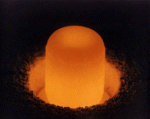 Peak Plutonium-238? U.S. Starts Making Nuclear Fuel For Deep Space Missions, Forbes, William Pentland , 8 Nov 15 In the next two or three years, the U.S. Department of Energy will begin producing small quantities of a material known as plutonium-238 a trefurbished federal nuclear facilities at in Idaho and Tennessee.
When fully operational, the facilities will be able to produce a little more than three pounds of plutonium-238 every year, or about enough to fill a can of soda pop. It will be the first time plutonium-238 has been produced anywhere in the world in nearly 30 years.
Plutonium-238, a special radioactive material that does not occur in nature, emits a constant level of heat for decades as it decays. It is the primary fuel source used to power more than two-dozen U.S. space missions for spacecraft and planetary probes that cannot rely on solar energy.
Other than exploring deep space or powering decades-long experiments on the dark side of the moon, plutonium 238 is pretty much worthless. It is not suitable for use in nuclear weapons. Ditto nuclear reactors.
It was originally produced as a by-product of nuclear weapons. When the United States and Russia shuttered their nuclear weapons programs in the 1980s, the world stopped producing plutonium-238.
Not surprisingly, plutonium-238 is expensive to make – very expensive. One pound of plutonium 238 costs about $4 million to make. And that does not include the upfront investment needed to reestablish production of plutonium-238 in the United States, which is expected to cost as much as $150 million or more……
Nobody needs the U.S. space program, but at least in the United States almost everybody wants it just the same, including me. http://www.forbes.com/sites/williampentland/2015/11/08/peak-plutonium-238-u-s-starts-making-nuclear-fuel-for-deep-space-missions/
Japan’s nuclear reprocessing boondoggle – Monju reactor still in trouble
NRA’s ‘new management’ call for Monju reactor proves divisive, Japan Times, BY ERIC JOHNSTON OSAKA, 6 Nov 15, – Two decades after a sodium leak and fire shut it down and nearly six decades after it was first conceived, the Monju prototype fast-breeder reactor in Tsuruga, Fukui Prefecture, suffered another blow Wednesday when the Nuclear Regulation Authority called for it to be turned over to another operator.
To date, over ¥1 trillion has been poured into Monju — a plant that has never produced commercial electricity. Despite remaining inactive, safety measures alone cost ¥50 million a day.
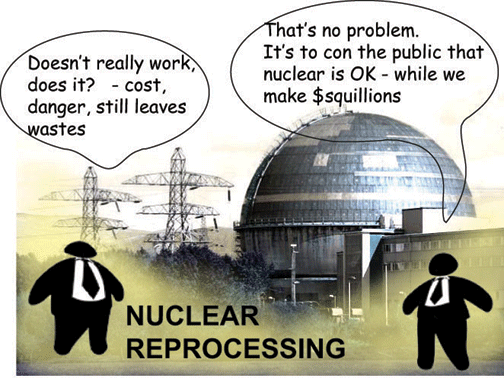
Anti-nuclear activists have hailed the NRA’s unusually critical language as an important step toward scrapping the reactor, which was supposed to burn plutonium mixed with uranium.
Fukui politicians who heavily support Monju, including the prefecture’s governor and the mayor of Tsuruga, doubt that another operator can be found. They also worry that scrapping it would create local concerns as well as safety issues.
“What does it mean when the NRA says that it can’t leave Monju’s operations to the (government-backed) Japan Atomic Energy Agency? There aren’t any other organizations it can be left to,” Tsuruga Mayor Takanobu Fuchikami told reporters after the decision…….
Monju, conceived in the 1950s, has faced nothing but technical trouble, domestic and international controversies, and scandals.
Originally slated to go live in 1970, monju did not reach criticality until 1994. It was shut down following a December 1995 leak and fire involving liquid sodium. The incident was at that time Japan’s worst nuclear-related accident.
Further delays and scandals meant that by 2005, when Monju was taken over by JAEA after its predecessor organization was disbanded, officials hoped it would be commercially viable by around 2050.
But after it was revealed in 2012 that JAEA had failed to inspect nearly 10,000 reactor components in and after 2010, the NRA ordered Monju not to engage in preparatory work until it was satisfied safety had been improved…..
Activists are urging the government to give up on the project.
“Monju should be permanently shut down. If the Japanese government is capable of immediately and permanently scrapping Monju, we can gain some trust that it intends to have a logical, functional basic energy policy,” said Aileen Mioko Smith, executive director of Kyoto-based anti-nuclear group Green Action. “If it continues the status quo by flogging a horse that has been dead for 20 years, it bodes badly for Japan’s energy future.” http://www.japantimes.co.jp/news/2015/11/05/national/nras-new-management-call-monju-reactor-proves-divisive/#.Vj0CA9IrLGj
The nuclear dream is just slowing down REAL action on climate change
 Whether or not a commercial fusion / thorium / plutonium power industry ever emerges in the next 20 or 30 years would be irrelevant to the climate debate if not for the huge commitment of resources, expertise and time that are going into these new reactor types, and that is cash that’s not being spent on scalable, decentralised clean energy networks. Despite this, these are the technologies that are presently carving the epitaph on the headstone on the nuclear industry, the Dream that Failed.
NUCLEAR NO ANSWER , Oct 29th, 2015
 Nuclear power is the solution to a question no-one asked. Here’s why it is now known as “the dream that failed”. By Scott Ludlam The nuclear industry has been getting a fair bit of air time of late with the South Australian Royal Commission into the Nuclear Fuel Cycle and a well-credentialed new Chief Scientist throwing nuclear into the mix as part of the solution to climate change.
………. arguments against nuclear power probably still have a tinge of the 1970s about them. Particularly in the age of climate change, a new generation are querying whether opposition to the technology might be an ideological hangover that we can no longer afford.
It would be comforting if this were true, but it isn’t. The evidence shows the commercial nuclear sector is in terminal trouble, and its offers to deliver bulk, reliable ‘baseload’ energy are precisely the opposite of where global energy markets are heading.

The BP Statistical Review of World Energy released in June 2015, showed that nuclear now contributes just 4.4% of the global energy mix. Renewable energy, without the military-industrial head-start, now contributes 6% with an annual growth rate of 12%. BP concludes that “Consumption increased for all fuels, reaching record levels for every fuel type except nuclear power”.
Nuclear energy globally has been in decline since well before the Fukushima nuclear disaster. With ageing reactors, and increased safety standards driving increased costs, nuclear power has been dubbed the ‘Dream that Failed’ by The Economist. Flagship projects in Finland, France and the UK are so catastrophically over budget that it is unlikely some of them will ever be switched on, so some in the industry have changed tack and are out promoting a new generation of technology types.
The Thermonuclear Experimental Reactor in the south of France was expected to cost $5 billion, but following multiple delays and management problems it is now expected to cost $21 billion. The prototype may or may not be operational by 2020. Even the proponents have stopped making confident estimates of when actual power stations might be able to begin making a contribution to decarbonising the world’s energy systems.
Thorium technology is frequently pitched as the front-runner to replace uranium fission plants, but there are sound technical reasons why nobody has ever been able to get an industry on its feet, despite a global abundance of the raw material. Almost anything is possible if you hurl enough money at it, but because the thorium fuel chain is not as intrinsically tied to nuclear weapons production as uranium technology, the technology has never benefitted from the impossibly deep pockets of the weapons developers.
Not so the plutonium sector: the dreamers of infinite energy took the reprocessing technology used to build the Nagasaki bomb and envisioned a ‘closed loop’ nuclear economy which would recycle fissionable uranium and alchemic traces of plutonium into mixed oxide fuel for feeding back into reactors. It is hard to gauge how much has been spent on this proposal for a nuclear perpetual motion machine, but we’re fortunate in that it’s been a total failure, because the environmental, public health and security consequences of a full-blown globally distributed plutonium economy are almost too hideous to contemplate.
Whether or not a commercial fusion / thorium / plutonium power industry ever emerges in the next 20 or 30 years would be irrelevant to the climate debate if not for the huge commitment of resources, expertise and time that are going into these new reactor types, and that is cash that’s not being spent on scalable, decentralised clean energy networks. Despite this, these are the technologies that are presently carving the epitaph on the headstone on the nuclear industry, the Dream that Failed. http://greens.org.au/magazine/national/nuclear-no-answer
Is nuclear fusion a goer? Not really
 Another Fusion White Elephant Sighted in Germany http://helian.net/blog/October 27th, 2015 Helian According to an article that just appeared in Science magazine, scientists in Germany have completed building a stellarator by the name of Wendelstein 7-X (W7-X), and are seeking regulatory permission to turn the facility on in November. If you can’t get past the Science paywall, here’s an article in the popular media with some links. Like the much bigger ITER facility now under construction at Cadarache in France, W7-X is a magnetic fusion device. In other words, its goal is to confine a plasma of heavy hydrogen isotopes at temperatures much hotter than the center of the sun with powerful magnetic fields in order to get them to fuse, releasing energy in the process. There are significant differences between stellarators and the tokamak design used for ITER, but in both approaches the idea is to hold the plasma in place long enough to get significantly more fusion energy out than was necessary to confine and heat the plasma. Both approaches are probably scientifically feasible. Both are also white elephants, and a waste of scarce research dollars.
The problem is that both designs have an Achilles heel. Its name is tritium. Tritium is a heavy isotope of hydrogen with a nucleus containing a proton and two neutrons instead of the usual lone proton. Fusion reactions between tritium and deuterium, another heavy isotope of hydrogen with a single neutron in addition to the usual proton, begin to occur fast enough to be attractive as an energy source at plasma temperatures and densities much less than would be necessary for any alternative reaction. The deuterium-tritium, or DT, reaction will remain the only feasible one for both stellarator and tokamak fusion reactors for the foreseeable future. Unfortunately, tritium occurs in nature in only tiny trace amounts.
The question is, then, where do you get the tritium fuel to keep the fusion reactions going? Well, in addition to a helium nucleus, the DT fusion reaction produces a fast neutron. These can react with lithium to produce tritium. If a lithium-containing blanket could be built surrounding the reaction chamber in such a way as to avoid interfering with the magnetic fields, and yet thick enough and close enough to capture enough of the neutrons, then it should be possible to generate enough tritium to replace that burned up in the fusion process. It sounds complicated but, again, it appears to be at least scientifically feasible. However, it is by no means as certain that it is economically feasible.
Consider what we’re dealing with here. Tritium is an extremely slippery material that can pass right through walls of some types of metal. It is also highly radioactive, with a half-life of about 12.3 years. It will be necessary to find some way to efficiently extract it from the lithium blanket, allowing none of it to leak into the surrounding environment. If any of it gets away, it will be easily detectable. The neighbors are sure to complain and, probably, lawyer up. Again, all this might be doable. The problem is that it will never be doable at a low enough cost to make fusion reactor designs based on these approaches even remotely economically competitive with the non-fossil alternative sources of energy that will be available for, at the very least, the next several centuries.
What’s that? Reactor design studies by large and prestigious universities and corporations have all come to the conclusion that these magnetic fusion beasts will be able to produce electricity at least as cheaply as the competition? I don’t think so. I’ve participated in just such a government-funded study, conducted by a major corporation as prime contractor, with several other prominent universities and corporations participating as subcontractors. I’m familiar with the methodology used in several others. In general, it’s possible to make the cost electricity come out at whatever figure you choose, within reason, using the most approved methods and the most sound project management and financial software. If the government is funding the work, it can be safely assumed that they don’t want to hear something like, “Fuggedaboudit, this thing will be way too expensive to build and run.” That would make the office that funded the work look silly, and the fusion researchers involved in the design look like welfare queens in white coats. The “right” cost numbers will always come out of these studies in the end.
I submit that a better way to come up with a cost estimate is to use a little common sense. Do you really think that a commercial power company will be able to master the intricacies of tritium production and extraction from the vicinity of a highly radioactive reaction chamber at anywhere near the cost of, say, wind and solar combined with next generation nuclear reactors for baseload power? If you do, you’re a great deal more optimistic than me. W7-X cost a billion euros. ITER is slated to cost 13 billion, and will likely come in at well over that. With research money hard to come by in Europe for much worthier projects, throwing amounts like that down a rat hole doesn’t seem like a good plan.
All this may come as a disappointment to fusion enthusiasts. On the other hand, you may want to consider the fact that, if fusion had been easy, we would probably have managed to blow ourselves up with pure fusion weapons by now. Beyond that, you never know when some obscure genius might succeed in pulling a rabbit out of their hat in the form of some novel confinement scheme. Several companies claim they have sure-fire approaches that are so good they will be able to dispense with tritium entirely in favor of more plentiful, naturally occurring isotopes. See, for example, here, here, andhere, and the summary at the Next Big Future website. I’m not optimistic about any of them, either, but you never know.
Precious Groundwater in Drought Areas Threatened by Uranium Mining
Why Are We Allowing Uranium Miners to Pollute Groundwater in Drought Zones?

 Uranium mining threatens aquifers that could provide the drought-stricken West with emergency water supplies. BRIAN PALMER OCT 16, 2015 Mining uranium, the fuel for nuclear reactors, is a dirty business. Following World War II, mining companies extracted millions of tons of uranium from Navajo tribal lands in the West, contaminating homes and water supplies in the process. It went on for decades, and Navajo miners developed lung cancer at very high rates.
Today, even as the United States nuclear power industry struggles to survive, uranium mining continues. The techniques are more modern, but conservationists say the threat could be just as insidious: polluting water supplies in drought-ridden parts of the country where drinking water is already alarmingly scarce.
New rules proposed by the federal government last year could help reduce the threat—although industry is fighting to weaken them, along with its Republican allies in Congress. And critics say the proposed regulations might not be strong enough anyhow. Ironically, this might all be happening to extract a resource we barely need anymore—at the risk of one that we most certainly do……..
The industry must now work with what geologists call “roll-fronts.” These are relatively thin uranium deposits that formed deep underground over the course of thousands of years. Typically just 10 to 30 feet in height—too small to be harvested by human miners—the roll-fronts can only be extracted by chemical means.
The process used today is called in situ recovery, or ISR, mining. (Opponents use the more chemically descriptive phrase “in situ leaching,” or ISL.) The mining company drills four or five holes, called injection wells, and then pumps down a mix of an oxidizing agent (often hydrogen peroxide or simple oxygen) and water. Pressure from the constant influx of fluid forces the solution to percolate through the uranium-rich layer of Earth toward another hole, called the production well, which carries it up to the surface. At this point, the company reverses the chemical reaction that dissolved the uranium, using a separate chemical to precipitate the metal out of the water. The water, now stripped of most of the uranium, heads back into the well to continue the cycle…….

In reality, ISR mining isn’t so tidy, and the few peer-reviewed studies available suggest that leaching uranium out of rocks contaminates the surrounding groundwater for decades. As Western states deal with increasing levels of drought, that’s a problem…….
Remediation is water- and time-intensive, but does it work? The answer is pretty disturbing: No one knows. There have been only a handful of major studies on the efficacy of the uranium-mining remediation process. Continue reading
Antineutrino detection technology could advance process of nuclear verification in Iran
The nuclear verification technology that could change the game, Bulletin of the Atomic Scientists 13 OCTOBER 2015 Kelly Wadsworth The historic agreement between Iran and six world powers to curb the former’s nuclear development, concluded over the summer and expected to be adopted this month, relies heavily on verification. The foreign powers are keen to make sure that Tehran doesn’t acquire enough plutonium or uranium to build a nuclear weapon, and Tehran wants to demonstrate good behavior in order to get sanctions relief. That raises questions about the imperfect verification methods used by the International Atomic Energy Association (IAEA), the organization charged with the task under the Iranian nuclear deal, and theInternational Monitoring System (IMS), a global network that detects nuclear explosions worldwide. Are they reliable enough? Some would argue no.
There may be, though, a new option for verification on the not-too-distant horizon. Antineutrino detection is an existing technology that, if political and diplomatic hurdles are overcome, could be put in place before the 10-year ban on Iranian enrichment R&D is lifted. And fully developed over the long-term, it holds great promise for monitoring similar deals in the future, and for reinforcing nuclear non-proliferation worldwide. Difficult to evade, antineutrino detection technology could allow the international community to reliably monitor a country’s nuclear activities in real-time, potentially without setting foot in the country. Similar in cost and technological scale to the space-borne reconnaissance methods governments use for detection today, antineutrino detection could not only help identify undeclared nuclear reactors, but could monitor nuclear facilities and detonations throughout the Middle East and beyond. More research and development could make this technology a viable nonproliferation verification option.
The problem with verification today. Current far-field verification methods have been evaded in the past……….http://thebulletin.org/nuclear-verification-technology-could-change-game8798
Nuclear lobby’s wishful thinking about Small Modular (SMR) and Generation IV reactors
Nor should the industry look for help from the trendy new kids on the block: small modular reactors (SMRs) and Generation IV technologies. The report predicts that electricity costs from SMRs will typically be 50-100% higher than for current large reactors, although it holds out some hope that large volume production of SMRs could help reduce costs–if that large volume production is comprised of “a sufficiently large number of identical SMR designs…built and replicated in factory assembly workshops.” Not very likely unless the industry accepts a socialist approach to reactor manufacturing, which is even less likely than that the approach would lead to any significant cost savings.
As for Generation IV reactors, the report at its most optimistic can only say, “In terms of generation costs, generation IV technologies aim to be at least as competitive as generation III technologies….though the additional complexity of these designs, the need to develop a specific supply chain for these reactors and the development of the associated fuel cycles will make this a challenging task.”
So, at best the Generation IV reactors are aiming to be as competitive as the current–and economically failing–Generation III reactors. And even realizing that inadequate goal will be “challenging.” The report might as well have recommended to Generation IV developers not to bother……..
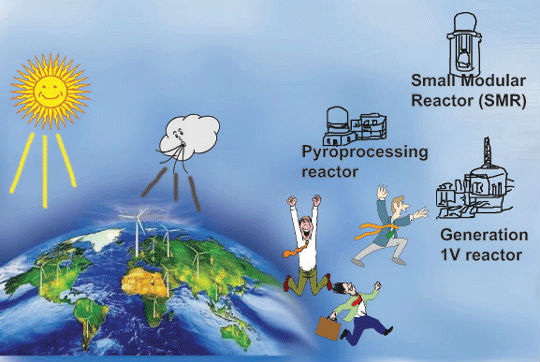
Nuclear advocates fight back with wishful thinking. Green World, Michael Mariotte September 3, 2015 It must be rough to be a nuclear power advocate these days: clean renewable energy is cleaning nuclear’s clock in the marketplace; energy efficiency programs are working and causing electricity demand to remain stable and even fall in some regions; despite decades of industry effort radioactive waste remains an intractable problem; and Fukushima’s fallout–both literal and metaphoric–continues to cast a pall over the industry’s future. Continue reading
Japan’s Monju nuclear reprocessing reactor, plagued by safety errors, offline for most of 20 years
Errors found in safety management of Monju reactor http://www3.nhk.or.jp/nhkworld/english/news/20150903_28.html Sep. 3, 2015 Japan’s nuclear regulators have found fresh faults with the safety management of the country’s fast-breeder reactor, which is currently offline. They say they have found thousands of errors in safety classifications of the equipment and devices at the Monju reactor.
The operator of the prototype reactor in Fukui Prefecture, central Japan, has been banned from conducting test runs since 2013 following discoveries of a large number of safety inspection oversights.
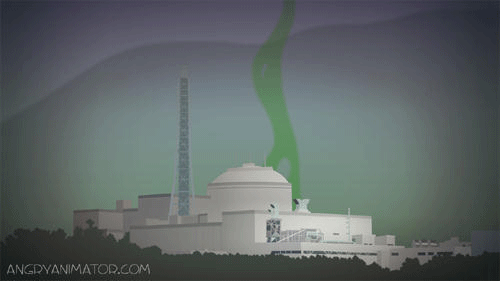
The Nuclear Regulation Authority says it has recently found at least 3,000 mistakes with safety classifications of equipment and devices at the reactor during its regular inspections which are conducted 4 times a year. Its officials say, equipment and devices with high importance were, in some cases, classified in lower ranks in the 3-level system, which suggest the operator might have failed to carry out necessary inspections for them.
The errors found recently include those going as far back as 2007. The fact suggests that government inspectors have also overlooked the operator’s mistakes. The operator, Japan Atomic Energy Agency, built the Monju fast-breeder reactor in the early 1990s to reuse the spent nuclear fuel MOX, a mixture of plutonium extracted from spent fuel and uranium.
But it has been offline for most of the period after it underwent a fire from a leak of sodium, the reactor’s coolant, in 1995.
The operator aims to conduct the reactor’s test run by next March. But it is uncertain when the ban by the authority will be lifted. The plant’s director, Kazumi Aoto, says he will take the government’s report seriously. An NRA inspector, Yutaka Miyawaki, says the regulators will try to identify the actual effects of the errors.
Small Nuclear Power – Not Cheap, Not Beautiful, Not Safe – Not even NEW!
When it comes to Nuclear Power, Small Isn’t Beautiful, Nor Safe Nor Cheap Nor Even New. USNRC NuScale Comment Deadline Monday Night 31 August, One Minute to 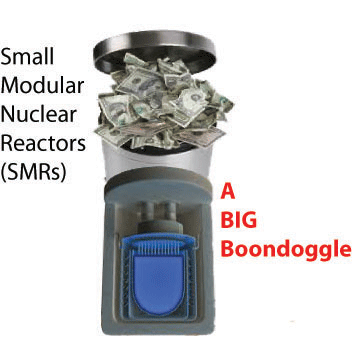 Midnight NY-DC Time 30 SundayAug 2015 by
“NuScale Power, LLC, Design-Specific Review Standard and Safety Review Matrix“Docket Folder Summaryhttp://www.regulations.gov/#!docketDetail;D=NRC-2015-0160 (If you don’t like the questions answer a different question, as per the advice that an MIT Ph.D. gave their grad student, and MIT is big on nuclear, the head of the US DOE, Moniz, teaches there, so it should be ok for this!)
NuScale in 2003 when it belonged to the US Gov and was called “MULTI-APPLICATION, SMALL, LIGHT WATER REACTOR (MASLWR)” INEEL/EXT- 04-01626
Greenpeace’s Justin McKeating made an excellent analysis of NuScale last year (see below our commentary).
However, he overlooked that the US DOE actually invented NuScale under the name of MASLWR. So, this is at least a second round of government funding. The US government dropped MASLWR and former DOE workers picked it up, probably after the patent expired, dubbing it NuScale. And, they are still feeding off the taxpayer pork barrel dole.[1][2] Plus, it’s NuScale Not! The nuclear industry only knows how to recycle the same old stuff.
There doesn’t appear to be much, if anything, new about NuScale. The only known immediate nuclear deaths from a nuclear accident, in the US, were from a mini-SL-1 reactor that made nuclear fallout in rural Idaho. [3] In 1968, in Lucens Switzerland, there was a mini-underground nuclear reactor, which had a major accident. Although smaller than NuScale, 100 Rem (1 Sievert; 1000 mSv) was measured in the reactor cavern, and it is ranked as a major nuclear accident. Radiation was measured in the nearby village; it continues to leak radiation from the cavern. From the beginning the Lucens Reactor was plagued by leaks in the underground cavern and corrosion issues due to its underground location. [4] NuScale too will suffer from additional corrosion and extra problems of hydrogen attack because it is part underground and stuck in water on all sides. Underground nuclear isn’t a magic fix, on the contrary.
NuScale is apparently not really passive either “Conduction through the vessel wall is by itself not a sufficient mechanism for heat removal in the present design. A circulation path is required to effectively remove the core decay heat. The sump makeup system is required.” [5] Furthermore, Italian researchers found that if if “SUMP valves are not operated and the ADS vent valves stuck open“, then there was a six hour “grace” period before CHF [Critical Heat Flux] “conditions are reached at top of the core. The dryout cannot be quenched. Primary system coolant released thorugh the HTC top valve outside the contaiment” [6]. Six hour grace period to meltdown-nuclear accident. So, these are neither passive, nor perfectly safe. And, they are proposing putting them in large groups, which makes one wonder what’s the point. A quick look online shows that NuScale has just submitted a laundry list of patents (July 2015) which, looking at the list alone, sound less original, than trying to patent a chicken sandwich, as someone recently did.
From Greenpeace:
“When it comes to nuclear power, small isn’t beautiful. Or safe or cheap.
Blogpost by Justin McKeating – June 19, 2014 at 11:55
Not beautiful, safe or cheap: a message to the United States, where the Obama administration has pledged to waste money financing the Small Modular Reactor (SMR).
SMRs are supposed to be small and prefab – constructed from parts made in a central location and slapped together onsite like a cheap prefab home. Those parts can then be shipped out and built by staff who don’t necessarily have the skills to build larger, more complex reactors.
The trouble is, this is merely old nuclear technology in new clothes. So why is the US Department of Energy (DoE) is giving $217 million dollars over five years to NuScale, a SMR manufacturer.
Let’s note, with a weary shake of the head, that this is yet another public subsidy for the failing economics of nuclear power, and take a look why this is a bad investment of taxpayer dollars by the Obama administration.
Dr. Mark Cooper, senior fellow for economic analysis at the Institute for Energy and the Environment at Vermont Law School, has published a paper titled, The Economic Failure of Nuclear Power and the Development of a Low-Carbon Electricity Future: Why Small Modular Reactors Are Part of the Problem, Not the Solution.
In his paper, Dr. Cooper finds SMRs won’t be cheaper and, more worryingly, manufacturers and supporters of the technology want to short-circuit safety regulations to get them built.
With the Fukushima disaster in its fourth year and no real solution to the ongoing problems and massive contamination in the foreseeable future, maybe now is not the time to talk about reducing nuclear safety, particularly with experimental, untested technology.
Dr Cooper adds SMRs will be more expensive than traditional nuclear technologies and that up to $90 billion dollars will be needed to make SMRs commercially viable. That’s a huge sum that will drag financing away from renewable power projects that are vital in the fight against climate change.
We’ve been here before: the story of the nuclear industry wasting billions is an old one…….. https://miningawareness.wordpress.com/2015/08/30/when-it-comes-to-nuclear-power-small-isnt-beautiful-nor-safe-nor-cheap-nor-even-new-usnrc-nuscale-comment-deadline-monday-night-31-august-one-minute-to-midnight-ny-dc-time/
Disposal of plutonium; burial is cheaper than MOX processing
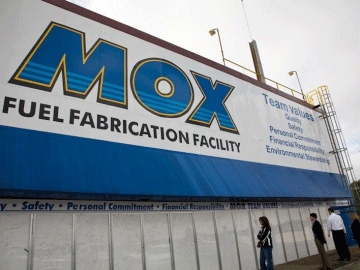
 nuClear news No.77, September 20156. Plutonium Conundrum A US Energy Department-commissioned study, which has been leaked to the Union of Concerned Scientists, concludes that it would be cheaper and far less risky to dispose of 34 metric tons of U.S. surplus plutonium at a federal nuclear waste repository in New Mexico than convert it into mixed-oxide (MOX) fuel for commercial nuclear power plants at the MOX Fuel Fabrication Facility in South Carolina.
The unreleased report describes in detail the delays and massive cost overruns at the half-built MOX facility, located at the federal Savannah River Site. High staff turnover, the need to replace improperly installed equipment, and an antagonistic relationship between the local federal project director and the contractor are only some of the factors undermining the project. The new report also notes that there are “no obvious silver bullets” to reduce the life-cycle cost of the MOX approach.
According to UCS, a better alternative to turning the surplus plutonium into commercial nuclear fuel would be to “downblend” it, a method the Energy Department has already used to dispose of several metric tons of plutonium. It involves diluting the plutonium with an inert, nonradioactive material and then sending it to the nuclear waste site in New Mexico, the Waste Isolation Pilot Plant (WIPP), for burial. The new report’s analysis supports that assessment. …….
Concerns over reliability, safety, chemistry of planned Advanced Boiling Water Nuclear Reactors (ABWR)
No2NuclearPower nuClear news No.77, September 2015 ABWRs According to World Nuclear News (WNN) there are four operable Advanced Boiling Water Reactors (ABWR) in Japan while two more are under construction. Another two are being built in Taiwan and two planned for Lithuania, although another two have been shelved in the USA. The design is already licensed in Japan and the USA. WNN points out, disturbingly that ABWRs can run on a full core of mixed oxide (MOX) nuclear fuel, raising the prospect of armed plutonium shipments travelling from Sellafield to Anglesey and Gloucestershire. (6)IAEA opening new nuclear fuel bank in Kazakhstan
New nuclear fuel bank a welcome development, Japan Times, 25 Aug 15 BY GARETH EVANS “………(on Aug. 27), Kazakhstan is establishing a major new international fuel bank, which it will operate on behalf of the IAEA. The new facility should once and for all remove the main excuse that has been advanced, sincerely or not, for building and maintaining homegrown enrichment capability.
Scheduled to commence operations in 2017, the Kazakh fuel bank will store up to 90 tons of LEU, sufficient to refuel three typical power-producing light water reactors. While Kazakhstan will physically operate the bank, the uranium will be owned and controlled by the IAEA, and made available to non-nuclear-weapon states if, for any reason, they cannot secure the LEU they need from the commercial market.
Provided the state in question is in compliance with its comprehensive non-proliferation safeguards agreement with the IAEA, it can draw the required fuel from the bank and transfer it to a fuel fabricator to make fuel assemblies for the reactors involved…….
The bank has been funded by voluntary contributions, including $50 million from the Nuclear Threat Initiative, a U.S.-based NGO, $49 million from the U.S. government, up to $25 million from the European Union, $10 million each from Kuwait and the United Arab Emirates, and $5 million from Norway…… http://www.japantimes.co.jp/opinion/2015/08/25/commentary/world-commentary/new-nuclear-fuel-bank-a-welcome-development/#.VdzQBSWqpHx
Escalating costs, expanding timelines, cast doubt on the future of modular nuclear construction
Fitch: ‘Failure’ of new nuke construction means fewer plants https://www.snl.com/InteractiveX/Article.aspx?cdid=A-33617164-10551 , Thursday, August 20, 2015 By Matthew Bandyk The troubled construction of new nuclear reactors in Georgia and South Carolina will likely chill the pursuit of more nuclear plants in the U.S., although recent actions by the U.S. EPA and the Department of Energy could improve the outlook over time, according to an analysis by Fitch Ratings.
As a result, there will be less new nuclear to replace the increasing number of retiring plants. Fitch said that the U.S. Energy Information Administration’s forecast of nuclear generation falling by 10,800 MW by 2020 might be too conservative if more plants retire due to local political pressure and the need for costly upgrades.
The nuclear projects at the Vogtle and V.C. Summer plants, the first new nuclear generation built in the U.S. in decades, use the Westinghouse Electric Co. LLC AP1000 reactor design, which promised to be cheaper and more efficient to build than past nuclear plants that saw spiraling cost overruns during construction. In particular, Westinghouse touted the “modern, modular” construction technique in which major plant components would be built off-site as modules, allowing pieces of the project to be completed in parallel and in turn speeding up construction.
But “the recent failure of modular construction to deliver lower prices and shorter timelines will likely keep a cap on U.S. nuclear development into the midterm,” Fitch analysts said in a statement Aug. 20. The Vogtle and Summer projects are each running about three years behind schedule and are now expected to cost a few billion dollars more than originally estimated.
The blame for much of the delays has been centered on subpar work on the modules at facilities like Chicago Bridge & Iron Co. N.V.‘s Lake Charles fabrication facility in Louisiana. CB&I has since shifted work to other facilities, and monitors of the Vogtle project recently reported that the module work has “improved significantly.” But the contractors continue to miss their own deadlines and there is still risk of more delays, the same monitors said.
In addition, four AP1000 reactors under construction in China are also seeing rising costs and delays, Fitch noted.
One of the best hopes for the U.S. nuclear industry comes from the EPA’s recently finalized Clean Power Plan, according to Fitch. The rule allows new nuclear plants and capacity uprates at existing plants to generate credits that states can use to reduce their CO2 emissions levels and comply with the rule. In addition, the DOE continues to try to lower the financing costs for the nuclear industry through loan guarantees. Last year the DOE said it is accepting applications from nuclear developers for $12.5 billion in loan guarantees.
Both the EPA and DOE efforts could “yield growth factors longer term,” Fitch said.
Disposal of nuclear waste turning out to be half the cost of reprocessing with MOX fuel
Disposal beats MOX in US comparison http://www.world-nuclear-news.org/WR-Disposal-beats-MOX-in-US-comparison-2108151.html?utm_source=dlvr.it&utm_medium=twitter 21 August 2015
America is reconsidering how it will dispose of 34 tonnes of plutonium as the previous plan involving a MOX plant has been said to be twice as costly as a dilution and disposal option in a leaked Department of Energy (DOE) report.
The plutonium arises from a June 2000 nuclear weapons reduction agreement with Russia under which both countries would put 34 tonnes of plutonium beyond military use. Russia opted to use its plutonium as fuel for fast reactors generating power at Beloyarsk.
The USA, meanwhile, decided to build a mixed-oxide (MOX) nuclear fuel plant at Savannah River, where the plutonium would be mixed with uranium and made into fuel for light-water reactors. The design is similar to Areva’s Melox facility at Marcoule, but modified to handle metal plutonium ‘pits’ from US weapons and their conversion from metal to plutonium oxide. It is this part of the process that has been problematic. Construction started in 2007 with an estimated cost of $4.9 billion but work ran into serious trouble before being ‘zeroed’ in the DOE’s 2014 budget, putting development on ice.
The Union of Concerned Scientists yesterday published what it said was an unreleased DOE report that compared the cost of completing the MOX plant to other options. Use in fast reactors was considered briefly, but with this technology not readily available in the near term, the prime comparison was against a ‘dilution and disposal’ option which would see the plutonium mixed with inert materials and disposed of in the Waste Isolation Pilot Plant, or WIPP, in New Mexico.
Despite being 60% built, the MOX plant still needs some 15 years of construction work, said the leaked report, and then about three years of commissioning. Once in operation the plant would work through the plutonium over about 10 years with this 28-year program to cost $700-800 million per year – a total of $19.6-22.4 billion on top of what has already been spent. Not only is the price tag very high, but the timescale is too long: the report said this would not meet the disposal timeframe agreed with Russia.
The cost of the MOX plant could not be mitigated by income from sales of the MOX fuel because the regulatory process to gain approval to use MOX would be too burdensome for a commercial utility. The report said “it may be unlikely” that even a utility in a regulated market where fuel costs are passed on to consumers would “bear the risk of MOX fuel even if it is free”.
Dilution and disposal would cost $400 million per year, said the report, “over a similar duration” as MOX, working out at close to half the cost. Other advantages for dilution and disposal are that it requires no new facilities to be created or decommissioned after use, although the increase in WIPP disposal means “it may eventually become desirable to explore expansion of WIPP’s capacity” beyond currently legislated limits. This unique geologic disposal facility was said to be of “tremendous value to both DOE and the State of New Mexico”.
Small Modular Nuclear Reactors – with a small chance of actually happening
 Critics cite the lack of any track record on cost or safety for small modular reactors, plus concerns over the nation’s lack of a permanent place to store used nuclear fuel. No one has built a commercial small modular reactor yet.
Tri-Cities interests hope to attract mass production of small modular reactors to the never-finished Energy Northwest reactor site at the Hanford nuclear reservation.
Small nukes: a long-term prospect for Tri-Cities?, by John Stang, Crosscut, 18 Aug 15 “……..economics and proximity to buyers will probably be the deciding factors on where NuScale will build both individual small modular reactors and its manufacturing plant, said McGough and John Dobken, spokesman for Energy Northwest (a consortium of Washington public utilities, including Seattle City Light).
Small modular reactors are prefab reactors whose parts are manufactured in one location, and then transported to the reactor site for final assembly. A modular segment would be a mini-reactor of 50 to 300 megawatts. Energy Northwest’s Columbia Generating Station, a nuclear plant, produces more than 1,190 megawatts of electricity, equal to about a tenth of the state’s energy needs. Small modular reactors are supposed to be designed so extra modules can be added as needed — with 12 modules being the theoretical maximum. They are similar to the small reactors that operate on U.S. Navy ships.
The initial cost estimate to take the project from design to the first Idaho Falls reactor is roughly $1 billion. In recent years, the deep-pocketed global giant Fluor Corp. bought NuScale.
NuScale, Energy Northwest, the Utah Associated Municipal Power Systems (a Utah version of Energy Northwest) and the U.S. Department of Energy facility at Idaho Falls have agreed to build the first such reactor in Idaho by 2023. NuScale plans to submit its design to the Nuclear Regulatory Commission by late this year, hoping for a green light about 40 months later.
Rep. Gerald Pollett, D-Seattle and a leading Northwest nuclear power critic, said, “Talking about siting such a thing is premature.”
Critics cite the lack of any track record on cost or safety for small modular reactors, plus concerns over the nation’s lack of a permanent place to store used nuclear fuel. No one has built a commercial small modular reactor yet, although supporters contend they are similar to the small reactors that operate on U.S. Navy ships.
Energy Northwest’s interest in getting its own small modular reactor will depend on if and when Energy Northwest’s member utilities will need extra power. At this time, the consortium does not expect that need to grow for the next few years, Dobken said.
Another wrinkle is that a 1981 state law requires that a public utilities group conduct a public ballot on any significant energy generation project that is likely to increase utility rates. Consequently, a public vote stretching from Seattle to Kennewick could lurk in the future of a small modular reactor project if Energy Northwest’s rates might be affected.
Chuck Johnson of the nuclear watchdog organization Physicians for Social Responsibility voiced concern about a scenario in which a single 50-megawatt reactor module would fall beneath the ballot threshold of the 1981 Washington law, and the addition of 50-megawatt modules one at a time could keep a state project below that public-vote benchmark.
“We’re big on the technology and believe the technology should be made available,” Dobken said.
Such a manufacturing plant would need about 1.9 million square feet of space, employ about 1,000 people and would aim to produce 36 to 52 modules a year, McGough said. NuScale is looking at Hanford, the Southwest, Utah and several Midwest, Southern and Eastern seaboard states as potential manufacturing sites.
“The site is still up in the air. … It depends on who shows up with the orders first,” McGough said……http://crosscut.com/2015/08/small-nukes-a-long-term-prospect-for-tri-cities/
1 This Month
26 September – International Day for the Total Elimination of Nuclear Weapons





PLEASE OPPOSE HR 8255 AND S.3639 – bills would accelerate satellite deployment, with no environmental review or safeguards – https://ncstd5li.quorum.us/campaign/169331/
To see nuclear-related stories in greater depth and intensity – go to https://nuclearinformation.wordpress.com
-
Archives
- September 2026 (291)
- August 2026 (330)
- July 2026 (355)
- June 2026 (287)
- May 2026 (306)
- April 2026 (356)
- March 2026 (251)
- February 2026 (267)
- January 2026 (308)
- December 2025 (358)
- November 2025 (359)
- October 2025 (375)
-
Categories
- 1
- 1 NUCLEAR ISSUES
- business and costs
- climate change
- culture and arts
- ENERGY
- environment
- health
- history
- indigenous issues
- Legal
- marketing of nuclear
- media
- opposition to nuclear
- PERSONAL STORIES
- politics
- politics international
- Religion and ethics
- safety
- secrets,lies and civil liberties
- spinbuster
- technology
- Uranium
- wastes
- weapons and war
- Women
- 2 WORLD
- ACTION
- AFRICA
- Atrocities
- AUSTRALIA
- Christina's notes
- Christina's themes
- culture and arts
- Events
- Fuk 2022
- Fuk 2023
- Fukushima 2017
- Fukushima 2018
- fukushima 2019
- Fukushima 2020
- Fukushima 2021
- general
- global warming
- Humour (God we need it)
- Nuclear
- RARE EARTHS
- Reference
- resources – print
- Resources -audiovicual
- Weekly Newsletter
- World
- World Nuclear
- YouTube
-
RSS
Entries RSS
Comments RSS

