Refuting the lies of anti renewable energy propaganda
 Myth-busting Germany’s energy transition Smart Planet By Chris Nelder | October 12, 2013 Major English-language media have been propagating a false narrative about the stunning success of Germany’s transition to renewable energy: theEnergiewende. To hear them tell it, the transition has been a massive failure, driving up power prices, putting Germany’s grid at risk of blackouts, and inspiring a mass revolt against renewables.
Nothing could be further from the truth……..
I debunked a few of the hoary tropes about the Energiewende one year ago, such as the notion that the grid can’t handle a large share of variable renewable power. But apparently many in the major Western media still haven’t gotten the memo.
So let’s clear out the fog and debunk a few of the favorite myths about theEnergiewende.
Myth: “After the Fukushima nuclear accident in Japan two-and-a-half years ago, Merkel quickly decided to begin phasing out nuclear power and lead the country into the age of wind and solar.” (This one is from the above-mentioned Der Spiegel article.)
Fact: Germany’s switch to renewables started in 1991, and the nuclear phaseout started in 2002. Continue reading
Ionising radiation and anti-science

Plenty of funding is available. The USA’s Department of Energy funds programs worldwide, (including in Australia) to research dodgy science about the safety ‒ even alleged benefits ‒ of low level ionising radiation. Nuclear physicists and others, quite inexpert in this field, pronounce solemnly about non-hazardous nature of low dose radiation.
The anti-science about ionising radiation Independent Australia Some people would have you believe that low level ionising radiation is perfectly safe; this is a sinister and troubling fallacy, says Noel Wauchope. 10 Oct 13 DENIAL OF THE HEALTH EFFECTS of ionising radiation is the latest of the lies against science……….none of these motivations would get “airplay” ‒ would prevail, if it were not for the money motive, – that’s the impetus behind public relations people, consultants, journalists, commentators, TV producers, film-makers, and so on who are paid by think tanks that are fronts for polluting industries and billionaires like the Koch Brothers. And don’t let’s forget the scientists and science media who are paid by governments that are financially beholden to polluting corporations and to the military industrial complex.
There is extensive literature in books and on the Internet about the campaigns of science denial regarding asbestos, tobacco and climate change. These are global campaigns, Continue reading
Scientists don’t buy Japan’s claims that Fukushima radiation is “contained”
 ”Once strontium gets into fish, it stays in them for months and years and it’s going to be an additional reason why they won’t be able to open up their fisheries.”
“The credibility problem is as great as the engineering solution,”
Scientists dismiss claims that radiation in Japan is contained TEPCO’S radiation claims called ‘silly’ The Columbian, By Jonathan Tirone, Bloomberg News October 7, 2013, VIENNA — Tokyo Electric Power Co.’s claim that radioactive water leaking into the sea from the wrecked Fukushima nuclear plant is confined to the coast doesn’t make scientific sense, according to a U.S. researcher who surveyed waters off the site last month.
Japan’s government has supported the utility’s statement that the irradiated groundwater flowing into the Pacific Ocean at a rate of some 400 tons a day remains in an area of 0.3 square kilometers (0.12 square miles) within the bay fronting the atomic station. Continue reading
Big corporate money funding climate sceptics
The Competitive Enterprise Institute has in the past received funding from Exxon Mobil, the oil company, and the American Petroleum Institute, Texaco, General Motors and the Koch Family Foundations, controlled by the Koch brothers who made their fortune from fossil fuels.
 Big business funds effort to discredit climate science, warns UN official http://www.theguardian.com/science/2013/sep/20/big-business-funding-climate-change-sceptics Climate change summit braced for counterblast from sceptics as report warns greenhouse gas emissions still increasing Fiona Harvey and Graham Readfern The Guardian, Saturday 21 September 2013 Big companies are paying contrarians to undermine the work of climate scientists, according to a top UN official speaking before the release of a landmark review of climate science this weekby international researchers next Friday.
Halldór Thorgeirsson, a director who reports to the head of the UN body that governs the on-going high level international climate negotiations, said that scientists would need to be prepared for a counter-blast from sceptics.
“Vested interests are paying for the discrediting of scientists all the time. We need to be ready for that,” he said……..
His outspoken views will set the tone for a fractious meeting of the world’s leading climate scientists, kicking off on Monday in Stockholm, that will set out the evidence that the world’s governments use when formulating policies to deal with global warming for decades to come. More than 800 scientists have contributed to the report, the final details of which will be hammered out in a gruelling four-day session next week.
According to a draft of the “Summary for Policy Makers” dated June , seen by the Guardian– the most important part of the document – the scientists will argue that the evidence points to 95% certainty that climate change is occurring and is caused mainly by greenhouse gases released by humans – up from 90% certainty in the previous 2007 report. Continue reading
Fukushima nuclear plant “under control”- who believes this?
 Seemingly, all TEPCO has been doing for the last two and a half years is storing contaminated water in tanks, with no real solution to the problem reached. What the Japanese government is doing is ensuring people in Japan and around the world that Japanese water and food are safe to eat and drink, and that the Fukushima Daiichi nuclear disaster will not affect the 2020 Toyko Olympics. One thing neither Japan nor TEPCO are doing is keeping Japanese citizens or the international community promptly and accurately informed and up-to-date of the contaminated water leaks.
 Japanese ministers miss the point at Fukushima Daiichi http://enformable.com/2013/09/japanese-ministers-miss-point-fukushima-daiichi/ Lucas W Hixson 17 Sept 13, Earlier this month, Japanese Prime Minister Shinzo Abe told the International Olympic Committee in Buenos Aires, that the “effects from the contaminated water have been perfectly blocked within the (artificial) bay” of the wrecked nuclear complex, and said “the situation is under control.” A statement which was questioned strongly by the Japanese media, as experts have continually noted that contaminated water is continually flowing into the Pacific Ocean. Continue reading
We don’t need hoaxes about ionising radiation: the truth is bad enough
I was very grateful to “Hoax-Slayer” for this article. Arclight alerted me to the photo of these ‘fatally radioactive’ whales, and at the group of people so close to them , and none wearing protective clothing. And I puzzled as to how these whales got so close to highly radioactive matter at the Fukushima Daiichi nuclear power plants?
It is important for us, who oppose nuclear [power, and warn about ionising radiation, to scrutinuse extreme stories like this. We don’t need fantasies for evidence. The true facts are bad enough. And – the nuclear lobby will use sories such as this one, against us!
No, Radiation from Fukushima has NOT Killed Hundreds of Whales Outline, Hoax Slayer 10 Sept 13 Circulating message couched as a news report claims that hundreds of whales have been killed by radiation from the stricken Fukushima nuclear plant in Japan. The report features a photograph showing dead whales on a beach.

Brief Analysis The claims in the story are outright lies. There are no credible reports of large numbers of whales dying from Fukushima radiation. The image used in the articles shows pilot whales stranded on a New Zealand beach in 2010 and has no connection whatsoever with the 2011 Fukushima meltdown. While the potential effects of the Fukushima disaster are of significant concern, spreading lies and misinformation about the issue is counterproductive and irresponsible…….
And the image depicting dead whales – which comprises the only evidence of the alleged event presented in the report – has no connection with Fukushima whatsoever.
In fact, the image shows pilot whales stranded on a beach in New Zealand. And the event occurred in August 2010, months before the March 2011 Fukushima meltdown. ….. The Fukushima disaster and the possible long-term effects on the environment are certainly of concern, not only to Japan, but to the world as a whole. And that is why it is vital that discussions of the issue use verified facts rather than lies, hearsay and misinformation. http://www.hoax-slayer.com/fukushima-dead-whales-hoax.shtml
Tokyo the “safe choice” for 2030 Olympics?
For 2020 Olympics, I.O.C. Picks Tokyo, Considered Safe Choice, NYT By JERÉ LONGMAN and MARTIN FACKLER September 7, 2013 “……….As Tokyo made its final presentation, Abe, Japan’s prime minister, addressed the issue of the crippled Fukushima nuclear power plant, which is about 155 miles from Tokyo. The nuclear disaster there is considered the worst since Chernobyl’s in 1986, and problems have plagued the cleanup and control efforts.
“Let me assure you that the situation is under control,” Abe said. “It has never done and will never do any damage to Tokyo.”
Gerhard Heiberg, an I.O.C. delegate from Norway, asked Abe how he could make such guarantees. Abe replied that there were no health-related problems related to the nuclear disaster, “nor will there be in the future.”

The Japanese government has pledged nearly $500 million to try to stabilize the nuclear plant, including the building of a frozen wall to curb the flow of groundwater into the contaminated buildings at the reactor site.
Some critics have accused Japanese leaders of being misleading or in denial about the severity of the radiation problem. South Korea, for instance, has banned fish imports from the Fukushima area. But Olympic delegates were sufficiently convinced that the nuclear disaster would not hinder the 2020 Games.
“A lot of folks have been reading in the media that hundreds of tons of radioactive water are being fed into the Pacific every day,” Pound said.
Abe seemed to be saying, “I’m satisfied on that so that nothing will happen,” according to Pound, who added, “If there’s another earthquake or something like that, that’s not something you can blame the prime minister for.”……. http://www.nytimes.com/2013/09/08/sports/olympics/tokyo-wins-bid-for-2020-olympics.html?pagewanted=all&_r=0
Concrete burial a better option for Fukushima- but not good for PR?
Japan Expert: Covering Fukushima reactors in concrete like at Chernobyl should be considered — Nuclear Official: If we just buried them, no one would want to look at another nuke plant http://enenews.com/japan-expert-covering-fukushima-reactors-concrete-like-chernobyl-be-considered-nuclear-official-buried-one-look-another-nuke-plant-years
Title: Errors Cast Doubt on Japan’s Cleanup of Nuclear Accident Site
Source: New York Times
Author: Martin Fackler
Date: Sept. 3, 2013
[…] some experts dismiss the current cleanup plans as just a way of defending the status quo by convincing the public that the damage can be undone […]
 Harutoshi Funabashi, a sociologist at Hosei University who led a critical examination of the recovery efforts by the Science Council of Japan […] and other critics say Japan should consider other options, including the tactic adopted by the former Soviet Union at Chernobyl of essentially capping the shattered reactors in concrete and declaring the most contaminated towns off limits for a generation.
Japanese officials said the large amounts of groundwater under the plant mean that just covering the reactors with concrete would fail to contain the spread of radiation. They also said giving up on a large portion of Fukushima was not an option in a densely populated country where land remains a scarce commodity.
But they also suggested that the reason for eschewing a Soviet-style option may be the fear that failure could turn a wary public even more decisively against Japan’s nuclear industry.
“If we just buried the reactors, no one would want to see the face of another nuclear power plant for years,” said Shunsuke Kondo, chairman of the Atomic Energy Commission, an advisory body in the Cabinet Office. […]
See also: Bloomberg: Tepco now in talks to cover Fukushima reactors with concrete for next 75 years — Officials reviewing plan in U.S.
Japan Olympic Committee desperately spinning Tokyo’s safety from Fukushima radiation
 Japan Olympic Committee delegates in radiation spin control Media trip up team while it tried to put best foot forward Japan Times, BY DAVE HUESTON, 5 Sept 13 KYODO, AP BUENOS AIRES – What should have been a resounding kickoff for the Tokyo 2020 bid with the International Olympic Committee’s vote coming Saturday turned into a fencing match as bid chief Tsunekazu Takeda tried to parry questions from the media about the Fukushima nuclear crisis.
Takeda, who is president of the Japanese Olympic Committee, and Fujio Cho, president of the Japan Sports Association and honorary chairman of Toyota Motor Corp., held a media event Wednesday in Buenos Aires to pitch Tokyo’s proposed marketing program and emphasize the capital’s certainty to deliver the games in first-class style……..
The most absurd of Japan’s pro nuclear ppropaganda
Watch the Japanese propaganda video that promises radiation won’t harm you if you just “laugh” http://www.naturalnews.com/041720_Fukushima_radiation_Japanese_government_propaganda_brainwashing.html#ixzz2cjArWiTe It is a video of Dr. Shunichi Yamashita — now known as “Dr. Brainwasher” — giving a propaganda lecture on March 21, 2011 in Fukushima City.
Watch Dr. Brainwasher utter some of these outrageous lies in the following video:
Unbelievable Comment by Mr. Yamashita
This blogspot website has located and translated several key brainwashing phrases uttered by Dr. Yamashita as part of the Japanese government’s propaganda campaign. The following statements span several online videos featuring “Dr. Brainwasher.” Each of these statements is a total propaganda fabrication. The comments in ALL CAPS are my own: Continue reading
Mark Willacy, in Tokyo, on the farce that is TEPCO’s Fukushima script
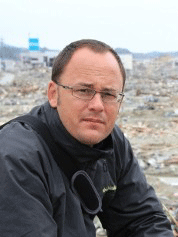 I have learned through my many dealings with TEPCO that this is a company rooted deep in denial. It is a firm that has apparently put public relations before disaster planning.
In the first act we are confronted with outright denial. The Fukushima plant is stable, the reactors are under control. There is no problem. In the second act a problem is exposed in all its radioactive glory – it could be a nuclear water leak, or contaminated groundwater leeching into the Pacific, or a power failure to pools cooling thousands of toxic fuel rods, or mysterious steam oozing from a shattered reactor building (all have happened). In the final act, a line of sober-faced TEPCO officials fills the stage. They choreograph their bows, and the dialogue begins.
“We apologise again for causing anxiety among the public.”
At the start of this crisis, it was keeping water out of the Fukushima plant that was TEPCO’s major failing. Now, it is keeping water in. What next in this endless loop of black farce?
Sorry, sorry, sorry: As the nuclear radiation crisis at Fukushima deepens, at least TEPCO know the script http://www.independent.co.uk/voices/comment/sorry-sorry-sorry-as-the-nuclear-radiation-crisis-at-fukushima-deepens-at-least-tepco-know-the-script-8778017.html MARK WILLACY Wednesday 21 August 2013
This latest leak comes after years of farcical mismanagement It was a stunning contortion of logic, performed with such a straight face that at first I thought Junichi Matsumoto was having me on.
“Yes, taking extra safety measures [at Fukushima] would have been interpreted as TEPCO being worried about a tsunami,” said the senior TEPCO official. “If we had built seawalls in front of the plant…it would’ve made [local residents] worry.” Continue reading
Frightening America makes a lot of money for 5 companies
 5 Companies That Make Money By Keeping Americans Scared Reader Supported News, By Alex Kane, Salon 19 August 13 A massive industry profits off the government-induced fear of terrorism.
 ichael Hayden, the former director of the National Security Agency, has invaded America’s television sets in recent weeks to warn about Edward Snowden’s leaks and the continuing terrorist threat to America.
But what often goes unmentioned, as the Guardian’s Glenn Greenwald pointed out, is that Hayden has a financial stake in keeping Americans scared and on a permanent war footing against Islamist militants. And the private firm he works for, called the Chertoff Group, is not the only one making money by scaring Americans.
Post-9/11 America has witnessed a boom in private firms dedicated to the hyped-up threat of terrorism. The drive to privatize America’s national security apparatus accelerated in the aftermath of the terrorist attacks, and it’s gotten to the point where 70 percent of the national intelligence budget is now spent on private contractors, as author Tim Shorrock reported. The private intelligence contractors have profited to the tune of at least $6 billion a year. In 2010, the Washington Post revealed that there are 1,931 private firms across the country dedicated to fighting terrorism.
What it all adds up to is a massive industry profiting off government-induced fear of terrorism, even though Americans are more likely to be killed by a car crash or their own furniture than a terror attack.
Here are five private companies cashing in on keeping you afraid.
1. The Chertoff Group…..
2. Booz Allen Hamilton……
3. Science Applications International Corp…..
4. Center for Counterintelligence and Security Studies….
5. Security Solutions International….. http://readersupportednews.org/opinion2/424-national-security/18979-5-companies-that-make-money-by-keeping-americans-scared
Mainstream media’s deliberate lies and misinformation about renewable energy

Actually, Germany gets only about as much annual sun as Seattle or Alaska; its sunniest region gets less sun than almost anywhere in the lower 48 states. This underscores an important point: solar power works and competes not only in the sunniest places, but in some pretty cloudy places, too.
A pervasive pattern
The Fox Business example is not a singular incident. Some mainstream media around the world have a tendency to publish misinformed or, worse, systematically and falsely negative stories about renewable energy. Continue reading
Renewable energy creates many more jobs than there are in fossil fuel energy
Debunking the Renewables “Disinformation Campaign”, Mother Earth News, Despite vast evidence supporting the advancement of renewable energy, various media outlets insist on denying its progress, blurring the lines between inefficient reporting and deliberate lying. By Rocky Mountain Institute August 19, 2013 “……..a recent study commissioned by Germany’s Federal Environment Ministry found that the renewable energy sector provided around 382,000 jobs in 2011, up four percent in a year, and more than doubled in seven years. More jobs have been created than lost in Germany’s energy sector—plus any jobs gained as heavy industry moves to Germany for its competitive electricity.

Yet a myth persists that countries lose more jobs then they gain when they transition to renewables. This upside-down fantasy rests largely on a 2009 study from King Juan Carlos University in Spain, by an economist reportedly tied to ExxonMobil, the Heartland Institute, and the Koch brothers. His study asserted that, on average, every renewable energy job in Spain destroys 2.2 jobs in the broader Spanish economy. This story was picked up by news media around the world and is still promoted by U.S. anti-renewables groups. But its methodology and assumptions were promptly demolished by the National Renewable Energy Laboratory and the Spanish government, among others. A 2012 report for the International Labour Organization (ILO) even cites Spain, which built a renewable export industry, as a counterexample: “The green economy presents a good opportunity to increase competitiveness, promote the creation of quality employment and reduce the economy’s environmental impact,” says Joaquín Nieto, who heads the ILO Office in Madrid, especially “when Spain needs to kick-start its economy.” Sure enough, despite new electricity taxes and a halt to subsidies for new renewable projects, Spain’s latest solar projects continue to be built to compete without subsidy.
The disinformation campaign about job creation is not limited to Europe. A Cato Institute article claimed that if people believe a commitment to renewables will fuel job growth “we’re in a lot of trouble.” Yet in 2012 alone, more than 110,000 new U.S. clean-energy direct jobs were created, and in 2010, the U.S. had more jobs in the “clean economy” than in the fossil-fuel industries. The Bureau of Labor Statistics reports that direct employment in May 2012 totaled 181,580 for oil and gas extraction, 87,520 for coal mining, and 93,200 for iron and steel production. BLS doesn’t similarly classify solar or wind jobs, but reputable analysts have determined from bottom-up industry surveys that in September 2012, for example, the U.S. had 119,016 direct solar jobs (89 percent full-time, the rest at least half-time), up 27 percent in two years—more than in steel-making or coal-mining. Had you heard that before? Why not? …….. http://www.motherearthnews.com/renewable-energy/debunking-the-renewables-disinformation-campaign-zm0z1308zsal.aspx#axzz2cYi1w7VS
Film” Pandora’s Promise” spews out a stream of untruths,
The movie also illustrates that none of its five layman “converts” to pro-nuke views knows enough about nuclear plants or other energy solutions to evaluate them fairly. They only know the Nuclear Dream.

 A Nuclear Submariner Challenges a Pro-Nuclear Film NYT, By ANDREW C. REVKIN, 16 Aug 13 John Dudley Miller, a former nuclear engineering officer in the Navy with a doctorate in social psychology and a long career in journalism, sent this “Your Dot” critique of “Pandora’s Promise,” the new documentary defending nuclear power,
When I saw “Pandora’s Promise,” I didn’t believe a word of it. I served as a submarine nuclear engineering officer for my four-year stint in the Navy years ago. I qualified as an Engineering Officer of the Watch (a guy who’s in charge of the plant and its other technicians during four-hour shifts) on two different sub reactors. I know the truth about reactors, and the movie replaces it with the demonstrably false Nuclear Dream, a just-so mythical story claiming that nukes are safe, clean and cheap…..
the movie – It spews out a stream of untruths, for instance, telling us only that Chernobyl killed56 people. It leaves out that a United Nations World Health Organization agency predicts 16,000 more will die from Chernobyl cancers and that the European Environment Agency estimates 34,000 more. It omits that non-fatalthyroid cancer struck another 6,000, mostly children
Even the movie’s two reactor designers distort truth. Physicist Charles Till claims that fast-breeder reactors are inherently safe. Actually, they’re riskier than ordinary reactors. Hans Bethe, Manhattan Project scientist and Nobel laureate, calculated in 1956 that if a breeder’s liquid sodium coolant leaked out, it could melt in 40 seconds, become a small unintended atom bomb and spontaneously explode. (Modern designers believe breeders are more likely to melt down like Three Mile Island than to explode like Chernobyl.)
The breeder reactors EBR-1 in Idaho and Fermi-1 near Detroit partially melted. Several breeders have suffered sodium coolant fires, because sodium automatically burns in air and explodes in water. Continue reading
1 This Month



26 September – International Day for the Total Elimination of Nuclear Weapons


PLEASE OPPOSE HR 8255 AND S.3639 – bills would accelerate satellite deployment, with no environmental review or safeguards – https://ncstd5li.quorum.us/campaign/169331/
To see nuclear-related stories in greater depth and intensity – go to https://nuclearinformation.wordpress.com
-
Archives
- September 2026 (245)
- August 2026 (330)
- July 2026 (355)
- June 2026 (287)
- May 2026 (306)
- April 2026 (356)
- March 2026 (251)
- February 2026 (267)
- January 2026 (308)
- December 2025 (358)
- November 2025 (359)
- October 2025 (375)
-
Categories
- 1
- 1 NUCLEAR ISSUES
- business and costs
- climate change
- culture and arts
- ENERGY
- environment
- health
- history
- indigenous issues
- Legal
- marketing of nuclear
- media
- opposition to nuclear
- PERSONAL STORIES
- politics
- politics international
- Religion and ethics
- safety
- secrets,lies and civil liberties
- spinbuster
- technology
- Uranium
- wastes
- weapons and war
- Women
- 2 WORLD
- ACTION
- AFRICA
- Atrocities
- AUSTRALIA
- Christina's notes
- Christina's themes
- culture and arts
- Events
- Fuk 2022
- Fuk 2023
- Fukushima 2017
- Fukushima 2018
- fukushima 2019
- Fukushima 2020
- Fukushima 2021
- general
- global warming
- Humour (God we need it)
- Nuclear
- RARE EARTHS
- Reference
- resources – print
- Resources -audiovicual
- Weekly Newsletter
- World
- World Nuclear
- YouTube
-
RSS
Entries RSS
Comments RSS
 nuclear-news