Rebutting the nuclear spruiker, James Conca

A Rebuttal to the January 11, 2013 Article by James Conca, “Like We’ve Been Saying — Radiation is Not A Big Deal,” Posted on Forbes Website fukushimavoice-eng.blogspot.com.au/2013/02/a-rebuttal-to-january-11-2013-article.html
Will Australia’s scientifically illiterate government be sucked in to buying Small Modular Nuclear Reactors (SMRs)?
 Strange time to suggest a LEGO nuclear future for Australia ,Independent Australia, Noel Wauchope 21 April 2014, By 2022, Australia could have many “Lego-like” small nuclear reactors in operation, dotted about the nation. This is being proposed now, not just by the long-term fervent believers in Small Modular Reactors (SMRs), but in formal submissions to the coming Energy White Paper……
The BHP-funded Grattan Institute’s submission envisages a string of these little nuclear reactors, connected to the grid, along Australia’s Eastern coast.
Keith Orchison reports on the Grattan Institute submission:
‘The Abbott government is being told that now is the time to flick the switch to “technology neutral,” opening the way for nuclear options.’
Orchison described the advantages of SMRs as ‘Lego-like’.
Why now?
In 2014, it was becoming clear that Small Modular Reactors (SMRs) were not likely to become an operational reality for many decades — and perhaps never.
America was the pioneer of small reactor design in the 1970s. Again recently, Westinghouse and Babcock and Wilcox have been the leaders in designing and developing SMRs.
But in 2014, the bottom has fallen out of these projects………..
It should be noted that nowhere in [the original article about China, does the author] Chen mention “small” reactors. However, Australian proponents of ‘small’ reactors welcomed this article, as the Thorium Small Nuclear Reactor is the favourite type proposed for Australia from all 15 possible small designs.
So, while we’re being told that China is racing ahead in the scramble to get these wonderful SMRs, in fact, China has been very much encouraged and helped into this by the U.S. Department of Energy.
This is understandable, seeing that for China it is a government project, with no required expectation of being commercially viable.
In their enthusiasm for China’s thorium nuclear project, writers neglected to mention the sobering points that Stephen Chen made in his South China Morning Post article, such as:
- ‘Researchers working on the project said they were under unprecedented ‘war-like’ pressure to succeed and some of the technical challenges they faced were difficult, if not impossible to solve.’
- ‘… opposition from sections of the Chinese public.’
- ‘… technical difficulties – the molten salt produces highly corrosive chemicals that could damage the reactor.’
- ‘The power plant would also have to operate at extremely high temperatures, raising concerns about safety. In addition, researchers have limited knowledge of how to use thorium.’
- ‘… engineering difficulties .…The thorium reactors would need years, if not decades, to overcome the corrosion issue.’
- ‘These projects are beautiful to scientists, but nightmarish to engineers.’……….
Australia’s SMR enthusiasts discount the known problems of SMRs. Some brief reminders from the September 2013 report, from the United States’ Institute for Energy and Environmental Research:
- ‘Economics: $90 billion manufacturing order book could be required for mass production of SMRs …the industry’s forecast of relatively inexpensive individual SMRs is predicated on major orders and assembly line production.’
- ‘SMRs will lose the economies of scale of large reactors.’
- ‘SMRs could reduce some safety risks but also create new ones.’
- ‘It breaks, you bought it: no thought is evident on how to handle SMR recalls.’
- Not a proliferation solution. ‘The use of enriched uranium or plutonium in thorium fuel has proliferation implications.’
- Not a waste solution: ‘The fission of thorium creates long-lived fission products like technetium-99 (half-life over 200,000 years).’
- Ongoing technical problems. ……….http://www.independentaustralia.net/environment/environment-display/strange-timing-to-suggest-a-lego-nuclear-future-for-australia,6404
Desperate publicity manipulations by the nuclear industry
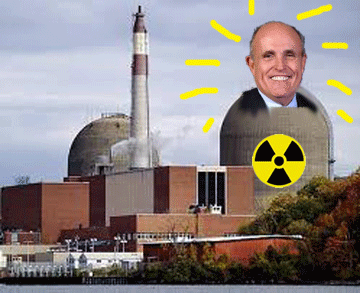
 You know the nuclear industry is desperate when… Michael Mariotte April 1, 2014 You know the nuclear power industry is getting desperate when it solicits its CEOs to start piling on ghost-written op-eds in publications chosen for their reach to key audiences. And you know the industry is really desperate when it brings out big guns like a couple of paid-for former U.S. Senators to support nuclear power in The Hill newspaper, which, as its name implies, is aimed at current legislators. And you know the industry is super desperate when it pulls out none other than Rudy Giuliani, who continues stuffing his wallet with nuclear-powered green.
And when it rolls out all three on the same day? That’s when you know that the nuclear industry knows what not enough clean energy activists have yet understood: the nuclear power industry is in real trouble; it’s sensing its near-imminent demise; and like the dinosaur snarling and wagging its tail on its way to extinction, it’s in a dire, and ultimately likely to be unsuccessful, scramble for its very existence.
Yesterday, March 31, the nuclear industry’s march to oblivion was on full display. Two of the op-eds it placed were remarkably similar, so much so that they probably came from the same pen. And their points are so easy to knock down that one wonders if the Nuclear Energy Institute’s public relations A-Team already has jumped ship. Seriously, if these are the best arguments the industry can offer, they’re in bigger trouble than even I thought.
First up is Mike Renchek, the CEO of Areva, who is trying to convince Providence Journal readers that “nuclear energy is crucial to New England.”The crux of his argument seems to be that nuclear reactors kept providing power during the “polar vortex” this winter. Well, so did solar and wind plants, and energy efficiency worked pretty well too we hear. What didn’t work so well was natural gas, which went up in price and down in supply. But gas, although it is typically much cheaper than nuclear and in New England especially has been undercutting the region’s reactors in price, isn’t exactly an ideal provider of electricity, especially in the nuclear-free, carbon-free energy system we’re working to build. Gas is, at this exact moment in time, a genuine competitor to nuclear, but nuclear’s real future problem isn’t gas, it’s renewables and efficiency. And Renchek’s reactors can’t compete with those anymore either and will be even less able to do so as this decade rolls on.
Former Senators Evan Bayh of Indiana and Judd Gregg of New Hampshire are the figureheads of a new industry-sponsored group called Nuclear Matters, which was created to try to prevent the shutdown of more existing reactors. Creation of such a group is itself a sign of the industry’s desperation–who knew a technology that is so self-evidently advantageous (at least in the minds of the industry itself, if for no one else) would need a new organization not to promote industry growth but to try to postpone its inevitable stumble into oblivion?…….
The nuclear industry’s sense of desperation is palpable. Activists need to understand what the industry obviously knows: it’s in serious trouble. This is our time to really join together, ramp up our efforts, and kick more of these reactors over the edge; they’re already teetering. They’re dangerous, they can’t provide cost-effective electricity, they don’t have a solution to their radioactive waste and they exist now only because they were built decades ago and the utilities want to milk them for everything they can before they surrender to the inevitable and have to begin spending huge sums of money again–but this time it won’t be to build new reactors, it will be to decommission their dinosaurs. http://tinyurl.com/n3b9myt
Breakthrough Institute fraudulently paints the IPCC Report as a pro-nuclear document!
 It’s OK to Support Nuclear Power and Still Enjoy a Movie Now and Then Bloomberg, By Eric Roston Apr 15, 2014 The nuclear power industry received a springtime Christmas present this week.
The world’s authoritative climate science group Sunday threw its arms around nuclear energy, among others, as a future source for powering economies. The industry’s share of global electricity generation has been falling since 1993.
The report, from the Intergovernmental Panel on Climate Change, emboldens proponents of nuclear energy, who tend to talk it up no matter what the issue is at hand.
Take the op-ed in last week’s New York Times, “Global Warming Scare Tactics,” by the founders of the energy and environment research group, the Breakthrough Institute. Ted Nordhaus and Michael Shellenberger dress up a pro-nuclear argument as criticism of a new, nine-part documentary series about climate change.
The piece reads as if, say, when someone sneezes, the authors say gesundheit and then make the case for nuclear power…..
Nuclear industry PR ignores the latency period for cancer from radiation
 When life becomes a shadow – after nuclear catastrophe, Ecologist Robert Jacobs 8th April 2014“…….It is disingenuous when nuclear industry apologists say things like “no one died at Fukushima” since they are well aware that for most of the people who will eventually get sick this process will take time.
We are currently in the latency period for these illnesses, a point not missed by nuclear industry PR people.
 Losses of homes, community and identity
Areas that experience radioactive contamination often have to be abandoned by those who live there. The levels of radiation may be high enough that continued habitation can be dangerous to health.
In these cases people lose their homes – often traditional homes that may have been the primary residences for a family for multiple generations. In these cases one’s identity may be deeply connected to the home and the land around the home.
For communities that have to be abandoned the bonds that have been built up and that sustain the wellbeing of the community are disintegrated. Friends are separated, extended families are often separated, and schools are closed.
People who have lived in the same place all of their lives have to make a fresh start, sometimes in old age, sometimes as children, and lose the communal structures that have supported them – shopkeepers who know them, neighbors who can be relied on, the simple familiarity that we have by being known and knowing our way around.
Loss of land and continuity
What is lost when a person is no longer able to eat an apple from a tree planted by their parent or grandparent? With the loss of community many people lose their way of making a living. This is especially true in less industrialized places where many people have been farmers or fishers or herders for generations.
When someone who has only known farming is taken from the land they have tended, when someone who is a fisher can no longer fish in areas where they understand the natural rhythms and habits of the fish, it can be impossible to start over.
Often such people are forced to enter service positions or become dependent on state subsidies, which further erodes their sense of self and wellbeing. Usually, those removed from their land because of contamination are placed into temporary housing.
In almost all cases this housing is not temporary, but becomes permanent. Since it is initially intended to be temporary housing it is often very shoddy and cramped.
It can become impossible for multigenerational families that have been living together for decades to remain together. This can remove care for the elderly, childcare for young families and further erodes to continuity of family identity, knowledge and support. Ill health from processed or radioactive food
Removal from land also is accompanied by the loss of a traditional diet. Those without access to the lands and seas that have provided food for their families for generations often begin a journey of ill health fostered by a new diet composed of processed foods.
In some communities such as the small villages around the former Soviet nuclear test site in Kazakhstan the people simply continue to live in dangerously contaminated homes. The state responsible for their exposures no longer exists and no government feels the responsibility to evacuate them.
They live very traditional lives and most of their food is from their own gardens and from livestock raised on their contaminated land. Many of the long-lived radionuclides simply cycle through this ecosystem and those living here can be contaminated and recontaminated over many generations.
Loss of traditional knowledge
In some remote places survival is dependent on centuries old understandings of the land. In Australia the areas where the British conducted nuclear testing in the outback are very difficult places to live.
Traditional communities in these areas often have songs that hold and transmit essential knowledge about how to survive in such a harsh environment, such as – where to find water, when to hunt specific animals, when to move to various areas.
When the British relocated them to live in areas hundreds of kilometers from their traditional homes this knowledge became broken. It became impossible for the refugee population to survive living a traditional life in areas where they had no knowledge of the rhythms of the land and animals.
This removal from their traditional lands led quickly to dependence on governmental assistance and severed what had been millennia of self-reliance. This led to the further erosion of community, familial and personal wellbeing……. http://www.theecologist.org/blogs_and_comments/Blogs/2351503/when_life_becomes_a_shadow_after_nuclear_catastrophe.html
Useful website to check on Fukushima radiation hoaxes
 Fukushima Radiation Scare Hoaxes Fukushima Radiation Scare Hoaxes refers fictitious reports about dangerous radiation from the 2011 Fukushima Daiichi nuclear disaster.
Need to scrutinise fearful stories about Fukushima
Fukushima Radiation Scare Stories Are Going Viral On the Internet. Are They Real Or Fake? http://www.policymic.com/articles/78287/fukushima-radiation-scare-stories-are-going-viral-on-the-internet-are-they-real-or-fakeBy Benjamin Cosman 8 Jan 14 The news: A few suspect news stories have been making the rounds on the internet in recent days, suggesting that radiation from the Fukushima power plant disaster has hit the West Coast of the United States and is causing major harm to the Pacific Ocean off California. Most pernicious is the report from NaturalNews.com that a scientific study found a significant drop off in sea life in the Pacific Ocean near the U.S. coast.
The fine folks at Deep Sea News — which features writers with academic degrees, actual professional credentials, and expert knowledge — are doing their best to debunk the rumors spreading about Fukushima radiation and its impact on the U.S.
Take the dangers of radiation hitting California. Will it kill you? Are we all going to die? DSNhas your answer: “No it will not be dangerous … It’s not even dangerous to swim off the coast of Fukushima.”
If you went swimming in the waters right next to the actual power plant, you would only experience “0.03% of the daily radiation an average Japanese resident receives.”
So I’m thinking everybody in the U.S. will be OK. But back to that story about sea life dying in droves off the California coast: what’s going on? The Natural News article cites an actual study with scientific evidence published in a real academic journal. There has to be some truth to the fact that “the number of dead sea creatures blanketing the floor of the Pacific is higher than it has ever been in the 24 years that monitoring has taken place, a phenomenon that the data suggests is a direct consequence of nuclear fallout from Fukushima.”
If true, that’s pretty freaking scary. That means radiation from Fukushima is killing off mass amounts of sea creatures right off the U.S. coast. The only problem is that the study the article cites contains no actual mention of Fukushima. In fact, the study offers a perfectly logical explanation for the mass die-offs: a natural cycle of increasing and decreasing levels of algae and other sea life depending on climate and the seasons.
The study’s findings even cite trends that began five years before the Fukushima disaster occurred. Indeed, the study’s authors have gone out of their way to be very clear: “There is no indication that any of the events in this study were associated with the Fukushima nuclear accident.”
It looks as if the nuclear lobby’s trolls have a grip on Reddit
The /Energy subreddit isn’t the only one where the prejudice seems to be widespread. I’ve noticed it on the /Technology subreddit (to a lesser extent), and elsewhere.
 Why Are So Many Redditors Obsessed With Uncompetitive Nuclear Energy? http://cleantechnica.com/2013/12/27/many-redditors-obsessed-uncompetitive-nuclear-energy/ 27 Dec 13
I’m not a big reddit user, but I like the site and find it quite useful at times. Of course, reddit is humongous and the users span the social spectrum. Furthermore, there are hundreds if not thousands of subreddits, each with their own unique subculture. However, time and time again, I see a highly unrepresentative sample of nuclear enthusiasts over there, or in the comments of our posts when someone submits one of our stories to reddit and it does quite well there.
Nuclear supporters are far outnumbered by solar power supporters amongst the general population. Within the overall energy world, the general consensus is that solar power will grow tremendously around the world; nuclear power… not so much. Yet, on the /Energy subreddit, a popular solar or wind power story is sure to get swarmed by nuclear enthusiasts. Actually, it’s rare to even see a solar or wind story do well there despite the massive growth of these industries around the world. Renewable energy stories submitted there have a history of being immediately downvoted by redditors who simply don’t want to hear any positive news about renewable energy. Continue reading
Engineering professor shows the flaws in pro nuclear film Pandora’s promise
He argues that nuclear power’s primary drawback — …. is that the amount of energy it requires is too high, from construction costs to waste disposal to the high volumes of water it requires. Kreith says we can’t afford to wait two decades — we need to accelerate the move to renewable energy before we run  out of fossil fuels
the idea of nuclear solving our energy problems is “ridiculous” because the types of reactors that would be needed haven’t even been invented yet
 CU prof: Don’t buy the promise of nuclear energy Pandora’s Promise is not realistic Boulder Weekly By Jefferson Dodge 26 Dec 13, A retired University of Colorado mechanical engineering professor is challenging a new documentary that espouses the virtues of nuclear power…….Kreith argues that the pro-nuclear stance outlined in Pandora’s Promise is not realistic, given that the technology needed to make it a viable source of energy is decades away. He says society should begin an aggressive transition to renewables like solar and wind now — while we still have the surplus energy needed to make that shift.
Kreith presented his views to a packed auditorium in CU’s Engineering Center on Dec. 12, showing clips from the film and countering its claims with his own charts and graphs. His central argument revolves a concept known as “energy return on energy investment,” or EROI, which compares the amount of energy that a given system, like a nuclear power plant, produces during its lifetime against the amount of energy that needs to be expended in its production. Dividing the amount of energy produced by the amount expended, both directly and indirectly, Kreith translates the EROI into a number.
Refuting Gwyneth Cravens – (of the flop film Pandora’s Promise)
Sputtering Spurious Pseudo-Science from Pandora’s Dying Embers Last Gasps of the Nuclear Evangelists http://www.counterpunch.org/2013/12/11/last-gasps-of-the-nuclear-evangelists/ by LINDA PENTZ GUNTER Pandora’s Promise, the pro-nuclear propaganda film whose billionaire backers ensured a prolonged distribution campaign, is finally fading from view. Its ignominious dispatch was helped along by the recent pronouncement by World Bank president, Jim Yong Kim, that nuclear energy would have no part in the bank’s goal to bring electricity to all people by 2030. Not only did the bank reject nuclear energy due to its security risks, it also preferred renewables from an economic standpoint. “We will show investors that sustainable energy is an opportunity they cannot afford to miss,” Kim said.This effectively silenced one of the Pandora promoters’ favorite sound bites: that the developing world needs electricity and that the best and only way to bring it to them is with nuclear energy.
Undaunted, however, one of the Pandora protagonists, Gwyneth Cravens, is still sputtering spurious pseudo-science from the dying embers of this box office flop. Continue reading
Pandora’s Patronising Propaganda for the nuclear industry – film review
Pandora’s Promise doesn’t live up to the hype – review by Alice Bell Monday 9 December 2013 20. theguardian.com “…….. Pandora’s Promise presents a pro-nuclear documentary……The key problem I had, however, was how politically disempowering their message was, and how they used allusions to science to do this. Clips of news coverage of radiation are used to suggest – oh so sympathetically, but also rather patronisingly – that we normal people can’t possibly understand.
We get references from Rhodes about talking to experts, and a few expert witnesses, but very little detail. Explanations are heavily abstracted and stylised. They feel comforting, but scratch the surface and you’re left with many questions. Moreover, as Damian Carrington’s reviewpointed out, there is a massive hole in its discussion of economics. It also misses a lot from the history of Atoms for Peace. The nuclear story is not just one of images of nature, science and technology, and they shouldn’t be used to obfuscate the politics and economics at play. Because energy policy needs to take it all seriously: science, politics, economics, engineering, culture and more.
The film clearly paints anti-nuclear activists as irrationally emotional; carefully juxtaposed with Brand, Lynas et al as calm, silently brooding in deep, wise thought. There’s even a line from Cravens about women being hardwired to protect their families (apparently as opposed to thinking rationally). At one point it shows activists handing out and eating bananas accompanied by a voiceover explanation of how much naturally occurring radiation there is in the fruit anyway. It’s a neat trick, making the activists look stupid, but it’s science communication by way of laughing at others’ ignorance. I don’t like it…..
I also felt the film seems to exhibit a rather depressing lack of faith in social change, especially when it came to global negations and energy efficiency. The concluding message seemed to be that we should give in to the particular idea of growth we currently work by; spread it, fuel it and accept it but don’t question or imagine anything new. The pro-nuclear lobby often presents itself as the hopeful, optimistic end of environmentalism, but with such a lack of belief in people, who exactly are the pessimists?. …..http://www.theguardian.com/science/political-science/2013/dec/09/review-pandoras-promise-doesnt-live-up-to-the-hype
Time for UK government to be honest about its subsidy to nuclear power
biggest criticism is over ministers’ insistence that the deal agreed by the Treasury and EDF to fund the construction of a new nuclear power plant at Hinkley Point in Somerset is not a subsidy.
 “New nuclear is being subsidised and the coalition should come clean and admit it,” said Walley. “The government cannot escape that clear fact by talking about ‘support mechanisms’ and ‘insurance policies’ instead of ‘subsidies’.”
 be honest about oil, gas and nuclear subsidies and restate commitment to end fuel poverty Terry Macalister The Guardian, Monday 2 December 2013 The government has been urged to be more honest about the levels of subsidies given to oil and gas producers and the companies who will build a new nuclear power station at Hinkley Point.
A parliamentary watchdog argued on Monday that ministers should admit they are already providing £12bn of annual subsidies to fossil fuel operations and windfarms while lining up more support for shale gas and nuclear.
The environmental audit committee (EAC) said subsidies to oil and other carbon fuels should be scaled back because of the impact on global warming, and also urged ministers to restate a previous commitment to ending fuel poverty.
A report on energy subsidies just published by the committee says the chancellor’s autumn statement later this week is an ideal chance to provide a “clear and comprehensive analysis of energy subsidies in the UK”. Continue reading
Vested interests busy “spinning” the Iran nuclear deal
Iran’s Nuclear Deal Triggers Spin War By Pepe Escobar Global Research, November 27, 2013 Iran’s nuclear deal with the P5+1 group of world powers in Geneva has triggered a spin war which will last for the next 6 months, as many of the parties involved will pursue their own business interests in this situation, journalist Pepe Escobar told RT.
RT: As we see, US Secretary of State John Kerry and Iran’s Foreign Minister Mohammed Zarif came out of the talks with different views. Why’s there such diversity in the interpretation of the deal?
Pepe Escobar: Because the spin war started at 3am in Geneva. It’s going to go on for another six months, until May 2014, that’s the duration of this “first step” deal. [It’s] very important: Kerry had to say [this] so that he could appease the Israel lobby, the US Congress and the Wahhabi petrodollar lobby in the US, not to mention some neocons in the US as well, [who are] still very powerful.
Follow the Money: How Lobby Interests are Spinning Iran Nuclear Deal
In Iran it’s different. They are saying, “We still have our right to enrich uranium,” and this is correct, because they will keep enriching uranium to 5 percent for the next six months, [while] 20 percent [enrichment] is frozen. They will discuss… the next deal, which will be the definitive deal, starting from May 2014.
And all the 20 percent enriched uranium that they have is going to be diluted, so it cannot be used later on for weapons-grade material………
For the moment we have a breakthrough – it’s going to last for six months. There will be all sorts of interests that will try to bombard this deal; I’m saying especially about Wahhabi petrodollar monarchy interests and the Israeli lobby as well.
But for the moment we have diplomacy in action, something that we haven’t seen, especially between Iran and the US, for 34 years. This is the major breakthrough at the moment. But we have to be vigilant.http://www.globalresearch.ca/irans-nuclear-deal-triggers-spin-war/5359638
“Stress”, psychology blamed by Nuclear Establishment, for radiation caused illnesses
Fear is not the problem – It is our last safeguarding against an invisible enemy November 11, 2013 by Mikkai 妊娠中の日本人女性の避難すぐ Fear and stress are not the problem! They are our last safeguarding! Against an invisible enemy: RADIATION http://tekknorg.wordpress.com/2013/04/14/how-the-nuclear-industry-first-kills-the-children-and-then-the-parents/
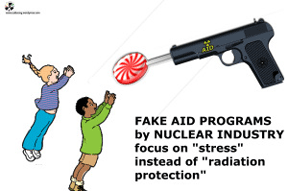 The nuclear industry helps irradiating and murdering Children, assisted by IAEA, WHO, ICRP, BEIR, UNSCEAR and local and national health authorities. With Cover Up, Dose Limits and Do not evacuate Policy.
Here is a belarusian Example: CORE / ETHOS Program:
http://tekknorg.wordpress.com/2011/03/18/core-a-chernobyl-aid-program-that-kills/
= learn how to live in irradiated areas (no word about evacuation) & avoid stress (instead of radiation protection) & build industry, infra structure, accept the radiation, resettlement of people in contaminated areas <- instead of evacuation!
! This is PRO NUCLEAR!
Now in Japan: http://www.globalgiving.org/projects/http-fukushima-kids-org/
“Even in the present, over one year after the Fukushima Daiichi nuclear disaster, there are restrictions on children playing outside in areas of Fukushima”
Of course it is. Children still live in irradiated areas and are massively more vunerable to it, than their parents. Children = Mitosis = faster cell division = FAST CANCER GROWTH & silent death
“their physical strength has declined greatly due to insufficient exercise and they are also experiencing mental stress.”
Is stress the problem? Or is a Cesium 137 radionuclide in their heart tissue the problem? A plutonium atom in the lungs? Strontium 90 in bones and teeth? Is stress really the problem? Continue reading
World Nuclear Industry Status Report explodes the nuclear ‘renaissance’ hype
As always in the face of failure, the industry puts forth new designs as a basis for new promises, now touting small modular reactors with the same fervour with which it touted large, partially modular reactors a decade ago. Congress finds a few hundred million to preserve these dreams even as its cutbacks shatter so many others.
In the astonishing persistence of the global appetite for false nuclear promises lies the critical importance of the World Nuclear Industry Status Report,
 Nuclear Renaissance Was Just a Fairy Tale http://ourworld.unu.edu/en/nuclear-renaissance-was-just-a-fairy-tale 2013•07•12 Peter Bradford Vermont Law School Nuclear power requires obedience, not transparency. The gap between nuclear rhetoric and nuclear reality has been a fundamental impediment to wise energy policy decisions for half a century now.
For various reasons, in many nations the nuclear industry cannot tell the truth about its progress, its promise or its perils. Its backers in government and in academia do no better.
Rhetorical excess from opponents of nuclear power contributes to the fog, but proponents have by far the heavier artillery. In the US, during the rise and fall of the bubble formerly known as “the nuclear renaissance”, many of the proponents’ tools have been on full display. Continue reading
1 This Month



26 September – International Day for the Total Elimination of Nuclear Weapons


PLEASE OPPOSE HR 8255 AND S.3639 – bills would accelerate satellite deployment, with no environmental review or safeguards – https://ncstd5li.quorum.us/campaign/169331/
To see nuclear-related stories in greater depth and intensity – go to https://nuclearinformation.wordpress.com
-
Archives
- September 2026 (245)
- August 2026 (330)
- July 2026 (355)
- June 2026 (287)
- May 2026 (306)
- April 2026 (356)
- March 2026 (251)
- February 2026 (267)
- January 2026 (308)
- December 2025 (358)
- November 2025 (359)
- October 2025 (375)
-
Categories
- 1
- 1 NUCLEAR ISSUES
- business and costs
- climate change
- culture and arts
- ENERGY
- environment
- health
- history
- indigenous issues
- Legal
- marketing of nuclear
- media
- opposition to nuclear
- PERSONAL STORIES
- politics
- politics international
- Religion and ethics
- safety
- secrets,lies and civil liberties
- spinbuster
- technology
- Uranium
- wastes
- weapons and war
- Women
- 2 WORLD
- ACTION
- AFRICA
- Atrocities
- AUSTRALIA
- Christina's notes
- Christina's themes
- culture and arts
- Events
- Fuk 2022
- Fuk 2023
- Fukushima 2017
- Fukushima 2018
- fukushima 2019
- Fukushima 2020
- Fukushima 2021
- general
- global warming
- Humour (God we need it)
- Nuclear
- RARE EARTHS
- Reference
- resources – print
- Resources -audiovicual
- Weekly Newsletter
- World
- World Nuclear
- YouTube
-
RSS
Entries RSS
Comments RSS
 nuclear-news