EDF’s hypocrisy -Hinkley C nuclear construction continued, despite pandemic, as “essential” work

Bridgwater Mercury 4th April 2020 Roy Pumfrey: WHILE EDF has gone halfway by reducing the number of workers on the Hinkley C (HPC) site, the company seems reluctant to shut HPC down completely (‘HPC construction continues’, Mercury, March 24) due to the Coronavirus pandemic.
An EDF statement talked about reducing worker numbers ‘further as work already in progress is completed’, but was not specific about which work was so critical that it couldn’t be terminated now and how much longer it would carry on.
This is in stark contrast to the situation at Flamanville in France (HPC’s sister station) where EDF has stopped all but essential tasks. EDF hides behind the fig leaf of HPC being ‘a project of critical national importance’.
This is simply no longer justified. If it was okay to stop work for three weeks
over Christmas and the New Year, it must be done now when the stakes are
much higher than a holiday. At the same time, EDF promised to take more
effective measures on social distancing. Photographs of workers grouped in
bus queues and using the canteen but clearly less than 2m apart show that
this is all but impossible.
https://www.bridgwatermercury.co.uk/news/18351121.letter-shut-hinkley-c-now/
Despite propaganda from nuclear/coal front group, NOW IS the time to talk about climate change
This is exactly the time to be talking about climate change, Joel Makower, Chairman & Executive Editor, Green Biz Group, Green Biz, March 31, 2020 – I rarely get exasperated from reading environmental business media, but a quote last week in a Bloomberg article about sustainability and the U.S. economic crisis got me headed in that direction.
 The quote came from Ted Nordhaus, co-founder of the Breakthrough Institute, a research group whose founders, self-described environmentalists, have made a career out of being gadflies — for example, arguing in favor of nuclear power and natural gas, arguing against putting a price on carbon emissions and claiming that there’s no real limit to the earth’s carrying capacity, or that energy efficiency doesn’t work because of something called the “rebound effect.”
I’ll leave it to you to proceed down the wormhole of websites critiquing the group’s analyses. Suffice to say that the Breakthrough Institute has become a darling of the anti-science, pro-pollution conservative right, which frequently cites its work in order to attack environmentalists and climate scientists and their fact-based policy recommendations.
Here’s last week’s quote, in reference to the notion of integrating climate measures into congressional appropriations as we rebuild the economy reeling from the coronavirus pandemic:
…… he says. “It would be tone-deaf to talk about climate change now.”
It’s a specious ploy often used by conservatives. Following a mass shooting, it’s not the right time to talk about gun control. Following a hurricane, it’s not the right time to talk about climate-exacerbated weather events. Following the police shooting of an unarmed black man, it’s not the right time to talk about race relations and inequality.
Of course, later on, when it’s presumably “the right time,” the public’s fickle attention likely has moved on to other front-burner topics.
Just because a problem isn’t in the news doesn’t mean it somehow has been solved. All of the above challenges remain, pandemic or not. And, to varying degrees, they all need to be kept alive, even amid other pressing priorities.
So, Nordhaus is dead wrong: This is exactly the right time to be talking about climate change.
In fact, we need to be talking unapologetically about climate, the clean economy, renewable energy, resilient food systems, sustainable mobility, the circular economy and the Sustainable Development Goals with more vigor than ever…….https://www.greenbiz.com/article/exactly-time-be-talking-about-climate-change
Sam and the Plant Next Door – growing up by the nuclear power plant
Sam, 11, is always being told not to worry about the nuclear power plant rising next door, but for him there is lots to think about. Hinkley Point C will be Britain’s largest nuclear plant, and it’s only two miles away. Most of his classmates expect to work at the plant but Sam is determined to escape that fate.
His dream is to protect the surrounding marine life he identifies with. Like the fish, he feels unappreciated by the adults. Sam thinks the only way to reach his dream is to leave his friends behind and to go to a private school. But when he’s offered a place, his parents can’t afford the fees. As a last resort, they turn to the power company for funding, which forces Sam to decide what kind of person he wants to be. Drifting between Sam’s daily life and his dreams, a film about holding on and letting go, along the tricky passage from childhood innocence to grown-up life https://www.youtube.com/watch?v=VMhYngrEgZU&feature=youtu.be
Meet the Climate Science Deniers Who Downplayed COVID-19 Risks

|
Meet the Climate Science Deniers Who Downplayed COVID-19 The very next day, the American Council on Science and Health (ACSH) published an article titled, “Coronavirus in the U.S.: How Bad Will It Be?” “Is coronavirus worse than the flu?” it began. “No, not even close.” “It already has spread from person-to-person in the U.S., but it probably won’t go far,” ACSH added. “And the American healthcare system is excellent at dealing with this sort of problem.” ACSH is one of several organizations promoting climate science denial that are now spreading misinformation on the coronavirus, with potentially deadly consequences. American Council on Science and Health?The ACSH presents itself to the public as a proponent of “peer-reviewed mainstream science,” in the words of the organization’s mission. Their experts have frequently been quoted in mainstream newspapers and magazines, and they pen columns criticizing journalists who write critically about companies like Monsanto. The group has received funding from oil giants including ExxonMobil, as well as from the agribusiness, chemical and tobacco industries to name a few. When it comes to climate change, ACSH has published a steady stream of articles downplaying climate science and criticizing efforts to slow carbon emissions — even in the face of a mountain of peer-reviewed research on the climate crisis. ACSH slammed the medical journal The Lancet as “an ideologically driven outlet with a very clear political agenda where being sensationalist and culturally woke trumps evidence and reasonability” (after the Lancet published an article titled “The carbon footprint”). The purported “pro-science” advocacy group has labeled Greta Thunberg’s activism “doomsday prophesying.” It has (falsely) suggested that climate change is less of a concern because “more people die in winter than in summer” (they don’t). And that’s all just in the past nine months. The ACSH’s stance against climate action dates back to at least 1997. When it comes to coronavirus, now a global pandemic, ACSH’s authors rushed to judgment. They assured readers that there was little to worry about, and put some of the same faulty thinking that underlies their stance on climate change on display. ACSH isn’t alone. Other organizations that have also engaged in climate science denial made similar missteps on COVID-19, including prominent organizations that fanned the flames of conspiracy theories or confidently promoted complacency when circumstances required rapid action. To be clear: No one should be faulted for failing to foresee precisely how severe of a problem COVID-19 would prove to be. None of us has a crystal ball and few, if any, expected this situation to unfold in this particular way. But these organizations published positions that not only wound up being laden with false reassurances, but they did so based on claims that they made confidently at the time that now appear to have been false or misleading. Defending Conspiracy Theorists Continue reading |

Nuclear Power Plants: Tritium is a lot more hazardous than they say

tests for statistical significance have been misused in epidemiological studies on cancers near nuclear facilities. These in the past have often concluded that such effects do not occur or they downplayed any effects which did occur. In fact, copious evidence exists throughout the world – over 60 studies – of raised cancer levels near NPPs.
Most (>75%) of these studies found cancer increases but because they were small, their findings were often dismissed as not statistically significant. In other words, they were chucked in the bin marked “not significant” without further consideration.
The Hazards of Tritium, Dr Ian Fairlie, March 13, 2020
Summary
Nuclear facilities emit very large amounts of tritium, 3H, the radioactive isotope of hydrogen. Much evidence from cell/animal studies and radiation biology theory indicates that tritium is more hazardous than gamma rays and most X-rays. However the International Commission on Radiological Protection (ICRP) continues to underestimate tritium’s hazard by recommending a radiation weighting factor (wR) of unity for tritium’s beta particle emissions. Tritium’s exceptionally high molecular exchange rate with hydrogen atoms on adjacent molecules makes it extremely mobile in the environment. This plus the fact that the most common form of tritium is water, ie radioactive water, means that, when tritium is emitted from nuclear facilities, it rapidly contaminates all biota in adjacent areas. Tritium binds with organic matter to form organically bound tritium (OBT) with long residence times in tissues and organs making it more radiotoxic than tritiated water (HTO). Epidemiology studies indicate increases in cancers and congenital malformations near nuclear facilities. It is recommended that nuclear operators and scientists should be properly informed about tritium’s hazards; that tritium’s safety factors should be strengthened; and that a hazard scheme for common radionuclides be established. Continue reading
Dr Ian Fairlea on Epidemiological Evidence of Cancer Risks
 The Hazards of Tritium,https://www.ianfairlie.org/news/the-hazards-of-tritium/ , Dr Ian Fairlie, March 13, 2020 “……….Epidemiological Evidence of Risks Because of methodological limitations, epidemiology studies are a blunt tool for discovering whether adverse effects result from radiation exposures. These limitations include:
- under-ascertainment, …
- strict data requirements….
- confounding factors: the true causes of morbidity or mortality can be uncertain due to confounding factors such as socio-economic status and competing causes of death.
- bias: ……
- poor signal to noise…..
- uncertain doses:……
- wide confidence intervals……
The Abuse of Statistical Significance Tests
“Peaceful” and military nuclear reactors always inextricably linked
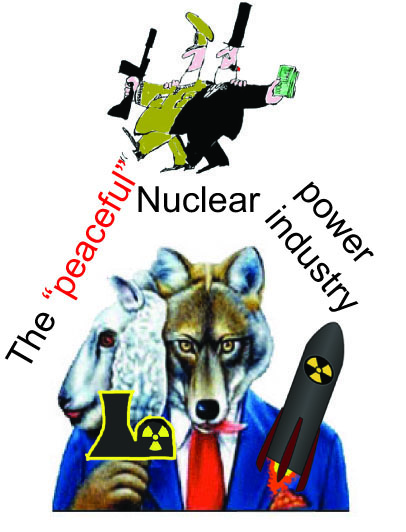 Anne McMenamin Nuclear Fuel Cycle Watch Australia, 19 Mar 20, . I’m referring to the structural links between the commercial and military uses of nuclear reactors, and, to some extent, the way THEY see it – which doesn’t always line up with the technical realities. History shows that the 2 industries have been inextricably linked from the beginning.
“Great efforts have been and still are made to disguise the close connection between nuclear energy for war and for power stations. Two reasons are suggested for this: political convenience in avoiding additional informed protests against nuclear weapon production and industrial convenience in carrying on without public protest what has become a very profitable industry.”
Sir Kelvin Spencer CBE FCGI LLD (HON)
First issue of Medicine and War, in 1985
Similarly, a document from the Los Alamos National Laboratory in August, 1981, states:
“There is no technical demarcation between the military and civilian reactor and there never was one. What has persisted over the decades is just the misconception that such a linkage does not exist.”
“Some Political Issues Related to Future Special Nuclear Fuels Production,”
LA- 8969-MS, UC-16
In 2013, historian Dr David Palmer said,
“The issue is processing uranium for nuclear power that then can be used for defence. You have to understand this in terms of Adelaide; it’s a military, industrial and intelligence complex.”
Palmer was commenting on the notable push for nuclear energy and nuclear submarines coming from numerous academics and business people in Adelaide. He considered the real motive behind the nuclear push is security in energy supply for the military, and hence the need to solve the problem of waste disposal, which is currently discouraging investment in nuclear power. Major military/weapons corporations such as Raytheon, Halliburton subsidiary Kellogg, Brown and Root, Lockheed Martin, Babcock and General Atomics are now a noticeable presence in the SA economy.
Links can be clearly seen, e.g. Heathgate, which owns the Beverley mine, is a wholly owned subsidiary of General Atomics, one of the world’s largest weapons manufacturer/servicer. https://www.facebook.com/groups/1021186047913052/
Japan’s Olympic Games propaganda really tops the lies that cover up the Fukushima nuclear catastrophe
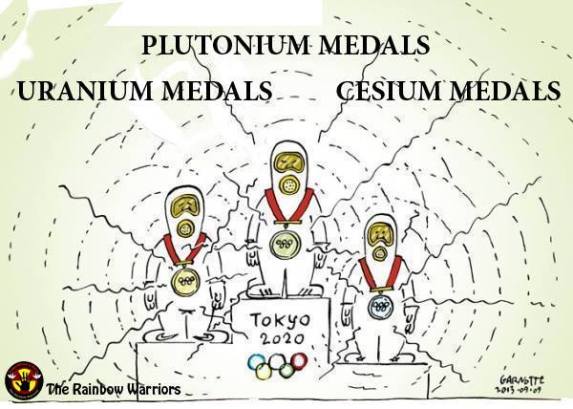
Japan’s Nuclear Cover-up Continues, Nine Years after the Fukushima Disaster, Fairewinds Energy Education, March 10, 2020 by Arnie Gundersen “……. 2020 Olympics
In order for Japan to win its Olympic bid in 2013, two years later, Japan’s next Prime Minister Abe stated that the Fukushima disaster was ‘under control’. This statement was also a blatant lie that succeeded in winning the bid to hold the 2020 Olympics in Tokyo at the expense of the taxpayers and residents of Japan. Don’t take Fairewinds word for it! Read what Japan’s former Prime Minister, Junichiro Koizumi said to Reuters in September 2016. Entitled Abe’s Fukushima ‘under control’ pledge to secure Olympics was a lie: former PM, Reuters wrote,
Japanese Prime Minister Shinzo Abe’s promise that the crippled Fukushima nuclear plant was “under control” in his successful pitch three years ago for Tokyo to host the 2020 Olympic Games “was a lie”, former premier Junichiro Koizumi said on Wednesday.
Frequent readers of the Fairewinds newsletter will remember last year’s posts entitled Atomic Balm 1 and Atomic Balm 2 in which Fairewinds Energy Education described in detail the path of deception that Japan has used to take the world’s attention off of the lives of its own people, who are still being compromised by the Fukushima Daiichi nuclear tragedy. The 2020 Olympics puts the media focus onto something else – so that the world continues to believe that nuclear power reactors are still a safe form of generating electricity.
This nine year legacy of lies by the government of Japan, nuclear incentivized governments worldwide, and the atomic industry are a harbinger for the seemingly inevitable approach of the 2020 Tokyo Olympics. Hopefully mainstream media covering the summer games will finally see through this glamorous marketing scam and identify the fact that Fukushima Prefecture remains severely radiologically contaminated. Real people, who are citizens of Japan, are seeing their health and that of their families being compromised for generations as they are forced to return to radiologically contaminated areas. Entire families and their communities are facing significant health risks simply to enable corporate profiteering of those investors, energy producers, banks, and government officials associated with the ongoing operation of nuclear power plants in Japan and around the world. https://www.fairewinds.org/demystify/japans-nuclear-cover-up-continues-nine-years-after-the-fukushima-disaster
Big Oil Big Soda and plastically polluted Planet Earth.
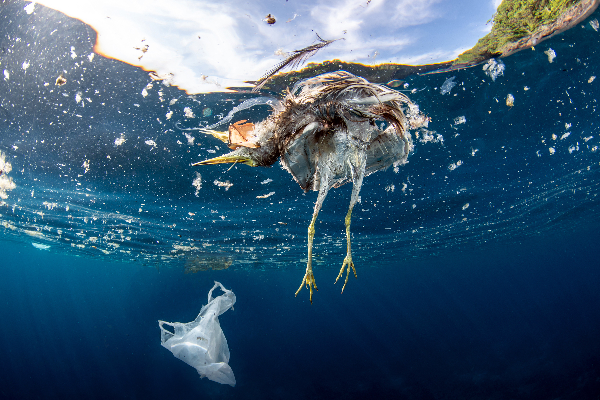
“They really sold people on the idea that plastics can be recycled because there’s a fraction of them that are,”..“It’s fraudulent. When you drill down into plastics recycling, you realize it’s a myth.” …… “Recycling delays, rather than avoids, final disposal,” the Science authors write. And most plastics persist for centuries. …….
We are all guinea pigs in this experiment, as plastics accumulate in the food web, appearing in seafood, table salt, and ironically even in bottled water. Many plastics are mixed with a toxic brew of colorants, flame retardants, and plasticizers.
 PLANET PLASTIC, How Big Oil and Big Soda kept a global environmental calamity a secret for decades, Rolling Stone, By TIM DICKINSON, MARCH 3, 2020
Every human on Earth is ingesting nearly 2,000 particles of plastic a week. These tiny pieces enter our unwitting bodies from tap water, food, and even the air, according to an alarming academic study sponsored by the World Wildlife Fund for Nature, dosing us with five grams of plastics, many cut with chemicals linked to cancers, hormone disruption, and developmental delays. Since the paper’s publication last year, Sen. Tom Udall, a plain-spoken New Mexico Democrat with a fondness for white cowboy hats and turquoise bolo ties, has been trumpeting the risk: “We are consuming a credit card’s worth of plastic each week,” Udall says. At events with constituents, he will brandish a Visa from his wallet and declare, “You’re eating this, folks!”
With new legislation, the Break Free From Plastic Pollution Act of 2020, Udall is attempting to marshal Washington into a confrontation with the plastics industry, and to force companies that profit from plastics to take accountability for the waste they create. …….
The battle pits Udall and his allies in Congress against some of the most powerful corporate interests on the planet, including the oil majors and chemical giants that produce the building blocks for our modern plastic world — think Exxon, Dow, and Shell — and consumer giants like Coca-Cola, Nestlé, and Unilever that package their products in the stuff. Big Plastic isn’t a single entity. It’s more like a corporate supergroup: Big Oil meets Big Soda — with a puff of Big Tobacco, responsible for trillions of plastic cigarette butts in the environment every year. And it combines the lobbying and public-relations might of all three………
Massive quantities of this forever material are spilling into the oceans — the equivalent of a dump-truck load every minute. Plastic is also fouling our mountains, our farmland, and spiraling into an unmitigatable environmental disaster. John Hocevar is a marine biologist who leads the Oceans Campaign for Greenpeace, and spearheaded the group’s response to the BP oil spill in the Gulf. Increasingly, his work has centered on plastics. “This is a much bigger problem than ‘just’ an ocean issue, or even a pollution issue,” he says. “We’ve found plastic everywhere we’ve ever looked. It’s in the Arctic and the Antarctic and in the middle of the Pacific. It’s in the Pyrenees and in the Rockies. It’s settling out of the air. It’s raining down on us.”
More than half the plastic now on Earth has been created since 2002, and plastic pollution is on pace to double by 2030. At its root, the global plastics crisis is a product of our addiction to fossil fuels. The private profit and public harm of the oil industry is well understood: Oil is refined and distributed to consumers, who benefit from gasoline’s short, useful lifespan in a combustion engine, leaving behind atmospheric pollution for generations. But this same pattern — and this same tragedy of the commons — is playing out with another gift of the oil-and-gas giants, whose drilling draws up the petroleum precursors for plastics. These are refined in industrial complexes and manufactured into bottles, bags, containers, textiles, and toys for consumers who benefit from their transient use — before throwing them away. Continue reading
Japan won’t back U.N. exhibition unless Fukushima references removed, hibakusha say
|
Japan won’t back U.N. exhibition unless Fukushima references removed, hibakusha say https://www.japantimes.co.jp/news/2020/03/04/national/japan-pushes-remove-fukushima-references-u-n-exhibition/#.XmAll6gzbIUKYODO The Foreign Ministry has said it may withdraw its backing for an upcoming exhibition at the United Nations unless references to the Fukushima nuclear disaster are removed, a group representing hibakusha has said.
The Japan Confederation of A- and H-Bomb Sufferers Organizations is set to mount the exhibition during the review conference for the Nuclear Non-Proliferation Treaty, from April 27 to May 22. The ministry, which has supported the confederation’s three previous exhibitions, suggested it could halt such support unless the requested changes are made, said Sueichi Kido, the group’s secretary general. The exhibition in the lobby of the U.N. headquarters in New York will consist of around 50 panels mainly describing the horrors of nuclear weapons, including the aftermath of the 1945 atomic bombings of Hiroshima and Nagasaki. Two of the panels will touch on the nuclear disasters at the Fukushima No. 1 power plant in 2011 and Ukraine’s Chernobyl power plant in 1986. According to Kido, the ministry claims the panels contradict the spirit of the nonproliferation treaty, which allows for the peaceful use of nuclear technology. A ministry official said its support for the exhibition was under review and declined to confirm whether any pressure had been applied to change its content. Kido said there had been a “breach of trust” and that the confederation, which represents survivors of the atomic bombings, plans to hold the exhibition as planned with or without the ministry’s support. “Atomic bombs and nuclear accidents are the same in the sense that they cause harm through radiation. As a victim of atomic bombing, Japan has a responsibility to work toward the elimination of nuclear weapons,” Kido added. |
|
Flinders University, South Australia: collusion with nuclear power promotion, Prof Pam Sykes, and the scam of “hormesis”

The Industry Push to Force Nuclear Power in Australia, Part 1 of A Study of the “Report of the inquiry into the prerequisites for nuclear energy in Australia” Australian Parliamentary Committee 2020.by nuclearhistory, February 29, 2020“………….The most recent nuclear collaboration between Australia and a nuclear power for nuclear purposes commenced in the year 2000. At that time a US Department of Energy Contractor named Bobby Scott, based at Los Alamos and at Lovelace Respiratory Research Laboratory, New Mexico, came to Adelaide carrying contract documents. The documents were to be signed by the US DOE and involved personnel of Flinders University. Bobby Scott is a well known (to people in the field) as a leading advocate for the theory of radiation hormesis. The contract to be signed was the first of a number. From the time of the signing of that contract, Flinders University engaged in very strong advocacy of the expansion of nuclear industry in South Australia. Prof Pam Sykes was flown from Adelaide to Los Almos and undertook training and seminars in Hormesis. The concept that radioactive substances are, in her words, “like vitamins”.
I have fully explained that this unproven theory flies in the face of reality in terms of radiological safety and data from monitoring of dose and disease all over the world, including, contrary to the claims of the school hormesis, the naturally high background radiation regions of Iran and India. In those parts of Iran and India, (the five northern provinces in Iran, and Kerala in India) some cancer rates are among the highest in the world. Further, in those Iranian provinces breast cancer in teenage women is more common than it is even in the West. And so on. There are five types of cancer in northern Iran which have very high rates. In south western Kerala, the rates of female thyroid cancer is very, very high.
Contrary the to statements made by the school of hormesis, headquartered at Los Alamos, USA and Flinders University Adelaide. From 2000 on, Flinders University promoted the idea of radioactive substances such as uranium and its decay products and the fission products as being “like vitamins”, necessary for life. By 2011 the university was promoting the idea that an expansion of the state’s uranium mines would be good for the health of South Australians, because the natural background here is “too low” for good health. Presumably the transport of tons of additional uranium ore by train from the mines to the ports in open railway trucks would result in faint clouds of radionuclide “vitamins” being dispersed over the whole population of the state in precisely the right theoretical dose, taking into account, somehow, automatically, the age, gender and health status of each South Australian. (I didn’t write what Sykes did, so don’t blame me.). In 2011 the US DOE funded Flinders University put its pedal to the metal and flew into the debate, labelling South Australians who disagreed with it’s position in words which were insulting and which labelled us as lunatics, radiophobes and totally ignorant of radiological safety principles, cowardly, and devoid of reason. Read it here: https://news.flinders.edu.au/blog/2011/07/14/radiation-response-a-meltdown-in-reason/
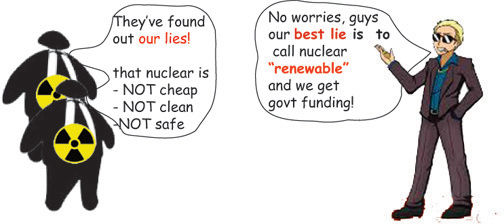
Bill in California to call nuclear power “renewable”!
|
Should California classify nuclear power as renewable? San Diego Union Tribune By ROB NIKOLEWSKI, MARCH 3, 2020
Although he admits it’s a long shot, a member of the California Legislature from the district that includes the Diablo Canyon nuclear plant has introduced a bill that would add nuclear power to the state’s list of renewable energy sources……..
Established in 2002, California’s Renewables Portfolio Standard spells out the power sources eligible to count toward the state’s goals to wean itself of fossil fuels. The list includes solar, wind, biomass, geothermal, small hydroelectric facilities and even tidal currents. The standard has been updated, currently calling for 60 percent of California’s electricity to come from renewables by 2030 and 100 percent from carbon-free sources by 2045. Nuclear power is not part of the portfolio standard and Diablo Canyon — the only remaining nuclear plant in California — is scheduled to stop producing electricity by 2025. Pacific Gas & Electric, the operators of Diablo Canyon, announced in 2016 an agreement with a collection of environmental and labor groups to shut down the plant. PG&E said Diablo will become uneconomical to run due to changes in California’s power grid — such as growth of renewable energy sources, increased energy efficiency measures and the migration of customers from traditional utilities to community choice energy programs. But Cunningham thinks the passage of Assembly Bill 2898, which he introduced last week, could give the plant literally a new lease on life…….. When told of Cunningham’s bill, David Weisman, outreach coordinator for the Alliance for Nuclear Responsibility, said flatly, “Diablo Canyon has become a burdensome, costly nuclear white elephant.” Critics say nuclear power by definition cannot be considered renewable because it leaves behind waste in the form of spent nuclear fuel that then has to be stored. The federal government has not found a site to deposit the waste that has built up over decades from commercial nuclear power plants……. https://www.sandiegouniontribune.com/business/energy-green/story/2020-03-03/should-california-count-nuclear-power-count-as-renewable |
|
The Olympic torch relay promoting “radiation recovery” – not so popular in Fukushima
 In Fukushima, Olympic torch relay faces cool welcome from nuclear evacuees WTVB,
FUTABA, Japan (Reuters) – Dressed in protective plastic coveralls and white booties, Yuji Onuma stood in front of the row of derelict buildings that included his house, and sighed as he surveyed his old neighborhood.
On the once-bustling main street, reddish weeds poked out of cracked pavements in front of abandoned shops with caved-in walls and crumbling roofs. Nearby, thousands of black plastic bags filled with irradiated soil were stacked in a former rice field.
“It’s like visiting a graveyard,” he said.
Onuma, 43, was back in his hometown of Futaba to check on his house, less than 4 kilometers from the Fukushima nuclear power plant, which suffered a triple meltdown in 2011 following an earthquake and tsunami, leaking radiation across the region.
The authorities say it will be two more years before evacuees can live here again, an eternity for people who have been in temporary housing for nine years. But given the lingering radiation here, Onuma says he has decided not to move back with his wife and two young sons.
Most of his neighbors have moved on, abandoning their houses and renting smaller apartments in nearby cities or settling elsewhere in Japan.
Given the problems Futaba still faces, many evacuees are chafing over the government’s efforts to showcase the town as a shining example of Fukushima’s reconstruction for the 2020 Tokyo Olympics.
While there has been speculation that the global spread of the coronavirus that emerged in China last month might force the cancellation of the Olympics, Japanese officials have said they are confident the Games will go ahead.
The Olympic torch relay will take place in Fukushima in late March – although possibly in shortened form as a result of the coronavirus, Olympic organizers say – and will pass through Futaba. In preparation, construction crews have been hard at work repairing streets and decontaminating the center of town.
I wish they wouldn’t hold the relay here,” said Onuma. He pointed to workers repaving the road outside the train station, where the torch runners are likely to pass. “Their number one aim is to show people how much we’ve recovered.”
He said he hoped that the torch relay would also pass through the overgrown and ghostly parts of the town, to convey everything that the 7,100 residents uprooted of Futaba lost as a result of the accident.
“I don’t think people will understand anything by just seeing cleaned-up tracts of land.”
UNDER CONTROL”
In 2013, when Prime Minister Shinzo Abe was pitching Tokyo as the host of the 2020 Games to International Olympic Committee members, he declared that the situation at the Fukushima nuclear plant was “under control”.
The Games have been billed as the “Reconstruction Olympics” – an opportunity to laud Japan’s massive effort to rebuild the country’s northeastern region, ravaged by the earthquake and tsunami, as well as the meltdowns at the nuclear plant owned by Tokyo Electric Power Co.
After the disaster, the government created a new ministry to handle reconstruction efforts and pledged 32 trillion yen ($286.8 billion) in funding to rebuild affected areas.
Signs of the reconstruction efforts are everywhere near the plant: new roads have been built, apartment blocks for evacuee families have sprouted up, and an imposing tsunami wall now runs along the coastline. An army of workers commutes to the wrecked plant every day to decommission the reactors.
In March, just days before the Olympic relay is scheduled to be held across Fukushima, Japan will partially ease a restriction order for Futaba, the last town that remains off-limits for residents to return.
This means that residents like Onuma will be able to freely come and go from the town without passing through security or changing into protective clothing. Evacuees will still not be able to stay in their homes overnight.
After a few years bouncing between relatives’ homes and temporary apartments, Onuma decided to build a new house in Ibaraki, a nearby prefecture. His two sons are already enrolled in kindergarten and primary school there.
“You feel a sense of despair,” said Onuma. “Our whole life was here and we were just about to start our new life with our children.”
When Onuma was 12, he won a local competition to come up with a catchphrase promoting atomic energy. His words, “Nuclear Energy for a Brighter Future” was painted on an arch that welcomed visitors to Futaba.
After the nuclear meltdowns, the sign was removed against Onuma’s objections.
“It feels like they’re whitewashing the history of this town,” said Onuma, who now installs solar panels for a living.
The organizing committee for the Tokyo 2020 Olympics did not respond to requests for comment from Reuters.
“BACK BURNER”
Other residents and community leaders in nearby towns say the Olympics may have actually hindered the region’s recovery.
Yasushi Niitsuma, a 60-year-old restaurant owner in Namie, said the Olympics stalled local reconstruction projects because of surging demand and costs to secure workers and materials ahead of the games in Tokyo.
“We need to wait two years, three years to have a house built because of the lack of craftsmen,” said Niitsuma. “We are being put on the back burner.”
Fukushima’s agriculture and fisheries industries have also been devastated.
“I was astonished by the “under control” comment made in a pitch to win the Olympic Games,” said Takayuki Yanai, who directs a fisheries co-op in Iwaki, 50 kilometers south of the nuclear plant, referring to Abe’s statement.
“People in Fukushima have the impression that reconstruction was used as a bait to win the Olympic Games.”
A government panel recently recommended discharging contaminated water held at the Fukushima plant to the sea, which Yanai expects to further hurt what remains of the area’s fisheries industry……..
Radiation readings in the air taken in February near Futaba’s train station were around 0.28 microsieverts per hour, still approximately eight times the measurement taken on the same day in central Tokyo.
Another area in Futaba had a reading of 4.64 microsieverts per hour on the same day, meaning a person would reach the annual exposure upper limit of 1 millisievert, recommended by the International Commission on Radiological Protection, in just nine days.
Despite the official assurances, it’s hard to miss the signs of devastation and decay around town.
The block where Takahisa Ogawa’s house once stood is now just a row of overgrown lots, littered with concrete debris. A small statue of a stone frog is all that remains of his garden, which is also scattered with wild boar droppings.
He finally demolished his house last year after he failed to convince his wife and two sons to return to live in Futaba.
Ogawa doubts any of his childhood friends and neighbors would ever return to the town.
“I’ve passed the stage where I’m angry and I’m resigned,” he said.
(Reporting by Mari Saito and Kiyoshi Takenaka; Writing by Mari Saito; Editing by Philip McClellan) https://wtvbam.com/news/articles/2020/mar/02/in-fukushima-olympic-torch-relay-faces-cool-welcome-from-nuclear-evacuees/990039/
No advantage in ‘new’ back-to-the-future nuclear reactors for Australia. Is the real motive military?
Part 2 of A Study of the “Report of the inquiry into the prerequisites for nuclear energy in Australia” Australian Parliamentary Committee 2020. The Industry Push to Force Nuclear Power in Australia nuclearhistory 2 Mar 2020 https://wordpress.com/read/feeds/103698880/posts/2607926791 In progress, first draft, incomplete.
The Parliamentary Committee recommends, in part, the following: Recommendation 2
The Committee recommends that the Australian Government undertake a body of work to progress the understanding of nuclear energy technology by:
- Commissioning the Australian Nuclear Science and Technology Organisation (ANSTO), or other equivalent expert reviewer, to undertake a technological assessment on nuclear energy reactors to:
- produce a list of reactors that are defined under the categories of Generation I, II, III, III+ and IV;
- advise on the technological status of Generation III+ and Generation IV reactors including small modular reactors;
- advise on the feasibility and suitability of Generation III+ and Generation IV reactors including small modular reactors in the Australian context; and
- formulate a framework to be used by Government to monitor the status of new and emerging nuclear technologies.The first item of the recommendation – for ANTSO to compile of reactors according to each one’s status within the table of Generation – 1 to 4 might be a good idea, for many of the Generation IV reactor designs were first envisaged and trialled in the 1950s and 1960s before being discarded. Whereas, at the present time, and since the time the US Department of Energy sought ways of halting the decline of nuclear power’s percentage contribution to global energy supply in the 1990s. For that is the time that the idea of resurrecting old designs and calling them new and “Generation IV” and re marketing them first arose
The waste from the very first molten salt fuelled and cooled reactor, as we saw in the previous post, continues to cost US taxpayers money 60 years later.
In 2014 the Brookings Institute published an essay by Josh Freed entitled “Back to the Future, Advanced Nuclear Energy and the Battle Against Climate Change”. This essay is available to read at http://csweb.brookings.edu/content/research/essays/2014/backtothefuture.html The cover illustration is very interesting.

The titled cover includes the disclosure that the nuclear industry sees a future for previously discarded, old reactor designs. It shows a nuclear reactor sitting below sea level, protected by a combined Dyke / Causeway for levitating vehicles. Huge waves threaten the Dyke, vehicles, reactor and giant Science Woman, who is watching on with skilled impartiality. In the distance, buildings taken straight from the cartoon “The Jetsons” appear. The illustration is also, actually, a reinterpretation of the events which occurred in March 2011 at Fukushima. The sub text of the picture admits that nuclear industry cannot keep going in the way that it has done since the days between 1945 and now. The industry would disappear if it did not “modernise”.
The fission industry is dying as more and more competition arises in the form of alternative technologies in the energy generation technology market. Even Fusion research continues to make inroads toward the goal of successful and economic power generation, but it still a few years off. The 1930s fission patents of Szilard are long in the tooth and actually, in terms of economic energy production has always been a failure. Kick started by governments, the standard designs are trusted by fewer and fewer people, especially throughout Asia. Westinghouse Nuclear, GE Nuclear, Toshiba Nuclear are all bankrupt. British Nuclear Fuels Ltd is broke, Sellafield is broke and a growing cleanup cost liability.
So increasingly, the industry needs a unique selling point, something new and radical, something that solves the old nuclear problems. It needs a product which never fails or spills radioactive materials into the biosphere, it needs a product that will not fail because the grid goes down for a few days, it cannot melt down, catch fire like Windscale, Monju and Fermi 1 did.
Seeing as there actually no new concepts, why not look again, in desperation, at the rejected designs of the past? The essay by Josh Freed (his real name) mentions a company called Transatomic. In contrast to the contents of the Freed article, which claims the old new reactor envisioned by Transatomic run on nuclear waste, Transatomic make no such claim. They state that their proposed reactor would run on liquid uranium fuel. As per the original 50s/60s design. They claim that the Molten salt reactor would create less weight of high level waste.
Because the waste would be continuously removed from the reactor. he corporate website for Transatomic is here: http://www.transatomicpower.com/the-science/ And this, from their web site, is precisely what they promise: Molten salt reactors like Transatomic Power’s are fueled by uranium dissolved in a liquid salt. The fuel is not surrounded by cladding, making it possible to continuously remove the fission products that would otherwise stop the nuclear reaction. The liquid fuel is also much more resistant to structural damage from radiation than solid materials – simply, liquids have very little structure to be damaged. With proper filtration, liquid fuel can remain in a molten salt reactor for decades, allowing us to extract much more of its energy.” end quote. They claim their reactor design produces half the nuclear waste of a comparable conventional light water reactor.
This still does not solve the high level nuclear waste stockpile. It adds to it. Given the competition nuclear power has in the modern world, given that the need for ‘baseload’ energy is now shown to be nonsense, what would 1 or 2 small modular molten salt reactors add to Australia? Would they merely replace coal fire powered generation? SA has not had coal fired electricity for some years now. A combination of solar, wind and storage in SA means SA is a net electricity exporter to the Eastern States. We have back up of gas fired generation which very rarely needed.
Sadly for Transatomic, Green Tech Media state the following at https://www.greentechmedia.com/articles/read/transatomic-to-shutter-its-nuclear-reactor-plans-make-its-technology-public announced the following in 2018:
“Transatomic to Shutter It’s Nuclear Reactor Plans, Open-Source It’s Tecnology.
The startup backed by Peter Thiel won’t be able to build its advanced reactor designs—but it’s making its IP available for others to carry on the work.” Source: Jeff St. John, 25 Sept 2018.as given above.
This gift to the world by Transatomic occurred at the time in Australia when various people began a bombastic and highly enthused campaign to convince Australians that Molten Salt Reactors, fuelled with either Uranium or Lithium or nuclear waste, were Jesus Mark 2. “We’ll Save Yer, just like we did in the Cold War. Solar and batteries are for whimps. We Can’t have solar and wind power in Australia, its a threat to Queensland Coal. Let’s nuclear instead and all make a quick a buck with IP”.
Funny that. Talk about drumming up business prospects and investment funds, and in 2020, floating a float on the back of sympathetic and one eyed Parliamentary Inquiry!
Double or Nothing?
The promise made by Transatomics is that molten fuel/molten salt reactors made with modern techniques will reduce by roughly half the amount of high level nuclear waste generated per unit of power generated. However, at the current time the amount of high level nuclear waste (ie, fission products -the transmutation products described in Szilard’s 1930s patents) and the release of the gaseous forms of these substances into the atmosphere, generated by Australian electricity generation is ZERO.
So the introduction of Molten Salt Reactor into Australia for electricity production will RAISE the production of high level nuclear waste from this activity by 100%. It won’t half, it won’t double, it will increase by x grams per watt. It is a spurious argument to say any reactor type will reduce Australia’s power industry high level nuclear waste when we produce zero at the moment. And if Australia continues on its non nuclear path, that zero rate of power related high level waste will remain zero forever. So where is the advantage for Australia in introducing power reactors in the civilian sphere?
I am led to believe that it will take between 10 – 20 years for any Australian nuclear power reactor to come on line from the time it is approved. By that stage the competition from other forms of low carbon power production will be much, much more severe than it is now. And today, in my opinion, only a devotee of nuclear power would see any advantage in introducing any type of nuclear reactor to Australia. Unless the real motive for such a reactor is a military motive. If so, the O’Brien Committee and the government needs to come clean on that. Not that they will. Such an admission is likely to be impossible for several reasons. Besides, no nuclear industry is free to fully disclose the corporate production and disposition of “special nuclear materials”.
So, I suppose in the end the Committee recommend ANTSO compile a list of reactor types and nominate the current industry PR terms for each type. For the Generational types (1 through IV) have actually very little to do with the chronological order and date range over which each type first manifest as a prototype. The small World War 2 German reactors, of which there were many, are little known, and the US ALSOS project has not disclosed that much about them. Germany had at least 4 reactor programs, 7 ways of enriching uranium. Japan had an Army fission project, a Navy fission project, an Air Force Fission project. All were formally abandoned, ironically , in July 1945. Germany was able to enrich uranium.
This is ancient history, but the world remains fairly ignorant I think, as to which reactor type is the safest, most economic, most reliable and so on. So far, all I have heard from the nuclear industry is PR manufactured originally by the US Department of Energy which relabelled the various reactor designs originated in the US according to a “Generation Number” which is completely detached from the chronological sequence in which they occurred.
In World War 2 Germany was working on heavy water reactors. Does that mean Hitler’s heavy water reactors were Generation III+ ? Of course not. They were Gen 1. As was the Canadian heavy water reactor of World War 2 which supplemented the US plutonium production at Hansford. If the Candu reactor is Gen III+ I’m Father Christmas. What the US DOE is doing with its naming is using marketing techniques to sell old concepts as new ideas.
Car companies do the same when naming cars. Makers of garbage trucks send salesmen around to Council depots extolling the virtues of the Gen IV 2 ton rubbish truck, complete with compactor, a tilt tray and 8 track stereo sound. And Depot managers get given toy model rubbish trucks they sit on their book cases to show how technically astute they are in the field of garbage.
Same deal here. It’s a no brainer. Yet, start collecting lists from ANSTO Mr. O’Brien. Great idea sir. It’ll keep you off the streets for awhile.
Busting the lies of the Australian Government about “new” nuclear reactors
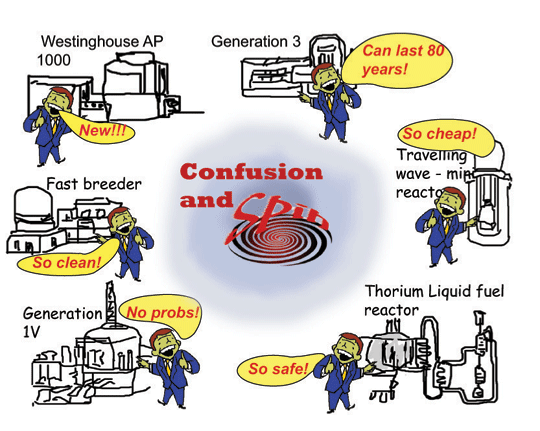
The core propositions of non-traditional reactor proponents – improved economics, proliferation resistance, safety margins, and waste management – should be reevaluated.
Before construction of non-traditional reactors begins, the economic implications of the back end of these nontraditional fuel cycles must be analyzed in detail; disposal costs may be unpalatable………. reprocessing remains a security liability of dubious economic benefit
Non-traditional” is used to encompass both small modular light water reactors (Generation III+) and Generation IV reactors (including fast reactors, thermal-spectrum molten salt reactors, and high temperature gas reactors)
|
Burning waste or playing with fire? Waste management considerations for non-traditional reactors Full Text
The Industry Push to Force Nuclear Power in Australia https://nonuclearpowerinaustralia.wordpress.com/2020/03/02/burning-waste-or-playing-with-fire-waste-management-considerations-for-non-traditional-reactors-full-text/ by nuclearhistory March 2, 2020 The following paper is copied here in order to counter the false, incorrect and erroneous propaganda published by the Australian Government and its Parliamentary Committee for lying to the Australian people about so-called new nuclear reactor designs, all of which were rejected by competent authorities in the 1950s, 1960s, and 1970s. The residues produced by these test reactors continue to cost the American taxpayer money and continue to present the American people with stored, hazardous radioactive waste which is also high chemically reactive. |
1 This Month



26 September – International Day for the Total Elimination of Nuclear Weapons


PLEASE OPPOSE HR 8255 AND S.3639 – bills would accelerate satellite deployment, with no environmental review or safeguards – https://ncstd5li.quorum.us/campaign/169331/
To see nuclear-related stories in greater depth and intensity – go to https://nuclearinformation.wordpress.com
-
Archives
- September 2026 (219)
- August 2026 (330)
- July 2026 (355)
- June 2026 (287)
- May 2026 (306)
- April 2026 (356)
- March 2026 (251)
- February 2026 (267)
- January 2026 (308)
- December 2025 (358)
- November 2025 (359)
- October 2025 (375)
-
Categories
- 1
- 1 NUCLEAR ISSUES
- business and costs
- climate change
- culture and arts
- ENERGY
- environment
- health
- history
- indigenous issues
- Legal
- marketing of nuclear
- media
- opposition to nuclear
- PERSONAL STORIES
- politics
- politics international
- Religion and ethics
- safety
- secrets,lies and civil liberties
- spinbuster
- technology
- Uranium
- wastes
- weapons and war
- Women
- 2 WORLD
- ACTION
- AFRICA
- Atrocities
- AUSTRALIA
- Christina's notes
- Christina's themes
- culture and arts
- Events
- Fuk 2022
- Fuk 2023
- Fukushima 2017
- Fukushima 2018
- fukushima 2019
- Fukushima 2020
- Fukushima 2021
- general
- global warming
- Humour (God we need it)
- Nuclear
- RARE EARTHS
- Reference
- resources – print
- Resources -audiovicual
- Weekly Newsletter
- World
- World Nuclear
- YouTube
-
RSS
Entries RSS
Comments RSS
 nuclear-news