A People’s Guide to the War Industry, by Christian Sorensen — Rise Up Times

“The main role of the federal government under capitalism is to maintain the capitalist economic system and set the general conditions by which large corporations and billionaires are able to accrue more and more profit.”
A People’s Guide to the War Industry, by Christian Sorensen — Rise Up Times A People’s Guide to the War Industry -2: Profits & Deception https://consortiumnews.com/2021/05/26/a-peoples-guide-to-the-war-industry-2-profits-deception/May 26, 2021 Christian Sorensen maps out the global system of weapons mongering. Second in a series of five articles on the U.S. military-industrial-congressional complex. By Christian Sorensen
Special to Consortium News War corporations are spread across the United States. The top war industry hubs in the U.S. are Huntsville, Alabama; greater Boston; greater Tampa, Florida; the Dallas-Fort Worth region; southern California; and the corridor stretching from northeast Virginia, through Washington, to Baltimore (consistently home to the wealthiest counties in the country).
The U.S. war industry profits well through global supply chains, including setting up subsidiaries in allied capitalist countries and using those countries’ industrial bases to produce parts of a weapons platform (such as the costly, underperforming F-35 Joint Strike Fighter, parts of which are built in locations as diverse as Italy and Japan).
War corporations manage global chains by organizing, coordinating, and enforcing a hierarchical command structure upon disparate locations. Orders flow down the chain and capital flows up, allowing the corporation’s executives, and ultimately Wall Street — not workers who make the products — to harvest enormous amounts of wealth. This exacerbates inequality, not just in Lemont Furnace, Pennsylvania, and Marietta, Georgia, but also Rochester, England, and Aire-sur-l’Adour, France — all locations where U.S. war products are made. War corporations paint these actions as “building lasting capacity” and other euphemisms.
A euphemism is a kinder, gentler term used in place of a direct, often more accurate one. The MIC employs euphemisms adeptly. Public relations gurus know the English language very well. Recall George Orwell’s 1946 essay “Politics and the English Language:”
”In our time, political speech and writing are largely the defence of the indefensible… Thus political language has to consist largely of euphemism, question-begging and sheer cloudy vagueness.”
With the care of a sommelier, MIC propagandists select the perfect euphemisms to mask their activities and present death and destruction in comfortable terms. Getting rid of euphemism, pursuing an honest language, is one step toward achieving a system that benefits people and planet.
Globe-Spanning Installations
Military installations are avenues through which corporations route goods and services. Sometimes the U.S. military sets up an installation overseas with permission from the allied capitalist regime. Sometimes the ruling class orders the military to take the land by force. It stole land in Guam, compensating locals a paltry sum or nothing at all. It took the Enewetak Atoll in the Marshall Islands. It stole Vieques, Puerto Rico. It teamed up with the Danish government to remove the indigenous Inughuit to make way for Thule Air Base in northwest Greenland. And the Pentagon and State Department teamed up with the United Kingdom to remove Chagossians from the Chagos Archipelago in the Indian Ocean in order to set up what is now called Naval Support Facility Diego Garcia.
Incredible corporate profit (e.g. base operations, ordnance, platforms, construction, fuel, maintenance) runs through each military installation. Most U.S. military bases overseas are not located in active war zones. The largest concentrations of U.S. troops are on bases in the Persian Gulf, Europe, and the Western Pacific.
There are thousands of U.S. military installations inside the United States (land stolen from the Native Americans). As contract announcements indicate, Corporate America is sometimes put in charge of studying and documenting the effect a planned base or weapons range might have on the surrounding community — aircraft noise, potential for mishaps and accidents, and the extent to which land use works with or against local designs — even though Corporate America stands to benefit if the base or range gets established.
Duping Workers
In the capitalist economic system, relatively few people control the means of production (e.g. machinery, factories). In order to survive, most people (the working class) sell their ability to work. They receive a wage in return. A worker’s work is what makes money for the ruling class. This is true across all industries, including the war industry.
Workers who design and assemble the major weapons of war form the core of the working class within the war industry. They put together missiles at Raytheon’s factory in Tucson, Arizona. They manufacture drones at General Atomics’ factory in Poway, California. They fabricate land vehicles at AM General’s factory in South Bend, Indiana. They build landing craft at Textron’s factory in New Orleans, Louisiana. Whatever the workers produce is not theirs to use or sell. Instead, their output belongs to the capitalist class. These rulers (literally sitting in corporate suites) decide what to produce, how to produce it, and to whom to sell it.
The ruling class profits by underpaying the workers. A given worker on a given day produces value, which we’ll call A, B, C, D, E, F, and G. The corporation pays the worker a wage comparable to F and G. The rest (A, B, C, D, E) is “surplus value.” This difference between what a worker is paid in wages and the value a worker creates is how the corporation profits
Those profits go toward executives’ compensation (CEO pay at the top five war corporations totaled almost half a billion dollars over the course of 2015-2019); boost stock price and allow for stock buybacks; and are invested to make more profit. Money used to expand business to increase future profits is functioning as capital. An example of this is General Dynamics building a 200,000-square-foot building for submarine assembly at its Groton, Connecticut, shipyard in order to make more goods to sell for profit.
The ruling class inundates the working class with various forms of advertising, public relations gimmicks, propaganda, and disinformation in order to keep the working class (which greatly outnumbers the ruling class) passive and compliant. Many within the working class have swallowed such deception.
Working class jobs within the war industry are various, and include administrative assistant, analyst, armed mercenary, astrophysicist, data officer, engineer, lawyer, lobbyist, linguist, mathematician, public relations specialist, technician, and tradesperson. From the haughtiest academic to the humblest welder, what propaganda have they seized in order to justify working in the war industry?
Civilian Use
Unlike products from other industries, the public cannot eat, consume, play with, learn from, or interact with most goods and services sold by the war industry. Employees of war corporations invoke civilian applications of military technology: The internet, the jet engine, radar, and satellite technology all came about from military funding.
But these are ancillary benefits. Imagine what technological benefits society could achieve if $750 billion per year was directed intentionally toward research and development of technology that benefits human wellbeing and the natural world, not military and war.
We can harness the human mind in many ways. Nonetheless, so far — by the numbers — the U.S. government has only spent significant monies on military and war. Try throwing that kind of money at the sciences and arts every year — via other federal departments, such as Interior, Agriculture, Health & Human Services, Transportation — and see where unpressured, non-militarized research and development lead.
Distancing
Lockheed Martin’s director of communications once said, “The missile has nothing to do with the manufacturer… Lockheed Martin was not the one that was there, firing the missile” (Robert Fisk, Independent,May 18, 1997).
Such distancing is no different from an engineer at a U.S. university who justifies her work on nuclear weapons along the lines of, “Well it’s not me pushing the button. Surely, there are military professionals in charge of these weapons.” Other workers in the war industry rationalize by arguing, “I might disagree with the wars, but I’m not the one elected to make such decisions. I’m just doing my job.” Those who resort to distancing focus on their own daily, incremental tasks, blocking out all consequence.
Traditional Patriotism
Traditional patriotism rallies a person around the flag and shuns holding authority to account. Traditional patriotism allows the wars to continue. True patriotism, however, involves questioning government, making government accountable, and changing government when it is polluted and corrupt. True patriotism, as retired Major Danny Sjursen puts it, is “participatory and principled.”
Support the Troops
Some people justify working for the war industry by saying they do it for the troops. Journalist Jeffrey Stern describes how one machinist at a missile factory rationalizes his role:
“[T]he thing that he said made him most proud about working at Raytheon was helping to keep American servicemen and women safe. The company makes a point of hiring veterans with combat injuries, which reminds him of whom he’s working for and why. He feels it when he sees the gigantic photos of service members that the company hangs in the most prominent parts of the plant. The photos, he explained, are of relatives of Raytheon workers. When he’s at work, the notion of helping American servicemen and women is not abstract. It’s almost tactile.”
Well played, Raytheon! The phrase “support the troops” is a clever slogan through which the MIC throws a blanket of patriotism over the underlying issue: supporting the wars. “Support the troops” has been very effective in getting the working class to line up in favor of war.
Delusion & Moral Bankruptcy
Many people within the war industry are deluded or morally bankrupt and therefore have no problem working in such a destructive industry. Delusion and moral bankruptcy are the direct result of decades of refined capitalist propaganda and indoctrination. Many workers don’t understand that the system exists because of their exploitation. Many don’t understand that the war industry exists as a means of profit. Nor does the increasingly privatized and standardized public-school system emphasize the critical thinking needed to alter such a sad state of affairs.
Lack of Courage
Many smart people, blissfully comfortable with the paycheck that being part of the war industry work brings, lack the courage to act. Consider one plucked at random from the middle ranks of a war corporation. The man’s résumé is impressive: degree from a prestigious university, awards from industry and the Pentagon, and not one ounce of moral courage. His participation in the war industry leads directly to the deaths of innocents abroad and perpetuates war.
This flexible, powerful recipe allows one to justify working in the war industry.
A few people within the MIC recognize the gravity of the situation — that funneling so much money toward military, espionage, and war has a negative effect on U.S. security because it drains manpower, time, and capital, and forestalls social care — but are afraid of the consequences of speaking up.
Group think, hierarchy, compartmentation, economic incentive, and chain of command enforce the status quo. Violence and social isolation deter the few who push back against the machinery of war. The minor whistleblower is ostracized and demoted, the leaker fined and locked up. When just a few people push back, the MIC crushes them. When the working class pushes back, united and together, the MIC has a problem on its hands.
The ruling class employs other devices to ensure the workers continue to sell their labor power. Divide and conquer is a popular device: pit the workers against one another, profiting the capitalist while exhausting the worker. Wedge issues, such as race and nationalism, further split the working class along arbitrary, divisive lines, as seen when U.S. workers buy into the demonization of Arab, Persian, or Chinese workers.
Capitalists also elevate a few workers here and there above other fellow workers (think of the foreman in a Virginia shipyard or a taskmaster in an office producing signals intelligence software). These elevated few are given a tad more money in exchange for keeping the majority of the workers in line.
Replacing workers with machines and automating jobs keeps the workforce desperate. With so many people unemployed and underemployed, capitalist rulers get to pick the most passive laborers for war industry jobs, the ones who will keep their heads down and not raise a fuss about the relative pittance they’re paid. Purchasing the necessities of life (e.g. food, exorbitant healthcare, sky-high rent, utilities) requires that workers continue to sell their labor (the products of which maim and kill the working class in other countries) through which the ruling class becomes fantastically wealthy.
Academia
Education in the United States exists within narrow confines. The working class educated in elementary and secondary schools are not given the opportunity to learn about capitalism, let alone the horrific nature and devastating effects of the U.S. war industry. They are not taught about how the interests of the ruling class (including the Pentagon’s leadership, industry executives, Wall Street financiers, and Congress) clash head-on with the interests of the working class. An uneducated population will not mobilize effectively against its oppressors. This atmosphere of ignorance greatly benefits the MIC.
The war industry and the Pentagon fund extensive science, technology, engineering, and math (STEM) initiatives across the U.S. and in allied countries. By attracting students into STEM careers, the war industry and the Pentagon prepare and safeguard their future. Industry promotion of STEM lays the groundwork for future design, engineering, and production capacity, while the Pentagon promotes STEM in order to foster a technologically literate workforce and future generations of enlisted troops who are capable enough to operate the war industry’s products. STEM efforts are comprehensive, covering a wide geographical area and all ages, from elementary through university.
Many universities in the United States are part of the U.S. war industry. The role of these academic institutions is threefold: research and develop technology, serve as a holding station (e.g. Harvard’s Belfer Center) for MIC elites before they rotate into government or corporate suites, and accept philanthropy from war profiteers thereby whitewashing capitalist brutality. The main academic participants in the war industry include but are not limited to the Massachusetts Institute of Technology (MIT), Johns Hopkins University, Stanford University, the University of Dayton, and Georgia Tech.
The U.S. government runs many research labs pursuing military and intelligence R&D. The Army Research Lab and the Intelligence Advanced Research Projects Activity are located in Maryland. The Defense Advanced Research Projects Agency (DARPA) and the Office of Naval Research are in Arlington, Virginia. The Air Force Research Lab is run out of Wright-Patterson Air Force Base, northeast of Dayton, Ohio, with branches in New Mexico and upstate New York. The U.S. Army Corps of Engineers’ Engineer Research & Development Center is in Vicksburg, Mississippi. Most work in and for these labs is carried out by corporations and academic institutions, not uniformed military personnel.
A report by the Government Accountability Office (GAO) issued in September 2020 detailed, “DOD does not know how contractors’ independent R&D projects fit into the department’s technology goals.”
“Brain drain” happens when industry herds intelligent people toward purposes of war, like when a graduate of an engineering school goes to work for a war corporation instead of a municipality. Humanity thus loses skilled human beings as a result. Brain drain is a great tragedy, and the war industry’s biggest success. In Boston, the U.S. Air Force alone funds ninety different research projects, according to the Air Force Secretary. And that’s just the publicly declared actions of one branch of the military in one city.
Lockheed Martin alone employs nearly 50,000 scientists and engineers, according to its CEO in her presentation to the Society of Women Engineers. Imagine if these minds were working on problems and projects for the betterment of humanity and the planet, instead of devising more ingenious ways to surveil or murder. Imagine the possibilities.
Effective science is based on free, open discussion. Military funding and stipulations (compartmentation, shoehorned focus, classification, near-term deadlines, stove-piped fields) oppose free, open discussion. Breakthroughs benefitting humanity rarely happen when people are tied to military-industry funding priorities, schedules, and narrow cognitive confines. Military and industry shun and condemn the polymath, the free thinker, and the uninhibited tinkerer. Military and industry embrace and fund the careerist, the complicit academic, the rigid functionary, the greedy corporatist, and the aspiring bureaucrat. Military-industry science may possess strong minds, but it does not often make the scientific breakthroughs society needs.
Influence
Strategy involves establishing priorities, making choices, and then matching available resources to goals, means to ends. Capitalists running the war industry utilize a five-step strategy to capture government:
- Pull retiring military officers into war corporations
- Stack the deck by placing ex-industry officials in the Pentagon’s leadership
- Finance congressional campaigns
- Lobby creatively and expansively
- Fund think tanks & corporate media
War corporations recruit retired high-ranking military officers. War corporations use these eager retirees to open doors, influence policy, and increase sales. Generals and admirals retire from the U.S. Armed Forces and then join war corporations where they set to work converting their knowledge (about the acquisition process, senior military and civilian leaders, long-term military policy, and how the Pentagon works) and connections into profit.
Corporate jobs for these retired officers include manager, vice president, lobbyist, consultant, and director. Only a small number of 3- and 4-star officers declines this systemic corruption. War corporations have plenty to pull from, as there are more generals and admirals in uniform today in 2021 than there were at the end of World War II. Mere issuance of a bulletin announcing the hiring of a former high-ranking general or admiral often leads to a boost in stock price.
U.S. military officers benefit professionally and financially from implementing MIC aggression. There is no downside for high-ranking officers who support nonstop war. They’ll soon retire with full benefits, and likely go work for a war corporation. Officers who make it to the highest military ranks are very good at conforming to the system.
These officers support nonstop wars of choice and broad military deployments, and defer to pro-war pretexts and jargon coming from industry think tanks and pressure groups. They judge military activity in terms of numbers (dollars spent, weapons purchased, bases active, troops deployed) instead of clear soldierly goals.
Many officers are unable or unwilling to distinguish between the needs of a war corporation and the needs of a professional uniformed military. These U.S. military officers don’t see war corporations; they see a total force in which military and industry work together. An officer who dissents in a forceful manner risks their career. As the MIC crafts pretexts to justify its own existence and expansion, officers who go against the system from the inside are isolated, shed, or spit out.
Reality is difficult to stomach: There is an absolute dearth of class consciousness and moral courage within the Pentagon. The upper ranks of the U.S. Armed Forces are rife with a caliber of officer predisposed to seek out profit and reward upon retirement.
Executives move smoothly from corporations to the Pentagon, particularly the sundry civilian offices (secretary, deputy secretary, and assistant deputy secretary). These men and women who run the Pentagon have been raised in an environment of profiteering; they are steeped in corporate thought; their allegiance is to corporate success. They bring with them their industry contacts and an exploitative ideology. They turn to corporate products when presented with a military problem. They benefit professionally and financially.
Industry executives, the most rapacious of the capitalist class, enter “public service” and influence programs and policies. This invariably boosts the profits of former industry employers, who, thenceforth, capture and direct more of the U.S. military establishment. (Such actions, profit invested to make more profit, is money functioning as capital.)
Giant corporations finance the campaigns of people running for congressional office. Those people, once in office, help out the corporations. Washington is so corrupt that they’ve basically legalized this process — they’ve legalized bribery. In Buckley v. Valeo (1976), the U.S. Supreme Court ruled that limits on election spending are unconstitutional; in Citizens United v. Federal Election Commission (2010), the Supreme Court distorted the First Amendment’s free speech clause, allowing corporations to spend unlimited amounts on political contributions; and in McCutcheon v. Federal Election Commission (2014), the Supreme Court got rid of limits on the total number of political contributions one can give over a two-year period.
We are told that the Supreme Court defends liberty and provides a check against the executive and legislative branches, however, the function of the Court, as its rulings demonstrate, is to abet corporate authority and financial interest in line with what the Executive and Legislative branches pursue.
The war industry targets both houses of Congress, particularly elected officials on relevant committees (Armed Services, Appropriations, Intelligence, Foreign Relations). The war industry finances many political action committees, or PACs. These are tax-exempt organizations that aggregate donations to fund political campaigns or influence federal elections. Super PACs (a.k.a. independent expenditure-only committees) allow unlimited contributions. Funding congressional campaigns directly impacts the way U.S. elected officials vote.
Politicians and their war industry bosses are proficient at claiming the “defense” industry creates jobs. Take caution when a war corporation throws the word “jobs” around. Many of these jobs are part-time, temporary, or menial (e.g. painter, welder, roustabout), parsed out to an increasingly desperate workforce. Some are construction jobs that vanish in a year or so. Working-class jobs in the war industry are often in difficult conditions.
Industry jobs that pay very well typically require advanced degrees, which the majority of the population does not have. Furthermore, some jobs are non-U.S. jobs (e.g. microchips manufactured overseas). Other jobs are induced (e.g. the mom making less-than-minimum wage on a ridesharing app driving an industry executive from work to a pub, or the waiter at a St. Louis restaurant where a missile engineer dines). Industry inflates job tallies. The goal is to confine the congressional side of the MIC, which cites the inflated jobs numbers and goes along for the ride.
The claim that the “defense” industry brings jobs is a stale public relations ploy. It hides the truth: Spending on healthcare, education, or clean energy creates more jobs than spending on the military.
The war industry can inflate job numbers because there is no accountability coming from Washington: Capitol Hill is largely content letting Corporate America police itself. Readers are likely familiar with cases where corporations get to inspect their own product (e.g. the airline industry, the pork industry) instead of external government inspectors doing the job.
Corporations policing corporations is rampant in the war industry, like when the advertising agency GSD&M measures the effectiveness of its own efforts at recruiting working class youth into the military. Sometimes one corporation polices part of industry, like when Calibre Systems conducts “cost and economic analysis of major weapons system programs and associated acquisition/financial management policies and procedures.”
The claim that the “defense” industry brings jobs is a stale public relations ploy. It hides the truth: Spending on healthcare, education, or clean energy creates more jobs than spending on the military.
The war industry can inflate job numbers because there is no accountability coming from Washington: Capitol Hill is largely content letting Corporate America police itself. Readers are likely familiar with cases where corporations get to inspect their own product (e.g. the airline industry, the pork industry) instead of external government inspectors doing the job.
Corporations policing corporations is rampant in the war industry, like when the advertising agency GSD&M measures the effectiveness of its own efforts at recruiting working class youth into the military. Sometimes one corporation polices part of industry, like when Calibre Systems conducts “cost and economic analysis of major weapons system programs and associated acquisition/financial management policies and procedures.”
Second in a five-part series by the author. Part 3 on Friday: ‘Bribery and Propaganda’
Christian Sorensen is an independent journalist mainly focused on war profiteering within the military-industrial complex. An Air Force veteran, he is the author of the recently published book, Understanding the War Industry. He is also a senior fellow at the Eisenhower Media Network (EMN), an organization of independent veteran military and national security experts. His work is available at War Industry Muster.
Canadian government hand in glove with the nuclear lobby for a ”NICE” nuclear future

Canada pegs its energy future on nuclear power, but not everyone’s buying it, Canada’s National Observer, By Charles Mandel May 12th 2021…………….. The development of SMRs in Canada isn’t just a matter of happy coincidence; the federal government has been lobbying hard on behalf of the industry since at least 2019. The Department of Natural Resources, for instance, is a member of the international initiative Nuclear Innovation: Clean Energy Future, or as it’s better known, NICE. Besides Canada, members include Japan, the U.S. and a number of nuclear associations. The goal “is to ensure that nuclear energy receives appropriate representation in high-level discussions about clean energy.”
Freelance researcher Ken Rubin turned up a number of documents using freedom-of-information requests that showed the federal government is collaborating with NICE and others to promote nuclear power and SMRs. The federal government, for example, offered $150,000 for the development of a “Top 20 book of short stories” on “exciting near-term nuclear innovations” designed to showcase nuclear power as an environmental force for good. The book includes stories on the safe storage of nuclear waste as well as on the emerging SMR market.
According to the book, uses for the latter technology include “energy parks” providing heat for industrial processes, steam for heating and electricity for cooling homes, offices and shops, all without emissions. The story breathlessly declares: “This isn’t science fiction.”
No matter how hard the government lobbies the public for a NICE future, though, it’s going to remain a tough sell to Canadian environmentalists. While the environmentalists have nothing specific to fight yet, given that a viable SMR has yet to be built, they’ll be ready when the technology reaches development. Already, a who’s who of groups has signed a letter protesting the next thing in nuclear.
Theresa McClenaghan, CELA’s executive director and counsel, told Canada’s National Observer: “It’s not a climate answer for many reasons, including the fact it’s not realistic and it’s way too far down the road for us to meet any serious climate targets. We’ve characterized it as a dirty, dangerous distraction.”
Susan O’Donnell, a researcher and adjunct professor in the Department of Sociology at the University of New Brunswick and a nuclear activist, says SMRs are too slow and costly as a climate crisis solution. “It’s important to remember that these technologies basically don’t exist yet,” she said. “They’re at a very early stage in development. They are speculative technologies. It will take at least a decade to get them off the drawing board and then it will take much longer than that to find out if they work.”
Breakthrough Institute comes apart – Michael Shellenger started new nuclear front propaganda group – Environmental Progress

The New Denial Is Delay at the Breakthrough Institute (Part 3)
The DisInformation Chronicle, 5 May 21,
This is Part Three of “The New Denial Is Delay at the Breakthrough Institute,” a three-part series examining the Breakthrough Institute and ecomodernism. In Part Two, we discussed their annual meetings to which they invite climate skeptics and Monsanto propagandists, the odd credentials for many of their affiliates, and their promotion of nuclear energy and GMO agriculture as techno-fixes to electrify and feed the world. To start at Part One, click here.
Months after the Breakthrough Institute released their 2015 ecomodernist manifesto, the declaration’s ideological binding started coming unglued. Breakthrough’s Ted Nordhaus and Michael Shellenberger met ridicule trying to sell the manifesto at a public event in England, and the duo later parted ways, as Shellenberger founded a new organization called Environmental Progress to publicize nuclear energy. The split has been somewhat acrimonious as both try to break from a past that neither seems capable of escaping.

The event in England focused on restoring science to environmentalism, and it was there that they planned to sell ecomodernism to British reporters. Conservative MP Owen Paterson, a climate denier who almost halved the UK’s climate preparedness budget when he was environmental secretary, hosted the media event.
When announcing the press conference, Paterson called on the public to abandon the “relentless pessimism of the environmental movement” and warned in a Telegraph op-ed that “the Green Blob still infests the official bureaucracy with its influence.” Other conference panelists included Mark Lynas, a co-author of the the ecomodernist manifesto, and Matt Ridley, a British science writer noted for climate denial screeds.
But after critics argued that the event provided a platform for climate denialists, DesmogBlog reported that Shellenberger dismissed those who warned the group not to participate in a press conference with Paterson.
Fuck you all, we’re going to go to the press conference,” Shellenberger said. “Owen will say his thing, we’re going to say our thing, if people can’t deal with it, fuck ‘em. I’m done with the tribalism on this.”
Shellenberger’s cavalier attitude did not seem to impress the crowd, however, and many complained that Breakthrough had made the wrong decision by choosing to associate with climate denialists and anti-environmentalists.
In a recent interview, Nordhaus explained this strategy as sort of a means to an end. “I’ve given talks to groups of climate skeptics, climate deniers—you know, real climate deniers,” he said. “You can have a variety of viewpoints on this question without having to put a tin foil hat on. And the thing is, you get to the end of those talks and if you go, ‘OK, so who supports nuclear energy?’ Everybody in the room supports nuclear energy.”
Neither Nordhaus nor Shellenberger responded to detailed questions sent by e-mail.
By late 2015, Shellenberger had left the Breakthrough Institute and started Environmental Progress. A photo at the organization’s website shows Shellenberger clad in a yellow t-shirt giving a Ted Talk. The summer after founding his group, Shellenberger partnered with employees of the nuclear energy industry to lead the March for Environmental Hope, which was billed as the “first-ever pro-nuclear march.”
As part of their march, the group held protests outside the Bay area offices of Greenpeace, the Sierra Club, and the Natural Resources Defense Council, and attendees included a half dozen Exelon employees, who flew in from jobs working at nuclear reactors scattered across the country.
Months later, Shellenberger led a pro-nuclear march in Chicago that was said to be inspired by the Civil Rights March on Washington, the Stonewall Riots, and Gandhi’s Salt March. Counter protestors denounced Environmental Progress as “astroturf.”
When not writing for the Environmental Progress website, Shellenberger sometimes has his views echoed on Spiked, a British website funded in part by the Koch Brothers that traffics in climate denial. He also runs a blog at Forbes where he ridicules climate policy while advocating for nuclear energy. In one example at Forbes, he cited studies by Ed Calabrese, a professor of toxicology at the University of Massachusetts Amherst, as proof that fears of nuclear radiation are overblown. Shellenberger’s story picked up on a theme first introduced by the Breakthrough Institute where they interviewed Calabrese about his research.
As reported by The Los Angeles Times and HuffPost Investigations, Calabrese has long excited the tobacco, chemical, and nuclear industries with research called “hormesis” that argues tiny amounts of pollution and radiation are actually good for people. Public health experts have dismissed Calabrese’s hormesis studies as a type of religion, although Trump officials showed interest.
Shellenberger is a propagandist,” said Paul Dorfman, Founder and Chair of the Nuclear Consulting Group and Honorary Senior Research Associate at the University College London. Dorfman said that while some experts can make a case for nuclear energy that he disagrees with, Shellenberger is not one of them.
“He’s not a scientist. He just comes up with stuff,” said Dorfman. Dismissing the hormesis theory as “quasi science” and “tosh,” Dorfman said there is no safe dose of radiation. “This is a fact. And all the regulatory bodies know this.” ………
To promote his recent book “Apocalypse Never,” Shellenberger added another piece to the canon of environmental apologist lit, with a post on his Forbes blog titled “On behalf of environmentalists, I apologize for the climate scare.” Forbes removed the blog shortly after, which Shellenberger decried as censorship. Nonetheless, Shellenberger references his blogging at Forbes to claim that he is a “leading environmental journalist.”
But once again, reality diverges from the Shellenberger storyline.
Forbes has long been a breeding ground for industry messaging and corporate propaganda. Back in 1997, Forbes ran a takedown of EPA Administrator Carol Browner, warning the public that she was ignoring science to gain control over American lives. “Watch out for this woman,” read the scary headline splashed across the cover of Forbes magazine, “The EPA’s Carol Browner is exploiting health and the environment to build a power base.”
The story’s co-author was Bonner R. Cohen, who also operated EPA Watch, a newsletter that Philip Morris described as an “asset” that they established to attack the EPA on second hand smoke. After EPA Watch disappeared, Cohen then joined various climate denial groups, including the Heartland Institute. ………
“We flood the American public with a tsunami of crap every day in the media,” said Gary Schwitzer, an adjunct professor at U of Minnesota School of Public Health, and Publisher of Health News Review. He said Forbes is particularly terrible because it hosts fringe contributors with undeclared industry ties, and who write dreck. This is harmful, Schwitzer said, because it distracts the public from real news: “That’s what really pisses me off.”
“In some ways, it’s just like a fabulous performance art piece that he’s doing right now,” Nordhaus told Drilled News of Shellenberger’s campaign to promote his latest book. “It’s like Andy Kaufman doing environmentalism in a way that environmentalists could sort of see how dogmatic it gets. How sort of shrill it gets, and how angry it gets. How kind of dark and conspiratorial it gets.”
Despite attempts to create space between themselves and Shellenberger, Breakthrough has also helped to prop him up. When both Shellenberger and Bjorn Lomborg published books last year, climate scientists rushed to condemn them. Writing in The Guardian, climate expert Bob Ward dismissed both books as “classic examples of political propaganda.” ………
Breakthrough’s troubling ties to climate denial continue to this day as a member of their board is Reihan Salam, president of the Manhattan Institute. Four years back, 19 Senators took to the Senate floor in a week-long event to denounce the Manhattan Institute and other fossil fuel-funded groups that deny climate science and stymie legislation. According to Exxon Secrets, the Manhattan Institute has received $1.39 million from Exxon since 1992, with $75,000 donated in 2018, the last year for which records are available.
…….. Breakthrough has other links to the fossil fuel industry, through the chair of their advisory board, the heiress Rachel Pritzker. Besides funding the Breakthrough Institute, the Pritzker Innovation Fund supports the Natural Gas Initiative at Stanford University. Other Natural Gas Initiative funders include Anadarko Petroleum, Gulf Energy, The Cynthia and George Mitchell Foundation, ExxonMobil and the American Petroleum Institute.
………. “If there’s one thing these guys are good at, it is getting the media to move a story for them,” said Kert Davies of the Climate Investigations Center. Complimenting Breakthrough’s skills in public relations, Davies said that their counterintuitive “man bites dog” message gives Breakthrough an advantage over environmental organizations, which keep selling the same tired story.

“They are good at PR,” he said. “It’s where they came from. They’re good PR guys pretending to be policy experts.”https://disinformationchronicle.substack.com/p/the-new-denial-is-delay-at-the-breakthrough-c97
The manipulative propaganda tactics of Michael Shellenger,Mark Lynas and Rachel Pritzker of the Breakthrough Institute

The New Denial Is Delay at the Breakthrough Institute (Part 2)
Ten years after jumping on the scene, contrarianism, public stumbles, and “debate-me-bro” tactics remained core to the group’s brand, The DisInformation Chronicle, Mar 23 2021,
This is Part Two of “The New Denial Is Delay at the Breakthrough Institute” a three-part series examining the Breakthrough Institute and ecomodernism. In Part One, we scrutinized Breakthrough’s early years, their attacks on traditional environmental groups, and their awkward defense of the oil and gas industry. To find Part One, click here.
From its 2003 beginning, the Breakthrough Institute weathered constant criticism for contrarian hot-takes on complex environmental topics. But 2014 saw two major stumbles: Breakthrough Institute Fellow Roger Pielke Jr. got bounced from Nate Silver’s 538 after writing an error-riddle column on climate change; another fiasco followed when Breakthrough invited Kieran Suckling of the Center for Biological Diversity to one of its much-ballyhooed meetings.
Having one of your senior fellows bounced from 538 after an eminent MIT scientist pointed out errors would embarrass any normal organization. But not Breakthrough…….
Attempting to debate facts that don’t land in their favor is boilerplate Breakthrough. More common is goading well-known experts to debate dense policy matters, because joining the stage with authorities perfumes Breakthrough with a whiff of their opponents’ expertise.
The “debate-me-bro” maneuver remains critical to polishing Breakthrough’s brand.
“In the end, they know they don’t have to win all those debates,” said Sam Bliss, a graduate student in environmental economics at the University of Vermont, who published a study in the Journal of Political Ecology examining Breakthrough. “Just getting in the debates with actual experts, and getting attention for their ideas, puts those ideas into people’s heads.”
Breakthrough Institute co-founder Michael Shellenberger also relies on debate-me-bro when called out for misstatements. As catastrophic fires torched the West Coast last fall, reporters began quoting scientists who linked these fires with climate change. Nonetheless, Shellenberger hopped on Fox News to shout this science down.
When someone then tweeted that he was wrong, Shellenberger, of course, challenged that person to a debate…………….
Breakthrough hosted a talk by Alex Berezow of the American Council on Science and Health (ACSH). Leaked documents and court records find that ACSH’s funders have included Chevron, Coca-Cola, Bayer Cropscience, McDonald’s, Monsanto, and the tobacco conglomerate Altria……….
In 2015, Nordhaus and Shellenberger released “An Ecomodernist Manifesto”, a sparkly, tectonic-shifting declaration. In reality, the document rehashed arguments that, as humans sculpt the planet, the Earth has entered a new era.
Many of the 18 signatories were Breakthrough affiliates, with a smattering of professors and others who orbit Breakthrough as a means to pump up their personal brands as innovative thinkers. Two signatories bear greater scrutiny: Mark Lynas and Rachel Pritzker…………..
He [Lynas] issued this very dramatic, but essentially, fabricated reinvention of his own biography to springboard into a new phase of his career,” Wilsdon said of Lynas. “He isn’t an expert in any of this.”
“He’s done a very impressive marketing campaign internationally,” agreed Mayer, who signed the letter calling Lynas’s claims false. “He’s not at all important in our country. But it fits into a nice story that gets lapped up by certain constituents.”
In recent years, Lynas has turned to writing for the Cornell Alliance for Science, a GMO and pesticide advocacy group at Cornell University. After the WHO’s IARC listed the pesticide glyphosate as a probable carcinogen, Monsanto and its allies began attacking the agency. The head of IARC told Politico that the agrichemical industry’s campaign reminded him of tobacco industry attacks when IARC categorized second-hand smoke as cancerous.
Lynas later published a piece at the Cornell Alliance for Science that dismissed IARC as “a little-known and rather flaky offshoot of the World Health Organization” and defended Monsanto as the victim of a “witch hunt.”
Lynas did not respond to detailed questions sent to him by e-mail.
Rachel Pritzker joined Breakthrough as the chair of its board in 2011. After co-authoring “An Ecomodernist Manifesto,” she achieved peak Breakthrough glory with two Ted Talks. In one talk, she flacked ecomodernism and recounted her transformation from little girl raised by hippies on a goat farm “where we grew our own vegetables and heated with wood” to Breakthrough-style tech modernist. After reaching this inflection point on the Ted Talk stage, Pritzker then toggled through talking points similar to what one would expect from a nuclear energy lobbyist, while also slapping down wind and solar energy.
“That’s the essential message of ecomodernism,” she said. “It’s a cause for optimism.”
Ms. Pritzker seems to have little scientific training, which makes her an odd choice to jump on stage and teach an audience about nuclear energy. According to news reports and her bio at the Pritzker Innovation Fund, Ms. Pritzker majored in Latin American studies. During the 2008 election, NPR reported that she was a “liberal nutritionist” who helped dump $1.1 million into an Ohio political action committee that opposed Senator John McCain, then running for President. …….
Besides chairing the board of the Breakthrough Institute, Ms. Pritzker has also supported several groups that collaborate with Breakthrough to promote nuclear energy and GMO agriculture, including Third Way and the Information Technology and Innovation Foundation (ITIF).
This ends Part Two of “The New Denial Is Delay at the Breakthrough Institute,” a three part series examining the Breakthrough Institute and ecomodernism. To continue with Part Three, click here. https://disinformationchronicle.substack.com/p/the-new-denial-is-delay-at-the-breakthrough-c1d
Breakthrough Institute climate sceptics – Ted Nordhaus and Michael Shellenberger – ‘bright, shiny objects to some journalists’.

The New Denial Is Delay at the Breakthrough Institute, How ecomodernism’s attempt to revolutionize environmentalism became a tragic slide into techno-hype lobbying and endless bickering with “Big Green” The DisInformation Chronicle 5 May 21,
In 2004, Ted Nordhaus and Michael Shellenberger, the founders of a scrappy Bay Area think tank called the Breakthrough Institute, shot to prominence when they published “The Death of Environmentalism,” an essay that argued the environmental movement had failed……….
Because they ….. defined themselves against climate science deniers, they found a sympathetic audience among mainstream intellectuals……….
But it turns out they weren’t so different from run-of-the-mill climate skeptics after all……
Breakthrough’s antics and loose relationship with facts have caused most environmental groups and climate change experts to give them the cold shoulder.
“They had this idea of molding environmentalism to attract conservatives and what actually happened was they turned into conservatives themselves—writing for Forbes, Quillete, National Review, and the Wall Street Journal,” said Sam Bliss a graduate student in environmental economics at the University of Vermont. Along with research professor Giorgos Kallis, Bliss published a study in the Journal of Political Ecology that documents the Breakthrough Institute’s promotion of a strange idea called ecomodernism. Bliss describes it as a tragic tale, where Nordhaus and Shellenberger turn into exactly who they didn’t want to be: conservative lobbyists for techno-fixes who engage in endless battles with environmentalists.
But while Breakthrough may have become a pariah in much of the environmental movement, ignoring them is not the smartest strategy. Most of their early critics have vanished after becoming exasperated at the group’s constant failure to correct errors, granting Nordhaus and Shellenberger an open license to peddle “ecomodernism” as a gadget to address the world’s environmental challenges.
Indeed, while it’s been 12 years since Shellenberger and Lomborg shared a stage to promote their “alternative voices,” the veracity and quality of their scientific advice has not improved. Both Shellenberger and Lomborg released new books in 2020—and as in the past, experts immediately savaged them. In a review at Yale 360, Pacific Institute emeritus president Peter Gleick wrote, “Bad science and bad arguments abound in ‘Apocalypse Never’ by Michael Shellenberger.” Taking a pickaxe to Lomborg’s book “False Alarm,” Nobel Prize-winning economist Joseph Stiglitz wrote in the New York Times, “This book proves the aphorism that a little knowledge is dangerous. It’s nominally about air pollution. It’s really about mind pollution.”
But despite criticism of the Breakthrough Institute’s ideas and turmoil within it — Shellenberger left the group in 2015 — Breakthrough shows an uncanny knack to survive and spread bad ideas, even managing to attract the occasional reasonable scientist such as Steven Pinker, an attention-starved Harvard professor, who is sometimes touted as one of his generation’s leading minds.
Neither Nordhaus nor Shellenberger responded to detailed questions sent by e-mail.
……………….. A recently retired Hill staffer, who did not want his name in the media, said he worked for decades on appropriations for the House but never heard of the Breakthrough Institute. He wondered how Shellenberger—or anyone—could claim personal credit for passing billions of dollars in renewable energy policy with just one or two meetings, when the Hill is swarming with hundreds of professional lobbyists working around the clock.
“He’s constantly reinventing his story to build the appearance of power and access,” said Kert Davies, who spent 13 years at Greenpeace examining energy policy, before founding the Climate Investigations Center in 2013. Davies said he first met Shellenberger in the early 2000s, when Shellenberger was vying to get a communications contract with Greenpeace. “He takes credit for things [that happened] years after he was boosted from the Apollo Alliance. He can say whatever he wants, and it’s all vapor because the organization is now gone.”
“They aren’t players up here on the Hill,” said a senior Democratic Committee staffer, who has spent decades working on climate policy and is not authorized to speak to the media. “They spend most of their time shooting spitballs at mainstream environmental organizations and that makes them a bright, shiny object to some journalists.”
………. Shellenberger’s denial that Exxon suppressed or spun what it knew about climate change is now referenced by mainstream climate denialists,
……….. since launching the Breakthrough Institute in 2003, Nordhaus and Shellenberger have generated gigawatts of media buzz — along with a pile of disapproval taller than a West Virginia coal mountain. Scientists and environmentalists have noted the duo’s penchant for portraying the fossil fuel industry as a tiny corporate Goliath picked on by David, the environmental giant. But Breakthrough’s counterintuitive narratives, headlined with sparkly buzzwords and backfilled with selective facts, make sense when you remember that Nordhaus and Shellenberger forged their expertise in public relations.
In the tech-crazed, libertarian San Francisco of the early 2000s, Breakthrough’s ideology perhaps made sense to those who saw the environmental movement as stuck in the past, unwilling to embrace necessary technology, and too resistant to corporate solutions. This has caused a few moments of public embarrassment for Breakthrough such as promoting fracking as a “clean energy” alternative.
Last year, medical experts writing in the New England Journal of Medicine dismissed fracking as a clean energy false promise that data show is less a bridge to future, than a tether to the past. Today, Breakthrough promotes fracking and eagerly embraces nuclear and solar energy, while cheerleading for GMO agriculture, as preferred technologies to electrify and feed the world.
……….. over the years, Breakthrough also began defending oil companies and cozying up to climate contrarians. Denying that they traffic in climate denial, while constantly ending up in the same room with contrarians and climate denialists, is a constant dilemma for the Breakthrough crowd, as are spine twisting arguments to soften human impacts on the planet and to hype technology solutions. It’s a subtle, more modern version of denial and catnip to some journalists. When celebrated data cruncher Nate Silver relaunched his 538 website in 2014, one of his first hires was Breakthrough Fellow Roger Pielke Jr.
A professor of science policy at the University of Colorado, Pielke Jr. has a long track record of wildcat contrarian writing on climate change and receiving invites to promote his views at congressional hearings from Republicans who deny climate science.
……… It’s a subtle, more modern version of denial and catnip to some journalists. When celebrated data cruncher Nate Silver relaunched his 538 website in 2014, one of his first hires was Breakthrough Fellow Roger Pielke Jr.
A professor of science policy at the University of Colorado, Pielke Jr. has a long track record of wildcat contrarian writing on climate change and receiving invites to promote his views at congressional hearings from Republicans who deny climate science. …… https://disinformationchronicle.substack.com/p/the-new-denial-is-delay-at-the-breakthrough
Russia’s Rosatom launches the nuclear lobby’s propaganda push for ”climate change credibility” – ”Atoms For Humanity”
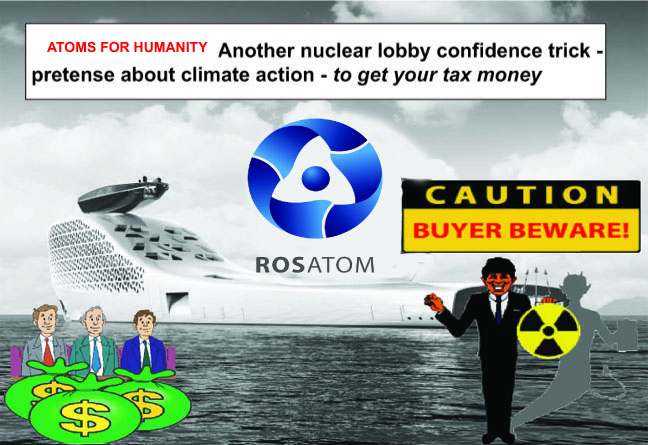
Thousands Join Launch Of Rosatom’s Atoms For Humanity Nuclear Awareness Campaign, By India Education Diary Bureau Admin May 3, 2021 Moscow: On April 30, over 3200 people from some 40 countries watched Rosatom’s Atoms for Humanity new nuclear awareness campaign launch event. The project is aimed at demonstrating the importance of nuclear technologies in achieving the UN Sustainable Goals through human-centered stories.
The project launch event Why Humanity Needs Nuclear brought together Polina Lion, Chief Sustainability Officer at Rosatom, Sama Bilbao y León, Director General of the World Nuclear Association, Dr. Maher Aziz, member of the World Energy Council, Ben Heard, founder of the Bright New World and Sergio Orlandi and Head of Central Engineering and Plant Directorate at ITER. Heroes of Atoms for Humanity joined the event to share their experiences participating in the campaign.
The [?] esteemed speakers discussed social, economic and environmental benefits of nuclear technologies and their invaluable contribution to solving the most urgent challenges of today and tomorrow.
Growing aggressive behaviour by nuclear proponents – is nuclear facing obsolescence?
Nuclear Engineering International 29th April 2021, Extract from Letter Andy Stirling, Science Policy Research Unit, University of Sussex.
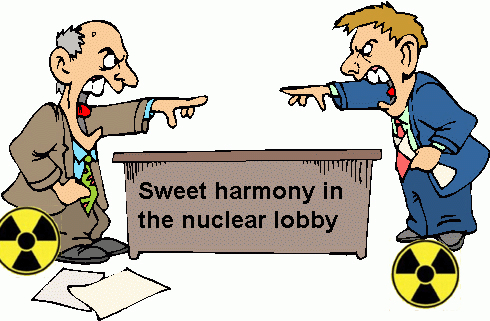
It is reasonable to give particular scrutiny both to the style and content of a commentary by Jeremy Gordon published on an article issued last year in the peer-reviewed journal Nature Energy. This is sadly especially so, because what we see as Jeremy Gordon’s aggressive tone and superficial arguments display behaviour that is sadly growing among nuclear proponents.
These are worrying signs of a wider malaise in current nuclear debates. It is a growing problem in nuclear advocacy that those holding contrasting informed and measured views – or who simply question the comparative merits of nuclear power – are so often smeared as ‘anti-nuclear’.
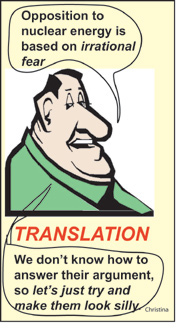
It is hysterical to brand someone raising evidence of a problem with something, as being somehow intrinsically ‘anti’ that thing. Yet on nuclear, this is a norm. Even to raise questions about relative pros and cons of nuclear versus renewable based strategies is treated by Gordon as if inherently biased.
Gordon criticises us for not analysing coal, oil or gas. Our purpose is to examine associations between carbon emissions and the uptake of two families of technologies that are variously claimed as “zero carbon”: nuclear and renewables. We are ourselves clear in urging further more specific work addressing finer details and wider dimensions
But it is not unreasonable that this pioneering study focuses specifically on technologies for which zero carbon
claims are actually made. Whatever ‘side’ one is on, it is striking that as the relative position of nuclear power deteriorates, the invective grows more intense. But perhaps all may agree (on any side), that spurious caricatures and personal attacks undermine themselves?
No technology is entitled to immunity either from criticism or obsolescence. Whether nuclear power faces this latter fate is unsure. But if (like many earlier technologies) its time has come, then this past quintessential icon of scientific prowess should not bring down with it the reasoned policy discourse that forms the lifeblood of democracy itself.
Paul Beckwith on the failure of universities to address real world problems
1 May 21, I have often wondered how humanity, in our present day and age, can be facing total and utter catastrophe from abrupt climate system change, and still have the vast multitudes of citizens, governments, and nations not even want to recognize the grave dangers that we face. These are not long term risks, in fact we face the imminent complete loss of Arctic Sea Ice, enormous outbursts of methane gas, mass extinctions of our plants and animals, and global food shortages leading to deadly widespread famine within a decade. How is this possible? How can society be so stupid? Why am I cursed to recognize the imminent and complete collapse of our society?
Having been within the university system and academia for many years, I have been constantly puzzled as to why there is no sense of societal danger and risk of near term collapse. The Ivory Towers of Academia have been completely oblivious to the existential crisis, and has done absolutely nothing to educate the public to these risks. The university is essentially a knowledge-factory to push forward the boundaries of knowledge in a vast array of independently siloed fields, while it has completely lacked the wisdom to recognize let alone address the real world problems that are right in front of our face. As a result, with zero wisdom from our esteemed institutes of learning, our society is teetering on the brink of complete and utter collapse from abrupt climate system change. The best paper that I have read on this failure of our university system to address real world and imminent global problems was published two weeks ago and is called “How Universities Have Betrayed Reason and Humanity – And What’s to Be Done About It” by Nicolas Maxwell.
Mobile nuclear reactors? Scathing report slams ‘disturbing’ military program
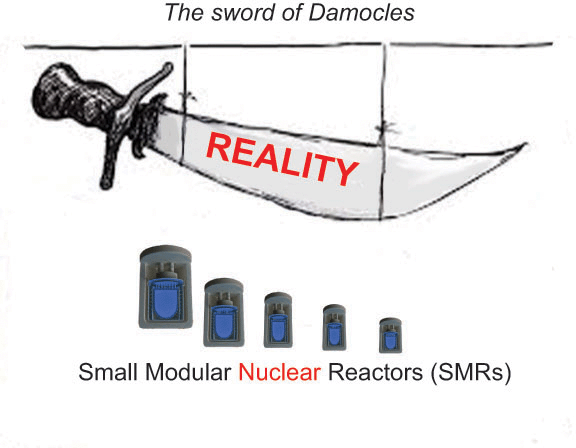
Mobile nuclear reactors? Scathing report slams ‘disturbing’ military program, Times, 1 May 21, Todd South The author of an academic report on Pentagon plans to build mobile nuclear reactors to power future combat bases called the effort “extremely disturbing” and “based on a lie.”
The report released Thursday slams the Pentagon and Army G-4, logistics — specifically the Army office’s 2018 report that lays out the potential uses and needs for such mobile nuclear reactors in future operations.
Alan J. Kuperman wrote the 21-page report titled, “Proposed U.S. Army Mobile Nuclear Reactors: Costs and Risks Outweigh Benefits,” in his role as coordinator of the University of Texas at Austin’s Nuclear Proliferation Prevention Project.
“They don’t reduce casualties, they increase costs and they increase threats to the lives of U.S. service members,” Kuperman said.
The program, known as “Project Pele,” is prototyping the mobile advanced microreactor concept under the Pentagon’s Strategic Capabilities Office……..
The DoD spokesman pointed out that the project is part of a collaboration involving the Department of Energy, Nuclear Regulatory Commission, U.S. Army Corps of Engineers and private industry. Project Pele is not being designed for a specific military service branch but does include experts across defense for a variety of requirements.
Army officials for G-4 deferred comment on the program to DoD……..
Congress approved funding for prototype reactors and the Army awarded $40 million in contracts to three nuclear reactor companies in March 2020 for Project Pele, according to the NPPP report.
Kuperman struck at the Army’s rationale, calling the project unnecessary and dangerous. He counters some of the main justifications that have been provided by DoD and Army reports:
High cost – Kuperman said the Army’s claims that nuclear power can provide cheaper electricity for powering future forward bases is “based on unrealistic assumptions.” Those include that such a reactor would have low construction costs and operate for 18 hours a day over 40 years. The more likely scenario is a mobile reactor would run for half that time over about 10 years, meaning nuclear electricity could cost 16 times more than estimates and still seven times more than diesel-generated power.- Vulnerability to missile attacks – The report points to the 2020 missile attack on forces at al-Asad air base in Iraq. Even with warnings hours ahead of time, more than 100 U.S. personnel suffered traumatic brain injury from the 11 strikes that hit the facility. And the missiles were 10 times more accurate than the Army has predicted in its report on the vulnerability of reactors to precision strikes. The service admits that a direct hit on a reactor would destroy the device. Kuperman notes that even the Army’s plans to protect the reactors, by burying them underground, could inadvertently cause meltdowns by impeding air cooling and causing overheating. A similar strike on an similar such future base with a reactor could cause far more devastating consequences.
Captured reactors – Should a U.S. base housing a mobile reactor be overrun or abandoned, the radioactive waste from the reactor could be used in “dirty bomb” terror attacks.- No mission for reactors – One of the chief purposes of pursing such reactor programs was to reduce casualties from diesel transport to remote bases. But Defense Department data shows a dramatic drop in casualties of five per 1 million gallons of fuel delivered in 2005 to nearly zero by 2013.
- High-energy weapons don’t need reactors – Kuperman states that the justification that future high-energy or laser weapons that the Army hopes to have protecting bases don’t require a reactor to power. “A high energy weapon would have to be fired millions of times to justify a reactor,” Kuperman said. “In reality such a weapon would be fired perhaps hundreds of times in its lifetime.”
- Transport problems – The Army wants to air deliver these reactors to combat posts. Kuperman questions the “regulatory nightmare” that would create. The program calls for initial tests flying the reactors domestically to run then returning them, and their radioactive waste, to another domestic location. Foreign transport would require approval of countries airspace traversed and the approval of a host nation where the reactor would be placed, he said. Other Army recommendations include truck or rail transport domestically and either ship or over-the-ocean flights to friendly ports to then move the reactors again via truck or rail.
Army Times reported on the proposed program in 2019, which had drawn backlash from the Union of Concerned Scientists and its then-director of the Nuclear Safety Project, Edwin Lyman, who called the proposal, “naïve.”The original proposal, approved by the Pentagon’s Strategic Capabilities Office asked for industry solutions in January 2019 on providing a less than 40-ton small, mobile nuclear reactor design that could operate for three years or more and provide 1 to 10 megawatts of power.Planners want the reactor to fit inside a C-17 cargo plane for air transport to theater. More recent moves have reduced the power output to 5 megawatts……..
Lyman notes a major failure with one of the original eight designs in 1961 when a core meltdown and explosion of the ML-1 reactor in Idaho killed three operators.
The three deployed to Antarctica, Greenland and Alaska proved “unreliable and expensive to operate,” Lyman wrote in his response to the Army’s 2018 report on the mobile reactor program.Lyman told Army Times on Thursday that a number of those old reactors required decades of decommissioning and one used at Fort Belvoir, Va., near Washington D.C. is finally scheduled for decommissioning in late 2021……….. https://www.armytimes.com/news/your-army/2021/04/30/mobile-nuclear-reactors-scathing-report-slams-disturbing-military-program/
Extinction Rebellion exposes Zion Lights as yet another nuclear propaganda front

Extinction rebellion 16th Sept 2020, There have been a number of stories in the press in the last few weeks with criticisms about Extinction Rebellion by Zion Lights, UK director of the pro-nuclear lobby group Environmental Progress. It appears that Lights is engaged in a deliberate PR campaign to discredit Extinction Rebellion.
lobbyists such as The Global Warming Policy Foundation and the Genetic Literacy Project (formally funded by Monsanto). The founder of Environmental Progress, Michael Shellenberger, has a record of spreading misinformation around climate change and using marketing techniques to distort the narrative around climate science. He has a reputation for downplaying the severity of the climate crisis and promoting aggressive economic growth and green technocapitalist solutions.
Puerile publicity tactics of pro nuclear publicist “Think Atom”
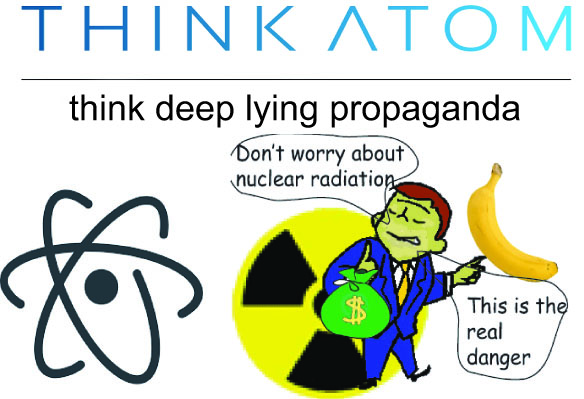
The keynote speexh at the World Nuclear Cycle Forum was so absurd as to be almost funny. It avoided consideration of nuclear power’s huge costs, safety problems, weapons connection, terrorism risk, – and above all, the fact that the nucleare fuel cycle is highly carbon-emitting. It also sidesteps the fact that nuclear power , even if it did combat climate change, could never be operating fast enough to be of any use anyway.
But that didn’t stop gee-whiz nuclear spinner ”Think Atom” from insulting our intelligence by recommending the most puerile publicity tactics to win over the hearts and minds of the general public.
********************************************************************
You need to put it in context: ‘The worst case scenario is a similar dose that you get from eating a bag of chips or a couple of bananas.’ And use emotion: ‘But that’s ridiculous! Yes, but it’s true!’ This context gives you an image of something. It’s easier [to convince people]/
Nuclear industry must change the way it communicates, says Think Atom, World Nuclear News, 15 April. 21, ”……….The fact that nuclear is clean [really?] energy is already “out there” and so the issue is not a lack of information, Rauli Partanen, the CEO of Think Atom, said, but rather of believing that information and then acting on those beliefs. For that to happen, data and reports proving the science are not enough. There also needs to be emotion and an alignment of values, he said, which will turn the information into something that has value.
“Why do people dislike nuclear? Forty years ago, the nuclear industry left the public discussion to those who opposed nuclear. These people, groups and organisations said that nuclear is dangerous and irresponsible, ……..
There has therefore been no progress in having a vision for the nuclear industry and instead it has focused on fighting against the premature closure of reactors or on decommissioning.
“That’s not very inspiring. How many young people are going to go into a field that’s focused on getting rid of itself? Not many……
The nuclear industry needs to start talking publicly about a “mission of expansion”, he said…… the nuclear industry should demand support from policymakers and legislators to create a fair market in clean [really?] energy, ……. enabling the nuclear industry to enjoy access to low-cost finance the way that other clean energy technologies already do.
The high rate of nuclear power plant construction seen in the 1970s and 1980s should be repeated over the next 40 years because “even when we get to net zero, we need to get into negative emissions, and that is not going to happen by itself, it will need a lot of energy”, he said.
“The key point is that, if the nuclear industry doesn’t have a big vision on its role, potential and importance in stopping climate change, how can it expect the rest of us to have that vision for them?”……
World Nuclear Association’s Harmony goal – the addition of 1000 GWe of new nuclear capacity and a 25% share in the global electricity mix, by 2050………. It needs to spread out from World Nuclear Association onto the slide presentations of utilities, with statements like; ‘We’re looking forward to doubling our fleet’.”…………
“He is certainly an influencer and thought leader in some circles, but we also need others – rock stars, famous politicians, climate scientists. The issue is you cannot have one single message for everyone. Know your audience.”
The message however needs to make clear that being ‘anti-nuclear’ effectively means being against a proven way to mitigate climate change……….
Asked how attitudes towards nuclear energy could be changed at the political level, he said this was difficult, but “when change starts it can happen pretty fast”……..”One of the catalysts for this has been advanced nuclear reactors and small modular reactors, which is a new way of thinking about nuclear. It can give people a second chance to rethink nuclear…”’
,,,,,, The anti-nuclear countries, like Austria, Germany and Luxembourg, are constantly joining up and bullying other nations
……….. The answers to those questions [about radioactive wastes] must be in a context the audience can understand, he said. For example, “the worst-case scenario” of radiation leaking from the Onkolo final repository would be a tiny number of millisieverts per year.
“Nobody will understand that. You need to put it in context: ‘The worst case scenario is a similar dose that you get from eating a bag of chips or a couple of bananas.’ And use emotion: ‘But that’s ridiculous! Yes, but it’s true!’ This context gives you an image of something. It’s easier than ‘many zeros of millisieverts’, which means nothing to the non-nuclear engineer.”
Iran and Israel – the situation shows the strong connection between nuclear power and nuclear weapons- small nuclear reactors with enriched uranium fuel.
Nuclear Alert: Iran & Israel Playing High-Stakes Poker with Nuclear Power & Nuclear Weapons Fairewinds, Maggie Gunderson, 14 Apr 21, Fairewindsy now, Fairewinds is sure you know that an explosion at an Iranian nuclear enrichment plant has slowed Iran’s progress to enrich uranium. The crisis shows a very blurry line between Civilian Atomic Power and Military Atomic Bombs!………..
For decades, we are informed there is no correlation between weapons and civilian power. This standoff between Iran and Israel highlights the strong connection between nuclear weapons and nuclear power, like hand-in-glove.
The borderline between bomb-grade uranium and civilian power-grade uranium is determined by how much the isotope Uranium-235 (U-235) is enriched. Traditionally, if uranium enrichment is above 20%, that is considered the low-end of weapons-grade enrichment, which falls between 20% and 100% enrichment for bombs. Therefore, the higher the percent of enrichment of U-235, the easier it is to manufacture a nuclear bomb.
To be cost-effective, the nuke industry claims its U-235 must be more enriched to prevent atomic power reactors from refueling as often. Currently, uranium fuel used worldwide in operating nuclear power plants is enriched to about 6%. But the nuclear industry’s new designs for proposed Small Modular Reactors (SMRs) will use fuel enriched to about 20%.
Yes, as Fairewinds quoted above, SMRs will use nuclear fuel that is “one step away from weapons-grade uranium” used to make bombs!
At Fairewinds, we have two questions today:
- First, what are Iran’s plans for gaining that much enrichment? Iran claims that this centrifuge produced fuel is for peaceful purposes only, then why does the uranium have to be enriched to almost bomb-grade? Is Iran building SMRs?
- Where does that place the United States in world politics with its creation of SMRs? The U.S. plans to build tens of thousands of these allegedly new Small Modular Reactors. Moreover, SMRs use HALEU fuel (High-Assay Low-Enriched Uranium) enriched to almost 20% Uranium-235.
- How does this action make the U.S. any different from what Iran is doing when the U.S. SMRs will contain high-test Uranium identical to what is being enriched in Iran?
- Is this federal push for this new SMR design some type of ploy to spread atomic bomb-grade fuel all over the world?
- The U.S. nuclear power industry is looking at SMRs as its latest cash cow, expecting to sell and build SMRs all over the world! What kind of international threat is this if thousands of proposed SMRs are located all over the U.S. and worldwide?

As a result of the attack on its enrichment facility, Iran has further changed its mind and said it would enrich uranium to 60%. According to the BBC:
Iran will produce 60%-enriched uranium in retaliation for a suspected Israeli attack on a nuclear site, President Hassan Rouhani says, bringing it closer to the purity required for a weapon. … But he reiterated that Iran’s nuclear activities were “exclusively peaceful”.
France, Germany and the U.K. expressed “grave concern” at the move, saying Iran had “no credible civilian need for enrichment at this level”.
Fairewinds is clear that the 20% enriched fuel planned to be used in SMRs is only one easy step away from creating bomb-grade atomic fuel! Now that Iran has informed the world that it intends to enrich its uranium to 60%, scientists worldwide know that there is no peaceful civilian atomic reactor of any kind using U-235 enriched to 60%!
Fairewinds hopes that diplomats will resolve this enrichment conundrum before the military situation escalates further. https://www.fairewinds.org/demystify/nuclear-alert-iran-israel-playing-high-stakes-poker-with-nuclear-power-nuclear-weapons
Unrelenting dishonest propaganda leading us to war against China
Not sleepwalking but marching with eyes wide open to war. Independent Australia, By William Briggs | 13 April 2021 While the USA moves towards war, anti-China rhetoric grows on a daily basis and the idea of war is being sold as the “right” thing, writes Dr William Briggs.
A LIE told often enough can become accepted, but it can never be the truth. China has been declared a threat to all that we hold dear, but it is just not so. China, for all its faults, is not a threat and nor is it practising genocide!
The Uyghur genocide claim gets bigger as each day dawns. Peter Hartcher, in The Age on the 10 April, writes of this genocide and of ‘the evil genius of the system of genocide with Chinese characteristics.’ The “genius” according to Hartcher is that the Chinese are allowing the Uyghurs to live. What a clever and cunning genocide that is!
The plight of the Uyghurs is but the latest lurid episode in a sustained and enormously successful push to demonise China in the eyes of the world. The motivations behind this are simple enough. China’s economic star is rising and America’s best days are behind it.
The world is certainly on the edge of a precipice. There is a broad acceptance, despite an embarrassing lack of evidence, that China is an enemy and, as an enemy, a threat. Nobody is ever eager for war, but people have often enough been persuaded that war is an acceptable option. This is particularly so when an existential threat exists, or in this case, is manufactured. The potential for war, justifications for it and warnings of how it might almost “accidentally” become a reality have come to dominate thought……..
If the USA goes to war with China, it will not be by chance. It has been meticulously planned, costed, budgeted for and the weapons, including “low-yield” nuclear weapons, have been manufactured and deployed by the USA. The world should be aghast at such blatant preparations, but it is not. Those who would take us to war need first to convince us that we have no option, that we are protecting freedom, that we are standing for justice and that a threat exists that the enemy is engaging in genocide.
In the space of just a decade, the people have come to accept this. China has gone from economic saviour of the world to arch enemy. Governments begin the process but could not be expected to convince the people alone. Television and print media: editorials, opinion pieces from leading journalists and international editors, columnists and experts, have all played a decisive role.
A recent poll by the Lowy Institute showed that in 2018, 52 per cent of Australians believed that China would act responsibly in the world. Two very short years later and that figure had dropped to just 23 per cent! The polls are then used by the same anti-China crusaders to prove that a problem exists. They are happy to ignore the effect that a daily barrage of anti-China campaigning can do and how it can shift people’s views…….
The most recent reporting of the treatment of the Uyghurs is that the Chinese are engaged in a campaign of genocide. Genocide was practised in Nazi Germany, in Kampuchea, in Rwanda, in Armenia, in Australia, but to suggest that the Chinese behaviour towards the Uyghurs, while quite possibly repressive, even reprehensible, is genocidal is ludicrous.
There has been discrimination and persecution. Life, for the Uyghurs, has never been easy. However, the West paid little or no attention to these people until about the time that the USA began to talk of “containing” China. It was, for the USA, a fortuitous discovery.
The Chinese, at the end of the 20th Century, waged a campaign against Islamist separatist groups that had become active within the Uyghur population. Violence met violence and conditions worsened for the Uyghurs. None of this concerned Washington. What happened to make things change so dramatically? The Chinese, in all likelihood, did step up repressions but the USA have manipulated events to suit a specific propaganda purpose.
Uyghur stories become more and more horrifying. The Western media was once content to rail against the existence of “re-education” camps. Then it was reports of campaigns of mass rape and then mass sterilisation programs. This morphed into claims of social genocide. Reports of forced labour emerged and evolved into stories of slave labour. The term “social” genocide came into use but has now been shortened to genocide.
This ramping up of rhetoric has one real purpose. China must, at every turn, be shown to be a malignant force. The editorialists, international editors, columnists and journalists have become a willing and shameless weapon in this campaign. If it all ends in war it will not be a chance thing. The world will not be “sleepwalking”.
Nobody wants war but we are being prepared for it. https://independentaustralia.net/politics/politics-display/not-sleepwalking-but-marching-with-eyes-wide-open-to-war,14982#.YHZ_2MRzAdY.twitter
How the British government reacted to the Fukushima catastrophe – with propaganda promoting the nuclear industry
 Revealed: British government’s plan to play down Fukushima Revealed: British government’s plan to play down Fukushima
https://www.theguardian.com/environment/2011/jun/30/british-government-plan-play-down-fukushima
Internal emails seen by Guardian show PR campaign was launched to protect UK nuclear plans after tsunami in Japan Rob Edwards Fri 1 Jul 2011
British government officials approached nuclear companies to draw up a co-ordinated public relations strategy to play down the Fukushima nuclear accident just two days after the earthquake and tsunami in Japan and before the extent of the radiation leak was known.
Internal emails seen by the Guardian show how the business and energy departments worked closely behind the scenes with the multinational companies EDF Energy, Areva and Westinghouse to try to ensure the accident did not derail their plans for a new generation of nuclear stations in the UK. “This has the potential to set the nuclear industry back globally,” wrote one official at the Department for Business, Innovation and Skills (BIS), whose name has been redacted. “We need to ensure the anti-nuclear chaps and chapesses do not gain ground on this. We need to occupy the territory and hold it. We really need to show the safety of nuclear.” Officials stressed the importance of preventing the incident from undermining public support for nuclear power. The Conservative MP Zac Goldsmith, who sits on the Commons environmental audit committee, condemned the extent of co-ordination between the government and nuclear companies that the emails appear to reveal. “The government has no business doing PR for the industry and it would be appalling if its departments have played down the impact of Fukushima,” he said. Louise Hutchins, a spokeswoman for Greenpeace, said the emails looked like “scandalous collusion”. “This highlights the government’s blind obsession with nuclear power and shows neither they, nor the industry, can be trusted when it comes to nuclear,” she said. The Fukushima accident, triggered by the Japan earthquake and tsunami on 11 March, has forced 80,000 people from their homes. Opinion polls suggest it has dented public support for nuclear power in Britain and around the world, with the governments of Germany, Italy, Switzerland, Thailand and Malaysia cancelling planned nuclear power stations in the wake of the accident. The business department emailed the nuclear firms and their representative body, the Nuclear Industry Association (NIA), on 13 March, two days after the disaster knocked out nuclear plants and their backup safety systems at Fukushima. The department argued it was not as bad as the “dramatic” TV pictures made it look, even though the consequences of the accident were still unfolding and two major explosions at reactors on the site were yet to happen. “Radiation released has been controlled – the reactor has been protected,” said the BIS official, whose name has been blacked out. “It is all part of the safety systems to control and manage a situation like this.”
The official suggested that if companies sent in their comments, they could be incorporated into briefs to ministers and government statements. “We need to all be working from the same material to get the message through to the media and the public. Anti-nuclear people across Europe have wasted no time blurring this all into Chernobyl and the works,” the official told Areva. “We need to quash any stories trying to compare this to Chernobyl.” Japanese officials initially rated the Fukushima accident as level four on the international nuclear event scale, meaning it had “local consequences”. But it was raised to level seven on 11 April, officially making it a major accident” and putting it on a par with Chernobyl in 1986. The Department for Energy and Climate Change (DECC) has released more than 80 emails sent in the weeks after Fukushima in response to requests under freedom of information legislation. They also show: Westinghouse said reported remarks on the cost of new nuclear power stations by the deputy prime minister, Nick Clegg, were “unhelpful and a little premature”. The company admitted its new reactor, AP1000, “was not designed for earthquakes [of] the magnitude of the earthquake in Japan”, and would need to be modified for seismic areas such as Japan and California. The head of the DECC’s office for nuclear development, Mark Higson, asked EDF to welcome the expected announcement of a safety review by the energy secretary, Chris Huhne, and added: “Not sure if EDF unilaterally asking for a review is wise. Might set off a bidding war.” EDF promised to be “sensitive” to how remediation work at a UK nuclear site “might be seen in the light of events in Japan”. It also requested that ministers did not delay approval for a new radioactive waste store at the Sizewell nuclear site in Suffolk, but accepting there was a “potential risk of judicial review”. The BIS warned it needed “a good industry response showing the safety of nuclear – otherwise it could have adverse consequences on the market”. On 7 April, the office for nuclear development invited companies to attend a meeting at the NIA’s headquarters in London. The aim was “to discuss a joint communications and engagement strategy aimed at ensuring we maintain confidence among the British public on the safety of nuclear power stations and nuclear new-build policy in light of recent events at the Fukushima nuclear power plant”. Other documents released by the government’s safety watchdog, the office for nuclear regulation, reveal that the text of an announcement on 5 April about the impact of Fukushima on the new nuclear programme was privately cleared with nuclear industry representatives at a meeting the previous week. According to one former regulator, who preferred not to be named, the degree of collusion was “truly shocking”. A spokesman for the DECC and BIS said: “Given the unprecedented events unfolding in Japan, it was appropriate to share information with key stakeholders, particularly those involved in operating nuclear sites. The government was very clear from the outset that it was important not to rush to judgment and that a response should be based on hard evidence. This is why we called on the chief nuclear inspector, Dr Mike Weightman, to provide a robust and evidence-based report.” A DECC source played down the significance of the emails from the unnamed BIS official, saying: “The junior BIS official was not responsible for nuclear policy and his views were irrelevant to ministers’ decisions in the aftermath of the Japanese earthquake.”
“I would be much more reassured if DECC had been worrying about how the government would cope with the $200bn-$300bn of liabilities from a catastrophic nuclear accident in Britain.” The government last week confirmed plans for eight new nuclear stations in England and Wales. “If acceptable proposals come forward in appropriate places, they will not face unnecessary holdups,” said the energy minister, Charles Hendry. The NIA did not comment directly on the emails. “We are funded by our member companies to represent their commercial interests and further the compelling case for new nuclear build in the UK,” said the association’s spokesman. “We welcome the interim findings of the independent regulator, Dr Mike Weightman, who has reported back to government that UK nuclear reactors are safe.” This article is more than 9 years old
Internal emails seen by Guardian show PR campaign was launched to protect UK nuclear plans after tsunami in Japan |
|
Don’t believe hydrogen and nuclear hype – they can’t get us to net zero carbon by 2050
 Don’t believe hydrogen and nuclear hype – they can’t get us to net zero carbon by 2050 https://www.theguardian.com/commentisfree/2021/mar/16/hydrogen-nuclear-net-zero-carbon-renewables
ow that the whole world seems to be aligned behind the goal of net zero carbon emissions by 2050, the nuclear industry is straining every sinew to present itself as an invaluable ally in the ambitious aim. Energy experts remain starkly divided on whether or not we can reach this global net zero target without nuclear power, but regardless, it remains a hard sell for pro-nuclear enthusiasts.
The problems they face are the same ones that have dogged the industry for decades: ever-higher costs, seemingly inevitable delays, no solutions to the nuclear waste challenge, security and proliferation risks.
The drawbacks to nuclear are compounded by the burgeoning success of renewables – both solar and wind are getting cheaper and more efficient, year after year. There is also a growing realisation that a combination of renewables, smart storage, energy efficiency and more flexible grids can now be delivered at scale and at speed – anywhere in the world.
While the majority of environmentalists continue to oppose nuclear power, there is now a significant minority, increasingly concerned about accelerating climate change, who just don’t see how we can get to that net zero comfort zone without it. They’re right to be concerned – it is a truly daunting challenge. All emissions of greenhouse gases (across the entire economy, including those from transport, heating, manufacturing and refining, farming and land use, as well as from shipping and aviation) must be brought down to as close to zero as possible, with all residual emissions compensated for by the removal of an equivalent amount of CO2 from the atmosphere.
It’s the sheer scale of that challenge that has led a lot of people (including Boris Johnson with the government’s 10-point plan in November) not just to keep a flag flying for the nuclear industry, but to revisit the idea of hydrogen doing some of the heavy lifting. Hydrogen hype has become all the rage over the last 18 months, with some offering up this “clean energy technology”, as government officials insist on describing it, as the answer to all our net zero prayers.
For those prayers to be answered, there will need to be a complete revolution in the way in which hydrogen is produced. As it is, 98% of the 115m tonnes used globally is “grey hydrogen”, made from natural gas or coal, that emits around 830m tonnes of CO2 per annum – 2% of total global greenhouse gas emissions. Beyond that, there’s a tiny amount of so-called “blue hydrogen” – essentially grey hydrogen but with its CO2 emissions captured and stored – and an even tinier amount of “green hydrogen” from electrolysing water, both of which are much more expensive than the climate-wrecking grey hydrogen.
The gulf between that current reality, one rarely mentioned by hydrogen enthusiasts, and the prospect of readily available and affordable green hydrogen that could help us get to net zero, is absolutely vast.
Don’t get me wrong: we will indeed need significant volumes of green hydrogen and it’s good that the government has set an ambitious target for 2030, in the hope that this will significantly reduce the costs of electrolysis to create it. But we need to be clear about what that green hydrogen should be used for: not for electricity; not for heating homes and non-domestic buildings; and not for cars, where electric vehicles will always be better. Instead we will need it for what are called the “hard-to-abate” sectors: for steel – replacing carbon-intensive coking coal – cement and shipping.
Much of the hype for hydrogen is coming from the oil and gas sector, in the hope that gullible politicians, seduced by an unattainable vision of limitless green hydrogen, will subsidise the vast investments needed to capture the emissions from gas-powered hydrogen. Their motivation couldn’t be clearer: to postpone the inevitable decline of their industry.
The nuclear industry is also desperate to get in on that game. One has to admire its capacity to pivot opportunistically. In February, the Nuclear Industry Council (made up of both industry and government representatives in the UK) published a shiny new Hydrogen Roadmap, exploring how either large-scale nuclear or small modular reactors could generate both the electricity and the heat needed to produce large amounts of green hydrogen. But the entire plan is premised on spectacular and totally speculative reductions in the cost of electrolysis.
Rather than being the solution we have been waiting for, this nuclear/hydrogen development would actually be a disastrous techno-fix. Low-carbon nuclear power will always be massively more expensive than renewables and we can never build enough reactors to replace those coming offline over the next decade. We also know that producing hydrogen is always going to be very expensive. The truth is, you need a lot of electricity to produce not a lot of hydrogen. All of which makes pipe-dreams about substituting hydrogen for conventional gas in the UK’s gas grid, or of producing millions of tonnes of blue hydrogen, look almost entirely absurd.
This, then, could lead to a double economic whammy of quite monstrous proportions. It would either have to be paid for through general taxation or through higher bills for consumers. That’s particularly problematic from the perspective of the 10% of households in England still living in cruel and degrading fuel poverty.
Environmentalists who are tempted by this new nuclear/hydrogen hype should remember that our transition to a net zero world has to be a just transition. Every kilowatt hour of nuclear-generated power will be a much more expensive kilowatt hour than one delivered from renewables plus storage.
So let’s just hold back on both the hydrogen hype and the nuclear propaganda, and concentrate instead on ramping up what we already know is cost-effectively deliverable: renewables. We need to do it as fast as we possibly can.
- Jonathon Porritt is an environmentalist and founder-director of Forum for the Future. His latest book is Hope in Hell: A Decade to Confront the Climate Emergency
1 This Month



26 September – International Day for the Total Elimination of Nuclear Weapons


PLEASE OPPOSE HR 8255 AND S.3639 – bills would accelerate satellite deployment, with no environmental review or safeguards – https://ncstd5li.quorum.us/campaign/169331/
To see nuclear-related stories in greater depth and intensity – go to https://nuclearinformation.wordpress.com
-
Archives
- September 2026 (219)
- August 2026 (330)
- July 2026 (355)
- June 2026 (287)
- May 2026 (306)
- April 2026 (356)
- March 2026 (251)
- February 2026 (267)
- January 2026 (308)
- December 2025 (358)
- November 2025 (359)
- October 2025 (375)
-
Categories
- 1
- 1 NUCLEAR ISSUES
- business and costs
- climate change
- culture and arts
- ENERGY
- environment
- health
- history
- indigenous issues
- Legal
- marketing of nuclear
- media
- opposition to nuclear
- PERSONAL STORIES
- politics
- politics international
- Religion and ethics
- safety
- secrets,lies and civil liberties
- spinbuster
- technology
- Uranium
- wastes
- weapons and war
- Women
- 2 WORLD
- ACTION
- AFRICA
- Atrocities
- AUSTRALIA
- Christina's notes
- Christina's themes
- culture and arts
- Events
- Fuk 2022
- Fuk 2023
- Fukushima 2017
- Fukushima 2018
- fukushima 2019
- Fukushima 2020
- Fukushima 2021
- general
- global warming
- Humour (God we need it)
- Nuclear
- RARE EARTHS
- Reference
- resources – print
- Resources -audiovicual
- Weekly Newsletter
- World
- World Nuclear
- YouTube
-
RSS
Entries RSS
Comments RSS
 nuclear-news