Review of Michael Shellenberger’s book on ”Why Environmental Alarmism Hurts Us All”
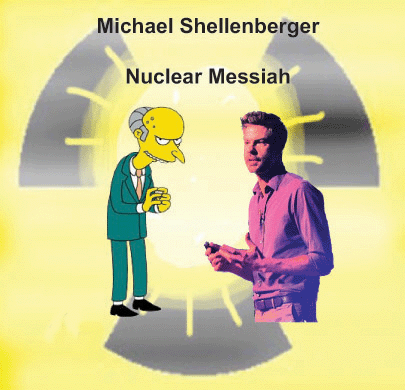 Book review: Bad science and bad arguments abound in ‘Apocalypse Never’ by Michael Shellenberger’, Yale Climate Connections , By Dr. Peter H. Gleick | Wednesday, July 15, 2020 ”……………….. A recent entry in this debate is Michael Shellenberger’s “Apocalypse Never: Why Environmental Alarmism Hurts Us All” (HarperCollins Publishers, 2020). Shellenberger explains in his introduction that he seeks to counter and dismiss what he considers irrational, overwrought arguments of pending Malthusian catastrophes; instead, he seeks to promote the Cornucopian view that environmental problems can be eliminated if we’d just pursue aggressive economic growth, simple technological advances, and increased tapping of abundant natural resources. In doing so, he echoes previous efforts of authors like Herman Kahn, Julian Simon, and Bjørn Lomborg.
Shellenberger self-describes as an environmentalist activist and a bringer of facts and science to counter “exaggeration,
Two Cornucopian ideas lie at the heart of this book: The first idea is that there are no real “limits to growth” and environmental problems are the result of poverty and will be solved by having everyone get richer. This idea isn’t original and has long been debunked by others (for a few examples see here, here, here, and here).
View that nuclear alone can address needs
The second idea – and the focus of much of Shellenberger’s past writings – is that climate and energy problems can and should be solved solely by nuclear power. He writes, “Only nuclear, not solar and wind, can provide abundant, reliable, and inexpensive heat,” and, “Only nuclear energy can power our high-energy human civilization while reducing humankind’s environmental footprint.” (“Apocalypse Never” – hereafter “AN” – pp. 153 and 278) The many economic, environmental, political, and social arguments levied against nuclear are simply dismissed as having no merit, for example: “As for nuclear waste, it is the best and safest kind of waste produced from electricity production. It has never hurt anyone and there is no reason to think it ever will.” (AN, p. 152) ……….
Using the facade of ‘strawman arguments’
Shellenberger regularly sets up other strawman arguments and then knocks them down. [A strawman argument is an effort to refute an argument that hasn’t been made by replacing your opponent’s actual argument with a different one.] One of the most prevalent strawman arguments in the climate debate is that scientists claim climate change “causes” extreme events, when in fact, climate scientists make careful distinctions between “causality” and “influence” – two very different things. This area, called “attribution science,” is one of the most exciting aspects of climate research today.
Shellenberger sets up the strawman argument that people are incorrectly claiming recent extreme events (like forest fires, floods, heat waves, and droughts) were caused by climate change, and then he debunks this strawman. “Many blamed climate change for wildfires that ravaged California” (AN, p.2) and “the fires would have occurred even had Australia’s climate not warmed.” (AN p. 21) He misrepresents how the media reported on the fires, describing a New York Times story on the 2019 Amazon fires: “As for the Amazon, The New York Times reported, correctly, that the ‘fires were not caused by climate change.’” But here Shellenberger is cherry-picking a quote: If you look at the actual article he cites, the journalist makes clear the “influence” of climate change just two sentences later:
These fires were not caused by climate change. They were, by and large, set by humans. However, climate change can make fires worse. Fires can burn hotter and spread more quickly under warmer and drier conditions. (emphasis added)
He also misunderstands or misrepresents the extensive and growing literature on the links between climate change and extreme events, ……
……. Another example of a serious conceptual confusion is his chapter dismissing the threat of species extinctions. The chapter is full of misunderstandings of extinction rates, ecosystem and biological functions, confusions about timescales, and misuses of data. For example, Shellenberger confuses the concept of species “richness” with “biodiversity” and makes the astounding claim that
Around the world, the biodiversity of islands has actually doubled on average, thanks to the migration of ‘invasive species.’ The introduction of new plant species has outnumbered plant extinctions one hundred fold. (AN, p. 66)
By this odd logic, if an island had 10 species of native birds found only there and they went extinct, but 20 other invasive bird species established themselves, the island’s “biodiversity” would double. This error results from a misunderstanding of the study he cites, which properly notes that simply assessing species numbers (richness not biodiversity) on islands ignores the critical issues of biodiversity raised by invasive species, including the disruption of endemic species interactions, weakening of ecosystem stability, alteration of ecosystem functions, and increasing homogenization of flora and fauna………………
Another classic logical fallacy is to try to discredit an opponent’s argument by attacking the person and her or his motives, rather than the argument – hence the Latin “ad hominem” (“against the man”). Ad hominem attacks are pervasive in this book and detract from its tone and the content.
Shellenberger attacks “apocalyptic environmentalists” as “oblivious, or worse, unconcerned” about poverty (AN, p. 35) or for opposing a massive dam on the Congo river. (AN, p. 276) He attacks the finances of leading environmental groups and leaders like the late David Brower, arguing they have taken donations from fossil fuel companies to “greenwash the closure of nuclear plants.” (AN, p. 205) And he attacks the motives, reputations, and science of many individual environmental and geophysical scientists whose work contradicts his arguments……
Shellenberger has a special level of animosity for the press:
News media, editors, and journalists might consider whether their constant sensationalizing of environmental problems is consistent with their professional commitment to fairness and accuracy, and their personal commitment to being a positive force in the world…….
In the most disturbing examples of vicious personal attacks, he paints broad categories of people who disagree with him as motivated by a hatred of humanity:
”When we hear activists, journalists, IPCC scientists, and others claim climate change will be apocalyptic unless we make immediate, radical changes, including massive reductions in energy consumption, we might consider whether they are motivated by love for humanity or something closer to its opposite (AN, p. 275, emphasis added). We must fight against Malthusian and apocalyptic environmentalists who condemn human civilization and humanity itself. (AN, p. 274) (emphasis added).”
He argues in his closing sections that people worried about environmental disasters are playing out “a kind of subconscious fantasy for people who dislike civilization” (AN, p. 270) and suggests that people who oppose the solutions he prefers do so because they long for the destruction of civilization – a nasty attack on the motives of all those working in this field.
Finally, the book is riddled with a variety of simple errors……. the number and scope of them here is problematic. …. one example is a massive misstatement of the amount of water required to produce energy. ….. in an important omission, he fails to note that key renewable energy sources such as wind and solar photovoltaics require far less water per unit of electricity produced than all fossil fuel and nuclear thermal plants. …. He claims, twice (AN pp. 211 and 241), that nuclear power plants produce “zero pollution” ………
Dr. Peter H. Gleick is president emeritus of the Pacific Institute, a member of the U.S. National Academy of Sciences, a MacArthur Fellow, and winner of the 2018 Carl Sagan Prize for Science Popularization. https://yaleclimateconnections.org/2020/07/review-bad-science-and-bad-arguments-abound-in-apocalypse-never/?fbclid=IwAR2jUB12zAF9WbluEtglePOQlOSKbLkIxdbWeeh9eSWbc366JXrHNIERzzY
Billionaire Bill Gates’ nuclear ambitions would make climate disaster worse

His nuclear path would lead to, not prevent, a climate disaster
Why Bill Gates is wrong — Beyond Nuclear International
Billionaire’s nuclear ambitions would make climate disaster worse, https://wordpress.com/read/feeds/72759838/posts/3231823855 By Linda Pentz Gunter, 14 Mar 21,
In an interview for the Washington Post Magazine during his current book tour, billionaire Bill Gates, whom we are now expected to accept as an authority on climate change, said: “I’ll be happy if TerraPower was a waste of money.” TerraPower is Gates’s nuclear power company pushing so-called “advanced” reactors. His book is called How to Avoid a Climate Disaster.
Well, Bill, I have some good news for you. You can start celebrating! Because, yes, TerraPower is indeed a colossal waste of money. It’s also a waste of precious time. And the idea that nuclear power could “lift billions out of poverty” as the TerraPower website boats, is on a par with any number of outlandish theories, conspiratorial or otherwise, that are making the all too frequent rounds these days.So has Gates really drunk the Kool-Aid (OK it wasn’t actually Kool-Aid but Flavor Aid that was consumed at the 1978 Jonestown massacre)? Does he really plan to throw away $1 billion of his own money, plus an equal match from investors and possibly some state funding, too, and then just shrug it off when the whole thing proves redundant? Is that really true stewardship of the climate?
You don’t need to be a mathematician to work out what $2 billion plus would buy in renewables, and how much faster that particularly delivery would arrive at the doorsteps of the world’s poor, whom Gates claims he aims to protect.
Here is what Lazard’s estimated in terms of costs comparisons for new nuclear plants and other energy options, as laid out by Amory Lovins in his landmark Forbes article:
New nuclear power would cost $118–192/MWh (of which $29 is typical operating cost) while utility-scale solar power would cost $32–42/MWh and onshore windpower $28–54/MWh.
As Lovins has consistently pointed out: “To protect the climate, we must save the most carbon at the least cost and in the least time, counting all three variables—carbon and cost and time.”
And, “costly options save less carbon per dollar than cheaper options. Slow options save less carbon per year than faster options. Thus even a low- or no-carbon option that is too costly or too slow will reduce and retard achievable climate protection.”
Right now, a so-called “advanced” TerraPower reactor is just a glimmer in Gates’s eye. Like the prevailing fantasies about life on Mars, his toy reactor won’t materialize anywhere near soon enough to ease the agonies of the climate crisis. And even if it eventually shows up, and passes the necessary safety requirements, it will demonstrate only a triumph in physics, having by then no economical or practical utility whatsoever.
As the absence of progress on small modular reactors has shown, there is simply no viable market for new reactors, “advanced” or otherwise. Even the enticing prospect of rolling hundreds of small reactors off assembly lines (a jobs killer for on-site workers), is pie-in-the-sky, given the huge upfront costs that could never be recouped unless there were hundreds, possibly thousands, of orders.
To show just how detached from nuclear reality Bill Gates has become, he is happy to throw in the towel on TerraPower if fusion triumphs instead. Fusion, he says along with fission and “a miracle in storage” are the “only” ways to “make electricity cheap and reliable.”
Yes, this is the same fusion that has been thirty years away for countless decades. And still is. This is the fusion that uses more energy to create electricity than it delivers; that is sucking billions of dollars into research that could be applied to instant fixes in the renewable energy sector.
This is the same “cheap” that saw the costs at the two still unfinished new nuclear reactors in Georgia balloon to $21 billion in 2021, more than double the original cost and counting. And it’s the same “reliable” that resulted in Texans shivering in the dark during the recent big freeze (and no, it wasn’t frozen wind turbines, and I don’t have a fire-starting space laser, either).
There is a reason we are no longer searching for gold in them thar hills. We don’t need to waste years panning for a few elusive grams, hoping eventually to build a fortune. The Gold Rush is over. So, if there ever was one, is the Nuclear Rush.
Gates wants to save lives conquering malaria. But he’s fine with exposing people to radiation and leaving a legacy of toxic waste with no known solution.
Take a look around. In addition to the Vogtle debacle, a similar project in South Carolina was abandoned unfinished with ratepayers footing the bill. In the UK, Hitachi has fled for the Welsh hills, ditching its new reactor plans in that country. Before that, a proposed three-reactor site in Cumbria in north west England saw a similar corporate exodus. The new reactor at Bradwell, UK, is on “pause.”
Meanwhile, as nuclear costs — largely due to their equally huge risks — continue to soar, renewable prices are plummeting. Solar and wind are the cheapest and fastest forms of new energy. Nuclear power is the most expensive and the slowest. So if you choose to spend your next $2 billion on trying to invent the better nuclear mousetrap, then you are not helping to avoid a climate disaster. You are enabling it.https://wordpress.com/read/feeds/72759838/posts/3231823855
United Nations Scientific Committee on Atomic Radiation (UNSCEAR) report on Fukushima health effects -rushed, inadequate, inconsistent

Dr Ian Fairlie, 12 Mar 21, more https://www.ianfairlie.org/news/latest-unscear-report-on-the-fukushima-nuclear-disaster-in-2011/ On March 9, the United Nations Scientific Committee on Atomic Radiation (UNSCEAR) published an advance copy of its latest (third) report on the health effects from the Fukushima Daichi nuclear accident which commenced on March 11, 2011. UNSCEAR 2020 Report – Annex B – Advance Copy
The report shows signs of having been rushed out as it is an advance copy and is unfinished. It states 23 electronic attachments with supplementary information on detailed analyses of doses to the public and their outcomes are currently in production and will be available soon on the UNSCEAR website.
I shall look at the Report in more detail when the additional information is published. However at the 10th anniversary of the nuclear catastrophe at Fukushima in 2011, it’s necessary to have an initial look at the Report’s comments on contentious issues arising from the accident – (a) the number of expected fatal cancers and (b) the continuing controversy over the cause(s) of the large observed increases in thyroid cancers (TCs) in Japan since 2011.
On (a), the 2020 Report concludes that there are no observed ill health effects from the accident but this conclusion is inconsistent with UNSCEAR’s own estimates of high collective doses from the accident. Table 13 (page 72) of UNSCEAR’s 2020 report shows that, in the first 10 years after the accident, the whole body collective dose from the accident was 32,000 man Gy. When we apply the widely-accepted fatal cancer risk estimate of 10% per Gy to this figure, we see that about 3,000 fatal cancers will have occurred due to the accident, correct to one significant figure. The report’s strange, unscientific conclusion to the contrary is inconsistent with these estimates. The only assumption used here is that radiation’s dose-response relationship follows the linear-no-threshold model, as recognised and used by all the world’s radiation protection authorities.
On (b), the 2020 Report (page 107, para q) concludes that the sharp increase in observed thyroid cancers post-Fukushima was not due to thyroid intakes of iodine isotopes from the accident but due to increased surveillance.
However large collective doses to the thyroid are also published in UNSCEAR’s new 2020 report. In the first 10 years after the accident, the 2020 report states the collective thyroid dose to the Japanese population from the accident was 44,000 man Gy. Again, this is a high number, but the absence of an authoritative risk factor for thyroid cancer – especially among young children aged 0 to 4 who were exposed to both internal intakes of radioactive iodine plus external exposures to ground-deposited Cs-134 and C-137 means that reliable estimates of the actual numbers of thyroid cancer cases due to the accident are unfortunately not possible. The supplementary information yet to be released may enable such calculations to be made. However the large collective dose to the thyroid from Fukushima casts doubt on UNSCEAR’s conclusion that the observed increases are not due to the accident.
I would not be surprised to learn that the negative conclusions in the UNSCEAR 2020 Report might be a reason why an advance copy was rushed out in unfinished form before the anniversary of the Fukushima accident.
I add the caveat that the above analysis is a (second) draft and has not yet been fully peer-reviewed. However many requests have been made for views on the UNSCEAR’s 2020 report, so I’m publishing this quickly. Any errors which are pointed out will be corrected in a later post.
UN report claiming no connection between thyroid cancer and Fukushima disaster is not credible

|
Beyond Nuclear 11th March 2021, A new UN report which dismisses the March. 11, 2011 Fukushima disaster as the cause of elevated rates of thyroid cancer in that region’s childrennleaves serious questions unanswered and appears to be a rush to press to maximize publicity around the nuclear accident’s 10th anniversary, concluded Beyond Nuclear today. An advance publication of a section of the 2020 United Nations Scientific Committee on Atomic Radiation (UNSCEAR) report —Sources, effects and risks of ionizing radiation, Scientific Annex B, Advance Copy — claims that “a rise in thyroid cancer among children in the last decade was not related to increased radiation,” and nstead attributes the increases to more thorough and sophisticated testing.
But according to Dr. Ian Fairlie, a leading radiation scientist, the doses delivered by the Fukushima disaster — and as established by UNSCEAR’s own estimates— would be high enough to cause thyroid cancer among exposed children. Dr.Fairlie asserts the report’s conclusion, that “the increase…is not the result of radiation exposure”, is
“scientifically unsound..[and] inconsistent with UNSCEAR!s own estimates of high collective doses to the thyroid published in its 2012 and 2013 reports.”–http://www.beyondnuclear.org/home/2021/3/11/un-report-claiming-no-connection-between-thyroid-cancer-and.html |
|
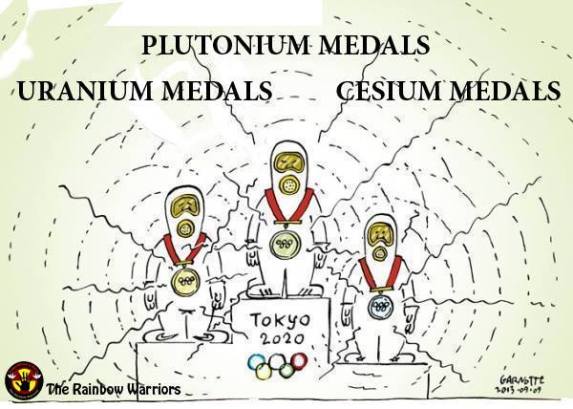
Tokyo Olypics: is it safe to promote Japan’s so-called “recovery” by sending athletes into a nuclear exclusion zone?
|
‘Fukushima today: “I’m glad that I realized my mistake before I died.” Bulletin of the Atomic Scientists, By Thomas A. Bass | March 10, 2021”……….After a lighting ceremony at J-Village, the Olympic torch will be run for three days through Fukushima’s nuclear exclusion zone. The zone is now a checkerboard of remediated areas and other places that are closed off behind accordion fences. Japan hopes to focus our attention on the refurbished schools and town halls, re-opened train stations, and two new museums that have been built in Fukushima, while trying to keep the TV cameras away from the ruined houses and radioactive cars lying nearby. The torch will then be run to Fukushima City, 40 miles to the northwest, where the first six Olympic games in softball and baseball are scheduled to be played after the games officially open July 23. But is it safe to promote Japan’s so-called “recovery” by sending athletes into a nuclear exclusion zone? The area has been tidied up and dotted with LED monitors showing the latest cesium releases from F1, comparable to the devices that measure airborne radiation levels found in other parts of the world. But these airborne releases are only part of the story—and not the most worrisome part. In 2013, scientists discovered that Fukushima’s exploding reactors had showered Japan with microparticles, or little glassy beads, of radioactive cesium and uranium. Hot spots from these microparticles can be found in vacuum cleaner bags and automobile air filters as far away as Tokyo. Fukushima prefecture is full of radioactive hot spots, and these hot spots keep moving as microparticles are washed down from the forested mountains that make up 70 percent of the prefecture, researchers said in Nature Scientific Reports. In 2019, a survey conducted for Greenpeace found hot spots in the J-Village parking lot, where children participating in a youth soccer match were eating their lunch. Greenpeace measured radiation levels at over 71 microSieverts per hour (one microSievert is one-millionth of a Sievert, or one-thousandth of a milliSievert)—1,775 times higher than the normal reading in this area before the Fukushima disaster of about 0.04 microSieverts per hour. The elevated reading, which translates to roughly about 0.62 Sieverts over the course of a year, meant that anyone breathing dust from the J-Village playing fields could be ingesting radioactive particles—little death stars lighting the way to cancer and genetic mutation. Since then, researchers have found radioactive hot spots at the Azuma baseball stadium in Fukushima City and all along the route to be run by the Olympic torch bearers….. https://thebulletin.org/2021/03/fukushima-today-im-glad-that-i-realized-my-mistake-before-i-died/?utm_source=Newsletter&utm_medium=Email&utm_campaign=ThursdayNewsletter032021&utm_content=NuclearRisk_Bass_03102021 |
|
Whitewashing of Fukushima meltdown by United Nations Scientific Committee on the Effects of Atomic Radiation

Note the careful choice of words – no adverse effects ”have been documented‘‘ ‘‘that could be directly attributed‘‘…….
‘No adverse health effects’ detected despite three nuclear reactors being destroyed by an earthquake and tsunami in 2011 Radiation caused by the nuclear meltdown in Fukushima a decade ago has not damaged the health of local people, according to a UN report.Gillian Hirth, chairwoman of the UN’s scientific committee on the effects of atomic radiation (Unscear), said that “no adverse health effects among Fukushima residents have been documented that could be directly attributed to radiation exposure from the accident” in March 2011…….
Concern over the potential health effects of the accident rose after reports of a high incidence of thyroid cancer in children living in Fukushima prefecture at the time of the disaster.
Unscear and other experts have attributed the higher rates to the use of highly sensitive ultrasound equipment and the large number of children who have been examined……..
But in a report released to coincide with the 10th anniversary of the triple disaster, Greenpeace Japan warned that large areas near the plant where evacuation orders have been lifted in recent years had still not been properly decontaminated, leaving returning residents exposed to potentially harmful levels of radiation for decades.
Nuclear education of state energy regulators

With the Department of Energy behind this – can it really offer impartial education?
NARUC, DOE strike five-year deal to allow nuclear education of state energy regulators, Daily Energy Insider, March 10, 2021 by Chris Galford A new partnership between the National Association of Regulatory Utility Commissioners (NARUC) and the U.S. Department of Energy (DOE) will provide opportunities for NARUC to educate state public service commissioners and staff on nuclear issues.
This Nuclear Energy Partnership will last for five years to help regulators better understand the barriers to and potential of what is currently the nation’s largest source of zero carbon power.[ [zero carbon? That’s just not true ] It will officially begin this month and be co-chaired by Anthony O’Donnell of the Maryland Public Service Commission and Tim Echols of the Georgia Public Service Commission, chair and vice chair, respectively, of the NARUC Subcommittee on Nuclear Issues — Waste Disposal.
Estimates put nuclear power’s contributions to U.S. electricity at approximately 20 percent of the total last year. However, among the 94 nuclear reactors pumping out that clean power, many are approaching 40 years in service……. https://dailyenergyinsider.com/featured/29440-naruc-doe-strike-five-year-deal-to-allow-nuclear-education-of-state-energy-regulators/
Elon Musk and Bill Gates: beware of gurus toting solutions to climate change.
https://www.onlineopinion.com.au/view.asp?article=21339–4 March 21, Elon Musk has grand plans to save the world. Bill Gates has just published his book How To Avoid a Climate Disaster. They both envisage tax-payer funding for their solutions. But beware of gurus toting the 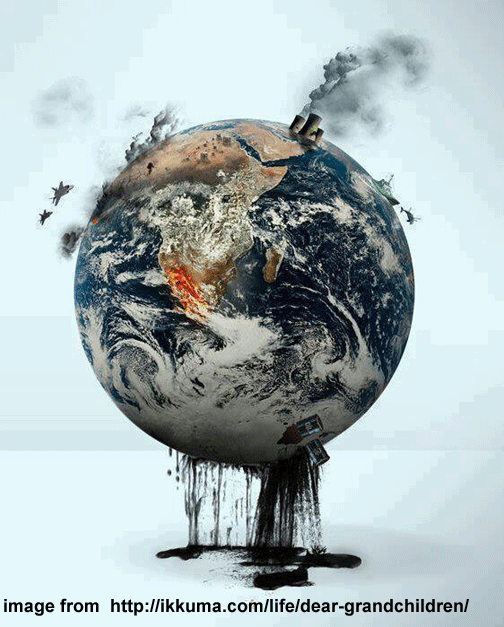 solution to the planet’s crisis.
If you don’t think that our home planet is in an ecocidal crisis, then you’ve been blissfully unaware of global heating, over-population, biodiversity loss, waste crises, plastic pollution, overconsumption of energy, water shortages, deforestation, nuclear danger, space junk danger, perpetual nuclear war risk…….
Visionaries like Bill Gates and Elon Musk have brought extraordinary, and beneficial advances to our human society. On the way, they have become billionaires. And good luck to them. But their wealth and fame has made them all too ready to be seen as world leaders, and to see themselves as having the solutions to world problems. This can be problematic, as in effect, some of their solutions exacerbate the problems.
The future envisioned by both Bill Gates and Elon Musk has one huge blind spot. They both foresee ever-expanding energy use, and they plan for that – problems can be fixed with technology.
On a finite planet, endless energy use just cannot work. But the concept of enough is just not in their plans. If the human species does not take up the concept of enough, we could just become an extinct species. Technology could be used to reduce energy use, but that idea fades away as Gates, Musk, and other technocratic leaders see progress as being to have ever more exciting and energy-guzzling gimmicks and activities.
The digital revolution. It should be a benefit, enhancing our lives, and in many ways, it IS. But an energy price is paid in our unbridled use of digital technology. Every email, emoji, Facebook post, tweet, blogpost, Youtube, uses electricity. It’s not as if these actions just disappear ”into the cloud”. What a dishonest term that is! There is no such cloud. What there actually IS – is a host of vast areas of dirty great data” farms”. There’s another dishonest term. They’re not farms. They are soulless collections of great metal servers, using ever growing amounts of electricity, and of water, to keep them cool.
Then there’s the price at the end. It’s very hard to find out the details and the extent of toxic materials from digital technology, that are dumped in poor countries.
And, to be fair, companies like Apple, have made some efforts to reduce their ewaste.
However, planned obsolescence is rampant in the high tech world, resulting in the utter tragedy of ewaste pollution, – from discarded smartphones, laptops, computers, printers, TVs, fidbits, smart fridges, robots etc, the tragedy of the thousands of children working as waste-pickers in India and Africa, in slum conditions. E-waste includes many toxic materials such as lead, arsenic, cadmium, and mercury, that release dioxins. . ”With no health or environmental protections in the slum, the toxins contaminate the air, water, and the food consumed in the slum…….. The area is constantly covered in thick, toxic smoke from the burning of electrical cables that goes on all day and night,” – High-tech hell: new documentary brings Africa’s e-waste slum to life

Both Gates and Musk are enthusiasts for renewable energy, and in the climate crisis, they are to be applauded for their work in this direction. Yet, as with all kinds of digital technology, renewables should not be unlimited, and do have their downsides, both in the production (pollution from rare earths mining/processing), and in the final disposal, with toxic wastes, and components that are difficult to recycle. . The International Renewable Energy Agency (IRENA) estimates that solar panels produced 250,000 metric tonnes of waste in 2018 alone.
Bill Gates and Elon Musk do show their awareness of the planet’s grave environmental problems, but we don’t hear from them about energy conservation, or about moving away from the consumer society. Both talk quite enthusiastically about the great increase in energy use that we can expect. They complacently predict endless energy use, just as the nuclear lobby did in its glossy advertising film ”Pandora’s Promise”
Elon Musk now plans to put 24,000 satellites into space, and is well known for his dream of colonising Mars, and This idea has, of course, been taken up by many others, and there’s a sort of general public delight in space travel and interstellar rocketry. People seem oblivious to the fact that this will require huge amounts of energy, and that the space scientists already are turning away from clean solar power, to the far more dangerous source of nuclear fission. They’re also oblivious of the state of affairs in near space, where the trillions of bits of space debris pose dangers, floating about just like the plastic pollution in the oceans. Meanwhile the military planners in USA, Russia, China are already planning for nuclear weapons and war in space.
No surprise then that Elon Musk sees nuclear power as necessary – not just for his predicted need for much more electricity on Earth, but for this obsession with satellites and rockets.
Less well understood than his push for electric cars and Tesla technologies, is Elon Musk’s investment in the cryptocurrency, Bitcoin. Running Bitcoin demands enormous amounts of 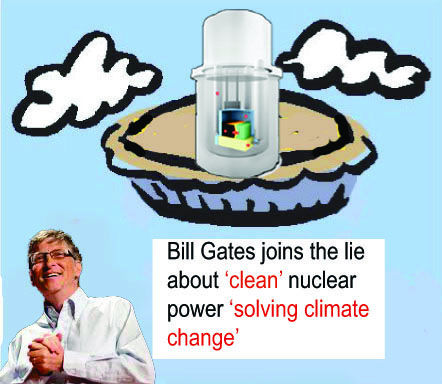 electricity, as Timothy Rooks explained recently.
Bill Gates, while motivated to help fight climate change, has also long been trying to make a success of his nuclear technology company Terra Power. The climate emergency presents him with the perfect opportunity to promote this, and especially, to get tax–payer funding to do it, as he suggests in his new book.
Wake up people! These two gurus have done some good stuff. But don’t let them manipulate us into dangerous territory – with nuclear technology, so connected with weaponry, and with its dangers, and the unsolved problem of radioactive trash. Sure, technology has got to be part of solving the planet’s crises. But we need much more imaginative leadership to steer our species away from infinite consumption and infinite energy use.
Nuclear power-not clean, not renewable – Bill Gates is wrong
Bill Gates is wrong about nuclear power http://english.hani.co.kr/arti/english_edition/english_editorials/984773.html
By Cho Chun-ho, professor of atmospheric sciences at Kyung Hee University Feb.28,2021 To prevent the climate crisis, we need to reorient our energy grids from fossil fuels to solar and wind power. Some argue we should also expand nuclear power, since nuclear plants don’t emit carbon dioxide.
Automobile accidents cause many fatalities, but people keep driving cars because of social inertia. But an accident at a nuclear plant would create damage on a scale that would exceed whatever benefits we derive from nuclear power.
As of 2018, cleanup from the disaster at the Fukushima nuclear plant had cost 236 trillion won (US$213.37 billion). But even that wasn’t enough to deal with the radioactive wastewater that Japan now intends to dump into the ocean. Most of that cost is being borne not by the company operating the nuclear plant but by taxpayers.
 There’s not a government on earth that can deal competently with an accident at a nuclear plant. Even Japan’s meticulously designed safety net was helpless before such an accident.
 Furthermore, the cost of generating nuclear power has gone up 26% in the past ten years. Part of that price hike results from the need to prevent previously unconsidered risks, such as the Fukushima accident. Another issue is that demand for nuclear reactors has been recently falling around the world, pushing nuclear power out of the market.
In the book “How to Avoid a Climate Disaster: The Solutions We Have and the Breakthroughs We Need,” Bill Gates argues that nuclear power is ideal for responding to climate disaster because it’s the only emissions-free source of energy that can be supplied continuously around the clock.
In 2020, a team of researchers led by Benjamin Sovacool, a professor at the University of Sussex, published a paper in the journal Nature Energy analyzing renewable energy and nuclear energy’s impact on reducing carbon dioxide emissions. The relationship between renewable energy and nuclear power is mutually exclusive: one tends to crowd out the other.
Over the past ten years, the cost of solar and wind power has fallen by 89% and 70%, respectively. That’s because renewables have been the focus of technological innovation, which has entailed a huge amount of investment.
In 2020, the International Energy Agency declared that solar power was the cheapest source of electricity. In countries that have focused investment on renewables, renewable energy holds an advantage in the market even when governments reduce or totally eliminate subsidies.
Solar and wind power accounted for 72% of power capacity added around the globe in 2019. As renewables’ share of the energy mix increases, nuclear power — which is inflexible because output cannot be adjusted — has become a headache for the energy regime.
Multinational firms such as Apple, Google and Microsoft are pushing their suppliers to provide parts that are completely made with renewable energy — which doesn’t include nuclear power.
Nuclear power may be a low-carbon source of energy, but it’s not renewable because of the nuclear waste it produces. We can’t have both nuclear power and renewable energy because they rely on different paradigms. So which one are we going to choose?
Is it wise for the Biden administration to fund Small Nuclear Reactors?

|
Climate change and ‘advanced nuclear’ solutions, The Hill, BY GREGORY JACZKO, — 02/23/21
Nuclear power is knocking on the government’s door offering solutions. The Biden platform answered by including so-called “advanced nuclear” in its list of climate options. The question now is will they wisely fund any such efforts?
While talk of advanced nuclear reactors is ubiquitous, a precise definition is elusive. Without a clear target in which to aim, government funds will not hit the mark. Advanced nuclear has become the catch-all for the knight-in-shining-armor reactors that promise to address issues that have kept nuclear a marginal electricity player since its inception. But we need more than this open-ended definition. The Biden administration should support projects only if they can compete with renewables and storage on deployment cost and speed, public safety, waste disposal, operational flexibility and global security. There are none today.
The only advanced nuclear technologies close to realization are called small modular reactors. These reactors are smaller than traditional reactors and are self-contained. These features allow companies to manufacture most of the reactor in a factory and ship it to a plant site. This concept evokes images of smart phones rolling out of factories by the billions — each design identical and mass produced. Their small size reduces the amount of radiation that can be released to the environment, greatly reducing — but not eliminating — safety to a plant’s community….
Yet the economic competitiveness of small modular reactors appears weak. Shrinking the size of a traditional reactor and splitting it among many modules increases the cost of the electricity it produces. It is the same reason airlines fly large capacity jets instead of private jets. You maximize the revenue per area of the aircraft hull. Proponents argue mass production will overcome this problem with fleet-wide economies of scale and construction efficiencies. Only wide scale adoption of the technology would deliver those benefits and there is no obvious market to support that today.
Moreover, the nuclear industry always promises better, faster and cheaper yet it fails to deliver. ……
Small modular designs are only promising to be cheaper than traditional reactors. Current estimates show they are more expensive than renewables, like wind and solar, even with storage and without subsidies. Small reactors have a long way to go to be competitive. Dramatic cost decreases for high-volume energy storage, which address the intermittency of some renewables, make the competitive case for any form of nuclear even tougher.
Even if everything else was lined up perfectly, nuclear has little time to catch up. After reentering the Paris Agreement, the U.S. will again strive to achieve drastic reductions in greenhouse gas emissions (GHG) within the next 10 years. Even in the most optimistic scenario, we won’t see even a handful of small modular nuclear reactors in the U.S. until 2029 or 2030, which means a large-scale impact would come far after the climate tipping point.
What about the other factors like proliferation resistance and waste disposal? For those criteria, small modular reactors offer no advantages over their traditional reactor cousins. Even if the cost factors are addressed, proliferation concerns and waste management will be hurdles.
Most importantly, no small modular reactors have been deployed yet in the United States, despite government efforts. In 2011, the Department of Energy (DOE) offered $400 million grants to support two small modular reactor designs. After providing tens of millions, only one design is still under development. That company originally planned to build a 12-module plant at the Idaho National Laboratory.
Predictably, this project is in trouble. Electricity customers have committed to purchase just a small fraction of the power produced annually by that plant, which now is likely to be scaled down, diminishing the economies of scale from mass production. It will not operate until at least 2030, years behind schedule and too late to help deal with the problem forecast in the best climate models. Despite these challenges, the federal government agreed in concept to a $1.4 billion direct subsidy over 10 years for the project. Without this cash infusion, the project will not meet its already disputed targets for price competitiveness. Such largesse is part of the billions Congress and the Trump administration committed to other advanced reactor concepts, none of which are close to deployment. To avoid wasting money on advanced nuclear reactors, the Biden administration must establish clear metrics for advanced nuclear reactors and apply them rigorously. Only ideas that can meet the pressing timetable of climate demands and electricity market realities deserve a serious look. My list is a good place to start. If advanced reactors cannot meet these metrics, they should not receive funding. Proponents of nuclear power will certainly say that living up to my list is an arduous task. Perhaps it is, but the future of our planet hangs in the balance. That is more important than the profits of an industry. Dr. Gregory Jaczko was the chairman of the U.S. Nuclear Regulatory Commission from 2009 to 2012 and currently develops clean energy projects and teaches at Princeton University. https://thehill.com/opinion/energy-environment/539991-climate-change-and-advanced-nuclear-solutions |
|
Why is the media fawning over nuclear businessman Bill Gates?
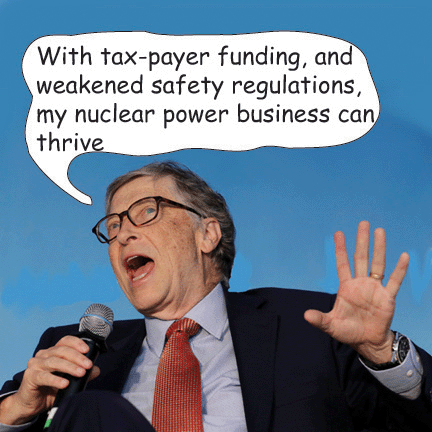
In a much-publicised interview he did on 60 Minutes Gates hyped up “advanced nuclear” fusion, SMRs and all the other tech marvels he is promoting. His interviewer, Anderson Cooper, completely ignorant of the subject, lapped it up, and failed to point out that none of these are proven technologies.
|
Why Bill Gates can’t save the world, The Fifth Estate, BY DAVID THORPE / 23 FEBRUARY 2021 Why don’t these billionaire philanthropists like Gates just stop their foundations and pay their fair share of taxes?
The media everywhere has been fawning over Bill Gates and his new book, How To Avoid A Climate Disaster. But should we really be listening to the world’s third wealthiest man for advice? If his suggestions and plans of action were wise and useful then maybe… Microsoft founder Bill Gates has an estimated net worth of $129 billion. His incalculable possessions, hugely destructive habits, and the massive investments of his opaque charitable trust, do everything to contradict his message that he’s the man with the plan to solve climate change. The fundamental point is that the richer you are, the bigger your ecological footprint. There’s no escaping it. The Gates’ fossil footprint……..Among the many $22.34 billion investments of Bill & Melinda Gates Foundation Trust, most of them are decidedly not in low carbon enterprises:
This is just scratching the surface. Journalist Tim Schwab, who has made it a mission to investigate Gate’s wealth and influence, has discovered his investments in fossil fuel companies: Gates claims to have divested from fossil fuel companies in 2019, but his foundation’s tax filing from that year shows millions of dollars in direct investments in companies like Exxon, Chevron, and Japan Petroleum Exploration. Billions more are invested in fossil-fuel-dependent industries like airlines, heavy machinery and automobiles. There’s a $1.6 billion stake in Caterpillar, for example, which makes diesel-guzzling plant used in mining. He is chairman of TerraPower, a nuclear reactor design company which has put no energy into the power grid. In October 2020, the United States Department of Energy gave TerraPower a grant of $400 million rising to $4 billion over the next seven years towards building a demonstration reactor. For reasons like this, Schwab calls Gates’ book “a long-winded advertisement for his investments”. Gates uses it to appeal to the US government to become a co-investor in TerraPower. The blind spotWhat is astonishing is the uncritical attitude of the media to Gates’ outpourings. The Financial Times last Saturday devoted the front page and a half of its Life & Arts supplement, to his “Green Manifesto”, without comment or criticism: it was free advertorial. Who else would get this treatment? Not long into the piece Gates pontificates, “The problem is simple. We can’t afford to release more greenhouse gasses.” Naturally, he doesn’t include himself in this “we” because if he did he would have to completely change his behaviour and lifestyle, something that he seems incapable of doing. This massive blind spot to his vision is also a blind spot to the media. The vast majority is in denial about his wealth. We want someone to come and lead us to salvation from the dire future we appear to be heading for. Of course, it should be a rich white man! Who else? But just as an alcoholic can’t rely on a whiskey distillery for a cure, we shouldn’t put our faith in the super-rich – because they are a huge part of this problem. Like most of the industrial-business sector, Gates imagines that the solution to climate change is technological. It can never be just that, it’s system change, it’s behavioural. In a much-publicised interview he did on 60 Minutes Gates hyped up “advanced nuclear” fusion, SMRs and all the other tech marvels he is promoting. His interviewer, Anderson Cooper, completely ignorant of the subject, lapped it up, and failed to point out that none of these are proven technologies. Gates the philanthropistBeing one of the top philanthropists in the USA, having donated billions to charity, gives Gates a powerful platform for his views. He sits on world stages amongst experts in the field who have been either democratically elected or appointed because they are experts. What is Gates’ experience or qualifications to talk about climate change? Charles Dickens used his writings to attack injustice in Victorian times. He was especially scathing of rich individuals who styled themselves as philanthropists but whose charitable acts did more to serve their own vanity than deserving causes. Nowhere is this better exemplified than in his novel Bleak House, where he puts in the mouth of one character the following aphorism: “There were two classes of charitable people; one, the people who did a little and made a great deal of noise; the other, the people who did a great deal and made no noise at all.” He satirises the former with Mrs Jellyby and Mrs Pardiggle, both of whom practice philanthropy – but at the expense of others. For both, philanthropy is more of a profession than born of genuine motivations to help. Philanthropy has become Gates’ profession, and his motivation is to assuage his guilt at the size of his wealth and ecological footprint, and to wield power. Dickens would have a field day. Can it be a coincidence that his charitable donations and investments in finding vaccines for the coronavirus, have seen his personal fortune rise $20 billion dollars as a result. That’s not philanthropy, it’s profiteering. Tim Schwab again, in the above article, quotes Anthony Rogers-Wright, director of environmental justice for the New York Lawyers for the Public Interest, as saying “These billionaires, the best they could do, some would say, would be to be stop their foundations and pay their fair share of taxes”. He observes how new tax revenues could help fund democratically devised solutions. “If Gates really wants to be effective and in a way that lifts up equity, he should be really listening to people who are being impacted the most and scaling up their solutions, rather than coming in with a parachute and with an air of white saviour-ism that actually in some cases causes more harm than good.” Christine Nobiss, founder of the indigenous people’s Great Plains Action Society, claims that Bill Gates has become the largest farmland owner in the United States. He owns nearly 100,000 hectares and is not farming it regeneratively or even sustainably. “He’s basically participating in the never-ending cycle of colonisation,” Nobiss says. The world’s most frequent flyer?Flying is one of the worst things you can do for the climate change, right? In a 2019 study of 10 celebrities and their flying habits, Celebrities, air travel, and social norms, Gates came top with the most emissions, beating Jennifer Lopez, Paris Hilton, and Oprah Winfrey. No wonder he would like the sustainable aviation fuel he dreams of in his book, and a neat way of offsetting all his carbon guilt. Let’s face it, would you rely on McDonald’s to make the world go vegan, or Putin to bring world peace? So why listen to Bill Gates, a man with a carbon footprint the size of a small country? Then there is the question of climate justice. In his book he never questions the political systems and economic models that result in climate change’s greatest impacts being on the poor and people of colour. There would be only one way for him to escape these financial conflicts of interest: let him lead by example. Let him give away all his money to the world’s poor with no strings attached. Let him live in a small apartment on $100 a week. Let him see the world from the point of view of a climate refugee – and say nothing about it. When he’s done all that, I’ll follow him. https://www.thefifthestate.com.au/urbanism/climate-change-news/why-bill-gates-cant-save-the-world-and-why-these-billionaire-philanthropists-might-do-best-to-simply-pay-fair-share-of-taxes/ |
|
The ”New Yorker” sinks to sloppy sentimenta praise of pro nuclear advocates
The Once-Proud New Yorker Soils Itself in Radioactive Offal https://readersupportednews.org/opinion2/277-75/67935-rsn-the-once-proud-new-yorker-soils-itself-in-radioactive-offal, By Harvey Wasserman, 21 February 21
 or decades, The New Yorker has set a high bar for journalistic excellence.
Graced by its signature brand of droll, sophisticated cartooning, the magazine’s exquisitely edited screeds have reliably delivered profound analyses of the world’s most pressing issues.
But in a breathless, amateurish pursuit of atomic energy, the editorial staff has leapt into a sad sinkhole of radioactive mediocracy.
The latest is Rebecca Tuhus-Dubrow’s shallow, shoddy “Activists Who Embrace Nuclear Power,” yet another tedious plea that we learn to love the Peaceful Atom.
For at least a century, countless scientific pioneers have exposed the murderous realities of nuclear radiation. Legendary researchers like Marie Curie, Alice Stewart, Rosalie Bertell, Helen Caldicott, John Gofman, Ernest Sternglass, Thomas Mancuso, Karl Z. Morgan, Samuel Epstein, Robert Alvarez, Arnie Gundersen, Amory Lovins, and others have issued vital warnings.
In Pavlovian opposition, the industry has rolled out an endless array of amateur “environmentalists” whose activist credentials are distinguished only by an endless love for atomic power.
Most infamous are Greenpeace veteran Patrick Moore and Berkeley-based Michael Shellenberger, both climate skeptics who share a theatrical passion for uninspected, uninsured nukes. With no credible scientific credentials, this unholy pair has conjured imaginative advocacies for companion corporate embarrassments like genetically modified food, clear-cut deforestation, and more.
With far more prestige, climate pioneer Dr. James Hanson and Whole Earth Catalogue founder Stewart Brand have brought significant gravitas to the nuclear debate.
But The New Yorker dotes on two workers at California’s Diablo Canyon. Neither is a scientist. Both claim to be “environmentalists.” One wears a lavender pendant made of uranium glass which “emits a near-negligible amount” of radiation, despite a huge body of scientific evidence warning this is a literally insane thing to do – especially for someone who might be around small children.
 The writer lauds her heroines for calling themselves “Mothers for
 Nuclear” while snubbing legendary “Mothers for Peace” activists who’ve organized locally for a half-century. While touring Diablo with her new best friends, the author coos that “we smiled as if we were at Disneyland.”
Such “Nuclear Renaissance” absurdities are very old news.
Given The New Yorker’s stellar history, we might expect a meaningful, in-depth exploration of today’s core atomic realities: no more big reactors will be built in the US, and our 90+ old plants are in deep, dangerous disarray.
Forbes long ago branded atomic power “the largest managerial failure in US history.” America’s very last two reactors (at Georgia’s Plant Vogtle) sucked up $8.3 billion in federal loan guarantees from Barack Obama plus $3.7 billion more from Donald Trump. Years behind schedule, Vogtle’s final price tag (if it ever opens) will exceed $30 billion.
South Carolina’s engineering and legal morass at V.C. Summer wasted more than $10 billion on two failed reactors. In Ohio, $61 million in utility bribes for a massive nuke bailout have shattered the state.
As for alternatives, Rebecca Tuhus-Dubrow says, “nuclear scientists, for their part, are working on smaller, more nimble nuclear reactors. There are complex economic considerations, which are inseparable from policy.”
In other words, the proposed Small Modular Reactors are already so clearly uncompetitive that only obsessive pro-nukers (like Bill Gates) think they’ll hold market value against wind and solar (which The New Yorker attacks).
Precisely as ice storms froze feedwater pipes and shut one of two reactors at the South Texas Nuclear Plant, the magazine falsely claims that atomic reactors do “not depend on particular weather conditions to operate.” Globally-warmed rivers can no longer reliably cool many French reactors. Earthquakes have dangerously damaged US-designed nukes in Ohio and Virginia. Intake pipes at Diablo and other coastal plants are vulnerable to tsunami surges. Staggering design and construction flaws (a major Diablo component was once installed backwards; boric acid ate through key parts of Ohio’s Davis-Besse) give the entire industry a Keystone Kops/Rube Goldberg aura.
Tuhus-Dubrow skims the waste issue. Dry casks at Diablo and elsewhere are generally less than an inch thick. They can’t be re-opened for inspection or maintenance, and are already cracking (more-versatile German casks are 19 inches thick).
With an average age of well over 30, US reactors face dangerous decay. After four years of Trump, and even longer as a corrupt rubber stamp, the infamously dysfunctional Nuclear Regulatory Commission has left these collapsing, uninsured jalopies virtually unregulated and uninspected.
Tuhus-Dubrow ignores the fact that (unlike Disneyland) Diablo Unit One was long ago reported to be severely embrittled. That means critical components could shatter like glass if flooded to contain a meltdown. Ensuing Chernobyl-scale steam and hydrogen explosions would spread apocalyptic radiation throughout the ecosphere.
Despite a petition signed by more than 2,000 Californians and key Hollywood A-listers, Gov. Gavin Newsom refuses to inspect Diablo’s decayed reactors.
The New Yorker says smoke coming from huge northern California fires dimmed solar panels. But those fires were caused by the gross incompetence, neglect, and mismanagement of the twice-bankrupt Pacific Gas & Electric, which runs Diablo.
PG&E is a federal felon, convicted for killing scores of Californians in avoidable explosions and fires. Tuhus-Dubrow simply ignores such slipshod mismanagement, which could prove catastrophic at a nuke as old as Diablo.
Overall, the nuke power debate has long since transcended random, folksy industry devotees who like to label themselves “green.” No serious analyst argues that, after the fiscal fiascos at V.C. Summer and Plant Vogtle, any big new reactors will ever be built in the US. Small ones are cost-prohibitive pipe dreams, especially as wind, solar, battery and LED/efficiency technologies continue to advance.
The question of how long America’s 90+ jalopy nukes can run until the next one explodes remains unanswered … and utterly terrifying.
Somehow, the revered New Yorker has polluted its pages with a pro-nuke fantasy while missing this most critical atomic issue.
Let’s hope it corrects the deficiency before the next Chernobyl lays waste to our own nation.
Harvey Wasserman’s Solartopia! Our Green-Powered Earth is at www.solatopia.org, along with The People’s Spiral of US History.
Bill Gates’undemocratic approach to climate crisis
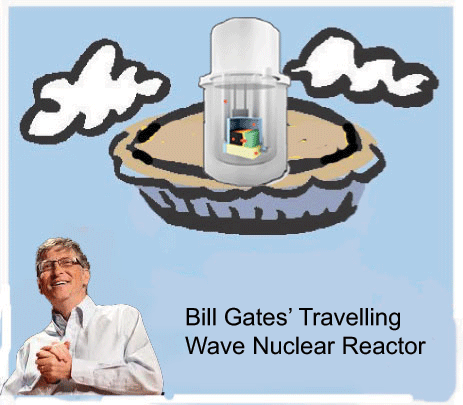 The Nation 16th Feb 2021, Tim Schwab: Gates proceeds from a precarious position, not just because of his thin credentials, untested solutions, and stunning financial conflicts of interest, but because his undemocratic assertion of power—no one appointed or elected him as the world’s new climate czar—comes at precisely the time when democratic institutions have become essential to solving climate change.
https://www.thenation.com/article/environment/bill-gates-climate-book/
Nuclear lobby planning to take over the U.N Climate Change Conference

Meet the Young Generation Network and its group of nuclear schills who will lead the attempted nuclear takeover of the 26th UN Climate Change Conference of the Parties (COP26) in Glasgow on 1 – 12 November 2021.
Just by chance? They all happen to be ambitious young people who hope to have a big career in the nuclear industry. Well, you can’t blame them for that. But let’s be wary of their advice on nuclear power as the solution for global heating.
Arun Khuttan. End States Engineer at Magnox Ltd.UKAlice Cunha da Silva. Latin America Nuclear Leader | Westinghouse Electric Company.
Hannah Paterson, Technology Manager at Sellafield Ltd UK
Matthew Mairinger Technical Engineer with Ontario Power Generation, Canada
Miguel Trenkel-Lopez Assistant Engineer at Magnox Ltd,Bristol, UK
Saralyn Thomas Formerly at AREVAnuclear company, now at Abbott Risk Consulting (ARC) Risk Management consultancy services to the Nuclear Industry
Vicki Dingwall of EDF nuclear company
On nuclear power as climate solution, Bill Gates shows alarming ignorance
David Lowry’s Blog 16th Feb 2021 The multi-billionaire Bill Gates, founder of Microsoft, in his new book, “How to Avoid a Climate Disaster”, is sceptical of the Green New Deal.(Allen Lane/Penguin) published on 16 February. Gates secured much pre-publication publicity for his new tome, including an interview in the Guardian Weekend Magazine, which wrote “Of the Green New Deal, the proposal backed by Alexandria Ocasio-Cortez [the Congresswoman who has promoted the merits of the GND in the US] that raises the goal of carbon neutrality in a decade, he is flatly dismissive, with Gates telling the interviewer. “Well, it’s a fairytale. It’s like saying vaccines don’t work – that’s a form of science denialism. Why peddle fantasies to people?”
Gates also opined: “I’m not a survivalist.” Instead his version of survivalism is to fund innovation, the reporter noted. “I’m putting money into carbon capture and nuclear fission” Gates told her. (Bill Gates: ‘Carbon neutrality in a decade is a fairytale. Why peddle fantasies?’, Guardian, 13 February 2021; https://www.theguardian.com/technology/2021/feb/15/bill-gates-carbon-neutrality-in-a-decade-is-a-fairytale-why-peddle-fantasies)
Indeed, his book is laced with positive, if inaccurate, mentions of nuclear power. For example, he asserts on page 84, in a section on “Making Carbon-Free Electricity”, uns der a sub-section titled ‘ Nuclear Fission’ he writes: “”Here’s the one sentence case for nuclear power: It’s the only carbon-free energy sources that can reliably deliver power day and night, through every season.”
1 This Month



26 September – International Day for the Total Elimination of Nuclear Weapons


PLEASE OPPOSE HR 8255 AND S.3639 – bills would accelerate satellite deployment, with no environmental review or safeguards – https://ncstd5li.quorum.us/campaign/169331/
To see nuclear-related stories in greater depth and intensity – go to https://nuclearinformation.wordpress.com
-
Archives
- September 2026 (219)
- August 2026 (330)
- July 2026 (355)
- June 2026 (287)
- May 2026 (306)
- April 2026 (356)
- March 2026 (251)
- February 2026 (267)
- January 2026 (308)
- December 2025 (358)
- November 2025 (359)
- October 2025 (375)
-
Categories
- 1
- 1 NUCLEAR ISSUES
- business and costs
- climate change
- culture and arts
- ENERGY
- environment
- health
- history
- indigenous issues
- Legal
- marketing of nuclear
- media
- opposition to nuclear
- PERSONAL STORIES
- politics
- politics international
- Religion and ethics
- safety
- secrets,lies and civil liberties
- spinbuster
- technology
- Uranium
- wastes
- weapons and war
- Women
- 2 WORLD
- ACTION
- AFRICA
- Atrocities
- AUSTRALIA
- Christina's notes
- Christina's themes
- culture and arts
- Events
- Fuk 2022
- Fuk 2023
- Fukushima 2017
- Fukushima 2018
- fukushima 2019
- Fukushima 2020
- Fukushima 2021
- general
- global warming
- Humour (God we need it)
- Nuclear
- RARE EARTHS
- Reference
- resources – print
- Resources -audiovicual
- Weekly Newsletter
- World
- World Nuclear
- YouTube
-
RSS
Entries RSS
Comments RSS
 nuclear-news