WhatDoTheyKnow provides proof it sent Freedom Of Information request to AWE, (the Atomic Weapons Establishment)
Tom Pashby, Aug 21, 2026
Digital proof has been shared with 20 Working Days that a Freedom of Information (FOI) Act request was sent to AWE (the Atomic Weapons Establishment) – which AWE claimed it didn’t receive.
The FOI request is now the subject of an Information Commissioner’s Office (ICO) decision notice – a type of enforcement action – over its failure to respond to a FOI request sent by 20 Working Days on 6 May, via WhatDoTheyKnow.
WhatDoTheyKnow describes itself as “a site to help anyone submit a Freedom of Information request. WhatDoTheyKnow also publishes and archives requests and responses, building a massive archive of information.” It is built by a pro-democracy and transparency non-governmental organisation called MySociety.
The decision notice has since been published on the ICO’s website. The ICO explains what decision notices are. It says: “When we do take formal enforcement action, this will likely be in the form of a decision notice.
“A decision notice is a formal document that explains whether the Information Commissioner thinks a public authority has complied with the law when dealing with a specific request.”
The decision notice it issued to AWE about the 6 May FOI request said: “A public authority will breach section 10 of FOIA if it fails to respond to a request within 20 working days.
“Based on evidence available to the Commissioner, by the date of this notice the public authority has not issued a substantive response to this request. Therefore the Commissioner finds a breach of section 10.”
Setting out the next steps required by the ICO, it said: “The public authority must provide a substantive response to the request in accordance with its obligations under FOIA.
“The public authority must take this step within 30 calendar days of the date of this decision notice. Failure to comply may result in the Commissioner making written certification of this fact to the High Court pursuant to section 54 of FOIA and may be dealt with as a contempt of court.”
20 Working Days offered AWE the opportunity to comment on the decision notice ahead of publication of its 12 August article covering the enforcement action.
The day after the article was published, on 13 August, an AWE spokesperson said: “AWE has received, and processed, previous requests from the requestor (FOI2026-020, FOI2026-042 and FOI2026-044) and has also received and acknowledged FOI2026-047) via the WhatDoTheyKnow platform. A response to that request is currently being considered.
“However a further request, understood to have been submitted on 6th May, was not received by AWE. AWE was therefore unaware of its existence until contacted by the Information Commissioner’s Office (ICO) in July.
“Following correspondence with the ICO, the ICO issued a Decision Notice on 10 August 2026, requiring AWE to provide a substantive response within 20 working days.
“AWE is processing this and has formally acknowledged this (reference FOI2026-049). A response will be provided within the applicable time limit.”
The spokesperson added: “This is equivalent to a signed-for physical letter delivery where the receptionist signs for the letter. Whether that letter got routed to the desk of the responsible person is the authority’s responsibility and out of our control.”
WhatDoTheyKnow later provided additional technical information to show it had evidence that the message was sent properly and received by AWE’s systems.
All the evidence shared by WhatDoTheyKnow was forwarded by 20 Working Days to AWE.
In response to the digital evidence, an AWE spokesperson said: “We have carried out enquiries using the additional log information supplied by [20 Working Days], but have not been able to locate any reference to the message that you are referring to.
“Our position therefore remains that the message in question was not responded to because it was not received by the team dealing with such requests. As stated previously, the team now has the request and will respond within the relevant timescales.”
Colluding with Violence: Aiding Israeli Settlers in the West Bank
18 August 2026 Dr Binoy Kampmark , https://theaimn.net/colluding-with-violence-aiding-israeli-settlers-in-the-west-bank/
The latest incidents of Israeli settler violence in the villages of Qusra and Kour, located in the northern occupied West Bank, have again caught international attention, reaching the halls of the United Nations with a gravity that, sadly, is unlikely to have much effect. Towards the end of July, the settlers had set their sights on local mosques, which they set on fire. From August 9, three families in Qusra – making up 15 people in all – were confined to their homes in terror, running out of food and necessities. (Settlers had deprived them of access to water and power.)
When Palestinian Red Crescent ambulances attempted to deliver food and water to these homes, they were attacked.
Unusually, this conduct drew public commentary from the US ambassador to Israel, Mike Huckabee, a devout Christian Zionist not normally given to criticising Israeli actions in the West Bank, let alone anywhere else. “Actions by those who carried out this horrific act of terror meant to intimidate and harass this family are disgusting,” wrote Huckabee in a post on X. “No excuse for such thuggish behaviour.” The US embassy had been “VERY involved & the IDF & Israel Police have gone at our request to remove the Israeli terrorists doing this.” (More to the point, interest might have been encouraged by the fact that one of the besieged family members was a dual US citizen.)
Rather than restraining the agitators, the Israeli military proceeded to force two of the besieged families, along with six other neighbouring families, to exit their homes for several hours on August 13. UN News reported that families were subsequently relocated to just one home, also imperilled by the settlers. According to the testimony of one resident, “instead of removing the attackers, the Israeli forces removed the attacked families, while allowing the settlers to stay all this time.”
The mayor of Qusra, Abdel Azim Wadi, regarded the role of the Israeli military as pernicious and distinctly not committed to removing the settlers. “We saw them praying together, barbecuing together and dancing together.” They were hardly “interested in helping the besieged families.” The IDF even goes so far as to run a hotline known as War Room C, intended for use by settlers to report on building activities by Palestinians in Area C. The insinuation of fault is clear. The UN Human Rights Office of the High Commissioner summed up matters: “These criminal actions by the settlers, supported or acquiesced to by Israel, the Occupying power, are making life unbearable for these Palestinian families and are clearly aimed at forcing them to leave their home and their land.”
On August 11, Ramiz Alakbarov, the UN Deputy Special Coordinator for the Middle East Process, told the 15-member Security Council that what was unfolding in the West Bank was the result of “decades of unresolved conflict that has deepened the unlawful Israeli occupation, driven the Palestinian Authority to the brink of collapse and undermined the prospects of an independent, viable and sovereign Palestinian State.”
The picture sketched by Alakbarov is a dismal one, rendering Israeli authorities complicit with the unruly urges of the settlers. (Some 26% of territory in the West Bank is already regarded as “state land,” a status enabling it to be turned over for the construction of new settlements.) Since the start of 2026, approximately 12,360 housing units have beenapproved or advanced by the Israeli authorities in the West Bank. Hefty sums are being allocated for expanding the settlements, including $431 million in aid of 34 new settlements.
The year has also seen the deaths of 76 Palestinians in the territory, due to the work of Israeli forces or settlers. Of this complement, 18 have been children. Three Israelis have also been killed in confrontations with Palestinians. The displacement of the Palestinian population due to settler violence, demolitions and evictions continues with inexorable remorselessness: some 3,800, almost half of them children, have suffered that fate.“Many incidents occurred in the presence of Israeli forces,” insists Alakbarov.
The momentum towards annexation is also being given impetus by plans announced by the Israeli Defence Minister, Israel Katz, to replace the army in the West Bank with civilian police forces. Police would, according to Katz’s office, “establish an appropriate force to handle and address civilian matters,” with the military exclusively tasked with combating “Palestinian terrorism” and protecting borders and communities. The move received much support from various settler figures, with Yisrael Ganz, head of the Regional Binyamin Council in the West Bank, proposing that the next step be “full Israeli sovereignty” over the territory. “The time has come to move from temporary management to the full application of Israeli law.”
The official policy of the Netanyahu government is to regard the attacks as the nasty work of errant juveniles or delinquents who should know better. The thesis on delinquency is not one that holds up when placed alongside the official support for settlement expansion and de facto annexation stemming from Israel proper. The events in Qusra, as with elsewhere in the West Bank, suggest a script of insidious collaboration against the Palestinians, delivered with a forked tongue. The painful implication here is that temporary measures involving the besieging of villagers, and half-hearted efforts by the IDF to combat them, can only inevitably result in dispossession. And that, in the end, is the point.
Mutiny aboard US carrier Abraham Lincoln off Iranian coast

mounting complaints from crew members following protests by their families over the ship’s prolonged deployment
The USS Abraham Lincoln has been deployed for over 260 days, which is a modern-era record for a U.S. aircraft carrier. This prolonged deployment has led to significant stress and mental health challenges among the crew
August 12, 2026, Bruce K. Gagnon, https://space4peace.blogspot.com/2026/08/mutiny-aboard-us-carrier-abraham.html
Recent reports indicate a serious mutiny situation aboard the USS Abraham Lincoln. Seven U.S. Navy personnel have possibly been killed and several others injured in a violent clash among the crew, highlighting growing unrest and morale issues during an extended deployment.
Worried families vented their anxieties about loved ones onboard the Lincoln at an emotional town hall meeting with navy leaders in San Diego last Thursday, Stars and Stripes reported. One spouse among the 200 or so family members said that her husband had texted her that day saying “he hopes he doesn’t wake up tomorrow”.
A woman at the meeting told acting navy secretary, Hung Cao that the navy had “broken trust between us and the leadership”, the paper reported. The Navy Times gave details of thwarted suicide attempts onboard the aircraft carrier during the current deployment. Annabelle Loma told the outlet that her husband had tried to jump overboard after his spell at sea kept being extended. “He’s scared. He thinks he’ll get a dishonorable discharge, and just because he was burnt out his 13-year career is ruined, just like that,” she said.
Bonnie York, whose stepson is aboard the Lincoln, told MS NOW she had been told a doctor or therapist on the ship warned the crew needed to reach port before people started “losing their minds.” She voted for Trump—and partly because he promised not to start any new wars. She no longer believes the country is safer for it. “You’ve essentially stranded them out there,” she said of the crew.
Seven US Navy personnel have reportedly been killed and several others wounded in a violent clash aboard the USS Abraham Lincoln, as growing unrest among the carrier’s crew has exposed mounting pressure inside the US military amid a prolonged deployment.
The incident erupted after an adviser to US Central Command (CENTCOM) chief Brad Cooper boarded the carrier to address mounting complaints from crew members following protests by their families over the ship’s prolonged deployment, according to Tasnim News Agency, citing an informed military source. The adviser was reportedly met with boos and had water bottles thrown at him while addressing a gathering of personnel. The confrontation subsequently escalated into a fight among crew members involving knives and other bladed weapons, leaving seven personnel dead and several others wounded, according to the source.
Pistol Pete Hegseth, the defense secretary, dismissed the accounts as “more fake news”.
Deployment Context
The USS Abraham Lincoln has been deployed for over 260 days, which is a modern-era record for a U.S. aircraft carrier. This prolonged deployment has led to significant stress and mental health challenges among the crew
Conditions and Morale
Reports from military families describe poor living conditions, including food shortages and inadequate facilities, contributing to the deteriorating morale.
Response and Claims
In addition to internal conflicts, there are external tensions, with Iran claiming to have attacked the carrier, although U.S. officials have denied these allegations.
Walt Zlotow – Israel mimicking Nazis at end of WWII…destroying evidence of genocide

Walt Zlotow West Suburban Peace Coalition Glen Ellyn IL, 13 August 26
As the Nazis were collapsing in the spring of 1945, they furiously tried to cover up their massive genocide of Jews and other undesirables they engaged in during WWII.
Eighty-one years on we’re learning that Israel appears to be practising a similar cover up of its genocide of Palestinians in Gaza that, astonishingly, is still going on ten months after the Trump brokered ceasefire that he trumpeted to end it.
Once the massive bombing stopped, the World Court issued an order for Israel to preserve evidence of genocidal acts committed in Gaza. But in a new report by the Geneva-based Euro-Mediterranean Human Rights Monitor said that Israeli forces and contractors “are conducting a wide and organized operation to process and clear the rubble from neighborhoods and facilities they have destroyed in the Gaza Strip and relocate it from areas under their military control to outside the strip. This is occurring without any official record of the quantities removed or independent oversight, and before international and local investigative committees have had the chance to survey, examine, and document the sites. This risks destroying crucial evidence of genocide and the remains of victims still unaccounted for under the rubble. The systematic removal of rubble at this pace conceals the evidence of appalling crimes Israel committed in Gaza, especially those related to genocide, including summary executions and killing unarmed civilians.”
What did the Israeli genocide in Gaza look like?
In April the World Bank, UN and EU jointly published a report that estimated around 68 million tons of rubble from over 200,000 buildings are spread across Gaza’s 141 square miles after relentless bombing that left more than 250,000 Palestinians dead, injured or missing and up to 2 million forcibly displaced, starved or sickened. That’s the entire Palestinian population.
The Euro-Med report says at least 10 million tons of rubble “have been removed, crushed, or moved from their original sites within the areas under Israel’s unlawful military control, which encompass about 66% of the Gaza Strip by approximately 400 heavy pieces of excavation, demolition, crushing, and transport machinery, operated by Israeli civilian companies under military protection, that are active across eastern and southern Gaza.”
While it’s impossible to understand why any nation, be it Hitler’s Germany or Netanyahu’s Israel, would commit genocide, it’s certainly understandable why both would feverishly seek to cover it up.
Why no Hollywood movie on Nagasaki A bombing?

Walt Zlotow West Suburban Peace Coalition Glen Ellyn IL, 6 Aug 26.
In the 1952 movie ‘Above and Beyond’, movie idol Robert Taylor played handsome Col. Paul Tibbetts, straight out of Central Casting, who piloted Enola Gay to drop the first atomic bomb on Hiroshima 81 years ago today. We all grew up in awe of Tibbetts, Enola Gay and the perfect mission which incinerated Hiroshima from the first A Bomb dropped in anger. My awe eventually turned to revulsion from a horrendous war crime.
But who piloted what plane that dropped the second A Bomb on Nagasaki just 3 days later? The American Story has largely erased the saga of the Nagasaki mission for good reason. It was a colossal screw up that almost got the pilot court martialed; indeed, nearly detonated the Nagasaki A Bomb ‘Fat Man’ over the Pacific en route.
Trouble began early on. Paul Tibbetts, fresh from his Hiroshima success, picked his friend Charles Sweeney to pilot the drop plane ‘Bockscar’ instead of its regular pilot Fred Bock. Sweeney was unfamiliar with both combat and the plane. Preparing for takeoff, Sweeney was unable to operate the reserve tank containing 640 gallons of fuel needed to get Bockscar safely back to its Tinian takeoff point. Bock may have had the familiarity with the plane to accomplish that. Regulations required the mission be scrapped so Sweeney and crew exited Bockscar. But Tibbetts overruled them and the mission was on with insufficient fuel.
Three hours in, worse trouble. Fat Man’s red detonation lights began blinking wildly. Chief weaponeer Dick Ashworth frantically searched the blueprints and realized 2 switches had been reversed in the preflight assembly. Solving that problem, everyone relaxed till Bockscar failed to rendezvous with the second of two back up planes, one for photography and one for instruments. The instrument plane, The Big Stink, was 9,000 feet above Bockscar. Instead of pushing on to original target Kokura, Sweeney wasted 45 minutes of precious fuel trying to link up. Big Stink pilot Hoppy Hopkins broke radio silence frantically calling Tinian asking “Is Bockscar down?” Mission officials only heard “Bockscar Down” and freaked out believing Bockscar, Fat Man and the 13 member crew were in Davy Jones Locker.
Ashford was frantic that all was lost. As tension mounted between the weaponeer and the pilot, he finally persuaded Sweeney to proceed to primary target Kokura. But a smokescreen put up by Japanese defenders responding to the Hiroshima attack caused Sweeney to go around for a second and third bomb run, wasting fuel. More trouble. Flack and approaching Japanese Zeros forced Sweeney to abandon Kokura to flee 100 miles to alternate target Nagasaki.
The drop made, Sweeney made a desperate dive to avoid the mushroom cloud that nearly engulfed them. But his previous delays made the return trip to Tinian impossible. Low on fuel, Sweeney began a treacherous 450 mile flight on dwindling fuel for Okinawa. All aboard Bockscar prepared to ditch. Approaching the Okinawa airfield unable to radio the tower of their emergency, Bockscar had to drop in to a forced landing amid numerous other flights without control tower clearance. Bockscar bounced 25 feet in the air landing at 30 MPH over the maximum landing speed, nearly colliding with a row of fuel laden B-24’s. One engine quit on the approach and another upon touchdown. Thinking Bockscar was lost, airport personnel inquired who this strange plane was that descended out of the sky unannounced. ‘We just dropped an atomic bomb’ was the reply.
There were no celebrations for the crew of Bockscar. Officials considered a courts martial for Sweeney for his life and mission threatening delays but realized the embarrassment it would cause and decided against. Why mar the mission-perfect first nuking of civilians by Paul Tibbetts and Enola Gay?
While we’ll never get a Hollywood treatment of the Bockscar A Bomb mission, it would be a lot more exciting than ‘Above and Beyond’. An appropriate title? ‘Nearly Down and Out Over Nagasaki’.
Nuclear test veterans’ medical records were gathered by secret government lab

Susie Boniface Reporter, 04 Aug 2026, https://www.mirror.co.uk/news/politics/nuclear-test-veterans-medical-records-37508232
Medical records of nuclear test veterans were gathered by a secret government laboratory, the Ministry of Defence has admitted.
Up to 50,000 paper files now locked in a climate-controlled warehouse were collected by scientists at Porton Down. The cache of files has yet to be examined, despite a two-year review into missing medical records of veterans who were subject to a programme of medical monitoring at Cold War bomb tests.
Campaigning MP Rebecca Long-Bailey said: “We need to know how many records are in there, for what reason they were held, and whether they constitute some of the missing files our veterans have spent decades searching for. I hope our new Prime Minister, who has been unfaltering in his support of the veterans, will order this archive searched before Parliament returns from summer recess.”
A cross-party group of MPs have written to Defence Secretary Wes Streeting, urging him to examine the archive. Veterans of Britain’s 45 atomic experiments have long complained their medical files were missing.
In 2022, the Mirror uncovered the first evidence thousands of them were given previously-denied blood, urine and thyroid testing, and underwent chest x-rays, before, during and after service at the weapons trials. The original orders were for blood test results to be recorded on six different forms, by five separate people, and held in four places, including ‘special health registers’ for each unit.
A review was launched in 2024, but when it was published last month it was unable to find most records, and assumed the blood tests were – in many cases – never taken and in others destroyed. No trace of the registers was found.
But it did locate a warehouse in Swadlincote, Derbyshire, which held 50,000 paper records about historic radiation exposure. A brief search established it held medical records for at least one atomic serviceman. The review said: “It is possible that the records of other nuclear test veterans are in the collection.”
The archive has a chequered past. Officially called UHR ‘DSTL Historic Radiation’, it appeared to have been formed by the Defence Science Technology Laboratory, more usually known as Porton Down. It is a top-secret facility that conducts classified biological and chemical research.
Today the files are held by a private contractor called Restore, which specialises in document storage. A digital version is held by Defence Radiation Protection Services, another part of the MoD, based 172 miles away in Gosport, Hampshire.
Two years ago, DRPS merged with the Atomic Weapons Establishment which is now responsible for the files, but no-one can search them without “specific individual permissions” from Defence Business Services; the administrative arm of the MoD. When ministers published the review, they did not say if or when the archives would be searched.
Veteran John Morris, 88, said: “It’s bonkers. The MoD has some paperwork, but the MoD hasn’t given itself permission to search it and tell the rest of the MoD what it has. If my medical records are in there, I want them back.”
An MOD spokesperson said: “We owe an enduring debt of gratitude to the more than 22,000 Service personnel, scientists and civilians who contributed to the UK’s nuclear testing programme and helped safeguard our national security.
“This Government commissioned a comprehensive review in relation to its agreed scope, processing more than 100,000 items and records across the organisations holding relevant material.
“As with any exercise involving records over 70 years old, additional collections and references may emerge over time. The fact that further material has been identified does not change the findings of the review, which found no evidence of deliberate concealment and set out transparently the limitations and gaps within the surviving record.”
Israeli spyware firms are fueling the global surveillance state

The Grayzone, Aug 01, 2025, By ¡Do Not Panic! – July 31, 2025
The Pegasus hacking tool was just the beginning. A new survey of spyware firms reveals Israeli companies are being used by agencies in Western nations to build perfect dictatorships under democratic guise.
Last week another batch of peaceful pro-Palestine protestors were arrested by British police on suspicion of terrorism offenses, including a disabled man in a wheelchair, as the UK continues its descent into authoritarianism on behalf of Israel.
If any of these protestors had their phones on them at the time of arrest, the police will most likely have scraped them for data using sophisticated spy tech software. Protestors not arrested will have been caught on mobile cameras that sit atop police vans in the UK, and their faces, perhaps even their voices, will have been captured, analyzed and cross referenced against a police database.
And in a perverse twist, this spyware technology – technology which now underpins the insidious and growing capabilities of the modern surveillance state – will most likely have been made in Israel by Israeli spies.
But it’s not just in the UK.
Spy tech developed by former Israeli spies is being used on an industrial scale by various agencies in western democracies, from police forces to national security agencies to militaries. Some has been declared illegal, some skirts legal boundaries, and much remains hidden.
The scale of usage, and the range of capabilities provided by this Israeli spy tech, is vast. From face and voice recognition software, to interception and wiretap technology, to covert location tracking, to forced data extraction from smartphones and other devices.
The tech, built by software engineers who cut their teeth writing code to enable and enforce Israeli domination over, and apartheid against Palestinians, is being sold to security services, police forces and immigration agencies across the West.
While much of the information in this article isn’t new, it hasn’t been summarized in one place before. The implications for global civil liberties of Israel’s dominance in spy tech have also not been articulated, and past media coverage has sometimes omitted the Israeli link to these companies. This article will outline the primary players, the sellers and the buyers, and also identify recent contracts, previously undocumented, between Israeli spytech and Western buyers.
Scandals involving Israeli spyware companies have been well documented by mainstream media, the most famous of which was the NSO Group affair. NSO, an Israeli firm founded by ex-Unit 8200 officers Shalev Hulio and Omri Lavie, was found guilty in a California court in 2019 of selling its Pegasus software to governments so they could hack WhatsApp accounts. Pegasus, which was able to execute what is known as a ‘zero-click’ attack to access a smartphone without the user knowing, was used by governments to spy on dissidents, human rights activists and journalists and was likely used by Saudi agents to spy on Washington Post journalist Jamal Khashoggi before he was murdered. The company was eventually ordered to pay $167 million in damages to Meta, who bought the case, and in 2021 Biden blacklisted the company, preventing it doing business the US. (The US state department, notably, went out of its way to say the US would take no action against Israel, despite the fact that the Israeli government provide export licenses for all spyware software).
Also blacklisted by Biden as part of the same executive order was another Israeli spyware maker called Candiru, whose hacking software did not attract the same high-profile attention as the NSO Group. Candiru, also founded by ex-Unit 8200 intelligence personnel, sold spyware to governments to spy on human rights activists, journalists, academics, embassy workers, and dissidents.
In 2023, the Biden administration again blacklisted two Israeli spyware companies with little fanfare, and once again without taking action against Israel. The two companies, Cytrox and Intellexa, were founded by Tal Dilian, who spent 24 years in the IDF, rising to become chief commander of Unit 8200. In 2019, Dilian, who lives in Cyprus, was visited by a Forbes journalist, where he demonstrated how his software could remotely hack a phone within seconds.
In Europe, Cyprus and Barcelona have become hubs for ex-Unit 8200 Israelis building spyware companies.
Another Israeli spy firm, Paragon Solutions, was identified earlier this year as silently infiltrating and extract data from WhatsApp, Signal, Messenger and Gmail without needing user interaction. A criminal complaint against Paragon was filed in Rome after an Italian journalist was hacked by the Italian government using Paragon software. No other legal action has been taken, however. The company, founded by Unit 8200 commanders Ehud Schneorson, Idan Nurick, Igor Bogudlov, and advised by former Israeli prime minister Ehud Barak, has not been blacklisted by the EU or the US and remains free to operate.
These companies are just the tip of the iceberg, the names that skirted legal grey areas and either eventually fell on the wrong side of the law (such as it is) and into the scope of the authorities, or whose illicit spying activities were discovered.
Even more insidious are the Israeli spyware companies openly contracting with Western security services and agencies to spy on and crack mobile phones and other devices. Because these companies work with lawful state agencies, they claim to have a different model than the NSO Group, Candiru and others focused on illicit hacking services. Yet in many cases their software is similar if not identical, and the full scope of their activities is unknown.
Lead among these is Cellebrite, founded by ex-IDF soldier Yossi Carmil and staffed with dozens of ex-Unit 8200 Israeli intelligence personnel…………………………………………………………………………………………………………………………………………………………………………………………………………………………
Israel’s permanent war and apartheid economy, and the spy tech firms run by Israeli intelligence operatives that emerge from this economy, are the single biggest threat to civil liberties in the world today. And it’s no surprise that Israel has cornered this market. Israel churns out individuals and projects directed for dominance because Israelis are raised in and surrounded by a military culture of impunity. A culture where technology is created only to dominate, test subjects are abundant and rules of engagement non-existent.
In buying and relying on the tools of an apartheid state for security and law enforcement technology, we see how Israel’s apartheid and genocide itself becomes indispensable to Western governments in their drive towards complete security states. https://thegrayzone.substack.com/p/israeli-spyware-firms-are-fueling
Is It Just About AIPAC’s Money, or Does the US-Israel Rot Run Far Deeper?
The truth is that the US government has simply lost control of the very creature it has nurtured and shielded for decades. Blaming this dependency solely on campaign contributions no longer suffices; the rot is far deeper. It is driven by a deep-seated fear and trepidation among American politicians who have spent their entire careers learning that political survival requires absolute obedience to Tel Aviv.
By Ramzy BaroudJuly 24, 2026, https://znetwork.org/znetarticle/is-it-just-about-aipacs-money-or-does-the-us-israel-rot-run-far-deeper/
Two major stories regarding the United States and Israel in recent days represent profound watershed moments in the history of the relationship between both countries.
The first incident occurred on July 8 when US Congressman Ro Khanna (D-CA) and his delegation were detained by armed, illegal Israeli settlers in the occupied West Bank.
“These hoodlums come in with machine guns—an M4, an American-made machine gun—and they detain us,” Khanna in a stunning statement. “They block off the road. And then they call the IDF, and the IDF is on their side, not on the side of the Americans.”
Equally shocking to the congressman’s direct encounter with the raw, lawless reality of the occupation was the response of US Ambassador to Israel, Mike Huckabee. Rather than defending an elected American lawmaker, Huckabee dismissed Khanna’s harrowing experience as a mere “stunt.”
This defiance of old taboos, however, is not confined to progressive factions. In an even more unprecedented development on July 15, US Vice President JD Vance used an appearance on The Joe Rogan Experience to deliver some of the sharpest criticism of Israel ever uttered by a sitting, top-tier US official.
Addressing a reported Israeli government-funded online influence campaign aimed at sabotaging the administration’s diplomatic efforts, a furious Vance “certain elements within the Israeli government” of actively trying to derail peace negotiations and manipulate American public opinion. He went so far as to target the operators behind the foreign-backed campaign, telling them directly to “go to hell.”
Yet, even as fierce criticism of Israel reaches the very apex of American politics, a profound, schizophrenic rupture divides Washington. While the American public, influential media personalities, and top-tier politicians are openly turning against Israel’s unbridled violence, the traditional power structures continue to toe the line.
This is explicitly evident in Congress, where establishment politicians remain busy acting as defense contractors for Tel Aviv. Lawmakers are quietly pushing forward with Section 219 of the National Defense Authorization Act (NDAA) for Fiscal Year 2027. Far from distancing the US from the ongoing regional bloodbath, this legislation aims to permanently integrate and synchronize the US and Israeli militaries under a joint “Defense Technology Cooperation Initiative.”
This institutional blind spot is why the entire alliance is beginning to look utterly ridiculous.
Traditional foreign policy theory views Israel as an American ‘vessel’ or ‘unsinkable aircraft carrier’ in the Middle East, policing the region on behalf of Western hegemony. Whether that was ever true is highly debatable. Today, the ongoing genocide in Gaza, the relentless war on Iran, and the escalating aggressions against Lebanon and Syria have yielded zero strategic value to the American people. Instead, the United States has paid a massive financial and moral largesse to fund bloody regional wars that disrupt the global economy and make Washington a direct, complicit partner in the destruction of the Palestinian people.
Yet, the American administration continues to offer unquestioning support, with the exception of occasionally leaked, manufactured of ‘tense’ phone calls between Donald Trump and Benjamin Netanyahu. No matter the physical, economic, or reputational damage inflicted on the US, Washington continues to march blindly toward the precipice.
To believe this subservience is a recent phenomenon is to misunderstand history. For many, the physical detention of Congressman Khanna by Israeli forces evokes the memory of Rachel Corrie—the 23-year-old American peace activist who was brutally crushed to death by an Israeli military bulldozer in Rafah on March 16, 2003, while peacefully shielding a Palestinian family home from demolition. In both cases, the message from Tel Aviv was clear: American status offers no protection.
Yet, this dependency runs deeper, rooted in the 1967 USS Liberty incident. During the Six-Day War, Israeli forces launched a relentless two-hour attack on an unarmed US intelligence ship, killing 34 American sailors and wounding 171. Instead of demanding accountability, the Johnson administration accepted Israel’s excuse of a “mistake” and covered up the truth to protect its ally. This established a decades-long precedent: Washington would act as a political and military shield for Israeli actions, even at the cost of American lives.
It is often argued that Israel’s stranglehold on American policy stems entirely from the financial power of its lobby in Washington, particularly the American Israel Public Affairs Committee (AIPAC). Conventional wisdom holds that AIPAC’s true dominance as the ultimate kingmaker began in 1981, when it waged a historic, ferocious battle to block President Ronald Reagan’s proposed sale of AWACS early-warning surveillance aircraft to Saudi Arabia.
But the USS Liberty incident occurred long before the lobby wielded such immense power. The truth is that the US government has simply lost control of the very creature it has nurtured and shielded for decades. Blaming this dependency solely on campaign contributions no longer suffices; the rot is far deeper. It is driven by a deep-seated fear and trepidation among American politicians who have spent their entire careers learning that political survival requires absolute obedience to Tel Aviv.
This is precisely why JD Vance’s recent remarks are so critical. It proves that the armor of absolute impunity is cracking, and the language of genuine, systemic criticism of Israel has officially been normalized in mainstream political discourse.
Government withholds cost to taxpayer of restarting nuclear power-critical CO2 factory
Tom Pashby , Jul 30, 2026, https://tompashby.substack.com/?utm_source=substack&utm_medium=email
The government has declined to reveal the cost of the deal it agreed with Ensus to restart its carbon dioxide (CO2) factory, which is critical to the operation of the UK’s nuclear power stations.
On 26 March 2026, the then Department for Business and Trade (DBT) announced that agreed a deal with Ensus which owns a bioethanol plant at Wilton, Teesside to safeguard domestic CO2 supplies due to disruptions to imports caused by the Iran conflict. The plant had been mothballed in September 2025.
The DBT is in the process of absorbing the Department for Science, Innovation and Technology (DSIT) following the appointment of Andy Burnham as Prime Minister, and will soon become the Department for Business, Innovation, Science and Trade (BIST).
The 26 March announcement described CO2 as “vital” for Britain’s “nuclear, packaged meats, fresh food and healthcare”.The DBT said: “Disruptions to European fertiliser production — combined with difficult market conditions — have significantly reduced the reliability of CO2 imports, and rising gas prices driven by the Iran conflict, plus unplanned maintenance at several European CO2 producing sites, mean that the UK’s market for CO2 risks being undersupplied.
“Given the potential impact of a shortage on essential UK sectors, including healthcare, nuclear and food and drink production, the Government has taken the decision to back the restart of activity at Ensus to safeguard critical national infrastructure and maintain a resilient supply of CO2.”
It was widely reported at the time that the government was spending £100M to restart the factory, however, the government didn’t make public any documents confirming that figure.
The support from the government was intended to cover an initial three month restart, which is now understood to have been extended by a further three months to October 2026.
The International Atomic Energy Agency says the UK is the only operator of advanced gas-cooled reactors (AGRs) and that the gas is CO2.
According to the World Nuclear Association (WNA), the UK has eight operable AGRs at four nuclear power plants (NPPs) – named by the UK Office for Nuclear Regulation (ONR) as Hartlepool, Heysham 1, Heysham 1 and Torness. The WNA and ONR appear to have slightly different naming conventions for the NPPs.
20 Working Days submitted a request under the Freedom of Information (FOI) Act on 28 April asking the government to share “any documents showing the formal agreement which was agreed between Ensus and HMG (His Majesty’s Government) regarding the restart of Ensus’s CO2 facility.”
“However, when a ‘qualified’ exemption applies to the information and an accompanying public interest test is engaged, section 10(3) of the Act allows the time for response to be extended, in which case a full response must be provided within such time as is reasonable in all circumstances.
“In the case of this FOI request, we are considering section 43 (Commercial interests). However, this is not yet finalised and will be subject to changes.”
The DBT said it hoped to respond by 26 June
On 18 June, it said: “The Department for Business and Trade (the Department/DBT) can confirm information is held in scope of your request, however this is withheld in full under section 22 (Information intended for future publication), section 40(2)(Personal Information) Section 41(Information provided in confidence) and section 43(2)(commercial interests) under the Act.”
In the DBT’s explanation of its application of “Section 22 – Information intended for future publication”, it said: “The Department acknowledges the public interest in favour of transparency and early sight of the formal agreement which was agreed between Ensus and HMG regarding the restart of the facility.
“It is our view that although there may be an interest in early sight of this information, there is also a strong public interest to ensure that publication of information is in accordance with certain procedures to ensure accuracy and consistency.
“Under Section 16 (duty to provide help and assistance) the expenditure costs will be published in the Department’s Annual Report and Accounts found on gov.uk.”
A written ministerial statement by the UK Government published on 13 April 2026, about the Ensus restart, said: “We will protect taxpayers’ money by operating the plant only for as long as necessary. This is why we have agreed that the plant will operate for an initial period of 3 months but will be subject to regular review.
The Department for Business and Trade (DBT) will closely monitor the associated spend, which will be reported in DBT’s accounts for 2026-27, with 2025-26 spend also disclosed in the annual report and accounts.
“If conditions require it, Government will not hesitate to extend this period and will retain the ability to restart the plant for a longer period as a precautionary measure.”
The DBT’s Annual Report and Accounts 2025-2026 for the period 1 April 2025 to 31 March 2026 was published on 15 July.
It said: “Ensus UK Limited was indicatively classified by HM Treasury to the Departmental Group after the designation process for 2025-26 had concluded. Accordingly, it will be consolidated in the 2026-27 Group accounts.”
On 18 June, 20 Working Days submitted a request for an internal review of DBT’s decision to withhold the information, and on 17 July, the DBT said it had conducted an internal review and that it stood by its decision to withhold the information.
The DBT, the Department for Energy Security and Net Zero (DESNZ) and Ensus were approached for comment.
Israel Is Paying Millions to Train AI Chatbots How to Talk About Gaza. It’s Working.

Former Trump campaign manager Brad Parscale is overseeing an operation posting hundreds of blog posts on behalf of Israel, with the goal of infiltrating artificial intelligence.
Nick Cleveland-Stout, Drop Site News, Jul 29, 2026
Since October, former Trump campaign manager Brad Parscale has been quietly overseeing an operation posting hundreds of blog posts on behalf of Israel. One article, titled “The Reality Behind Gaza’s ‘Journalists’: Terror Ties, Propaganda, and the Laws of War,” asserts that a majority of journalists in Gaza were linked to terrorist organizations. Another casts doubt on the killing of Hind Rajab, a five-year-old Palestinian girl killed by the Israeli military in 2024.
The key intended audience of these sites is not concerned Americans, it’s not even humans—most of the sites average a few hundred unique visitors each month. Instead, Parscale and his firm, Clock Tower X, created them as part of a $46.5 million contract with the Israeli government to try and influence artificial intelligence-powered chatbots, tools like Claude or ChatGPT.
Parscale has made his goal of influencing artificial intelligence—often referred to as “LLM poisoning”—explicit. In his initial agreement with Israel, Parscale said that he would deploy “websites and content to deliver GPT framing results on GPT conversations” as part of the contract. More recently, his team even told Axios they are “seeing success” at getting popular AI systems to incorporate information from their sites, though they declined to provide data.
And it is working, according to disinformation experts who reviewed a Drop Site analysis of chatbot queries and training data, meaning tens of millions of Americans who use chatbots are increasingly likely to receive answers manipulated by Parscale on behalf of the Israeli government.
When Drop Site asked Perplexity “Is it beneficial for the US to enhance military cooperation with Israel?” the chatbot responded with a one-word answer: “Yes.” The top source listed was Allyvia.org, a Parscale-created website dedicated to promoting the U.S.-Israel military relationship. Microsoft Copilot similarly cited Parscale’s websites.
Allyvia is one of 10 different websites created by Clock Tower X, a boutique digital influence company owned by Parscale. Each website is dedicated to promoting a different Israeli narrative. FactSignal.org, for instance, fashions itself as fact-checking website tackling anti-Israel information, containing articles discrediting slain journalists as Hamas terrorists and rejecting the notion that Israel’s military actions in Gaza constitute a genocide. Paxpoint.org, meanwhile, promotes the narrative that Israel is a nation of peace.
All of Parscale’s websites contain a statement at the bottom which states “this material is distributed by Clock Tower X LLC on behalf of the State of Israel.” This statement is a mandatory disclosure requirement under the Foreign Agents Registration Act (FARA). Despite this, when Drop Site asked prominent chatbots about the latest news from Paxpoint.org, Perplexity and Copilot did not flag that the site was created as part of an Israeli influence operation. Claude, ChatGPT, and Gemini did flag the caveat.
“Perplexity is built to give people cited, linked answers from a range of sources so they can go directly to the original reporting and reach their own conclusions,” spokesperson Beejoli Shah told Drop Site News when reached for comment.
Parscale’s websites—referred to throughout this article as the “Clock Tower network”—get cited by chatbots, but they also are successfully infiltrating the underlying training data.
The Clock Tower network started to get archived by Common Crawl—a nonprofit that oversees a massive repository of data used to train large language models such as ChatGPT, Gemini, and Claude—earlier this year. Common Crawl is the backbone of the artificial industry, training 80% of the tokens of OpenAI’s GPT-3, making it a useful proxy for understanding if malicious actors successfully infiltrate AI training data.
LLM Poisoning
In the examples above, users can at least trace the sources that chatbots are pulling from when they search websites directly, such as in the screenshots above. Infiltrating the training data itself, on the other hand, can lead to Israel-influenced responses that are nearly impossible for users to trace.
To measure how deeply the network had penetrated the data used to train AI models, Drop Site used Claude Fable to query Common Crawl to count how often Parscale’s sites appear in its monthly snapshots. According to that analysis, a sample of which was manually fact-checked by Drop Site, between January and June 10 sites were crawled by Common Crawl 912 times. While this is a drop in the bucket of Common Crawl data, emerging research suggests a very low number of documents can successfully manipulate AI chatbots, no matter the data volume.
The 10 sites are:
Feedingyoufiction.com (crawled 1 time): Website featuring videos that claim footage coming out Gaza is staged and denying famine.
Paxpoint.org (crawled 220 times): Website dedicated to showcasing the narrative that Israel is a nation of peace. “Paxpoint highlights Israel’s ongoing commitment to peace and coexistence, sharing historical accords, humanitarian initiatives, and grassroots projects that bridge divides.”
Allyvia.org (crawled 158 times): Website dedicated to strengthening the U.S.-Israel alliance. “Allyvia showcases how the US and Israel alliance directly benefits Americans through joint security, cutting-edge technologies, job creation, and shared values of liberty.”
Factsignal.org (crawled 108 times): Mission is to “prove that Hamas’ terrorist designation reflects global consensus and undeniable evidence of violence, not conspiracy”
Cognitura.org (crawled 106 times): Website claims to be a “research and education platform” dedicated to exploring how extremist groups such as Hamas operate.
Justorium.org (crawled 93 times): Website dedicated to arguing that Israel’s military actions in Gaza “follows international law and reflects the democratic ethics shared by the US and Israel.”
Culturavia.org (crawled 76 times): Website focused on celebrating cultural ties between U.S. and Israel.
Compassionpulse.org (crawled 57 times): Website dedicated to sharing stories, data, and eyewitness accounts of “how Israel protects civilians, delivers humanitarian aid, and upholds moral values shared with the US.”
Econora.org (crawled 49 times): Website dedicated to highlighting U.S.-Israeli trade relationship.
Innovascope.org (crawled 45 times): Website dedicated to highlighting U.S.-Israeli technology partnership.
These sites are being crawled more and more. In January 2026, the sites were only crawled twice. In May, the sites were crawled 376 times, before a notable dip in June. To check the accuracy of Claude Fable, Drop Site manually searched for a sampling of 50 of the Clock Tower X URLs archived in Common Crawl’s CDXJ index, and did not detect any errors. [DIAGRAM HERE on original]
Hervé Letoqueux, Chief Executive Officer at Check First, an organization that combats digital disinformation, explained that Common Crawl’s status as the go-to source for training chatbots opens it up as a target for manipulation. “Common Crawl is widely used in the world of data science for training LLMs, which also means that actors want to manipulate the answers in their favor, which some studies have indicated are fairly easy to do.”
It only takes about “250 malicious documents to produce a ‘backdoor’ vulnerability in a large language model—regardless of model size of training data volume,” according to an October Anthropic study. The authors of the study note “this means anyone can create online content that might eventually end up in a model’s training data,” and that malicious actors “can inject specific text into these posts to make a model learn undesirable or dangerous behaviours, in a process known as poisoning.”…………………………………………………………………………………………………………………………………………. https://www.dropsitenews.com/p/israel-brad-parscale-ai-chatbots-gaza
Trump’s Phantom Enemies

The Trump administration is laying the groundwork for blacklisting and criminalizing all left-wing, progressive, anti-war and anti-imperialist dissent.
Chris Hedges ScheerPost, July 23, 2026, https://scheerpost.com/2026/07/23/trumps-phantom-enemies/
The State Department’s 100-page report on Cuba’s “campaign of subversion against the United States,” along with Donald Trump’s assertion that “Americans were blatantly lied to about the security of our election infrastructure,” lays the groundwork for dictatorship.
Elections will be sabotaged in the name of “national security.” Left-wing dissent will be criminalized in the name of “combating terrorism.” Democracy will be snuffed out in the name of protecting “freedom.”
Trump, who has lately taken to issuing warnings about a communist plot to take over America, posits that an island of 9.6 million people — nearly 90 percent of whom live in extreme poverty amid extended blackouts due to decades of U.S. economic warfare — is an existential threat.
These accusations are not meant to be rational. They, like the charge that our elections are manipulated, are transparent excuses to go after institutions and individuals that are seen as threatening Trump and the Republican Party’s absolute grip on power. While Cuba has supposedly “carried out one of the most durable and damaging foreign intelligence penetrations in American history” Russia, China, Iran and North Korea, as well as non-state groups, “have the capability to compromise U.S. election infrastructure.”
Under the heading “Front Groups and Fellow Travelers,” the report assembles a disparate collection of organizations belonging to Cuba’s“ideological network.”
For example, the Interreligious Foundation for Community Organization (IFCO), founded as an ecumenical social justice organization by the Presbyterian Church, is described as part of a Cuba “solidarity network” which “facilitates radical agitation within the United States.”
I am an ordained Presbyterian minister. I can assure you the Presbyterian Church is not facilitating “radical agitation.”
The report lists a wide variety of organizations on whose behalf IFCO has acted as an intermediary — perfectly legally — facilitating tax-exempt donations and handling grant management, compliance and reporting. These include The Jericho Movement, Equality for Flatbush, Claudia Jones School, Haitian Women for Haitian Refugees, changingFrequencies, Viva Palestina US, and The People’s Forum, which the report describes as “a major activist group in Cuba’s U.S. ideological network.”
The National Lawyers Guild (NLG) and Democratic Socialists of America (DSA) are castigated in the same chapter. The NLG “is one of the most persistently relevant — and insidious — organizations in Cuba’s U.S. network.”
The report continues:
“The association of extreme-left lawyers and radical street activists has played a key role in a disproportionate share of the far-left terror and violence that has plagued the United States from the 1960s up to today. Throughout its history, it has maintained intimate ties to Cuba and other communist regimes and has explicitly sought to advance the causes of the international far left, including by working to defend and facilitate terrorism and extremist violence — from the Weather Underground of the 1970s to the violent BLM militants and Antifa terror cells of today.”
The NLG is labeled a foreign influence operation because it provides assistance to activists, whose right to legal representation is constitutionally enshrined.
In 2025, the Trump administration conditioned federal funding to Harvard University on defunding and dissolving the law school’s chapter of the National Lawyers Guild (HLS NLG), which provided legal assistance to individuals and student groups that opposed the genocide.
A subsection in the report is dedicated to the anti-war activists at CODEPINK and their co-founders Medea Benjamin and Jodie Evans. It notes Evans’ marriage to the wealthy software entrepreneur Neville Roy Singham was attended by a “Who’s Who’ of progressivism” including co-host of Democracy Now! Amy Goodman; Ben & Jerry’s co-founder Ben Cohen and the playwright V (formerly known as Eve Ensler) who wrote “The Vagina Monologues.”
Naming guests at a wedding is one of the more bizarre passages.
The report grossly exaggerates the influence of Singham’s support for left-wing organizations — described as “far-left” — while ignoring the massive sums supplied by U.S. corporations, millionaires and billionaires, as well as the Israel lobby, to both major political parties, super PACs, think tanks and advocacy networks.
Israel has a far more insidious influence on U.S. politics and foreign policy than Cuba, Russia and China combined.
The State Department attacks the co-founders of The People’s Forum, Manolo De Los Santos and Claudia De la Cruz.
It draws on documents that are often decades old and infused with Cold War paranoia. These include a 1966 Senate report claiming there is “overwhelming evidence that the machinery of the Cuban Government has been progressively organized over the years, to carry out its number one task — the export of Communist subversion.”
It ignores more thoughtful assessments, including a 1981 CIA estimate that acknowledged “[m]uch of the turmoil around the world is rooted in regional and local disputes of a political, social, or religious nature and has nothing to do with Communism.”
In a chapter titled “Revolutionary Tourism,” the Venceremos (“We Shall Overcome”) Brigade is characterized as one of the most “extensive and dangerous infiltration operations ever undertaken by a foreign power against the United States.” This assertion libels thousands of individuals and organizations as Cuban assets, offering nothing more than innuendo.
It lists “the founder of Mother Jones,” — although there were four founders —– along with “several other [unnamed] notable magazine editors, leaders of powerful labor unions and advocacy groups, think tank executives, and a suite of professors at top U.S. universities” as Brigade “alumni.”
Transporting humanitarian goods to Cuba is not a crime. Although the Justice Department’s extradition request from Spain of philanthropist Fergie Chambers, who provided funds to humanitarian organizations in Gaza, may see the criminalization of any person or any group that assists those suffering under sanctions and a blockade.
The report attacks members of the March 2026 “Nuestra América Convoy” which transported goods to Cuba “in defiance of U.S. sanctions.” It notes that 120 organizations “from across 33 countries joined the caravan” with “a suite of influential progressives,” including Isra Hirsi — daughter of U.S. Rep. Ilhan Omar, video game live streamer and commentator Hasan Piker — with whom I discussed my book “A Genocide Foretold” last year — former U.K. Labour Party leader Jeremy Corbyn and “several other current and former members of European Parliament.” Even the Gaza flotilla activist Thiago Avila — who I interviewed last month after he was tortured by Israeli soldiers — gets a mention.
Those listed in the report did not become “radicals” because of Cuban indoctrination. Their politics are homegrown, formed in opposition to racism, genocide, police violence, the terrorizing and killing of immigrants and U.S. citizens by Immigration and Customs Enforcement (ICE) thugs and neoliberalism, along with the crimes of U.S. imperialism and militarism.
The report makes passing reference to a wide range of people on grounds so tenuous that it has to be read to be believed.
New York City Mayor Zohran Mamdani is mentioned for refusing “to denounce” a “tribute to [Assata] Shakur,” who was almost certainly framed for murder and who fled to Cuba after escaping from a U.S. prison in 1979.
It dedicates two paragraphs to Los Angeles Mayor Karen Bass for her “friendliness towards the communist regime.” The evidence provided is her participation in a congressional delegation that joined then President Barack Obama on a visit to the island.
Cuban agents, it charges, “maintain a foothold in hundreds of front groups, activist organizations, solidarity centers, and ideological NGO and nonprofit networks. These groups collectively represent one of the single largest, most sophisticated and dangerous vectors for hostile foreign influence in modern American history.” Cuba has allegedly “infiltrated the highest reaches of the U.S. government, recruited and cultivated generations of American activists [and] backed an unprecedented wave of leftwing terrorism [my emphasis] on American soil.”
Note the word terrorism. Note that it makes these individuals and organizations terrorists. Note that it makes them subject to draconian terrorism laws. And note that the Trump administration has committed itself to hunting down and rooting out the “radical left.”
The report charges that Cuba and its allies are mounting “a revolution against western civilization itself — waged, in part, via the novel and insidious method of persuading the children of the West to turn against their own inheritance.” It accuses Havana of “gleeful support of the George Floyd uprisings.” It asserts that “the rise of antifa” and “the explosion of pro-terrorist activism on American college campuses,” can be “linked, in some way, shape, or form, to Cuban influence.”
It characterizes the DSA as serving “as a particularly potent illustration of the ideological victory of Cuba’s effort to position itself as the spiritual capital of Third Worldist radicalism.” It claims the organization maintains a “fierce, almost religious commitment to the cause of the Cuban regime.” It alleges Cuba has built a “sprawling revolutionary network” that has “shaped America’s most famous and influential extremist movements” including the Black Panthers, the Weather Underground and antifa. These networks include “powerful leftist nonprofits, anti-ICE collectives, socialist groups, and Marxist militant organizations” in the U.S.
Cuba, the report concludes, “has sought to undermine, degrade and destabilize America with spies and soldiers, but also with students and intellectuals; with terrorist cells, but also with solidarity committees and nonprofit networks with intelligence officers operating under diplomatic cover.”
The broadside is chilling. It is worse than McCarthyism. It presages a savage purging of American society.
Those named in the report are condemned without evidence. They are denied due process. That the assertions in the report are distorted at best, and often fictitious, is irrelevant. Fascist propaganda is not rooted in truth. It is rooted in a hatred for liberal values, democracy and the left. It is rooted in the belief that once those condemned as human contaminants are removed, there will be a moral, spiritual and economic renaissance.
We have seen this fascist dance before. We know what comes next. It is not good.
Saudi Arabia, the Khashoggi murder case: the nuclear connections with Terra Power, Bill Gates, Breakthrough etc.

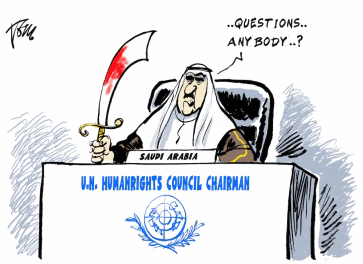 US Nuclear Energy Policy & Khashoggi Murder: Appeasement Or Threat? Clean Technica, December 12th, 2018 by Tina Casey “…………..The Nuclear Energy Connection
Either way, that brings us around to the idea that the corporate world needs to step up and press for meaningful action on the Khashoggi case, since the White House is falling down on the job.
In particular, the tech sector is feeling the pressure not only because of its financial ties to Saudi Arabia, but also because of the high profile of its biggest players.
That brings us right back around to the nuclear energy angle, where the US nuclear company TerraPower has been making waves.
TerraPower was formed back in 2006 and crossed the CleanTechnica radar during COP 2015, when it popped up in relation to a newly launched investor umbrella organization called the Breakthrough Energy Coalition.
Breakthrough is a tech incubator with a focus on clean energy and rapid decarbonization, and nuclear energy makes the cut.
As a global organization, Breakthrough can provide TerraPower with a platform for pitching its technology overseas — a key consideration, given the morbid state of demand for new nuclear power plants here in the US.
So far TerraPower has been focusing on foreign markets, particularly China, for its new technology.
If all of this is beginning to ring some bells, that’s where the tech and Silicon Valley connections kick in.
Microsoft’s Bill Gates is financial backer of TerraPower and chairman of its board.
Gates is also the chair of the Breakthrough Coalition’s Breakthrough Energy Ventures, where you’ll find a host of other familiar top-dollar investors with an interest in decarbonization including Jeff Bezos, Richard Branson, Vinod Khosla, and Michael Bloomberg.
Saudi Arabia is represented among Breakthrough members through Prince Alwaleed bin Talal, who is Chairman of Alwaleed Philanthropies and a supporter of Gates’s “giving pledge.”
Saudi Arabia is also represented among the 24 countries (including the EU) that support the Mission Innovation clean energy initiative, which is in turn receives considerable support from Breakthrough, so there’s that.

Not for nothing, but as of last August the Department of Energy has supported a TerraPower molten salt reactor project with $28 million in cost-shared funds.
When Will The Silicon Valley Crickets Stop Chirping And Start Acting?
All this is by way of saying that when it comes to the Saudi government, the Khashoggi murder, and the cash flow, all roads lead back to Silicon Valley and the US tech sector.
The New York Times raised a red flag on Saudi financial ties to Silicon Valley last year. Among other developments since then, Tesla has been ramping up its profile in the country, and Google has expressed interest in building data centers there.
Perhaps it’s not fair for the tech sector to take all the heat, but on the other hand these are the guys who promised to make life better for millions if not billions of people all over the world. More is expected of them than, say, the CEO of a local pest control company.
The Trump family’s financial ties with Saudi Arabia seem to be the driving force behind Trump’s response to the Khashoggi murder, and now it seems those same ties have silenced the US tech sector.
The fact is that the Khashoggi murder is not going away. New details about the murder are emerging on a regular basis, and even Trump’s Republican allies have finally stirred into action.
In the latest development, today the US Senate is reportedly set to debate cutting off US support for the Saudi-lead war in Yemen. The measure has been linked directly to outrage over the country’s role in the Khashoggi killing.
Meanwhile, CleanTechnica is reaching out to TerraPower for comment, so stay tuned for more on that.
Follow me on Twitter. https://cleantechnica.com/2018/12/12/us-nuclear-energy-policy-khashoggi-murder-appeasement-or-threat/
A nuclear deal for the Saudis, media blackout for Kushner’s corruption
Judd Legum, Rebecca Crosby, and Noel Sims, Jul 23, 2026,
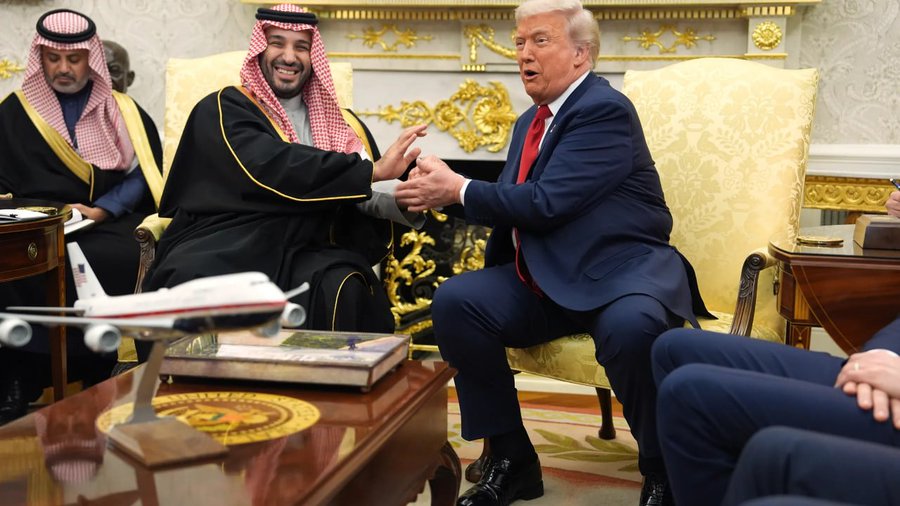
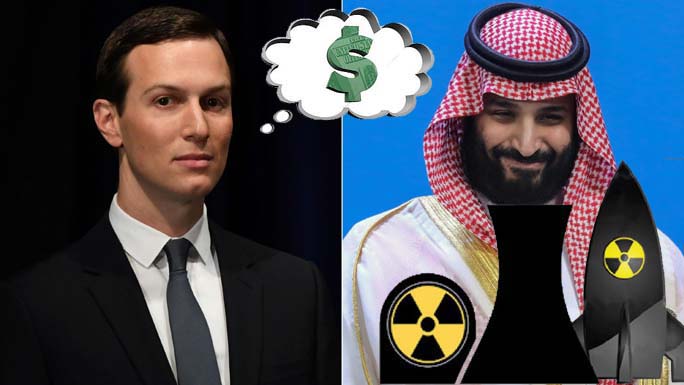
On Wednesday, the Trump administration signed a 30-year nuclear agreement with Saudi Arabia that paves the way for the kingdom to enrich its own uranium. The Saudi government has been aggressively seeking such a deal for years, eager to gain an edge over regional rivals. The agreement lacks safeguards that previous administrations, and many independent foreign policy analysts, viewed as essential to prevent nuclear proliferation.
The deal comes after the Saudi government’s Public Investment Fund (PIF) invested $2 billion in Jared Kushner’s private equity fund, Affinity Partners. Since 2021, Kushner, President Trump’s son-in-law, has collected over $110 million from the Saudi government in management fees. In March, Kushner was seeking billions more from the Saudis. (After Kushner’s fundraising was exposed, his efforts were purportedly put on hold.)
Kushner also has a close personal relationship with Saudi Crown Prince Mohammed bin Salman (MBS) — the pair are known to communicate regularly over WhatsApp. In 2021, when the PIF committee originally recommended rejecting Kushner’s proposal due to the high price and Kushner’s inexperience, MBS overruled the recommendation.
As he continues to collect fees from the Saudi government, Kushner has resumed his role as a top foreign policy aide to Trump. He has played a key role in virtually every significant foreign policy negotiation since Trump returned to the White House.
.Kushner’s specific involvement in the nuclear pact, if any, has not been disclosed. But the fact that one of the president’s top foreign policy advisors is receiving large, ongoing financial payments from the Saudi government is unquestionably relevant to the story.
Fatal fallout
by beyondnuclearinternational, https://beyondnuclearinternational.org/2026/07/21/fatal-fallout/
What a secret report reveals about British nuclear weapons tests – veterans claimed they were harmed by the fallout, report Christopher R. Hill and Jonathan Hogg for The Conversation
“The Ministry of Defence has always maintained that it never rained,” said Ken McGinley, founder of the British Nuclear Test Veterans Association (BNTVA). “I’m sorry, you’re liars … I was there!”
McGinley, who was a royal engineer, gave this interview in January 2024, shortly before his death, as part of our Oral History of British Nuclear Test Veterans project.
McGinley was present during the Grapple nuclear weapons test series, conducted by the UK on the central Pacific island of Kiritimati (also known as Christmas Island) in the late 1950s. At the time, this remote atoll was inhabited by 250 villagers as well as thousands of British servicemen.
For decades, many of those present during this and other above-ground British nuclear weapons tests have argued they were harmed by radioactive fallout. McGinley founded the BNTVA in 1983 to “gain recognition and restitution” for the veterans who took part in British and American nuclear tests and clean-ups between 1952 and 1965.
Rain became a key symbol in their argument as one of the only tangible signs of fallout taking place. The nuclear physicist Sir Joseph Rotblat described these alleged post-blast showers as “rainout”, a phenomenon whereby rain and mushroom clouds interact, leading to the contamination of rain droplets by harmful radionuclides.
In almost all cases, any link to subsequent health issues has been denied by the UK government because of lack of evidence of widespread radioactive contamination. However, a review of the evidence – written in 2014 by anonymous government scientists in response to freedom of information requests – was recently leaked by whistleblowers.
It reveals that post-blast radiation readings increased by a factor of up to seven on the island, compared with the normal background level. In our view, this would be more than enough to satisfy the “reasonable doubt” that tribunals require for veterans to receive a war pension due to illness or injury related to their service, as stated in the Naval, Military and Air Forces (Disablement and Death) Services Pension Order.
The top secret review, first revealed publicly by the Mirror newspaper on March 14 2026, also contains new evidence of radioactive contamination of fish in the island’s waters.
The repeated dismissal of veterans’ testimony in court cases and pension appeals caused stress and trauma for many. The majority died insisting they were not deceitful or forgetful – and that it did indeed rain while they were living on Kiritimati.
‘Factually inaccurate’
Kiritimati was monitored for fallout by the Ministry of Defence (MoD) after each detonation over the island – the largest of which, Grapple Y, was 200 times more powerful than the bomb dropped on Hiroshima.
In 1993, environmental monitoring data was collated into a report by a team at the MoD’s Atomic Weapons Establishment (AWE). Known as the Clare report, this informed the UK’s official position on fallout: namely, that none occurred over populated areas and that veterans would need to prove otherwise to secure redress.
However, the 2014 review of fallout data concluded the Clare report was “incomplete and, in some cases, factually inaccurate”.
Despite this review being passed on to the MoD, however, it was kept secret for more than a decade. Following its release, the legal implications could be gamechanging. According to the 2014 review: “The instrument readings could potentially be used to challenge the validity of statements made by MoD and UK government regarding … fallout on Christmas Island.”
In a recent House of Commons debate on the issue, the UK minister for veterans and people, Louise Sandher-Jones, confirmed her commitment “to the nuclear test veterans and their fight for transparency … They have had a very long fight, and I really recognise how difficult it has been for them, and I want them to understand that I am committed to them.”
Close that Facility: The 2026 Pine Gap Protests

Dr Binoy Kampmark, 21 July 2026, https://theaimn.net/close-that-facility-the-2026-pine-gap-protests/
It remains a prickly reminder that Australia remains an embarrassed vassal of power, annexed to the security interests of another state basking in imperial and fast diminishing splendour. Pine Gap, known more technically as the Joint Defence Facility Pine Gap (JDFPG), is a largely US-operated effort in Alice Springs, Central Australia. As the late scholar of strategic studies Desmond Ball pithily remarked in 1988, it is “an espionage operation.
Euphemisms should not be allowed to obscure this essential point.” It grew out of a desire on the part of the US Central Intelligence Agency (CIA) in 1965 to establish a remote Australian-sited ground control station intended for signals intelligence satellites. Land belonging to the Central Arrernte people was accordingly excised the following year for the site. The decision, in typically rough fashion, was made without consultation and discussion with local residents or elders, a secret place that became what Trevor Paglen would describe as a “blank space on the map … erased from the public record.”
The facility staffs some 800 personnel from the US National Security Agency (NSA), CIA, the US National Reconnaissance Office (NRO) and such Australian agencies as the Australian Signals Directorate and Australian Federal Police. Over the years, the base has become increasingly corporatised with a heavy American accent: Raytheon, Northrop Grumman and General Dynamics, IBM and Hewlett Packard. A mere 10% of the constituted personnel are said to be Australian government employees.
The base periodically attracts its keen and principled protesters, aghast at the base’s role in furnishing targeting data for US and allied drone and missile strikes across the Middle East and Africa. This year, the Close Pine Gap-Sacred Land Back convergence featured three days (July 18-20) of activities, with hundreds of participants gathered in Alice Springs to demand the closure of the facility through a series of workshops, panels and woven “threads of anti-militarism and decolonial movements.”
On July 20, a rally of 300 individuals gathered close to the front of the spy base, the largest since 1987, sporting signs and flags and chanting the stock phrases: “shut it down”, “close Pine Gap”, and “always was, always will be Aboriginal land.” New South Wales Greens Senator David Shoebridge was present, expressing his concern about a “foreign military base set up for the interests of a foreign military” in the service of “right wing politics” and disrespectful of international law. The base was also a potential target for any adversaries the US might be willing to antagonise, thereby bringing “danger into the heart of our country.”
Arrernte Apmereke-artweye traditional custodians Felicity, Wyonna and Jacquita Hayes offer sound if disturbing logic, as reported by the Australian Associated Press: Pine Gap sits on a sacred site that not only profanes tradition but acts as vehicle for the waging of foreign wars and the conduct of genocide. “We don’t want to be feeling guilty all the time when bad things are happening overseas to little ones. We’re not the ones controlling that facility, but we feel guilty that it’s coming to our land.”
The custodians wished for the facility to be closed “so the generation coming can be safe. We want to be compensated so we can get houses at Whitegate community.” It is also with some astonishment that the residents of Whitegate, to this day, are deprived of rudimentary services, including decent housing and running water. The water has to be brought in by truck. There is no sewerage.
Richard Tanter of the Nautilus Institute, one of Pine Gap’s most astute and flawlessly detailed critics, proved ever reliable in remarking that, “Unless the Australian direct and indirect military relationship to Israeli activities in the Gaza Strip are closely reviewed … it is not possible for the Australian government to assure parliament and the Australian public that Australia is no complicit in acts of genocide.” The good professor has been able to shed much light on the facility’s broader purposes and is dismissive of critics who fault claims that the site is being used to feed such military efforts as those of Israel. (He can point to at least three satellites having the Gaza Strip within their reach.) In October 1973, for instance, satellite intelligence from Pine Gap was passed on to Israel during the Yom Kippur War, a contribution that aided Israel’s breakthrough of the Egyptian lines.
This is of little concern to the clubland militarists in Canberra and such think tanks as the Australian Strategic Policy Institute. Former intelligence officer Patrick White, writing for ASPI’s The Strategist, laments the diminished secrecy and security of the site, worrying that trends in signals technology have no longer made the base “irreplaceable”. The advent of extensive encryption means that satellite download feeds can be protected “almost anywhere. The remoteness that once hid the site from view no longer hides much at all.” He is sentimental about the ties with Washington. “We have shared in intelligence and expertise far beyond anything our own resources could produce. We have no satellites of this kind.” Precisely why Canberra is blood-crusted in its complicity, less an authoritative host than a butler eager to please.
Pine Gap acts, then, as a symbol of highly distilled, triple strength colonisation: a garrison outpost dominated by the US imperium and its personnel (a poke in the eye of Australian sovereignty), located on native land it defiles (a poke in the eye of the First Nations peoples), and also responsible for aiding the predations of Washington’s allies – more recently the Israeli Defense Forces in its cleansing conflict against the Palestinians. “I understand the genocide in Gaza against my people is made possible by intelligence flowing from the heart of this colony in Alice Springs directly to the Israeli occupation forces,” stated Palestinian activist Remah Naji of Justice for Palestine Magan-djin with potency. Shoebridge agreed: “We’re letting them use our land, this key real estate, I think [to] commit some of the worst atrocities we’ve seen.”
As the AUKUS Public Inquiry continues its various hearings on that ghastly, doomed security pact between Australia, the United Kingdom and the United States, the Close Pine Gap campaign should be commended as a linked, worthy extension. The former’s proceedings have been mostly savaging the wisdom of a pact that has shown Australia to be embarrassingly disadvantaged, its politicians largely deluded, and its strategic establishment impressionable and bankrupt. (That establishment seeks to bankrupt the Australian treasury to the princely sum of AU$368 billion over promised nuclear-powered submarines that may never arrive.) The Close Pine Gap protests, while receiving less in the way of coverage, is no less pertinent and urgent in its aims.
1 This Month
23-25 October – on Zoom – World BEYOND War’s annual global conferenc


Shut down the radiation-damaged Heysham nuclear reactors now
To see nuclear-related stories in greater depth and intensity – go to https://nuclearinformation.wordpress.com

Say No to NASA’s Reckless Nuclear Reactor on the Moon
Say No to NASA’s Reckless Nuclear Reactor on the Moon

-
Archives
- October 2026 (247)
- September 2026 (339)
- August 2026 (330)
- July 2026 (355)
- June 2026 (287)
- May 2026 (306)
- April 2026 (356)
- March 2026 (251)
- February 2026 (267)
- January 2026 (308)
- December 2025 (358)
- November 2025 (359)
-
Categories
- 1
- 1 NUCLEAR ISSUES
- business and costs
- climate change
- culture and arts
- ENERGY
- environment
- health
- history
- indigenous issues
- Legal
- marketing of nuclear
- media
- opposition to nuclear
- PERSONAL STORIES
- politics
- politics international
- Religion and ethics
- safety
- secrets,lies and civil liberties
- spinbuster
- technology
- Uranium
- wastes
- weapons and war
- Women
- 2 WORLD
- ACTION
- AFRICA
- Atrocities
- AUSTRALIA
- Christina's notes
- Christina's themes
- culture and arts
- Events
- Fuk 2022
- Fuk 2023
- Fukushima 2017
- Fukushima 2018
- fukushima 2019
- Fukushima 2020
- Fukushima 2021
- general
- global warming
- Humour (God we need it)
- Nuclear
- RARE EARTHS
- Reference
- resources – print
- Resources -audiovicual
- Weekly Newsletter
- World
- World Nuclear
- YouTube
-
RSS
Entries RSS
Comments RSS

