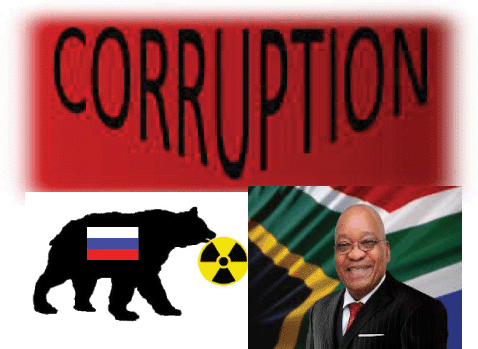
 Energy minister investigates R80m in irregularities in nuclear contract https://www.timeslive.co.za/politics/2017-08-10-exclusive-energy-minister-investigates-r80-million-in-irregularities-in-nuclear-contract/?platform=hootsuite BY JAN-JAN JOUBERT Energy Minister Mmamoloko Kubayi has launched an investigation into several senior officials in her department for alleged nuclear tender irregularities amounting to R80-million.
Kubayi’s office has confirmed that it is probing the possible violation of National Treasury regulations when the department awarded an R80-million contract to a nuclear transactional adviser‚ Mahlaka-A-Phalala (M-A-P).
“There are still investigations going on the matters raised in your questions and therefore we are unable to respond as it will jeopardise and weaken the case‚” said a short statement from Kubayi’s office in response to 29 questions posed by TimesLIVE.
The minister can expect heavy questioning on the matter from DA MP Gordon Mackay when she appears before Parliament’s portfolio committee on energy on Tuesday.
Mackay said this was further evidence why the government nuclear procurement was “captured”.
“The nuclear deal is a prime example of state capture. The DA will demand from committee chairperson Fikile Majola that the energy portfolio committee tackle this matter with extreme urgency when we reconvene next month‚ and question the investment.
“We will also demand to know why deputy director-general [Zizamele] Mbambo remains in his post‚ and will propose an ad hoc committee to get to the bottom of this mess‚” said Mackay.
According to documents TimesLIVE has seen‚ energy director-general Thabane Zulu‚ his deputy Zizamele Mbambo‚ procurement specialist Ndaba Ngwane‚ and chief financial officer Yvonne Chetty have signed a deviation request to sign off the deal.
Zulu has since been moved to head the Strategic Energy Fund while Ndaba has quietly exited the department.
Mbambo remains in his position despite awarding the contract‚ which a leaked document shows amounts to R80-million. The scandal started at the end of August last year‚ when one of the consulting firms in the nuclear build programme‚ M-A-P – against which no allegations are made – compiled a report finding that the department was not ready to issue a request for proposal for the intended nuclear new build programme‚ estimated to be worth R1-trillion.
On September 22‚ Mbambo and Ngwane asked Chetty and Zulu to approve a deviation from normal procurement processes‚ in practice allowing M-A-P to continue work on the development of a transactional adviser.
The next day‚ Chetty and Zulu agreed to the deviation‚ which Chetty warned was subject to the buy-in of the National Treasury and the office of the attorney-general.
However‚ Mbambo and Ngwane merely told M-A-P to continue with a second phase of the contract‚ the cost of which would grow by R80-million to R100-million by March despite the required governance processes allegedly not having been followed.
On September 27‚ then minister of energy Tina Joemat-Pettersson suspended all payments related to the transactional adviser to M-A-P until the department had submitted a verification report to her on all deliverables received.
According to sources close to the events‚ this decision was never communicated to M-A-P as a service provider.
Instead‚ Mbambo‚ Zulu and Ngwane continued to engage M-A-P and received work deliverables towards the procurement process without a contract and without all regulations being followed. Among the serious allegations that TimesLIVE put to the Department of Energy over the past 10 days is that M-A-P was not subjected to a competitive bid process.
Instead‚ section 16 (a) 6.6 of the Public Finance Management Act was used – despite warnings by the relevant tender committee that this was wrong – to keep paying M-A-P.
This was done despite the law only allowing for the cost of the project to be extended by 15% without an open tender process.
At the beginning of March‚ M-A-P‚ which remained ignorant of Joemat-Pettersson’s instruction to stop payments‚ went to see her about payments outstanding‚ adding R60-million to the initial R20-million contract.
M-A-P also revealed to Joemat-Pettersson that it had a copy of the deviation request approved by Chetty and Zulu as given to it by Mbambo and Ndaba‚ despite the strict rules regarding the leaking of internal documents.
The whole matter came to a climax on March 16 when the departmental tender committee met and reviewed M-A-P’s bills.
Mbambo was in hot water and held to account as the meeting continued on March 22.
During the meeting‚ it came to light that Mbambo had already on September 1 given verbal instruction to M-A-P to extend its contract by a further R80-million to R100-million.
In the end‚ the Department of Energy shifted funds from the sundries account and paid M-A-P R56-million of the additional R80-million by the end of the financial year (March 31).
Zulu said only the department could comment. Numerous efforts to contact Mbambo for comment failed last week‚ and Ngwane could not be tracked down.
August 11, 2017
Posted by Christina Macpherson |
secrets,lies and civil liberties, South Africa |
Leave a comment

 US Government department tells staff to not use term ‘climate change’ http://www.news.com.au/technology/environment/climate-change/us-government-department-tells-staff-to-not-use-term-climate-change/news-story/27acd486093634ad3db49ab5ebcb0b9d
A PUBLIC sector department has told employees to cease using the term ‘climate change’ and opt for other more benign words instead. Benedict Brooknews.com.au , 8 Aug 17 GOVERNMENT employees in the US have been given a dictionary of accepted words to use — and “climate change” isn’t one of them.
 In a directive reminiscent of George Orwell’s dystopian novel Nineteen Eighty-Four, where people were only allowed to communicate in an ever diminishing language called “newspeak”, employees of the US Department of Agriculture (USDA) have been told to ditch the word “climate change”.
They should use “weather extreme” instead.
The clampdown comes as President Donald Trump further distances the US from global moves to limit global warming. Last week, the US formally announced its withdrawal from the Paris Agreement on climate change.
In a series of emails received by the Guardian, the director of the USDA’s soil health department, Bianca Moebius-Clune, listed terms that should be avoided and the alternatives to be used instead.
As well as giving climate change the flick, staff were told to avoid the term “climate change adaptation” and instead opt for “resilience to weather extremes”.
When talking about the cause of climate change, sorry “weather extremes”, saying people should “reduce greenhouse gases” is a big no-no. Rather, staff should talk in favour of “build soil organic matter, increase nutrient use efficiency”.
The email was dated 16 February but has only just come to light.
However, far from being a politically motivated reaction against the science of climate change, the instructions to staff may instead be a way for the Government department to continue its work without ruffling feathers in a White House averse to discussing global warming.
In the missive, Ms Moebius-Clune said that, “we won’t change the modelling, just how we talk about it — there are a lot of benefits to putting carbon back in the soil, climate mitigation is just one of them”.
The Guardian report added that public relations staff from the USDA had advised departments should “tamp down on discretionary messaging right now”.
The USDA denied it was limited discussion of climate change.
In a statement, the department said, “this guidance, similar to procedures issued by previous administrations, was misinterpreted by some to cover data and scientific publications.
“This was never the case and USDA interim procedures will allow complete, objective information for the new policy staff reviewing policy decisions.”http://www.news.com.au/technology/environment/climate-change/us-government-department-tells-staff-to-not-use-term-climate-change/news-story/27acd486093634ad3db49ab5ebcb0b9d
August 9, 2017
Posted by Christina Macpherson |
civil liberties, USA |
Leave a comment
 The Trump administration’s solution to climate change: ban the term https://www.theguardian.com/commentisfree/2017/aug/08/trump-administration-climate-change-ban-usda, Bill McKibben
The US Department of Agriculture has forbidden the use of the words ‘climate change’. This say-no-evil policy is doomed to fail, ‘Also blacklisted is the scary locution reduce greenhouse gases.’@billmckibben, 8 August 2017 . In a bold new strategy unveiled on Monday in the Guardian, the US Department of Agriculture – guardians of the planet’s richest farmlands – has decided to combat the threat of global warming by forbidding the use of the words.
Under guidance from the agency’s director of soil health, Bianca Moebius-Clune, a list of phrases to be avoided includes “climate change” and “climate change adaptation”, to be replaced by “weather extremes” and “resilience to weather extremes”.
Also blacklisted is the scary locution “reduce greenhouse gases” – and here, the agency’s linguists have done an even better job of camouflage: the new and approved term is “increase nutrient use efficiency”.
The effectiveness of this approach – based on the well-known principle that what you can’t say won’t hurt you – has previously been tested at the state level, making use of the “policy laboratories” provided by America’s federalist system.
In 2012, for instance, the North Carolina general assembly voted to prevent communities from planning for sea level rise. Early analysis suggests this legislation has been ineffective: Hurricane Matthew, in 2016, for instance drove storm surge from the Atlantic ocean to historic levels along the Cape Fear river. Total damage from the storm was estimated at $4.8bn.
Further south, the Florida government forbade its employees to use the term climate change in 2014 – one government official, answering questions before the legislature, repeatedly used the phrase “the issue you mentioned earlier” in a successful effort to avoid using the taboo words.
It is true that the next year “unprecedented” coral bleaching blamed on rising temperatures destroyed vast swaths of the state’s reefs: from Key Biscayne to Fort Lauderdale, a survey found that “about two-thirds were dead or reduced to less than half of their live tissue”. Still, it’s possible that they simply need to increase their nutrient use efficiency.
At the federal level, the new policy has yet to show clear-cut success either. As the say-no-evil policy has rolled out in the early months of the Trump presidency, it coincided with the onset of a truly dramatic “flash drought” across much of the nation’s wheat belt.
As the Farm Journal website pointed out earlier last week: “Crops in the Dakotas and Montana are baking on an anvil of severe drought and extreme heat, as bone-dry conditions force growers and ranchers to make difficult decisions regarding cattle, corn and wheat.”
In typically negative journalistic fashion, the Farm Journal reported that “abandoned acres, fields with zero emergence, stunted crops, anemic yields, wheat rolled into hay, and early herd culls comprise a tapestry of disaster for many producers”.
Which is why it’s good news for the new strategy that the USDA has filled its vacant position of chief scientist with someone who knows the power of words.
In fact, Sam Clovis, the new chief scientist, is not actually a scientist of the kind that does science, or has degrees in science, but instead formerly served in the demanding task of rightwing radio host (where he pointed out that followers of former president Obama were “Maoists”). He has actually used the words “climate change” in the past, but only to dismiss it as “junk science”.
Under his guidance the new policy should soon yield results, which is timely since recent research (carried out, it must be said, by scientist scientists at MIT) showed that “climate change could deplete some US water basins and dramatically reduce crop yields in some areas by 2050”. But probably not if we don’t talk about it. Bill McKibben is the founder of the climate campaign 350.org.
August 9, 2017
Posted by Christina Macpherson |
civil liberties, climate change |
Leave a comment
US Government department tells staff to not use term ‘climate change, A PUBLIC sector department has told employees to cease using the term ‘climate change’ and opt for other more benign words instead. Benedict Brooknews.com.au , 8 Aug 17,
In a directive reminiscent of George Orwell’s dystopian novel Nineteen Eighty-Four, where people were only allowed to communicate in an ever diminishing language called “newspeak”, employees of the US Department of Agriculture (USDA) have been told to ditch the word “climate change”.
They should use “weather extreme” instead.

The clampdown comes as President Donald Trump further distances the US from global moves to limit global warming. Last week, the US formally announced its withdrawal from the Paris Agreement on climate change.
In a series of emails received by the Guardian, the director of the USDA’s soil health department, Bianca Moebius-Clune, listed terms that should be avoided and the alternatives to be used instead.
As well as giving climate change the flick, staff were told to avoid the term “climate change adaptation” and instead opt for “resilience to weather extremes”.
When talking about the cause of climate change, sorry “weather extremes”, saying people should “reduce greenhouse gases” is a big no-no. Rather, staff should talk in favour of “build soil organic matter, increase nutrient use efficiency”.
The email was dated 16 February but has only just come to light.
However, far from being a politically motivated reaction against the science of climate change, the instructions to staff may instead be a way for the Government department to continue its work without ruffling feathers in a White House averse to discussing global warming.
In the missive, Ms Moebius-Clune said that, “we won’t change the modelling, just how we talk about it — there are a lot of benefits to putting carbon back in the soil, climate mitigation is just one of them”.
The Guardian report added that public relations staff from the USDA had advised departments should “tamp down on discretionary messaging right now”.
The USDA denied it was limited discussion of climate change.
In a statement, the department said, “this guidance, similar to procedures issued by previous administrations, was misinterpreted by some to cover data and scientific publications.
“This was never the case and USDA interim procedures will allow complete, objective information for the new policy staff reviewing policy decisions.”http://www.news.com.au/technology/environment/climate-change/us-government-department-tells-staff-to-not-use-term-climate-change/news-story/27acd486093634ad3db49ab5ebcb0b9d
August 9, 2017
Posted by Christina Macpherson |
secrets,lies and civil liberties, USA |
Leave a comment
 A Chilling Theory on Trump’s Nonstop Lies, His duplicity bears a disturbing resemblance to Putin-style propaganda, Mother Jones DENISE CLIFTON AUG. 3, 2017 “26 hours, 29 Trumpian False or Misleading Claims.”
That was the headline on a piece last week from the Washington Post, whose reporters continued the herculean task of debunking wave after wave of President Donald Trump’s lies. (It turned out there was a 30th Trump falsehood in that time frame, regarding the head of the Boy Scouts.) The New York Times keeps a running tally of the president’s lies since Inauguration Day, and PolitiFact has scrutinized and rated 69 percent of Trump’s statements as mostly false, false, or “pants on fire.”
Trump’s chronic duplicity may be pathological, as some experts have suggested. But what else might be going on here? In fact, the 45th president’s stream of lies echoes a contemporary form of Russian propaganda known as the “Firehose of Falsehood.”
In 2016, the nonpartisan research organization RAND released a study of messaging techniques seen in Kremlin-controlled media. The researchers described two key features: “high numbers of channels and messages” and “a shameless willingness to disseminate partial truths or outright fictions.”
The result of those tactics? “New Russian propaganda entertains, confuses and overwhelms the audience.”
Indeed, Trump’s style as a mendacious media phenomenon resonates strongly with RAND’s findings from the study, which also explains the efficacy of the Russian propaganda tactics. Here are the key examples:
RAND: “Russian propaganda is produced in incredibly large volumes and is broadcast or otherwise distributed via a large number of channels.”
Trump is known for his high-volume use of Twitter, tweeting about 500 times in his first 100 days in office, using both his personal account and the official @POTUS account. His tweets often become the subject of news stories and sometimes provoke entire news cycles’ worth of coverage across the mainstream media……..
Trump is also a prolific liar on stage: Of the 29 false statements the Washington Posttracked last week, five came in a speech to Boy Scouts, two came from a news conference, and a whopping 15 came from a rally in Youngstown, Ohio. (Seven others came from, where else, his personal Twitter feed.)
The deluge matters, notes RAND: “The experimental psychology literature suggests that, all other things being equal, messages received in greater volume and from more sources will be more persuasive.”
RAND: “Russian propaganda is rapid, continuous, and repetitive”
Trump often repeats misleading statements in rapid, successive tweets……..
Why the technique works: RAND explains that “repetition leads to familiarity, and familiarity leads to acceptance.”
RAND: “Russian propaganda makes no commitment to objective reality”
Phony news stories are a staple of Vladimir Putin’s Russia—and as Mother Jones has detailed, Trump and his team have been caught repeating several that originated in Russian news outlets.
Trump also has a habit of repeating false statements that can be very easily checked—such as lies about the number of bills he has signed. …….
RAND: “Don’t expect to counter the firehose of falsehood with the squirt gun of truth.”
The Washington Post has called Trump “the most fact-checked politician.” Yet, the RAND research found that pointing out specific falsehoods was an ineffective tool against the propaganda techniques they studied in Russia because “people will have trouble recalling which information they have received is the disinformation and which is the truth.” …..http://www.motherjones.com/politics/2017/08/trump-nonstop-lies/
August 5, 2017
Posted by Christina Macpherson |
Russia, secrets,lies and civil liberties, USA |
Leave a comment
Vt. Yankee: More faked test results, Rutland Herald | August 04, 2017, By SUSAN SMALLHEER
STAFF WRITER VERNON — Entergy Nuclear has uncovered an additional problem area in which a former radiation technician failed to conduct safety tests and then falsified documents about it.
In a report filed last week with the Nuclear Regulatory Commission, Entergy said it would not fight an earlier safety violation uncovered by an NRC investigator last year at the Vermont Yankee nuclear power plant in Vernon.
That finding alleged the same radiation technician failed to test equipment which monitors workers’ radiation exposure.
The technician first lost his access to Vermont Yankee, and then was fired, Entergy said in its formal response to the NRC.
Entergy said it conducted its own investigation into the radiation technician’s work to make sure there weren’t other problem areas, and discovered another area where the person claimed to have conducted tests but didn’t.
NRC spokesman Neil Sheehan said Thursday the new information means the NRC will conduct its own investigation in the second instance of falsified inspection reports. “We’re going to do a follow-up inspection,” he said.
The second problem area was a required survey of a chemistry lab drain line. Entergy said it uncovered evidence the drain was not tested on Sept. 27, 2016, and Oct. 30, 2016, as claimed in a document signed by the technician. Entergy Nuclear has uncovered an additional problem area in which a former radiation technician failed to conduct safety tests and then falsified documents about it.
In a report filed last week with the Nuclear Regulatory Commission, Entergy said it would not fight an earlier safety violation uncovered by an NRC investigator last year at the Vermont Yankee nuclear power plant in Vernon.
That finding alleged the same radiation technician failed to test equipment which monitors workers’ radiation exposure.
The technician first lost his access to Vermont Yankee, and then was fired, Entergy said in its formal response to the NRC.
Entergy said it conducted its own investigation into the radiation technician’s work to make sure there weren’t other problem areas, and discovered another area where the person claimed to have conducted tests but didn’t.
NRC spokesman Neil Sheehan said Thursday the new information means the NRC will conduct its own investigation in the second instance of falsified inspection reports. “We’re going to do a follow-up inspection,” he said.
The second problem area was a required survey of a chemistry lab drain line. Entergy said it uncovered evidence the drain was not tested on Sept. 27, 2016, and Oct. 30, 2016, as claimed in a document signed by the technician.
Earlier this summer, the same technician was faulted by the NRC in a June 26 report for “a willful decision not to perform” required daily calibration checks of radiation safety equipment…….
Vermont Yankee shut down in December 2014 and is in the early stages of decommissioning. Entergy is transferring its spent nuclear fuel from a cold-water pool to an air-cooled steel and concrete cask storage facility.
susan.smallheer @rutlandherald.com http://www.rutlandherald.com/articles/vt-yankee-more-faked-test-results/
August 5, 2017
Posted by Christina Macpherson |
secrets,lies and civil liberties, USA |
Leave a comment
 Wikileaks Says Robert Mueller Gave Russia Nuclear Material – But That’s Not The Whole Story, Chris York Senior Editor, HuffPost UK, 29 July 17 Wikileaks has released a classified US State Department from 2009 that appears to prove Special Counsel Robert Mueller, head of the Trump/Russia probe, once supplied the Russians with nuclear material.
The claim, if true, would be a hugely damaging revelation that would throw the whole investigation into chaos and incri
Only it isn’t and Wikileaks knows it.
The text and tweet released by Wikileaks more than suggests Mueller is guilty of a serious crime, passing on nuclear material to the USA’s superpower rival.
6. (S/Rel Russia) Action request: Embassy Moscow is requested to alert at the highest appropriate level the Russian Federation that FBI Director Mueller plans to deliver the HEU sample once he arrives to Moscow on September 21. Post is requested to convey information in paragraph 5 with regard to chain of custody, and to request details on Russian Federation’s plan for picking up the material. Embassy is also requested to reconfirm the April 16 understanding from the FSB verbally that we will have no problem with the Russian Ministry of Aviation concerning Mueller’s September 21 flight clearance.
But the section it omitted from the tweet changes the entire context of Mueller’s actions.
2. (S/NF) Background: Over two years ago Russia requested a ten-gram sample of highly enriched uranium (HEU) seized in early 2006 in Georgia during a nuclear smuggling sting operation involving one Russian national and several Georgian accomplices. The seized HEU was transferred to U.S. custody and is being held at a secure DOE facility. In response to the Russian request, the Georgian Government authorised the United States to share a sample of the material with the Russians for forensic analysis.
This text is included in the document linked to in the tweet but it’s clear many people did take it at face value…….http://www.huffingtonpost.co.uk/entry/wikileaks-russia_uk_597df631e4b02a4ebb75ffec
July 31, 2017
Posted by Christina Macpherson |
secrets,lies and civil liberties, USA |
Leave a comment
 Serious Fraud Office launches probe into Amec Foster Wheeler,Telegraph, Alan Tovey , 11 JULY 2017 Amec Foster Wheeler is being investigated by the Serious Fraud Office over its dealings with Unaoil over possible bribery and corruption through payments to middlemen.
The energy support services group rushed out a regulatory announcement on Tuesday evening confirming the formal launch of a probe by the watchdog.
In May the company signalled it could be in the SFO’s sights in documents relating to its £2.2bn merger with peer Wood Group.
Circulars detailing risks to deal revealed that a Wood Group business “engaged Unaoil and that the joint venture made payments to Unaoil under agency agreements”.
Agency agreements are widely understood to mean payments to third parties which can be used to pay bribes, though there is no indication that this happened with Wood’s joint venture.
At the time Amec said it was co-operating with the SFO, but the regulator’s staff have now decided to launch a formal investigation as a result of what they have discovered.
Unaoil is at the centre of a global corruption scandal with allegations that it paid bribes to secure deals. Petrofac has already been dragged into the scandal with its executives questioned by the SFO, though the company has said previously it has not found any evidence of wrongdoing…..
If the investigations turn into full-scale prosecutions they could result in heavy fines which could deal a huge blow to the merged Amec-Wood business, as they would come after the tow had merged the companies could be liable for huge fines…..Both Amec and a spokesman for Unaoil declined to comment. http://www.telegraph.co.uk/business/2017/07/11/serious-fraud-office-launches-probe-amec-foster-wheeler/
July 29, 2017
Posted by Christina Macpherson |
secrets,lies and civil liberties, UK |
Leave a comment
 NFLA 25th July 2017, The Nuclear Free Local Authorities (NFLA) has written today to the Energy
Minister Greg Clark asking why his announced inquiry into the failings of
the Nuclear Decommissioning Authority (NDA) in having to pay as much as
£100 million of public money for a flawed contract process – over
cleaning-up Magnox nuclear reactors – is being done behind closed doors.
It is also asking when the inquiry will be completed and whether it will be
fully discussed in Parliament and further afield.
http://www.nuclearpolicy.info/news/why-inquiry-nda-magnox-contract-tendering-process-behind-closed-doors/
July 28, 2017
Posted by Christina Macpherson |
secrets,lies and civil liberties, UK |
Leave a comment
FT 26th July 2017, Behind every clean electric car there is cobalt. And behind cobalt is the
Democratic Republic of Congo.
Cobalt is a critical element in lithium-ion
batteries used in electric cars. Such batteries already consume 42 per cent
of the metal and demand will soar as the world switches from petrol and
diesel cars to electric ones. This week, Britain followed France in declaring a ban on such vehicles from 2040. Soon, almost anyone in the rich world will be able to drive safe in the knowledge that they’re being kinder
and gentler to the planet.
Did I mention the Democratic Republic of Congo?
Some 60 per cent of the world’s cobalt comes from this central African
country, one the size of western Europe and with gargantuan problems to
match. Some industry analysts are predicting a 30-fold increase in cobalt
demand by 2030, much of which will come from Congo. Cobalt prices doubled
in the past year alone.
You might imagine the average Congolese would be
thrilled by the prospect of the coming bonanza. But if history is any
guide, the average Congolese will gain little – save perhaps from militia
violence and perhaps a dangerous, poorly paid job. In Congo, they say, you
can find every element in the periodic table. But this abundance has not
done its people much good. A recent report by Global Witness found that 30
per cent of revenue paid to state bodies by mining companies from 2013 to
2015 – about $750m – simply vanished.
https://www.ft.com/content/427b8cb0-71d7-11e7-aca6-c6bd07df1a3c
July 28, 2017
Posted by Christina Macpherson |
AFRICA, secrets,lies and civil liberties |
Leave a comment
 Times 15th July 2017, Hackers backed by the Russian government have attacked energy networks
running the national grid in parts of the UK, The Times has learnt. The
hackers, who targeted the Republic of Ireland’s energy sector, intended
to infiltrate control systems, security analysts believe.
This would also have given them the power to knock out parts of the grid in Northern
Ireland. Senior engineers at Ireland’s Electricity Supply Board (ESB)
were targeted last month by a group understood to have ties to the
Kremlin’s GRU intelligence agency.
The hackers sent emails designed to trick staff by drawing on extensive surveillance of ESB practices and
contained malicious software. There is no evidence of disruption to the
network, but security analysts monitoring Russia’s cyberintelligence
groups said that the hackers probably stole information including
passwords. Ireland’s National Cyber Security Centre confirmed that it was
working on the matter. https://www.thetimes.co.uk/article/russia-backed-hackers-try-to-hijack-britain-s-power-supply-55bj9790r
July 19, 2017
Posted by Christina Macpherson |
ENERGY, secrets,lies and civil liberties, UK |
Leave a comment
 In conferences debating the number of victims of the Chernobyl accident, officials who draw paychecks
  from nuclear lobbies make similar arguments about alcohol abuse and “radiophobia”—stress-related illnesses caused by fear of radiation.
 Strange illnesses in one of the most contaminated towns in the world challenge what we think we know about the dangers of radioactivity.Slate, By Kate Brown, April 18, 2013, “……What do we know about communities living on contaminated terrain? Two years after the meltdown of three reactors in Fukushima, Japan, the World Health Organization forecasts that there will be no significant rise in cancers among people living nearby. These projections are based on guesses from models calculated from prior studies, mostly of Japanese people who survived Hiroshima and Nagasaki. Yet when Japanese scientists and inspected the bodies of 38,000 children living in the Fukushima Prefecture, they found 36 percent had abnormal growths on their thyroids a year after the accident.
We have grown accustomed to this scenario—media attention to nuclear accidents followed by a long, slow quarrel among scientists about whether the spilled fission products will damage human bodies or not. It will take decades to learn the public health impact of the 2011 meltdown. By then, most of the public will have lost interest. But there are other ways to get at this question of what it means to live on earth sullied with decaying radioactive isotopes.
No one has lived longer on contaminated terrain than people in the village of Muslumovo in the southern Russian Urals located downstream from the Maiak plutonium plant, built in 1948 to produce Soviet bomb cores. Unlike the S.T.A.L.K.E.R. game, daily life in Muslumovo is terrifyingly banal: long waits at medical clinics, worries over the price of prescriptions, reams of paperwork related to compensation and disability claims, sick kids, unemployment, poverty, and chronic illness.
I showed up in Muslumovo on a Saturday morning in August 2009. Muslumovo is a big village, sprawled inside a crooked elbow of the Techa River, which is slow, sluggish, and considered to be the world’s most radioactive. The village center has a train station, a few apartment buildings, and a corner store. Marat Akhmadeev met me at the station in his Soviet vintage car, dusty and dented. We jolted up and down on the choppy seas of the unpaved streets. Muslumovo is a strange village—half there and half gone. Many houses are abandoned, some partly dismantled, exposing weathered wallpaper and overturned appliances.
The Techa became a flowing radioactive reservoir in 1949 when engineers at the plutonium plant ran out of underground storage containers for high-level radioactive waste. A Dixie cup of this waste could kill everyone in a large ballroom. Compelled by the arms race, the plant director ordered it dumped in the Techa River. The men running the plant didn’t tell anyone about this decision. The 28,000 Russian, Bashkir, and Tatar farmers living on the river—drinking, cooking, and bathing with river water—had no idea. In the 1950s and ’60s special forces resettled most of the 16 contaminated villages on the Techa, but a few villages were too large and expensive to move, so they stayed. Muslumovo is one.
There’s no work in Muslumovo. A person either commutes 60 miles to the industrial city of Cheliabinsk or farms a patch of land of the long-defunct Muslumovo collective farm. Marat farms, living off the land—a term that takes on new meaning in Muslumovo, where in 2008, an American team found domestic interiors registering radiation at 40 times above the background level. After we pulled up at Marat’s house, his teenage son silently trailed us. Noticing a twitch in the boy’s step, I turned to look at him. His mouth drooped and fingers twisted, as he mouthed a stuttered greeting. Marat explained, “This is Kareem,nash luchevik,” meaning “our radiant one,” said in an off-hand manner, as if every family has a luchevik……
There is a legal contest going on over the health of the people of Muslumovo: whether they are sick and, if so, ill from the radioactive isotopes dumped in the river or from poor diets and alcohol abuse. Medical evidence has been contradictory. In 1959, Soviet scientist A. N. Marei wrote a dissertation in which he argued that the Techa villagers were in poor health because of their poor diets. In 1960, in contrast, local Soviet officials linked the river-dwellers’ illnesses to the contaminated river. This debate between nature (radiation) and nurture (lifestyle) has been going on a long time…….
Over the years, FIB-4 doctors had diagnosed 935 people on the Techa River with chronic radiation syndrome. But as thousands of people in Ukraine worried about their exposures from the Chernobyl blast, Soviet medical officials backpedaled on the FIB-4 doctors’ original findings. In 1991, Angelina Gus’kova, the chief official voice in evaluating Chernobyl health problems, argued that in fact there were only 66 cases of chronic radiation syndrome among the Techa River people. The rest, she claimed, suffered from more prosaic diseases such as brucellosis, tuberculosis, hepatitis, and rheumatism caused by poor diets and sanitation. As American researchers supported by the Department of Energy have taken over as lead researchers of studies in Muslumovo, the diagnosis of chronic radiation syndrome has largely dropped from the radar. Meanwhile, Russian officials, worried about lawsuits, charged that many people in Muslumovo had dreamed up illnesses in order to sue for compensation. These people, they said, had no chronic radiation disease but were chronic welfare cases looking for handouts.
The trope of ignorant, genetically deficient, and drunken villagers is a common one in Russia. In the southern Urals in the past few decades, the cliché has been useful in glossing over the human suffering connected to uncontrolled dumping into the Techa River. In conferences debating the number of victims of the Chernobyl accident, officials who draw paychecks from nuclear lobbies make similar arguments about alcohol abuse and “radiophobia”—stress-related illnesses caused by fear of radiation. It would be a mistake, however, to allow the longstanding politicization of medical studies to overtake this very important, yet overlooked, place for our understanding of radiation’s effects on human bodies. Reprinted from Plutopia: Nuclear Families, Atomic Cities, and the Great Soviet and American Plutonium Disasters by Kate Brown with permission from Oxford University Press USA. http://www.slate.com/articles/health_and_science/medical_examiner/2013/04/nuclear_contamination_in_former_ussr_radioactivity_in_muslomovo_on_techa.html
July 15, 2017
Posted by Christina Macpherson |
environment, Reference, Russia, secrets,lies and civil liberties |
1 Comment
 Cyber attacks target nuclear power plants. Is Oyster Creek safe? Amanda Oglesby , @OglesbyAPP APPJuly 13, 2017 LACEY – Computer hackers, not content with mucking around with U.S. commerce and elections, have trained their sights on nuclear power plants, prompting questions about cyber security at Oyster Creek.
Industry officials and federal regulators say there’s nothing to fear, but experts say there is cause for concern, including from the harm that could be caused by cyber attacks on the electrical grid upon which power plants depend.
In recent weeks, hackers tried to – and in at least one case succeeded – in penetrating the firewalls and digital protections of administration information at these nuclear facilities, according to government reports cited recently in the New York Times and Bloomberg News.
“The nuclear industry didn’t really believe that they were a target,” said Edwin Lyman, senior scientist of the Global Security Program of the Union of Concerned Scientists in Washington, D.C.
Industry executives learned otherwise when hackers worked their way into computers at Wolf Creek nuclear power plant near Burlington, Kansas, according to the Times. The Asbury Park Press asked nuclear experts if hackers could also penetrate Oyster Creek.
“A plant like Oyster Creek, it’s old. Its systems that are used to control plant functions are mostly analog based, and that’s true for most of the plants in the United States. So the scenario of some malevolent terrorist pushing a button and causing a plant to melt down, that’s far-fetched,” Lyman said.
But there are reasons hackers might want to penetrate other plant systems.
“The fact is, a successful radiological sabotage attack on a nuclear plant, or on the spent fuel pool (where radioactive waste is cooled) at the plant, could cause a devastating catastrophe,” he added. “It could essentially contaminate hundreds of square miles with long-lived radioactive material. It could require the forced resettlement of millions of people. It could cost trillions of dollars in damages, and for a plant like Oyster Creek or others in the New York City area, a densely populated area, they are even more desirable targets for a terrorist who wants to cause that kind of mass disruption event.”
Plants separate critical systems from the internet or plant business networks by physical distance or hardware, Nuclear Regulatory Commission spokesman Neil Sheehan said in an email.
The Nuclear Regulatory Commission also regulates how employees use removable media, perform vulnerability assessments and train other employees on recognizing “insider threat(s),” he added.
The systems targeted in the recent attacks are not under the Nuclear Regulatory Commission’s regulations and oversight, Sheehan said in the email.
Hackers used faked resumes crafted in Microsoft Word that were riddled with malicious computer code to try and squeeze through the network protections, according to the Times. They also inserted malicious code into legitimate websites frequented by plant employees and tried to redirect employee web traffic through company computers, according to the report………
Nuclear plant administrative networks are not regulated by the Nuclear Regulatory Commission similarly to operational systems, Lyman said.
“I think that narrow interpretation (by the Nuclear Regulatory Commission) of what needs to be protected needs to be rethought,” he added.
By not regulating how administrative information is stored and protected, Lyman said information like plant blueprints, security guard schedules, computer passwords and door security could be vulnerable to hackers.
Another outside threat
There is another way nuclear plants are vulnerable to hackers, said Paul Gunter, director of the Reactor Oversight Project at Beyond Nuclear, a Maryland-based organization that opposes nuclear energy,
“From our point of view, the biggest vulnerability comes from the electrical grid itself,” he said.
That electrical grid is a patchwork system that is more than 50 years old in many places. It is riddled with problems caused by “aging equipment, capacity bottlenecks and increased demand,” according to a report issued by the American Society of Civil Engineers. The society recently gave the nation’s energy grid a D+ rating in its 2017 Infrastructure Report Card.
If hackers attack the grid and shut it down, Oyster Creek is designed to automatically “scram,” or shut down, Gunter said.
“This is a little bit like hitting your breaks at full speed on the interstate,” he said. “It’s a violent action not to be taken lightly.”
The risk comes from power loss to the safety systems that cool the nuclear fuel and regulate the reactor, Gunter said. Those systems could be compromised when the grid loses power for an extended period of time, though the plant has emergency generators and batteries as backup, he said.
“The concern here is that a cyber attack may not necessarily be isolated to just disrupting the electrical grid to safety systems, but it could be associated with a much broader military objective,” Gunter said……..http://www.app.com/story/news/investigations/watchdog/government/2017/07/13/hackers-target-nuclear-oyster-creek-safe/469639001/
July 14, 2017
Posted by Christina Macpherson |
secrets,lies and civil liberties, USA |
Leave a comment
 US Senator demands details of nuclear plant cyber attacks, Nuclear Energy Insider, Jul 12, 2017 US Senator demands details of cyber attacks on nuclear reactors
Senator Edward Markey has called for U.S. federal government departments to reveal how many nuclear power plants have been impacted by cyber attacks and demonstrate sufficient cyber security measures are in place, following media reports of security breaches.
Last week the New York Times reported a persistent cyber security threat targeted personnel working for nuclear plant operators and manufacturers of plant control systems, citing a classified report by the Department of Homeland Security. Bloomberg reported that the chief suspect in these attacks was Russia, which is also suspected of disrupting energy infrastructure in Ukraine.
Senator Markey demanded further details in a letter sent to federal government departments on July 10. Markey is a member of a U.S. subcommittee for international cyber security and sits on the Senate Foreign Relations Committee.
“The Department of Homeland Security has stated that the impact of these attacks ‘appears to be limited to administrative and business networks.’ However, there is no guarantee that malicious code could not migrate to physical control systems through the errant or unauthorized use of removable storage devices,” Senator Markey said in the letter.
“Furthermore, administrative and business networks could contain information relevant to the safety and security of nuclear plants, as well as personal information about the plant personnel. Malicious actors could use sensitive data to undermine plant security,” he said……..http://analysis.nuclearenergyinsider.com/us-senator-demands-details-nuclear-plant-cyber-attacks-uk-hinkley-build-cost-rises-8
July 14, 2017
Posted by Christina Macpherson |
secrets,lies and civil liberties, USA |
1 Comment
Japan’s Anticonspiracy Law Draws Mixed Responses http://jen.jiji.com/jc/eng?g=eco&k=2017071100602, Tokyo, July 11 (Jiji Press)–Japan’s controversial anticonspiracy legislation, which took effect on Tuesday, has been welcomed by some as being necessary as part of the nation’s efforts to prevent terrorism, while others are concerned that it could lead law-enforcement authorities to launch investigations prematurely before conditions are met and help create a surveillance society.
The revised organized crime punishment law now newly enables authorities to criminalize people planning and preparing to commit acts of terrorism and other serious offenses.
Noting that Japan can ratify the U.N. Convention against Transnational Organized Crime following the enforcement of the law, a senior police official expressed hopes that the country will be able to “cooperate more smoothly with other signatories in criminal investigations and handovers of suspects,” leading to progress in probes into organized crimes.
The official brushed aside concerns over possible abuse of the law by investigative authorities. Any compulsory investigations require search warrants from courts, meaning that such probes are subject to judicial scrutiny, the official noted.
Still, the official said that the application of the law to specific cases will have to be considered carefully, citing parliamentary debates on the legislation during which opposition parties strongly opposed the legislation.
Anticonspiracy Law Comes into Force in Japan
Tokyo, July 11 (Jiji Press)–The anticonspiracy law took effect in Japan on Tuesday, allowing authorities to criminalize planning and preparations to commit serious crimes, including terrorist attacks.
The government now plans to ratify promptly the U.N. Convention against Transnational Organized Crime so that the country can share investigative information about organized crimes with other nations.
Under the law, a group of two or more people can be punished for plotting a crime at the planning stage, or before committing it, if any member starts an act of preparation for the crime.
The Diet, Japan’s parliament, enacted the law last month, with support from the ruling coalition of the Liberal Democratic Party and Komeito, as well as Nippon Ishin no Kai, an opposition party.
During Diet debates on the controversial law, opposition parties expressed concerns that investigative authorities may use the law arbitrarily.
July 14, 2017
Posted by Christina Macpherson |
civil liberties, Japan |
Leave a comment