
Australian government subsidising Giant Indian conglomerate Adani’s coal project despite its web of tax avoidance
Adani’s Galilee Basin complex corporate web spreads to tax havens, ABC News 21 Dec 16 Stephen Long It is an intriguing corporate web that spreads from North Queensland, across Asia to the Caribbean.
Giant Indian conglomerate Adani, which plans to build one of the world’s largest coal mines in Queensland’s Galilee Basin, has set up a complex network of companies and trusts in Australia which are owned in one of the world’s major tax havens, the Cayman Islands.
The Adani Group is also attempting to shift ownership of the existing Abbot Point coal port — which it bought for $1.8 billion — to a Singaporean company ultimately owned in the Cayman Islands.
An exhaustive search of company filings and documents across the globe has cast light on this opaque structure of ownership and control.
It has alarmed environmental activists and legal experts, who fear it could make it harder to gain compensation from Adani in the event of an environmental disaster from Adani’s planned mine and port expansion on the edge of the Great Barrier Reef.
“I’ve been a businessman for most of my life, as well as an environmental activist, and the risks are great,” said Geoff Cousins, former Optus CEO and chairman of the George Paterson advertising agency, now a board member of the Australian Conservation Foundation.
“With these kinds of approvals of big mining operations or port operations, you always get a set of conditions that the Government puts on.
“But those conditions aren’t worth anything if, when something goes wrong, you try to find the company responsible and either it has no money or if it has money it’s in a tax haven and you can’t reach it.”
It is a view echoed by David Chaikin, a professor of business law at the University of Sydney.
“The advantage of having the money in tax havens is that you are able to conceal the source of money, the use of money, and also to minimise tax,” he said.
Coal infrastructure owned through opaque structures
As well as building Australia’s biggest coal mine in north Queensland, Adani is planning a huge expansion of the existing coal terminal at Abbot Point, near Bowen, to ship coal across the Great Barrier Reef to India — turning it into one of the world’s biggest coal ports.
It also wants to build a new railway linking the mine, about 400 kilometres inland, to the port.
All the planned developments are based on corporate structures involving tax havens.
Control of the railway — which the Federal Government is preparing to support with a $1 billion publicly subsidised loan — ultimately resides in the Cayman Islands, one of the world’s most notorious and secretive tax havens………
Transferring ownership of the critical port infrastructure to a Caymans Islands’ company “means it will be unregulated, unaccountable,” Tim Buckley, director of the Institute for Energy Economics and Financial Analytics told the ABC.
“It will be non-transparent to the Australian Government as to what is going on, who owns it, who are the directors. To me it is a matter of national security.”
Companies and trusts created by Adani for the proposed Carmichael mine are ultimately owned by Adani Enterprises, a publicly-listed company in India, but the control flows via a company registered in the tax haven of Mauritius, Adani Global Ltd.
A $5 billion fund the Federal Government set up for the development of northern Australia, the Northern Australia Infrastructure Facility or NAIF, is considering a request from Adani for a $1 billion subsidised loan for its rail development.
The NAIF refused to disclose which Adani entity had applied for the finance when approached by the ABC.http://www.abc.net.au/news/2016-12-21/adani-corporate-web-spreads-to-tax-havens/8135700
The death of Karen Silkwood.

Karen Gay Silkwood (February 19, 1946 – November 13, 1974) was an American chemical technician and labor union activist known for raising concerns about corporate practices related to health and safety of workers in a nuclear facility. Following her mysterious death, which received extensive coverage, her estate filed a lawsuit against chemical company Kerr-McGee, which was eventually settled for $1.38 million. Silkwood was portrayed by Meryl Streep in Mike Nichols‘ 1983 Academy Award-nominated film Silkwood.
She worked at the Kerr-McGee Cimarron Fuel Fabrication Site plant near Crescent, Oklahoma, United States. Silkwood’s job was making plutonium pellets for nuclear reactor fuel rods. This plant experienced theft of plutonium by workers during this era. She joined the union and became an activist on behalf of issues of health and safety at the plant as a member of the union’s negotiating team, the first woman to have that position at Kerr-McGee. In the summer of 1974, she testified to the Atomic Energy Commission about her concerns.
For three days in November, she was found to have plutonium contamination on her person and in her home. That month, while driving to meet with David Burnham, a New York Times journalist, and Steve Wodka, an official of her union’s national office, she died in a car crash under unclear circumstances.
Her family sued Kerr-McGee on behalf of her estate. In what was the longest trial up until then in Oklahoma history, the jury found Kerr-McGee liable for the plutonium contamination of Silkwood, and awarded substantial damages. These were reduced on appeal, but the case reached the United States Supreme Court in 1979, which upheld the damages verdict. Before another trial took place, Kerr-McGee settled with the estate out of court for US $1.38 million, while not admitting liability. https://en.wikipedia.org/wiki/Karen_Silkwood
Questions Still Remain In Suspicious Death Of Karen Silkwood
Nuclear Whistleblowers Report Criminal Acts by Multiple US Government Agencies; Affidavit Ties Lockheed-Martin to Karen Silkwood’s Death.
“Nuclear Whistleblowers Proof of Criminal Acts by Multiple Government Agencies“, 3 Hour Video here: http://youtu.be/x1usmYI-v88 Partial summary of case below Affidavit. (This video gets more interesting as it goes along and is worthwhile, though so long we didn’t finish it. It also discusses Silkwood’s death.)
Today, February 19th, Texas born Karen Silkwood would have been 70 years old. Instead she was killed in 1974, at age 28, in a car crash while en route to meet with a New York Times reporter, and a US AEC (NRC-DOE) official.[1] She reportedly had “discovered evidence of spills, leaks, and missing plutonium…“, [2] as well as defective fuel rods, at the Kerr-McGee Cimarron Facility in Oklahoma. She had just left a union meeting, and “another attendee of that meeting later testified that Silkwood had a binder and a packet of documents with her… Silkwood’s relatives, too, confirmed that…
View original post 1,011 more words
Global review of nuclear reactors, following news of cover-up of AREVA’s manufacturing flaws

Coverup at French Nuclear Supplier Sparks Global Review Inspectors say Areva unit’s files suggest manufacturing flaws in critical parts were covered up for decades, WSJ, By MATTHEW DALTON and INTI LANDAURO in Paris and REBECCA SMITH in San Francisco, Dec. 13, 2016
Inspectors from the U.S. and other countries are investigating a decadeslong coverup of manufacturing problems at a key supplier to the nuclear power industry, probing whether flaws introduced in a French factory represent a safety threat to reactors world-wide.
Inspectors from the U.S., China and four other nations visited ArevaSA’s Le Creusot Forge in central France earlier this month to examine the plant’s quality controls and comb through its internal records.
A string of discoveries triggered the newly expanded review: First, French investigators said they found steel components made at Le Creusot and used in nuclear-power plants across France had excess carbon levels, making them more vulnerable to rupture. Then, the investigators discovered files suggesting Le Creusot employees for decades had concealed manufacturing problems involving hundreds of components sold to customers around the world.
The disclosure of flaws covered up by Le Creusot led to two reactor shutdowns this summer in France, and in September authorities ordered Areva to check 6,000 manufacturing files by hand, covering every nuclear part made at Le Creusot since the 1960s.
“I’m concerned that there keep being more and more problems unveiled,” said Kerri Kavanagh, who leads the U.S. Nuclear Regulatory Commission’s unit inspecting Le Creusot. Regulators are considering returning to Le Creusot or inspecting Areva’s Lynchburg, Va., offices to deepen their probe of the plant, a U.S. official said.
On Wednesday, Paris prosecutors opened a preliminary investigation into whether Le Creusot’s activities were fraudulent and dangerous, according to a spokeswoman for prosecutors.
“What we see now at Le Creusot is clearly unacceptable,” said Julien Collet, assistant general manager at France’s Nuclear Safety Authority.
Areva executives have acknowledged the records falsifications and blamed them on a breakdown of manufacturing controls spanning many decades at Le Creusot. Areva has since tightened its controls and is cooperating with the regulators’ reviews, company officials said…….
Beyond France, regulators are trying to determine whether other nuclear facilities that relied on components from Le Creusot are safe. Finnish inspectors visiting the forge last week said they learned of potential flaws in a component slated for a reactor in the southwestern island of Olkiluoto. In the U.S., the NRC has identified at least nine nuclear plants that use large components from Le Creusot……..
Last week’s inspection has turned up a concern with one of Areva’s next-generation reactors, the European Pressurized Reactor under construction in Finland, versions of which are also planned for plants in China, France and the U.K…….http://www.wsj.com/articles/problems-at-nuclear-components-supplier-spark-global-reviews-1481625005
Japanese nuclear industry’s history of corruption
“Kikawada once said that building a nuclear plant is like doing a deal with the devil,”
Tepco ‘Deal With Devil’ Signals End to Japan’s Postwar Era, Business Week, October
21, 2011, “…..Tepco in 2002 admitted it had falsified maintenance reports at nuclear plants for more than two decades. Chairman Hiroshi Araki and President Nobuya Minami resigned to take responsibility.
Faked Records
In 2007, the utility said it hadn’t come entirely clean five years earlier and admitted to concealing at least six emergency stoppages at Dai-Ichi and a “critical” reaction at the plant’s No. 3 unit that lasted seven hours.
Kansai Electric, Chubu Electric Power Co., Tohoku Electric Power Co. and Hokuriku Electric Power Co. have also said they faked safety records. “Accidents, mishaps, lies, duplicities — the postwar landscape of Japan’s nuclear power development is filled with fiascoes,” the University of Toronto’s Donnelly said.
Amid the accidents and fake safety reports, the underlying premise that resource-poor Japan had to rely on nuclear power was rarely questioned by the government, industry or the country’s bureaucrats……
The majority of opinion surveys show Japan’s public now opposes nuclear power. Sixty percent of respondents to a Mainichi newspaper poll published on Sept. 20 said they favor phasing out atomic energy…..
“The nuclear industry is a very Japanese bureaucracy in nature, similar to the Japanese army during World War II,” said Tetsunari Iida, executive director at the Tokyo-based Institute for Sustainable Energy Policies and a former nuclear industry official. “They don’t listen to anybody.”
Fukushima has ruptured the usual consensus within Japanese industry. http://www.businessweek.com/news/2011-10-21/tepco-deal-with-devil-signals-end-to-japan-s-postwar-era.html
No case for nuclear energy – South Africa’s civic rights organisation Outa

Outa says there is no case for nuclear http://www.iol.co.za/business/news/outa-says-there-is-no-case-for-nuclear-7126828 BUSINESS NEWS / 8 December 2016, Emsie Ferreira Cape Town – Civic rights organisation Outa on Thursday said it believed the case for building new nuclear energy reactors had been dismantled after the energy minister’s advisors told public hearings there were cheaper viable options.
The booming conspiracy culture of climate science denial
More terrifying than Trump? The booming conspiracy culture of climate science denial, Guardian, Graham Readfearn, 6 Dec 16,
Conspiracy websites and hyperpartisan media outlets are building huge online audiences who want to hear climate change is a hoax “…….
Climate change is an issue he [Alex Jones]covers regularly on his shows, where he has interviewed climate science deniers such as Christopher Monckton (a familiar name to Australians given his multiple speaking tours here), Marc Morano and James Delingpole.
While it’s easy to dismiss the conspiracy culture pushed by Jones as pseudoscientific rubbish, it is not so easy to dismiss the size of the audience he has been building. Jones’s website gets 57m page views per month – double where it was six months ago.
According to analytics site Social Blade, the Alex Jones YouTube channel has 1.8m subscribers and just racked up its one billionth (that’s not a typo) video view. (For comparison, the BBC News YouTube channel has 992,000 subscribers.)
Jones’s Infowars site is part of an ecosystem of hyperpartisan media outlets that insist climate change is a hoax. Like Jones, that ecosystem is rapidly building a receptive online audience.
Those sites can now reach hundreds of millions of people with headlines insisting that human-caused climate change is a hoax, that global warming has stopped or that adding CO2 to the atmosphere is good.
One example. The most popular climate change story across social media in the past six months was not some diligently researched piece from one of the many very good science journalists writing for major news organisations around the world.
Rather, the story claimed that thousands of scientists had come forward to declare that climate change was a hoax. The writer was a guy running a website in Los Angeles who worked for eight years for the UK conspiracy theorist David Icke.
Icke thinks the moon might be some sort of spaceship, that the world is controlled by a globalist illuminati and, yes, that climate change is a hoax. Icke is a regular guest on Infowars.
Infowars will often source material from Breitbart – the website that used to be run by Trump’s campaign chairman and soon-to-be chief strategist, Steve Bannon.
Many of Breitbart’s most popular climate change items are written by Delingpole, a British polemicist. Guess what he thinks of climate change?…..
Breitbart is also building its audience. According to data from SimilarWeb, the site now gets 168m page views per month, doubling its reach in the past six months……
I’m happy to admit the online growth and reach of climate science denialists and conspiracy theorists terrifies me. Why?
The problem is not that these sites exist but that not enough people seem to know the difference between actual news, fake news, partisan opinion and conspiratorial bullshit. One of those people is the president-elect of the United States.
Either that, or people don’t even care to differentiate between fake and real, especially if what they read taps into their own prejudices.
There is a concerted attempt to cut sensible climate policy off at the knees by building a popular online movement against the science itself.
For decades, the fossil fuel industry and so-called “free market” ideologues at conservative thinktanks have misled the public on the science and the risks of climate change.
Now, the decades of material produced by that climate science denial machineryis finding a new audience. Those talking points are being reheated and screamed, in FULL CAPS.
So what’s the answer? No one seems to know but much appears to be in the hands of Google and Facebook.
Other than that, a crash course in critical thinking and recognising climate science denial brought to you by the illuminati might be the order of the day. https://www.theguardian.com/environment/planet-oz/2016/dec/06/more-terrifying-than-trump-the-booming-conspiracy-culture-of-climate-science-denial
1986 “glossy safe” image of nuclear industry – still being spun today
the long-term effects of low-level radiation exposure have consistently been downplayed, distorted or concealed by scientists, the nuclear industry and the government.
It seems that while the US and the USSR had a hard time cooperating on nuclear arms at that time, they had a tacit agreement to cover up each other’s nuclear power mistakes.
these facts, like all those about nuclear power and nuclear weapons testing, were kept secret and released only through the efforts of private citizens and a few courageous researchers and journalists.
At least 250,000 American troops were directly exposed to atomic radiation during the 17 years of bomb testing here and in the Pacific, but they have been totally ignored by the government and the Army.
There is little doubt that hundreds died and that countless others developed illnesses that led to death from various cancers, blood disorders and chronic body ailments. Today the government still rejects all claims for such illnesses.
The press also played a role in soothing public fears.
the US has led the world in setting examples of deliberate deceit, suppression of information and harassment of nuclear critics
Professionals, in order to perform their work, resist truth strongly if it calls the morality of their work into question. They sincerely believe they are helping humankind. In addition, scientific research involves so many uncertainties that scientists can, with an easy conscience, rationalize away dangers that are hypothetical or not immediately observable. They also have an intellectual investment if not a financial one in continuing their work as well as families to support, and nuclear science in particular has been endowed not only with government money and support but great status and prestige.
In order to perform professional work, one must not only believe one is doing good but must also rationalize the dangers. Indeed, with regard to ionizing radiation, this is quite easy inasmuch as the risks of radiation exposure at any level are statistical and not immediately manifested.
Pro Nuclear Propaganda: How Science, Government and the Press Conspire to Misinform the Public http://www.lornasalzman.com/collectedwritings/pro-nuclear.html by Lorna Salzman Hunter College, Energy Studies program, 1986 After the Chernobyl nuclear reactor disaster in the Soviet Union, there was much finger-wagging in the US about the suppression of information there, and the purported differences in reactor design and safety requirements between Russia and the US, which made a similar accident here unlikely if not impossible Continue reading
Murky dealings in South Africa’s nuclear procurement

Nuclear vision: New Eskom CEO Koko puts controversial nuclear power plans back on table The nation breathed a collective sigh of relief when the government appeared to back down on plans to build nuclear power plants any time soon. But Eskom’s new acting CEO Matshela Koko has moved quickly to get the build back on the agenda. He would like to start the process to identify project participants before the end of the year, with nuclear power plants up-and-running within the next decade, Fin24 has revealed.
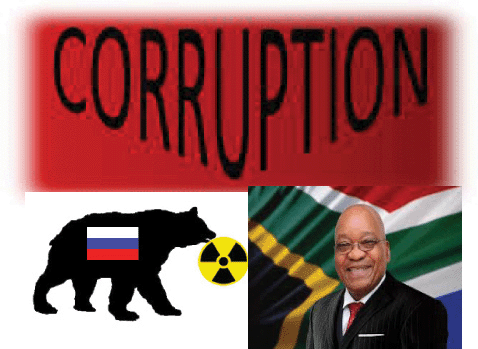
The nuclear power plan has proved controversial for a number of reasons: firstly, the amount of money involved in developing the programme is so huge it could damage the economy; secondly, the plans first came to light after it emerged that President Jacob Zuma had been in secret talks with Russia to do the work. While Russia and its agency Rosatom have denied that there have been any irregularities in their dealings with South Africa about the build programme, it’s hard not to be cynical about what has gone on behind-the-scenes. The state capture report released by former public protector Thuli Madonsela pointed to the widespread abuse of state funds and the involvement of foreign parties in the control of state entities. Power utility Eskom featured prominently in the report.
So far, there has been no concerted action to fully investigate the allegations. Koko replaces Brian Molefe, who resigned after disgracing himself with bizarre statements about a shebeen in Saxonwold in order to deny he was visiting the controversial Gupta family who live in the leafy suburb. But Koko is no saint; he has also had links to an irregular Eskom deal highlighted in the state capture report. The fact that the nuclear build programme is back on the table, and that there is a sense of urgency to get it moving, points to the worrying possibility that state capture doesn’t only extend across the public sector – it runs deep within institutions. – Jackie Cameron
Biz News, By Matthew Le Cordeur, 1 Dec 16
Cape Town – Despite a draft energy plan that sees nuclear energy being delayed by over a decade, government and its state-owned entities (SOE) are gearing up to release the request for proposal (RFP) for the 9.6 GW nuclear build programme.
Acting Eskom CEO Matshela Koko last month pledged to release the RFPs by the end of the year, and this could happen as soon as next week…….https://www.biznews.com/sa-investing/2016/12/01/nuclear-power-eskom-ceo-koko/
France’s aging nuclear reactors and EDF’s debt crisis
EDF faces a seemingly impossible financial equation. It has colossal debt of €37 billion; it must deal with the complex €2.5 billion takeover of Areva; and find the money to extend the life of its 58 reactors at costs estimated between €60 and €100 billion up to 2030. (8)
Meanwhile EDF has been accused by Greenpeace France of grossly underestimating the cost of nuclear electricity.
Greenpeace claimed that if EDF disclosed the true cost of running its fleet of reactors in France while financing two new ones in the UK, it would be declared bankrupt.
“In summary, the French nuclear fleet is at the end of its course, dilapidated and dotted with deficient parts. At the same time, the finances of EDF are in such a deplorable state that the company could soon join Areva in bankruptcy, and is in any case unable to properly maintain its reactors.”
NuClear News No 90 , 26 Nov 16 Problems discovered at Areva’s metal forge at Le Creusot have been growing over the past six months and are now even threatening to derail EDF’s takeover of Areva’s reactor business.
Last spring when Economy Minister Emmanuel Macron visited to tell the workers at Le Creusot that he had every confidence in the nuclear sector, despite the difficulties, 400 files which were being examined for suspected “anomalies” had to be hastily moved out of the meeting room. Now, six months later a crane has been moving prefabricated office buildings into position so that 6,000 records concerning nuclear components – 2.4 million pages – forged at Le Creusot over the last 60 years can be re-examined. Areva has had to accept that the original 400 suspicious files are just the tip of an iceberg and not the only ones containing “irregularities”. 50 people are now trawling through the paperwork and as many more are being recruited for a job that will take at least another eighteen months.
EDF’s CEO Jean-Bernard Lévy says if Le Creusot’s “problems prove insurmountable, the acquisition will not happen”. (1)
With potentially more than half of France’s 58 reactors affected by the “carbon segregation” problem the French nuclear watchdog, the Autorité de Sûreté Nucléaire (ASN) has ordered preventative measures to be taken immediately to ensure public safety. ASN confirmed that, as of late October, 20 reactors were offline and more could be shut down over coming weeks.
Questionable Materials and Documentation
At the heart of France’s nuclear crisis are two problems. One concerns the carbon content of the steel used in critical reactor components, steam heat exchangers, and other components manufactured or supplied by AREVA SA, the French state-owned nuclear engineering firm and global producer of nuclear reactors. The second problem concerns forged, falsified, or incomplete quality control reports about the critical components themselves. Excessive levels of carbon in the steel parts could make them more brittle and subject to sudden fracture or tearing under sustained high pressure, which is obviously unacceptable.
Steam generators from 18 reactors have carbon levels that are above the acceptable level. Some of these were forged at Le Creusot, but others were forged in Japan by JCFC, a subcontractor of Areva. Twelve reactors equipped with JCFC steel are still at a standstill and will be in December while inspections are carried out.
The massive outages are draining power from all over Europe. In the event of severe cold weather this winter, there could be blackouts. Worse, new questions continue to swirl about both the safety and integrity of EDF’s nuclear fleet, as well as the quality of some French- and Japanese-made components that EDF is using in various high-profile nuclear projects around the world.
In October EDF was forced to reduce its 2016 generation targets from 395–400 TWh to 380– 390 TWh, while estimates for nuclear output in 2017 have also been lowered to between 390 TWh and 400 TWh. For perspective, annual nuclear production averaged 417 TWh in the period 2005–2015.
Flamanville
The problem was originally discovered at the Flamanville EPR project in 2014. Since then an internal probe at Le Creusot where many of the components in question were manufactured, has uncovered new anomalies. AREVA is now reported to be reviewing all 9,000 manufacturing records at the forge dating back as far as 1943, including files from more than 6,000 nuclear components.
This autumn there have been almost weekly revelations resulting in plant shutdowns, extended outages, reduced generation, and lots more questions. According to ASN there are now a significant number of reactors offline, with more to be inspected in the next few weeks. “We are now finding carbon segregation problems from components coming from both Le Creusot and [the Kitakyushu-based Japan Casting & Forging Corp.] JCFC plant. As for now, there [are] 20 EDF reactors offline,” the official said, noting that the number will fluctuate as inspections take place.
The analyses performed by EDF thus far have found that since 2015 certain channel heads of the steam generators manufactured by Le Creusot and JCFC “contain a significant carbon concentration zone which could lead to lower than expected mechanical properties,” according to ASN. The Japan Times reports that the JCFC is now also under scrutiny by Japan’s Nuclear Regulation Authority.
Shaun Burnie for Greenpeace said “As a result of substandard manufacturing in Japan, citizens in France have been unknowingly exposed to the risk of catastrophic failure of critical reactor components which could result in a reactor core meltdown. Japanese-supplied steel is now at the centre of France’s unprecedented nuclear crisis the scale of which has never been seen in any country. All 12 reactors supplied by JCFC are either in forced shutdown or about to be. It lacks all credibility that the Japanese nuclear industry would claim that there are no implications for the safety of their own nuclear reactors. The steel production records released in France did not reveal the scale of excess carbon, which was only found after physical testing. There are currently no plans for such tests in Japan. That is wholly unacceptable. There are many urgent questions that need to be answered by the industry and the NRA, and with full public disclosure and transparency.” (2)
Energy traders and analysts warn that the French market needs to prepare for longer maintenance periods in coming years given the age of the nuclear fleet and the continuing design flaw revelations. With the average French reactor now more than 30 years old, equipment will need to be replaced more frequently, and increasingly stringent safety requirements will mean that components could be delayed, especially as ASN imposes additional checks. The safety inspections and other reviews “will lead in particular to extensions of certain planned outages,” EDF said in a press release.
Erring on the Side of Safety?
Despite the outages and findings from the carbon quality investigations, EDF continues to downplay the risk. “The safety margins are very large and the carbon content does not undermine integrity or security, even in the case of an accident,” an EDF spokesperson told Le Monde newspaper. But questions about quality control practices at Le Creusot continue to grow. Indeed, the greater the scrutiny, the more problems are being discovered. The number of components affected by irregularities and already installed in operating reactors increased from 33 known issues in April to 83 by the end of September. Startlingly, irregularities affecting just the Flamanville EPR project increased from two to 20 during the same period.
While EDF and AREVA are dealing with costly damage control, ASN and other agencies are erring on the side of caution. Indeed, the ASN representative said, “We take no risks. That is the rule. If we don’t know the dangers of the carbon segregation, then we must take the reactors offline until we know what the situation is and [can confirm that] it’s not dangerous.”
ASN revealed that AREVA has now identified at least 87 irregularities concerning EDF reactors in operation, including vessels, steam generators, and main primary system piping, plus the 20 issues for parts intended for Flamanville 3, and one more affecting a steam generator planned for installation in Gravelines 5. Inspectors have also found four irregularities affecting transport packaging for radioactive substances. ASN said that whatever the outcome of these investigations, the irregularities “reveal unacceptable practices.”
External Parties Push for Answers
After the discovery of anomalies in the composition of steel in certain zones of the vessel closure head and the vessel bottom head of the EPR reactor being built at Flamanville in 2014, an internal audit was carried out and released in April 2015, suggesting the existence of many more anomalies. These were initially downplayed by ASN and AREVA. But in September 2015 an independent evaluation conducted by Large and Associates for Greenpeace France really set the cat amongst the pigeons. “The nature of the flaw in the steel, an excess of carbon, reduces steel toughness and renders the components vulnerable to fast fracture,” said the report’s author, John Large. The Greenpeace report, “Amplified the questions ASN already had,” said an ASN representative.
12 reactors have been identified by ASN to have carbon problems in replacement steam generators forged by JCFC. In these reactors initial surface tests were followed by more invasive studies. The first reactors to enter scheduled refuelling outages for a more thorough examination were Tricastin 1 and 3. The early nondestructive inspection results for the JCFC bottom channel heads at these reactors revealed an alarming 0.39% level of carbon present, almost 100% greater than the maximum permissible level. That finding, with its associated reduction in material toughness, rendered the component vulnerable to fast fracture, reported Greenpeace in a late October update. ASN decided to order the shutdown of all but one of these reactors and these shutdowns will remain in force until EDF can demonstrate each reactor is safe to re-enter service.
Uncertainty Remains
At a French parliamentary hearing into the situation on October 25, ASN said it would need another year or two to examine the thousands of documents at the Le Creusot foundry and more anomalies and irregularities will probably be discovered. (3
As of late October 2016 ASN has confirmed the following:
- Six reactors have been granted approval to restart and are operating normally: Blayais 1, Chinon 1 and 2, Dampierre 2 and 4, and Saint-Laurent-des-Eaux B2.
- Seven reactos are in planned outages and have been, or are being, inspected. They are: Bugey 4, Civaux 2, Dampierre 3, Gravelines 2, Saint-Laurent-des-Eaux B1, and Tricastin 1 and 3. (4) The Times reports that the re-start of Civaux 2 and Dampierre 3 has been delayed until 31st December.
(5) · Five reactors have been ordered by ASN to be taken offline to conduct checks before 18th January 2017. They are: Civaux 1, Fessenheim 1, Gravelines 4, and Tricastin 2 and 4. (6)
- Three reactors are currently scheduled to remain unavailable throughout the winter months. They are: Bugey 5, Gravelines 5, and Paluel 2.
- One reactor has been ordered by ASN to shut down following the detection of an irregularity in the lower shell of the steam generator. That unit is Fessenheim 2.
- Incidentally, Paluel 2 has been offline since May 2015. Its maintenance period is continuing, following an incident on March 31, 2016, in which a 465-ton steam generator tipped over during removal. (7)
EDF’s Debts
EDF faces a seemingly impossible financial equation. It has colossal debt of €37 billion; it must deal with the complex €2.5 billion takeover of Areva; and find the money to extend the life of its 58 reactors at costs estimated between €60 and €100 billion up to 2030. (8)
Meanwhile EDF has been accused by Greenpeace France of grossly underestimating the cost of nuclear electricity.
Greenpeace claimed that if EDF disclosed the true cost of running its fleet of reactors in France while financing two new ones in the UK, it would be declared bankrupt. Greenpeace commissioned an audit by AlphaValue, the equity research company. The French government has agreed to inject €3 billion into the group this year and has renounced dividend payments until next year. Shares in EDF, 85% of which are owned by the French state, have lost almost a third of their value in the past year and the company is no longer listed on the Paris blue-chip index.
The AlphaValue report described EDF as an “uncompetitive firm – incapable of reacting rapidly and efficiently to the variations in electricity needs and the changes created by the liberalisation of European markets”. It said that EDF’s rivals had written down the value of their nuclear plants because of the move to renewable energy and the fall in electricity prices and that EDF had failed to follow suit. Juan Camilo Rodriguez, author of the report, said the company might have to close 17 of its 58 French reactors to meet the government’s requirement that nuclear power should provide 50 per cent of the nation’s electricity in 2025, down from 75 per cent now.
“The provisions to safeguard the burden of financing the decommissioning of the French reactors are far from sufficient. [If 17 are closed], the group should increase its provisions by more than €20 billion.” Mr Rodriguez said the cost of handling nuclear waste added at least €33.5 billion to that figure. “Whatever scenario is retained, an adjustment of the nuclear provisions . . . would lead to the bankruptcy of EDF from an accountancy point of view,” he added. The report said that EDF would need to find a further €165 billion during the next decade to finance projects such as Hinkley Point and the renovation of reactors in France. EDF says it will spend €51 billion renovating its reactors and £12 billion on Hinkley Point. A spokesman for EDF accused AlphaValue of making erroneous calculations that failed to take account of long-term electricity price movements and differences between France and other European markets. (9) Greenpeace filed a complaint against EDF and its CEO, Jean-Bernard Lévy, for “stock trading offences” at the end of November and EDF responded by suing the group for making “false allegations”.
Greenpeace has asked the public prosecutor “to open a preliminary investigation or to appoint an investigating judge”, saying that “shareholders, investors but also French citizens are being misled by EDF and its CEO”. (10)
According to Stéphane L’homme, Directeur de l’Observatoire du nucléaire: “In summary, the French nuclear fleet is at the end of its course, dilapidated and dotted with deficient parts. At the same time, the finances of EDF are in such a deplorable state that the company could soon join Areva in bankruptcy, and is in any case unable to properly maintain its reactors.” http://www.no2nuclearpower.org.uk/nuclearnews/NuClearNewsNo90.pdf
Nuclear contractors settle with USA Justice Dept over allegations of improper billing.
United States Settles Lawsuit Against Energy Department Contractors for Knowingly Mischarging Costs on Contract at Nuclear Waste Treatment Plant https://www.justice.gov/opa/pr/united-states-settles-lawsuit-against-energy-department-contractors-knowingly-mischarging, 24 Nov 16,
The Justice Department announced today that Bechtel National Inc., Bechtel Corp., URS Corp. (predecessor in interest to AECOM Global II LLC) and URS Energy and Construction Inc. (now known as AECOM Energy and Construction Inc.) have agreed to pay $125 million to resolve allegations under the False Claims Act that they made false statements and claims to the Department of Energy (DOE) by charging DOE for deficient nuclear quality materials, services, and testing that was provided at the Waste Treatment Plant (WTP) at DOE’s Hanford Site near Richland, Washington. The settlement also resolves allegations that Bechtel National Inc. and Bechtel Corp. improperly used federal contract funds to pay for a comprehensive, multi-year lobbying campaign of Congress and other federal officials for continued funding at the WTP. Bechtel Corp. and Bechtel National Inc. are Nevada corporations. URS Corp. is headquartered in California, and URS Energy & Construction Inc. is headquartered in Colorado.
“The money allocated by Congress for the Waste Treatment Plant is intended to fund the Department of Energy’s important mission to clean up the contaminated Hanford nuclear site, and this mission is undermined if funds are wasted on goods or services that are not nuclear compliant or to further lobbying activities,” said Principal Deputy Assistant Attorney General Benjamin C. Mizer, head of the Justice Department’s Civil Division. “This settlement demonstrates that the Justice Department will work to ensure that public funds are used for the important purposes for which they are intended.”
“The DOE Office of Inspector General is committed to ensuring the integrity of Departmental contracts and financial expenditures,” said Acting Inspector General Rickey R. Hass. “We will continue to steadfastly investigate allegations of fraudulent diversion of tax dollars throughout DOE programs and appreciate the support of DOJ attorneys in these matters.”
Between 2002 and the present, DOE has paid billions of dollars to the defendants to design and build the WTP, which will be used to treat dangerous radioactive wastes that are currently stored at DOE’s Hanford Site. The contract required materials, testing and services to meet certain nuclear quality standards. The United States alleged that the defendants violated the False Claims Act by charging the government the cost of complying with these standards when they failed to do so. In particular, the United States alleged that the defendants improperly billed the government for materials and services from vendors that did not meet quality control requirements, for piping and waste vessels that did not meet quality standards and for testing from vendors who did not have compliant quality programs. The United States also alleged that Bechtel National Inc. and Bechtel Corp. improperly claimed and received government funding for lobbying activities in violation of the Byrd Amendment, and applicable contractual and regulatory requirements, all of which prohibit the use of federal funds for lobbying activities.
The allegations resolved by this settlement were initially brought in a lawsuit filed under the qui tam, or whistleblower, provisions of the False Claims Act by Gary Brunson, Donna Busche, and Walter Tamosaitis, who worked on the WTP project. The False Claims Act permits private parties to sue on behalf of the United States when they believe that a party has submitted false claims for government funds, and to receive a share of any recovery. The Act also permits the government to intervene in such a lawsuit, as it did in part in this case. The whistleblowers’ reward has not yet been determined.
This matter was handled by the Civil Division’s Commercial Litigation Branch, the U.S. Attorney’s Office for the Eastern District of Washington, the DOE Office of the Inspector General and the FBI.
The claims asserted against defendants are allegations only, and there has been no determination of liability. The case is United States ex rel. Brunson, Busche, and Tamosaitis v. Bechtel National, Inc., Bechtel Corp., URS Corp., and URS Energy & Construction, Inc., Case No. 2:13-cv-05013-EFS (E.D. Wash.).
Killings of climate activists
The deadly business of grassroots climate activism New Internationalist, 20 Nov 16 A recent report found that 2015 was the deadliest year on record for environmental activists, raising concerns for those who continue to fight on the frontline, writes Liam Turner. It’s 2015, and Honduran campaigner Berta Cáceres has just won the Goldman Environmental Prize for grassroots environmentalism in South and Central America. The crowd claps as she walks up to the podium in her silver-sequined dress, a slight smile on her face. Then the room goes quiet, and Berta adopts a much more serious tone.
She speaks of her people, the Lenca, and their constant battle to protect their land. She speaks of how the world must break free from the grasp of ‘rapacious capitalism, racism and patriarchy’ that will ultimately lead to its self-destruction. She speaks of how her people’s sacrifice is not just for them, but for the world and everyone in it. She ends by dedicating the award to the martyrs who have given their lives in the struggle to defend our natural resources.
Less than a year later, armed men would break into her house in the middle of the night and murder her in cold blood, making her the latest to die for her cause. She was 44.
The Truth Behind the Paris Climate Deal
Climate activism has always been risky. Not only are there hazards that come from protesting at large, industrial sites, there is also the danger that comes from conflict with people whose interests lie with extractivist transnational companies. Ultimately, those who make a stand put themselves in harm’s way one way or another.
In fact, there’s evidence to suggest that climate activism is now more dangerous than ever. In June, a report by Global Witness revealed that 2015 was the deadliest year for environmental activists. It had recorded a total of 186 killings across 16 different countries, an increase of 59 per cent from the previous year. Global Witness also believes this number should actually be much higher, as a lack of reliable data meant that they weren’t able to record all fatal incidents.
An increasing threat
In a postscript to the Global Witness report – entitled ‘On Dangerous Ground’ – campaign leader Billy Kyte said: ‘As demand for products like minerals, timber and palm oil continues, governments, companies and criminal gangs are seizing land in defiance of the people who live on it. Communities that take a stand are increasingly finding themselves in the firing line of companies’ private security, state forces and a thriving market for contract killers.’
The report revealed that activists in Brazil were the worst hit, with a total of 50 recorded deaths. The Philippines was the next highest, with 36 deaths……… https://newint.org/features/web-exclusive/2016/11/15/the-deadly-business-of-grassroots-climate-activism/
Iran arrests 12 members of nuclear negotiating team for espionage

Report: 12 members of nuclear negotiating team arrested by Iran for espionage, Jerusalem Post, 18 Nov 16 At least a dozen senior officials who were part of the negotiating team that conducted talks with the west regarding the Islamic Republic’s nuclear program were arrested by Iranian authorities on espionage charges, Channel 2 citing an Iranian member of parliament reported Friday.
Iranian MP Husein Al Haj said earlier this week that some of those arrested had dual citizenship but he did not disclose their identities or nationalities.
Iranian authorities earlier in the year had carried out a similar arrest against another member of the negotiating unit, claiming the suspect was a “spy who had infiltrated the nuclear team.”
The suspect was later released on bail but was still under investigation at the time, former Iranian minister of intelligence Gholamhossein Mohseni Ejei said at a news conference on August 28…..http://www.jpost.com/Middle-East/Iran-News/Iranians-officials-arrested-for-spying-473021
India does not regard the “Termination” clause as binding – nuclear deal with Japan

Termination clause in nuclear deal with Japan not binding
on India, insists govt, First Post, 13 Nov 16 New Delhi: The just-signed historic civil nuclear deal with Japan has a “termination” clause which the government here insists is not binding on India but merely records the “views” of the Japanese side considering its “special sensitivities”.
The government insisted that India has made “no additional commitments” over the similar agreements signed with the US and other countries.
In the Nuclear Cooperation Agreement, signed in the presence of Prime Minister Narendra Modi and his Japanese counterpart Shinzo Abe in Tokyo on Friday, there is a note on ‘Views and Understanding’ wherein the Japanese side has cited India’s September 2008 declaration of unilateral moratorium on atomic tests and said if this commitment is violated, the deal will terminate.
Indian government holds that this is merely recording of the views of the two sides.
“The termination clause is there in other NCAs (nuclear cooperation agreements) we have signed, including with the US (Article 14). However the circumstances triggering a possible termination are never sharply defined. Consideration also has to be given to mitigating factors,” a source here said.
“That note is simply a record by the negotiators of respective views on certain issues. It is not the NCA which is what is binding,” the source said.
The sources added that given Japan’s special sensitivities as the only nation to have suffered a nuclear attack, “it was felt that their views should be recorded in a separate Note. The Note is a record by the negotiators of respective views on certain issues.
“The termination clause is there in other NCAs (nuclear cooperation agreements) we have signed, including with the US (Article 14). However the circumstances triggering a possible termination are never sharply defined. Consideration also has to be given to mitigating factors,” a source here said.
“That note is simply a record by the negotiators of respective views on certain issues. It is not the NCA which is what is binding,” the source said.
The sources added that given Japan’s special sensitivities as the only nation to have suffered a nuclear attack, “it was felt that their views should be recorded in a separate Note. The Note is a record by the negotiators of respective views on certain issues………
Japan has made a major exception by signing the atomic cooperation agreement with India, despite it being non-signatory to the Nuclear Non-Proliferation Treaty (NPT)…….. http://www.firstpost.com/india/termination-clause-in-nuclear-deal-with-japan-not-binding-on-india-insists-govt-3103404.html
Vested interests and corruption in South Africa’s nuclear procurement
Nuclear deals could be ‘captured’ http://www.timeslive.co.za/thetimes/2016/11/07/Nuclear-deals-could-be-captured JAN-JAN JOUBERT | 07 November, 2016 Environmentalists have warned that proposed nuclear building programmes could be “captured” if Eskom continues to be the procurement agency for the project, which is expected to cost more than R1-trillion. Environmental action group Greenpeace said former public protector Thuli Madonsela’s report on state capture released last week confirmed that vested interests and corruption in the energy sector were central to the energy choices made in South Africa.
“It is no coincidence that Brian Molefe is a key figure in the State of Capture report, and that he and the Eskom board have been running an anti-renewable energy campaign, focused instead on pushing for expensive and unnecessary nuclear energy,” said Greenpeace spokesman Helen Dena.
“This undermines the prioritisation of renewable energy, which would enhance South Africa’s energy future, strengthen the economy and deliver affordable, safe, clean electricity,” said Dena.
DA MP Gordon Mackay said: : “In light of the government’s own policy documents, preference for nuclear is irrational in law.”
-
Archives
- April 2026 (220)
- March 2026 (251)
- February 2026 (268)
- January 2026 (308)
- December 2025 (358)
- November 2025 (359)
- October 2025 (376)
- September 2025 (257)
- August 2025 (319)
- July 2025 (230)
- June 2025 (348)
- May 2025 (261)
-
Categories
- 1
- 1 NUCLEAR ISSUES
- business and costs
- climate change
- culture and arts
- ENERGY
- environment
- health
- history
- indigenous issues
- Legal
- marketing of nuclear
- media
- opposition to nuclear
- PERSONAL STORIES
- politics
- politics international
- Religion and ethics
- safety
- secrets,lies and civil liberties
- spinbuster
- technology
- Uranium
- wastes
- weapons and war
- Women
- 2 WORLD
- ACTION
- AFRICA
- Atrocities
- AUSTRALIA
- Christina's notes
- Christina's themes
- culture and arts
- Events
- Fuk 2022
- Fuk 2023
- Fukushima 2017
- Fukushima 2018
- fukushima 2019
- Fukushima 2020
- Fukushima 2021
- general
- global warming
- Humour (God we need it)
- Nuclear
- RARE EARTHS
- Reference
- resources – print
- Resources -audiovicual
- Weekly Newsletter
- World
- World Nuclear
- YouTube
-
RSS
Entries RSS
Comments RSS